To Outpace China’s
Exports
1*Dr. Manika Singla - Project Fellow
 Across developing nations there is an ongoing debate and emerging
concern about the:
 Threat and opportunity in relation to the rise of China
 And the consequent intensification of competition in labour intensive
manufactures
 The debate is even more pertinent in case of India, as China and India are
not just similar in population size but also with respect to factor
endowments.
 It is important therefore,
 To explore the structure of comparative advantage of India and China
 And the extent to which the two economies compete with each other in the
global market for exports in manufacturing/value added sector
 This paper makes an attempt to develop some insights on the subject.
2*Dr. Manika Singla - Project Fellow
 The dynamics of Chinese comparative advantage has been
analyzed in several studies, prominent among these are:
 Hinloopen and Marrewijk (2004) study & Albaladejo
(2003):
 Aspect of threat/ opportunity in the context of China's
economic relations with South East and East Asia
 Lall and Weiss (2004):
 Chinese competitive threat to the Latin American economies
 No Attempt: Competitiveness that Chinese exports may pose
for Indian manufacturers and exporters in the global
economy.
3*Dr. Manika Singla - Project Fellow
a. What is the fastest route to economic
development?
b. Why India lagged in performance from China?
c. Can India surpass China?
4*Dr. Manika Singla - Project Fellow
Assumption:
 SME(Small and Medium Enterprises) is a primary indicator
of country’s future economic expansion
 As it can effectively disseminate economic benefits to larger
section of society by engaging even low skill laborers
Limitation:
 Non-economic factors such as:
a) Human Rights
b) Democratic Empowerment
5*Dr. Manika Singla - Project Fellow
Highlights:
 Comparative Advantage (China):
a) Production specific
b) Macroeconomic factor’s
 SWOT Analysis (India)
Methodology:
 Time Series Line Graphs & BAR Diagrams (2000-2010)
a) India's & China's export intensity in international markets
b) India’s potential to capture manufacturing export segment
Research Instrument:
 Secondary Data Collection: Newspapers, Journals, Working
Papers, Web Data
6*Dr. Manika Singla - Project Fellow
 Part One: Comparative Contributions To GDP of India &
China (Comparative Analysis)
 Part Two: Factors for China’s Growth Model
 Part Three: Emerging Business Avenues For Indian
Exporters & India’s Forecast
 Part Four: Policy Implications & Manufacturing Strategy
for India (SWOT Analysis)
7*Dr. Manika Singla - Project Fellow
To GDP of India &
China
8*Dr. Manika Singla - Project Fellow
Figure 1 Figure 2
9
0%
10%
20%
30%
40%
50%
60%
70%
80%
90%
100%
2000
2002
2004
2006
2008
2010
12001400
1900
26004320
5870
390
450
620
900 1490
0
250
325
590
980 1420
0
25003300
5900980014300
0
China
Goods Exports
(BillionUSD)
Merchandise
exports
(BillionUSD)
Manufacturing
Value Added
(BillionUSD)
GDP (BillionUSD)
0%
10%
20%
30%
40%
50%
60%
70%
80%
90%
100%
480 510 700
910 1160
1730
68 72
102
138
170
0
440 500 780
120
179
042 52 78
124 188
0
India
Goods Exports
(BillionUSD)
Merchandise
exports
(BillionUSD)
Manufacturing
Value Added
(BillionUSD)
GDP
(BillionUSD)
*Dr. Manika Singla - Project Fellow
As per World Bank data indicated in figures 1 & 2:
 GDP for China was reported at 5870 USD and for India at
1730 USD in 2010 indicating an almost 70.5% increase for
which:
 Exports including merchandise exports and goods exports as
well as manufacturing value addition plays a major role.
Meaning:
 Demand for domestic production of China is highly driven
by merchandise and value added exports
10*Dr. Manika Singla - Project Fellow
Fig 1.1 Fig 1.2
11
3.892
1.612
1.812
5.308
3.368
2.114
12.888
5.318
81.784
0 50 100
Europe & Central…
Middle East &…
Sub-Saharan Africa
East Asia & Pacific
Latin America &…
South Asia
Economies…
Economies Within…
High-Income…
China (% of total merchandise
exports)
Average
2.862
3.642
5.422
10.254
2.62
5.082
24.822
5.078
68.604
0 20 40 60 80
Europe & Central Asia
Middle East &…
Sub-Saharan Africa
East Asia & Pacific
Latin America & the…
South Asia
Economies Outside…
Economies Within…
High-Income…
India (% of total merchandise exports)
Average
*Dr. Manika Singla - Project Fellow
 Since 2000, India’s market for merchandise exports in high
income economies and Europe and Central Asia remained
unexplored in comparison to China.
 Hence, India can think of exploring the markets for its
merchandise exports in Latin America & the Caribbean,
Europe & Central Asia, Developing Economies within Region
and High-Income Economies in the coming future.
12*Dr. Manika Singla - Project Fellow
Fig 2.1 Fig 2.2
13
71.036
1.388
5.24
10.91
9.642
0 20 40 60 80
Manufactures Exports
Agricultural Raw Materials
Exports
Ores and Metals Exports
Food Exports
Fuel Exports
% of Merchandise Exports of India
average
90.918
0.664
1.886
3.822
2.438
0 50 100
Manufactures
Exports
Agricultural Raw
Materials…
Ores and Metals
Exports
Food Exports
Fuel Exports
% of Merchandise Exports of
China
average
*Dr. Manika Singla - Project Fellow
 The world bank statistics indicates that India has succeeded in
competing with China in other segments of merchandise
exports except the segment of manufactured exports.
 In other words, China has gained comparative advantage in
manufacturers exports in comparison to India.
 This demonstrates that India needs to find its potential in
labour intensive manufacturing in order to compete in global
markets.
14*Dr. Manika Singla - Project Fellow
Fig 3.1 Fig 3.2
15
2.24
4.05
2.5
92.425
17.68333
333
0 50 100
Textiles and
Clothing
Food; Beverages
and Tobacco
Machinery &
Transport…
Other
Manufacturing
Chemicals
% of Value Added in Manufacturing in
China
average
9.736666
667
10.9
19.82666
667
41.6
17.66666
667
0 10 20 30 40 50
Textiles and Clothing
Food; Beverages and
Tobacco
Machinery & Transport
Equipment
Other Manufacturing
Chemicals
% of value added in Manufacturing in
India
average
*Dr. Manika Singla - Project Fellow
 Value added contribution of China in GDP beats India
towards industries belonging to other manufacturing
 Leaving other industries belonging to chemicals,
machinery, food and textiles in which India has attained a
much better position.
 That means there’s an opportunity for Indians to explore
new areas of manufacturing such as value added segments
(food processing), indigenous production (handicrafts),
engineering goods, biotechnology, organic farming, auto
parts etc.
16*Dr. Manika Singla - Project Fellow
China’s Growth Model
17*Dr. Manika Singla - Project Fellow
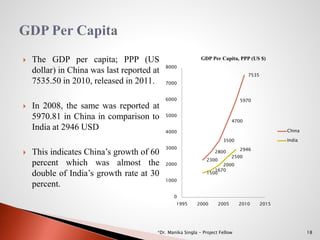
 The GDP per capita; PPP (US
dollar) in China was last reported at
7535.50 in 2010, released in 2011.
 In 2008, the same was reported at
5970.81 in China in comparison to
India at 2946 USD
 This indicates China’s growth of 60
percent which was almost the
double of India’s growth rate at 30
percent.
18
2300
2800
3500
4700
5970
7535
1500
1670
2000
2500
2946
0
1000
2000
3000
4000
5000
6000
7000
8000
1995 2000 2005 2010 2015
GDP Per Capita, PPP (US $)
China
India
*Dr. Manika Singla - Project Fellow
Macro Economic Factors:
1. Political Influence of China.
2. Liberalization of the Market.
3. Foreign Direct Investment.
4. Export Competitiveness.
5. Cross- Currency Valuation.
6. Logistics Performance Index.
7. Manipulation of Intellectual
Property rights.
8. Special Economic Zones (SEZs).
7. Infrastructure Development.
8. Technological Developments.
9. Govt. Incentives to
Manufacturing Sectors.
10. Capital Markets.
11. Special Support to State
Owned Enterprises.
12. Industrial Production.
13. Strategic Locations.
19*Dr. Manika Singla - Project Fellow
Production Specific Factors:
1. Vendor Base Development.
2. Low Cost Business Environment:-
 Labor Productivity & Input Costs.
 Capital & Borrowing Cost.
3. Company Management Capabilities.
20*Dr. Manika Singla - Project Fellow
For Indian Exports
21*Dr. Manika Singla - Project Fellow
1. Indian Jewelry.
2. Textiles Industry.
3. Tourism.
4. Automobile.
5. Social Ventures
6. Software.
7. Engineering goods.
8. Franchising.
9. Education & Training.
10. Food Processing.
11. Corporate Demands.
12. Ayurveda & Traditional
Medicine.
13. Organic Farming.
14. Media.
15. Floriculture.
16. Toys.
17. Healthcare Sector.
18. Biotechnology.
19. Energy Solutions.
20. Recycling Business.
22*Dr. Manika Singla - Project Fellow
 June 2010 Deloitte's study ranked top five countries in
manufacturing competitiveness as: China, India, Korea, the
U.S. and Brazil
 BRIC concept: Russia and Brazil will be the major exporter
of raw materials while China and India with their low costs
and other numerous advantages will export the manufactured
goods and services.
 The drive behind India’s higher growth rates will be three
things called as DRG factors:
1) Demographics.
2) Reforms.
3) Globalization.
23*Dr. Manika Singla - Project Fellow
 Global trend to manufacture and source products in low-cost countries
(LCCs).
 India can — and should — aspire to become one of the three largest
exporters of manufactured goods among LCCs by 2015.
 For this, India has to increase its share in world manufacturing trade from
0.8% to 3.5% by 2015 in order to increase its :
 GDP growth rate.
 Jobs in different segments of manufacturing sector such as:
1. Apparel.
2. Auto components.
3. Specialty chemicals.
4. Electrical and electronic products etc.
24*Dr. Manika Singla - Project Fellow
To outpace Chinese
exports from domestic
and global markets
25*Dr. Manika Singla - Project Fellow
STRENGTHS
 English Proficiency
 Government Support
 Cost Advantages
 Strong Tertiary Education
 Process Quality Focus
 Skilled Workforce / Demography
 Entrepreneurship
 Reasonable Technical Innovations
 Reverse Brain Drain
 Existing Long Term Relationship
WEAKNESSES
 Positioning & Brand Management
 Infrastructure
 Cultural Differences
 Sales & Marketing
 Legal System Bureaucracy
 Poor Globalization Skill
26*Dr. Manika Singla - Project Fellow
OPPURTUNITIES
 Creation of global brands
 Resource Based Sectors
 Chinese domestic & export
market
 Leverage relationship in
Middle East markets
 Indian Domestic Market
Growth
 Exploring New Segments of
Manufacturing
THREATS
 Internal Competition for
Resources
 Over promise / Under
Delivery
 Regional Geo-Political
Uncertainty
 Rising Labor Cost
 Competition from Other
Countries
 Corruption / Piracy / Trust
27*Dr. Manika Singla - Project Fellow
1. Infrastructure development.
2. Increase in domestic savings & investments.
3. Prioritizing labor law reforms.
4. Overcome from internal security threat.
5. Focus on primary & secondary education.
 THE GOVERNMENT NEEDS TO REMOVE FOUR BARRIERS
TO EXPORT-LED GROWTH:
1. Stimulate domestic demand by reducing indirect taxes and import duties
2. De bottleneck ports and accelerate power reforms
3. Encourage the development of several manufacturing clusters
4. Accelerate labor reforms and facilitate skill development
28*Dr. Manika Singla - Project Fellow
 The dumping of “one hour technology” inferior products(fans, toys,
watches, mobile etc) has become threat to Indian industry and is the one of
the main cause of dampening labour intensive export market.
 As China followed a path of Capitalism through FDI, India also need to
have a solid political foresight and realistic economic strategy to face the
internal challenges and widen its scope of manufacturing base with a view
to make its place in international markets.
Strategy for India:
A Strategy to make India a manufacturing hub in global competitive export
segments through - harnessing the global opportunities and managing the
key economic resources effectively, is prerequisite for economic
development.
29*Dr. Manika Singla - Project Fellow
India needs to roll out innovative and effective economic plans like:
 Agriculture – Be a Food Base for the World
Producing the value added food, medicinal plant, aromatic oils & bio
material for the global market.
 Manufacturing – Realizing the existing labor cost advantage & labor
flexibility
Reforming the tax structure and labor laws
Supporting with modern infrastructure
 Infocom – Capture huge market potential & natural advantage of huge
talent pool (Technologically Savvy and English- Friendly)
Offering cost benefits of the technology to customers
30*Dr. Manika Singla - Project Fellow
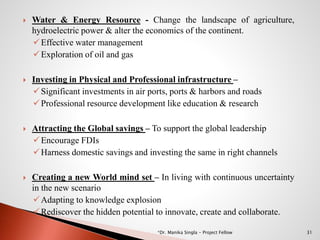
 Water & Energy Resource - Change the landscape of agriculture,
hydroelectric power & alter the economics of the continent.
Effective water management
Exploration of oil and gas
 Investing in Physical and Professional infrastructure –
Significant investments in air ports, ports & harbors and roads
Professional resource development like education & research
 Attracting the Global savings – To support the global leadership
Encourage FDIs
Harness domestic savings and investing the same in right channels
 Creating a new World mind set – In living with continuous uncertainty
in the new scenario
Adapting to knowledge explosion
Rediscover the hidden potential to innovate, create and collaborate.
31*Dr. Manika Singla - Project Fellow
Answers to Research
Questions
32*Dr. Manika Singla - Project Fellow
 An FDI driven Approach
 Development of Homegrown Entrepreneurship
 Efficient Banking & Transparent Capital Markets
 Stronger Infrastructure to support Private Enterprise
 Fuller Utilization of Resources
 Organic Growth
 Absorption of New Technologies from Abroad
33*Dr. Manika Singla - Project Fellow
 Uncertainty in the markets
 Inappropriate receptors (production organizations) to absorb foreign
technology
 Poor quality of the industrial partner having trading orientation instead of
industrial orientation.
 Inability to mobilize the resources effectively
 Less developed employment-intensive manufacturing
 Weaknesses in infrastructure and administration
 Labor market rules
 Poor regulatory quality and government ineffectiveness
 Weak banking system
 Commercial banks are still largely state-owned
 Political resistance to selling the state banks or allowing foreign banks to
enter the Indian market
34*Dr. Manika Singla - Project Fellow
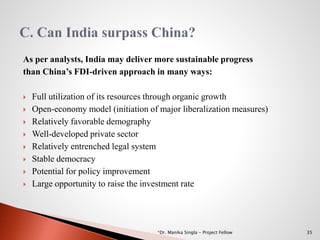
As per analysts, India may deliver more sustainable progress
than China’s FDI-driven approach in many ways:
 Full utilization of its resources through organic growth
 Open-economy model (initiation of major liberalization measures)
 Relatively favorable demography
 Well-developed private sector
 Relatively entrenched legal system
 Stable democracy
 Potential for policy improvement
 Large opportunity to raise the investment rate
35*Dr. Manika Singla - Project Fellow
 Dimaranan Betina, Lanchovichina Elena, and Martinr Will, 2007, “China,
India, and the Future of the World Economy”, Policy Research Working
Paper 4043, The World Bank Development Research Group, August.
 Wilson Dominic and Purushothaman Roopa, 2003, “Dreaming with
BRICs: The Path 2050”, Goldman Sachs, Global Economics Paper no:
99, October.
 Dooley, Michael, David Folkerts-Landau, Shunming Zhang, “Inequality
Change in China and (Hokou) Labour Mobility Restrictions,” NBER
Working Paper No. W10649, July 2004.
 Eichengreen, Barry, Yeongseop Rhee, Hui Tong, “The Impact of China
on The Exports of Other Asian Countries,” NBER Working Paper No.
W10727, September 2004.
 Hertel, Thomas and Fan Zhai (2004)."Labour Market Distortions,
Rural-Urban Inequality and the Opening of China's Economy" World
Bank Policy Research Working Paper 3455, November 2004
36*Dr. Manika Singla - Project Fellow
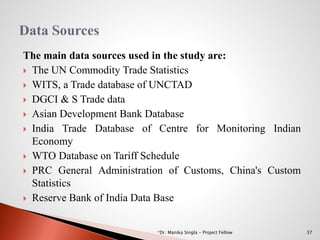
The main data sources used in the study are:
 The UN Commodity Trade Statistics
 WITS, a Trade database of UNCTAD
 DGCI & S Trade data
 Asian Development Bank Database
 India Trade Database of Centre for Monitoring Indian
Economy
 WTO Database on Tariff Schedule
 PRC General Administration of Customs, China's Custom
Statistics
 Reserve Bank of India Data Base
37*Dr. Manika Singla - Project Fellow
38
Dr. Manika Singla
(Project Fellow – UGC Major Project)
Leave the Comments Below
*Dr. Manika Singla - Project Fellow

ppt-export challenge

  • 1.
    To Outpace China’s Exports 1*Dr.Manika Singla - Project Fellow
  • 2.
     Across developingnations there is an ongoing debate and emerging concern about the:  Threat and opportunity in relation to the rise of China  And the consequent intensification of competition in labour intensive manufactures  The debate is even more pertinent in case of India, as China and India are not just similar in population size but also with respect to factor endowments.  It is important therefore,  To explore the structure of comparative advantage of India and China  And the extent to which the two economies compete with each other in the global market for exports in manufacturing/value added sector  This paper makes an attempt to develop some insights on the subject. 2*Dr. Manika Singla - Project Fellow
  • 3.
     The dynamicsof Chinese comparative advantage has been analyzed in several studies, prominent among these are:  Hinloopen and Marrewijk (2004) study & Albaladejo (2003):  Aspect of threat/ opportunity in the context of China's economic relations with South East and East Asia  Lall and Weiss (2004):  Chinese competitive threat to the Latin American economies  No Attempt: Competitiveness that Chinese exports may pose for Indian manufacturers and exporters in the global economy. 3*Dr. Manika Singla - Project Fellow
  • 4.
    a. What isthe fastest route to economic development? b. Why India lagged in performance from China? c. Can India surpass China? 4*Dr. Manika Singla - Project Fellow
  • 5.
    Assumption:  SME(Small andMedium Enterprises) is a primary indicator of country’s future economic expansion  As it can effectively disseminate economic benefits to larger section of society by engaging even low skill laborers Limitation:  Non-economic factors such as: a) Human Rights b) Democratic Empowerment 5*Dr. Manika Singla - Project Fellow
  • 6.
    Highlights:  Comparative Advantage(China): a) Production specific b) Macroeconomic factor’s  SWOT Analysis (India) Methodology:  Time Series Line Graphs & BAR Diagrams (2000-2010) a) India's & China's export intensity in international markets b) India’s potential to capture manufacturing export segment Research Instrument:  Secondary Data Collection: Newspapers, Journals, Working Papers, Web Data 6*Dr. Manika Singla - Project Fellow
  • 7.
     Part One:Comparative Contributions To GDP of India & China (Comparative Analysis)  Part Two: Factors for China’s Growth Model  Part Three: Emerging Business Avenues For Indian Exporters & India’s Forecast  Part Four: Policy Implications & Manufacturing Strategy for India (SWOT Analysis) 7*Dr. Manika Singla - Project Fellow
  • 8.
    To GDP ofIndia & China 8*Dr. Manika Singla - Project Fellow
  • 9.
    Figure 1 Figure2 9 0% 10% 20% 30% 40% 50% 60% 70% 80% 90% 100% 2000 2002 2004 2006 2008 2010 12001400 1900 26004320 5870 390 450 620 900 1490 0 250 325 590 980 1420 0 25003300 5900980014300 0 China Goods Exports (BillionUSD) Merchandise exports (BillionUSD) Manufacturing Value Added (BillionUSD) GDP (BillionUSD) 0% 10% 20% 30% 40% 50% 60% 70% 80% 90% 100% 480 510 700 910 1160 1730 68 72 102 138 170 0 440 500 780 120 179 042 52 78 124 188 0 India Goods Exports (BillionUSD) Merchandise exports (BillionUSD) Manufacturing Value Added (BillionUSD) GDP (BillionUSD) *Dr. Manika Singla - Project Fellow
  • 10.
    As per WorldBank data indicated in figures 1 & 2:  GDP for China was reported at 5870 USD and for India at 1730 USD in 2010 indicating an almost 70.5% increase for which:  Exports including merchandise exports and goods exports as well as manufacturing value addition plays a major role. Meaning:  Demand for domestic production of China is highly driven by merchandise and value added exports 10*Dr. Manika Singla - Project Fellow
  • 11.
    Fig 1.1 Fig1.2 11 3.892 1.612 1.812 5.308 3.368 2.114 12.888 5.318 81.784 0 50 100 Europe & Central… Middle East &… Sub-Saharan Africa East Asia & Pacific Latin America &… South Asia Economies… Economies Within… High-Income… China (% of total merchandise exports) Average 2.862 3.642 5.422 10.254 2.62 5.082 24.822 5.078 68.604 0 20 40 60 80 Europe & Central Asia Middle East &… Sub-Saharan Africa East Asia & Pacific Latin America & the… South Asia Economies Outside… Economies Within… High-Income… India (% of total merchandise exports) Average *Dr. Manika Singla - Project Fellow
  • 12.
     Since 2000,India’s market for merchandise exports in high income economies and Europe and Central Asia remained unexplored in comparison to China.  Hence, India can think of exploring the markets for its merchandise exports in Latin America & the Caribbean, Europe & Central Asia, Developing Economies within Region and High-Income Economies in the coming future. 12*Dr. Manika Singla - Project Fellow
  • 13.
    Fig 2.1 Fig2.2 13 71.036 1.388 5.24 10.91 9.642 0 20 40 60 80 Manufactures Exports Agricultural Raw Materials Exports Ores and Metals Exports Food Exports Fuel Exports % of Merchandise Exports of India average 90.918 0.664 1.886 3.822 2.438 0 50 100 Manufactures Exports Agricultural Raw Materials… Ores and Metals Exports Food Exports Fuel Exports % of Merchandise Exports of China average *Dr. Manika Singla - Project Fellow
  • 14.
     The worldbank statistics indicates that India has succeeded in competing with China in other segments of merchandise exports except the segment of manufactured exports.  In other words, China has gained comparative advantage in manufacturers exports in comparison to India.  This demonstrates that India needs to find its potential in labour intensive manufacturing in order to compete in global markets. 14*Dr. Manika Singla - Project Fellow
  • 15.
    Fig 3.1 Fig3.2 15 2.24 4.05 2.5 92.425 17.68333 333 0 50 100 Textiles and Clothing Food; Beverages and Tobacco Machinery & Transport… Other Manufacturing Chemicals % of Value Added in Manufacturing in China average 9.736666 667 10.9 19.82666 667 41.6 17.66666 667 0 10 20 30 40 50 Textiles and Clothing Food; Beverages and Tobacco Machinery & Transport Equipment Other Manufacturing Chemicals % of value added in Manufacturing in India average *Dr. Manika Singla - Project Fellow
  • 16.
     Value addedcontribution of China in GDP beats India towards industries belonging to other manufacturing  Leaving other industries belonging to chemicals, machinery, food and textiles in which India has attained a much better position.  That means there’s an opportunity for Indians to explore new areas of manufacturing such as value added segments (food processing), indigenous production (handicrafts), engineering goods, biotechnology, organic farming, auto parts etc. 16*Dr. Manika Singla - Project Fellow
  • 17.
    China’s Growth Model 17*Dr.Manika Singla - Project Fellow
  • 18.
     The GDPper capita; PPP (US dollar) in China was last reported at 7535.50 in 2010, released in 2011.  In 2008, the same was reported at 5970.81 in China in comparison to India at 2946 USD  This indicates China’s growth of 60 percent which was almost the double of India’s growth rate at 30 percent. 18 2300 2800 3500 4700 5970 7535 1500 1670 2000 2500 2946 0 1000 2000 3000 4000 5000 6000 7000 8000 1995 2000 2005 2010 2015 GDP Per Capita, PPP (US $) China India *Dr. Manika Singla - Project Fellow
  • 19.
    Macro Economic Factors: 1.Political Influence of China. 2. Liberalization of the Market. 3. Foreign Direct Investment. 4. Export Competitiveness. 5. Cross- Currency Valuation. 6. Logistics Performance Index. 7. Manipulation of Intellectual Property rights. 8. Special Economic Zones (SEZs). 7. Infrastructure Development. 8. Technological Developments. 9. Govt. Incentives to Manufacturing Sectors. 10. Capital Markets. 11. Special Support to State Owned Enterprises. 12. Industrial Production. 13. Strategic Locations. 19*Dr. Manika Singla - Project Fellow
  • 20.
    Production Specific Factors: 1.Vendor Base Development. 2. Low Cost Business Environment:-  Labor Productivity & Input Costs.  Capital & Borrowing Cost. 3. Company Management Capabilities. 20*Dr. Manika Singla - Project Fellow
  • 21.
    For Indian Exports 21*Dr.Manika Singla - Project Fellow
  • 22.
    1. Indian Jewelry. 2.Textiles Industry. 3. Tourism. 4. Automobile. 5. Social Ventures 6. Software. 7. Engineering goods. 8. Franchising. 9. Education & Training. 10. Food Processing. 11. Corporate Demands. 12. Ayurveda & Traditional Medicine. 13. Organic Farming. 14. Media. 15. Floriculture. 16. Toys. 17. Healthcare Sector. 18. Biotechnology. 19. Energy Solutions. 20. Recycling Business. 22*Dr. Manika Singla - Project Fellow
  • 23.
     June 2010Deloitte's study ranked top five countries in manufacturing competitiveness as: China, India, Korea, the U.S. and Brazil  BRIC concept: Russia and Brazil will be the major exporter of raw materials while China and India with their low costs and other numerous advantages will export the manufactured goods and services.  The drive behind India’s higher growth rates will be three things called as DRG factors: 1) Demographics. 2) Reforms. 3) Globalization. 23*Dr. Manika Singla - Project Fellow
  • 24.
     Global trendto manufacture and source products in low-cost countries (LCCs).  India can — and should — aspire to become one of the three largest exporters of manufactured goods among LCCs by 2015.  For this, India has to increase its share in world manufacturing trade from 0.8% to 3.5% by 2015 in order to increase its :  GDP growth rate.  Jobs in different segments of manufacturing sector such as: 1. Apparel. 2. Auto components. 3. Specialty chemicals. 4. Electrical and electronic products etc. 24*Dr. Manika Singla - Project Fellow
  • 25.
    To outpace Chinese exportsfrom domestic and global markets 25*Dr. Manika Singla - Project Fellow
  • 26.
    STRENGTHS  English Proficiency Government Support  Cost Advantages  Strong Tertiary Education  Process Quality Focus  Skilled Workforce / Demography  Entrepreneurship  Reasonable Technical Innovations  Reverse Brain Drain  Existing Long Term Relationship WEAKNESSES  Positioning & Brand Management  Infrastructure  Cultural Differences  Sales & Marketing  Legal System Bureaucracy  Poor Globalization Skill 26*Dr. Manika Singla - Project Fellow
  • 27.
    OPPURTUNITIES  Creation ofglobal brands  Resource Based Sectors  Chinese domestic & export market  Leverage relationship in Middle East markets  Indian Domestic Market Growth  Exploring New Segments of Manufacturing THREATS  Internal Competition for Resources  Over promise / Under Delivery  Regional Geo-Political Uncertainty  Rising Labor Cost  Competition from Other Countries  Corruption / Piracy / Trust 27*Dr. Manika Singla - Project Fellow
  • 28.
    1. Infrastructure development. 2.Increase in domestic savings & investments. 3. Prioritizing labor law reforms. 4. Overcome from internal security threat. 5. Focus on primary & secondary education.  THE GOVERNMENT NEEDS TO REMOVE FOUR BARRIERS TO EXPORT-LED GROWTH: 1. Stimulate domestic demand by reducing indirect taxes and import duties 2. De bottleneck ports and accelerate power reforms 3. Encourage the development of several manufacturing clusters 4. Accelerate labor reforms and facilitate skill development 28*Dr. Manika Singla - Project Fellow
  • 29.
     The dumpingof “one hour technology” inferior products(fans, toys, watches, mobile etc) has become threat to Indian industry and is the one of the main cause of dampening labour intensive export market.  As China followed a path of Capitalism through FDI, India also need to have a solid political foresight and realistic economic strategy to face the internal challenges and widen its scope of manufacturing base with a view to make its place in international markets. Strategy for India: A Strategy to make India a manufacturing hub in global competitive export segments through - harnessing the global opportunities and managing the key economic resources effectively, is prerequisite for economic development. 29*Dr. Manika Singla - Project Fellow
  • 30.
    India needs toroll out innovative and effective economic plans like:  Agriculture – Be a Food Base for the World Producing the value added food, medicinal plant, aromatic oils & bio material for the global market.  Manufacturing – Realizing the existing labor cost advantage & labor flexibility Reforming the tax structure and labor laws Supporting with modern infrastructure  Infocom – Capture huge market potential & natural advantage of huge talent pool (Technologically Savvy and English- Friendly) Offering cost benefits of the technology to customers 30*Dr. Manika Singla - Project Fellow
  • 31.
     Water &Energy Resource - Change the landscape of agriculture, hydroelectric power & alter the economics of the continent. Effective water management Exploration of oil and gas  Investing in Physical and Professional infrastructure – Significant investments in air ports, ports & harbors and roads Professional resource development like education & research  Attracting the Global savings – To support the global leadership Encourage FDIs Harness domestic savings and investing the same in right channels  Creating a new World mind set – In living with continuous uncertainty in the new scenario Adapting to knowledge explosion Rediscover the hidden potential to innovate, create and collaborate. 31*Dr. Manika Singla - Project Fellow
  • 32.
    Answers to Research Questions 32*Dr.Manika Singla - Project Fellow
  • 33.
     An FDIdriven Approach  Development of Homegrown Entrepreneurship  Efficient Banking & Transparent Capital Markets  Stronger Infrastructure to support Private Enterprise  Fuller Utilization of Resources  Organic Growth  Absorption of New Technologies from Abroad 33*Dr. Manika Singla - Project Fellow
  • 34.
     Uncertainty inthe markets  Inappropriate receptors (production organizations) to absorb foreign technology  Poor quality of the industrial partner having trading orientation instead of industrial orientation.  Inability to mobilize the resources effectively  Less developed employment-intensive manufacturing  Weaknesses in infrastructure and administration  Labor market rules  Poor regulatory quality and government ineffectiveness  Weak banking system  Commercial banks are still largely state-owned  Political resistance to selling the state banks or allowing foreign banks to enter the Indian market 34*Dr. Manika Singla - Project Fellow
  • 35.
    As per analysts,India may deliver more sustainable progress than China’s FDI-driven approach in many ways:  Full utilization of its resources through organic growth  Open-economy model (initiation of major liberalization measures)  Relatively favorable demography  Well-developed private sector  Relatively entrenched legal system  Stable democracy  Potential for policy improvement  Large opportunity to raise the investment rate 35*Dr. Manika Singla - Project Fellow
  • 36.
     Dimaranan Betina,Lanchovichina Elena, and Martinr Will, 2007, “China, India, and the Future of the World Economy”, Policy Research Working Paper 4043, The World Bank Development Research Group, August.  Wilson Dominic and Purushothaman Roopa, 2003, “Dreaming with BRICs: The Path 2050”, Goldman Sachs, Global Economics Paper no: 99, October.  Dooley, Michael, David Folkerts-Landau, Shunming Zhang, “Inequality Change in China and (Hokou) Labour Mobility Restrictions,” NBER Working Paper No. W10649, July 2004.  Eichengreen, Barry, Yeongseop Rhee, Hui Tong, “The Impact of China on The Exports of Other Asian Countries,” NBER Working Paper No. W10727, September 2004.  Hertel, Thomas and Fan Zhai (2004)."Labour Market Distortions, Rural-Urban Inequality and the Opening of China's Economy" World Bank Policy Research Working Paper 3455, November 2004 36*Dr. Manika Singla - Project Fellow
  • 37.
    The main datasources used in the study are:  The UN Commodity Trade Statistics  WITS, a Trade database of UNCTAD  DGCI & S Trade data  Asian Development Bank Database  India Trade Database of Centre for Monitoring Indian Economy  WTO Database on Tariff Schedule  PRC General Administration of Customs, China's Custom Statistics  Reserve Bank of India Data Base 37*Dr. Manika Singla - Project Fellow
  • 38.
    38 Dr. Manika Singla (ProjectFellow – UGC Major Project) Leave the Comments Below *Dr. Manika Singla - Project Fellow