Preetam singh sankhla Int. Journal of Engineering Research and Applications www.ijera.com
ISSN : 2248-9622, Vol. 4, Issue 10( Part - 6), October 2014, pp.11-14
www.ijera.com 11 | P a g e
Evaluating the barriers for enhacing the utilization level of
advanced manufacturing technologies (AMTs) in manufacturing
industry
Preetam singh sankhla
Department of mechanical engineering, Pacific university,Udaipur -313001,rajasthan,india
ABSTRACT
This research has been out within the field of the barriers of advanced manufacturing technology. It has been
goal to investigate the barriers affecting the implementation of AMT in the organisation. the work with this
paper has been carried out in cooperation with machine well with the goal to create recommendation for the
company in how they could implement AMT successfully in the company in order to answer the question what
should a small industry focus on to implement the AMT concept successfully, an investigation in the two middle
size industries in the Rajasthan (India) were visited. One interview was carried out with managers at both the
two companies and a questionnaire was handed out to workers. The aim was to see if there were any large
differences in the barriers of AMT which is applying in the company. The interview and questionnaire did show
that a company should know about barriers of AMT & their inter relationship if they wanted to accomplish more
in the organisation with tea work and get more busy from the employees. It is important that all workers know
the vision and goal why a company is implementing AMT. Advanced manufacturing technology (AMT) has
been viewed strategic weapon to gain competitive advantages by manufacturing organisation .
The small and medium scale industries (SMISs) are under increasing pressure to adopt advanced manufacturing
technology to be competitive or simply to survive. The successful implementation of AMT will requires the
companies to have a workforce with higher level of skills, a flexible organizational structure and include a new
culture in managing and training a workforce in the manufacturing industries. The ability of the workers to run
multiple machines, stopping production when problem occur, communication of organizational goals and
participation in idea generation and decision making are important in achieving a higher benefits of AMT. The
SMIs have to increase the educational and supervision needs of the workers and also have a higher
understanding of the technology to realize its potential.
The proposed framework has synthesized previous studies and integrated related studies through conducting a
complete literature review. This paper is a theoretical construction that synthesizes previous studies .this model
can provide managers with practical solutions through granting in depth understanding of whole internal
external technological and environmental and awarding empirical insight into overcoming barriers to the
adoption and implementation of AMT.
I. 1.INTRODUCTION
Advanced manufacturing technology is defined
as an automated production system of people,
machines and tools for planning and control of
production process, including the procurement of raw
materials ,parts and components and the shipment
and service of finished products ( small and chen ,
1995). It is also described a a variety of technologies
that utilize the computers in the manufacturing
activities either directly or indirectly (Boyer et al.,
1996).AMT s enhances coordination between
different departments .greater control of the
processes, reduced product design time ,shorter lead
time and stable high quality output (Meredith, 1987).
AMT can be described as a group of computer
based technologies, including computer –aided
design (CAD ), computer numerical control (CNC)
machines, robotics (RO),flexible manufacturing
system (FMS),automated storage and retrieval system
, automated material handling system (AMHS),
automated guided vehicles (AGV), bar coding (BC),
material requirement planning (MRP), statistical
process control (SPC), manufacturing resource
planning (MRP II),enterprise resource (ERP ),
activity based costing (ABC) and office automation
(OA) . (Dangyacha et. al., 2006.
The study will try to demonstrate the relationship of
AMTs barriers and company performance .since most
of the studies were done in the environment of
developed countries , this study sets to explain the
dimensions of advanced manufacturing technology
and its relationship with company performances in
the context of a new emerging Indian economy.
RESEARCH ARTICLE OPEN ACCESS
Preetam singh sankhla Int. Journal of Engineering Research and Applications www.ijera.com
ISSN : 2248-9622, Vol. 4, Issue 10( Part - 6), October 2014, pp.11-14
www.ijera.com 12 | P a g e
II. HURDLES/BARRIERS FOR
ADVANCED MANUFACTURING
TECHNOLOGIES (AMTS)
UTILIZATION
It is accepted that technological innovation is a
critically important activity Advances in technology
have moved manufacturing organization towards a
new competitive landscape. Managers in
manufacturing organization are experiencing the
emergences of advanced manufacturing technologies
(AMTs) such as CAD/CAM,CAPP,FMS and
robotics. An insight into the country’s manufacturing
scenario reveals that advanced manufacturing
technologies (AMTs) and human factors remained As
neglected areas in the Indian industry since long .thus
Indian manufacturing organizations, in the last two
decades have been fored to lookout for proactive
strategic technology management initiatives, for
harnessing manufacturing competitiveness. The
detailed literature review reflects the following issues
connected with hurdles/barriers in the advanced
manufacturing technologies (AMTs) utilization
process :-
 Education and training to management and its
employees are crucial to utilization of
advanced manufacturing technologies.
 Commitment from top management is a
critical factors in any major organizational
change
 Scarcity of skilled workforce is another hurdle
for technology utilization.
 There is always a resistance from employees
to the changing conditions and it impact on the
success of technology utilization process needs
to be investigated.
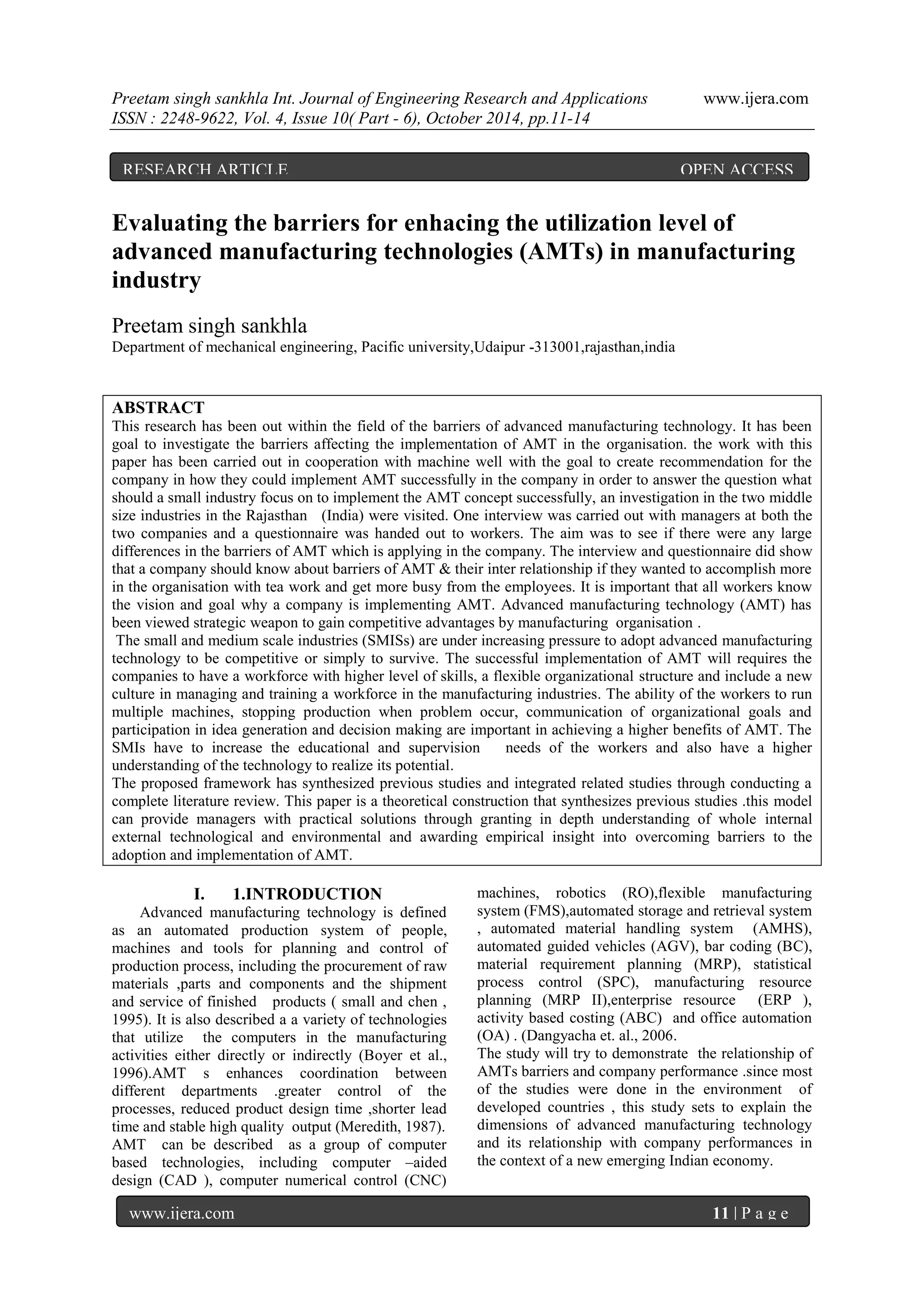
Barriers during advanced manufacturing technologies utilization
Table 2.1. Advanced Manufacturing Technology barriers
S.No. AMT Barriers (AMTBs) References
1 Lack of top management commitment [2],[32]
2 Lack of strategic planning [2],[38] ,[13]
3 Lack of appropriate source of finance [30],[2],[32],[13
4 Lack of cost justification [6],[2]
5 Lack of culture [2]
6 Lack of interaction/ inadequate
communication
[12]
7 Lack of employee empowerment [12],[2]
8 Lack of organizational structure [2]
9 Lack of Methodology [2]
10 Lack of training and education [2], [8]
11 Lack of Technology [1],[2],[38],[14]
12 Lack of knowledge on AMT [13]
13 Disparity in Pay [2]
14 Lack of Integration of system [2]
15 AMT skill deficiency [22], [2] ,[1]
16 Resistance to change [12],[2], [13]
17 Lack of performance measurement system [2]
18 Increased maintenance Cost [13]
19 Fear of loss of role identity [1]
20 Fear of work overload [1]
Preetam singh sankhla Int. Journal of Engineering Research and Applications www.ijera.com
ISSN : 2248-9622, Vol. 4, Issue 10( Part - 6), October 2014, pp.11-14
www.ijera.com 13 | P a g e
III. RESEARCH METHODOLOGY
The purpose of this study is to identify the
possible barriers hindering the SMIs from achieving
the strategic benefit offered by AMT.though
numerous factors have been identified as necessary to
obtain the strategic benefits of AMT, the study
focuses on the organizational structure and culture,
the availability of the right workforce, planning and
understanding of the technology an level o computer
integration
For the purpose of this research following
methodology has been adopted.
 A search of the literature has been conducted
to identify various barriers of AMT
implementation. The search has been carried
out in English language and employed the
following electronic data bases.
1. ABI / Inform -
http://www.il.proquest.com/pqdauto
2. EBSCO Databases -
http://search.epnet.com/
3. Elsevier's Science Direct-
http://www.sciencedirect.com/
4. Emerald Full-text -
http://iris.emeraldinsight.com/
5. IEEE / IEE Electronic Library Online
(IEL) - http://ieeexplore.ieee.org/
6. ProQuest Science (formerly ASTP) -
http://www.il.proquest.com/pqdauto
 Interpretive structural Modelling is used to
understanding the dynamics between various
advance manufacturing technology barriers
(AMTBs) that hinder the AMT implement in
the organizations.
 AHP is a well established decision making
process. It is used to develop the predictive
model for AMTBs which hinders the AMT
implementation.
IV. DISCUSSION OF RESULTS
In developing country especially India,
technology is advancing so rapidly in the mechanical
manufacturing industry those highly skilled and
trained workers are believed to be an essential
attribute of successful AMT systems. The results of
the study show that skill deficiency; inadequate
training programs and improper knowledge
significantly affect the performance of the employees;
leads to poor utilization of manpower. For this good
education and training program should be arranged to
enable employees to have confidence in performing
the new jobs and bring them job satisfaction. It has
been observed that lack of management experience
and knowledge significantly affects the performance
of any manufacturing system. In Indian
manufacturing industry ,the result of study indicate
that focus must be shifted to on the root cause of the
problems by identifying and of relevant experience
of top management at all levels for advanced
manufacturing technology utilization. The Indian
manufacturing industry is facing these problems. To
survive in this competitive world, they have to
improve their infrastructure for providing more
competitive environments to everybody working in
the system. The results of the study depict that
increasing complexity of the technology leads to
continuing education and training for co-workers
working in the plant. Workers in modern
manufacturing environments not only need training in
depth (level of proficiency in a skill) but extent
(different skills) as well. From an Indian workers’
point of view, tailored training for high –tech jobs
directly supports their career development and value
to the firm
V. CONCLUSIONS
The research highlights the contribution of
various research issues for enhancing the advanced
manufacturing technology utilization in Indian
industry for accruing strategic benefits for meeting
the challenges posed by global competition .the
literature review as well as research analysis has been
employed in this study to investigate the roll of
different AMTs barriers; which effect the
performance of manufacturing organization for
achieving success. It is concluded that Indian
manufacturing industry has not been able to fully
utilize it resources because of different hurdles
affecting the performance of advanced
manufacturing technology (AMTs) utilization .the
following are the barriers that effect the
manufacturing system significantly as pointed by
empirical research analysis; scarcity of skilled
workforce; training to management and its
employees; lack of related infrastructure; resistance
from employees to the changing conditions; disparity
in pay scales of employees.
Refrences
[1.] 1. Ghani and Jayabalan, 2000 Boyer et al.,
1996 Meredith, 1987
[2.] 2. Singh, H. and Khamba, J.S. (2009)
‘Evaluating the Barriers for Enhancing the
Utilization Level of Advanced Manufacturing
Technologies (AMTs) in Indian Manufacturing
Industry’.
[3.] 3. Dean, J., Yoon, S., and Susman, G. (1992)
‘Advanced Manufacturing Technology and
Organization Structure: Empowerment or
Subordination’, Organization Science, Vol. 3,
pp. 203-229.
[4.] 4. Bessant, J., (1993) ‘The lessons of failure:
learning to manage new manufacturing
technology’, Int. J. Technology Management,
Vol.8, No.(2/3/4), pp.197–215.
Preetam singh sankhla Int. Journal of Engineering Research and Applications www.ijera.com
ISSN : 2248-9622, Vol. 4, Issue 10( Part - 6), October 2014, pp.11-14
www.ijera.com 14 | P a g e
[5.] 5. Dangayach, G.S. and Deshmukh, S.G. (2005)
‘Advanced manufacturing technology
implementation: evidence from Indian small and
medium enterprises (SMEs)’, Journal of
Manufacturing Technology Management, Vol.
16, pp.483–496.
[6.] 6.Boyer, K., Leong, G., Ward, P. and Krajewski,
L.(1997) ‘Unlocking the potential of advanced
manufacturing technologies, Journal of
Operations Management,Vol.15, No.4, pp.331-
47.
[7.] 7. Meredith, J.R.(1987) ‘Implementation New
Manufacturing Technologies: Managerial
Lessons over the FMS Life Cycle’,
Interface,Vol.17, No.6, pp.51-62.
[8.] 8.Zammuto, R., and O’Connor, E., (1992)
‘Gaining Advanced Manufacturing
Technologies’ Benefits: the Role of
Organization Design and Culture’, Academy of
Management Review, Vol.17, pp.701-728.
[9.] 9.Small, M. and Chen, I. (1995) ‘Investment
justification of advanced manufacturing
technology: an empirical analysis’, Journal of
Engineering and Technology Management,
10.Barton, L.D. and Kraus, W.A.(1985)
‘Implementing new technology. Harvard
Business
[10.] 11.Chung, K. (1991) ‘Delivering advantages
from advanced manufacturing technologies: an
organizing paradigm’, International Journal of
Production Economics, Vol.25, No.1/3, pp.13-
21.
[11.] 12.Davids, K. and Martin, R. (1990) ‘Shop floor
rebellions. Industrial Society’, pp.26–27.
[12.] Davis, K. (1994) ‘Human behaviour at work’,
New Delhi Tata McGraw Hill.
[13.] 13.Gill, H.S., Singh, H. and Singh, S. (2010)
‘Effectiveness of Advanced Manufacturing
Technologies in SMEs of Auto Parts
Manufacturing’, International Conference on
Industrial Engineering and Operations
Management.
[14.] 14.Hung, S.C. and Chu, Y.Y.(2006)
‘Stimulating New Industries from Emerging
Technologies: Challenges for the Public Sector’
Technovation, Vol.26, No.1, pp.104-110.
[15.] 15.Jharkharia, S. and Shankar, R.(2004) ‘ IT
enablement of supply chains: modeling the
enablers’, International Journal of Productivity
and Performance Management, Vol.53, No.8,
pp.700-712.
[16.] 16.Khamba, J.S. and Singh, T.P. (2001)
‘Flexible Management of New Technology’,
Global Journal of Flexible Systems
Management, Vol.2, No.4, pp.41-53.
[17.] 17.Lee, H.L.and Whang, S. (2000) ‘Information
sharing in a supply chain’, Int. J. Technology
Management, Vol.20, pp.373–387.
[18.] 18.Marri, H.B., Gunasekaran, A. and Sohag,
R.A. (2007) ‘Implementation of Advanced
Manufacturing Technology in Pakistani Small
and Medium Enterprises: An Empirical
Analysis’, Journal of Enterprise Information
Management, Vol.20, No.6, pp.726-739.
[19.] 19.Meredith, J.R.(1987) ‘Implementation New
Manufacturing Technologies: Managerial
Lessons over the FMS Life Cycle’,
Interface,Vol.17, No.6, pp.51-62.
[20.] 20.Ravi, V., Shankar, R. and Tiwari, M.K.
(2005) ‘Productivity improvement of a
computer hardware supply chain’, International
Journal of Productivity and Performance
Management Vol.54,No.4, pp.239-255.
[21.] 21.Sage, A.P. (1997) ‘ Interpretive Structural
Modeling: Methodology for Large-scale
Systems’, New York. McGraw-Hill, pp.
1977:91-164.
[22.] 22.Sambasiva Rao, K.V. and Deshmukh, S.G.
(1994) ‘Strategic Framework for Implementing
Flexible Manufacturing Systems in India’,
International Journal of Operations &
Production Management, Vol.14,No.4, PP.50-
63.
[23.] 23..Singh, R.K., Garg, S.K., Deshmukh, S.G.
and Kumar, M. (2007) ‘Modelling of critical
success factors for implementation of AMTs’,
Journal of Modelling in Management, Vol.2,
No.3, pp.232-250.
[24.] 24.Singh, H. and Khamba, J.S. (2009)
‘Evaluating the Barriers for Enhancing the
Utilization Level of Advanced Manufacturing
Technologies (AMTs) in Indian Manufacturing
Industry’, The 2nd International Multi-
Conference on Engineering and Technological
Innovation:
[25.] 25.Small, M. and Chen, I. (1995) ‘Investment
justification of advanced manufacturing
technology: an empirical analysis’, Journal of
Engineering and Technology Management,
Vol.12, pp.27–55.
[26.] 26.Small, M.H. and Yasin, M.H. (1997)
‘Advanced Manufacturing Technology
implementation policy and performance’, J.
Operate manage, 2000ol.15, pp.359-370.
[27.] 27.Warfield, J.W. (1974) ‘Developing
interconnected matrices in structural modeling
IEEE Transactions on Systems Men and
Cybernetics’, Vol.4, No.1, pp.51-81.
[28.] 28.Boyer, K., Leong, G., Ward, P. and
Krajewski, L.(1997) ‘Unlocking the potential of
advanced manufacturing technologies, Journal
of Operations Management,Vol.15, No.4,
pp.331-47.
[29.] 29..Hollenstein, H. (2004) ‘Determinants of the
adoption of Information and Communication
Technologies (ICT) An empirical analysis based
on firm-level data for the Swiss business sector’,
pp.315–342.

Evaluating the barriers for enhacing the utilization level of advanced manufacturing technologies (AMTs) in manufacturing industry

  • 1.
    Preetam singh sankhlaInt. Journal of Engineering Research and Applications www.ijera.com ISSN : 2248-9622, Vol. 4, Issue 10( Part - 6), October 2014, pp.11-14 www.ijera.com 11 | P a g e Evaluating the barriers for enhacing the utilization level of advanced manufacturing technologies (AMTs) in manufacturing industry Preetam singh sankhla Department of mechanical engineering, Pacific university,Udaipur -313001,rajasthan,india ABSTRACT This research has been out within the field of the barriers of advanced manufacturing technology. It has been goal to investigate the barriers affecting the implementation of AMT in the organisation. the work with this paper has been carried out in cooperation with machine well with the goal to create recommendation for the company in how they could implement AMT successfully in the company in order to answer the question what should a small industry focus on to implement the AMT concept successfully, an investigation in the two middle size industries in the Rajasthan (India) were visited. One interview was carried out with managers at both the two companies and a questionnaire was handed out to workers. The aim was to see if there were any large differences in the barriers of AMT which is applying in the company. The interview and questionnaire did show that a company should know about barriers of AMT & their inter relationship if they wanted to accomplish more in the organisation with tea work and get more busy from the employees. It is important that all workers know the vision and goal why a company is implementing AMT. Advanced manufacturing technology (AMT) has been viewed strategic weapon to gain competitive advantages by manufacturing organisation . The small and medium scale industries (SMISs) are under increasing pressure to adopt advanced manufacturing technology to be competitive or simply to survive. The successful implementation of AMT will requires the companies to have a workforce with higher level of skills, a flexible organizational structure and include a new culture in managing and training a workforce in the manufacturing industries. The ability of the workers to run multiple machines, stopping production when problem occur, communication of organizational goals and participation in idea generation and decision making are important in achieving a higher benefits of AMT. The SMIs have to increase the educational and supervision needs of the workers and also have a higher understanding of the technology to realize its potential. The proposed framework has synthesized previous studies and integrated related studies through conducting a complete literature review. This paper is a theoretical construction that synthesizes previous studies .this model can provide managers with practical solutions through granting in depth understanding of whole internal external technological and environmental and awarding empirical insight into overcoming barriers to the adoption and implementation of AMT. I. 1.INTRODUCTION Advanced manufacturing technology is defined as an automated production system of people, machines and tools for planning and control of production process, including the procurement of raw materials ,parts and components and the shipment and service of finished products ( small and chen , 1995). It is also described a a variety of technologies that utilize the computers in the manufacturing activities either directly or indirectly (Boyer et al., 1996).AMT s enhances coordination between different departments .greater control of the processes, reduced product design time ,shorter lead time and stable high quality output (Meredith, 1987). AMT can be described as a group of computer based technologies, including computer –aided design (CAD ), computer numerical control (CNC) machines, robotics (RO),flexible manufacturing system (FMS),automated storage and retrieval system , automated material handling system (AMHS), automated guided vehicles (AGV), bar coding (BC), material requirement planning (MRP), statistical process control (SPC), manufacturing resource planning (MRP II),enterprise resource (ERP ), activity based costing (ABC) and office automation (OA) . (Dangyacha et. al., 2006. The study will try to demonstrate the relationship of AMTs barriers and company performance .since most of the studies were done in the environment of developed countries , this study sets to explain the dimensions of advanced manufacturing technology and its relationship with company performances in the context of a new emerging Indian economy. RESEARCH ARTICLE OPEN ACCESS
  • 2.
    Preetam singh sankhlaInt. Journal of Engineering Research and Applications www.ijera.com ISSN : 2248-9622, Vol. 4, Issue 10( Part - 6), October 2014, pp.11-14 www.ijera.com 12 | P a g e II. HURDLES/BARRIERS FOR ADVANCED MANUFACTURING TECHNOLOGIES (AMTS) UTILIZATION It is accepted that technological innovation is a critically important activity Advances in technology have moved manufacturing organization towards a new competitive landscape. Managers in manufacturing organization are experiencing the emergences of advanced manufacturing technologies (AMTs) such as CAD/CAM,CAPP,FMS and robotics. An insight into the country’s manufacturing scenario reveals that advanced manufacturing technologies (AMTs) and human factors remained As neglected areas in the Indian industry since long .thus Indian manufacturing organizations, in the last two decades have been fored to lookout for proactive strategic technology management initiatives, for harnessing manufacturing competitiveness. The detailed literature review reflects the following issues connected with hurdles/barriers in the advanced manufacturing technologies (AMTs) utilization process :-  Education and training to management and its employees are crucial to utilization of advanced manufacturing technologies.  Commitment from top management is a critical factors in any major organizational change  Scarcity of skilled workforce is another hurdle for technology utilization.  There is always a resistance from employees to the changing conditions and it impact on the success of technology utilization process needs to be investigated. Barriers during advanced manufacturing technologies utilization Table 2.1. Advanced Manufacturing Technology barriers S.No. AMT Barriers (AMTBs) References 1 Lack of top management commitment [2],[32] 2 Lack of strategic planning [2],[38] ,[13] 3 Lack of appropriate source of finance [30],[2],[32],[13 4 Lack of cost justification [6],[2] 5 Lack of culture [2] 6 Lack of interaction/ inadequate communication [12] 7 Lack of employee empowerment [12],[2] 8 Lack of organizational structure [2] 9 Lack of Methodology [2] 10 Lack of training and education [2], [8] 11 Lack of Technology [1],[2],[38],[14] 12 Lack of knowledge on AMT [13] 13 Disparity in Pay [2] 14 Lack of Integration of system [2] 15 AMT skill deficiency [22], [2] ,[1] 16 Resistance to change [12],[2], [13] 17 Lack of performance measurement system [2] 18 Increased maintenance Cost [13] 19 Fear of loss of role identity [1] 20 Fear of work overload [1]
  • 3.
    Preetam singh sankhlaInt. Journal of Engineering Research and Applications www.ijera.com ISSN : 2248-9622, Vol. 4, Issue 10( Part - 6), October 2014, pp.11-14 www.ijera.com 13 | P a g e III. RESEARCH METHODOLOGY The purpose of this study is to identify the possible barriers hindering the SMIs from achieving the strategic benefit offered by AMT.though numerous factors have been identified as necessary to obtain the strategic benefits of AMT, the study focuses on the organizational structure and culture, the availability of the right workforce, planning and understanding of the technology an level o computer integration For the purpose of this research following methodology has been adopted.  A search of the literature has been conducted to identify various barriers of AMT implementation. The search has been carried out in English language and employed the following electronic data bases. 1. ABI / Inform - http://www.il.proquest.com/pqdauto 2. EBSCO Databases - http://search.epnet.com/ 3. Elsevier's Science Direct- http://www.sciencedirect.com/ 4. Emerald Full-text - http://iris.emeraldinsight.com/ 5. IEEE / IEE Electronic Library Online (IEL) - http://ieeexplore.ieee.org/ 6. ProQuest Science (formerly ASTP) - http://www.il.proquest.com/pqdauto  Interpretive structural Modelling is used to understanding the dynamics between various advance manufacturing technology barriers (AMTBs) that hinder the AMT implement in the organizations.  AHP is a well established decision making process. It is used to develop the predictive model for AMTBs which hinders the AMT implementation. IV. DISCUSSION OF RESULTS In developing country especially India, technology is advancing so rapidly in the mechanical manufacturing industry those highly skilled and trained workers are believed to be an essential attribute of successful AMT systems. The results of the study show that skill deficiency; inadequate training programs and improper knowledge significantly affect the performance of the employees; leads to poor utilization of manpower. For this good education and training program should be arranged to enable employees to have confidence in performing the new jobs and bring them job satisfaction. It has been observed that lack of management experience and knowledge significantly affects the performance of any manufacturing system. In Indian manufacturing industry ,the result of study indicate that focus must be shifted to on the root cause of the problems by identifying and of relevant experience of top management at all levels for advanced manufacturing technology utilization. The Indian manufacturing industry is facing these problems. To survive in this competitive world, they have to improve their infrastructure for providing more competitive environments to everybody working in the system. The results of the study depict that increasing complexity of the technology leads to continuing education and training for co-workers working in the plant. Workers in modern manufacturing environments not only need training in depth (level of proficiency in a skill) but extent (different skills) as well. From an Indian workers’ point of view, tailored training for high –tech jobs directly supports their career development and value to the firm V. CONCLUSIONS The research highlights the contribution of various research issues for enhancing the advanced manufacturing technology utilization in Indian industry for accruing strategic benefits for meeting the challenges posed by global competition .the literature review as well as research analysis has been employed in this study to investigate the roll of different AMTs barriers; which effect the performance of manufacturing organization for achieving success. It is concluded that Indian manufacturing industry has not been able to fully utilize it resources because of different hurdles affecting the performance of advanced manufacturing technology (AMTs) utilization .the following are the barriers that effect the manufacturing system significantly as pointed by empirical research analysis; scarcity of skilled workforce; training to management and its employees; lack of related infrastructure; resistance from employees to the changing conditions; disparity in pay scales of employees. Refrences [1.] 1. Ghani and Jayabalan, 2000 Boyer et al., 1996 Meredith, 1987 [2.] 2. Singh, H. and Khamba, J.S. (2009) ‘Evaluating the Barriers for Enhancing the Utilization Level of Advanced Manufacturing Technologies (AMTs) in Indian Manufacturing Industry’. [3.] 3. Dean, J., Yoon, S., and Susman, G. (1992) ‘Advanced Manufacturing Technology and Organization Structure: Empowerment or Subordination’, Organization Science, Vol. 3, pp. 203-229. [4.] 4. Bessant, J., (1993) ‘The lessons of failure: learning to manage new manufacturing technology’, Int. J. Technology Management, Vol.8, No.(2/3/4), pp.197–215.
  • 4.
    Preetam singh sankhlaInt. Journal of Engineering Research and Applications www.ijera.com ISSN : 2248-9622, Vol. 4, Issue 10( Part - 6), October 2014, pp.11-14 www.ijera.com 14 | P a g e [5.] 5. Dangayach, G.S. and Deshmukh, S.G. (2005) ‘Advanced manufacturing technology implementation: evidence from Indian small and medium enterprises (SMEs)’, Journal of Manufacturing Technology Management, Vol. 16, pp.483–496. [6.] 6.Boyer, K., Leong, G., Ward, P. and Krajewski, L.(1997) ‘Unlocking the potential of advanced manufacturing technologies, Journal of Operations Management,Vol.15, No.4, pp.331- 47. [7.] 7. Meredith, J.R.(1987) ‘Implementation New Manufacturing Technologies: Managerial Lessons over the FMS Life Cycle’, Interface,Vol.17, No.6, pp.51-62. [8.] 8.Zammuto, R., and O’Connor, E., (1992) ‘Gaining Advanced Manufacturing Technologies’ Benefits: the Role of Organization Design and Culture’, Academy of Management Review, Vol.17, pp.701-728. [9.] 9.Small, M. and Chen, I. (1995) ‘Investment justification of advanced manufacturing technology: an empirical analysis’, Journal of Engineering and Technology Management, 10.Barton, L.D. and Kraus, W.A.(1985) ‘Implementing new technology. Harvard Business [10.] 11.Chung, K. (1991) ‘Delivering advantages from advanced manufacturing technologies: an organizing paradigm’, International Journal of Production Economics, Vol.25, No.1/3, pp.13- 21. [11.] 12.Davids, K. and Martin, R. (1990) ‘Shop floor rebellions. Industrial Society’, pp.26–27. [12.] Davis, K. (1994) ‘Human behaviour at work’, New Delhi Tata McGraw Hill. [13.] 13.Gill, H.S., Singh, H. and Singh, S. (2010) ‘Effectiveness of Advanced Manufacturing Technologies in SMEs of Auto Parts Manufacturing’, International Conference on Industrial Engineering and Operations Management. [14.] 14.Hung, S.C. and Chu, Y.Y.(2006) ‘Stimulating New Industries from Emerging Technologies: Challenges for the Public Sector’ Technovation, Vol.26, No.1, pp.104-110. [15.] 15.Jharkharia, S. and Shankar, R.(2004) ‘ IT enablement of supply chains: modeling the enablers’, International Journal of Productivity and Performance Management, Vol.53, No.8, pp.700-712. [16.] 16.Khamba, J.S. and Singh, T.P. (2001) ‘Flexible Management of New Technology’, Global Journal of Flexible Systems Management, Vol.2, No.4, pp.41-53. [17.] 17.Lee, H.L.and Whang, S. (2000) ‘Information sharing in a supply chain’, Int. J. Technology Management, Vol.20, pp.373–387. [18.] 18.Marri, H.B., Gunasekaran, A. and Sohag, R.A. (2007) ‘Implementation of Advanced Manufacturing Technology in Pakistani Small and Medium Enterprises: An Empirical Analysis’, Journal of Enterprise Information Management, Vol.20, No.6, pp.726-739. [19.] 19.Meredith, J.R.(1987) ‘Implementation New Manufacturing Technologies: Managerial Lessons over the FMS Life Cycle’, Interface,Vol.17, No.6, pp.51-62. [20.] 20.Ravi, V., Shankar, R. and Tiwari, M.K. (2005) ‘Productivity improvement of a computer hardware supply chain’, International Journal of Productivity and Performance Management Vol.54,No.4, pp.239-255. [21.] 21.Sage, A.P. (1997) ‘ Interpretive Structural Modeling: Methodology for Large-scale Systems’, New York. McGraw-Hill, pp. 1977:91-164. [22.] 22.Sambasiva Rao, K.V. and Deshmukh, S.G. (1994) ‘Strategic Framework for Implementing Flexible Manufacturing Systems in India’, International Journal of Operations & Production Management, Vol.14,No.4, PP.50- 63. [23.] 23..Singh, R.K., Garg, S.K., Deshmukh, S.G. and Kumar, M. (2007) ‘Modelling of critical success factors for implementation of AMTs’, Journal of Modelling in Management, Vol.2, No.3, pp.232-250. [24.] 24.Singh, H. and Khamba, J.S. (2009) ‘Evaluating the Barriers for Enhancing the Utilization Level of Advanced Manufacturing Technologies (AMTs) in Indian Manufacturing Industry’, The 2nd International Multi- Conference on Engineering and Technological Innovation: [25.] 25.Small, M. and Chen, I. (1995) ‘Investment justification of advanced manufacturing technology: an empirical analysis’, Journal of Engineering and Technology Management, Vol.12, pp.27–55. [26.] 26.Small, M.H. and Yasin, M.H. (1997) ‘Advanced Manufacturing Technology implementation policy and performance’, J. Operate manage, 2000ol.15, pp.359-370. [27.] 27.Warfield, J.W. (1974) ‘Developing interconnected matrices in structural modeling IEEE Transactions on Systems Men and Cybernetics’, Vol.4, No.1, pp.51-81. [28.] 28.Boyer, K., Leong, G., Ward, P. and Krajewski, L.(1997) ‘Unlocking the potential of advanced manufacturing technologies, Journal of Operations Management,Vol.15, No.4, pp.331-47. [29.] 29..Hollenstein, H. (2004) ‘Determinants of the adoption of Information and Communication Technologies (ICT) An empirical analysis based on firm-level data for the Swiss business sector’, pp.315–342.