A Strategy to Increase Students’ Motivation and
Decrease Dropout Rates on Computer
Programming Courses in a Public Institute of
Education and Technology
Alexandre R.S. Correia, IFSertaoPE, Brazil
Dr. Essi Ryymin, HAMK, Finland
Fernando S. Pacheco, IFSC, Brazil
D.Sc. Päivi Aarreniemi-Jokipelto, Haaga-Helia, Finland
Brian Joyce, HAMK, Finland
6/23/2015EdMedia 2015, World Conference on Educational Media and Technology
paivi.aarreniemi-jokipelto@haaga-helia.fi
1
2
Researchers Institutions
Alexandre R.S. Correia
alexandre.correia@ifsertao-
pe.edu.br
Federal Institute of Education, Science
and Technology at Sertao Pernambucano -
IFSertaoPE, Petrolina, Brazil
Essi Ryymin
essi.ryymin@hamk.fi
Häme University of Applied Sciences -
HAMK, Hämeenlinna, Finland
Fernando S. Pacheco
fspacheco@ifsc.edu.br
Federal Institute of Education, Science
and Technology at Santa Catarina - IFSC,
Florianopolis, Brazil
Päivi Aarreniemi-Jokipelto
paivi.aarreniemi-jokipelto@
haaga-helia.fi
Haaga-Helia University of Applied
Sciences, School of Vocational Teacher
Education, Helsinki, Finland
Brian Joyce
brian.joyce@hamk.fi
Häme University of Applied Sciences -
HAMK, Hämeenlinna, Finland
Outline
 Objective of the study
 Computer programming
 Context of the study
 Research question
 Selected strategy
 Questionnaire survey
 Contributions
6/23/2015EdMedia 2015, World Conference on Educational Media and Technology
paivi.aarreniemi-jokipelto@haaga-helia.fi
3
Objective of the Study
 This paper is a report on a exploratory design research of
educational intervention conducted on a public institute of
education in Brazil.
 There are remarkable problems of dropout rates in the
school.
 The educational intervention presented here offers a new
strategy to mitigate dropout rates by re-designing
teaching on the basis of a student-centered approach with
emphasis on guided participation and project-based
learning.
6/23/2015EdMedia 2015, World Conference on Educational Media and Technology
paivi.aarreniemi-jokipelto@haaga-helia.fi
4
The Brazilian Federal Network of Institutes of
Education and Technology
 Since 2008 the main goal is: providing free and public
education from high-school to doctoral degree;
 It was created in 1909 (106 years);
 562 educational units spread the whole country;
 1 million students seats;
 60 thousands staff members (teachers and officers).
6/23/2015EdMedia 2015, World Conference on Educational Media and Technology
paivi.aarreniemi-jokipelto@haaga-helia.fi
5
Source: Ministry of Education - report series (2014).
Computer Programming Dropout Rate and the
Motivation to Learn
 A global problem
 Introductory courses are known to be a challenge for most of
the students. The difficulties to learn the fundamentals on how
to program computers have led to high rates of dropout at
higher education or vocational degrees (Brusilovsky et al. 1994,
McCracken et al. 2001, Lister et al. 2004).
 Dropout rate - when a student does not pass a course and
need to repeat it or give up the entire program because he/she
did not pass.
 Motivation - a persistent effort a student pays toward learning
(Law et al., 2010)
6/23/2015EdMedia 2015, World Conference on Educational Media and Technology
paivi.aarreniemi-jokipelto@haaga-helia.fi
9
Context of the Study
 The Institute of Education and Technology at Sertao - Petrolina campus,
the region has been known as one of the poorest regions in Brazil
 The Brazilian Federal Network of Institutes of Education and Technology:
According to Brazilian Government, from 2004 to 2011 on 25% of the
student had graduated in bachelor teacher training (4-year long ISCED 6).
The first year dropout rate was 57%. The indicators for the vocational
education were worst.
 The dropout (semiannually statistics):
 Bachelor teacher training degree, sdr=27.5% (ces=232 and tcs=320).
 Adult education vocational degree, sdr=44.0% (ces=56 and tcs=100)
 High school vocational education degree, sdr=-14.0% (ces=114 and tcs=100)
at the (More students than seats)
 A smaller sdr stands for smaller dropout rate (the ideal situation would be sdr
as zero, which stands for the number of current enrolled students equal to the
total capacity). 6/23/2015EdMedia 2015, World Conference on Educational Media and Technology
paivi.aarreniemi-jokipelto@haaga-helia.fi
10
Research Question
 If teachers in computer programing courses at the study
institution decide to apply SCAEGP-PBL, would it help to
increase students’ motivation and to reduce their dropout
rates?
 SCAEGP - student-centered approach with emphasis on
guided participation pedagogy  motivation might
increase (Kember, 2008)
 PBL - Project-based Learning: Motivation increases 
dropout rate might decrease (Jenkins, 2001; Law et al.
2010)
6/23/2015EdMedia 2015, World Conference on Educational Media and Technology
paivi.aarreniemi-jokipelto@haaga-helia.fi
11
Strategy to Enhance Motivation and Mitigate
Dropout Rates
 The current state in the study institution:
 Most of the computer programming classrooms are teacher-
centered;
 Most tasks surrounding project’s aspects are busywork (for
students and teachers) rather than effective learning through
social context projects.
 What we are going to propose?
 Adoption of a student-centered approach with emphasis on
guided participation pedagogy and project-based learning
technique (SCAEGP-PBL)
6/23/2015EdMedia 2015, World Conference on Educational Media and Technology
paivi.aarreniemi-jokipelto@haaga-helia.fi
12
Implementing the Selected Strategy
 Create a pilot course, to run in parallel with the regular
courses
 Select randomly students to take this pilot course;
 Take questionnaires based on motivation, from students
before starting and after ending the both courses
 A statistical analysis to find out whether the strategy will
increase the motivation and decrease the dropout rates
 Present these outcomes to have feedback, contribution,
discussion and plan/execute new actions.
6/23/2015EdMedia 2015, World Conference on Educational Media and Technology
paivi.aarreniemi-jokipelto@haaga-helia.fi
13
Questionnaire Survey
 To students to explore their motivation (Jenkins, 2001):
 Extrinsic - the desire to complete the course in order
to attain some expected reward, leveraging career,
etc.
 Intrinsic - interest in programming for its own sake;
 Social - to please some 3rd party whose the opinion
is valued;
 Achievement - do well for personal satisfaction.
6/23/2015EdMedia 2015, World Conference on Educational Media and Technology
paivi.aarreniemi-jokipelto@haaga-helia.fi
14
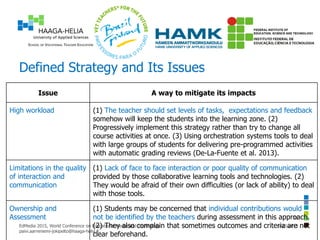
Defined Strategy and Its Issues
6/23/2015EdMedia 2015, World Conference on Educational Media and Technology
paivi.aarreniemi-jokipelto@haaga-helia.fi
15
Issue A way to mitigate its impacts
High workload (1) The teacher should set levels of tasks, expectations and feedback
somehow will keep the students into the learning zone. (2)
Progressively implement this strategy rather than try to change all
course activities at once. (3) Using orchestration systems tools to deal
with large groups of students for delivering pre-programmed activities
with automatic grading reviews (De-La-Fuente et al. 2013).
Limitations in the quality
of interaction and
communication
(1) Lack of face to face interaction or poor quality of communication
provided by those collaborative learning tools and technologies. (2)
They would be afraid of their own difficulties (or lack of ability) to deal
with those tools.
Ownership and
Assessment
(1) Students may be concerned that individual contributions would
not be identified by the teachers during assessment in this approach.
(2) They also complain that sometimes outcomes and criteria are not
clear beforehand.
Main Contributions
1. The whole institution (teachers, managers and
students) will aware of its dropout rates problem;
2. Encreaced motivation might decrease the dropout
rates;
3. The proposed strategy is a systematic way to motivate
and decrease the dropout rates.
4. The proposed strategy is aligned with 21st skills and
competencies.
6/23/2015EdMedia 2015, World Conference on Educational Media and Technology
paivi.aarreniemi-jokipelto@haaga-helia.fi
16
Acknowledgements
 Alexandre R. S. Correia and Fernando S. Pacheco
received financial support from CNPq (the Brazilian
National Council for Scientific and Technological
Development) and SETEC/MEC (Brazilian Ministry of
Education) through the public call CNPq - SETEC/MEC
n. 015/2014.
6/23/2015EdMedia 2015, World Conference on Educational Media and Technology
paivi.aarreniemi-jokipelto@haaga-helia.fi
17
Further information
Alexandre R.S. Correia
alexandre.correia@
ifsertao-pe.edu.br
6/23/2015EdMedia 2015, World Conference on Educational Media and Technology
paivi.aarreniemi-jokipelto@haaga-helia.fi
18

A strategy to increase students’ motivation and decrease dropout rates

  • 1.
    A Strategy toIncrease Students’ Motivation and Decrease Dropout Rates on Computer Programming Courses in a Public Institute of Education and Technology Alexandre R.S. Correia, IFSertaoPE, Brazil Dr. Essi Ryymin, HAMK, Finland Fernando S. Pacheco, IFSC, Brazil D.Sc. Päivi Aarreniemi-Jokipelto, Haaga-Helia, Finland Brian Joyce, HAMK, Finland 6/23/2015EdMedia 2015, World Conference on Educational Media and Technology paivi.aarreniemi-jokipelto@haaga-helia.fi 1
  • 2.
    2 Researchers Institutions Alexandre R.S.Correia alexandre.correia@ifsertao- pe.edu.br Federal Institute of Education, Science and Technology at Sertao Pernambucano - IFSertaoPE, Petrolina, Brazil Essi Ryymin essi.ryymin@hamk.fi Häme University of Applied Sciences - HAMK, Hämeenlinna, Finland Fernando S. Pacheco fspacheco@ifsc.edu.br Federal Institute of Education, Science and Technology at Santa Catarina - IFSC, Florianopolis, Brazil Päivi Aarreniemi-Jokipelto paivi.aarreniemi-jokipelto@ haaga-helia.fi Haaga-Helia University of Applied Sciences, School of Vocational Teacher Education, Helsinki, Finland Brian Joyce brian.joyce@hamk.fi Häme University of Applied Sciences - HAMK, Hämeenlinna, Finland
  • 3.
    Outline  Objective ofthe study  Computer programming  Context of the study  Research question  Selected strategy  Questionnaire survey  Contributions 6/23/2015EdMedia 2015, World Conference on Educational Media and Technology paivi.aarreniemi-jokipelto@haaga-helia.fi 3
  • 4.
    Objective of theStudy  This paper is a report on a exploratory design research of educational intervention conducted on a public institute of education in Brazil.  There are remarkable problems of dropout rates in the school.  The educational intervention presented here offers a new strategy to mitigate dropout rates by re-designing teaching on the basis of a student-centered approach with emphasis on guided participation and project-based learning. 6/23/2015EdMedia 2015, World Conference on Educational Media and Technology paivi.aarreniemi-jokipelto@haaga-helia.fi 4
  • 5.
    The Brazilian FederalNetwork of Institutes of Education and Technology  Since 2008 the main goal is: providing free and public education from high-school to doctoral degree;  It was created in 1909 (106 years);  562 educational units spread the whole country;  1 million students seats;  60 thousands staff members (teachers and officers). 6/23/2015EdMedia 2015, World Conference on Educational Media and Technology paivi.aarreniemi-jokipelto@haaga-helia.fi 5 Source: Ministry of Education - report series (2014).
  • 6.
    Computer Programming DropoutRate and the Motivation to Learn  A global problem  Introductory courses are known to be a challenge for most of the students. The difficulties to learn the fundamentals on how to program computers have led to high rates of dropout at higher education or vocational degrees (Brusilovsky et al. 1994, McCracken et al. 2001, Lister et al. 2004).  Dropout rate - when a student does not pass a course and need to repeat it or give up the entire program because he/she did not pass.  Motivation - a persistent effort a student pays toward learning (Law et al., 2010) 6/23/2015EdMedia 2015, World Conference on Educational Media and Technology paivi.aarreniemi-jokipelto@haaga-helia.fi 9
  • 7.
    Context of theStudy  The Institute of Education and Technology at Sertao - Petrolina campus, the region has been known as one of the poorest regions in Brazil  The Brazilian Federal Network of Institutes of Education and Technology: According to Brazilian Government, from 2004 to 2011 on 25% of the student had graduated in bachelor teacher training (4-year long ISCED 6). The first year dropout rate was 57%. The indicators for the vocational education were worst.  The dropout (semiannually statistics):  Bachelor teacher training degree, sdr=27.5% (ces=232 and tcs=320).  Adult education vocational degree, sdr=44.0% (ces=56 and tcs=100)  High school vocational education degree, sdr=-14.0% (ces=114 and tcs=100) at the (More students than seats)  A smaller sdr stands for smaller dropout rate (the ideal situation would be sdr as zero, which stands for the number of current enrolled students equal to the total capacity). 6/23/2015EdMedia 2015, World Conference on Educational Media and Technology paivi.aarreniemi-jokipelto@haaga-helia.fi 10
  • 8.
    Research Question  Ifteachers in computer programing courses at the study institution decide to apply SCAEGP-PBL, would it help to increase students’ motivation and to reduce their dropout rates?  SCAEGP - student-centered approach with emphasis on guided participation pedagogy  motivation might increase (Kember, 2008)  PBL - Project-based Learning: Motivation increases  dropout rate might decrease (Jenkins, 2001; Law et al. 2010) 6/23/2015EdMedia 2015, World Conference on Educational Media and Technology paivi.aarreniemi-jokipelto@haaga-helia.fi 11
  • 9.
    Strategy to EnhanceMotivation and Mitigate Dropout Rates  The current state in the study institution:  Most of the computer programming classrooms are teacher- centered;  Most tasks surrounding project’s aspects are busywork (for students and teachers) rather than effective learning through social context projects.  What we are going to propose?  Adoption of a student-centered approach with emphasis on guided participation pedagogy and project-based learning technique (SCAEGP-PBL) 6/23/2015EdMedia 2015, World Conference on Educational Media and Technology paivi.aarreniemi-jokipelto@haaga-helia.fi 12
  • 10.
    Implementing the SelectedStrategy  Create a pilot course, to run in parallel with the regular courses  Select randomly students to take this pilot course;  Take questionnaires based on motivation, from students before starting and after ending the both courses  A statistical analysis to find out whether the strategy will increase the motivation and decrease the dropout rates  Present these outcomes to have feedback, contribution, discussion and plan/execute new actions. 6/23/2015EdMedia 2015, World Conference on Educational Media and Technology paivi.aarreniemi-jokipelto@haaga-helia.fi 13
  • 11.
    Questionnaire Survey  Tostudents to explore their motivation (Jenkins, 2001):  Extrinsic - the desire to complete the course in order to attain some expected reward, leveraging career, etc.  Intrinsic - interest in programming for its own sake;  Social - to please some 3rd party whose the opinion is valued;  Achievement - do well for personal satisfaction. 6/23/2015EdMedia 2015, World Conference on Educational Media and Technology paivi.aarreniemi-jokipelto@haaga-helia.fi 14
  • 12.
    Defined Strategy andIts Issues 6/23/2015EdMedia 2015, World Conference on Educational Media and Technology paivi.aarreniemi-jokipelto@haaga-helia.fi 15 Issue A way to mitigate its impacts High workload (1) The teacher should set levels of tasks, expectations and feedback somehow will keep the students into the learning zone. (2) Progressively implement this strategy rather than try to change all course activities at once. (3) Using orchestration systems tools to deal with large groups of students for delivering pre-programmed activities with automatic grading reviews (De-La-Fuente et al. 2013). Limitations in the quality of interaction and communication (1) Lack of face to face interaction or poor quality of communication provided by those collaborative learning tools and technologies. (2) They would be afraid of their own difficulties (or lack of ability) to deal with those tools. Ownership and Assessment (1) Students may be concerned that individual contributions would not be identified by the teachers during assessment in this approach. (2) They also complain that sometimes outcomes and criteria are not clear beforehand.
  • 13.
    Main Contributions 1. Thewhole institution (teachers, managers and students) will aware of its dropout rates problem; 2. Encreaced motivation might decrease the dropout rates; 3. The proposed strategy is a systematic way to motivate and decrease the dropout rates. 4. The proposed strategy is aligned with 21st skills and competencies. 6/23/2015EdMedia 2015, World Conference on Educational Media and Technology paivi.aarreniemi-jokipelto@haaga-helia.fi 16
  • 14.
    Acknowledgements  Alexandre R.S. Correia and Fernando S. Pacheco received financial support from CNPq (the Brazilian National Council for Scientific and Technological Development) and SETEC/MEC (Brazilian Ministry of Education) through the public call CNPq - SETEC/MEC n. 015/2014. 6/23/2015EdMedia 2015, World Conference on Educational Media and Technology paivi.aarreniemi-jokipelto@haaga-helia.fi 17
  • 15.
    Further information Alexandre R.S.Correia alexandre.correia@ ifsertao-pe.edu.br 6/23/2015EdMedia 2015, World Conference on Educational Media and Technology paivi.aarreniemi-jokipelto@haaga-helia.fi 18