ENTI 407
Project Proposal
Presented to: Kris Hans
December 9
LearnVR @ UCalgary
Creating Innovative E-Learning Platforms for Educational Institutions
Post COVID-19
Presented by:
Jason Chen-Leung
Shagufta Farheen
Kunwoo Shim
Jessica Vu
EXECUTIVE SUMMARY
In March 2020, the World Health Organization (WHO) declared a global pandemic,
thereby disrupting several industries and operations. This pandemic presented a stark reminder of
how educational institutions have not yet reached the full potential of innovative, e-learning
methods. It has revealed the vulnerabilities of these systems across the world and made students
question the value of gaining a post-secondary degree. Given the demand of online classes, we
identified the following opportunity at the University of Calgary: How might post-secondary
educators provide interactive learning mediums for students to foster innovative work
collaborations?
Based on a SWOT analysis, we have determined that the University’s Taylor Institute of
Teaching and Learning has been a supportive association and provided resources for educators
and students. Despite these tools, educators and students at the University are dissatisfied by the
class engagement on online Zoom lectures and want engaging classroom settings. For many
universities, immersive technologies (like virtual reality (VR)) provide several opportunities for
the institution to be a reputable leader in innovative teaching and learning platforms. Yet, such
technologies are developing in a fast pace, but have inefficient systems and are inaccessible to all
stakeholders.
Therefore, we propose LearnVR, a virtual world learning platform designed for
educators to increase engagement with students through interactive virtual activities. LearnVR
allows educators to design classrooms and customize other learning environments to their needs
to accelerate learning in an engaging and “hands-on” approach. The VR worlds will be
accessible through a personalized Open Education Resources (OER) for each class to provide
easy access to the virtual classroom and online supplement materials in one place. With in-house
development at the University, our team hopes to co-create the solution with relevant
stakeholders to make this revolutionary idea a reality!
Our unique value proposition (UVP) is that users can create customized, interactive
classrooms; have access to integrated VRChats for social interaction; and there is no requirement
for VR headsets. Our early adopters include senior undergraduate students, who are career-
starters and coming-of-age. For educators, we will target academic staff, including instructors
and associate professors. We will test our minimally viable produce (MVP) among class sizes of
20-25 students. For the initial rollout of our services, we will adopt a freemium pricing strategy
with basic services (i.e., users participate in learning sessions for at most one class/per day and
platform is only for 20 users).
Over the past 4 months, we have developed an MVP through the platform, Unity, as well
as a landing page, and conducted student surveys via Google Forms and Zapier. Our assessment
of the market demand and substitutes indicates that the in-house development of LearnVR will
be of high interest for the University, in comparison to alternatives and substitutes available.
Although LearnVR is an ambitious project, we believe this will propel the University’s
reputation and make them a leader in revolutionary teaching and learning methods with
immersive technology.
TABLE OF CONTENTS
1.0 Introduction & Problem Identification 1
2.0 Situational Analysis 2
2.1 Stakeholder Analysis 2
2.2 SWOT Analysis 2
3.0 Discussion of Alternatives 5
3.1 Insights from Students & Educators 5
3.2 Alternatives Considered 6
3.3 Decision Criteria 7
4.0 Business Model 7
4.1 The Solution 7
4.2 Early Adopters 8
4.3 Unique Value Proposition 8
4.4 Pricing Strategy 9
4.5 Feasibility Analysis 10
4.6 Key Metrics / Implementation Plan 10
5.0 Prototype & Testing 10
5.1 Use of Technology 10
5.2 Minimum Viable Product 10
5.3 Testing 10
5.4 Feedback of Prototype 11
6.0 Competitive Analysis 11
6.1 Market Demand 11
6.2 Market Alternatives 12
6.3 Porter’s Five Forces Model 12
7.0 Conclusion 14
EXHIBITS
EXHIBIT A: Stakeholder Analysis 15
EXHIBIT B: Interview with Anthonia Anowai & Cindy Kalenga 17
EXHIBIT C: Interview with Simon Li 20
EXHIBIT D: Interview with Erik Christiansen 23
EXHIBIT E: Interview with Tony Chaston 27
EXHIBIT F: Student Insights Survey - Responses Summary 31
EXHIBIT G: Zapier Email Notification 32
EXHIBIT H: Decision Matrix 33
EXHIBIT I: Feasibility Analysis 34
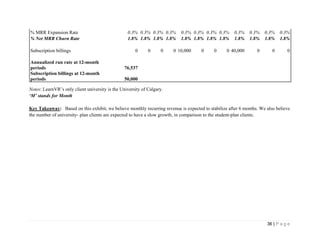
EXHIBIT J: Financial Projections 35
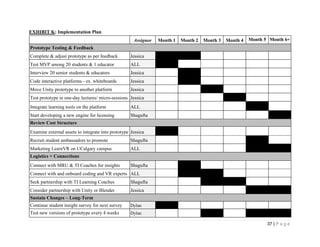
EXHIBIT K: Implementation Plan 37
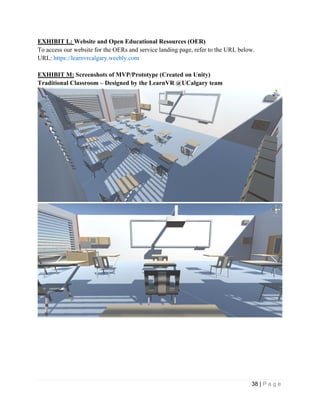
EXHIBIT L: Website and Open Educational Resources (OER) 38
EXHIBIT M: Prototype Photos 38
REFERENCES 41
1 | P a g e
1.0 Introduction & Problem Identification
In March 2020, the World Health Organization (WHO) declared a global pandemic, thereby
disrupting several industries and operations (WHO, 2020). The education sector experienced a
heavy toll, with institutions having to switch to an online course delivery system overnight.
Several students believed they would be back for their in-person classes within a week’s time;
however, no one considered an online learning format for the next 12 to 16 months. During this
period, millions of students around the globe experienced dysconnectivity from their peers and
professors, ‘Zoom fatigue’, and lack of retention of knowledge (Dhawan, 2020).
Hence, the COVID-19 pandemic presented a stark reminder of how our educational institutions
have not yet reached the full potential of innovative, e-learning methods. It has revealed the
vulnerabilities of educational systems across the world and has made students question the value
of gaining a post-secondary degree. Traditional methods of learning or face-to-face interactions
were disrupted, and similar models were carried over in an online format. Instead of considering
this disruption as an opportunity to innovate, the status quo was maintained in an online medium.
Moreover, post-secondary institutions struggled to keep up with the complexities of technologies
and encountered issues pertaining to academic integrity, student engagement and learning
approaches (Fedoruk, et al., 2021).
Other concerns and issues with the online ‘e-learning’ platforms among students and educators
include: 1) communication barriers and limited proximity; 2) limited customization of teaching
methods; 3) differing digital capabilities; 4) inadequate compatibility between technological
design and learning flexibilities; and 5) students’ tendency to procrastinate (Dhawan, 2020) (S.
Li, personal communication, November 19, 2021). While all these issues are relevant and
stakeholders demand effective solutions, our team aims to address the first two issues identified
via virtual reality (VR) systems.
Despite these troubles, the shift to online learning benefited people with some forms of
disabilities, such as immunocompromised students or students with mobility or respiratory
problems (Mackenzie et al., 2021). As identified by many researchers, the width of the
communication and depth of interaction is what matters, rather than spatial or temporal distances
(Mackenzie et al., 2021).
The promise of continuous, rapid developments in technology has shown distance education to
be easily adopted. In the aftermath of the pandemic, we believe these circumstances provide
opportunities to develop the “lucrative side of online teaching and learning” that is accessible to
all students and educators (Dhawan, 2020). Researchers globally have also encouraged educators
to embrace the ‘global reset of education’ as a result of the pandemic and consider creative
approaches to revolutionize teaching and learning post-COVID (Robinson, 2020).
2 | P a g e
The problem statement is Educators and students at post-secondary institutions are
overwhelmed by the dysconnectivity in the online classroom, and thus are unable to adapt to the
new setting. We would like to reframe this challenge into an opportunity: How might post-
secondary educators provide interactive learning mediums for students to foster innovative work
collaborations?
Since our team is located in the Calgary, Alberta region, we plan to develop the recommended
solutions at the University of Calgary. Our team members have strong connections within the
University (such as among peers, professors, and administration), and this will be a strong asset
when gaining insights and testing out our minimum viable product (MVP).
2.0 Situational Analysis
2.1 Stakeholder Analysis
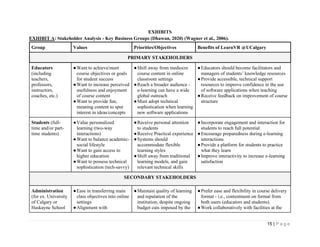
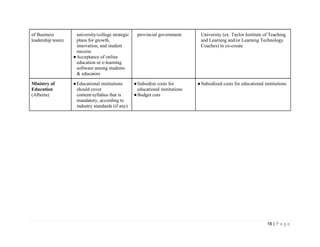
To ensure the viability of our idea, we recognize the following stakeholders: educators (including
teachers, professors, instructors, coaches); students (university/college); educational institutions;
and the Ministry of Education of Alberta. Refer to Exhibit A.
2.2 SWOT Analysis
The following is a SWOT Analysis to examine the current e-learning platforms, resources
provided, and procedures at the University of Calgary.
Strengths:
Upon declaration of the pandemic, the Taylor Institute of Teaching and Learning at the
University of Calgary developed new processes over two weeks to ensure the continuation of
teaching and learning (Fedoruk, et al., 2021). To elaborate, the Taylor Institute fits within the
profile of the University’s Vice-Provost (Teaching and Learning) and consists of the following
teams: Strategic Operations; Academic and Research; Learning Technology and Design; and
Experiential Learning team (Taylor Institute of Teaching and Learning, 2021).
We assume the learning technology and design team was at the forefront in developing the first
of its kind, Learning Technologies Production Coaches (LTPC) at the University. This group
consisted of graduate students or ‘Tech Coaches’ who provided direct technical support to
faculty during the transition to online course delivery (Fedoruk, et al., 2021) (A. Anowai & C.
Kalenga, personal communications, November 18, 2021). We believe the involvement of such
student leaders contributed to the Taylor Institute's work in developing the appropriate resources.
In a recent reflection report by the Taylor Institute and Learning Technology Coaches, the phrase
‘Students as Partners’ or SaP was identified to categorize their approach. This co-creation of
resources is in line with the concept of design thinking, where problem solvers are encouraged
to empathize with end-users and define the problem accordingly.
3 | P a g e
Moreover, students at the University of Calgary also took a leadership approach in advocating
for their learning needs. For example, the Students’ Union at the University actively advocated
for student learning needs and resources. As such, the University’s President and Vice-Provost
have conducted countless consultations pertaining to e-learning issues - including academic
misconduct/integrity, and the potential inclusion of e-proctoring technology (Students’ Union,
n.d.). These consultations are indicative of how senior leadership at the University directly
connected with student leaders on the strategic direction of the e-learning methods employed.
Weaknesses
Given the sudden switch of all classes to online mediums was a disruption, many professors and
educators have shared their concerns. At the University of Calgary, professors have cited a trend
between decreasing marks on assessments due to lack of class engagement. Professors are also
discouraged by the increasing number of “black boxes” during Zoom calls and the lack of
student interaction in online classrooms (S. Li, personal communication, November 19, 2021).
Similar to many high school teachers in Alberta, the University’s educators have also struggled
to keep up with the technological demands (Edwardson, 2021). Reportedly, academic
misconduct issues have also been on the rise across Alberta schools and universities. In this case,
the online learning platform enables students to connect with other peers (Edwardson, 2021) (S.
Li, personal communication, November 19, 2021). For example, associate professor at the
University of Calgary, Sarah Eaton, stated the possibility of companies offering services to
students in the form of doing assignments for them or acting as impersonators to tests on behalf
of students (Edwardson, 2021). These incidents impact the University’s reputation, and its
mission to foster ethical leadership among students.
On the other hand, students have also spoken up about the concerns surrounding online
education. In a faculty-wide survey at the Haskayne School of Business, over 67% of students
ranked the transition to online learning at three or lower on a linear scale (with one being not
‘effective or efficient’ and five being ‘excellent’) (Koehler, 2020). Anxiety levels and mental
health concerns among students have been reported to increase across all faculties at the
University (Koehler, 2020). With this increase in isolation and loneliness (Robinson, 2020),
educational efficacy takes an impact from the lack of presence (Sanchez-Cabrero et al., 2019).
Moreover, in a survey conducted for this project, students stated online learning poses difficulty
in concentrating in courses for long periods of time. These comments might refer to the ‘Zoom
fatigue’ experienced, due to sustained hours in front of computer screens. University students
have also stated that group projects are difficult to coordinate when attending classes virtually.
Opportunities
Online learning is no more an option; it is a necessity (Dhawan, 2020). For example, at
universities in China, online education has increased exponentially at the onset of the pandemic
4 | P a g e
(Dhawan, 2020). The explosion of technology during this time period indicates that universities
should grab the opportunity to innovate their traditional teaching and learning approaches.
In fact, Associate Professor at the Mount Royal University (MRU), Erik Christiansen, mentioned
that VR solves the problem of making social connections in a classroom setting, while also
providing instructors and students with an opportunity to re-create face-to-face classes and
bringing people from all over the world (E. Christiansen, personal communication, November
29, 2021). He also mentions how integrating VR in classroom settings prepares students for the
job market, where industry demands technical expertise and skills in navigating new
technologies (E. Christiansen, personal communication, November 29, 2021). Thus, increasing
market demand for e-learning is an opportunity for start-ups and educational institutions to create
change and disruption in the traditional educational sector.
To further emphasize the opportunities presented by VR, a study conducted on a group of
pharmacy students by Coyne et al. (2018) returned hugely optimistic results with a plethora of
potential improvements over traditional education. Students who participated in this team-based
learning (TBL) activity reported gains in immersion and communication. In fact, some features
offered in VR were able to transcend in-person communication, such as the ability to draw in 3D.
A majority of these students agreed that they would choose a VR TBL activity over current
online methods and even that they would be less likely to withdraw from a course offered in VR.
If nothing else, this study found that students enjoy a VR learning environment and would be
eager to take a course offered in this fashion (Coyne et al., 2018).
Current distance education has already uncovered the gains in “equitable quality and inclusive
education” (Mackenzie et al., 2021). However, interactive elements and “depth of interaction”
have taken a backseat in this current format (Mackenzie et al., 2021). While the current online
format has expanded the width of communication in some areas - namely video lectures
accessible across time zones and borders, it has also been constrained in other ways such as labs
and team-based discussion. This is undoubtedly the next step in the evolution of distance-based
learning (Mackenzie et al., 2021) (Coyne et al., 2018)
Threats
Due to the pandemic, several post-secondary institutions switched to an online learning format
because it was the only option. Yet, during these unprecedented times, the concern is not about
whether online teaching-learning methods can provide quality education; rather how academic
institutions will be able to adopt online learning in such a massive manner (Dhawan 2020). Thus,
it is vital that educational institutions adapt to the changing technological needs and demands, so
as to maintain their national and/or international reputation. Students who have experienced VR
learning are enthusiastic about taking more courses in a similar format; this suggests institutions
who adopt early will see a rise in prestige among their peers (Coyne et al., 2018). Proper tools,
5 | P a g e
including a stable internet connection and necessary technical skills (among students and
educators), are also required for a successful e-learning experience (E. Christiansen, personal
communication, November 29, 2021).
Lastly, implementing new forms of immersive technology for teaching and learning is an
expensive undertaking at a large scale. This indicates better-funded post-secondary institutions
might have an edge and be leaders in this field. Tony Chaston, an associate professor at MRU,
has also mentioned the risk of institutions missing out on this opportunity. He stated, if post-
secondary institutions do not have immersive technologies in place by 2030, they could
experience a negative brand image, reputation, and may not attract good student talent.
3.0 Discussion of Alternatives
3.1 Insights from Students & Educators
To empathize with the direct stakeholders involved in e-learning platforms, our team conducted
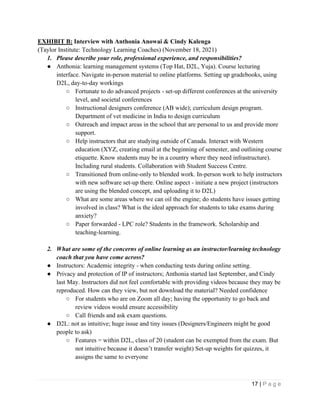
interviews with University staff and educators (Exhibits B – E). On the other hand, we
conducted a survey to gain student insights about e-learning at the University of Calgary.
First, we found that educators at the University of Calgary initially struggled with the transition
to online courses. They needed assistance in setting up new software (i.e., Zoom, during the early
days of the pandemic and online learning). It was also challenging for educators to interact with
students outside of the country or have different time zones; thus, they needed proper
infrastructure for consistent communication with out-of-range students. Technology Coaches,
like Anthonia and Cindy, were at the forefront to ease this transition and provide professors with
adequate resources to get by. However, they did note that online learning was not perfect, due to
the nuances of maintaining a smooth teaching session. For example, educators struggled to
manage supplementary technologies, like Top Hat, D2L, Jamboard, etc., while operating classes
via Zoom. They hoped to have all these supplementary technologies on one platform, and not
have to ‘juggle’ between Apps. Anthonia and Cindy also mentioned the specific needs of
language classes, where student engagement is vital to comprehend and speak the language. In
these ‘engagement-heavy classes’, instructors struggled to connect with students directly in the
online platform, and identify which students needed help (A. Anowai & C. Kalenga, personal
communication, November 18, 2021).
In addition to technology-related issues, we also discussed with an engineering professor, who
teaches a capstone course at the Schulich School of Engineering. His concerns pertained to the
trends in his online classes, where student disengagement has led to decreasing grades or results
on quizzes and similar timed assessments. He identified a potential factor to be the ‘too much
flexibility’ and ‘limited discipline’ among students taking online or asynchronous classes. We
asked him if VR technologies could help with improvements in student engagement - here, the
professor disagreed, noting that external factors (like student discipline) need to be resolved first
6 | P a g e
(S. Li, personal communication, November 19, 2021). On the contrary, Technology Coaches
Anthonia and Cindy agreed, stating that VR could provide an avenue for an integrated teaching
experience and foster a more successful blended or flipped classroom teaching.
Second, we also examined student insights through a survey via a survey circulated among
networks and the University sub-reddit (Refer to Exhibit F). As of December 7, 2021, we
received over 23 responses and still counting. These students recognized the benefits of online
learning, such as the flexibility offered, convenience as per their schedule, reduction in
travel/commute time, and ability to readily access online learning material. Yet, there were
several concerns raised on the online teaching practices at the University. A comment raised was
on the inability to connect with content conveyed; here, we assume this might be due to the lack
of student-teacher relationship building. Another response referred to how group projects are
difficult, and we assume this could be from the lack of student connection building on the current
learning platform, i.e., Zoom. Similar to educators, students also mentioned the impact of ‘Zoom
fatigue’, which hinders their motivation and class engagement.
Furthermore, we will also refer to similar solutions adopted at nearby institutions; for example,
MRU’s VR course offering (Glenn, 2021) (E. Christiansen, November 27, 2021) (T. Chaston,
December 8, 2021).
3.2 Alternatives Considered
The following are some of the possible solutions to promote and enhance interactive online
learning methods at the target educational institution:
3.2.1 VR Chat Rooms: To increase interaction with peers and simulate in-person social activity,
VR chat rooms can be developed with 3D models of the students’ physical classrooms, allowing
students to “sit” in the classroom through virtual avatars as though they were all physically there.
Students would be able to access this through any device (Zimmerman, 2019).
Pros: Increase interactivity in a virtual environment and endless capabilities with technology.
Cons: Lacks the “physical” interaction.
3.2.2 Use of VR Headsets: Use of VR chat rooms, but only accessible through VR headsets.
Pros: Further increase in interactivity and “physical” activity.
Cons: Expensive cost to purchase.
3.2.3 Open Education Resources: More interactive activities and multimedia resources can be
built into Open Education Resources (OERs). To elaborate, OERs provide affordable and
accessible teaching resources to students under an open license and under the public domain
(UNESCO, n.d.).
Pros: Affordable and easily accessible learning materials.
Cons: Talent to create the OER and regular upkeep of materials (e.g., checking online links are
still valid).
7 | P a g e
3.2.4 Educational Games: Fun browser games to supplement class materials. An example for
younger children is the website, CoolMath4Kids.
Pros: Increased engagement and enjoyment in learning activities.
Cons: Talent and labour to develop games to meet criteria.
3.2.5 Pop Culture Figures: Famous figures used to foster classroom engagement (copyright
would need to be taken into consideration) or a new persona could be created. This would be
effective for younger students (e.g., using Dora as a figure to teach or create new fictional
characters) (Klein, 2019).
Pros: Increased engagement and excitement from students.
Cons: Talent and labour to create character and content. May need to purchase rights for use of
popular characters.
3.2.6 Better video production: Higher-quality production in video lectures can improve
engagement (e.g., YouTube educational channels, Vsauce, Bill Nye, Cells at Work, etc.).
Pros: Easy to learn video editing and increase students’ consumption of materials.
Cons: Time and labour, quality of production depends on the skill.
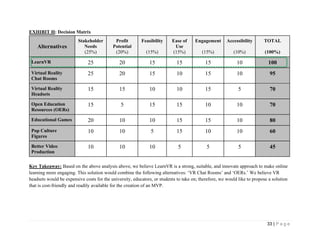
3.3 Decision Criteria: To determine the appropriate course of action, we have considered the
following factors as part of our decision analysis: compliance with stakeholder needs/interests
(25%), profit potential (20%), feasibility (15%), easy-to-use technology (15%), student-educator
engagement (15%), and accessibility (10%). Refer to Exhibit H for scoring for each alternative.
4.0 Business Model
4.1 The Solution
Our recommended solution is LearnVR, a virtual world learning platform designed for educators
to increase engagement with students through interactive virtual activities. LearnVR allows
educators to design classrooms and customize other learning environments to their needs to
accelerate learning in an engaging and “hands-on” approach. Through the VR world, students
can walk around their classrooms via their VR Headset or personal computer, simulating a real
classroom filled with students.
Interaction with objects and gamified learning activities can be added into classrooms at the
educator’s request. Standard object interaction includes, but is not limited to, writing on virtual
whiteboards, playing videos and presentations on the whiteboard, interacting with tables and
chairs, and accessing “paper” assignments. Gamified learning activities are created based on
requirements provided by the educators to our developers, who create all customizations for the
VR worlds. The VR worlds will be accessible on a personalized OER for each class to provide
easy access to the virtual classroom and online supplement materials in one place.
8 | P a g e
4.2 Early Adopters
Given the University of Calgary hosts over 33,000 undergraduate and graduate students, with
over 1,800 academic staff, it is vital for us to segment this population (University of Calgary,
2021). For ease of testing our solution, we will primarily target the undergraduate student
population, as this makes up the majority of the student population. To determine the appropriate
early adopter group, we have segmented the student body into 5 groups and 3 groups for
academic staff.
For the undergraduate student body, we have segmented groups based on a study by the
Parthenon Group and Ernst & Young in the United States. These segments include aspiring
academics; coming-of-age; career starters; career accelerators; industry switchers; and academic
wanderers (Ladd et al., 2014). We believe the appropriate personas or segments for the
University of Calgary would be the coming-of-age and career starter students. First, the coming-
of-age students have the luxury of taking time to figure out their passion and are involved in a
variety of activities, without knowing where exactly it will lead them (Ladd et al., 2014). Second,
the career starter students are job-oriented and use college/university education to advance their
career prospects. Additionally, targeting these two groups considers how both aim to develop
skillsets to excel in the job market; this was also noted by E. Christiansen.
On the other hand, for educators, we have identified three segments among the academic staff,
who focus on research & development; scholarship; and teaching. Given the scope of our
recommendation, we will target the teaching segment, and particularly instructors and associate
professors. We believe these groups are more open to innovative teaching models; unlike tenured
professors who focus on traditional teaching practices. This was also noted by E. Christiansen
when asked about why universities or post-secondary institutions are hesitant to innovate.
Given the variability in class sizes, we will primarily target courses that consist of senior students
(i.e., third year and above), with class sizes of around 20-25 students. We also want to target
courses that have a heavy focus on practical learning experience and group engagement.
However, course names and codes change on a regular basis; thus, we hope to work
collaboratively with the Taylor Institute of Teaching and Learning and the Technology Courses
to find appropriate courses for the testing of our solution.
4.3 Unique Value Proposition
The unique value proposition (UVP) is a concise, straight-to-the-point statement about the
benefits our platform offers to users; it is an explanation of what makes our platform different
(YEC, 2019). Three features that differentiates LearnVR are:
1) The ability for users to create customized, interactive classrooms
2) Integrated VRChats allows users to create social networks for their classes
3) No requirement for VR headsets; thus, making the platform accessible to all users
9 | P a g e
4.4 Pricing Strategy
Our recommendation will have a buyer-user model. Here, the buyer would be the post-secondary
institution, whereas users would be the educators and students. However, as noted previously,
adopting VR-based technologies are expensive, due to the rapid developments which could lead
to obsolescence. We were recommended by E. Christiansen to have the users initially pay for the
VR platform and resources; this model is similar to how MRU rolled out its pilot VR course
among senior Psychology-major students (Glenn, 2021). Additionally, our solution does not
require users to have a VR headset to access the learning platform; this reduces the costs related
to acquiring the technical equipment and other barriers to using the platform.
As such, we believe a subscription-based pricing model would be appropriate for our platform.
Our pricing model would be similar to how Zoom (another online teaching and learning
substitute) charges its users for freemium services. This provides users access to basic services
free of charge, but money is charged for additional desired features or services to expand the
functionality and use of the platform. We will offer a free subscription model for those users who
want to participate in learning sessions for at most 2 hours/day or one class/per day. The free
platform will only allow for 20 users to access the platform per class. Given our freemium model
is represented through our prototype, the limited features offered include accessing VR chats and
creating online networks within a classroom setting.
However, our premium service will have two tiers. The first tier will charge users on a monthly
basis to access all tools of the platform (i.e., accessing VR chats, unlimited usage, creating
networks, interactive whiteboards, gamified learning activities). From the educators’ perspective,
they can only use this platform for approximately 25-50 users at any given time or class.
Students will be charged $5/month and educators will be able to access LearnVR through
university-wide plans charged at $1,250/month. The second tier will charge users on an annual
basis, and they will have access to all platform tools. Here, from the educators’ perspective, they
can use this option to host large classroom sessions and/or webinars for over 50 students.
Students will be charged $60/year and universities at $15,000/year. These prices are competitive
to interactive learning substitutes, like Top Hat ($48/year) and Zoom (est. $16,000+/year) (Top
Hat, 2021; Zoom, 2021). Although we have not reached the stages for the first and second-tier
models in our prototype, we believe the freemium model is adequate to gain feedback.
When the users (i.e., educators and students) create an account with our platform, they will be
required to sign-up as one of the two groups. Since educators will be the main host of the
classroom setting, they will have more authority on controlling the session, creating VR Worlds,
and customizing the space.
10 | P a g e
4.5 Feasibility Analysis
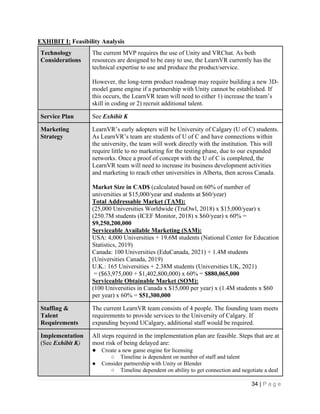
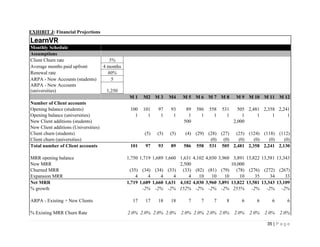
To support the feasibility of our solution, we have conducted an analysis on the following:
technology considerations, product/service marketplace, marketing strategy, staffing and talent
capacity, implementation, and financial projections. Refer to Exhibit I and J.
Moreover, when chatting with E. Christiansen, we also discussed how the Theory of Innovative
Disruption by Clayton Christensen plays a role in this situation - this phenomenon refers to
how innovation transforms an existing market or sector by introducing simplicity, convenience,
accessibility, and affordability where complication and high cost are status quo (Christensen
Institute, 2021). However, VR technologies are expensive and unscalable at educational
institutions currently. Due to this reason, Zoom technologies have been used to handle large
courses in an inexpensive manner. VR technologies are expensive, inefficient (i.e., low battery
life), and have limited power (E. Christiansen, personal communication, November 29, 2021).
For this reason, these VR technologies challenge established software and technology by
entering at the bottom of the market, with low margins, and eventually moving upwards.
4.6 Key Metrics/Implementation
To track the growth and development of LearnVR’s platform, we have created a 6-month
implementation plan. This plan acts as key metrics or checkpoints for our team to test out the
prototype and make appropriate adjustments. Refer to Exhibit K for the implementation plan.
5.0 Prototype and Testing
5.1 Use of Technology
5.1.1 Unity: Unity is a game engine that allows users to create 3D multimedia including but not
limited to: games, animations, and film. Unity was used to create the VR world as an MVP.
5.1.2 VRChat: VRChat is an online game that allows players to interact with each other using 3D
players in 3D worlds and is integrated with Unity. VRChat was used to host the VR world
created for the MVP and allows invited users to access the world for testing.
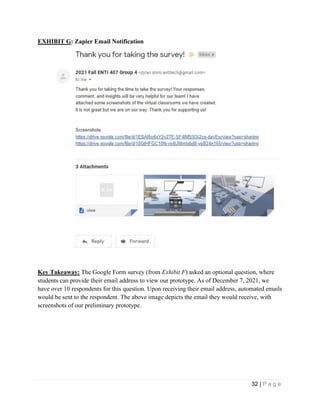
5.1.3 Google Forms & Zapier: Google Forms is a survey software and was used to collect
information from respondents. Zapier was used to send automated email screenshots of our
prototype to those who responded to our survey. (See Exhibit F & G)
5.1.4 Weebly: Weebly is a web hosting service. This software was used to create the OER that
hosts access to the VR World and supplement materials to the class. (See Exhibit L)
11 | P a g e
5.2 Minimally Viable Product
An MVP is a version of a new product which allows a team to collect the maximum amount of
validated learning about customers, with the least effort (Ries, n.d.). Our MVP was created using
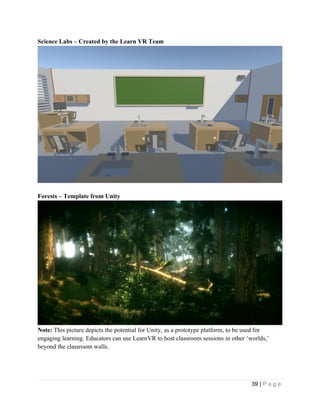
Unity and free assets available on the Unity Assets Store. Prototypes have been created for the
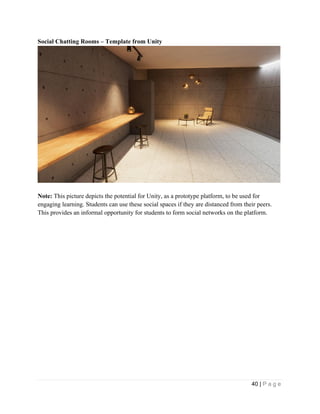
following: Traditional Classroom, Science Lab, Forest/Outdoor Activities, and Social Chatting
Areas. (See Exhibit M). The VR World created for the Traditional Classroom is accessible for
testing on VRChat, where users will be able to walk around in the virtual classroom. Users are
not able to interact with objects on the MVP at this stage.
5.3 Testing
The MVP is available for testing on VRChat. See below for instructions to test:
1. Download and create an account on Steam.
2. Once downloaded, open the Steam desktop app and download VRChat (can be searched
in the Store on Steam).
3. Once in VRChat, access the VR World invite. (See Exhibit L)
Given the VR World’s limited capabilities (users are only able to walk around the classroom)
and the process to access the world, limited testing was conducted with only the LearnVR team
with VRChat. Survey respondents were able to view photos of the prototype to provide feedback.
5.4 Feedback
Due to limited features in the MVP, testing was only conducted by the LearnVR team and two
additional public testers (i.e., friends of the LearnVR team). See below for feedback given.
1. More realistic features/classrooms (as current MVP consist of basic assets).
2. Additional interaction features and premade avatars (e.g., interaction with peers, ability for
hand gestures during presentations, ability to sit in chairs, ability to use virtual pen and paper,
avatars created in the likeliness of the student/user).
3. Ability to move outside the room and the VR world containing the greater university or more
rooms.
6.0 Competitive Analysis
6.1 Market Demand
Through a survey, we were able to find that many students at the University of Calgary are
frustrated with the existing online system. Some of the problems commented by students include
difficulty to focus, lack of engagement, boring lectures, lack of communication with the
instructors, and the feeling of disconnectedness. Although these problems make online learning a
painful experience, some students do still prefer online learning, and some even need online
learning to be continued, due to the long-lasting pandemic, which does not show signs of getting
any better. Over 70% of students in the survey asked for more interaction in online classes. (See
Exhibit F for summary)
12 | P a g e
6.2 Market Alternatives/Substitutes
Currently, the most common tool used among University of Calgary students/educators for
online learning is Zoom. It is a freemium platform and has established contracts or partnerships
with post-secondary institutions, like the University. For students and educators, the accounts are
paid for by the university, and offers little to no barriers. However, Zoom is a video conferencing
application, and it is not a dedicated learning tool. It does not have helpful or customizable
features specific for the education sector.
Other substitutes or supplementary tools for online engagement is Top Hat; a quiz tool used
broadly for in-class pop quizzes. Top Hat also includes a survey tool which is used to measure
real-time class participation and increasing class engagement. Although this is not in the VR
space, educators have used this platform at UCalgary to facilitate student engagement over
online classes (Anowai & Kalenga, personal communication, November 18, 2021).
Another substitute includes already existing VR education programs which are run by specific
online learning institutions, such as Richmond University. Another potential competitor in the
market is ClassVR. They provide virtual theme parks for virtual field trips for elementary and
middle school students. They are developing simple, effective and innovative solutions to
classroom challenges. (ClassVR, 2021).
6.3 Porter’s Five Forces
6.3.1 Threat of New Entrants
As demand and market for online learning increase more companies develop new online learning
tools and systems, and educational institutions attempt to implement new systems that will bring
a better online learning experience. The threat of new entrants in the online learning tool industry
includes loyalty of the educational institution, instructor, and students. As an institution
implements an online learning system, all instructors and students will start using that tool. When
such tools are used for the first time and as users get more comfortable with one system, we are
able to create loyalty. Therefore, we have a first mover advantage. Another threat of new entrants
will be the existence of personal experiences to the problems. Given our team is also comprised
of current UCalgary students who experienced the drastic transition from in-person to online
classes, we are able to apply the problems personally experienced and able to empathize with
others effectively.
6.3.2 Bargaining Power of Suppliers
The bargaining power of suppliers is very high due to the low number of suppliers of such online
learning services. However, we believe that the number of services will increase as more online
learning becomes a standard.
13 | P a g e
6.3.3 Threat of Substitute Products
There is very little threat of substitute products at the moment, as online learning has been
around for a long time but has not seen a significant development from Zoom. Currently, Zoom
provides a simple, inexpensive, and easy experience for both instructors and students (E.
Christiansen, personal communication, November 29, 2021); yet there is continuous Zoom
fatigue and disengagement among participants (S. Li, personal communication, November 19,
2021). Top Hat is another example of an online learning tool; however, it shows limitations to
what it can do other than real time surveys or quizzes. Top Hat can be a supplementary tool for
instructors to use for more engagement but shows lack of features.
Additionally, we believe the in-house development of LearnVR will help reduce our costs and
provide access to relevant subject-matter experts. This will also enable the University to enhance
its reputation in the education-technology space; thereby providing them an opportunity to be a
leader and pioneer for change.
6.3.4 Bargaining Power of Buyers
Bargaining power of buyers is high, as one may just choose to give up on online learning
engagement and choose a dry and non-interactive online learning. We recognize there are some
individuals who do prefer the current style of online learning as they do not look for engagement
in online classes, they look for efficiency in the delivery of the course materials. The bargaining
power is also supported by the burden of the users to pay for additional equipment for better
experience of our solution. Moreover, our solution of virtual classrooms may be uncomfortable
for some users, as they may experience digital 3D space with dizziness and simulation sickness.
6.3.5 Rivalry Among Existing Competitors
Although we are providing a solution for online learning which remains to be a space where it
lacks innovation, other competitors like Microsoft Teams are preparing a launch of VR and AR
implementation into their platform (Stein, 2021). This shows other companies already exist in
the market and are aiming towards more engagement in the online space through VR and
augmented reality (AR) technologies. Rivalry among existing competitors is forecasted to
become higher in the near future. In terms of virtual space, Facebook also shows great potential
with their development of the ‘Metaverse.’ Here, Meta brings “a way to interact and
communicate across geographic locations (McEwan, 2021). It is a digital space where almost all
real-life elements are transitioned into digital and virtual space. Since Facebook is a well-
established company, with an international presence, there is a possibility for it to enter the
educational system. However, we believe due to its current reputation in the media from recent
data breaches and whistleblower, it may not be successful in the education space. Facebook has
been targeted by many cyber-attacks and shown that it is very vulnerable in terms of protecting
personal data; this will make educational institutions hesitant to use systems made by Facebook.
14 | P a g e
7.0 Conclusion
Online learning has become a standard in post-secondary education, to a point where
“universities [are] offering more than 10 online degrees out of the top 100 worldwide from the
QS Rankings list.” (Pop, n.d.) This trend will continue, even under the circumstance that the
pandemic will get better, the benefit of flexibility of online learning will make both students and
instructors want the option of online learning. The problems of online learning will continue and
there will be the desire for the quality of online learning to come up to the level of in-person
learning, which can be achieved with our solution of LearnVR. Our team will continue to pursue
the idea of LearnVR until we can achieve a reality where all online learning can become
engaging and effective.
15 | P a g e
EXHIBITS
EXHIBIT A: Stakeholder Analysis - Key Business Groups (Dhawan, 2020) (Wagner et al., 2006).
Group Values Priorities/Objectives Benefits of LearnVR @UCalgary
PRIMARY STAKEHOLDERS
Educators
(including
teachers,
professors,
instructors,
coaches, etc.)
●Want to achieve/meet
course objectives or goals
for student success
●Want to increase perceived
usefulness and enjoyment
of course content
●Want to provide fun,
meaning content to spur
interest in ideas/concepts
●Shift away from mediocre
course content in online
classroom settings
●Reach a broader audience -
e-learning can have a wide
global outreach
●Must adopt technical
sophistication when learning
new software applications
●Educators should become facilitators and
managers of students’ knowledge resources
●Provide accessible, technical support
resources to improve confidence in the use
of software applications when teaching
●Receive feedback on improvement of course
structure
Students (full-
time and/or part-
time students)
●Value personalized
learning (two-way
interactions)
●Want to balance academic-
social lifestyle
●Want to gain access to
higher education
●Want to possess technical
sophistication (tech-savvy)
●Receive personal attention
to students
●Receive Practical experience
●Systems should
accommodate flexible
learning styles
●Shift away from traditional
learning models, and gain
relevant technical skills
●Incorporate engagement and interaction for
students to reach full potential
●Encourage preparedness during e-learning
interactions
●Provide a platform for students to practice
what they learn
●Improve interactivity to increase e-learning
satisfaction
SECONDARY STAKEHOLDERS
Administration
(for ex. University
of Calgary or
Haskayne School
●Ease in transferring main
class objectives into online
settings
●Alignment with
●Maintain quality of learning
and reputation of the
institution, despite ongoing
budget cuts imposed by the
●Prefer ease and flexibility in course delivery
format - i.e., contentment on format from
both users (educators and students).
●Work collaboratively with facilities at the
16 | P a g e
of Business
leadership team)
university/college strategic
plans for growth,
innovation, and student
success
●Acceptance of online
education or e-learning
software among students
& educators
provincial government. University (ex. Taylor Institute of Teaching
and Learning and/or Learning Technology
Coaches) to co-create
Ministry of
Education
(Alberta)
●Educational institutions
should cover
content/syllabus that is
mandatory, according to
industry standards (if any)
●Subsidize costs for
educational institutions
●Budget cuts
●Subsidized costs for educational institutions
17 | P a g e
EXHIBIT B: Interview with Anthonia Anowai & Cindy Kalenga
(Taylor Institute: Technology Learning Coaches) (November 18, 2021)
1. Please describe your role, professional experience, and responsibilities?
● Anthonia: learning management systems (Top Hat, D2L, Yuja). Course lecturing
interface. Navigate in-person material to online platforms. Setting up gradebooks, using
D2L, day-to-day workings
○ Fortunate to do advanced projects - set-up different conferences at the university
level, and societal conferences
○ Instructional designers conference (AB wide); curriculum design program.
Department of vet medicine in India to design curriculum
○ Outreach and impact areas in the school that are personal to us and provide more
support.
○ Help instructors that are studying outside of Canada. Interact with Western
education (XYZ, creating email at the beginning of semester, and outlining course
etiquette. Know students may be in a country where they need infrastructure).
Including rural students. Collaboration with Student Success Centre.
○ Transitioned from online-only to blended work. In-person work to help instructors
with new software set-up there. Online aspect - initiate a new project (instructors
are using the blended concept, and uploading it to D2L)
○ What are some areas where we can oil the engine; do students have issues getting
involved in class? What is the ideal approach for students to take exams during
anxiety?
○ Paper forwarded - LPC role? Students in the framework. Scholarship and
teaching-learning.
2. What are some of the concerns of online learning as an instructor/learning technology
coach that you have come across?
● Instructors: Academic integrity - when conducting tests during online setting.
● Privacy and protection of IP of instructors; Anthonia started last September, and Cindy
last May. Instructors did not feel comfortable with providing videos because they may be
reproduced. How can they view, but not download the material? Needed confidence
○ For students who are on Zoom all day; having the opportunity to go back and
review videos would ensure accessibility
○ Call friends and ask exam questions.
● D2L: not as intuitive; huge issue and tiny issues (Designers/Engineers might be good
people to ask)
○ Features = within D2L, class of 20 (student can be exempted from the exam. But
not intuitive because it doesn’t transfer weight) Set-up weights for quizzes, it
assigns the same to everyone
18 | P a g e
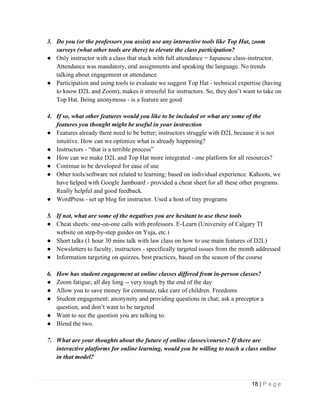
3. Do you (or the professors you assist) use any interactive tools like Top Hat, zoom
surveys (what other tools are there) to elevate the class participation?
● Only instructor with a class that stuck with full attendance = Japanese class-instructor.
Attendance was mandatory, oral assignments and speaking the language. No trends
talking about engagement or attendance.
● Participation and using tools to evaluate we suggest Top Hat - technical expertise (having
to know D2L and Zoom), makes it stressful for instructors. So, they don’t want to take on
Top Hat. Being anonymous - is a feature are good
4. If so, what other features would you like to be included or what are some of the
features you thought might be useful in your instruction
● Features already there need to be better; instructors struggle with D2L because it is not
intuitive. How can we optimize what is already happening?
● Instructors - “that is a terrible process”
● How can we make D2L and Top Hat more integrated - one platform for all resources?
● Continue to be developed for ease of use
● Other tools/software not related to learning; based on individual experience. Kahoots, we
have helped with Google Jamboard - provided a cheat sheet for all these other programs.
Really helpful and good feedback.
● WordPress - set up blog for instructor. Used a host of tiny programs
5. If not, what are some of the negatives you are hesitant to use these tools
● Cheat sheets: one-on-one calls with professors. E-Learn (University of Calgary TI
website on step-by-step guides on Yuja, etc.)
● Short talks (1 hour 30 mins talk with law class on how to use main features of D2L)
● Newsletters to faculty, instructors - specifically targeted issues from the month addressed
● Information targeting on quizzes, best practices, based on the season of the course
6. How has student engagement at online classes differed from in-person classes?
● Zoom fatigue; all day long -- very tough by the end of the day
● Allow you to save money for commute, take care of children. Freedoms
● Student engagement: anonymity and providing questions in chat; ask a preceptor a
question, and don’t want to be targeted
● Want to see the question you are talking to.
● Blend the two.
7. What are your thoughts about the future of online classes/courses? If there are
interactive platforms for online learning, would you be willing to teach a class online
in that model?
19 | P a g e
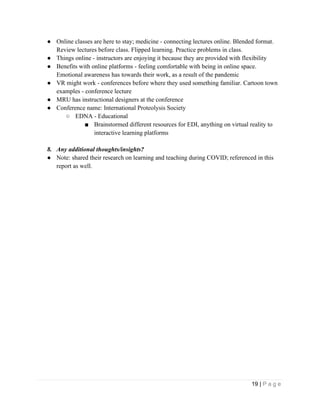
● Online classes are here to stay; medicine - connecting lectures online. Blended format.
Review lectures before class. Flipped learning. Practice problems in class.
● Things online - instructors are enjoying it because they are provided with flexibility
● Benefits with online platforms - feeling comfortable with being in online space.
Emotional awareness has towards their work, as a result of the pandemic
● VR might work - conferences before where they used something familiar. Cartoon town
examples - conference lecture
● MRU has instructional designers at the conference
● Conference name: International Proteolysis Society
○ EDNA - Educational
■ Brainstormed different resources for EDI, anything on virtual reality to
interactive learning platforms
8. Any additional thoughts/insights?
● Note: shared their research on learning and teaching during COVID; referenced in this
report as well.
20 | P a g e
EXHIBIT C: Interview with Simon Li
(Associate Professor, Schulich School of Engineering) (November 19, 2021).
1. Please describe your role, professional experience, and responsibilities?
● Capstone design course
● Heating cooling system for buildings
● This semester, teaching new course of energy system
● Programming,
● How to manage and deliver the capstone course - like a module (implementation plan)
(free to use, check out)
● Teaching style is not different from colleagues
2. What are some of the concerns of online learning as an instructor/learning technology
coach that you have come across?
● Starting point at COVID (dramatic point) (March 2020); Capstone instructor - perfect
time to interrupt project
● Transition was chaotic - anticipation of how the pandemic would be? Optimistic,
anticipate that things would get better.
● Transition from interruption to September 2020; described as completely online for the
academic year. Considered as a transition - this semester. September 2020 vs 2021 is
different because of the possible chaos of information (i.e., information overload?)
○ Provincial government - recall as disruption; lockdown
○ Different over the refined period of time
○ Chaos - if something like this happened, students were given lenient grading.
Everyone was on the same boat.
○ People anticipate difficulties - everyone is online (ranging appearance) (Ranging
about the assessment)
■ In-person examination is still effective is what people believe; but we
can’t do that. We need to prepare ahead of it
■ Normal in-person types of things - students agree that the best thing we
could do is find alternative
■ Imagine team meetings on Zoom - much less need for physical prototype;
encourage virtual simulation/product
● Major complaint: Mental health issues; hybrid delivery
○ [blended learning is different hybrid teaching]. Blend activities (with classroom,
but different activities. Worksheet, videos)
■ Hybrid - accommodate in-person and online.
■ Hybrid possesses many challenges. Students perceive - they could have a
choice, either in person or online
■ Students perceive having choices. However, this could be a source of
anxiety for students
21 | P a g e
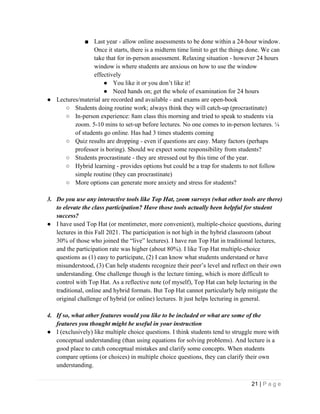
■ Last year - allow online assessments to be done within a 24-hour window.
Once it starts, there is a midterm time limit to get the things done. We can
take that for in-person assessment. Relaxing situation - however 24 hours
window is where students are anxious on how to use the window
effectively
● You like it or you don’t like it!
● Need hands on; get the whole of examination for 24 hours
● Lectures/material are recorded and available - and exams are open-book
○ Students doing routine work; always think they will catch-up (procrastinate)
○ In-person experience: 8am class this morning and tried to speak to students via
zoom. 5-10 mins to set-up before lectures. No one comes to in-person lectures. ¼
of students go online. Has had 3 times students coming
○ Quiz results are dropping - even if questions are easy. Many factors (perhaps
professor is boring). Should we expect some responsibility from students?
○ Students procrastinate - they are stressed out by this time of the year.
○ Hybrid learning - provides options but could be a trap for students to not follow
simple routine (they can procrastinate)
○ More options can generate more anxiety and stress for students?
3. Do you use any interactive tools like Top Hat, zoom surveys (what other tools are there)
to elevate the class participation? Have those tools actually been helpful for student
success?
● I have used Top Hat (or mentimeter, more convenient), multiple-choice questions, during
lectures in this Fall 2021. The participation is not high in the hybrid classroom (about
30% of those who joined the “live” lectures). I have run Top Hat in traditional lectures,
and the participation rate was higher (about 80%). I like Top Hat multiple-choice
questions as (1) easy to participate, (2) I can know what students understand or have
misunderstood, (3) Can help students recognize their peer’s level and reflect on their own
understanding. One challenge though is the lecture timing, which is more difficult to
control with Top Hat. As a reflective note (of myself), Top Hat can help lecturing in the
traditional, online and hybrid formats. But Top Hat cannot particularly help mitigate the
original challenge of hybrid (or online) lectures. It just helps lecturing in general.
4. If so, what other features would you like to be included or what are some of the
features you thought might be useful in your instruction
● I (exclusively) like multiple choice questions. I think students tend to struggle more with
conceptual understanding (than using equations for solving problems). And lecture is a
good place to catch conceptual mistakes and clarify some concepts. When students
compare options (or choices) in multiple choice questions, they can clarify their own
understanding.
22 | P a g e
5. How has student engagement at online classes differed from in-person classes?
● It’s not something I expect… but I want to clarify. The participation of 100% online (as
my experience in 2020-21) was fairly good. I did not see significant drop of student
engagement (e.g., students would answer questions on Zoom chats). However, when
switching to hybrid teaching (as in Fall 2021), I expected that the situation should be
better than 100% online, but I am wrong. I do not know the reason (probably I am still in
the midst of this process). My initial guess is that… when students perceived to have
more options or flexibility (as the case in hybrid teaching), they may feel less obligated to
follow the schedules (and feel that their peers will do the same).
6. What are your thoughts about the future of online classes/courses? If there are
interactive platforms for online learning, would you be willing to teach a class online
in that model?
● Our proposal is not a good idea
● Reality is that schools have been doing online education as a seamless business. And
make good money?
● How do they do operations for online teaching - not brand new because of COVID [based
on tuition money]. Observational - learning is based on interest and motivation.
● Online teaching = they actually regulate the learner behaviour in a strict way. (goes back
to comment on building a routine)
● Devoted time to study - then the complaints may not reach Dean’s office. Students do it
because they HAVE TO - to meet the benchmark for course requirements
● Teachers want to make sure students’ concerns and issues are addressed at the end of
class. What if student is not “there”
● Interactive - is really good on one side of the equation; how to regulate the disciple.
● More regulation = better performance, more discipline
● Examples of online schools: Taking attendance, tied to final grade, request response from
chat, all discussion is graded (if not responded, then they are penalized) [Robertson
College - has some quick review on taking an online class (wife is taking course from
there). Conventional work.
● Could be a mix - if students see the importance of good discipline. At the beginning they
will complain, so they need to see the effect and how it is beneficial for student success.
23 | P a g e
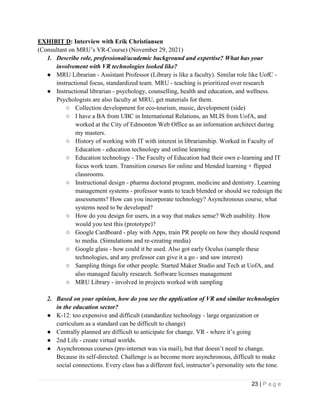
EXHIBIT D: Interview with Erik Christiansen
(Consultant on MRU’s VR-Course) (November 29, 2021)
1. Describe role, professional/academic background and expertise? What has your
involvement with VR technologies looked like?
● MRU Librarian - Assistant Professor (Library is like a faculty). Similar role like UofC -
instructional focus, standardized team. MRU - teaching is prioritized over research
● Instructional librarian - psychology, counselling, health and education, and wellness.
Psychologists are also faculty at MRU, get materials for them.
○ Collection development for eco-tourism, music, development (side)
○ I have a BA from UBC in International Relations, an MLIS from UofA, and
worked at the City of Edmonton Web Office as an information architect during
my masters.
○ History of working with IT with interest in librarianship. Worked in Faculty of
Education - education technology and online learning
○ Education technology - The Faculty of Education had their own e-learning and IT
focus work team. Transition courses for online and blended learning + flipped
classrooms.
○ Instructional design - pharma doctoral program, medicine and dentistry. Learning
management systems - professor wants to teach blended or should we redesign the
assessments? How can you incorporate technology? Asynchronous course, what
systems need to be developed?
○ How do you design for users, in a way that makes sense? Web usability. How
would you test this (prototype)?
○ Google Cardboard - play with Apps, train PR people on how they should respond
to media. (Simulations and re-creating media)
○ Google glass - how could it be used. Also got early Oculus (sample these
technologies, and any professor can give it a go - and saw interest)
○ Sampling things for other people. Started Maker Studio and Tech at UofA, and
also managed faculty research. Software licenses management
○ MRU Library - involved in projects worked with sampling
2. Based on your opinion, how do you see the application of VR and similar technologies
in the education sector?
● K-12: too expensive and difficult (standardize technology - large organization or
curriculum as a standard can be difficult to change)
● Centrally planned are difficult to anticipate for change. VR - where it’s going
● 2nd Life - create virtual worlds.
● Asynchronous courses (pre-internet was via mail), but that doesn’t need to change.
Because its self-directed. Challenge is as become more asynchronous, difficult to make
social connections. Every class has a different feel, instructor’s personality sets the tone.
24 | P a g e
○ VR solves that problem because you can meet up with space (Alt Space) - social network
(bought by Microsoft). Create an avatar and world. Do presentations at real time and be
able to record. Re-create a face-to-face class and bring people from all over the world.
○ How can it be intimate and valuable for education? Face-to-face, very expensive to scale
and need to decentralize education. Headset/display where we can enter a digital world
(Follow-up Question): What about price/costs - how can it be accessible for students?
● Digital Frontier (Psychology Course) at MRU (Tony has experience in the context of
psychology). (AI, and privacy, computer-based ignition; survey course in a VR
environment)
● Tony was interested in VR as a side hobby; and Erik was involved as a consultant on this
project.
● ‘Left the real world’ - digital frontier. Open to 20-25 students. Some equipment available
on campus that students can use (Research Lab and have oculus quests). (Oculus Go does
not support Alt space - need to have a headset to support the App)
● Can’t use that or get from the library, then students are asked to purchase the headset.
OER experience, first-course of its kind can be expensive to test. Maybe have a grant to
get the equipment? VR is changing rapidly, and poor investment to get all equipment and
have it outdated (not like desktop computers)
● Pilot course, limited enrollment, and no other costs. Strive to not add books. Maybe get
used equipment? Same ballpark as price. Purchasing and using a headset and get ready to
use it - leaving the course with a technology and practical experience > textbook is much
more valuable
● Opportunity cost - can’t wait for technology to be cheap, otherwise it will take 7+ years
● What is a good investment - learning to use that technology and having a license is much
more valuable than a textbook?
● Ex.: you need laptop to go to classes and have people. Need to be accessible.
3. Why are educational institutions often hesitant to move away from traditional
classroom teaching methods? How can the shift to innovation online learning
platforms be adopted?
● Depends on individual and institutional culture.
● Vested interest in learning about how to teach. What did you learn and what was different
before and after the course design changes? How do people learn and organize their
lives/notes? (current research and knowledge development in that)
● Academic - doctoral program does not teach people who to ‘do education’
○ Focuses on super-specialization - there are trade-offs. There is a range.
○ Not a lot of room for pedagogical processes
○ Research institute - not incentivized or rewarded (general)
○ Tenure based on publication - question what are people incentive to do
25 | P a g e
○ How can you be rewarded for them (consider COVID)?
○ Hesitant to change because it is a huge machine - online learning (to do that well,
it requires expertise). Consider competition with University of Phoenix and AU -
they invest in teaching and learning
■ For-profit school, but good at teaching online now (Phoenix)
○ High amount of expertise, recruit people, and consider how to attract the people.
Post-secondary should be considered as business, need to consider cost-benefit
analysis and cutting-edge technology
○ Christensen’s Disruption Theory - can’t scale or compete, common example:
routers for internet (Nortel was making switches before). Construction machines
are hydraulic, but before they were
○ VR is a similar format. Zoom is inexpensive and good enough to handle large
courses for now. VR is expensive, and resolution is different in terms of
pixilation. Slow, battery life. Limited to power
○ Technology is still evolving - going to all VR is expensive, and it will become
obsolete. Don’t adopt in large amounts, and they need to do experiments.
○ Think about the skillset required to do online - know how to work on this
platform, how to import slide deck in a VR world and be able to control it,
record….there are several skills required!
■ Needed an operator before for learning pre-internet. We need to have a
similar support system
■ Good at it - need to get experiences from outside
■ Community: Educators in VR (website and conferences)
4. Given the pandemic, what is the future of online learning - specifically in MRU or
Alberta region? Do you think it is less popular among students?
● Inspired students to do something about it (look at press releases)
● Good, positive support, and can run it every year - build word of mouth momentum. May
inspire other people at other institutions to do the same and run similar technologies.
● Uptick in people taking these courses. It is expensive to have students come to courses
● Future of online learning - where should it go? Micro-credential courses - rather than
pursue degrees. Particular skills need to be developed (for example: web development or
project management) - could you do an online learning course and be able to scale it.
● High-level entrepreneurship course - need to take an accounting micro-credential. Have
them stacked and equivalent to one course. Material is standardized, and material is
universal. Increase enrollment and super high-quality lectures, and some exams - but the
course doesn’t do well in seminar format
● Makes sense to look at the course and see if it needs to be bespoke every single time.
What material you NEED to know. Use VR to create a lecture-hall (comes down to the
type of assessment)
26 | P a g e
○ Get the skills on expert writing and need professor feedback. Take it on a course-
by-course basis.
○ Identify what can be scaled up, and double down on the quality of the face-to-face
learning.
5. Our project focuses on introducing VR classrooms based on an OER platform at the
University of Calgary. We hope this will make online learning engaging, while also
providing accessible educational materials. Any insights/feedback?
● Virtual avatar system and join alt-space without a headset. Control with other things.
Don’t need to have a headset, but it is valuable because it can increase connectivity
● Create opportunities for students to build their own learning network? Personal digital
learning network - huge advantage where people can build their own community
● Example: teaching and learning inquiry - looked into community (online forum and self-
assess and apply for certificate). Doesn’t require a lot of maintenance. Maybe someone
can oversee that. Use that platform to create their own groups (discord has that option to
be used in education)
● Some sort of platform where people can meet up - but learning network expands beyond
course boundaries.
● Trusted network of people - where students can fail and be able to learn from it in a safe
space. Need to make it simple for people. Invest time in that network, and graduate with
those connections (consider ENTI - need connections and incentives)
● ‘Digital Native’ - need to teach people how to use the technology, need those
competencies because it is relevant in the industry. Need to tell people that we need to
develop this learning network - need it to graduate.
● Job specific skills vs critical thinking.
27 | P a g e
EXHIBIT E: Interview with Tony Chaston
(Associate Professor, MRU) (December 8, 2021)
1. Describe role, professional/academic background and expertise? What has your
involvement with VR technologies looked like?
• Anthony Chaston – Associate Professor of Psychology at MRU
• 15th
year – 2nd
home
• VR research – PhD is on perception of outdoor spaces; perceptual psychologist (how does
light go into our eye, and how do we process it). Estimating distance, navigate through space
• VR: natural progression – way to provide more realistic outdoor simulations. Take people
outside for experiments and trails (but logistically time consuming and expensive)
• Oculus launch – will go consumer; there is potential and can be realized at the consumer
level. Started off early research: experiments focused on lower stress levels.
• ‘Exposure therapy’ – expose people to situations, so they can work through it.
Nature/outdoor environments lower stress levels. Studying time in the wilderness, reduces
stress. Can we get nature therapy to work in VR? Opportunities to access – for students and
anybody. Easily accessible, and don’t need an appointment.
2. Based on your opinion, how do you see the application of VR and similar technologies in
the education sector?
• Teaching POV: Teaching an entire course on VR, and content is centered around that. In-
and-out of VR (Digital Frontiers course: AI and perception; all emerging technologies and
how we interact with?)
o Human perception and navigation. How to design VR spaces. Dating, social life, and
workplace – can impact humans
o Psychology connection and teach in VR – see impact and role of VR, when people
are VR. Go straight to the activity and practical experience and exposure.
o High level discussion of how to cook, without experiencing the process (analogy)
• Objective: ‘Face-to-Face’ focus on MRU as per small class sizes. With this technology, it is
taking online education, which is poorer quality, and see if there is online education that is
satisfying and has more achievable learning outcomes. Better outcomes – learning and
enjoying the course. (First fully immersive VR course in the world)
• ‘Educators in VR’ group – international community. iLearn – immersive learning network.
• ‘Metaverse’ articles – VR in education is the FUTURE; but its already here
• Dystopian view of VR – makes it dramatic
o VR is highly connected with AI. This is a tool – but it does need to be regulated
▪ Average educational system would not accept Meta or Facebook, but they
would accept VR in class
▪ 2030 – fully VR version of campus; students are expecting to go to classes
live and on the VR campus. Universities can be on the board or be the last to
the party.
28 | P a g e
• Challenge with universities – there is still value with face-to-face talk
o Bureaucracy and approval processes – there needs to be a review and approval
process.
o Funding has to be approved and brought into the calendar – and these take a long
time!
o If universities are not starting now – then they would be way behind, and this impacts
the city as well!
o City of Calgary – technology that is available at university and big business/corporate
office in the city – we are not training students for that market demand. Universities
in Alberta have fallen behind; there is no money – universities of AB.
• What is the impact of teaching this course on education as a whole – what is the bigger
picture?
3. (Follow-up Question): What about price/costs - how can it be accessible for students?
• Created a committee and talked about student issues, and technology access. What is the
average Wi-Fi?
• Platforms: AltSpaceVR – has a 2D interface as well, can use the VR headset (don’t need to
make it mandatory, and give them the choice). Also, for PC and Mac – consider games.
Limited, because there are no ‘hands’ or ‘mobility’
• 2D interface was a backup in case the controller was not working or if the headset was not
working. Good backup – maybe not needed in the future, when VR is much more developed.
• 2D interface helped with marking for assignments and grading.
• Free for students – AltSpace is free to use and access. Ease of access was important. Needed
a platform that was good to teaching tools. Hand icon – controller (click on it)
o “Megaphone” – voice gets louder and have conversations where everyone can hear
each other.
o Educator – sees 3 windows
▪ Controllers (slide remote control)
▪ World Editor – make changes to the virtual world
▪ Participation – shows all the students (microphones, mute, message)
• Make it functional for the course, educator and students!
• No textbook for course – offset the cost for VR headset
a. OER: Educators in VR – we are trying to amass multiple VR Worlds. Build a
catalogue of worlds and make it accessible for educators/students.
- Who is building them, and how to share a license with someone? Giving
shared content
29 | P a g e
4. Why are educational institutions often hesitant to move away from traditional classroom
teaching methods? How can the shift to innovation online learning platforms be adopted?
• Conversation between live, real-life experience is still unique and we can’t simulate that yet
(in VR)
• The live has the ability to understand facial expressions and understand the sense of the
classroom. Self-monitoring and seeing what the tone and attitude is in the surroundings. Get
people to perk and have them engage.
• In VR, avatars are not yet expressive. How can they communicate in that medium? Teaching
them about over exaggerating head nods, and emojis as communication tools. Other students
can do that. It is good for discussion, but not as good for taking notes
• Customize content to work in that medium.
• Not reluctant to move, they move in a slow and gradual manner – nothing happens in less
than 3 years. Universities are willing to have big things to happen – but big things can be
pushed through but need to understand that systems work slowly, and taxpayer dollars need
to be considered.
5. Student feedback and response on the course?
• Informal, anecdotal comments
• Enthusiastic and excited about it! Behavioral design – sample of students is not objective,
and is also biased because they choose to enroll in this pilot course
• ‘Be aware of glitches’ – trying something new, but now looking back it has been running
very smoothly. Events on AltSpaceVR, Educators in VR – umbrella group of over 20 teams
that are working on projects and working with VR in that discipline.
• Using tools and feeling confident
• Students: University official came to the physical lab and VR headset – she met with
students. Some comments mentioned:
o 30-40% would like all their university courses in VR. And why?
▪ Concentrate better than in a live classroom. Less distractions (not wide
peripheral and no sounds or distractions of classroom)
▪ Pretty easy to focus and keep attention engaged.
▪ Hard to take notes – limitation they found. But course design was such that
note-taking was not critical.
▪ Discussion groups and lecture in the first part of the course; then break out
and form small groups to work.
▪ Note: headset need to be charged, so there is break during the class. Then
asked to do some research.
▪ Sending content – meet at campfires. Want slides and pictures for
presentations.
o Travel to other worlds sometimes – teleported as a class where Educators in VR has
built. Created a world that teaches how to make worlds (‘bookmarked it’)
30 | P a g e
o Social media platform to a large extent; build pictures into the world
• Challenges:
o Daily issues b/c of where the technology is at. Media – getting enough content to
discuss. It would be great to do a multimedia interface.
o Biggest challenges – making content in- and-out and make it more accessible.
Research data – surveyed VR professionals, what is the biggest challenge to get into
education
▪ Who is building the content, where is it coming from, and how is it being
integrated into content management systems (i.e., D2L, Canvas)
▪ How do we marry the two tools together?
▪ Development of content.
▪ Someone needs to build that content – content development at this stage, and
where it is starting.
6. Given the pandemic, what is the future of online learning - specifically in MRU or Alberta
region? Do you think it is less popular among students?
• Role of VR – for the last two days. Have a VR version of the course? Students build a VR
World on AltSpace and referred to peer-reviewed articles and connecting course concepts.
Whole class is teleporting and moving around. Why is this cool?
o Creative and interesting way to work on term project
o Form of experiential learning – idea of learning by doing. Hands-on-skills while
learning theoretical skills
o Next day: Tony presented at an iLearn conference, and attend the conference as
avatars, and had photos of virtual worlds. It is being presented at an international
conference.
▪ People from around the world attended the world and had the connections to
make VR setup in the world. Specialized
• Province wants universities to move towards experiential learning. In this course, they were
able to build on the VR World. Building skillsets and teaching a conceptual language.
7. Any insights/feedback?
• What gets cut/saved by the government? Brief discussion on the impact of this stakeholder
group, and its implications on students/educators
o Taxpayers dollars – they have the biggest stake.
31 | P a g e
EXHIBIT F: Student Insights Survey - Responses Summary
As of December 7, 2021, our team received 23 responses via our Google Forms survey.
The survey asked 10 questions regarding online classes and the quality of the current online
learning system. The numerical questions include how many online classes you have taken in
total at the University of Calgary, and On a scale of 1-10, with 1 being extremely negative and
10 being extremely positive, how would you view the online classes at University of Calgary.
The following is a summary of key insights:
● On average, students took 10 online classes for their programs at the University; the
highest number of course being 27 classes by one respondent.
● For the linear scale question, the average score received was 6 in the survey.
● When asked about the general featured enjoyed by students, most responded mentioned
the flexibility offered with online and asynchronous/synchronous learning. Other
respondents mentioned the benefits of reduced costs due to no ‘physical’ books, reduced
commute time and costs.
● The negatives of online learning were regarding lack of communication, engagement,
focus, motivation, coordination of schedules, low quality of teaching, and feeling of
‘wasting money.’
● When asked about which part should be improved, many students chose Zoom.
Responses mentioned how Zoom does not provide enough engagement and wanted more
interaction during classes by using more online tools to make it more like an in-person
experience.
● For another quantitative question, we asked if respondents ever interacted with virtual
reality technology. From this question, approximately 48% stated ‘Yes.’
● We also inquired if respondents have a VR headset. Here, only 3 respondents possessed a
headset. Approximately 70% of the respondents said ‘No’
● When asked if they wanted ‘more freedom’, ‘more discipline’ ‘more interaction’ for
improvements: Over 50% of the responses stated, ‘more interaction,’ 30% ‘more
freedom.’ Other responses also included recommendations such as: engaging teaching
methods adopted by professors, inclusion of creative ideas or course delivery methods.
32 | P a g e
EXHIBIT G: Zapier Email Notification
Key Takeaway: The Google Form survey (from Exhibit F) asked an optional question, where
students can provide their email address to view our prototype. As of December 7, 2021, we
have over 10 respondents for this question. Upon receiving their email address, automated emails
would be sent to the respondent. The above image depicts the email they would receive, with
screenshots of our preliminary prototype.
33 | P a g e
EXHIBIT H: Decision Matrix
Alternatives
Stakeholder
Needs
(25%)
Profit
Potential
(20%)
Feasibility
(15%)
Ease of
Use
(15%)
Engagement
(15%)
Accessibility
(10%)
TOTAL
(100%)
LearnVR 25 20 15 15 15 10 100
Virtual Reality
Chat Rooms
25 20 15 10 15 10 95
Virtual Reality
Headsets
15 15 10 10 15 5 70
Open Education
Resources (OERs)
15 5 15 15 10 10 70
Educational Games 20 10 10 15 15 10 80
Pop Culture
Figures
10 10 5 15 10 10 60
Better Video
Production
10 10 10 5 5 5 45
Key Takeaway: Based on the above analysis above, we believe LearnVR is a strong, suitable, and innovate approach to make online
learning more engaging. This solution would combine the following alternatives: ‘VR Chat Rooms’ and ‘OERs.’ We believe VR
headsets would be expensive costs for the university, educators, or students to take on; therefore, we would like to propose a solution
that is cost-friendly and readily available for the creation of an MVP.
34 | P a g e
EXHIBIT I: Feasibility Analysis
Technology
Considerations
The current MVP requires the use of Unity and VRChat. As both
resources are designed to be easy to use, the LearnVR currently has the
technical expertise to use and produce the product/service.
However, the long-term product roadmap may require building a new 3D-
model game engine if a partnership with Unity cannot be established. If
this occurs, the LearnVR team will need to either 1) increase the team’s
skill in coding or 2) recruit additional talent.
Service Plan See Exhibit K
Marketing
Strategy
LearnVR’s early adopters will be University of Calgary (U of C) students.
As LearnVR’s team are students of U of C and have connections within
the university, the team will work directly with the institution. This will
require little to no marketing for the testing phase, due to our expanded
networks. Once a proof of concept with the U of C is completed, the
LearnVR team will need to increase its business development activities
and marketing to reach other universities in Alberta, then across Canada.
Market Size in CAD$ (calculated based on 60% of number of
universities at $15,000/year and students at $60/year)
Total Addressable Market (TAM):
(25,000 Universities Worldwide (TruOwl, 2018) x $15,000/year) x
(250.7M students (ICEF Monitor, 2018) x $60/year) x 60% =
$9,250,200,000
Serviceable Available Marketing (SAM):
USA: 4,000 Universities + 19.6M students (National Center for Education
Statistics, 2019)
Canada: 100 Universities (EduCanada, 2021) + 1.4M students
(Universities Canada, 2019)
U.K.: 165 Universities + 2.38M students (Universities UK, 2021)
= ($63,975,000 + $1,402,800,000) x 60% = $880,065,000
Serviceable Obtainable Market (SOM):
(100 Universities in Canada x $15,000 per year) x (1.4M students x $60
per year) x 60% = $51,300,000
Staffing &
Talent
Requirements
The current LearnVR team consists of 4 people. The founding team meets
requirements to provide services to the University of Calgary. If
expanding beyond UCalgary, additional staff would be required.
Implementation
(See Exhibit K)
All steps required in the implementation plan are feasible. Steps that are at
most risk of being delayed are:
● Create a new game engine for licensing
○ Timeline is dependent on number of staff and talent
● Consider partnership with Unity or Blender
○ Timeline dependent on ability to get connection and negotiate a deal
35 | P a g e
EXHIBIT J: Financial Projections
LearnVR
Monthly Schedule
Assumptions
Client Churn rate 5%
Average months paid upfront 4 months
Renewal rate 80%
ARPA - New Accounts (students) 5
ARPA - New Accounts
(universities) 1,250
M 1 M2 M 3 M4 M 5 M 6 M 7 M 8 M 9 M 10 M 11 M 12
Number of Client accounts
Opening balance (students) 100 101 97 93 89 586 558 531 505 2,481 2,358 2,241
Opening balance (universities) 1 1 1 1 1 1 1 1 1 1 1 1
New Client additions (students) 500 2,000
New Client additions (Universities)
Client churn (students) (5) (5) (5) (4) (29) (28) (27) (25) (124) (118) (112)
Client churn (universities) (0) (0) (0) (0) (0) (0)
Total number of Client accounts 101 97 93 89 586 558 531 505 2,481 2,358 2,241 2,130
MRR opening balance 1,750 1,719 1,689 1,660 1,631 4,102 4,030 3,960 3,891 13,822 13,581 13,343
New MRR 2,500 10,000
Churned MRR (35) (34) (34) (33) (33) (82) (81) (79) (78) (276) (272) (267)
Expansion MRR 4 4 4 4 4 10 10 10 10 35 34 33
Net MRR 1,719 1,689 1,660 1,631 4,102 4,030 3,960 3,891 13,822 13,581 13,343 13,109
% growth -2% -2% -2% 152% -2% -2% -2% 255% -2% -2% -2%
ARPA - Existing + New Clients 17 17 18 18 7 7 7 8 6 6 6 6
% Existing MRR Churn Rate 2.0% 2.0% 2.0% 2.0% 2.0% 2.0% 2.0% 2.0% 2.0% 2.0% 2.0% 2.0%
36 | P a g e
% MRR Expansion Rate 0.3% 0.3% 0.3% 0.3% 0.3% 0.3% 0.3% 0.3% 0.3% 0.3% 0.3% 0.3%
% Net MRR Churn Rate 1.8% 1.8% 1.8% 1.8% 1.8% 1.8% 1.8% 1.8% 1.8% 1.8% 1.8% 1.8%
Subscription billings 0 0 0 0 10,000 0 0 0 40,000 0 0 0
Annualized run rate at 12-month
periods 76,537
Subscription billings at 12-month
periods 50,000
Notes: LearnVR’s only client university is the University of Calgary.
‘M’ stands for Month
Key Takeaway: Based on this exhibit, we believe monthly recurring revenue is expected to stabilize after 6 months. We also believe
the number of university- plan clients are expected to have a slow growth, in comparison to the student-plan clients.
37 | P a g e
EXHIBIT K: Implementation Plan
Assignee Month 1 Month 2 Month 3 Month 4 Month 5 Month 6+
Prototype Testing & Feedback
Complete & adjust prototype as per feedback Jessica
Test MVP among 20 students & 1 educator ALL
Interview 20 senior students & educators Jessica
Code interactive platforms - ex. whiteboards Jessica
Move Unity prototype to another platform Jessica
Test prototype in one-day lectures/ micro-sessions Jessica
Integrate learning tools on the platform ALL
Start developing a new engine for licensing Shagufta
Review Cost Structure
Examine external assets to integrate into prototype Jessica
Recruit student ambassadors to promote Shagufta
Marketing LearnVR on UCalgary campus ALL
Logistics + Connections
Connect with MRU & TI Coaches for insights Shagufta
Connect with and onboard coding and VR experts ALL
Seek partnership with TI Learning Coaches Shagufta
Consider partnership with Unity or Blender Jessica
Sustain Changes – Long-Term
Continue student insight survey for next survey Dylan
Test new versions of prototype every 4 weeks Dylan
38 | P a g e
EXHIBIT L: Website and Open Educational Resources (OER)
To access our website for the OERs and service landing page, refer to the URL below.
URL: https://learnvrcalgary.weebly.com
EXHIBIT M: Screenshots of MVP/Prototype (Created on Unity)
Traditional Classroom – Designed by the LearnVR @UCalgary team
39 | P a g e
Science Labs – Created by the Learn VR Team
Forests – Template from Unity
Note: This picture depicts the potential for Unity, as a prototype platform, to be used for
engaging learning. Educators can use LearnVR to host classroom sessions in other ‘worlds,’
beyond the classroom walls.
40 | P a g e
Social Chatting Rooms – Template from Unity
Note: This picture depicts the potential for Unity, as a prototype platform, to be used for
engaging learning. Students can use these social spaces if they are distanced from their peers.
This provides an informal opportunity for students to form social networks on the platform.
41 | P a g e
Reference List
Christensen Institute. (2021). Disruptive innovation. Retrieved on November 30, 2021, from
https://www.christenseninstitute.org/key-concepts/disruptive-innovation-2/
ClassVR. (n.d.). Retrieved December 6, 2021, from https://www.classvr.com/.
Coyne, L., Takemoto, J.K., Parmentier, B.L., Merritt, T., & Sharpton, R.A. (2018). Exploring
virtual reality as a platform for distance team-based learning. Currents in Pharmacy
Teaching and Learning 10(10), pp. 1384-1390. Doi
https://doi.org/10.1016/j.cptl.2018.07.005
Dhawan, S. (2020). “Online learning: A panacea in the time of COVID-19 crisis.” Sage Journals
49(1), p. 5 - 22. Retrieved from
https://journals.sagepub.com/doi/full/10.1177/0047239520934018
Edwardson, L. (2021, May 18). Calgary educators concerned students are falling behind,
cheating more during pandemic. CBC News. Retrieved on November 28, 2021, from
https://www.cbc.ca/news/canada/calgary/calgary-educators-concerned-students-falling-
behind-cheating-1.6026878
EduCanada. (2021). Retrieved on December 6, 2021, from https://www.educanada.ca/programs-
programmes/university-universite.aspx?lang=eng
Fedoruk, L., Wright, A., Anowai, A., & Osondu, Y. (2021). Students as partners in a COVID-19
online teaching and learning environment. International Journal on Innovations in
Online Education 5(1). DOI: 10.1615/IntJInnovOnlineEdu.2021038948
Glenn, P. (2021, September 20). Bell rings for first virtual reality class at Mount Royal
University. Mount Royal University. Retrieved from
https://www.mtroyal.ca/AboutMountRoyal/MediaRoom/Stories/2021/09/bell-rings-for-
first-virtual-reality-class-at-mount-royal-university.htm
ICEF Monitor. (2018). Study projects dramatic growth for global higher education through 2040.
Retrieved on December 6, 2021, from https://monitor.icef.com/2018/10/study-projects-
dramatic-growth-global-higher-education-2040/
Klein, A. (2019, December 11). Digital ‘Dora the Explorer’ helps young children learn math;
study finds. Education Week. Retrieved from https://www.edweek.org/leadership/digital-
dora-the-explorer-helps-young-children-learn-math-study-finds/2019/12
Koehler, K. (2020, May 20). Haskayne students voice their opinion on the university’s handling
of transition to online learning. The Gauntlet. Retrieved on November 28, 2021, from
https://thegauntlet.ca/2020/05/20/haskayne-students-voice-their-opinion-on-universitys-
handling-of-transition-to-online-learning/
Ladd, H., Reynolds, S., & Selingo, J.J. (2014, August). The differentiated university. The
Parthenon Group (joined with Ernst & Young LLP). Retrieved from
http://cdn.ey.com/parthenon/pdf/perspectives/4.4.2-The-Differentiated-University-Part-I-
1-disclaimer.pdf
MacKenzie, A., Bacalja, A., Annamali, D. et al. (2021). Dissolving the dichotomies between
online and campus-based teaching: A collective response to The Manifesto for Teaching
42 | P a g e
Online (Bayne et al. 2020). Post digital Science and Education. Doi:
https://doi.org/10.1007/s42438-021-00259-z
McEwan, B. (2021, November 18). We know better than to allow Facebook to control the
metaverse. The Conversation. Retrieved December 7, 2021, from
https://theconversation.com/we-know-better-than-to-allow-facebook-to-control-the-
metaverse-171467.
National Center for Education Statistics. (2021). Fast Facts: Back-to-school statistics. Retrieved
on December 6, 2021, from https://nces.ed.gov/fastfacts/display.asp?id=372
https://nces.ed.gov/fastfacts/display.asp?id=84
Pop, A. (n.d.). Best Universities in the World Offering Online Degrees in 2021. StudyPortals.
Retrieved December 6, 2021, from https://www.mastersportal.com/articles/2795/best-
universities-in-the-world-offering-online-degrees-in-2021.html.
Reis, E. (n.d.). [Day 3/30] What is an MVP? Lean Startup Co. Retrieved from
https://leanstartup.co/what-is-an-mvp/
Robinson, K. (2020). A global reset of education. Prospects 49, p. 7 - 9.
https://doi.org/10.1007/s11125-020-09493-y
Sanchez-Cabrero, R., Costa-Roman, O., Pericacho-Gomez, F.J., Novillo-Lopez, M.A., Arigita-
Garcia, A., Barrientos-Fernandez, A. (2019). Early virtual reality adopters in Spain:
Sociodemographic profile and interest in the use of virtual reality as a learning tool.
Heliyon 5(3). Doi https://doi.org/10.1016/j.heliyon.2019.e01338
Stein, S. (2021, November 2). Microsoft teams is getting avatars, launching in VR and AR Next
year. CNET. Retrieved December 6, 2021, from
https://www.cnet.com/tech/computing/microsoft-teams-is-getting-avatars-launching-in-
vr-and-ar-next-year/.
Students’ Union (University of Calgary). (n.d.). Student Legislative Council. Retrieved from
https://www.su.ucalgary.ca/about/who-we-are/students-legislative-council/ (Note:
Accesses minuted and agendas archives).
Taylor Institute for Teaching and Learning. (2021). Website - University of Calgary. Retrieved
from https://taylorinstitute.ucalgary.ca/
Top Hat. (2021). Pricing. Retrieved on December 6, 2021, from https://Top Hat.com/pricing/
TruOwl. (2021). Retrieved on December 6, 2021, from https://truowl.com/university/how-many-
universities-exist-in-the-world/
UNESCO. (2021). Open Educational Resources (OER). Retrieved from
https://en.unesco.org/themes/building-knowledge-societies/oer
Universities Canada. 2020. Facts and Stats - Universities Canada. Retrieved on December 6,
2021, from https://www.univcan.ca/universities/facts-and-stats/
Universities UK. (2021, September 3). Retrieved on December 6, 2021, from
https://www.universitiesuk.ac.uk/latest/insights-and-analysis/higher-education-numbers
University of Calgary. (2021, October). Facts and figures. Retrieved on December 2, 2021, from
https://www.ucalgary.ca/about/our-organization/facts-and-figures
43 | P a g e
Wagner, N., Hassanein, K., & Head, M. (2006). E-learning in higher education: A stakeholders’
analysis. DeGroote School of Business, McMaster University [28th International
Conference - Information Technology Interfaces (ITI) 2006]. Retrieved from
https://citeseerx.ist.psu.edu/viewdoc/download?doi=10.1.1.662.9223&rep=rep1&type=pd
f
World Health Organization. (2020, March 11). WHO Director-General’s opening remarks at the
media briefing on COVID-19 - March 11, 2020. Retrieved on November 20, 2021, from
https://www.who.int/director-general/speeches/detail/who-director-general-s-opening-
remarks-at-the-media-briefing-on-covid-19---11-march-2020
Young Entrepreneur Council (YEC). (2019, November 21). 4 Ways to find your unique values
proposition. Inc. Retrieved on December 2, 2021, from https://www.inc.com/young-
entrepreneur-council/what-is-a-unique-value-proposition-how-do-you-find-it.html
Zimmerman, E. (2019, August 22). AR/VR in K-12: Schools use immersive technology for
assistive learning. EdTech. Retrieved from
https://edtechmagazine.com/k12/article/2019/08/arvr-k-12-schools-use-immersive-
technology-assistive-learning-perfcon
Zoom. (2021). Zoom for Education Pricing. Retrieved on December 6, 2021, from
https://zoom.us/pricing/education

LearnVR Report

  • 1.
    ENTI 407 Project Proposal Presentedto: Kris Hans December 9 LearnVR @ UCalgary Creating Innovative E-Learning Platforms for Educational Institutions Post COVID-19 Presented by: Jason Chen-Leung Shagufta Farheen Kunwoo Shim Jessica Vu
  • 2.
    EXECUTIVE SUMMARY In March2020, the World Health Organization (WHO) declared a global pandemic, thereby disrupting several industries and operations. This pandemic presented a stark reminder of how educational institutions have not yet reached the full potential of innovative, e-learning methods. It has revealed the vulnerabilities of these systems across the world and made students question the value of gaining a post-secondary degree. Given the demand of online classes, we identified the following opportunity at the University of Calgary: How might post-secondary educators provide interactive learning mediums for students to foster innovative work collaborations? Based on a SWOT analysis, we have determined that the University’s Taylor Institute of Teaching and Learning has been a supportive association and provided resources for educators and students. Despite these tools, educators and students at the University are dissatisfied by the class engagement on online Zoom lectures and want engaging classroom settings. For many universities, immersive technologies (like virtual reality (VR)) provide several opportunities for the institution to be a reputable leader in innovative teaching and learning platforms. Yet, such technologies are developing in a fast pace, but have inefficient systems and are inaccessible to all stakeholders. Therefore, we propose LearnVR, a virtual world learning platform designed for educators to increase engagement with students through interactive virtual activities. LearnVR allows educators to design classrooms and customize other learning environments to their needs to accelerate learning in an engaging and “hands-on” approach. The VR worlds will be accessible through a personalized Open Education Resources (OER) for each class to provide easy access to the virtual classroom and online supplement materials in one place. With in-house development at the University, our team hopes to co-create the solution with relevant stakeholders to make this revolutionary idea a reality! Our unique value proposition (UVP) is that users can create customized, interactive classrooms; have access to integrated VRChats for social interaction; and there is no requirement for VR headsets. Our early adopters include senior undergraduate students, who are career- starters and coming-of-age. For educators, we will target academic staff, including instructors and associate professors. We will test our minimally viable produce (MVP) among class sizes of 20-25 students. For the initial rollout of our services, we will adopt a freemium pricing strategy with basic services (i.e., users participate in learning sessions for at most one class/per day and platform is only for 20 users). Over the past 4 months, we have developed an MVP through the platform, Unity, as well as a landing page, and conducted student surveys via Google Forms and Zapier. Our assessment of the market demand and substitutes indicates that the in-house development of LearnVR will be of high interest for the University, in comparison to alternatives and substitutes available. Although LearnVR is an ambitious project, we believe this will propel the University’s reputation and make them a leader in revolutionary teaching and learning methods with immersive technology.
  • 3.
    TABLE OF CONTENTS 1.0Introduction & Problem Identification 1 2.0 Situational Analysis 2 2.1 Stakeholder Analysis 2 2.2 SWOT Analysis 2 3.0 Discussion of Alternatives 5 3.1 Insights from Students & Educators 5 3.2 Alternatives Considered 6 3.3 Decision Criteria 7 4.0 Business Model 7 4.1 The Solution 7 4.2 Early Adopters 8 4.3 Unique Value Proposition 8 4.4 Pricing Strategy 9 4.5 Feasibility Analysis 10 4.6 Key Metrics / Implementation Plan 10 5.0 Prototype & Testing 10 5.1 Use of Technology 10 5.2 Minimum Viable Product 10 5.3 Testing 10 5.4 Feedback of Prototype 11 6.0 Competitive Analysis 11 6.1 Market Demand 11 6.2 Market Alternatives 12 6.3 Porter’s Five Forces Model 12 7.0 Conclusion 14 EXHIBITS EXHIBIT A: Stakeholder Analysis 15 EXHIBIT B: Interview with Anthonia Anowai & Cindy Kalenga 17 EXHIBIT C: Interview with Simon Li 20 EXHIBIT D: Interview with Erik Christiansen 23 EXHIBIT E: Interview with Tony Chaston 27 EXHIBIT F: Student Insights Survey - Responses Summary 31 EXHIBIT G: Zapier Email Notification 32 EXHIBIT H: Decision Matrix 33 EXHIBIT I: Feasibility Analysis 34 EXHIBIT J: Financial Projections 35 EXHIBIT K: Implementation Plan 37 EXHIBIT L: Website and Open Educational Resources (OER) 38 EXHIBIT M: Prototype Photos 38 REFERENCES 41
  • 4.
    1 | Pa g e 1.0 Introduction & Problem Identification In March 2020, the World Health Organization (WHO) declared a global pandemic, thereby disrupting several industries and operations (WHO, 2020). The education sector experienced a heavy toll, with institutions having to switch to an online course delivery system overnight. Several students believed they would be back for their in-person classes within a week’s time; however, no one considered an online learning format for the next 12 to 16 months. During this period, millions of students around the globe experienced dysconnectivity from their peers and professors, ‘Zoom fatigue’, and lack of retention of knowledge (Dhawan, 2020). Hence, the COVID-19 pandemic presented a stark reminder of how our educational institutions have not yet reached the full potential of innovative, e-learning methods. It has revealed the vulnerabilities of educational systems across the world and has made students question the value of gaining a post-secondary degree. Traditional methods of learning or face-to-face interactions were disrupted, and similar models were carried over in an online format. Instead of considering this disruption as an opportunity to innovate, the status quo was maintained in an online medium. Moreover, post-secondary institutions struggled to keep up with the complexities of technologies and encountered issues pertaining to academic integrity, student engagement and learning approaches (Fedoruk, et al., 2021). Other concerns and issues with the online ‘e-learning’ platforms among students and educators include: 1) communication barriers and limited proximity; 2) limited customization of teaching methods; 3) differing digital capabilities; 4) inadequate compatibility between technological design and learning flexibilities; and 5) students’ tendency to procrastinate (Dhawan, 2020) (S. Li, personal communication, November 19, 2021). While all these issues are relevant and stakeholders demand effective solutions, our team aims to address the first two issues identified via virtual reality (VR) systems. Despite these troubles, the shift to online learning benefited people with some forms of disabilities, such as immunocompromised students or students with mobility or respiratory problems (Mackenzie et al., 2021). As identified by many researchers, the width of the communication and depth of interaction is what matters, rather than spatial or temporal distances (Mackenzie et al., 2021). The promise of continuous, rapid developments in technology has shown distance education to be easily adopted. In the aftermath of the pandemic, we believe these circumstances provide opportunities to develop the “lucrative side of online teaching and learning” that is accessible to all students and educators (Dhawan, 2020). Researchers globally have also encouraged educators to embrace the ‘global reset of education’ as a result of the pandemic and consider creative approaches to revolutionize teaching and learning post-COVID (Robinson, 2020).
  • 5.
    2 | Pa g e The problem statement is Educators and students at post-secondary institutions are overwhelmed by the dysconnectivity in the online classroom, and thus are unable to adapt to the new setting. We would like to reframe this challenge into an opportunity: How might post- secondary educators provide interactive learning mediums for students to foster innovative work collaborations? Since our team is located in the Calgary, Alberta region, we plan to develop the recommended solutions at the University of Calgary. Our team members have strong connections within the University (such as among peers, professors, and administration), and this will be a strong asset when gaining insights and testing out our minimum viable product (MVP). 2.0 Situational Analysis 2.1 Stakeholder Analysis To ensure the viability of our idea, we recognize the following stakeholders: educators (including teachers, professors, instructors, coaches); students (university/college); educational institutions; and the Ministry of Education of Alberta. Refer to Exhibit A. 2.2 SWOT Analysis The following is a SWOT Analysis to examine the current e-learning platforms, resources provided, and procedures at the University of Calgary. Strengths: Upon declaration of the pandemic, the Taylor Institute of Teaching and Learning at the University of Calgary developed new processes over two weeks to ensure the continuation of teaching and learning (Fedoruk, et al., 2021). To elaborate, the Taylor Institute fits within the profile of the University’s Vice-Provost (Teaching and Learning) and consists of the following teams: Strategic Operations; Academic and Research; Learning Technology and Design; and Experiential Learning team (Taylor Institute of Teaching and Learning, 2021). We assume the learning technology and design team was at the forefront in developing the first of its kind, Learning Technologies Production Coaches (LTPC) at the University. This group consisted of graduate students or ‘Tech Coaches’ who provided direct technical support to faculty during the transition to online course delivery (Fedoruk, et al., 2021) (A. Anowai & C. Kalenga, personal communications, November 18, 2021). We believe the involvement of such student leaders contributed to the Taylor Institute's work in developing the appropriate resources. In a recent reflection report by the Taylor Institute and Learning Technology Coaches, the phrase ‘Students as Partners’ or SaP was identified to categorize their approach. This co-creation of resources is in line with the concept of design thinking, where problem solvers are encouraged to empathize with end-users and define the problem accordingly.
  • 6.
    3 | Pa g e Moreover, students at the University of Calgary also took a leadership approach in advocating for their learning needs. For example, the Students’ Union at the University actively advocated for student learning needs and resources. As such, the University’s President and Vice-Provost have conducted countless consultations pertaining to e-learning issues - including academic misconduct/integrity, and the potential inclusion of e-proctoring technology (Students’ Union, n.d.). These consultations are indicative of how senior leadership at the University directly connected with student leaders on the strategic direction of the e-learning methods employed. Weaknesses Given the sudden switch of all classes to online mediums was a disruption, many professors and educators have shared their concerns. At the University of Calgary, professors have cited a trend between decreasing marks on assessments due to lack of class engagement. Professors are also discouraged by the increasing number of “black boxes” during Zoom calls and the lack of student interaction in online classrooms (S. Li, personal communication, November 19, 2021). Similar to many high school teachers in Alberta, the University’s educators have also struggled to keep up with the technological demands (Edwardson, 2021). Reportedly, academic misconduct issues have also been on the rise across Alberta schools and universities. In this case, the online learning platform enables students to connect with other peers (Edwardson, 2021) (S. Li, personal communication, November 19, 2021). For example, associate professor at the University of Calgary, Sarah Eaton, stated the possibility of companies offering services to students in the form of doing assignments for them or acting as impersonators to tests on behalf of students (Edwardson, 2021). These incidents impact the University’s reputation, and its mission to foster ethical leadership among students. On the other hand, students have also spoken up about the concerns surrounding online education. In a faculty-wide survey at the Haskayne School of Business, over 67% of students ranked the transition to online learning at three or lower on a linear scale (with one being not ‘effective or efficient’ and five being ‘excellent’) (Koehler, 2020). Anxiety levels and mental health concerns among students have been reported to increase across all faculties at the University (Koehler, 2020). With this increase in isolation and loneliness (Robinson, 2020), educational efficacy takes an impact from the lack of presence (Sanchez-Cabrero et al., 2019). Moreover, in a survey conducted for this project, students stated online learning poses difficulty in concentrating in courses for long periods of time. These comments might refer to the ‘Zoom fatigue’ experienced, due to sustained hours in front of computer screens. University students have also stated that group projects are difficult to coordinate when attending classes virtually. Opportunities Online learning is no more an option; it is a necessity (Dhawan, 2020). For example, at universities in China, online education has increased exponentially at the onset of the pandemic
  • 7.
    4 | Pa g e (Dhawan, 2020). The explosion of technology during this time period indicates that universities should grab the opportunity to innovate their traditional teaching and learning approaches. In fact, Associate Professor at the Mount Royal University (MRU), Erik Christiansen, mentioned that VR solves the problem of making social connections in a classroom setting, while also providing instructors and students with an opportunity to re-create face-to-face classes and bringing people from all over the world (E. Christiansen, personal communication, November 29, 2021). He also mentions how integrating VR in classroom settings prepares students for the job market, where industry demands technical expertise and skills in navigating new technologies (E. Christiansen, personal communication, November 29, 2021). Thus, increasing market demand for e-learning is an opportunity for start-ups and educational institutions to create change and disruption in the traditional educational sector. To further emphasize the opportunities presented by VR, a study conducted on a group of pharmacy students by Coyne et al. (2018) returned hugely optimistic results with a plethora of potential improvements over traditional education. Students who participated in this team-based learning (TBL) activity reported gains in immersion and communication. In fact, some features offered in VR were able to transcend in-person communication, such as the ability to draw in 3D. A majority of these students agreed that they would choose a VR TBL activity over current online methods and even that they would be less likely to withdraw from a course offered in VR. If nothing else, this study found that students enjoy a VR learning environment and would be eager to take a course offered in this fashion (Coyne et al., 2018). Current distance education has already uncovered the gains in “equitable quality and inclusive education” (Mackenzie et al., 2021). However, interactive elements and “depth of interaction” have taken a backseat in this current format (Mackenzie et al., 2021). While the current online format has expanded the width of communication in some areas - namely video lectures accessible across time zones and borders, it has also been constrained in other ways such as labs and team-based discussion. This is undoubtedly the next step in the evolution of distance-based learning (Mackenzie et al., 2021) (Coyne et al., 2018) Threats Due to the pandemic, several post-secondary institutions switched to an online learning format because it was the only option. Yet, during these unprecedented times, the concern is not about whether online teaching-learning methods can provide quality education; rather how academic institutions will be able to adopt online learning in such a massive manner (Dhawan 2020). Thus, it is vital that educational institutions adapt to the changing technological needs and demands, so as to maintain their national and/or international reputation. Students who have experienced VR learning are enthusiastic about taking more courses in a similar format; this suggests institutions who adopt early will see a rise in prestige among their peers (Coyne et al., 2018). Proper tools,
  • 8.
    5 | Pa g e including a stable internet connection and necessary technical skills (among students and educators), are also required for a successful e-learning experience (E. Christiansen, personal communication, November 29, 2021). Lastly, implementing new forms of immersive technology for teaching and learning is an expensive undertaking at a large scale. This indicates better-funded post-secondary institutions might have an edge and be leaders in this field. Tony Chaston, an associate professor at MRU, has also mentioned the risk of institutions missing out on this opportunity. He stated, if post- secondary institutions do not have immersive technologies in place by 2030, they could experience a negative brand image, reputation, and may not attract good student talent. 3.0 Discussion of Alternatives 3.1 Insights from Students & Educators To empathize with the direct stakeholders involved in e-learning platforms, our team conducted interviews with University staff and educators (Exhibits B – E). On the other hand, we conducted a survey to gain student insights about e-learning at the University of Calgary. First, we found that educators at the University of Calgary initially struggled with the transition to online courses. They needed assistance in setting up new software (i.e., Zoom, during the early days of the pandemic and online learning). It was also challenging for educators to interact with students outside of the country or have different time zones; thus, they needed proper infrastructure for consistent communication with out-of-range students. Technology Coaches, like Anthonia and Cindy, were at the forefront to ease this transition and provide professors with adequate resources to get by. However, they did note that online learning was not perfect, due to the nuances of maintaining a smooth teaching session. For example, educators struggled to manage supplementary technologies, like Top Hat, D2L, Jamboard, etc., while operating classes via Zoom. They hoped to have all these supplementary technologies on one platform, and not have to ‘juggle’ between Apps. Anthonia and Cindy also mentioned the specific needs of language classes, where student engagement is vital to comprehend and speak the language. In these ‘engagement-heavy classes’, instructors struggled to connect with students directly in the online platform, and identify which students needed help (A. Anowai & C. Kalenga, personal communication, November 18, 2021). In addition to technology-related issues, we also discussed with an engineering professor, who teaches a capstone course at the Schulich School of Engineering. His concerns pertained to the trends in his online classes, where student disengagement has led to decreasing grades or results on quizzes and similar timed assessments. He identified a potential factor to be the ‘too much flexibility’ and ‘limited discipline’ among students taking online or asynchronous classes. We asked him if VR technologies could help with improvements in student engagement - here, the professor disagreed, noting that external factors (like student discipline) need to be resolved first
  • 9.
    6 | Pa g e (S. Li, personal communication, November 19, 2021). On the contrary, Technology Coaches Anthonia and Cindy agreed, stating that VR could provide an avenue for an integrated teaching experience and foster a more successful blended or flipped classroom teaching. Second, we also examined student insights through a survey via a survey circulated among networks and the University sub-reddit (Refer to Exhibit F). As of December 7, 2021, we received over 23 responses and still counting. These students recognized the benefits of online learning, such as the flexibility offered, convenience as per their schedule, reduction in travel/commute time, and ability to readily access online learning material. Yet, there were several concerns raised on the online teaching practices at the University. A comment raised was on the inability to connect with content conveyed; here, we assume this might be due to the lack of student-teacher relationship building. Another response referred to how group projects are difficult, and we assume this could be from the lack of student connection building on the current learning platform, i.e., Zoom. Similar to educators, students also mentioned the impact of ‘Zoom fatigue’, which hinders their motivation and class engagement. Furthermore, we will also refer to similar solutions adopted at nearby institutions; for example, MRU’s VR course offering (Glenn, 2021) (E. Christiansen, November 27, 2021) (T. Chaston, December 8, 2021). 3.2 Alternatives Considered The following are some of the possible solutions to promote and enhance interactive online learning methods at the target educational institution: 3.2.1 VR Chat Rooms: To increase interaction with peers and simulate in-person social activity, VR chat rooms can be developed with 3D models of the students’ physical classrooms, allowing students to “sit” in the classroom through virtual avatars as though they were all physically there. Students would be able to access this through any device (Zimmerman, 2019). Pros: Increase interactivity in a virtual environment and endless capabilities with technology. Cons: Lacks the “physical” interaction. 3.2.2 Use of VR Headsets: Use of VR chat rooms, but only accessible through VR headsets. Pros: Further increase in interactivity and “physical” activity. Cons: Expensive cost to purchase. 3.2.3 Open Education Resources: More interactive activities and multimedia resources can be built into Open Education Resources (OERs). To elaborate, OERs provide affordable and accessible teaching resources to students under an open license and under the public domain (UNESCO, n.d.). Pros: Affordable and easily accessible learning materials. Cons: Talent to create the OER and regular upkeep of materials (e.g., checking online links are still valid).
  • 10.
    7 | Pa g e 3.2.4 Educational Games: Fun browser games to supplement class materials. An example for younger children is the website, CoolMath4Kids. Pros: Increased engagement and enjoyment in learning activities. Cons: Talent and labour to develop games to meet criteria. 3.2.5 Pop Culture Figures: Famous figures used to foster classroom engagement (copyright would need to be taken into consideration) or a new persona could be created. This would be effective for younger students (e.g., using Dora as a figure to teach or create new fictional characters) (Klein, 2019). Pros: Increased engagement and excitement from students. Cons: Talent and labour to create character and content. May need to purchase rights for use of popular characters. 3.2.6 Better video production: Higher-quality production in video lectures can improve engagement (e.g., YouTube educational channels, Vsauce, Bill Nye, Cells at Work, etc.). Pros: Easy to learn video editing and increase students’ consumption of materials. Cons: Time and labour, quality of production depends on the skill. 3.3 Decision Criteria: To determine the appropriate course of action, we have considered the following factors as part of our decision analysis: compliance with stakeholder needs/interests (25%), profit potential (20%), feasibility (15%), easy-to-use technology (15%), student-educator engagement (15%), and accessibility (10%). Refer to Exhibit H for scoring for each alternative. 4.0 Business Model 4.1 The Solution Our recommended solution is LearnVR, a virtual world learning platform designed for educators to increase engagement with students through interactive virtual activities. LearnVR allows educators to design classrooms and customize other learning environments to their needs to accelerate learning in an engaging and “hands-on” approach. Through the VR world, students can walk around their classrooms via their VR Headset or personal computer, simulating a real classroom filled with students. Interaction with objects and gamified learning activities can be added into classrooms at the educator’s request. Standard object interaction includes, but is not limited to, writing on virtual whiteboards, playing videos and presentations on the whiteboard, interacting with tables and chairs, and accessing “paper” assignments. Gamified learning activities are created based on requirements provided by the educators to our developers, who create all customizations for the VR worlds. The VR worlds will be accessible on a personalized OER for each class to provide easy access to the virtual classroom and online supplement materials in one place.
  • 11.
    8 | Pa g e 4.2 Early Adopters Given the University of Calgary hosts over 33,000 undergraduate and graduate students, with over 1,800 academic staff, it is vital for us to segment this population (University of Calgary, 2021). For ease of testing our solution, we will primarily target the undergraduate student population, as this makes up the majority of the student population. To determine the appropriate early adopter group, we have segmented the student body into 5 groups and 3 groups for academic staff. For the undergraduate student body, we have segmented groups based on a study by the Parthenon Group and Ernst & Young in the United States. These segments include aspiring academics; coming-of-age; career starters; career accelerators; industry switchers; and academic wanderers (Ladd et al., 2014). We believe the appropriate personas or segments for the University of Calgary would be the coming-of-age and career starter students. First, the coming- of-age students have the luxury of taking time to figure out their passion and are involved in a variety of activities, without knowing where exactly it will lead them (Ladd et al., 2014). Second, the career starter students are job-oriented and use college/university education to advance their career prospects. Additionally, targeting these two groups considers how both aim to develop skillsets to excel in the job market; this was also noted by E. Christiansen. On the other hand, for educators, we have identified three segments among the academic staff, who focus on research & development; scholarship; and teaching. Given the scope of our recommendation, we will target the teaching segment, and particularly instructors and associate professors. We believe these groups are more open to innovative teaching models; unlike tenured professors who focus on traditional teaching practices. This was also noted by E. Christiansen when asked about why universities or post-secondary institutions are hesitant to innovate. Given the variability in class sizes, we will primarily target courses that consist of senior students (i.e., third year and above), with class sizes of around 20-25 students. We also want to target courses that have a heavy focus on practical learning experience and group engagement. However, course names and codes change on a regular basis; thus, we hope to work collaboratively with the Taylor Institute of Teaching and Learning and the Technology Courses to find appropriate courses for the testing of our solution. 4.3 Unique Value Proposition The unique value proposition (UVP) is a concise, straight-to-the-point statement about the benefits our platform offers to users; it is an explanation of what makes our platform different (YEC, 2019). Three features that differentiates LearnVR are: 1) The ability for users to create customized, interactive classrooms 2) Integrated VRChats allows users to create social networks for their classes 3) No requirement for VR headsets; thus, making the platform accessible to all users
  • 12.
    9 | Pa g e 4.4 Pricing Strategy Our recommendation will have a buyer-user model. Here, the buyer would be the post-secondary institution, whereas users would be the educators and students. However, as noted previously, adopting VR-based technologies are expensive, due to the rapid developments which could lead to obsolescence. We were recommended by E. Christiansen to have the users initially pay for the VR platform and resources; this model is similar to how MRU rolled out its pilot VR course among senior Psychology-major students (Glenn, 2021). Additionally, our solution does not require users to have a VR headset to access the learning platform; this reduces the costs related to acquiring the technical equipment and other barriers to using the platform. As such, we believe a subscription-based pricing model would be appropriate for our platform. Our pricing model would be similar to how Zoom (another online teaching and learning substitute) charges its users for freemium services. This provides users access to basic services free of charge, but money is charged for additional desired features or services to expand the functionality and use of the platform. We will offer a free subscription model for those users who want to participate in learning sessions for at most 2 hours/day or one class/per day. The free platform will only allow for 20 users to access the platform per class. Given our freemium model is represented through our prototype, the limited features offered include accessing VR chats and creating online networks within a classroom setting. However, our premium service will have two tiers. The first tier will charge users on a monthly basis to access all tools of the platform (i.e., accessing VR chats, unlimited usage, creating networks, interactive whiteboards, gamified learning activities). From the educators’ perspective, they can only use this platform for approximately 25-50 users at any given time or class. Students will be charged $5/month and educators will be able to access LearnVR through university-wide plans charged at $1,250/month. The second tier will charge users on an annual basis, and they will have access to all platform tools. Here, from the educators’ perspective, they can use this option to host large classroom sessions and/or webinars for over 50 students. Students will be charged $60/year and universities at $15,000/year. These prices are competitive to interactive learning substitutes, like Top Hat ($48/year) and Zoom (est. $16,000+/year) (Top Hat, 2021; Zoom, 2021). Although we have not reached the stages for the first and second-tier models in our prototype, we believe the freemium model is adequate to gain feedback. When the users (i.e., educators and students) create an account with our platform, they will be required to sign-up as one of the two groups. Since educators will be the main host of the classroom setting, they will have more authority on controlling the session, creating VR Worlds, and customizing the space.
  • 13.
    10 | Pa g e 4.5 Feasibility Analysis To support the feasibility of our solution, we have conducted an analysis on the following: technology considerations, product/service marketplace, marketing strategy, staffing and talent capacity, implementation, and financial projections. Refer to Exhibit I and J. Moreover, when chatting with E. Christiansen, we also discussed how the Theory of Innovative Disruption by Clayton Christensen plays a role in this situation - this phenomenon refers to how innovation transforms an existing market or sector by introducing simplicity, convenience, accessibility, and affordability where complication and high cost are status quo (Christensen Institute, 2021). However, VR technologies are expensive and unscalable at educational institutions currently. Due to this reason, Zoom technologies have been used to handle large courses in an inexpensive manner. VR technologies are expensive, inefficient (i.e., low battery life), and have limited power (E. Christiansen, personal communication, November 29, 2021). For this reason, these VR technologies challenge established software and technology by entering at the bottom of the market, with low margins, and eventually moving upwards. 4.6 Key Metrics/Implementation To track the growth and development of LearnVR’s platform, we have created a 6-month implementation plan. This plan acts as key metrics or checkpoints for our team to test out the prototype and make appropriate adjustments. Refer to Exhibit K for the implementation plan. 5.0 Prototype and Testing 5.1 Use of Technology 5.1.1 Unity: Unity is a game engine that allows users to create 3D multimedia including but not limited to: games, animations, and film. Unity was used to create the VR world as an MVP. 5.1.2 VRChat: VRChat is an online game that allows players to interact with each other using 3D players in 3D worlds and is integrated with Unity. VRChat was used to host the VR world created for the MVP and allows invited users to access the world for testing. 5.1.3 Google Forms & Zapier: Google Forms is a survey software and was used to collect information from respondents. Zapier was used to send automated email screenshots of our prototype to those who responded to our survey. (See Exhibit F & G) 5.1.4 Weebly: Weebly is a web hosting service. This software was used to create the OER that hosts access to the VR World and supplement materials to the class. (See Exhibit L)
  • 14.
    11 | Pa g e 5.2 Minimally Viable Product An MVP is a version of a new product which allows a team to collect the maximum amount of validated learning about customers, with the least effort (Ries, n.d.). Our MVP was created using Unity and free assets available on the Unity Assets Store. Prototypes have been created for the following: Traditional Classroom, Science Lab, Forest/Outdoor Activities, and Social Chatting Areas. (See Exhibit M). The VR World created for the Traditional Classroom is accessible for testing on VRChat, where users will be able to walk around in the virtual classroom. Users are not able to interact with objects on the MVP at this stage. 5.3 Testing The MVP is available for testing on VRChat. See below for instructions to test: 1. Download and create an account on Steam. 2. Once downloaded, open the Steam desktop app and download VRChat (can be searched in the Store on Steam). 3. Once in VRChat, access the VR World invite. (See Exhibit L) Given the VR World’s limited capabilities (users are only able to walk around the classroom) and the process to access the world, limited testing was conducted with only the LearnVR team with VRChat. Survey respondents were able to view photos of the prototype to provide feedback. 5.4 Feedback Due to limited features in the MVP, testing was only conducted by the LearnVR team and two additional public testers (i.e., friends of the LearnVR team). See below for feedback given. 1. More realistic features/classrooms (as current MVP consist of basic assets). 2. Additional interaction features and premade avatars (e.g., interaction with peers, ability for hand gestures during presentations, ability to sit in chairs, ability to use virtual pen and paper, avatars created in the likeliness of the student/user). 3. Ability to move outside the room and the VR world containing the greater university or more rooms. 6.0 Competitive Analysis 6.1 Market Demand Through a survey, we were able to find that many students at the University of Calgary are frustrated with the existing online system. Some of the problems commented by students include difficulty to focus, lack of engagement, boring lectures, lack of communication with the instructors, and the feeling of disconnectedness. Although these problems make online learning a painful experience, some students do still prefer online learning, and some even need online learning to be continued, due to the long-lasting pandemic, which does not show signs of getting any better. Over 70% of students in the survey asked for more interaction in online classes. (See Exhibit F for summary)
  • 15.
    12 | Pa g e 6.2 Market Alternatives/Substitutes Currently, the most common tool used among University of Calgary students/educators for online learning is Zoom. It is a freemium platform and has established contracts or partnerships with post-secondary institutions, like the University. For students and educators, the accounts are paid for by the university, and offers little to no barriers. However, Zoom is a video conferencing application, and it is not a dedicated learning tool. It does not have helpful or customizable features specific for the education sector. Other substitutes or supplementary tools for online engagement is Top Hat; a quiz tool used broadly for in-class pop quizzes. Top Hat also includes a survey tool which is used to measure real-time class participation and increasing class engagement. Although this is not in the VR space, educators have used this platform at UCalgary to facilitate student engagement over online classes (Anowai & Kalenga, personal communication, November 18, 2021). Another substitute includes already existing VR education programs which are run by specific online learning institutions, such as Richmond University. Another potential competitor in the market is ClassVR. They provide virtual theme parks for virtual field trips for elementary and middle school students. They are developing simple, effective and innovative solutions to classroom challenges. (ClassVR, 2021). 6.3 Porter’s Five Forces 6.3.1 Threat of New Entrants As demand and market for online learning increase more companies develop new online learning tools and systems, and educational institutions attempt to implement new systems that will bring a better online learning experience. The threat of new entrants in the online learning tool industry includes loyalty of the educational institution, instructor, and students. As an institution implements an online learning system, all instructors and students will start using that tool. When such tools are used for the first time and as users get more comfortable with one system, we are able to create loyalty. Therefore, we have a first mover advantage. Another threat of new entrants will be the existence of personal experiences to the problems. Given our team is also comprised of current UCalgary students who experienced the drastic transition from in-person to online classes, we are able to apply the problems personally experienced and able to empathize with others effectively. 6.3.2 Bargaining Power of Suppliers The bargaining power of suppliers is very high due to the low number of suppliers of such online learning services. However, we believe that the number of services will increase as more online learning becomes a standard.
  • 16.
    13 | Pa g e 6.3.3 Threat of Substitute Products There is very little threat of substitute products at the moment, as online learning has been around for a long time but has not seen a significant development from Zoom. Currently, Zoom provides a simple, inexpensive, and easy experience for both instructors and students (E. Christiansen, personal communication, November 29, 2021); yet there is continuous Zoom fatigue and disengagement among participants (S. Li, personal communication, November 19, 2021). Top Hat is another example of an online learning tool; however, it shows limitations to what it can do other than real time surveys or quizzes. Top Hat can be a supplementary tool for instructors to use for more engagement but shows lack of features. Additionally, we believe the in-house development of LearnVR will help reduce our costs and provide access to relevant subject-matter experts. This will also enable the University to enhance its reputation in the education-technology space; thereby providing them an opportunity to be a leader and pioneer for change. 6.3.4 Bargaining Power of Buyers Bargaining power of buyers is high, as one may just choose to give up on online learning engagement and choose a dry and non-interactive online learning. We recognize there are some individuals who do prefer the current style of online learning as they do not look for engagement in online classes, they look for efficiency in the delivery of the course materials. The bargaining power is also supported by the burden of the users to pay for additional equipment for better experience of our solution. Moreover, our solution of virtual classrooms may be uncomfortable for some users, as they may experience digital 3D space with dizziness and simulation sickness. 6.3.5 Rivalry Among Existing Competitors Although we are providing a solution for online learning which remains to be a space where it lacks innovation, other competitors like Microsoft Teams are preparing a launch of VR and AR implementation into their platform (Stein, 2021). This shows other companies already exist in the market and are aiming towards more engagement in the online space through VR and augmented reality (AR) technologies. Rivalry among existing competitors is forecasted to become higher in the near future. In terms of virtual space, Facebook also shows great potential with their development of the ‘Metaverse.’ Here, Meta brings “a way to interact and communicate across geographic locations (McEwan, 2021). It is a digital space where almost all real-life elements are transitioned into digital and virtual space. Since Facebook is a well- established company, with an international presence, there is a possibility for it to enter the educational system. However, we believe due to its current reputation in the media from recent data breaches and whistleblower, it may not be successful in the education space. Facebook has been targeted by many cyber-attacks and shown that it is very vulnerable in terms of protecting personal data; this will make educational institutions hesitant to use systems made by Facebook.
  • 17.
    14 | Pa g e 7.0 Conclusion Online learning has become a standard in post-secondary education, to a point where “universities [are] offering more than 10 online degrees out of the top 100 worldwide from the QS Rankings list.” (Pop, n.d.) This trend will continue, even under the circumstance that the pandemic will get better, the benefit of flexibility of online learning will make both students and instructors want the option of online learning. The problems of online learning will continue and there will be the desire for the quality of online learning to come up to the level of in-person learning, which can be achieved with our solution of LearnVR. Our team will continue to pursue the idea of LearnVR until we can achieve a reality where all online learning can become engaging and effective.
  • 18.
    15 | Pa g e EXHIBITS EXHIBIT A: Stakeholder Analysis - Key Business Groups (Dhawan, 2020) (Wagner et al., 2006). Group Values Priorities/Objectives Benefits of LearnVR @UCalgary PRIMARY STAKEHOLDERS Educators (including teachers, professors, instructors, coaches, etc.) ●Want to achieve/meet course objectives or goals for student success ●Want to increase perceived usefulness and enjoyment of course content ●Want to provide fun, meaning content to spur interest in ideas/concepts ●Shift away from mediocre course content in online classroom settings ●Reach a broader audience - e-learning can have a wide global outreach ●Must adopt technical sophistication when learning new software applications ●Educators should become facilitators and managers of students’ knowledge resources ●Provide accessible, technical support resources to improve confidence in the use of software applications when teaching ●Receive feedback on improvement of course structure Students (full- time and/or part- time students) ●Value personalized learning (two-way interactions) ●Want to balance academic- social lifestyle ●Want to gain access to higher education ●Want to possess technical sophistication (tech-savvy) ●Receive personal attention to students ●Receive Practical experience ●Systems should accommodate flexible learning styles ●Shift away from traditional learning models, and gain relevant technical skills ●Incorporate engagement and interaction for students to reach full potential ●Encourage preparedness during e-learning interactions ●Provide a platform for students to practice what they learn ●Improve interactivity to increase e-learning satisfaction SECONDARY STAKEHOLDERS Administration (for ex. University of Calgary or Haskayne School ●Ease in transferring main class objectives into online settings ●Alignment with ●Maintain quality of learning and reputation of the institution, despite ongoing budget cuts imposed by the ●Prefer ease and flexibility in course delivery format - i.e., contentment on format from both users (educators and students). ●Work collaboratively with facilities at the
  • 19.
    16 | Pa g e of Business leadership team) university/college strategic plans for growth, innovation, and student success ●Acceptance of online education or e-learning software among students & educators provincial government. University (ex. Taylor Institute of Teaching and Learning and/or Learning Technology Coaches) to co-create Ministry of Education (Alberta) ●Educational institutions should cover content/syllabus that is mandatory, according to industry standards (if any) ●Subsidize costs for educational institutions ●Budget cuts ●Subsidized costs for educational institutions
  • 20.
    17 | Pa g e EXHIBIT B: Interview with Anthonia Anowai & Cindy Kalenga (Taylor Institute: Technology Learning Coaches) (November 18, 2021) 1. Please describe your role, professional experience, and responsibilities? ● Anthonia: learning management systems (Top Hat, D2L, Yuja). Course lecturing interface. Navigate in-person material to online platforms. Setting up gradebooks, using D2L, day-to-day workings ○ Fortunate to do advanced projects - set-up different conferences at the university level, and societal conferences ○ Instructional designers conference (AB wide); curriculum design program. Department of vet medicine in India to design curriculum ○ Outreach and impact areas in the school that are personal to us and provide more support. ○ Help instructors that are studying outside of Canada. Interact with Western education (XYZ, creating email at the beginning of semester, and outlining course etiquette. Know students may be in a country where they need infrastructure). Including rural students. Collaboration with Student Success Centre. ○ Transitioned from online-only to blended work. In-person work to help instructors with new software set-up there. Online aspect - initiate a new project (instructors are using the blended concept, and uploading it to D2L) ○ What are some areas where we can oil the engine; do students have issues getting involved in class? What is the ideal approach for students to take exams during anxiety? ○ Paper forwarded - LPC role? Students in the framework. Scholarship and teaching-learning. 2. What are some of the concerns of online learning as an instructor/learning technology coach that you have come across? ● Instructors: Academic integrity - when conducting tests during online setting. ● Privacy and protection of IP of instructors; Anthonia started last September, and Cindy last May. Instructors did not feel comfortable with providing videos because they may be reproduced. How can they view, but not download the material? Needed confidence ○ For students who are on Zoom all day; having the opportunity to go back and review videos would ensure accessibility ○ Call friends and ask exam questions. ● D2L: not as intuitive; huge issue and tiny issues (Designers/Engineers might be good people to ask) ○ Features = within D2L, class of 20 (student can be exempted from the exam. But not intuitive because it doesn’t transfer weight) Set-up weights for quizzes, it assigns the same to everyone
  • 21.
    18 | Pa g e 3. Do you (or the professors you assist) use any interactive tools like Top Hat, zoom surveys (what other tools are there) to elevate the class participation? ● Only instructor with a class that stuck with full attendance = Japanese class-instructor. Attendance was mandatory, oral assignments and speaking the language. No trends talking about engagement or attendance. ● Participation and using tools to evaluate we suggest Top Hat - technical expertise (having to know D2L and Zoom), makes it stressful for instructors. So, they don’t want to take on Top Hat. Being anonymous - is a feature are good 4. If so, what other features would you like to be included or what are some of the features you thought might be useful in your instruction ● Features already there need to be better; instructors struggle with D2L because it is not intuitive. How can we optimize what is already happening? ● Instructors - “that is a terrible process” ● How can we make D2L and Top Hat more integrated - one platform for all resources? ● Continue to be developed for ease of use ● Other tools/software not related to learning; based on individual experience. Kahoots, we have helped with Google Jamboard - provided a cheat sheet for all these other programs. Really helpful and good feedback. ● WordPress - set up blog for instructor. Used a host of tiny programs 5. If not, what are some of the negatives you are hesitant to use these tools ● Cheat sheets: one-on-one calls with professors. E-Learn (University of Calgary TI website on step-by-step guides on Yuja, etc.) ● Short talks (1 hour 30 mins talk with law class on how to use main features of D2L) ● Newsletters to faculty, instructors - specifically targeted issues from the month addressed ● Information targeting on quizzes, best practices, based on the season of the course 6. How has student engagement at online classes differed from in-person classes? ● Zoom fatigue; all day long -- very tough by the end of the day ● Allow you to save money for commute, take care of children. Freedoms ● Student engagement: anonymity and providing questions in chat; ask a preceptor a question, and don’t want to be targeted ● Want to see the question you are talking to. ● Blend the two. 7. What are your thoughts about the future of online classes/courses? If there are interactive platforms for online learning, would you be willing to teach a class online in that model?
  • 22.
    19 | Pa g e ● Online classes are here to stay; medicine - connecting lectures online. Blended format. Review lectures before class. Flipped learning. Practice problems in class. ● Things online - instructors are enjoying it because they are provided with flexibility ● Benefits with online platforms - feeling comfortable with being in online space. Emotional awareness has towards their work, as a result of the pandemic ● VR might work - conferences before where they used something familiar. Cartoon town examples - conference lecture ● MRU has instructional designers at the conference ● Conference name: International Proteolysis Society ○ EDNA - Educational ■ Brainstormed different resources for EDI, anything on virtual reality to interactive learning platforms 8. Any additional thoughts/insights? ● Note: shared their research on learning and teaching during COVID; referenced in this report as well.
  • 23.
    20 | Pa g e EXHIBIT C: Interview with Simon Li (Associate Professor, Schulich School of Engineering) (November 19, 2021). 1. Please describe your role, professional experience, and responsibilities? ● Capstone design course ● Heating cooling system for buildings ● This semester, teaching new course of energy system ● Programming, ● How to manage and deliver the capstone course - like a module (implementation plan) (free to use, check out) ● Teaching style is not different from colleagues 2. What are some of the concerns of online learning as an instructor/learning technology coach that you have come across? ● Starting point at COVID (dramatic point) (March 2020); Capstone instructor - perfect time to interrupt project ● Transition was chaotic - anticipation of how the pandemic would be? Optimistic, anticipate that things would get better. ● Transition from interruption to September 2020; described as completely online for the academic year. Considered as a transition - this semester. September 2020 vs 2021 is different because of the possible chaos of information (i.e., information overload?) ○ Provincial government - recall as disruption; lockdown ○ Different over the refined period of time ○ Chaos - if something like this happened, students were given lenient grading. Everyone was on the same boat. ○ People anticipate difficulties - everyone is online (ranging appearance) (Ranging about the assessment) ■ In-person examination is still effective is what people believe; but we can’t do that. We need to prepare ahead of it ■ Normal in-person types of things - students agree that the best thing we could do is find alternative ■ Imagine team meetings on Zoom - much less need for physical prototype; encourage virtual simulation/product ● Major complaint: Mental health issues; hybrid delivery ○ [blended learning is different hybrid teaching]. Blend activities (with classroom, but different activities. Worksheet, videos) ■ Hybrid - accommodate in-person and online. ■ Hybrid possesses many challenges. Students perceive - they could have a choice, either in person or online ■ Students perceive having choices. However, this could be a source of anxiety for students
  • 24.
    21 | Pa g e ■ Last year - allow online assessments to be done within a 24-hour window. Once it starts, there is a midterm time limit to get the things done. We can take that for in-person assessment. Relaxing situation - however 24 hours window is where students are anxious on how to use the window effectively ● You like it or you don’t like it! ● Need hands on; get the whole of examination for 24 hours ● Lectures/material are recorded and available - and exams are open-book ○ Students doing routine work; always think they will catch-up (procrastinate) ○ In-person experience: 8am class this morning and tried to speak to students via zoom. 5-10 mins to set-up before lectures. No one comes to in-person lectures. ¼ of students go online. Has had 3 times students coming ○ Quiz results are dropping - even if questions are easy. Many factors (perhaps professor is boring). Should we expect some responsibility from students? ○ Students procrastinate - they are stressed out by this time of the year. ○ Hybrid learning - provides options but could be a trap for students to not follow simple routine (they can procrastinate) ○ More options can generate more anxiety and stress for students? 3. Do you use any interactive tools like Top Hat, zoom surveys (what other tools are there) to elevate the class participation? Have those tools actually been helpful for student success? ● I have used Top Hat (or mentimeter, more convenient), multiple-choice questions, during lectures in this Fall 2021. The participation is not high in the hybrid classroom (about 30% of those who joined the “live” lectures). I have run Top Hat in traditional lectures, and the participation rate was higher (about 80%). I like Top Hat multiple-choice questions as (1) easy to participate, (2) I can know what students understand or have misunderstood, (3) Can help students recognize their peer’s level and reflect on their own understanding. One challenge though is the lecture timing, which is more difficult to control with Top Hat. As a reflective note (of myself), Top Hat can help lecturing in the traditional, online and hybrid formats. But Top Hat cannot particularly help mitigate the original challenge of hybrid (or online) lectures. It just helps lecturing in general. 4. If so, what other features would you like to be included or what are some of the features you thought might be useful in your instruction ● I (exclusively) like multiple choice questions. I think students tend to struggle more with conceptual understanding (than using equations for solving problems). And lecture is a good place to catch conceptual mistakes and clarify some concepts. When students compare options (or choices) in multiple choice questions, they can clarify their own understanding.
  • 25.
    22 | Pa g e 5. How has student engagement at online classes differed from in-person classes? ● It’s not something I expect… but I want to clarify. The participation of 100% online (as my experience in 2020-21) was fairly good. I did not see significant drop of student engagement (e.g., students would answer questions on Zoom chats). However, when switching to hybrid teaching (as in Fall 2021), I expected that the situation should be better than 100% online, but I am wrong. I do not know the reason (probably I am still in the midst of this process). My initial guess is that… when students perceived to have more options or flexibility (as the case in hybrid teaching), they may feel less obligated to follow the schedules (and feel that their peers will do the same). 6. What are your thoughts about the future of online classes/courses? If there are interactive platforms for online learning, would you be willing to teach a class online in that model? ● Our proposal is not a good idea ● Reality is that schools have been doing online education as a seamless business. And make good money? ● How do they do operations for online teaching - not brand new because of COVID [based on tuition money]. Observational - learning is based on interest and motivation. ● Online teaching = they actually regulate the learner behaviour in a strict way. (goes back to comment on building a routine) ● Devoted time to study - then the complaints may not reach Dean’s office. Students do it because they HAVE TO - to meet the benchmark for course requirements ● Teachers want to make sure students’ concerns and issues are addressed at the end of class. What if student is not “there” ● Interactive - is really good on one side of the equation; how to regulate the disciple. ● More regulation = better performance, more discipline ● Examples of online schools: Taking attendance, tied to final grade, request response from chat, all discussion is graded (if not responded, then they are penalized) [Robertson College - has some quick review on taking an online class (wife is taking course from there). Conventional work. ● Could be a mix - if students see the importance of good discipline. At the beginning they will complain, so they need to see the effect and how it is beneficial for student success.
  • 26.
    23 | Pa g e EXHIBIT D: Interview with Erik Christiansen (Consultant on MRU’s VR-Course) (November 29, 2021) 1. Describe role, professional/academic background and expertise? What has your involvement with VR technologies looked like? ● MRU Librarian - Assistant Professor (Library is like a faculty). Similar role like UofC - instructional focus, standardized team. MRU - teaching is prioritized over research ● Instructional librarian - psychology, counselling, health and education, and wellness. Psychologists are also faculty at MRU, get materials for them. ○ Collection development for eco-tourism, music, development (side) ○ I have a BA from UBC in International Relations, an MLIS from UofA, and worked at the City of Edmonton Web Office as an information architect during my masters. ○ History of working with IT with interest in librarianship. Worked in Faculty of Education - education technology and online learning ○ Education technology - The Faculty of Education had their own e-learning and IT focus work team. Transition courses for online and blended learning + flipped classrooms. ○ Instructional design - pharma doctoral program, medicine and dentistry. Learning management systems - professor wants to teach blended or should we redesign the assessments? How can you incorporate technology? Asynchronous course, what systems need to be developed? ○ How do you design for users, in a way that makes sense? Web usability. How would you test this (prototype)? ○ Google Cardboard - play with Apps, train PR people on how they should respond to media. (Simulations and re-creating media) ○ Google glass - how could it be used. Also got early Oculus (sample these technologies, and any professor can give it a go - and saw interest) ○ Sampling things for other people. Started Maker Studio and Tech at UofA, and also managed faculty research. Software licenses management ○ MRU Library - involved in projects worked with sampling 2. Based on your opinion, how do you see the application of VR and similar technologies in the education sector? ● K-12: too expensive and difficult (standardize technology - large organization or curriculum as a standard can be difficult to change) ● Centrally planned are difficult to anticipate for change. VR - where it’s going ● 2nd Life - create virtual worlds. ● Asynchronous courses (pre-internet was via mail), but that doesn’t need to change. Because its self-directed. Challenge is as become more asynchronous, difficult to make social connections. Every class has a different feel, instructor’s personality sets the tone.
  • 27.
    24 | Pa g e ○ VR solves that problem because you can meet up with space (Alt Space) - social network (bought by Microsoft). Create an avatar and world. Do presentations at real time and be able to record. Re-create a face-to-face class and bring people from all over the world. ○ How can it be intimate and valuable for education? Face-to-face, very expensive to scale and need to decentralize education. Headset/display where we can enter a digital world (Follow-up Question): What about price/costs - how can it be accessible for students? ● Digital Frontier (Psychology Course) at MRU (Tony has experience in the context of psychology). (AI, and privacy, computer-based ignition; survey course in a VR environment) ● Tony was interested in VR as a side hobby; and Erik was involved as a consultant on this project. ● ‘Left the real world’ - digital frontier. Open to 20-25 students. Some equipment available on campus that students can use (Research Lab and have oculus quests). (Oculus Go does not support Alt space - need to have a headset to support the App) ● Can’t use that or get from the library, then students are asked to purchase the headset. OER experience, first-course of its kind can be expensive to test. Maybe have a grant to get the equipment? VR is changing rapidly, and poor investment to get all equipment and have it outdated (not like desktop computers) ● Pilot course, limited enrollment, and no other costs. Strive to not add books. Maybe get used equipment? Same ballpark as price. Purchasing and using a headset and get ready to use it - leaving the course with a technology and practical experience > textbook is much more valuable ● Opportunity cost - can’t wait for technology to be cheap, otherwise it will take 7+ years ● What is a good investment - learning to use that technology and having a license is much more valuable than a textbook? ● Ex.: you need laptop to go to classes and have people. Need to be accessible. 3. Why are educational institutions often hesitant to move away from traditional classroom teaching methods? How can the shift to innovation online learning platforms be adopted? ● Depends on individual and institutional culture. ● Vested interest in learning about how to teach. What did you learn and what was different before and after the course design changes? How do people learn and organize their lives/notes? (current research and knowledge development in that) ● Academic - doctoral program does not teach people who to ‘do education’ ○ Focuses on super-specialization - there are trade-offs. There is a range. ○ Not a lot of room for pedagogical processes ○ Research institute - not incentivized or rewarded (general) ○ Tenure based on publication - question what are people incentive to do
  • 28.
    25 | Pa g e ○ How can you be rewarded for them (consider COVID)? ○ Hesitant to change because it is a huge machine - online learning (to do that well, it requires expertise). Consider competition with University of Phoenix and AU - they invest in teaching and learning ■ For-profit school, but good at teaching online now (Phoenix) ○ High amount of expertise, recruit people, and consider how to attract the people. Post-secondary should be considered as business, need to consider cost-benefit analysis and cutting-edge technology ○ Christensen’s Disruption Theory - can’t scale or compete, common example: routers for internet (Nortel was making switches before). Construction machines are hydraulic, but before they were ○ VR is a similar format. Zoom is inexpensive and good enough to handle large courses for now. VR is expensive, and resolution is different in terms of pixilation. Slow, battery life. Limited to power ○ Technology is still evolving - going to all VR is expensive, and it will become obsolete. Don’t adopt in large amounts, and they need to do experiments. ○ Think about the skillset required to do online - know how to work on this platform, how to import slide deck in a VR world and be able to control it, record….there are several skills required! ■ Needed an operator before for learning pre-internet. We need to have a similar support system ■ Good at it - need to get experiences from outside ■ Community: Educators in VR (website and conferences) 4. Given the pandemic, what is the future of online learning - specifically in MRU or Alberta region? Do you think it is less popular among students? ● Inspired students to do something about it (look at press releases) ● Good, positive support, and can run it every year - build word of mouth momentum. May inspire other people at other institutions to do the same and run similar technologies. ● Uptick in people taking these courses. It is expensive to have students come to courses ● Future of online learning - where should it go? Micro-credential courses - rather than pursue degrees. Particular skills need to be developed (for example: web development or project management) - could you do an online learning course and be able to scale it. ● High-level entrepreneurship course - need to take an accounting micro-credential. Have them stacked and equivalent to one course. Material is standardized, and material is universal. Increase enrollment and super high-quality lectures, and some exams - but the course doesn’t do well in seminar format ● Makes sense to look at the course and see if it needs to be bespoke every single time. What material you NEED to know. Use VR to create a lecture-hall (comes down to the type of assessment)
  • 29.
    26 | Pa g e ○ Get the skills on expert writing and need professor feedback. Take it on a course- by-course basis. ○ Identify what can be scaled up, and double down on the quality of the face-to-face learning. 5. Our project focuses on introducing VR classrooms based on an OER platform at the University of Calgary. We hope this will make online learning engaging, while also providing accessible educational materials. Any insights/feedback? ● Virtual avatar system and join alt-space without a headset. Control with other things. Don’t need to have a headset, but it is valuable because it can increase connectivity ● Create opportunities for students to build their own learning network? Personal digital learning network - huge advantage where people can build their own community ● Example: teaching and learning inquiry - looked into community (online forum and self- assess and apply for certificate). Doesn’t require a lot of maintenance. Maybe someone can oversee that. Use that platform to create their own groups (discord has that option to be used in education) ● Some sort of platform where people can meet up - but learning network expands beyond course boundaries. ● Trusted network of people - where students can fail and be able to learn from it in a safe space. Need to make it simple for people. Invest time in that network, and graduate with those connections (consider ENTI - need connections and incentives) ● ‘Digital Native’ - need to teach people how to use the technology, need those competencies because it is relevant in the industry. Need to tell people that we need to develop this learning network - need it to graduate. ● Job specific skills vs critical thinking.
  • 30.
    27 | Pa g e EXHIBIT E: Interview with Tony Chaston (Associate Professor, MRU) (December 8, 2021) 1. Describe role, professional/academic background and expertise? What has your involvement with VR technologies looked like? • Anthony Chaston – Associate Professor of Psychology at MRU • 15th year – 2nd home • VR research – PhD is on perception of outdoor spaces; perceptual psychologist (how does light go into our eye, and how do we process it). Estimating distance, navigate through space • VR: natural progression – way to provide more realistic outdoor simulations. Take people outside for experiments and trails (but logistically time consuming and expensive) • Oculus launch – will go consumer; there is potential and can be realized at the consumer level. Started off early research: experiments focused on lower stress levels. • ‘Exposure therapy’ – expose people to situations, so they can work through it. Nature/outdoor environments lower stress levels. Studying time in the wilderness, reduces stress. Can we get nature therapy to work in VR? Opportunities to access – for students and anybody. Easily accessible, and don’t need an appointment. 2. Based on your opinion, how do you see the application of VR and similar technologies in the education sector? • Teaching POV: Teaching an entire course on VR, and content is centered around that. In- and-out of VR (Digital Frontiers course: AI and perception; all emerging technologies and how we interact with?) o Human perception and navigation. How to design VR spaces. Dating, social life, and workplace – can impact humans o Psychology connection and teach in VR – see impact and role of VR, when people are VR. Go straight to the activity and practical experience and exposure. o High level discussion of how to cook, without experiencing the process (analogy) • Objective: ‘Face-to-Face’ focus on MRU as per small class sizes. With this technology, it is taking online education, which is poorer quality, and see if there is online education that is satisfying and has more achievable learning outcomes. Better outcomes – learning and enjoying the course. (First fully immersive VR course in the world) • ‘Educators in VR’ group – international community. iLearn – immersive learning network. • ‘Metaverse’ articles – VR in education is the FUTURE; but its already here • Dystopian view of VR – makes it dramatic o VR is highly connected with AI. This is a tool – but it does need to be regulated ▪ Average educational system would not accept Meta or Facebook, but they would accept VR in class ▪ 2030 – fully VR version of campus; students are expecting to go to classes live and on the VR campus. Universities can be on the board or be the last to the party.
  • 31.
    28 | Pa g e • Challenge with universities – there is still value with face-to-face talk o Bureaucracy and approval processes – there needs to be a review and approval process. o Funding has to be approved and brought into the calendar – and these take a long time! o If universities are not starting now – then they would be way behind, and this impacts the city as well! o City of Calgary – technology that is available at university and big business/corporate office in the city – we are not training students for that market demand. Universities in Alberta have fallen behind; there is no money – universities of AB. • What is the impact of teaching this course on education as a whole – what is the bigger picture? 3. (Follow-up Question): What about price/costs - how can it be accessible for students? • Created a committee and talked about student issues, and technology access. What is the average Wi-Fi? • Platforms: AltSpaceVR – has a 2D interface as well, can use the VR headset (don’t need to make it mandatory, and give them the choice). Also, for PC and Mac – consider games. Limited, because there are no ‘hands’ or ‘mobility’ • 2D interface was a backup in case the controller was not working or if the headset was not working. Good backup – maybe not needed in the future, when VR is much more developed. • 2D interface helped with marking for assignments and grading. • Free for students – AltSpace is free to use and access. Ease of access was important. Needed a platform that was good to teaching tools. Hand icon – controller (click on it) o “Megaphone” – voice gets louder and have conversations where everyone can hear each other. o Educator – sees 3 windows ▪ Controllers (slide remote control) ▪ World Editor – make changes to the virtual world ▪ Participation – shows all the students (microphones, mute, message) • Make it functional for the course, educator and students! • No textbook for course – offset the cost for VR headset a. OER: Educators in VR – we are trying to amass multiple VR Worlds. Build a catalogue of worlds and make it accessible for educators/students. - Who is building them, and how to share a license with someone? Giving shared content
  • 32.
    29 | Pa g e 4. Why are educational institutions often hesitant to move away from traditional classroom teaching methods? How can the shift to innovation online learning platforms be adopted? • Conversation between live, real-life experience is still unique and we can’t simulate that yet (in VR) • The live has the ability to understand facial expressions and understand the sense of the classroom. Self-monitoring and seeing what the tone and attitude is in the surroundings. Get people to perk and have them engage. • In VR, avatars are not yet expressive. How can they communicate in that medium? Teaching them about over exaggerating head nods, and emojis as communication tools. Other students can do that. It is good for discussion, but not as good for taking notes • Customize content to work in that medium. • Not reluctant to move, they move in a slow and gradual manner – nothing happens in less than 3 years. Universities are willing to have big things to happen – but big things can be pushed through but need to understand that systems work slowly, and taxpayer dollars need to be considered. 5. Student feedback and response on the course? • Informal, anecdotal comments • Enthusiastic and excited about it! Behavioral design – sample of students is not objective, and is also biased because they choose to enroll in this pilot course • ‘Be aware of glitches’ – trying something new, but now looking back it has been running very smoothly. Events on AltSpaceVR, Educators in VR – umbrella group of over 20 teams that are working on projects and working with VR in that discipline. • Using tools and feeling confident • Students: University official came to the physical lab and VR headset – she met with students. Some comments mentioned: o 30-40% would like all their university courses in VR. And why? ▪ Concentrate better than in a live classroom. Less distractions (not wide peripheral and no sounds or distractions of classroom) ▪ Pretty easy to focus and keep attention engaged. ▪ Hard to take notes – limitation they found. But course design was such that note-taking was not critical. ▪ Discussion groups and lecture in the first part of the course; then break out and form small groups to work. ▪ Note: headset need to be charged, so there is break during the class. Then asked to do some research. ▪ Sending content – meet at campfires. Want slides and pictures for presentations. o Travel to other worlds sometimes – teleported as a class where Educators in VR has built. Created a world that teaches how to make worlds (‘bookmarked it’)
  • 33.
    30 | Pa g e o Social media platform to a large extent; build pictures into the world • Challenges: o Daily issues b/c of where the technology is at. Media – getting enough content to discuss. It would be great to do a multimedia interface. o Biggest challenges – making content in- and-out and make it more accessible. Research data – surveyed VR professionals, what is the biggest challenge to get into education ▪ Who is building the content, where is it coming from, and how is it being integrated into content management systems (i.e., D2L, Canvas) ▪ How do we marry the two tools together? ▪ Development of content. ▪ Someone needs to build that content – content development at this stage, and where it is starting. 6. Given the pandemic, what is the future of online learning - specifically in MRU or Alberta region? Do you think it is less popular among students? • Role of VR – for the last two days. Have a VR version of the course? Students build a VR World on AltSpace and referred to peer-reviewed articles and connecting course concepts. Whole class is teleporting and moving around. Why is this cool? o Creative and interesting way to work on term project o Form of experiential learning – idea of learning by doing. Hands-on-skills while learning theoretical skills o Next day: Tony presented at an iLearn conference, and attend the conference as avatars, and had photos of virtual worlds. It is being presented at an international conference. ▪ People from around the world attended the world and had the connections to make VR setup in the world. Specialized • Province wants universities to move towards experiential learning. In this course, they were able to build on the VR World. Building skillsets and teaching a conceptual language. 7. Any insights/feedback? • What gets cut/saved by the government? Brief discussion on the impact of this stakeholder group, and its implications on students/educators o Taxpayers dollars – they have the biggest stake.
  • 34.
    31 | Pa g e EXHIBIT F: Student Insights Survey - Responses Summary As of December 7, 2021, our team received 23 responses via our Google Forms survey. The survey asked 10 questions regarding online classes and the quality of the current online learning system. The numerical questions include how many online classes you have taken in total at the University of Calgary, and On a scale of 1-10, with 1 being extremely negative and 10 being extremely positive, how would you view the online classes at University of Calgary. The following is a summary of key insights: ● On average, students took 10 online classes for their programs at the University; the highest number of course being 27 classes by one respondent. ● For the linear scale question, the average score received was 6 in the survey. ● When asked about the general featured enjoyed by students, most responded mentioned the flexibility offered with online and asynchronous/synchronous learning. Other respondents mentioned the benefits of reduced costs due to no ‘physical’ books, reduced commute time and costs. ● The negatives of online learning were regarding lack of communication, engagement, focus, motivation, coordination of schedules, low quality of teaching, and feeling of ‘wasting money.’ ● When asked about which part should be improved, many students chose Zoom. Responses mentioned how Zoom does not provide enough engagement and wanted more interaction during classes by using more online tools to make it more like an in-person experience. ● For another quantitative question, we asked if respondents ever interacted with virtual reality technology. From this question, approximately 48% stated ‘Yes.’ ● We also inquired if respondents have a VR headset. Here, only 3 respondents possessed a headset. Approximately 70% of the respondents said ‘No’ ● When asked if they wanted ‘more freedom’, ‘more discipline’ ‘more interaction’ for improvements: Over 50% of the responses stated, ‘more interaction,’ 30% ‘more freedom.’ Other responses also included recommendations such as: engaging teaching methods adopted by professors, inclusion of creative ideas or course delivery methods.
  • 35.
    32 | Pa g e EXHIBIT G: Zapier Email Notification Key Takeaway: The Google Form survey (from Exhibit F) asked an optional question, where students can provide their email address to view our prototype. As of December 7, 2021, we have over 10 respondents for this question. Upon receiving their email address, automated emails would be sent to the respondent. The above image depicts the email they would receive, with screenshots of our preliminary prototype.
  • 36.
    33 | Pa g e EXHIBIT H: Decision Matrix Alternatives Stakeholder Needs (25%) Profit Potential (20%) Feasibility (15%) Ease of Use (15%) Engagement (15%) Accessibility (10%) TOTAL (100%) LearnVR 25 20 15 15 15 10 100 Virtual Reality Chat Rooms 25 20 15 10 15 10 95 Virtual Reality Headsets 15 15 10 10 15 5 70 Open Education Resources (OERs) 15 5 15 15 10 10 70 Educational Games 20 10 10 15 15 10 80 Pop Culture Figures 10 10 5 15 10 10 60 Better Video Production 10 10 10 5 5 5 45 Key Takeaway: Based on the above analysis above, we believe LearnVR is a strong, suitable, and innovate approach to make online learning more engaging. This solution would combine the following alternatives: ‘VR Chat Rooms’ and ‘OERs.’ We believe VR headsets would be expensive costs for the university, educators, or students to take on; therefore, we would like to propose a solution that is cost-friendly and readily available for the creation of an MVP.
  • 37.
    34 | Pa g e EXHIBIT I: Feasibility Analysis Technology Considerations The current MVP requires the use of Unity and VRChat. As both resources are designed to be easy to use, the LearnVR currently has the technical expertise to use and produce the product/service. However, the long-term product roadmap may require building a new 3D- model game engine if a partnership with Unity cannot be established. If this occurs, the LearnVR team will need to either 1) increase the team’s skill in coding or 2) recruit additional talent. Service Plan See Exhibit K Marketing Strategy LearnVR’s early adopters will be University of Calgary (U of C) students. As LearnVR’s team are students of U of C and have connections within the university, the team will work directly with the institution. This will require little to no marketing for the testing phase, due to our expanded networks. Once a proof of concept with the U of C is completed, the LearnVR team will need to increase its business development activities and marketing to reach other universities in Alberta, then across Canada. Market Size in CAD$ (calculated based on 60% of number of universities at $15,000/year and students at $60/year) Total Addressable Market (TAM): (25,000 Universities Worldwide (TruOwl, 2018) x $15,000/year) x (250.7M students (ICEF Monitor, 2018) x $60/year) x 60% = $9,250,200,000 Serviceable Available Marketing (SAM): USA: 4,000 Universities + 19.6M students (National Center for Education Statistics, 2019) Canada: 100 Universities (EduCanada, 2021) + 1.4M students (Universities Canada, 2019) U.K.: 165 Universities + 2.38M students (Universities UK, 2021) = ($63,975,000 + $1,402,800,000) x 60% = $880,065,000 Serviceable Obtainable Market (SOM): (100 Universities in Canada x $15,000 per year) x (1.4M students x $60 per year) x 60% = $51,300,000 Staffing & Talent Requirements The current LearnVR team consists of 4 people. The founding team meets requirements to provide services to the University of Calgary. If expanding beyond UCalgary, additional staff would be required. Implementation (See Exhibit K) All steps required in the implementation plan are feasible. Steps that are at most risk of being delayed are: ● Create a new game engine for licensing ○ Timeline is dependent on number of staff and talent ● Consider partnership with Unity or Blender ○ Timeline dependent on ability to get connection and negotiate a deal
  • 38.
    35 | Pa g e EXHIBIT J: Financial Projections LearnVR Monthly Schedule Assumptions Client Churn rate 5% Average months paid upfront 4 months Renewal rate 80% ARPA - New Accounts (students) 5 ARPA - New Accounts (universities) 1,250 M 1 M2 M 3 M4 M 5 M 6 M 7 M 8 M 9 M 10 M 11 M 12 Number of Client accounts Opening balance (students) 100 101 97 93 89 586 558 531 505 2,481 2,358 2,241 Opening balance (universities) 1 1 1 1 1 1 1 1 1 1 1 1 New Client additions (students) 500 2,000 New Client additions (Universities) Client churn (students) (5) (5) (5) (4) (29) (28) (27) (25) (124) (118) (112) Client churn (universities) (0) (0) (0) (0) (0) (0) Total number of Client accounts 101 97 93 89 586 558 531 505 2,481 2,358 2,241 2,130 MRR opening balance 1,750 1,719 1,689 1,660 1,631 4,102 4,030 3,960 3,891 13,822 13,581 13,343 New MRR 2,500 10,000 Churned MRR (35) (34) (34) (33) (33) (82) (81) (79) (78) (276) (272) (267) Expansion MRR 4 4 4 4 4 10 10 10 10 35 34 33 Net MRR 1,719 1,689 1,660 1,631 4,102 4,030 3,960 3,891 13,822 13,581 13,343 13,109 % growth -2% -2% -2% 152% -2% -2% -2% 255% -2% -2% -2% ARPA - Existing + New Clients 17 17 18 18 7 7 7 8 6 6 6 6 % Existing MRR Churn Rate 2.0% 2.0% 2.0% 2.0% 2.0% 2.0% 2.0% 2.0% 2.0% 2.0% 2.0% 2.0%
  • 39.
    36 | Pa g e % MRR Expansion Rate 0.3% 0.3% 0.3% 0.3% 0.3% 0.3% 0.3% 0.3% 0.3% 0.3% 0.3% 0.3% % Net MRR Churn Rate 1.8% 1.8% 1.8% 1.8% 1.8% 1.8% 1.8% 1.8% 1.8% 1.8% 1.8% 1.8% Subscription billings 0 0 0 0 10,000 0 0 0 40,000 0 0 0 Annualized run rate at 12-month periods 76,537 Subscription billings at 12-month periods 50,000 Notes: LearnVR’s only client university is the University of Calgary. ‘M’ stands for Month Key Takeaway: Based on this exhibit, we believe monthly recurring revenue is expected to stabilize after 6 months. We also believe the number of university- plan clients are expected to have a slow growth, in comparison to the student-plan clients.
  • 40.
    37 | Pa g e EXHIBIT K: Implementation Plan Assignee Month 1 Month 2 Month 3 Month 4 Month 5 Month 6+ Prototype Testing & Feedback Complete & adjust prototype as per feedback Jessica Test MVP among 20 students & 1 educator ALL Interview 20 senior students & educators Jessica Code interactive platforms - ex. whiteboards Jessica Move Unity prototype to another platform Jessica Test prototype in one-day lectures/ micro-sessions Jessica Integrate learning tools on the platform ALL Start developing a new engine for licensing Shagufta Review Cost Structure Examine external assets to integrate into prototype Jessica Recruit student ambassadors to promote Shagufta Marketing LearnVR on UCalgary campus ALL Logistics + Connections Connect with MRU & TI Coaches for insights Shagufta Connect with and onboard coding and VR experts ALL Seek partnership with TI Learning Coaches Shagufta Consider partnership with Unity or Blender Jessica Sustain Changes – Long-Term Continue student insight survey for next survey Dylan Test new versions of prototype every 4 weeks Dylan
  • 41.
    38 | Pa g e EXHIBIT L: Website and Open Educational Resources (OER) To access our website for the OERs and service landing page, refer to the URL below. URL: https://learnvrcalgary.weebly.com EXHIBIT M: Screenshots of MVP/Prototype (Created on Unity) Traditional Classroom – Designed by the LearnVR @UCalgary team
  • 42.
    39 | Pa g e Science Labs – Created by the Learn VR Team Forests – Template from Unity Note: This picture depicts the potential for Unity, as a prototype platform, to be used for engaging learning. Educators can use LearnVR to host classroom sessions in other ‘worlds,’ beyond the classroom walls.
  • 43.
    40 | Pa g e Social Chatting Rooms – Template from Unity Note: This picture depicts the potential for Unity, as a prototype platform, to be used for engaging learning. Students can use these social spaces if they are distanced from their peers. This provides an informal opportunity for students to form social networks on the platform.
  • 44.
    41 | Pa g e Reference List Christensen Institute. (2021). Disruptive innovation. Retrieved on November 30, 2021, from https://www.christenseninstitute.org/key-concepts/disruptive-innovation-2/ ClassVR. (n.d.). Retrieved December 6, 2021, from https://www.classvr.com/. Coyne, L., Takemoto, J.K., Parmentier, B.L., Merritt, T., & Sharpton, R.A. (2018). Exploring virtual reality as a platform for distance team-based learning. Currents in Pharmacy Teaching and Learning 10(10), pp. 1384-1390. Doi https://doi.org/10.1016/j.cptl.2018.07.005 Dhawan, S. (2020). “Online learning: A panacea in the time of COVID-19 crisis.” Sage Journals 49(1), p. 5 - 22. Retrieved from https://journals.sagepub.com/doi/full/10.1177/0047239520934018 Edwardson, L. (2021, May 18). Calgary educators concerned students are falling behind, cheating more during pandemic. CBC News. Retrieved on November 28, 2021, from https://www.cbc.ca/news/canada/calgary/calgary-educators-concerned-students-falling- behind-cheating-1.6026878 EduCanada. (2021). Retrieved on December 6, 2021, from https://www.educanada.ca/programs- programmes/university-universite.aspx?lang=eng Fedoruk, L., Wright, A., Anowai, A., & Osondu, Y. (2021). Students as partners in a COVID-19 online teaching and learning environment. International Journal on Innovations in Online Education 5(1). DOI: 10.1615/IntJInnovOnlineEdu.2021038948 Glenn, P. (2021, September 20). Bell rings for first virtual reality class at Mount Royal University. Mount Royal University. Retrieved from https://www.mtroyal.ca/AboutMountRoyal/MediaRoom/Stories/2021/09/bell-rings-for- first-virtual-reality-class-at-mount-royal-university.htm ICEF Monitor. (2018). Study projects dramatic growth for global higher education through 2040. Retrieved on December 6, 2021, from https://monitor.icef.com/2018/10/study-projects- dramatic-growth-global-higher-education-2040/ Klein, A. (2019, December 11). Digital ‘Dora the Explorer’ helps young children learn math; study finds. Education Week. Retrieved from https://www.edweek.org/leadership/digital- dora-the-explorer-helps-young-children-learn-math-study-finds/2019/12 Koehler, K. (2020, May 20). Haskayne students voice their opinion on the university’s handling of transition to online learning. The Gauntlet. Retrieved on November 28, 2021, from https://thegauntlet.ca/2020/05/20/haskayne-students-voice-their-opinion-on-universitys- handling-of-transition-to-online-learning/ Ladd, H., Reynolds, S., & Selingo, J.J. (2014, August). The differentiated university. The Parthenon Group (joined with Ernst & Young LLP). Retrieved from http://cdn.ey.com/parthenon/pdf/perspectives/4.4.2-The-Differentiated-University-Part-I- 1-disclaimer.pdf MacKenzie, A., Bacalja, A., Annamali, D. et al. (2021). Dissolving the dichotomies between online and campus-based teaching: A collective response to The Manifesto for Teaching
  • 45.
    42 | Pa g e Online (Bayne et al. 2020). Post digital Science and Education. Doi: https://doi.org/10.1007/s42438-021-00259-z McEwan, B. (2021, November 18). We know better than to allow Facebook to control the metaverse. The Conversation. Retrieved December 7, 2021, from https://theconversation.com/we-know-better-than-to-allow-facebook-to-control-the- metaverse-171467. National Center for Education Statistics. (2021). Fast Facts: Back-to-school statistics. Retrieved on December 6, 2021, from https://nces.ed.gov/fastfacts/display.asp?id=372 https://nces.ed.gov/fastfacts/display.asp?id=84 Pop, A. (n.d.). Best Universities in the World Offering Online Degrees in 2021. StudyPortals. Retrieved December 6, 2021, from https://www.mastersportal.com/articles/2795/best- universities-in-the-world-offering-online-degrees-in-2021.html. Reis, E. (n.d.). [Day 3/30] What is an MVP? Lean Startup Co. Retrieved from https://leanstartup.co/what-is-an-mvp/ Robinson, K. (2020). A global reset of education. Prospects 49, p. 7 - 9. https://doi.org/10.1007/s11125-020-09493-y Sanchez-Cabrero, R., Costa-Roman, O., Pericacho-Gomez, F.J., Novillo-Lopez, M.A., Arigita- Garcia, A., Barrientos-Fernandez, A. (2019). Early virtual reality adopters in Spain: Sociodemographic profile and interest in the use of virtual reality as a learning tool. Heliyon 5(3). Doi https://doi.org/10.1016/j.heliyon.2019.e01338 Stein, S. (2021, November 2). Microsoft teams is getting avatars, launching in VR and AR Next year. CNET. Retrieved December 6, 2021, from https://www.cnet.com/tech/computing/microsoft-teams-is-getting-avatars-launching-in- vr-and-ar-next-year/. Students’ Union (University of Calgary). (n.d.). Student Legislative Council. Retrieved from https://www.su.ucalgary.ca/about/who-we-are/students-legislative-council/ (Note: Accesses minuted and agendas archives). Taylor Institute for Teaching and Learning. (2021). Website - University of Calgary. Retrieved from https://taylorinstitute.ucalgary.ca/ Top Hat. (2021). Pricing. Retrieved on December 6, 2021, from https://Top Hat.com/pricing/ TruOwl. (2021). Retrieved on December 6, 2021, from https://truowl.com/university/how-many- universities-exist-in-the-world/ UNESCO. (2021). Open Educational Resources (OER). Retrieved from https://en.unesco.org/themes/building-knowledge-societies/oer Universities Canada. 2020. Facts and Stats - Universities Canada. Retrieved on December 6, 2021, from https://www.univcan.ca/universities/facts-and-stats/ Universities UK. (2021, September 3). Retrieved on December 6, 2021, from https://www.universitiesuk.ac.uk/latest/insights-and-analysis/higher-education-numbers University of Calgary. (2021, October). Facts and figures. Retrieved on December 2, 2021, from https://www.ucalgary.ca/about/our-organization/facts-and-figures
  • 46.
    43 | Pa g e Wagner, N., Hassanein, K., & Head, M. (2006). E-learning in higher education: A stakeholders’ analysis. DeGroote School of Business, McMaster University [28th International Conference - Information Technology Interfaces (ITI) 2006]. Retrieved from https://citeseerx.ist.psu.edu/viewdoc/download?doi=10.1.1.662.9223&rep=rep1&type=pd f World Health Organization. (2020, March 11). WHO Director-General’s opening remarks at the media briefing on COVID-19 - March 11, 2020. Retrieved on November 20, 2021, from https://www.who.int/director-general/speeches/detail/who-director-general-s-opening- remarks-at-the-media-briefing-on-covid-19---11-march-2020 Young Entrepreneur Council (YEC). (2019, November 21). 4 Ways to find your unique values proposition. Inc. Retrieved on December 2, 2021, from https://www.inc.com/young- entrepreneur-council/what-is-a-unique-value-proposition-how-do-you-find-it.html Zimmerman, E. (2019, August 22). AR/VR in K-12: Schools use immersive technology for assistive learning. EdTech. Retrieved from https://edtechmagazine.com/k12/article/2019/08/arvr-k-12-schools-use-immersive- technology-assistive-learning-perfcon Zoom. (2021). Zoom for Education Pricing. Retrieved on December 6, 2021, from https://zoom.us/pricing/education