A	
  Strategy	
  for	
  Addressing	
  Cyber	
  
Security	
  Challenges	
  
Mustaque	
  Ahamad	
  
Professor	
  of	
  Computer	
  Science,	
  Georgia	
  Ins>tute	
  of	
  Technology	
  
Global	
  Professor	
  of	
  Engineering,	
  New	
  York	
  University	
  Abu	
  Dhabi	
  
Co-­‐founder	
  and	
  Chief	
  Scien>st,	
  Pindrop	
  Security	
  
A	
  Couple	
  of	
  Observa>ons	
  
•  Cyber	
  security	
  has	
  become	
  an	
  extremely	
  
important	
  problem	
  for	
  people,	
  businesses	
  and	
  
governments.	
  
•  Addressing	
  cyber	
  security	
  challenges	
  presents	
  
serious	
  challenges.	
  
•  Cyber	
  now	
  reaches	
  into	
  cri>cal	
  physical	
  
systems.	
  
•  Cyber	
  security	
  is	
  going	
  to	
  be	
  a	
  journey,	
  not	
  a	
  
des>na>on.	
  
Are	
  Things	
  Really	
  Bad?	
  
•  Growing	
  sophis>ca>on	
  of	
  the	
  threat	
  landscape	
  
–  Cyber	
  criminals,	
  hack>vits,	
  terrorists	
  and	
  na>on-­‐states	
  
–  Cyber	
  crime	
  costs	
  are	
  reaching	
  half	
  a	
  trillion	
  dollars	
  (In	
  
India,	
  0.21%	
  of	
  GDP,	
  McAfee	
  2014	
  Report)	
  
–  Greatest	
  transfer	
  of	
  wealth	
  (Keith	
  Alexander,	
  
hXp://foreignpolicy.com/2012/07/09/nsa-­‐chief-­‐cybercrime-­‐cons>tutes-­‐the-­‐greatest-­‐transfer-­‐of-­‐wealth-­‐in-­‐history/	
  )	
  
•  Complex	
  technology	
  ecosystem	
  
–  “Reflec>ons	
  on	
  trus>ng	
  trust”	
  
•  People,	
  processes	
  and	
  coordina>on	
  across	
  
mul>ple	
  stakeholders	


Threats	
  +	
  Vulnerabili>es	
  =>	
  AXacks	
  
•  Can	
  we	
  make	
  threats	
  go	
  away?	
  
•  AXribu>on	
  is	
  extremely	
  difficult	
  
•  Global	
  and	
  transna>onal	
  
•  How	
  can	
  we	
  address	
  vulnerabili>es?	
  
•  Security	
  errors	
  in	
  sofware	
  (over	
  1700	
  entries	
  in	
  NVD	
  in	
  last	
  
3	
  months)	
  
•  Asymmetry	
  –	
  aXackers	
  only	
  need	
  to	
  find	
  one	
  bug,	
  we	
  need	
  
to	
  fix	
  all	
  
•  People	
  are	
  weak	
  links	
  
•  Only	
  higher	
  assurance,	
  no	
  perfect	
  security	
  
–  Stronger	
  preven>on	
  and	
  early	
  detec>on	
  
–  	
  Faster	
  recovery	
  and	
  remedia>on	
  
So,	
  What	
  Can	
  We	
  Do?	
  
•  Educa>on	
  
– Developing	
  the	
  “security	
  mindset”	
  
– Undergraduate	
  and	
  graduate	
  programs	
  
•  Research	
  
– Rapidly	
  evolving	
  field	
  
•  Policy,	
  legal	
  and	
  regula>on	
  
– It	
  is	
  much	
  more	
  than	
  technology	
  
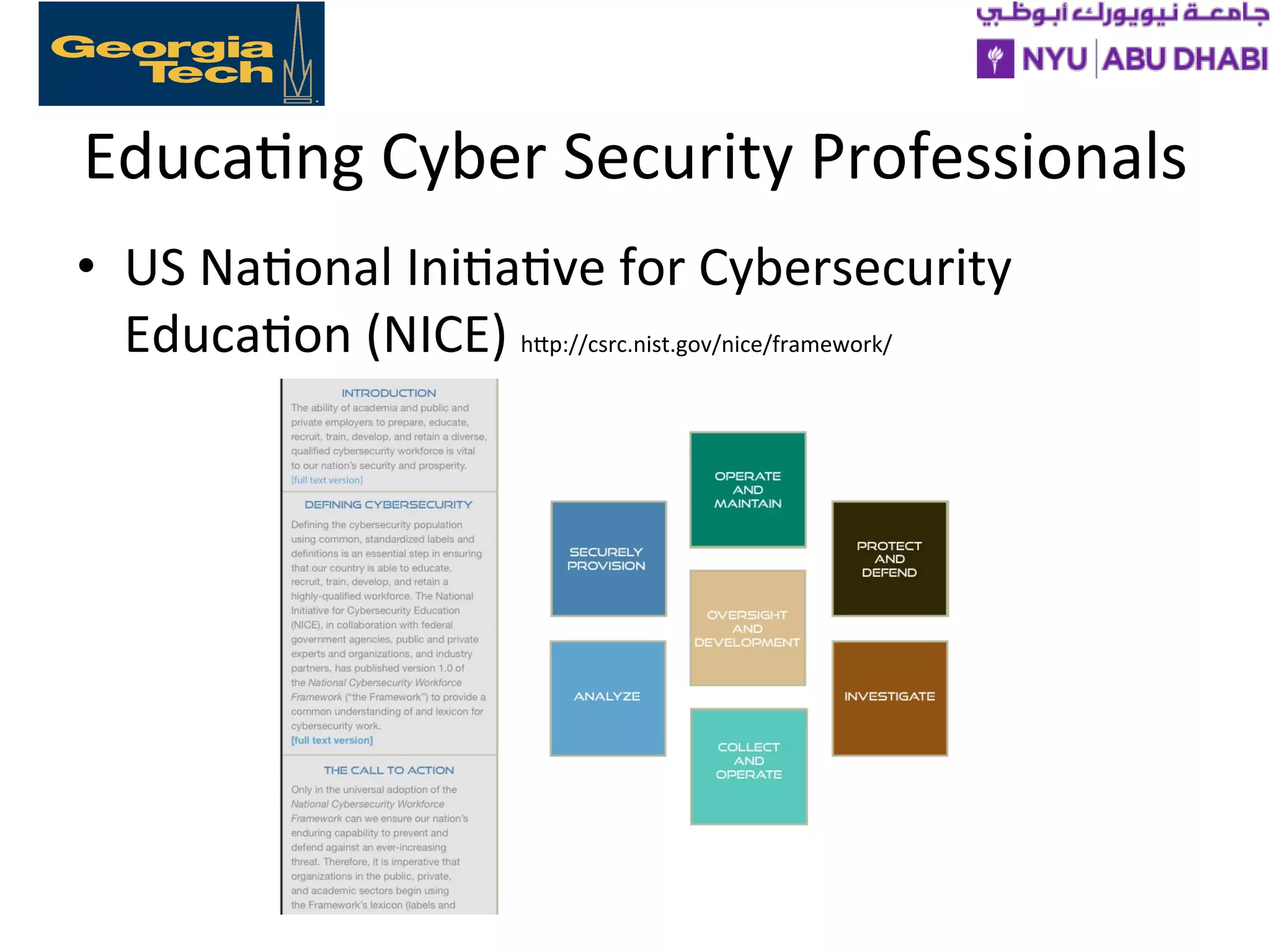
Educa>ng	
  Cyber	
  Security	
  Professionals	
  
•  US	
  Na>onal	
  Ini>a>ve	
  for	
  Cybersecurity	
  
Educa>on	
  (NICE)	
  hXp://csrc.nist.gov/nice/framework/	


Capacity	
  Building	
  for	
  Educa>ng	
  Cyber	
  
Security	
  Professionals	
  
•  What	
  do	
  we	
  do?	
  
–  Undergraduate	
  or	
  graduate	
  programs?	
  
–  Integra>ng	
  security	
  concepts	
  in	
  CS	
  curriculum?	
  
–  Voca>onal	
  programs?	
  
•  	
  How	
  do	
  we	
  do	
  it?	
  
–  So,	
  where	
  do	
  we	
  find	
  cyber	
  security	
  faculty?	
  
–  Developing	
  hands	
  on	
  projects	
  and	
  laboratories	
  
•  US	
  Response	
  
–  Centers	
  of	
  Excellence	
  Program	
  (NSA/DHS)	
  
–  Scholarship-­‐for-­‐Service	
  (SFS)	
  Program)	
  
–  NSF	
  SaTC	
  Educa>on	
  Projects	
  
•  Curriculum	
  development,	
  sharing,	
  workshops	
  etc.	
  
Research	
  Capacity	
  Building	
  
•  Evolving	
  threat	
  landscape	
  and	
  rapidly	
  
changing	
  technologies	
  
– Gelng	
  ahead	
  of	
  emerging	
  threats	
  
– “Test	
  and	
  verify”	
  rather	
  than	
  “trust	
  but	
  verify”	
  
•  Diverse	
  set	
  of	
  research	
  challenges	
  
– Trustworthiness	
  of	
  technology	
  to	
  human	
  
dimension	
  
•  Real-­‐world	
  impact	
  of	
  research	
  
– Tech	
  transfer	
  and	
  commercializa>on	
  
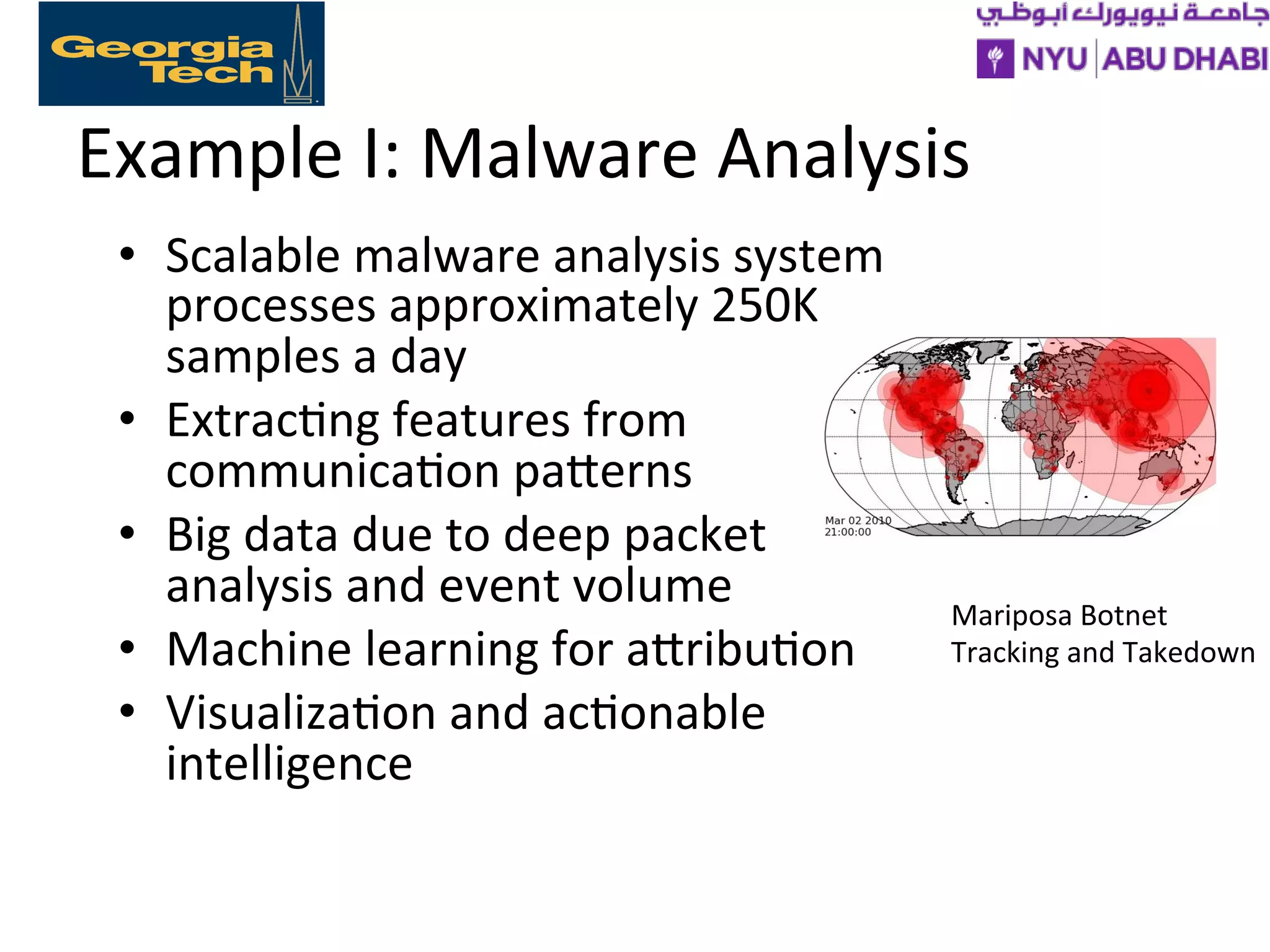
Example	
  I:	
  Malware	
  Analysis	
  
•  Scalable	
  malware	
  analysis	
  system	
  
processes	
  approximately	
  250K	
  
samples	
  a	
  day	
  
•  Extrac>ng	
  features	
  from	
  
communica>on	
  paXerns	
  
•  Big	
  data	
  due	
  to	
  deep	
  packet	
  
analysis	
  and	
  event	
  volume	
  
•  Machine	
  learning	
  for	
  aXribu>on	
  
•  Visualiza>on	
  and	
  ac>onable	
  
intelligence	


Mariposa	
  Botnet	
  
Tracking	
  and	
  Takedown	
  
Example	
  II:	
  Data-­‐Driven	
  Cyber	
  Risk	
  
•  Collect	
  cyber	
  risk	
  relevant	
  data	
  
from	
  mul>ple	
  sources	
  
– Vulnerabili>es	
  
– Exploit	
  kits	
  and	
  malware	
  
– AXack	
  data	
  (public	
  and	
  	
  
private)	
  
•  Analy>cs	
  and	
  visualiza>on	
  
– Lean	
  back	
  and	
  lean	
  forward	


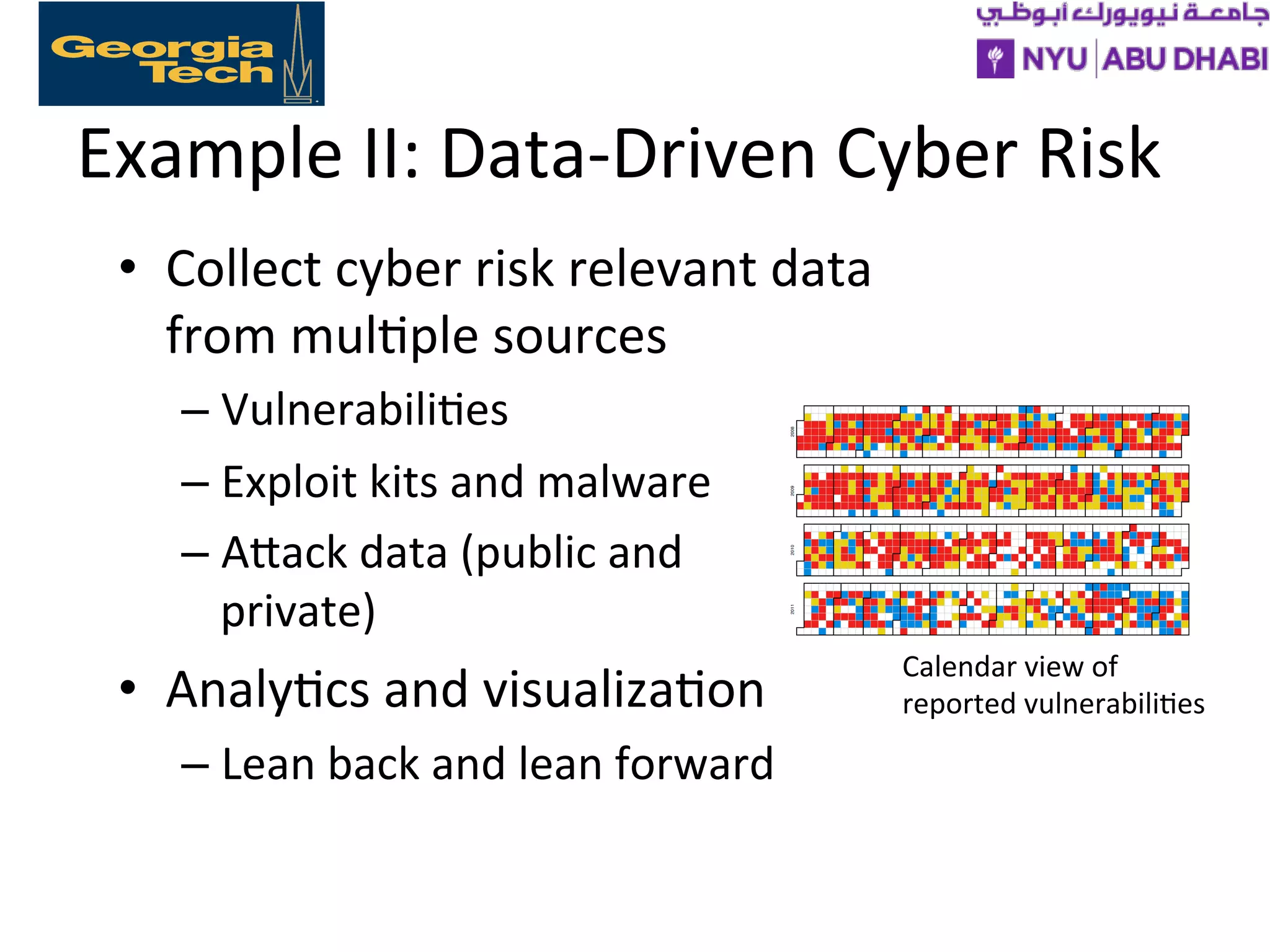
Calendar	
  view	
  of	
  	
  
reported	
  vulnerabili>es	
  
Na>onal	
  R&D	
  Strategy:	
  US	
  Example	
  
•  Na>onal	
  Science	
  Founda>on	
  Secure	
  and	
  Trustworthy	
  
(SaTC)	
  
–  Launched	
  afer	
  developing	
  a	
  na>onal	
  strategy	
  (
hXps://www.whitehouse.gov/sites/default/files/microsites/ostp/fed_cybersecurity_rd_strategic_plan_2011.pdf)	
  
–  Interdisciplinary	
  including	
  behavioral	
  and	
  economic	
  aspects	
  
•  DHS,	
  DARPA	
  and	
  NSA	
  Ini>a>ves	
  
–  Cri>cal	
  infrastructure	
  security	
  (CPS)	
  
–  Resilient	
  and	
  transparent	
  compu>ng	
  
–  Science	
  of	
  security	
  
•  Networking	
  and	
  Informa>on	
  Technology	
  Research	
  and	
  
Development	
  (NITRD)	
  Program	
  
–  Coordinated	
  across	
  mul>ple	
  agencies	
  
–  High	
  level	
  goal	
  is	
  to	
  maintain	
  US	
  technological	
  leadership	
  in	
  this	
  
field	
  
Cyber	
  Security	
  Policy	
  
•  Policy	
  development	
  is	
  as	
  important	
  as	
  best	
  
technical	
  safeguards	
  
•  Should	
  companies	
  and	
  government	
  agencies	
  
required	
  to	
  prac>ce	
  certain	
  level	
  of	
  cyber	
  
hygiene?	
  
•  Informa>on	
  sharing	
  and	
  coordina>on	
  
•  Privacy	
  
•  Legal	
  and	
  enforcement	
  issues	
  
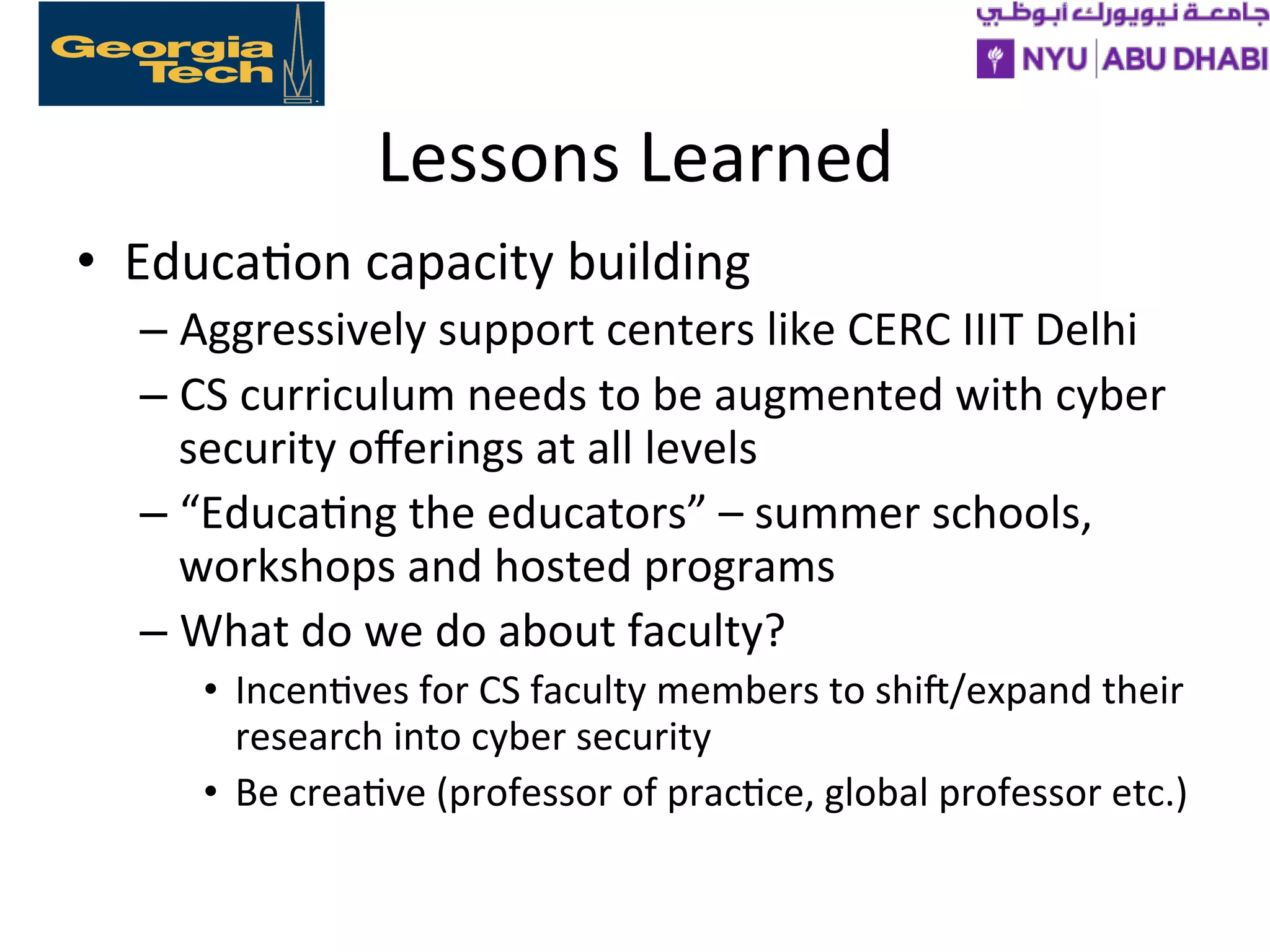
Lessons	
  Learned	
  
•  Educa>on	
  capacity	
  building	
  
– Aggressively	
  support	
  centers	
  like	
  CERC	
  IIIT	
  Delhi	
  	
  
– CS	
  curriculum	
  needs	
  to	
  be	
  augmented	
  with	
  cyber	
  
security	
  offerings	
  at	
  all	
  levels	
  
– “Educa>ng	
  the	
  educators”	
  –	
  summer	
  schools,	
  
workshops	
  and	
  hosted	
  programs	
  
– What	
  do	
  we	
  do	
  about	
  faculty?	
  
•  Incen>ves	
  for	
  CS	
  faculty	
  members	
  to	
  shif/expand	
  their	
  
research	
  into	
  cyber	
  security	
  
•  Be	
  crea>ve	
  (professor	
  of	
  prac>ce,	
  global	
  professor	
  etc.)	
  
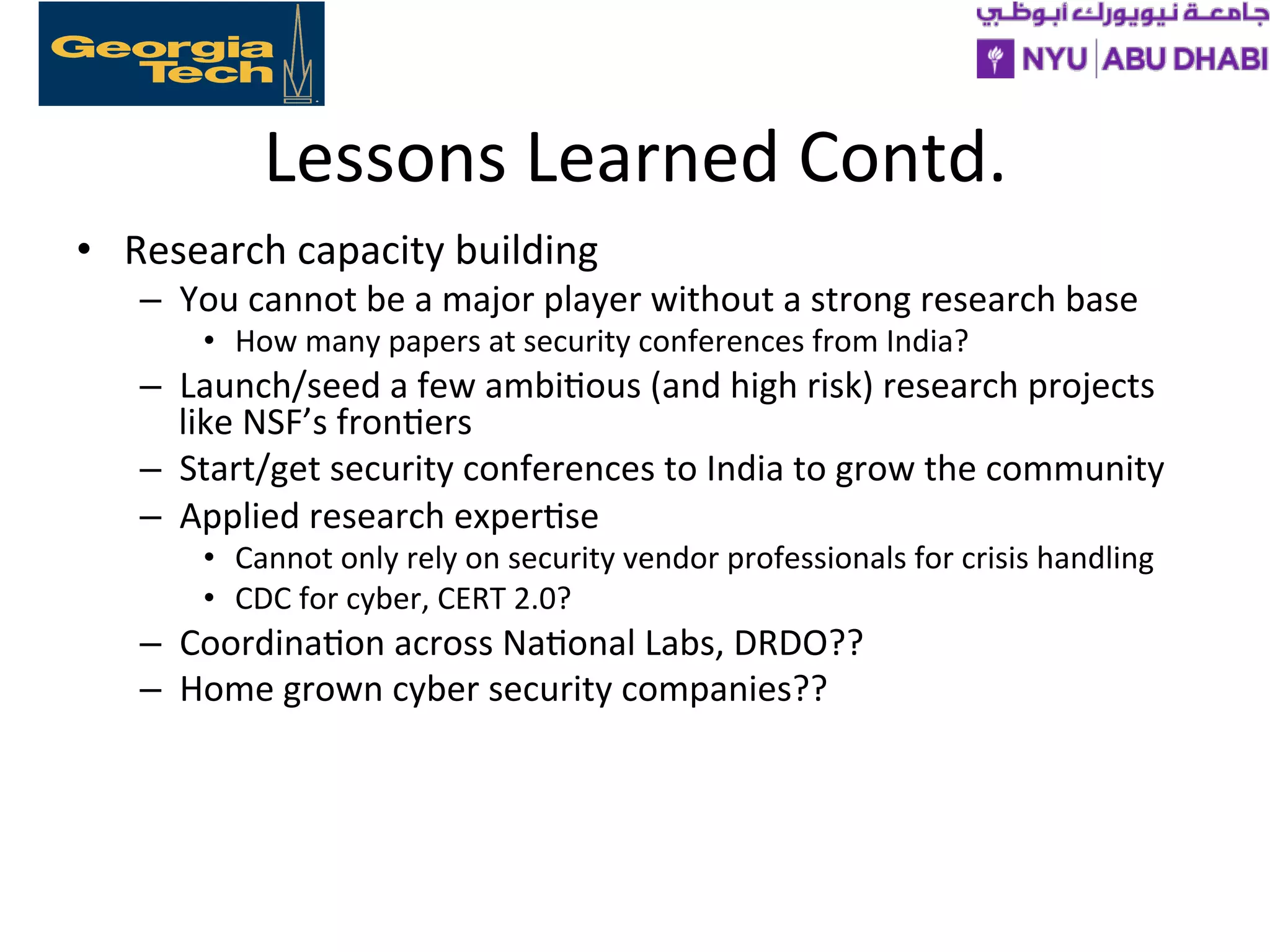
Lessons	
  Learned	
  Contd.	
  
•  Research	
  capacity	
  building	
  
–  You	
  cannot	
  be	
  a	
  major	
  player	
  without	
  a	
  strong	
  research	
  base	
  	
  
•  How	
  many	
  papers	
  at	
  security	
  conferences	
  from	
  India?	
  
–  Launch/seed	
  a	
  few	
  ambi>ous	
  (and	
  high	
  risk)	
  research	
  projects	
  
like	
  NSF’s	
  fron>ers	
  
–  Start/get	
  security	
  conferences	
  to	
  India	
  to	
  grow	
  the	
  community	
  
–  Applied	
  research	
  exper>se	
  
•  Cannot	
  only	
  rely	
  on	
  security	
  vendor	
  professionals	
  for	
  crisis	
  handling	
  
•  CDC	
  for	
  cyber,	
  CERT	
  2.0?	
  
–  Coordina>on	
  across	
  Na>onal	
  Labs,	
  DRDO??	
  
–  Home	
  grown	
  cyber	
  security	
  companies??	
  
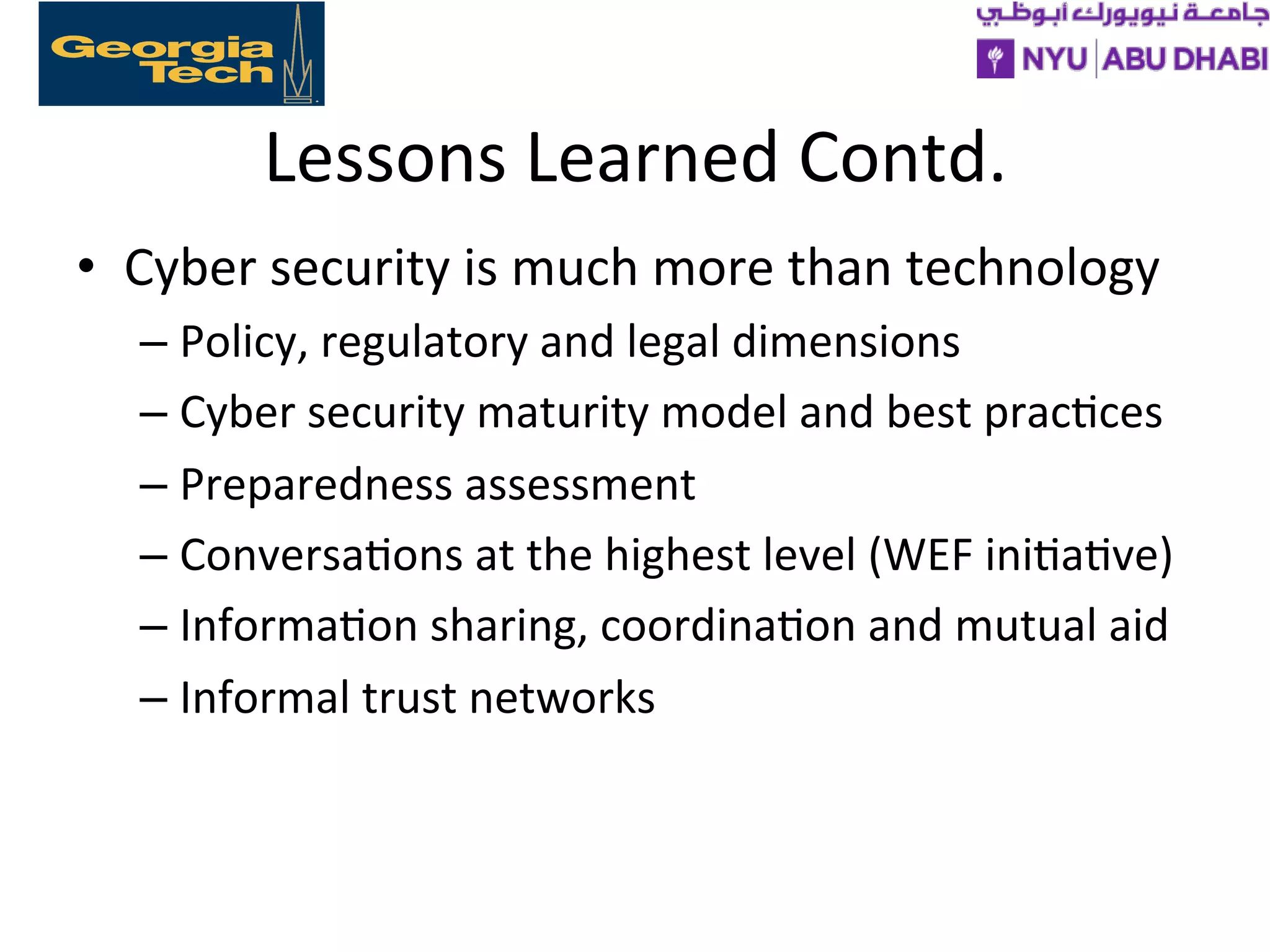
Lessons	
  Learned	
  Contd.	
  
•  Cyber	
  security	
  is	
  much	
  more	
  than	
  technology	
  
– Policy,	
  regulatory	
  and	
  legal	
  dimensions	
  
– Cyber	
  security	
  maturity	
  model	
  and	
  best	
  prac>ces	
  
– Preparedness	
  assessment	
  
– Conversa>ons	
  at	
  the	
  highest	
  level	
  (WEF	
  ini>a>ve)	
  
– Informa>on	
  sharing,	
  coordina>on	
  and	
  mutual	
  aid	
  
– Informal	
  trust	
  networks	
  
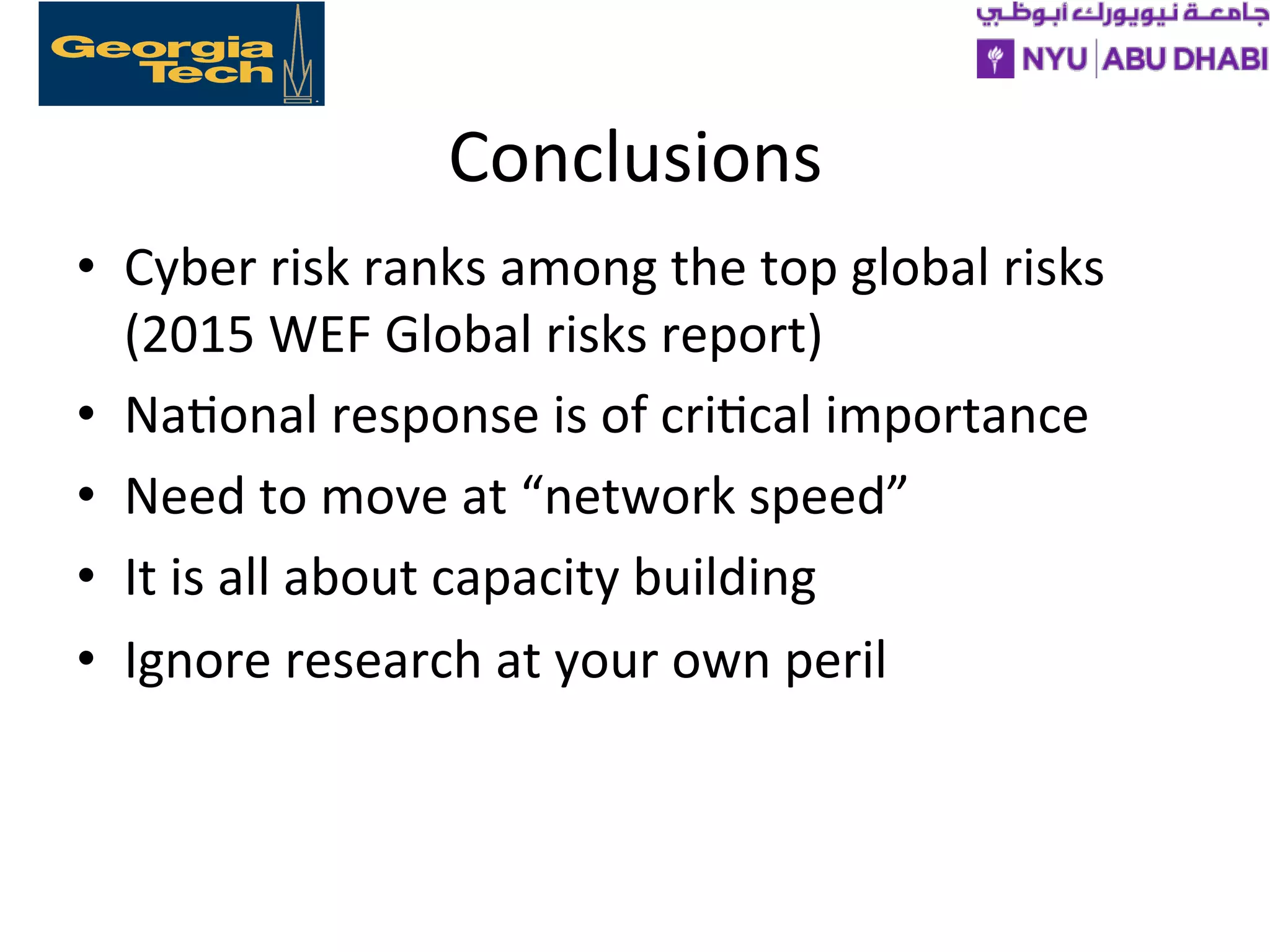
Conclusions	
  
•  Cyber	
  risk	
  ranks	
  among	
  the	
  top	
  global	
  risks	
  
(2015	
  WEF	
  Global	
  risks	
  report)	
  
•  Na>onal	
  response	
  is	
  of	
  cri>cal	
  importance	
  
•  Need	
  to	
  move	
  at	
  “network	
  speed”	
  
•  It	
  is	
  all	
  about	
  capacity	
  building	
  
•  Ignore	
  research	
  at	
  your	
  own	
  peril	


A Strategy for Addressing Cyber Security Challenges

  • 1.
    A  Strategy  for  Addressing  Cyber   Security  Challenges   Mustaque  Ahamad   Professor  of  Computer  Science,  Georgia  Ins>tute  of  Technology   Global  Professor  of  Engineering,  New  York  University  Abu  Dhabi   Co-­‐founder  and  Chief  Scien>st,  Pindrop  Security  
  • 2.
    A  Couple  of  Observa>ons   •  Cyber  security  has  become  an  extremely   important  problem  for  people,  businesses  and   governments.   •  Addressing  cyber  security  challenges  presents   serious  challenges.   •  Cyber  now  reaches  into  cri>cal  physical   systems.   •  Cyber  security  is  going  to  be  a  journey,  not  a   des>na>on.  
  • 3.
    Are  Things  Really  Bad?   •  Growing  sophis>ca>on  of  the  threat  landscape   –  Cyber  criminals,  hack>vits,  terrorists  and  na>on-­‐states   –  Cyber  crime  costs  are  reaching  half  a  trillion  dollars  (In   India,  0.21%  of  GDP,  McAfee  2014  Report)   –  Greatest  transfer  of  wealth  (Keith  Alexander,   hXp://foreignpolicy.com/2012/07/09/nsa-­‐chief-­‐cybercrime-­‐cons>tutes-­‐the-­‐greatest-­‐transfer-­‐of-­‐wealth-­‐in-­‐history/  )   •  Complex  technology  ecosystem   –  “Reflec>ons  on  trus>ng  trust”   •  People,  processes  and  coordina>on  across   mul>ple  stakeholders    
  • 4.
    Threats  +  Vulnerabili>es  =>  AXacks   •  Can  we  make  threats  go  away?   •  AXribu>on  is  extremely  difficult   •  Global  and  transna>onal   •  How  can  we  address  vulnerabili>es?   •  Security  errors  in  sofware  (over  1700  entries  in  NVD  in  last   3  months)   •  Asymmetry  –  aXackers  only  need  to  find  one  bug,  we  need   to  fix  all   •  People  are  weak  links   •  Only  higher  assurance,  no  perfect  security   –  Stronger  preven>on  and  early  detec>on   –   Faster  recovery  and  remedia>on  
  • 5.
    So,  What  Can  We  Do?   •  Educa>on   – Developing  the  “security  mindset”   – Undergraduate  and  graduate  programs   •  Research   – Rapidly  evolving  field   •  Policy,  legal  and  regula>on   – It  is  much  more  than  technology  
  • 6.
    Educa>ng  Cyber  Security  Professionals   •  US  Na>onal  Ini>a>ve  for  Cybersecurity   Educa>on  (NICE)  hXp://csrc.nist.gov/nice/framework/    
  • 7.
    Capacity  Building  for  Educa>ng  Cyber   Security  Professionals   •  What  do  we  do?   –  Undergraduate  or  graduate  programs?   –  Integra>ng  security  concepts  in  CS  curriculum?   –  Voca>onal  programs?   •   How  do  we  do  it?   –  So,  where  do  we  find  cyber  security  faculty?   –  Developing  hands  on  projects  and  laboratories   •  US  Response   –  Centers  of  Excellence  Program  (NSA/DHS)   –  Scholarship-­‐for-­‐Service  (SFS)  Program)   –  NSF  SaTC  Educa>on  Projects   •  Curriculum  development,  sharing,  workshops  etc.  
  • 8.
    Research  Capacity  Building   •  Evolving  threat  landscape  and  rapidly   changing  technologies   – Gelng  ahead  of  emerging  threats   – “Test  and  verify”  rather  than  “trust  but  verify”   •  Diverse  set  of  research  challenges   – Trustworthiness  of  technology  to  human   dimension   •  Real-­‐world  impact  of  research   – Tech  transfer  and  commercializa>on  
  • 9.
    Example  I:  Malware  Analysis   •  Scalable  malware  analysis  system   processes  approximately  250K   samples  a  day   •  Extrac>ng  features  from   communica>on  paXerns   •  Big  data  due  to  deep  packet   analysis  and  event  volume   •  Machine  learning  for  aXribu>on   •  Visualiza>on  and  ac>onable   intelligence               Mariposa  Botnet   Tracking  and  Takedown  
  • 10.
    Example  II:  Data-­‐Driven  Cyber  Risk   •  Collect  cyber  risk  relevant  data   from  mul>ple  sources   – Vulnerabili>es   – Exploit  kits  and  malware   – AXack  data  (public  and     private)   •  Analy>cs  and  visualiza>on   – Lean  back  and  lean  forward               Calendar  view  of     reported  vulnerabili>es  
  • 11.
    Na>onal  R&D  Strategy:  US  Example   •  Na>onal  Science  Founda>on  Secure  and  Trustworthy   (SaTC)   –  Launched  afer  developing  a  na>onal  strategy  ( hXps://www.whitehouse.gov/sites/default/files/microsites/ostp/fed_cybersecurity_rd_strategic_plan_2011.pdf)   –  Interdisciplinary  including  behavioral  and  economic  aspects   •  DHS,  DARPA  and  NSA  Ini>a>ves   –  Cri>cal  infrastructure  security  (CPS)   –  Resilient  and  transparent  compu>ng   –  Science  of  security   •  Networking  and  Informa>on  Technology  Research  and   Development  (NITRD)  Program   –  Coordinated  across  mul>ple  agencies   –  High  level  goal  is  to  maintain  US  technological  leadership  in  this   field  
  • 12.
    Cyber  Security  Policy   •  Policy  development  is  as  important  as  best   technical  safeguards   •  Should  companies  and  government  agencies   required  to  prac>ce  certain  level  of  cyber   hygiene?   •  Informa>on  sharing  and  coordina>on   •  Privacy   •  Legal  and  enforcement  issues  
  • 13.
    Lessons  Learned   • Educa>on  capacity  building   – Aggressively  support  centers  like  CERC  IIIT  Delhi     – CS  curriculum  needs  to  be  augmented  with  cyber   security  offerings  at  all  levels   – “Educa>ng  the  educators”  –  summer  schools,   workshops  and  hosted  programs   – What  do  we  do  about  faculty?   •  Incen>ves  for  CS  faculty  members  to  shif/expand  their   research  into  cyber  security   •  Be  crea>ve  (professor  of  prac>ce,  global  professor  etc.)  
  • 14.
    Lessons  Learned  Contd.   •  Research  capacity  building   –  You  cannot  be  a  major  player  without  a  strong  research  base     •  How  many  papers  at  security  conferences  from  India?   –  Launch/seed  a  few  ambi>ous  (and  high  risk)  research  projects   like  NSF’s  fron>ers   –  Start/get  security  conferences  to  India  to  grow  the  community   –  Applied  research  exper>se   •  Cannot  only  rely  on  security  vendor  professionals  for  crisis  handling   •  CDC  for  cyber,  CERT  2.0?   –  Coordina>on  across  Na>onal  Labs,  DRDO??   –  Home  grown  cyber  security  companies??  
  • 15.
    Lessons  Learned  Contd.   •  Cyber  security  is  much  more  than  technology   – Policy,  regulatory  and  legal  dimensions   – Cyber  security  maturity  model  and  best  prac>ces   – Preparedness  assessment   – Conversa>ons  at  the  highest  level  (WEF  ini>a>ve)   – Informa>on  sharing,  coordina>on  and  mutual  aid   – Informal  trust  networks  
  • 16.
    Conclusions   •  Cyber  risk  ranks  among  the  top  global  risks   (2015  WEF  Global  risks  report)   •  Na>onal  response  is  of  cri>cal  importance   •  Need  to  move  at  “network  speed”   •  It  is  all  about  capacity  building   •  Ignore  research  at  your  own  peril