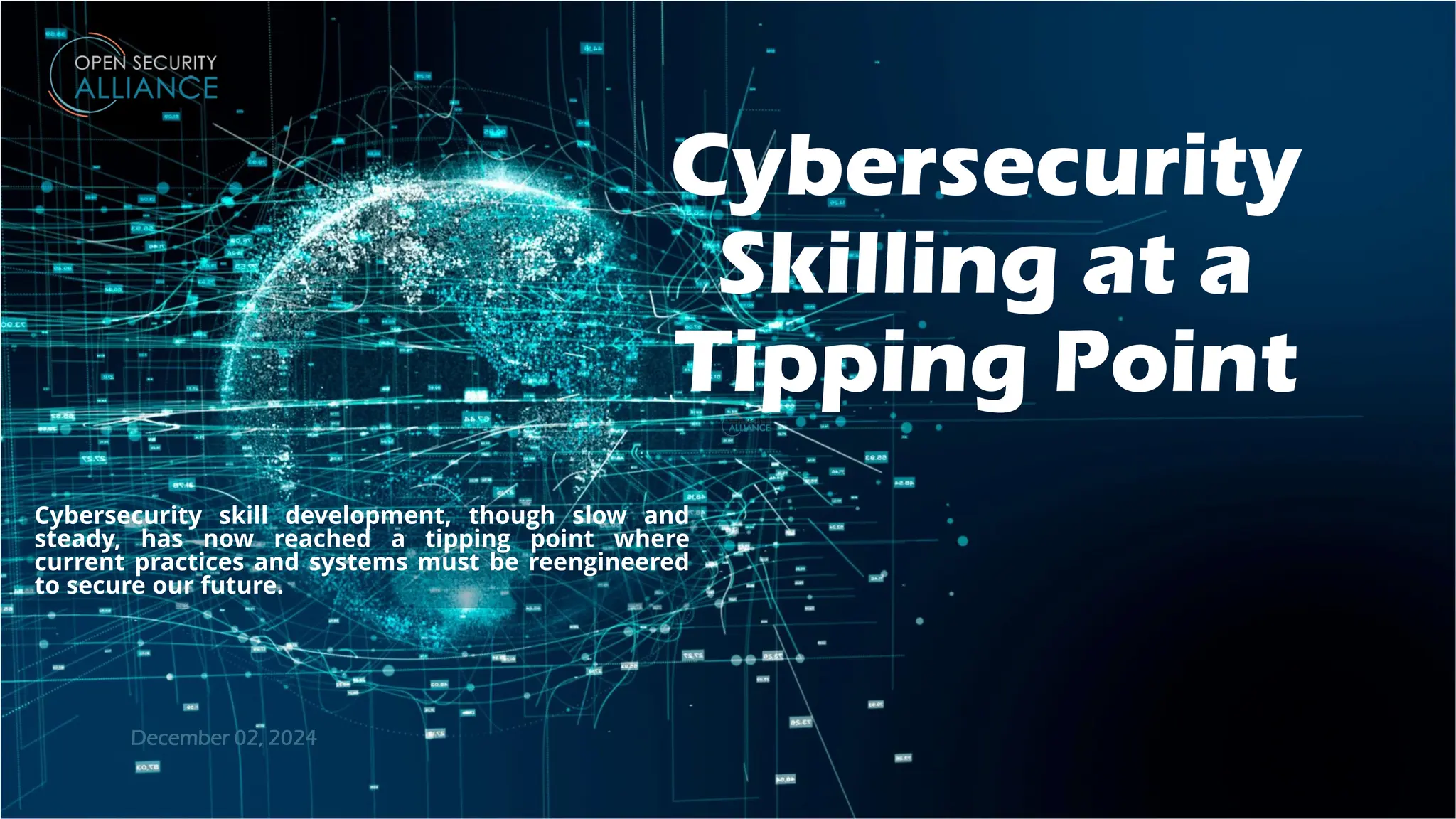
Cybersecurity
Skilling at a
Tipping Point
Cybersecurity skill development, though slow and
steady, has now reached a tipping point where
current practices and systems must be reengineered
to secure our future.
December 02, 2024
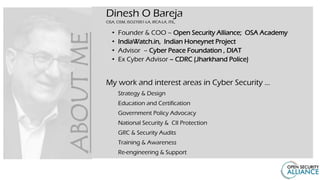
Dinesh O Bareja
CISA, CISM, ISO27001-LA, IRCA-LA, ITIL,
• Founder & COO – Open Security Alliance; OSA Academy
• IndiaWatch.in, Indian Honeynet Project
• Advisor – Cyber Peace Foundation , DIAT
• Ex Cyber Advisor – CDRC (Jharkhand Police)
My work and interest areas in Cyber Security …
Strategy & Design
Education and Certification
Government Policy Advocacy
National Security & CII Protection
GRC & Security Audits
Training & Awareness
Re-engineering & Support
ABOUT
ME
This presentation was made for a Faculty
Development Program at one of the leading
educational institutions in India.
Name and reference to the institution has been
redacted.
If you need any information about this
presentation please feel free to reach out to me /
us using the contact information provided in the
last slide.
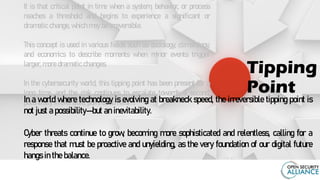
It is that critical point in time when a system,
behavior, or process reaches a threshold and
begins to experience a significant or
dramatic change, which may be irreversible.
In the cybersecurity world, this tipping point
has been present for a long time, and the
risk continues to escalate towards a second,
potentially irreversible, point of no return.
Tipping
Point
It is that critical point in time when a system, behavior, or process
reaches a threshold and begins to experience a significant or
dramatic change, which may be irreversible.
This concept is used in various fields such as sociology, climatology,
and economics to describe moments when minor events trigger
larger, more dramatic changes.
In the cybersecurity world, this tipping point has been present for a
long time, and the risk continues to escalate towards a second,
potentially irreversible, point of no return.
Tipping
Point
In a world where technology is evolving at breakneck speed, the irreversible tipping point is
not just a possibility—but an inevitability.
Cyber threats continue to grow, becoming more sophisticated and relentless, calling for a
response that must be proactive and unyielding, as the very foundation of our digital future
hangs in the balance.
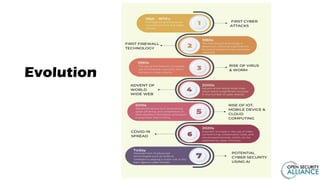
Evolution
But Has
Anything
Changed?
Sorry, Nothing
Seems To Have
Changed !
We are at a cross-roads which is why I term this
as the Tipping Point
Our choices are few so lets select them wisely
… and then… walk the talk
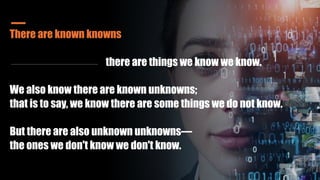
There are known knowns
there are things we know we know.
We also know there are known unknowns;
that is to say, we know there are some things we do not know.
But there are also unknown unknowns—
the ones we don't know we don't know.
The Cybersecurity Imperative
• Growing Cyber Threats in a Digital-First World
• Businesses, governments, and individuals increasingly rely on digital
platforms, and as a result cyber threats are becoming more frequent and
sophisticated.
• Global cybercrime costs are expected to reach $10.5 trillion annually by 2025,
up from $3 trillion in 2015 (Cybersecurity Ventures).
• The Critical Role of Educators in Addressing the Skills Gap
• Educators have the responsibility to nurture a cybersecurity workforce
capable of addressing current and future challenges.
• There is a global shortage of 3.4 million cybersecurity professionals (2023).
• Need for a Robust Framework for Skill Development
• The current fragmented approach to cybersecurity education is inadequate
and needs serious rethink and redesign to enhance learning outcomes.
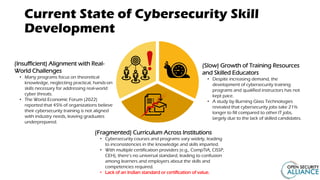
Current State of Cybersecurity Skill
Development
(Insufficient) Alignment with Real-
World Challenges
• Many programs focus on theoretical
knowledge, neglecting practical, hands-on
skills necessary for addressing real-world
cyber threats.
• The World Economic Forum (2022)
reported that 45% of organizations believe
their cybersecurity training is not aligned
with industry needs, leaving graduates
underprepared.
(Fragmented) Curriculum Across Institutions
• Cybersecurity courses and programs vary widely, leading
to inconsistencies in the knowledge and skills imparted.
• With multiple certification providers (e.g., CompTIA, CISSP,
CEH), there’s no universal standard, leading to confusion
among learners and employers about the skills and
competencies required.
• Lack of an Indian standard or certification of value.
(Slow) Growth of Training Resources
and Skilled Educators
• Despite increasing demand, the
development of cybersecurity training
programs and qualified instructors has not
kept pace.
• A study by Burning Glass Technologies
revealed that cybersecurity jobs take 21%
longer to fill compared to other IT jobs,
largely due to the lack of skilled candidates.
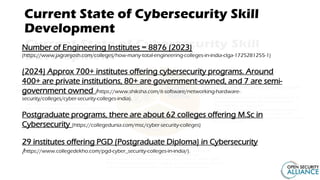
Current State of Cybersecurity Skill
Development
Number of Engineering Institutes = 8876 (2023)
(https://www.jagranjosh.com/colleges/how-many-total-engineering-colleges-in-india-clga-1725281255-1)
(2024) Approx 700+ institutes offering cybersecurity programs. Around
400+ are private institutions, 80+ are government-owned, and 7 are semi-
government owned (https://www.shiksha.com/it-software/networking-hardware-
security/colleges/cyber-security-colleges-india).
Postgraduate programs, there are about 62 colleges offering M.Sc in
Cybersecurity (https://collegedunia.com/msc/cyber-security-colleges)
29 institutes offering PGD (Postgraduate Diploma) in Cybersecurity
(https://www.collegedekho.com/pgd-cyber_security-colleges-in-india/).
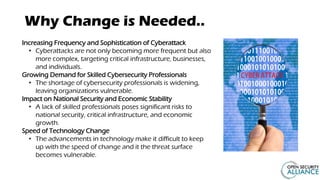
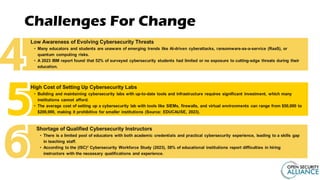
Why Change is Needed..
Increasing Frequency and Sophistication of Cyberattack
• Cyberattacks are not only becoming more frequent but also
more complex, targeting critical infrastructure, businesses,
and individuals.
Growing Demand for Skilled Cybersecurity Professionals
• The shortage of cybersecurity professionals is widening,
leaving organizations vulnerable.
Impact on National Security and Economic Stability
• A lack of skilled professionals poses significant risks to
national security, critical infrastructure, and economic
growth.
Speed of Technology Change
• The advancements in technology make it difficult to keep
up with the speed of change and it the threat surface
becomes vulnerable.
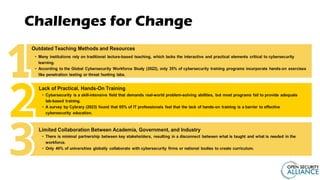
Challenges for Change
Challenges For Change
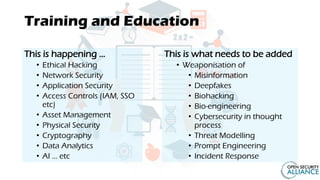
Training and Education
This is happening …
• Ethical Hacking
• Network Security
• Application Security
• Access Controls (IAM, SSO
etc)
• Asset Management
• Physical Security
• Cryptography
• Data Analytics
• AI … etc
This is what needs to be added
• Weaponisation of
• Misinformation
• Deepfakes
• Biohacking
• Bio-engineering
• Cybersecurity in thought
process
• Threat Modelling
• Prompt Engineering
• Incident Response
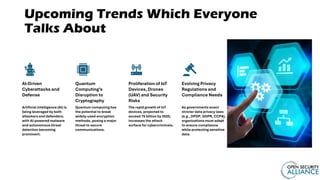
Upcoming Trends Which Everyone
Talks About
AI-Driven
Cyberattacks and
Defense
Artificial intelligence (AI) is
being leveraged by both
attackers and defenders,
with AI-powered malware
and autonomous threat
detection becoming
prominent.
Quantum
Computing’s
Disruption to
Cryptography
Quantum computing has
the potential to break
widely-used encryption
methods, posing a major
threat to secure
communications.
Proliferation of IoT
Devices, Drones
(UAV) and Security
Risks
The rapid growth of IoT
devices, projected to
exceed 75 billion by 2025,
increases the attack
surface for cybercriminals.
Evolving Privacy
Regulations and
Compliance Needs
As governments enact
stricter data privacy laws
(e.g., DPDP, GDPR, CCPA),
organizations must adapt
to ensure compliance
while protecting sensitive
data.
Shaping the Cybersecurity Future
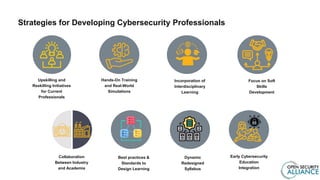
Collaboration
Between Industry
and Academia
Strategies for Developing Cybersecurity Professionals
Hands-On Training
and Real-World
Simulations
Incorporation of
Interdisciplinary
Learning
Focus on Soft
Skills
Development
Early Cybersecurity
Education
Integration
Upskilling and
Reskilling Initiatives
for Current
Professionals
Dynamic
Redesigned
Syllabus
Best practices &
Standards to
Design Learning
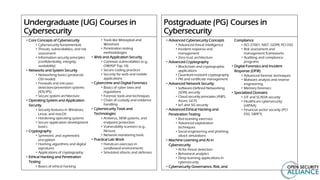
Undergraduate (UG) Courses in
Cybersecurity
• Core Concepts of Cybersecurity
• Cybersecurity fundamentals
• Threats, vulnerabilities, and risk
assessment
• Information security principles
(confidentiality, integrity,
availability)
• Networks and System Security
• Networking basics (protocols,
OSI model)
• Firewalls and intrusion
detection/prevention systems
(IDS/IPS)
• Secure system architecture
• Operating System and Application
Security
• Security features in Windows,
Linux, and macOS
• Hardening operating systems
• Secure application development
basics
• Cryptography
• Symmetric and asymmetric
encryption
• Hashing algorithms and digital
signatures
• Applications of cryptography
• Ethical Hacking and Penetration
Testing
• Basics of ethical hacking
• Tools like Metasploit and
Wireshark
• Penetration testing
methodologies
• Web and Application Security
• Common vulnerabilities (e.g.,
OWASP Top 10)
• Secure coding practices
• Security for web and mobile
applications
• Cybercrime and Digital Forensics
• Basics of cyber laws and
regulations
• Forensic tools and techniques
• Chain of custody and evidence
handling
• Cybersecurity Tools and
Technologies
• Antivirus, SIEM systems, and
endpoint protection
• Vulnerability scanners (e.g.,
Nessus)
• Network monitoring tools
• Practical Lab Work
• Hands-on exercises in
sandboxed environments
• Simulated attacks and defenses
Postgraduate (PG) Courses in
Cybersecurity
• Advanced Cybersecurity Concepts
• Advanced threat intelligence
• Incident response and
management
• Zero trust architecture
• Advanced Cryptography
• Blockchain and cryptographic
applications
• Quantum-resistant cryptography
• PKI and certificate management
• Advanced Network Security
• Software-Defined Networking
(SDN) security
• Cloud security principles (AWS,
Azure, GCP)
• IoT and 5G security
• Advanced Ethical Hacking and
Penetration Testing
• Red teaming exercises
• Advanced exploitation
techniques
• Social engineering and phishing
attack simulations
• Machine Learning and AI in
Cybersecurity
• AI for threat detection
• Behavioral analytics
• Deep learning applications in
cybersecurity
• Cybersecurity Governance, Risk, and
Compliance
• ISO 27001, NIST, GDPR, PCI DSS
• Risk assessment and
management frameworks
• Auditing and compliance
programs
• Digital Forensics and Incident
Response (DFIR)
• Advanced forensic techniques
• Malware analysis and reverse
engineering
• Memory forensics
• Specialized Domains
• OT and SCADA security
• Healthcare cybersecurity
(HIPAA)
• Financial sector security (PCI
DSS, SWIFT)
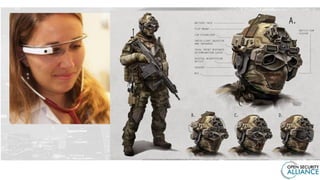
Upcoming and
happening
which no one
talks about
The Need Is
To Look
Beyond
The Six Million Dollar man
(1970)
Body Implants
Bio Magnetic implants
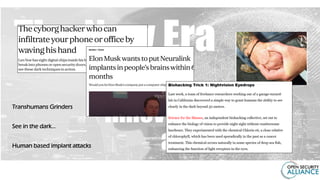
Transhumans Grinders
See in the dark...
Human based implant attacks
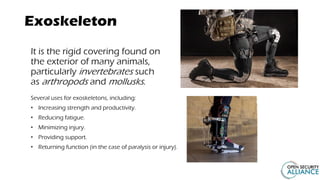
Exoskeleton
It is the rigid covering found on
the exterior of many animals,
particularly invertebrates such
as arthropods and mollusks.
Several uses for exoskeletons, including:
• Increasing strength and productivity.
• Reducing fatigue.
• Minimizing injury.
• Providing support.
• Returning function (in the case of paralysis or injury).
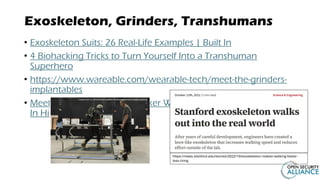
Exoskeleton, Grinders, Transhumans
• Exoskeleton Suits: 26 Real-Life Examples | Built In
• 4 Biohacking Tricks to Turn Yourself Into a Transhuman
Superhero
• https://www.wareable.com/wearable-tech/meet-the-grinders-
implantables
• Meet Len: The Offensive Hacker With 10 Microchips Implanted
In His Body
https://news.stanford.edu/stories/2022/10/exoskeleton-makes-walking-faster-
less-tiring
A Critical Function
While recognized as a critical activity research is
an add-on and may not be a primary function at
educational institutions.
Reason: Our concept of “research” conditioned
by traditional mindset where we need output
for journals, patents etc
Reason: it needs a lot of equipment and money!
Break these myths and engage in research.
- Study of global cybersecurity standards to
enhance Indian
- Risk Assessment and management framework
- Mapping modus operandi of global cyberattacks
to threat models and applying to Indian scenarios
- Develop gamification models for cyber drills and
training
- National cybersecurity framework and
organization structure
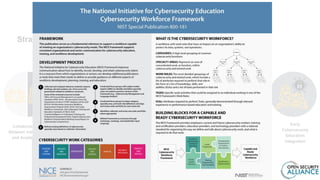
- Cybersecurity skill/knowledge assessment and
programs based on NICE framework
- Adoption of NICE framework to Indian
environment for development of a standard
education / training program
Research Can Be Simple – Breaking The
Myth
E dinesh@opensecurityalliance.org
@bizsprite
L: linkedin.com/in/dineshbareja
+91.9769890505
dineshobareja
dineshobareja
opensecurityalliance.org
dineshbareja.com

Cybersecurity Skilling at a Tipping Point.pdf

  • 1.
    Cybersecurity Skilling at a TippingPoint Cybersecurity skill development, though slow and steady, has now reached a tipping point where current practices and systems must be reengineered to secure our future. December 02, 2024
  • 2.
    Dinesh O Bareja CISA,CISM, ISO27001-LA, IRCA-LA, ITIL, • Founder & COO – Open Security Alliance; OSA Academy • IndiaWatch.in, Indian Honeynet Project • Advisor – Cyber Peace Foundation , DIAT • Ex Cyber Advisor – CDRC (Jharkhand Police) My work and interest areas in Cyber Security … Strategy & Design Education and Certification Government Policy Advocacy National Security & CII Protection GRC & Security Audits Training & Awareness Re-engineering & Support ABOUT ME
  • 3.
    This presentation wasmade for a Faculty Development Program at one of the leading educational institutions in India. Name and reference to the institution has been redacted. If you need any information about this presentation please feel free to reach out to me / us using the contact information provided in the last slide.
  • 4.
    It is thatcritical point in time when a system, behavior, or process reaches a threshold and begins to experience a significant or dramatic change, which may be irreversible. In the cybersecurity world, this tipping point has been present for a long time, and the risk continues to escalate towards a second, potentially irreversible, point of no return. Tipping Point
  • 5.
    It is thatcritical point in time when a system, behavior, or process reaches a threshold and begins to experience a significant or dramatic change, which may be irreversible. This concept is used in various fields such as sociology, climatology, and economics to describe moments when minor events trigger larger, more dramatic changes. In the cybersecurity world, this tipping point has been present for a long time, and the risk continues to escalate towards a second, potentially irreversible, point of no return. Tipping Point In a world where technology is evolving at breakneck speed, the irreversible tipping point is not just a possibility—but an inevitability. Cyber threats continue to grow, becoming more sophisticated and relentless, calling for a response that must be proactive and unyielding, as the very foundation of our digital future hangs in the balance.
  • 6.
  • 7.
  • 8.
  • 9.
    We are ata cross-roads which is why I term this as the Tipping Point Our choices are few so lets select them wisely … and then… walk the talk
  • 10.
    There are knownknowns there are things we know we know. We also know there are known unknowns; that is to say, we know there are some things we do not know. But there are also unknown unknowns— the ones we don't know we don't know.
  • 11.
    The Cybersecurity Imperative •Growing Cyber Threats in a Digital-First World • Businesses, governments, and individuals increasingly rely on digital platforms, and as a result cyber threats are becoming more frequent and sophisticated. • Global cybercrime costs are expected to reach $10.5 trillion annually by 2025, up from $3 trillion in 2015 (Cybersecurity Ventures). • The Critical Role of Educators in Addressing the Skills Gap • Educators have the responsibility to nurture a cybersecurity workforce capable of addressing current and future challenges. • There is a global shortage of 3.4 million cybersecurity professionals (2023). • Need for a Robust Framework for Skill Development • The current fragmented approach to cybersecurity education is inadequate and needs serious rethink and redesign to enhance learning outcomes.
  • 12.
    Current State ofCybersecurity Skill Development (Insufficient) Alignment with Real- World Challenges • Many programs focus on theoretical knowledge, neglecting practical, hands-on skills necessary for addressing real-world cyber threats. • The World Economic Forum (2022) reported that 45% of organizations believe their cybersecurity training is not aligned with industry needs, leaving graduates underprepared. (Fragmented) Curriculum Across Institutions • Cybersecurity courses and programs vary widely, leading to inconsistencies in the knowledge and skills imparted. • With multiple certification providers (e.g., CompTIA, CISSP, CEH), there’s no universal standard, leading to confusion among learners and employers about the skills and competencies required. • Lack of an Indian standard or certification of value. (Slow) Growth of Training Resources and Skilled Educators • Despite increasing demand, the development of cybersecurity training programs and qualified instructors has not kept pace. • A study by Burning Glass Technologies revealed that cybersecurity jobs take 21% longer to fill compared to other IT jobs, largely due to the lack of skilled candidates.
  • 13.
    Current State ofCybersecurity Skill Development Number of Engineering Institutes = 8876 (2023) (https://www.jagranjosh.com/colleges/how-many-total-engineering-colleges-in-india-clga-1725281255-1) (2024) Approx 700+ institutes offering cybersecurity programs. Around 400+ are private institutions, 80+ are government-owned, and 7 are semi- government owned (https://www.shiksha.com/it-software/networking-hardware- security/colleges/cyber-security-colleges-india). Postgraduate programs, there are about 62 colleges offering M.Sc in Cybersecurity (https://collegedunia.com/msc/cyber-security-colleges) 29 institutes offering PGD (Postgraduate Diploma) in Cybersecurity (https://www.collegedekho.com/pgd-cyber_security-colleges-in-india/).
  • 14.
    Why Change isNeeded.. Increasing Frequency and Sophistication of Cyberattack • Cyberattacks are not only becoming more frequent but also more complex, targeting critical infrastructure, businesses, and individuals. Growing Demand for Skilled Cybersecurity Professionals • The shortage of cybersecurity professionals is widening, leaving organizations vulnerable. Impact on National Security and Economic Stability • A lack of skilled professionals poses significant risks to national security, critical infrastructure, and economic growth. Speed of Technology Change • The advancements in technology make it difficult to keep up with the speed of change and it the threat surface becomes vulnerable.
  • 15.
  • 16.
  • 17.
    Training and Education Thisis happening … • Ethical Hacking • Network Security • Application Security • Access Controls (IAM, SSO etc) • Asset Management • Physical Security • Cryptography • Data Analytics • AI … etc This is what needs to be added • Weaponisation of • Misinformation • Deepfakes • Biohacking • Bio-engineering • Cybersecurity in thought process • Threat Modelling • Prompt Engineering • Incident Response
  • 18.
    Upcoming Trends WhichEveryone Talks About AI-Driven Cyberattacks and Defense Artificial intelligence (AI) is being leveraged by both attackers and defenders, with AI-powered malware and autonomous threat detection becoming prominent. Quantum Computing’s Disruption to Cryptography Quantum computing has the potential to break widely-used encryption methods, posing a major threat to secure communications. Proliferation of IoT Devices, Drones (UAV) and Security Risks The rapid growth of IoT devices, projected to exceed 75 billion by 2025, increases the attack surface for cybercriminals. Evolving Privacy Regulations and Compliance Needs As governments enact stricter data privacy laws (e.g., DPDP, GDPR, CCPA), organizations must adapt to ensure compliance while protecting sensitive data.
  • 19.
  • 20.
    Collaboration Between Industry and Academia Strategiesfor Developing Cybersecurity Professionals Hands-On Training and Real-World Simulations Incorporation of Interdisciplinary Learning Focus on Soft Skills Development Early Cybersecurity Education Integration Upskilling and Reskilling Initiatives for Current Professionals Dynamic Redesigned Syllabus Best practices & Standards to Design Learning
  • 21.
    Undergraduate (UG) Coursesin Cybersecurity • Core Concepts of Cybersecurity • Cybersecurity fundamentals • Threats, vulnerabilities, and risk assessment • Information security principles (confidentiality, integrity, availability) • Networks and System Security • Networking basics (protocols, OSI model) • Firewalls and intrusion detection/prevention systems (IDS/IPS) • Secure system architecture • Operating System and Application Security • Security features in Windows, Linux, and macOS • Hardening operating systems • Secure application development basics • Cryptography • Symmetric and asymmetric encryption • Hashing algorithms and digital signatures • Applications of cryptography • Ethical Hacking and Penetration Testing • Basics of ethical hacking • Tools like Metasploit and Wireshark • Penetration testing methodologies • Web and Application Security • Common vulnerabilities (e.g., OWASP Top 10) • Secure coding practices • Security for web and mobile applications • Cybercrime and Digital Forensics • Basics of cyber laws and regulations • Forensic tools and techniques • Chain of custody and evidence handling • Cybersecurity Tools and Technologies • Antivirus, SIEM systems, and endpoint protection • Vulnerability scanners (e.g., Nessus) • Network monitoring tools • Practical Lab Work • Hands-on exercises in sandboxed environments • Simulated attacks and defenses Postgraduate (PG) Courses in Cybersecurity • Advanced Cybersecurity Concepts • Advanced threat intelligence • Incident response and management • Zero trust architecture • Advanced Cryptography • Blockchain and cryptographic applications • Quantum-resistant cryptography • PKI and certificate management • Advanced Network Security • Software-Defined Networking (SDN) security • Cloud security principles (AWS, Azure, GCP) • IoT and 5G security • Advanced Ethical Hacking and Penetration Testing • Red teaming exercises • Advanced exploitation techniques • Social engineering and phishing attack simulations • Machine Learning and AI in Cybersecurity • AI for threat detection • Behavioral analytics • Deep learning applications in cybersecurity • Cybersecurity Governance, Risk, and Compliance • ISO 27001, NIST, GDPR, PCI DSS • Risk assessment and management frameworks • Auditing and compliance programs • Digital Forensics and Incident Response (DFIR) • Advanced forensic techniques • Malware analysis and reverse engineering • Memory forensics • Specialized Domains • OT and SCADA security • Healthcare cybersecurity (HIPAA) • Financial sector security (PCI DSS, SWIFT)
  • 23.
  • 24.
    The Need Is ToLook Beyond The Six Million Dollar man (1970) Body Implants Bio Magnetic implants
  • 29.
    Transhumans Grinders See inthe dark... Human based implant attacks
  • 30.
    Exoskeleton It is therigid covering found on the exterior of many animals, particularly invertebrates such as arthropods and mollusks. Several uses for exoskeletons, including: • Increasing strength and productivity. • Reducing fatigue. • Minimizing injury. • Providing support. • Returning function (in the case of paralysis or injury).
  • 31.
    Exoskeleton, Grinders, Transhumans •Exoskeleton Suits: 26 Real-Life Examples | Built In • 4 Biohacking Tricks to Turn Yourself Into a Transhuman Superhero • https://www.wareable.com/wearable-tech/meet-the-grinders- implantables • Meet Len: The Offensive Hacker With 10 Microchips Implanted In His Body https://news.stanford.edu/stories/2022/10/exoskeleton-makes-walking-faster- less-tiring
  • 32.
    A Critical Function Whilerecognized as a critical activity research is an add-on and may not be a primary function at educational institutions. Reason: Our concept of “research” conditioned by traditional mindset where we need output for journals, patents etc Reason: it needs a lot of equipment and money! Break these myths and engage in research.
  • 33.
    - Study ofglobal cybersecurity standards to enhance Indian - Risk Assessment and management framework - Mapping modus operandi of global cyberattacks to threat models and applying to Indian scenarios - Develop gamification models for cyber drills and training - National cybersecurity framework and organization structure - Cybersecurity skill/knowledge assessment and programs based on NICE framework - Adoption of NICE framework to Indian environment for development of a standard education / training program Research Can Be Simple – Breaking The Myth
  • 34.