CYBER
SECURITY
PLANNING 101
ANDRE W LOSCHM ANN M A RK G A U DE T RYAN VALLE E
PANELISTS
BRYAN HARALOVICH
Partner,
Welch LLP
President & CTO,
Field Effect Software
Product Line
Manager, CIRA
Senior VP,
Fully Managed
Cyber Security and SMEs
Andrew L os ch ma n n
3 messages for
SMEs in 2019:
You can do something
You are important
You have cyber security
responsibilities
Message #1
You are important.
• Threat actors (“attackers”) are not individuals, they’re organizations.
• The motivation is almost always financially motivated.
• Like most organizations, they adapt. In 2019, this means automation and
scale: Data theft and resale, Credential sales, Ransomware, Financial
Redirection… what’s next?
If you have any assets, or have the potential to have an asset, you are a
target.
Message #2
You have cyber security
responsibilities.
• Customers
• Stakeholders
• Regulatory, Industry and other authorities
Message #3
You can do something.
• It is not an impossible problem.
• Cyber Security threats are well understood at this point, as are
effective defence strategies.
• This technology, knowledge and process needed to make a real
difference is not out of reach.
• Believe it or not, the basics matter, and making a mistake on the
basics are what will get you into trouble.
Measuring
Success
Cyber Security is
measurable and should:
• Be continuous
• Improve your network
• Lower your risk (and
costs)
D-Zone Cybersecurity
MARK GAUDET
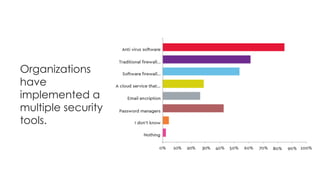
Organizations
have
implemented a
multiple security
tools.
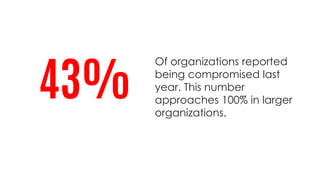
Of organizations reported
being compromised last
year. This number
approaches 100% in larger
organizations.
43%
Canadians
understand
the
importance of
layers.
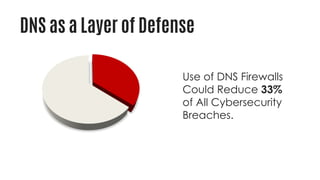
DNS as a Layer of Defense
Use of DNS Firewalls
Could Reduce 33%
of All Cybersecurity
Breaches.
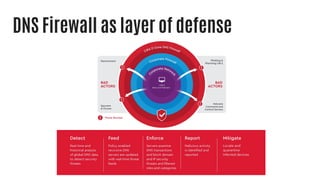
DNS Firewall as layer of defense
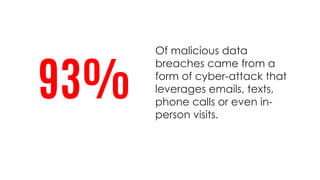
Of malicious data
breaches came from a
form of cyber-attack that
leverages emails, texts,
phone calls or even in-
person visits.
93%
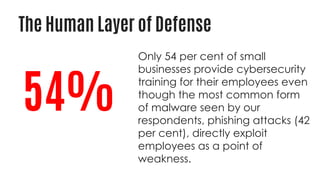
Only 54 per cent of small
businesses provide cybersecurity
training for their employees even
though the most common form
of malware seen by our
respondents, phishing attacks (42
per cent), directly exploit
employees as a point of
weakness.
54%
The Human Layer of Defense
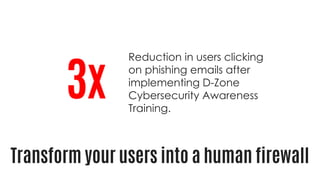
Reduction in users clicking
on phishing emails after
implementing D-Zone
Cybersecurity Awareness
Training.
3x
Transform your users into a human firewall
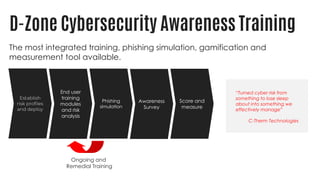
The most integrated training, phishing simulation, gamification and
measurement tool available.
D-Zone Cybersecurity Awareness Training
Score and
measure
Ongoing and
Remedial Training
“Turned cyber risk from
something to lose sleep
about into something we
effectively manage”
C-Therm Technologies
Awareness
Survey
Phishing
simulation
End user
training
modules
and risk
analysis
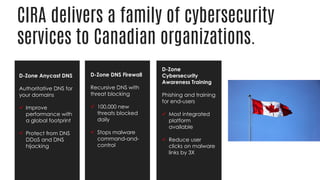
CIRA delivers a family of cybersecurity
services to Canadian organizations.
D-Zone Anycast DNS
Authoritative DNS for
your domains
 Improve
performance with
a global footprint
 Protect from DNS
DDoS and DNS
hijacking
D-Zone DNS Firewall
Recursive DNS with
threat blocking
 100,000 new
threats blocked
daily
 Stops malware
command-and-
control
D-Zone
Cybersecurity
Awareness Training
Phishing and training
for end-users
 Most integrated
platform
available
 Reduce user
clicks on malware
links by 3X
Summary
• Defense in Depth
• Leverage additional layers
• DNS
• Staff
Fully Managed – Cyber Security
RYAN VAL L EE
Current threats and who they are
targeting
The Continued Increase in Ransomware.
• In 2016, a business fell victim to ransomware every 40 seconds.
• 70% of all malware attacks last year were ransomware.
• 91% of cyberattacks begin with spear phishing email, which are
commonly used to infect organizations with ransomware.
Cybersecurity Ventures predicts cybercrime will cost the world in excess of
$6 trillion annually by 2021, up from $3 trillion in 2015. Ransomware is
expected to worsen and make up a proportionately larger share of total
cybercrime by 2021.
Weaponization of Artificial Intelligence
• Security companies are using AI to protect environments and users,
therefore it is certain that the hackers are following suit in their attack
methodologies.
• Hackers leverage AI in spear phishing exploits to create carefully
targeted messages that trick people into sharing sensitive data and
installing malware.
• AI is used to collect information about a target organization from
across the internet, to instigate detailed and targeted exploits, and
crack passwords.
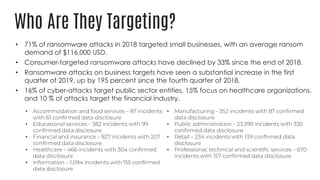
Who Are They Targeting?
• 71% of ransomware attacks in 2018 targeted small businesses, with an average ransom
demand of $116,000 USD.
• Consumer-targeted ransomware attacks have declined by 33% since the end of 2018.
• Ransomware attacks on business targets have seen a substantial increase in the first
quarter of 2019, up by 195 percent since the fourth quarter of 2018.
• 16% of cyber-attacks target public sector entities, 15% focus on healthcare organizations,
and 10 % of attacks target the financial industry.
•
•
•
•
•
•
•
•
•
Who Are They Targeting? - Continued
• As can be seen from the data, public administrations are a very large target and this has
been seen with the number of public municipalities which have suffered breaches
recently.
• “There's over two thousand municipalities in Canada ... they hold a lot of sensitive
information on individuals ... on properties, on a lot of transactions. They're very
vulnerable.” Dan Mathieson, mayor of Stratford … in a CBC news report after the
municipality was hit with ransomware on 14th April 2019.
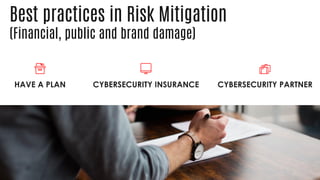
Best practices in Risk Mitigation
(Financial, public and brand damage)
HAVE A PLAN CYBERSECURITY INSURANCE CYBERSECURITY PARTNER
Disclosure issues
surrounding the Personal Information Protection and Electronic
Documents Act (PIPEDA)
PIPEDA applies to private-sector organizations across Canada that collect, use or disclose
personal information in the course of a commercial activity. As of 1st November 2018, it is
mandatory to report to the Privacy Commissioner of Canada breaches of security
safeguards involving personal information that pose a real risk of significant harm to
individuals. Failure to report such a breach can lead to fines of up to $100,000. (source:
Government of Canada & Global News)
•
•
•
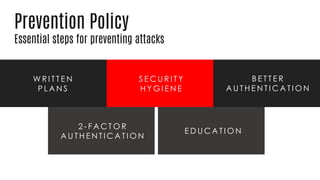
W R I T T E N
P L A N S
Prevention Policy
Essential steps for preventing attacks
S E C U R I T Y
H Y G I E N E
B E T T E R
A U T H E N T I C A T I O N
2 - F A C T O R
A U T H E N T I C A T I O N
E D U C A T I O N
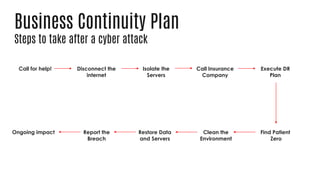
Call for help!
Business Continuity Plan
Steps to take after a cyber attack
Disconnect the
internet
Isolate the
Servers
Call Insurance
Company
Execute DR
Plan
Find Patient
Zero
Clean the
Environment
Restore Data
and Servers
Report the
Breach
Ongoing impact
ANDRE W LOSCHM ANN M A RK G A U DE T RYAN VALLE E
PANELISTS
BRYAN HARALOVICH
Partner,
Welch LLP
bharalovich@welchllp.com
613.236.9191
President & CTO,
Field Effect Software
aloschmann@fieldeffect.com
613.686.6342
Product Line Manager,
CIRA
mark.gaudet@cira.ca
613.237.5335
Senior VP,
Fully Managed
Ryan.vallee@fullymanaged.com
613.591.9800
THANK YOU

Cyber Security Planning 101

  • 1.
  • 2.
    ANDRE W LOSCHMANN M A RK G A U DE T RYAN VALLE E PANELISTS BRYAN HARALOVICH Partner, Welch LLP President & CTO, Field Effect Software Product Line Manager, CIRA Senior VP, Fully Managed
  • 3.
    Cyber Security andSMEs Andrew L os ch ma n n
  • 4.
    3 messages for SMEsin 2019: You can do something You are important You have cyber security responsibilities
  • 5.
    Message #1 You areimportant. • Threat actors (“attackers”) are not individuals, they’re organizations. • The motivation is almost always financially motivated. • Like most organizations, they adapt. In 2019, this means automation and scale: Data theft and resale, Credential sales, Ransomware, Financial Redirection… what’s next? If you have any assets, or have the potential to have an asset, you are a target.
  • 6.
    Message #2 You havecyber security responsibilities. • Customers • Stakeholders • Regulatory, Industry and other authorities
  • 7.
    Message #3 You cando something. • It is not an impossible problem. • Cyber Security threats are well understood at this point, as are effective defence strategies. • This technology, knowledge and process needed to make a real difference is not out of reach. • Believe it or not, the basics matter, and making a mistake on the basics are what will get you into trouble.
  • 8.
    Measuring Success Cyber Security is measurableand should: • Be continuous • Improve your network • Lower your risk (and costs)
  • 9.
  • 10.
  • 11.
    Of organizations reported beingcompromised last year. This number approaches 100% in larger organizations. 43%
  • 12.
  • 13.
    DNS as aLayer of Defense Use of DNS Firewalls Could Reduce 33% of All Cybersecurity Breaches.
  • 14.
    DNS Firewall aslayer of defense
  • 15.
    Of malicious data breachescame from a form of cyber-attack that leverages emails, texts, phone calls or even in- person visits. 93%
  • 16.
    Only 54 percent of small businesses provide cybersecurity training for their employees even though the most common form of malware seen by our respondents, phishing attacks (42 per cent), directly exploit employees as a point of weakness. 54% The Human Layer of Defense
  • 17.
    Reduction in usersclicking on phishing emails after implementing D-Zone Cybersecurity Awareness Training. 3x Transform your users into a human firewall
  • 18.
    The most integratedtraining, phishing simulation, gamification and measurement tool available. D-Zone Cybersecurity Awareness Training Score and measure Ongoing and Remedial Training “Turned cyber risk from something to lose sleep about into something we effectively manage” C-Therm Technologies Awareness Survey Phishing simulation End user training modules and risk analysis
  • 19.
    CIRA delivers afamily of cybersecurity services to Canadian organizations. D-Zone Anycast DNS Authoritative DNS for your domains  Improve performance with a global footprint  Protect from DNS DDoS and DNS hijacking D-Zone DNS Firewall Recursive DNS with threat blocking  100,000 new threats blocked daily  Stops malware command-and- control D-Zone Cybersecurity Awareness Training Phishing and training for end-users  Most integrated platform available  Reduce user clicks on malware links by 3X
  • 20.
    Summary • Defense inDepth • Leverage additional layers • DNS • Staff
  • 21.
    Fully Managed –Cyber Security RYAN VAL L EE
  • 22.
    Current threats andwho they are targeting The Continued Increase in Ransomware. • In 2016, a business fell victim to ransomware every 40 seconds. • 70% of all malware attacks last year were ransomware. • 91% of cyberattacks begin with spear phishing email, which are commonly used to infect organizations with ransomware. Cybersecurity Ventures predicts cybercrime will cost the world in excess of $6 trillion annually by 2021, up from $3 trillion in 2015. Ransomware is expected to worsen and make up a proportionately larger share of total cybercrime by 2021.
  • 23.
    Weaponization of ArtificialIntelligence • Security companies are using AI to protect environments and users, therefore it is certain that the hackers are following suit in their attack methodologies. • Hackers leverage AI in spear phishing exploits to create carefully targeted messages that trick people into sharing sensitive data and installing malware. • AI is used to collect information about a target organization from across the internet, to instigate detailed and targeted exploits, and crack passwords.
  • 24.
    Who Are TheyTargeting? • 71% of ransomware attacks in 2018 targeted small businesses, with an average ransom demand of $116,000 USD. • Consumer-targeted ransomware attacks have declined by 33% since the end of 2018. • Ransomware attacks on business targets have seen a substantial increase in the first quarter of 2019, up by 195 percent since the fourth quarter of 2018. • 16% of cyber-attacks target public sector entities, 15% focus on healthcare organizations, and 10 % of attacks target the financial industry. • • • • • • • • •
  • 25.
    Who Are TheyTargeting? - Continued • As can be seen from the data, public administrations are a very large target and this has been seen with the number of public municipalities which have suffered breaches recently. • “There's over two thousand municipalities in Canada ... they hold a lot of sensitive information on individuals ... on properties, on a lot of transactions. They're very vulnerable.” Dan Mathieson, mayor of Stratford … in a CBC news report after the municipality was hit with ransomware on 14th April 2019.
  • 26.
    Best practices inRisk Mitigation (Financial, public and brand damage) HAVE A PLAN CYBERSECURITY INSURANCE CYBERSECURITY PARTNER
  • 27.
    Disclosure issues surrounding thePersonal Information Protection and Electronic Documents Act (PIPEDA) PIPEDA applies to private-sector organizations across Canada that collect, use or disclose personal information in the course of a commercial activity. As of 1st November 2018, it is mandatory to report to the Privacy Commissioner of Canada breaches of security safeguards involving personal information that pose a real risk of significant harm to individuals. Failure to report such a breach can lead to fines of up to $100,000. (source: Government of Canada & Global News) • • •
  • 28.
    W R IT T E N P L A N S Prevention Policy Essential steps for preventing attacks S E C U R I T Y H Y G I E N E B E T T E R A U T H E N T I C A T I O N 2 - F A C T O R A U T H E N T I C A T I O N E D U C A T I O N
  • 29.
    Call for help! BusinessContinuity Plan Steps to take after a cyber attack Disconnect the internet Isolate the Servers Call Insurance Company Execute DR Plan Find Patient Zero Clean the Environment Restore Data and Servers Report the Breach Ongoing impact
  • 30.
    ANDRE W LOSCHMANN M A RK G A U DE T RYAN VALLE E PANELISTS BRYAN HARALOVICH Partner, Welch LLP bharalovich@welchllp.com 613.236.9191 President & CTO, Field Effect Software aloschmann@fieldeffect.com 613.686.6342 Product Line Manager, CIRA mark.gaudet@cira.ca 613.237.5335 Senior VP, Fully Managed Ryan.vallee@fullymanaged.com 613.591.9800
  • 31.