D E A L I N G W I T H T O D A Y ’ S A S Y M M E T R I C T H R E AT


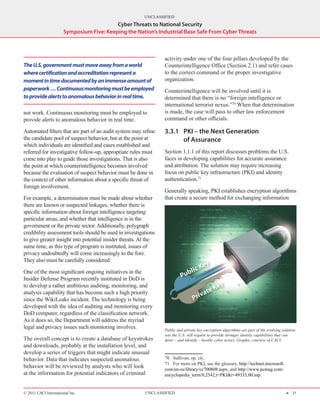
   Cyber Threats
                     to National Security


                       SYMPOSIUM FIVE
              Keeping the Nation’s Industrial Base
       Safe From Cyber Threats
The Asymmetric Threat website (asymmetricthreat.net) includes downloadable
reports from all symposia in both series and serves as a knowledge network to
advance the dialogue on national and global security, presenting resources and
original research, and providing a forum for review and discussion of pertinent
themes and events.


SERIES ONE


SERIES TWO
UNCLASSIFIED
                                          Cyber Threats to National Security
                      Symposium Five: Keeping the Nation’s Industrial Base Safe From Cyber Threats


                    This document is intended only as a summary of the personal remarks made by
                    participants at the March 1, 2011 symposium, “Keeping the Nation’s Industrial
                     Base Safe From Cyber Threats,” held at the Carnegie Institution for Science,
                     Washington, D.C., and co-sponsored by CACI International Inc (CACI), the
                      U.S. Naval Institute (USNI), and the Center for Security Policy (CSP). It is
                    published as a public service. It does not necessarily reflect the views of CACI,
                           USNI, CSP, the U.S. government, or their officers and employees.

                        The pro bono Asymmetric Threat symposia series was started in 2008 to
                     contribute to the national discourse on the topic of asymmetric threats facing
                        the United States. CACI and the National Defense University sponsored
                     Symposium One in the series, and CACI and USNI sponsored Symposia Two
                     and Three. With Symposium Four, also sponsored by CACI and USNI, a new
                     Asymmetric Threat series was initiated focusing on Cyber Threats. With new
                    sponsor CSP,“Keeping the Nation’s Industrial Base Safe From Cyber Threats”
                      is the fifth symposium in the Asymmetric Threat series and the second in the
                                                   Cyber Threat series.


                                                    September 2011


© 2011 CACI International Inc                         UNCLASSIFIED                                      H 1
UNCLASSIFIED
                                   Cyber Threats to National Security
               Symposium Five: Keeping the Nation’s Industrial Base Safe From Cyber Threats


Contents
Executive Summary……………………………………………………………………………… 3
1	       Dimensions of the Cyber Threat………………………………………………………… 4
1.1	     Vulnerabilities of the Industrial Base………………………………………………………………………                                    5
1.1.1	   Assurance and Attribution…………………………………………………………………………………                                             5
1.1.2	   Anonymity and Deterrence …………………………………………………………………………………                                             7
1.1.3	   Public Awareness and Understanding………………………………………………………………………                                        7
1.1.4	   Federal Policy and Responsibility……………………………………………………………………………                                       8

2	       Assessing the Cyber and Insider Threat to the Industrial Base……………………… 11
2.1	   The Realities of the Growing Cyber and Insider Threats……………………………………………………                           12
2.2	   Keeping Pace With Change…………………………………………………………………………………                                              14
2.2.1	 Operational Flexibility………………………………………………………………………………………                                             15
2.2.2	Technologies…………………………………………………………………………………………………                                                     16
2.2.3	 Into the Cloud: The End of the Perimeter Defense…………………………………………………………                               16
2.2.4	 Secure Information Sharing…………………………………………………………………………………                                            17

3	       Securing the Industrial Base…………………………………………………………… 19
3.1	     Private Sector and Citizen Understanding…………………………………………………………………                                  19
3.2	     Consensus on Privacy vs. National Security …………………………………………………………………                               19
3.3	     Technical and Enforcement Tools ……………………………………………………………………………                                      20
3.3.1	   PKI – the Next Generation of Assurance……………………………………………………………………                                   21
3.4	     An Educated Workforce………………………………………………………………………………………                                             22
3.5	     The Public-Private Partnership………………………………………………………………………………                                       23
3.6	     International Agreements……………………………………………………………………………………                                           25

4	Recommendations……………………………………………………………………… 28
4.1	 Defining Success…………………………………………………………………………………………… 30
4.2	Conclusion…………………………………………………………………………………………………… 31

Glossary ………………………………………………………………………………………… 32
Acknowledgments……………………………………………………………………………… 35


2 H                                            UNCLASSIFIED                           © 2011 CACI International Inc
UNCLASSIFIED
                                          Cyber Threats to National Security
                      Symposium Five: Keeping the Nation’s Industrial Base Safe From Cyber Threats


Executive Summary
Shortly after entering office, President Obama                       Against this ominous backdrop, the nation’s critical
unequivocally highlighted the safeguarding of                        infrastructure remains vulnerable to a vast array of cyber
cyberspace as a national security priority. Since then,              attacks, crimes, and other activities inimical to U.S. national
the administration has cited “significant progress in                security objectives.
cybersecurity, ensuring that Americans, our businesses,
and our government are building better protections                   Cyber threats to industry emanate from numerous sources.
against cyber threats.”1 Recently, the administration                These range from traditional external actors such as rogue
released its international strategy for cyberspace, a                states, to highly sophisticated intruders posing an advanced
measure the President described as “the first time that              persistent threat, to “inside” sources lurking within the most
our nation has laid out an approach that unifies our                 trusted circles of U.S government, industry and academia.
engagement with international partners on the full                   Protecting the industrial base has been further hindered
range of cyber issues.”2 Though noteworthy, these                    by industrial migration into cloud computing and by the
achievements have not abated the persisting imperative               difficulty in ensuring that technological protections in this
to counter cyber threats systematically, comprehensively,            area are sufficiently dynamic to counter the ever-morphing
and aggressively. This paper examines that imperative                cyber threat.
through one critical prism: the industrial base.                     The challenge of securing cyberspace and protecting
The lengthening litany of recent cyber attacks against               the industrial base against these threats is daunting, but
U.S. infrastructure – apparently of hostile origin –                 not insurmountable. Success demands a strategy that
exposes the glaring vulnerabilities of this industrial               couples agile, adaptive national security policies with
base. The critical research, production, marketing, and              market incentives designed to spur private forging of the
distribution engines of America’s economy are at once                technological shields and swords required to defeat a
vitalized by today’s dizzying advances in technology                 technology-driven enemy.
and information sharing – and asymmetrically                         Any strategy to defeat the cyber threat and protect America’s
threatened by often anonymous individual and                         industrial base must be supported by flexible legislation that
state actors who ride the same currents to infiltrate                defines government roles and authorities while balancing
increasingly edgeless digital networks from within                   national security imperatives with personal privacy, and by
and without.                                                         U.S.-led international agreements that establish norms and
The situation is further complicated by many                         enforce sanctions. If carried out among an aware citizenry
Americans’ idealized notions of cyberspace, as well as               by federal officials who recognize private industry’s
the difficulties in promulgating policies and legislation            indispensable cybersecurity role, and a savvy, technologically
that clearly assign roles and responsibilities to                    educated workforce, such an approach offers the U.S.
particular government entities and keep pace with the                the surest path to safeguarding its industrial base within a
exponentially evolving cyber medium.                                 cyberspace that remains more a bustling social and economic
                                                                     forum and marketplace than a battlefield.


1  Fact Sheet: The Administration’s Cybersecurity Accomplishments,
May 12, 2011, http://www.whitehouse.gov/sites/default/files/fact_
sheet-administration_cybersecurity_accomplishments.pdf.
2  President Barack H. Obama, International Strategy for
Cyberspace, May 2011, http://www.whitehouse.gov/sites/default/
files/rss_viewer/internationalstrategy_cyberspace.pdf.


© 2011 CACI International Inc                                 UNCLASSIFIED                                                        H 3
UNCLASSIFIED
                                        Cyber Threats to National Security
                    Symposium Five: Keeping the Nation’s Industrial Base Safe From Cyber Threats


1      	 Dimensions of
         the Cyber Threat
The scenarios that one can conjure to describe the scope
of today’s cyber threat are chilling because they are both
sweepingly devastating and eminently plausible.
The power blackout that brought life’s normal rhythms
to a virtual standstill for 55 million people in the
United States and Canada on August 14, 2003, was the
unintended result of strained power lines and power
system weaknesses. Yet this accidental disruption to
America’s infrastructure demonstrated the relative
fragility of America’s industrial base and foreshadowed its
susceptibility to harm, particularly from intentional actors.3

Indeed, in more recent years, cyber attacks of hostile origin
have exploited glaring vulnerabilities in America’s defense
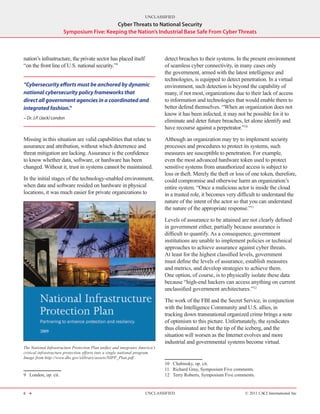
of its digital infrastructure. For example, the intentional          With all power gone from their homes and offices, New Yorkers filled the
and unauthorized release of classified U.S. documents                streets during the August 2003 blackout. Photo by Eric Skiff.
through WikiLeaks and the costly, apparently continuing
attacks on Sony’s PlayStation network4 both demonstrate              The cyber genie is out of the bottle, and the U.S. must not
that the cyber threat is real, present, and serious. Moreover,       fall behind in establishing and supporting cyber defense,
the Sony attacks in particular may reflect the disturbing            countermeasures, and offensive capability as instruments
characteristic of asymmetric warfare that targets citizens           of national power and strength.
rather than governments. Though it is hard to determine
                                                                     The threat emerges from a tsunami of technological
whether the attack was intended to damage Sony as a
                                                                     advances and information sharing. It is washing over
corporate entity, or simply to exasperate America’s parents,
                                                                     bureaucracies, infrastructures, legislation, and cultures
the hackers’ wide reach was on display.5
                                                                     with an ever-rising intensity that leaves governments
                                                                     confounded, frightened, and struggling to keep pace. It is
                                                                     also a threat attended with opportunity. The revolutionary
The cyber genie is out of the bottle, and the U.S. must              wave of the “Arab Spring,” for example, is being nurtured
not fall behind in establishing and supporting cyber                 through social media outlets that enable insurgent leaders
defense, countermeasures, and offensive capability as                to rally support. At the same time, autocratic regimes are
instruments of national power and strength.                          fighting back with their own cyber measures, prompting
                                                                     the State Department to fund cyber defense training as a
                                                                     counter response.
3  Dr. J.P. (Jack) London, Symposium Five comments.                  Although cyberspace can be an arena for positive and
4  Hayley Tsukayama, “Sony hit with attacks in Greece and Japan,”
                                                                     stabilizing impulses that sustain a nation’s identity, it can
The Washington Post, May 24, 2011.
5  PlayStation Network services were down for two and one-half       also be a battlefield on which threats from outside and
months, affecting more than 100 million customer accounts (the       within jeopardize a nation’s security. In this light, while
second-largest online data breach in U.S. history), and will cost    some nations view their citizens’ access to cyberspace
Sony an estimated $173 million. Mariko Yasu, “Sony to Complete       as an avenue of healthy communication, others regard
Restoration of Online Services This Week,” Bloomberg News, http://
www.bloomberg.com/news/2011-07-04/sony-to-resume-playstation-        such access as a risk. The most enlightened nations
network-services-in-japan.html, accessed on July 5, 2011.            clearly see it as both, and struggle to settle on the degree


4 H                                                           UNCLASSIFIED                                        © 2011 CACI International Inc
UNCLASSIFIED
                                          Cyber Threats to National Security
                      Symposium Five: Keeping the Nation’s Industrial Base Safe From Cyber Threats


of cybersecurity they can afford in terms of resource
investment and constrained individual liberty.

Given the struggles of even the most developed countries
in controlling relatively concrete problems such as
conventional crime and illegal immigration, some
view cyberspace as an unleashable force that cannot be
regulated without a cyber “kill switch.” However, even
if control of the cyber world is unachievable, the threats
it harbors can be mitigated. There is a way that proactive
governments committed to information and technology
security can operate effectively within that world to
advance their national objectives.

In this context, and with the objective of furthering the
dialogue concerning the future of U.S. security in the
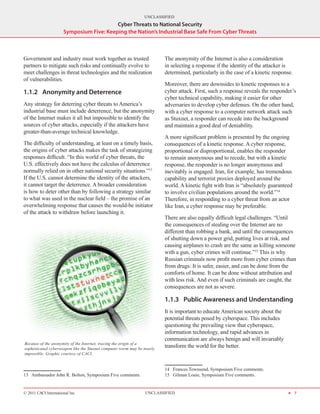
                                                                        Cyber attacks on America’s technology-enabled industrial base can
cyber era, this paper evaluates the cyber threat from                   strike at multiple points and come from both outsider and insider threats.
one critical perspective: the industrial base, and the                  Graphic courtesy of CACI.
overarching strategies and specific measures that should
be undertaken to protect it against cyber attacks from                 intrusions, and as the technology environment evolves
outside, and within.                                                   and becomes increasingly wireless, those with malicious
                                                                       (or worse) intent have increasingly proximate access.
1.1	 Vulnerabilities of the                                            Not only can hackers, criminals, and states (rogue or
                                                                       otherwise) passively monitor industrial activity, but they
     Industrial Base                                                   can also pose as wireless access points and start drawing
                                                                       in communications that are riding on networks. The
America’s industrial base may be defined as the total
                                                                       result is insiders who no longer have to depend on remote
industrial capacity (including the capacity of repair and
                                                                       intrusions. In this scenario, trying to develop a strategy
maintenance facilities) of the U.S. economy or nation
                                                                       to detect and eliminate intrusions would seem an almost
available for use.6
                                                                       insurmountable problem. It is clear that trying to develop
The industrial base has, increasingly, become a                        a strategy in this area is a “whack-a-mole problem.”7
technology-enabled environment. This means that the
machines Americans most depend on – cars, planes,                      1.1.1	 Assurance and Attribution
even pacemakers – all will soon have remote diagnostic                 Protecting America’s industrial base from cyber threats
capabilities. Cyber threats to an industrial base of this              is already a national security priority. Cybersecurity is a
kind will therefore not only be aimed at networks. Nor                 major component of the National Infrastructure Protection
will the cyber threat be only a remote intrusion issue.                Plan (NIPP) developed by the Department of Homeland
The standard vectors seen in this area will be supply                  Security (DHS) in 2006.8
chain and vendor.
                                                                       Cybersecurity policies must also carefully balance
The design, manufacture, delivery, installation, repair,               technology development and risk management. For example,
upgrading, and updating of these products give                         cloud computing is a growing trend, but it requires a higher
adversaries of the U.S. significant entrance points to U.S.            level of protection to ensure data reliability, availability, and
systems. The supply chain provides multiple points for                 security. Given that it owns some 85 to 90 percent of the

6  Also see http://www.businessdictionary.com/definition/industrial-   7  Steven R. Chabinsky, Symposium Five comments.
base.html.                                                             8  London, op. cit.


© 2011 CACI International Inc                                   UNCLASSIFIED                                                                  H 5
UNCLASSIFIED
                                           Cyber Threats to National Security
                       Symposium Five: Keeping the Nation’s Industrial Base Safe From Cyber Threats


nation’s infrastructure, the private sector has placed itself                  detect breaches to their systems. In the present environment
“on the front line of U.S. national security.”9                                of seamless cyber connectivity, in many cases only
                                                                               the government, armed with the latest intelligence and
                                                                               technologies, is equipped to detect penetration. In a virtual
“Cybersecurity efforts must be anchored by dynamic                             environment, such detection is beyond the capability of
national cybersecurity policy frameworks that                                  many, if not most, organizations due to their lack of access
direct all government agencies in a coordinated and                            to information and technologies that would enable them to
integrated fashion.”                                                           better defend themselves. “When an organization does not
                                                                               know it has been infected, it may not be possible for it to
- Dr. J.P. (Jack) London
                                                                               eliminate and deter future breaches, let alone identify and
                                                                               have recourse against a perpetrator.”10

Missing in this situation are valid capabilities that relate to                Although an organization may try to implement security
assurance and attribution, without which deterrence and                        processes and procedures to protect its systems, such
threat mitigation are lacking. Assurance is the confidence                     measures are susceptible to penetration. For example,
to know whether data, software, or hardware has been                           even the most advanced hardware token used to protect
changed. Without it, trust in systems cannot be maintained.                    sensitive systems from unauthorized access is subject to
                                                                               loss or theft. Merely the theft or loss of one token, therefore,
In the initial stages of the technology-enabled environment,                   could compromise and otherwise harm an organization’s
when data and software resided on hardware in physical                         entire system. “Once a malicious actor is inside the cloud
locations, it was much easier for private organizations to                     in a trusted role, it becomes very difficult to understand the
                                                                               nature of the intent of the actor so that you can understand
                                                                               the nature of the appropriate response.”11

                                                                               Levels of assurance to be attained are not clearly defined
                                                                               in government either, partially because assurance is
                                                                               difficult to quantify. As a consequence, government
                                                                               institutions are unable to implement policies or technical
                                                                               approaches to achieve assurance against cyber threats.
                                                                               At least for the highest classified levels, government
                                                                               must define the levels of assurance, establish measures
                                                                               and metrics, and develop strategies to achieve them.
                                                                               One option, of course, is to physically isolate these data
                                                                               because “high-end hackers can access anything on current
                                                                               unclassified government architectures.”12

                                                                               The work of the FBI and the Secret Service, in conjunction
                                                                               with the Intelligence Community and U.S. allies, in
                                                                               tracking down transnational organized crime brings a note
                                                                               of optimism to this picture. Unfortunately, the syndicates
                                                                               thus eliminated are but the tip of the iceberg, and the
                                                                               situation will worsen as the Internet evolves and more
                                                                               industrial and governmental systems become virtual.
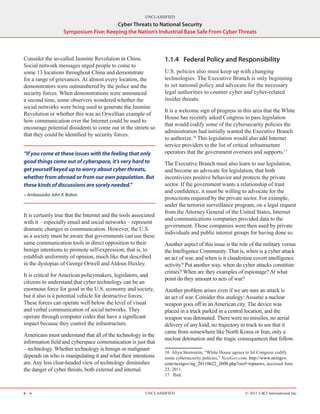
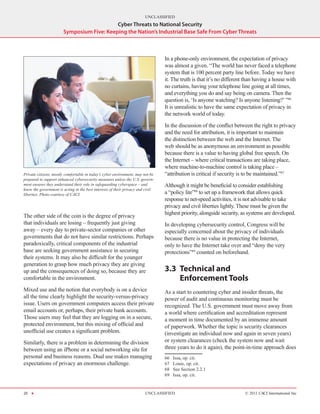
The National Infrastructure Protection Plan unifies and integrates America’s
critical infrastructure protection efforts into a single national program.
Image from http://www.dhs.gov/xlibrary/assets/NIPP_Plan.pdf.
                                                                               10  Chabinsky, op. cit.
                                                                               11  Richard Gray, Symposium Five comments.
9  London, op. cit.                                                            12  Terry Roberts, Symposium Five comments.


6 H                                                                   UNCLASSIFIED                                    © 2011 CACI International Inc
UNCLASSIFIED
                                          Cyber Threats to National Security
                      Symposium Five: Keeping the Nation’s Industrial Base Safe From Cyber Threats


Government and industry must work together as trusted                    The anonymity of the Internet is also a consideration
partners to mitigate such risks and continually evolve to                in selecting a response if the identity of the attacker is
meet challenges in threat technologies and the realization               determined, particularly in the case of a kinetic response.
of vulnerabilities.
                                                                         Moreover, there are downsides to kinetic responses to a
1.1.2	 Anonymity and Deterrence                                          cyber attack. First, such a response reveals the responder’s
                                                                         cyber technical capability, making it easier for other
Any strategy for deterring cyber threats to America’s                    adversaries to develop cyber defenses. On the other hand,
industrial base must include deterrence, but the anonymity               with a cyber response to a computer network attack such
of the Internet makes it all but impossible to identify the              as Stuxnet, a responder can recede into the background
sources of cyber attacks, especially if the attackers have               and maintain a good deal of deniability.
greater-than-average technical knowledge.
                                                                         A more significant problem is presented by the ongoing
The difficulty of understanding, at least on a timely basis,             consequences of a kinetic response. A cyber response,
the origins of cyber attacks makes the task of strategizing              proportional or disproportional, enables the responder
responses difficult. “In this world of cyber threats, the                to remain anonymous and to recede, but with a kinetic
U.S. effectively does not have the calculus of deterrence                response, the responder is no longer anonymous and
normally relied on in other national security situations.”13             inevitably is engaged. Iran, for example, has tremendous
If the U.S. cannot determine the identity of the attackers,              capability and terrorist proxies deployed around the
it cannot target the deterrence. A broader consideration                 world. A kinetic fight with Iran is “absolutely guaranteed
is how to deter other than by following a strategy similar               to involve civilian populations around the world.”14
to what was used in the nuclear field – the promise of an                Therefore, in responding to a cyber threat from an actor
overwhelming response that causes the would-be initiator                 like Iran, a cyber response may be preferable.
of the attack to withdraw before launching it.
                                                                         There are also equally difficult legal challenges. “Until
                                                                         the consequences of stealing over the Internet are no
                                                                         different than robbing a bank, and until the consequences
                                                                         of shutting down a power grid, putting lives at risk, and
                                                                         causing airplanes to crash are the same as killing someone
                                                                         with a gun, cyber crimes will continue.”15 This is why
                                                                         Russian criminals now profit more from cyber crimes than
                                                                         from drugs: It is safer, easier, and can be done from the
                                                                         comforts of home. It can be done without attribution and
                                                                         with less risk. And even if such criminals are caught, the
                                                                         consequences are not as severe.

                                                                         1.1.3	 Public Awareness and Understanding
                                                                         It is important to educate American society about the
                                                                         potential threats posed by cyberspace. This includes
                                                                         questioning the prevailing view that cyberspace,
                                                                         information technology, and rapid advances in
                                                                         communication are always benign and will invariably
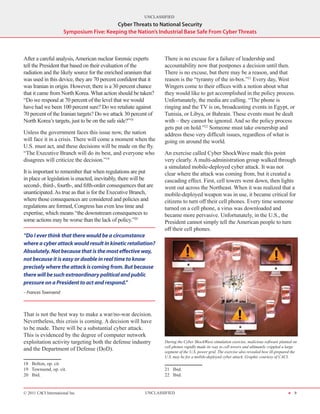
Because of the anonymity of the Internet, tracing the origin of a
sophisticated cyberweapon like the Stuxnet computer worm may be nearly
                                                                         transform the world for the better.
impossible. Graphic courtesy of CACI.


                                                                         14  Frances Townsend, Symposium Five comments.
13  Ambassador John R. Bolton, Symposium Five comments.                  15  Gilman Louie, Symposium Five comments.


© 2011 CACI International Inc                                   UNCLASSIFIED                                                     H 7
UNCLASSIFIED
                                       Cyber Threats to National Security
                   Symposium Five: Keeping the Nation’s Industrial Base Safe From Cyber Threats


Consider the so-called Jasmine Revolution in China.               1.1.4	 Federal Policy and Responsibility
Social network messages urged people to come to
some 13 locations throughout China and demonstrate                U.S. policies also must keep up with changing
for a range of grievances. At almost every location, the          technologies. The Executive Branch is only beginning
demonstrators were outnumbered by the police and the              to set national policy and advocate for the necessary
security forces. When demonstrations were announced               legal authorities to counter cyber and cyber-related
a second time, some observers wondered whether the                insider threats.
social networks were being used to generate the Jasmine
                                                                  It is a welcome sign of progress in this area that the White
Revolution or whether this was an Orwellian example of
                                                                  House has recently asked Congress to pass legislation
how communication over the Internet could be used to
                                                                  that would codify some of the cybersecurity policies the
encourage potential dissidents to come out in the streets so
                                                                  administration had initially wanted the Executive Branch
that they could be identified by security forces.
                                                                  to authorize.16 This legislation would also add Internet
                                                                  service providers to the list of critical infrastructure
“If you come at these issues with the feeling that only           operators that the government oversees and supports.17
good things come out of cyberspace, it’s very hard to             The Executive Branch must also learn to use legislation,
get yourself keyed up to worry about cyber threats,               and become an advocate for legislation, that both
whether from abroad or from our own population. But               incentivizes positive behavior and protects the private
these kinds of discussions are sorely needed.”                    sector. If the government wants a relationship of trust
                                                                  and confidence, it must be willing to advocate for the
- Ambassador John R. Bolton
                                                                  protections required by the private sector. For example,
                                                                  under the terrorist surveillance program, on a legal request
                                                                  from the Attorney General of the United States, Internet
It is certainly true that the Internet and the tools associated
                                                                  and communications companies provided data to the
with it – especially email and social networks – represent
                                                                  government. Those companies were then sued by private
dramatic changes in communication. However, the U.S.
                                                                  individuals and public interest groups for having done so.
as a society must be aware that governments can use these
same communication tools in direct opposition to their            Another aspect of this issue is the role of the military versus
benign intentions to promote self-expression; that is, to         the Intelligence Community. That is, when is a cyber attack
establish uniformity of opinion, much like that described         an act of war, and when is it clandestine covert intelligence
in the dystopias of George Orwell and Aldous Huxley.              activity? Put another way, when do cyber attacks constitute
                                                                  crimes? When are they examples of espionage? At what
It is critical for American policymakers, legislators, and
                                                                  point do they amount to acts of war?
citizens to understand that cyber technology can be an
enormous force for good in the U.S. economy and society,          Another problem arises even if we are sure an attack is
but it also is a potential vehicle for destructive forces.        an act of war. Consider this analogy: Assume a nuclear
These forces can operate well below the level of visual           weapon goes off in an American city. The device was
and verbal communication of social networks. They                 placed in a truck parked in a central location, and the
operate through computer codes that have a significant            weapon was detonated. There were no missiles, no aerial
impact because they control the infrastructure.                   delivery of any kind, no trajectory to track to see that it
                                                                  came from somewhere like North Korea or Iran, only a
Americans must understand that all of the technology in the
                                                                  nuclear detonation and the tragic consequences that follow.
information field and cyberspace communication is just that
– technology. Whether technology is benign or malignant
                                                                  16  Aliya Sternstein, “White House agrees to let Congress codify
depends on who is manipulating it and what their intentions       some cybersecurity policies,” NextGov.com, http://www.nextgov.
are. Any less clear-headed view of technology diminishes          com/nextgov/ng_20110622_2600.php?oref=topnews, accessed June
the danger of cyber threats, both external and internal.          23, 2011.
                                                                  17  Ibid.


8 H                                                       UNCLASSIFIED                                    © 2011 CACI International Inc
UNCLASSIFIED
                                          Cyber Threats to National Security
                      Symposium Five: Keeping the Nation’s Industrial Base Safe From Cyber Threats


After a careful analysis, American nuclear forensic experts       There is no excuse for a failure of leadership and
tell the President that based on their evaluation of the          accountability now that postpones a decision until then.
radiation and the likely source for the enriched uranium that     There is no excuse, but there may be a reason, and that
was used in this device, they are 70 percent confident that it    reason is the “tyranny of the in-box.”21 Every day, West
was Iranian in origin. However, there is a 30 percent chance      Wingers come to their offices with a notion about what
that it came from North Korea. What action should be taken?       they would like to get accomplished in the policy process.
“Do we respond at 70 percent of the level that we would           Unfortunately, the media are calling. “The phone is
have had we been 100 percent sure? Do we retaliate against        ringing and the TV is on, broadcasting events in Egypt, or
70 percent of the Iranian targets? Do we attack 30 percent of     Tunisia, or Libya, or Bahrain. These events must be dealt
North Korea’s targets, just to be on the safe side?”18            with – they cannot be ignored. And so the policy process
                                                                  gets put on hold.”22 Someone must take ownership and
Unless the government faces this issue now, the nation            address these very difficult issues, regardless of what is
will face it in a crisis. There will come a moment when the       going on around the world.
U.S. must act, and these decisions will be made on the fly.
“The Executive Branch will do its best, and everyone who          An exercise called Cyber ShockWave made this point
disagrees will criticize the decision.”19                         very clearly. A multi-administration group walked through
                                                                  a simulated mobile-deployed cyber attack. It was not
It is important to remember that when regulations are put         clear where the attack was coming from, but it created a
in place or legislation is enacted, inevitably, there will be     cascading effect. First, cell towers went down, then lights
second-, third-, fourth-, and fifth-order consequences that are   went out across the Northeast. When it was realized that a
unanticipated. As true as that is for the Executive Branch,       mobile-deployed weapon was in use, it became critical for
where those consequences are considered and policies and          citizens to turn off their cell phones. Every time someone
regulations are formed, Congress has even less time and           turned on a cell phone, a virus was downloaded and
expertise, which means “the downstream consequences to            became more pervasive. Unfortunately, in the U.S., the
some actions may be worse than the lack of policy.”20             President cannot simply tell the American people to turn
                                                                  off their cell phones.
“Do I ever think that there would be a circumstance
where a cyber attack would result in kinetic retaliation?
Absolutely. Not because that is the most effective way,
not because it is easy or doable in real time to know
precisely where the attack is coming from. But because
there will be such extraordinary political and public
pressure on a President to act and respond.”
– Frances Townsend


That is not the best way to make a war/no-war decision.
Nevertheless, this crisis is coming. A decision will have
to be made. There will be a substantial cyber attack.
This is evidenced by the degree of computer network
exploitation activity targeting both the defense industry         During the Cyber ShockWave simulation exercise, malicious software planted on
                                                                  cell phones rapidly made its way to cell towers and ultimately crippled a large
and the Department of Defense (DoD).                              segment of the U.S. power grid. The exercise also revealed how ill-prepared the
                                                                  U.S. may be for a mobile-deployed cyber attack. Graphic courtesy of CACI.
18  Bolton, op. cit.
19  Townsend, op. cit.                                            21  Ibid.
20  Ibid.                                                         22  Ibid.


© 2011 CACI International Inc                              UNCLASSIFIED                                                                    H 9
UNCLASSIFIED
                                          Cyber Threats to National Security
                      Symposium Five: Keeping the Nation’s Industrial Base Safe From Cyber Threats


                                                                             However, it is difficult to determine symmetry in cyber
                                                                             warfare. What will the U.S. do if a country like North
                                                                             Korea attacks NASDAQ or shuts down the New York
                                                                             Stock Exchange?

                                                                             The U.S. cannot shut down the North Korean stock
                                                                             exchange – such an entity doesn’t exist. Will the U.S. drop
                                                                             a bomb that takes human lives because financial damage
                                                                             cannot be inflicted? Where is the line that other nation
                                                                             states recognize they must not cross or risk retaliation?
                                                                             Where is the policy that defines what that retaliation will
                                                                             comprise? That “cyber line” is blurred because the United
                                                                             States “has not thought enough about it.” 23
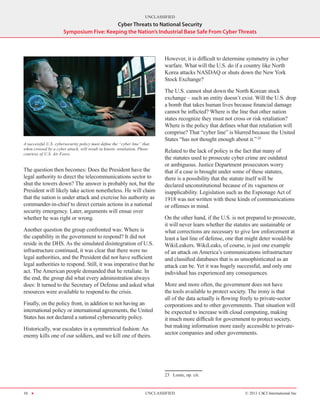
A successful U.S. cybersecurity policy must define the “cyber line” that,
when crossed by a cyber attack, will result in kinetic retaliation. Photo
courtesy of U.S. Air Force.
                                                                             Related to the lack of policy is the fact that many of
                                                                             the statutes used to prosecute cyber crime are outdated
                                                                             or ambiguous. Justice Department prosecutors worry
The question then becomes: Does the President have the                       that if a case is brought under some of these statutes,
legal authority to direct the telecommunications sector to                   there is a possibility that the statute itself will be
shut the towers down? The answer is probably not, but the                    declared unconstitutional because of its vagueness or
President will likely take action nonetheless. He will claim                 inapplicability. Legislation such as the Espionage Act of
that the nation is under attack and exercise his authority as                1918 was not written with these kinds of communications
commander-in-chief to direct certain actions in a national                   or offenses in mind.
security emergency. Later, arguments will ensue over
whether he was right or wrong.                                               On the other hand, if the U.S. is not prepared to prosecute,
                                                                             it will never learn whether the statutes are sustainable or
Another question the group confronted was: Where is                          what corrections are necessary to give law enforcement at
the capability in the government to respond? It did not                      least a last line of defense, one that might deter would-be
reside in the DHS. As the simulated disintegration of U.S.                   WikiLeakers. WikiLeaks, of course, is just one example
infrastructure continued, it was clear that there were no                    of an attack on America’s communications infrastructure
legal authorities, and the President did not have sufficient                 and classified databases that is as unsophisticated as an
legal authorities to respond. Still, it was imperative that he               attack can be. Yet it was hugely successful, and only one
act. The American people demanded that he retaliate. In                      individual has experienced any consequences.
the end, the group did what every administration always
does: It turned to the Secretary of Defense and asked what                   More and more often, the government does not have
resources were available to respond to the crisis.                           the tools available to protect society. The irony is that
                                                                             all of the data actually is flowing freely to private-sector
Finally, on the policy front, in addition to not having an                   corporations and to other governments. That situation will
international policy or international agreements, the United                 be expected to increase with cloud computing, making
States has not declared a national cybersecurity policy.                     it much more difficult for government to protect society,
Historically, war escalates in a symmetrical fashion: An                     but making information more easily accessible to private-
enemy kills one of our soldiers, and we kill one of theirs.                  sector companies and other governments.


                                                                             23  Louie, op. cit.


10 H                                                                  UNCLASSIFIED                                © 2011 CACI International Inc
UNCLASSIFIED
                                          Cyber Threats to National Security
                      Symposium Five: Keeping the Nation’s Industrial Base Safe From Cyber Threats


2       	 Assessing the Cyber                                   sensor, device, vehicle, power switch, and light bulb that
                                                                has an Internet Protocol (IP) address. For most citizens, the
          and Insider Threat to                                 2003 blackout in the Northeast was an inconvenience, but by
                                                                2020, almost every device and system imaginable will be on
          the Industrial Base                                   IP. “This will allow a nation state, rogue or otherwise, to use
                                                                cyberspace as a strategic, not simply a tactical, weapon.”27

According to the Internet security firm McAfee, more            “Just as the easiest way to rob a bank is to own it, the
than half the world’s critical infrastructure organizations     easiest way to compromise a system is to be inside it.”
have reported being hit by large-scale cyber attacks
or infiltrations.24 China and Russia are both known to          - Steven R. Chabinsky
routinely probe American industrial networks to find
information and vulnerabilities to use as leverage in any
                                                                The insider threat is also very real. Even if it were possible
future dispute scenario.
                                                                to eliminate all remote intrusions, the problem would not
In fact, the private sector, over the next few years, may       go away because, as has been said, “just as the easiest way
actually be a “bigger target and more vulnerable”25 in          to rob a bank is to own it, the easiest way to compromise a
many respects than some governmental institutions, due          system is to be inside it.”28
in large part to its ubiquity in American society. Moreover,
                                                                In considering cyber threats to the American industrial
the private sector has operated in conditions of relative
                                                                base, it is important not to focus so intently on the threat
security for so long that it is less prepared than the public
                                                                from outside so as to lose sight of the insider threat, which
sector to protect itself against cyber threats.
                                                                comes from three sources:
In securing the U.S. industrial base, it is important to
note that cyber threats emerge from a panoply of sources.       ƒƒ The Classic Insider has already been tasked to
Radical Islam is one such source, but the Russians,                do damage and seeks a position with a specific
Chinese, and many others are also continually testing              organization to carry out that task.
America’s cyber defenses. Threats also come from non-           ƒƒ The Disgruntled Insider is a person who joins an
national actors: terrorist cells, thrill-seeking or malicious      organization with the best intentions but later becomes
hackers, disgruntled employees, and others. Efforts to             dissatisfied. That dissatisfaction causes this actor to
address cyber threats must clearly define potential threats        decide to do damage after he or she is in place.
and develop strategies to deal with them. “When it comes
to protecting the industrial base, the industrial sector is     ƒƒ The Careless Insider is probably well-meaning but can
looking to government to be able to articulate the threat.”26      create dangerous vulnerabilities. This is the individual
                                                                   who inadvertently introduces malware by carelessly
Cyber threats to the industrial base include more than             connecting personal storage devices or accessing
just cyber attacks. They also include cyber espionage              untrusted sites and files. It can be someone who simply
and exploitation of system vulnerabilities. Hackers are            leaves a system on when going to lunch, or who writes
no longer – if they ever were – just kids huddled over             down a password and leaves it in the top desk drawer. 29
their keyboards in a dorm room or parents’ basement. At
the same time, the threat of individual cyber criminals         Another typology of the insider threat is as follows:
pales in comparison to that of nation states. Within a few
                                                                ƒƒ An insider that acts individually to commit harm.
years, a nation state determined to use cyberspace as a
strategic weapon will have the ability to eliminate every       ƒƒ An insider who is linked to an outsider.

24  London, op. cit.                                            27  Louie, op. cit.
25  Bolton, op. cit.                                            28  Chabinsky, op. cit.
26  Michelle Van Cleave, Symposium Five comments.               29  Stephen Smith, Symposium Five comments.


© 2011 CACI International Inc                           UNCLASSIFIED                                                      H 11
UNCLASSIFIED
                                        Cyber Threats to National Security
                    Symposium Five: Keeping the Nation’s Industrial Base Safe From Cyber Threats


For any comprehensive cybersecurity policy to succeed,
it must take into account the real possibility that the most
dangerous and hard-to-find adversaries may be those with
legitimate access to systems and infrastructure.

2.1	 The Realities of the Growing
     Cyber and Insider Threats
The cyber world is sometimes imagined as one in which
everybody gets along and plays by the rules. This is
probably best exemplified by the young people of the
world who are using Facebook, Twitter, and similar tools
to get together and create new structures. Sooner rather
than later, we are all going to be talking to each other
across borders. As the song says, “We are the world.” But
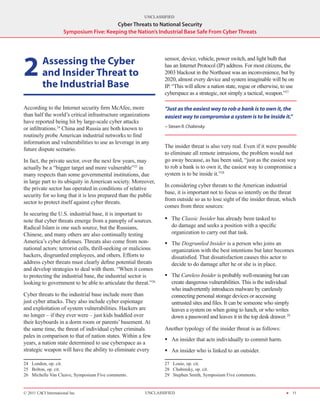
                                                                     Cyber attacks like the hacking of the NASDAQ stock exchange in February
do not expect a “kumbaya” world. Rather, we can, and                 2011 may herald an era of cyber warfare on U.S. economic institutions,
should, anticipate a world in which cyber attacks grow in            with results that can range from damaging investor confidence to compro-
frequency, gravity, and magnitude.                                   mising the U.S. economy on a global scale. Photo by Sean Yu.


Consider: The 2008 presidential campaigns of Barack                  collect data from control systems of global energy and
Obama and John McCain suffered cyber attacks. These                  petrochemical companies.32
cyber intrusions were countered relatively easily, but
                                                                     American businesses like Northrop Grumman have also
they did force all senior campaign staff to replace their
                                                                     experienced cyber intrusions and disruptions, probably
BlackBerries and laptops.30
                                                                     from sites within China. Microsoft had to provide source
It has not been so easy for DoD. In the first six months             codes to the Chinese government in order to do business
of 2009, DoD recorded nearly 44,000 incidents of                     there, and was still subject to cyber attacks. Attacks on
malicious cyber activity from sources ranging from                   Google and its Chinese users were allegedly coordinated
criminal hackers to foreign governments. Penetrations                at the highest levels of the Chinese government. Chinese
of Pentagon systems may have been efforts to map out                 cyber spies are known to have penetrated the U.S.
U.S. government networks and learn how to cripple                    power networks to leave potentially disruptive software
America’s command-and-control systems. While the                     programs or simply to gain tactical information.33
cost in terms of lost data is unknown, remediation for
                                                                     Elsewhere, the Stuxnet computer worm was introduced
those attacks exceeded $100 million. Cyber espionage
                                                                     into the nuclear facilities of Iran, causing centrifuges to
alone may have cost the United States up to $200 billion
                                                                     spin out of control and actually destroy themselves. At the
a year.31
                                                                     same time, Stuxnet sent a message to monitoring computers
On February 6, 2011, it was reported that hackers had                confirming that the reactors were operating normally.
accessed the NASDAQ Stock Exchange. In March 2011,
                                                                     Such incidents underscore the need for caution and
Americans learned that the major energy companies
                                                                     readiness on the part of the United States. Indeed,
were being hit by a series of cyber attacks that started in
                                                                     DHS is warning of copycat attacks.34 The director
November of 2009. “Night Dragon” hackers, believed to
be Chinese, were able to steal intellectual property and
                                                                     32  London, comments, op. cit.
                                                                     33  London, “Made in China,” op. cit.
30  Dr. J.P. (Jack) London, “Made in China,” Proceedings, April      34  Aliya Sternstein, “Cybersecurity center director warns of
2011.                                                                Stuxnet copycats,” NextGov.com, http://www.nextgov.com/nextgov/
31  Ibid.                                                            ng_20110526_8466.php?oref=rss?zone=NGtoday.


12 H                                                          UNCLASSIFIED                                       © 2011 CACI International Inc
UNCLASSIFIED
                                           Cyber Threats to National Security
                       Symposium Five: Keeping the Nation’s Industrial Base Safe From Cyber Threats


of the department’s National Cybersecurity and                  WikiLeaks put U.S. sources, methods, diplomats, and
Communications Integration Center has expressed                 forces at risk around the world. Combine this kind of
concern that malicious cyber actors could use growing           subversion with a sophisticated cyber attack on the U.S.
public information about the Stuxnet code to reengineer         industrial base, and the consequences could be far more
the software to attack broader targets.35                       profound. The founder of WikiLeaks, Julian Assange, says
                                                                that his next targets are major American banks and other
Moreover, just as external cyber threats are growing,           private-sector entities. His ability to access databases,
cyber-related insider threats are also increasing.              to make those databases public, or to corrupt, change,
On December 4, 2006, U.S. Navy Petty Officer Ariel              or counterfeit them could lead to damage to the U.S.
Weinmann pleaded guilty to desertion, espionage, and            infrastructure that is “all but unimaginable.”37
other charges. The public record shows that he jumped           There are standing DoD directives that deal clearly and
ship in Connecticut, taking with him an unspecified             explicitly with the unique regulations that relate to securing
quantity of classified electronic files.                        classified information systems and digital data. In this light,
While he was on duty, Weinmann downloaded detailed              the case of WikiLeaks becomes a matter of “command
national defense information, including such technical          responsibility,”38 and it is, one may assume, being addressed
manuals as that for the Tomahawk missile. He presented          in those channels. This case has also prompted a massive
these secret files to representatives of a foreign              investigation into how all federal agencies protect classified
government at scheduled meetings in Yemen, Vienna,              information and how insider threats may be addressed.
and Mexico City.                                                On the other hand, the Weinmann case and ensuing damage
Five years later, an Army private was able to take              assessment, which included specific recommendations to
hundreds of thousands of cables and other documents             rectify this security lapse, brought this looming problem to
out of a classified network that was not supposed to            the attention of national leadership. In 2006, it was thought
be downloadable, printable, or manipulable outside of           that “changes would surely be made.”39
its theoretically secure environment. He accomplished           In a DoD action to protect against threats in cleared defense
this task by doing nothing more than putting on a set of        industry organizations, the Defense Security Service (DSS)
earphones and listening to music while he downloaded            is investigating the possibility of including contract language
information. “How are sophisticated computer codes              with specific details about expected protections to ensure that
useful when a system is so vulnerable to penetration that       all bidders understand they must build protection, including
the very lowest level employee can undertake an activity        insider threat protection, into their systems. It should also be
that has profound consequences?”36                              noted that a thorough, competent insider threat program is
                                                                “defensive, reactive, and offensive,”40 requiring the support
                                                                of law enforcement and counterintelligence agencies with
                                                                investigative and operational authorities.
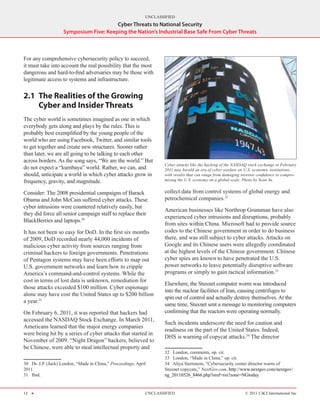
WikiLeaks put U.S. sources, methods, dip-                       More often than not, recent espionage cases have involved
lomats, and forces at risk around the world.
Combine this kind of subversion with a so-                      someone working in industry who has decided to go over
phisticated cyber attack on the U.S. industrial                 to the other side. Clearly, the government must do a better
base, and the consequences could be far more                    job of helping the industrial base protect itself against
profound. Image from WikiLeaks.
                                                                insider threats. The DSS, Navy, Army, and Air Force have
                                                                the authority to work directly with industry and help them
                                                                from a counterintelligence perspective.
                                                                37    Ibid
35  Sternstein, “Cybersecurity                                  38    Troy Sullivan, Symposium Five comments.
center director,” op. cit.                                      39    Van Cleave, op. cit.
36  Bolton, op. cit.                                            40    Smith, op. cit.


© 2011 CACI International Inc                           UNCLASSIFIED                                                       H 13
UNCLASSIFIED
                                        Cyber Threats to National Security
                    Symposium Five: Keeping the Nation’s Industrial Base Safe From Cyber Threats


DoD has some 22 organizations that have overlapping               or suspected link to foreign intelligence services or
counterintelligence (CI) authorities. Each has a                  international terrorist organizations are reported to the
responsibility to its parent organizations and to other           Department of Defense counterintelligence specialists,
organizations that do not have their own CI authority.            they will forward that information to the appropriate
These organizations are responsible for defending against         command or law enforcement personnel. This model
insider threats.                                                  has been shared with the National Counterintelligence
                                                                  Executive, who is trying to develop an insider threat
To put “a little intellectual rigor and a little military         policy for the federal government.
thinking”41 into what an insider threat means in DoD, the
Secretary of Defense charged the Assistant Secretary of           It is also important to realize that not all efforts should
Defense for Homeland Defense and Americas’ Security               be directed toward defending against the insider who
Affairs (ASD/HD&ASA) to create and lead a Defense                 acts alone. The potential for government or private-
Department Insider Threat Program. In support of this             sector insiders to walk off with large volumes of files is
effort, the Counterintelligence Directorate, Office of the        a known threat and there are “known ways of dealing
Under Secretary of Defense for Intelligence, and the              with it.”43
ASD/HD&ASA developed an approach, based on four
pillars,42 to address the insider threat. The four pillars are    For every criminal miscreant who individually
as follows:                                                       betrays the trust of the nation, there are hundreds of
                                                                  determined foreign intelligence officers and spies
ƒƒ Anti-terrorism Force Protection focuses on the violent         out to undermine America’s interests by stealing the
   insider extremist in the department.                           proprietary information of the U.S. industrial base and
                                                                  information critical to U.S. economic health and national
ƒƒ Information Assurance addresses the person who                 well‑being. In order to stop them, the United States must
   decides to damage DoD IT systems.                              never forget to continue directing significant energy
ƒƒ Security concerns the individual who compromises               into learning how these foreign intelligence services
   DoD information to unauthorized personnel.                     accomplish their missions.

ƒƒ Insider Counterintelligence focuses on the trusted
   insider who has a link to a foreign intelligence service,
                                                                  2.2	 Keeping Pace With Change
   an international terrorist organization, or a similar
                                                                  To keep up with the pace of technology changes and
   group.
                                                                  evolving threats, the business-as-usual approach must
To the extent that these pillars represent four different         be replaced. Business and government must be able to
insider threats, stakeholders are needed from throughout          move at the speed of technology in this area, and citizens’
DoD to address them. Although those stakeholders                  freedom of access to cyberspace needs to maintained 24/7.
represent different organizations and are primarily
interested in different types of threats, to be effective their   This is not an area that lends itself to legislation or law
activities and policies will be integrated. Perhaps most          enforcement. Fundamentally, America as a whole is
importantly, the Insider Defense Program will review the          relying on legislation and law enforcement systems that
mitigation activities that each of these stovepipes has been      were never designed to secure its most sensitive, vital,
working on to ensure that the mitigation activities of one        and critical infrastructures. “The technologists put us in
stovepipe will, in fact, generate information that could          this situation,” it has been said, “and the technologists
benefit the others.                                               have to get us out.”44 Until this opportunity is recognized,
                                                                  incentivized through the market, and founded on new
For example, when suspicious activities that are possibly         approaches and technologies, this problem will never
related to an insider threat but do not have a known              be resolved. Continuing to put resources into the current
41  Sullivan, op. cit.                                            43  Van Cleave, op. cit.
42  As presented by Sullivan.                                     44  Chabinsky, op. cit.


14 H                                                      UNCLASSIFIED                                 © 2011 CACI International Inc
UNCLASSIFIED
                                          Cyber Threats to National Security
                      Symposium Five: Keeping the Nation’s Industrial Base Safe From Cyber Threats


architecture is not a viable approach. Similarly, “the                  vulnerability mitigation strategy is “destined to fail.”48 The
interagency approaches that exist today are there to address            WikiLeaks incident is just one example of the damage
other challenges and are not effective in this arena.”45                excess privilege can cause. Employees are reminded
                                                                        to report suspicious behavior because just one person
The DoD Defense Industrial Base Cyber Security Task                     in an organization can make a positive difference. Of
Force is a major initiative. It is a partnership among                  course, the other side of the coin is that one person in an
some 40 major contractors that receive classified threat                organization can also make a negative difference.
information in return for providing information about
their loss of DoD information as a result of computer                   It is now possible for one user in a network environment
intrusions. The agreement is that if these contractors                  to entirely change the risk posture of an organization in
provide the information, DoD does not penalize them.                    a moment. That is unacceptable. The notion of focusing
There is a parallel initiative to add guidance to the                   on privileges and power, therefore, is significant. No
Defense Federal Acquisition Regulations about reporting                 progress will be made until the technologists and the
and certain standards that have to be met to do business                economists “start talking to each other”49 because much
with the government.                                                    of the solution can be market-driven and many of the
                                                                        technologies can be developed. Some of the solutions
2.2.1	 Operational Flexibility                                          may bump up against accepted notions of privacy and
                                                                        anonymity. It is therefore probably a good idea to start
From a policymaking standpoint, the realization of the
                                                                        thinking differently about those systems and services that
need to respond at net speed is critical. If nothing else, a
                                                                        require privacy and anonymity and the full protections
“policy lite”46 must be developed that enables those who
                                                                        that this country has rightfully grown to uphold.
have the capability to do so to react immediately, putting
them in the position to respond not only appropriately                  In the communications arena, whether Twitter or email
but promptly. Guidelines and rules of engagement must                   or VoIP,50 the government has no oversight and certainly
be established that address responses to specific types of              no ownership over the networks. That situation must
cyber attacks. Those who can react most quickly must                    remain as it is. However, it is also a fact that significant
be identified and put in the position to do so, whether                 systems and services exist that are responsible for the
responding to an external or internal threat.                           electric power grid and other critical infrastructure.
                                                                        In these arenas, notions of anonymity and privacy are
“To survive in the world, many of us learned to mind our
                                                                        far outweighed, to the extent that they even exist, by
P’s and Q’s. To survive in the cyber world, it’s necessary
                                                                        security concerns.
to mind our P’s and A’s. The A’s of cybersecurity are
assurance and attribution. On the vulnerability side, the               In considering technical solutions for those systems
P’s are privileges and power.”47                                        and services where security is more paramount than
                                                                        anonymity, mechanisms must be in place to ensure
Users are given privileges that far exceed what they
                                                                        that transactional data, at least at a certain level, shows
require, along with more powerful hardware and software
                                                                        provenance. That information may be encrypted. It may
than they need. These excess privileges and power
                                                                        be available only with the consent of one of the parties.
provide opportunities for mischief and malice. Until
                                                                        It may require a court order to obtain – but it must at
these opportunities are recognized and reduced, any
                                                                        least ride through communications.
45  Roberts, op. cit.
46  Although there is no formal consensus on this commonly used
term, broadly speaking “policy lite” may be defined as referring
to a less formal U.S. government policy, e.g. less binding than a       48  Ibid.
Presidential Executive Order; or a higher-level but less-detailed       49  Ibid.
and broader policy document that provides flexibility, agility, and     50  Voice over Internet Protocol. This is a technology that allows
adaptability for the government to be as proactive as possible in       users to make voice calls using a broadband Internet connection
responding to rapidly evolving challenges such as cyber threats.        instead of a conventional phone line. See http://transition.fcc.gov/
47  Chabinsky, op. cit.                                                 voip.


© 2011 CACI International Inc                                   UNCLASSIFIED                                                              H 15
UNCLASSIFIED
                                         Cyber Threats to National Security
                     Symposium Five: Keeping the Nation’s Industrial Base Safe From Cyber Threats


2.2.2	Technologies
In 1999-2000, the global community underwent a
technological transformation: In came the Internet and
web-based services, and out went the client server. A
major driver of that transformation was concern
about Y2K.51

Around the world, government and industry leaders and
ordinary citizens were worried about the problems that
might occur at the stroke of midnight on December 31,
1999. Would absolutely everything quit or collapse?
Corporate boards of directors invested billions of dollars
to eliminate old software and install new applications
that enabled Internet use.
                                                                          Internet Protocol version 4 (IPv4), which is the foundation for most Internet
U.S. government organizations initially just patched their                communications, is running out of space to store Internet address names
                                                                          and will soon be replaced by the next-generation IPv6. However, IPv6 will
way through, then eventually adopted methodologies                        likely lead to a move to a more virtual environment, which will then be more
that industry had started using. This also afforded many                  susceptible to cyber threats. Graphic courtesy of CACI.
organizations the opportunity to take advantage of Y2K
to upgrade their infrastructure and increase the reliability              2.2.3	 Into the Cloud:
of their systems and networks.                                            The End of the Perimeter Defense
A similar transformation, with its own set of challenges,                 The devices running on IPv4 are those that plug into
is set to occur again. This time, the transformation will                 a wall. The devices that will be running on IPv6 are
be driven by the move from IPv4, which is running out                     those that run off a battery. The strategies for running on
of name space (the number of addresses to support IP                      batteries are completely different than the strategies for
devices), to IPv6.52 In terms of the name space issue, the                running off power in the wall.54
Internet will “hit that wall”53 sometime in 2011.
                                                                          As any IT professional will note, given the increasing
Some patches will enable IPv4 to survive for a few more                   demand and the increasing cost for power and energy,
years, but sooner or later, the transition to IPv6 will be                because of power consumption, it is more cost-efficient to
necessary. At the same time, this is another opportunity                  replace servers every two years than to allow old servers
to upgrade infrastructure and enhance cybersecurity.                      to continue to run. Because battery power is so critical, by
                                                                          2014, the current Internet infrastructure will be replaced
                                                                          by a move to the cloud, which is more efficient and
51  The problem anticipated when computer applications developed
                                                                          allows mobility. In this virtualized environment, many of
in the 1960s and 70s used six-digit date codes, so that when the date     the trends that are in evidence today will be an order of
registered 01-01-00, the concern was that the applications would read     magnitude faster. However, this new environment also
this date as January 1, 1900 instead of January 1, 2000.                  creates new cyber threats.
52  The Internet operates by transferring packets of data a­ ross
                                                           c
networks as specified by an international communications protocol         Anything connected to the Internet is in the “red
known as the Internet Protocol (IP). Each data packet contains two
                                                                          zone.”55 It cannot be relied upon. Therefore, for critical
numeric addresses that are the packet’s origin and destination devices.
IPv4 has been the foundation for most Internet communications since       infrastructure, national security, financial institutions, and
1981. However, the Internet’s growth has created a need for more          the rest of the industrial base, a “green zone” must be
addresses than are possible in IPv4. IPv6 allows for vastly more          created, in which critical components are physically
numerical addresses, but switching from IPv4 to IPv6 may introduce
the possibility of increased cyber threats.                               54  Ibid.
53  Louie, op. cit.                                                       55  Roberts, op. cit.


16 H                                                             UNCLASSIFIED                                             © 2011 CACI International Inc
UNCLASSIFIED
                                            Cyber Threats to National Security
                        Symposium Five: Keeping the Nation’s Industrial Base Safe From Cyber Threats


or technically isolated. As that green zone is developed,       Industry and the government are investing billions of
critical infrastructure will operate within it.                 dollars in cybersecurity to implement strategies based on
                                                                current web-based, enterprise-control architectures that
The assumption will be that the green zone will be              will soon be replaced.
attacked continually. Therefore, its resiliency must be
guaranteed. Creating such a zone requires a determination       The replacement will have no perimeter. For most people,
of how to map current networks. The sensor grids that           the principal computing device will be a slate or an iPhone
must be in place from the beginning to give common              tied in virtually to an unknown site. All the security that is
operational pictures of the architecture must also be           currently relied on will be obsolete by 2014.
identified so that, as the zone is attacked, regions of the
architecture can be cut off as necessary.                       At that point, when infrastructure and systems are fully
                                                                controlled by IP, the stakes go up exponentially. “That is
Design and operation of the cloud in this vulnerable            when cyber and insider threats will be encountered at a
environment must be determined, along with the                  strategic level.”57
initiatives required to provide warning about low-level
germination of new malware activities. It is also vital to      2.2.4	 Secure Information Sharing
recognize that “there will be threat vectors that do not
                                                                In formulating security policy to protect against cyber and
even exist today, making alert capabilities even more
                                                                insider threats, it is worth noting two themes that are at
critical in order to meet these threats head-on instead of
                                                                the “front and center of everything that is done across the
reacting only when they manifest themselves.”56
                                                                DoD mission.”58
Traditionally, cybersecurity strategy has been based on
perimeter defense. Whether at Google, Amazon, or the            ƒƒ Information should be shared in ways never previously
U.S. government, data are put in a physical box, in a              imagined, with up-to-the-minute technologies, across
physical location. That physical location is secured by            every boundary – among federal agencies; state,
armed guards and fences, as well as deep background                local, and tribal governments; nongovernmental
checks and, in some cases, polygraphs on the people who            organizations; and partners around the world.
have access to the location and the data.                       ƒƒ Attacks on government networks, from outsiders and
                                                                   insiders, grow exponentially every day.
“Anybody in the software business will tell you that
                                                                Because these two themes are not usually considered to
any hardware hack can hack into any software                    be related, much of the work that both government and
defense.”                                                       private organizations do does not get to the heart of the
– Gilman Louie                                                  issue at hand: protecting the industrial base from cyber
                                                                and insider attacks.

That is today. Tomorrow, such data will run in the              The IT world has shifted dramatically. This is no longer a
public cloud. Owners of data will not know where it             world of big IT systems that are built to last for years. It is
is, who is running it, who is controlling it, or who is         a world of service‑oriented architecture. This move from
seeing it. What does it mean to have a virtualized system       large IT systems to a service‑oriented approach introduces
containing secure data that is spread all over the world,       a democratization of technology. Organizations no longer
running on any computer on demand and vulnerable                hire employees to go off for months to build a solution
to hacking?                                                     to a problem. Now, an employee can build a solution at
                                                                home, overnight.
Because this threat is new, the mathematics and the
science behind protecting that data are underdeveloped.
                                                                57  Louie, op. cit.
56  Roberts, op. cit.                                           58  David M. Wennergren, Symposium Five comments.


© 2011 CACI International Inc                           UNCLASSIFIED                                                      H 17
UNCLASSIFIED
                                        Cyber Threats to National Security
                    Symposium Five: Keeping the Nation’s Industrial Base Safe From Cyber Threats


Government partnerships with industry have grown
exponentially. Most of the research work done internally
is now done externally. In these partnerships, any threat to
a company that is part of the defense industrial base is a
threat to the nation as a whole.

Secure sharing is not a set of isolated problems to solve,
but more about two issues that have to be managed
effectively to avoid forever falling behind. Considering
current security concerns, the answer does not lie in
erecting greater obstacles to access or imposing greater
isolation on systems. Those actions miss the point,
because the U.S. government and industry cannot
complete their missions if they cannot reach across
boundaries. The need now is to reduce the number of
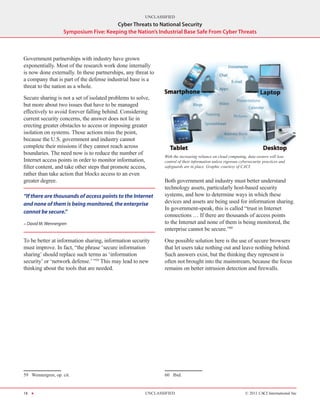
                                                               With the increasing reliance on cloud computing, data owners will lose
Internet access points in order to monitor information,        control of their information unless rigorous cybersecurity practices and
filter content, and take other steps that promote access,      safeguards are in place. Graphic courtesy of CACI.
rather than take action that blocks access to an even
greater degree.                                                Both government and industry must better understand
                                                               technology assets, particularly host‑based security
“If there are thousands of access points to the Internet       systems, and how to determine ways in which these
and none of them is being monitored, the enterprise            devices and assets are being used for information sharing.
                                                               In government‑speak, this is called “trust in Internet
cannot be secure.”
                                                               connections … If there are thousands of access points
- David M. Wennergren                                          to the Internet and none of them is being monitored, the
                                                               enterprise cannot be secure.”60

To be better at information sharing, information security      One possible solution here is the use of secure browsers
must improve. In fact, “the phrase ‘secure information         that let users take nothing out and leave nothing behind.
sharing’ should replace such terms as ‘information             Such answers exist, but the thinking they represent is
security’ or ‘network defense.’ ”59 This may lead to new       often not brought into the mainstream, because the focus
thinking about the tools that are needed.                      remains on better intrusion detection and firewalls.


59  Wennergren, op. cit.                                       60  Ibid.


18 H                                                   UNCLASSIFIED                                            © 2011 CACI International Inc
UNCLASSIFIED
                                          Cyber Threats to National Security
                      Symposium Five: Keeping the Nation’s Industrial Base Safe From Cyber Threats


3        	 Securing the                                       distance costs were just a few years ago. Still, some
                                                              private-sector organizations may be skeptical of the
           Industrial Base                                    need to invest in cyber protection or may look to the
                                                              government to address the cyber threat.

                                                              U.S. leaders must also consider the role of the public,
The value of the Internet to the industrial base is mostly    which is not prepared for a potential disablement
a connected value. Whether data exists in the cloud or        of its computers. The public will inevitably be in
on a PC, once the system is unplugged, the data has little    the middle of the coming cyber war and, therefore,
value. “Both the public and private sectors now depend on     must be included in preparations for this conflict. It
connectivity for efficiency.”61                               is imperative that the American public understand
                                                              the technical repercussions of potential leaks to U.S.
It is against this framework that the Homeland Security
                                                              adversaries. “We are motivated, we have incentive,
Council presented its first threat brief. The results were
                                                              when something touches us closely in our work or at
so overwhelming that “the first reaction was to start
                                                              home. And incentives rule the world.”65 Cyber attacks
unplugging systems from the Internet until vulnerabilities
                                                              can affect far more than Sony PlayStations.
could be addressed.”62 However, it is the connected
world that must be made robust. The rules of cyberspace       The worst possible way to address cybersecurity issues is
that continually increase the predictability of this tool     to put up yet another firewall or buy a new PC. Dealing
of commerce – rules that allow cyberspace to do what it       with these threats requires a change in public attitudes and
does and do it ever better and faster – are mostly set by     significant private-sector investment. In the long run, the
tradition or by the private sector. “The government’s role    right answers will save money, especially compared to the
is to ensure that private commerce is not interrupted.”63     ineffective (or partially effective) protection provided by
                                                              the money spent today on stopgap measures.
However, within the larger threat context, there is no
single government agency, no branch of government,
no private company that can by itself counter cyber           3.2	 Consensus on Privacy
and insider threats. It requires the full engagement of,           vs. National Security
and cooperation among, Congress, agency leaders, and
industry to bring solutions to this arena. “The way elected   Although protection of privacy is important, it is also
representatives and the private industry work together on     important to distinguish from whom privacy is to be
this issue is critical to the nation’s future.”64             protected – the government or the private sector.

                                                              Americans’ privacy from government is protected by the
3.1	 Private Sector and                                       Constitution, and that protection is one that government
     Citizen Understanding                                    agencies must respect. However, privacy under the
                                                              Constitution has limits. An individual is entitled to a
For more than two decades, technology has allowed             presumption of privacy unless the federal government can
individuals and organizations to become much                  demonstrate to a neutral magistrate that there is probable
more efficient. For example, companies can hold               cause he or she is engaged in activities so nefarious
teleconferences over the Internet, transparently supporting   that the right to privacy must be infringed. Therefore,
multiple gateways at no incremental cost. Using the           the government has the ability to protect its citizens by
Internet to stream video, employ VoIP, and transfer data      infringing the privacy of criminals, saboteurs, and the like.
is, in fact, less expensive than telephone lines and long-    Part of the contract of the Constitution is the government’s
                                                              most fundamental obligation to protect its citizenry.
61    Hon. Darrell Issa, Symposium Five comments.
62    Townsend, op. cit.
63    Issa, op. cit.                                          65  Major General Thomas L. Wilkerson, Symposium Five
64    Paul M. Cofoni, Symposium Five comments.                comments.


© 2011 CACI International Inc                          UNCLASSIFIED                                                     H 19
UNCLASSIFIED
                                           Cyber Threats to National Security
                       Symposium Five: Keeping the Nation’s Industrial Base Safe From Cyber Threats


                                                                                 In a phone-only environment, the expectation of privacy
                                                                                 was almost a given. “The world has never faced a telephone
                                                                                 system that is 100 percent party line before. Today we have
                                                                                 it. The truth is that it’s no different than having a house with
                                                                                 no curtains, having your telephone line going at all times,
                                                                                 and everything you do and say being on camera. Then the
                                                                                 question is, ‘Is anyone watching? Is anyone listening?’ ”66
                                                                                 It is unrealistic to have the same expectation of privacy in
                                                                                 the network world of today.

                                                                                 In the discussion of the conflict between the right to privacy
                                                                                 and the need for attribution, it is important to maintain
                                                                                 the distinction between the web and the Internet. The
                                                                                 web should be as anonymous an environment as possible
                                                                                 because there is a value to having global free speech. On
                                                                                 the Internet – where critical transactions are taking place,
                                                                                 where machine-to-machine control is taking place –
Private citizens, mostly comfortable in today’s cyber environment, may not be    “attribution is critical if security is to be maintained.”67
prepared to support enhanced cybersecurity measures unless the U.S. govern-
ment ensures they understand their role in safeguarding cyberspace – and         Although it might be beneficial to consider establishing
know the government is acting in the best interests of their privacy and civil
liberties. Photo courtesy of CACI.                                               a “policy lite”68 to set up a framework that allows quick
                                                                                 response to net-speed activities, it is not advisable to take
                                                                                 privacy and civil liberties lightly. These must be given the
                                                                                 highest priority, alongside security, as systems are developed.
The other side of the coin is the degree of privacy
that individuals are losing – frequently just giving                             In developing cybersecurity control, Congress will be
away – every day to private-sector companies or other                            especially concerned about the privacy of individuals
governments that do not have similar restrictions. Perhaps                       because there is no value in protecting the Internet,
paradoxically, critical components of the industrial                             only to have the Internet take over and “deny the very
base are seeking government assistance in securing                               protections”69 counted on beforehand.
their systems. It may also be difficult for the younger
generation to grasp how much privacy they are giving
up and the consequences of doing so, because they are                            3.3	 Technical and
comfortable in the environment.                                                       Enforcement Tools
Mixed use and the notion that everybody is on a device                           As a start to countering cyber and insider threats, the
all the time clearly highlight the security-versus-privacy                       power of audit and continuous monitoring must be
issue. Users on government computers access their private                        recognized. The U.S. government must move away from
email accounts or, perhaps, their private bank accounts.                         a world where certification and accreditation represent
Those users may feel that they are logging on in a secure,                       a moment in time documented by an immense amount
protected environment, but this mixing of official and                           of paperwork. Whether the topic is security clearances
unofficial use creates a significant problem.                                    (investigate an individual now and again in seven years)
Similarly, there is a problem in determining the division                        or system clearances (check the system now and wait
between using an iPhone or a social networking site for                          three years to do it again), the point-in-time approach does
personal and business reasons. Dual use makes managing                           66    Issa, op. cit.
expectations of privacy an enormous challenge.                                   67    Louie, op. cit.
                                                                                 68    See Section 2.2.1
                                                                                 69    Issa, op. cit.


20 H                                                                    UNCLASSIFIED                                    © 2011 CACI International Inc
UNCLASSIFIED
                                          Cyber Threats to National Security
                      Symposium Five: Keeping the Nation’s Industrial Base Safe From Cyber Threats


                                                                 activity under one of the four pillars developed by the
The U.S. government must move away from a world                  Counterintelligence Office (Section 2.1) and refer cases
where certification and accreditation represent a                to the correct command or the proper investigative
moment in time documented by an immense amount of                organization.
paperwork … Continuous monitoring must be employed               Counterintelligence will be involved until it is
to provide alerts to anomalous behavior in real time.            determined that there is no “foreign intelligence or
                                                                 international terrorist nexus.”70 When that determination
not work. Continuous monitoring must be employed to              is made, the case will pass to other law enforcement
provide alerts to anomalous behavior in real time.               command or other officials.

Automated filters that are part of an audit system may refine    3.3.1	 PKI – the Next Generation
the candidate pool of suspect behavior, but at the point at             of Assurance
which individuals are identified and cases established and
referred for investigative follow‑up, appropriate rules must     Section 1.1.1 of this report discusses problems the U.S.
come into play to guide those investigations. That is also       faces in developing capabilities for accurate assurance
the point at which counterintelligence becomes involved          and attribution. The solution may require increasing
because the evaluation of suspect behavior must be done in       focus on public key infrastructure (PKI) and identity
the context of other information about a specific threat of      authentication.71
foreign involvement.
                                                                 Generally speaking, PKI establishes encryption algorithms
For example, a determination must be made about whether          that create a secure method for exchanging information
there are known or suspected linkages, whether there is
specific information about foreign intelligence targeting
particular areas, and whether that intelligence is in the
government or the private sector. Additionally, polygraph
credibility assessment tools should be used in investigations
to give greater insight into potential insider threats. At the
same time, as this type of program is instituted, issues of
privacy undoubtedly will come increasingly to the fore.
They also must be carefully considered.

One of the most significant ongoing initiatives in the
Insider Defense Program recently instituted in DoD is
to develop a rather ambitious auditing, monitoring, and
analysis capability that has become such a high priority
since the WikiLeaks incident. The technology is being
developed with the idea of auditing and monitoring every
DoD computer, regardless of the classification network.
As it does so, the Department will address the myriad
legal and privacy issues such monitoring involves.               Public and private key encryption algorithms are part of the evolving solution
                                                                 sets the U.S. will require to provide stronger identity capabilities that can
The overall concept is to create a database of keystrokes        deter – and identify – hostile cyber actors. Graphic courtesy of CACI.
and downloads, probably at the installation level, and
develop a series of triggers that might indicate unusual
behavior. Data that indicates suspected anomalous                70  Sullivan, op. cit..
                                                                 71  For more on PKI, see the glossary, http://technet.microsoft.
behavior will be reviewed by analysts who will look              com/en-us/library/cc700808.aspx, and http://www.pcmag.com/
at the information for potential indicators of criminal          encyclopedia_term/0,2542,t=PKI&i=49333,00.asp.


© 2011 CACI International Inc                            UNCLASSIFIED                                                                    H 21
UNCLASSIFIED
                                         Cyber Threats to National Security
                     Symposium Five: Keeping the Nation’s Industrial Base Safe From Cyber Threats


over public or private networks. Digital certificates that
authenticate the identity of organizations and individuals
are used to ensure that messages have not been altered or
tampered with. The Defense Advanced Research Projects
Agency (DARPA) and the National Security Agency
are now looking at PKI and other advanced identity
authentication technologies as “part of the next generation
of assurance and defense.”72

At DoD, which has been using PKI certificates on smart
cards for years, 3.5 million people are doing cryptographic
logon to the network, digitally signing travel claims,
encrypting emails when necessary, and using certificates
to do secure browsing. They are moving away from a
world of user IDs and passwords.                                  The Department of Defense is now focused on training a “cyber cadre” of
                                                                  experts who possess the knowledge and skills to advise on and respond to
This strong identity capability enables agencies to know          evolving cyber threats. Photo courtesy of U.S. Air Force.
who each user is, what device the user is on, where
the user is navigating, and what activities the user is           3.4	 An Educated Workforce
performing. The power of identity management is critical
in coping with insider threats.                                   Skill sets and educational requirements are already
                                                                  changing in the job market. Hiring at the FBI, for example,
A strong identity capability also provides information on         is increasingly geared toward those with specialized skills.
the validity of a member in the user community and the            The agency is hiring fewer lawyers and accountants and
validity of certificates. A user’s organization, clearance, and   more people that have technical abilities and language
role are known in any given login situation, determining          skills. On the intelligence analyst side, the FBI is looking
what data the user can access, and what he or she can do          at college graduates with B.S. degrees in electrical
with that data. A user with a Secret clearance, for example,      engineering and similar disciplines.73
does not need to see everything Secret but ought to be able
to see the information that the combination of clearance          Organizations, public or private, concerned with
level and specific role allows. To accomplish this, data-         cybersecurity need an “Internet‑savvy” workforce. DoD
tagging is a mundane but necessary task.                          debated the use of social media and social networking
                                                                  services and concluded that it had no choice but to use
The federal government and its industry partners should           them. The question was how to use them effectively.
be able to standardize to combine PKI with personal               The solution to that problem is to have the right kind
identity verification (PIV) interoperability cards. The idea      of monitoring technology, both at the gateway and on
is to have one identity card allow its holder to do business      individual devices, and to have an Internet‑smart workforce.
with multiple federal agencies rather than a separate             Then social networking tools can be used effectively.
identity tied to individual systems or facilities.
                                                                  Efforts to educate workers on how to be savvy Internet
A data service is available that allows a driver’s license, for   users are important. One of the potential opportunities
example, to be “swiped” and read immediately. The service         organizations have is to attract the young net generation.
matches this against terrorist watch lists, the National Crime    Members of that generation should be the employees of
Information Center (NCIC), and other databases – and              choice moving forward. Government in particular needs
does so against real-time data. Services like these need to       to bring them on board and “unleash their creativity.”74
be made available on a widespread basis so that real-time
information can be shared at all installations.
                                                                  73  Chabinsky, op. cit.
72  Gray, op. cit.                                                74  Wennergren, op. cit.


22 H                                                      UNCLASSIFIED                                        © 2011 CACI International Inc
UNCLASSIFIED
                                          Cyber Threats to National Security
                      Symposium Five: Keeping the Nation’s Industrial Base Safe From Cyber Threats


DoD is also focused on building up what it calls the “cyber
cadre,” 75 particularly for the Defense Cyber Crime Center.
One significant obstacle is that the Department works under
the old personnel schemes and compensation programs.
One way to overcome this obstacle is to use contractors
to perform tasks that might seem to be inherently
governmental. The Deputy Secretary is particularly
concerned with this and frequently mentions the need for
appropriately skilled personnel to build the cyber cadre.


3.5	 The Public-Private Partnership
While experts and leaders from government and
industry agree that public-private partnerships (P3s)
and public-private partnership pilots (P4s) must be part
of any effective strategy and program to counter cyber
and insider threats, it is clear the U.S. government
needs to take the lead on defending the nation’s critical              The FBI’s InfraGard program, NSA’s recent work with Internet service providers,
                                                                       and Defense Industrial Base Cyber Security/Information Assurance (DIB CS/IA)
infrastructure.                                                        projects represent promising public/private partnerships that must be part of U.S.
                                                                       cybersecurity policy to protect America’s industrial base. Seals courtesy of the
“The private sector owns most of the shoreline, but we                 respective organizations and programs. Graphic courtesy of CACI.
still need a navy,” said James Lewis, senior fellow at the
nonprofit Center for Strategic and International Studies,              One difficulty is reaching the appropriate level of sensitivity
in testimony before a House Oversight and Government                   for sharing information. Another impediment may be the
Reform subcommittee hearing.76 Just as airlines are not                means of transferring information. Because of the “rampant
asked to defend airspace, businesses cannot be required to             intrusions and data exfiltration”79 that have occurred in
protect cyberspace solely on their own. Nor can voluntary              unclassified networks, the focus of one Defense Industrial
regulations adequately resolve the problem. Partnership is             Base program is on protecting those networks. Participants
the most effective approach.                                           naturally assumed that they would use their information
                                                                       technology and networks to share information. Unfortunately,
This partnership could take the form of something like                 in effect they initially proposed to share solutions and cyber
FBI’s InfraGard program, which facilitates sharing of                  threat information on the very networks that had been
actionable intelligence on possible threats among law                  compromised. Obviously, other sharing mechanisms need to
enforcement, academia, and the public sector.77 More                   be found, which may be yet another challenge.
recently, the National Security Agency has begun a P4 with
Internet service providers to deploy new tools in countering           This is a time when “the government needs to work
cyber attacks against defense contractors.78 This is a                 with the private sector to define a new paradigm”80 for
promising sign of progress in public-private collaboration.            a relationship to address cybersecurity. A relationship of
                                                                       trust must be built between the public and private sectors
Information sharing is key, and though this may be an                  to seriously address the challenges that cyber crime
obvious starting point, it is not without obstacles.                   represents to the industrial base. The government cannot
                                                                       do it alone. The government must have the help of the
75  Gray, op. cit.                                                     private sector. That is where the intellectual capital to
76  Sternstein, “Cybersecurity center director,” op. cit.              solve this problem resides. A real partnership involves a
77  London comments, op. cit.                                          relationship of trust and confidence.
78  Ellen Nakashima, “NSA allies with Internet carriers to thwart
cyber attacks against defense firms,” The Washington Post, June 16,
                                                                       79  Gray, op. cit.
2011.
                                                                       80  Townsend, op. cit.


© 2011 CACI International Inc                                  UNCLASSIFIED                                                                        H 23
UNCLASSIFIED
                                           Cyber Threats to National Security
                       Symposium Five: Keeping the Nation’s Industrial Base Safe From Cyber Threats


Some government agencies complain of insufficient                                 To forge a new relationship that will encourage
transparency on the part of the private sector with                               information sharing, work needs to be done on both sides,
government. However, the government is “not necessarily                           which will require commitment at senior levels, along
sufficiently transparent with the private sector, either.”81                      with new legal authorities.
Many believe that the information the government has is
over‑classified and that this over-classification masks a larger                  Yet another obstacle to information sharing and P4
problem of insufficient useful information on the part of the                     initiatives (among industry, academia, and government)
government. If the government desires greater sharing from                        is the frequent response that activities in this realm are
the private sector, these concerns must be addressed.                             prohibited by current laws. To keep pace with the threat
                                                                                  and with technology, the issues that might negatively
Issues of competition and market also affect the sharing                          impact the ability to use P3s and P4s must be identified
of information. Unless and until the government can                               and resolved. These issues include determining when
convince a private-sector organization that the government                        a public-private voluntary issue affects business
can protect information, both from the organization’s                             relationships, source selections, or contract requirements.
competitors and from public disclosure under FOIA or
from congressional subpoenas, that organization will not                          Such legal issues become an obstacle to acting at net speed
share information.                                                                and responding to cyber threats. The U.S. government must
                                                                                  take a certain amount of risk to be able to address these
Nowhere is this more evident than in the financial sector.                        problems because, if nothing else, “U.S. adversaries are not
Banks and credit card companies suffer billions of dollars                        constrained by the same legal frameworks and issues.”82
of loss every year due to cyber crime. Only a small                               One recommendation might be to do a low-level pilot
fraction of that is reported to the federal government                            with all involved parties and “walk through those decision
because of the concern that the public would lose                                 points” 83 to determine what can – and cannot – be done.
confidence in the financial sector if it understood the
extent of the problem.                                                            One good example of a successful public-private
                                                                                  partnership is the Defense Industrial Base Cyber Security/
                                                                                  Information Assurance (DIB CS/IA) Program.

                                                                                  DIB CS/IA is a family of P4s. The justification for these
                                                                                  programs is that the U.S. government has unique insights
                                                                                  and information about cyber threats and vulnerabilities
                                                                                  and some very sophisticated capabilities to defend
                                                                                  against those threats. However, the need exists for
                                                                                  new and creative ways to share that information and
                                                                                  those capabilities with the private sector, the critical
                                                                                  infrastructure. A new model must be put in place that
                                                                                  allows this vital sharing.

                                                                                  Put another way, “The soft stuff is the hard stuff.”84
                                                                                  There are many difficulties involved in developing
                                                                                  technical approaches for cybersecurity and appropriate
                                                                                  responses to intrusions or attacks. To develop these
The difficulties inherent in public-private information sharing can be seen in
the financial sector, where banks and credit card companies are often reluctant
to reveal cyber attacks on their systems for fear of losing public confidence.    82  Gray, op. cit.
For the public-private partnership to succeed, the government must convince       83  Roberts, op. cit.
these institutions it can both protect their disclosures and help them counter
                                                                                  84  Gray, using a phrase commonly attributed to Dr. Michael
cyber threats. Graphic courtesy of CACI.
                                                                                  Hammer, a founder of the business process reengineering
                                                                                  management theory. See also http://www.bizjournals.com/portland/
81  Townsend, op. cit.                                                            stories/2008/10/20/smallb4.html.


24 H                                                                    UNCLASSIFIED                                      © 2011 CACI International Inc
UNCLASSIFIED
                                          Cyber Threats to National Security
                      Symposium Five: Keeping the Nation’s Industrial Base Safe From Cyber Threats


defenses and responses, assurance and attribution must         more timely and relevant. Now, they are building the
be addressed, the nature of an event must be understood,       infrastructure to open that information-sharing model to
the source of an attack or intrusion must be identified,       a wider base, not only throughout the DIB but also, to
and the intent of the actor must be determined. These are      the extent that it makes sense, with such agencies as the
all difficult undertakings.                                    Department of Homeland Security (DHS). DHS may then
                                                               take the lead in spreading the capabilities developed in the
As those in the private sector attempt to confront             DIB CS/IA to other critical infrastructures.
these issues, it becomes apparent that a new and agile
mechanism is needed to keep pace with the threat.              The information being shared in this program is some
Business and government leaders like to think of               of the unique cyber threat information held by the
themselves as being on the cutting edge, being creative        DoD and other entities that are very sophisticated in
and open to new partnerships. However, these same              their approaches to cybersecurity. Another set of pilot
leaders keep falling back on established laws, restrictions,   activities is exploring how the unique information that
and mindsets. Innovation is confronted with old (perhaps       DoD or government agencies have available can be
outdated) legal requirements that address competition,         shared with organizations that depend on commercial
unfair preferential advantage, antitrust, and many other       services for their cybersecurity.
issues that inhibit the speed and agility with which
public-/private-sector partnerships could be formed.           Much of the work in developing strategies to protect the
                                                               industrial base has been done in and by DoD and DHS
How should P3s and P4s be structured? One                      and their contractors, but 85 to 90 percent of the critical
approach is to create a structure that is similar to a         infrastructure is in the commercial sector. Therefore,
critical infrastructure voluntary partnership. In this         even if the government protects its data and systems, “if
information-sharing model, all participants come               cyber criminals can access the intellectual capital of the
to the table voluntarily. There are no enforcement             nation through the government’s private-sector partners,
mechanisms. Another option is a more regulatory                everyone is still at risk.”85
approach, one that would require partners to come to
the table and that has some enforcement mechanism,             Ideas for sharing information, tips, queuing, and similar
such as the DIB CS/IA.                                         issues have been worked for quite some time. Companies
                                                               that sent representatives to this symposium are working
The DIB CS/IA model may work in other environments,            with DoD on how to share that kind of information
but it must be noted that DoD may be in a unique               because doing so is absolutely vital.
situation. The defense industrial base (DIB) is not only
DoD’s critical infrastructure sector (for which it is          From a security perspective, the Defense Security
responsible in critical infrastructure schemes), but the       Service (DSS) is the cognitive security and counter-
DIB is also made up of DoD contractors. U.S. weapons           intelligence authority in the defense industry. However,
systems are being developed by these contractors,              DSS works only with Defense‑cleared contractors, not
so the background security for the systems on which            the entire industrial base. There have been efforts to
those technologies are being developed is incredibly           rectify this in some way, but just as those efforts were
important. Separate business relationships must be             beginning to move with some aggressiveness, they were
respected. Creating a model in which a voluntary,              slowed by budget constraints. The good news, however,
friendly, trust-based relationship coexists with a             is that DSS recognizes that it must do more in this area.
contractual relationship is not an easy task.
                                                               3.6	 International Agreements
Challenges notwithstanding, the program has worked
very well. It started as a pilot program with a small group    A frequent suggestion on how to counter cyber and insider
of DIB partners attempting to identify how information         threats is to establish international agreements, as has been
could be shared in a secure manner. They were able
to make information sharing both secure and much               85  Wennergren, op. cit.


© 2011 CACI International Inc                           UNCLASSIFIED                                                   H 25
UNCLASSIFIED
                                         Cyber Threats to National Security
                     Symposium Five: Keeping the Nation’s Industrial Base Safe From Cyber Threats


done in the arms control arena.86 Signatories would agree
not to engage in cyber warfare. Of course, that may be
easier said than done.

Although the cyber infrastructure is a global resource,
the management of which requires a new approach to
relationships between nations, the risks inherent to such
an approach cannot be dismissed. “There are many
nations, organizations and individuals who see this as
very much a zero sum game and are prepared to take
advantage of the sort of globalist approach that we
particularly have fostered.”87

“If one country cannot protect the rest of the world
from cyber threats originating on its soil, the rest of the           International agreements on cybersecurity are critical to the global
world has an absolute right to do so.”                                cooperation that is required to defeat cyber threats to the U.S. and all nations.
                                                                      Graphic courtesy of CACI.
– Congressman Darrell Issa (R-CA)

                                                                      This is not like copyright or patent protection, which are
There are certain classes of behavior that responsible                win-lose situations. In cybersecurity, with the exception of
nations can agree should be prohibited. For example, if               North Korea, “every nation is a loser”90 if the environment
some actor – a malevolent hacker, a terrorist cell, or a rogue        as a whole cannot be made safe and reliable.
state – shuts down the critical infrastructure of a city or
nation, that is unacceptable behavior. “The Chinese have              There is an appreciation in the WMD (weapons of
as much interest as the Americans in making sure that the             mass destruction) community, as just one example, that
stock exchanges and monetary systems are not corrupted.”88            verification in the biological area is essentially impossible.
                                                                      Nevertheless, any verification argument made in this area
One problem with working effectively internationally                  would be better than one that could be made for the cyber
to counter the cyber threat is the lack of a direct,                  warfare area.91
ongoing interface with cyber staff in European Union
countries, which represent more than half of the rest of              Another problem in establishing international agreements
the developed world. Information from U.S. embassies                  is that when it comes to international negotiation, friends
is funneled to the chief executive. If the President does             and allies are not always readily apparent. Consider,
not initiate action, nothing happens. If the President                for example, how the United States shares intelligence
does initiate action, Congress may question it. Indeed,               within NATO. It is very restricted, even with close NATO
“Congress is not structured to deal with this problem.”89             allies. The U.S. simply does not share the most sensitive
                                                                      intelligence with any of its NATO allies and certainly
A recommended solution is to engineer a United Nations                not with all of them. Engaging in complex negotiations
resolution on cybersecurity and a unified treaty that                 with others about cybersecurity poses risks similar to
requires cooperation among nations in the cyber realm.                sharing intelligence with allies. Such negotiations may
                                                                      require discussion of sophisticated defensive measures,
86  President Obama also addressed international cooperation to       for example, and may provide information and expose
counter cyber threats in his May 2011 publication, International      vulnerabilities to those who are not true allies.
Strategy for Cyberspace, http://www.whitehouse.gov/sites/default/
files/rss_viewer/internationalstrategy_cyberspace.pdf.                90  Ibid.
87  Frank J. Gaffney, Symposium Five comments.                        91  Bolton: “I think you could make an argument, a bad argument,
88  Townsend, op. cit.                                                but you could make a better argument in the biological area than you
89  Issa, op. cit.                                                    can in cyberspace.”


26 H                                                           UNCLASSIFIED                                            © 2011 CACI International Inc
UNCLASSIFIED
                                          Cyber Threats to National Security
                      Symposium Five: Keeping the Nation’s Industrial Base Safe From Cyber Threats


More importantly, and related to the verification question,     global infrastructure, and the U.S. will not be able to touch
it could well be that the greatest threats faced in the         them. The other alternative, escalating the stakes on both,
cyber field are not the ones traceable to, and the result of,   is equally a recipe for disaster.
obvious actions by nation states. The greatest threats may
come from non-state actors who may or may not have              The United States has an opportunity to take a role in
some affiliation to any state, organization, or cause. In a     defining the problem to the rest of the world, including
world of plausible deniability, that is yet another problem     the UN and NATO and countries to which America
with international agreements.                                  provides aid, who may themselves be bad actors but
                                                                want to ensure that the U.S. aid relationship continues.
                                                                It could be argued before the World Trade Organization
“There are many nations, organizations, and                     that bad behavior in this arena could, in fact, be a
individuals who see this as very much a zero sum game           legitimate reason for trade sanctions. The U.S. position
and are prepared to take advantage of the sort of               is that Internet trade is trade. Every country, with the
globalist approach that we particularly have fostered.”         exception of North Korea, is part of this global trade,
                                                                and that global trade should be enforced and protected.
– Frank J. Gaffney
                                                                Backing that position is a role for the U.S. government.
                                                                It is not something the private sector can do.
Still, as has been noted, in a world of nation states, there
are some cyber activities that all might agree are outside      The private sector cannot convince the world to agree
the pale, so there may be some role for international           that there must be a strategy, that nation states must
agreements. In its deliberations on establishing a national     work together, and that there must be real sanctions and/
Cyber Command, Congress suggests that, as necessary,            or repercussions when actors – individuals, groups, or
international law may be changed to provide the ability         governments – create a cyber threat or launch a cyber
to deal, for example, with something like WikiLeaks.            attack. The government is the only entity that can do that.
Although it is not necessarily a matter that can or should      China, for example, must be made to realize that the world
be addressed in an international agreement, laws or             as a whole expects it to stop being part of the problem and
policies must also be established to avoid war every time a     start being part of the solution. Not only is the government
hacker in China or Albania begins an exploitation of either     the only entity that can do this, but it is the entity that
government or non-government assets.                            must do it. “There is no punishment for actors who use
At the same time, an international agreement may need           cyber tools to mine the research and development efforts
to be established to shut those hackers down. The tools         of others or who steal information with impunity. This
and the authority to use them must be available, along          has great impact on America’s economic competitiveness
with an international understanding that “if one country        and, therefore, on the strength and security of the U.S.
cannot protect the rest of the world from cyber threats         industrial base.”93
originating on its soil, the rest of the world has an           The truth is that there are, by far, more cyber attacks for
absolute right to do so.”92                                     commercial purposes than there are cyber attacks against
Every nation will continue its own espionage activities,        the government. The government may try to protect its
and no nation will relinquish the right to use cyber attacks    citizens and its assets, including U.S. nuclear weapons,
as acts of war when it is attacked or even sufficiently         but all of that protection is for naught if the U.S. economy
threatened. Certain moves in this arena can be taken off        is not viable. And the economy can lose its viability if,
the table, but unless action is taken now, the U.S. and         every time there is an innovation, it is simultaneously
others will always be in the position of throwing up their      available to every other country. At that point, the driver
hands in despair and frustration. Actors will always be         for innovation is lost.
attacking from a physical place across America’s cyber or

92  Issa, op. cit.                                              93  Ibid.


© 2011 CACI International Inc                            UNCLASSIFIED                                                   H 27
UNCLASSIFIED
                                           Cyber Threats to National Security
                       Symposium Five: Keeping the Nation’s Industrial Base Safe From Cyber Threats


4       	Recommendations                                                      A number of recommendations may be made to advance
                                                                              the national understanding of cyber threats in general and to
                                                                              keep the nation’s industrial base safe from cyber and cyber-
                                                                              related insider threats. These appear on the following page.
The cybersecurity threat is an unquestioned national                          A public and private partnership is needed to implement
security interest that the U.S. is not prepared or equipped                   these recommendations. No matter how well the federal
to address. Indeed, as a nation, it has not even done the                     government is protected from cyber and insider threats,
“intellectual homework”94 needed to understand the                            national security is not well served unless America’s
overall nature of the threat. American efforts now are                        citizens, commerce, and way of life are likewise protected.
aimed toward protecting the current infrastructure, most                      Based on both precedents and current and pending
of which will be “worthless in the next four years.”95                        legislation, the DHS has the mission to coordinate and
It is imperative that America systematically expand its                       lead multi-level and inter-governmental efforts for
thinking about the cyber world and the challenges it will                     cybersecurity supporting what this report describes as the
bring in the very near future.                                                industrial base and critical infrastructure.

                                                                              Cybersecurity and cyber-related insider threats will
                                                                              need to become a major facet of homeland security and
                                                                              homeland defense missions. DHS, with support from
                                                                              the Secretary of Defense and all other federal cabinet
                                                                              heads, has the lead for the National Infrastructure
                                                                              Protection Plan. Inherent in this mission is coordinating
                                                                              across industries and organizations as well as the
                                                                              intelligence, defense, and law enforcement and public
                                                                              safety communities.

                                                                              These federal efforts must also give the public practical,
                                                                              actionable information that will enable individuals,
                                                                              businesses, and organizations to understand why it
                                                                              is important to use Internet-connected devices and
                                                                              information safely. Each individual must understand
                                                                              how he or she has responsibility in protecting other
                                                                              users. This undertaking requires collective efforts among
                                                                              communities, organizations, and industries to reach the
                                                                              requisite level of risk management and active defense to
                                                                              protect from cyber and insider threats.

                                                                              Many parts of the nation must come together to ensure a
                                                                              trusted collaboration among the envisioned public-private
                                                                              partnership. The campaign must forthrightly and directly
                                                                              address a series of highly sensitive issues, including open
                                                                              society vs. open cyberspace; security and privacy of
To best protect America’s industrial base, all the pieces of the              commercial and proprietary information; anonymity vs.
cybersecurity puzzle must fall into place. Graphic courtesy of CACI.          privacy and the Constitutional right to privacy; liability
                                                                              issues tied to government sharing of threat and risk
                                                                              information; government sharing of threat information
94  Bolton, op. cit.                                                          with only selected industries and individuals; and
95  Louie, op. cit.                                                           assignment and acceptance of responsibility.


28 H                                                                   UNCLASSIFIED                                © 2011 CACI International Inc
UNCLASSIFIED
                                          Cyber Threats to National Security
                      Symposium Five: Keeping the Nation’s Industrial Base Safe From Cyber Threats


     Recommendations
     Recommendation 1 – Develop a comprehensive and adaptive United States government policy
     framework that identifies roles, responsibilities, and resources across the government (federal, state, and
     local) to detect, defend, and preempt cyber threats to the industrial base. Prioritize the development of
     methodologies and metrics for planning and forecasting resource requirements for cyber defense.

     Recommendation 2 – Define the spectrum of cyber threats to the industrial base and potential responses
     to them. This includes categorizing cyber attacks and which attacks constitute acts of war, as well as
     cultivating offensive and preemptive capabilities.
     Recommendation 3 – Embrace the concept of cyberspace as a military domain, equivalent to the domains
     of land, air, sea, and outer space, enabling the U.S. government to lawfully target hostile nations and other
     adversaries. Develop a comprehensive strategic doctrine and rules of engagement governing the offensive
     use of cyber capabilities by the U.S. Make it clear that the U.S. has ample technical means to act in its
     national interest and has the capacity to mount a targeted symmetric or asymmetric response in defense.
     Recommendation 4 – Strengthen support for National Infrastructure Protection Plan initiatives for
     integrating critical infrastructure and key resource pro­ ection initiatives into a unified national effort.
                                                             t
     Provide periodic reviews and updates of these initiatives to assure that cybersecurity, supply chain
     integrity, personnel security, physical security, information security, information assurance, insider threat,
     and training and education measures and resources keep pace with technology change and evolving threats.
     Recommendation 5 – Foster public-private partnerships that provide trusted collaboration to prevent,
     secure, protect, and mitigate the impact of cyber attacks and cyber-related insider threats. Enact legislation
     to confer authorities, assign responsibilities, define reporting relationships, and resolve privacy and liability
     issues to facilitate the degree of information sharing required to support cyber intelligence and insider
     threat programs.
     Recommendation 6 – Encourage the private-sector development of cybersecurity technologies and
     heightened IT security by offering economic incentives that are realistic and tailored to particular industries.
     Recommendation 7 – Make a national commitment to lead world efforts in fostering access to and
     security within cyberspace – just as the U.S. has done in ensuring freedom of the seas, air, and space –
     by accelerating the development of legislation, policy, procedures, and authorities. This includes rapidly
     evolving international and non-governmental partnerships that promote cybersecurity and freedom of
     access to cyberspace.


© 2011 CACI International Inc                          UNCLASSIFIED                                                     H 29
UNCLASSIFIED
                                       Cyber Threats to National Security
                   Symposium Five: Keeping the Nation’s Industrial Base Safe From Cyber Threats


4.1	 Defining Success                                            Whether they result in an acceleration of national efforts
                                                                 to better deal with cyber threats and cyber-related insider
The data needed to gauge the success of security measures        threats is yet to be seen. Though there has been an
taken to counter cyber and insider threats requires not          upswing in the tempo of executive and legislative efforts
just analysis of the federal government’s experience             on cyber threats and insider-threat issues, these efforts
but samplings or measurements of the results of the              have yet to provide measurable results.
private sector. This is key even when the private sector
                                                                 Each system, each service, each nation state should have
is reluctant to report on cyber incidents and the extent of
                                                                 an understanding of the level of cyber risk it faces and
damage caused by these incidents.
                                                                 the level that is acceptable, because the world will never
Part of the reluctance comes from competitive                    be cyber-risk-free. Each actor will have its own risk
considerations, but it also comes from a lack of liability       calculus. Considering the discrete categories of risk –
legislation needed to foster information exchanges among         threat, vulnerability, consequence, and mitigation – at least
participants in the public-private partnership. With the         outlines a path of approach in the cost-benefit analysis of
private sector “owning” more than 90 percent of the nation’s     how much risk is acceptable.
cyber operations, omitting this segment of the nation results
                                                                 Still, determining risk exposure is increasingly difficult,
in an incomplete measurement of the problem.
                                                                 because the proper data points are not available. This
There may also be a false sense of security throughout           makes it difficult to develop a strategy, which presumably
the government and private sector because the U.S. has           is to lower that risk to an acceptable level, recognizing that
not been hit by a large-scale cyber attack. Nevertheless,        what is acceptable will be different for different systems,
DHS must be adequately resourced and supported by                services, and nation states.
legislation if it is going to lead infrastructure protection
                                                                 In the current situation, neither an acceptable level of risk
efforts, including protection of both the industrial base
                                                                 nor a strategy for sustaining that level has been defined.
and the defense industrial base. Among the enabling
                                                                 Most projects in this arena are interim measures, but
legislation is the need for a refined evaluation protocol
                                                                 they have not been considered as a whole to determine
that gauges cybersecurity readiness and vulnerabilities.
                                                                 whether the degree of risk reduction they offer results
As discussed in 2010 in the symposium report on Cyber            in an acceptable level of risk. The real question is not
Threats to National Security – Countering Challenges             whether such projects will be successful, but what degree
to the Global Supply Chain, without a refined evaluation         of risk remains, and is it survivable? Thus, for all the pilot
protocol, gauging the nation’s success in countering cyber       projects currently underway, in both the private sector
threats will prove at least as difficult as assessing the        and government, one must ask: To what end? What is
efficacy of America’s response to the more conventional          gained when real-time information-sharing objectives are
terrorist attack of September 11, 2001.                          achieved, other than, perhaps, a short-term tactical benefit?

The nation needs cyber domain awareness. This requires
measurement of cyber infrastructure at all levels of the
nation and aggregating and analyzing the information.
How to best do this is currently being debated. However,
based on the patchwork of federal efforts, antiquated
authorities and enabling legislation, and the lack of critical
analysis of public-private partnerships, this debate may
continue for some time.

Events such as WikiLeaks, Stuxnet, and the Arab Spring           It is difficult, but necessary, for any U.S. cyber strategy to include clear
have elevated the urgency, complexity, and power                 measures that delineate acceptable levels of risk – and what is gained as a
of cyber operations and cyber-related insider threats.           result. Graphic courtesy of CACI.


30 H                                                      UNCLASSIFIED                                          © 2011 CACI International Inc
UNCLASSIFIED
                                          Cyber Threats to National Security
                      Symposium Five: Keeping the Nation’s Industrial Base Safe From Cyber Threats


4.2	Conclusion                                                 There is no partial protection. Nothing takes the place
                                                               of a proactive and reactive set of defenses. One of the
Facing the unique national security challenges linked to       challenges the U.S. faces is to change the dialogue.
the nation’s, citizens’, and economy’s use of cyberspace,      Addressing cybersecurity in the present is not a question
the United States must do everything in its power to build     of throwing money at the problem or generating goodwill
and implement a comprehensive strategy for dealing with        and cooperation between the public and private sectors.
cybersecurity and cyber-related insider threats.               It is about the fact that there are impediments to execution
                                                               of an effective cybersecurity policy that enables proactive
                                                               and reactive activity and that gives the American people
“The development of the Internet and information               confidence that their rights are protected.
technology has been an enormously enabling
                                                               The U.S. did not establish its nuclear warfare doctrines
experience for civilization. It has added to trust,            overnight. It required time to refine its thinking and to apply
communication, productivity, and efficiency … Our              its efforts to formulating a strategy that enabled it to win the
task is to preserve this, not to wall things off and make      Cold War. A similar larger strategy is needed in the arena of
things inefficient because miscreants misuse it.”              cybersecurity. Clearly, the U.S. cannot protect itself simply
– Former Virginia Governor James S. Gilmore, III
                                                               by playing defense. “If we resign ourselves to just trying
                                                               to prevent attacks or mitigating the consequences when
                                                               we do, we’re just inviting more attacks.”97	
For the first time in history, cyberspace has become the
                                                               The question facing Americans today is whether efforts
village square at a global level for knowledge sharing
                                                               for integrating the nation’s many critical infrastructure
and communications. At the same time, this dependency
                                                               and key resource protection initiatives are successful,
on technology and interconnectivity has only increased
                                                               comprehensive, and adequately resourced and managed
vulnerability to it.
                                                               to provide long-term frameworks for dealing with a wide
Securing the industrial base is among the challenges           range of threats. For now, the answer is no.
the nation faces in building and implementing a
                                                               The findings and recommendations of the symposium on
comprehensive cybersecurity strategy. Governments at
                                                               Cyber Threats to National Security – Keeping the Nation’s
all levels will need to evolve trusted partnerships with
                                                               Industrial Base Safe From Cyber Threats are intended to
industry, communities, and citizens to maximize the
                                                               advance a national dialogue on defining and examining
positive aspects of cyberspace while mitigating risks.
                                                               the pace of technology change and threats, along with the
Technology change will not slow down, nor will those
                                                               actions and commitments governments and the public-
intending to use cyberspace to harm the United States
                                                               private partnership can take to mitigate risk, support the
become timid in pursuing their objectives through cyber
                                                               economy, and strengthen national security. The industrial
means while governments work out cybersecurity and
                                                               base is in some ways the “canary in the mine shaft” for
insider threat issues. As a government and as a nation, the
                                                               determining if the nation succeeds in implementing a
United States must be second to none in implementing
                                                               comprehensive strategy for dealing with cyber threats and
and sustaining comprehensive cybersecurity.
                                                               cyber-related insider threats.
Perhaps most important in this discussion of cybersecurity
                                                               The next symposium in the Cyber Threat series is
is consideration of the American economy. As long as it is
                                                               being planned for Spring 2012. As details become final,
healthy, productive, and growing, the U.S. can surmount
                                                               information will be posted to the Asymmetric Threat
the challenges of the 21st century, but that also means that
                                                               website at asymmetricthreat.net.
its adversaries can see the advantages of striking at the
U.S. through its economy – and “what better way to do so
than through a cyber attack?”96
96  The Hon. James Gilmore, Symposium Five comments.           97  Bolton, op. cit.


© 2011 CACI International Inc                          UNCLASSIFIED                                                       H 31
UNCLASSIFIED
                                     Cyber Threats to National Security
                 Symposium Five: Keeping the Nation’s Industrial Base Safe From Cyber Threats


Glossary                                                     Cyber attack – Generally an act that uses computer
                                                             code to disrupt computer processing or steal data, often
                                                             by exploiting a software or hardware vulnerability
                                                             or a weakness in security practices. Results include
Asymmetric threat – A broad and unpredictable                disrupting the reliability of equipment, the integrity of
spectrum of risks, actions, and operations conducted by      data, and the confidentiality of communications. As
state and non-state actors that can potentially undermine    technologies and cyberspace capabilities evolve, the
national and global security.                                types and nature of cyber attacks are also expected to
                                                             evolve, so that current definitions should be viewed
Asymmetric warfare – Combat between two or
                                                             as foundational rather than final. See also Botnets,
more state or non-state actors whose relative military
                                                             Cybercrime, and Cyberterrorism: Vulnerabilities and
power, strategies, tactics, resources, and goals differ
                                                             Policy Issues for Congress, Congressional Research
significantly.
                                                             Service Report for Congress, http://www.fas.org/sgp/crs/
Cloud computing – Internet-based computing whereby           terror/RL32114.pdf.
data, information technology resources, and software
                                                             Cyber criminals – Individuals or groups whose criminal
applications are stored on the Internet and provided to
                                                             conduct is primarily through or are dependent on
computers and mobile devices on demand, often through
                                                             operating through cyberspace/cyber domain.
a web browser, rather than running installed software
on a personal computer or server. See also http://www.       Cyber manipulation – A cyber attack involving an
cloudcomputingdefined.com.                                   information operation resulting in a compromise of the
                                                             operation or product delivered through a supply chain.
Cybersecurity – The protection of data and systems
                                                             For example, products are delivered to the wrong place,
in networks that are connected to the Internet by
                                                             at the wrong time, or not at all, or there is a quality or
preventing, detecting, and responding to attacks. See also
                                                             type problem.
the Department of Homeland Security’s U.S. Computer
Security Readiness Team website at http://www.us-cert.       Cyber ShockWave – A simulated cyber attack on the
gov/cas/tips/ST04-001.html.                                  U.S. that examined how the government would respond
                                                             to a large-scale cyber crisis. The simulation was hosted
Cyberspace/Cyber domain – The information
                                                             by the Bipartisan Policy Center (BPC) on February 16,
environment of the global network of information
                                                             2010 in Washington, D.C. and was created by former
technology infrastructures that includes the Internet,
                                                             CIA Director General Michael Hayden and the BPC.
telecommunications networks, computer systems, and
                                                             The simulation envisioned an attack that disables 20
embedded processors and controllers. The term was
                                                             million smartphones through a malware program planted
originated by author William Gibson in his 1984 novel
                                                             through a popular smartphone application. The attack
Neuromancer. See also Joint Publication 1, Doctrine for
                                                             escalates, shutting down an electronic energy trading
the Armed Forces of the United States, http://www.dtic.
                                                             platform and crippling the power grid on the Eastern
mil/doctrine/new_pubs/jp1.pdf.
                                                             seaboard. See also http://www.bipartisanpolicy.org/news/
Cyberterrorism – The unlawful attacks and threats of         press-releases/2010/02/cyber-shockwave-shows-us-
attack against computers, networks, and the information      unprepared-cyber-threats.
stored therein when done to intimidate or coerce a
government or its people to further political or social
objectives. Actors who engage in these kinds of activities
are commonly referred to as cyber terrorists.


32 H                                                  UNCLASSIFIED                               © 2011 CACI International Inc
UNCLASSIFIED
                                          Cyber Threats to National Security
                      Symposium Five: Keeping the Nation’s Industrial Base Safe From Cyber Threats


Cyber threats – Natural or man-made incidents                Industrial base – Variously defined, but this report
(intentional or unintentional) that would be detrimental     considers it the total industrial capacity (including the
to the cyber domain, or which are dependent on or            capacity of repair and maintenance facilities) of the U.S.
operate through cyberspace/cyber domain.                     economy or nation available for use. See also http://www.
                                                             businessdictionary.com/definition/industrial-base.html.
Defense Advanced Research Projects Agency
(DARPA) – A Department of Defense agency whose               Internet Protocol (IP) – The method or protocol by
mission is to maintain the technological superiority of      which data is sent from one computer to another on the
the U.S. military and prevent technological surprise from    Internet.
harming national security by sponsoring revolutionary,
high-payoff research bridging the gap between                Internet Protocol (IP) address – A numerical address
fundamental discoveries and their military use.              assigned to each device (e.g., computer, printer) on the
See also http://www.darpa.mil/default.aspx.                  Internet. Its most general function is to identify devices
                                                             that are sending data and devices that are receiving data.
Defense Industrial Base (DIB) – The Department of            Each device on the Internet has at least one IP address
Defense, government, and private sector worldwide            that uniquely identifies it from all other Internet devices.
industrial complex with the capabilities of performing
research and development, design, production, delivery,      Internet Protocol version 4 (IPv4) and version 6
and maintenance of military weapons systems,                 (IPv6) – IPv4 is the fourth revision in the development
subsystems, components, or parts to meet military            of the Internet Protocol and has been the foundation for
requirements. See also http://www.dhs.gov/files/             most Internet communications since 1981. The problem
programs/gc_1189165508550.shtm.                              discussed in this report regarding IP versions centers
                                                             upon the fact that in IPv4, an address consists of 32
Defense Industrial Base (DIB) Cyber Security                 bits, which limits the address space to 4,294,967,296
Information Assurance (CS/IA) Program –                      (232) possible unique addresses. However, because of
Established by the Department of Defense, the DIB            the enormous growth of the Internet, this address space
CS/IA program is a collaborative information-sharing         will soon become depleted. IPv6 was developed in part
partnership between industry and the U.S. government.        to solve this problem, as it uses 128 bits for the Internet
Under the program, DoD provides threat information,          address, providing the potential for a maximum of 2128,
IA best practices, and mentorship to companies to help       or about 3.403×1038 unique addresses.
them better secure their unclassified networks. In return,
companies are asked to report network incidents to DoD.      National Crime Information Center – A computerized
See also http://dibnet.dod.mil/staticweb/index.html.         system of crime records and data, maintained by the
                                                             Federal Bureau of Investigation, that can be tapped into
Defense Security Service (DSS) – A Department of             by virtually every criminal justice agency nationwide.
Defense agency that provides security support services       See also http://www.fbi.gov/about-us/cjis/ncic/ncic.
to the military services, Defense agencies, 23 federal
agencies, and approximately 13,000 cleared contractor        National Infrastructure Protection Plan (NIPP) – A
facilities. See also http://www.dss.mil/index.html.          plan developed by the Department of Homeland Security
                                                             to provide the unifying structure for the integration of
Hardware token – A physical device that is used to           a wide range of efforts for the enhanced protection and
authenticate users who are accessing secured computer        resiliency of the nation’s critical infrastructure and key
systems or networks, such as a private bank account.         resources into a single national program. See also http://
The simplest hardware tokens generate numbers that are       www.dhs.gov/xlibrary/assets/NIPP_Plan.pdf.
recognized by the system when keyed in. Also called
security tokens.


© 2011 CACI International Inc                         UNCLASSIFIED                                                   H 33
UNCLASSIFIED
                                     Cyber Threats to National Security
                 Symposium Five: Keeping the Nation’s Industrial Base Safe From Cyber Threats


Personal Identity Verification (PIV) – The standard        from a trusted authority. Using the public and private
for identification of federal government employees         keys, individuals can protect information by encrypting
and contractors, as specified in the National Institute    messages and digital signatures and providing for
of Standards and Technology publication Federal            a digital certificate of authenticity. See also http://
Information Processing Standard Publication 201,           searchsecurity.techtarget.com/sDefinition/0,,sid14_
Personal Identity Verification (PIV) of Federal            gci214299,00.html.
Employees and Contractors, and as directed by
Homeland Security Presidential Directive – Number          Supply chain – Starting with unprocessed raw
12. The PIV card is an ID card issued by the federal       materials and ending with the final customer using the
government that contains a computer chip that controls     finished goods, the supply chain links many companies
a federal employee’s or contractor’s access to secured     together. Also defined as the material and informational
buildings and computer resources. See also http://csrc.    interchanges in the logistical process stretching from
nist.gov/groups/SNS/piv/index.html.                        acquisition of raw materials to delivery of finished
                                                           products to the end user. All vendors, service providers,
Public Key Infrastructure (PKI) – A system of              and customers are links in the supply chain. See also
hardware, software, and services that enables users of     http://cscmp.org/digital/glossary/glossary.asp.
an unsecured public network such as the Internet to
securely and privately exchange data and money through     Stuxnet – A Windows computer worm discovered in
the use of a public and private cryptographic key pair     July 2010 that targets industrial software and equipment.


34 H                                                UNCLASSIFIED                              © 2011 CACI International Inc
UNCLASSIFIED
                                          Cyber Threats to National Security
                      Symposium Five: Keeping the Nation’s Industrial Base Safe From Cyber Threats


Acknowledgments
Symposium Participants (alphabetical order)
John R. Bolton                                   Thomas L. Wilkerson                            Jeff Wright
Former United States Permanent                   Major General, USMC (Ret);                     Senior Vice President, Enterprise
Representative to the United Nations             Chief Executive Officer, USNI                  Technologies and Services Group,
                                                                                                CACI International Inc
Steven R. Chabinsky
Deputy Assistant Director, Cyber Division,       Advisors
Federal Bureau of Investigation
                                                                                                Editor
                                                 Louis Andre
Paul M. Cofoni                                   Senior Vice President, Business Development,   Michael Pino
                                                 CACI International Inc                         Publications Principal,
President and Chief Executive Officer,
                                                                                                CACI International Inc
CACI International Inc                           Zalmai Azmi
Frank J. Gaffney                                 Senior Vice President, Enterprise              Reviewer
President and Chief Executive Officer,           Technologies and Services Group,
Center for Security Policy                       CACI International Inc                         Z. Selin Hur
                                                                                                Strategic Programs Principal,
James S. Gilmore, III                            Christine Brim                                 CACI International Inc
Former Governor of the Commonwealth of           Chief Operating Officer,
Virginia; CACI Board of Directors                Center for Security Policy                     Graphic Design
Richard M. Gray                                  Paul Cofoni                                    Chris Impink
Associate General Counsel, Office of the         President and Chief Executive Officer,         Graphic Artist, CACI International Inc
Deputy General Counsel for Acquisition and       CACI International Inc
Logistics, Department of Defense                 Steve Coppinger                                Art Direction
Darrell Issa (R-CA)                              Vice President, National Solutions Group,
                                                                                                Steve Gibson
Chairman, Committee on House Oversight           CACI International Inc
                                                                                                Creative Director, CACI International Inc
Dr. J.P. (Jack) London                           Scott Gureck
Executive Chairman and Chairman                  Executive Director of Communications,          Publisher and Editor-in-Chief
of the Board, CACI International Inc;            USNI
                                                                                                Dr. J.P. (Jack) London
Former CEO, CACI International Inc               Hilary Hageman                                 Executive Chairman and Chairman
Gilman Louie                                     Vice President, Legal Division,                of the Board, CACI International Inc;
Partner, Alsop Louie Partners; Former            CACI International Inc                         Former CEO, CACI International Inc
Chief Executive Officer, In-Q-Tel                Jake Jacoby
                                                 Executive Vice President, National Solutions
                                                                                                Communications Executive
Terry Roberts
Executive Director, Acquisition Support          Group, CACI International Inc                  Jody Brown
Interagency Acquisition & Cyber, Carnegie                                                       Executive Vice President, Corporate
                                                 Ben Lerner
Mellon Software Engineering Institute                                                           Communications, CACI International Inc
                                                 Vice President, Center for Security Policy
Stephen Smith                                    Dr. J.P. (Jack) London                         Program Manager
Executive Assistant Director for National        Executive Chairman and Chairman
Security, Naval Criminal Investigative Service                                                  Jeff Wright
                                                 of the Board, CACI International Inc;
                                                                                                Senior Vice President, Enterprise
Troy Sullivan                                    Former CEO, CACI International Inc
                                                                                                Technologies and Services Group,
Director of Counterintelligence, Office of the   Dr. Warren Phillips                            CACI International Inc
Under Secretary of Defense for Intelligence      Professor Emeritus, University of Maryland;
Frances Townsend                                 CEO/COB, Advanced Blast Protection;            Event Manager
Chairman of the Board of Directors,              CACI Board of Directors
                                                                                                Janis Albuquerque
Intelligence and National Security Alliance;     Dan Porter                                     Senior Marketing Manager,
Former Homeland Security Advisor to              Executive Vice President, Enterprise           CACI International Inc
President George W. Bush                         Technologies and Services Group,
Michelle Van Cleave                              CACI International Inc                         Cyber Threats to National Security –
Former National Counterintelligence Executive John Quattrocki                                   Keeping the Nation’s Industrial Base Safe
                                                                                                From Cyber Threats was held on March 1,
David M. Wennergren                           Director, National Solutions Group,
                                                                                                2011 at the Carnegie Institution for
Assistant Deputy Chief Management Officer,    CACI International Inc
                                                                                                Science, Washington, D.C.
Department of Defense

© 2011 CACI International Inc                                   UNCLASSIFIED                                                             H 35
UNCLASSIFIED
                                Cyber Threats to National Security
            Symposium Five: Keeping the Nation’s Industrial Base Safe From Cyber Threats


              For more information on the Asymmetric Threat symposia series, visit

                   http://asymmetricthreat.net


       The site includes downloadable reports from each symposium and serves as a
       knowledge network to advance the dialogue on national and global security,
       presenting resources and original research, and providing a forum for review and
       discussion of pertinent themes and events.


                                          September 2011


36 H                                        UNCLASSIFIED                           © 2011 CACI International Inc
®

   U.S. Naval Institute                              CACI International Inc
     291 Wood Road                                  1100 North Glebe Road
Annapolis, Maryland 21402                          Arlington, Virginia 22201
     (410) 268-6110                                     (703) 841-7800
      www.usni.org                                       www.caci.com
                                                      asymmetricthreat.net


                           Center for Security Policy
                    1901 Pennsylvania Avenue, NW, Suite 201
                             Washington, DC 20006
                                (202) 835-9077
                           centerforsecuritypolicy.org


                                                                               © CACI 2011

Asymmetric threat 5_paper

  • 1.
    D E AL I N G W I T H T O D A Y ’ S A S Y M M E T R I C T H R E AT Cyber Threats to National Security SYMPOSIUM FIVE Keeping the Nation’s Industrial Base Safe From Cyber Threats
  • 2.
    The Asymmetric Threatwebsite (asymmetricthreat.net) includes downloadable reports from all symposia in both series and serves as a knowledge network to advance the dialogue on national and global security, presenting resources and original research, and providing a forum for review and discussion of pertinent themes and events. SERIES ONE SERIES TWO
  • 3.
    UNCLASSIFIED Cyber Threats to National Security Symposium Five: Keeping the Nation’s Industrial Base Safe From Cyber Threats This document is intended only as a summary of the personal remarks made by participants at the March 1, 2011 symposium, “Keeping the Nation’s Industrial Base Safe From Cyber Threats,” held at the Carnegie Institution for Science, Washington, D.C., and co-sponsored by CACI International Inc (CACI), the U.S. Naval Institute (USNI), and the Center for Security Policy (CSP). It is published as a public service. It does not necessarily reflect the views of CACI, USNI, CSP, the U.S. government, or their officers and employees. The pro bono Asymmetric Threat symposia series was started in 2008 to contribute to the national discourse on the topic of asymmetric threats facing the United States. CACI and the National Defense University sponsored Symposium One in the series, and CACI and USNI sponsored Symposia Two and Three. With Symposium Four, also sponsored by CACI and USNI, a new Asymmetric Threat series was initiated focusing on Cyber Threats. With new sponsor CSP,“Keeping the Nation’s Industrial Base Safe From Cyber Threats” is the fifth symposium in the Asymmetric Threat series and the second in the Cyber Threat series. September 2011 © 2011 CACI International Inc UNCLASSIFIED H 1
  • 4.
    UNCLASSIFIED Cyber Threats to National Security Symposium Five: Keeping the Nation’s Industrial Base Safe From Cyber Threats Contents Executive Summary……………………………………………………………………………… 3 1 Dimensions of the Cyber Threat………………………………………………………… 4 1.1 Vulnerabilities of the Industrial Base……………………………………………………………………… 5 1.1.1 Assurance and Attribution………………………………………………………………………………… 5 1.1.2 Anonymity and Deterrence ………………………………………………………………………………… 7 1.1.3 Public Awareness and Understanding……………………………………………………………………… 7 1.1.4 Federal Policy and Responsibility…………………………………………………………………………… 8 2 Assessing the Cyber and Insider Threat to the Industrial Base……………………… 11 2.1 The Realities of the Growing Cyber and Insider Threats…………………………………………………… 12 2.2 Keeping Pace With Change………………………………………………………………………………… 14 2.2.1 Operational Flexibility……………………………………………………………………………………… 15 2.2.2 Technologies………………………………………………………………………………………………… 16 2.2.3 Into the Cloud: The End of the Perimeter Defense………………………………………………………… 16 2.2.4 Secure Information Sharing………………………………………………………………………………… 17 3 Securing the Industrial Base…………………………………………………………… 19 3.1 Private Sector and Citizen Understanding………………………………………………………………… 19 3.2 Consensus on Privacy vs. National Security ………………………………………………………………… 19 3.3 Technical and Enforcement Tools …………………………………………………………………………… 20 3.3.1 PKI – the Next Generation of Assurance…………………………………………………………………… 21 3.4 An Educated Workforce……………………………………………………………………………………… 22 3.5 The Public-Private Partnership……………………………………………………………………………… 23 3.6 International Agreements…………………………………………………………………………………… 25 4 Recommendations……………………………………………………………………… 28 4.1 Defining Success…………………………………………………………………………………………… 30 4.2 Conclusion…………………………………………………………………………………………………… 31 Glossary ………………………………………………………………………………………… 32 Acknowledgments……………………………………………………………………………… 35 2 H UNCLASSIFIED © 2011 CACI International Inc
  • 5.
    UNCLASSIFIED Cyber Threats to National Security Symposium Five: Keeping the Nation’s Industrial Base Safe From Cyber Threats Executive Summary Shortly after entering office, President Obama Against this ominous backdrop, the nation’s critical unequivocally highlighted the safeguarding of infrastructure remains vulnerable to a vast array of cyber cyberspace as a national security priority. Since then, attacks, crimes, and other activities inimical to U.S. national the administration has cited “significant progress in security objectives. cybersecurity, ensuring that Americans, our businesses, and our government are building better protections Cyber threats to industry emanate from numerous sources. against cyber threats.”1 Recently, the administration These range from traditional external actors such as rogue released its international strategy for cyberspace, a states, to highly sophisticated intruders posing an advanced measure the President described as “the first time that persistent threat, to “inside” sources lurking within the most our nation has laid out an approach that unifies our trusted circles of U.S government, industry and academia. engagement with international partners on the full Protecting the industrial base has been further hindered range of cyber issues.”2 Though noteworthy, these by industrial migration into cloud computing and by the achievements have not abated the persisting imperative difficulty in ensuring that technological protections in this to counter cyber threats systematically, comprehensively, area are sufficiently dynamic to counter the ever-morphing and aggressively. This paper examines that imperative cyber threat. through one critical prism: the industrial base. The challenge of securing cyberspace and protecting The lengthening litany of recent cyber attacks against the industrial base against these threats is daunting, but U.S. infrastructure – apparently of hostile origin – not insurmountable. Success demands a strategy that exposes the glaring vulnerabilities of this industrial couples agile, adaptive national security policies with base. The critical research, production, marketing, and market incentives designed to spur private forging of the distribution engines of America’s economy are at once technological shields and swords required to defeat a vitalized by today’s dizzying advances in technology technology-driven enemy. and information sharing – and asymmetrically Any strategy to defeat the cyber threat and protect America’s threatened by often anonymous individual and industrial base must be supported by flexible legislation that state actors who ride the same currents to infiltrate defines government roles and authorities while balancing increasingly edgeless digital networks from within national security imperatives with personal privacy, and by and without. U.S.-led international agreements that establish norms and The situation is further complicated by many enforce sanctions. If carried out among an aware citizenry Americans’ idealized notions of cyberspace, as well as by federal officials who recognize private industry’s the difficulties in promulgating policies and legislation indispensable cybersecurity role, and a savvy, technologically that clearly assign roles and responsibilities to educated workforce, such an approach offers the U.S. particular government entities and keep pace with the the surest path to safeguarding its industrial base within a exponentially evolving cyber medium. cyberspace that remains more a bustling social and economic forum and marketplace than a battlefield. 1  Fact Sheet: The Administration’s Cybersecurity Accomplishments, May 12, 2011, http://www.whitehouse.gov/sites/default/files/fact_ sheet-administration_cybersecurity_accomplishments.pdf. 2  President Barack H. Obama, International Strategy for Cyberspace, May 2011, http://www.whitehouse.gov/sites/default/ files/rss_viewer/internationalstrategy_cyberspace.pdf. © 2011 CACI International Inc UNCLASSIFIED H 3
  • 6.
    UNCLASSIFIED Cyber Threats to National Security Symposium Five: Keeping the Nation’s Industrial Base Safe From Cyber Threats 1 Dimensions of the Cyber Threat The scenarios that one can conjure to describe the scope of today’s cyber threat are chilling because they are both sweepingly devastating and eminently plausible. The power blackout that brought life’s normal rhythms to a virtual standstill for 55 million people in the United States and Canada on August 14, 2003, was the unintended result of strained power lines and power system weaknesses. Yet this accidental disruption to America’s infrastructure demonstrated the relative fragility of America’s industrial base and foreshadowed its susceptibility to harm, particularly from intentional actors.3 Indeed, in more recent years, cyber attacks of hostile origin have exploited glaring vulnerabilities in America’s defense of its digital infrastructure. For example, the intentional With all power gone from their homes and offices, New Yorkers filled the and unauthorized release of classified U.S. documents streets during the August 2003 blackout. Photo by Eric Skiff. through WikiLeaks and the costly, apparently continuing attacks on Sony’s PlayStation network4 both demonstrate The cyber genie is out of the bottle, and the U.S. must not that the cyber threat is real, present, and serious. Moreover, fall behind in establishing and supporting cyber defense, the Sony attacks in particular may reflect the disturbing countermeasures, and offensive capability as instruments characteristic of asymmetric warfare that targets citizens of national power and strength. rather than governments. Though it is hard to determine The threat emerges from a tsunami of technological whether the attack was intended to damage Sony as a advances and information sharing. It is washing over corporate entity, or simply to exasperate America’s parents, bureaucracies, infrastructures, legislation, and cultures the hackers’ wide reach was on display.5 with an ever-rising intensity that leaves governments confounded, frightened, and struggling to keep pace. It is also a threat attended with opportunity. The revolutionary The cyber genie is out of the bottle, and the U.S. must wave of the “Arab Spring,” for example, is being nurtured not fall behind in establishing and supporting cyber through social media outlets that enable insurgent leaders defense, countermeasures, and offensive capability as to rally support. At the same time, autocratic regimes are instruments of national power and strength. fighting back with their own cyber measures, prompting the State Department to fund cyber defense training as a counter response. 3  Dr. J.P. (Jack) London, Symposium Five comments. Although cyberspace can be an arena for positive and 4  Hayley Tsukayama, “Sony hit with attacks in Greece and Japan,” stabilizing impulses that sustain a nation’s identity, it can The Washington Post, May 24, 2011. 5  PlayStation Network services were down for two and one-half also be a battlefield on which threats from outside and months, affecting more than 100 million customer accounts (the within jeopardize a nation’s security. In this light, while second-largest online data breach in U.S. history), and will cost some nations view their citizens’ access to cyberspace Sony an estimated $173 million. Mariko Yasu, “Sony to Complete as an avenue of healthy communication, others regard Restoration of Online Services This Week,” Bloomberg News, http:// www.bloomberg.com/news/2011-07-04/sony-to-resume-playstation- such access as a risk. The most enlightened nations network-services-in-japan.html, accessed on July 5, 2011. clearly see it as both, and struggle to settle on the degree 4 H UNCLASSIFIED © 2011 CACI International Inc
  • 7.
    UNCLASSIFIED Cyber Threats to National Security Symposium Five: Keeping the Nation’s Industrial Base Safe From Cyber Threats of cybersecurity they can afford in terms of resource investment and constrained individual liberty. Given the struggles of even the most developed countries in controlling relatively concrete problems such as conventional crime and illegal immigration, some view cyberspace as an unleashable force that cannot be regulated without a cyber “kill switch.” However, even if control of the cyber world is unachievable, the threats it harbors can be mitigated. There is a way that proactive governments committed to information and technology security can operate effectively within that world to advance their national objectives. In this context, and with the objective of furthering the dialogue concerning the future of U.S. security in the Cyber attacks on America’s technology-enabled industrial base can cyber era, this paper evaluates the cyber threat from strike at multiple points and come from both outsider and insider threats. one critical perspective: the industrial base, and the Graphic courtesy of CACI. overarching strategies and specific measures that should be undertaken to protect it against cyber attacks from intrusions, and as the technology environment evolves outside, and within. and becomes increasingly wireless, those with malicious (or worse) intent have increasingly proximate access. 1.1 Vulnerabilities of the Not only can hackers, criminals, and states (rogue or otherwise) passively monitor industrial activity, but they Industrial Base can also pose as wireless access points and start drawing in communications that are riding on networks. The America’s industrial base may be defined as the total result is insiders who no longer have to depend on remote industrial capacity (including the capacity of repair and intrusions. In this scenario, trying to develop a strategy maintenance facilities) of the U.S. economy or nation to detect and eliminate intrusions would seem an almost available for use.6 insurmountable problem. It is clear that trying to develop The industrial base has, increasingly, become a a strategy in this area is a “whack-a-mole problem.”7 technology-enabled environment. This means that the machines Americans most depend on – cars, planes, 1.1.1 Assurance and Attribution even pacemakers – all will soon have remote diagnostic Protecting America’s industrial base from cyber threats capabilities. Cyber threats to an industrial base of this is already a national security priority. Cybersecurity is a kind will therefore not only be aimed at networks. Nor major component of the National Infrastructure Protection will the cyber threat be only a remote intrusion issue. Plan (NIPP) developed by the Department of Homeland The standard vectors seen in this area will be supply Security (DHS) in 2006.8 chain and vendor. Cybersecurity policies must also carefully balance The design, manufacture, delivery, installation, repair, technology development and risk management. For example, upgrading, and updating of these products give cloud computing is a growing trend, but it requires a higher adversaries of the U.S. significant entrance points to U.S. level of protection to ensure data reliability, availability, and systems. The supply chain provides multiple points for security. Given that it owns some 85 to 90 percent of the 6  Also see http://www.businessdictionary.com/definition/industrial- 7  Steven R. Chabinsky, Symposium Five comments. base.html. 8  London, op. cit. © 2011 CACI International Inc UNCLASSIFIED H 5
  • 8.
    UNCLASSIFIED Cyber Threats to National Security Symposium Five: Keeping the Nation’s Industrial Base Safe From Cyber Threats nation’s infrastructure, the private sector has placed itself detect breaches to their systems. In the present environment “on the front line of U.S. national security.”9 of seamless cyber connectivity, in many cases only the government, armed with the latest intelligence and technologies, is equipped to detect penetration. In a virtual “Cybersecurity efforts must be anchored by dynamic environment, such detection is beyond the capability of national cybersecurity policy frameworks that many, if not most, organizations due to their lack of access direct all government agencies in a coordinated and to information and technologies that would enable them to integrated fashion.” better defend themselves. “When an organization does not know it has been infected, it may not be possible for it to - Dr. J.P. (Jack) London eliminate and deter future breaches, let alone identify and have recourse against a perpetrator.”10 Missing in this situation are valid capabilities that relate to Although an organization may try to implement security assurance and attribution, without which deterrence and processes and procedures to protect its systems, such threat mitigation are lacking. Assurance is the confidence measures are susceptible to penetration. For example, to know whether data, software, or hardware has been even the most advanced hardware token used to protect changed. Without it, trust in systems cannot be maintained. sensitive systems from unauthorized access is subject to loss or theft. Merely the theft or loss of one token, therefore, In the initial stages of the technology-enabled environment, could compromise and otherwise harm an organization’s when data and software resided on hardware in physical entire system. “Once a malicious actor is inside the cloud locations, it was much easier for private organizations to in a trusted role, it becomes very difficult to understand the nature of the intent of the actor so that you can understand the nature of the appropriate response.”11 Levels of assurance to be attained are not clearly defined in government either, partially because assurance is difficult to quantify. As a consequence, government institutions are unable to implement policies or technical approaches to achieve assurance against cyber threats. At least for the highest classified levels, government must define the levels of assurance, establish measures and metrics, and develop strategies to achieve them. One option, of course, is to physically isolate these data because “high-end hackers can access anything on current unclassified government architectures.”12 The work of the FBI and the Secret Service, in conjunction with the Intelligence Community and U.S. allies, in tracking down transnational organized crime brings a note of optimism to this picture. Unfortunately, the syndicates thus eliminated are but the tip of the iceberg, and the situation will worsen as the Internet evolves and more industrial and governmental systems become virtual. The National Infrastructure Protection Plan unifies and integrates America’s critical infrastructure protection efforts into a single national program. Image from http://www.dhs.gov/xlibrary/assets/NIPP_Plan.pdf. 10  Chabinsky, op. cit. 11  Richard Gray, Symposium Five comments. 9  London, op. cit. 12  Terry Roberts, Symposium Five comments. 6 H UNCLASSIFIED © 2011 CACI International Inc
  • 9.
    UNCLASSIFIED Cyber Threats to National Security Symposium Five: Keeping the Nation’s Industrial Base Safe From Cyber Threats Government and industry must work together as trusted The anonymity of the Internet is also a consideration partners to mitigate such risks and continually evolve to in selecting a response if the identity of the attacker is meet challenges in threat technologies and the realization determined, particularly in the case of a kinetic response. of vulnerabilities. Moreover, there are downsides to kinetic responses to a 1.1.2 Anonymity and Deterrence cyber attack. First, such a response reveals the responder’s cyber technical capability, making it easier for other Any strategy for deterring cyber threats to America’s adversaries to develop cyber defenses. On the other hand, industrial base must include deterrence, but the anonymity with a cyber response to a computer network attack such of the Internet makes it all but impossible to identify the as Stuxnet, a responder can recede into the background sources of cyber attacks, especially if the attackers have and maintain a good deal of deniability. greater-than-average technical knowledge. A more significant problem is presented by the ongoing The difficulty of understanding, at least on a timely basis, consequences of a kinetic response. A cyber response, the origins of cyber attacks makes the task of strategizing proportional or disproportional, enables the responder responses difficult. “In this world of cyber threats, the to remain anonymous and to recede, but with a kinetic U.S. effectively does not have the calculus of deterrence response, the responder is no longer anonymous and normally relied on in other national security situations.”13 inevitably is engaged. Iran, for example, has tremendous If the U.S. cannot determine the identity of the attackers, capability and terrorist proxies deployed around the it cannot target the deterrence. A broader consideration world. A kinetic fight with Iran is “absolutely guaranteed is how to deter other than by following a strategy similar to involve civilian populations around the world.”14 to what was used in the nuclear field – the promise of an Therefore, in responding to a cyber threat from an actor overwhelming response that causes the would-be initiator like Iran, a cyber response may be preferable. of the attack to withdraw before launching it. There are also equally difficult legal challenges. “Until the consequences of stealing over the Internet are no different than robbing a bank, and until the consequences of shutting down a power grid, putting lives at risk, and causing airplanes to crash are the same as killing someone with a gun, cyber crimes will continue.”15 This is why Russian criminals now profit more from cyber crimes than from drugs: It is safer, easier, and can be done from the comforts of home. It can be done without attribution and with less risk. And even if such criminals are caught, the consequences are not as severe. 1.1.3 Public Awareness and Understanding It is important to educate American society about the potential threats posed by cyberspace. This includes questioning the prevailing view that cyberspace, information technology, and rapid advances in communication are always benign and will invariably Because of the anonymity of the Internet, tracing the origin of a sophisticated cyberweapon like the Stuxnet computer worm may be nearly transform the world for the better. impossible. Graphic courtesy of CACI. 14  Frances Townsend, Symposium Five comments. 13  Ambassador John R. Bolton, Symposium Five comments. 15  Gilman Louie, Symposium Five comments. © 2011 CACI International Inc UNCLASSIFIED H 7
  • 10.
    UNCLASSIFIED Cyber Threats to National Security Symposium Five: Keeping the Nation’s Industrial Base Safe From Cyber Threats Consider the so-called Jasmine Revolution in China. 1.1.4 Federal Policy and Responsibility Social network messages urged people to come to some 13 locations throughout China and demonstrate U.S. policies also must keep up with changing for a range of grievances. At almost every location, the technologies. The Executive Branch is only beginning demonstrators were outnumbered by the police and the to set national policy and advocate for the necessary security forces. When demonstrations were announced legal authorities to counter cyber and cyber-related a second time, some observers wondered whether the insider threats. social networks were being used to generate the Jasmine It is a welcome sign of progress in this area that the White Revolution or whether this was an Orwellian example of House has recently asked Congress to pass legislation how communication over the Internet could be used to that would codify some of the cybersecurity policies the encourage potential dissidents to come out in the streets so administration had initially wanted the Executive Branch that they could be identified by security forces. to authorize.16 This legislation would also add Internet service providers to the list of critical infrastructure “If you come at these issues with the feeling that only operators that the government oversees and supports.17 good things come out of cyberspace, it’s very hard to The Executive Branch must also learn to use legislation, get yourself keyed up to worry about cyber threats, and become an advocate for legislation, that both whether from abroad or from our own population. But incentivizes positive behavior and protects the private these kinds of discussions are sorely needed.” sector. If the government wants a relationship of trust and confidence, it must be willing to advocate for the - Ambassador John R. Bolton protections required by the private sector. For example, under the terrorist surveillance program, on a legal request from the Attorney General of the United States, Internet It is certainly true that the Internet and the tools associated and communications companies provided data to the with it – especially email and social networks – represent government. Those companies were then sued by private dramatic changes in communication. However, the U.S. individuals and public interest groups for having done so. as a society must be aware that governments can use these same communication tools in direct opposition to their Another aspect of this issue is the role of the military versus benign intentions to promote self-expression; that is, to the Intelligence Community. That is, when is a cyber attack establish uniformity of opinion, much like that described an act of war, and when is it clandestine covert intelligence in the dystopias of George Orwell and Aldous Huxley. activity? Put another way, when do cyber attacks constitute crimes? When are they examples of espionage? At what It is critical for American policymakers, legislators, and point do they amount to acts of war? citizens to understand that cyber technology can be an enormous force for good in the U.S. economy and society, Another problem arises even if we are sure an attack is but it also is a potential vehicle for destructive forces. an act of war. Consider this analogy: Assume a nuclear These forces can operate well below the level of visual weapon goes off in an American city. The device was and verbal communication of social networks. They placed in a truck parked in a central location, and the operate through computer codes that have a significant weapon was detonated. There were no missiles, no aerial impact because they control the infrastructure. delivery of any kind, no trajectory to track to see that it came from somewhere like North Korea or Iran, only a Americans must understand that all of the technology in the nuclear detonation and the tragic consequences that follow. information field and cyberspace communication is just that – technology. Whether technology is benign or malignant 16  Aliya Sternstein, “White House agrees to let Congress codify depends on who is manipulating it and what their intentions some cybersecurity policies,” NextGov.com, http://www.nextgov. are. Any less clear-headed view of technology diminishes com/nextgov/ng_20110622_2600.php?oref=topnews, accessed June the danger of cyber threats, both external and internal. 23, 2011. 17  Ibid. 8 H UNCLASSIFIED © 2011 CACI International Inc
  • 11.
    UNCLASSIFIED Cyber Threats to National Security Symposium Five: Keeping the Nation’s Industrial Base Safe From Cyber Threats After a careful analysis, American nuclear forensic experts There is no excuse for a failure of leadership and tell the President that based on their evaluation of the accountability now that postpones a decision until then. radiation and the likely source for the enriched uranium that There is no excuse, but there may be a reason, and that was used in this device, they are 70 percent confident that it reason is the “tyranny of the in-box.”21 Every day, West was Iranian in origin. However, there is a 30 percent chance Wingers come to their offices with a notion about what that it came from North Korea. What action should be taken? they would like to get accomplished in the policy process. “Do we respond at 70 percent of the level that we would Unfortunately, the media are calling. “The phone is have had we been 100 percent sure? Do we retaliate against ringing and the TV is on, broadcasting events in Egypt, or 70 percent of the Iranian targets? Do we attack 30 percent of Tunisia, or Libya, or Bahrain. These events must be dealt North Korea’s targets, just to be on the safe side?”18 with – they cannot be ignored. And so the policy process gets put on hold.”22 Someone must take ownership and Unless the government faces this issue now, the nation address these very difficult issues, regardless of what is will face it in a crisis. There will come a moment when the going on around the world. U.S. must act, and these decisions will be made on the fly. “The Executive Branch will do its best, and everyone who An exercise called Cyber ShockWave made this point disagrees will criticize the decision.”19 very clearly. A multi-administration group walked through a simulated mobile-deployed cyber attack. It was not It is important to remember that when regulations are put clear where the attack was coming from, but it created a in place or legislation is enacted, inevitably, there will be cascading effect. First, cell towers went down, then lights second-, third-, fourth-, and fifth-order consequences that are went out across the Northeast. When it was realized that a unanticipated. As true as that is for the Executive Branch, mobile-deployed weapon was in use, it became critical for where those consequences are considered and policies and citizens to turn off their cell phones. Every time someone regulations are formed, Congress has even less time and turned on a cell phone, a virus was downloaded and expertise, which means “the downstream consequences to became more pervasive. Unfortunately, in the U.S., the some actions may be worse than the lack of policy.”20 President cannot simply tell the American people to turn off their cell phones. “Do I ever think that there would be a circumstance where a cyber attack would result in kinetic retaliation? Absolutely. Not because that is the most effective way, not because it is easy or doable in real time to know precisely where the attack is coming from. But because there will be such extraordinary political and public pressure on a President to act and respond.” – Frances Townsend That is not the best way to make a war/no-war decision. Nevertheless, this crisis is coming. A decision will have to be made. There will be a substantial cyber attack. This is evidenced by the degree of computer network exploitation activity targeting both the defense industry During the Cyber ShockWave simulation exercise, malicious software planted on cell phones rapidly made its way to cell towers and ultimately crippled a large and the Department of Defense (DoD). segment of the U.S. power grid. The exercise also revealed how ill-prepared the U.S. may be for a mobile-deployed cyber attack. Graphic courtesy of CACI. 18  Bolton, op. cit. 19  Townsend, op. cit. 21  Ibid. 20  Ibid. 22  Ibid. © 2011 CACI International Inc UNCLASSIFIED H 9
  • 12.
    UNCLASSIFIED Cyber Threats to National Security Symposium Five: Keeping the Nation’s Industrial Base Safe From Cyber Threats However, it is difficult to determine symmetry in cyber warfare. What will the U.S. do if a country like North Korea attacks NASDAQ or shuts down the New York Stock Exchange? The U.S. cannot shut down the North Korean stock exchange – such an entity doesn’t exist. Will the U.S. drop a bomb that takes human lives because financial damage cannot be inflicted? Where is the line that other nation states recognize they must not cross or risk retaliation? Where is the policy that defines what that retaliation will comprise? That “cyber line” is blurred because the United States “has not thought enough about it.” 23 A successful U.S. cybersecurity policy must define the “cyber line” that, when crossed by a cyber attack, will result in kinetic retaliation. Photo courtesy of U.S. Air Force. Related to the lack of policy is the fact that many of the statutes used to prosecute cyber crime are outdated or ambiguous. Justice Department prosecutors worry The question then becomes: Does the President have the that if a case is brought under some of these statutes, legal authority to direct the telecommunications sector to there is a possibility that the statute itself will be shut the towers down? The answer is probably not, but the declared unconstitutional because of its vagueness or President will likely take action nonetheless. He will claim inapplicability. Legislation such as the Espionage Act of that the nation is under attack and exercise his authority as 1918 was not written with these kinds of communications commander-in-chief to direct certain actions in a national or offenses in mind. security emergency. Later, arguments will ensue over whether he was right or wrong. On the other hand, if the U.S. is not prepared to prosecute, it will never learn whether the statutes are sustainable or Another question the group confronted was: Where is what corrections are necessary to give law enforcement at the capability in the government to respond? It did not least a last line of defense, one that might deter would-be reside in the DHS. As the simulated disintegration of U.S. WikiLeakers. WikiLeaks, of course, is just one example infrastructure continued, it was clear that there were no of an attack on America’s communications infrastructure legal authorities, and the President did not have sufficient and classified databases that is as unsophisticated as an legal authorities to respond. Still, it was imperative that he attack can be. Yet it was hugely successful, and only one act. The American people demanded that he retaliate. In individual has experienced any consequences. the end, the group did what every administration always does: It turned to the Secretary of Defense and asked what More and more often, the government does not have resources were available to respond to the crisis. the tools available to protect society. The irony is that all of the data actually is flowing freely to private-sector Finally, on the policy front, in addition to not having an corporations and to other governments. That situation will international policy or international agreements, the United be expected to increase with cloud computing, making States has not declared a national cybersecurity policy. it much more difficult for government to protect society, Historically, war escalates in a symmetrical fashion: An but making information more easily accessible to private- enemy kills one of our soldiers, and we kill one of theirs. sector companies and other governments. 23  Louie, op. cit. 10 H UNCLASSIFIED © 2011 CACI International Inc
  • 13.
    UNCLASSIFIED Cyber Threats to National Security Symposium Five: Keeping the Nation’s Industrial Base Safe From Cyber Threats 2 Assessing the Cyber sensor, device, vehicle, power switch, and light bulb that has an Internet Protocol (IP) address. For most citizens, the and Insider Threat to 2003 blackout in the Northeast was an inconvenience, but by 2020, almost every device and system imaginable will be on the Industrial Base IP. “This will allow a nation state, rogue or otherwise, to use cyberspace as a strategic, not simply a tactical, weapon.”27 According to the Internet security firm McAfee, more “Just as the easiest way to rob a bank is to own it, the than half the world’s critical infrastructure organizations easiest way to compromise a system is to be inside it.” have reported being hit by large-scale cyber attacks or infiltrations.24 China and Russia are both known to - Steven R. Chabinsky routinely probe American industrial networks to find information and vulnerabilities to use as leverage in any The insider threat is also very real. Even if it were possible future dispute scenario. to eliminate all remote intrusions, the problem would not In fact, the private sector, over the next few years, may go away because, as has been said, “just as the easiest way actually be a “bigger target and more vulnerable”25 in to rob a bank is to own it, the easiest way to compromise a many respects than some governmental institutions, due system is to be inside it.”28 in large part to its ubiquity in American society. Moreover, In considering cyber threats to the American industrial the private sector has operated in conditions of relative base, it is important not to focus so intently on the threat security for so long that it is less prepared than the public from outside so as to lose sight of the insider threat, which sector to protect itself against cyber threats. comes from three sources: In securing the U.S. industrial base, it is important to note that cyber threats emerge from a panoply of sources. ƒƒ The Classic Insider has already been tasked to Radical Islam is one such source, but the Russians, do damage and seeks a position with a specific Chinese, and many others are also continually testing organization to carry out that task. America’s cyber defenses. Threats also come from non- ƒƒ The Disgruntled Insider is a person who joins an national actors: terrorist cells, thrill-seeking or malicious organization with the best intentions but later becomes hackers, disgruntled employees, and others. Efforts to dissatisfied. That dissatisfaction causes this actor to address cyber threats must clearly define potential threats decide to do damage after he or she is in place. and develop strategies to deal with them. “When it comes to protecting the industrial base, the industrial sector is ƒƒ The Careless Insider is probably well-meaning but can looking to government to be able to articulate the threat.”26 create dangerous vulnerabilities. This is the individual who inadvertently introduces malware by carelessly Cyber threats to the industrial base include more than connecting personal storage devices or accessing just cyber attacks. They also include cyber espionage untrusted sites and files. It can be someone who simply and exploitation of system vulnerabilities. Hackers are leaves a system on when going to lunch, or who writes no longer – if they ever were – just kids huddled over down a password and leaves it in the top desk drawer. 29 their keyboards in a dorm room or parents’ basement. At the same time, the threat of individual cyber criminals Another typology of the insider threat is as follows: pales in comparison to that of nation states. Within a few ƒƒ An insider that acts individually to commit harm. years, a nation state determined to use cyberspace as a strategic weapon will have the ability to eliminate every ƒƒ An insider who is linked to an outsider. 24  London, op. cit. 27  Louie, op. cit. 25  Bolton, op. cit. 28  Chabinsky, op. cit. 26  Michelle Van Cleave, Symposium Five comments. 29  Stephen Smith, Symposium Five comments. © 2011 CACI International Inc UNCLASSIFIED H 11
  • 14.
    UNCLASSIFIED Cyber Threats to National Security Symposium Five: Keeping the Nation’s Industrial Base Safe From Cyber Threats For any comprehensive cybersecurity policy to succeed, it must take into account the real possibility that the most dangerous and hard-to-find adversaries may be those with legitimate access to systems and infrastructure. 2.1 The Realities of the Growing Cyber and Insider Threats The cyber world is sometimes imagined as one in which everybody gets along and plays by the rules. This is probably best exemplified by the young people of the world who are using Facebook, Twitter, and similar tools to get together and create new structures. Sooner rather than later, we are all going to be talking to each other across borders. As the song says, “We are the world.” But Cyber attacks like the hacking of the NASDAQ stock exchange in February do not expect a “kumbaya” world. Rather, we can, and 2011 may herald an era of cyber warfare on U.S. economic institutions, should, anticipate a world in which cyber attacks grow in with results that can range from damaging investor confidence to compro- frequency, gravity, and magnitude. mising the U.S. economy on a global scale. Photo by Sean Yu. Consider: The 2008 presidential campaigns of Barack collect data from control systems of global energy and Obama and John McCain suffered cyber attacks. These petrochemical companies.32 cyber intrusions were countered relatively easily, but American businesses like Northrop Grumman have also they did force all senior campaign staff to replace their experienced cyber intrusions and disruptions, probably BlackBerries and laptops.30 from sites within China. Microsoft had to provide source It has not been so easy for DoD. In the first six months codes to the Chinese government in order to do business of 2009, DoD recorded nearly 44,000 incidents of there, and was still subject to cyber attacks. Attacks on malicious cyber activity from sources ranging from Google and its Chinese users were allegedly coordinated criminal hackers to foreign governments. Penetrations at the highest levels of the Chinese government. Chinese of Pentagon systems may have been efforts to map out cyber spies are known to have penetrated the U.S. U.S. government networks and learn how to cripple power networks to leave potentially disruptive software America’s command-and-control systems. While the programs or simply to gain tactical information.33 cost in terms of lost data is unknown, remediation for Elsewhere, the Stuxnet computer worm was introduced those attacks exceeded $100 million. Cyber espionage into the nuclear facilities of Iran, causing centrifuges to alone may have cost the United States up to $200 billion spin out of control and actually destroy themselves. At the a year.31 same time, Stuxnet sent a message to monitoring computers On February 6, 2011, it was reported that hackers had confirming that the reactors were operating normally. accessed the NASDAQ Stock Exchange. In March 2011, Such incidents underscore the need for caution and Americans learned that the major energy companies readiness on the part of the United States. Indeed, were being hit by a series of cyber attacks that started in DHS is warning of copycat attacks.34 The director November of 2009. “Night Dragon” hackers, believed to be Chinese, were able to steal intellectual property and 32  London, comments, op. cit. 33  London, “Made in China,” op. cit. 30  Dr. J.P. (Jack) London, “Made in China,” Proceedings, April 34  Aliya Sternstein, “Cybersecurity center director warns of 2011. Stuxnet copycats,” NextGov.com, http://www.nextgov.com/nextgov/ 31  Ibid. ng_20110526_8466.php?oref=rss?zone=NGtoday. 12 H UNCLASSIFIED © 2011 CACI International Inc
  • 15.
    UNCLASSIFIED Cyber Threats to National Security Symposium Five: Keeping the Nation’s Industrial Base Safe From Cyber Threats of the department’s National Cybersecurity and WikiLeaks put U.S. sources, methods, diplomats, and Communications Integration Center has expressed forces at risk around the world. Combine this kind of concern that malicious cyber actors could use growing subversion with a sophisticated cyber attack on the U.S. public information about the Stuxnet code to reengineer industrial base, and the consequences could be far more the software to attack broader targets.35 profound. The founder of WikiLeaks, Julian Assange, says that his next targets are major American banks and other Moreover, just as external cyber threats are growing, private-sector entities. His ability to access databases, cyber-related insider threats are also increasing. to make those databases public, or to corrupt, change, On December 4, 2006, U.S. Navy Petty Officer Ariel or counterfeit them could lead to damage to the U.S. Weinmann pleaded guilty to desertion, espionage, and infrastructure that is “all but unimaginable.”37 other charges. The public record shows that he jumped There are standing DoD directives that deal clearly and ship in Connecticut, taking with him an unspecified explicitly with the unique regulations that relate to securing quantity of classified electronic files. classified information systems and digital data. In this light, While he was on duty, Weinmann downloaded detailed the case of WikiLeaks becomes a matter of “command national defense information, including such technical responsibility,”38 and it is, one may assume, being addressed manuals as that for the Tomahawk missile. He presented in those channels. This case has also prompted a massive these secret files to representatives of a foreign investigation into how all federal agencies protect classified government at scheduled meetings in Yemen, Vienna, information and how insider threats may be addressed. and Mexico City. On the other hand, the Weinmann case and ensuing damage Five years later, an Army private was able to take assessment, which included specific recommendations to hundreds of thousands of cables and other documents rectify this security lapse, brought this looming problem to out of a classified network that was not supposed to the attention of national leadership. In 2006, it was thought be downloadable, printable, or manipulable outside of that “changes would surely be made.”39 its theoretically secure environment. He accomplished In a DoD action to protect against threats in cleared defense this task by doing nothing more than putting on a set of industry organizations, the Defense Security Service (DSS) earphones and listening to music while he downloaded is investigating the possibility of including contract language information. “How are sophisticated computer codes with specific details about expected protections to ensure that useful when a system is so vulnerable to penetration that all bidders understand they must build protection, including the very lowest level employee can undertake an activity insider threat protection, into their systems. It should also be that has profound consequences?”36 noted that a thorough, competent insider threat program is “defensive, reactive, and offensive,”40 requiring the support of law enforcement and counterintelligence agencies with investigative and operational authorities. WikiLeaks put U.S. sources, methods, dip- More often than not, recent espionage cases have involved lomats, and forces at risk around the world. Combine this kind of subversion with a so- someone working in industry who has decided to go over phisticated cyber attack on the U.S. industrial to the other side. Clearly, the government must do a better base, and the consequences could be far more job of helping the industrial base protect itself against profound. Image from WikiLeaks. insider threats. The DSS, Navy, Army, and Air Force have the authority to work directly with industry and help them from a counterintelligence perspective. 37  Ibid 35  Sternstein, “Cybersecurity 38  Troy Sullivan, Symposium Five comments. center director,” op. cit. 39  Van Cleave, op. cit. 36  Bolton, op. cit. 40  Smith, op. cit. © 2011 CACI International Inc UNCLASSIFIED H 13
  • 16.
    UNCLASSIFIED Cyber Threats to National Security Symposium Five: Keeping the Nation’s Industrial Base Safe From Cyber Threats DoD has some 22 organizations that have overlapping or suspected link to foreign intelligence services or counterintelligence (CI) authorities. Each has a international terrorist organizations are reported to the responsibility to its parent organizations and to other Department of Defense counterintelligence specialists, organizations that do not have their own CI authority. they will forward that information to the appropriate These organizations are responsible for defending against command or law enforcement personnel. This model insider threats. has been shared with the National Counterintelligence Executive, who is trying to develop an insider threat To put “a little intellectual rigor and a little military policy for the federal government. thinking”41 into what an insider threat means in DoD, the Secretary of Defense charged the Assistant Secretary of It is also important to realize that not all efforts should Defense for Homeland Defense and Americas’ Security be directed toward defending against the insider who Affairs (ASD/HD&ASA) to create and lead a Defense acts alone. The potential for government or private- Department Insider Threat Program. In support of this sector insiders to walk off with large volumes of files is effort, the Counterintelligence Directorate, Office of the a known threat and there are “known ways of dealing Under Secretary of Defense for Intelligence, and the with it.”43 ASD/HD&ASA developed an approach, based on four pillars,42 to address the insider threat. The four pillars are For every criminal miscreant who individually as follows: betrays the trust of the nation, there are hundreds of determined foreign intelligence officers and spies ƒƒ Anti-terrorism Force Protection focuses on the violent out to undermine America’s interests by stealing the insider extremist in the department. proprietary information of the U.S. industrial base and information critical to U.S. economic health and national ƒƒ Information Assurance addresses the person who well‑being. In order to stop them, the United States must decides to damage DoD IT systems. never forget to continue directing significant energy ƒƒ Security concerns the individual who compromises into learning how these foreign intelligence services DoD information to unauthorized personnel. accomplish their missions. ƒƒ Insider Counterintelligence focuses on the trusted insider who has a link to a foreign intelligence service, 2.2 Keeping Pace With Change an international terrorist organization, or a similar To keep up with the pace of technology changes and group. evolving threats, the business-as-usual approach must To the extent that these pillars represent four different be replaced. Business and government must be able to insider threats, stakeholders are needed from throughout move at the speed of technology in this area, and citizens’ DoD to address them. Although those stakeholders freedom of access to cyberspace needs to maintained 24/7. represent different organizations and are primarily interested in different types of threats, to be effective their This is not an area that lends itself to legislation or law activities and policies will be integrated. Perhaps most enforcement. Fundamentally, America as a whole is importantly, the Insider Defense Program will review the relying on legislation and law enforcement systems that mitigation activities that each of these stovepipes has been were never designed to secure its most sensitive, vital, working on to ensure that the mitigation activities of one and critical infrastructures. “The technologists put us in stovepipe will, in fact, generate information that could this situation,” it has been said, “and the technologists benefit the others. have to get us out.”44 Until this opportunity is recognized, incentivized through the market, and founded on new For example, when suspicious activities that are possibly approaches and technologies, this problem will never related to an insider threat but do not have a known be resolved. Continuing to put resources into the current 41  Sullivan, op. cit. 43  Van Cleave, op. cit. 42  As presented by Sullivan. 44  Chabinsky, op. cit. 14 H UNCLASSIFIED © 2011 CACI International Inc
  • 17.
    UNCLASSIFIED Cyber Threats to National Security Symposium Five: Keeping the Nation’s Industrial Base Safe From Cyber Threats architecture is not a viable approach. Similarly, “the vulnerability mitigation strategy is “destined to fail.”48 The interagency approaches that exist today are there to address WikiLeaks incident is just one example of the damage other challenges and are not effective in this arena.”45 excess privilege can cause. Employees are reminded to report suspicious behavior because just one person The DoD Defense Industrial Base Cyber Security Task in an organization can make a positive difference. Of Force is a major initiative. It is a partnership among course, the other side of the coin is that one person in an some 40 major contractors that receive classified threat organization can also make a negative difference. information in return for providing information about their loss of DoD information as a result of computer It is now possible for one user in a network environment intrusions. The agreement is that if these contractors to entirely change the risk posture of an organization in provide the information, DoD does not penalize them. a moment. That is unacceptable. The notion of focusing There is a parallel initiative to add guidance to the on privileges and power, therefore, is significant. No Defense Federal Acquisition Regulations about reporting progress will be made until the technologists and the and certain standards that have to be met to do business economists “start talking to each other”49 because much with the government. of the solution can be market-driven and many of the technologies can be developed. Some of the solutions 2.2.1 Operational Flexibility may bump up against accepted notions of privacy and anonymity. It is therefore probably a good idea to start From a policymaking standpoint, the realization of the thinking differently about those systems and services that need to respond at net speed is critical. If nothing else, a require privacy and anonymity and the full protections “policy lite”46 must be developed that enables those who that this country has rightfully grown to uphold. have the capability to do so to react immediately, putting them in the position to respond not only appropriately In the communications arena, whether Twitter or email but promptly. Guidelines and rules of engagement must or VoIP,50 the government has no oversight and certainly be established that address responses to specific types of no ownership over the networks. That situation must cyber attacks. Those who can react most quickly must remain as it is. However, it is also a fact that significant be identified and put in the position to do so, whether systems and services exist that are responsible for the responding to an external or internal threat. electric power grid and other critical infrastructure. In these arenas, notions of anonymity and privacy are “To survive in the world, many of us learned to mind our far outweighed, to the extent that they even exist, by P’s and Q’s. To survive in the cyber world, it’s necessary security concerns. to mind our P’s and A’s. The A’s of cybersecurity are assurance and attribution. On the vulnerability side, the In considering technical solutions for those systems P’s are privileges and power.”47 and services where security is more paramount than anonymity, mechanisms must be in place to ensure Users are given privileges that far exceed what they that transactional data, at least at a certain level, shows require, along with more powerful hardware and software provenance. That information may be encrypted. It may than they need. These excess privileges and power be available only with the consent of one of the parties. provide opportunities for mischief and malice. Until It may require a court order to obtain – but it must at these opportunities are recognized and reduced, any least ride through communications. 45  Roberts, op. cit. 46  Although there is no formal consensus on this commonly used term, broadly speaking “policy lite” may be defined as referring to a less formal U.S. government policy, e.g. less binding than a 48  Ibid. Presidential Executive Order; or a higher-level but less-detailed 49  Ibid. and broader policy document that provides flexibility, agility, and 50  Voice over Internet Protocol. This is a technology that allows adaptability for the government to be as proactive as possible in users to make voice calls using a broadband Internet connection responding to rapidly evolving challenges such as cyber threats. instead of a conventional phone line. See http://transition.fcc.gov/ 47  Chabinsky, op. cit. voip. © 2011 CACI International Inc UNCLASSIFIED H 15
  • 18.
    UNCLASSIFIED Cyber Threats to National Security Symposium Five: Keeping the Nation’s Industrial Base Safe From Cyber Threats 2.2.2 Technologies In 1999-2000, the global community underwent a technological transformation: In came the Internet and web-based services, and out went the client server. A major driver of that transformation was concern about Y2K.51 Around the world, government and industry leaders and ordinary citizens were worried about the problems that might occur at the stroke of midnight on December 31, 1999. Would absolutely everything quit or collapse? Corporate boards of directors invested billions of dollars to eliminate old software and install new applications that enabled Internet use. Internet Protocol version 4 (IPv4), which is the foundation for most Internet U.S. government organizations initially just patched their communications, is running out of space to store Internet address names and will soon be replaced by the next-generation IPv6. However, IPv6 will way through, then eventually adopted methodologies likely lead to a move to a more virtual environment, which will then be more that industry had started using. This also afforded many susceptible to cyber threats. Graphic courtesy of CACI. organizations the opportunity to take advantage of Y2K to upgrade their infrastructure and increase the reliability 2.2.3 Into the Cloud: of their systems and networks. The End of the Perimeter Defense A similar transformation, with its own set of challenges, The devices running on IPv4 are those that plug into is set to occur again. This time, the transformation will a wall. The devices that will be running on IPv6 are be driven by the move from IPv4, which is running out those that run off a battery. The strategies for running on of name space (the number of addresses to support IP batteries are completely different than the strategies for devices), to IPv6.52 In terms of the name space issue, the running off power in the wall.54 Internet will “hit that wall”53 sometime in 2011. As any IT professional will note, given the increasing Some patches will enable IPv4 to survive for a few more demand and the increasing cost for power and energy, years, but sooner or later, the transition to IPv6 will be because of power consumption, it is more cost-efficient to necessary. At the same time, this is another opportunity replace servers every two years than to allow old servers to upgrade infrastructure and enhance cybersecurity. to continue to run. Because battery power is so critical, by 2014, the current Internet infrastructure will be replaced by a move to the cloud, which is more efficient and 51  The problem anticipated when computer applications developed allows mobility. In this virtualized environment, many of in the 1960s and 70s used six-digit date codes, so that when the date the trends that are in evidence today will be an order of registered 01-01-00, the concern was that the applications would read magnitude faster. However, this new environment also this date as January 1, 1900 instead of January 1, 2000. creates new cyber threats. 52  The Internet operates by transferring packets of data a­ ross c networks as specified by an international communications protocol Anything connected to the Internet is in the “red known as the Internet Protocol (IP). Each data packet contains two zone.”55 It cannot be relied upon. Therefore, for critical numeric addresses that are the packet’s origin and destination devices. IPv4 has been the foundation for most Internet communications since infrastructure, national security, financial institutions, and 1981. However, the Internet’s growth has created a need for more the rest of the industrial base, a “green zone” must be addresses than are possible in IPv4. IPv6 allows for vastly more created, in which critical components are physically numerical addresses, but switching from IPv4 to IPv6 may introduce the possibility of increased cyber threats. 54  Ibid. 53  Louie, op. cit. 55  Roberts, op. cit. 16 H UNCLASSIFIED © 2011 CACI International Inc
  • 19.
    UNCLASSIFIED Cyber Threats to National Security Symposium Five: Keeping the Nation’s Industrial Base Safe From Cyber Threats or technically isolated. As that green zone is developed, Industry and the government are investing billions of critical infrastructure will operate within it. dollars in cybersecurity to implement strategies based on current web-based, enterprise-control architectures that The assumption will be that the green zone will be will soon be replaced. attacked continually. Therefore, its resiliency must be guaranteed. Creating such a zone requires a determination The replacement will have no perimeter. For most people, of how to map current networks. The sensor grids that the principal computing device will be a slate or an iPhone must be in place from the beginning to give common tied in virtually to an unknown site. All the security that is operational pictures of the architecture must also be currently relied on will be obsolete by 2014. identified so that, as the zone is attacked, regions of the architecture can be cut off as necessary. At that point, when infrastructure and systems are fully controlled by IP, the stakes go up exponentially. “That is Design and operation of the cloud in this vulnerable when cyber and insider threats will be encountered at a environment must be determined, along with the strategic level.”57 initiatives required to provide warning about low-level germination of new malware activities. It is also vital to 2.2.4 Secure Information Sharing recognize that “there will be threat vectors that do not In formulating security policy to protect against cyber and even exist today, making alert capabilities even more insider threats, it is worth noting two themes that are at critical in order to meet these threats head-on instead of the “front and center of everything that is done across the reacting only when they manifest themselves.”56 DoD mission.”58 Traditionally, cybersecurity strategy has been based on perimeter defense. Whether at Google, Amazon, or the ƒƒ Information should be shared in ways never previously U.S. government, data are put in a physical box, in a imagined, with up-to-the-minute technologies, across physical location. That physical location is secured by every boundary – among federal agencies; state, armed guards and fences, as well as deep background local, and tribal governments; nongovernmental checks and, in some cases, polygraphs on the people who organizations; and partners around the world. have access to the location and the data. ƒƒ Attacks on government networks, from outsiders and insiders, grow exponentially every day. “Anybody in the software business will tell you that Because these two themes are not usually considered to any hardware hack can hack into any software be related, much of the work that both government and defense.” private organizations do does not get to the heart of the – Gilman Louie issue at hand: protecting the industrial base from cyber and insider attacks. That is today. Tomorrow, such data will run in the The IT world has shifted dramatically. This is no longer a public cloud. Owners of data will not know where it world of big IT systems that are built to last for years. It is is, who is running it, who is controlling it, or who is a world of service‑oriented architecture. This move from seeing it. What does it mean to have a virtualized system large IT systems to a service‑oriented approach introduces containing secure data that is spread all over the world, a democratization of technology. Organizations no longer running on any computer on demand and vulnerable hire employees to go off for months to build a solution to hacking? to a problem. Now, an employee can build a solution at home, overnight. Because this threat is new, the mathematics and the science behind protecting that data are underdeveloped. 57  Louie, op. cit. 56  Roberts, op. cit. 58  David M. Wennergren, Symposium Five comments. © 2011 CACI International Inc UNCLASSIFIED H 17
  • 20.
    UNCLASSIFIED Cyber Threats to National Security Symposium Five: Keeping the Nation’s Industrial Base Safe From Cyber Threats Government partnerships with industry have grown exponentially. Most of the research work done internally is now done externally. In these partnerships, any threat to a company that is part of the defense industrial base is a threat to the nation as a whole. Secure sharing is not a set of isolated problems to solve, but more about two issues that have to be managed effectively to avoid forever falling behind. Considering current security concerns, the answer does not lie in erecting greater obstacles to access or imposing greater isolation on systems. Those actions miss the point, because the U.S. government and industry cannot complete their missions if they cannot reach across boundaries. The need now is to reduce the number of With the increasing reliance on cloud computing, data owners will lose Internet access points in order to monitor information, control of their information unless rigorous cybersecurity practices and filter content, and take other steps that promote access, safeguards are in place. Graphic courtesy of CACI. rather than take action that blocks access to an even greater degree. Both government and industry must better understand technology assets, particularly host‑based security “If there are thousands of access points to the Internet systems, and how to determine ways in which these and none of them is being monitored, the enterprise devices and assets are being used for information sharing. In government‑speak, this is called “trust in Internet cannot be secure.” connections … If there are thousands of access points - David M. Wennergren to the Internet and none of them is being monitored, the enterprise cannot be secure.”60 To be better at information sharing, information security One possible solution here is the use of secure browsers must improve. In fact, “the phrase ‘secure information that let users take nothing out and leave nothing behind. sharing’ should replace such terms as ‘information Such answers exist, but the thinking they represent is security’ or ‘network defense.’ ”59 This may lead to new often not brought into the mainstream, because the focus thinking about the tools that are needed. remains on better intrusion detection and firewalls. 59  Wennergren, op. cit. 60  Ibid. 18 H UNCLASSIFIED © 2011 CACI International Inc
  • 21.
    UNCLASSIFIED Cyber Threats to National Security Symposium Five: Keeping the Nation’s Industrial Base Safe From Cyber Threats 3 Securing the distance costs were just a few years ago. Still, some private-sector organizations may be skeptical of the Industrial Base need to invest in cyber protection or may look to the government to address the cyber threat. U.S. leaders must also consider the role of the public, The value of the Internet to the industrial base is mostly which is not prepared for a potential disablement a connected value. Whether data exists in the cloud or of its computers. The public will inevitably be in on a PC, once the system is unplugged, the data has little the middle of the coming cyber war and, therefore, value. “Both the public and private sectors now depend on must be included in preparations for this conflict. It connectivity for efficiency.”61 is imperative that the American public understand the technical repercussions of potential leaks to U.S. It is against this framework that the Homeland Security adversaries. “We are motivated, we have incentive, Council presented its first threat brief. The results were when something touches us closely in our work or at so overwhelming that “the first reaction was to start home. And incentives rule the world.”65 Cyber attacks unplugging systems from the Internet until vulnerabilities can affect far more than Sony PlayStations. could be addressed.”62 However, it is the connected world that must be made robust. The rules of cyberspace The worst possible way to address cybersecurity issues is that continually increase the predictability of this tool to put up yet another firewall or buy a new PC. Dealing of commerce – rules that allow cyberspace to do what it with these threats requires a change in public attitudes and does and do it ever better and faster – are mostly set by significant private-sector investment. In the long run, the tradition or by the private sector. “The government’s role right answers will save money, especially compared to the is to ensure that private commerce is not interrupted.”63 ineffective (or partially effective) protection provided by the money spent today on stopgap measures. However, within the larger threat context, there is no single government agency, no branch of government, no private company that can by itself counter cyber 3.2 Consensus on Privacy and insider threats. It requires the full engagement of, vs. National Security and cooperation among, Congress, agency leaders, and industry to bring solutions to this arena. “The way elected Although protection of privacy is important, it is also representatives and the private industry work together on important to distinguish from whom privacy is to be this issue is critical to the nation’s future.”64 protected – the government or the private sector. Americans’ privacy from government is protected by the 3.1 Private Sector and Constitution, and that protection is one that government Citizen Understanding agencies must respect. However, privacy under the Constitution has limits. An individual is entitled to a For more than two decades, technology has allowed presumption of privacy unless the federal government can individuals and organizations to become much demonstrate to a neutral magistrate that there is probable more efficient. For example, companies can hold cause he or she is engaged in activities so nefarious teleconferences over the Internet, transparently supporting that the right to privacy must be infringed. Therefore, multiple gateways at no incremental cost. Using the the government has the ability to protect its citizens by Internet to stream video, employ VoIP, and transfer data infringing the privacy of criminals, saboteurs, and the like. is, in fact, less expensive than telephone lines and long- Part of the contract of the Constitution is the government’s most fundamental obligation to protect its citizenry. 61  Hon. Darrell Issa, Symposium Five comments. 62  Townsend, op. cit. 63  Issa, op. cit. 65  Major General Thomas L. Wilkerson, Symposium Five 64  Paul M. Cofoni, Symposium Five comments. comments. © 2011 CACI International Inc UNCLASSIFIED H 19
  • 22.
    UNCLASSIFIED Cyber Threats to National Security Symposium Five: Keeping the Nation’s Industrial Base Safe From Cyber Threats In a phone-only environment, the expectation of privacy was almost a given. “The world has never faced a telephone system that is 100 percent party line before. Today we have it. The truth is that it’s no different than having a house with no curtains, having your telephone line going at all times, and everything you do and say being on camera. Then the question is, ‘Is anyone watching? Is anyone listening?’ ”66 It is unrealistic to have the same expectation of privacy in the network world of today. In the discussion of the conflict between the right to privacy and the need for attribution, it is important to maintain the distinction between the web and the Internet. The web should be as anonymous an environment as possible because there is a value to having global free speech. On the Internet – where critical transactions are taking place, where machine-to-machine control is taking place – Private citizens, mostly comfortable in today’s cyber environment, may not be “attribution is critical if security is to be maintained.”67 prepared to support enhanced cybersecurity measures unless the U.S. govern- ment ensures they understand their role in safeguarding cyberspace – and Although it might be beneficial to consider establishing know the government is acting in the best interests of their privacy and civil liberties. Photo courtesy of CACI. a “policy lite”68 to set up a framework that allows quick response to net-speed activities, it is not advisable to take privacy and civil liberties lightly. These must be given the highest priority, alongside security, as systems are developed. The other side of the coin is the degree of privacy that individuals are losing – frequently just giving In developing cybersecurity control, Congress will be away – every day to private-sector companies or other especially concerned about the privacy of individuals governments that do not have similar restrictions. Perhaps because there is no value in protecting the Internet, paradoxically, critical components of the industrial only to have the Internet take over and “deny the very base are seeking government assistance in securing protections”69 counted on beforehand. their systems. It may also be difficult for the younger generation to grasp how much privacy they are giving up and the consequences of doing so, because they are 3.3 Technical and comfortable in the environment. Enforcement Tools Mixed use and the notion that everybody is on a device As a start to countering cyber and insider threats, the all the time clearly highlight the security-versus-privacy power of audit and continuous monitoring must be issue. Users on government computers access their private recognized. The U.S. government must move away from email accounts or, perhaps, their private bank accounts. a world where certification and accreditation represent Those users may feel that they are logging on in a secure, a moment in time documented by an immense amount protected environment, but this mixing of official and of paperwork. Whether the topic is security clearances unofficial use creates a significant problem. (investigate an individual now and again in seven years) Similarly, there is a problem in determining the division or system clearances (check the system now and wait between using an iPhone or a social networking site for three years to do it again), the point-in-time approach does personal and business reasons. Dual use makes managing 66  Issa, op. cit. expectations of privacy an enormous challenge. 67  Louie, op. cit. 68  See Section 2.2.1 69  Issa, op. cit. 20 H UNCLASSIFIED © 2011 CACI International Inc
  • 23.
    UNCLASSIFIED Cyber Threats to National Security Symposium Five: Keeping the Nation’s Industrial Base Safe From Cyber Threats activity under one of the four pillars developed by the The U.S. government must move away from a world Counterintelligence Office (Section 2.1) and refer cases where certification and accreditation represent a to the correct command or the proper investigative moment in time documented by an immense amount of organization. paperwork … Continuous monitoring must be employed Counterintelligence will be involved until it is to provide alerts to anomalous behavior in real time. determined that there is no “foreign intelligence or international terrorist nexus.”70 When that determination not work. Continuous monitoring must be employed to is made, the case will pass to other law enforcement provide alerts to anomalous behavior in real time. command or other officials. Automated filters that are part of an audit system may refine 3.3.1 PKI – the Next Generation the candidate pool of suspect behavior, but at the point at of Assurance which individuals are identified and cases established and referred for investigative follow‑up, appropriate rules must Section 1.1.1 of this report discusses problems the U.S. come into play to guide those investigations. That is also faces in developing capabilities for accurate assurance the point at which counterintelligence becomes involved and attribution. The solution may require increasing because the evaluation of suspect behavior must be done in focus on public key infrastructure (PKI) and identity the context of other information about a specific threat of authentication.71 foreign involvement. Generally speaking, PKI establishes encryption algorithms For example, a determination must be made about whether that create a secure method for exchanging information there are known or suspected linkages, whether there is specific information about foreign intelligence targeting particular areas, and whether that intelligence is in the government or the private sector. Additionally, polygraph credibility assessment tools should be used in investigations to give greater insight into potential insider threats. At the same time, as this type of program is instituted, issues of privacy undoubtedly will come increasingly to the fore. They also must be carefully considered. One of the most significant ongoing initiatives in the Insider Defense Program recently instituted in DoD is to develop a rather ambitious auditing, monitoring, and analysis capability that has become such a high priority since the WikiLeaks incident. The technology is being developed with the idea of auditing and monitoring every DoD computer, regardless of the classification network. As it does so, the Department will address the myriad legal and privacy issues such monitoring involves. Public and private key encryption algorithms are part of the evolving solution sets the U.S. will require to provide stronger identity capabilities that can The overall concept is to create a database of keystrokes deter – and identify – hostile cyber actors. Graphic courtesy of CACI. and downloads, probably at the installation level, and develop a series of triggers that might indicate unusual behavior. Data that indicates suspected anomalous 70  Sullivan, op. cit.. 71  For more on PKI, see the glossary, http://technet.microsoft. behavior will be reviewed by analysts who will look com/en-us/library/cc700808.aspx, and http://www.pcmag.com/ at the information for potential indicators of criminal encyclopedia_term/0,2542,t=PKI&i=49333,00.asp. © 2011 CACI International Inc UNCLASSIFIED H 21
  • 24.
    UNCLASSIFIED Cyber Threats to National Security Symposium Five: Keeping the Nation’s Industrial Base Safe From Cyber Threats over public or private networks. Digital certificates that authenticate the identity of organizations and individuals are used to ensure that messages have not been altered or tampered with. The Defense Advanced Research Projects Agency (DARPA) and the National Security Agency are now looking at PKI and other advanced identity authentication technologies as “part of the next generation of assurance and defense.”72 At DoD, which has been using PKI certificates on smart cards for years, 3.5 million people are doing cryptographic logon to the network, digitally signing travel claims, encrypting emails when necessary, and using certificates to do secure browsing. They are moving away from a world of user IDs and passwords. The Department of Defense is now focused on training a “cyber cadre” of experts who possess the knowledge and skills to advise on and respond to This strong identity capability enables agencies to know evolving cyber threats. Photo courtesy of U.S. Air Force. who each user is, what device the user is on, where the user is navigating, and what activities the user is 3.4 An Educated Workforce performing. The power of identity management is critical in coping with insider threats. Skill sets and educational requirements are already changing in the job market. Hiring at the FBI, for example, A strong identity capability also provides information on is increasingly geared toward those with specialized skills. the validity of a member in the user community and the The agency is hiring fewer lawyers and accountants and validity of certificates. A user’s organization, clearance, and more people that have technical abilities and language role are known in any given login situation, determining skills. On the intelligence analyst side, the FBI is looking what data the user can access, and what he or she can do at college graduates with B.S. degrees in electrical with that data. A user with a Secret clearance, for example, engineering and similar disciplines.73 does not need to see everything Secret but ought to be able to see the information that the combination of clearance Organizations, public or private, concerned with level and specific role allows. To accomplish this, data- cybersecurity need an “Internet‑savvy” workforce. DoD tagging is a mundane but necessary task. debated the use of social media and social networking services and concluded that it had no choice but to use The federal government and its industry partners should them. The question was how to use them effectively. be able to standardize to combine PKI with personal The solution to that problem is to have the right kind identity verification (PIV) interoperability cards. The idea of monitoring technology, both at the gateway and on is to have one identity card allow its holder to do business individual devices, and to have an Internet‑smart workforce. with multiple federal agencies rather than a separate Then social networking tools can be used effectively. identity tied to individual systems or facilities. Efforts to educate workers on how to be savvy Internet A data service is available that allows a driver’s license, for users are important. One of the potential opportunities example, to be “swiped” and read immediately. The service organizations have is to attract the young net generation. matches this against terrorist watch lists, the National Crime Members of that generation should be the employees of Information Center (NCIC), and other databases – and choice moving forward. Government in particular needs does so against real-time data. Services like these need to to bring them on board and “unleash their creativity.”74 be made available on a widespread basis so that real-time information can be shared at all installations. 73  Chabinsky, op. cit. 72  Gray, op. cit. 74  Wennergren, op. cit. 22 H UNCLASSIFIED © 2011 CACI International Inc
  • 25.
    UNCLASSIFIED Cyber Threats to National Security Symposium Five: Keeping the Nation’s Industrial Base Safe From Cyber Threats DoD is also focused on building up what it calls the “cyber cadre,” 75 particularly for the Defense Cyber Crime Center. One significant obstacle is that the Department works under the old personnel schemes and compensation programs. One way to overcome this obstacle is to use contractors to perform tasks that might seem to be inherently governmental. The Deputy Secretary is particularly concerned with this and frequently mentions the need for appropriately skilled personnel to build the cyber cadre. 3.5 The Public-Private Partnership While experts and leaders from government and industry agree that public-private partnerships (P3s) and public-private partnership pilots (P4s) must be part of any effective strategy and program to counter cyber and insider threats, it is clear the U.S. government needs to take the lead on defending the nation’s critical The FBI’s InfraGard program, NSA’s recent work with Internet service providers, and Defense Industrial Base Cyber Security/Information Assurance (DIB CS/IA) infrastructure. projects represent promising public/private partnerships that must be part of U.S. cybersecurity policy to protect America’s industrial base. Seals courtesy of the “The private sector owns most of the shoreline, but we respective organizations and programs. Graphic courtesy of CACI. still need a navy,” said James Lewis, senior fellow at the nonprofit Center for Strategic and International Studies, One difficulty is reaching the appropriate level of sensitivity in testimony before a House Oversight and Government for sharing information. Another impediment may be the Reform subcommittee hearing.76 Just as airlines are not means of transferring information. Because of the “rampant asked to defend airspace, businesses cannot be required to intrusions and data exfiltration”79 that have occurred in protect cyberspace solely on their own. Nor can voluntary unclassified networks, the focus of one Defense Industrial regulations adequately resolve the problem. Partnership is Base program is on protecting those networks. Participants the most effective approach. naturally assumed that they would use their information technology and networks to share information. Unfortunately, This partnership could take the form of something like in effect they initially proposed to share solutions and cyber FBI’s InfraGard program, which facilitates sharing of threat information on the very networks that had been actionable intelligence on possible threats among law compromised. Obviously, other sharing mechanisms need to enforcement, academia, and the public sector.77 More be found, which may be yet another challenge. recently, the National Security Agency has begun a P4 with Internet service providers to deploy new tools in countering This is a time when “the government needs to work cyber attacks against defense contractors.78 This is a with the private sector to define a new paradigm”80 for promising sign of progress in public-private collaboration. a relationship to address cybersecurity. A relationship of trust must be built between the public and private sectors Information sharing is key, and though this may be an to seriously address the challenges that cyber crime obvious starting point, it is not without obstacles. represents to the industrial base. The government cannot do it alone. The government must have the help of the 75  Gray, op. cit. private sector. That is where the intellectual capital to 76  Sternstein, “Cybersecurity center director,” op. cit. solve this problem resides. A real partnership involves a 77  London comments, op. cit. relationship of trust and confidence. 78  Ellen Nakashima, “NSA allies with Internet carriers to thwart cyber attacks against defense firms,” The Washington Post, June 16, 79  Gray, op. cit. 2011. 80  Townsend, op. cit. © 2011 CACI International Inc UNCLASSIFIED H 23
  • 26.
    UNCLASSIFIED Cyber Threats to National Security Symposium Five: Keeping the Nation’s Industrial Base Safe From Cyber Threats Some government agencies complain of insufficient To forge a new relationship that will encourage transparency on the part of the private sector with information sharing, work needs to be done on both sides, government. However, the government is “not necessarily which will require commitment at senior levels, along sufficiently transparent with the private sector, either.”81 with new legal authorities. Many believe that the information the government has is over‑classified and that this over-classification masks a larger Yet another obstacle to information sharing and P4 problem of insufficient useful information on the part of the initiatives (among industry, academia, and government) government. If the government desires greater sharing from is the frequent response that activities in this realm are the private sector, these concerns must be addressed. prohibited by current laws. To keep pace with the threat and with technology, the issues that might negatively Issues of competition and market also affect the sharing impact the ability to use P3s and P4s must be identified of information. Unless and until the government can and resolved. These issues include determining when convince a private-sector organization that the government a public-private voluntary issue affects business can protect information, both from the organization’s relationships, source selections, or contract requirements. competitors and from public disclosure under FOIA or from congressional subpoenas, that organization will not Such legal issues become an obstacle to acting at net speed share information. and responding to cyber threats. The U.S. government must take a certain amount of risk to be able to address these Nowhere is this more evident than in the financial sector. problems because, if nothing else, “U.S. adversaries are not Banks and credit card companies suffer billions of dollars constrained by the same legal frameworks and issues.”82 of loss every year due to cyber crime. Only a small One recommendation might be to do a low-level pilot fraction of that is reported to the federal government with all involved parties and “walk through those decision because of the concern that the public would lose points” 83 to determine what can – and cannot – be done. confidence in the financial sector if it understood the extent of the problem. One good example of a successful public-private partnership is the Defense Industrial Base Cyber Security/ Information Assurance (DIB CS/IA) Program. DIB CS/IA is a family of P4s. The justification for these programs is that the U.S. government has unique insights and information about cyber threats and vulnerabilities and some very sophisticated capabilities to defend against those threats. However, the need exists for new and creative ways to share that information and those capabilities with the private sector, the critical infrastructure. A new model must be put in place that allows this vital sharing. Put another way, “The soft stuff is the hard stuff.”84 There are many difficulties involved in developing technical approaches for cybersecurity and appropriate responses to intrusions or attacks. To develop these The difficulties inherent in public-private information sharing can be seen in the financial sector, where banks and credit card companies are often reluctant to reveal cyber attacks on their systems for fear of losing public confidence. 82  Gray, op. cit. For the public-private partnership to succeed, the government must convince 83  Roberts, op. cit. these institutions it can both protect their disclosures and help them counter 84  Gray, using a phrase commonly attributed to Dr. Michael cyber threats. Graphic courtesy of CACI. Hammer, a founder of the business process reengineering management theory. See also http://www.bizjournals.com/portland/ 81  Townsend, op. cit. stories/2008/10/20/smallb4.html. 24 H UNCLASSIFIED © 2011 CACI International Inc
  • 27.
    UNCLASSIFIED Cyber Threats to National Security Symposium Five: Keeping the Nation’s Industrial Base Safe From Cyber Threats defenses and responses, assurance and attribution must more timely and relevant. Now, they are building the be addressed, the nature of an event must be understood, infrastructure to open that information-sharing model to the source of an attack or intrusion must be identified, a wider base, not only throughout the DIB but also, to and the intent of the actor must be determined. These are the extent that it makes sense, with such agencies as the all difficult undertakings. Department of Homeland Security (DHS). DHS may then take the lead in spreading the capabilities developed in the As those in the private sector attempt to confront DIB CS/IA to other critical infrastructures. these issues, it becomes apparent that a new and agile mechanism is needed to keep pace with the threat. The information being shared in this program is some Business and government leaders like to think of of the unique cyber threat information held by the themselves as being on the cutting edge, being creative DoD and other entities that are very sophisticated in and open to new partnerships. However, these same their approaches to cybersecurity. Another set of pilot leaders keep falling back on established laws, restrictions, activities is exploring how the unique information that and mindsets. Innovation is confronted with old (perhaps DoD or government agencies have available can be outdated) legal requirements that address competition, shared with organizations that depend on commercial unfair preferential advantage, antitrust, and many other services for their cybersecurity. issues that inhibit the speed and agility with which public-/private-sector partnerships could be formed. Much of the work in developing strategies to protect the industrial base has been done in and by DoD and DHS How should P3s and P4s be structured? One and their contractors, but 85 to 90 percent of the critical approach is to create a structure that is similar to a infrastructure is in the commercial sector. Therefore, critical infrastructure voluntary partnership. In this even if the government protects its data and systems, “if information-sharing model, all participants come cyber criminals can access the intellectual capital of the to the table voluntarily. There are no enforcement nation through the government’s private-sector partners, mechanisms. Another option is a more regulatory everyone is still at risk.”85 approach, one that would require partners to come to the table and that has some enforcement mechanism, Ideas for sharing information, tips, queuing, and similar such as the DIB CS/IA. issues have been worked for quite some time. Companies that sent representatives to this symposium are working The DIB CS/IA model may work in other environments, with DoD on how to share that kind of information but it must be noted that DoD may be in a unique because doing so is absolutely vital. situation. The defense industrial base (DIB) is not only DoD’s critical infrastructure sector (for which it is From a security perspective, the Defense Security responsible in critical infrastructure schemes), but the Service (DSS) is the cognitive security and counter- DIB is also made up of DoD contractors. U.S. weapons intelligence authority in the defense industry. However, systems are being developed by these contractors, DSS works only with Defense‑cleared contractors, not so the background security for the systems on which the entire industrial base. There have been efforts to those technologies are being developed is incredibly rectify this in some way, but just as those efforts were important. Separate business relationships must be beginning to move with some aggressiveness, they were respected. Creating a model in which a voluntary, slowed by budget constraints. The good news, however, friendly, trust-based relationship coexists with a is that DSS recognizes that it must do more in this area. contractual relationship is not an easy task. 3.6 International Agreements Challenges notwithstanding, the program has worked very well. It started as a pilot program with a small group A frequent suggestion on how to counter cyber and insider of DIB partners attempting to identify how information threats is to establish international agreements, as has been could be shared in a secure manner. They were able to make information sharing both secure and much 85  Wennergren, op. cit. © 2011 CACI International Inc UNCLASSIFIED H 25
  • 28.
    UNCLASSIFIED Cyber Threats to National Security Symposium Five: Keeping the Nation’s Industrial Base Safe From Cyber Threats done in the arms control arena.86 Signatories would agree not to engage in cyber warfare. Of course, that may be easier said than done. Although the cyber infrastructure is a global resource, the management of which requires a new approach to relationships between nations, the risks inherent to such an approach cannot be dismissed. “There are many nations, organizations and individuals who see this as very much a zero sum game and are prepared to take advantage of the sort of globalist approach that we particularly have fostered.”87 “If one country cannot protect the rest of the world from cyber threats originating on its soil, the rest of the International agreements on cybersecurity are critical to the global world has an absolute right to do so.” cooperation that is required to defeat cyber threats to the U.S. and all nations. Graphic courtesy of CACI. – Congressman Darrell Issa (R-CA) This is not like copyright or patent protection, which are There are certain classes of behavior that responsible win-lose situations. In cybersecurity, with the exception of nations can agree should be prohibited. For example, if North Korea, “every nation is a loser”90 if the environment some actor – a malevolent hacker, a terrorist cell, or a rogue as a whole cannot be made safe and reliable. state – shuts down the critical infrastructure of a city or nation, that is unacceptable behavior. “The Chinese have There is an appreciation in the WMD (weapons of as much interest as the Americans in making sure that the mass destruction) community, as just one example, that stock exchanges and monetary systems are not corrupted.”88 verification in the biological area is essentially impossible. Nevertheless, any verification argument made in this area One problem with working effectively internationally would be better than one that could be made for the cyber to counter the cyber threat is the lack of a direct, warfare area.91 ongoing interface with cyber staff in European Union countries, which represent more than half of the rest of Another problem in establishing international agreements the developed world. Information from U.S. embassies is that when it comes to international negotiation, friends is funneled to the chief executive. If the President does and allies are not always readily apparent. Consider, not initiate action, nothing happens. If the President for example, how the United States shares intelligence does initiate action, Congress may question it. Indeed, within NATO. It is very restricted, even with close NATO “Congress is not structured to deal with this problem.”89 allies. The U.S. simply does not share the most sensitive intelligence with any of its NATO allies and certainly A recommended solution is to engineer a United Nations not with all of them. Engaging in complex negotiations resolution on cybersecurity and a unified treaty that with others about cybersecurity poses risks similar to requires cooperation among nations in the cyber realm. sharing intelligence with allies. Such negotiations may require discussion of sophisticated defensive measures, 86  President Obama also addressed international cooperation to for example, and may provide information and expose counter cyber threats in his May 2011 publication, International vulnerabilities to those who are not true allies. Strategy for Cyberspace, http://www.whitehouse.gov/sites/default/ files/rss_viewer/internationalstrategy_cyberspace.pdf. 90  Ibid. 87  Frank J. Gaffney, Symposium Five comments. 91  Bolton: “I think you could make an argument, a bad argument, 88  Townsend, op. cit. but you could make a better argument in the biological area than you 89  Issa, op. cit. can in cyberspace.” 26 H UNCLASSIFIED © 2011 CACI International Inc
  • 29.
    UNCLASSIFIED Cyber Threats to National Security Symposium Five: Keeping the Nation’s Industrial Base Safe From Cyber Threats More importantly, and related to the verification question, global infrastructure, and the U.S. will not be able to touch it could well be that the greatest threats faced in the them. The other alternative, escalating the stakes on both, cyber field are not the ones traceable to, and the result of, is equally a recipe for disaster. obvious actions by nation states. The greatest threats may come from non-state actors who may or may not have The United States has an opportunity to take a role in some affiliation to any state, organization, or cause. In a defining the problem to the rest of the world, including world of plausible deniability, that is yet another problem the UN and NATO and countries to which America with international agreements. provides aid, who may themselves be bad actors but want to ensure that the U.S. aid relationship continues. It could be argued before the World Trade Organization “There are many nations, organizations, and that bad behavior in this arena could, in fact, be a individuals who see this as very much a zero sum game legitimate reason for trade sanctions. The U.S. position and are prepared to take advantage of the sort of is that Internet trade is trade. Every country, with the globalist approach that we particularly have fostered.” exception of North Korea, is part of this global trade, and that global trade should be enforced and protected. – Frank J. Gaffney Backing that position is a role for the U.S. government. It is not something the private sector can do. Still, as has been noted, in a world of nation states, there are some cyber activities that all might agree are outside The private sector cannot convince the world to agree the pale, so there may be some role for international that there must be a strategy, that nation states must agreements. In its deliberations on establishing a national work together, and that there must be real sanctions and/ Cyber Command, Congress suggests that, as necessary, or repercussions when actors – individuals, groups, or international law may be changed to provide the ability governments – create a cyber threat or launch a cyber to deal, for example, with something like WikiLeaks. attack. The government is the only entity that can do that. Although it is not necessarily a matter that can or should China, for example, must be made to realize that the world be addressed in an international agreement, laws or as a whole expects it to stop being part of the problem and policies must also be established to avoid war every time a start being part of the solution. Not only is the government hacker in China or Albania begins an exploitation of either the only entity that can do this, but it is the entity that government or non-government assets. must do it. “There is no punishment for actors who use At the same time, an international agreement may need cyber tools to mine the research and development efforts to be established to shut those hackers down. The tools of others or who steal information with impunity. This and the authority to use them must be available, along has great impact on America’s economic competitiveness with an international understanding that “if one country and, therefore, on the strength and security of the U.S. cannot protect the rest of the world from cyber threats industrial base.”93 originating on its soil, the rest of the world has an The truth is that there are, by far, more cyber attacks for absolute right to do so.”92 commercial purposes than there are cyber attacks against Every nation will continue its own espionage activities, the government. The government may try to protect its and no nation will relinquish the right to use cyber attacks citizens and its assets, including U.S. nuclear weapons, as acts of war when it is attacked or even sufficiently but all of that protection is for naught if the U.S. economy threatened. Certain moves in this arena can be taken off is not viable. And the economy can lose its viability if, the table, but unless action is taken now, the U.S. and every time there is an innovation, it is simultaneously others will always be in the position of throwing up their available to every other country. At that point, the driver hands in despair and frustration. Actors will always be for innovation is lost. attacking from a physical place across America’s cyber or 92  Issa, op. cit. 93  Ibid. © 2011 CACI International Inc UNCLASSIFIED H 27
  • 30.
    UNCLASSIFIED Cyber Threats to National Security Symposium Five: Keeping the Nation’s Industrial Base Safe From Cyber Threats 4 Recommendations A number of recommendations may be made to advance the national understanding of cyber threats in general and to keep the nation’s industrial base safe from cyber and cyber- related insider threats. These appear on the following page. The cybersecurity threat is an unquestioned national A public and private partnership is needed to implement security interest that the U.S. is not prepared or equipped these recommendations. No matter how well the federal to address. Indeed, as a nation, it has not even done the government is protected from cyber and insider threats, “intellectual homework”94 needed to understand the national security is not well served unless America’s overall nature of the threat. American efforts now are citizens, commerce, and way of life are likewise protected. aimed toward protecting the current infrastructure, most Based on both precedents and current and pending of which will be “worthless in the next four years.”95 legislation, the DHS has the mission to coordinate and It is imperative that America systematically expand its lead multi-level and inter-governmental efforts for thinking about the cyber world and the challenges it will cybersecurity supporting what this report describes as the bring in the very near future. industrial base and critical infrastructure. Cybersecurity and cyber-related insider threats will need to become a major facet of homeland security and homeland defense missions. DHS, with support from the Secretary of Defense and all other federal cabinet heads, has the lead for the National Infrastructure Protection Plan. Inherent in this mission is coordinating across industries and organizations as well as the intelligence, defense, and law enforcement and public safety communities. These federal efforts must also give the public practical, actionable information that will enable individuals, businesses, and organizations to understand why it is important to use Internet-connected devices and information safely. Each individual must understand how he or she has responsibility in protecting other users. This undertaking requires collective efforts among communities, organizations, and industries to reach the requisite level of risk management and active defense to protect from cyber and insider threats. Many parts of the nation must come together to ensure a trusted collaboration among the envisioned public-private partnership. The campaign must forthrightly and directly address a series of highly sensitive issues, including open society vs. open cyberspace; security and privacy of To best protect America’s industrial base, all the pieces of the commercial and proprietary information; anonymity vs. cybersecurity puzzle must fall into place. Graphic courtesy of CACI. privacy and the Constitutional right to privacy; liability issues tied to government sharing of threat and risk information; government sharing of threat information 94  Bolton, op. cit. with only selected industries and individuals; and 95  Louie, op. cit. assignment and acceptance of responsibility. 28 H UNCLASSIFIED © 2011 CACI International Inc
  • 31.
    UNCLASSIFIED Cyber Threats to National Security Symposium Five: Keeping the Nation’s Industrial Base Safe From Cyber Threats Recommendations Recommendation 1 – Develop a comprehensive and adaptive United States government policy framework that identifies roles, responsibilities, and resources across the government (federal, state, and local) to detect, defend, and preempt cyber threats to the industrial base. Prioritize the development of methodologies and metrics for planning and forecasting resource requirements for cyber defense. Recommendation 2 – Define the spectrum of cyber threats to the industrial base and potential responses to them. This includes categorizing cyber attacks and which attacks constitute acts of war, as well as cultivating offensive and preemptive capabilities. Recommendation 3 – Embrace the concept of cyberspace as a military domain, equivalent to the domains of land, air, sea, and outer space, enabling the U.S. government to lawfully target hostile nations and other adversaries. Develop a comprehensive strategic doctrine and rules of engagement governing the offensive use of cyber capabilities by the U.S. Make it clear that the U.S. has ample technical means to act in its national interest and has the capacity to mount a targeted symmetric or asymmetric response in defense. Recommendation 4 – Strengthen support for National Infrastructure Protection Plan initiatives for integrating critical infrastructure and key resource pro­ ection initiatives into a unified national effort. t Provide periodic reviews and updates of these initiatives to assure that cybersecurity, supply chain integrity, personnel security, physical security, information security, information assurance, insider threat, and training and education measures and resources keep pace with technology change and evolving threats. Recommendation 5 – Foster public-private partnerships that provide trusted collaboration to prevent, secure, protect, and mitigate the impact of cyber attacks and cyber-related insider threats. Enact legislation to confer authorities, assign responsibilities, define reporting relationships, and resolve privacy and liability issues to facilitate the degree of information sharing required to support cyber intelligence and insider threat programs. Recommendation 6 – Encourage the private-sector development of cybersecurity technologies and heightened IT security by offering economic incentives that are realistic and tailored to particular industries. Recommendation 7 – Make a national commitment to lead world efforts in fostering access to and security within cyberspace – just as the U.S. has done in ensuring freedom of the seas, air, and space – by accelerating the development of legislation, policy, procedures, and authorities. This includes rapidly evolving international and non-governmental partnerships that promote cybersecurity and freedom of access to cyberspace. © 2011 CACI International Inc UNCLASSIFIED H 29
  • 32.
    UNCLASSIFIED Cyber Threats to National Security Symposium Five: Keeping the Nation’s Industrial Base Safe From Cyber Threats 4.1 Defining Success Whether they result in an acceleration of national efforts to better deal with cyber threats and cyber-related insider The data needed to gauge the success of security measures threats is yet to be seen. Though there has been an taken to counter cyber and insider threats requires not upswing in the tempo of executive and legislative efforts just analysis of the federal government’s experience on cyber threats and insider-threat issues, these efforts but samplings or measurements of the results of the have yet to provide measurable results. private sector. This is key even when the private sector Each system, each service, each nation state should have is reluctant to report on cyber incidents and the extent of an understanding of the level of cyber risk it faces and damage caused by these incidents. the level that is acceptable, because the world will never Part of the reluctance comes from competitive be cyber-risk-free. Each actor will have its own risk considerations, but it also comes from a lack of liability calculus. Considering the discrete categories of risk – legislation needed to foster information exchanges among threat, vulnerability, consequence, and mitigation – at least participants in the public-private partnership. With the outlines a path of approach in the cost-benefit analysis of private sector “owning” more than 90 percent of the nation’s how much risk is acceptable. cyber operations, omitting this segment of the nation results Still, determining risk exposure is increasingly difficult, in an incomplete measurement of the problem. because the proper data points are not available. This There may also be a false sense of security throughout makes it difficult to develop a strategy, which presumably the government and private sector because the U.S. has is to lower that risk to an acceptable level, recognizing that not been hit by a large-scale cyber attack. Nevertheless, what is acceptable will be different for different systems, DHS must be adequately resourced and supported by services, and nation states. legislation if it is going to lead infrastructure protection In the current situation, neither an acceptable level of risk efforts, including protection of both the industrial base nor a strategy for sustaining that level has been defined. and the defense industrial base. Among the enabling Most projects in this arena are interim measures, but legislation is the need for a refined evaluation protocol they have not been considered as a whole to determine that gauges cybersecurity readiness and vulnerabilities. whether the degree of risk reduction they offer results As discussed in 2010 in the symposium report on Cyber in an acceptable level of risk. The real question is not Threats to National Security – Countering Challenges whether such projects will be successful, but what degree to the Global Supply Chain, without a refined evaluation of risk remains, and is it survivable? Thus, for all the pilot protocol, gauging the nation’s success in countering cyber projects currently underway, in both the private sector threats will prove at least as difficult as assessing the and government, one must ask: To what end? What is efficacy of America’s response to the more conventional gained when real-time information-sharing objectives are terrorist attack of September 11, 2001. achieved, other than, perhaps, a short-term tactical benefit? The nation needs cyber domain awareness. This requires measurement of cyber infrastructure at all levels of the nation and aggregating and analyzing the information. How to best do this is currently being debated. However, based on the patchwork of federal efforts, antiquated authorities and enabling legislation, and the lack of critical analysis of public-private partnerships, this debate may continue for some time. Events such as WikiLeaks, Stuxnet, and the Arab Spring It is difficult, but necessary, for any U.S. cyber strategy to include clear have elevated the urgency, complexity, and power measures that delineate acceptable levels of risk – and what is gained as a of cyber operations and cyber-related insider threats. result. Graphic courtesy of CACI. 30 H UNCLASSIFIED © 2011 CACI International Inc
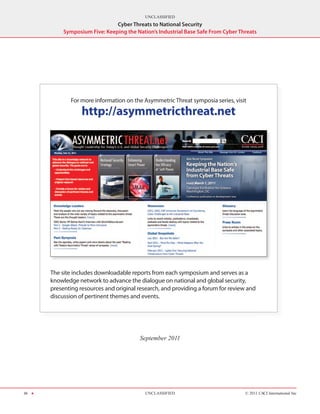
  • 33.
    UNCLASSIFIED Cyber Threats to National Security Symposium Five: Keeping the Nation’s Industrial Base Safe From Cyber Threats 4.2 Conclusion There is no partial protection. Nothing takes the place of a proactive and reactive set of defenses. One of the Facing the unique national security challenges linked to challenges the U.S. faces is to change the dialogue. the nation’s, citizens’, and economy’s use of cyberspace, Addressing cybersecurity in the present is not a question the United States must do everything in its power to build of throwing money at the problem or generating goodwill and implement a comprehensive strategy for dealing with and cooperation between the public and private sectors. cybersecurity and cyber-related insider threats. It is about the fact that there are impediments to execution of an effective cybersecurity policy that enables proactive and reactive activity and that gives the American people “The development of the Internet and information confidence that their rights are protected. technology has been an enormously enabling The U.S. did not establish its nuclear warfare doctrines experience for civilization. It has added to trust, overnight. It required time to refine its thinking and to apply communication, productivity, and efficiency … Our its efforts to formulating a strategy that enabled it to win the task is to preserve this, not to wall things off and make Cold War. A similar larger strategy is needed in the arena of things inefficient because miscreants misuse it.” cybersecurity. Clearly, the U.S. cannot protect itself simply – Former Virginia Governor James S. Gilmore, III by playing defense. “If we resign ourselves to just trying to prevent attacks or mitigating the consequences when we do, we’re just inviting more attacks.”97 For the first time in history, cyberspace has become the The question facing Americans today is whether efforts village square at a global level for knowledge sharing for integrating the nation’s many critical infrastructure and communications. At the same time, this dependency and key resource protection initiatives are successful, on technology and interconnectivity has only increased comprehensive, and adequately resourced and managed vulnerability to it. to provide long-term frameworks for dealing with a wide Securing the industrial base is among the challenges range of threats. For now, the answer is no. the nation faces in building and implementing a The findings and recommendations of the symposium on comprehensive cybersecurity strategy. Governments at Cyber Threats to National Security – Keeping the Nation’s all levels will need to evolve trusted partnerships with Industrial Base Safe From Cyber Threats are intended to industry, communities, and citizens to maximize the advance a national dialogue on defining and examining positive aspects of cyberspace while mitigating risks. the pace of technology change and threats, along with the Technology change will not slow down, nor will those actions and commitments governments and the public- intending to use cyberspace to harm the United States private partnership can take to mitigate risk, support the become timid in pursuing their objectives through cyber economy, and strengthen national security. The industrial means while governments work out cybersecurity and base is in some ways the “canary in the mine shaft” for insider threat issues. As a government and as a nation, the determining if the nation succeeds in implementing a United States must be second to none in implementing comprehensive strategy for dealing with cyber threats and and sustaining comprehensive cybersecurity. cyber-related insider threats. Perhaps most important in this discussion of cybersecurity The next symposium in the Cyber Threat series is is consideration of the American economy. As long as it is being planned for Spring 2012. As details become final, healthy, productive, and growing, the U.S. can surmount information will be posted to the Asymmetric Threat the challenges of the 21st century, but that also means that website at asymmetricthreat.net. its adversaries can see the advantages of striking at the U.S. through its economy – and “what better way to do so than through a cyber attack?”96 96  The Hon. James Gilmore, Symposium Five comments. 97  Bolton, op. cit. © 2011 CACI International Inc UNCLASSIFIED H 31
  • 34.
    UNCLASSIFIED Cyber Threats to National Security Symposium Five: Keeping the Nation’s Industrial Base Safe From Cyber Threats Glossary Cyber attack – Generally an act that uses computer code to disrupt computer processing or steal data, often by exploiting a software or hardware vulnerability or a weakness in security practices. Results include Asymmetric threat – A broad and unpredictable disrupting the reliability of equipment, the integrity of spectrum of risks, actions, and operations conducted by data, and the confidentiality of communications. As state and non-state actors that can potentially undermine technologies and cyberspace capabilities evolve, the national and global security. types and nature of cyber attacks are also expected to evolve, so that current definitions should be viewed Asymmetric warfare – Combat between two or as foundational rather than final. See also Botnets, more state or non-state actors whose relative military Cybercrime, and Cyberterrorism: Vulnerabilities and power, strategies, tactics, resources, and goals differ Policy Issues for Congress, Congressional Research significantly. Service Report for Congress, http://www.fas.org/sgp/crs/ Cloud computing – Internet-based computing whereby terror/RL32114.pdf. data, information technology resources, and software Cyber criminals – Individuals or groups whose criminal applications are stored on the Internet and provided to conduct is primarily through or are dependent on computers and mobile devices on demand, often through operating through cyberspace/cyber domain. a web browser, rather than running installed software on a personal computer or server. See also http://www. Cyber manipulation – A cyber attack involving an cloudcomputingdefined.com. information operation resulting in a compromise of the operation or product delivered through a supply chain. Cybersecurity – The protection of data and systems For example, products are delivered to the wrong place, in networks that are connected to the Internet by at the wrong time, or not at all, or there is a quality or preventing, detecting, and responding to attacks. See also type problem. the Department of Homeland Security’s U.S. Computer Security Readiness Team website at http://www.us-cert. Cyber ShockWave – A simulated cyber attack on the gov/cas/tips/ST04-001.html. U.S. that examined how the government would respond to a large-scale cyber crisis. The simulation was hosted Cyberspace/Cyber domain – The information by the Bipartisan Policy Center (BPC) on February 16, environment of the global network of information 2010 in Washington, D.C. and was created by former technology infrastructures that includes the Internet, CIA Director General Michael Hayden and the BPC. telecommunications networks, computer systems, and The simulation envisioned an attack that disables 20 embedded processors and controllers. The term was million smartphones through a malware program planted originated by author William Gibson in his 1984 novel through a popular smartphone application. The attack Neuromancer. See also Joint Publication 1, Doctrine for escalates, shutting down an electronic energy trading the Armed Forces of the United States, http://www.dtic. platform and crippling the power grid on the Eastern mil/doctrine/new_pubs/jp1.pdf. seaboard. See also http://www.bipartisanpolicy.org/news/ Cyberterrorism – The unlawful attacks and threats of press-releases/2010/02/cyber-shockwave-shows-us- attack against computers, networks, and the information unprepared-cyber-threats. stored therein when done to intimidate or coerce a government or its people to further political or social objectives. Actors who engage in these kinds of activities are commonly referred to as cyber terrorists. 32 H UNCLASSIFIED © 2011 CACI International Inc
  • 35.
    UNCLASSIFIED Cyber Threats to National Security Symposium Five: Keeping the Nation’s Industrial Base Safe From Cyber Threats Cyber threats – Natural or man-made incidents Industrial base – Variously defined, but this report (intentional or unintentional) that would be detrimental considers it the total industrial capacity (including the to the cyber domain, or which are dependent on or capacity of repair and maintenance facilities) of the U.S. operate through cyberspace/cyber domain. economy or nation available for use. See also http://www. businessdictionary.com/definition/industrial-base.html. Defense Advanced Research Projects Agency (DARPA) – A Department of Defense agency whose Internet Protocol (IP) – The method or protocol by mission is to maintain the technological superiority of which data is sent from one computer to another on the the U.S. military and prevent technological surprise from Internet. harming national security by sponsoring revolutionary, high-payoff research bridging the gap between Internet Protocol (IP) address – A numerical address fundamental discoveries and their military use. assigned to each device (e.g., computer, printer) on the See also http://www.darpa.mil/default.aspx.  Internet. Its most general function is to identify devices that are sending data and devices that are receiving data. Defense Industrial Base (DIB) – The Department of Each device on the Internet has at least one IP address Defense, government, and private sector worldwide that uniquely identifies it from all other Internet devices. industrial complex with the capabilities of performing research and development, design, production, delivery, Internet Protocol version 4 (IPv4) and version 6 and maintenance of military weapons systems, (IPv6) – IPv4 is the fourth revision in the development subsystems, components, or parts to meet military of the Internet Protocol and has been the foundation for requirements. See also http://www.dhs.gov/files/ most Internet communications since 1981. The problem programs/gc_1189165508550.shtm. discussed in this report regarding IP versions centers upon the fact that in IPv4, an address consists of 32 Defense Industrial Base (DIB) Cyber Security bits, which limits the address space to 4,294,967,296 Information Assurance (CS/IA) Program – (232) possible unique addresses. However, because of Established by the Department of Defense, the DIB the enormous growth of the Internet, this address space CS/IA program is a collaborative information-sharing will soon become depleted. IPv6 was developed in part partnership between industry and the U.S. government. to solve this problem, as it uses 128 bits for the Internet Under the program, DoD provides threat information, address, providing the potential for a maximum of 2128, IA best practices, and mentorship to companies to help or about 3.403×1038 unique addresses. them better secure their unclassified networks. In return, companies are asked to report network incidents to DoD. National Crime Information Center – A computerized See also http://dibnet.dod.mil/staticweb/index.html. system of crime records and data, maintained by the Federal Bureau of Investigation, that can be tapped into Defense Security Service (DSS) – A Department of by virtually every criminal justice agency nationwide. Defense agency that provides security support services See also http://www.fbi.gov/about-us/cjis/ncic/ncic. to the military services, Defense agencies, 23 federal agencies, and approximately 13,000 cleared contractor National Infrastructure Protection Plan (NIPP) – A facilities. See also http://www.dss.mil/index.html. plan developed by the Department of Homeland Security to provide the unifying structure for the integration of Hardware token – A physical device that is used to a wide range of efforts for the enhanced protection and authenticate users who are accessing secured computer resiliency of the nation’s critical infrastructure and key systems or networks, such as a private bank account. resources into a single national program. See also http:// The simplest hardware tokens generate numbers that are www.dhs.gov/xlibrary/assets/NIPP_Plan.pdf. recognized by the system when keyed in. Also called security tokens. © 2011 CACI International Inc UNCLASSIFIED H 33
  • 36.
    UNCLASSIFIED Cyber Threats to National Security Symposium Five: Keeping the Nation’s Industrial Base Safe From Cyber Threats Personal Identity Verification (PIV) – The standard from a trusted authority. Using the public and private for identification of federal government employees keys, individuals can protect information by encrypting and contractors, as specified in the National Institute messages and digital signatures and providing for of Standards and Technology publication Federal a digital certificate of authenticity. See also http:// Information Processing Standard Publication 201, searchsecurity.techtarget.com/sDefinition/0,,sid14_ Personal Identity Verification (PIV) of Federal gci214299,00.html. Employees and Contractors, and as directed by Homeland Security Presidential Directive – Number Supply chain – Starting with unprocessed raw 12. The PIV card is an ID card issued by the federal materials and ending with the final customer using the government that contains a computer chip that controls finished goods, the supply chain links many companies a federal employee’s or contractor’s access to secured together. Also defined as the material and informational buildings and computer resources. See also http://csrc. interchanges in the logistical process stretching from nist.gov/groups/SNS/piv/index.html. acquisition of raw materials to delivery of finished products to the end user. All vendors, service providers, Public Key Infrastructure (PKI) – A system of and customers are links in the supply chain. See also hardware, software, and services that enables users of http://cscmp.org/digital/glossary/glossary.asp. an unsecured public network such as the Internet to securely and privately exchange data and money through Stuxnet – A Windows computer worm discovered in the use of a public and private cryptographic key pair July 2010 that targets industrial software and equipment. 34 H UNCLASSIFIED © 2011 CACI International Inc
  • 37.
    UNCLASSIFIED Cyber Threats to National Security Symposium Five: Keeping the Nation’s Industrial Base Safe From Cyber Threats Acknowledgments Symposium Participants (alphabetical order) John R. Bolton Thomas L. Wilkerson Jeff Wright Former United States Permanent Major General, USMC (Ret); Senior Vice President, Enterprise Representative to the United Nations Chief Executive Officer, USNI Technologies and Services Group, CACI International Inc Steven R. Chabinsky Deputy Assistant Director, Cyber Division, Advisors Federal Bureau of Investigation Editor Louis Andre Paul M. Cofoni Senior Vice President, Business Development, Michael Pino CACI International Inc Publications Principal, President and Chief Executive Officer, CACI International Inc CACI International Inc Zalmai Azmi Frank J. Gaffney Senior Vice President, Enterprise Reviewer President and Chief Executive Officer, Technologies and Services Group, Center for Security Policy CACI International Inc Z. Selin Hur Strategic Programs Principal, James S. Gilmore, III Christine Brim CACI International Inc Former Governor of the Commonwealth of Chief Operating Officer, Virginia; CACI Board of Directors Center for Security Policy Graphic Design Richard M. Gray Paul Cofoni Chris Impink Associate General Counsel, Office of the President and Chief Executive Officer, Graphic Artist, CACI International Inc Deputy General Counsel for Acquisition and CACI International Inc Logistics, Department of Defense Steve Coppinger Art Direction Darrell Issa (R-CA) Vice President, National Solutions Group, Steve Gibson Chairman, Committee on House Oversight CACI International Inc Creative Director, CACI International Inc Dr. J.P. (Jack) London Scott Gureck Executive Chairman and Chairman Executive Director of Communications, Publisher and Editor-in-Chief of the Board, CACI International Inc; USNI Dr. J.P. (Jack) London Former CEO, CACI International Inc Hilary Hageman Executive Chairman and Chairman Gilman Louie Vice President, Legal Division, of the Board, CACI International Inc; Partner, Alsop Louie Partners; Former CACI International Inc Former CEO, CACI International Inc Chief Executive Officer, In-Q-Tel Jake Jacoby Executive Vice President, National Solutions Communications Executive Terry Roberts Executive Director, Acquisition Support Group, CACI International Inc Jody Brown Interagency Acquisition & Cyber, Carnegie Executive Vice President, Corporate Ben Lerner Mellon Software Engineering Institute Communications, CACI International Inc Vice President, Center for Security Policy Stephen Smith Dr. J.P. (Jack) London Program Manager Executive Assistant Director for National Executive Chairman and Chairman Security, Naval Criminal Investigative Service Jeff Wright of the Board, CACI International Inc; Senior Vice President, Enterprise Troy Sullivan Former CEO, CACI International Inc Technologies and Services Group, Director of Counterintelligence, Office of the Dr. Warren Phillips CACI International Inc Under Secretary of Defense for Intelligence Professor Emeritus, University of Maryland; Frances Townsend CEO/COB, Advanced Blast Protection; Event Manager Chairman of the Board of Directors, CACI Board of Directors Janis Albuquerque Intelligence and National Security Alliance; Dan Porter Senior Marketing Manager, Former Homeland Security Advisor to Executive Vice President, Enterprise CACI International Inc President George W. Bush Technologies and Services Group, Michelle Van Cleave CACI International Inc Cyber Threats to National Security – Former National Counterintelligence Executive John Quattrocki Keeping the Nation’s Industrial Base Safe From Cyber Threats was held on March 1, David M. Wennergren Director, National Solutions Group, 2011 at the Carnegie Institution for Assistant Deputy Chief Management Officer, CACI International Inc Science, Washington, D.C. Department of Defense © 2011 CACI International Inc UNCLASSIFIED H 35
  • 38.
    UNCLASSIFIED Cyber Threats to National Security Symposium Five: Keeping the Nation’s Industrial Base Safe From Cyber Threats For more information on the Asymmetric Threat symposia series, visit http://asymmetricthreat.net The site includes downloadable reports from each symposium and serves as a knowledge network to advance the dialogue on national and global security, presenting resources and original research, and providing a forum for review and discussion of pertinent themes and events. September 2011 36 H UNCLASSIFIED © 2011 CACI International Inc
  • 40.
    ® U.S. Naval Institute CACI International Inc 291 Wood Road 1100 North Glebe Road Annapolis, Maryland 21402 Arlington, Virginia 22201 (410) 268-6110 (703) 841-7800 www.usni.org www.caci.com asymmetricthreat.net Center for Security Policy 1901 Pennsylvania Avenue, NW, Suite 201 Washington, DC 20006 (202) 835-9077 centerforsecuritypolicy.org © CACI 2011