Through Education to Cyber 
Security 
Petr Špiřík
Future of Cyber Security 
“The next battle will be the battle for the hearts and minds.” 
“Capability and will.” 
Dr. Jarno Limnéll, CyCon 2014 
CC-BY-SA • Petr Špiřík
Problem Statement 
There are not enough cyber security experts. 
It is not going to fix by itself. 
CC-BY-SA • Petr Špiřík
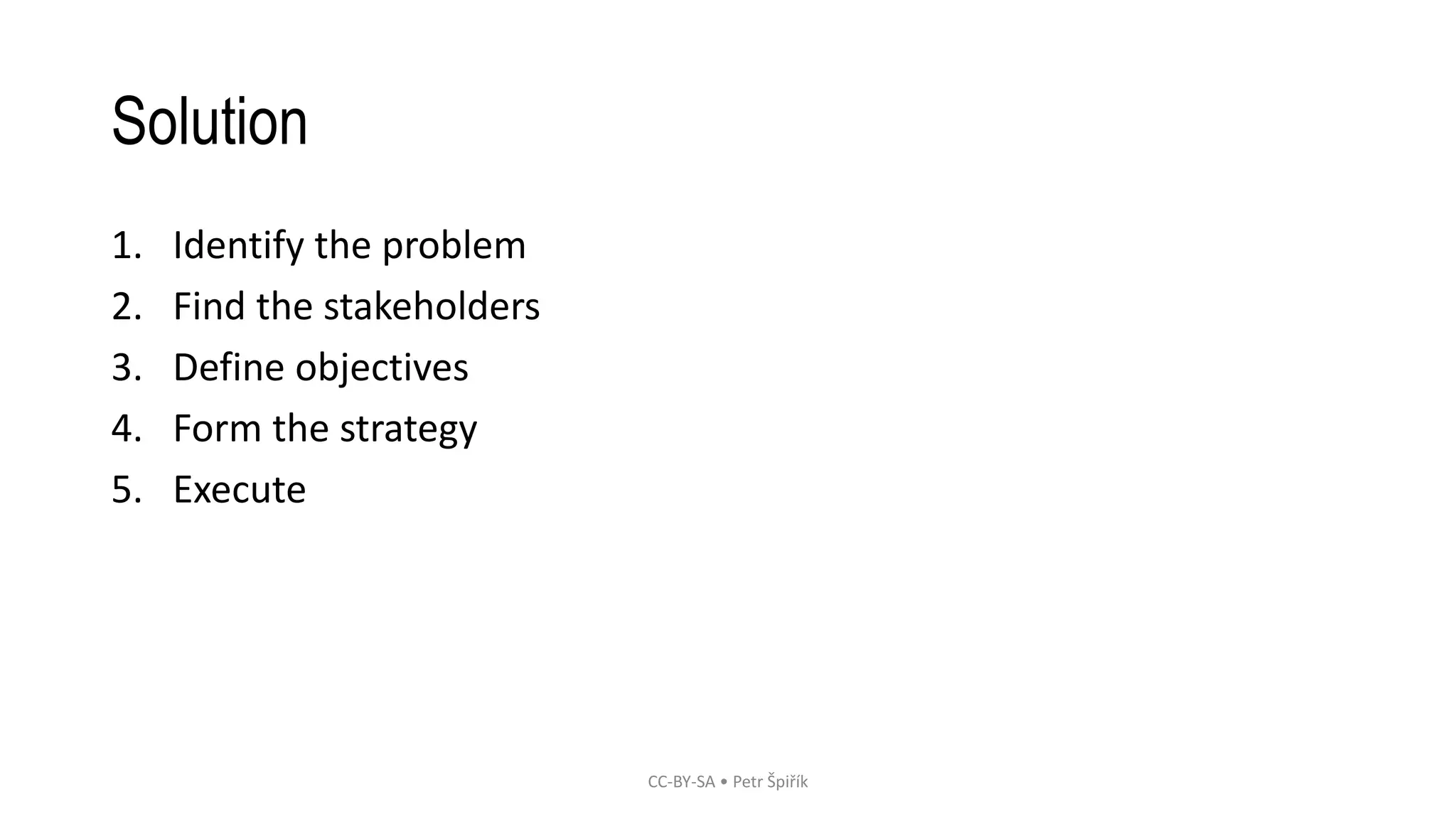
Solution 
1. Identify the problem 
2. Find the stakeholders 
3. Define objectives 
4. Form the strategy 
5. Execute 
CC-BY-SA • Petr Špiřík
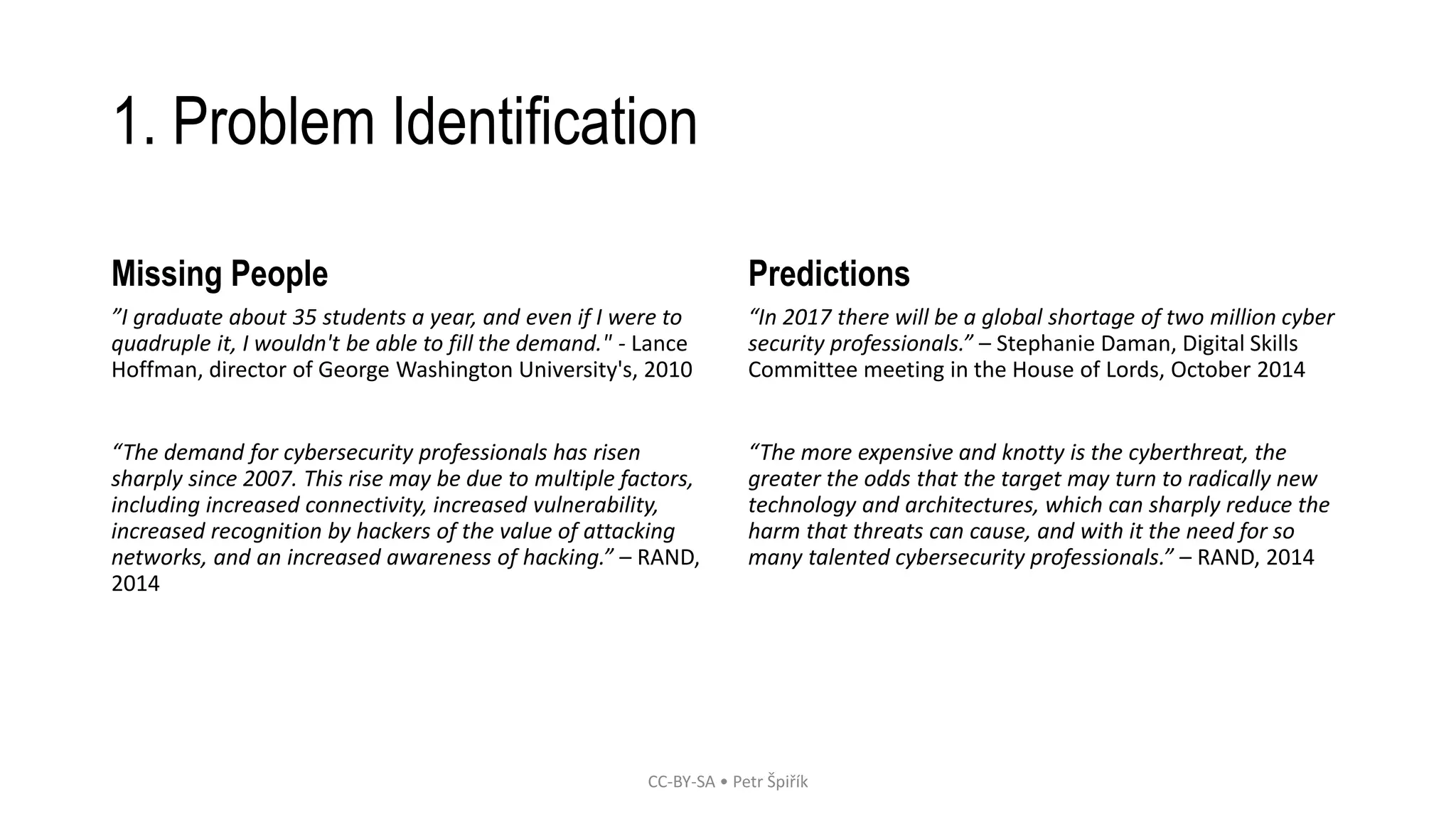
1. Problem Identification 
Missing People 
”I graduate about 35 students a year, and even if I were to 
quadruple it, I wouldn't be able to fill the demand." - Lance 
Hoffman, director of George Washington University's, 2010 
“The demand for cybersecurity professionals has risen 
sharply since 2007. This rise may be due to multiple factors, 
including increased connectivity, increased vulnerability, 
increased recognition by hackers of the value of attacking 
networks, and an increased awareness of hacking.” – RAND, 
2014 
Predictions 
“In 2017 there will be a global shortage of two million cyber 
security professionals.” – Stephanie Daman, Digital Skills 
Committee meeting in the House of Lords, October 2014 
“The more expensive and knotty is the cyberthreat, the 
greater the odds that the target may turn to radically new 
technology and architectures, which can sharply reduce the 
harm that threats can cause, and with it the need for so 
many talented cybersecurity professionals.” – RAND, 2014 
CC-BY-SA • Petr Špiřík
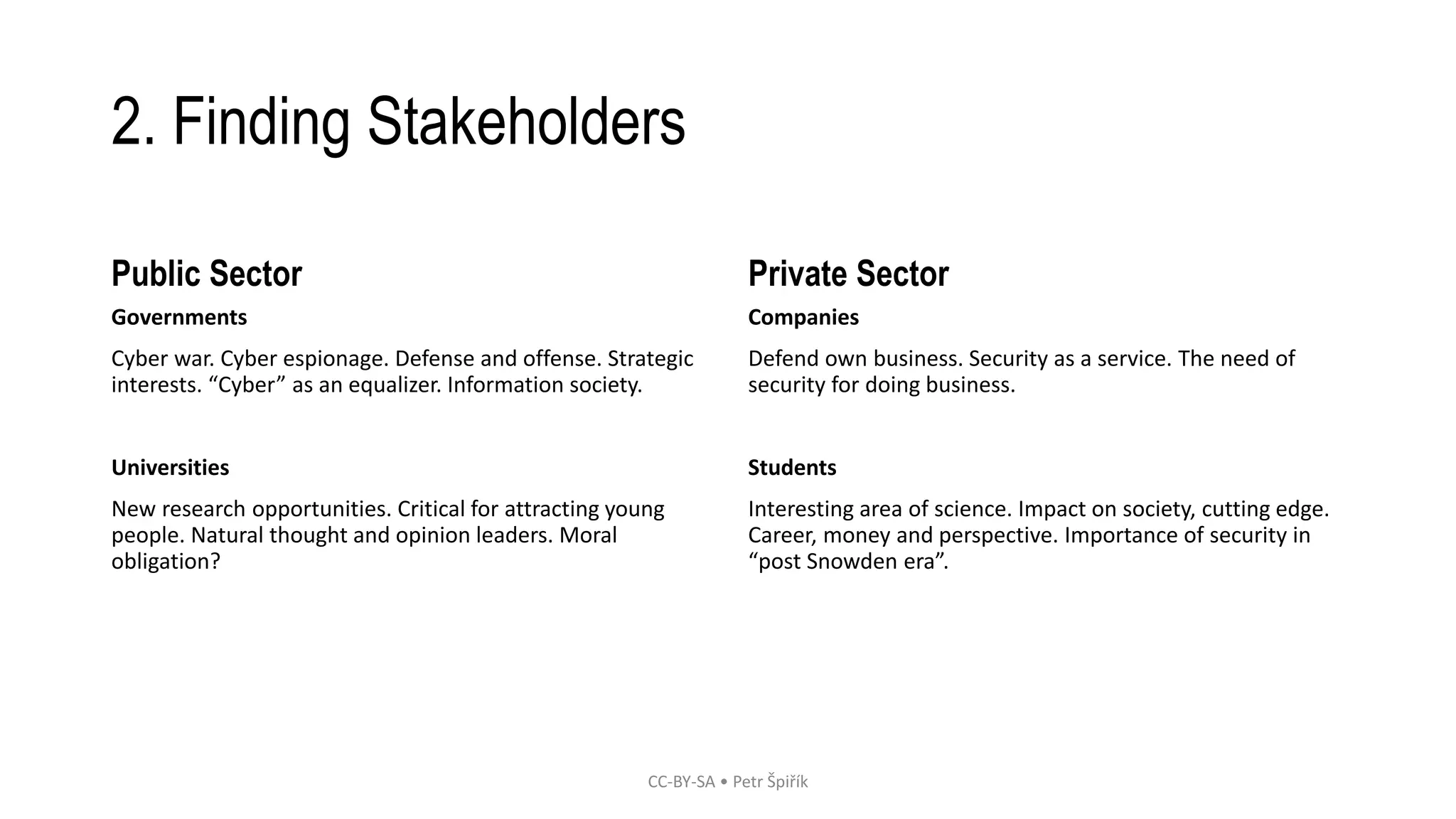
2. Finding Stakeholders 
Public Sector 
Governments 
Cyber war. Cyber espionage. Defense and offense. Strategic 
interests. “Cyber” as an equalizer. Information society. 
Universities 
New research opportunities. Critical for attracting young 
people. Natural thought and opinion leaders. Moral 
obligation? 
Private Sector 
Companies 
Defend own business. Security as a service. The need of 
security for doing business. 
Students 
Interesting area of science. Impact on society, cutting edge. 
Career, money and perspective. Importance of security in 
“post Snowden era”. 
CC-BY-SA • Petr Špiřík
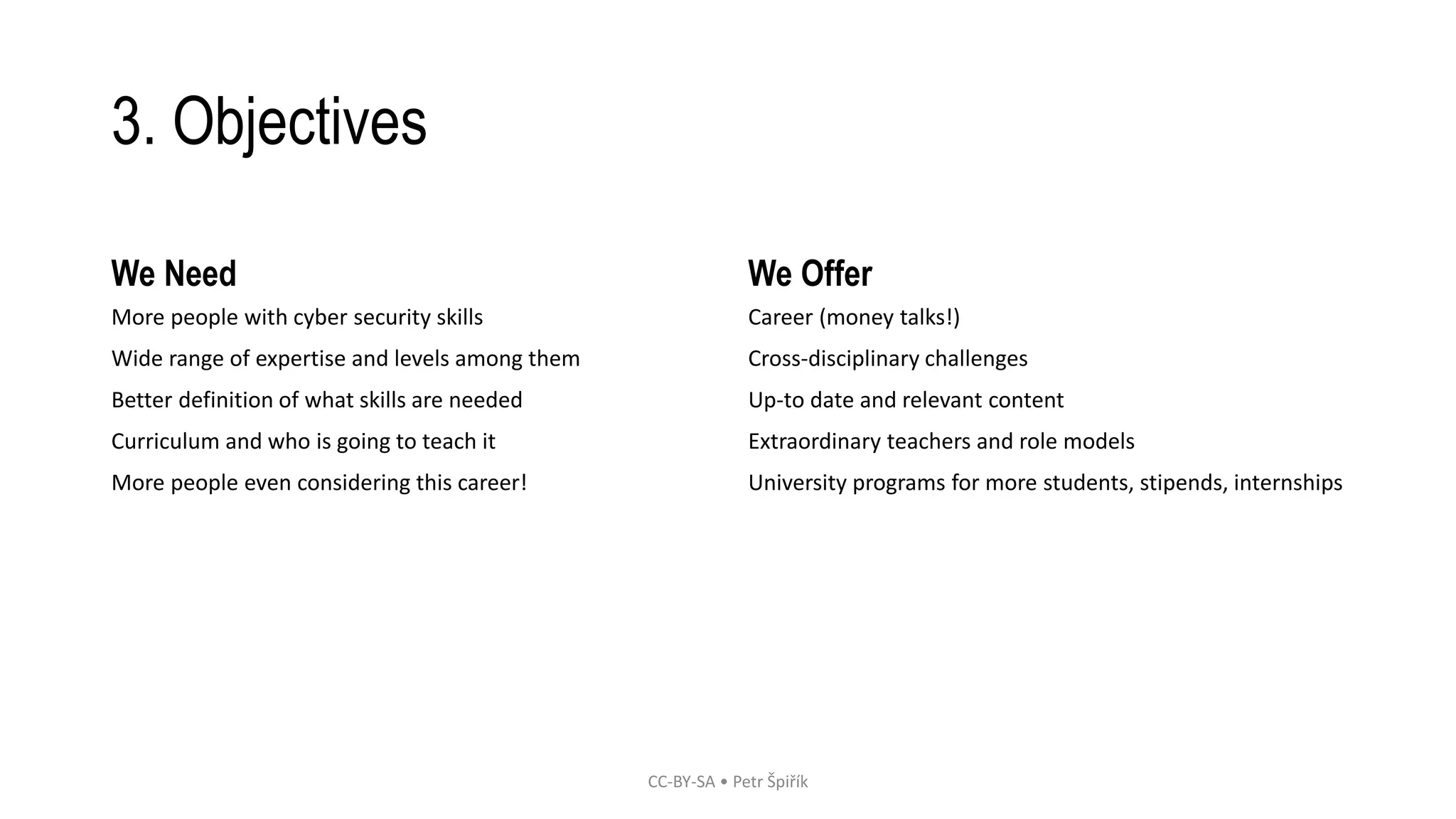
3. Objectives 
We Need 
More people with cyber security skills 
Wide range of expertise and levels among them 
Better definition of what skills are needed 
Curriculum and who is going to teach it 
More people even considering this career! 
We Offer 
Career (money talks!) 
Cross-disciplinary challenges 
Up-to date and relevant content 
Extraordinary teachers and role models 
University programs for more students, stipends, internships 
CC-BY-SA • Petr Špiřík
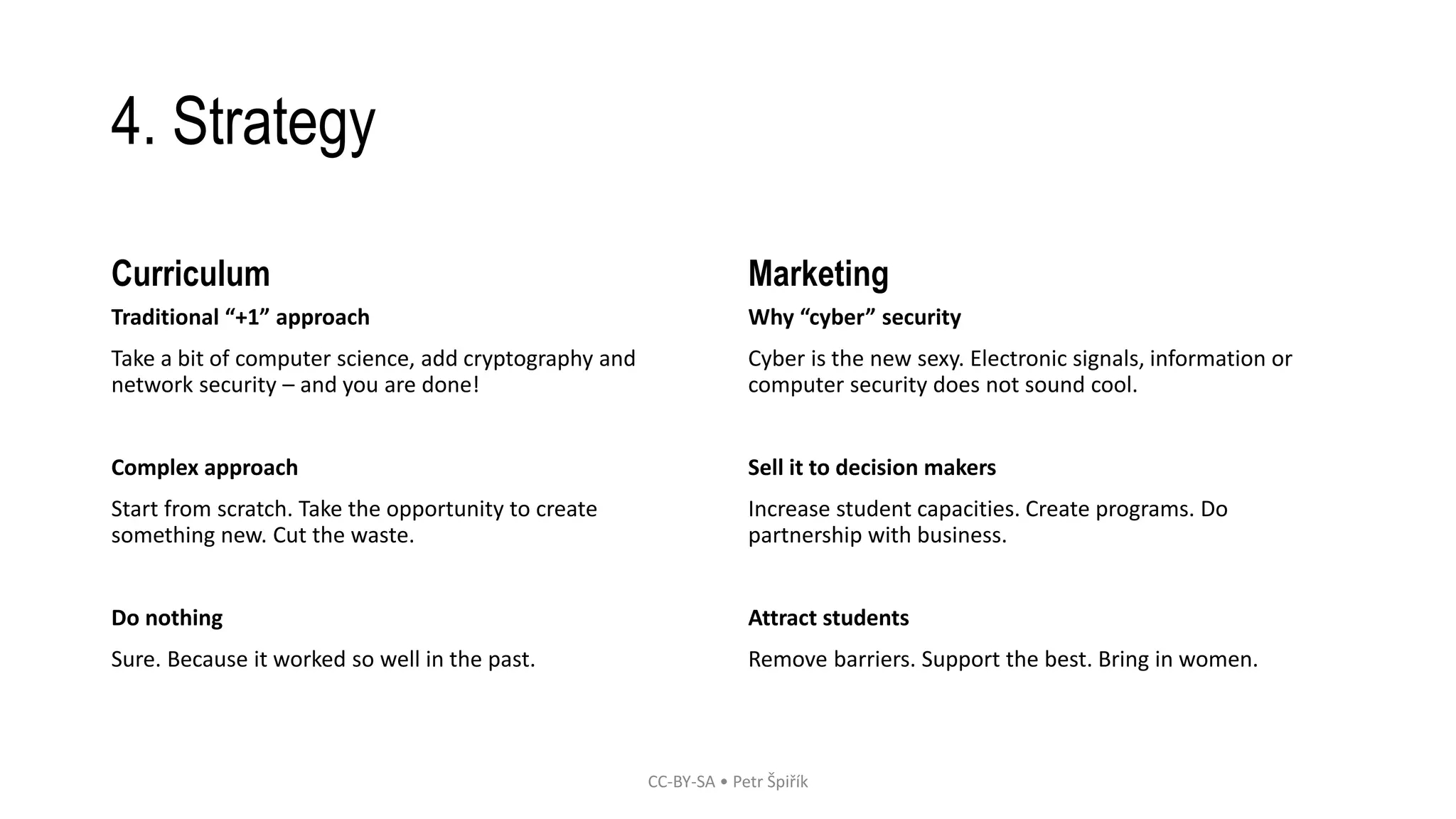
4. Strategy 
Curriculum 
Traditional “+1” approach 
Take a bit of computer science, add cryptography and 
network security – and you are done! 
Complex approach 
Start from scratch. Take the opportunity to create 
something new. Cut the waste. 
Do nothing 
Sure. Because it worked so well in the past. 
Marketing 
Why “cyber” security 
Cyber is the new sexy. Electronic signals, information or 
computer security does not sound cool. 
Sell it to decision makers 
Increase student capacities. Create programs. Do 
partnership with business. 
Attract students 
Remove barriers. Support the best. Bring in women. 
CC-BY-SA • Petr Špiřík
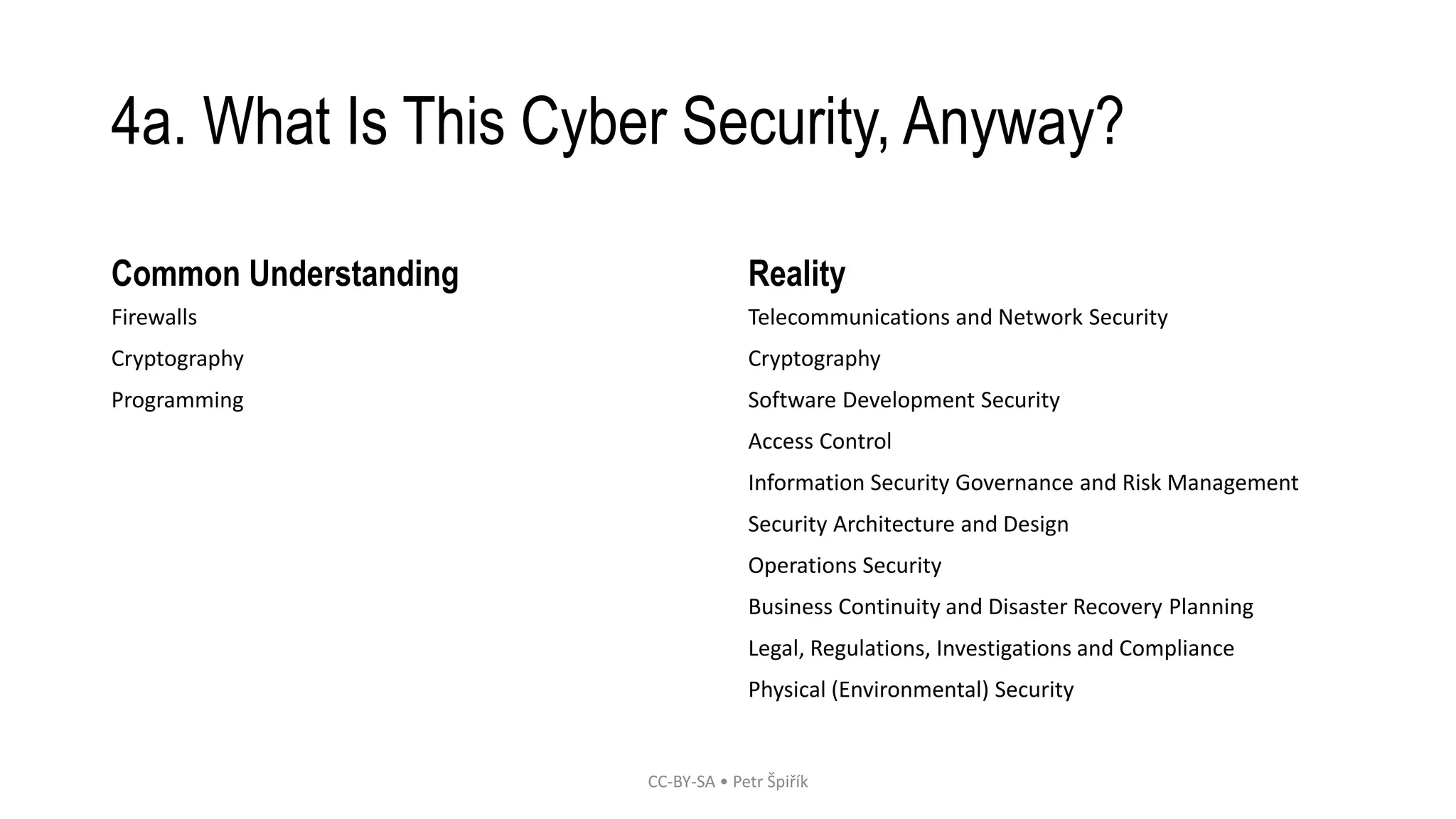
4a. What Is This Cyber Security, Anyway? 
Common Understanding 
Firewalls 
Cryptography 
Programming 
Reality 
Telecommunications and Network Security 
Cryptography 
Software Development Security 
Access Control 
Information Security Governance and Risk Management 
Security Architecture and Design 
Operations Security 
Business Continuity and Disaster Recovery Planning 
Legal, Regulations, Investigations and Compliance 
Physical (Environmental) Security 
CC-BY-SA • Petr Špiřík
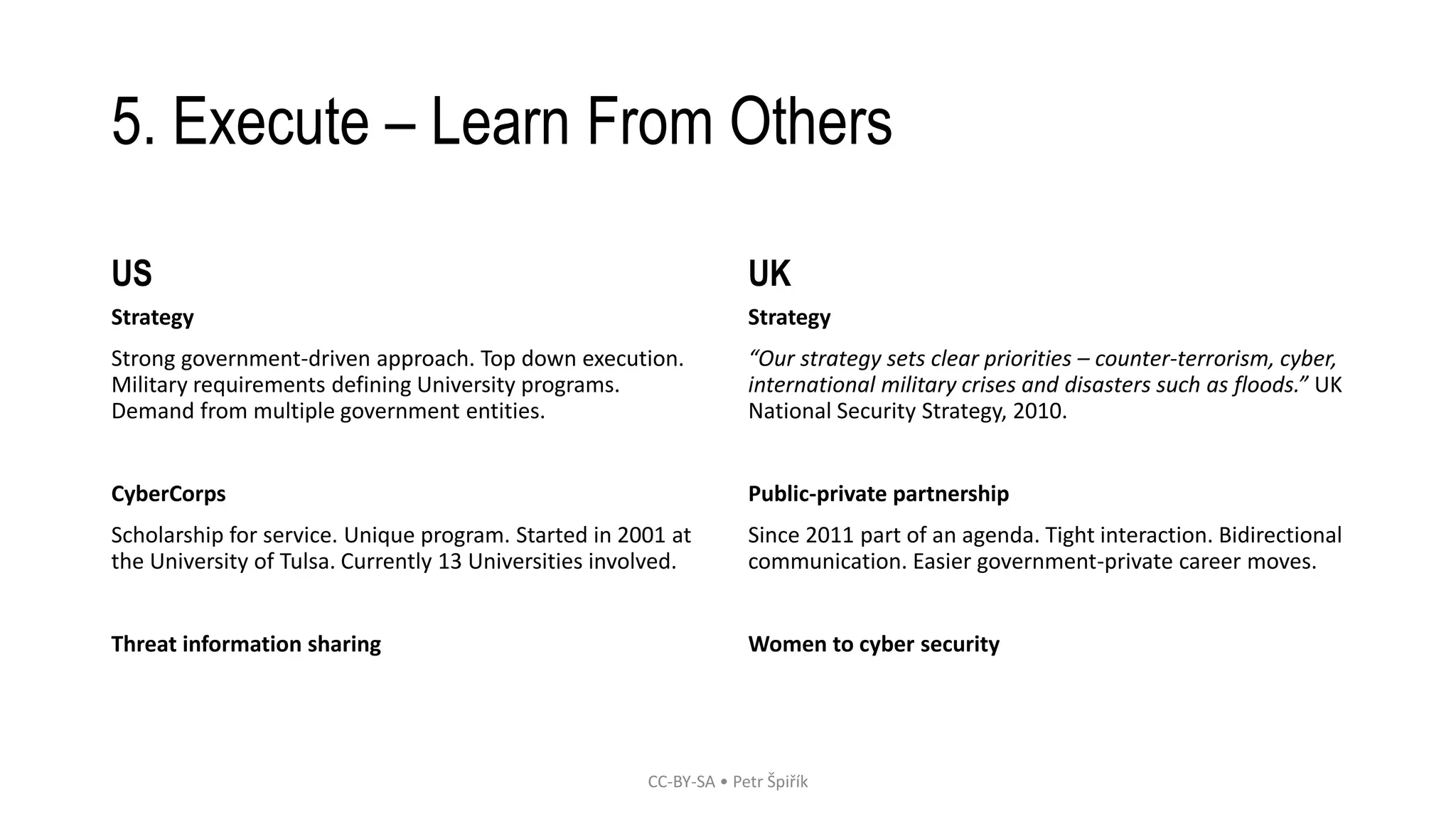
5. Execute – Learn From Others 
US 
Strategy 
Strong government-driven approach. Top down execution. 
Military requirements defining University programs. 
Demand from multiple government entities. 
CyberCorps 
Scholarship for service. Unique program. Started in 2001 at 
the University of Tulsa. Currently 13 Universities involved. 
Threat information sharing 
UK 
Strategy 
“Our strategy sets clear priorities – counter-terrorism, cyber, 
international military crises and disasters such as floods.” UK 
National Security Strategy, 2010. 
Public-private partnership 
Since 2011 part of an agenda. Tight interaction. Bidirectional 
communication. Easier government-private career moves. 
Women to cyber security 
CC-BY-SA • Petr Špiřík
Thanks For All the Fish! 
Petr Špiřík 
Cyber Threat Intelligence 
petr.spirik@gmail.com 
@HidenatNet 
CC-BY-SA • Petr Špiřík

Education to cyber security

  • 1.
    Through Education toCyber Security Petr Špiřík
  • 2.
    Future of CyberSecurity “The next battle will be the battle for the hearts and minds.” “Capability and will.” Dr. Jarno Limnéll, CyCon 2014 CC-BY-SA • Petr Špiřík
  • 3.
    Problem Statement Thereare not enough cyber security experts. It is not going to fix by itself. CC-BY-SA • Petr Špiřík
  • 4.
    Solution 1. Identifythe problem 2. Find the stakeholders 3. Define objectives 4. Form the strategy 5. Execute CC-BY-SA • Petr Špiřík
  • 5.
    1. Problem Identification Missing People ”I graduate about 35 students a year, and even if I were to quadruple it, I wouldn't be able to fill the demand." - Lance Hoffman, director of George Washington University's, 2010 “The demand for cybersecurity professionals has risen sharply since 2007. This rise may be due to multiple factors, including increased connectivity, increased vulnerability, increased recognition by hackers of the value of attacking networks, and an increased awareness of hacking.” – RAND, 2014 Predictions “In 2017 there will be a global shortage of two million cyber security professionals.” – Stephanie Daman, Digital Skills Committee meeting in the House of Lords, October 2014 “The more expensive and knotty is the cyberthreat, the greater the odds that the target may turn to radically new technology and architectures, which can sharply reduce the harm that threats can cause, and with it the need for so many talented cybersecurity professionals.” – RAND, 2014 CC-BY-SA • Petr Špiřík
  • 6.
    2. Finding Stakeholders Public Sector Governments Cyber war. Cyber espionage. Defense and offense. Strategic interests. “Cyber” as an equalizer. Information society. Universities New research opportunities. Critical for attracting young people. Natural thought and opinion leaders. Moral obligation? Private Sector Companies Defend own business. Security as a service. The need of security for doing business. Students Interesting area of science. Impact on society, cutting edge. Career, money and perspective. Importance of security in “post Snowden era”. CC-BY-SA • Petr Špiřík
  • 7.
    3. Objectives WeNeed More people with cyber security skills Wide range of expertise and levels among them Better definition of what skills are needed Curriculum and who is going to teach it More people even considering this career! We Offer Career (money talks!) Cross-disciplinary challenges Up-to date and relevant content Extraordinary teachers and role models University programs for more students, stipends, internships CC-BY-SA • Petr Špiřík
  • 8.
    4. Strategy Curriculum Traditional “+1” approach Take a bit of computer science, add cryptography and network security – and you are done! Complex approach Start from scratch. Take the opportunity to create something new. Cut the waste. Do nothing Sure. Because it worked so well in the past. Marketing Why “cyber” security Cyber is the new sexy. Electronic signals, information or computer security does not sound cool. Sell it to decision makers Increase student capacities. Create programs. Do partnership with business. Attract students Remove barriers. Support the best. Bring in women. CC-BY-SA • Petr Špiřík
  • 9.
    4a. What IsThis Cyber Security, Anyway? Common Understanding Firewalls Cryptography Programming Reality Telecommunications and Network Security Cryptography Software Development Security Access Control Information Security Governance and Risk Management Security Architecture and Design Operations Security Business Continuity and Disaster Recovery Planning Legal, Regulations, Investigations and Compliance Physical (Environmental) Security CC-BY-SA • Petr Špiřík
  • 10.
    5. Execute –Learn From Others US Strategy Strong government-driven approach. Top down execution. Military requirements defining University programs. Demand from multiple government entities. CyberCorps Scholarship for service. Unique program. Started in 2001 at the University of Tulsa. Currently 13 Universities involved. Threat information sharing UK Strategy “Our strategy sets clear priorities – counter-terrorism, cyber, international military crises and disasters such as floods.” UK National Security Strategy, 2010. Public-private partnership Since 2011 part of an agenda. Tight interaction. Bidirectional communication. Easier government-private career moves. Women to cyber security CC-BY-SA • Petr Špiřík
  • 11.
    Thanks For Allthe Fish! Petr Špiřík Cyber Threat Intelligence petr.spirik@gmail.com @HidenatNet CC-BY-SA • Petr Špiřík