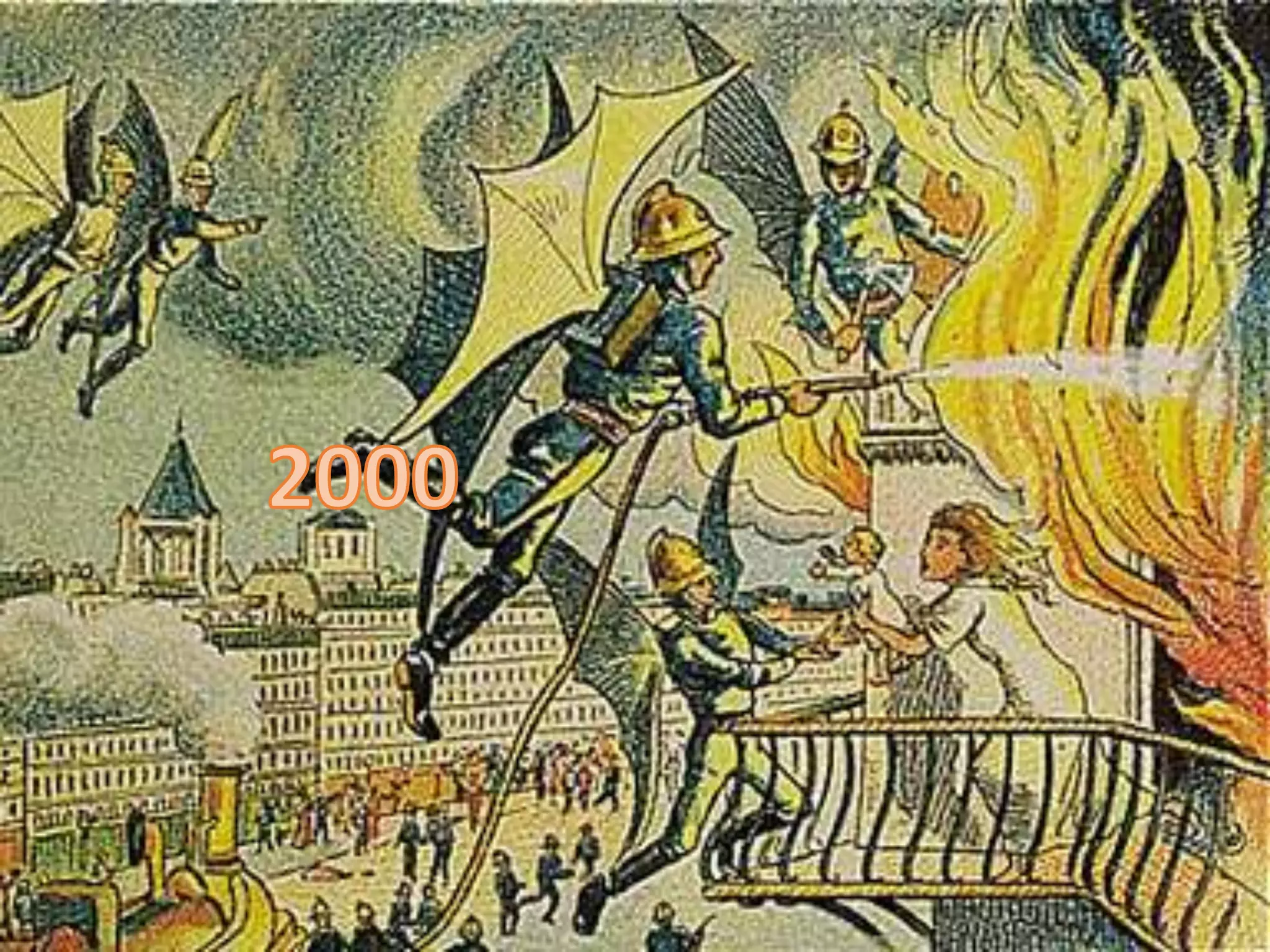
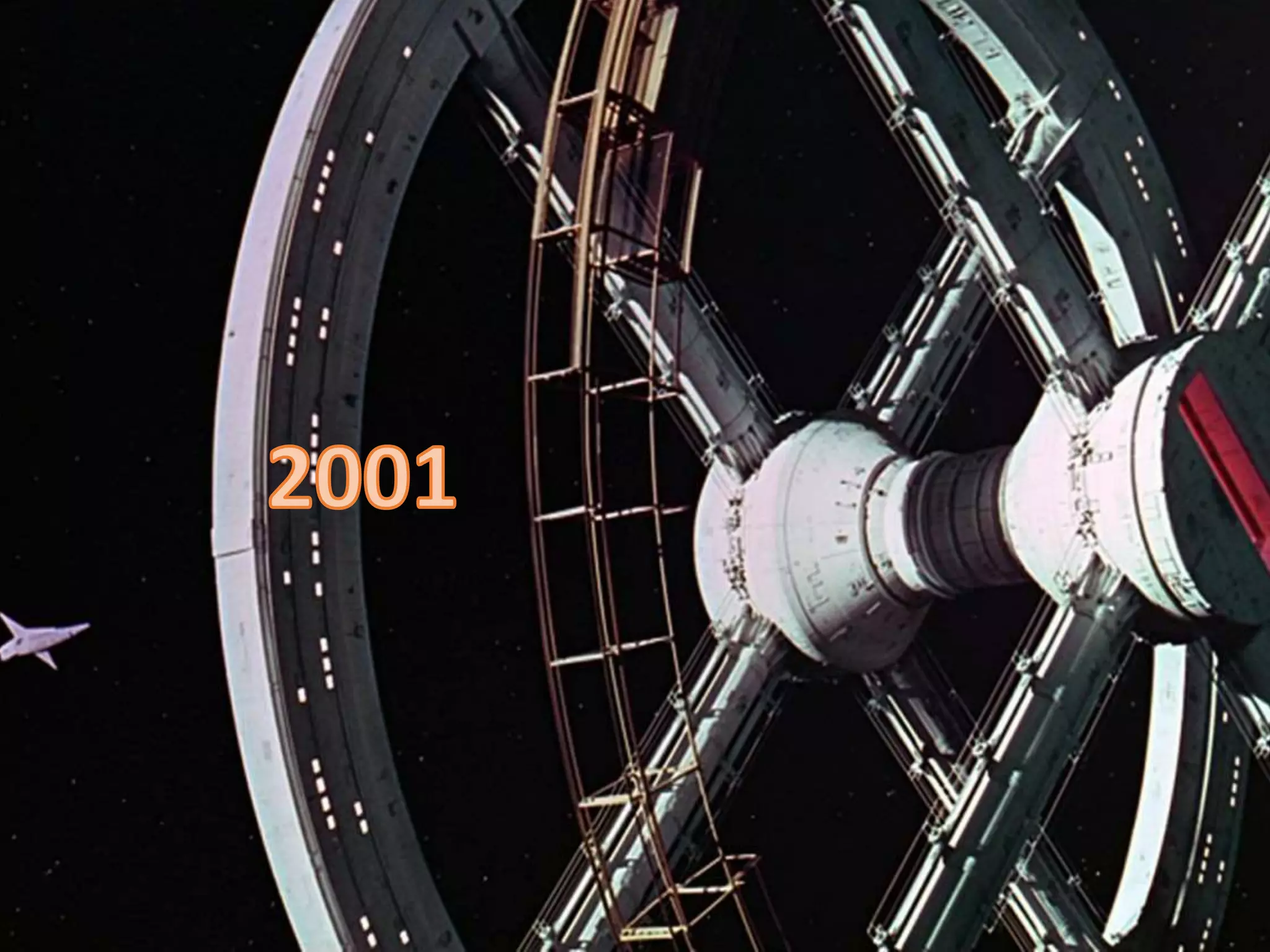

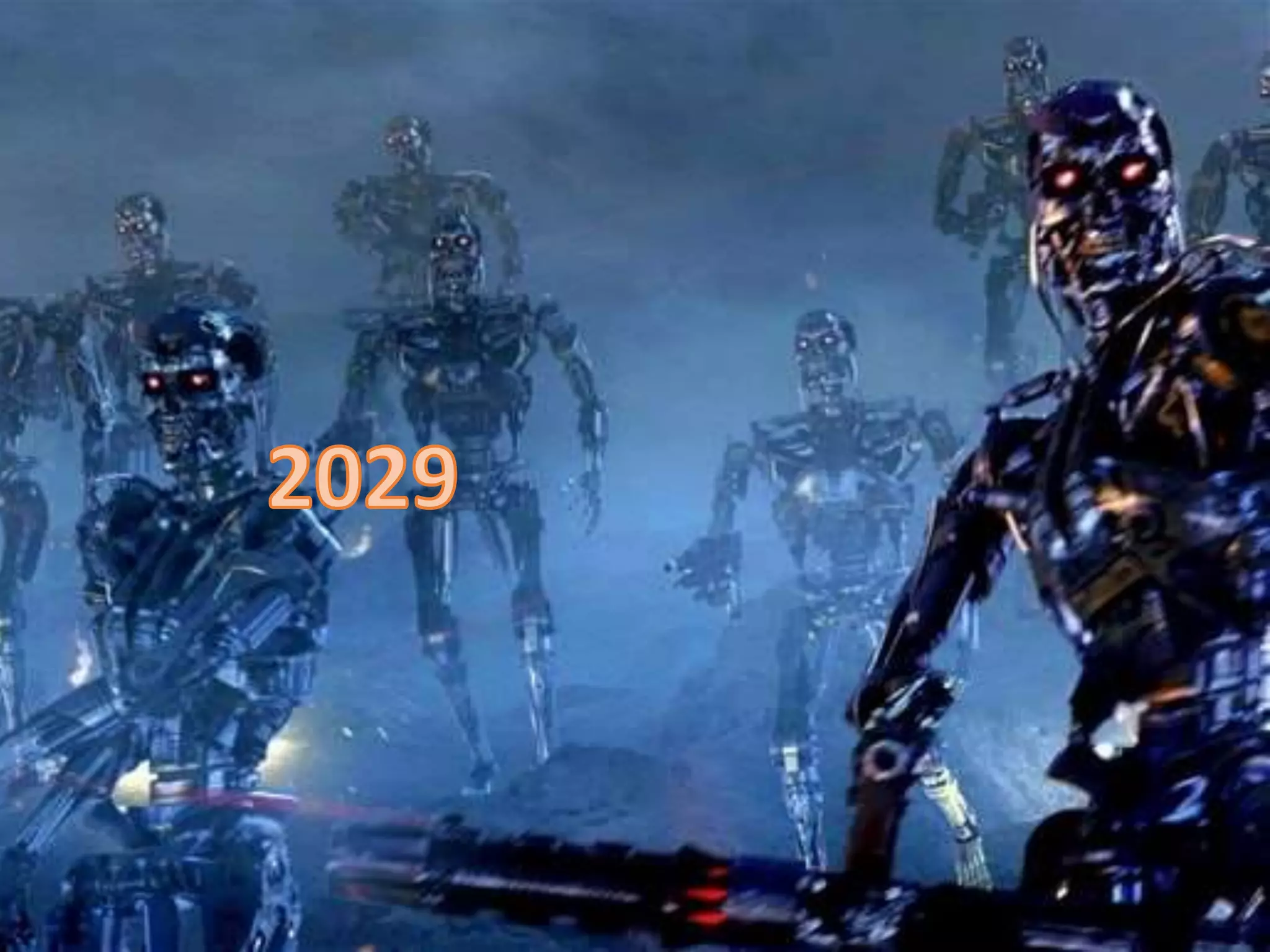











A skeptic’s view of
Automation and AI
Rob England
Automation and AI
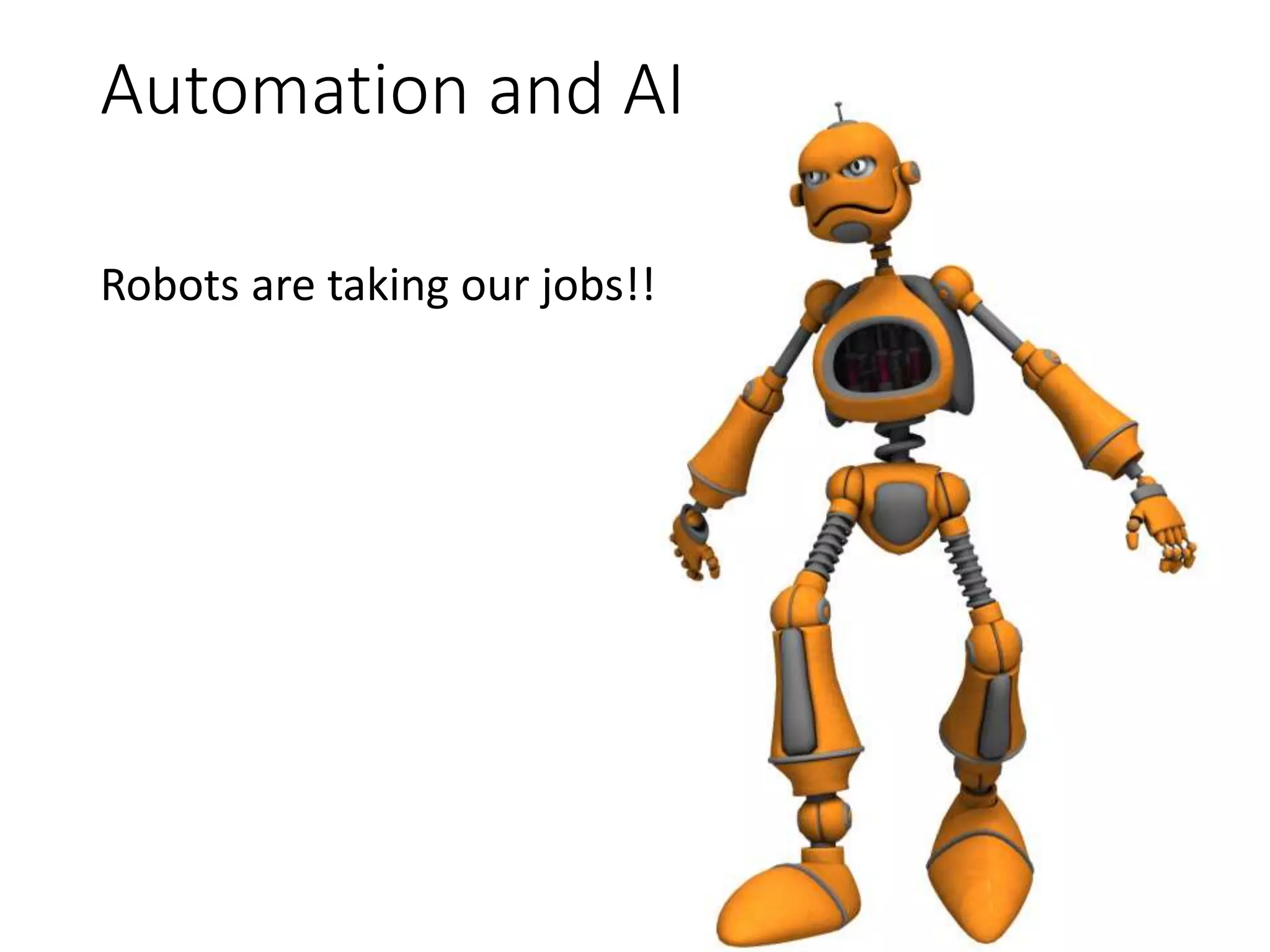
Robots are taking our jobs!!
Forecasting is hard,
especially about the
future
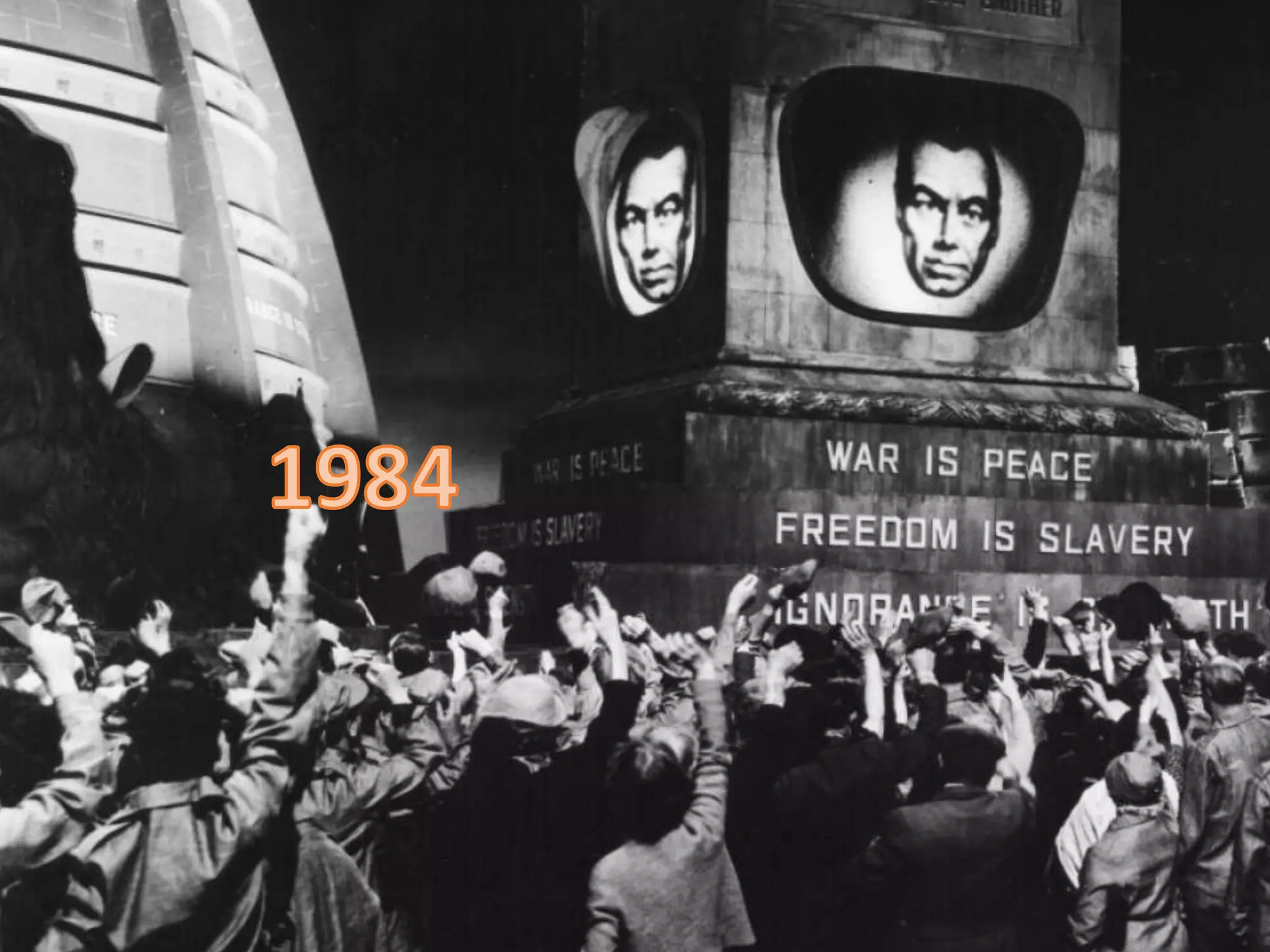
1984
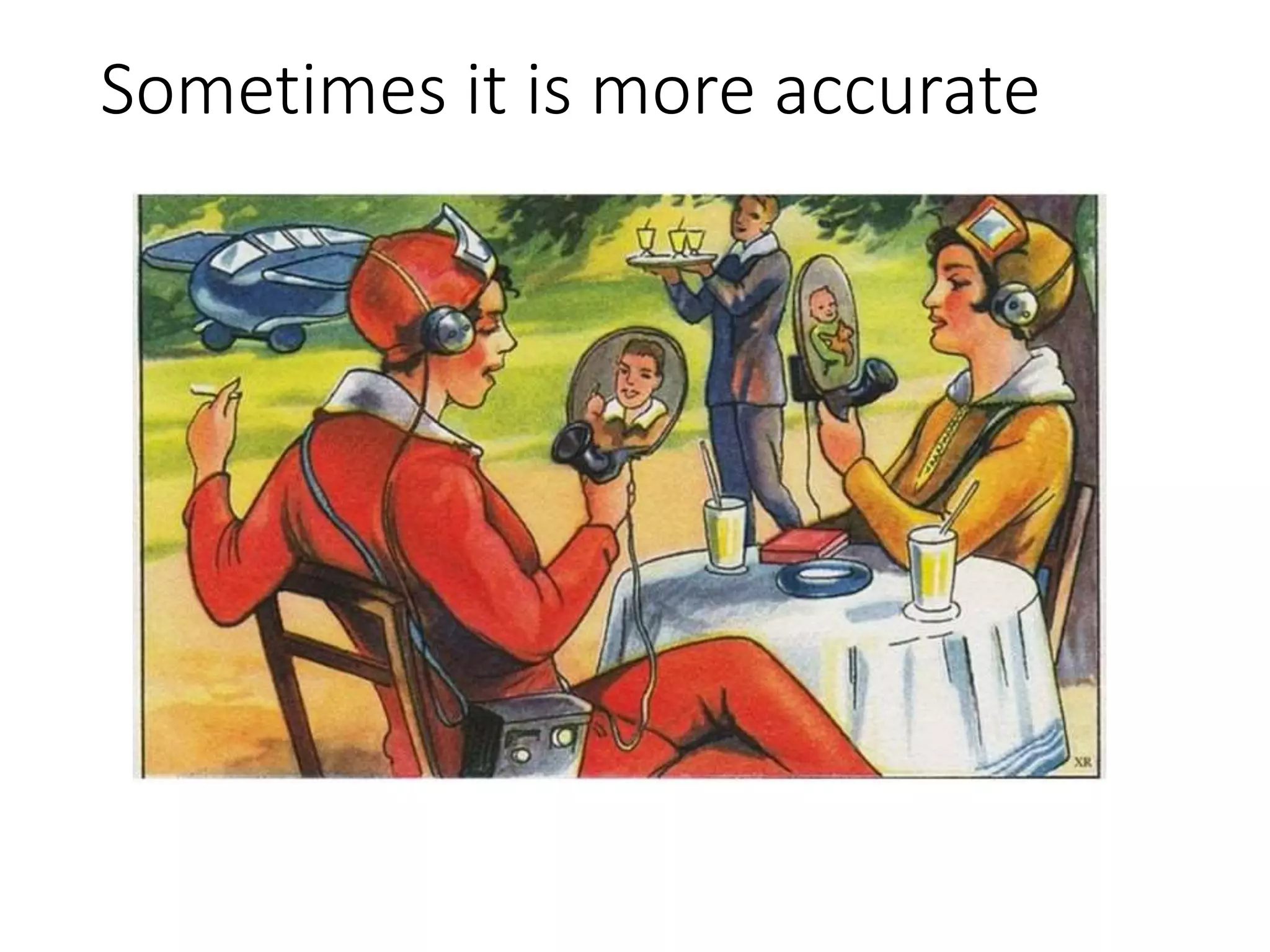
Sometimes it is more accurate
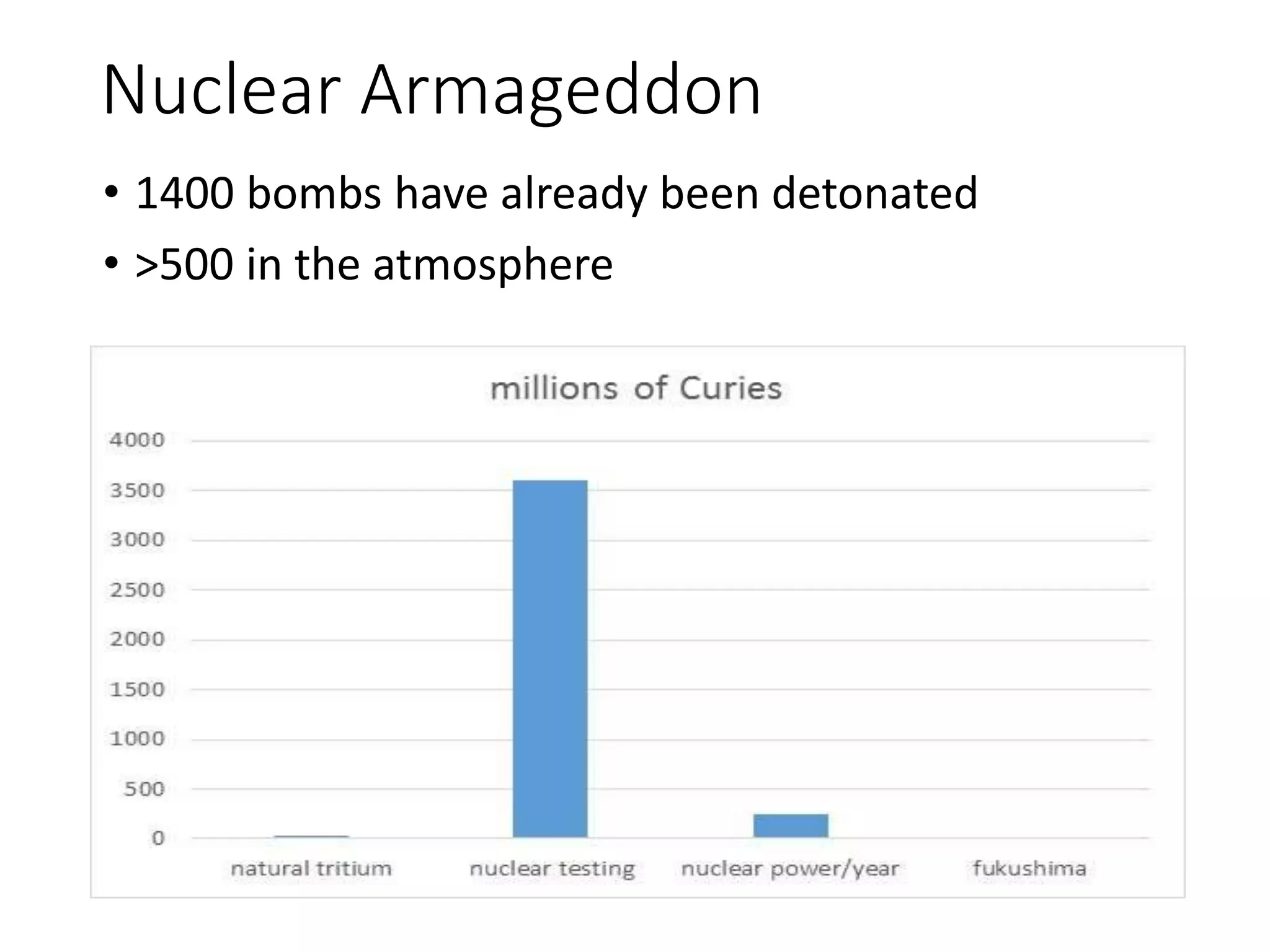
Nuclear Armageddon
Nuclear Armageddon
• 1400 bombs have already been detonated
• >500 in the atmosphere
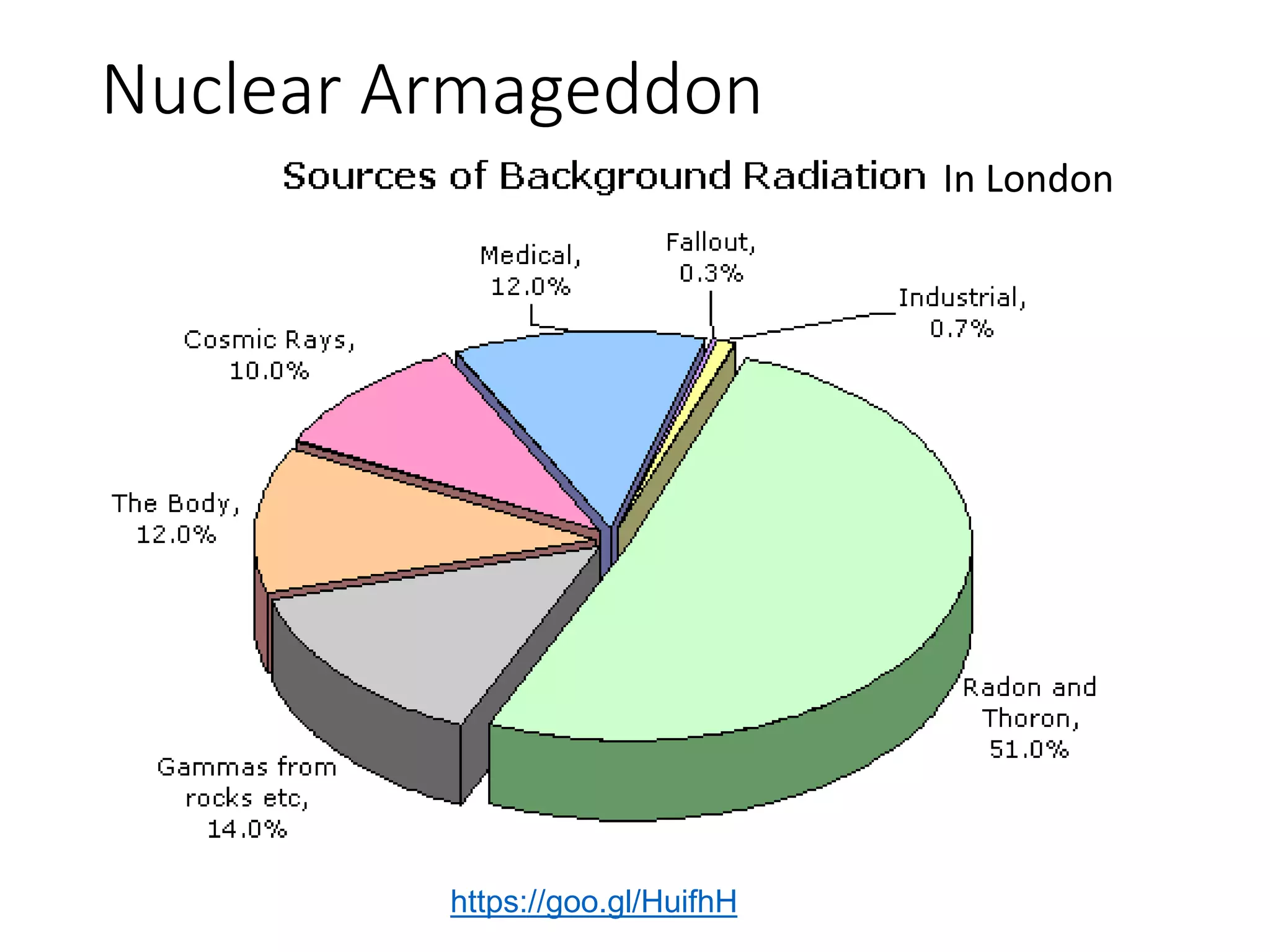
Nuclear Armageddon
https://goo.gl/HuifhH
In London
End of resources
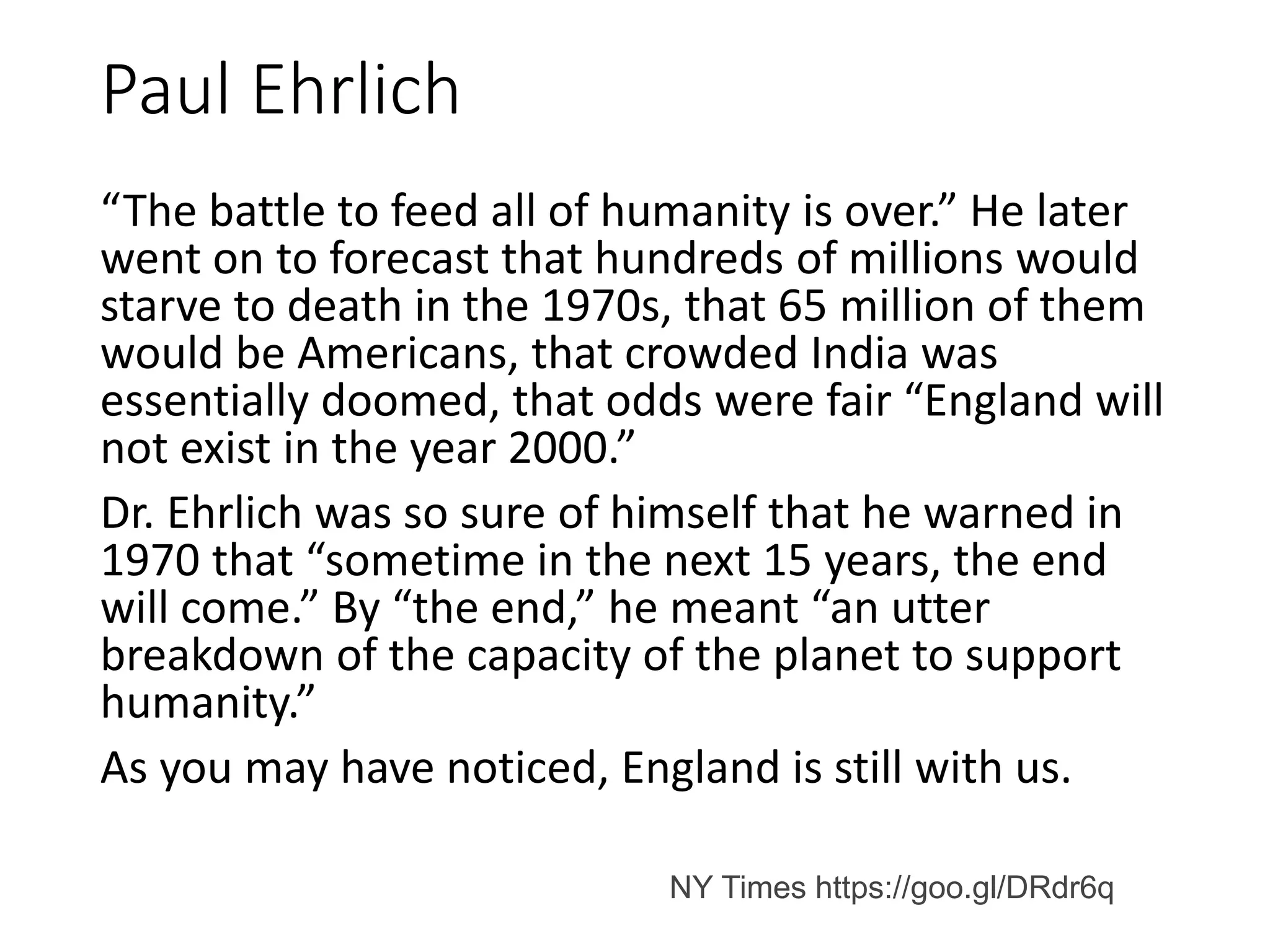
Paul Ehrlich
“The battle to feed all of humanity is over.” He later
went on to forecast that hundreds of millions would
starve to death in the 1970s, that 65 million of them
would be Americans, that crowded India was
essentially doomed, that odds were fair “England will
not exist in the year 2000.”
Dr. Ehrlich was so sure of himself that he warned in
1970 that “sometime in the next 15 years, the end
will come.” By “the end,” he meant “an utter
breakdown of the capacity of the planet to support
humanity.”
As you may have noticed, England is still with us.
NY Times https://goo.gl/DRdr6q
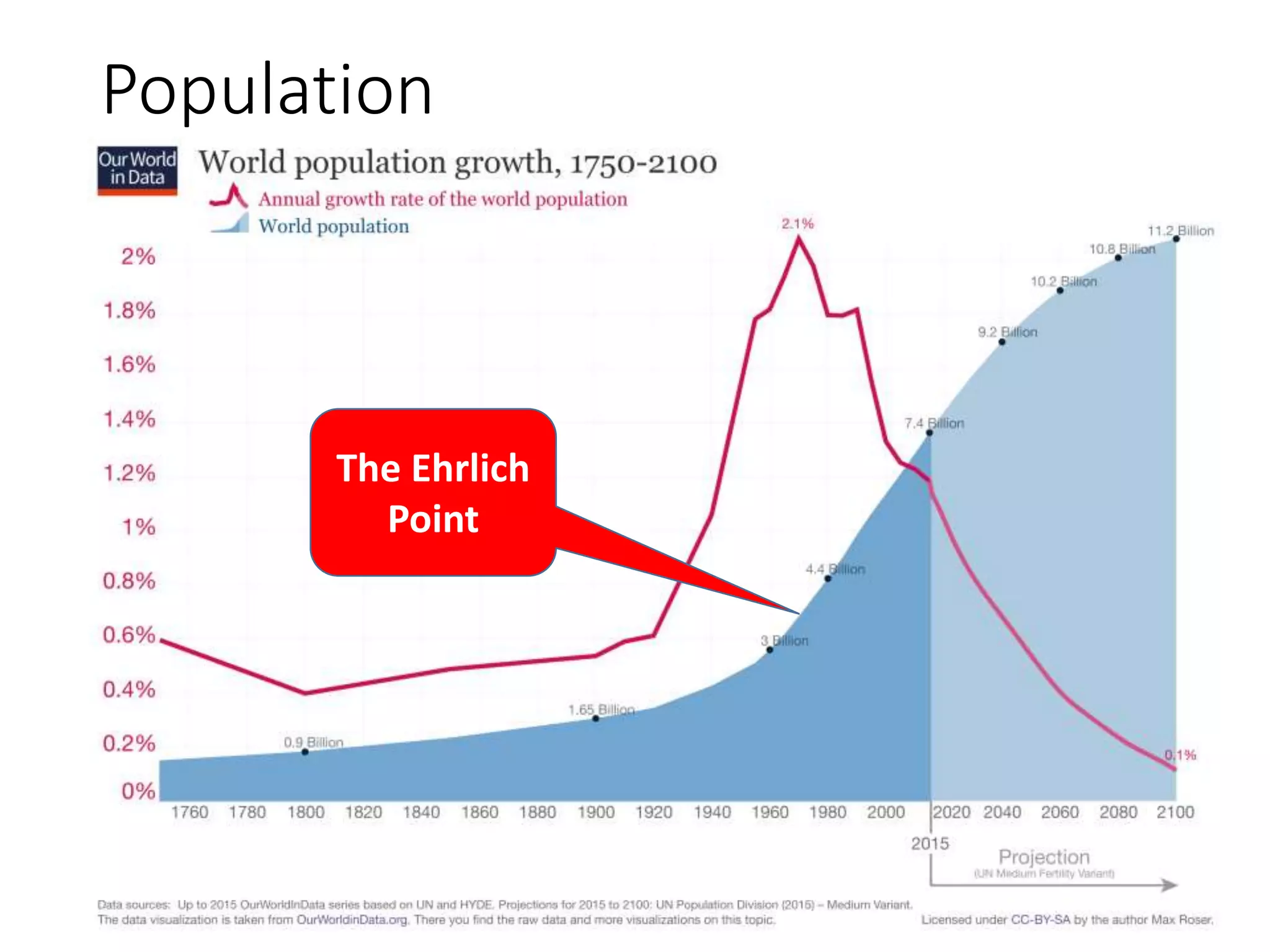
Population
The Ehrlich
Point
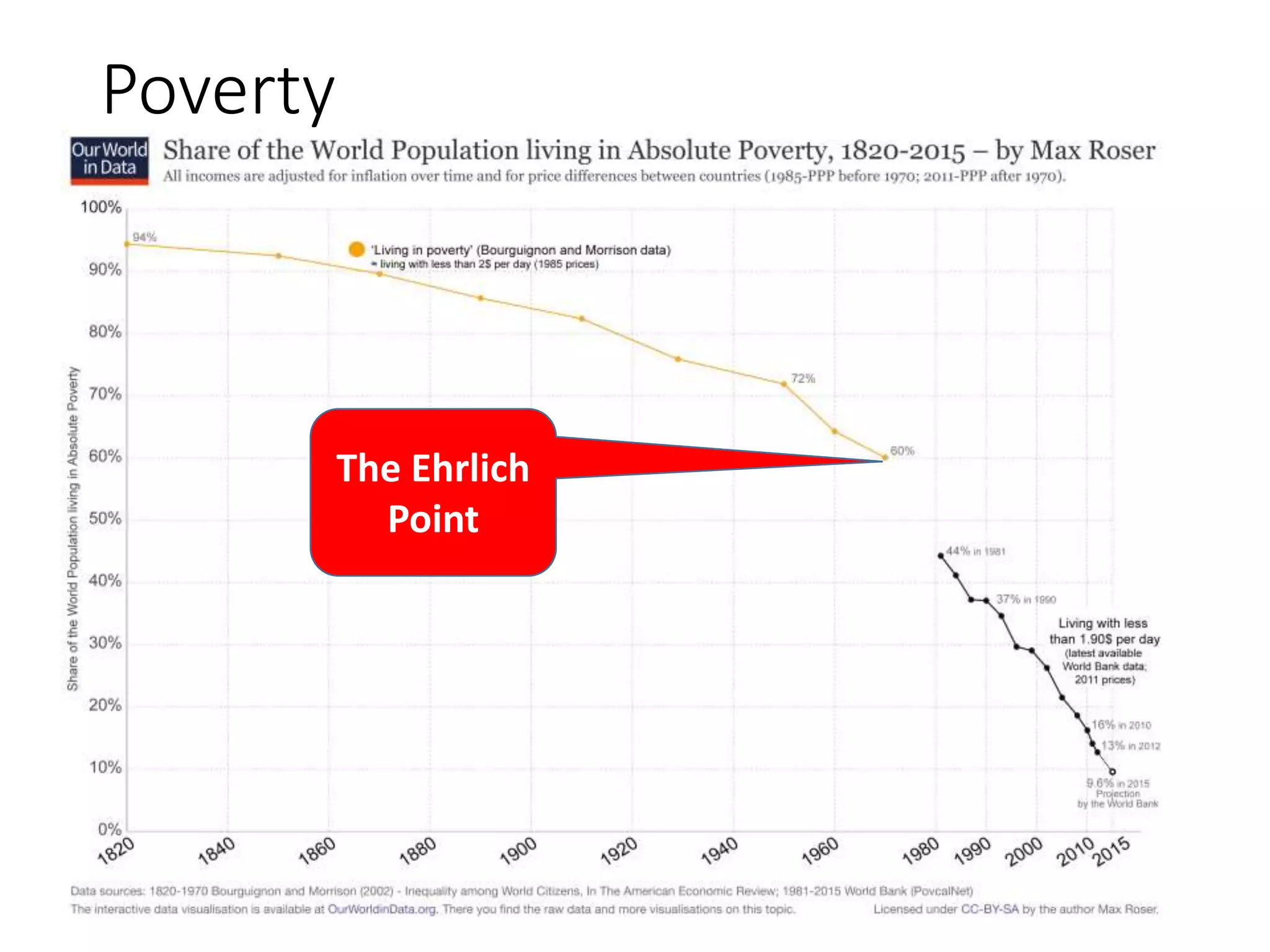
Poverty
The Ehrlich
Point
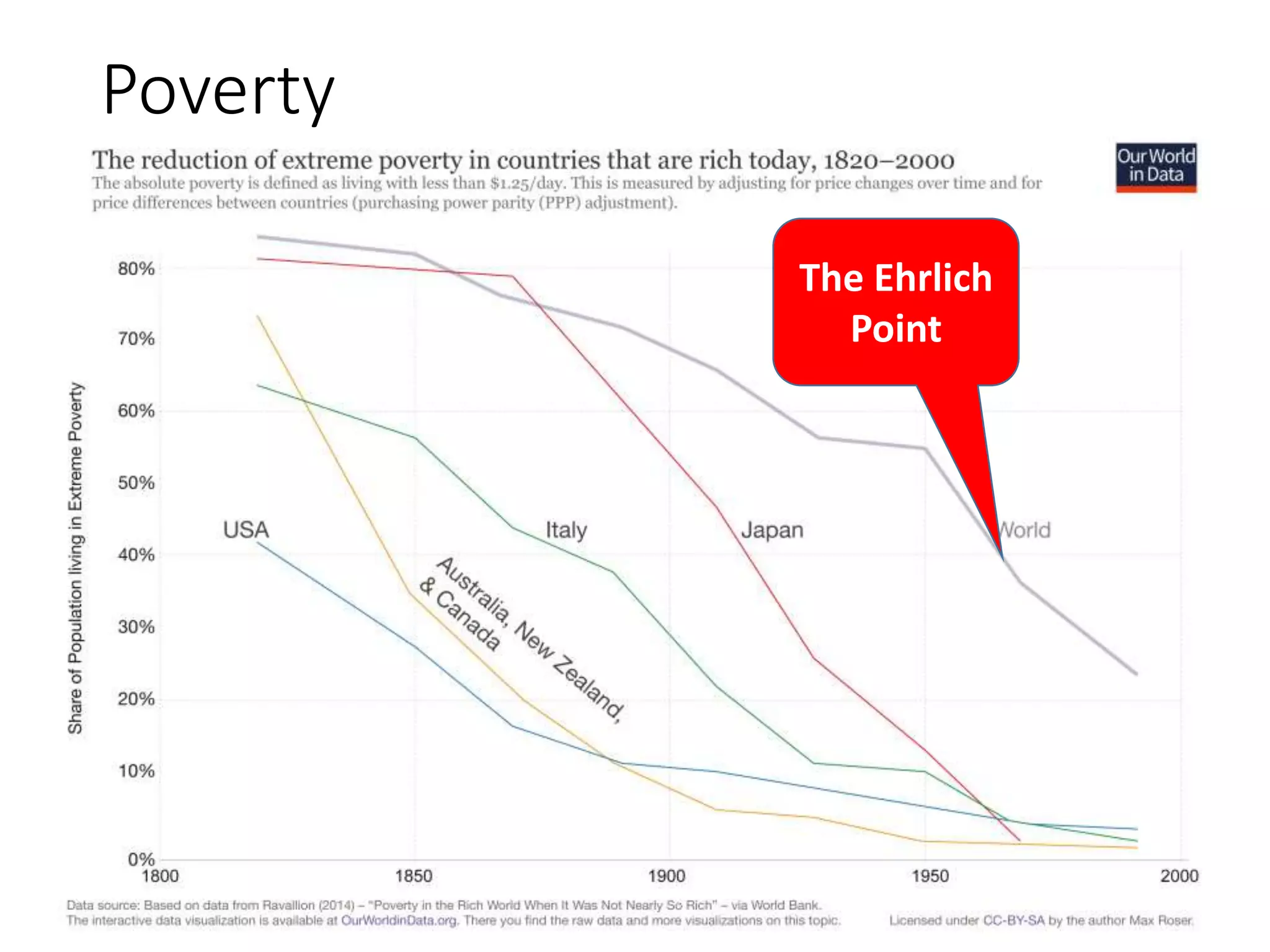
Poverty
The Ehrlich
Point
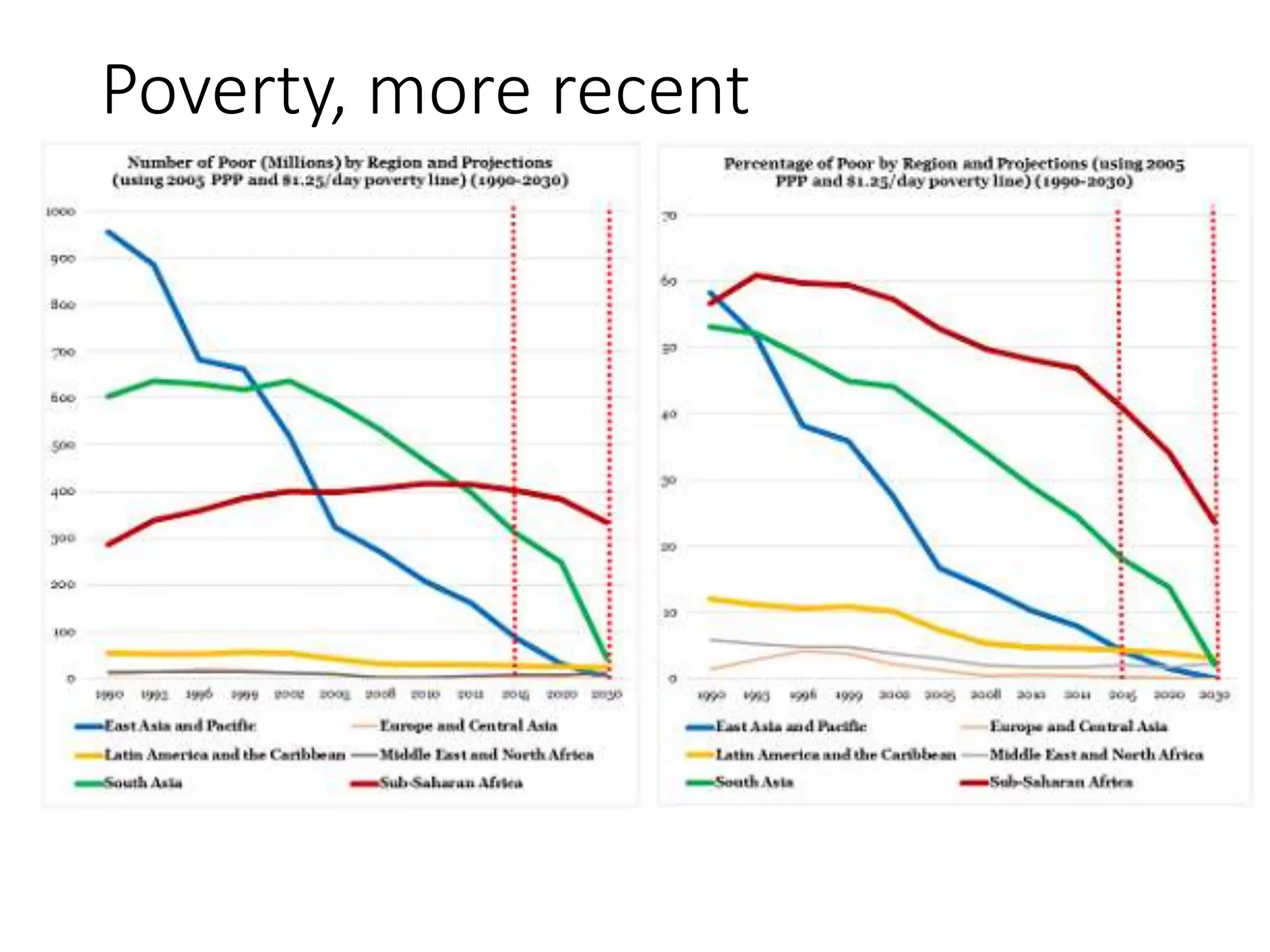
Poverty, more recent
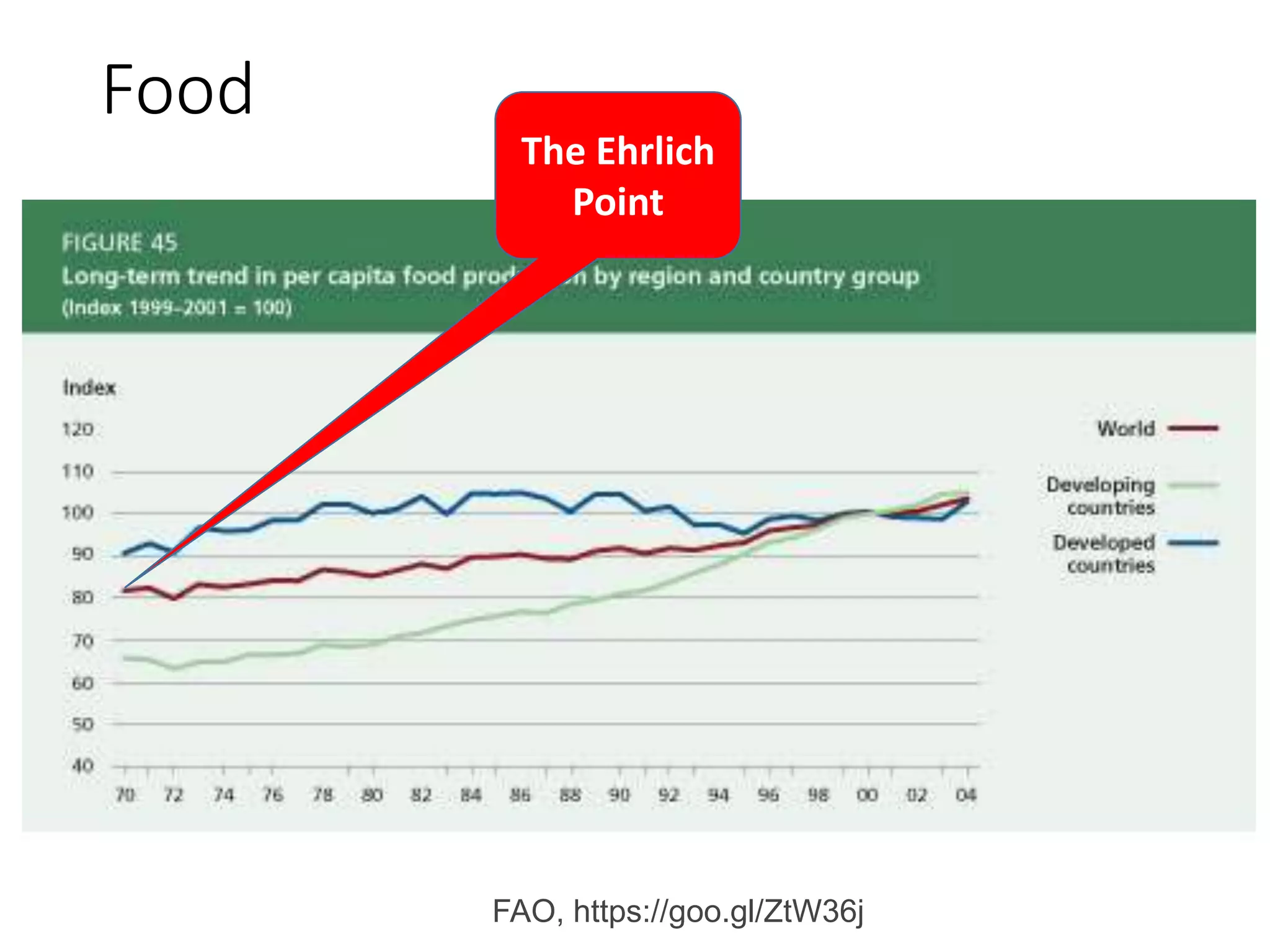
Food
The Ehrlich
Point
FAO, https://goo.gl/ZtW36j
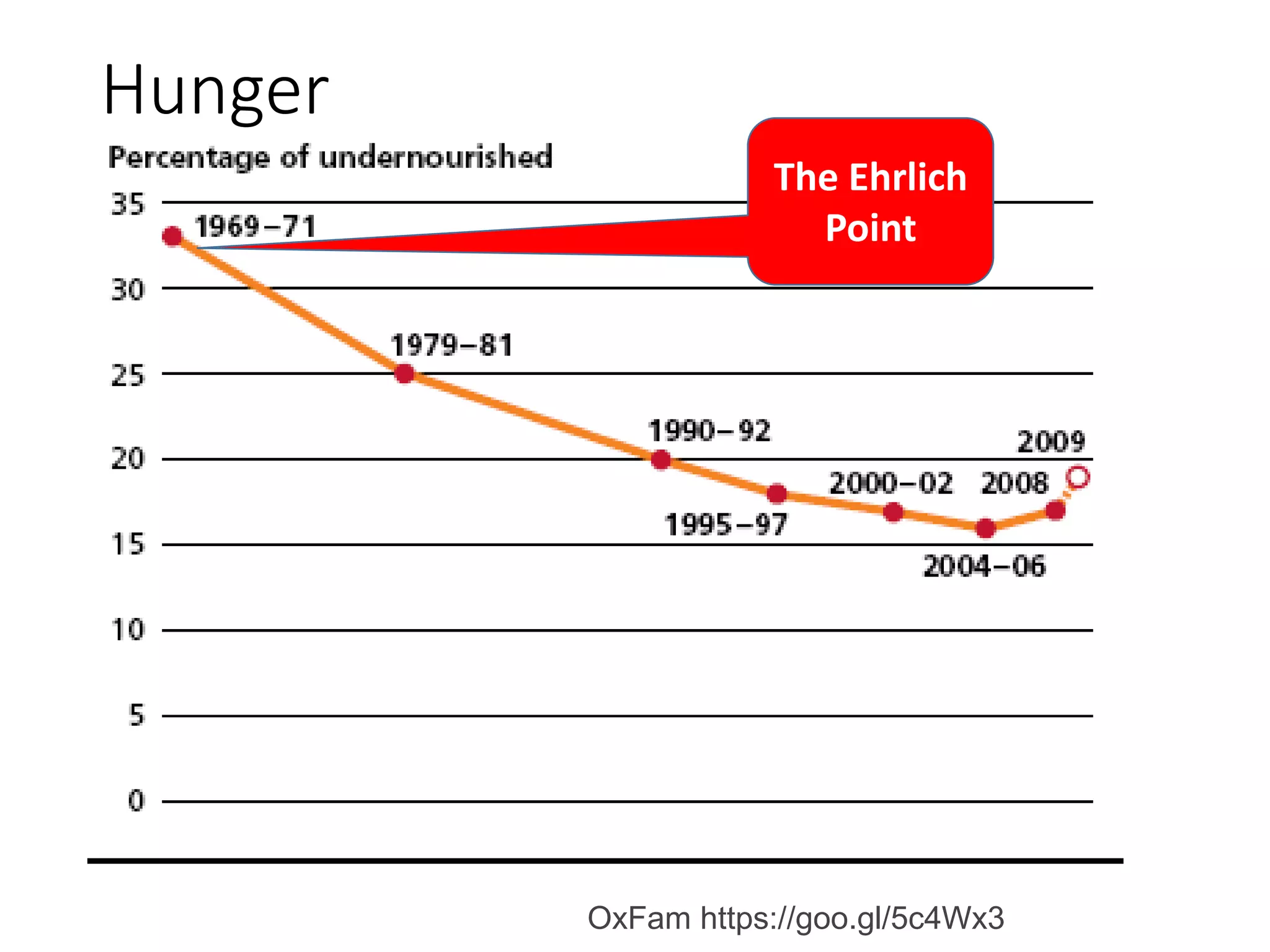
Hunger
OxFam https://goo.gl/5c4Wx3
The Ehrlich
Point
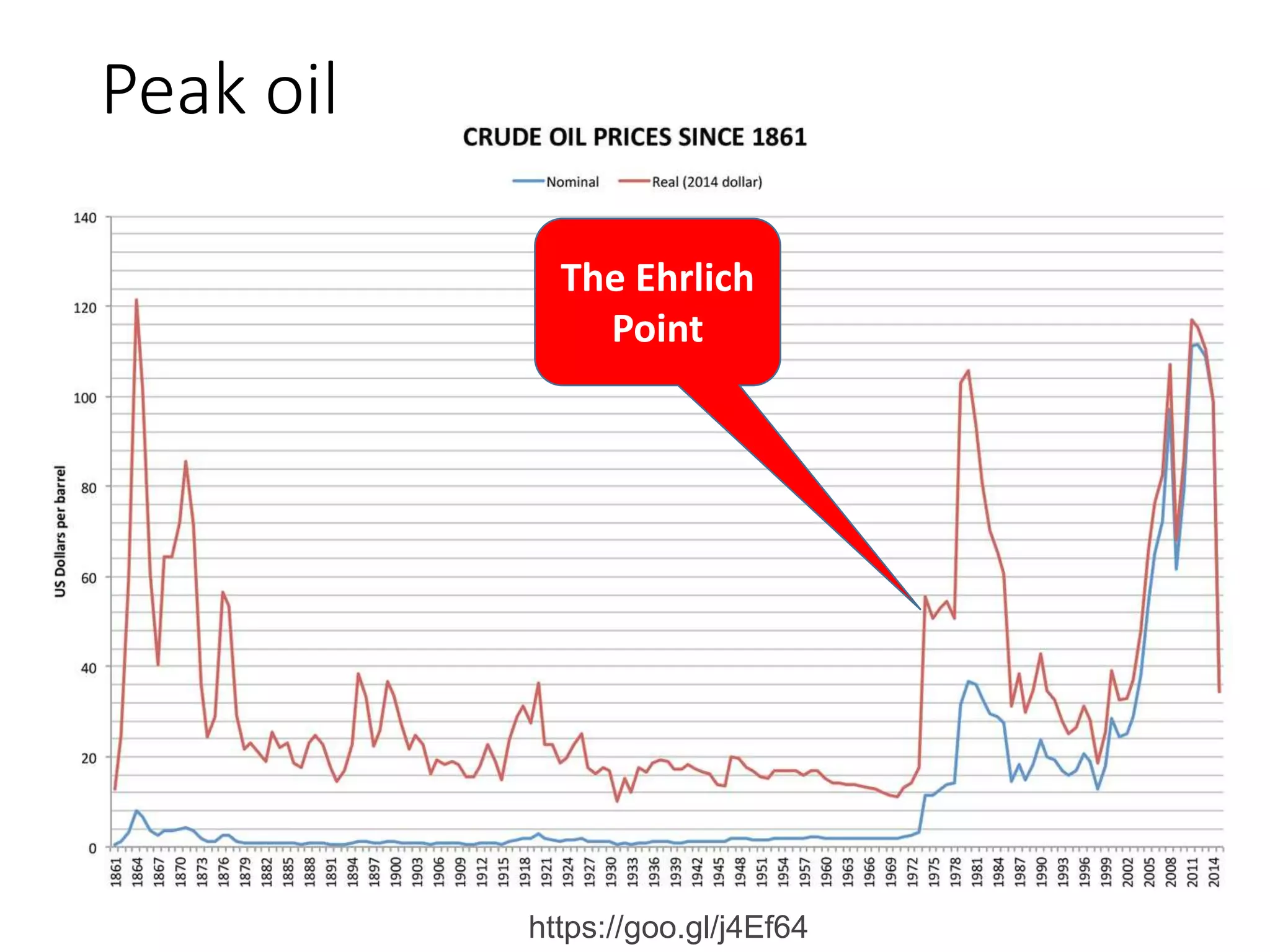
Peak oil
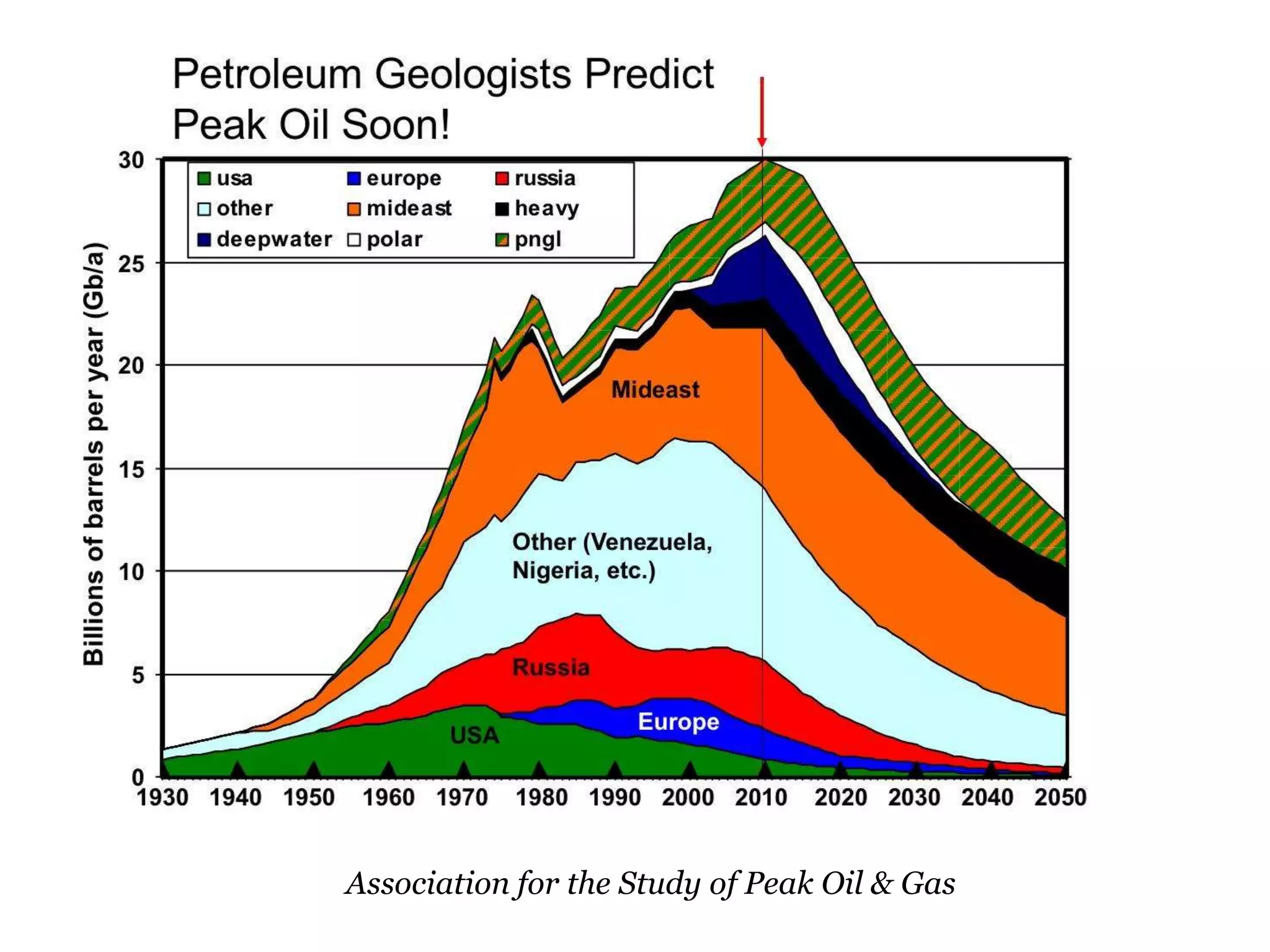
Peak oil
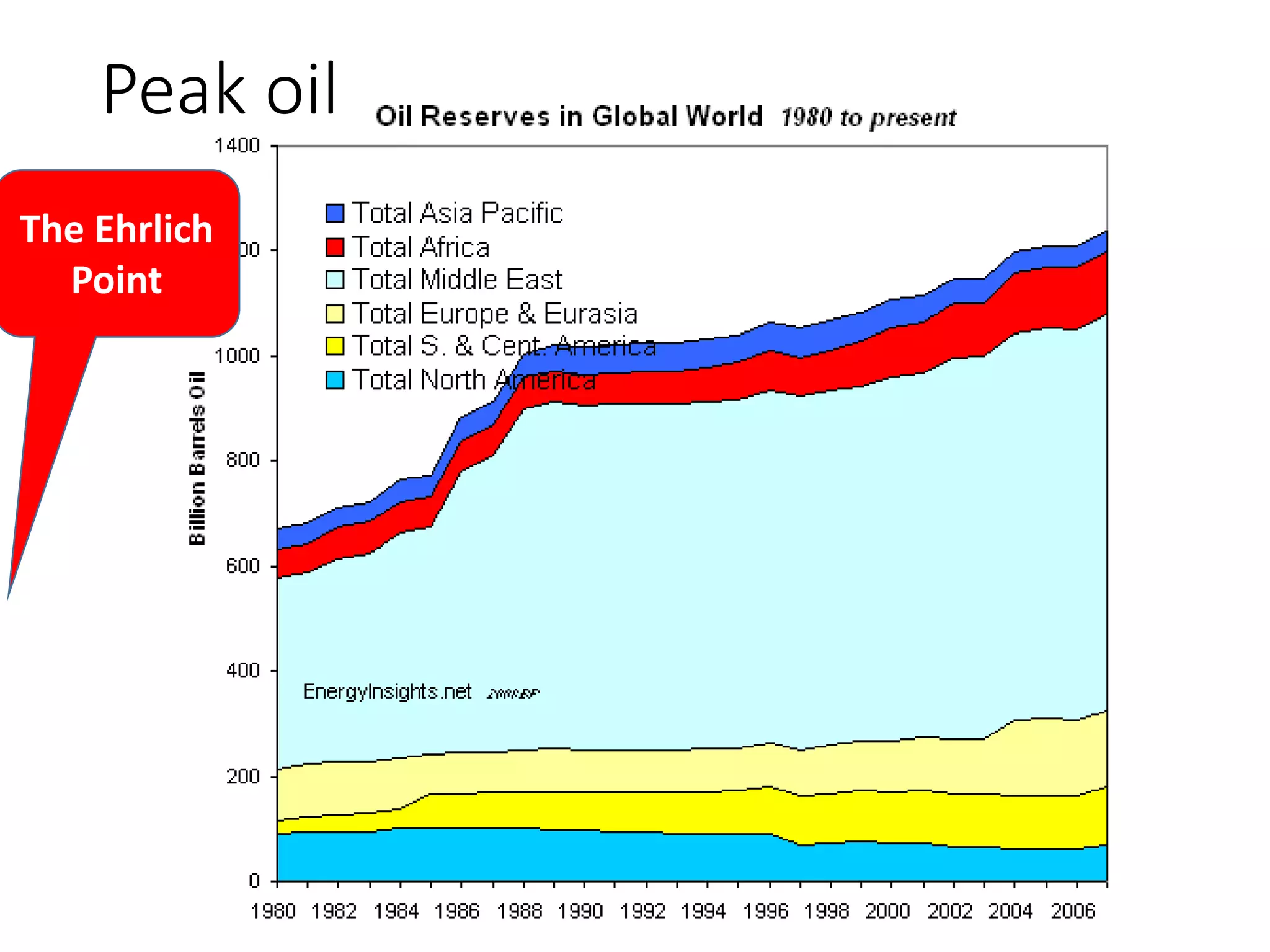
Association for the Study of Peak Oil & Gas
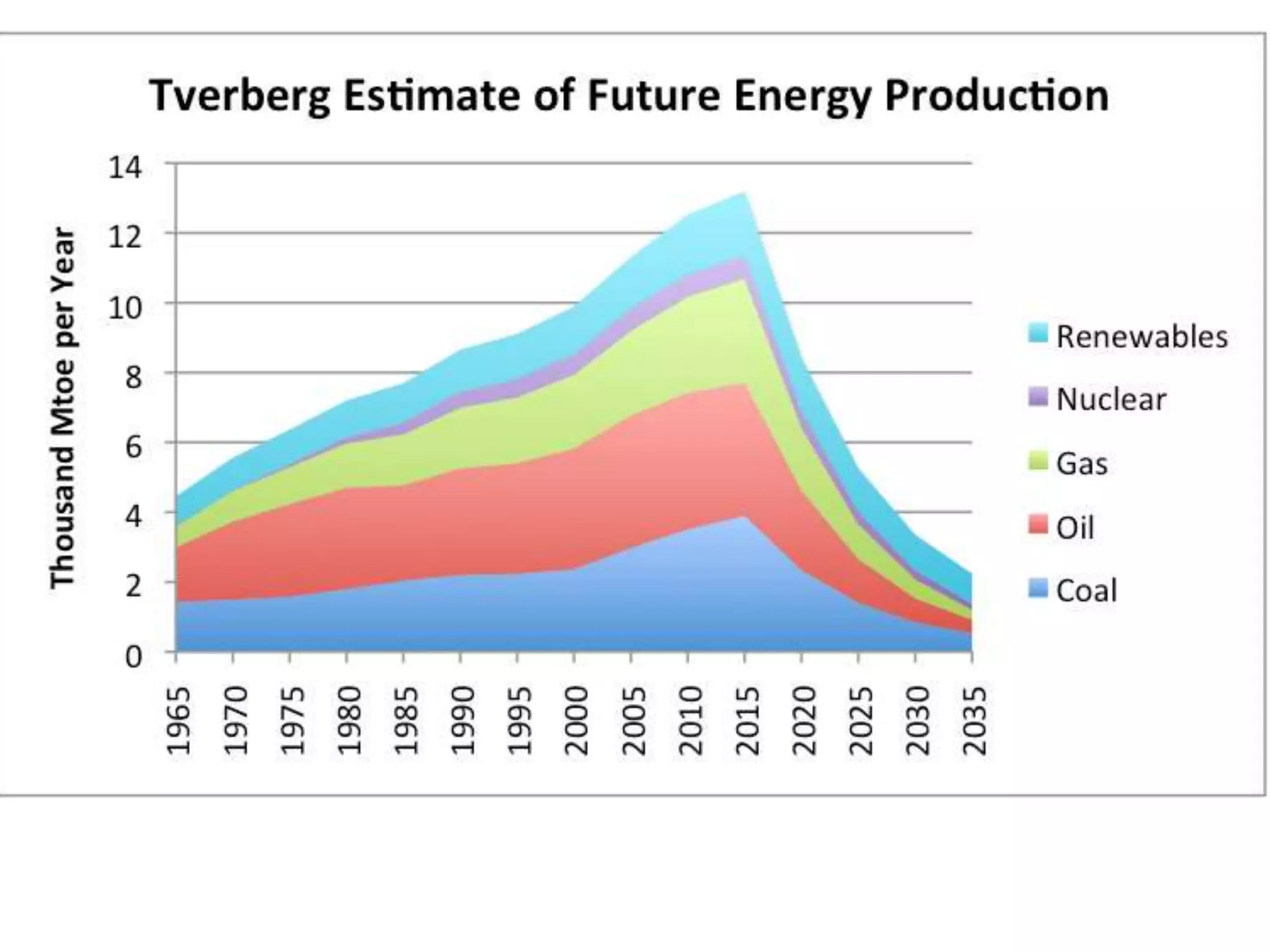
Peak oil
https://goo.gl/j4Ef64
The Ehrlich
Point
Peak oil
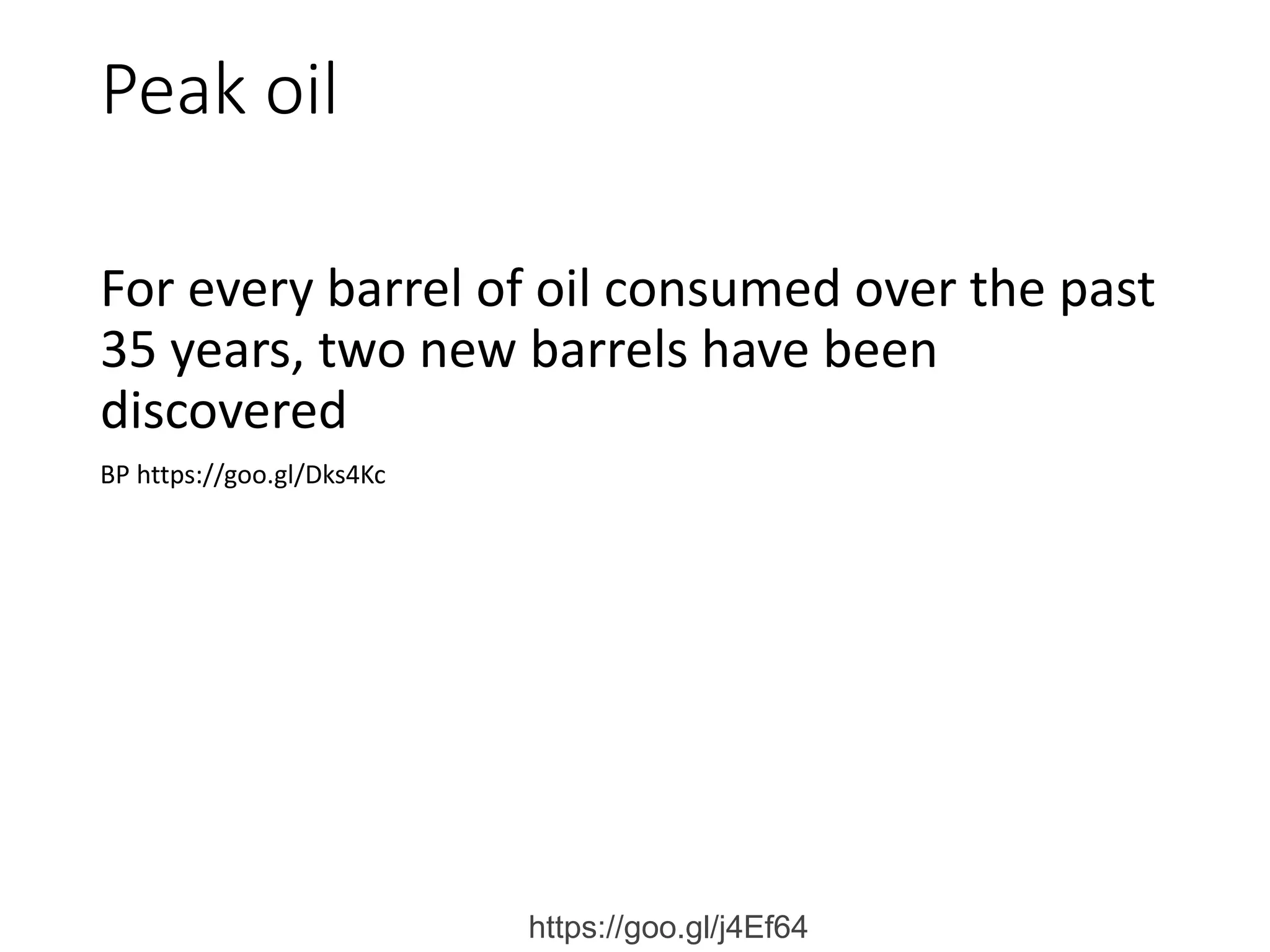
For every barrel of oil consumed over the past
35 years, two new barrels have been
discovered
BP https://goo.gl/Dks4Kc
https://goo.gl/j4Ef64
Peak oil
The Ehrlich
Point
Ice age
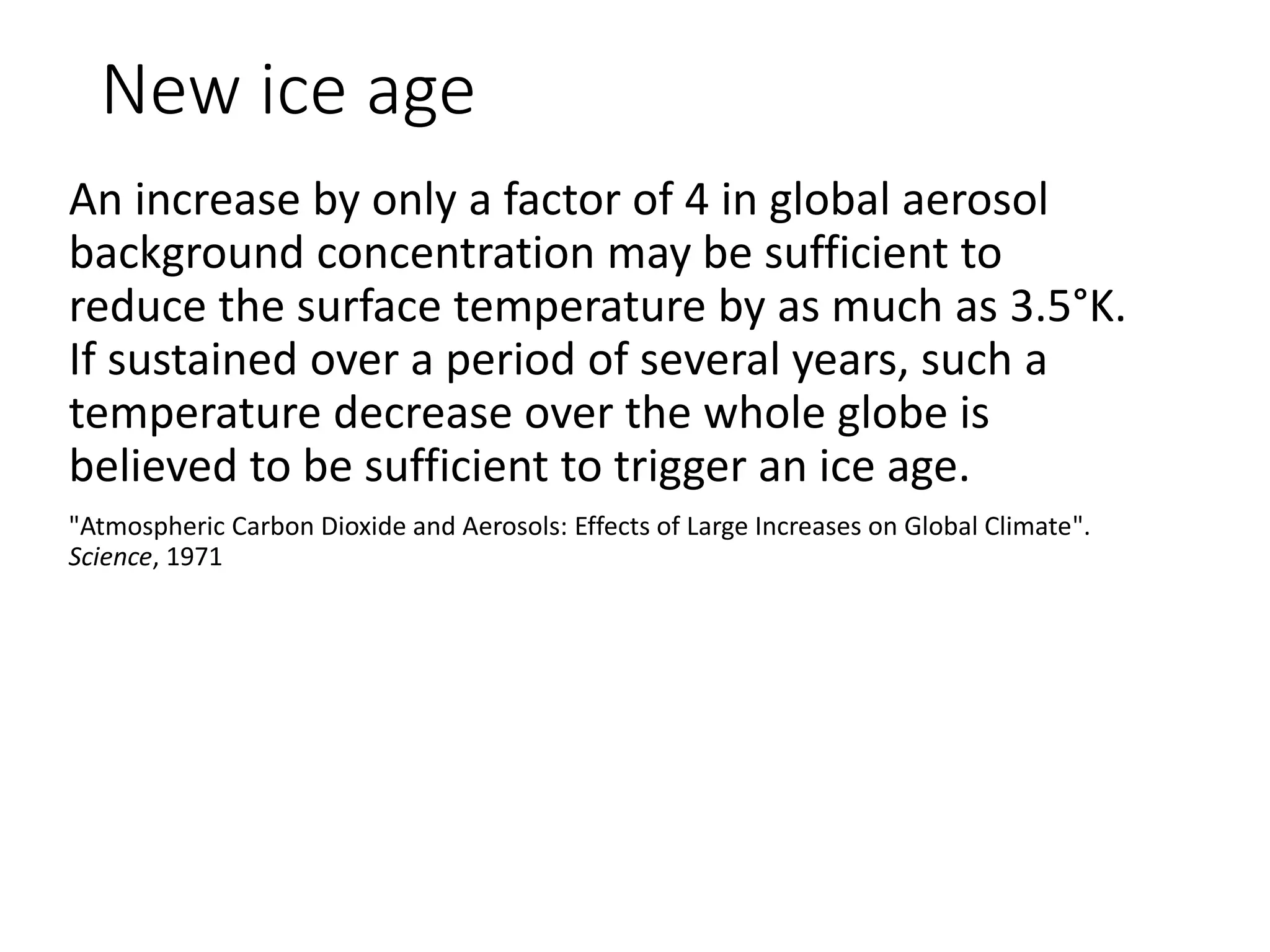
New ice age
An increase by only a factor of 4 in global aerosol
background concentration may be sufficient to
reduce the surface temperature by as much as 3.5°K.
If sustained over a period of several years, such a
temperature decrease over the whole globe is
believed to be sufficient to trigger an ice age.
"Atmospheric Carbon Dioxide and Aerosols: Effects of Large Increases on Global Climate".
Science, 1971
New ice age
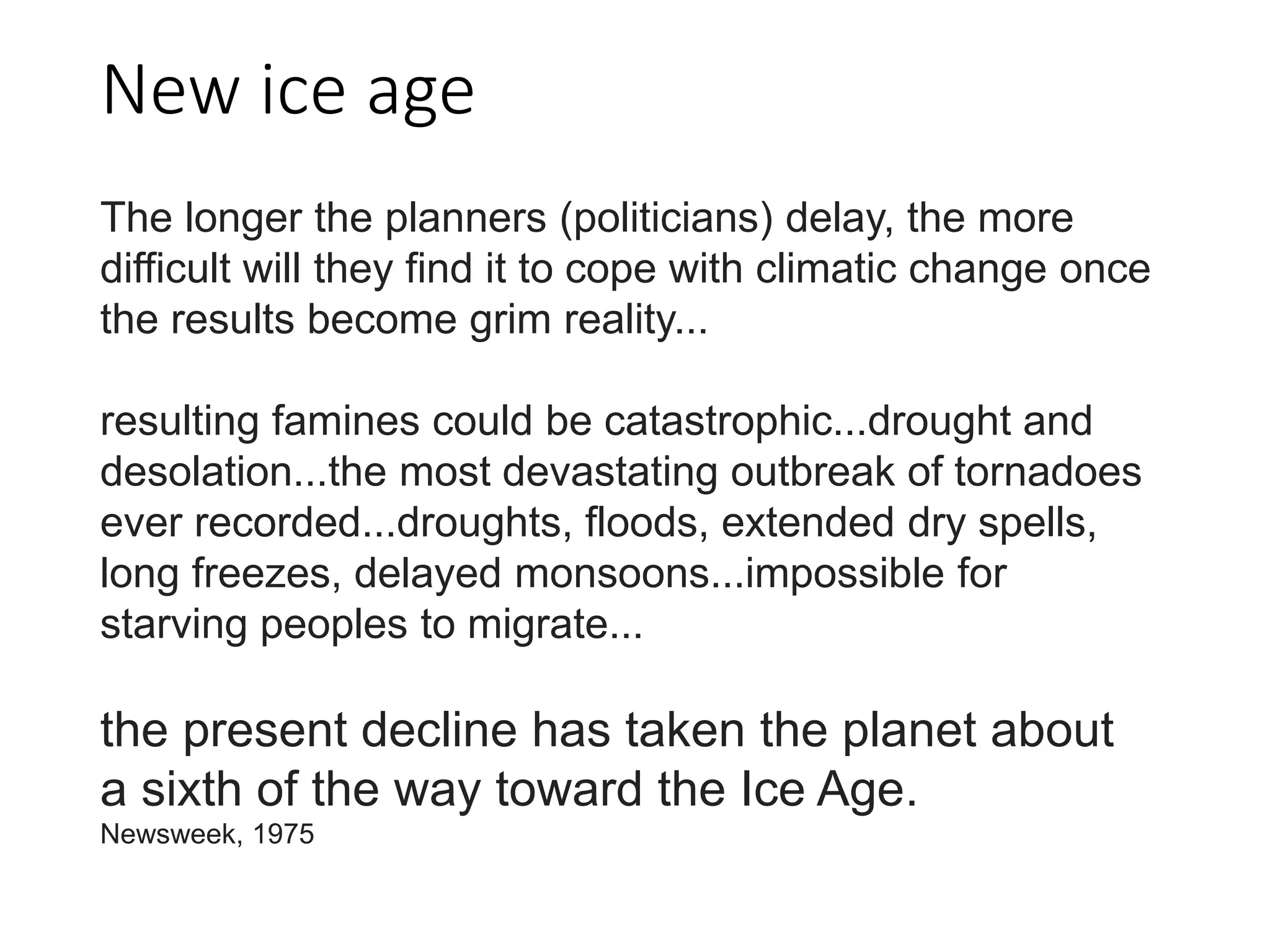
The longer the planners (politicians) delay, the more
difficult will they find it to cope with climatic change once
the results become grim reality...
resulting famines could be catastrophic...drought and
desolation...the most devastating outbreak of tornadoes
ever recorded...droughts, floods, extended dry spells,
long freezes, delayed monsoons...impossible for
starving peoples to migrate...
the present decline has taken the planet about
a sixth of the way toward the Ice Age.
Newsweek, 1975
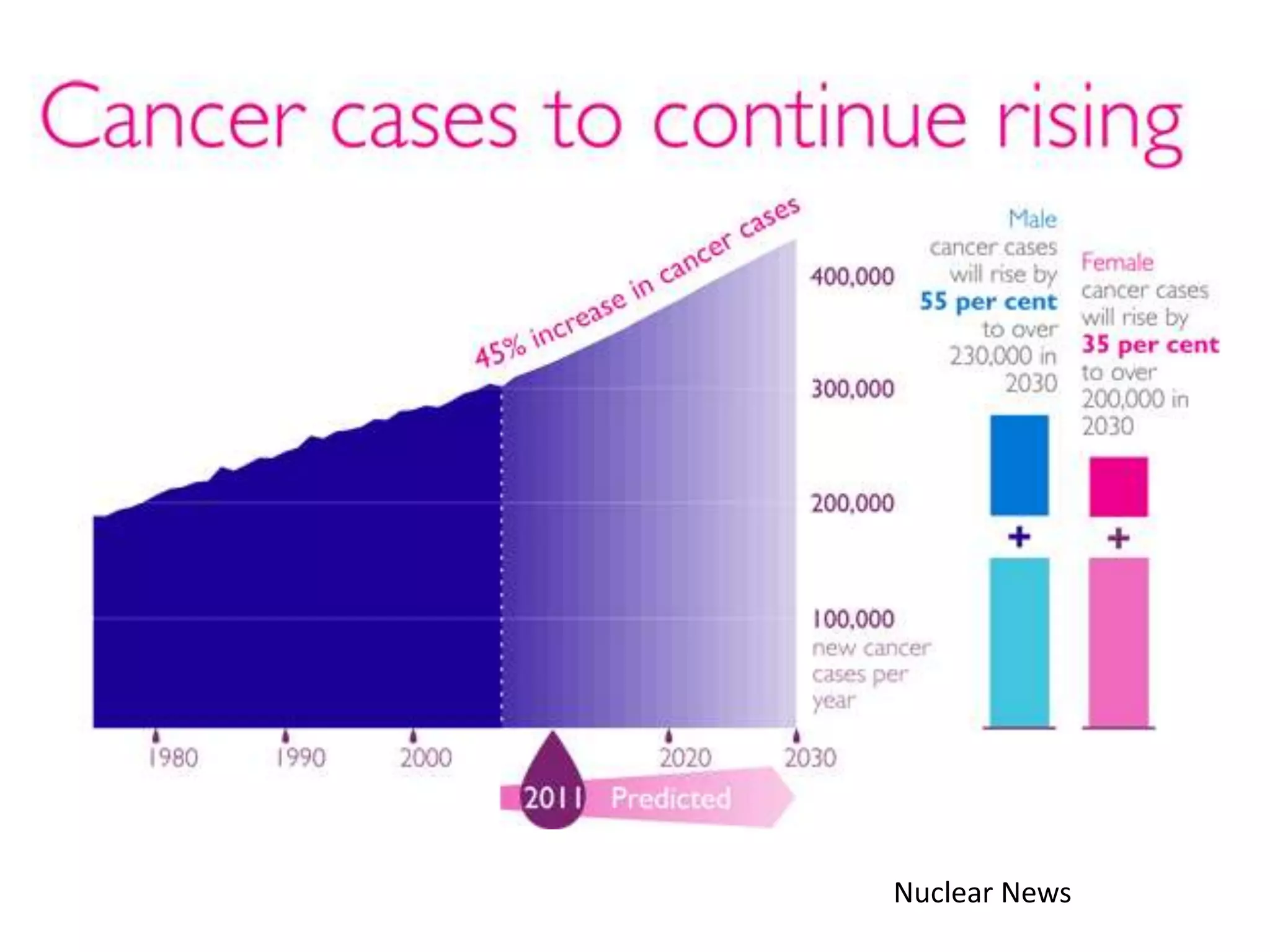
Cancer
Nuclear News
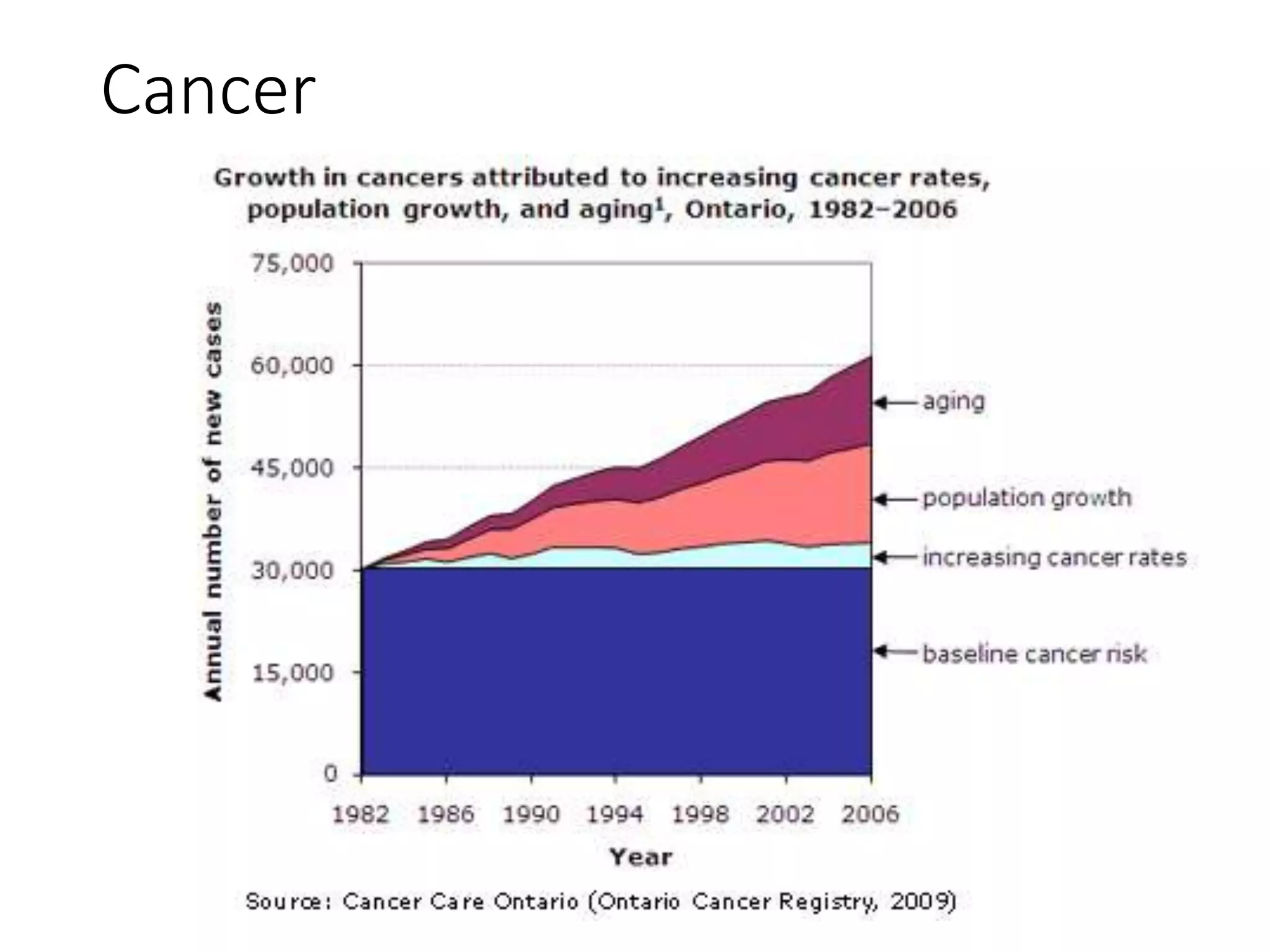
Cancer
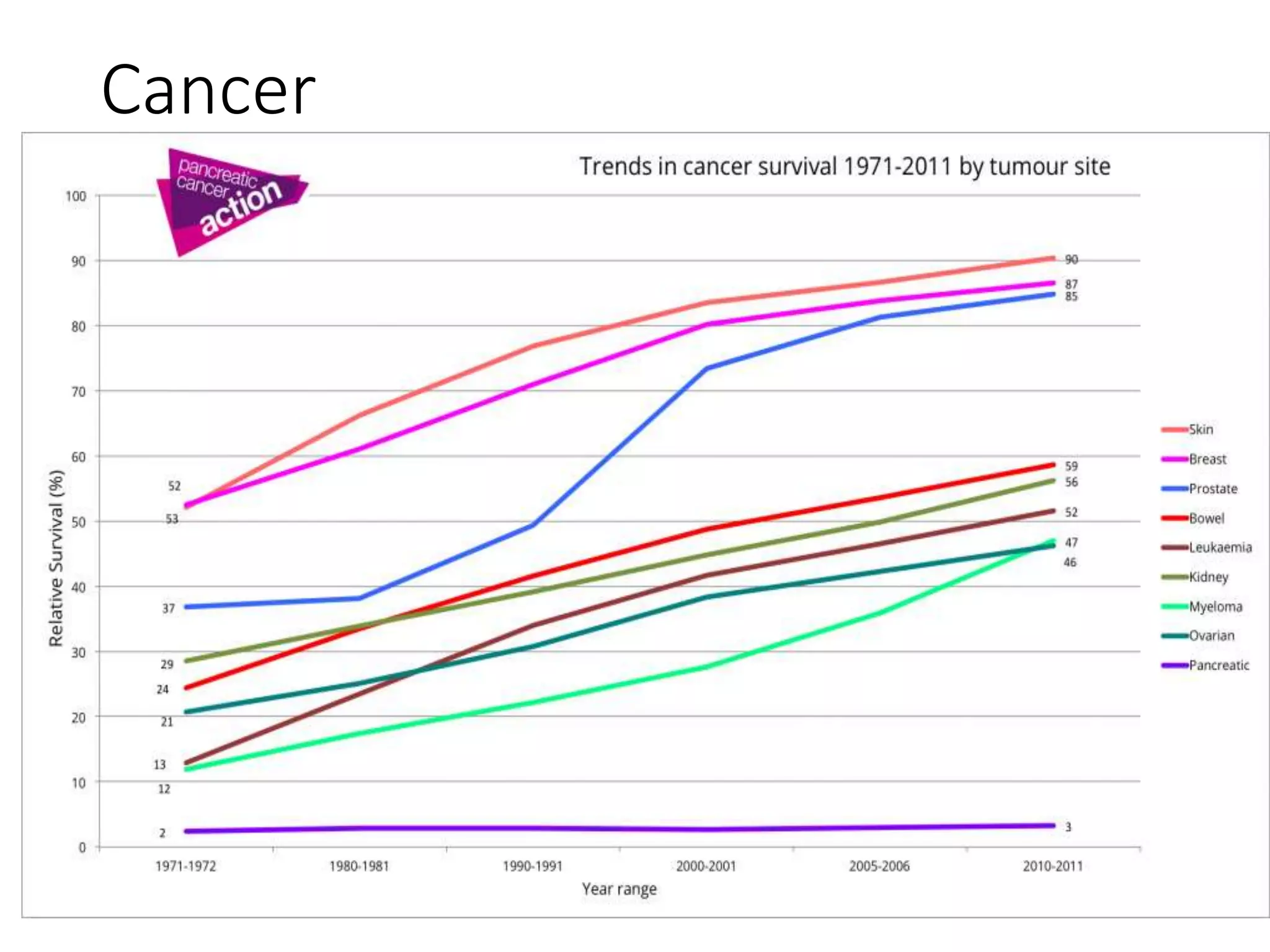
Cancer
Sometimes it is real but that
doesn’t stop the b.s.
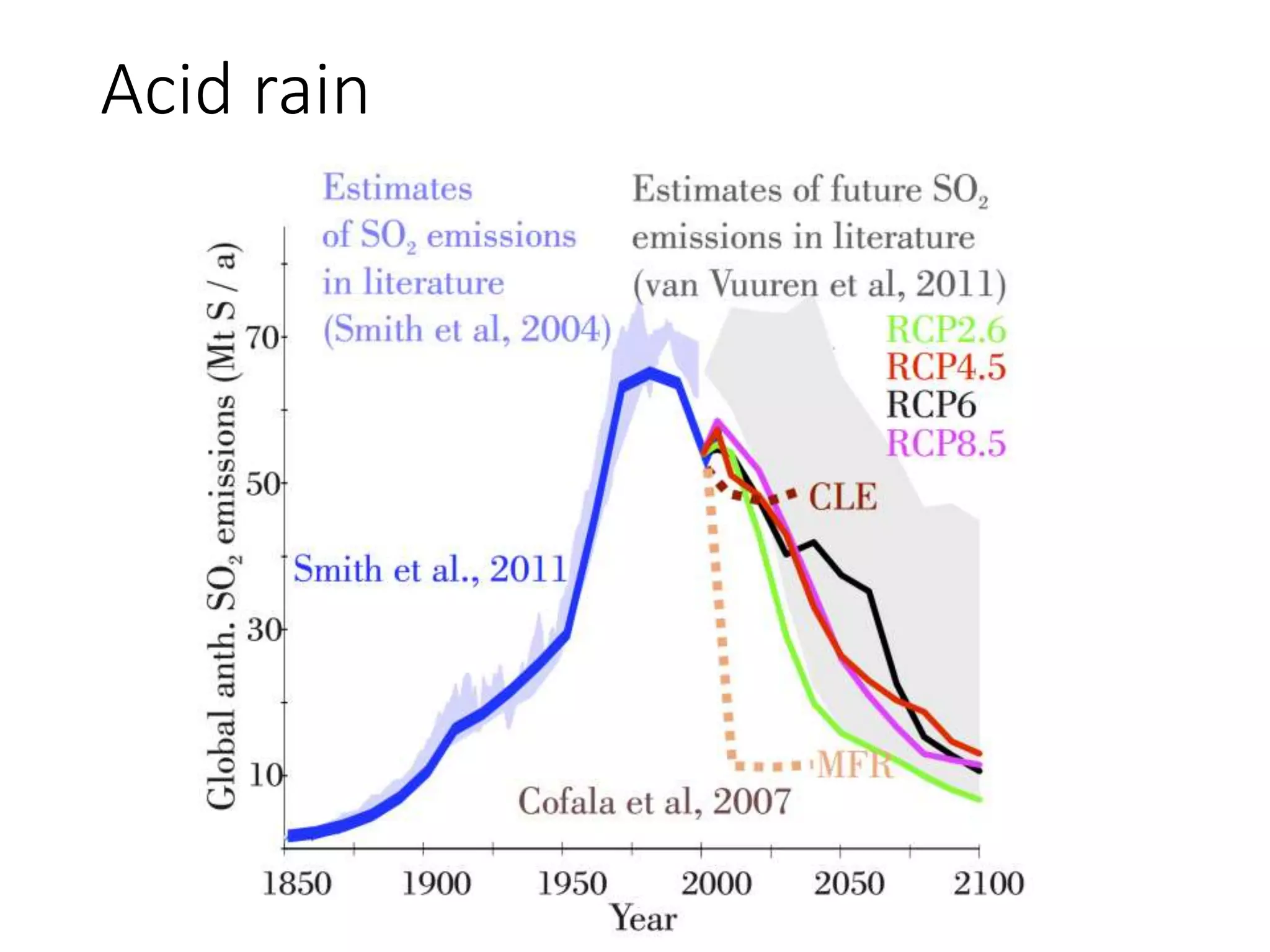
Acid rain
Acid rain
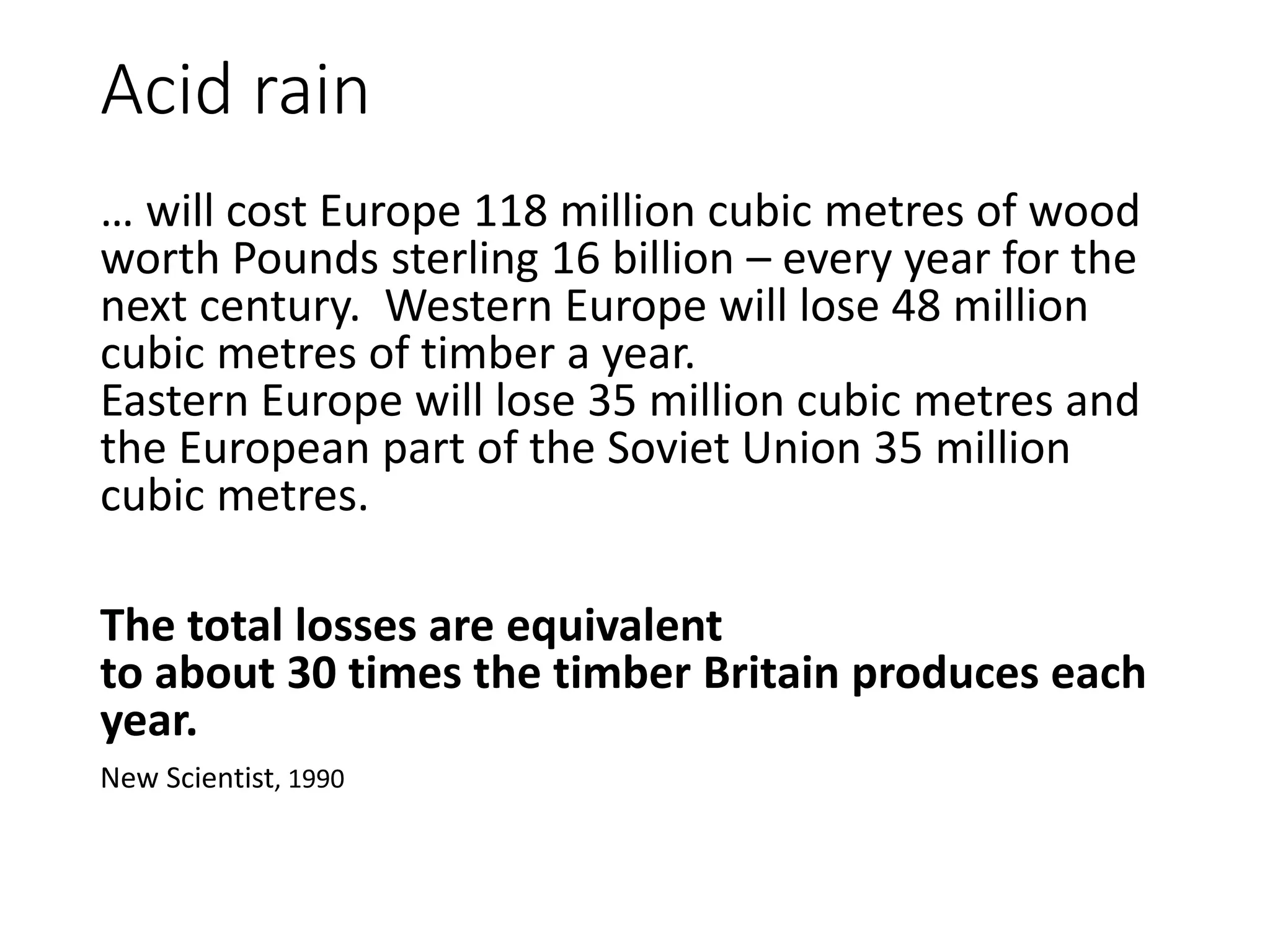
… will cost Europe 118 million cubic metres of wood
worth Pounds sterling 16 billion – every year for the
next century. Western Europe will lose 48 million
cubic metres of timber a year.
Eastern Europe will lose 35 million cubic metres and
the European part of the Soviet Union 35 million
cubic metres.
The total losses are equivalent
to about 30 times the timber Britain produces each
year.
New Scientist, 1990
Acid rain
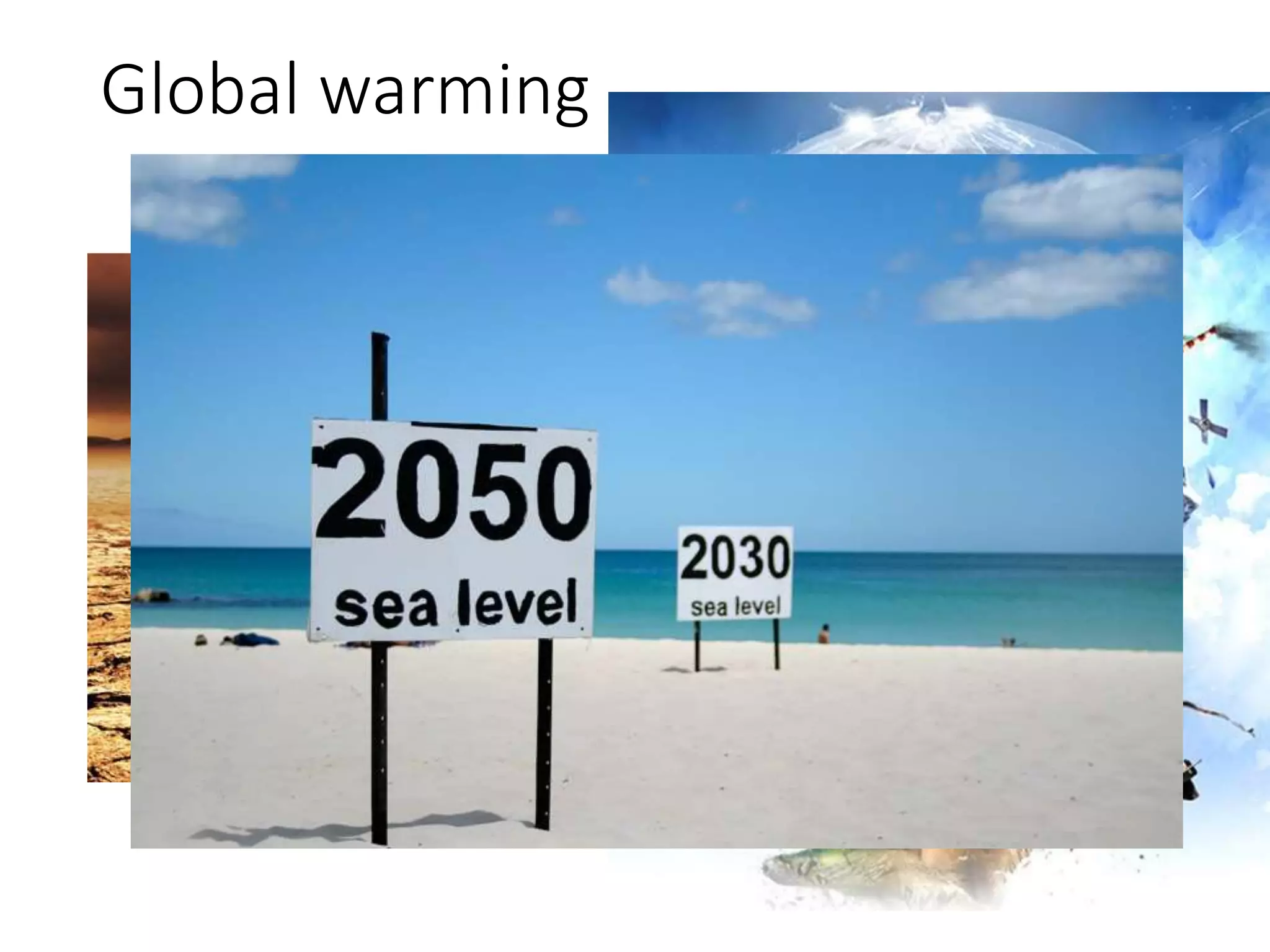
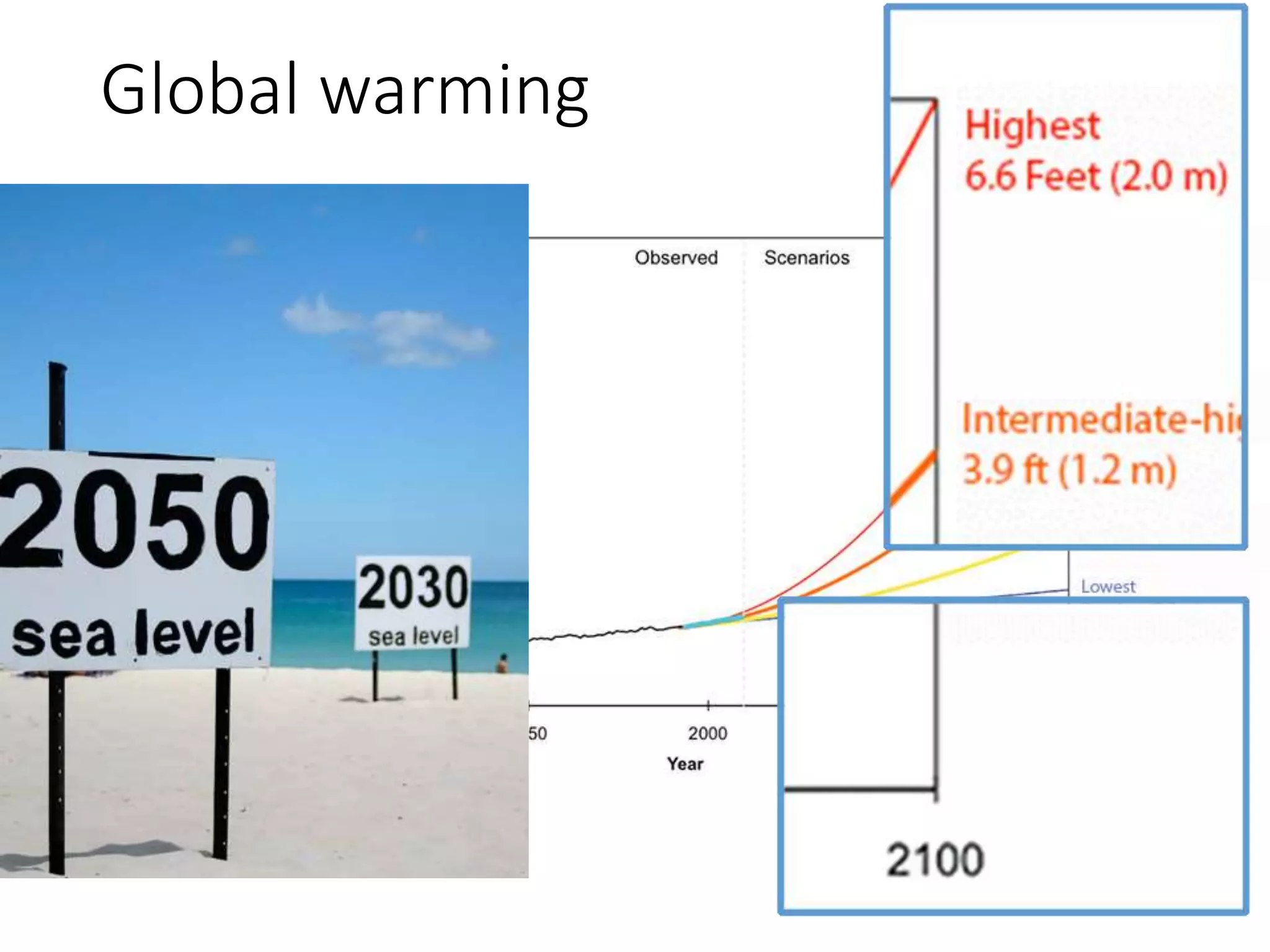
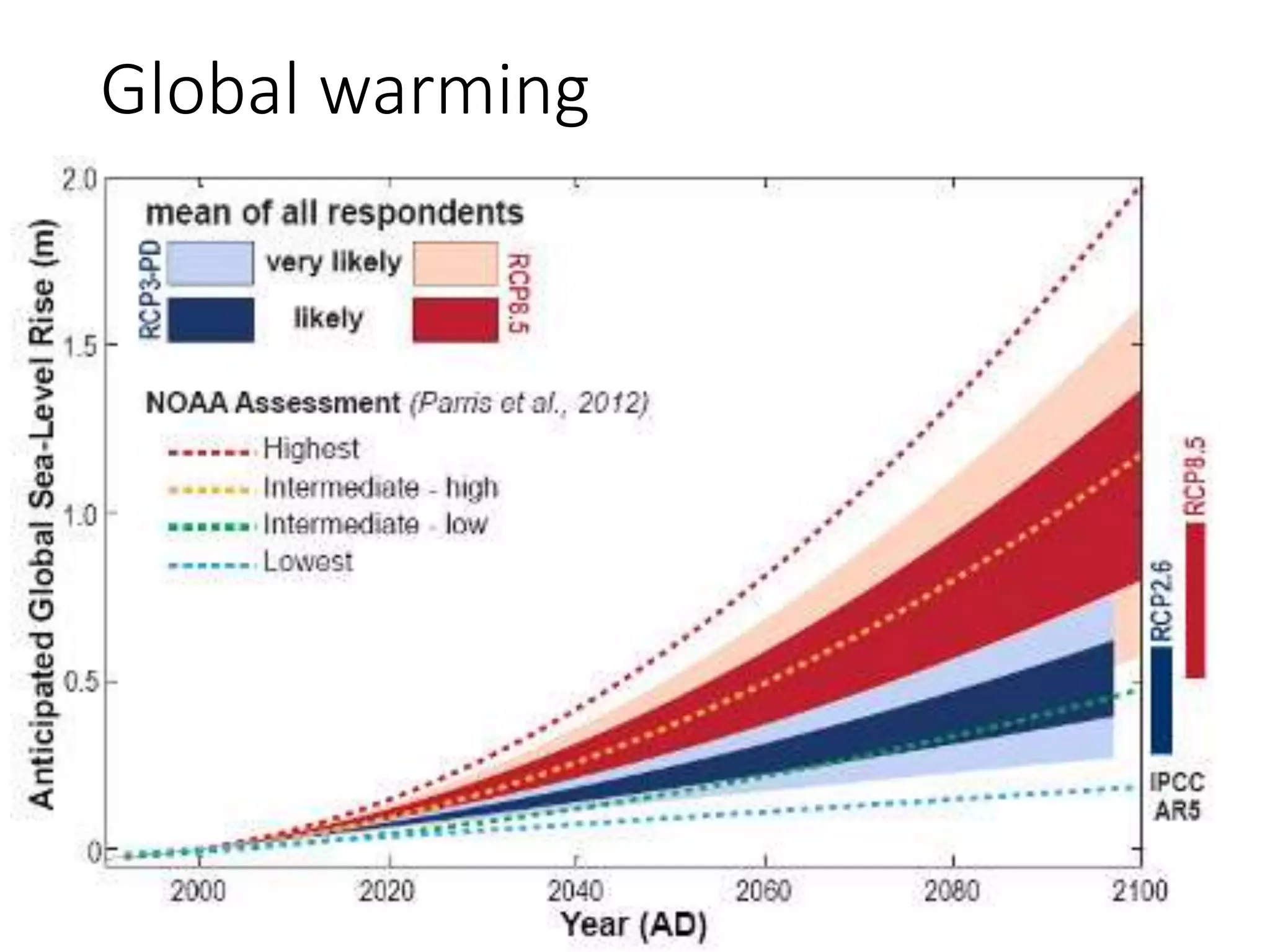
Global warming
Global warming
Global warming
Global warming
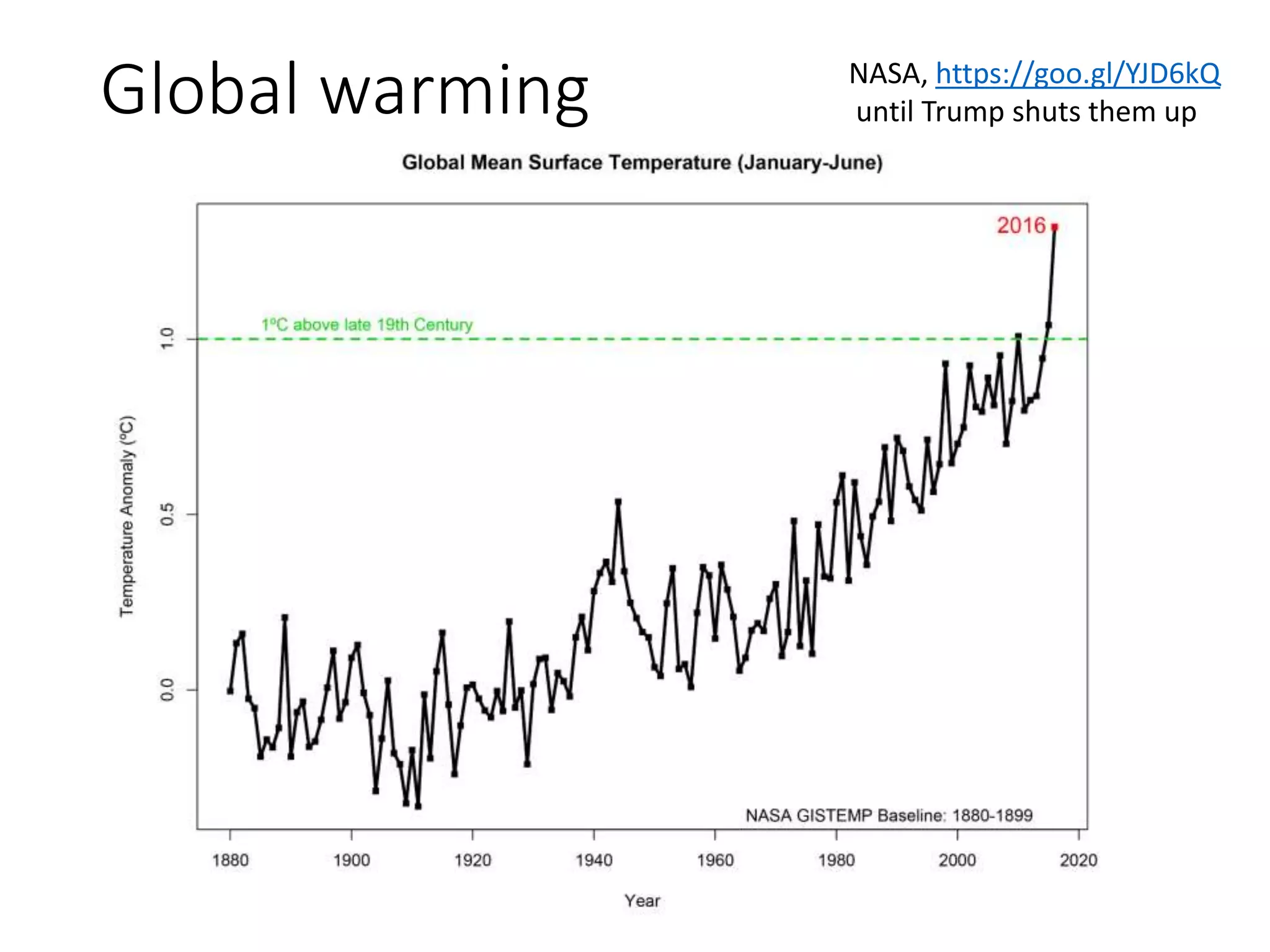
Global warming NASA, https://goo.gl/YJD6kQ
until Trump shuts them up
Sources of b.s.
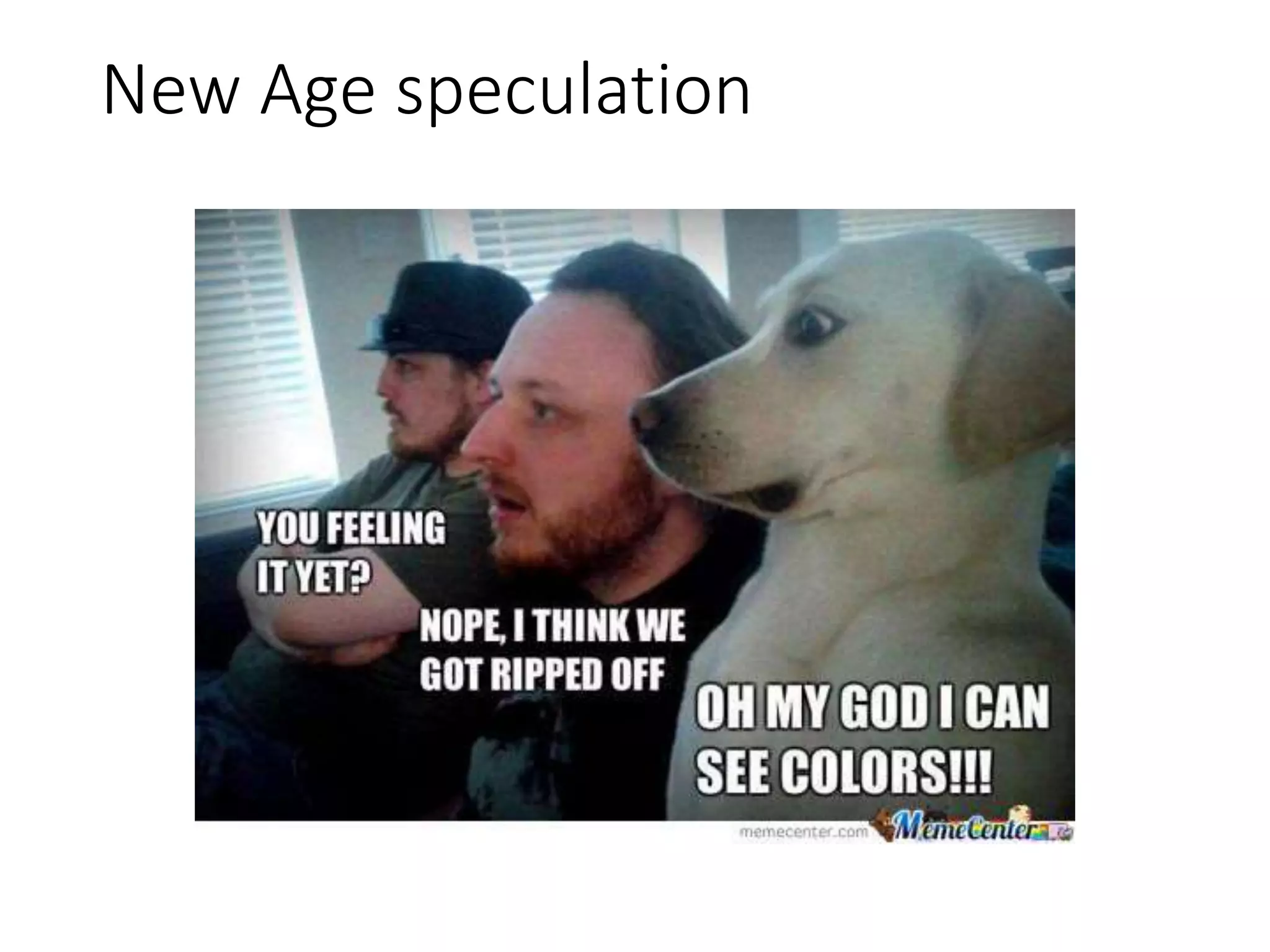
New Age speculation
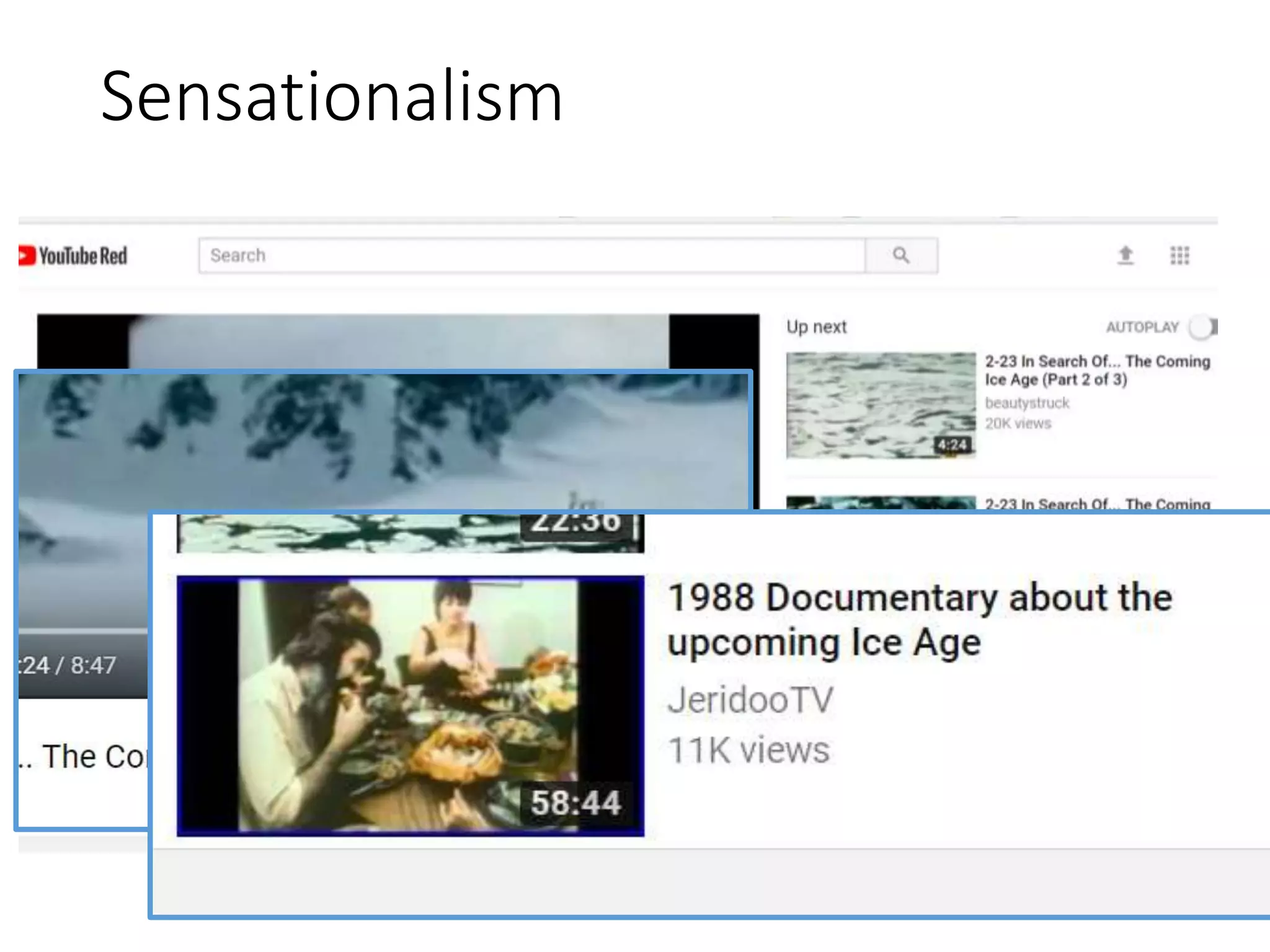
Sensationalism
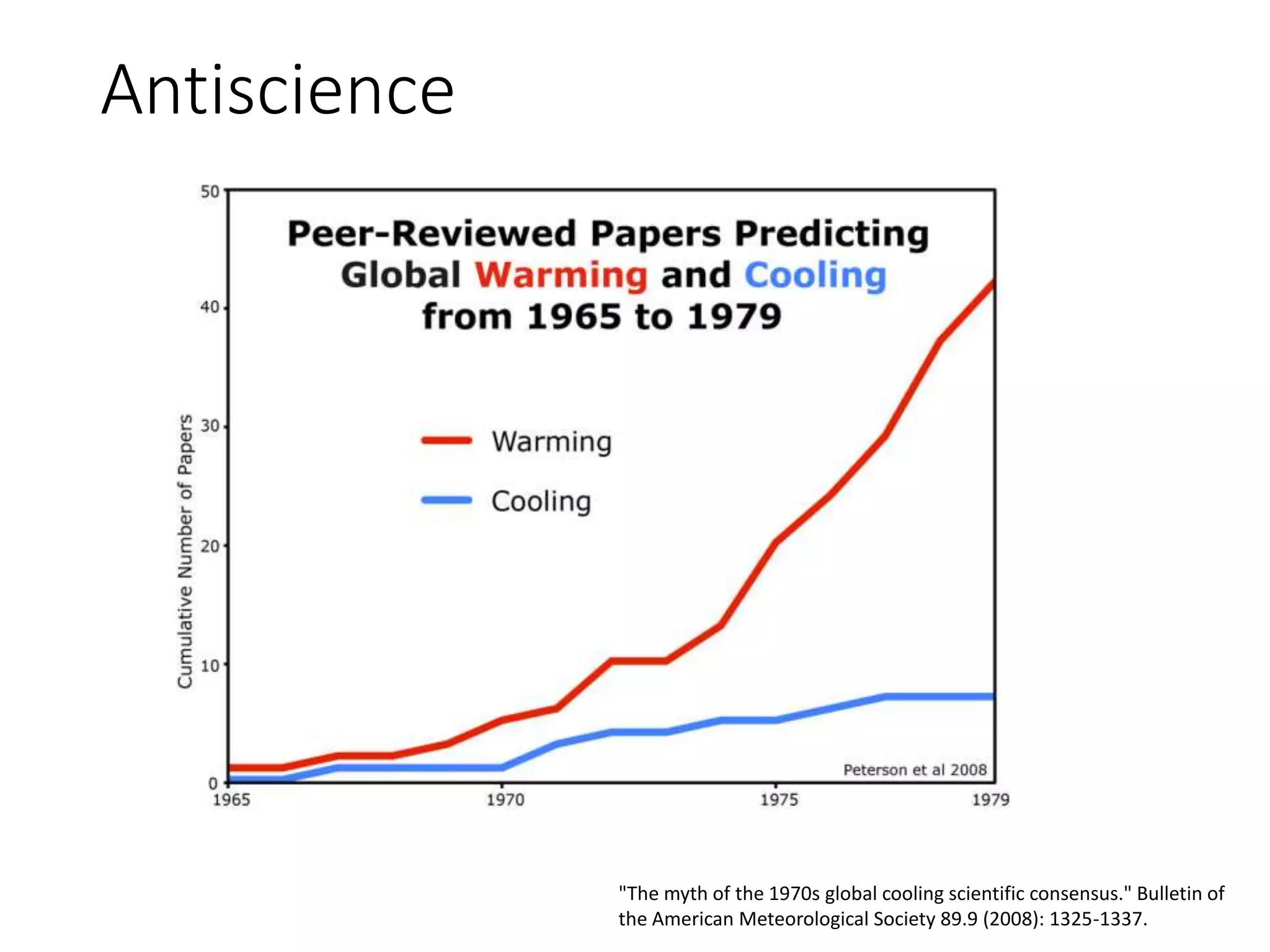
Antiscience
"The myth of the 1970s global cooling scientific consensus." Bulletin of
the American Meteorological Society 89.9 (2008): 1325-1337.
Antiscience hysteria
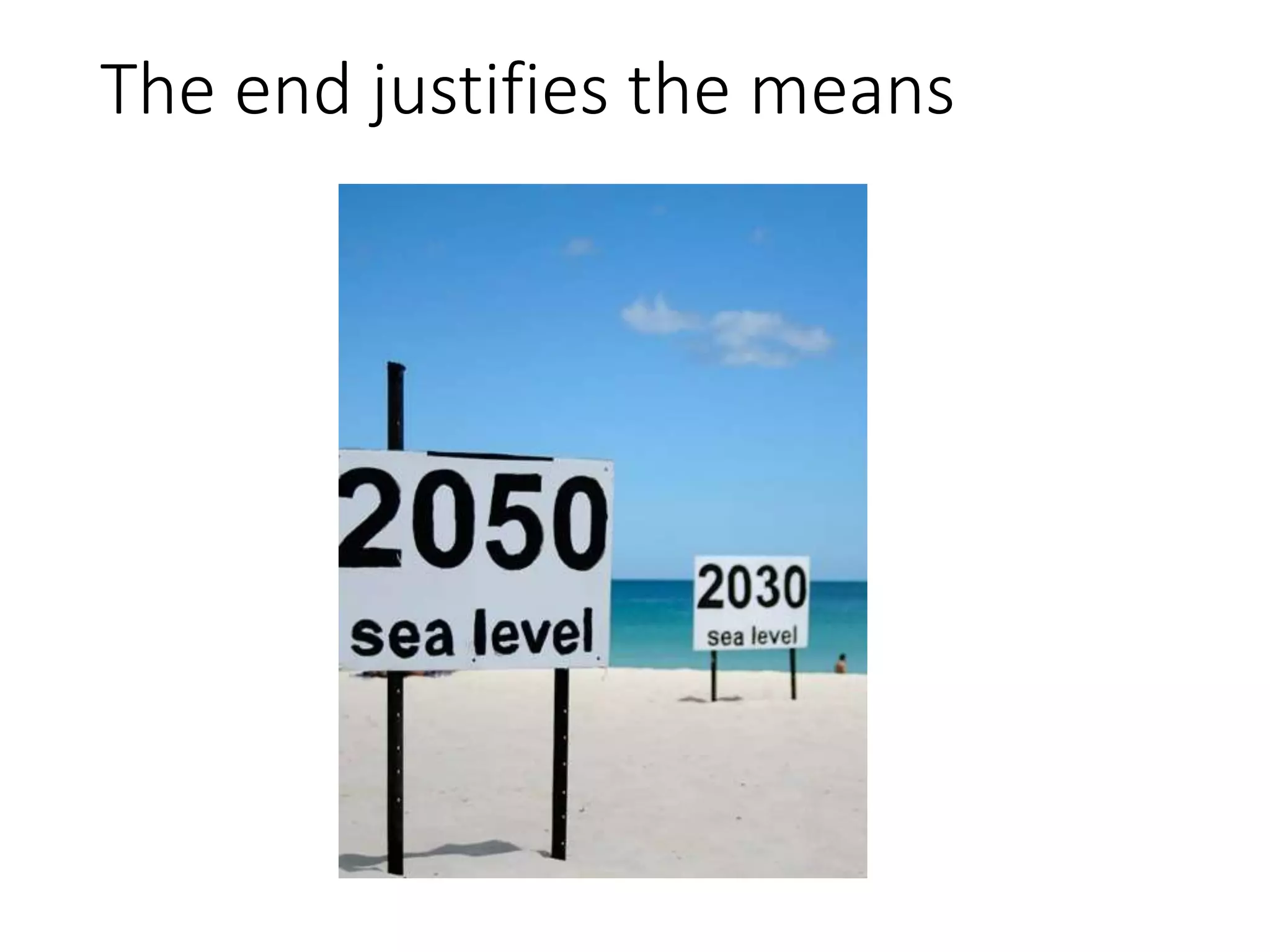
The end justifies the means
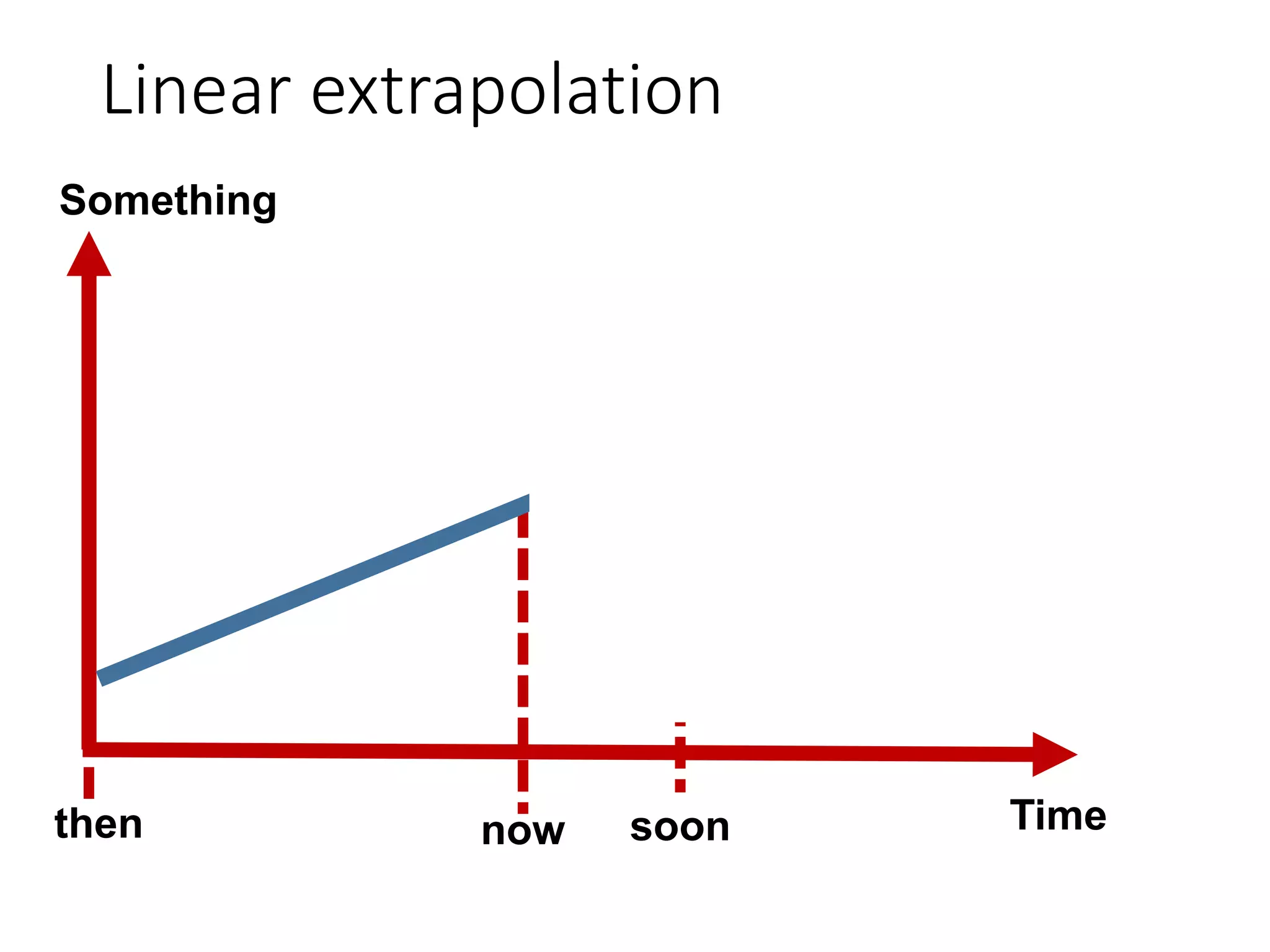
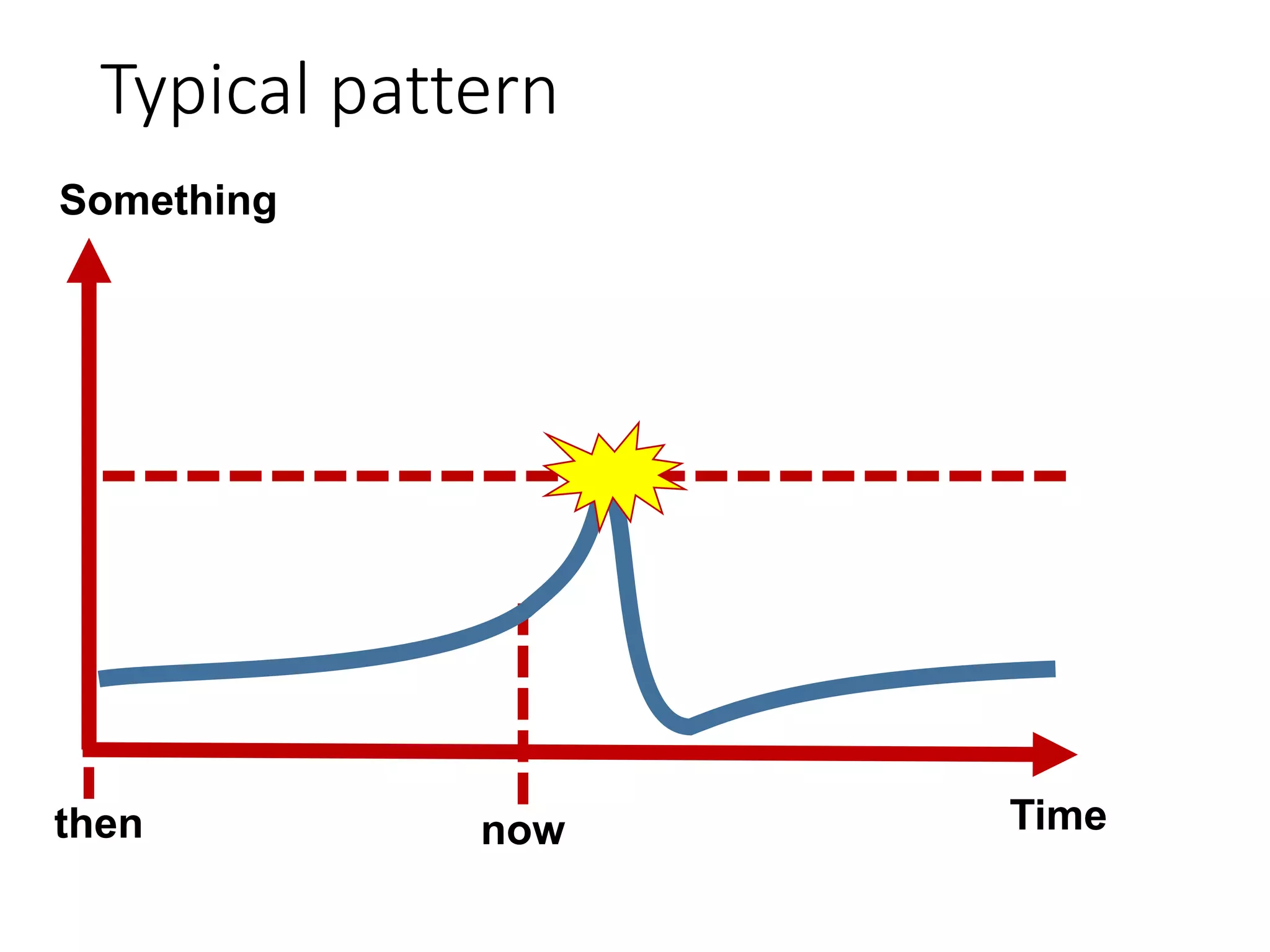
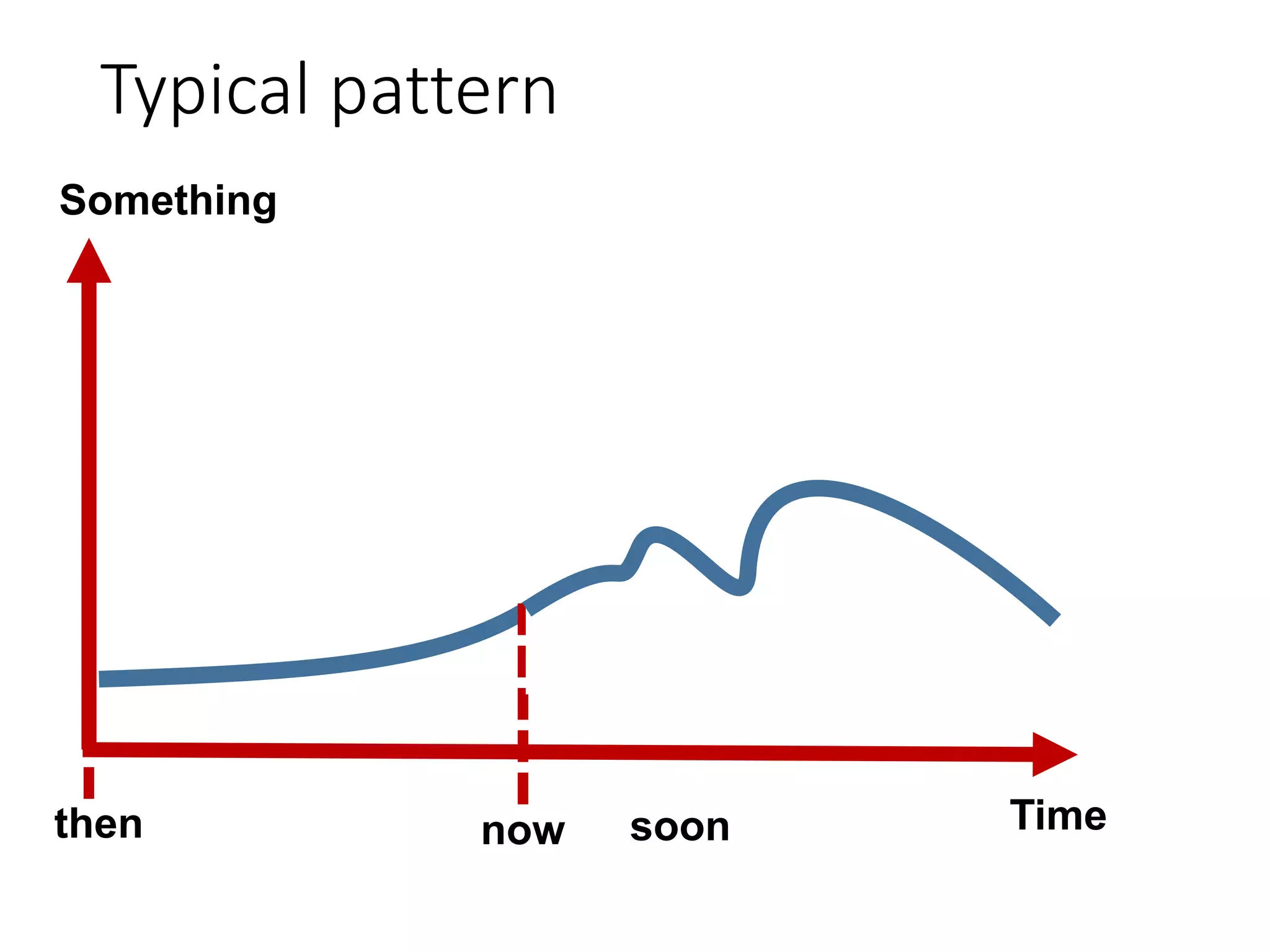
Extrapolation
Linear extrapolation
Time
Something
now soonthen
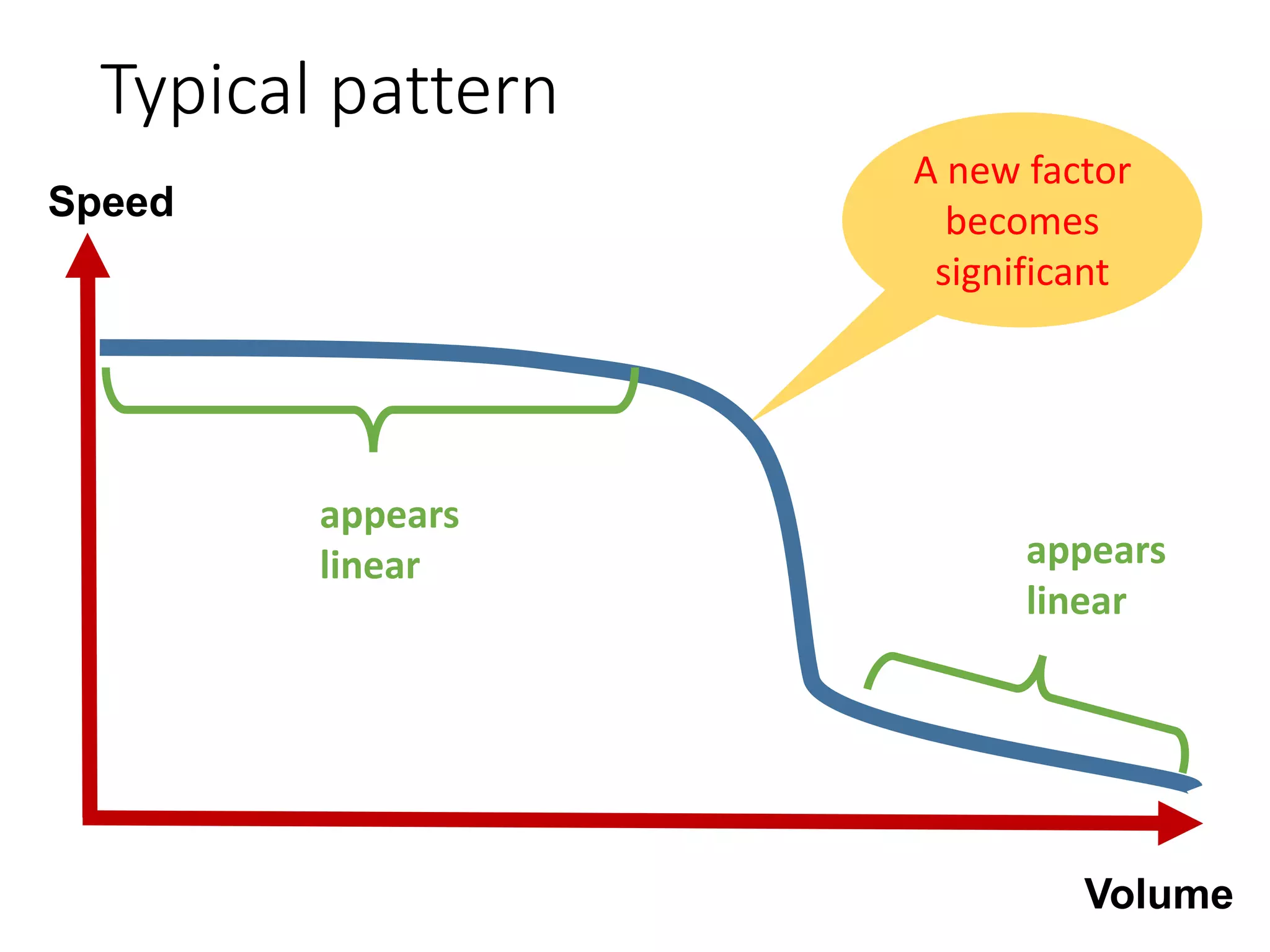
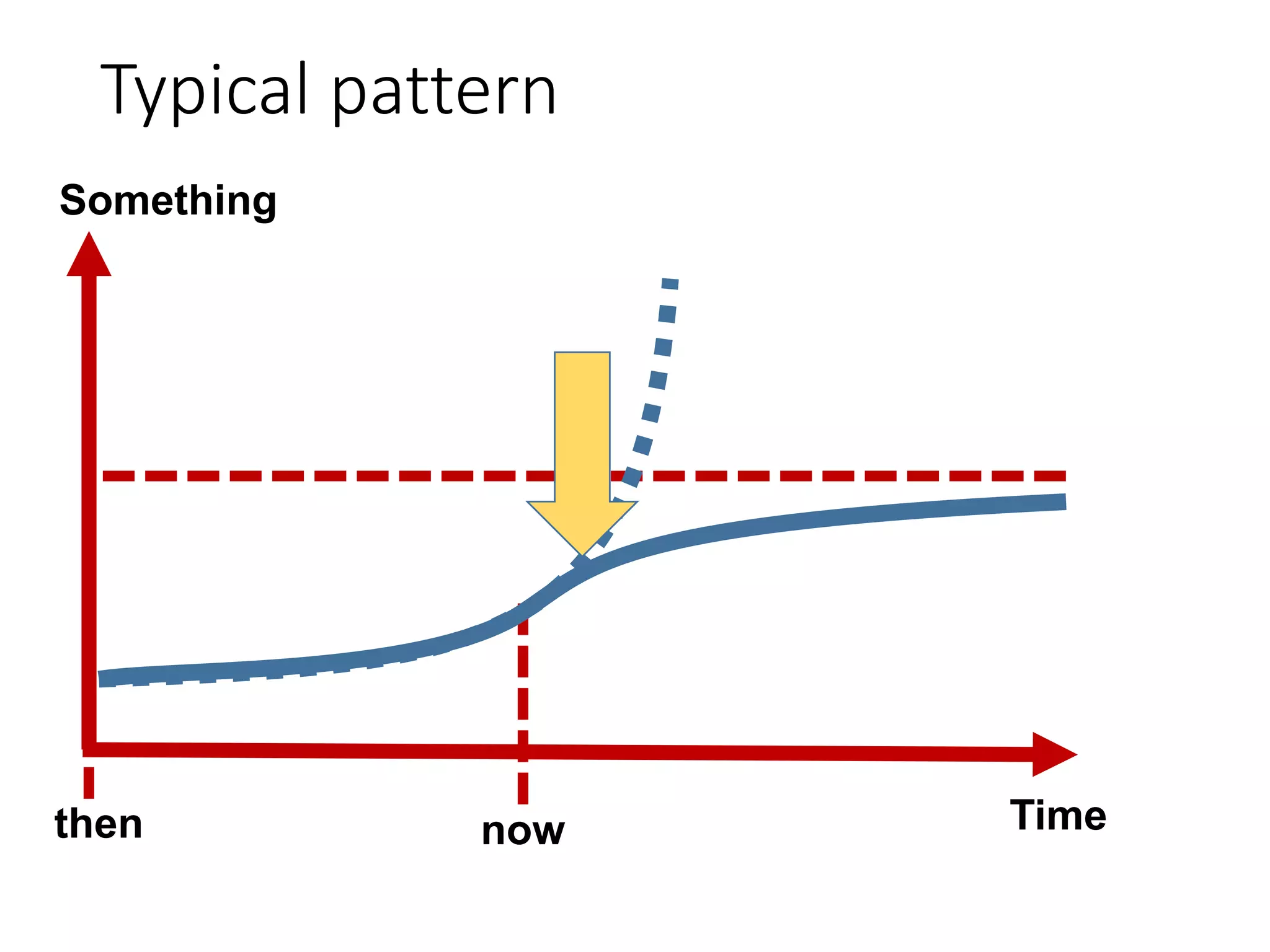
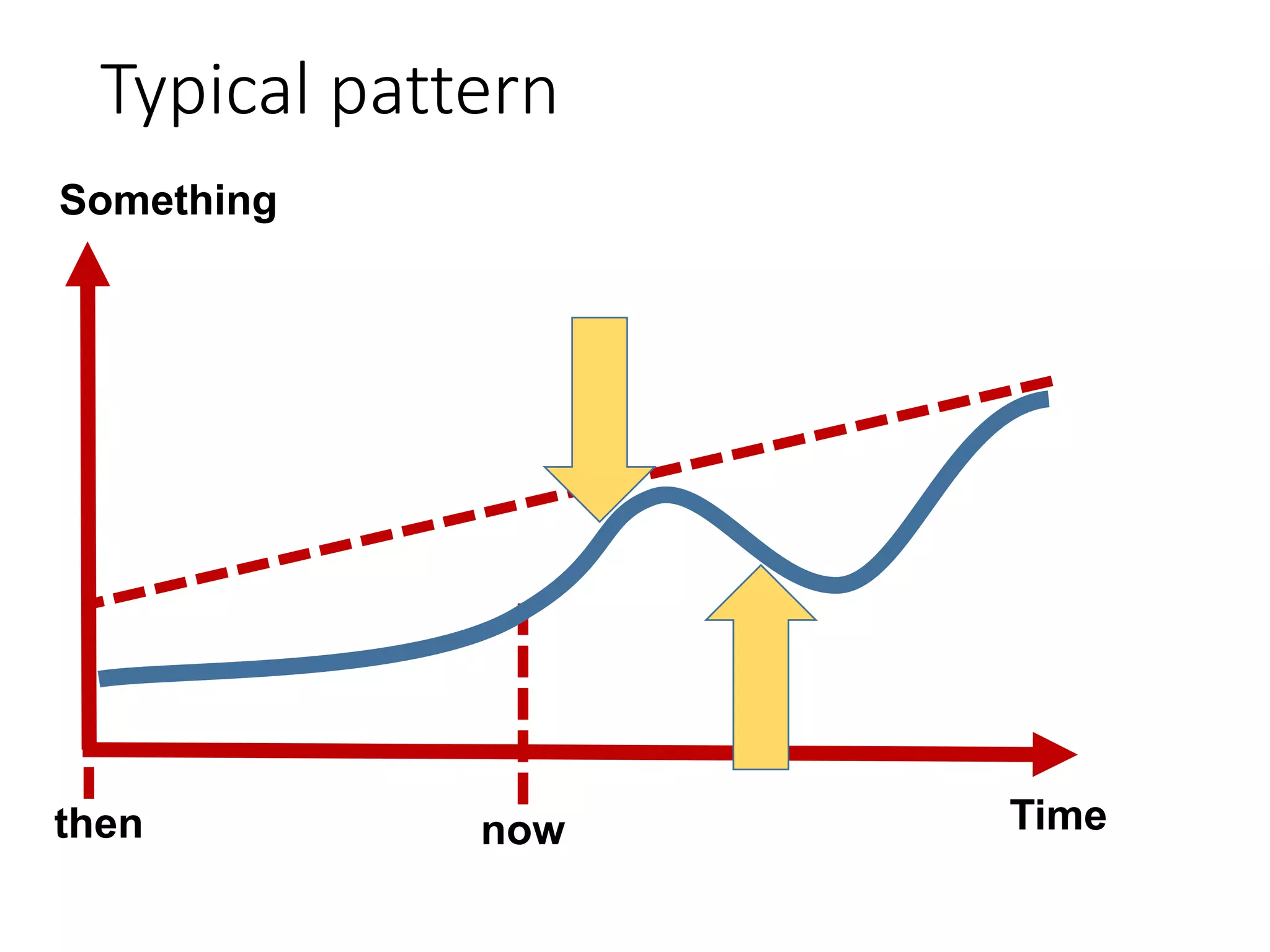
Typical pattern
Volume
A new factor
becomes
significant
Speed
appears
linear appears
linear
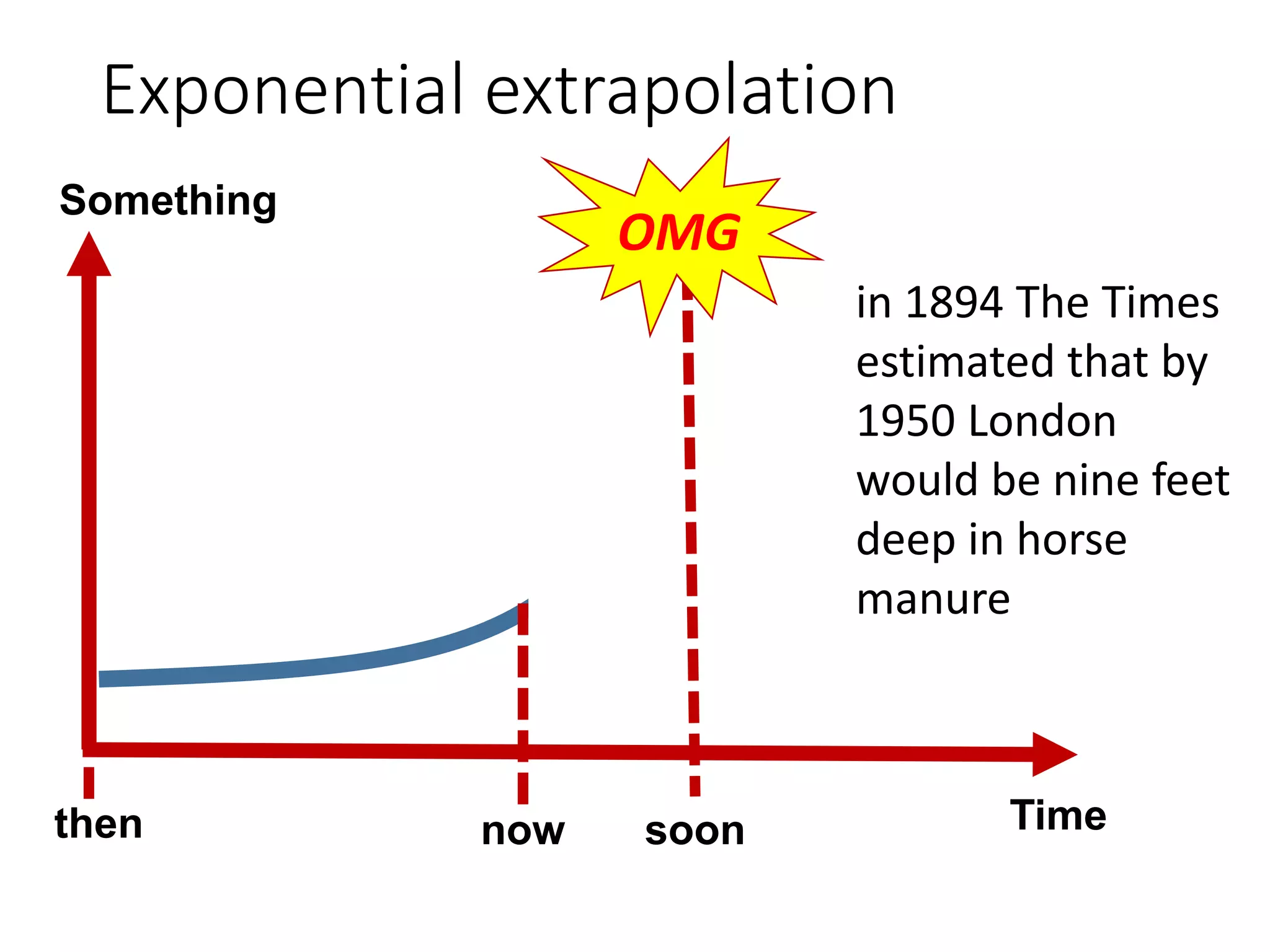
Exponential extrapolation
Time
Something
now soon
OMG
then
in 1894 The Times
estimated that by
1950 London
would be nine feet
deep in horse
manure
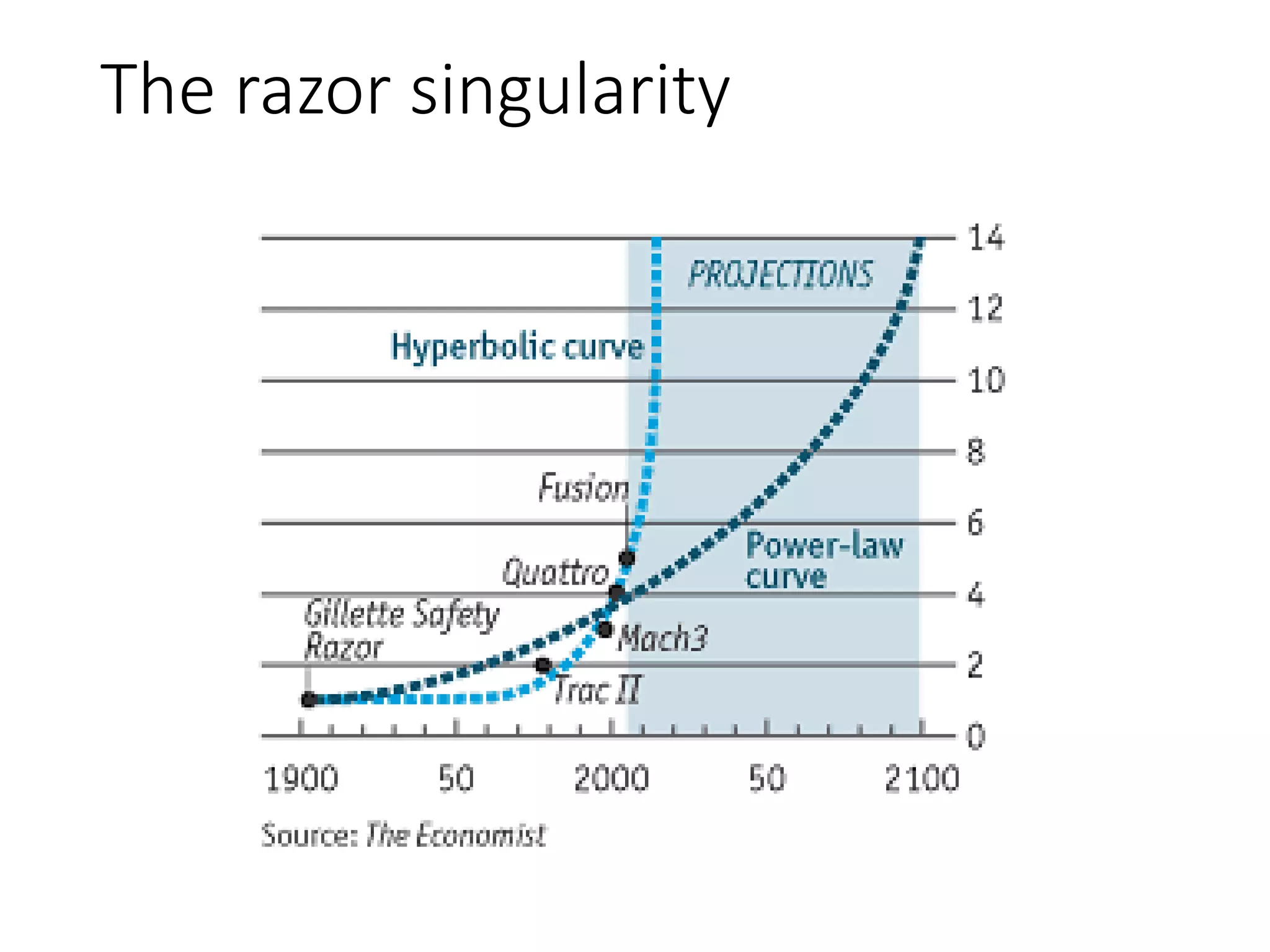
The razor singularity
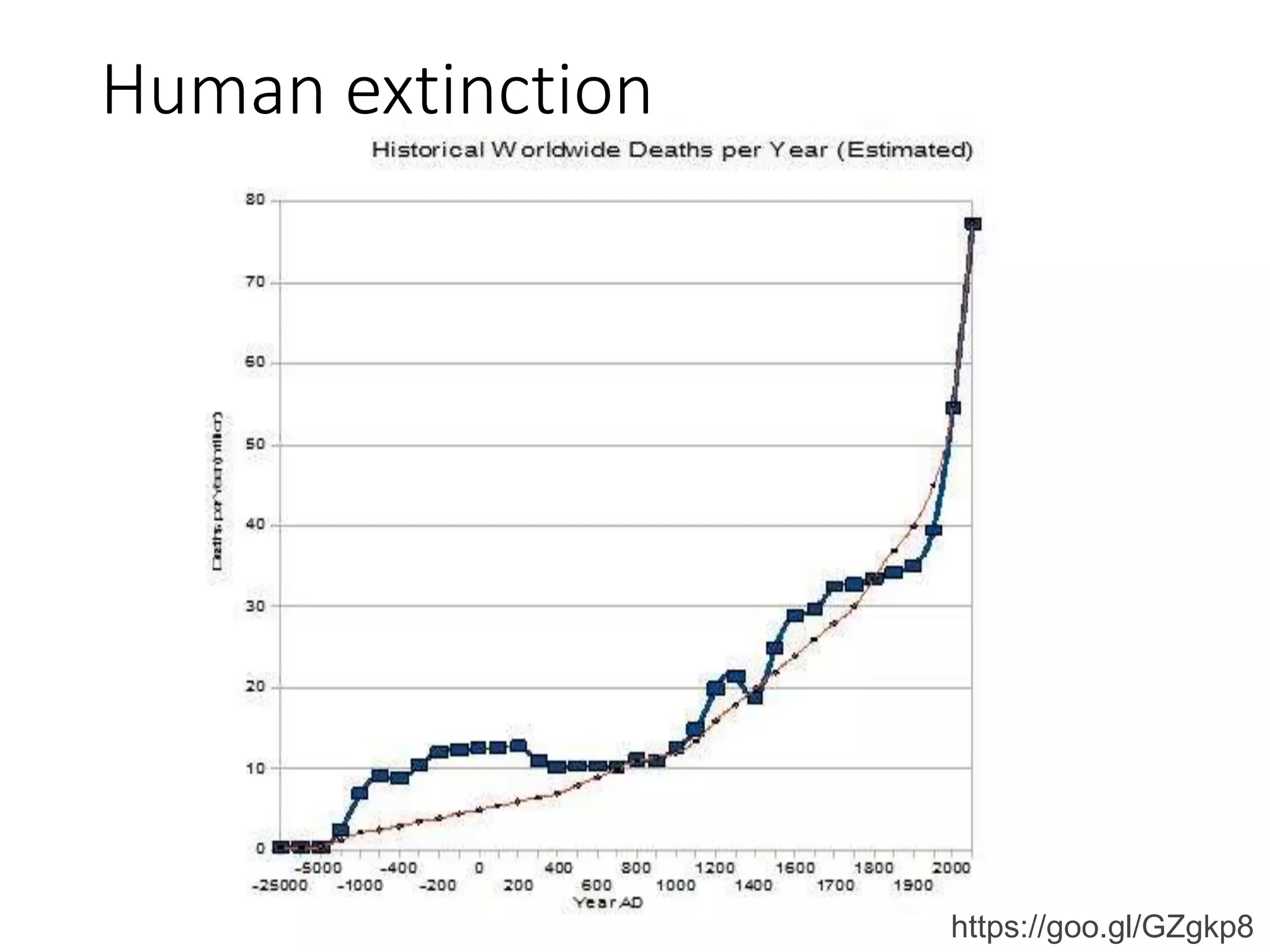
Human extinction
https://goo.gl/GZgkp8
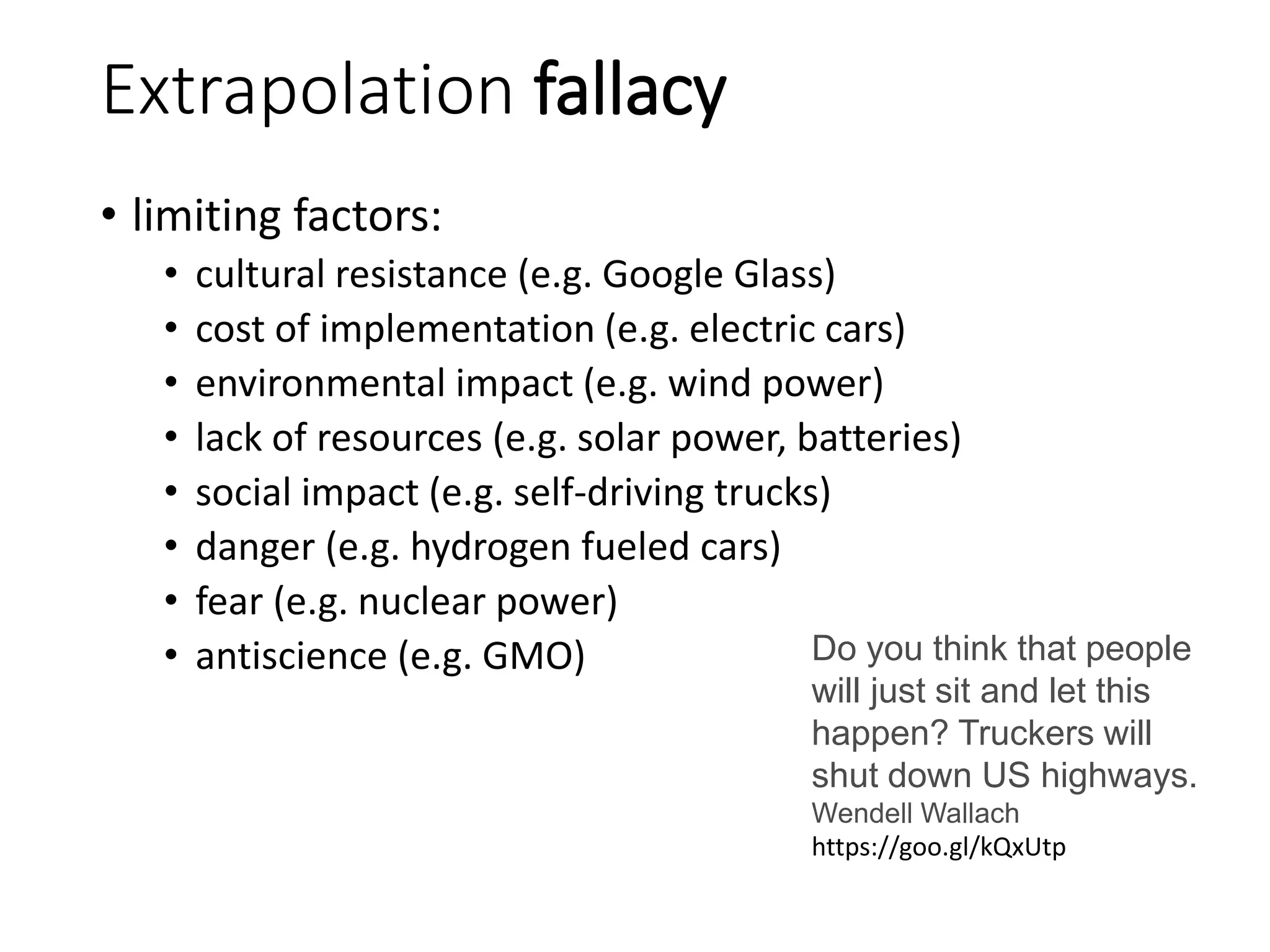
Extrapolation fallacy
• limiting factors:
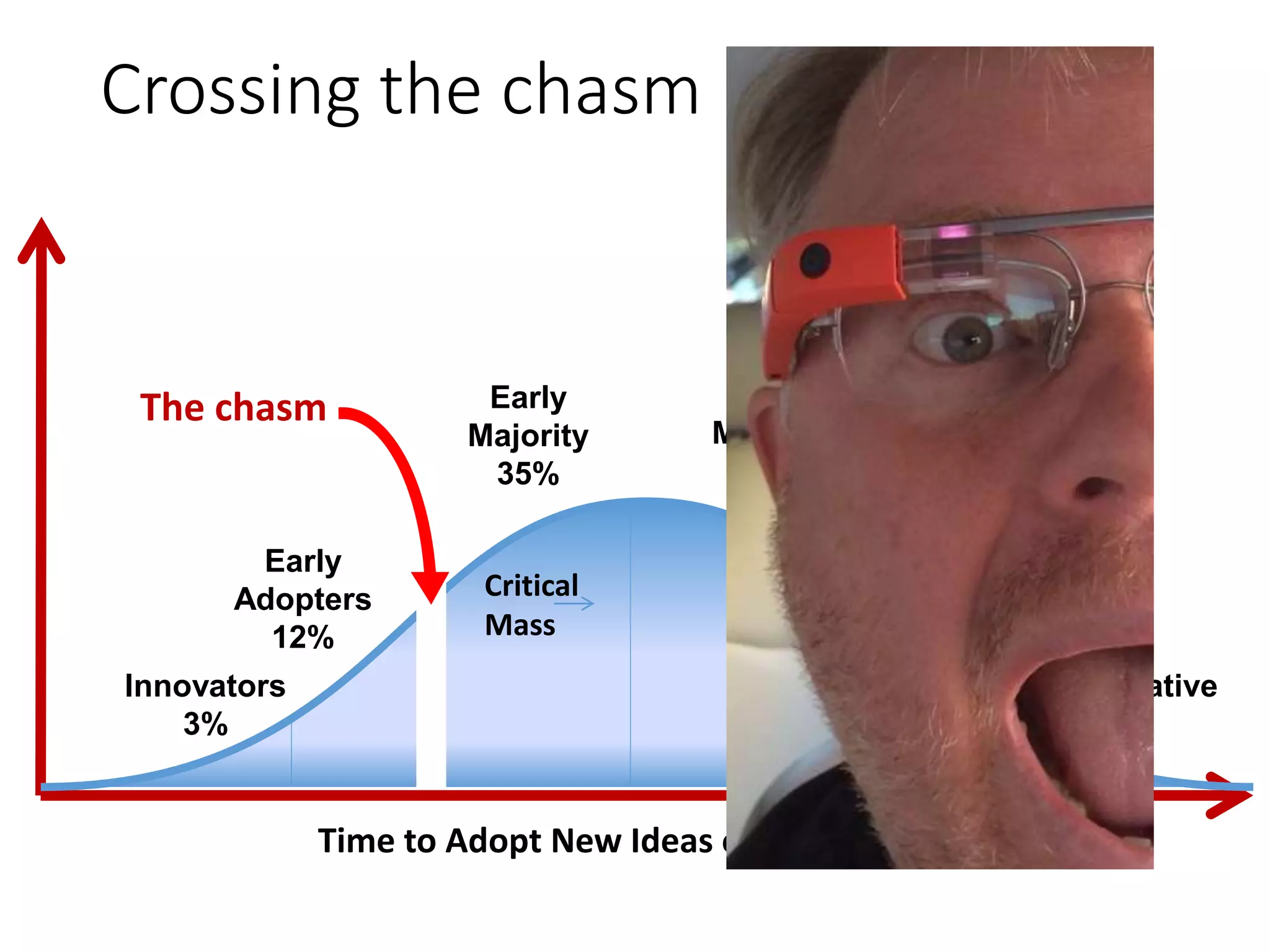
• cultural resistance (e.g. Google Glass)
• cost of implementation (e.g. electric cars)
• environmental impact (e.g. wind power)
• lack of resources (e.g. solar power, batteries)
• social impact (e.g. self-driving trucks)
• danger (e.g. hydrogen fueled cars)
• fear (e.g. nuclear power)
• antiscience (e.g. GMO) Do you think that people
will just sit and let this
happen? Truckers will
shut down US highways.
Wendell Wallach
https://goo.gl/kQxUtp
Typical pattern
Time
Something
nowthen
Typical pattern
Time
Something
nowthen
Typical pattern
Time
Something
nowthen
Typical pattern
Time
Something
now soonthen
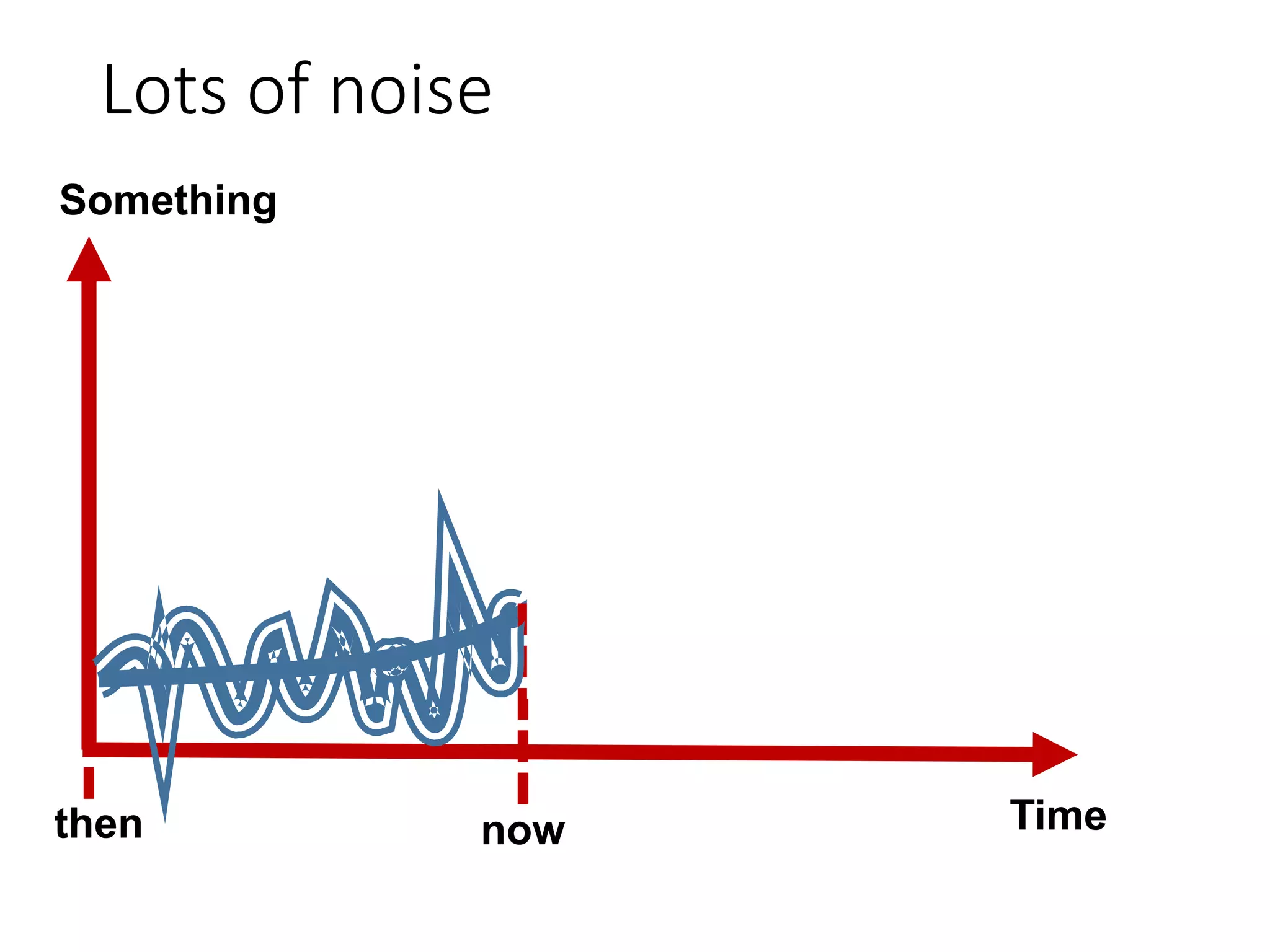
Lots of noise
Time
Something
nowthen
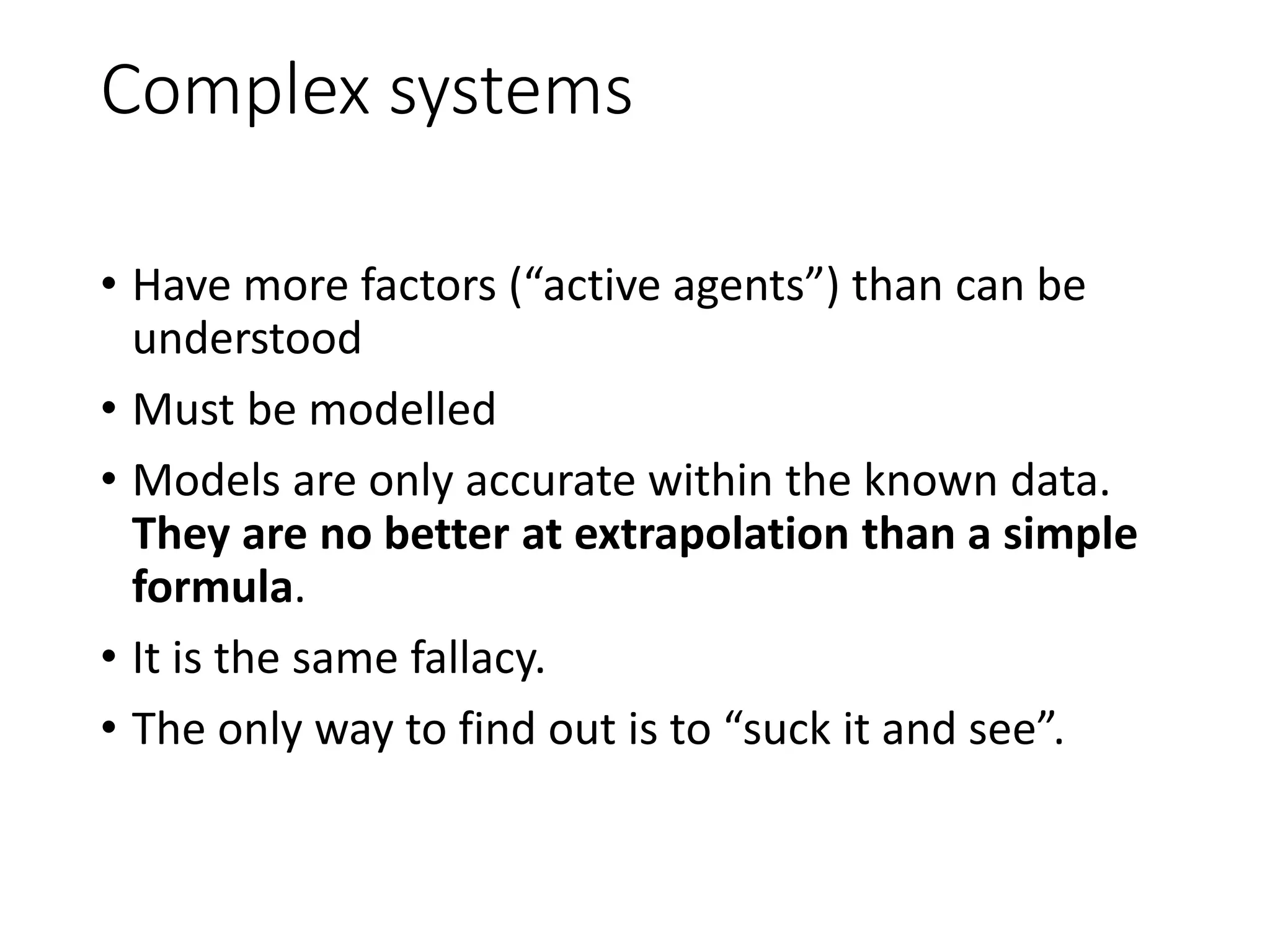
Complex systems
• Have more factors (“active agents”) than can be
understood
• Must be modelled
• Models are only accurate within the known data.
They are no better at extrapolation than a simple
formula.
• It is the same fallacy.
• The only way to find out is to “suck it and see”.
Today’s b.s.
Automation and AI
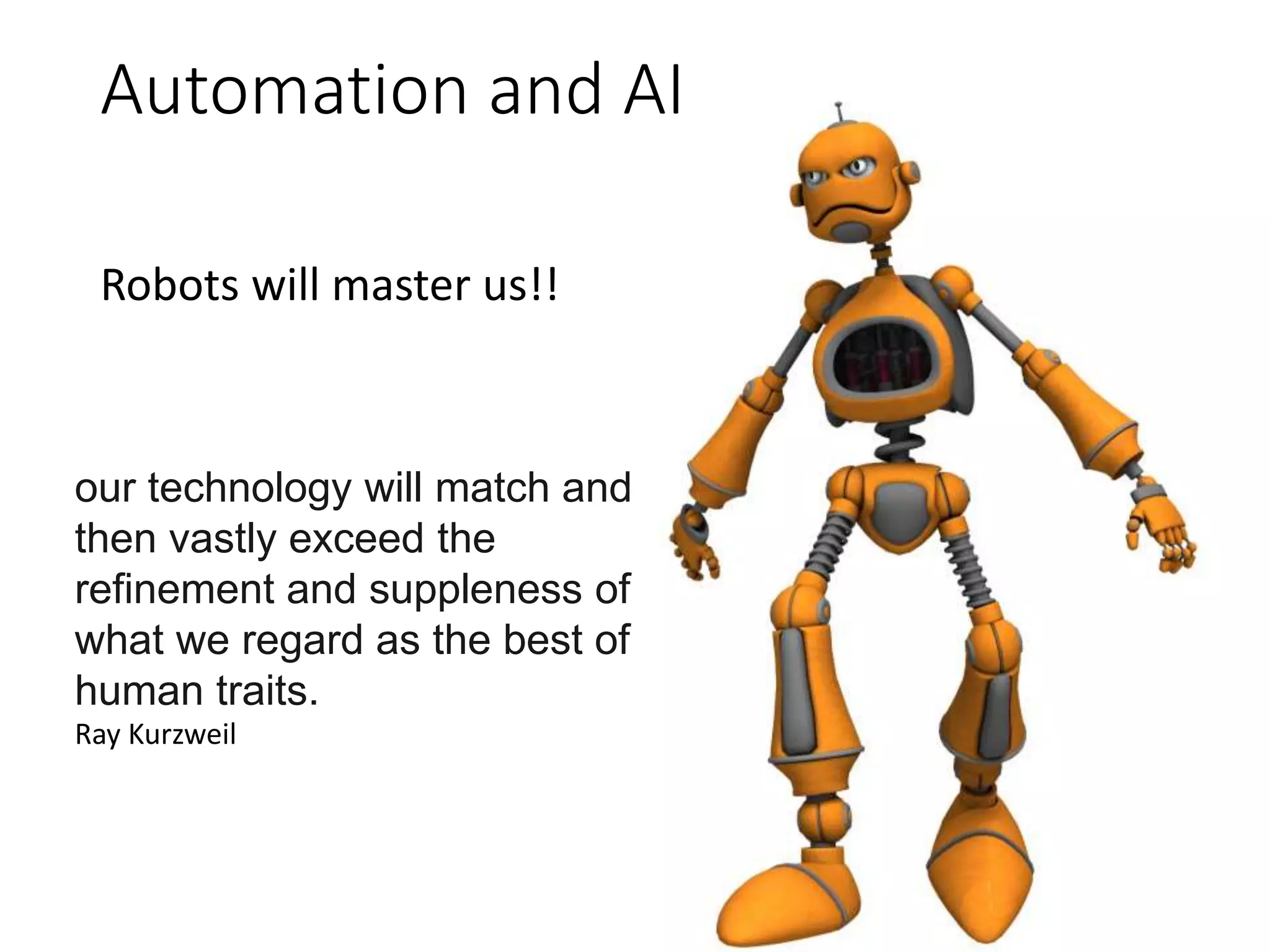
Robots will master us!!
our technology will match and
then vastly exceed the
refinement and suppleness of
what we regard as the best of
human traits.
Ray Kurzweil
Automation and AI
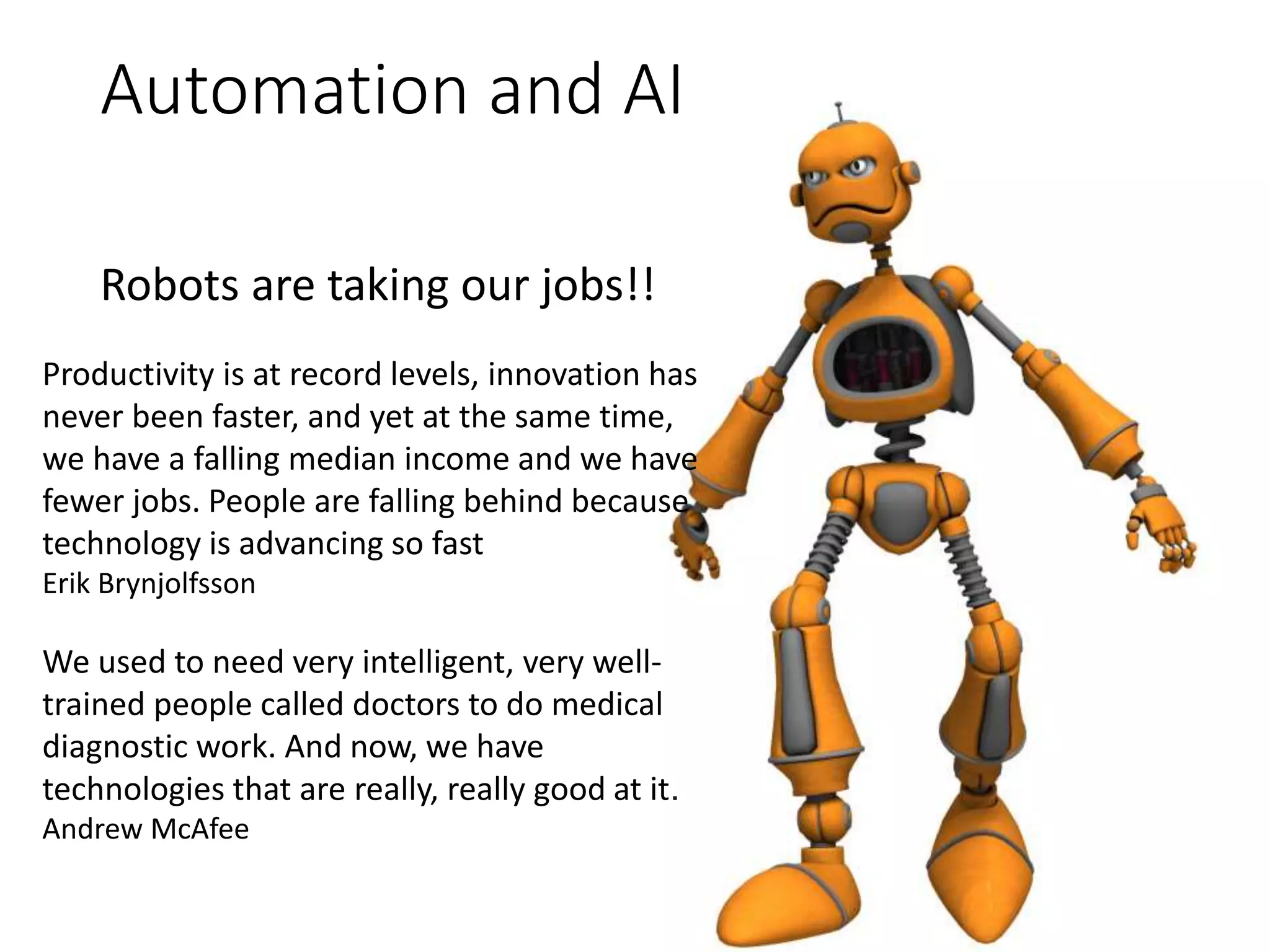
Robots are taking our jobs!!
Productivity is at record levels, innovation has
never been faster, and yet at the same time,
we have a falling median income and we have
fewer jobs. People are falling behind because
technology is advancing so fast
Erik Brynjolfsson
We used to need very intelligent, very well-
trained people called doctors to do medical
diagnostic work. And now, we have
technologies that are really, really good at it.
Andrew McAfee
Automation and AI
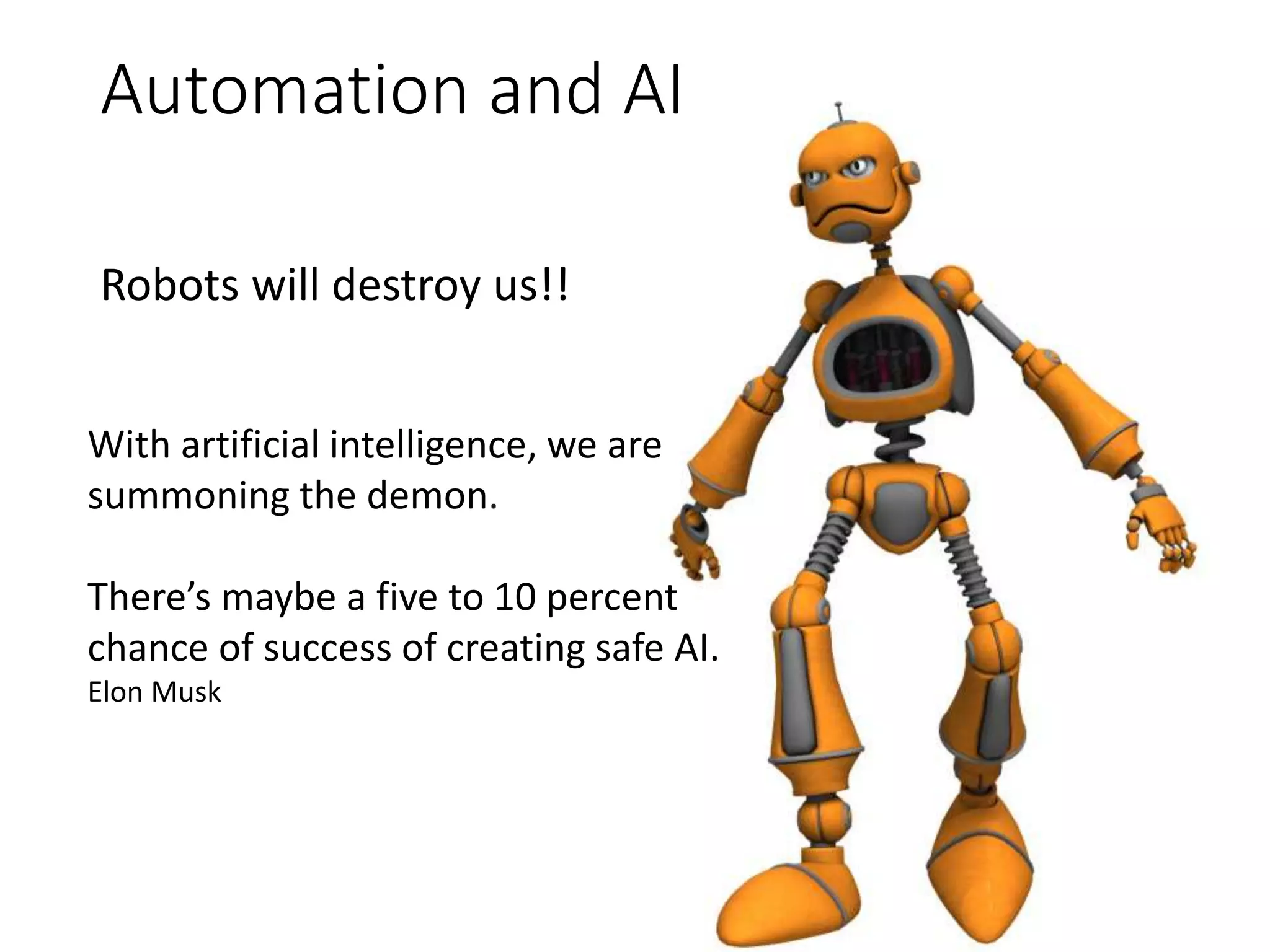
Robots will destroy us!!
With artificial intelligence, we are
summoning the demon.
There’s maybe a five to 10 percent
chance of success of creating safe AI.
Elon Musk
Automation and AI
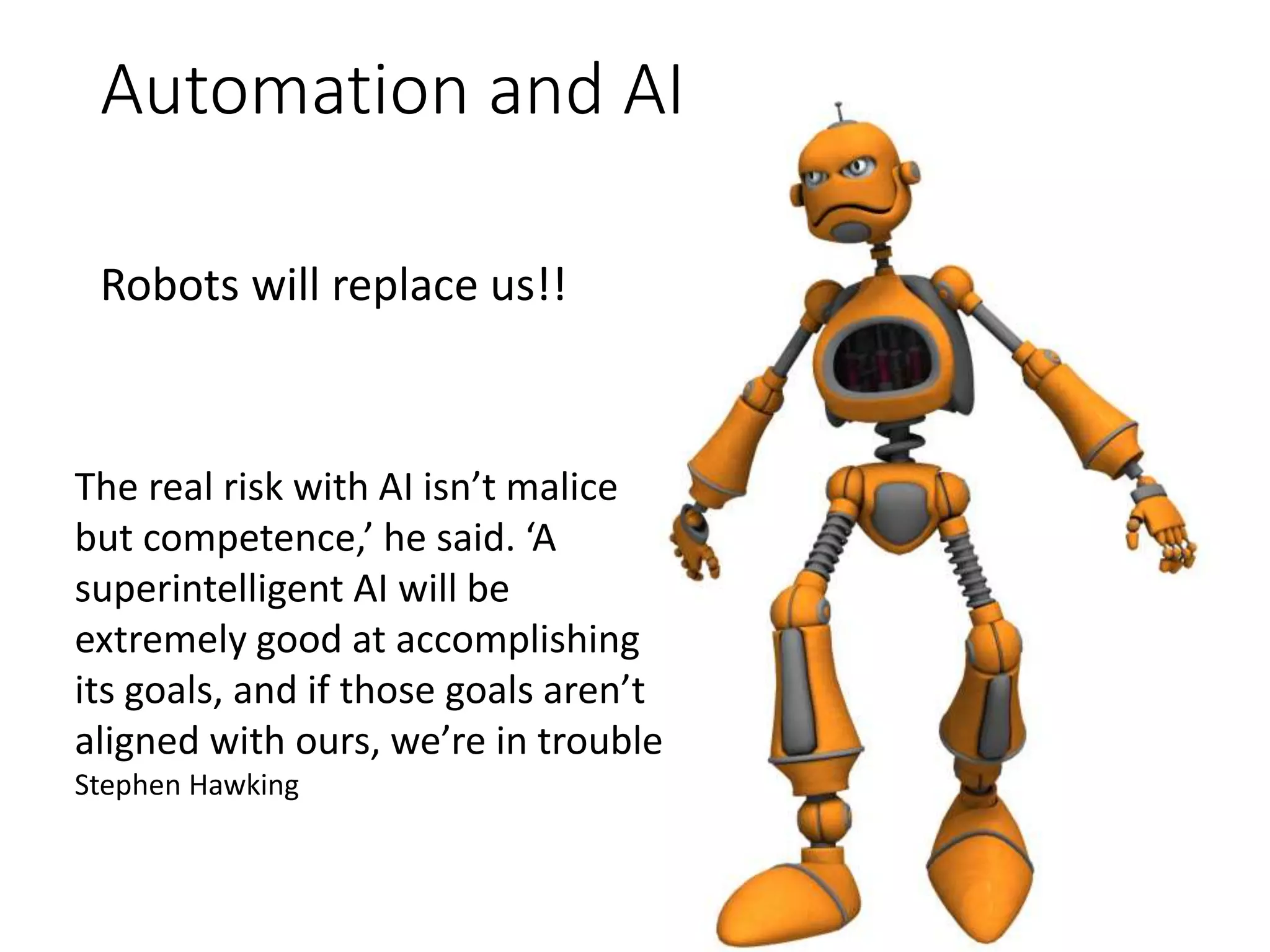
Robots will replace us!!
The real risk with AI isn’t malice
but competence,’ he said. ‘A
superintelligent AI will be
extremely good at accomplishing
its goals, and if those goals aren’t
aligned with ours, we’re in trouble
Stephen Hawking
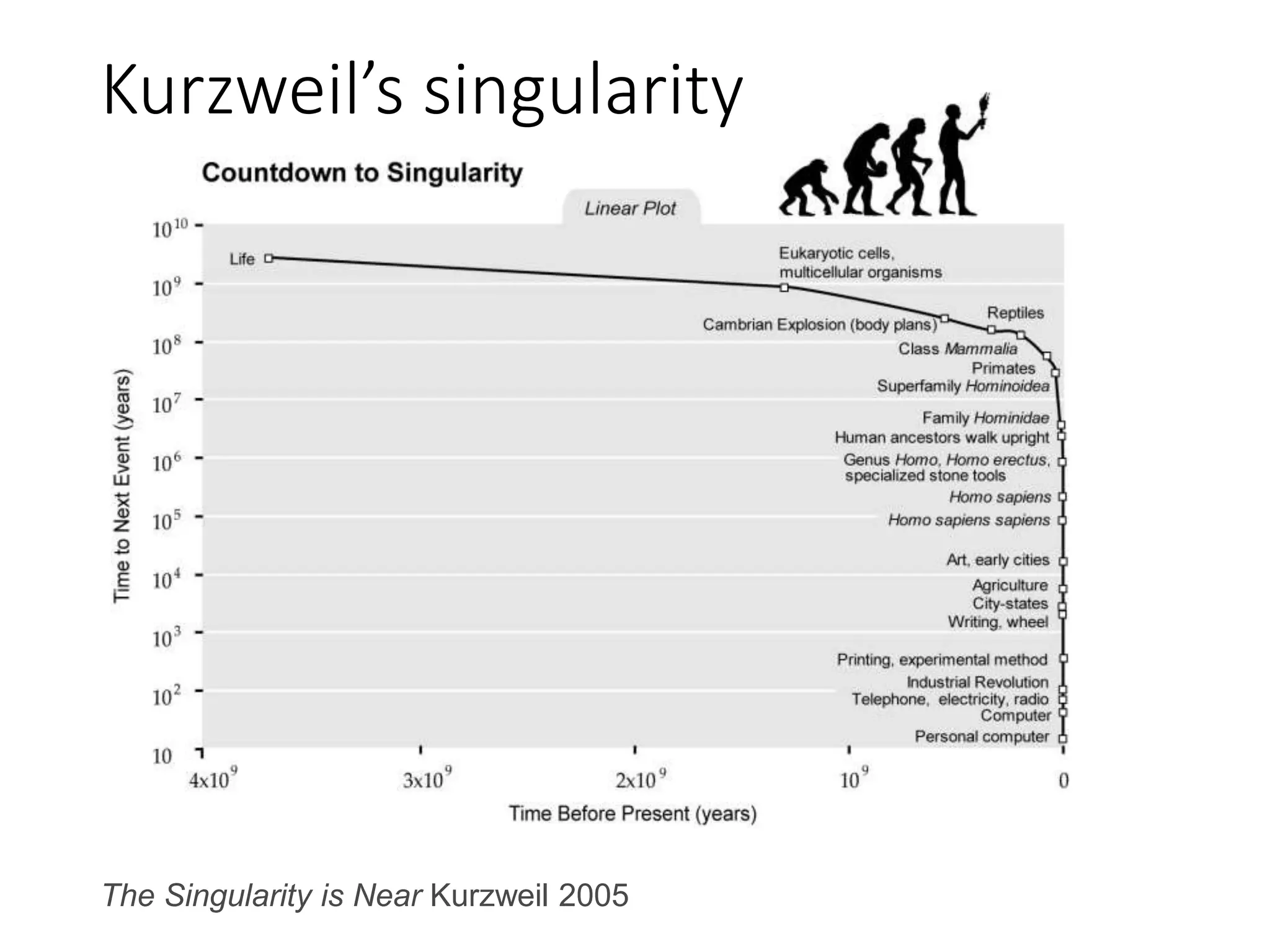
Kurzweil’s singularity
The Singularity is Near Kurzweil 2005
Kurzweil’s singularity
I have set the date 2045 for
the ‘Singularity’ which is
when we will multiply our
effective intelligence a billion
fold by merging with the
intelligence we have created.
Kurzweil https://goo.gl/XcNwyC
How accurate is Kurzweil anyway?
Ray Kurzweil missed the Cloud, Facebook, Twitter,
SaaS, phone apps, and Angry Birds.
He rates himself 85-95% accurate.
LessWrong rates him 54% https://goo.gl/YQEJCA
I rate him 50/50. https://goo.gl/rNFaYT
Even a blind squirrel finds a few nuts.
(BTW)
Supercomputers will achieve one human
brain capacity by 2010, and personal
computers will do so by about 2020.
Ray Kurzweil https://goo.gl/CNGjHJ
The mechanical model fallacy
The most complex known object
in the universe: a custom-made
analogue processor with 20 year
setup, multiple parallel
processing mechanisms, both
electrical and chemical,
specialised "hardware" areas, and
active biological self-modification
• Physical
• More nodes than stars in the
galaxy
• 100 trillion nerve connections
• Electrical
• Chemical
• Hormonal
• DNA and growth
Researchers at the
University of North Carolina
have shown that dendrites
do more than relay
information from one
neuron to the next. They
actively process
information, multiplying the
brain's computing power.
"Suddenly, it's as if the
processing power of the
brain is much greater than
we had originally thought”
https://goo.gl/y4z8Kk
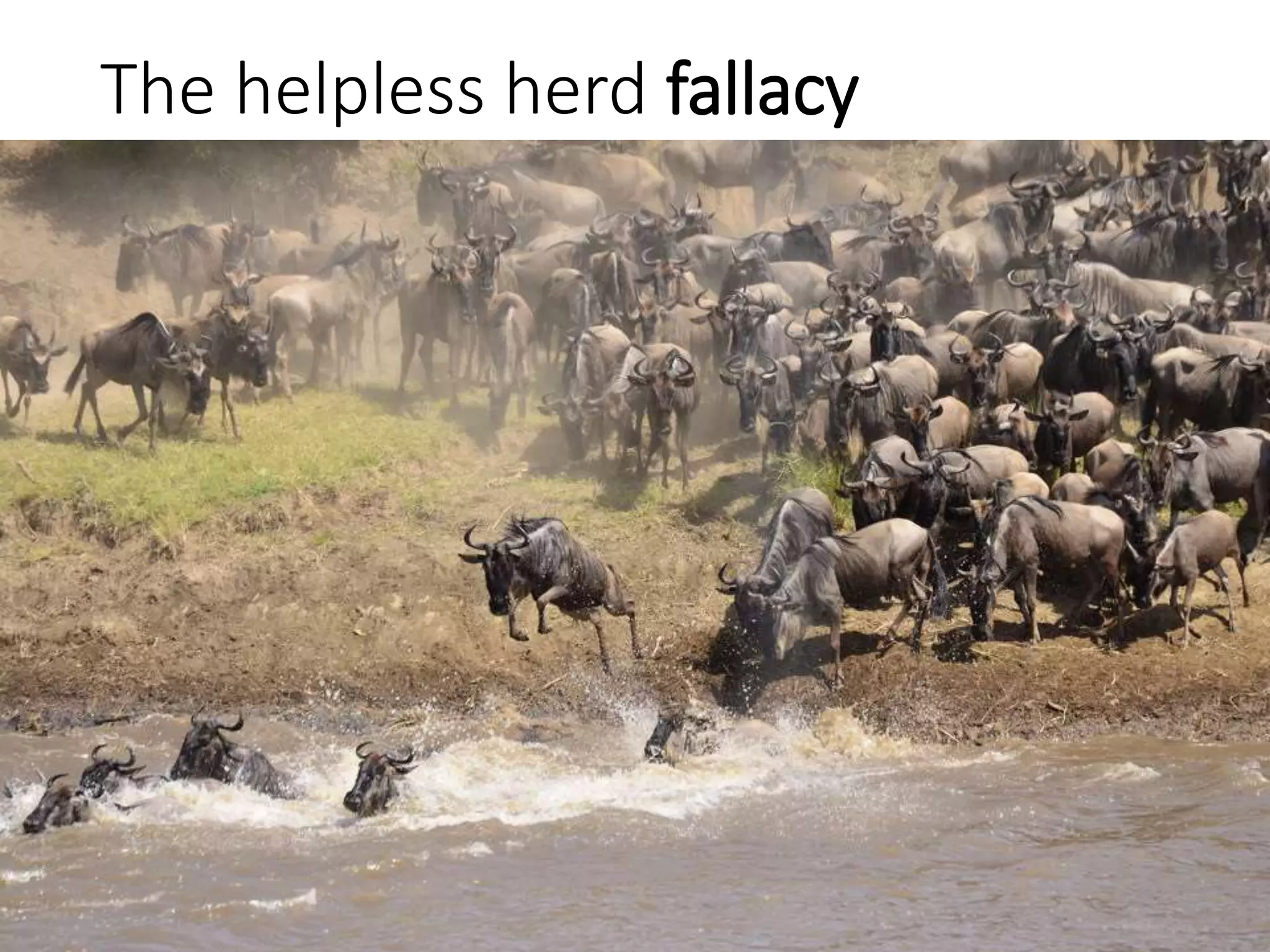
The helpless herd fallacy
• Acid rain levels have dropped 65% since 1976
• The Green Revolution continues to feed the world.
• Fracking dropped the price of oil and broke the
OPEC cartel
• Electric cars are a thing.
• Our food is so clean and healthy we obsess about
almost undetectable fears.
• We sure fixed that ice age problem.
The static world fallacy
by 2030, many of the
world's largest economies
will have more jobs than
adult citizens to do those
jobs
Rainer Strack, BCG
https://goo.gl/oSbYq4
“My grandfather wouldn’t
recognize what I do as
work.”
Google chief economist Hal Varian
https://goo.gl/hghz8p
The social change fallacy
• We need to worry about sociological change, and
society can't change faster than society can change.
• There is no singularity here. Technology will fly off
into unrealised potential, while we eat up that
potential as fast as we can AND NO FASTER.
Crossing the chasm
Early
Adopters
12%
Innovators
3%
Early
Majority
35%
Late
Majority
35%
Conservative
15%
Time to Adopt New Ideas or Technology
Critical
Mass
The chasm
The reality
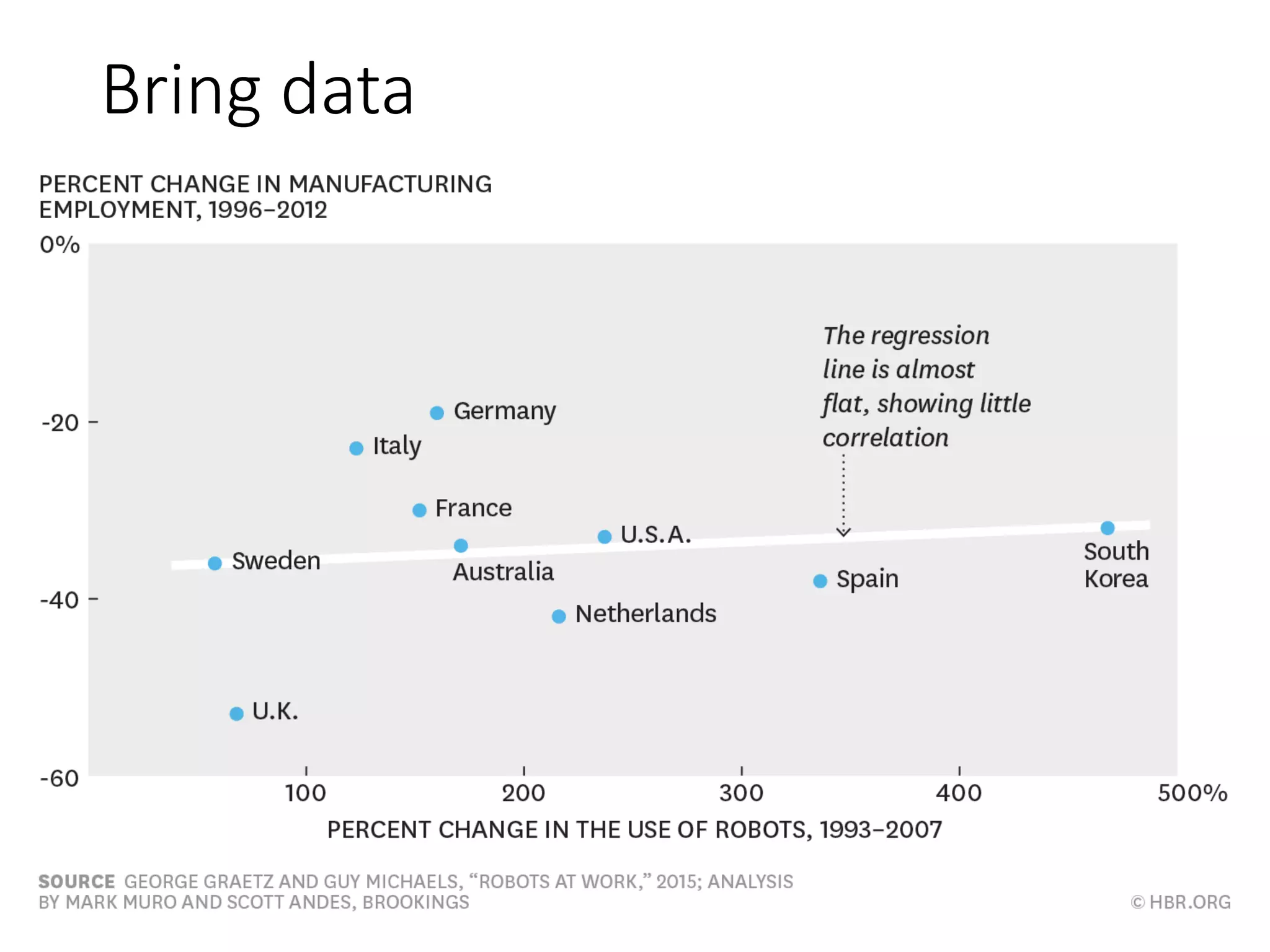
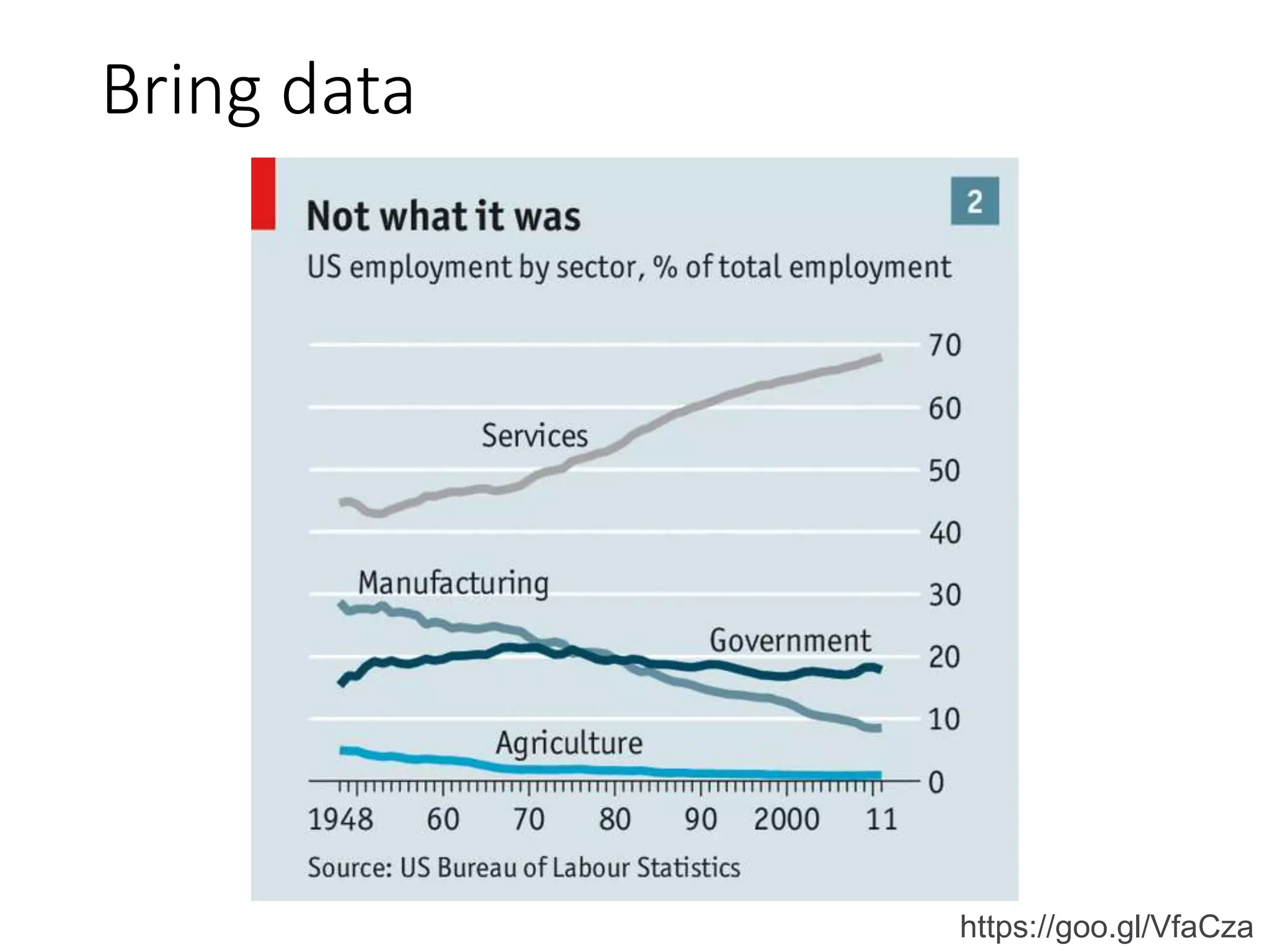
Bring data
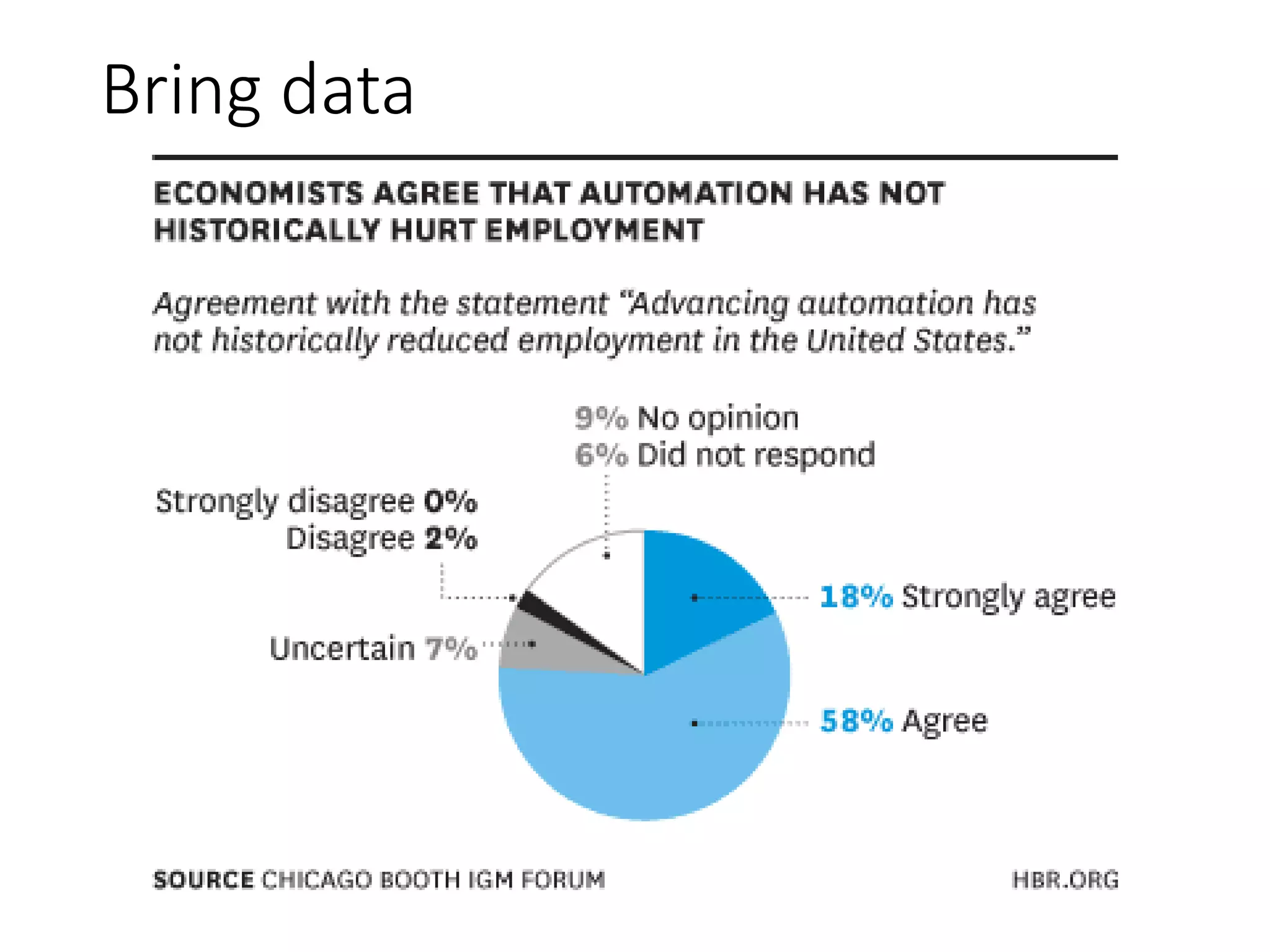
Bring data
Bring data
https://goo.gl/VfaCza
Bring data
In contrast to other studies, we take into account the
heterogeneity of workers’ tasks within occupations.
Overall, we find that, on average across the 21 OECD
countries, 9 % of jobs are automatable. The threat
from technological advances thus seems much less
pronounced.
OECD https://goo.gl/gZqagi
Robots are simpletons
Google’s self-driving cars can only
operate on roads that humans have
mapped by hand, manually marking
every piece of street-furniture.
The NSA can’t point to a single
terrorist plot that mass-surveillance
has disrupted.
Ad personalization sucks so hard you
can hear it from orbit.
Cory Doctorow
https://goo.gl/saLhYr
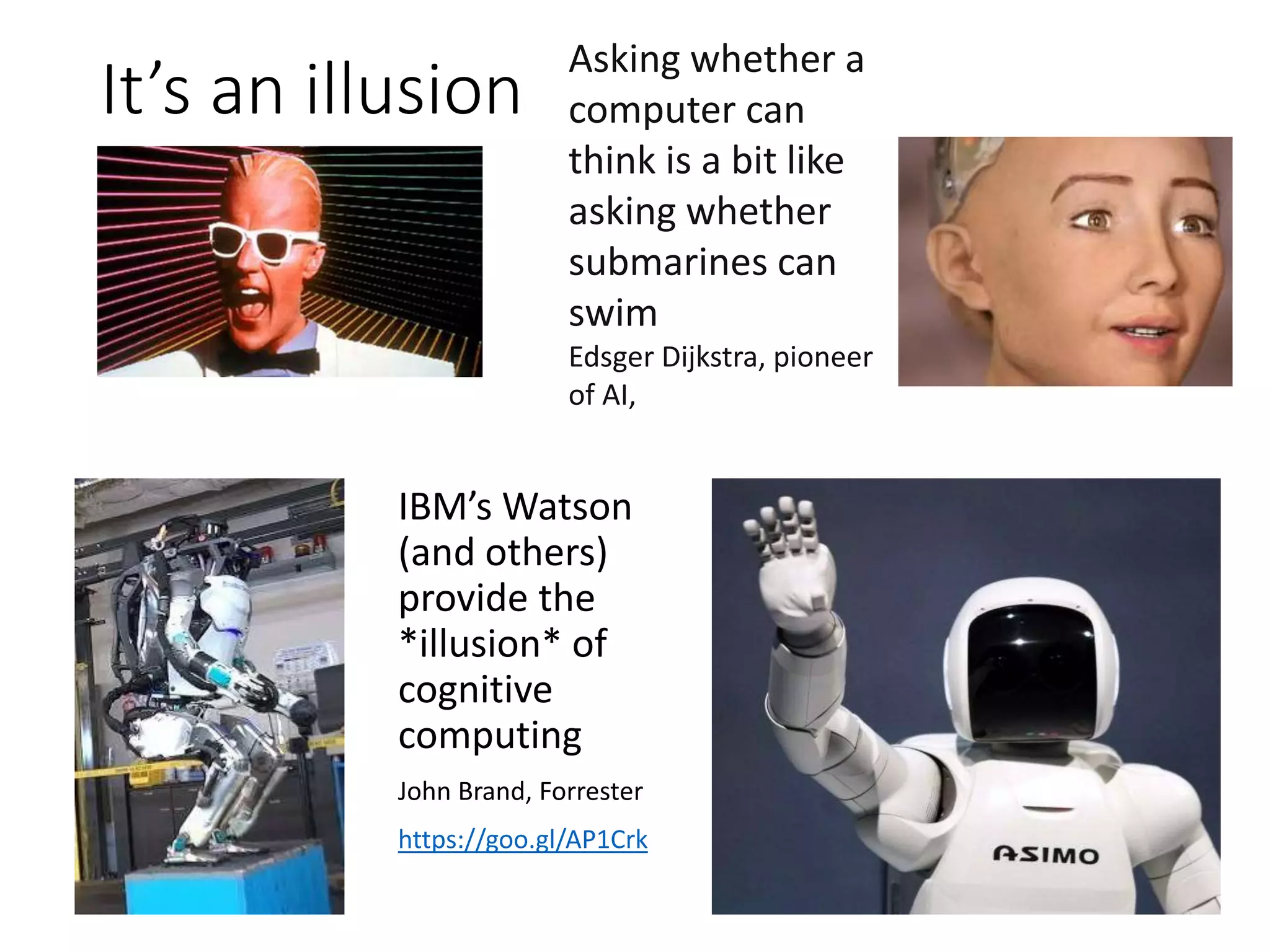
It’s an illusion
Asking whether a
computer can
think is a bit like
asking whether
submarines can
swim
Edsger Dijkstra, pioneer
of AI,
IBM’s Watson
(and others)
provide the
*illusion* of
cognitive
computing
John Brand, Forrester
https://goo.gl/AP1Crk
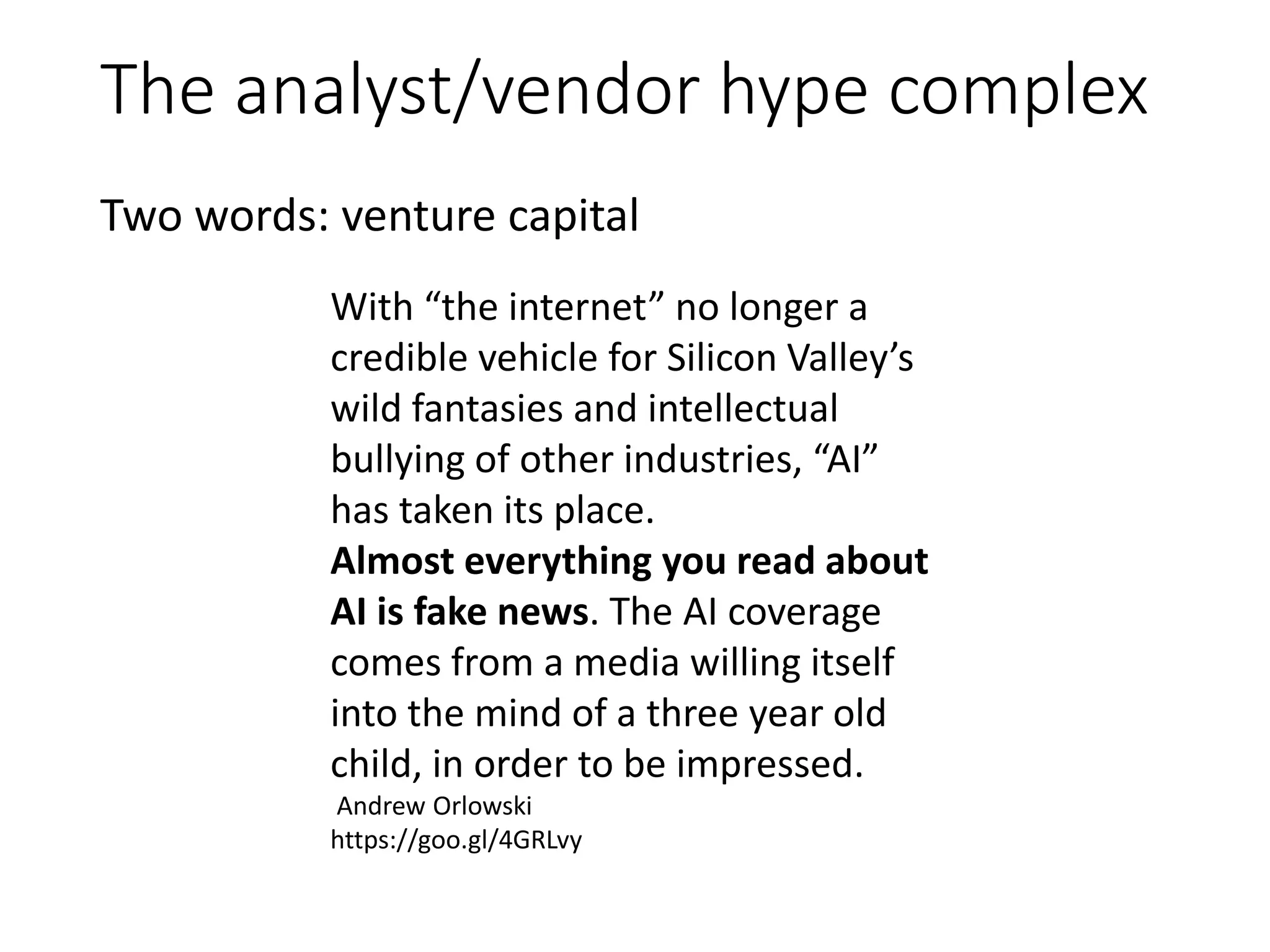
The analyst/vendor hype complex
Two words: venture capital
With “the internet” no longer a
credible vehicle for Silicon Valley’s
wild fantasies and intellectual
bullying of other industries, “AI”
has taken its place.
Almost everything you read about
AI is fake news. The AI coverage
comes from a media willing itself
into the mind of a three year old
child, in order to be impressed.
Andrew Orlowski
https://goo.gl/4GRLvy
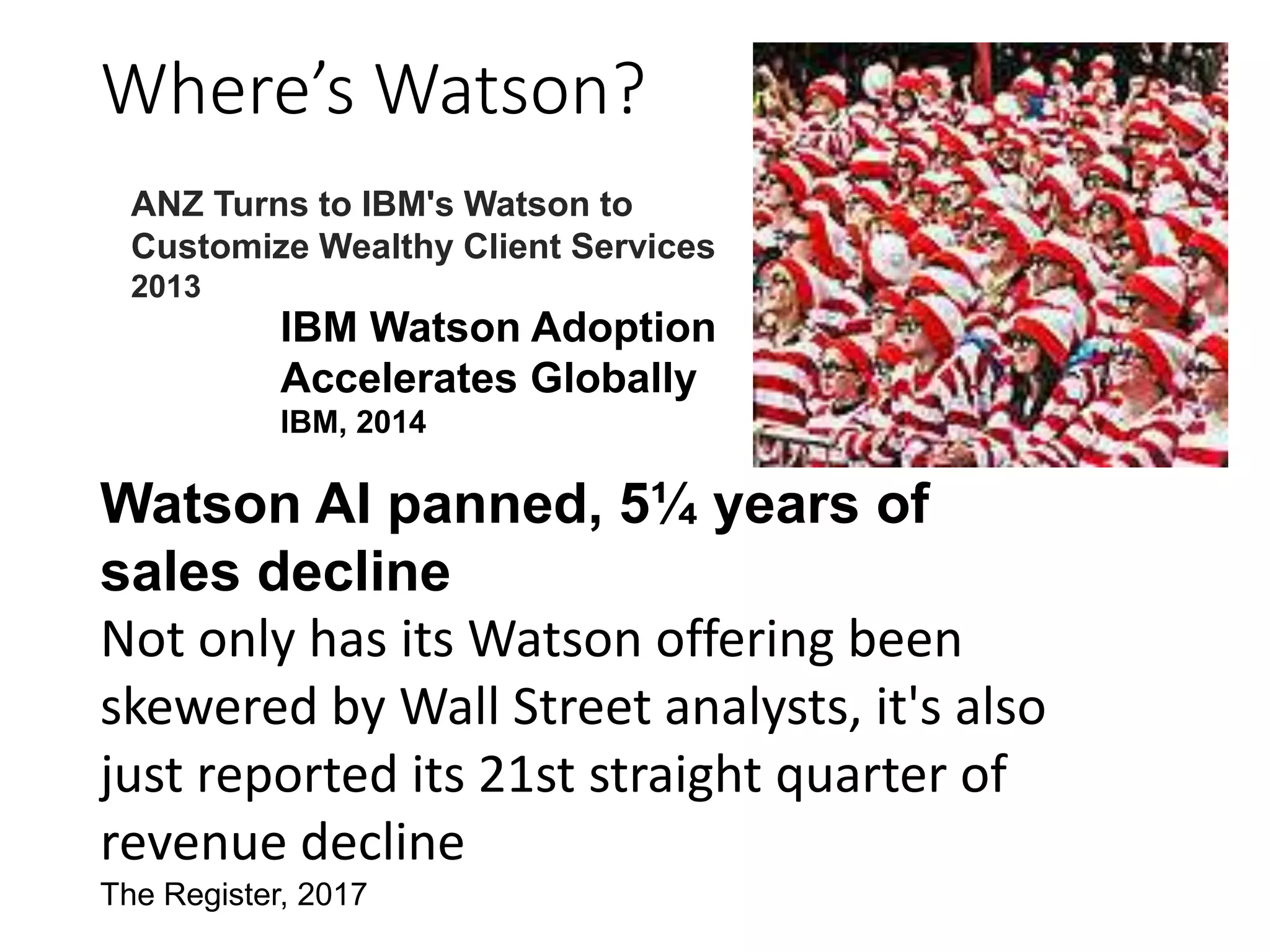
Where’s Watson?
Watson AI panned, 5¼ years of
sales decline
Not only has its Watson offering been
skewered by Wall Street analysts, it's also
just reported its 21st straight quarter of
revenue decline
The Register, 2017
IBM Watson Adoption
Accelerates Globally
IBM, 2014
ANZ Turns to IBM's Watson to
Customize Wealthy Client Services
2013
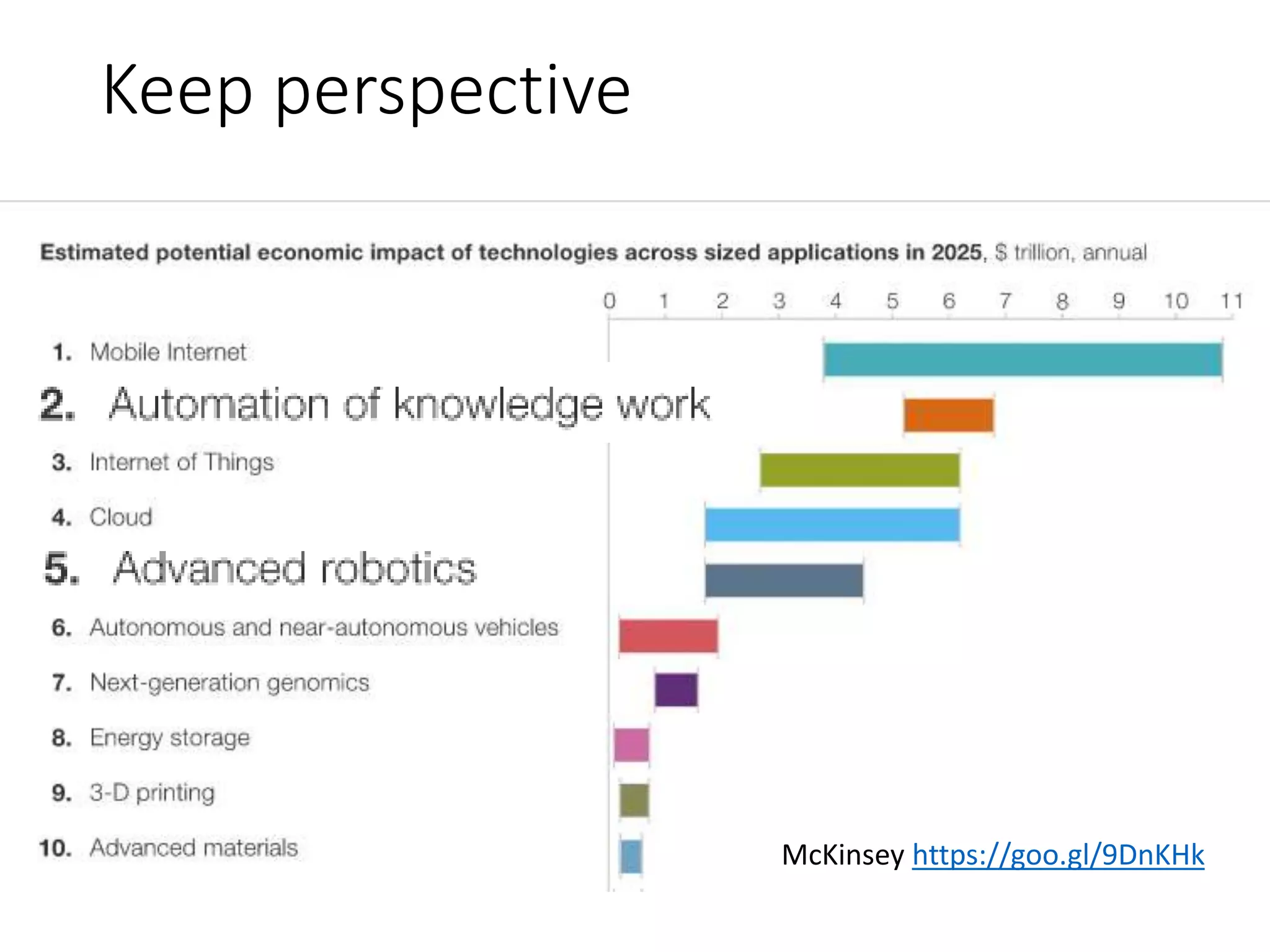
Keep perspective
McKinsey https://goo.gl/9DnKHk
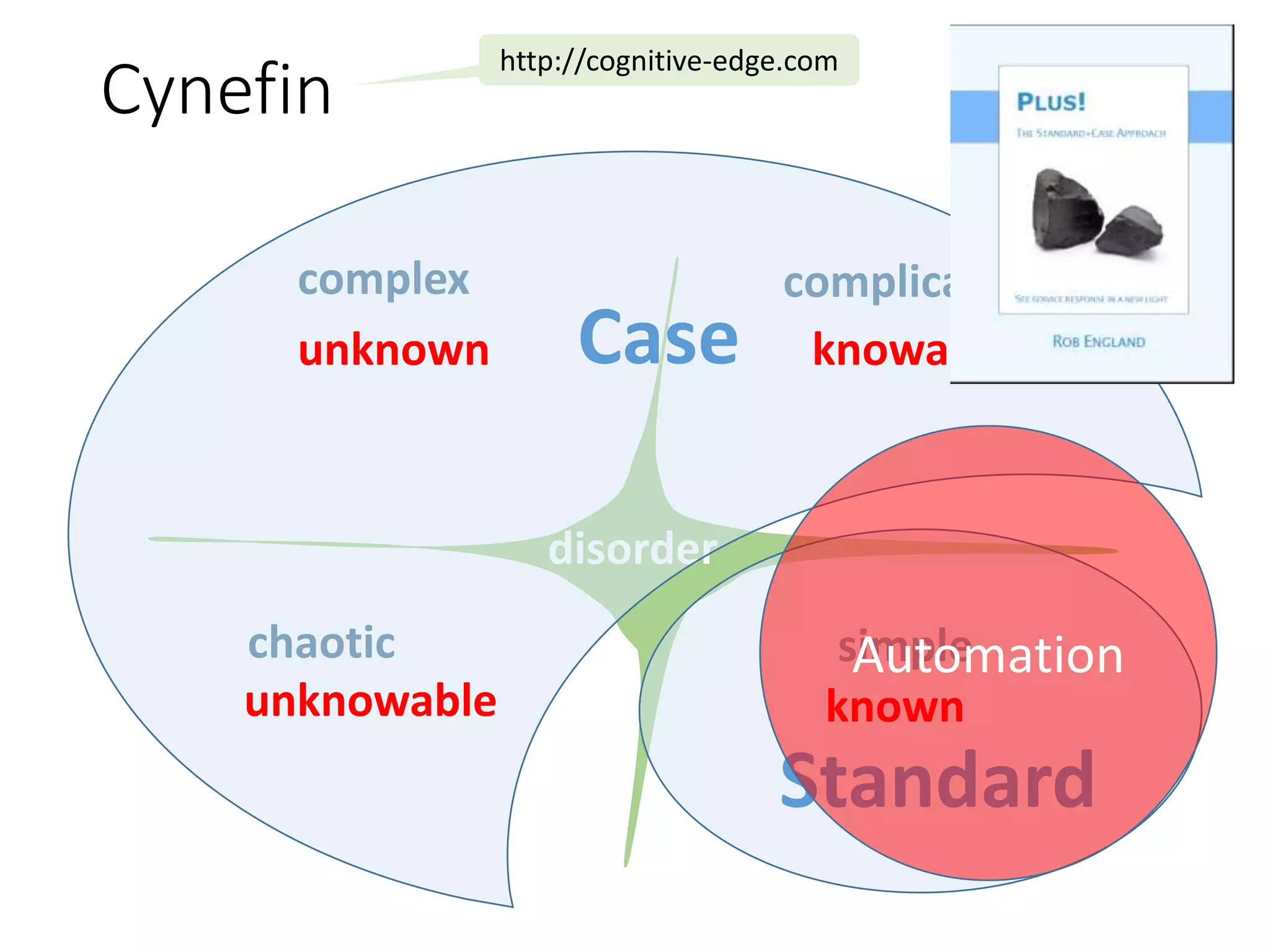
disorder
simplechaotic
complex complicated
Standard
Case
Cynefin
Automation
unknown knowable
unknowable known
http://cognitive-edge.com
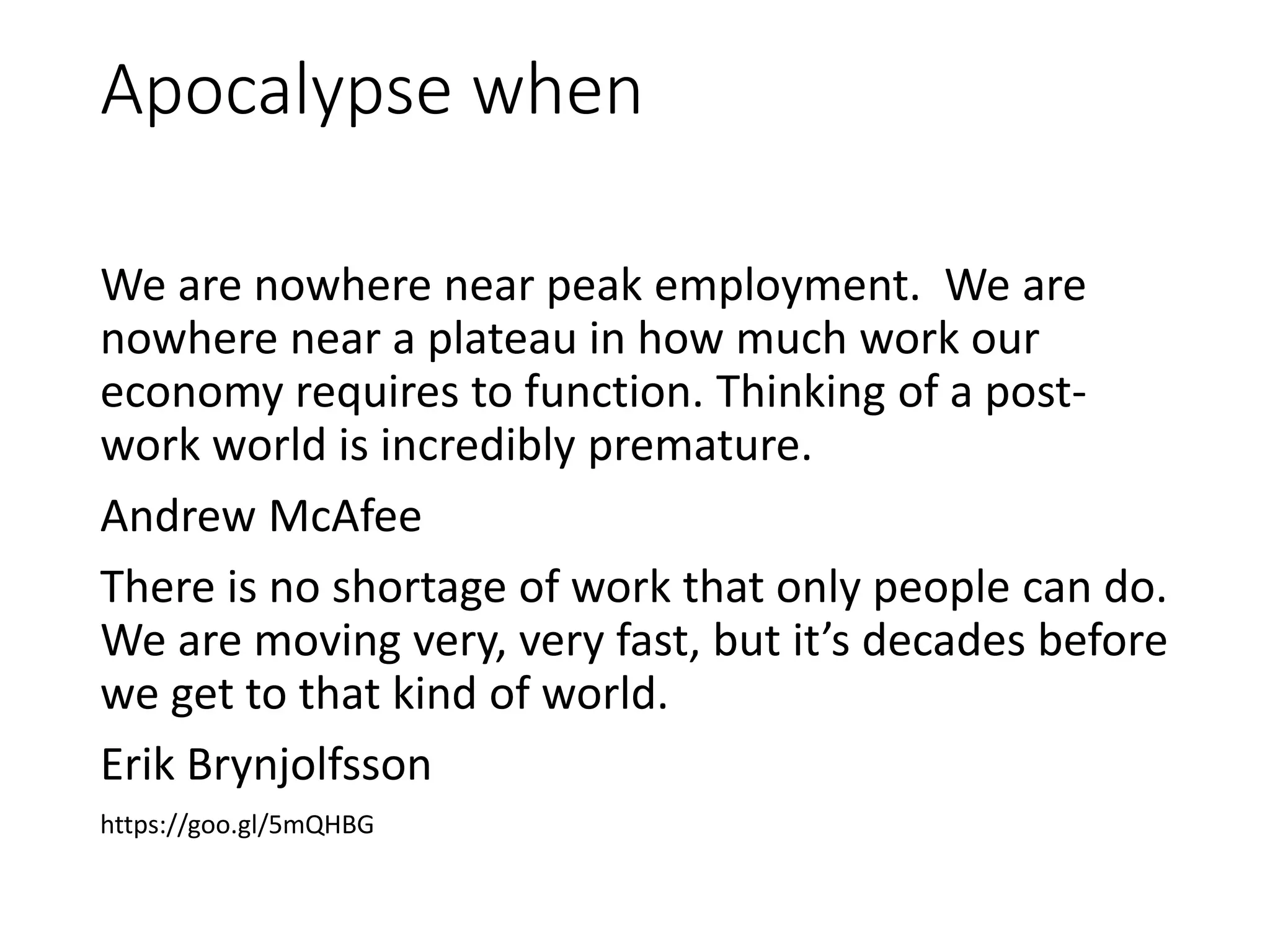
Apocalypse when
We are nowhere near peak employment. We are
nowhere near a plateau in how much work our
economy requires to function. Thinking of a post-
work world is incredibly premature.
Andrew McAfee
There is no shortage of work that only people can do.
We are moving very, very fast, but it’s decades before
we get to that kind of world.
Erik Brynjolfsson
https://goo.gl/5mQHBG
Optimism
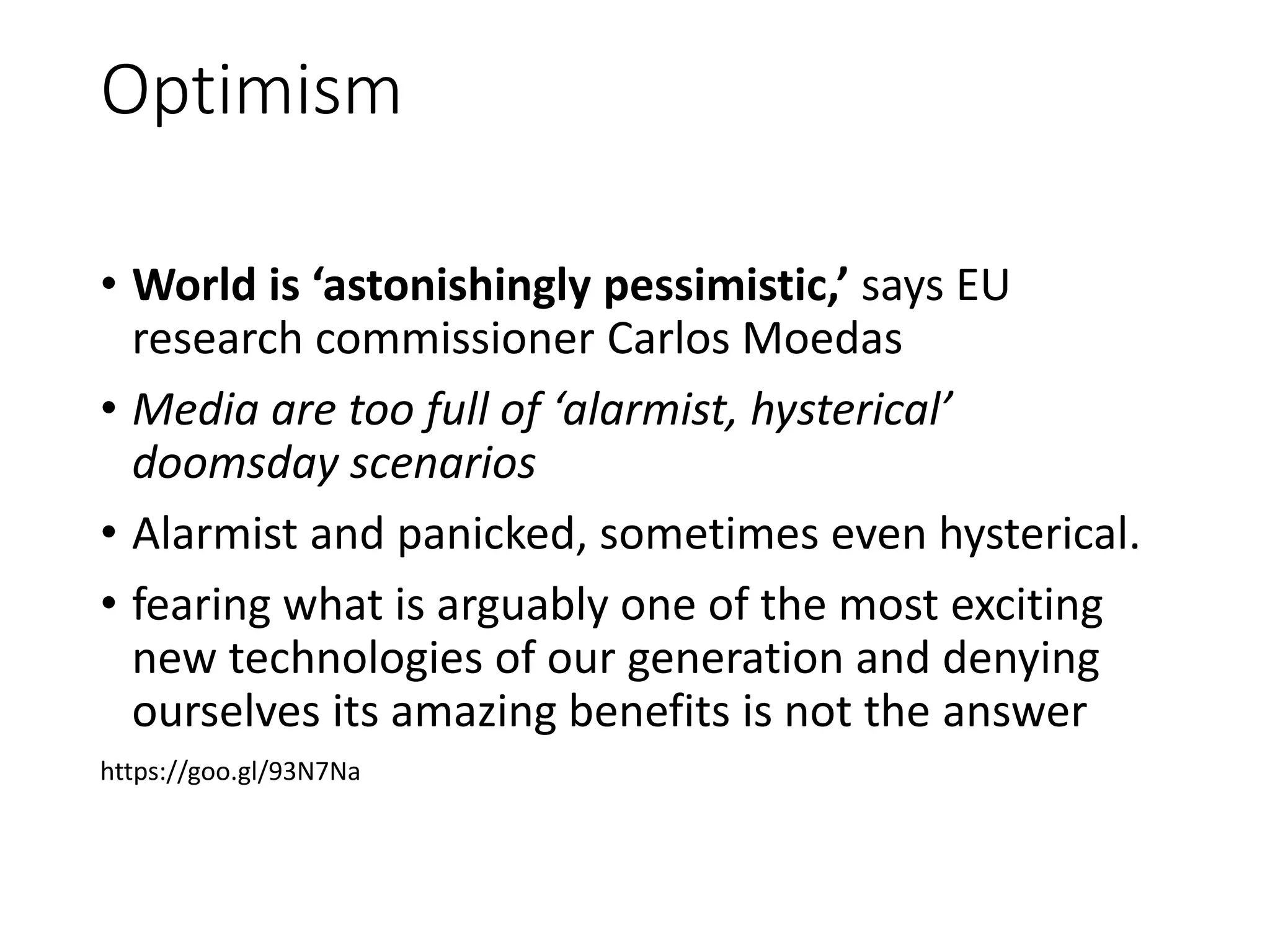
Optimism
• World is ‘astonishingly pessimistic,’ says EU
research commissioner Carlos Moedas
• Media are too full of ‘alarmist, hysterical’
doomsday scenarios
• Alarmist and panicked, sometimes even hysterical.
• fearing what is arguably one of the most exciting
new technologies of our generation and denying
ourselves its amazing benefits is not the answer
https://goo.gl/93N7Na
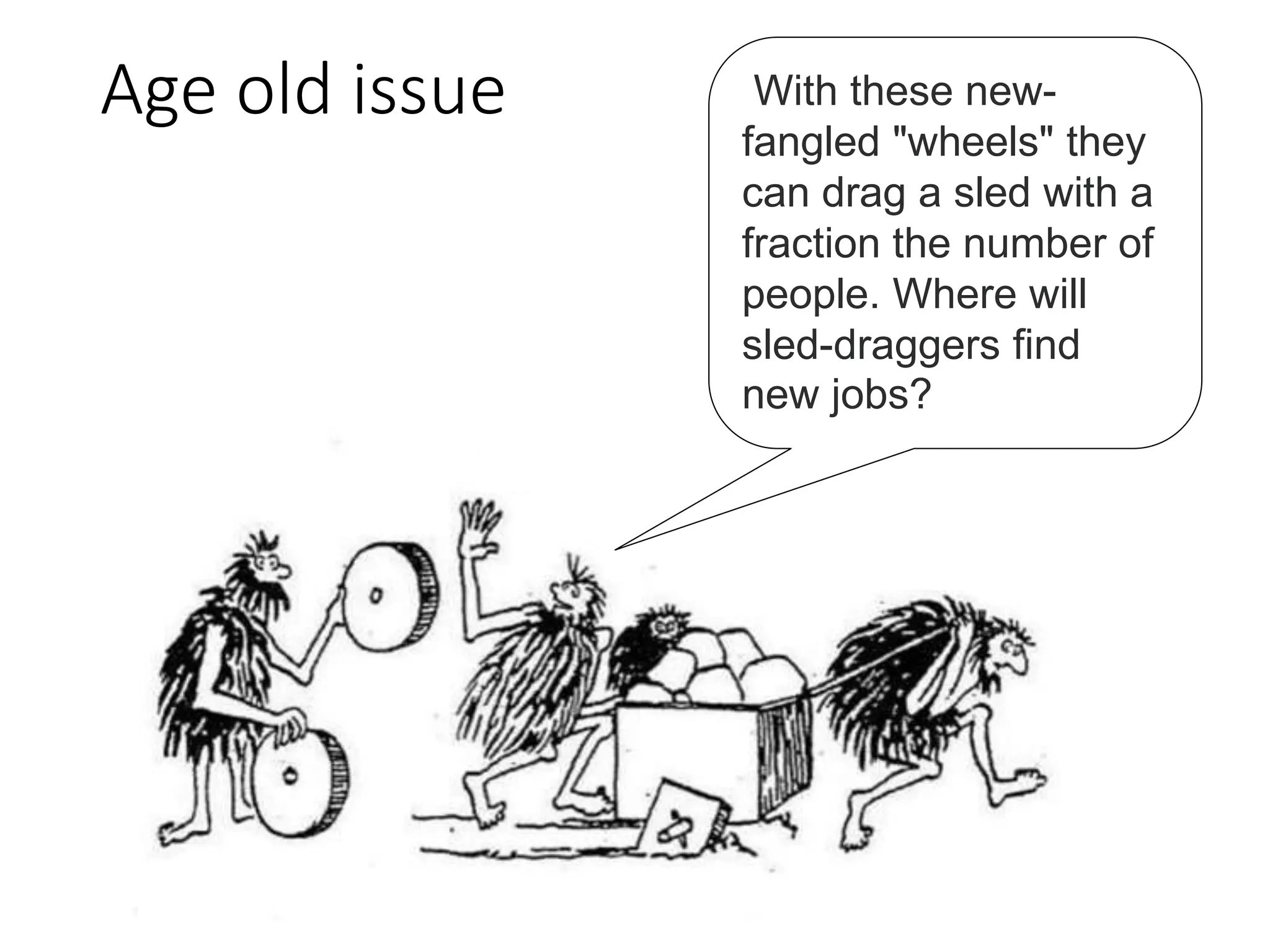
Age old issue With these new-
fangled "wheels" they
can drag a sled with a
fraction the number of
people. Where will
sled-draggers find
new jobs?
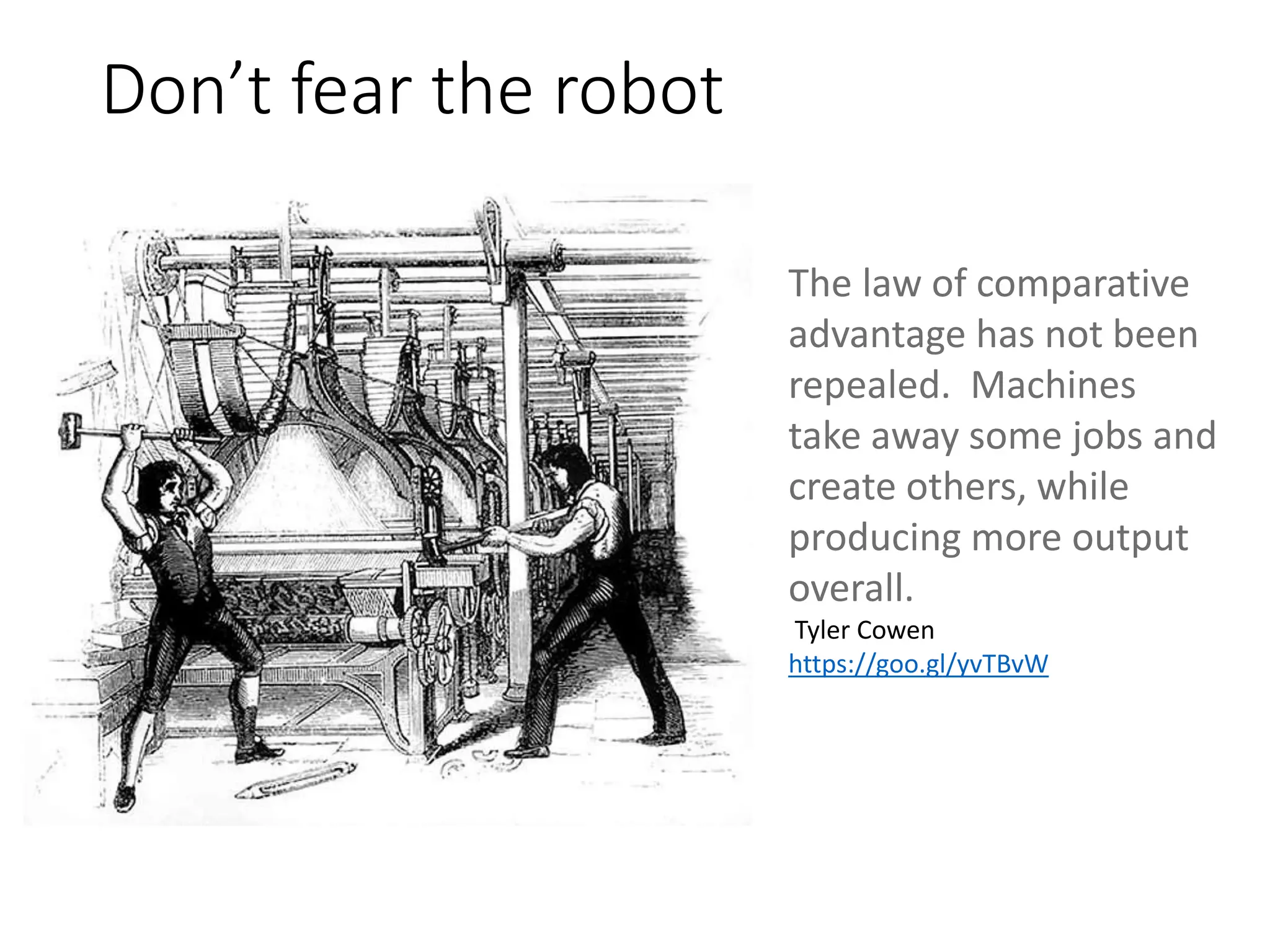
Don’t fear the robot
The law of comparative
advantage has not been
repealed. Machines
take away some jobs and
create others, while
producing more output
overall.
Tyler Cowen
https://goo.gl/yvTBvW
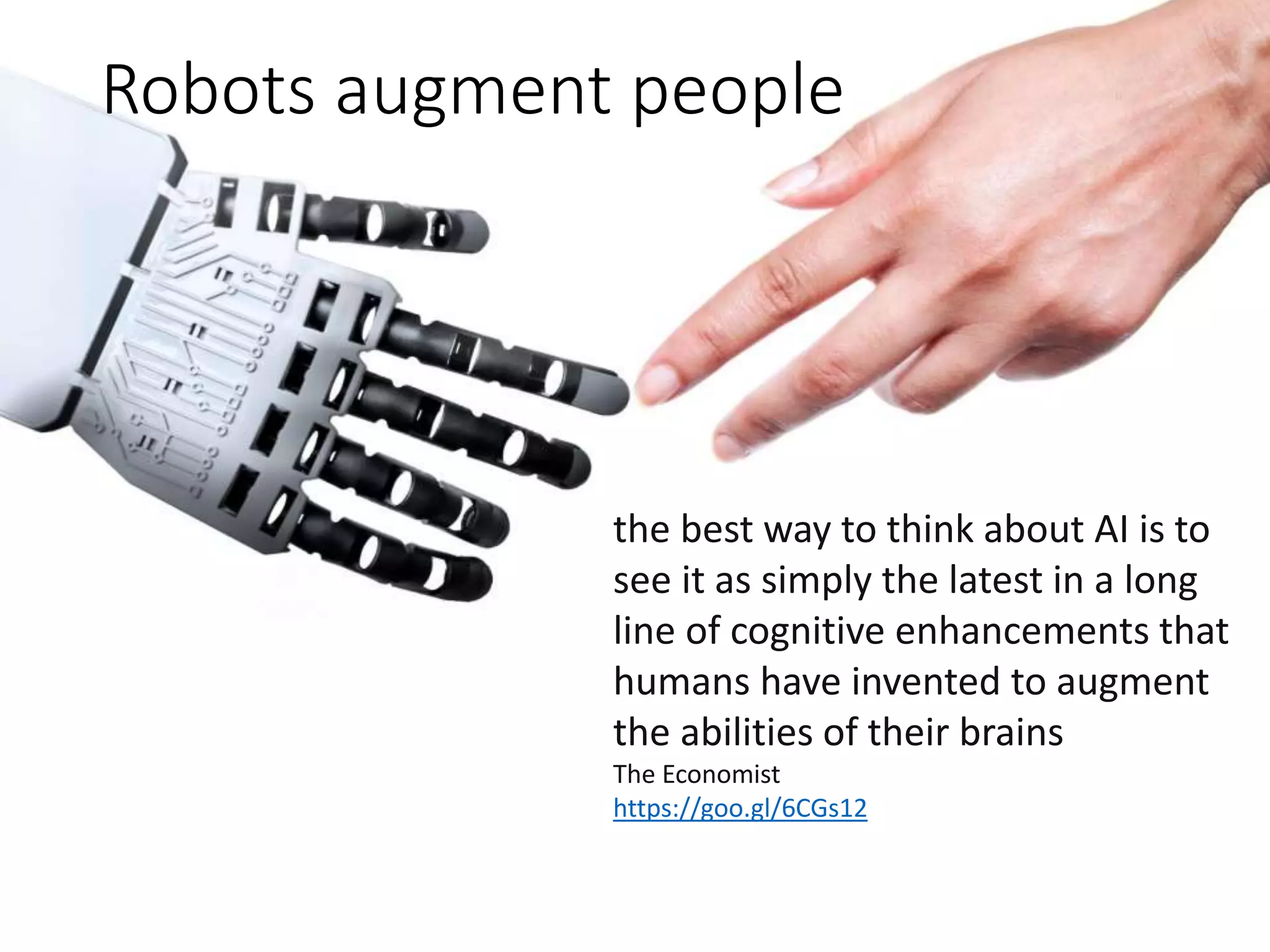
Robots augment people
the best way to think about AI is to
see it as simply the latest in a long
line of cognitive enhancements that
humans have invented to augment
the abilities of their brains
The Economist
https://goo.gl/6CGs12
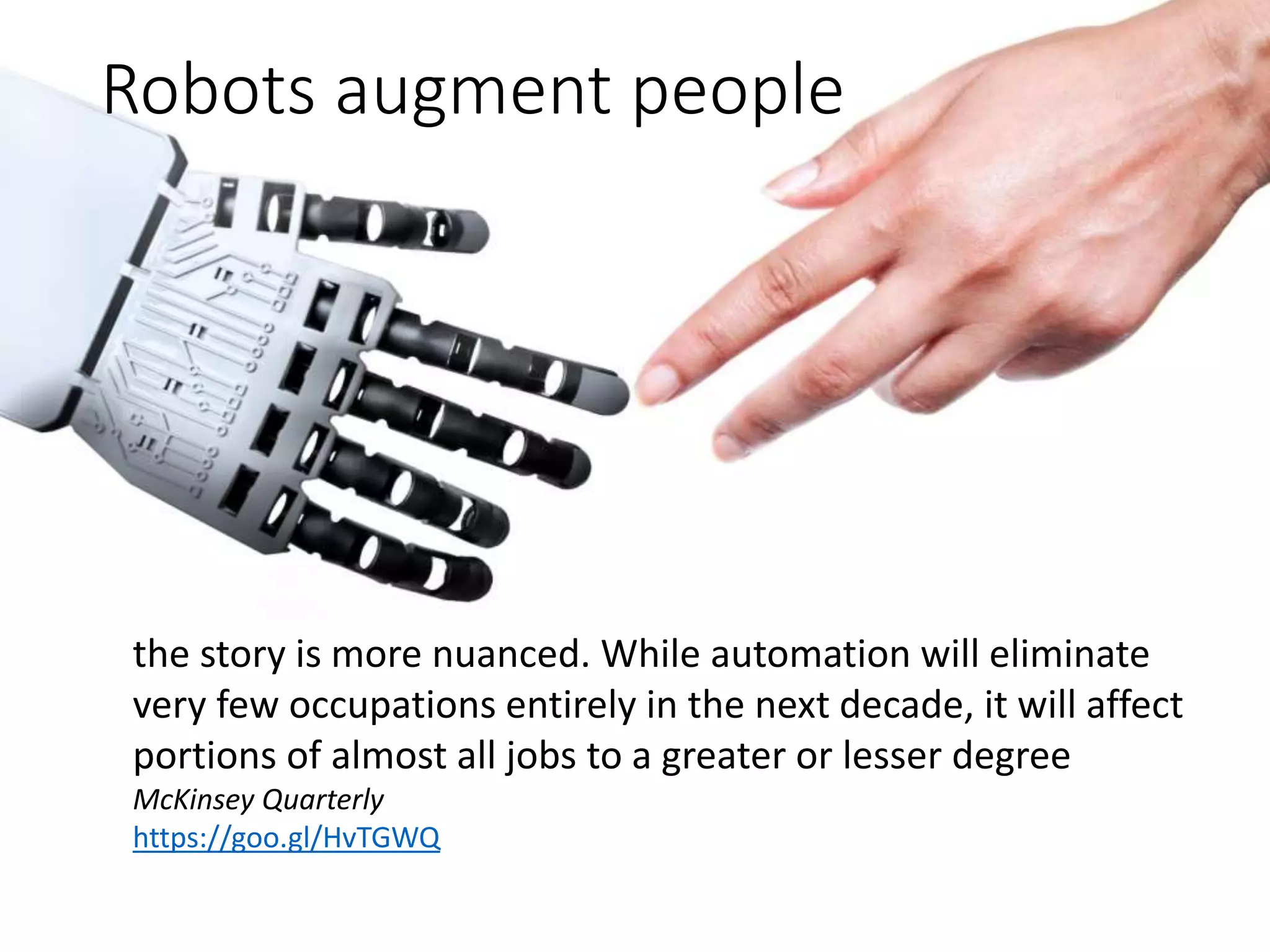
Robots augment people
the story is more nuanced. While automation will eliminate
very few occupations entirely in the next decade, it will affect
portions of almost all jobs to a greater or lesser degree
McKinsey Quarterly
https://goo.gl/HvTGWQ
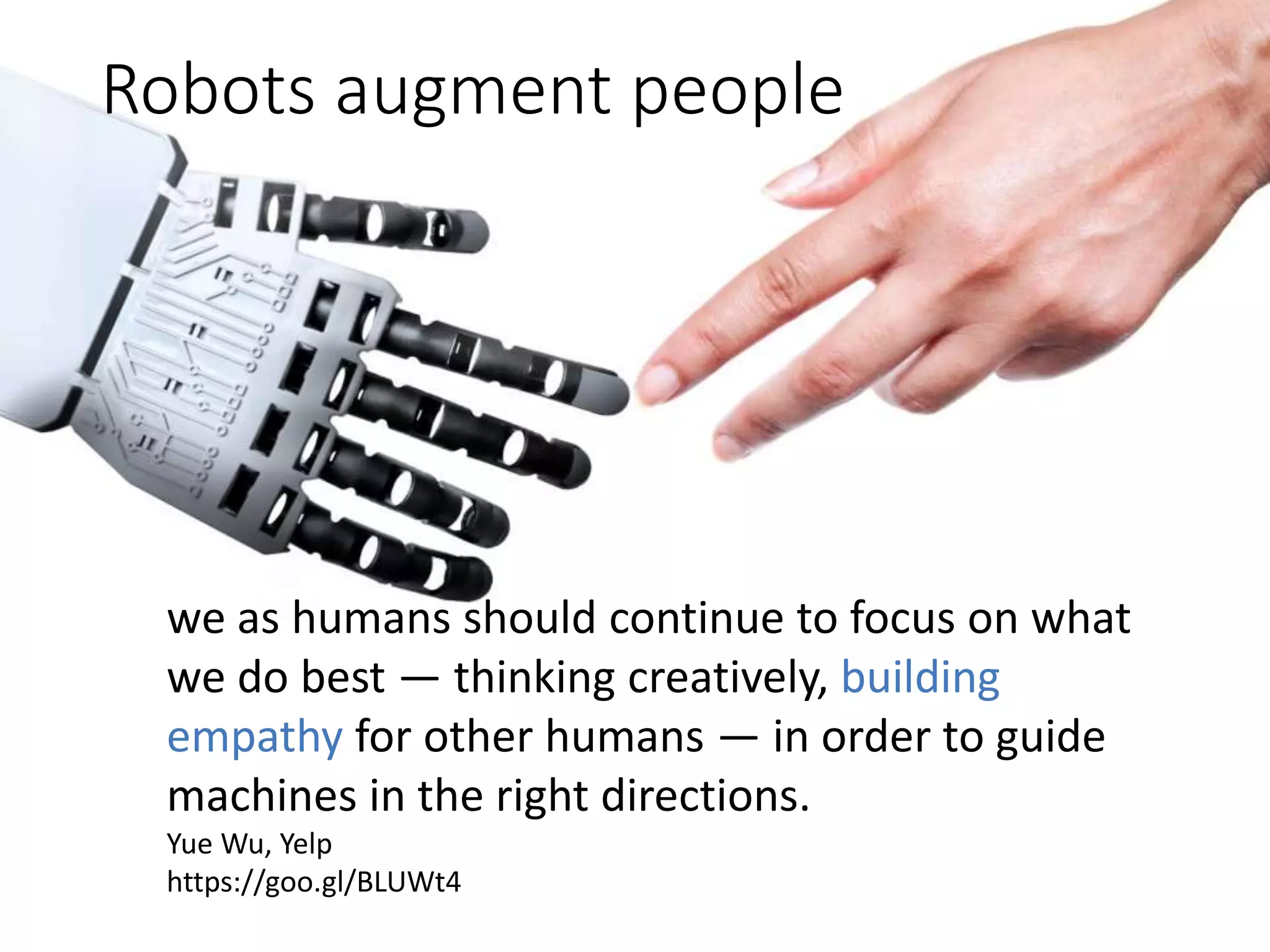
Robots augment people
we as humans should continue to focus on what
we do best — thinking creatively, building
empathy for other humans — in order to guide
machines in the right directions.
Yue Wu, Yelp
https://goo.gl/BLUWt4
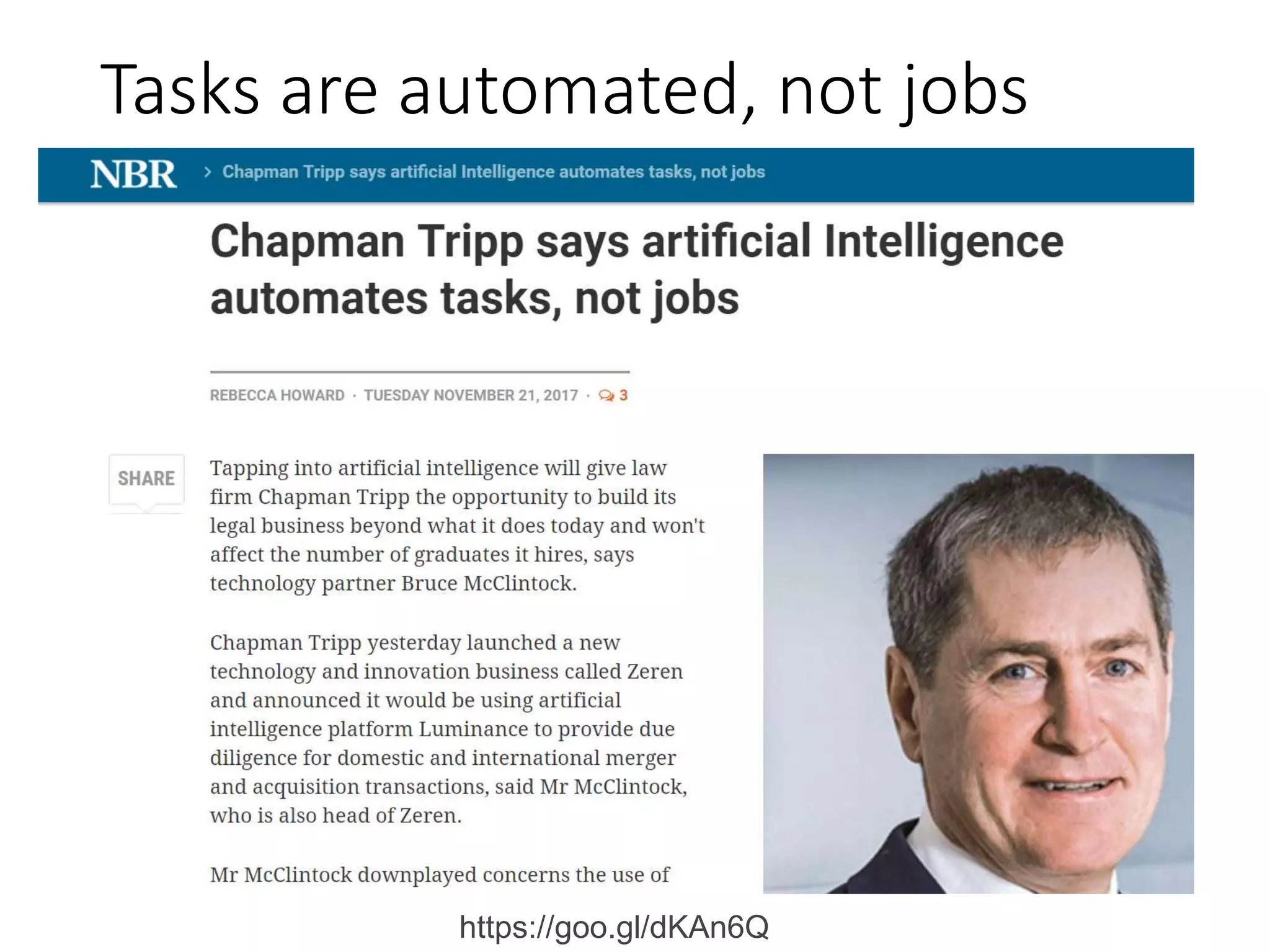
Tasks are automated, not jobs
https://goo.gl/dKAn6Q
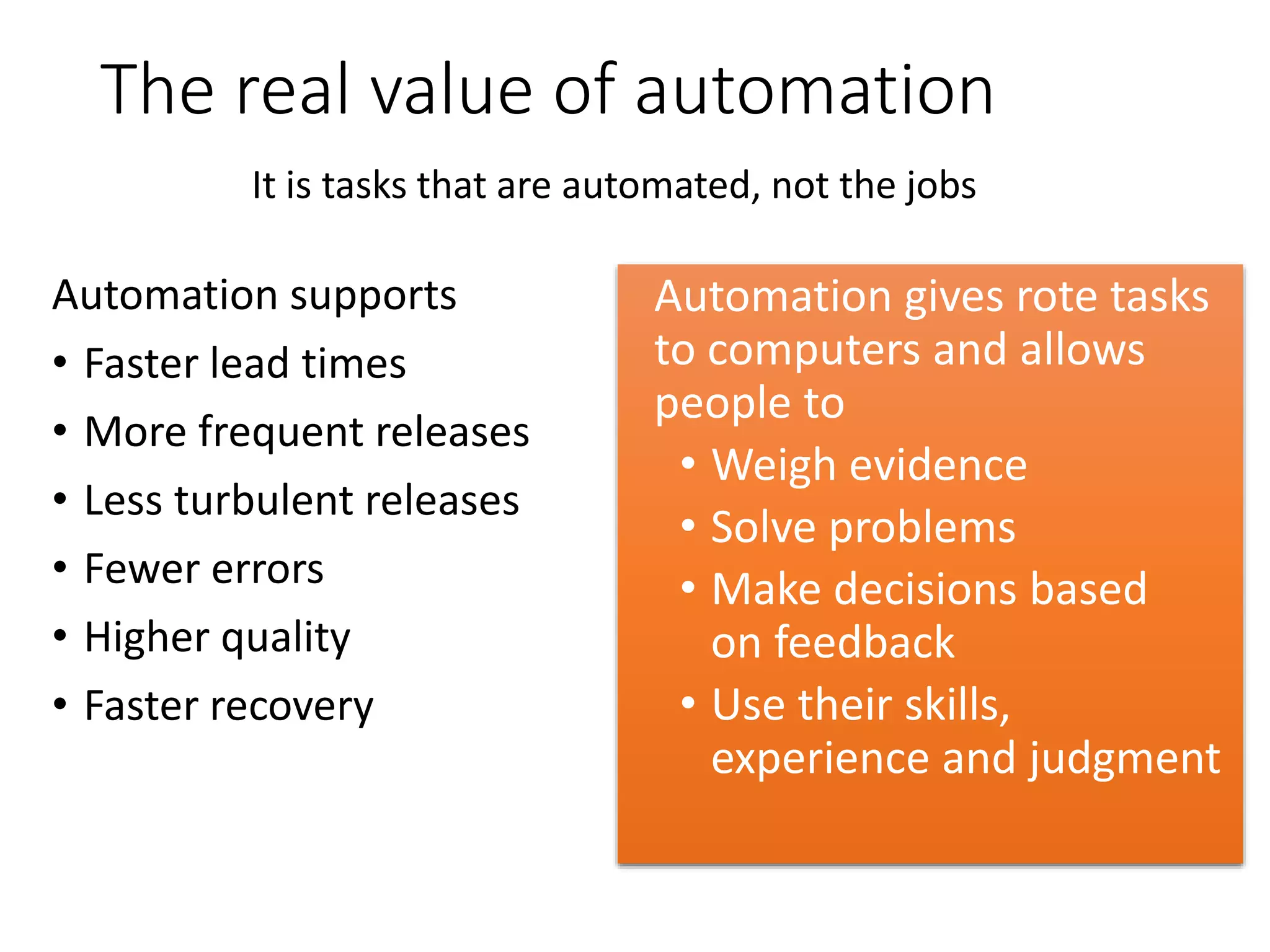
The real value of automation
Automation supports
• Faster lead times
• More frequent releases
• Less turbulent releases
• Fewer errors
• Higher quality
• Faster recovery
Automation gives rote tasks
to computers and allows
people to
• Weigh evidence
• Solve problems
• Make decisions based
on feedback
• Use their skills,
experience and judgment
It is tasks that are automated, not the jobs
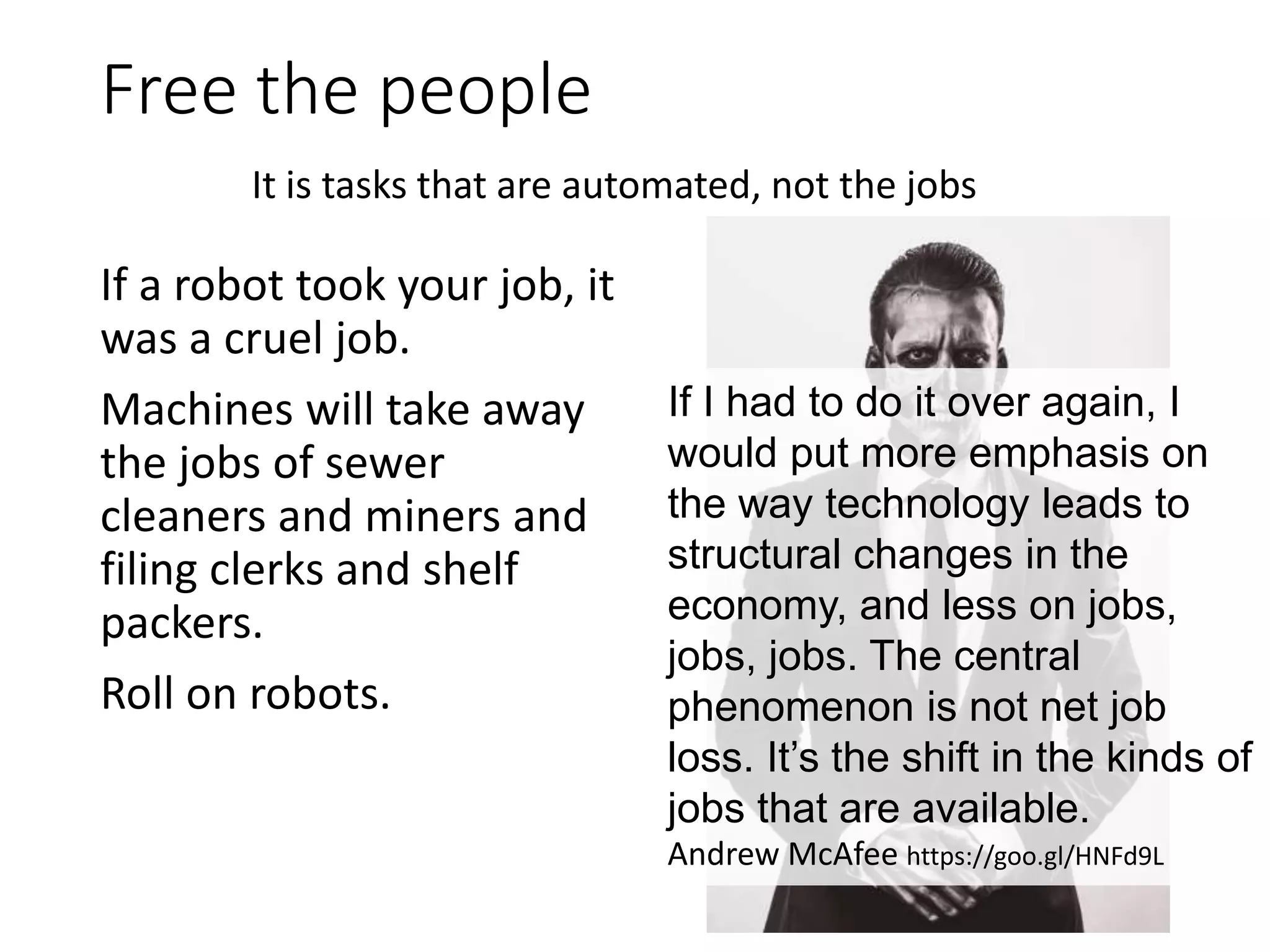
Free the people
If a robot took your job, it
was a cruel job.
Machines will take away
the jobs of sewer
cleaners and miners and
filing clerks and shelf
packers.
Roll on robots.
It is tasks that are automated, not the jobs
If I had to do it over again, I
would put more emphasis on
the way technology leads to
structural changes in the
economy, and less on jobs,
jobs, jobs. The central
phenomenon is not net job
loss. It’s the shift in the kinds of
jobs that are available.
Andrew McAfee https://goo.gl/HNFd9L
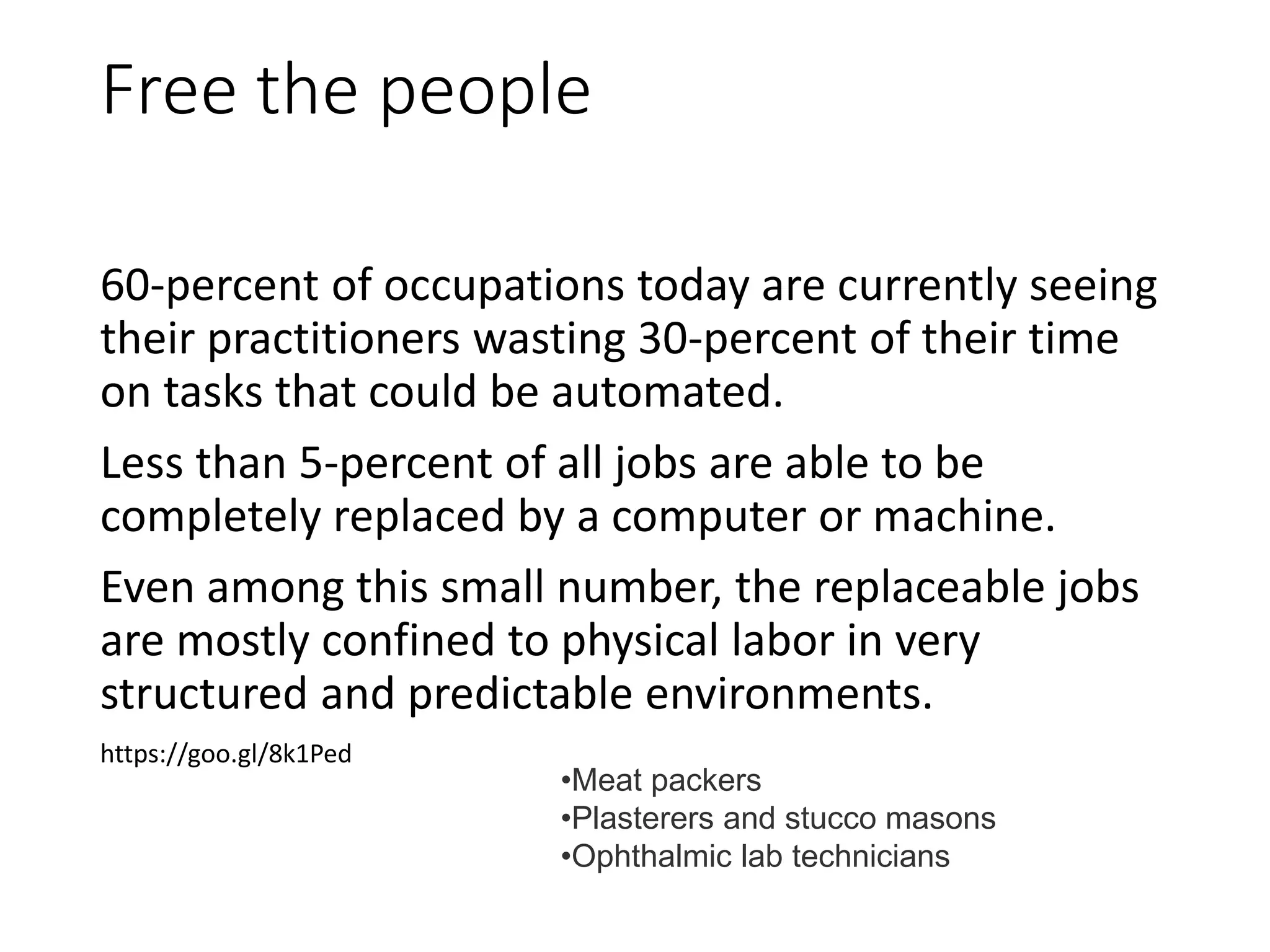
Free the people
60-percent of occupations today are currently seeing
their practitioners wasting 30-percent of their time
on tasks that could be automated.
Less than 5-percent of all jobs are able to be
completely replaced by a computer or machine.
Even among this small number, the replaceable jobs
are mostly confined to physical labor in very
structured and predictable environments.
https://goo.gl/8k1Ped
•Meat packers
•Plasterers and stucco masons
•Ophthalmic lab technicians
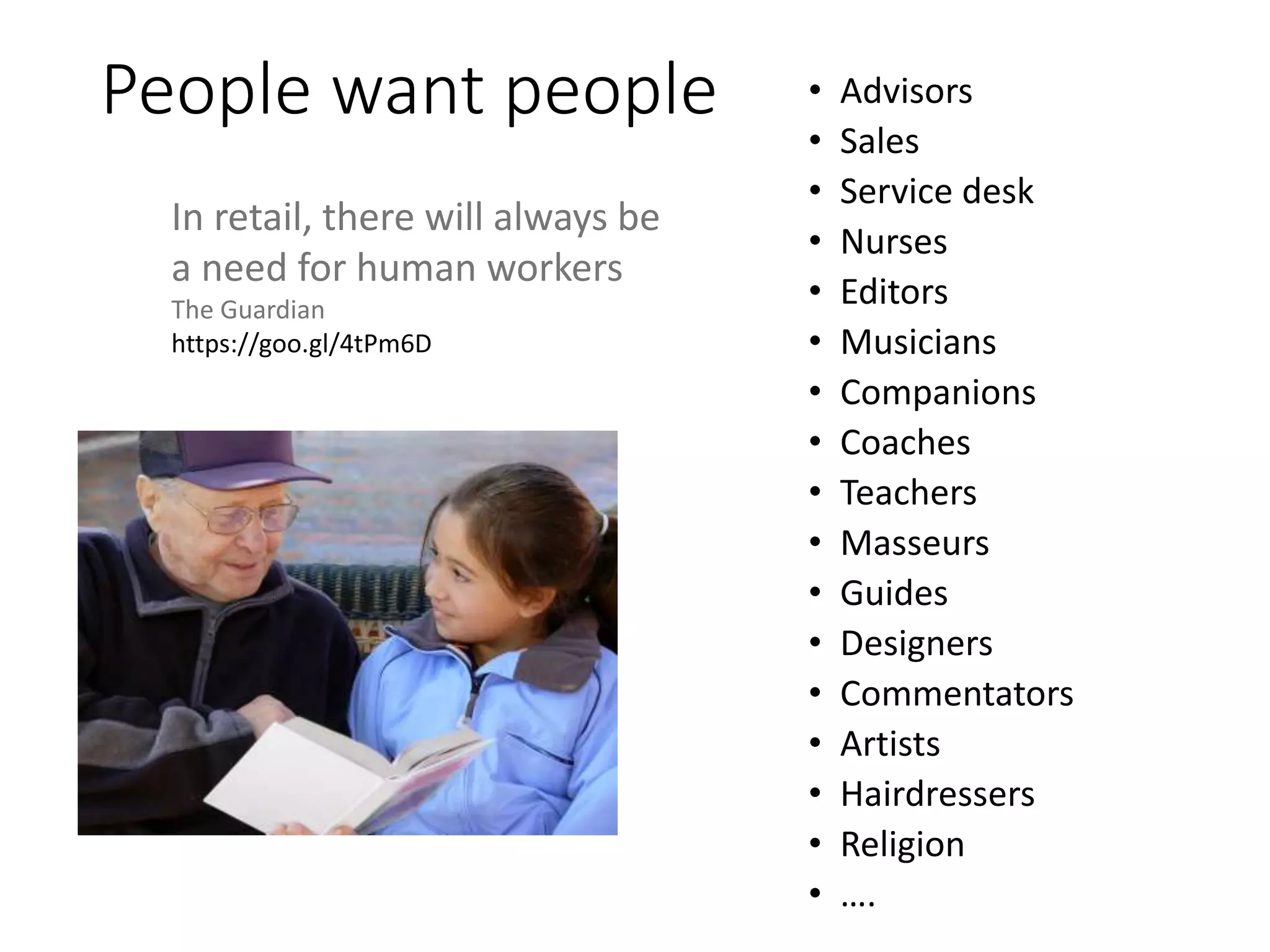
People want people • Advisors
• Sales
• Service desk
• Nurses
• Editors
• Musicians
• Companions
• Coaches
• Teachers
• Masseurs
• Guides
• Designers
• Commentators
• Artists
• Hairdressers
• Religion
• ….
In retail, there will always be
a need for human workers
The Guardian
https://goo.gl/4tPm6D
Stop underestimating mankind
200 years ago, the majority of the human race
worked on the land. 100 years ago the majority
worked in heavy industry. Those people aren't
unemployed.
The human race is anti-fragile: we thrive on change,
stress, discontinuities. Germany and Japan after
WWII. Christchurch after the quake.
98% of the manual labor
performed in ancient
Egypt is now automated
Keith Swenson
https://goo.gl/hTP7Mq
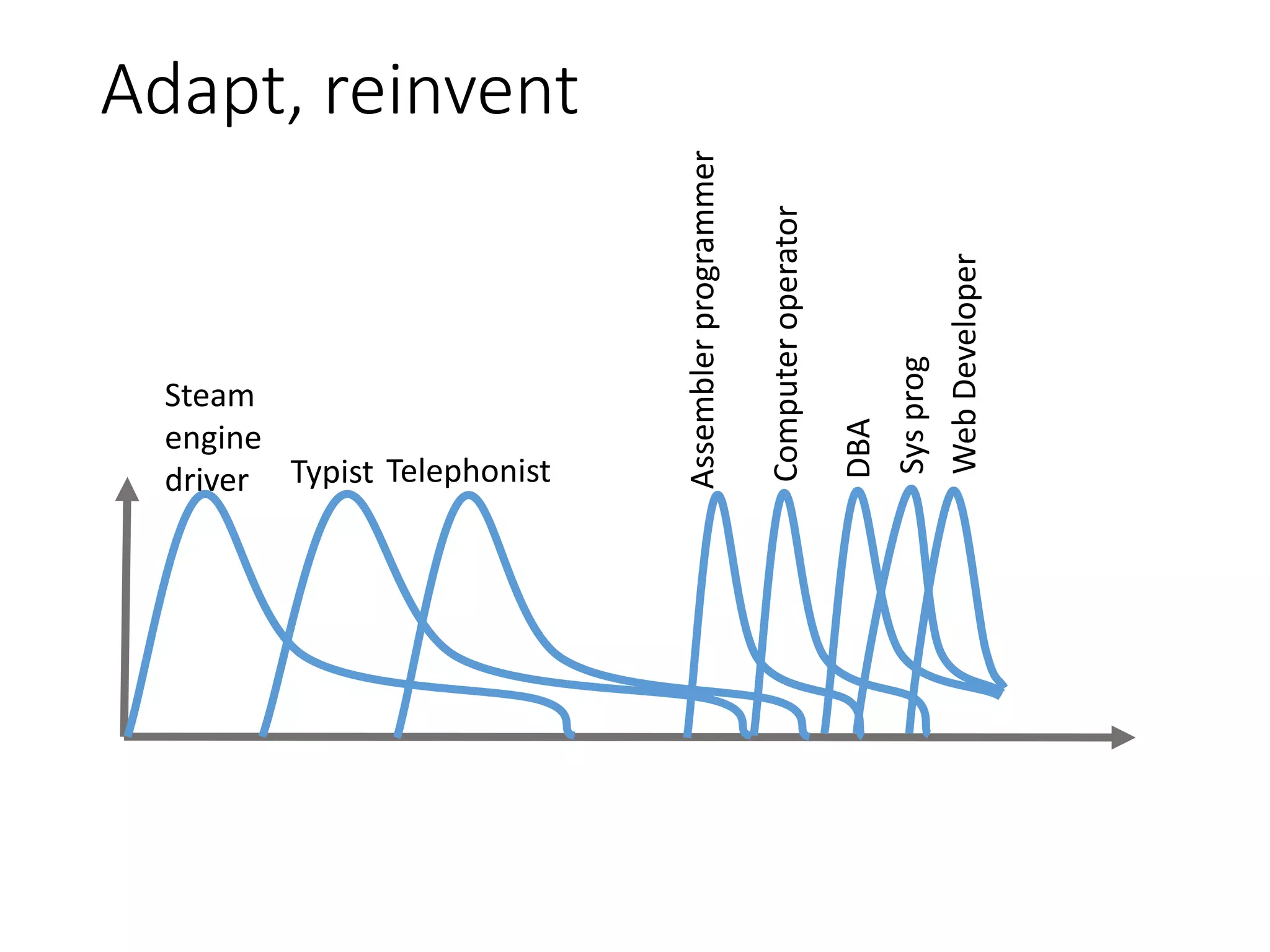
Adapt, reinvent
Steam
engine
driver Typist Telephonist
Assemblerprogrammer
DBA
Sysprog
Computeroperator
WebDeveloper
Adapt, reinvent
Not every employee will adapt and innovate, but we
believe most will.
Those that do adapt will go in two directions: one
group will focus on becoming more productive by
doing more of the same kind of work they did in the
past with the assistance of digital labor.
The other will move on to more value-added
activities
ISG https://goo.gl/5HvJXe
If opinion matters to you…
1,896 experts divided:
52% expect that technology will not displace more jobs
than it creates by 2025
• Advances in technology may displace certain types of
work, but historically they have been a net creator of
jobs.
• We will adapt to these changes by inventing entirely
new types of work, and by taking advantage of uniquely
human capabilities.
• Technology will free us from day-to-day drudgery, and
allow us to define our relationship with “work” in a
more positive and socially beneficial way.
• Ultimately, we as a society control our own destiny
through the choices we make.
Pew Research https://goo.gl/z55szF
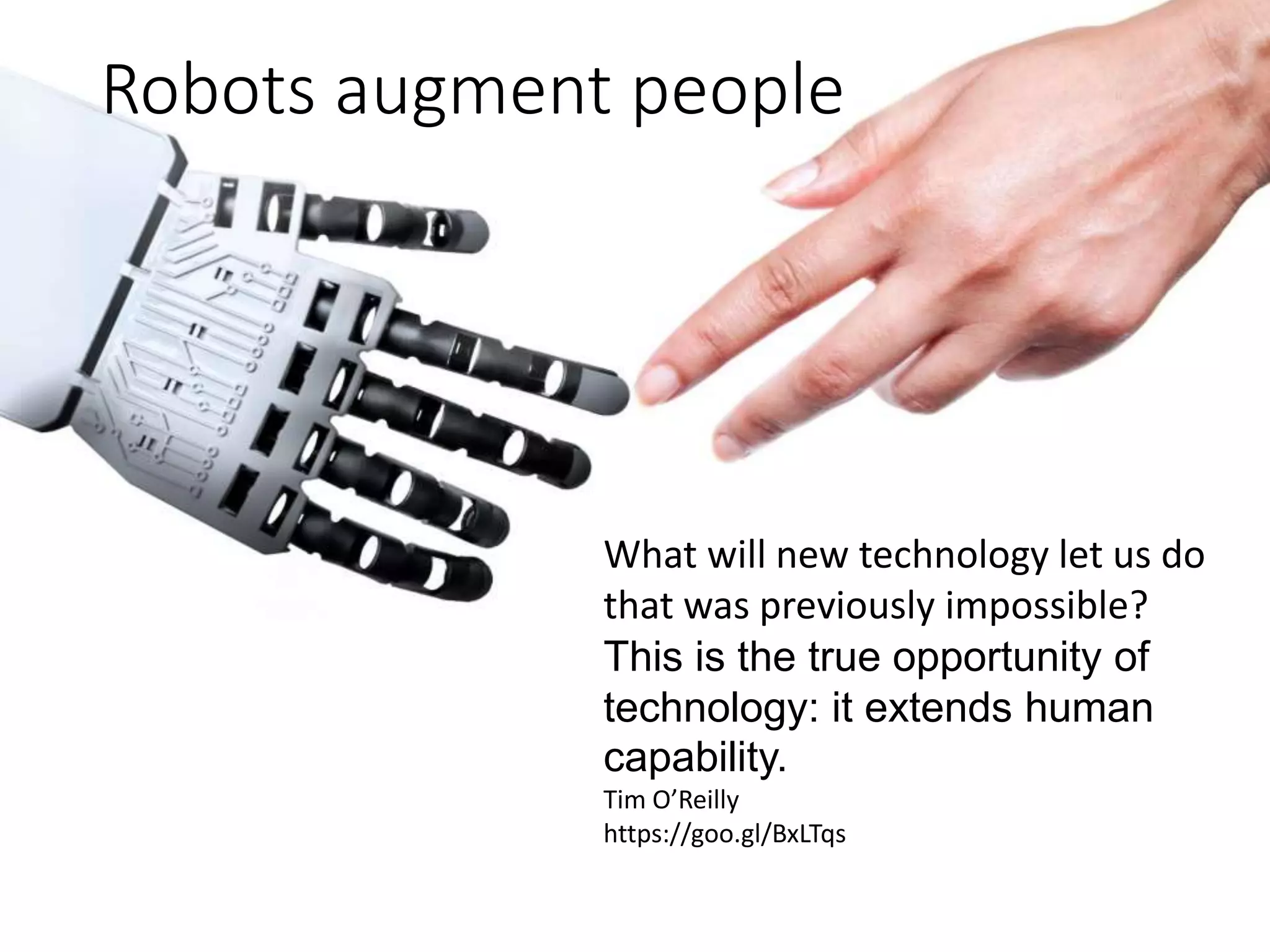
Robots augment people
What will new technology let us do
that was previously impossible?
This is the true opportunity of
technology: it extends human
capability.
Tim O’Reilly
https://goo.gl/BxLTqs
Rob England
www.itskeptic.org
@theitskeptic

A skeptic's view of Automation and AI

  • 1.
    A skeptic’s viewof Automation and AI Rob England
  • 2.
    Automation and AI Robotsare taking our jobs!!
  • 3.
  • 4.
  • 9.
    Sometimes it ismore accurate
  • 10.
  • 11.
    Nuclear Armageddon • 1400bombs have already been detonated • >500 in the atmosphere
  • 12.
  • 13.
  • 14.
    Paul Ehrlich “The battleto feed all of humanity is over.” He later went on to forecast that hundreds of millions would starve to death in the 1970s, that 65 million of them would be Americans, that crowded India was essentially doomed, that odds were fair “England will not exist in the year 2000.” Dr. Ehrlich was so sure of himself that he warned in 1970 that “sometime in the next 15 years, the end will come.” By “the end,” he meant “an utter breakdown of the capacity of the planet to support humanity.” As you may have noticed, England is still with us. NY Times https://goo.gl/DRdr6q
  • 15.
  • 16.
  • 17.
  • 18.
  • 19.
  • 20.
  • 21.
  • 22.
    Peak oil Association forthe Study of Peak Oil & Gas
  • 24.
  • 25.
    Peak oil For everybarrel of oil consumed over the past 35 years, two new barrels have been discovered BP https://goo.gl/Dks4Kc https://goo.gl/j4Ef64
  • 26.
  • 27.
  • 28.
    New ice age Anincrease by only a factor of 4 in global aerosol background concentration may be sufficient to reduce the surface temperature by as much as 3.5°K. If sustained over a period of several years, such a temperature decrease over the whole globe is believed to be sufficient to trigger an ice age. "Atmospheric Carbon Dioxide and Aerosols: Effects of Large Increases on Global Climate". Science, 1971
  • 29.
    New ice age Thelonger the planners (politicians) delay, the more difficult will they find it to cope with climatic change once the results become grim reality... resulting famines could be catastrophic...drought and desolation...the most devastating outbreak of tornadoes ever recorded...droughts, floods, extended dry spells, long freezes, delayed monsoons...impossible for starving peoples to migrate... the present decline has taken the planet about a sixth of the way toward the Ice Age. Newsweek, 1975
  • 30.
  • 31.
  • 32.
  • 33.
  • 34.
    Sometimes it isreal but that doesn’t stop the b.s.
  • 35.
  • 36.
    Acid rain … willcost Europe 118 million cubic metres of wood worth Pounds sterling 16 billion – every year for the next century. Western Europe will lose 48 million cubic metres of timber a year. Eastern Europe will lose 35 million cubic metres and the European part of the Soviet Union 35 million cubic metres. The total losses are equivalent to about 30 times the timber Britain produces each year. New Scientist, 1990
  • 37.
  • 38.
  • 39.
  • 40.
  • 41.
  • 42.
    Global warming NASA,https://goo.gl/YJD6kQ until Trump shuts them up
  • 43.
  • 44.
  • 45.
  • 46.
    Antiscience "The myth ofthe 1970s global cooling scientific consensus." Bulletin of the American Meteorological Society 89.9 (2008): 1325-1337.
  • 47.
  • 48.
  • 49.
  • 50.
  • 51.
    Typical pattern Volume A newfactor becomes significant Speed appears linear appears linear
  • 52.
    Exponential extrapolation Time Something now soon OMG then in1894 The Times estimated that by 1950 London would be nine feet deep in horse manure
  • 53.
  • 54.
  • 55.
    Extrapolation fallacy • limitingfactors: • cultural resistance (e.g. Google Glass) • cost of implementation (e.g. electric cars) • environmental impact (e.g. wind power) • lack of resources (e.g. solar power, batteries) • social impact (e.g. self-driving trucks) • danger (e.g. hydrogen fueled cars) • fear (e.g. nuclear power) • antiscience (e.g. GMO) Do you think that people will just sit and let this happen? Truckers will shut down US highways. Wendell Wallach https://goo.gl/kQxUtp
  • 56.
  • 57.
  • 58.
  • 59.
  • 60.
  • 61.
    Complex systems • Havemore factors (“active agents”) than can be understood • Must be modelled • Models are only accurate within the known data. They are no better at extrapolation than a simple formula. • It is the same fallacy. • The only way to find out is to “suck it and see”.
  • 62.
  • 63.
    Automation and AI Robotswill master us!! our technology will match and then vastly exceed the refinement and suppleness of what we regard as the best of human traits. Ray Kurzweil
  • 64.
    Automation and AI Robotsare taking our jobs!! Productivity is at record levels, innovation has never been faster, and yet at the same time, we have a falling median income and we have fewer jobs. People are falling behind because technology is advancing so fast Erik Brynjolfsson We used to need very intelligent, very well- trained people called doctors to do medical diagnostic work. And now, we have technologies that are really, really good at it. Andrew McAfee
  • 65.
    Automation and AI Robotswill destroy us!! With artificial intelligence, we are summoning the demon. There’s maybe a five to 10 percent chance of success of creating safe AI. Elon Musk
  • 66.
    Automation and AI Robotswill replace us!! The real risk with AI isn’t malice but competence,’ he said. ‘A superintelligent AI will be extremely good at accomplishing its goals, and if those goals aren’t aligned with ours, we’re in trouble Stephen Hawking
  • 67.
  • 68.
    Kurzweil’s singularity I haveset the date 2045 for the ‘Singularity’ which is when we will multiply our effective intelligence a billion fold by merging with the intelligence we have created. Kurzweil https://goo.gl/XcNwyC
  • 69.
    How accurate isKurzweil anyway? Ray Kurzweil missed the Cloud, Facebook, Twitter, SaaS, phone apps, and Angry Birds. He rates himself 85-95% accurate. LessWrong rates him 54% https://goo.gl/YQEJCA I rate him 50/50. https://goo.gl/rNFaYT Even a blind squirrel finds a few nuts.
  • 70.
    (BTW) Supercomputers will achieveone human brain capacity by 2010, and personal computers will do so by about 2020. Ray Kurzweil https://goo.gl/CNGjHJ
  • 71.
    The mechanical modelfallacy The most complex known object in the universe: a custom-made analogue processor with 20 year setup, multiple parallel processing mechanisms, both electrical and chemical, specialised "hardware" areas, and active biological self-modification • Physical • More nodes than stars in the galaxy • 100 trillion nerve connections • Electrical • Chemical • Hormonal • DNA and growth Researchers at the University of North Carolina have shown that dendrites do more than relay information from one neuron to the next. They actively process information, multiplying the brain's computing power. "Suddenly, it's as if the processing power of the brain is much greater than we had originally thought” https://goo.gl/y4z8Kk
  • 72.
  • 73.
    The helpless herdfallacy • Acid rain levels have dropped 65% since 1976 • The Green Revolution continues to feed the world. • Fracking dropped the price of oil and broke the OPEC cartel • Electric cars are a thing. • Our food is so clean and healthy we obsess about almost undetectable fears. • We sure fixed that ice age problem.
  • 74.
    The static worldfallacy by 2030, many of the world's largest economies will have more jobs than adult citizens to do those jobs Rainer Strack, BCG https://goo.gl/oSbYq4 “My grandfather wouldn’t recognize what I do as work.” Google chief economist Hal Varian https://goo.gl/hghz8p
  • 75.
    The social changefallacy • We need to worry about sociological change, and society can't change faster than society can change. • There is no singularity here. Technology will fly off into unrealised potential, while we eat up that potential as fast as we can AND NO FASTER.
  • 76.
  • 77.
  • 78.
  • 79.
  • 80.
  • 81.
    Bring data In contrastto other studies, we take into account the heterogeneity of workers’ tasks within occupations. Overall, we find that, on average across the 21 OECD countries, 9 % of jobs are automatable. The threat from technological advances thus seems much less pronounced. OECD https://goo.gl/gZqagi
  • 82.
    Robots are simpletons Google’sself-driving cars can only operate on roads that humans have mapped by hand, manually marking every piece of street-furniture. The NSA can’t point to a single terrorist plot that mass-surveillance has disrupted. Ad personalization sucks so hard you can hear it from orbit. Cory Doctorow https://goo.gl/saLhYr
  • 83.
    It’s an illusion Askingwhether a computer can think is a bit like asking whether submarines can swim Edsger Dijkstra, pioneer of AI, IBM’s Watson (and others) provide the *illusion* of cognitive computing John Brand, Forrester https://goo.gl/AP1Crk
  • 84.
    The analyst/vendor hypecomplex Two words: venture capital With “the internet” no longer a credible vehicle for Silicon Valley’s wild fantasies and intellectual bullying of other industries, “AI” has taken its place. Almost everything you read about AI is fake news. The AI coverage comes from a media willing itself into the mind of a three year old child, in order to be impressed. Andrew Orlowski https://goo.gl/4GRLvy
  • 85.
    Where’s Watson? Watson AIpanned, 5¼ years of sales decline Not only has its Watson offering been skewered by Wall Street analysts, it's also just reported its 21st straight quarter of revenue decline The Register, 2017 IBM Watson Adoption Accelerates Globally IBM, 2014 ANZ Turns to IBM's Watson to Customize Wealthy Client Services 2013
  • 86.
  • 87.
  • 88.
    Apocalypse when We arenowhere near peak employment. We are nowhere near a plateau in how much work our economy requires to function. Thinking of a post- work world is incredibly premature. Andrew McAfee There is no shortage of work that only people can do. We are moving very, very fast, but it’s decades before we get to that kind of world. Erik Brynjolfsson https://goo.gl/5mQHBG
  • 89.
  • 90.
    Optimism • World is‘astonishingly pessimistic,’ says EU research commissioner Carlos Moedas • Media are too full of ‘alarmist, hysterical’ doomsday scenarios • Alarmist and panicked, sometimes even hysterical. • fearing what is arguably one of the most exciting new technologies of our generation and denying ourselves its amazing benefits is not the answer https://goo.gl/93N7Na
  • 91.
    Age old issueWith these new- fangled "wheels" they can drag a sled with a fraction the number of people. Where will sled-draggers find new jobs?
  • 92.
    Don’t fear therobot The law of comparative advantage has not been repealed. Machines take away some jobs and create others, while producing more output overall. Tyler Cowen https://goo.gl/yvTBvW
  • 93.
    Robots augment people thebest way to think about AI is to see it as simply the latest in a long line of cognitive enhancements that humans have invented to augment the abilities of their brains The Economist https://goo.gl/6CGs12
  • 94.
    Robots augment people thestory is more nuanced. While automation will eliminate very few occupations entirely in the next decade, it will affect portions of almost all jobs to a greater or lesser degree McKinsey Quarterly https://goo.gl/HvTGWQ
  • 95.
    Robots augment people weas humans should continue to focus on what we do best — thinking creatively, building empathy for other humans — in order to guide machines in the right directions. Yue Wu, Yelp https://goo.gl/BLUWt4
  • 96.
    Tasks are automated,not jobs https://goo.gl/dKAn6Q
  • 97.
    The real valueof automation Automation supports • Faster lead times • More frequent releases • Less turbulent releases • Fewer errors • Higher quality • Faster recovery Automation gives rote tasks to computers and allows people to • Weigh evidence • Solve problems • Make decisions based on feedback • Use their skills, experience and judgment It is tasks that are automated, not the jobs
  • 98.
    Free the people Ifa robot took your job, it was a cruel job. Machines will take away the jobs of sewer cleaners and miners and filing clerks and shelf packers. Roll on robots. It is tasks that are automated, not the jobs If I had to do it over again, I would put more emphasis on the way technology leads to structural changes in the economy, and less on jobs, jobs, jobs. The central phenomenon is not net job loss. It’s the shift in the kinds of jobs that are available. Andrew McAfee https://goo.gl/HNFd9L
  • 99.
    Free the people 60-percentof occupations today are currently seeing their practitioners wasting 30-percent of their time on tasks that could be automated. Less than 5-percent of all jobs are able to be completely replaced by a computer or machine. Even among this small number, the replaceable jobs are mostly confined to physical labor in very structured and predictable environments. https://goo.gl/8k1Ped •Meat packers •Plasterers and stucco masons •Ophthalmic lab technicians
  • 100.
    People want people• Advisors • Sales • Service desk • Nurses • Editors • Musicians • Companions • Coaches • Teachers • Masseurs • Guides • Designers • Commentators • Artists • Hairdressers • Religion • …. In retail, there will always be a need for human workers The Guardian https://goo.gl/4tPm6D
  • 101.
    Stop underestimating mankind 200years ago, the majority of the human race worked on the land. 100 years ago the majority worked in heavy industry. Those people aren't unemployed. The human race is anti-fragile: we thrive on change, stress, discontinuities. Germany and Japan after WWII. Christchurch after the quake. 98% of the manual labor performed in ancient Egypt is now automated Keith Swenson https://goo.gl/hTP7Mq
  • 102.
    Adapt, reinvent Steam engine driver TypistTelephonist Assemblerprogrammer DBA Sysprog Computeroperator WebDeveloper
  • 103.
    Adapt, reinvent Not everyemployee will adapt and innovate, but we believe most will. Those that do adapt will go in two directions: one group will focus on becoming more productive by doing more of the same kind of work they did in the past with the assistance of digital labor. The other will move on to more value-added activities ISG https://goo.gl/5HvJXe
  • 104.
    If opinion mattersto you… 1,896 experts divided: 52% expect that technology will not displace more jobs than it creates by 2025 • Advances in technology may displace certain types of work, but historically they have been a net creator of jobs. • We will adapt to these changes by inventing entirely new types of work, and by taking advantage of uniquely human capabilities. • Technology will free us from day-to-day drudgery, and allow us to define our relationship with “work” in a more positive and socially beneficial way. • Ultimately, we as a society control our own destiny through the choices we make. Pew Research https://goo.gl/z55szF
  • 105.
    Robots augment people Whatwill new technology let us do that was previously impossible? This is the true opportunity of technology: it extends human capability. Tim O’Reilly https://goo.gl/BxLTqs
  • 106.

Editor's Notes

  • #25 By Jashuah - Own work by uploader, data from BP workbook of historical data, CC BY-SA 3.0, https://commons.wikimedia.org/w/index.php?curid=20745151
  • #26 By Jashuah - Own work by uploader, data from BP workbook of historical data, CC BY-SA 3.0, https://commons.wikimedia.org/w/index.php?curid=20745151
  • #30 Dogs and cats living together
  • #43 But then again we also have this, so… you know
  • #46 Life isn’t a movie "Wow man, imagine if..." "Far out! You're freaking me out man. It could be real!"  We don’t teach enough science or critical thought
  • #48 By Skeptical Science; Based on data published in Peterson, Thomas C., William M. Connolley, and John Fleck. "The myth of the 1970s global cooling scientific consensus." Bulletin of the American Meteorological Society 89.9 (2008): 1325-1337. - http://www.skepticalscience.com/graphics.php, CC BY 3.0, https://commons.wikimedia.org/w/index.php?curid=22915488
  • #67 https://futurism.com/elon-musk-outlined-two-critical-things-threatening-humanity/amp/
  • #71 What Ray fails to mention is that long before you get to the second half of the chessboard you have wheat pissing everywhere, pouring off the sides of the board, making it impossible to count let alone pile it. The pile would be bigger than Mt Everest - you couldn't find the chessboard. Even if you could, there isn't enough rice on Earth to do this. Every simple extrapolation hits physical constraints that slow and eventually cap an increase. Welcome to the real world. Kurzweil and Brynjolfsson and McAfee and all the other abusers of practical science can indulge in all the "oh wow man" intellectual masturbation they want, the real world just doesn't work like that. The graph doesn't rocket off the top, and the sky doesn't fall.
  • #74  in 12 years or so we might hypothetically have enough processing power - if the extraordinary and historically unprecedented curve of this graph is sustainable into new orders of magnitude for another decade and a half and if no other factor intervenes such as economic collapse - to run a simulation with the same CPU instruction rate as the overly simplistic model of the human brain. This does not say we will know how to model the human brain. Only that we can run a model with the same number of operations per second as we think might maybe be happening in the human brain. What that model will actually DO is completely unknown and this curve tells us nothing about that. Even if we come up with some sort of brain model to use up all these FLOPS, there is zero evidence that it will behave as an intelligence of any sort, only that it will have the same horsepower as our simplistic neuron models of the brain suggest we might have. I can build a fire that releases the same energy as a car, but it won't tell me much about how cars work.
  • #76 We aren't helpless and we aren't mindless. We adjust, we respond, we correct, we react
  • #86 Forget all the sci-fi your brains have been addled with. Current real-world robots are dedicated machines that can do one task better than a human can, over and over. They're not general thinking machines, not even Watson. AI is still so far away it's ridiculous. Artificial intelligence is like nuclear fusion: it has been 10 years off for the last fifty years. And McKinsey predict it will stay that way: the future of robotics will continue to be dedicated to specialised tasks. "Oh sure it can recognise the video image of a cat. Ask it how to make a cat happy." - me
  • #89 IBM have to recover some of that R&D, and they have to brand as innovators. So too do a small number of clients with more money than sense. Watson will disappear too, after they've generated a few brochure case studies. Remember Big Blue? Watson is just a fancy IVR answer-phone. Sure it can learn the answers you like to hear, pulling them from known data. But it does not truly understand. It has no experience, no context. It no more understands WHAT it is answering than your IVR does. John Brand at Forrester has similar things to say about Watson. Stop anthropomorphising a dumb machine.
  • #98 It is tasks that are automated, not the jobs
  • #99 It is tasks that are automated, not the jobs
  • #100 It is tasks that are automated, not the jobs
  • #103  it's no different to the factory: if your job involves mindless drudgery then maybe Watson the robot can do it more reliably and cheaply. But if you are replace-able that's because you are doing a robot job - get out of it. If your job is to be a real human and a knowledge-worker then relax, your job isn't going to a robot. An Indian, Filipino, or Nigerian maybe, but not a machine. If a robot replaces someone now or in the foreseeable future (based on real facts not wild extrapolations) it is because that person was doing a job I wouldnt wish on them. If you free people from slavery, they find new things to do. History has shown that over and over. We should embrace their liberation, not set them quaking in fear.
  • #106 So what happens when robots take more and more drudge jobs? Same as has been happening for the last 30 years as robotics expanded. People find new jobs. Entrepreneurs work out how to use available talent to deliver value. We are resilient, resourceful, intelligent. We turn situations to our advantage. We find new opportunities. Heck, we CREATE and INVENT new opportunities. We legislate against negative effects (when we're smart enough).
  • #110 It is tasks that are automated, not the jobs