Getting
Started:
DevOps
Improvement
Experiments
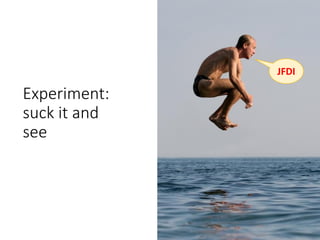
Experiment:
suck it and
see
JFDI
Fail fast
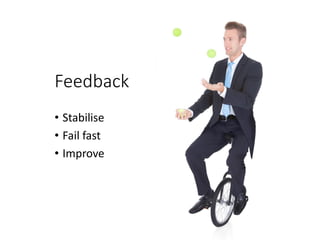
Feedback
• Stabilise
• Fail fast
• Improve
Why experiment?
If you’re wondering:
• How can I learn more about DevOps?
• How can DevOps thinking help our team?
• What can we experiment with?
• What can be better?
Then experiment to:
• Test whether a DevOps idea works in your context
• Create a proof point for the organisation
• Make a useful improvement
• Get people involved and enthused with DevOps
• Contribute to team-building
• Learn new skills
How to experiment?
• Workshop: Discuss amongst the team, and
decide on an experiment
• Reason (need, problem, risk)
• Scope
• Changes
• Desired outcome
• Put it in your work backlog
• Get it on the DevOps team’s list
• Get resources; collaborate
• Run the experiment
• Review results
• Reflect on what worked and what didn’t, and
what could be better
• Record results
• Share results
• Improve and try again
Brainstorming
experiments
• Workshop
• Facilitated by DevOps team
• 60-90 minutes
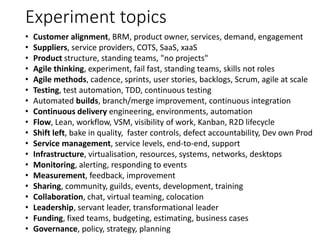
Experiment topics
• Customer alignment, BRM, product owner, services, demand, engagement
• Suppliers, service providers, COTS, SaaS, xaaS
• Product structure, standing teams, "no projects"
• Agile thinking, experiment, fail fast, standing teams, skills not roles
• Agile methods, cadence, sprints, user stories, backlogs, Scrum, agile at scale
• Testing, test automation, TDD, continuous testing
• Automated builds, branch/merge improvement, continuous integration
• Continuous delivery engineering, environments, automation
• Flow, Lean, workflow, VSM, visibility of work, Kanban, R2D lifecycle
• Shift left, bake in quality, faster controls, defect accountability, Dev own Prod
• Service management, service levels, end-to-end, support
• Infrastructure, virtualisation, resources, systems, networks, desktops
• Monitoring, alerting, responding to events
• Measurement, feedback, improvement
• Sharing, community, guilds, events, development, training
• Collaboration, chat, virtual teaming, colocation
• Leadership, servant leader, transformational leader
• Funding, fixed teams, budgeting, estimating, business cases
• Governance, policy, strategy, planning
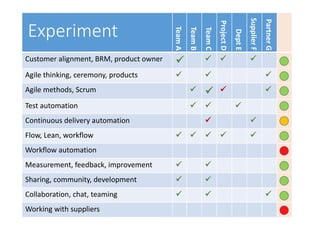
TeamA
TeamB
TeamC
ProjectD
DeptE
SupplierF
PartnerG
Customer alignment, BRM, product owner    
Agile thinking, ceremony, products   
Agile methods, Scrum    
Test automation   
Continuous delivery automation  
Flow, Lean, workflow     
Workflow automation
Measurement, feedback, improvement  
Sharing, community, development  
Collaboration, chat, teaming   
Working with suppliers
Experiment
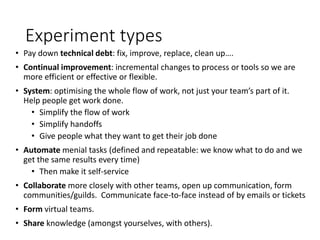
Experiment types
• Pay down technical debt: fix, improve, replace, clean up….
• Continual improvement: incremental changes to process or tools so we are
more efficient or effective or flexible.
• System: optimising the whole flow of work, not just your team’s part of it.
Help people get work done.
• Simplify the flow of work
• Simplify handoffs
• Give people what they want to get their job done
• Automate menial tasks (defined and repeatable: we know what to do and we
get the same results every time)
• Then make it self-service
• Collaborate more closely with other teams, open up communication, form
communities/guilds. Communicate face-to-face instead of by emails or tickets
• Form virtual teams.
• Share knowledge (amongst yourselves, with others).
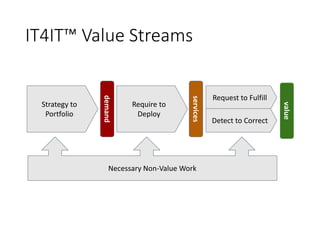
IT4IT™ Value Streams
Strategy to
Portfolio
Require to
Deploy
demand
services
Request to Fulfill
Detect to Correct
value
Necessary Non-Value Work
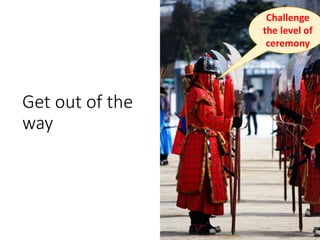
Get out of the
way
Challenge
the level of
ceremony
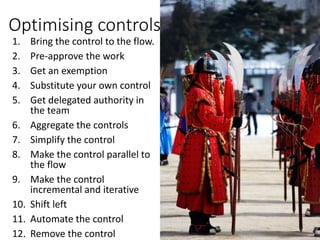
Optimising controls
1. Bring the control to the flow.
2. Pre-approve the work
3. Get an exemption
4. Substitute your own control
5. Get delegated authority in
the team
6. Aggregate the controls
7. Simplify the control
8. Make the control parallel to
the flow
9. Make the control
incremental and iterative
10. Shift left
11. Automate the control
12. Remove the control
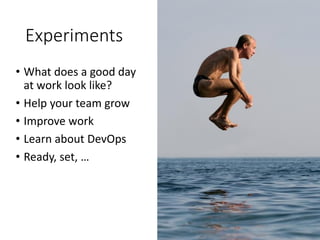
Experiments
• What does a good day
at work look like?
• Help your team grow
• Improve work
• Learn about DevOps
• Ready, set, …
© Two Hills Ltd 2016-2017
Created and published by Two Hills
letterbox@twohills.co.nz
www.twohills.co.nz
PO Box 57-150, Mana
Porirua 5247
New Zealand
Licensed under a Creative Commons Attribution-ShareAlike 3.0
Unported License.
Content must be attributed to "© Copyright Two Hills Ltd
www.twohills.co.nz by Rob England
Images copyright CanStockPhoto.com

DevOps experiment guidelines for leaders

  • 1.
  • 2.
  • 3.
  • 4.
  • 5.
    Why experiment? If you’rewondering: • How can I learn more about DevOps? • How can DevOps thinking help our team? • What can we experiment with? • What can be better? Then experiment to: • Test whether a DevOps idea works in your context • Create a proof point for the organisation • Make a useful improvement • Get people involved and enthused with DevOps • Contribute to team-building • Learn new skills
  • 6.
    How to experiment? •Workshop: Discuss amongst the team, and decide on an experiment • Reason (need, problem, risk) • Scope • Changes • Desired outcome • Put it in your work backlog • Get it on the DevOps team’s list • Get resources; collaborate • Run the experiment • Review results • Reflect on what worked and what didn’t, and what could be better • Record results • Share results • Improve and try again
  • 7.
  • 8.
    Experiment topics • Customeralignment, BRM, product owner, services, demand, engagement • Suppliers, service providers, COTS, SaaS, xaaS • Product structure, standing teams, "no projects" • Agile thinking, experiment, fail fast, standing teams, skills not roles • Agile methods, cadence, sprints, user stories, backlogs, Scrum, agile at scale • Testing, test automation, TDD, continuous testing • Automated builds, branch/merge improvement, continuous integration • Continuous delivery engineering, environments, automation • Flow, Lean, workflow, VSM, visibility of work, Kanban, R2D lifecycle • Shift left, bake in quality, faster controls, defect accountability, Dev own Prod • Service management, service levels, end-to-end, support • Infrastructure, virtualisation, resources, systems, networks, desktops • Monitoring, alerting, responding to events • Measurement, feedback, improvement • Sharing, community, guilds, events, development, training • Collaboration, chat, virtual teaming, colocation • Leadership, servant leader, transformational leader • Funding, fixed teams, budgeting, estimating, business cases • Governance, policy, strategy, planning
  • 9.
    TeamA TeamB TeamC ProjectD DeptE SupplierF PartnerG Customer alignment, BRM,product owner     Agile thinking, ceremony, products    Agile methods, Scrum     Test automation    Continuous delivery automation   Flow, Lean, workflow      Workflow automation Measurement, feedback, improvement   Sharing, community, development   Collaboration, chat, teaming    Working with suppliers Experiment
  • 10.
    Experiment types • Paydown technical debt: fix, improve, replace, clean up…. • Continual improvement: incremental changes to process or tools so we are more efficient or effective or flexible. • System: optimising the whole flow of work, not just your team’s part of it. Help people get work done. • Simplify the flow of work • Simplify handoffs • Give people what they want to get their job done • Automate menial tasks (defined and repeatable: we know what to do and we get the same results every time) • Then make it self-service • Collaborate more closely with other teams, open up communication, form communities/guilds. Communicate face-to-face instead of by emails or tickets • Form virtual teams. • Share knowledge (amongst yourselves, with others).
  • 11.
    IT4IT™ Value Streams Strategyto Portfolio Require to Deploy demand services Request to Fulfill Detect to Correct value Necessary Non-Value Work
  • 12.
    Get out ofthe way Challenge the level of ceremony
  • 13.
    Optimising controls 1. Bringthe control to the flow. 2. Pre-approve the work 3. Get an exemption 4. Substitute your own control 5. Get delegated authority in the team 6. Aggregate the controls 7. Simplify the control 8. Make the control parallel to the flow 9. Make the control incremental and iterative 10. Shift left 11. Automate the control 12. Remove the control
  • 14.
    Experiments • What doesa good day at work look like? • Help your team grow • Improve work • Learn about DevOps • Ready, set, …
  • 15.
    © Two HillsLtd 2016-2017 Created and published by Two Hills letterbox@twohills.co.nz www.twohills.co.nz PO Box 57-150, Mana Porirua 5247 New Zealand Licensed under a Creative Commons Attribution-ShareAlike 3.0 Unported License. Content must be attributed to "© Copyright Two Hills Ltd www.twohills.co.nz by Rob England Images copyright CanStockPhoto.com