Now, Robot:
Artificial Intelligence in 2017
Moshe Vardi,
APRIL 20, 2017
vardi@cs.rice.edu
Think Back to 2000!
• iPhone didn’t exist (2007)
• iTunes, iPod didn’t exist (2001)
• Video rental, CD music stores were everywhere
• Wikipedia didn’t exist (2001)
• Free video phone calls didn’t exist (2003)
• GPS-based driving directions didn’t exist (2008)
• You’d never have predicted that in 15 years:
You would speak routinely to computers
Your photo album would identify people in pictures
Self-driving cars would be on the road
Think Forward to 2030!
• Self driving, self flying vehicles?
• Widespread household, workplace robots?
• Intelligent workflow assistants?
• Super-human vision, hearing, smelling,
sensing?
• Computers that read and understand?
Expected: Unparalleled Wealth Creation
Tech 2017: $2.6T in market capitalization!
• Apple -- $735B
• Alphabet -– $575B
• Microsoft -- $504B
• Amazon.com -- $426B
• Facebook -- $400
What is the societal impact?
The Societal Cost of the Automobile
• 1.25M deaths in 2013 worldwide
• 20-50M are injured or disabled
• More than half of all road traffic deaths occur
among young adults ages 15-44
• Road crashes are the leading cause of death
among young people ages 15-29,
• Road crashes cost > $0.5T
• Human error accounts for more than 90% of car
crashes
The Automation of Driving
• 30 companies are now working on self-driving
cars – estimated market: $2-5T over next decade
• Technical issues to be resolved within 10-15 yrs
• Many legal issues need to be resolved
• Profound business disruption: (1) Major industrial
contraction (cars are now idle 90% of the time),
(2) “Major loss of business” for insurance, legal,
and medical industry
• Huge societal benefit: reduce accidents, liberate
elders and the disabled
The Most Common Jobs (2014)
Technology and Work
Threefold Impact:
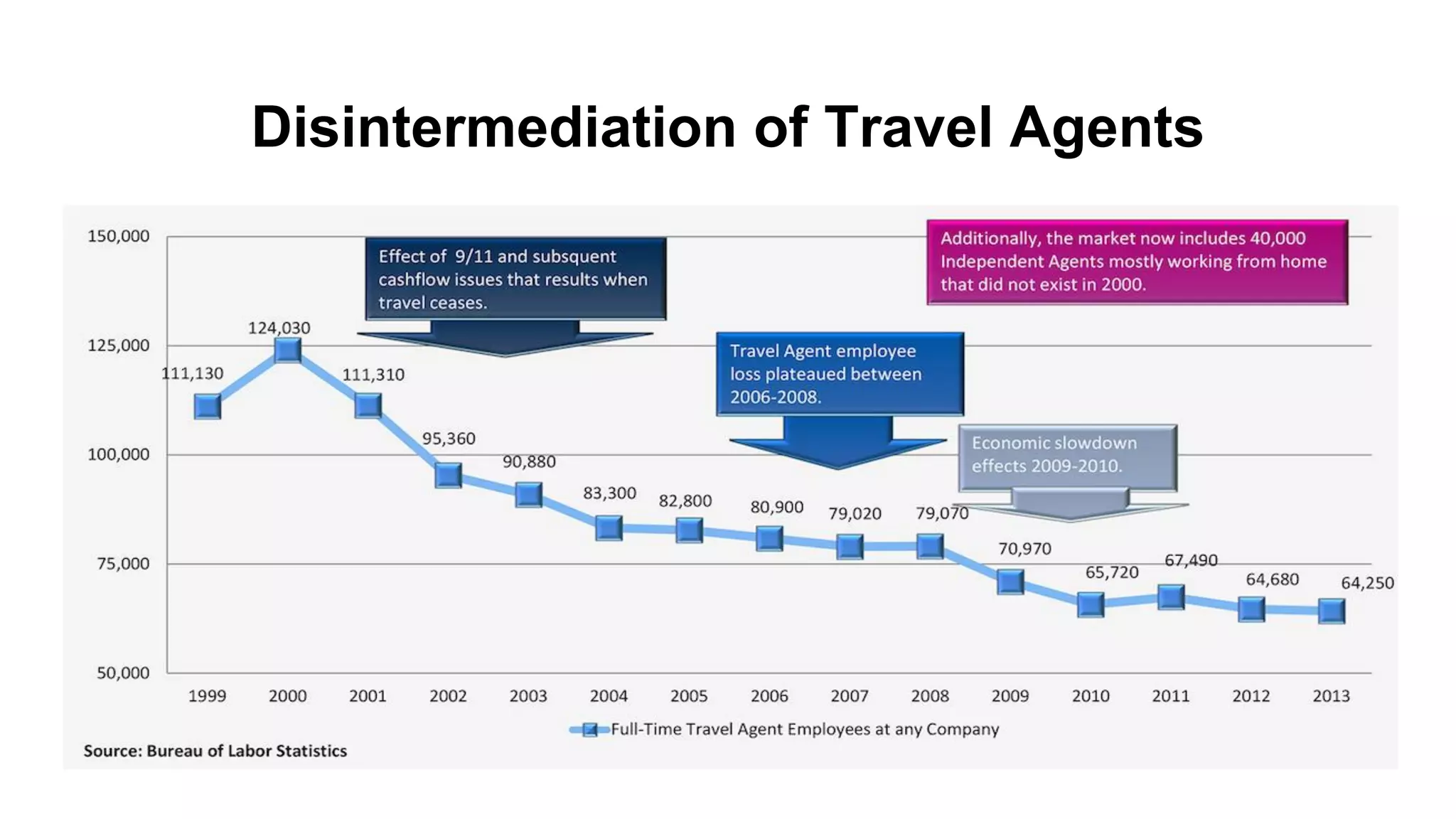
• Disintermediation: elimination of intermediaries
• Unbundling: replacement of “jobs” by collection of
“tasks”
• Substitution: replacement of human labor by
machines
Disintermediation
• The removal of intermediaries from a supply chain
in connection with a transaction or a series of
transactions.
Disintermediation of Travel Agents
Unbundling
• R. Coates, 1937: “The Nature of the Firm” --
Firms hire workers to reduce transaction costs
• Conclusion: If transaction costs can be reduced,
then firms should contract out and not hire.
• Job: an organizational role to perform a set of
tasks
• Conclusion: If transaction costs are low enough,
then jobs can be broken into their constituent
tasks and contracted out.
The Platform Economy
• Uber, Lyft: transportation
• Airbnb: lodging
• LinkedIn: recruiting
• Amazon, Microsoft, Google: Cloud
• Amazon: Retail
• TaskRabbit, UpWork, Fiverr: misc. services
The Contingent Workforce
• US GAO, May 2015 -- Contingent Workforce: Size,
Characteristics, Earnings, and Benefits: “We estimate
that contingent workers comprised 35.3 percent of employed
workers in 2006 and 40.4 percent in 2010.”
• McKinsey, Oct. 2016 -- Independent work: Choice,
necessity, and the gig economy: “1 in 3 workers employed in
Gig Economy, but not all by choice”
Substitution: What about the Drivers?
• 4M truck+taxi drivers in the US
• 15M US jobs involve operating a vehicle
• Automation of the whole supply chain is expected:
cargo ships, ports, trucking, warehouses, delivery,
…
• Bottom Line: Massive loss of jobs!
• But, new jobs will be created. Right?
• Comparison: Driving vs Manufacturing
Decoupling in US Manufacturing
Driving Force: Automation
Tesla Model S Factory Floor
The Future is Now
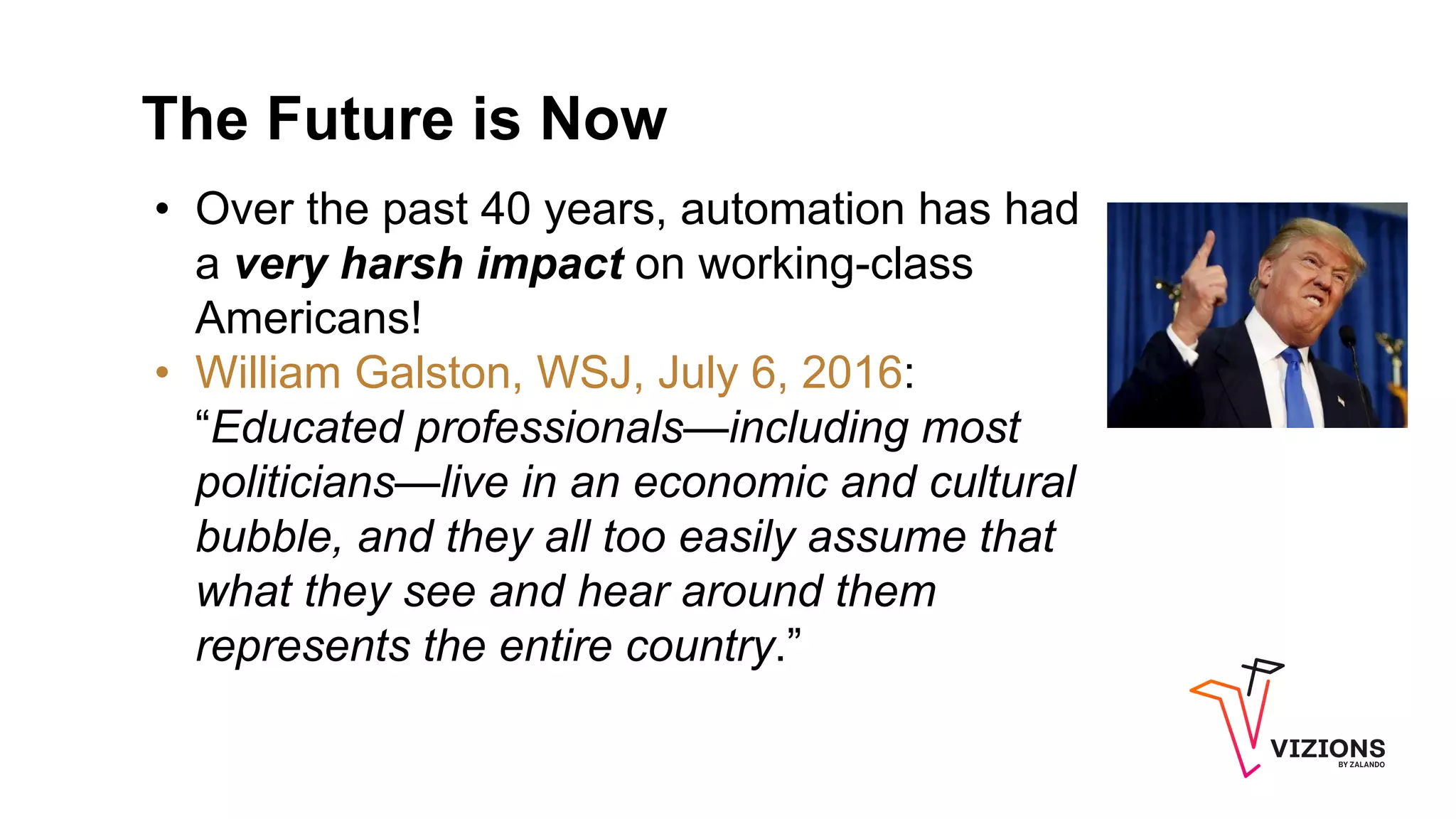
• Over the past 40 years, automation has had
a very harsh impact on working-class
Americans!
• William Galston, WSJ, July 6, 2016:
“Educated professionals—including most
politicians—live in an economic and cultural
bubble, and they all too easily assume that
what they see and hear around them
represents the entire country.”
The Great Decoupling
Real Median Income
Labor-Force Participation - Men
End of Marriage?
Growing Inequality
Political Response?
President Obama: Bloomberg News, June ‘16
“Because of automation, …, we’re going to
have to examine the social compact, the
same way we did early in the 19th century
and then again during and after the Great
Depression.”
THANK YOU – Questions?

Now, Robot: Artificial Intelligence in 2017

  • 1.
    Now, Robot: Artificial Intelligencein 2017 Moshe Vardi, APRIL 20, 2017 vardi@cs.rice.edu
  • 2.
    Think Back to2000! • iPhone didn’t exist (2007) • iTunes, iPod didn’t exist (2001) • Video rental, CD music stores were everywhere • Wikipedia didn’t exist (2001) • Free video phone calls didn’t exist (2003) • GPS-based driving directions didn’t exist (2008) • You’d never have predicted that in 15 years: You would speak routinely to computers Your photo album would identify people in pictures Self-driving cars would be on the road
  • 3.
    Think Forward to2030! • Self driving, self flying vehicles? • Widespread household, workplace robots? • Intelligent workflow assistants? • Super-human vision, hearing, smelling, sensing? • Computers that read and understand?
  • 4.
    Expected: Unparalleled WealthCreation Tech 2017: $2.6T in market capitalization! • Apple -- $735B • Alphabet -– $575B • Microsoft -- $504B • Amazon.com -- $426B • Facebook -- $400 What is the societal impact?
  • 5.
    The Societal Costof the Automobile • 1.25M deaths in 2013 worldwide • 20-50M are injured or disabled • More than half of all road traffic deaths occur among young adults ages 15-44 • Road crashes are the leading cause of death among young people ages 15-29, • Road crashes cost > $0.5T • Human error accounts for more than 90% of car crashes
  • 6.
    The Automation ofDriving • 30 companies are now working on self-driving cars – estimated market: $2-5T over next decade • Technical issues to be resolved within 10-15 yrs • Many legal issues need to be resolved • Profound business disruption: (1) Major industrial contraction (cars are now idle 90% of the time), (2) “Major loss of business” for insurance, legal, and medical industry • Huge societal benefit: reduce accidents, liberate elders and the disabled
  • 7.
    The Most CommonJobs (2014)
  • 8.
    Technology and Work ThreefoldImpact: • Disintermediation: elimination of intermediaries • Unbundling: replacement of “jobs” by collection of “tasks” • Substitution: replacement of human labor by machines
  • 9.
    Disintermediation • The removalof intermediaries from a supply chain in connection with a transaction or a series of transactions.
  • 10.
  • 11.
    Unbundling • R. Coates,1937: “The Nature of the Firm” -- Firms hire workers to reduce transaction costs • Conclusion: If transaction costs can be reduced, then firms should contract out and not hire. • Job: an organizational role to perform a set of tasks • Conclusion: If transaction costs are low enough, then jobs can be broken into their constituent tasks and contracted out.
  • 12.
    The Platform Economy •Uber, Lyft: transportation • Airbnb: lodging • LinkedIn: recruiting • Amazon, Microsoft, Google: Cloud • Amazon: Retail • TaskRabbit, UpWork, Fiverr: misc. services
  • 13.
    The Contingent Workforce •US GAO, May 2015 -- Contingent Workforce: Size, Characteristics, Earnings, and Benefits: “We estimate that contingent workers comprised 35.3 percent of employed workers in 2006 and 40.4 percent in 2010.” • McKinsey, Oct. 2016 -- Independent work: Choice, necessity, and the gig economy: “1 in 3 workers employed in Gig Economy, but not all by choice”
  • 14.
    Substitution: What aboutthe Drivers? • 4M truck+taxi drivers in the US • 15M US jobs involve operating a vehicle • Automation of the whole supply chain is expected: cargo ships, ports, trucking, warehouses, delivery, … • Bottom Line: Massive loss of jobs! • But, new jobs will be created. Right? • Comparison: Driving vs Manufacturing
  • 15.
    Decoupling in USManufacturing
  • 16.
  • 17.
    Tesla Model SFactory Floor
  • 18.
    The Future isNow • Over the past 40 years, automation has had a very harsh impact on working-class Americans! • William Galston, WSJ, July 6, 2016: “Educated professionals—including most politicians—live in an economic and cultural bubble, and they all too easily assume that what they see and hear around them represents the entire country.”
  • 19.
  • 20.
  • 21.
  • 22.
  • 23.
  • 24.
    Political Response? President Obama:Bloomberg News, June ‘16 “Because of automation, …, we’re going to have to examine the social compact, the same way we did early in the 19th century and then again during and after the Great Depression.”
  • 25.
    THANK YOU –Questions?