Download to read offline

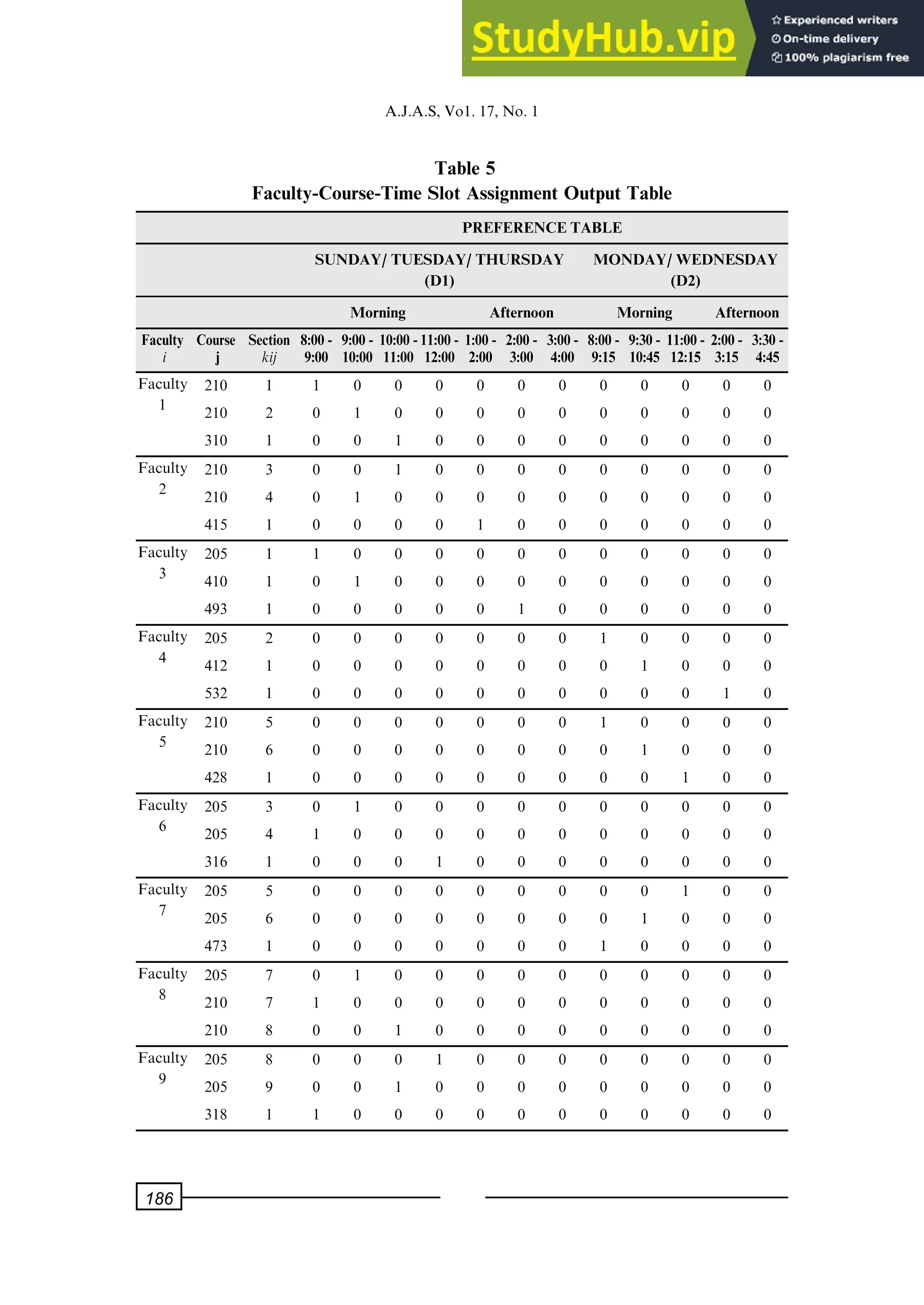
![proven to ful®ll most goals comple-
tely. Moreover, faculties satisfaction
levelobtainedwereupto85.2and88.
8 for the two stages models respec-
tively. The overall satisfaction level
when combining the two results
reachedupto73.6%asfarasfaculties
getting their ®rst choices of prefer-
ences.Nonetheless,faculties'satisfac-
tionlevelreachedupto100%whenit
came to getting at least their second
choices of preferences.Itis important
to realize however, that faculties' sa-
tisfaction level is solely data depen-
dent.Thismeansthatifmostfaculties
prefer to teach the same course and
only one faculty could teach it at a
time, then not everybody who prefers
to teach that course could do so. On
the other hand, if it happens that
di€erent faculties prefer to teach dif-
ferentcourses,thenmostfacultieswill
be assigned to teach their preferred
courses. Work is underway to build a
three-stage model integrated within a
decision support system. The imple-
mentation and the results of the ex-
perimentationwithsuchsystemforall
majors at the College of Business
Administration will be reported in a
forthcoming paper.
References
Dinkel, J. and J.Mote. 1989. An Ecient
Decision Support System for Aca-
demic Course Scheduling. Opera-
tionsResearch,37(6): 853-864
Badri, M. A. 1996. A two-stage multi-
objective scheduling model for [fa-
culty-course-time] assignments. Eur-
opean Journal of Operational
Research,94(1): 16-28.
Badri, M. A., Davis, D. L., Davis, D. F.,
Hollingsworth, J. 1998. A multi-ob-
jective course scheduling model:
Combining faculty preferences for
courses and times. Computers and
OperationsResearch,25(4): 303-316.
Hinkin, T. R. and Thompson, G. M.
2002. SchedulExpert: Scheduling
Courses in the Cornell University
School of Hotel Administration. In-
terfaces,32(6): 45-57
Al-Yakoob, S. M. and Sherali, H. D.
2006. Mathematical programming
models and algorithms for a class-
faculty assignment problem. Eur-
opean Journal of Operational Re-
search,173:488-507.
Al-Yakoob, S. M. and Sherali, H. D.
2007. A mixed-integer programming
approach to a class timetabling pro-
blem: A case study with gender po-
licies and trac considerations an.
EuropeanJournalofOperationalRe-
search,180:1028-1044.
Anderson, D., Sweeney, D., Williams, T.
2008. An Introduction to Manage-
ment Science: Quantitative Ap-
proaches toDecision Making, 11e.
Lee, S. 1972. Goal Programming for De-
cision Analysis. Auberback Publish-
ers, Philadelphia, PA.
A.J.A.S,Vo1.17,No.1
188](https://image.slidesharecdn.com/asequentialtwo-stagegoalprogrammingmod-elforfaculty-course-timeslotassignments-230804170023-143bf4b0/75/A-Sequential-Two-Stage-Goal-Programming-Mod-El-For-Faculty-Course-Time-Slot-Assignments-20-2048.jpg)

![G
_
l
_
M
[
F
l
a
P
L
=
Q
l
G
?
C
J
O
G
q
A
A
9
=
g
d
P
a
l
Q
J
_
A
c
H
_
l
W
t
_
?
A
M
Z
c
[
C
f
]
9
A
J
c
8
?
G
_
A
O
Q
c
U
_
_
l
a
G
O
G
_
O
Q
G
T
c
?
a
C
a
r
9
B
G
_
A
O
Q
c
U
l
J
l
O
t
l
9
c
J
T
H
Q
G
8
O
r
Q
=
9
H
G
_
J
T
c
H
J
l
c
O
C
J
l
O
G
_
r
9
J
Q
j
G
9
l
g
?
G
_
t
a
c
B
c
g
O
A
a
a
c
Q
F
l
a
P
L
c
T
A
a
c
h
C
H
c
F
A
H
f
F
G
O
a
_
?
A
A
Z
q
=
9
_
t
p
9
A
I
a
G
_
p
g
9
_
c
?
F
f
]
9
A
J
c
8
?
G
_
A
O
Q
c
U
_
_
l
a
G
O
G
_
O
Q
G
T
c
?
a
C
a
r
9
B
G
_
A
O
Q
c
U
,
a
G
J
O
G
k
l
H
C
J
m
G
_
A
J
O
c
9
B
G
_
A
d
A
a
G
G
l
g
d
m
G
_
G
9
l
g
9
B
p
d
G
l
c
h
C
F
J
9
A
G
_
g
9
_
m
.
a
r
O
A
m
A
Z
l
c
m
a
=
F
9
A
f
O
I
C
F
d
l
?
p
d
J
P
G
G
_
l
G
9
c
_
_
J
Z
a
c
f
_
b
G
_
G
O
a
c
G
_
l
D
9
_
d
_
P
_
u
,
a
_
t
H
l
g
d
m
J
P
g
G
F
F
d
l
?
t
9
F
B
A
g
9
F
d
l
H
=
g
^
G
a
G
F
G
_
r
Z
a
Q
a
G
_
g
G
R
.
p
d
J
P
G
G
_
=
J
E
A
m
G
T
A
M
O
G
m
a
Q
c
r
?
G
_
=
Q
l
G
?
G
_
K
O
p
c
?
G
_
D
F
9
8
c
?
(
Z
p
Q
-
1
)
=
J
c
E
A
m
A
M
Z
c
[
C
f
]
9
A
J
c
8
?
G
_
A
O
Q
c
U
_
_
l
a
G
O
G
_
O
Q
G
T
c
?
p
d
G
_
l
Q
J
_
?
G
F
a
_
b
,
D
m
A
M
Z
c
[
t
c
f
]
a
J
c
8
?
A
O
Q
c
U
l
h
G
_
l
9
O
I
G
_
l
M
Z
Z
?
_
_
_
p
A
Q
G
B
G
_
R
l
F
c
?
G
_
l
M
Z
Z
?
_
t
c
c
a
m
O
Q
G
T
d
p
d
G
_
l
Q
J
_
?
G
_
D
9
F
c
?
.
M
;
c
J
9
A
c
H
G
_
l
Q
J
_
A
c
H
c
g
l
c
G
_
F
l
a
P
L
f
_
b
A
g
d
c
m
C
p
]
_
c
?
C
f
]
9
A
J
c
8
?
G
_
A
O
Q
c
U
_
_
l
a
G
O
G
_
O
Q
G
T
c
?
p
d
G
_
l
Q
J
_
?
G
F
a
_
b
,
D
m
A
g
d
c
m
C
p
]
_
c
?
C
f
]
9
A
J
c
8
?
G
_
A
O
Q
c
U
_
I
a
r
9
B
G
_
R
l
F
c
?
_
A
O
Q
c
U
t
c
l
9
O
I
A
m
A
M
Z
c
Z
K
9
_
p
d
G
_
l
Q
J
_
?
G
F
a
_
b
.
A
r
a
m
G
_
a
Q
c
r
?
G
_
l
T
A
M
O
l
?
p
d
J
P
G
G
_
=
J
E
=
A
J
r
c
s
f
O
I
C
J
O
G
q
J
T
C
a
_
a
c
9
B
l
J
O
O
I
,
=
J
c
E
c
A
m
A
J
r
c
s
t
c
J
O
q
J
T
C
J
l
c
A
=
9
_
F
T
=
?
E
_
b
G
_
r
a
G
f
O
a
G
_
r
a
G
F
c
H
G
_
l
a
_
a
=
?
a
G
_
M
9
Z
?
=
9
_
G
9
l
g
?
a
G
_
t
_
c
?
a
G
_
r
T
m
a
G
_
A
M
Z
[
,
a
A
m
G
_
r
c
9
m
=
T
c
F
9
Q
c
a
J
9
B
l
M
A
_
p
?
:
M
A
=
9
Q
Z
J
?
G
_
F
l
a
P
L
.
a
_
r
O
C
D
=
A
B
G
_
l
Q
J
_
?
G
F
a
_
b
l
H
G
_
F
l
a
P
L
r
O
Q
I
f
_
b
A
J
r
c
s
l
g
d
m
G
F
J
O
G
q
t
9
l
_
?
,
a
A
J
r
c
s
E
G
l
9
_
d
C
p
]
_
c
?
C
f
]
9
A
J
c
8
?
G
_
A
O
Q
c
U
E
_
b
G
_
l
a
G
O
G
_
A
d
c
Q
i
=
a
H
p
d
A
O
Q
c
T
K
9
=
F
T
=
?
85,2
%
a
p
d
G
_
l
Q
J
_
?
G
_
D
9
F
c
?
G
T
A
a
9
Y
G
_
F
l
a
P
L
C
H
c
J
r
s
C
p
]
_
c
?
C
f
]
9
A
J
c
8
?
G
_
A
O
Q
c
U
E
_
b
G
F
a
r
9
B
G
_
R
l
F
c
?
_
A
O
Q
c
U
G
_
l
a
G
O
G
_
l
M
Z
Z
?
_
K
m
=
F
T
=
?
E
G
l
9
_
c
?
A
Z
c
E
_
b
88,8
%
.
Mohamad K. Hasan received a degree of Bachelor of Science in
Mathematical Statistics from Alexandria University, Egypt, in
1978. He was awarded a degree of Master of Science in Mathe-
matics from Texas AM University, Texas, USA, in 1988, and a
degree of Doctor of Philosophy in Transportation Systems from
Texas AM University, Texas USA, in 1991. Currently, he works
as Associate Professor at Department of Quantitative Methods
and Information Systems, College of Business Administration,
A.J.A.S,Vo1.17,No.1
190](https://image.slidesharecdn.com/asequentialtwo-stagegoalprogrammingmod-elforfaculty-course-timeslotassignments-230804170023-143bf4b0/75/A-Sequential-Two-Stage-Goal-Programming-Mod-El-For-Faculty-Course-Time-Slot-Assignments-22-2048.jpg)


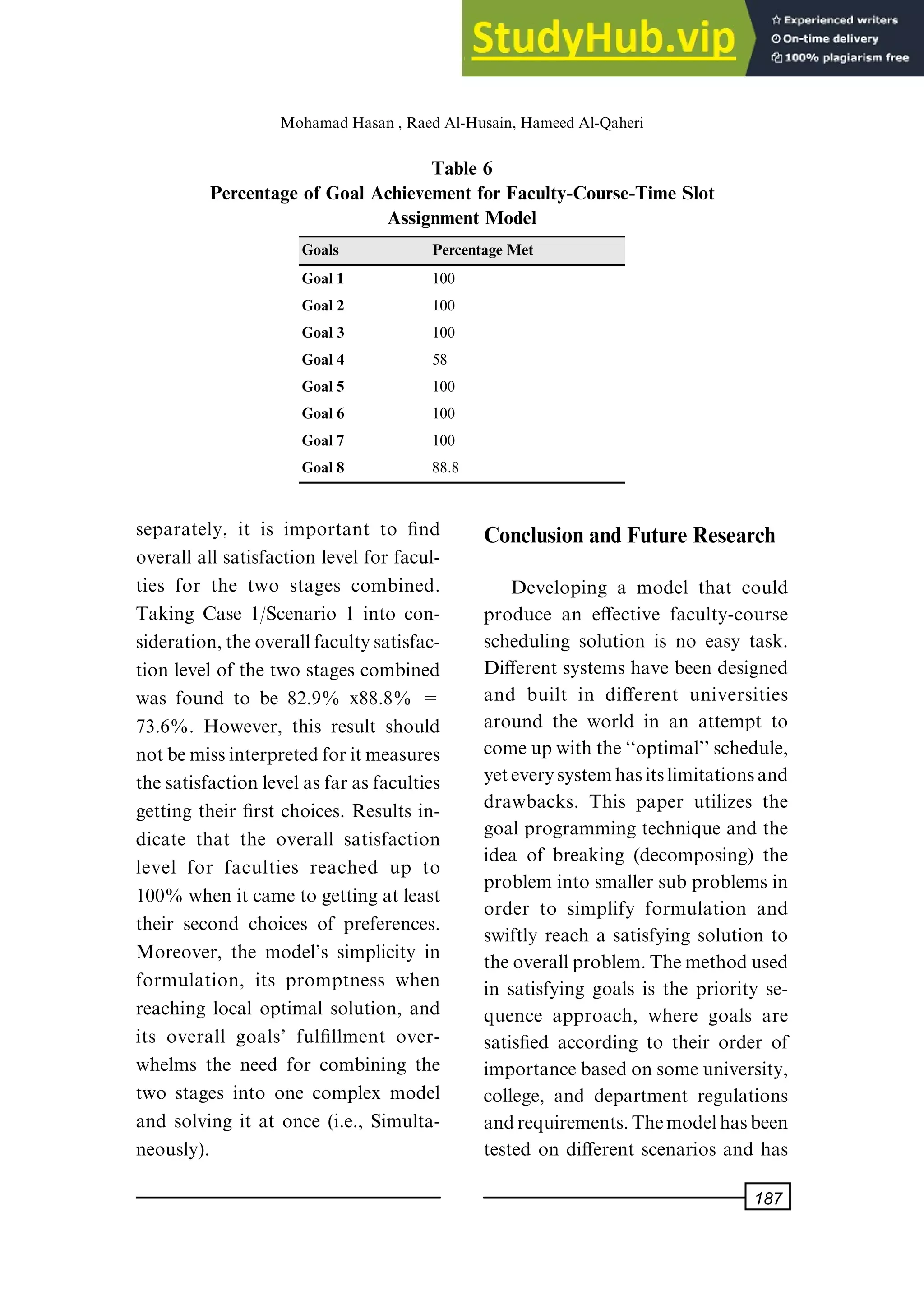
This paper proposes a two-stage sequential goal programming model for faculty-course-time slot assignments at Kuwait University. The first stage uses goal programming to assign faculty members to courses by maximizing faculty course preferences. The second stage then allocates assigned faculty-courses to time slots by maximizing faculty time preferences. The model decomposes the complex scheduling problem into more manageable stages. Testing showed the first stage fulfilled faculty course teaching preferences up to 85.2% and the second stage fulfilled faculty-course-time slot preferences up to 88.8%.


