TIMETABLE MANAGEMENT SYSTEM USING AHP
CSW 35104: FINAL YEAR PROJECT 1
NAME : EMEER SHAFIQ BIN ROSLAN
NO MATRIC : 043039
SUBJECT : CSF 35104 FINAL YEAR PROJECT I
SUPERVISOR : DR. AZRUL AMRI BIN JAMAL
Background Project
 The head of an academic department in any university is usually
responsible for preparing a course timetable every semester.
 Preparing course timetables is a time-consuming task which academic
colleges face.
 Course timetabling is not only formulating a timetable for courses, but also
has to be performed based on many constraints, such as classroom
availability and capacity, interference between rooms and courses and
conflicts between courses and instructors.
 The timetabling problem consists in scheduling a sequence of lectures
between teachers and students in a prefixed period of time (typically a
week), satisfying a set of constraints of various types.
 The manual solution of the timetabling problem usually requires many
person-days of work.
 In addition, the solution obtained may be unsatisfactory in some respect,
for example a student may not be able to take the courses he/she wants
because they are scheduled at the same time.
 For the above reason, a considerable attention has been devoted to
automated timetabling.
 During the last thirty years, starting with (Gotlieb 1963), many papers
related to automated timetabling have been published in conferences
proceedings and journals.
 In addition, several applications have been developed and employed with
a good success.
Problem Statement
 The course timetabling problem must be solved by the departments of Universities at
the beginning of every semester(Hana Rudov´a, Tom´aˇs M¨uller and Keith Murray, 2014
)
 It is a though problem which requires department to use humans and computers in
order to find a proper course timetable(Berggn,Robert,Nielsen,Timmy, 2018)
 Timetabling process must be done for each semester frequently, which is an exhausting
and time consuming task(Hamed Babaie, Jabeb Karimpour, Amin Hadidi, 2014)
 The allocation of whole of events in timeslots and rooms performs by the university
course timetabling process considering the list of hard and soft constraints presented in
one semester, so that no conflict is created in such
allocations(Cemalettin Kubat, Harun Taskin, ErcanÖztemel, 2016)
 Scheduling lectures, exams, seminars etc. for a university turns out to be a harder task
than what it seems to be at first glance(Can Akkan, Aylan Gulcu, 2018)
Objectives
 To study the requirement of generating a timetable and AHP technique
method in providing alternative solutions for CTUAT.
 To design a timetable management that processes each of the courses
requirement using simple AHP technique.
 To implement/develop the timetabling system using AHP technique.
 To analyze the performance of the timetable management tool
performance in term of processing speed for each course.
METHODOLOGY
Rapid Prototyping:
 The process of prototyping involves quick building up of a prototype or
working model for the purpose of testing the various design features,
ideas, concepts, functionality, output and performance.
 Refers to the creation of a model that will eventually be discarded rather
than becoming part of the final delivered software.
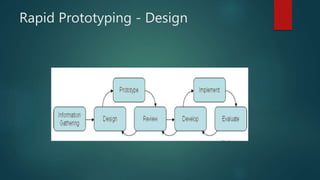
 The following illustration is a representation of the different phases of the
Rapid Prototyping model.
Rapid Prototyping - Design
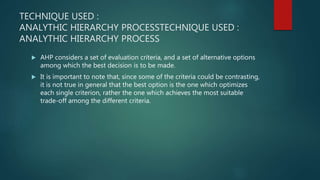
TECHNIQUE USED :
ANALYTHIC HIERARCHY PROCESSTECHNIQUE USED :
ANALYTHIC HIERARCHY PROCESS
 AHP considers a set of evaluation criteria, and a set of alternative options
among which the best decision is to be made.
 It is important to note that, since some of the criteria could be contrasting,
it is not true in general that the best option is the one which optimizes
each single criterion, rather the one which achieves the most suitable
trade-off among the different criteria.
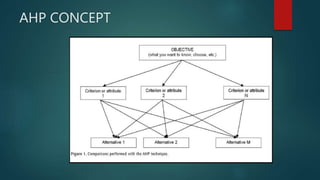
AHP CONCEPT
AHP ALGORITHM :
NUMERIC ALGORITHM
Assuming the AHP hierarchy on the left as our sample,
for :
Level 1 : Expertise Criteria (4 x 4 size)
Level 2 : Lecturer (3 x 3 size)
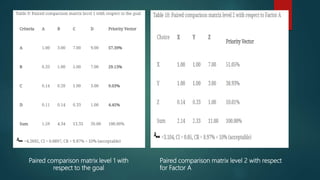
We have to make a comparison matrices, (4 X 4) and
(3 X 3)
Using equation :
Paired comparison matrix level 1 with
respect to the goal
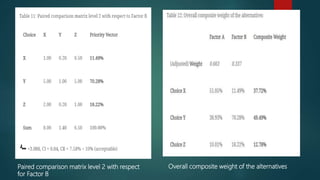
Paired comparison matrix level 2 with respect
for Factor A
Paired comparison matrix level 2 with respect
for Factor B
Overall composite weight of the alternatives
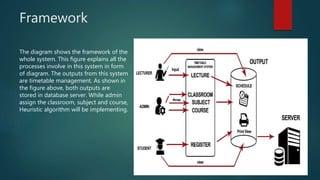
Framework
The diagram shows the framework of the
whole system. This figure explains all the
processes involve in this system in form
of diagram. The outputs from this system
are timetable management. As shown in
the figure above, both outputs are
stored in database server. While admin
assign the classroom, subject and course,
Heuristic algorithm will be implementing.
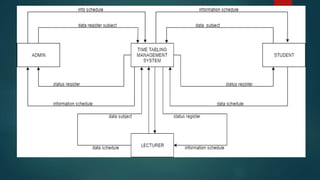
Context Diagram
 Diagram below shows the context diagram that displays all the function of
the systems.
DATA FLOW DIAGRAM
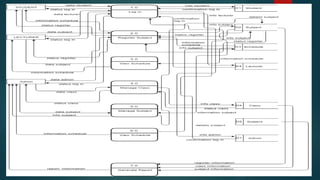
 Diagram below shows the Data Flow Diagram level 0 that displays all the
function of the systems.
ERD DIAGRAM
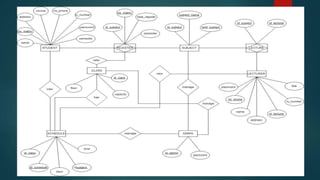
 Diagram below shows the Entity Relationship Diagram that displays the
relationship of the systems.
id
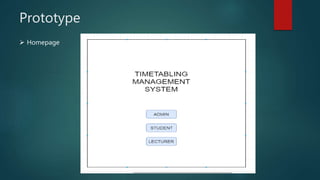
Prototype
 Homepage
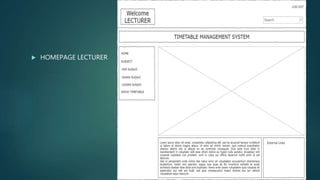
PROTOTYPE
 LOG IN
 HOMEPAGE ADMIN
 HOMEPAGE LECTURER
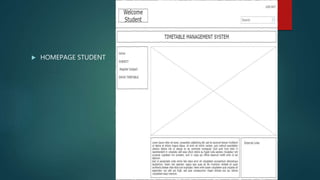
 HOMEPAGE STUDENT
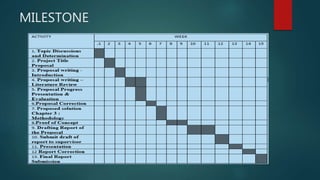
MILESTONE
REFERENCES
 Abdullah, S., Burke, E. K., & McCollum, B. (2007, September). A hybrid evolutionary
approach to the university course timetabling problem. In Evolutionary Computation,
2007. CEC 2007. IEEE Congress on (pp. 1764-1768). IEEE.
 Kostuch, P., & Socha, K. (2004, April). Hardness prediction for the university course
timetabling problem. In European Conference on Evolutionary Computation in
Combinatorial Optimization (pp. 135-144). Springer, Berlin, Heidelberg.
 Ozdemir, M. S., & Gasimov, R. N. (2004). The analytic hierarchy process and
multiobjective 0–1 faculty course assignment. European Journal of Operational
Research, 157(2), 398-408.
 Kumar, S. (2016). Solving University Course Timetabling Problem Using AHP Method. IUP
Journal of Computer Sciences, 10.
 Ilham, N. I., Saat, E. M., Rahman, N. A., Rahman, F. Y. A., & Kasuan, N. (2017, November).
Auto-generate scheduling system based on expert system. In Control System,
Computing and Engineering (ICCSCE), 2017 7th IEEE International Conference on (pp. 6-
10). IEEE.

Timetable management system(chapter 3)

  • 1.
    TIMETABLE MANAGEMENT SYSTEMUSING AHP CSW 35104: FINAL YEAR PROJECT 1 NAME : EMEER SHAFIQ BIN ROSLAN NO MATRIC : 043039 SUBJECT : CSF 35104 FINAL YEAR PROJECT I SUPERVISOR : DR. AZRUL AMRI BIN JAMAL
  • 2.
    Background Project  Thehead of an academic department in any university is usually responsible for preparing a course timetable every semester.  Preparing course timetables is a time-consuming task which academic colleges face.  Course timetabling is not only formulating a timetable for courses, but also has to be performed based on many constraints, such as classroom availability and capacity, interference between rooms and courses and conflicts between courses and instructors.  The timetabling problem consists in scheduling a sequence of lectures between teachers and students in a prefixed period of time (typically a week), satisfying a set of constraints of various types.
  • 3.
     The manualsolution of the timetabling problem usually requires many person-days of work.  In addition, the solution obtained may be unsatisfactory in some respect, for example a student may not be able to take the courses he/she wants because they are scheduled at the same time.  For the above reason, a considerable attention has been devoted to automated timetabling.  During the last thirty years, starting with (Gotlieb 1963), many papers related to automated timetabling have been published in conferences proceedings and journals.  In addition, several applications have been developed and employed with a good success.
  • 4.
    Problem Statement  Thecourse timetabling problem must be solved by the departments of Universities at the beginning of every semester(Hana Rudov´a, Tom´aˇs M¨uller and Keith Murray, 2014 )  It is a though problem which requires department to use humans and computers in order to find a proper course timetable(Berggn,Robert,Nielsen,Timmy, 2018)  Timetabling process must be done for each semester frequently, which is an exhausting and time consuming task(Hamed Babaie, Jabeb Karimpour, Amin Hadidi, 2014)  The allocation of whole of events in timeslots and rooms performs by the university course timetabling process considering the list of hard and soft constraints presented in one semester, so that no conflict is created in such allocations(Cemalettin Kubat, Harun Taskin, ErcanÖztemel, 2016)  Scheduling lectures, exams, seminars etc. for a university turns out to be a harder task than what it seems to be at first glance(Can Akkan, Aylan Gulcu, 2018)
  • 5.
    Objectives  To studythe requirement of generating a timetable and AHP technique method in providing alternative solutions for CTUAT.  To design a timetable management that processes each of the courses requirement using simple AHP technique.  To implement/develop the timetabling system using AHP technique.  To analyze the performance of the timetable management tool performance in term of processing speed for each course.
  • 6.
    METHODOLOGY Rapid Prototyping:  Theprocess of prototyping involves quick building up of a prototype or working model for the purpose of testing the various design features, ideas, concepts, functionality, output and performance.  Refers to the creation of a model that will eventually be discarded rather than becoming part of the final delivered software.  The following illustration is a representation of the different phases of the Rapid Prototyping model.
  • 7.
  • 8.
    TECHNIQUE USED : ANALYTHICHIERARCHY PROCESSTECHNIQUE USED : ANALYTHIC HIERARCHY PROCESS  AHP considers a set of evaluation criteria, and a set of alternative options among which the best decision is to be made.  It is important to note that, since some of the criteria could be contrasting, it is not true in general that the best option is the one which optimizes each single criterion, rather the one which achieves the most suitable trade-off among the different criteria.
  • 9.
  • 10.
    AHP ALGORITHM : NUMERICALGORITHM Assuming the AHP hierarchy on the left as our sample, for : Level 1 : Expertise Criteria (4 x 4 size) Level 2 : Lecturer (3 x 3 size) We have to make a comparison matrices, (4 X 4) and (3 X 3) Using equation :
  • 11.
    Paired comparison matrixlevel 1 with respect to the goal Paired comparison matrix level 2 with respect for Factor A
  • 12.
    Paired comparison matrixlevel 2 with respect for Factor B Overall composite weight of the alternatives
  • 13.
    Framework The diagram showsthe framework of the whole system. This figure explains all the processes involve in this system in form of diagram. The outputs from this system are timetable management. As shown in the figure above, both outputs are stored in database server. While admin assign the classroom, subject and course, Heuristic algorithm will be implementing.
  • 14.
    Context Diagram  Diagrambelow shows the context diagram that displays all the function of the systems.
  • 16.
    DATA FLOW DIAGRAM Diagram below shows the Data Flow Diagram level 0 that displays all the function of the systems.
  • 18.
    ERD DIAGRAM  Diagrambelow shows the Entity Relationship Diagram that displays the relationship of the systems.
  • 19.
  • 20.
  • 21.
  • 22.
  • 23.
  • 24.
  • 25.
  • 26.
    REFERENCES  Abdullah, S.,Burke, E. K., & McCollum, B. (2007, September). A hybrid evolutionary approach to the university course timetabling problem. In Evolutionary Computation, 2007. CEC 2007. IEEE Congress on (pp. 1764-1768). IEEE.  Kostuch, P., & Socha, K. (2004, April). Hardness prediction for the university course timetabling problem. In European Conference on Evolutionary Computation in Combinatorial Optimization (pp. 135-144). Springer, Berlin, Heidelberg.  Ozdemir, M. S., & Gasimov, R. N. (2004). The analytic hierarchy process and multiobjective 0–1 faculty course assignment. European Journal of Operational Research, 157(2), 398-408.  Kumar, S. (2016). Solving University Course Timetabling Problem Using AHP Method. IUP Journal of Computer Sciences, 10.  Ilham, N. I., Saat, E. M., Rahman, N. A., Rahman, F. Y. A., & Kasuan, N. (2017, November). Auto-generate scheduling system based on expert system. In Control System, Computing and Engineering (ICCSCE), 2017 7th IEEE International Conference on (pp. 6- 10). IEEE.