Politecnico	di	Milano
Dipartimento	di	Elettronica,	Informazione	e	Bioingegneria	(DEIB)
Anna	Maria	Nestorov,	Enrico	Reggiani	and	Marco	D.	Santambrogio
{annamaria.nestorov,	enrico2.reggiani}@mail.polimi.it	
marco.santambrogio@polimi.it		
A	SCALABLE	DATAFLOW	IMPLEMENTATION	OF		
CURRAN’S	APPPROXIMATION	ALGORITHM	
7th	June	2017	@	Xilinx
2
Contributions
Thanks to the Maxeler Tools productivity features, we aimed to create an
efficient parametric design which: 

1. Computes Value at Risk (VaR) of a portfolio of Asian Options based on
Curran’s approximation method

2. Supports arbitrary number of averaging points
3
• Black-Scholes model: option payoff variable no closed-form representation for
its probability distribution

• Curran's Approximation: expected option payoff conditional on the
geometric mean of the prices at averaging points

• Curran’s algorithm characterised by:

1. High degree of precision

2. Computational intensive 

• High number of invocations to the Normal Cumulative Distribution Function
(NCDF), exponentials and logarithms

• Highly parallel computation, completely independent variables are calculated

• Evaluation of one portfolio takes from one to many hours
Curran’s	Approximation	for	Asian	Option	Pricing
4
• A	server-class	HPC	system	comprising:	
1.	8	MAX4	MAIA	DFEs	with	an	Altera	StraXx	V	FPGA	and	96	GB	of	DRAM	each		
2.	a	dual	socket	Intel	Xeon	CPU	X5650	CPU	subsystem	with	24	hardware	cores	per	
socket	running	at	2.67GHz	and	using	768GB	of	RAM
1U	Maxeler	MAX4	MPC-X	Architecture
5
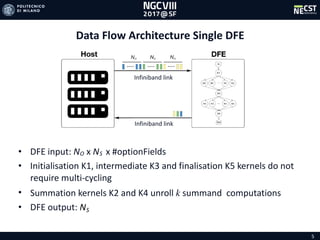
• DFE	input:	N			x	N			x	#optionFields		
• Initialisation	K1,	intermediate	K3	and	finalisation	K5	kernels	do	not	
require	multi-cycling		
• Summation	kernels	K2	and	K4	unroll	k	summand		computations	
• DFE	output:	N	S
Data	Flow	Architecture	Single	DFE
O S
Infiniband	link
Infiniband	link
6
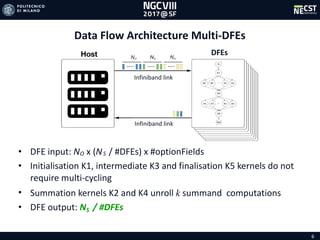
• DFE	input:	N			x	(N			/	#DFEs)	x	#optionFields		
• Initialisation	K1,	intermediate	K3	and	finalisation	K5	kernels	do	not	
require	multi-cycling		
• Summation	kernels	K2	and	K4	unroll	k	summand		computations	
• DFE	output:	N			/	#DFEsS
Data	Flow	Architecture	Multi-DFEs
O S
DFEs
Infiniband	link
Infiniband	link
7
• Two	test	data	sets:	DataSet30	and	DataSet780	
• Precision	analysis	performed	exploiting	fixed-point	
and	floating-point	data	types,	one	per	build,	for	the	
entire	design	
• DFE	resource	usage	analysis	for	the	same	data	types	
• Dynamic	ranges	analysis	
Experiments
8
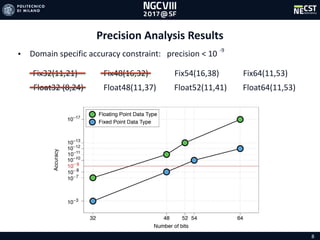
• Domain	specific	accuracy	constraint:			precision	<	10		
																						
Fix32(11,21)													Fix48(16,32)													Fix54(16,38)												Fix64(11,53)
Float32	(8,24)										Float48(11,37)									Float52(11,41)								Float64(11,53)
Precision	Analysis	Results
-9
9
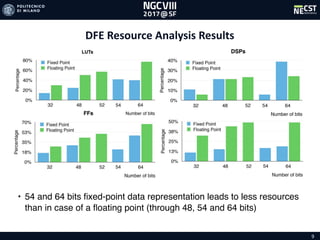
• 54 and 64 bits fixed-point data representation leads to less resources
than in case of a floating point (through 48, 54 and 64 bits)
DFE	Resource	Analysis	Results
10
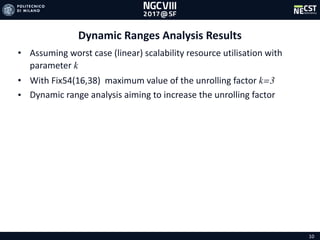
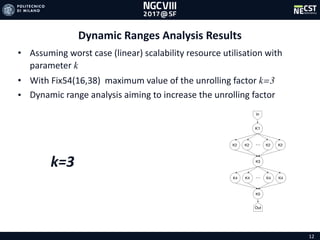
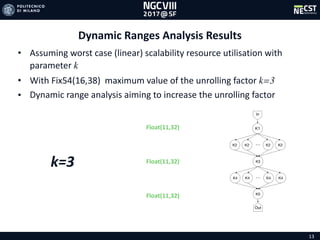
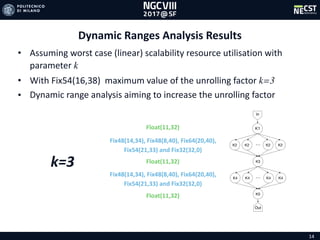
• Assuming	worst	case	(linear)	scalability	resource	utilisation	with	
parameter	k	
• With	Fix54(16,38)		maximum	value	of	the	unrolling	factor	k=3	
• Dynamic	range	analysis	aiming	to	increase	the	unrolling	factor
Dynamic	Ranges	Analysis	Results
11
• Assuming	worst	case	(linear)	scalability	resource	utilisation	with	
parameter	k	
• With	Fix54(16,38)		maximum	value	of	the	unrolling	factor	k=3	
• Dynamic	range	analysis	aiming	to	increase	the	unrolling	factor
k=3
Dynamic	Ranges	Analysis	Results
12
• Assuming	worst	case	(linear)	scalability	resource	utilisation	with	
parameter	k	
• With	Fix54(16,38)		maximum	value	of	the	unrolling	factor	k=3	
• Dynamic	range	analysis	aiming	to	increase	the	unrolling	factor
K1
K2 K2 K2 K2
K3
K4 K4 K4 K4
K5
…
…
k=3
Dynamic	Ranges	Analysis	Results
13
• Assuming	worst	case	(linear)	scalability	resource	utilisation	with	
parameter	k	
• With	Fix54(16,38)		maximum	value	of	the	unrolling	factor	k=3	
• Dynamic	range	analysis	aiming	to	increase	the	unrolling	factor
K1
K2 K2 K2 K2
K3
K4 K4 K4 K4
K5
…
…
Float(11,32)
Float(11,32)
Float(11,32)
k=3
Dynamic	Ranges	Analysis	Results
14
• Assuming	worst	case	(linear)	scalability	resource	utilisation	with	
parameter	k	
• With	Fix54(16,38)		maximum	value	of	the	unrolling	factor	k=3	
• Dynamic	range	analysis	aiming	to	increase	the	unrolling	factor
K1
K2 K2 K2 K2
K3
K4 K4 K4 K4
K5
…
…
Float(11,32)
Float(11,32)
Float(11,32)
Fix48(14,34),	Fix48(8,40),	Fix64(20,40),		
Fix54(21,33)	and	Fix32(32,0)
Fix48(14,34),	Fix48(8,40),	Fix64(20,40),		
Fix54(21,33)	and	Fix32(32,0)
k=3
Dynamic	Ranges	Analysis	Results
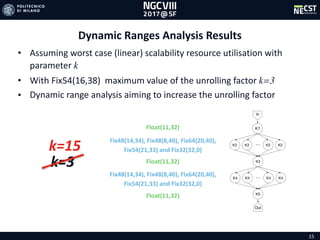
15
• Assuming	worst	case	(linear)	scalability	resource	utilisation	with	
parameter	k	
• With	Fix54(16,38)		maximum	value	of	the	unrolling	factor	k=3	
• Dynamic	range	analysis	aiming	to	increase	the	unrolling	factor
K1
K2 K2 K2 K2
K3
K4 K4 K4 K4
K5
…
…
Float(11,32)
Float(11,32)
Float(11,32)
Fix48(14,34),	Fix48(8,40),	Fix64(20,40),		
Fix54(21,33)	and	Fix32(32,0)
Fix48(14,34),	Fix48(8,40),	Fix64(20,40),		
Fix54(21,33)	and	Fix32(32,0)
k=3
k=15
Dynamic	Ranges	Analysis	Results
16
Speedups	and	Energy	Efficiencies
s CPU 48 Cores Single DFE
DataSet30
DataSet780
Tabella 1-1
DataSet30 DataSet780
PU 1 Core 21 400
PU 24 Cores 7 36
PU 48 Cores 8 27
ingle DFE 5 6
s CPU 48 Cores Single DFE
DataSet30
DataSet780
Tabella 1-1-1
DataSet30 DataSet780
PU 1 Core 11 30
PU 24 Cores 7 36
PU 48 Cores 8 27
ingle DFE 11 12
RunTime[s]
1
100
10000
CPU 1 Core CPU 24 Cores CPU 48 Cores Single DFE 8 DFEs
2,181
11,99
238,564240,017
3789,277
1,461,25
10,3310,49
158,81
DataSet30
DataSet780
SocketEnergy[Wh]
1
10
100
CPU 1 Core CPU 24 Cores CPU 48 Cores Single DFE 8 DFEs
8
6
27
36
400
55
87
21
DataSet30
DataSet780
17
• An	example	of	large	class	of	HPC	application	with	numerical	solvers	used	
as	case	study	in	EXTRA	European	Project	
• Improvements	in	runtime	and	energy	utilisation	offer	a	compelling	
advantage	to	financial	institutions	that	want	to	reduce	both	option	pricing	
time	and	energy	usage	
• DFE:			
1. Multi-DFE	energy	efficiency	in	progress	
2. Porting	to	the	new	Maxeler	MAX5	based	on	Xilinx	Virtex	UltraScale+	
• CPU:	
1. More	improvements	to	be	done
Conclusions	and	Future	Works
18
THANKS	FOR	THE	ATTENTION!
{annamaria.nestorov,	enrico2.reggiani}@mail.polimi.it		
marco.santambrogio@polimi.it		
Acknowledgements	to	Hristina	Palikareva,	Pavel	Burovskiy	and	Tobias	Becker	from	Maxeler	Technologies	London

A Scalable Dataflow Implementation of Curran's Approximation Algorithm