
Emerging Technologies in Chemical
Transportation & Emergency Response
TRANSPORTATION OF HAZARDOUS CHEMICALS
Under Chemical Disaster Management
at Mascot Hotel, Thiruvananthapuram on 24th and 25th November, 2010
by
Harsh Pandya
Infinity Consulting
Pandya.ace@gmail.com
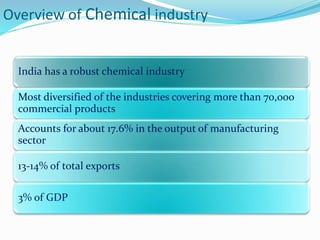
Overview of Chemical industry
India has a robust chemical industry
Most diversified of the industries covering more than 70,000
commercial products
Accounts for about 17.6% in the output of manufacturing
sector
13-14% of total exports
3% of GDP
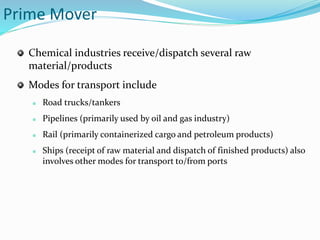
Prime Mover
Chemical industries receive/dispatch several raw
material/products
Modes for transport include
 Road trucks/tankers
 Pipelines (primarily used by oil and gas industry)
 Rail (primarily containerized cargo and petroleum products)
 Ships (receipt of raw material and dispatch of finished products) also
involves other modes for transport to/from ports
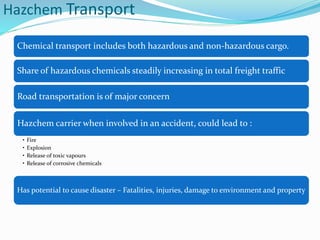
Hazchem Transport
Chemical transport includes both hazardous and non-hazardous cargo.
Share of hazardous chemicals steadily increasing in total freight traffic
Road transportation is of major concern
Hazchem carrier when involved in an accident, could lead to :
• Fire
• Explosion
• Release of toxic vapours
• Release of corrosive chemicals
Has potential to cause disaster – Fatalities, injuries, damage to environment and property
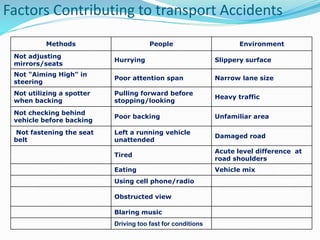
Factors Contributing to transport Accidents
Methods People Environment
Not adjusting
mirrors/seats
Hurrying Slippery surface
Not "Aiming High" in
steering
Poor attention span Narrow lane size
Not utilizing a spotter
when backing
Pulling forward before
stopping/looking
Heavy traffic
Not checking behind
vehicle before backing
Poor backing Unfamiliar area
Not fastening the seat
belt
Left a running vehicle
unattended
Damaged road
Tired
Acute level difference at
road shoulders
Eating Vehicle mix
Using cell phone/radio
Obstructed view
Blaring music
Driving too fast for conditions
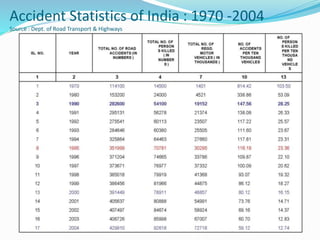
Accident Statistics of India : 1970 -2004
Source : Dept. of Road Transport & Highways
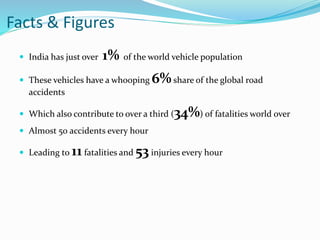
Facts & Figures
 India has just over 1% of the world vehicle population
 These vehicles have a whooping 6%share of the global road
accidents
 Which also contribute to over a third (34%) of fatalities world over
 Almost 50 accidents every hour
 Leading to 11 fatalities and 53 injuries every hour
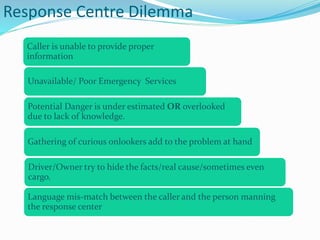
Response Centre Dilemma
Caller is unable to provide proper
information
Driver/Owner try to hide the facts/real cause/sometimes even
cargo.
Potential Danger is under estimated OR overlooked
due to lack of knowledge.
Unavailable/ Poor Emergency Services
Language mis-match between the caller and the person manning
the response center
Gathering of curious onlookers add to the problem at hand
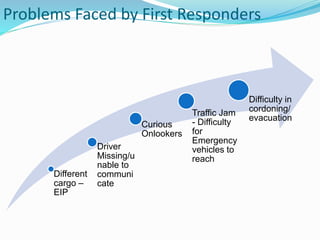
Different
cargo –
EIP
Driver
Missing/u
nable to
communi
cate
Curious
Onlookers
Traffic Jam
- Difficulty
for
Emergency
vehicles to
reach
Difficulty in
cordoning/
evacuation
Problems Faced by First Responders
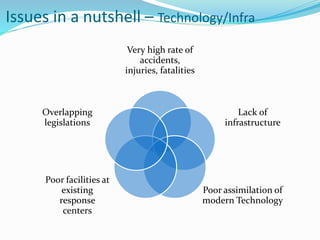
Issues in a nutshell – Technology/Infra
Very high rate of
accidents,
injuries, fatalities
Lack of
infrastructure
Poor assimilation of
modern Technology
Poor facilities at
existing
response
centers
Overlapping
legislations
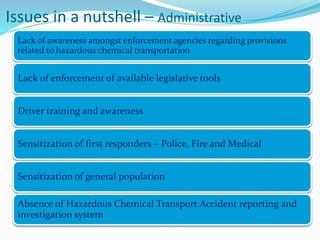
Issues in a nutshell – Administrative
Lack of awareness amongst enforcement agencies regarding provisions
related to hazardous chemical transportation
Lack of enforcement of available legislative tools
Driver training and awareness
Sensitization of first responders – Police, Fire and Medical
Sensitization of general population
Absence of Hazardous Chemical Transport Accident reporting and
investigation system
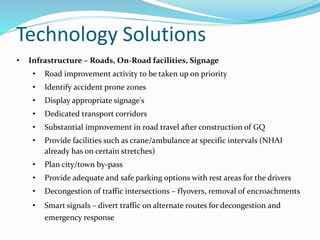
Technology Solutions
• Infrastructure – Roads, On-Road facilities, Signage
• Road improvement activity to be taken up on priority
• Identify accident prone zones
• Display appropriate signage's
• Dedicated transport corridors
• Substantial improvement in road travel after construction of GQ
• Provide facilities such as crane/ambulance at specific intervals (NHAI
already has on certain stretches)
• Plan city/town by-pass
• Provide adequate and safe parking options with rest areas for the drivers
• Decongestion of traffic intersections – flyovers, removal of encroachments
• Smart signals – divert traffic on alternate routes for decongestion and
emergency response
Technology Solutions
• Infrastructure – Response centers - Health
• Using GIS techniques map the National and State
highways
• Overlay the location of Major hospitals state-wide
including DH, SDH, CHC and major private hospitals
• Establish Trauma-Center norms
• Identify gaps and evaluate cost to cover the gap
• Form a PPP model for upgradation, operation &
maintenance
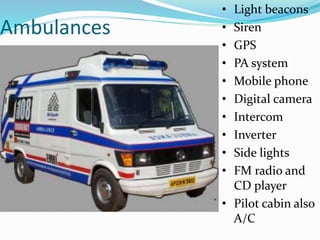
Ambulances
• Light beacons
• Siren
• GPS
• PA system
• Mobile phone
• Digital camera
• Intercom
• Inverter
• Side lights
• FM radio and
CD player
• Pilot cabin also
A/C
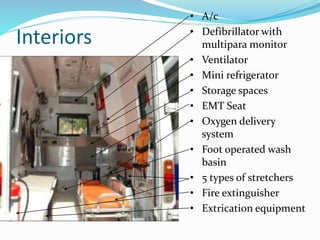
Interiors
• A/c
• Defibrillator with
multipara monitor
• Ventilator
• Mini refrigerator
• Storage spaces
• EMT Seat
• Oxygen delivery
system
• Foot operated wash
basin
• 5 types of stretchers
• Fire extinguisher
• Extrication equipment
Technology Solutions
• Infrastructure – Response centers - ERC
• On the available GIS map of National and State highways – locate the
available ERCs
• Overlay the location of first responders - police stations, Fire stations and
major industries
• Mark locations of DHQ
• Establish benchmarks based on number of chemical industries and broad
extent of chemical cargo movement along the corridors in the vicinity
• Draw circles of 25/50 Km from potential response centers
• Identify blank areas and plan to establish ERCs/Upgrade existing facilities
at the response centers
Technology Solutions
• Infrastructure – Response System
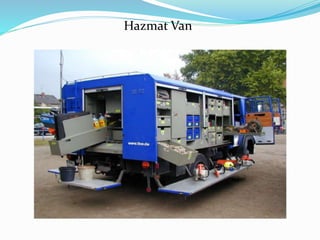
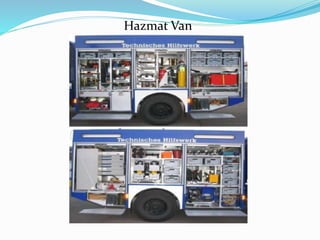
• Hazmat Van
• Advanced fire-fighting facilities
• Temporary area lighting facilities – flood lights
(flame proof – POL Service)
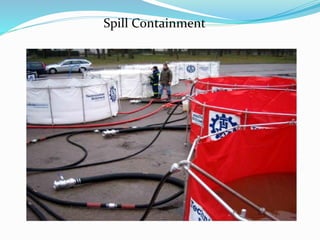
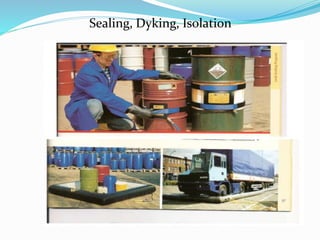
• Spill containment/mop-up/coverage systems
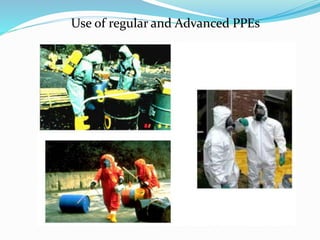
• Use of appropriate PPEs
• Procurement of advanced PPEs
Hazmat Van
Hazmat Van
Spill Containment
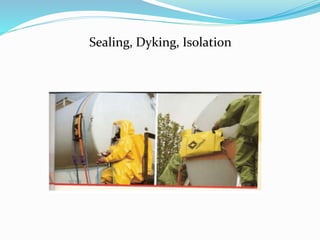
Sealing, Dyking, Isolation
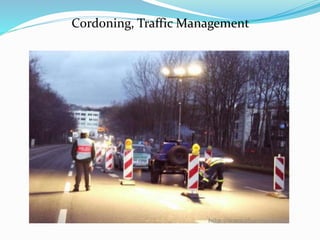
Cordoning, Traffic Management
Use of regular and Advanced PPEs
Technology Solutions
GIS in Transport Planning
• GPS enabled fleet
• Real-time tracking
• Also helpful in emergency response
• Technology readily available and used in India
• GIS Based Emergency Planning & Response
• Development of Highway DMPs for vulnerable
stretches – expanded to cover all NH/SH
• Regular conduct of Mock Drills
• GIS in Transport Planning
• Develop GIS maps of cities/towns/UAs
• Overlay existing routes
• Estimate existing chemical cargo movement
• Explore traffic restriction on certain hours of the day –
allowed only between 10pm and 6 am
• Night time permission allows easy movement of heavy
vehicles as well as response vehicles, if need be
• Lesser impact on people – as indoors – on the negative
– difficult for area evacuation and getting prompt
response
Technology Solutions
GIS in Transport Planning
• Explore alternate routes avoiding Cities/towns/UAs
• Till the time alternate routes constructed, using GIS
plan the best fit option using constraint mapping
• Based on identified routes – communicate to
stakeholders
Technology Solutions
Administrative Solutions
Department of Hazchem Transport Management under State
Police to be set up for imparting :
Comprehensive training for staff issuing fitness certificates regarding
design codes, their requirement for the inherent safety of the container
and the vehicle, etc.
Comprehensive training of the inspectors regarding the applicable legal
requirements
Training for the inspectors regarding the Hazardous chemicals so as to
make them understand the consequences of non-compliance and the
extent of possible damage in case of an accident involving hazardous
chemical carrier.
Specific training on handling and transport of non petroleum cargo
Recording and analyzing transportation accident data
MODIFICATION / HARMONISATION OF RULES
List of Hazardous Chemicals in different rules to be harmonized
Accident Database mechanism needs to be devised and implemented
Responsibility for Loading Leaky/Defective Tankers to be clearly
defined in CMV Rules
Number, specification and type of Fire Extinguishers & PPEs to be
clearly specified and different rules to be harmonized.
Administrative Solutions
Thank You

Emerging technologies

  • 1.
    Emerging Technologies inChemical Transportation & Emergency Response TRANSPORTATION OF HAZARDOUS CHEMICALS Under Chemical Disaster Management at Mascot Hotel, Thiruvananthapuram on 24th and 25th November, 2010 by Harsh Pandya Infinity Consulting Pandya.ace@gmail.com
  • 2.
    Overview of Chemicalindustry India has a robust chemical industry Most diversified of the industries covering more than 70,000 commercial products Accounts for about 17.6% in the output of manufacturing sector 13-14% of total exports 3% of GDP
  • 3.
    Prime Mover Chemical industriesreceive/dispatch several raw material/products Modes for transport include  Road trucks/tankers  Pipelines (primarily used by oil and gas industry)  Rail (primarily containerized cargo and petroleum products)  Ships (receipt of raw material and dispatch of finished products) also involves other modes for transport to/from ports
  • 4.
    Hazchem Transport Chemical transportincludes both hazardous and non-hazardous cargo. Share of hazardous chemicals steadily increasing in total freight traffic Road transportation is of major concern Hazchem carrier when involved in an accident, could lead to : • Fire • Explosion • Release of toxic vapours • Release of corrosive chemicals Has potential to cause disaster – Fatalities, injuries, damage to environment and property
  • 5.
    Factors Contributing totransport Accidents Methods People Environment Not adjusting mirrors/seats Hurrying Slippery surface Not "Aiming High" in steering Poor attention span Narrow lane size Not utilizing a spotter when backing Pulling forward before stopping/looking Heavy traffic Not checking behind vehicle before backing Poor backing Unfamiliar area Not fastening the seat belt Left a running vehicle unattended Damaged road Tired Acute level difference at road shoulders Eating Vehicle mix Using cell phone/radio Obstructed view Blaring music Driving too fast for conditions
  • 6.
    Accident Statistics ofIndia : 1970 -2004 Source : Dept. of Road Transport & Highways
  • 7.
    Facts & Figures India has just over 1% of the world vehicle population  These vehicles have a whooping 6%share of the global road accidents  Which also contribute to over a third (34%) of fatalities world over  Almost 50 accidents every hour  Leading to 11 fatalities and 53 injuries every hour
  • 8.
    Response Centre Dilemma Calleris unable to provide proper information Driver/Owner try to hide the facts/real cause/sometimes even cargo. Potential Danger is under estimated OR overlooked due to lack of knowledge. Unavailable/ Poor Emergency Services Language mis-match between the caller and the person manning the response center Gathering of curious onlookers add to the problem at hand
  • 9.
    Different cargo – EIP Driver Missing/u nable to communi cate Curious Onlookers TrafficJam - Difficulty for Emergency vehicles to reach Difficulty in cordoning/ evacuation Problems Faced by First Responders
  • 10.
    Issues in anutshell – Technology/Infra Very high rate of accidents, injuries, fatalities Lack of infrastructure Poor assimilation of modern Technology Poor facilities at existing response centers Overlapping legislations
  • 11.
    Issues in anutshell – Administrative Lack of awareness amongst enforcement agencies regarding provisions related to hazardous chemical transportation Lack of enforcement of available legislative tools Driver training and awareness Sensitization of first responders – Police, Fire and Medical Sensitization of general population Absence of Hazardous Chemical Transport Accident reporting and investigation system
  • 12.
    Technology Solutions • Infrastructure– Roads, On-Road facilities, Signage • Road improvement activity to be taken up on priority • Identify accident prone zones • Display appropriate signage's • Dedicated transport corridors • Substantial improvement in road travel after construction of GQ • Provide facilities such as crane/ambulance at specific intervals (NHAI already has on certain stretches) • Plan city/town by-pass • Provide adequate and safe parking options with rest areas for the drivers • Decongestion of traffic intersections – flyovers, removal of encroachments • Smart signals – divert traffic on alternate routes for decongestion and emergency response
  • 13.
    Technology Solutions • Infrastructure– Response centers - Health • Using GIS techniques map the National and State highways • Overlay the location of Major hospitals state-wide including DH, SDH, CHC and major private hospitals • Establish Trauma-Center norms • Identify gaps and evaluate cost to cover the gap • Form a PPP model for upgradation, operation & maintenance
  • 14.
    Ambulances • Light beacons •Siren • GPS • PA system • Mobile phone • Digital camera • Intercom • Inverter • Side lights • FM radio and CD player • Pilot cabin also A/C
  • 15.
    Interiors • A/c • Defibrillatorwith multipara monitor • Ventilator • Mini refrigerator • Storage spaces • EMT Seat • Oxygen delivery system • Foot operated wash basin • 5 types of stretchers • Fire extinguisher • Extrication equipment
  • 16.
    Technology Solutions • Infrastructure– Response centers - ERC • On the available GIS map of National and State highways – locate the available ERCs • Overlay the location of first responders - police stations, Fire stations and major industries • Mark locations of DHQ • Establish benchmarks based on number of chemical industries and broad extent of chemical cargo movement along the corridors in the vicinity • Draw circles of 25/50 Km from potential response centers • Identify blank areas and plan to establish ERCs/Upgrade existing facilities at the response centers
  • 17.
    Technology Solutions • Infrastructure– Response System • Hazmat Van • Advanced fire-fighting facilities • Temporary area lighting facilities – flood lights (flame proof – POL Service) • Spill containment/mop-up/coverage systems • Use of appropriate PPEs • Procurement of advanced PPEs
  • 18.
  • 19.
  • 20.
  • 21.
  • 22.
  • 23.
  • 24.
    Use of regularand Advanced PPEs
  • 25.
    Technology Solutions GIS inTransport Planning • GPS enabled fleet • Real-time tracking • Also helpful in emergency response • Technology readily available and used in India • GIS Based Emergency Planning & Response • Development of Highway DMPs for vulnerable stretches – expanded to cover all NH/SH • Regular conduct of Mock Drills
  • 26.
    • GIS inTransport Planning • Develop GIS maps of cities/towns/UAs • Overlay existing routes • Estimate existing chemical cargo movement • Explore traffic restriction on certain hours of the day – allowed only between 10pm and 6 am • Night time permission allows easy movement of heavy vehicles as well as response vehicles, if need be • Lesser impact on people – as indoors – on the negative – difficult for area evacuation and getting prompt response Technology Solutions
  • 27.
    GIS in TransportPlanning • Explore alternate routes avoiding Cities/towns/UAs • Till the time alternate routes constructed, using GIS plan the best fit option using constraint mapping • Based on identified routes – communicate to stakeholders Technology Solutions
  • 28.
    Administrative Solutions Department ofHazchem Transport Management under State Police to be set up for imparting : Comprehensive training for staff issuing fitness certificates regarding design codes, their requirement for the inherent safety of the container and the vehicle, etc. Comprehensive training of the inspectors regarding the applicable legal requirements Training for the inspectors regarding the Hazardous chemicals so as to make them understand the consequences of non-compliance and the extent of possible damage in case of an accident involving hazardous chemical carrier. Specific training on handling and transport of non petroleum cargo Recording and analyzing transportation accident data
  • 29.
    MODIFICATION / HARMONISATIONOF RULES List of Hazardous Chemicals in different rules to be harmonized Accident Database mechanism needs to be devised and implemented Responsibility for Loading Leaky/Defective Tankers to be clearly defined in CMV Rules Number, specification and type of Fire Extinguishers & PPEs to be clearly specified and different rules to be harmonized. Administrative Solutions
  • 30.