A platform for
Nordic OER
Tore Hoel
2013-11-08
Creative Commons
Attribution-ShareAlike

This work is licensed under a Creative Commons Attribution-ShareAlike 3.0 Unported License.
Definition of OER
(one of many)

OER are learning resources
that are usable, adaptable
to specific learning needs,
and freely shareable
(European Commission (2013)Opening up Education:
Innovative teaching and learning for all through new
Technologies and Open Educational Resources, COM(2013)
654 final)
1. Values
In the Nordic countries, we share
values of openness and transparency,
access for all to education, and
commitment to citizen participation.
Open Educational Resources (OER)
build on these values. Uptake of OER
will improve Nordic education.
2. Innovation
OER raises all sorts of unprecedented
questions about education. Thus, OER
will play an increasingly important role
in innovating global educational
practices. There is a need to focus the
innovative potential of OER for Nordic
knowledge economies.
3. Models of education
OER gives organisations an
opportunity to redesign their
educational and/or financial
models. Promoting OER helps
identifying opportunities and
dismantling barriers to highquality learning and teaching.
4. Market
Freely shareable OER does not
mean the end of commercial
markets. Authors, content providers,
publishers, school authorities and
others should discuss how OER can
be integrated into the Nordic
educational systems.
5. Awareness
Raising awareness is first priority to promote OER
in the Nordic countries. UNESCO’s Paris
Declaration, and EU’s Opening Up Education are
international initiatives that offer sound foundation.
Inspiration should also be sought from emerging
policies in our countries on Open Source, Open
Access, Open Data, Open Education, Open
Research and Open Innovation, as OER is part of
these open practices.
6. Quality
Sharing enhances the quality of
education, and OER introduces
an aspect of peer review in
learning and teaching. Quality
should be the focus integrating
OER in Nordic education.
7. Language and Culture
The Nordic languages and cultures are
small and have to find their own position
in a OER community dominated by
English language and Anglo-American
culture. The Nordic countries will benefit
from close co-operation when coming up
with their own policies on how to
contribute to the local and global OER
commons.
8. Global responsibility
OER is a global phenomenon with
no limits to who can publish or
who can use. Through promoting
OER, the Nordic countries can
strengthen their contribution to
global educational development.
9. Institutions
Educational institutions should have a
policy and plans for promoting OER. The
Nordic collaboration on OER should help
schools, colleges, universities, vocational
training institutions, and other
educational institutions develop their
OER strategy, e.g. through knowledge
sharing and exchange
10. Governments
Governments are responsible for
providing a favourable framework
for OER. Local, regional and
national authorities should
develop policies and strategies
for use of OERs within their remit.
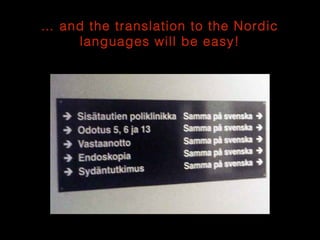
… and the translation to the Nordic
languages will be easy!
Contact
tore.hoel@hioa.no
@tore
#nordicoer
#nordicoer
#nordicoer
#nordicoer
#nordicoer

A platform for the Nordic OER movement

  • 1.
    A platform for NordicOER Tore Hoel 2013-11-08
  • 2.
    Creative Commons Attribution-ShareAlike This workis licensed under a Creative Commons Attribution-ShareAlike 3.0 Unported License.
  • 3.
    Definition of OER (oneof many) OER are learning resources that are usable, adaptable to specific learning needs, and freely shareable (European Commission (2013)Opening up Education: Innovative teaching and learning for all through new Technologies and Open Educational Resources, COM(2013) 654 final)
  • 4.
    1. Values In theNordic countries, we share values of openness and transparency, access for all to education, and commitment to citizen participation. Open Educational Resources (OER) build on these values. Uptake of OER will improve Nordic education.
  • 5.
    2. Innovation OER raisesall sorts of unprecedented questions about education. Thus, OER will play an increasingly important role in innovating global educational practices. There is a need to focus the innovative potential of OER for Nordic knowledge economies.
  • 6.
    3. Models ofeducation OER gives organisations an opportunity to redesign their educational and/or financial models. Promoting OER helps identifying opportunities and dismantling barriers to highquality learning and teaching.
  • 7.
    4. Market Freely shareableOER does not mean the end of commercial markets. Authors, content providers, publishers, school authorities and others should discuss how OER can be integrated into the Nordic educational systems.
  • 8.
    5. Awareness Raising awarenessis first priority to promote OER in the Nordic countries. UNESCO’s Paris Declaration, and EU’s Opening Up Education are international initiatives that offer sound foundation. Inspiration should also be sought from emerging policies in our countries on Open Source, Open Access, Open Data, Open Education, Open Research and Open Innovation, as OER is part of these open practices.
  • 9.
    6. Quality Sharing enhancesthe quality of education, and OER introduces an aspect of peer review in learning and teaching. Quality should be the focus integrating OER in Nordic education.
  • 10.
    7. Language andCulture The Nordic languages and cultures are small and have to find their own position in a OER community dominated by English language and Anglo-American culture. The Nordic countries will benefit from close co-operation when coming up with their own policies on how to contribute to the local and global OER commons.
  • 11.
    8. Global responsibility OERis a global phenomenon with no limits to who can publish or who can use. Through promoting OER, the Nordic countries can strengthen their contribution to global educational development.
  • 12.
    9. Institutions Educational institutionsshould have a policy and plans for promoting OER. The Nordic collaboration on OER should help schools, colleges, universities, vocational training institutions, and other educational institutions develop their OER strategy, e.g. through knowledge sharing and exchange
  • 13.
    10. Governments Governments areresponsible for providing a favourable framework for OER. Local, regional and national authorities should develop policies and strategies for use of OERs within their remit.
  • 14.
    … and thetranslation to the Nordic languages will be easy!
  • 15.