BRIDGING LANGUAGE ACQUISITION
AND LANGUAGE POLICY, Centre for Languages and
Literature, Lund University, 17-18 June, 2015
Open Educational Resources (OER) for Less Used Languages –
Calling for Policy Collaboration
Projektet genomförs med ekonomiskt stöd från Europeiska kommissionen. För uppgifterna i denna publikation ansvarar
endast upphovsmannen. Europeiska kommissionen tar inget ansvar för hur dessa uppgifter kan komma att användas.
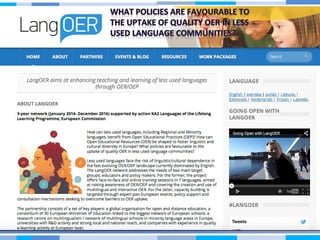
LangOER
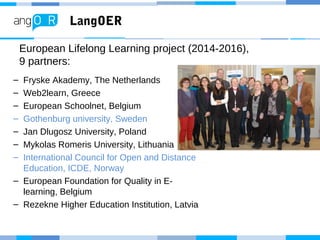
– Fryske Akademy, The Netherlands
– Web2learn, Greece
– European Schoolnet, Belgium
– Gothenburg university, Sweden
– Jan Dlugosz University, Poland
– Mykolas Romeris University, Lithuania
– International Council for Open and Distance
Education, ICDE, Norway
– European Foundation for Quality in E-
learning, Belgium
– Rezekne Higher Education Institution, Latvia
European Lifelong Learning project (2014-2016),
9 partners:
Open Educational Resources (OER) for
Less Used Languages – Calling for Policy
Collaboration
Sylvi Vigmo University of Gothenburg, Sweden
sylvi.vigmo@ped.gu.se
Gard Titlestad, ICDE, Norway
Linda Bradley, University of Gothenburg, Sweden
Monique Lamarque-Udnæs, ICDE
Øystein Johannesen, ICDE
What are OER?
Open Educational Resources, as defined in the 2012 Paris
OER Declaration (UNESCO), are “teaching, learning and
research materials in any medium, digital or otherwise,
that reside in the public domain or have been released
under an open license that permits no-cost access, use,
adaptation and redistribution by others with no or limited
restrictions. Open licensing is built within the existing
framework of intellectual property rights as defined by
relevant international conventions and respects the
authorship of the work”.
Assumptions about advantages –
OER?
o Allow legal extensive use of the resources free of charge
o Enable increased and low cost access to education
o Enable increased quality assurance for the learning materials
used by learners
o Enable innovation, creativity and sustainable use
o Enable the rapid development of courses and programmes
o Lower the cost of delivering online and blended learning
o Make available high quality materials at any time when
delivered online.
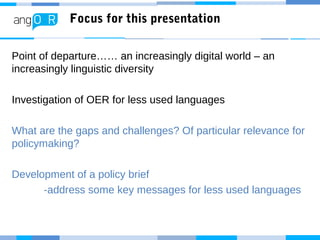
Focus for this presentation
Point of departure…… an increasingly digital world – an
increasingly linguistic diversity
Investigation of OER for less used languages
What are the gaps and challenges? Of particular relevance for
policymaking?
Development of a policy brief
-address some key messages for less used languages
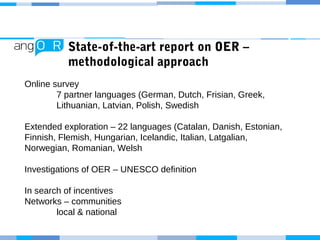
State-of-the-art report on OER –
methodological approach
Online survey
7 partner languages (German, Dutch, Frisian, Greek,
Lithuanian, Latvian, Polish, Swedish
Extended exploration – 22 languages (Catalan, Danish, Estonian,
Finnish, Flemish, Hungarian, Icelandic, Italian, Latgalian,
Norwegian, Romanian, Welsh
Investigations of OER – UNESCO definition
In search of incentives
Networks – communities
local & national
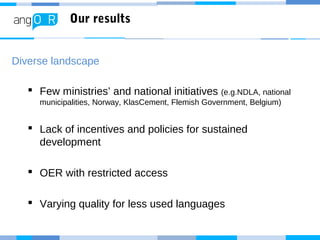
Our results
Diverse landscape
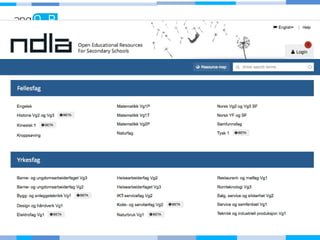
 Few ministries’ and national initiatives (e.g.NDLA, national
municipalities, Norway, KlasCement, Flemish Government, Belgium)
 Lack of incentives and policies for sustained
development
 OER with restricted access
 Varying quality for less used languages
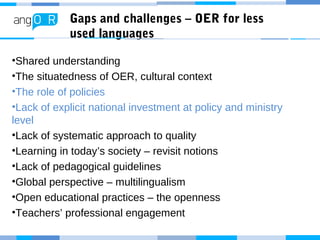
Gaps and challenges – OER for less
used languages
•Shared understanding
•The situatedness of OER, cultural context
•The role of policies
•Lack of explicit national investment at policy and ministry
level
•Lack of systematic approach to quality
•Learning in today’s society – revisit notions
•Lack of pedagogical guidelines
•Global perspective – multilingualism
•Open educational practices – the openness
•Teachers’ professional engagement
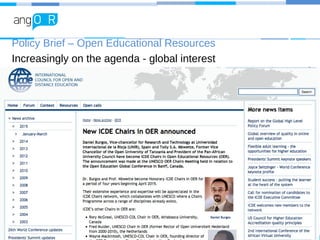
Policy Brief – Open Educational Resources
Increasingly on the agenda - global interest
Potential benefits
Increased efficiency
OECD expects “open sharing to speed up the development
of new learning resources, stimulate internal improvement,
innovation and reuse and help the institution to keep good
records of materials and their internal and external use”
Improved quality of teaching and learning
Cost saving
Innovative
The UNESCO OER community acknowledges that huge
potential (language preservation and revitalization,
education and development for poverty alleviation) lies in local
language OER.
Oates,L. (2009). Coming up short in the OER movement: African Language OERs
http://ojs.stanford.edu/ojs/index.php/a2k/article/view/449/275l
Main challenges for governments in
adopting and promoting OER for less
used languages?
 Lack of policies and frameworks – and a need to translate policies
into actions
Grass root level initiatives need to be supported by relevant
national policy initiatives and vice versa: no policies will give
results if they are left only as declarations of intent
 Address resistance and offer directions for more dialogue and
partnership – nationally and internationally
 Knowledge of quality OER existence, use and impact = low or
lacking
Main challenges…. Cont.
 Linguistic and cultural barriers
 Lack of awareness that multilingualism can enrich education
 Resources must “travel well” – to other contexts
 Lack of good models
 Culture of open sharing – not yet recognized in educational
systems
Recommendations for Governments –
Policy brief
Adopt national policies in support of Open Educational Resources
in less used languages
Should address critical issues such as funding, capacity
building and sharing, as well as possible regulatory issues
Incentives, monitoring and assessment mechanisms should
be included in national and institutional policies
Recommendations… cont.
Facilitate partnerships with private, public and the educational sector,
market places and collaborative arenas for quality OER
At national level: governments and national agencies could
consider incentives for networking to increase collaboration
and innovation in OER
Collaboration should include the possibility of private-public
partnerships
Recommendations… cont.
Take the leadership in facilitating the development of open
frameworks and standards to ease the ability of OER repositories and
systems to work together
OER repositories should be open for use across languages,
cultures and countries
OER repositories need national and international standards
and frameworks of classification to follow so that they can be
easily recognized and accessed across institutions, countries
and languages
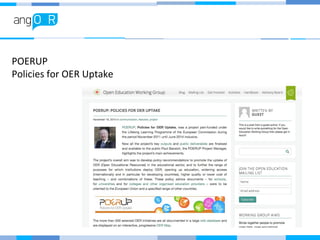
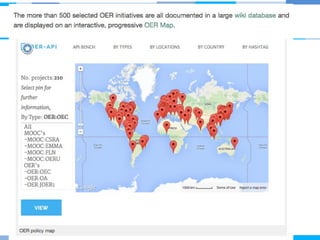
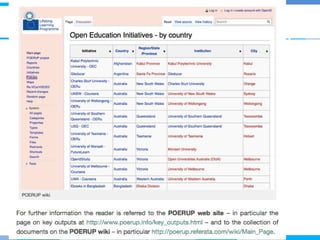
POERUP
Policies for OER Uptake
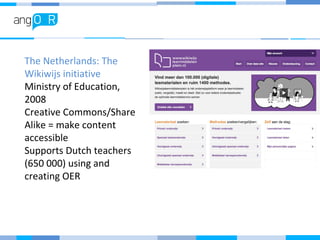
The Netherlands: The
Wikiwijs initiative
Ministry of Education,
2008
Creative Commons/Share
Alike = make content
accessible
Supports Dutch teachers
(650 000) using and
creating OER
Slideshare LangOER http://www.slideshare.net/LangOER
LangOER resources http://langoer.eun.org/resources
sylvi.vigmo@ped.gu.se
Department of Education, Communication and Learning,
University of Gothenburg

Bridging language acquision and language policy

  • 1.
    BRIDGING LANGUAGE ACQUISITION ANDLANGUAGE POLICY, Centre for Languages and Literature, Lund University, 17-18 June, 2015 Open Educational Resources (OER) for Less Used Languages – Calling for Policy Collaboration Projektet genomförs med ekonomiskt stöd från Europeiska kommissionen. För uppgifterna i denna publikation ansvarar endast upphovsmannen. Europeiska kommissionen tar inget ansvar för hur dessa uppgifter kan komma att användas.
  • 2.
    LangOER – Fryske Akademy,The Netherlands – Web2learn, Greece – European Schoolnet, Belgium – Gothenburg university, Sweden – Jan Dlugosz University, Poland – Mykolas Romeris University, Lithuania – International Council for Open and Distance Education, ICDE, Norway – European Foundation for Quality in E- learning, Belgium – Rezekne Higher Education Institution, Latvia European Lifelong Learning project (2014-2016), 9 partners:
  • 3.
    Open Educational Resources(OER) for Less Used Languages – Calling for Policy Collaboration Sylvi Vigmo University of Gothenburg, Sweden sylvi.vigmo@ped.gu.se Gard Titlestad, ICDE, Norway Linda Bradley, University of Gothenburg, Sweden Monique Lamarque-Udnæs, ICDE Øystein Johannesen, ICDE
  • 6.
    What are OER? OpenEducational Resources, as defined in the 2012 Paris OER Declaration (UNESCO), are “teaching, learning and research materials in any medium, digital or otherwise, that reside in the public domain or have been released under an open license that permits no-cost access, use, adaptation and redistribution by others with no or limited restrictions. Open licensing is built within the existing framework of intellectual property rights as defined by relevant international conventions and respects the authorship of the work”.
  • 7.
    Assumptions about advantages– OER? o Allow legal extensive use of the resources free of charge o Enable increased and low cost access to education o Enable increased quality assurance for the learning materials used by learners o Enable innovation, creativity and sustainable use o Enable the rapid development of courses and programmes o Lower the cost of delivering online and blended learning o Make available high quality materials at any time when delivered online.
  • 8.
    Focus for thispresentation Point of departure…… an increasingly digital world – an increasingly linguistic diversity Investigation of OER for less used languages What are the gaps and challenges? Of particular relevance for policymaking? Development of a policy brief -address some key messages for less used languages
  • 9.
    State-of-the-art report onOER – methodological approach Online survey 7 partner languages (German, Dutch, Frisian, Greek, Lithuanian, Latvian, Polish, Swedish Extended exploration – 22 languages (Catalan, Danish, Estonian, Finnish, Flemish, Hungarian, Icelandic, Italian, Latgalian, Norwegian, Romanian, Welsh Investigations of OER – UNESCO definition In search of incentives Networks – communities local & national
  • 10.
    Our results Diverse landscape Few ministries’ and national initiatives (e.g.NDLA, national municipalities, Norway, KlasCement, Flemish Government, Belgium)  Lack of incentives and policies for sustained development  OER with restricted access  Varying quality for less used languages
  • 11.
    Gaps and challenges– OER for less used languages •Shared understanding •The situatedness of OER, cultural context •The role of policies •Lack of explicit national investment at policy and ministry level •Lack of systematic approach to quality •Learning in today’s society – revisit notions •Lack of pedagogical guidelines •Global perspective – multilingualism •Open educational practices – the openness •Teachers’ professional engagement
  • 12.
    Policy Brief –Open Educational Resources Increasingly on the agenda - global interest
  • 13.
    Potential benefits Increased efficiency OECDexpects “open sharing to speed up the development of new learning resources, stimulate internal improvement, innovation and reuse and help the institution to keep good records of materials and their internal and external use” Improved quality of teaching and learning Cost saving Innovative The UNESCO OER community acknowledges that huge potential (language preservation and revitalization, education and development for poverty alleviation) lies in local language OER. Oates,L. (2009). Coming up short in the OER movement: African Language OERs http://ojs.stanford.edu/ojs/index.php/a2k/article/view/449/275l
  • 14.
    Main challenges forgovernments in adopting and promoting OER for less used languages?  Lack of policies and frameworks – and a need to translate policies into actions Grass root level initiatives need to be supported by relevant national policy initiatives and vice versa: no policies will give results if they are left only as declarations of intent  Address resistance and offer directions for more dialogue and partnership – nationally and internationally  Knowledge of quality OER existence, use and impact = low or lacking
  • 15.
    Main challenges…. Cont. Linguistic and cultural barriers  Lack of awareness that multilingualism can enrich education  Resources must “travel well” – to other contexts  Lack of good models  Culture of open sharing – not yet recognized in educational systems
  • 16.
    Recommendations for Governments– Policy brief Adopt national policies in support of Open Educational Resources in less used languages Should address critical issues such as funding, capacity building and sharing, as well as possible regulatory issues Incentives, monitoring and assessment mechanisms should be included in national and institutional policies
  • 17.
    Recommendations… cont. Facilitate partnershipswith private, public and the educational sector, market places and collaborative arenas for quality OER At national level: governments and national agencies could consider incentives for networking to increase collaboration and innovation in OER Collaboration should include the possibility of private-public partnerships
  • 18.
    Recommendations… cont. Take theleadership in facilitating the development of open frameworks and standards to ease the ability of OER repositories and systems to work together OER repositories should be open for use across languages, cultures and countries OER repositories need national and international standards and frameworks of classification to follow so that they can be easily recognized and accessed across institutions, countries and languages
  • 19.
  • 23.
    The Netherlands: The Wikiwijsinitiative Ministry of Education, 2008 Creative Commons/Share Alike = make content accessible Supports Dutch teachers (650 000) using and creating OER
  • 25.
    Slideshare LangOER http://www.slideshare.net/LangOER LangOERresources http://langoer.eun.org/resources sylvi.vigmo@ped.gu.se Department of Education, Communication and Learning, University of Gothenburg