1. The document presents a new scaled fuzzy method using PSO segmentation (SePSO) applied to control the frequency in a two area power system. SePSO is used to optimize the gains of a fuzzy PID controller to improve the frequency response.
2. Two identical interconnected power areas were simulated in MATLAB to test the new scaled fuzzy method. The results showed the proposed SePSO optimization led to a significantly faster response with lower undershoot compared to classical and PSO-fuzzy controllers under different load disturbances and time schedules.
3. The SePSO method works by dividing the search space into segments, with each segment running a separate PSO algorithm to find local optimal points. These local points are
![International Journal of Electrical and Computer Engineering (IJECE)
Vol. 9, No. 2, April 2019, pp. 815~825
ISSN: 2088-8708, DOI: 10.11591/ijece.v9i2.pp815-825 815
Journal homepage: http://iaescore.com/journals/index.php/IJECE
A new scaled fuzzy method using PSO segmentation (SePSO)
applied for two area power system
Balasim M. Hussein
Department of Power and Electrical Machines, College of Engineering, University Of Diyala Diyala, Iraq
Article Info ABSTRACT
Article history:
Received Apr 27, 2018
Revised Sep 13, 2018
Accepted Oct 4, 2018
The balance of the power supply and demand (frequency control) is one of
the most ancient approaches for the power systems, which is considered as a
highly complex system.The power systems frequency response is a perfect
indicator of the resilience to the multi-disturbances. In this work, the fuzzy
logichas been scaledusing PSO segmentation (SePSO) and suggested to get
high performance of frequency stability. PSO has participated into multi-
segments for calculating the scald-fuzzy membership with basic rules.
Two identical interconnectedpower areas wereselected to exam the new
scaled fuzzy method. The time response of the results has undertaken the
effectiveness of the controller reactionusing the MATLAB Simulink.
The work feed back proved that the proposed SePSO optimization for the
controlhas significantly faster with low undershot concerningthe classical
controllers in differenttime schedules and disturbance values.
Keywords:
Control
Frequency
Scald-fuzzy
Segmentation
Two area
Copyright © 2019 Institute of Advanced Engineering and Science.
All rights reserved.
Corresponding Author:
Balasim M.Hussein,
Electrical Engineering Department,
College of Engineering,
University of Diyala,
Diyala, Iraq.
Email: balasim@inbox.ru
1. INTRODUCTION
The objective of generating a good quality of an electrical power system is to supply energy to
consumers at nominal system frequency and voltage [1]. The balancing of power generation with the load
demand is a real challenge in the highly complex controlled system [2]. Normally, the steady-state
frequency is changing by the random variation of the customer's energy demand, and LFC is the
controller which responsible for reset the normal condition [2].
The LFC performance is directly affecting by the feedback controller design to maintain the
power transferred between the two areas at its' expected values [3]. The area control error (ACE) is most
important challenge in the LFC loop which is representing as the control output[3].
The classical controllers have been used in different power system operation and control topics due to its
simplicity. But, the main drawback of classical controller is tuning its parameters and it is design for
narrow conditions [2], [3].
To counteract the bad circumstances of classical frequency controllers; many intelligent control
methods have been put forward and studied towards developing the stability [3], [4].
Normally the fuzzy controllers have not been able to diminish the darkness beyond of classical
controllers, therewith the cases which are examined with the intelligent methodology are undoubtedly
negligible with respect to the uncompensated problems [1]. Ones of the most realistic conditions to geta
promised results in any fuzzy controller are the obtaining and optimizing the fuzzy rules and its'
memberships [5].](https://image.slidesharecdn.com/1012970-200717021054/85/A-new-scaled-fuzzy-method-using-PSO-segmentation-SePSO-applied-for-two-area-power-system-1-320.jpg)
![International Journal of Electrical and Computer Engineering (IJECE)
Vol. 9, No. 2, April 2019, pp. 815~825
ISSN: 2088-8708, DOI: 10.11591/ijece.v9i2.pp815-825 815
Journal homepage: http://iaescore.com/journals/index.php/IJECE
A new scaled fuzzy method using PSO segmentation (SePSO)
applied for two area power system
Balasim M. Hussein
Department of Power and Electrical Machines, College of Engineering, University Of Diyala Diyala, Iraq
Article Info ABSTRACT
Article history:
Received Apr 27, 2018
Revised Sep 13, 2018
Accepted Oct 4, 2018
The balance of the power supply and demand (frequency control) is one of
the most ancient approaches for the power systems, which is considered as a
highly complex system.The power systems frequency response is a perfect
indicator of the resilience to the multi-disturbances. In this work, the fuzzy
logichas been scaledusing PSO segmentation (SePSO) and suggested to get
high performance of frequency stability. PSO has participated into multi-
segments for calculating the scald-fuzzy membership with basic rules.
Two identical interconnectedpower areas wereselected to exam the new
scaled fuzzy method. The time response of the results has undertaken the
effectiveness of the controller reactionusing the MATLAB Simulink.
The work feed back proved that the proposed SePSO optimization for the
controlhas significantly faster with low undershot concerningthe classical
controllers in differenttime schedules and disturbance values.
Keywords:
Control
Frequency
Scald-fuzzy
Segmentation
Two area
Copyright © 2019 Institute of Advanced Engineering and Science.
All rights reserved.
Corresponding Author:
Balasim M.Hussein,
Electrical Engineering Department,
College of Engineering,
University of Diyala,
Diyala, Iraq.
Email: balasim@inbox.ru
1. INTRODUCTION
The objective of generating a good quality of an electrical power system is to supply energy to
consumers at nominal system frequency and voltage [1]. The balancing of power generation with the load
demand is a real challenge in the highly complex controlled system [2]. Normally, the steady-state
frequency is changing by the random variation of the customer's energy demand, and LFC is the
controller which responsible for reset the normal condition [2].
The LFC performance is directly affecting by the feedback controller design to maintain the
power transferred between the two areas at its' expected values [3]. The area control error (ACE) is most
important challenge in the LFC loop which is representing as the control output[3].
The classical controllers have been used in different power system operation and control topics due to its
simplicity. But, the main drawback of classical controller is tuning its parameters and it is design for
narrow conditions [2], [3].
To counteract the bad circumstances of classical frequency controllers; many intelligent control
methods have been put forward and studied towards developing the stability [3], [4].
Normally the fuzzy controllers have not been able to diminish the darkness beyond of classical
controllers, therewith the cases which are examined with the intelligent methodology are undoubtedly
negligible with respect to the uncompensated problems [1]. Ones of the most realistic conditions to geta
promised results in any fuzzy controller are the obtaining and optimizing the fuzzy rules and its'
memberships [5].](https://image.slidesharecdn.com/1012970-200717021054/75/A-new-scaled-fuzzy-method-using-PSO-segmentation-SePSO-applied-for-two-area-power-system-1-2048.jpg)
![ ISSN: 2088-8708
Int J Elec & Comp Eng, Vol. 9, No. 2, April 2019 : 815 - 825
816
PSO control fuzzy gain at each area after sudden update of the active power using a new
algorithm suggested by A. Jaber et al., [6]. Other works, involved the use of Genetic Algorithm or Ant
Colony Optimization to scald the fuzzy for driving the frequency control in power systems [7]-[9].
However, even though PSO or Ga strategies to scale the fuzzy is performing well in some cases,
they may fail to ensure that the frequency response [10]-[12].
In this paper, Se-PSO was used to get the optimal gain to scale the fuzzy PID controller.
This controller has appliedto two symmetrical areas which were simulated using MATLAB. The range
initial values o of the Fuzzy controller gains have been divided into a different number of segments.
The simulation results have demonstrated the feasibility of the ensemble in the suggested method via
ITAE properties estimation approach with respect to PID and PSO-scaled fuzzy.
2. MODEL OF INTERCONNECTED POWER SYSTEM AREAS
The two main reasons for Automatic Generation Control (AVC) to neglect Automatic Voltage
Regulator the AVR loop In interconnected power system are:-
a) The voltage remains fairly constant during small changes in the system’s load, while the
deviation in frequency.
b) The AVC is faster than the prime mover reaction.
So the model is consist of four parts of simulation (Governor Turbine Model, Tie Line Model,
and Control Area Modeling)
The parameters of the separatedarea of a power systemcan represent inthe block diagram as
follows [13]-[19]. Single area power system is shown in Figure 1.
N
ji
j
ijT
1
s/2
N
ji
j
jij fT
1
LiP
giP miP
Figure 1. Single area power system
3. PSO MATHEMATICAL MODEL
In 1995, PSO algorithm was introduced by Eberhart and Kennedy as a novel heuristic
method [20].
The PSO index of the best particle in the population is representingby the symbol g. At each time
step t in the simulation the velocity of the ith
particle represented as vi = (vi1, vi2, . . . , vid), is adjusted along
each axis j the equation.](https://image.slidesharecdn.com/1012970-200717021054/85/A-new-scaled-fuzzy-method-using-PSO-segmentation-SePSO-applied-for-two-area-power-system-2-320.jpg)
![Int J Elec & Comp Eng ISSN: 2088-8708
A new scaled fuzzy method using PSO segmentation (SePSO) applied for two… (Balasim M. Hussein)
817
( ) ( ) ( ( ) ( )) ( ( ) ( )) (1)
Where c1, c2are acceleration coefficients, pi and Gi the local and global optimum point after each iteration
respectively, and ω is weight of inertia.
pi and Gi are cognitive and social acceleration coefficient. Also, the particle’s velocity range is
constant and updating for each iteration as :
[ ] (2)
The new position of a particle is calculated according to the equation shown:
( ) ( ) ( ) (3)
Moreover, personal new position of the particle is updated using
( ) {
( ( )) ( ( ))
( ) ( ( )) ( ( ))
(4)
While the global best index is defined as:
( )) (5)
4. SePSO METHOD
The requirement to develop a new technique to increase the accuracy of PSO was became one of
the main topics in optimization science. The case of existing more than an optimal point which is
explained in 2.4, is a big problem in PSO.
The divided of the searching particles into searching groups is the aim of the proposed method.
Each segment is a PSO algorithm to evaluate the global point as shown in Figure 2. The optimal initial
range is always given a faster convergence to achieve the optimal global point [20].
Figure 2. Optimal local and global points
In Figure 2, points 1,2 and 3can be assumed as a segment optimal local points,butthe global
optimal point is3. A modification of PSO equations with additional equation have been done to get the
optimal segment and point as shown [21];
(6)
( ) ( ) ( ( ) ( )) ( ( ) ( )) (7)](https://image.slidesharecdn.com/1012970-200717021054/85/A-new-scaled-fuzzy-method-using-PSO-segmentation-SePSO-applied-for-two-area-power-system-3-320.jpg)
![ ISSN: 2088-8708
Int J Elec & Comp Eng, Vol. 9, No. 2, April 2019 : 815 - 825
818
( ) ( ) ( ) (8)
Hence;
(9)
Where,j is the totalparameter segment number. Also the flowchart of the SePSO is shown in Figure 3.
Figure 3. SePSO optimization
5. SCALED FUZZY CONTROLLER
The expert in classical Fuzzy methods is the adjusted way to calculate the boundary of the fuzzy
membership functions, which is not sure to guarantee the systems’ performance [2]. On the other hand,
using of intelligent search optimization methods to select the boundaries of the memberships are limited
upon the designed operation conditions.
The Scaled Fuzzy controller can increase the control operation conditions. This controller is
depending on adapting the error and the change of error (the input of the fuzzy controller) according to
the fuzzy membership instead of changing the memberships according to the operation condition.
For example, we supposed that the boundaries of the input to the fuzzy controller are from 100
to -100, and the selected memberships are from 1 to -1. In this case to adapt the input with the fuzzy
system we can multiply the input by a gain of 1/100 without need to change in fuzzy membership figures.
This gain is called the scaled fuzzy parameter. Figure 4 is show the overall scaled parameter control.](https://image.slidesharecdn.com/1012970-200717021054/85/A-new-scaled-fuzzy-method-using-PSO-segmentation-SePSO-applied-for-two-area-power-system-4-320.jpg)
![Int J Elec & Comp Eng ISSN: 2088-8708
A new scaled fuzzy method using PSO segmentation (SePSO) applied for two… (Balasim M. Hussein)
819
Figure 4. Scaled fuzzy controller
Was proposed to control the frequency by Broujeni [14]. However, the using of GA may effect
by the initial values which caused to divergence and convergence of the optimum point.
6. THE PROPOSED METHOD
To overcome the slow response of using the GA and PSO in scaled fuzzy PI controller,
A combination between SePSO and fuzzy PI controller the boundaries to Synthesis the membership
functions (scaled fuzzy gains). These gains represented by three parameters Gout, Gin1, and Gin2, which
are shown in Figure 5 [2], [14]. The rule of the fuzzy has been suggested as in Table1 according to the
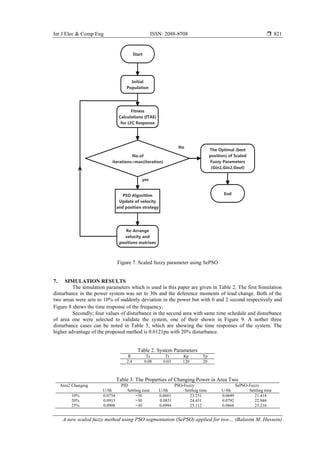
inputs and the output membership function which are shown in Figure 6. The flow chart of SePSO
algorithm to scaled the fuzzy PI parameters as optimal response is shown in Figure 7.
Table 1. Scaled Fuzzy Rules
⁄ PP SP ZE SN NN
PP PP SP SP ZE ZE
SP SP SP ZE ZE NS
ZE SP ZE ZE NS NS
SN ZE ZE NS NS NN
NN ZE NS NS NN NN
Where: PP: medium positive, SP: small positive,SN: small negative, ZE: zero and NN: medium negative.](https://image.slidesharecdn.com/1012970-200717021054/85/A-new-scaled-fuzzy-method-using-PSO-segmentation-SePSO-applied-for-two-area-power-system-5-320.jpg)
![ ISSN: 2088-8708
Int J Elec & Comp Eng, Vol. 9, No. 2, April 2019 : 815 - 825
820
The rules in the fuzzy controller which are used in this works can be listed in Table 1. Also a basic
membership function sets of identical triangles was used for the input and the output of fuzzy as shown in
Figure 6. In this controller, MOMdefuzzification method has been performed in this work.
Figure 5. Scaled Fuzzy PI controller
Figure 6. Input & output Membership
On the other hand, the change and developing of basic PSO have reduced the weak points of
optimal solution of many problems [21], [22]. Among the partial swarmimprovement, the algorithms
searching has been dividedinto groups each one was named segment, and the method was named PSO
segmentation [20].
In this paper, Se-PSO was used to calculate the optimal gain to scale the fuzzy PID controller.
The fuzzy controlhas appliedto two symmetrical areas which were simulated using MATLAB. Each of
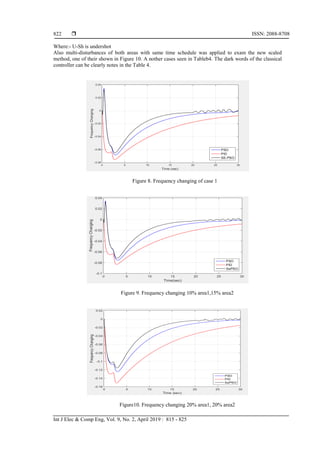
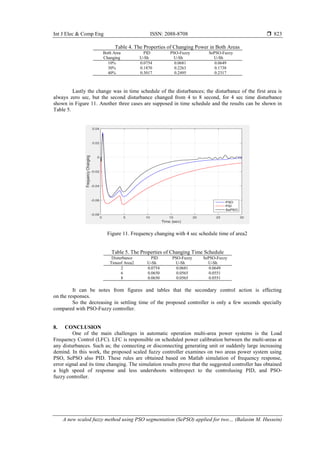
Kp, Kd, and Kiinitial values ranges have divided into a different number of segments. The simulation
results have demonstrated the feasibility of the ensemble in the suggested method via ITAE properties
estimation approach.](https://image.slidesharecdn.com/1012970-200717021054/85/A-new-scaled-fuzzy-method-using-PSO-segmentation-SePSO-applied-for-two-area-power-system-6-320.jpg)
![ ISSN: 2088-8708
Int J Elec & Comp Eng, Vol. 9, No. 2, April 2019 : 815 - 825
824
REFERENCES
[1] S. A. Azeer, et al., “Intelligent Controllers for Load Frequency Control of Two-Area Power System,” Science
Direct, vol. 50, no. 2, 2017, pp. 301-306.
[2] Aqeel S. Jaber, et al., “Advance Two-Area Load Frequency Control using Particle Swarm Optimization Scaled
Fuzzy Logic,” Adv. Mater. Res., vol. 622-623, 2013, pp. 80-85, 2013.
[3] M. Najeeb, et al., “An Optimal LFC in Two-Area Power Systems Using a Meta-heuristic Optimization
Algorithm,” International Journal of Electrical and Computer Engineering, vol. 7, no. 6, pp. 3217- 3225, 2017.
[4] T.P. Dao, et al., “Novel Hybrid Load-Frequency Controller Applying Artificial Intelligence Techniques
Integrated with Superconducting Magnetic Energy Storage Devices for an Interconnected Electric Power Grid,”
King Fahd University of Petroleum & Minerals Journal 2015.
[5] T. Wen, “Load Frequency Control: Problems and Solutions,” Control Conf. (CCC), 30thChinese, 2011,
pp. 6281-6286.
[6] Aqeel S. Jaber, et al., “A new Improvemrnt of Conventional PI/PD contrllers fot load frequency control with
scaled fuzzy controller,” International Journal of Engineering and Applied Sciences, vol. 2, no. 4, 2015,
pp. 69-74.
[7] Hassan Farhan Rashag, et al., “Modified Direct Torque Control using Algorithm Control of Stator Flux
Estimation and Space Vector Modulation Based on Fuzzy Logic Control for Achieving High Performance from
Induction Motors,” Journal of Power Electronics, vol. 13, no. 3, p. 369, 2013.
[8] I. K. E. Cam, “Load Frequency Control In Two Area Power Systems Using Fuzzy Logic Controller,” Energy
Convers. Manag. vol. 46, no. 2, 2005, pp. 233-243, 2005.
[9] K Manickavasagan, “Fuzzy based Power Flow control of Two Area Power System,” International Journal of
Electrical and Computer Engineering (IJECE), vol. 2, no. 1, pp. 130-136, 2012.
[10] A. Guediri and D. Ben Attous, “Modeling and Comparison of Ip and Fuzzy-Pi Regulators of Speed Control of
Dfim for Supply of Power to the Electrical Network,” J Fundam Appl Sci., vol. 10, no. 1, 2018,
pp. 181-190.
[11] E. A. H. Abdalla, et al., “Model Behaviorof Cooling Plant Using Subtractive Clustering Anfis At University
Buildings,” J Fundam Appl Sci., vol. 10, no. 3S, pp. 665-679, 2018.
[12] R. Farhangi, et al., “Load–frequency Control of Interconnected Power System using Emotional Learning-based
Intelligent Controller,” Power Energy Syst., vol. 36, no. 1, pp.76-83, 2012.
[13] S. Ghoshal, “Optimizations of PID Gains by Particle Swarm Optimizations in Fuzzy Based Automatic
Generation Control,” Electr. Power Syst. Res., vol. 2, no. 3, pp. 203-212, 2004.
[14] Sayed Mojtaba Shirvani Boroujeni, et al., “Load Frequency Control in Multi Area Electric Power System
Using Genetic Scaled Fuzzy Logic,” International Journal of Physical Sciences, vol. 6, no. 3, pp. 377-385,
2011.
[15] Vikram Kumar Kamboj, et al., “Automatic Generation Control for Interconnected Hydro-thermal System with
the help of Conventional Controllers,” International Journal of Electrical and Computer Engineering (IJECE),
vol. 2, no. 4, pp. 547-552, 2012.
[16] R. Farhangi, et al., “Load–frequency Control of Interconnected Power System using Emotional Learning-based
Intelligent Controller,” Power Energy Syst., vol. 36, no. 1, pp. 76-83, 2012.
[17] A.M. Abdel Ghany, “Design of Static Output Feedback PID Controller via ILMI Method for APower System
Stabilizer,” 12th Middle East Power Systems Conference, 2008, pp. 593-599.
[18] Hoseinpoor, et al., “Wind Turbines Controll by Pso Algorithm,” J Fundam Appl Sci., vol. 8, no. 2S,
pp. 3638-3646, 2016.
[19] A. J. H. Shayeghi, H.A. Shayanfar, “Load Frequency Control Strategies: A State-of-the-Art Survey for the
Researcher,” Energy Convers. Manag. Sci., vol. 50, no. 2, pp. 344-353, 2009.
[20] Aqeel S. Jaber, et al., “A new Parameters Identification of single area Power System based LFC using
Segmentation Particle Swarm Optimization (SePSO) Algorithm,” Power and Energy Engineering Conference
(APPEEC) IEE Asia-Pacific, 2013, pp.1-6.
[21] Mouellef Sihem, et al., “Optimal Design of Switched Reluctance Motor using PSO Based FEM-EMC
Modeling,” International Journal of Electrical and Computer Engineering (IJECE), vol. 5, no. 5, 2015,
pp. 427-432, 2015.
[22] S. P. Mangaiyarkarasi, et al., “Optimal Location and Sizing of Multiple Static VAr Compensators for Voltage
Risk Assessment Using Hybrid PSO-GSA Algorithm,” King Fahd University of Petroleum & Minerals
Journal, 2018.](https://image.slidesharecdn.com/1012970-200717021054/85/A-new-scaled-fuzzy-method-using-PSO-segmentation-SePSO-applied-for-two-area-power-system-10-320.jpg)