ME 333 Manufacturing Process I
© 2006 Prof. B. Ravi, Mechanical Engineering Department, Indian Institute of Technology, Bombay.
Lecture 09
Casting Defects
• Types of Defects
• Inspection Methods
• Moulding Related Defects
• Filling Related Defects
• Solidification Related Defects
• Defects Analysis
Types of Defects
ƒ Based on Location:
¾ External
¾ Internal
ƒ Based on Type:
¾ Geometric
¾ Integrity
ƒ Based on Size/Severity:
¾ Small/Minor
¾ Large/Major
ƒ Based on Process:
¾ Moulding-related
¾ Filling-related
¾ Solidification-related.
ƒ Based on Cause:
¾ Raw materials
¾ Product design
¾ Tooling design
¾ Process parameters
¾ Process control
ƒ Based on Stage:
¾ Casting
¾ Rough machining
¾ Finish machining
¾ Service
ƒ Based on Reparability:
¾ Repairable
¾ Irreparable
Inspection Methods
ƒ Destructive:
¾ Sectioning, Machining
¾ Mechanical testing
¾ Chemical testing
ƒ Non-Destructive:
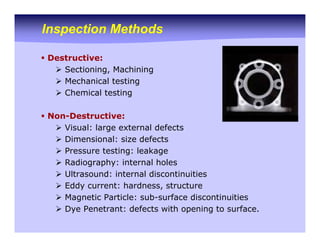
¾ Visual: large external defects
¾ Dimensional: size defects
¾ Pressure testing: leakage
¾ Radiography: internal holes
¾ Ultrasound: internal discontinuities
¾ Eddy current: hardness, structure
¾ Magnetic Particle: sub-surface discontinuities
¾ Dye Penetrant: defects with opening to surface.
Moulding-related Defects
ƒ Improper Closure
ƒ Across parting plane: flash
ƒ Along parting line: mismatch
FLASH
MISMATCH
[Atlas of Casting Defects, Institute of British Foundrymen]
Filling-related Defects
ƒ Incomplete Filling: cold shut, misrun.
ƒ Gaseous Entrapments: blow hole, gas porosity.
ƒ Solid Inclusions: sand inclusion, slag inclusion.
COLD SHUT MISRUN BLOW HOLE GAS POROSITY
[Atlas
of
Casting
Defects,
Institute
of
British
Foundrymen]
Solidification/Cooling-related Defects
ƒ Solidification Shrinkage: cavity, porosity, centerline, sink.
ƒ Hindered Cooling Contraction: hot tear, crack, distortion.
SHRINKAGE CAVITY POROSITY
SINK CORNER SHRINKAGE CRACK
[Atlas
of
Casting
Defects,
Institute
of
British
Foundrymen]
Defects Analysis
ƒ Individual Defect:
¾ Defect identification
¾ Cause identification
¾ Remedy specification
ƒ Defects over a batch/period:
¾ Quality control charts
¾ Defect frequency (histogram)
¾ Defect spectrum (pattern over time)
ƒ Expert Systems for Defects Analysis
¾ Knowledge base (IF-THEN rules with confidence)
¾ Inference Engine
Summary
ƒ Casting defects are significant: typically 1-10%
ƒ About 20 major types of casting defects:
Flash, mismatch, cold shut, misrun, blow hole, gas porosity,
shrinkage cavity, porosity, centerline, sink, hot tear, crack,
scab, swell, metal penetration, rough surface.
Other defects: improper composition and properties.
ƒ Implications:
¾ Minor defects can be repaired, with cost increase.
¾ Major defects lead to rejection, with loss of productivity.
ƒ Status and Progress:
¾ Quality control and defects analysis: experts/systems.
¾ Quality certification and assurance gaining importance.
¾ Responsibility shifting to manufacturer; legal implications.
¾ Toward zero defects: prevention is better than cure!
Home Exercise
• Draw the cause-effect (Ishikawa) diagram for the following defects:
Shrinkage porosity, Blow hole, Mismatch.
Include causes related to moulding, filling and solidification.
• For each of above group of causes, identify the sub-causes
(ex. improper filling), and sub-sub-causes (ex. ingate too small).
• Write the IF-THEN rules for identifying and troubleshooting (cause)
the following defects: shrinkage porosity, gas porosity.

120048832-Casting-Defects-Ppt.pdf

  • 1.
    ME 333 ManufacturingProcess I © 2006 Prof. B. Ravi, Mechanical Engineering Department, Indian Institute of Technology, Bombay. Lecture 09 Casting Defects • Types of Defects • Inspection Methods • Moulding Related Defects • Filling Related Defects • Solidification Related Defects • Defects Analysis
  • 2.
    Types of Defects ƒBased on Location: ¾ External ¾ Internal ƒ Based on Type: ¾ Geometric ¾ Integrity ƒ Based on Size/Severity: ¾ Small/Minor ¾ Large/Major ƒ Based on Process: ¾ Moulding-related ¾ Filling-related ¾ Solidification-related. ƒ Based on Cause: ¾ Raw materials ¾ Product design ¾ Tooling design ¾ Process parameters ¾ Process control ƒ Based on Stage: ¾ Casting ¾ Rough machining ¾ Finish machining ¾ Service ƒ Based on Reparability: ¾ Repairable ¾ Irreparable
  • 3.
    Inspection Methods ƒ Destructive: ¾Sectioning, Machining ¾ Mechanical testing ¾ Chemical testing ƒ Non-Destructive: ¾ Visual: large external defects ¾ Dimensional: size defects ¾ Pressure testing: leakage ¾ Radiography: internal holes ¾ Ultrasound: internal discontinuities ¾ Eddy current: hardness, structure ¾ Magnetic Particle: sub-surface discontinuities ¾ Dye Penetrant: defects with opening to surface.
  • 4.
    Moulding-related Defects ƒ ImproperClosure ƒ Across parting plane: flash ƒ Along parting line: mismatch FLASH MISMATCH [Atlas of Casting Defects, Institute of British Foundrymen]
  • 5.
    Filling-related Defects ƒ IncompleteFilling: cold shut, misrun. ƒ Gaseous Entrapments: blow hole, gas porosity. ƒ Solid Inclusions: sand inclusion, slag inclusion. COLD SHUT MISRUN BLOW HOLE GAS POROSITY [Atlas of Casting Defects, Institute of British Foundrymen]
  • 6.
    Solidification/Cooling-related Defects ƒ SolidificationShrinkage: cavity, porosity, centerline, sink. ƒ Hindered Cooling Contraction: hot tear, crack, distortion. SHRINKAGE CAVITY POROSITY SINK CORNER SHRINKAGE CRACK [Atlas of Casting Defects, Institute of British Foundrymen]
  • 7.
    Defects Analysis ƒ IndividualDefect: ¾ Defect identification ¾ Cause identification ¾ Remedy specification ƒ Defects over a batch/period: ¾ Quality control charts ¾ Defect frequency (histogram) ¾ Defect spectrum (pattern over time) ƒ Expert Systems for Defects Analysis ¾ Knowledge base (IF-THEN rules with confidence) ¾ Inference Engine
  • 8.
    Summary ƒ Casting defectsare significant: typically 1-10% ƒ About 20 major types of casting defects: Flash, mismatch, cold shut, misrun, blow hole, gas porosity, shrinkage cavity, porosity, centerline, sink, hot tear, crack, scab, swell, metal penetration, rough surface. Other defects: improper composition and properties. ƒ Implications: ¾ Minor defects can be repaired, with cost increase. ¾ Major defects lead to rejection, with loss of productivity. ƒ Status and Progress: ¾ Quality control and defects analysis: experts/systems. ¾ Quality certification and assurance gaining importance. ¾ Responsibility shifting to manufacturer; legal implications. ¾ Toward zero defects: prevention is better than cure!
  • 9.
    Home Exercise • Drawthe cause-effect (Ishikawa) diagram for the following defects: Shrinkage porosity, Blow hole, Mismatch. Include causes related to moulding, filling and solidification. • For each of above group of causes, identify the sub-causes (ex. improper filling), and sub-sub-causes (ex. ingate too small). • Write the IF-THEN rules for identifying and troubleshooting (cause) the following defects: shrinkage porosity, gas porosity.