Engineering | Architecture | Design-Build | Surveying | Planning | GeoSpatial Solutions
June 11, 2015
GEOSPATIAL SOLUTIONS
A LiDAR Processing Workflow
Supporting LAS 1.4 and
Testing for USGS NGP Base
Specification Compliance
Copyright © 2015 Merrick & Company - All rights reserved.
Matt Bethel
Director of Technology
for Merrick & Company
Development Manager
for MARS® software
Copyright © 2015 Merrick & Company - All rights reserved.
Office Locations
19 Offices
15 Domestic
4 International
Copyright © 2015 Merrick & Company - All rights reserved.
Global Project Experience
What’s new in LAS 1.4?
How MARS® handles LAS 1.4
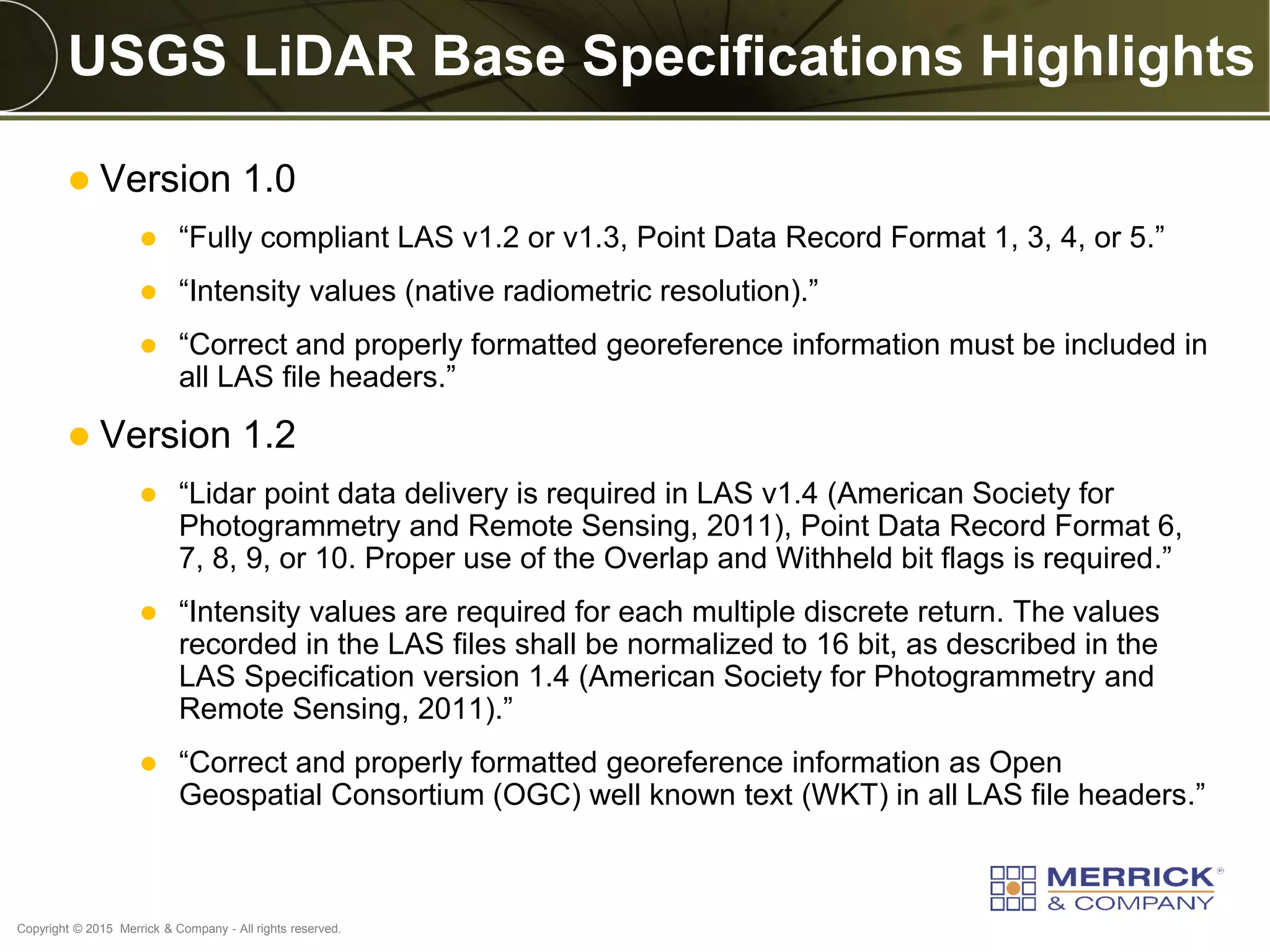
USGS LiDAR Base Specifications Highlights
MARS® QC Module Highlights
Presentation Agenda
Copyright © 2015 Merrick & Company - All rights reserved.
What’s New in LAS 1.4?
 Point Data Record Formats (PDRF) 6-10 [MARS® 6-8]
 Option for Extended Variable Length Record (EVLR) for
general use
 Dedicated use of Well Known Text (WKT) for CRS
 Point attribute additions of overlap bit flag and sensor
channel bit
 Support for up to 15 returns
 New scan angle format increasing stored resolution
 Intensity and RGBN normalization
 Fourth colorization band support (RGBN)
 Support for up to 256 classes with new definitions
Copyright © 2015 Merrick & Company - All rights reserved.
How Merrick Advanced Remote Sensing
(MARS®) LiDAR processing software
handles LAS 1.4
Copyright © 2015 Merrick & Company - All rights reserved.
Point Data Record Formats (PDRF) 6-8
 MARS® has supported all LAS versions (1.0-1.4) and
PDRFs 0-3 and 6-8, read and write, for 3.5 years
 MARS® 8.1 will
 work upon only LAS 1.4, PDRF 6-8 for a standardized workflow
 read in any LAS version (1.0-1.4 and PDRFs 0-3, 6-8) and
perform an appropriate conversion to LAS 1.4, PDRF 6-8
during the one time, pre-processing, spatial indexing stage
 have an LAS converter for end process conversion (write) to
older LAS versions
PDRF Description
6 Core 30 bytes that are shared by Point Data Record Formats 6 to 10
7 Adds three RGB color channels to PDRF 6
8 Adds a fourth NIR (near infrared) channels to PDRF 7
9 Adds Wave Packets to Point Data Record Format 6
10 Adds Wave Packets to Point Data Record Format 8
PDRF Up
Conversion
0 → 6*
1 → 6
2 → 7*
3 → 7
*Timestamps
set to “0”
Copyright © 2015 Merrick & Company - All rights reserved.
Point Data Record Formats (PDRF) 6-8
Copyright © 2015 Merrick & Company - All rights reserved.
Extended Variable Length Record (EVLR)
 MARS® 8.0 currently supports both
VLRs and EVLRs
 MARS® 8.1 will
 convert incoming VLRs to EVLRs
 only work upon EVLRs
 Benefits of EVLR
 allow for faster EVLR-method
modifications since the end of the file can
be quickly edited or appended by MARS®
rather than re-writing the entire file to
modify the VLR at the top
 prevent spreading or accidentally
duplicating information between the VLR
and the EVLR (e.g. GeoTIFF tags and
WKT)
Copyright © 2015 Merrick & Company - All rights reserved.
Well Known Text (WKT)
 MARS® 8.0 currently supports both
GeoTIFF tags and WKT (OGC dialect)
 MARS® 8.1 will
 convert incoming GeoTIFF tags to WKT
whenever possible
 only work upon WKT
 Benefits of WKT
 allow for faster CRS addition or modifications
since the end of the file can be quickly edited or
appended by MARS® rather than re-writing the
entire file to modify the GeoTIFF tags at the top
 more robust CRS definitions as compared to
GeoTIFF tags
 store vertical datum, height model, and units
Copyright © 2015 Merrick & Company - All rights reserved.
Bit Flags
 Classification flags (bits 0-3)
 Synthetic (bit 0) – LMS will always set this to 0
 Key-point (bit 1) – LMS will always set this to 0
 Withheld (bit 2) - LMS will almost always set
points to 0, on special cases 1
 Overlap (bit 3) – LMS will always set this to 0
 Scanner Channel (bits 4-5)
 Single scanner systems - LMS will always set this to 0
 Dual scanner systems - LMS will set these to two numbers between 0 and 3
 Scan direction (bit 6) - LMS will set points to either 0 or 1
 Edge of flight line (bit 7) - LMS will set points to 0 and 1
Bit Field Name Description
0 Synthetic
If set then this point was created by a
technique other than LIDAR collection
such as digitized from a photogrammetric
stereo model or by traversing a waveform.
1 Key-point
If set, this point is considered to be a
model key-point and thus generally should
not be withheld in a thinning algorithm.
2 Withheld
If set, this point should not be included in
processing (synonymous with Deleted).
3 Overlap
If set, this point is within the overlap region
of two or more swaths or takes. Setting
this bit is not mandatory (unless, of
course, it is mandated by a particular
delivery specification) but allows
Classification of overlap points to be
preserved.
Copyright © 2015 Merrick & Company - All rights reserved.
Bit Flags - MARS® Interfaces
Copyright © 2015 Merrick & Company - All rights reserved.
Bit Flags - MARS® Results
Copyright © 2015 Merrick & Company - All rights reserved.
Bit Flags - lasinfo Results
Copyright © 2015 Merrick & Company - All rights reserved.
Bit Flags - MARS® Results
Copyright © 2015 Merrick & Company - All rights reserved.
Support for up to 15 Returns
Copyright © 2015 Merrick & Company - All rights reserved.
7 Return Sample
Copyright © 2015 Merrick & Company - All rights reserved.
Scan Angle Rank vs. Scan Angle
0°
+90°-90° +15000-15000
0
-30000 +30000
Scan angle rank
(LAS versions 1.0-1.3)
Scan angle
(LAS version 1.4)
Only integer values for angles
Finer angular values scaled in 0.006°
increments converted to integers
Scan angle = (Scan angle rank / 90) X 15000
Sky
Ground
Copyright © 2015 Merrick & Company - All rights reserved.
Scan Angle - Results
Copyright © 2015 Merrick & Company - All rights reserved.
Intensity Normalization
 For LAS 1.4 compliance,
all point intensities must
be normalized to 16-bit
 8-bit intensities are scaled
by multiplying values by 256
 12-bit intensities are scaled
by multiplying values by 16
 MARS® 8.0 has a
conversion tool
 MARS® 8.1 will force this
conversion during spatial
indexing stage if 16-bit
intensity values are not
found. It will do the same
for non-16-bit RGB(N)
values if present in PDRF 7
and 8.
Copyright © 2015 Merrick & Company - All rights reserved.
Intensity Normalization - Results
Native 12-bit
Normalized to 16-bit
Native 8-bit
intensity and RGB
normalized to 16-bit
Copyright © 2015 Merrick & Company - All rights reserved.
Fourth Colorization Band Support (RGBN)
 LAS 1.4 supports RGBN =
Red, Green, Blue, Near
Infrared primarily for
photogrammetrically correlated
point clouds that use LAS as
the storage file format
 MARS® 8.0 supports 3 band
source color LiDAR filtering
 MARS® 8.1 will support 3, 4, or
5 band source color LiDAR
filtering
 If an imaging sensor is used to
create point clouds stored in
LAS 1.4 version format, PDRF
8, up to 5 channels of color
can be stored (Intensity +
RGBN).
Copyright © 2015 Merrick & Company - All rights reserved.
256 Classes
 256 classes supported for LAS 1.4
PDRFs 6-10
 No more model key-point class or
overlap class, these are bit flags now
 Additional ASPRS standardized
classes and descriptions
Classification Value Meaning
0 Created, never classified
1 Unclassified
2 Ground
3 Low Vegetation
4 Medium Vegetation
5 High Vegetation
6 Building
7 Low Point (noise)
8 Reserved
9 Water
10 Rail
11 Road Surface
12 Reserved
13 Wire – Guard (Shield)
14 Wire – Conductor (Phase)
15 Transmission Tower
16 Wire-structure Connector (e.g. Insulator)
17 Bridge Deck
18 High Noise
19-63 Reserved
64-255 User definable
Copyright © 2015 Merrick & Company - All rights reserved.
256 Classes - Results
Copyright © 2015 Merrick & Company - All rights reserved.
LAS Version Converter from 1.4 to 1.0 – 1.3
 Input LAS 1.4 PDRF of 6-8 will be reassigned for LAS <1.4 PDRF
 6 → 1
 7 → 3
 8 → 3 and drops fourth color (N) channel data
 EVLR content will be moved to VLR
 WKT format will be converted to GeoTIFF tag format whenever possible
 If input LAS files have > 5 returns, the conversion will directly map the
first 4 and use the last return as the 5th return. All remaining points get
coded to 0 of 5.
 Scan angle will be converted from “Scan Angle” to “Scan Angle Rank”
with a resulting loss of angular precision.
 Bit flag mapping
 Synthetic, Key-point, and Withheld - user has the option to map bit flags to
classes or older LAS version bit flags (1.1-1.3 bit flags 5,6,7)
 Overlap: map to class 12 (default selection) for all LAS versions
Copyright © 2015 Merrick & Company - All rights reserved.
USGS LiDAR Base Specifications Highlights
 Version 1.0
 “Fully compliant LAS v1.2 or v1.3, Point Data Record Format 1, 3, 4, or 5.”
 “Intensity values (native radiometric resolution).”
 “Correct and properly formatted georeference information must be included in
all LAS file headers.”
 Version 1.2
 “Lidar point data delivery is required in LAS v1.4 (American Society for
Photogrammetry and Remote Sensing, 2011), Point Data Record Format 6,
7, 8, 9, or 10. Proper use of the Overlap and Withheld bit flags is required.”
 “Intensity values are required for each multiple discrete return. The values
recorded in the LAS files shall be normalized to 16 bit, as described in the
LAS Specification version 1.4 (American Society for Photogrammetry and
Remote Sensing, 2011).”
 “Correct and properly formatted georeference information as Open
Geospatial Consortium (OGC) well known text (WKT) in all LAS file headers.”
Copyright © 2015 Merrick & Company - All rights reserved.
MARS® QC Module
 MARS® offers a license level to
use the fully automated QC
module for batch testing of the
USGS’ National Geospatial
Program LiDAR Base
Specification (LBS)
 MARS® 8.0 supports all LAS file
tests for the LBS version 1.0
 Modifications to the QC module
will be required to properly
support the complete testing of
the newer and current LBS
version 1.2
 More information on the MARS®
QC module can be found in this
2013 ILMF presentation
Copyright © 2015 Merrick & Company - All rights reserved.
Thank You
Matt Bethel
Director of Technology
Merrick & Company
http://www.merrick.com/Geospatial
matt.bethel@merrick.com
(303) 353-3662

A LiDAR Processing Workflow Supporting LAS 1.4 and Testing for USGS NGP Base Specification Compliance

  • 1.
    Engineering | Architecture| Design-Build | Surveying | Planning | GeoSpatial Solutions June 11, 2015 GEOSPATIAL SOLUTIONS A LiDAR Processing Workflow Supporting LAS 1.4 and Testing for USGS NGP Base Specification Compliance
  • 2.
    Copyright © 2015Merrick & Company - All rights reserved. Matt Bethel Director of Technology for Merrick & Company Development Manager for MARS® software
  • 3.
    Copyright © 2015Merrick & Company - All rights reserved. Office Locations 19 Offices 15 Domestic 4 International
  • 4.
    Copyright © 2015Merrick & Company - All rights reserved. Global Project Experience
  • 5.
    What’s new inLAS 1.4? How MARS® handles LAS 1.4 USGS LiDAR Base Specifications Highlights MARS® QC Module Highlights Presentation Agenda
  • 6.
    Copyright © 2015Merrick & Company - All rights reserved. What’s New in LAS 1.4?  Point Data Record Formats (PDRF) 6-10 [MARS® 6-8]  Option for Extended Variable Length Record (EVLR) for general use  Dedicated use of Well Known Text (WKT) for CRS  Point attribute additions of overlap bit flag and sensor channel bit  Support for up to 15 returns  New scan angle format increasing stored resolution  Intensity and RGBN normalization  Fourth colorization band support (RGBN)  Support for up to 256 classes with new definitions
  • 7.
    Copyright © 2015Merrick & Company - All rights reserved. How Merrick Advanced Remote Sensing (MARS®) LiDAR processing software handles LAS 1.4
  • 8.
    Copyright © 2015Merrick & Company - All rights reserved. Point Data Record Formats (PDRF) 6-8  MARS® has supported all LAS versions (1.0-1.4) and PDRFs 0-3 and 6-8, read and write, for 3.5 years  MARS® 8.1 will  work upon only LAS 1.4, PDRF 6-8 for a standardized workflow  read in any LAS version (1.0-1.4 and PDRFs 0-3, 6-8) and perform an appropriate conversion to LAS 1.4, PDRF 6-8 during the one time, pre-processing, spatial indexing stage  have an LAS converter for end process conversion (write) to older LAS versions PDRF Description 6 Core 30 bytes that are shared by Point Data Record Formats 6 to 10 7 Adds three RGB color channels to PDRF 6 8 Adds a fourth NIR (near infrared) channels to PDRF 7 9 Adds Wave Packets to Point Data Record Format 6 10 Adds Wave Packets to Point Data Record Format 8 PDRF Up Conversion 0 → 6* 1 → 6 2 → 7* 3 → 7 *Timestamps set to “0”
  • 9.
    Copyright © 2015Merrick & Company - All rights reserved. Point Data Record Formats (PDRF) 6-8
  • 10.
    Copyright © 2015Merrick & Company - All rights reserved. Extended Variable Length Record (EVLR)  MARS® 8.0 currently supports both VLRs and EVLRs  MARS® 8.1 will  convert incoming VLRs to EVLRs  only work upon EVLRs  Benefits of EVLR  allow for faster EVLR-method modifications since the end of the file can be quickly edited or appended by MARS® rather than re-writing the entire file to modify the VLR at the top  prevent spreading or accidentally duplicating information between the VLR and the EVLR (e.g. GeoTIFF tags and WKT)
  • 11.
    Copyright © 2015Merrick & Company - All rights reserved. Well Known Text (WKT)  MARS® 8.0 currently supports both GeoTIFF tags and WKT (OGC dialect)  MARS® 8.1 will  convert incoming GeoTIFF tags to WKT whenever possible  only work upon WKT  Benefits of WKT  allow for faster CRS addition or modifications since the end of the file can be quickly edited or appended by MARS® rather than re-writing the entire file to modify the GeoTIFF tags at the top  more robust CRS definitions as compared to GeoTIFF tags  store vertical datum, height model, and units
  • 12.
    Copyright © 2015Merrick & Company - All rights reserved. Bit Flags  Classification flags (bits 0-3)  Synthetic (bit 0) – LMS will always set this to 0  Key-point (bit 1) – LMS will always set this to 0  Withheld (bit 2) - LMS will almost always set points to 0, on special cases 1  Overlap (bit 3) – LMS will always set this to 0  Scanner Channel (bits 4-5)  Single scanner systems - LMS will always set this to 0  Dual scanner systems - LMS will set these to two numbers between 0 and 3  Scan direction (bit 6) - LMS will set points to either 0 or 1  Edge of flight line (bit 7) - LMS will set points to 0 and 1 Bit Field Name Description 0 Synthetic If set then this point was created by a technique other than LIDAR collection such as digitized from a photogrammetric stereo model or by traversing a waveform. 1 Key-point If set, this point is considered to be a model key-point and thus generally should not be withheld in a thinning algorithm. 2 Withheld If set, this point should not be included in processing (synonymous with Deleted). 3 Overlap If set, this point is within the overlap region of two or more swaths or takes. Setting this bit is not mandatory (unless, of course, it is mandated by a particular delivery specification) but allows Classification of overlap points to be preserved.
  • 13.
    Copyright © 2015Merrick & Company - All rights reserved. Bit Flags - MARS® Interfaces
  • 14.
    Copyright © 2015Merrick & Company - All rights reserved. Bit Flags - MARS® Results
  • 15.
    Copyright © 2015Merrick & Company - All rights reserved. Bit Flags - lasinfo Results
  • 16.
    Copyright © 2015Merrick & Company - All rights reserved. Bit Flags - MARS® Results
  • 17.
    Copyright © 2015Merrick & Company - All rights reserved. Support for up to 15 Returns
  • 18.
    Copyright © 2015Merrick & Company - All rights reserved. 7 Return Sample
  • 19.
    Copyright © 2015Merrick & Company - All rights reserved. Scan Angle Rank vs. Scan Angle 0° +90°-90° +15000-15000 0 -30000 +30000 Scan angle rank (LAS versions 1.0-1.3) Scan angle (LAS version 1.4) Only integer values for angles Finer angular values scaled in 0.006° increments converted to integers Scan angle = (Scan angle rank / 90) X 15000 Sky Ground
  • 20.
    Copyright © 2015Merrick & Company - All rights reserved. Scan Angle - Results
  • 21.
    Copyright © 2015Merrick & Company - All rights reserved. Intensity Normalization  For LAS 1.4 compliance, all point intensities must be normalized to 16-bit  8-bit intensities are scaled by multiplying values by 256  12-bit intensities are scaled by multiplying values by 16  MARS® 8.0 has a conversion tool  MARS® 8.1 will force this conversion during spatial indexing stage if 16-bit intensity values are not found. It will do the same for non-16-bit RGB(N) values if present in PDRF 7 and 8.
  • 22.
    Copyright © 2015Merrick & Company - All rights reserved. Intensity Normalization - Results Native 12-bit Normalized to 16-bit Native 8-bit intensity and RGB normalized to 16-bit
  • 23.
    Copyright © 2015Merrick & Company - All rights reserved. Fourth Colorization Band Support (RGBN)  LAS 1.4 supports RGBN = Red, Green, Blue, Near Infrared primarily for photogrammetrically correlated point clouds that use LAS as the storage file format  MARS® 8.0 supports 3 band source color LiDAR filtering  MARS® 8.1 will support 3, 4, or 5 band source color LiDAR filtering  If an imaging sensor is used to create point clouds stored in LAS 1.4 version format, PDRF 8, up to 5 channels of color can be stored (Intensity + RGBN).
  • 24.
    Copyright © 2015Merrick & Company - All rights reserved. 256 Classes  256 classes supported for LAS 1.4 PDRFs 6-10  No more model key-point class or overlap class, these are bit flags now  Additional ASPRS standardized classes and descriptions Classification Value Meaning 0 Created, never classified 1 Unclassified 2 Ground 3 Low Vegetation 4 Medium Vegetation 5 High Vegetation 6 Building 7 Low Point (noise) 8 Reserved 9 Water 10 Rail 11 Road Surface 12 Reserved 13 Wire – Guard (Shield) 14 Wire – Conductor (Phase) 15 Transmission Tower 16 Wire-structure Connector (e.g. Insulator) 17 Bridge Deck 18 High Noise 19-63 Reserved 64-255 User definable
  • 25.
    Copyright © 2015Merrick & Company - All rights reserved. 256 Classes - Results
  • 26.
    Copyright © 2015Merrick & Company - All rights reserved. LAS Version Converter from 1.4 to 1.0 – 1.3  Input LAS 1.4 PDRF of 6-8 will be reassigned for LAS <1.4 PDRF  6 → 1  7 → 3  8 → 3 and drops fourth color (N) channel data  EVLR content will be moved to VLR  WKT format will be converted to GeoTIFF tag format whenever possible  If input LAS files have > 5 returns, the conversion will directly map the first 4 and use the last return as the 5th return. All remaining points get coded to 0 of 5.  Scan angle will be converted from “Scan Angle” to “Scan Angle Rank” with a resulting loss of angular precision.  Bit flag mapping  Synthetic, Key-point, and Withheld - user has the option to map bit flags to classes or older LAS version bit flags (1.1-1.3 bit flags 5,6,7)  Overlap: map to class 12 (default selection) for all LAS versions
  • 27.
    Copyright © 2015Merrick & Company - All rights reserved. USGS LiDAR Base Specifications Highlights  Version 1.0  “Fully compliant LAS v1.2 or v1.3, Point Data Record Format 1, 3, 4, or 5.”  “Intensity values (native radiometric resolution).”  “Correct and properly formatted georeference information must be included in all LAS file headers.”  Version 1.2  “Lidar point data delivery is required in LAS v1.4 (American Society for Photogrammetry and Remote Sensing, 2011), Point Data Record Format 6, 7, 8, 9, or 10. Proper use of the Overlap and Withheld bit flags is required.”  “Intensity values are required for each multiple discrete return. The values recorded in the LAS files shall be normalized to 16 bit, as described in the LAS Specification version 1.4 (American Society for Photogrammetry and Remote Sensing, 2011).”  “Correct and properly formatted georeference information as Open Geospatial Consortium (OGC) well known text (WKT) in all LAS file headers.”
  • 28.
    Copyright © 2015Merrick & Company - All rights reserved. MARS® QC Module  MARS® offers a license level to use the fully automated QC module for batch testing of the USGS’ National Geospatial Program LiDAR Base Specification (LBS)  MARS® 8.0 supports all LAS file tests for the LBS version 1.0  Modifications to the QC module will be required to properly support the complete testing of the newer and current LBS version 1.2  More information on the MARS® QC module can be found in this 2013 ILMF presentation
  • 29.
    Copyright © 2015Merrick & Company - All rights reserved. Thank You Matt Bethel Director of Technology Merrick & Company http://www.merrick.com/Geospatial matt.bethel@merrick.com (303) 353-3662