Clarence Anslem
Systems Architect
July 2019
Engineering The New IP Transport
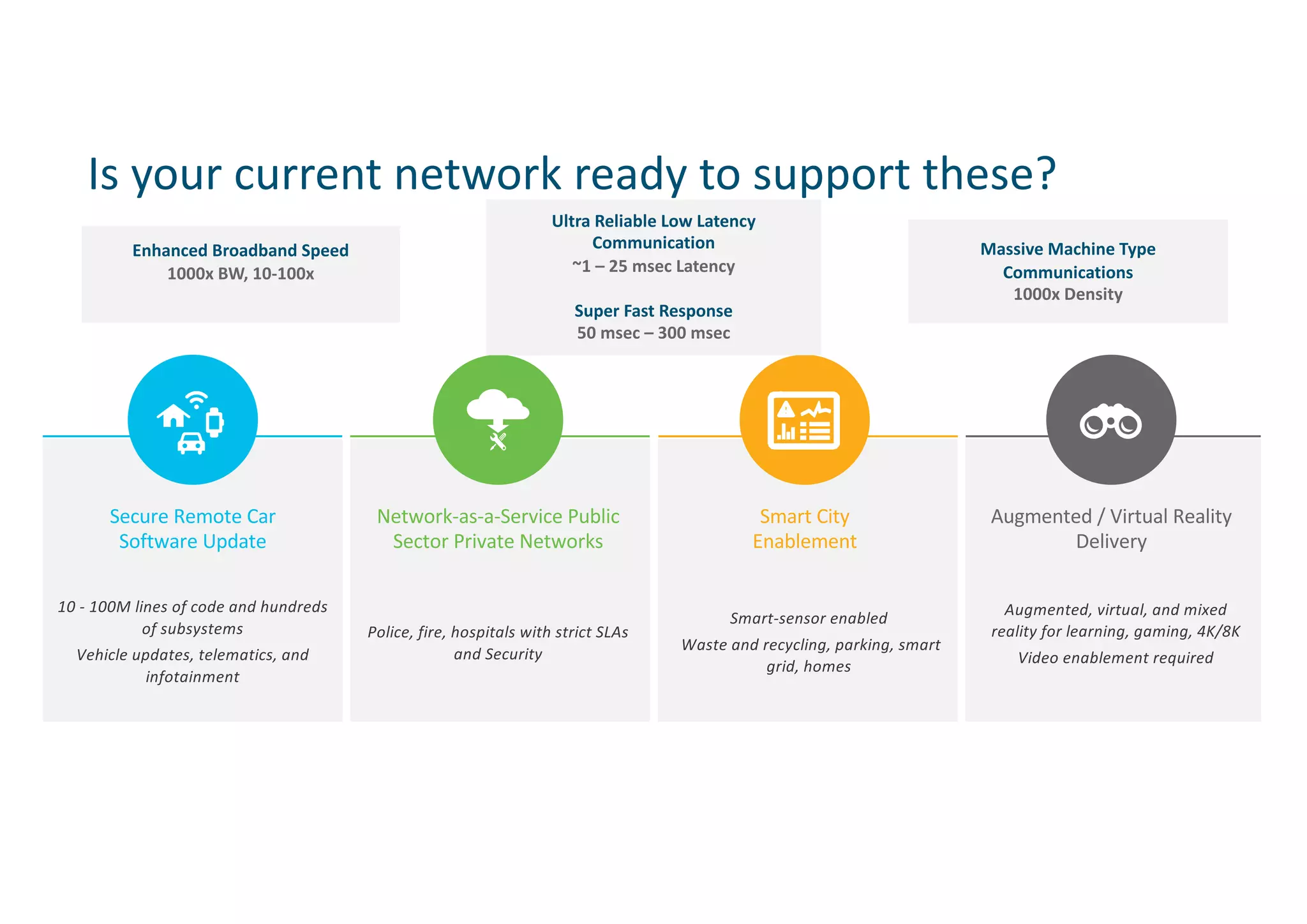
Is your current network ready to support these?
10 - 100M lines of code and hundreds
of subsystems
Vehicle updates, telematics, and
infotainment
Secure Remote Car
Software Update
Police, fire, hospitals with strict SLAs
and Security
Network-as-a-Service Public
Sector Private Networks
Smart-sensor enabled
Waste and recycling, parking, smart
grid, homes
Smart City
Enablement
Augmented, virtual, and mixed
reality for learning, gaming, 4K/8K
Video enablement required
Augmented / Virtual Reality
Delivery
Enhanced Broadband Speed
1000x BW, 10-100x
Ultra Reliable Low Latency
Communication
~1 – 25 msec Latency
Super Fast Response
50 msec – 300 msec
Massive Machine Type
Communications
1000x Density
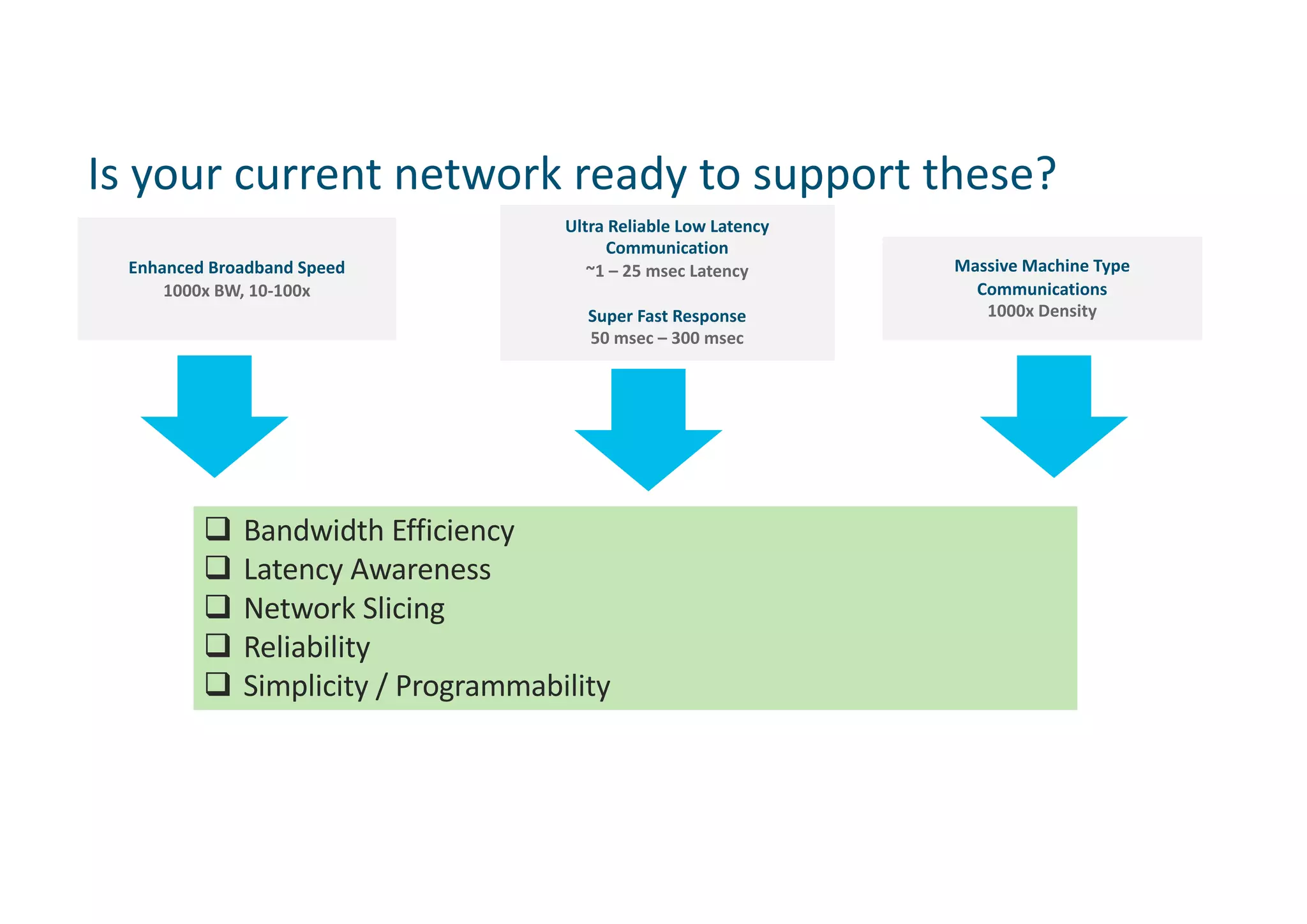
Is your current network ready to support these?
q Bandwidth Efficiency
q Latency Awareness
q Network Slicing
q Reliability
q Simplicity / Programmability
Enhanced Broadband Speed
1000x BW, 10-100x
Massive Machine Type
Communications
1000x Density
Ultra Reliable Low Latency
Communication
~1 – 25 msec Latency
Super Fast Response
50 msec – 300 msec
Aggregation
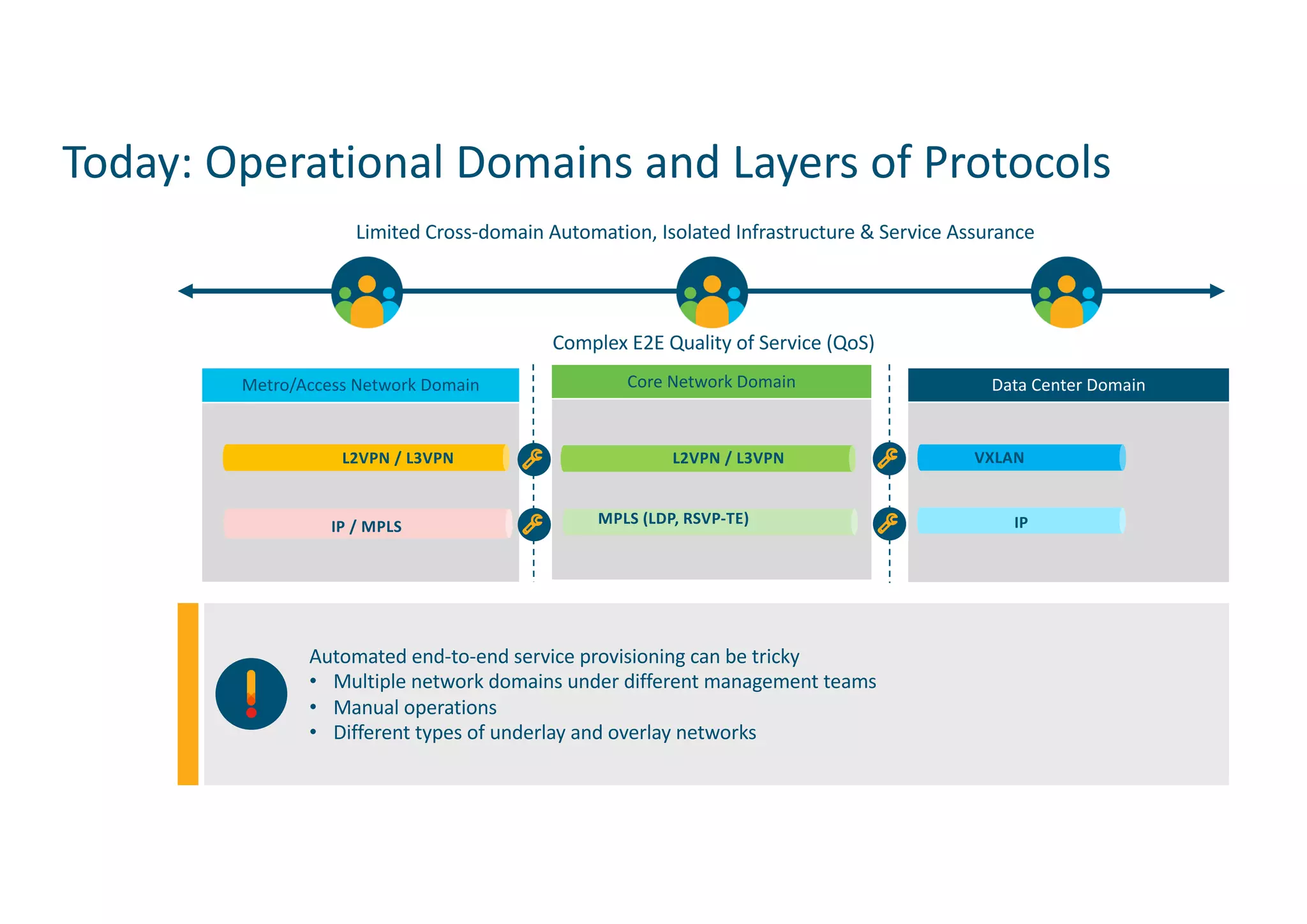
Today: Operational Domains and Layers of Protocols
Metro/Access Network Domain Core Network Domain Data Center Domain
Limited Cross-domain Automation, Isolated Infrastructure & Service Assurance
Automated end-to-end service provisioning can be tricky
• Multiple network domains under different management teams
• Manual operations
• Different types of underlay and overlay networks
IPMPLS (LDP, RSVP-TE)
L2VPN / L3VPN L2VPN / L3VPN VXLAN
Complex E2E Quality of Service (QoS)
IP / MPLS
Aggregation
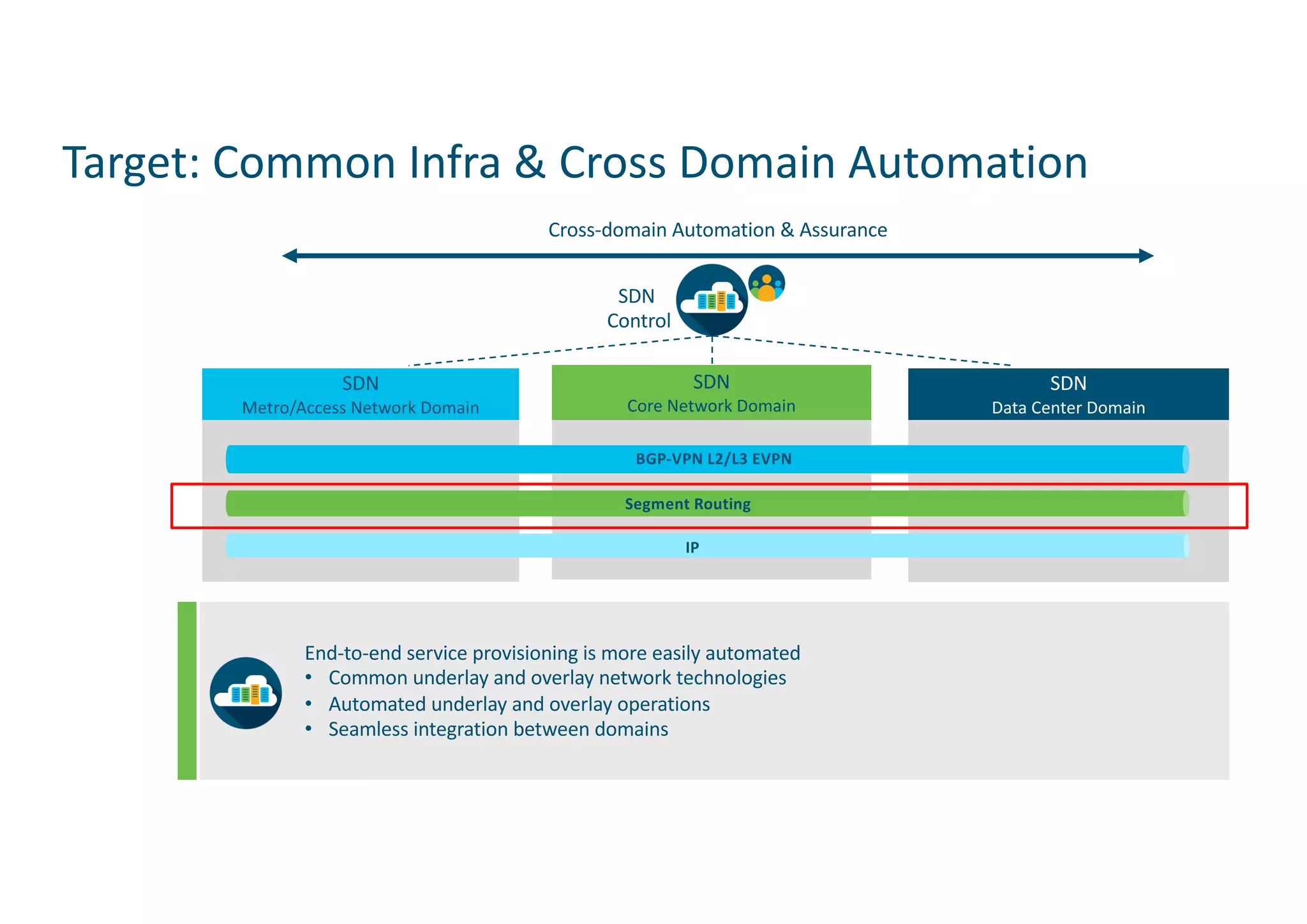
SDN
Metro/Access Network Domain
SDN
Core Network Domain
SDN
Data Center Domain
Segment Routing
BGP-VPN L2/L3 EVPN
Cross-domain Automation & Assurance
SDN
Control
End-to-end service provisioning is more easily automated
• Common underlay and overlay network technologies
• Automated underlay and overlay operations
• Seamless integration between domains
IP
Target: Common Infra & Cross Domain Automation
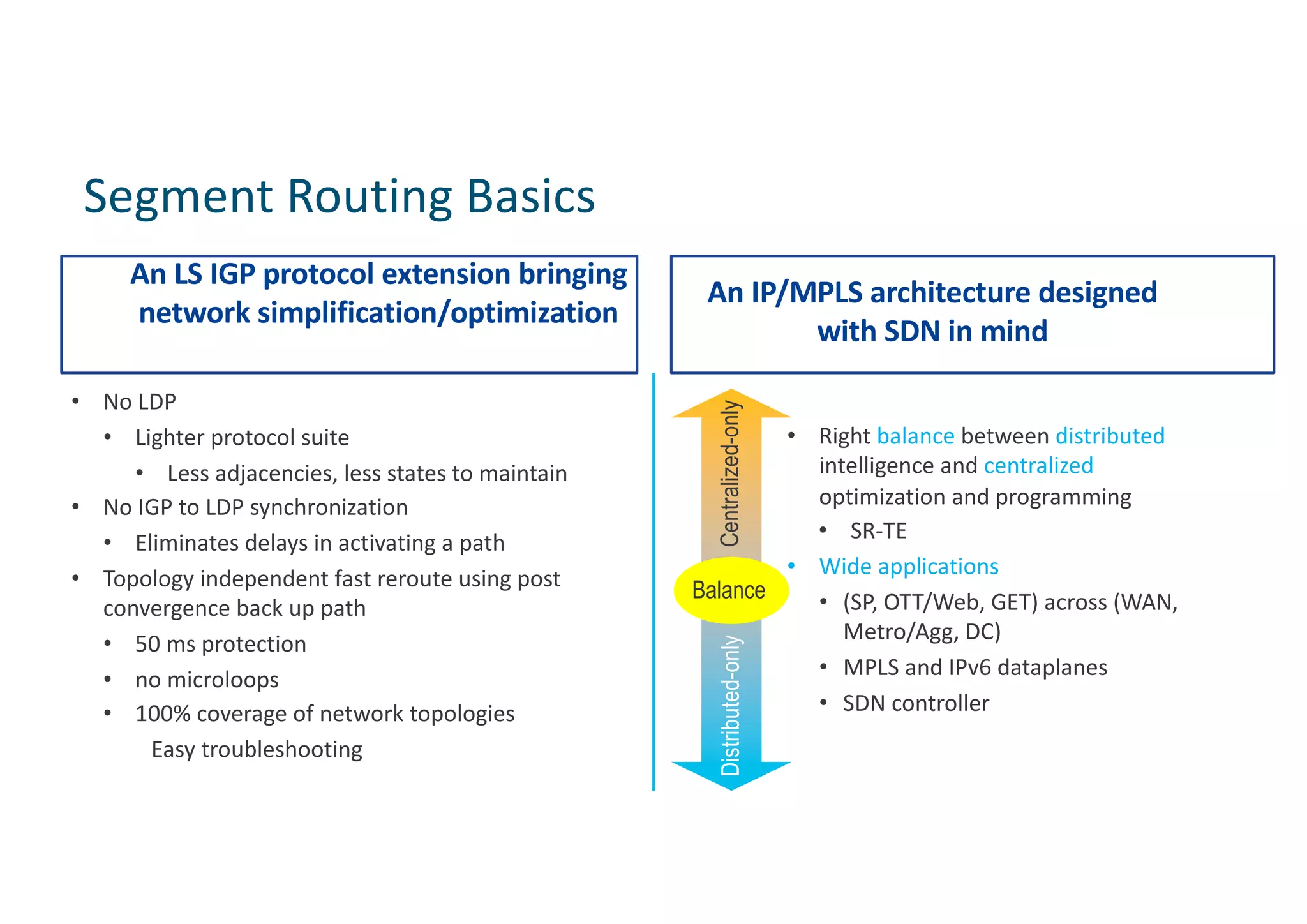
Segment Routing Basics
An LS IGP protocol extension bringing
network simplification/optimization
An IP/MPLS architecture designed
with SDN in mind
• Right balance between distributed
intelligence and centralized
optimization and programming
• SR-TE
• Wide applications
• (SP, OTT/Web, GET) across (WAN,
Metro/Agg, DC)
• MPLS and IPv6 dataplanes
• SDN controller
• No LDP
• Lighter protocol suite
• Less adjacencies, less states to maintain
• No IGP to LDP synchronization
• Eliminates delays in activating a path
• Topology independent fast reroute using post
convergence back up path
• 50 ms protection
• no microloops
• 100% coverage of network topologies
Easy troubleshooting
Balance
Centralized-onlyDistributed-only
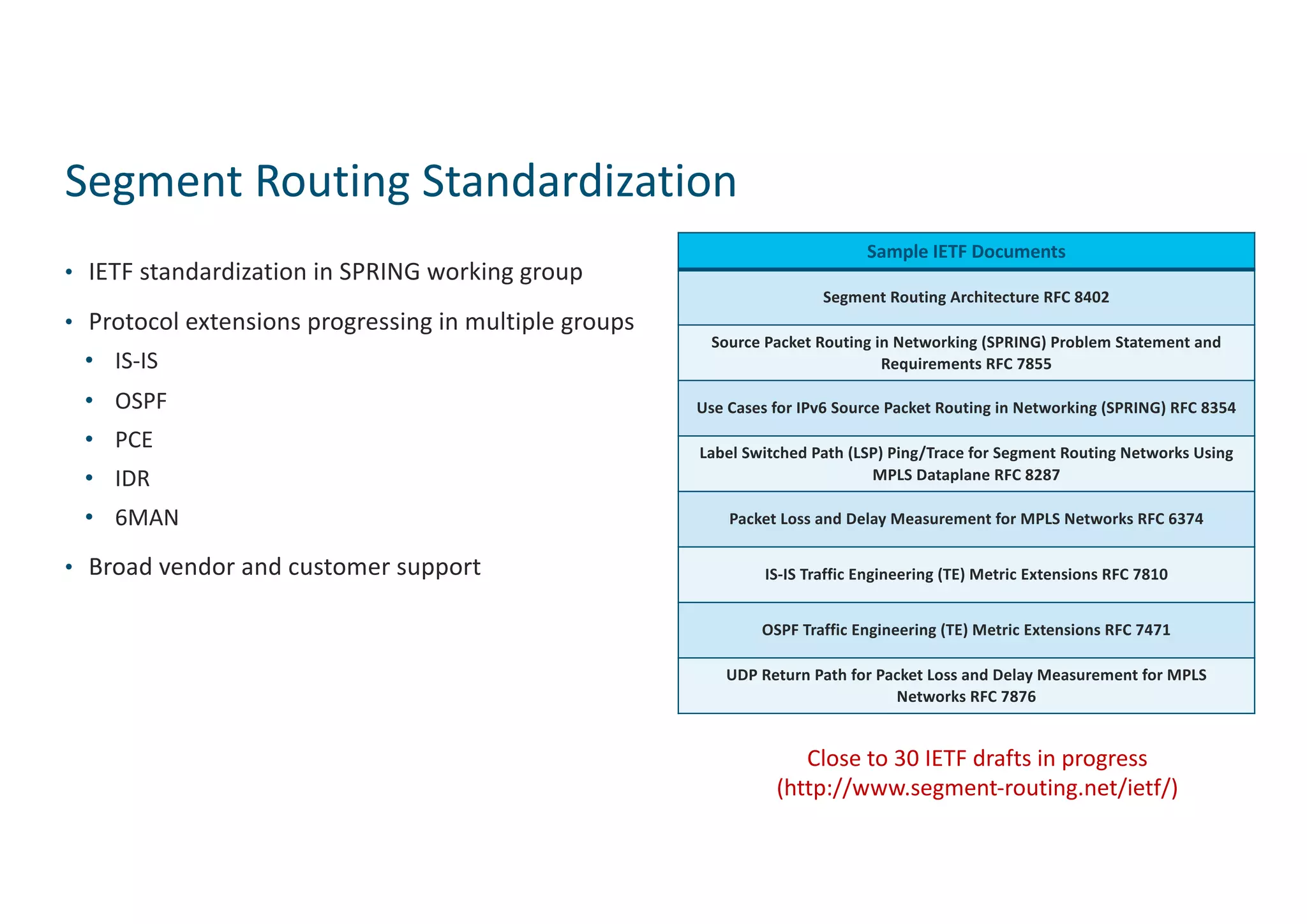
Segment Routing Standardization
• IETF standardization in SPRING working group
• Protocol extensions progressing in multiple groups
• IS-IS
• OSPF
• PCE
• IDR
• 6MAN
• Broad vendor and customer support
7
Sample IETF Documents
Segment Routing Architecture RFC 8402
Source Packet Routing in Networking (SPRING) Problem Statement and
Requirements RFC 7855
Use Cases for IPv6 Source Packet Routing in Networking (SPRING) RFC 8354
Label Switched Path (LSP) Ping/Trace for Segment Routing Networks Using
MPLS Dataplane RFC 8287
Packet Loss and Delay Measurement for MPLS Networks RFC 6374
IS-IS Traffic Engineering (TE) Metric Extensions RFC 7810
OSPF Traffic Engineering (TE) Metric Extensions RFC 7471
UDP Return Path for Packet Loss and Delay Measurement for MPLS
Networks RFC 7876
Close to 30 IETF drafts in progress
(http://www.segment-routing.net/ietf/)
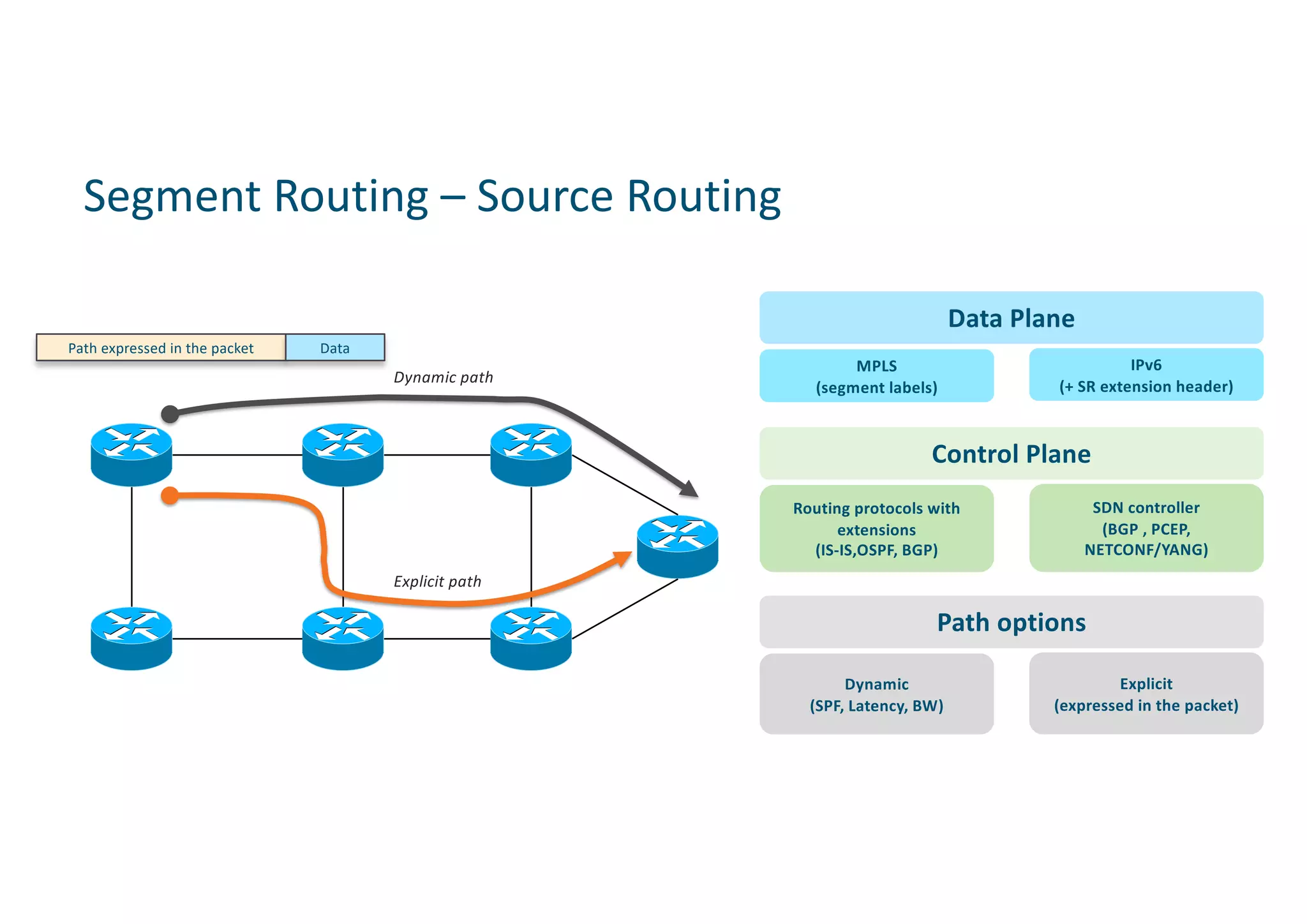
Segment Routing – Source Routing
Path expressed in the packet Data
Dynamic path
Explicit path
Path options
Dynamic
(SPF, Latency, BW)
Explicit
(expressed in the packet)
Control Plane
Routing protocols with
extensions
(IS-IS,OSPF, BGP)
SDN controller
(BGP , PCEP,
NETCONF/YANG)
Data Plane
MPLS
(segment labels)
IPv6
(+ SR extension header)
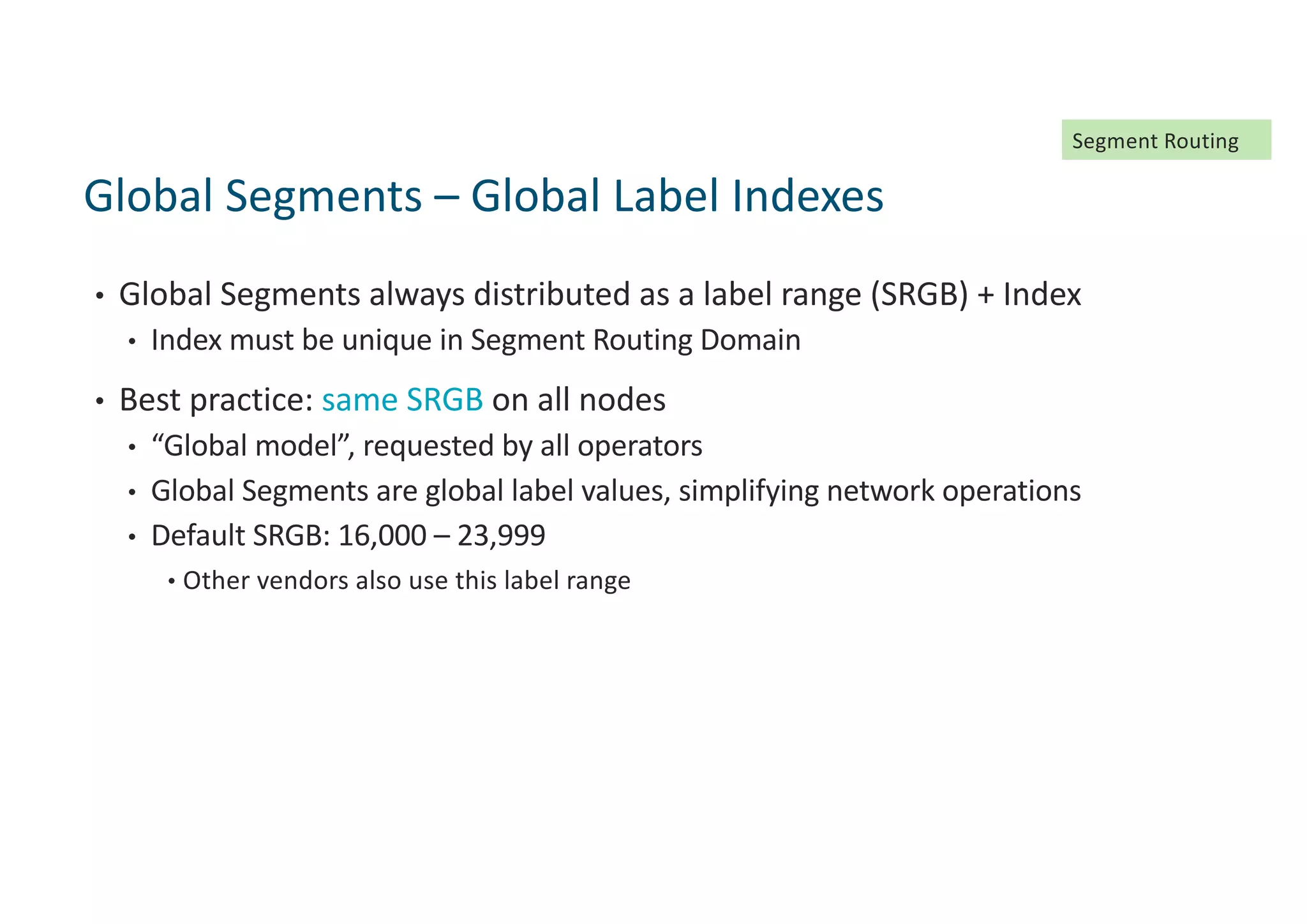
• Global Segments always distributed as a label range (SRGB) + Index
• Index must be unique in Segment Routing Domain
• Best practice: same SRGB on all nodes
• “Global model”, requested by all operators
• Global Segments are global label values, simplifying network operations
• Default SRGB: 16,000 – 23,999
• Other vendors also use this label range
Global Segments – Global Label Indexes
Segment Routing
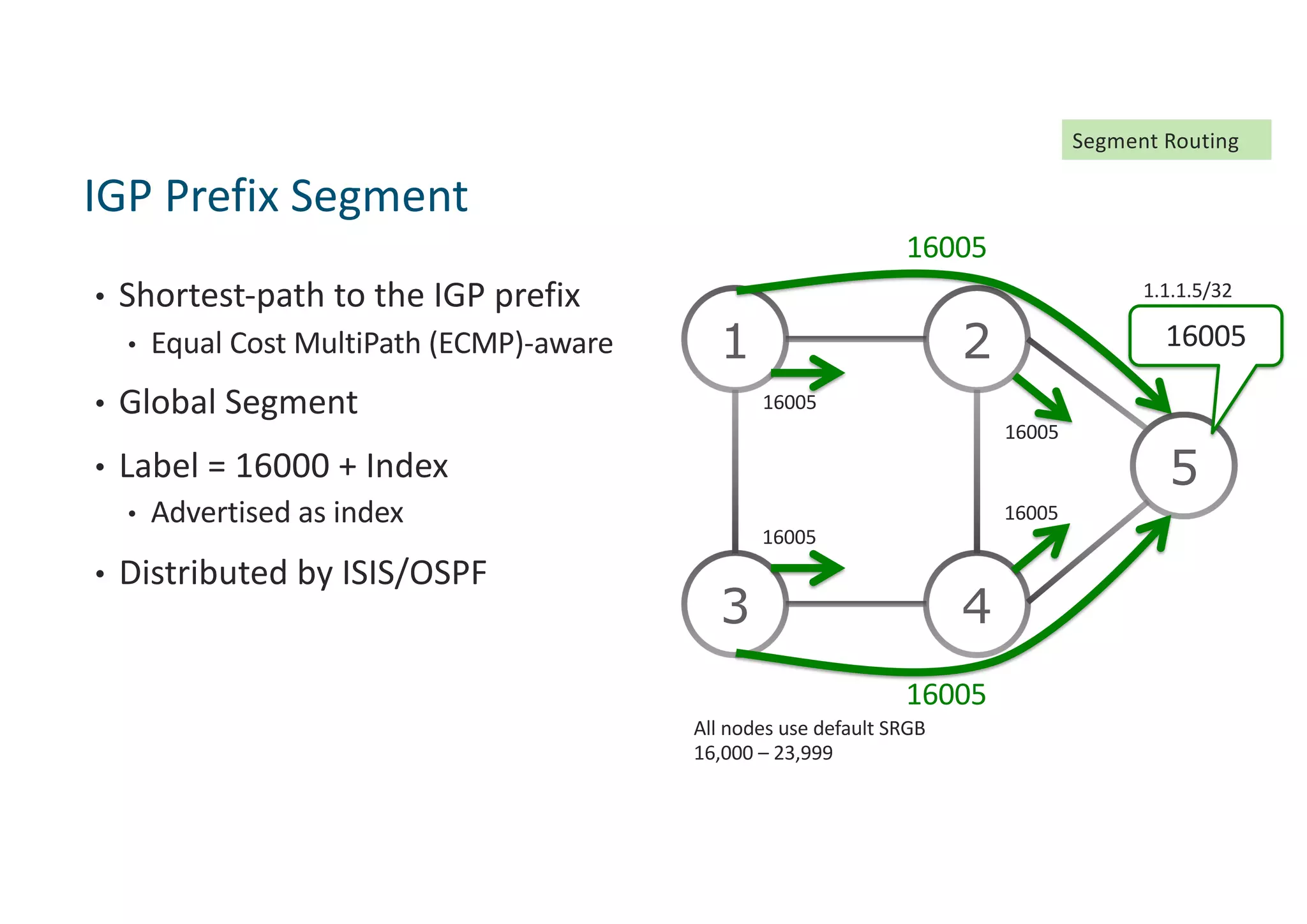
• Shortest-path to the IGP prefix
• Equal Cost MultiPath (ECMP)-aware
• Global Segment
• Label = 16000 + Index
• Advertised as index
• Distributed by ISIS/OSPF
IGP Prefix Segment
1 2
3 4
5
16005
16005
16005
16005
16005
16005
16005
1.1.1.5/32
All nodes use default SRGB
16,000 – 23,999
Segment Routing
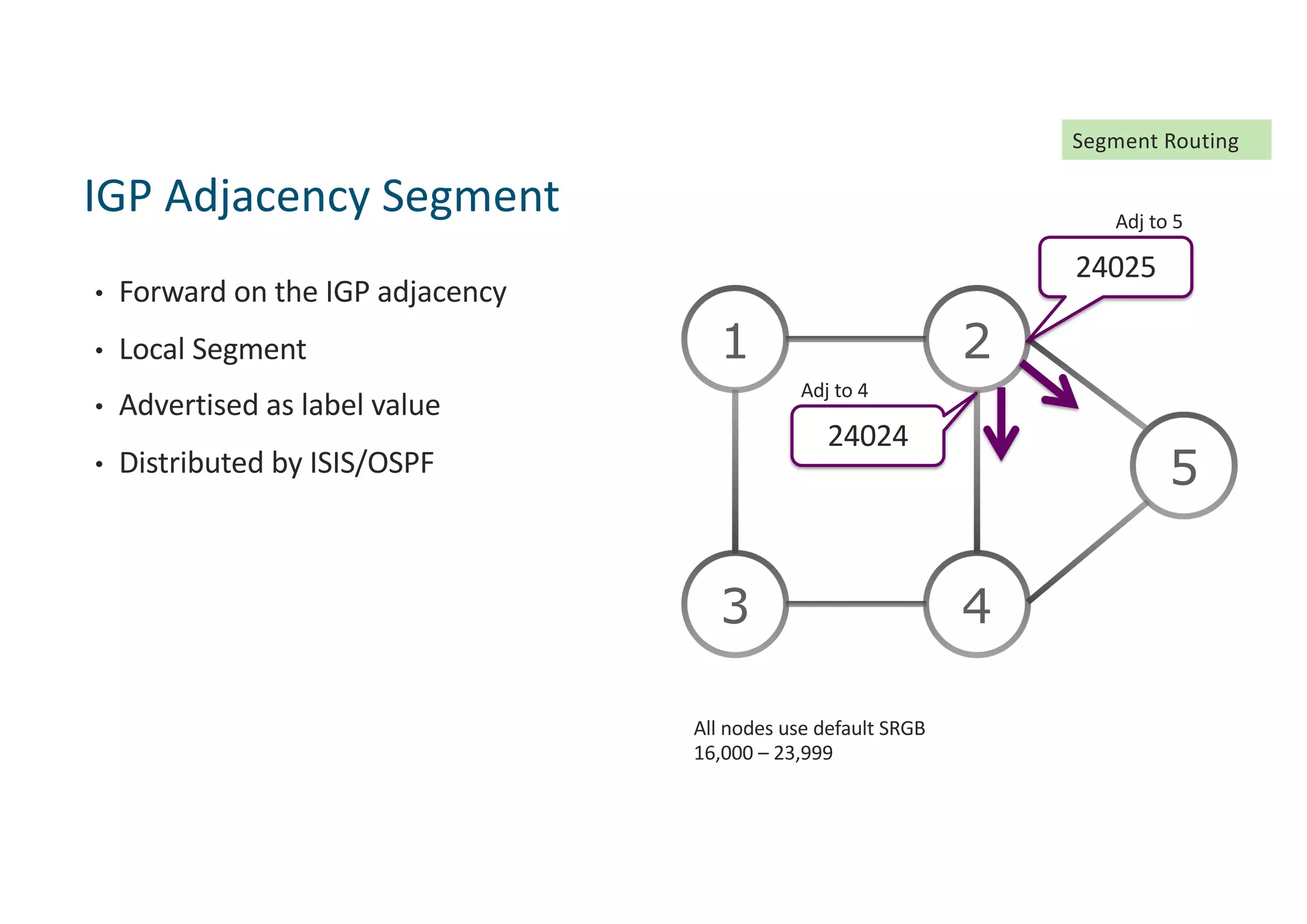
• Forward on the IGP adjacency
• Local Segment
• Advertised as label value
• Distributed by ISIS/OSPF
IGP Adjacency Segment
1 2
3 4
5
24024
24025
Adj to 5
Adj to 4
All nodes use default SRGB
16,000 – 23,999
Segment Routing
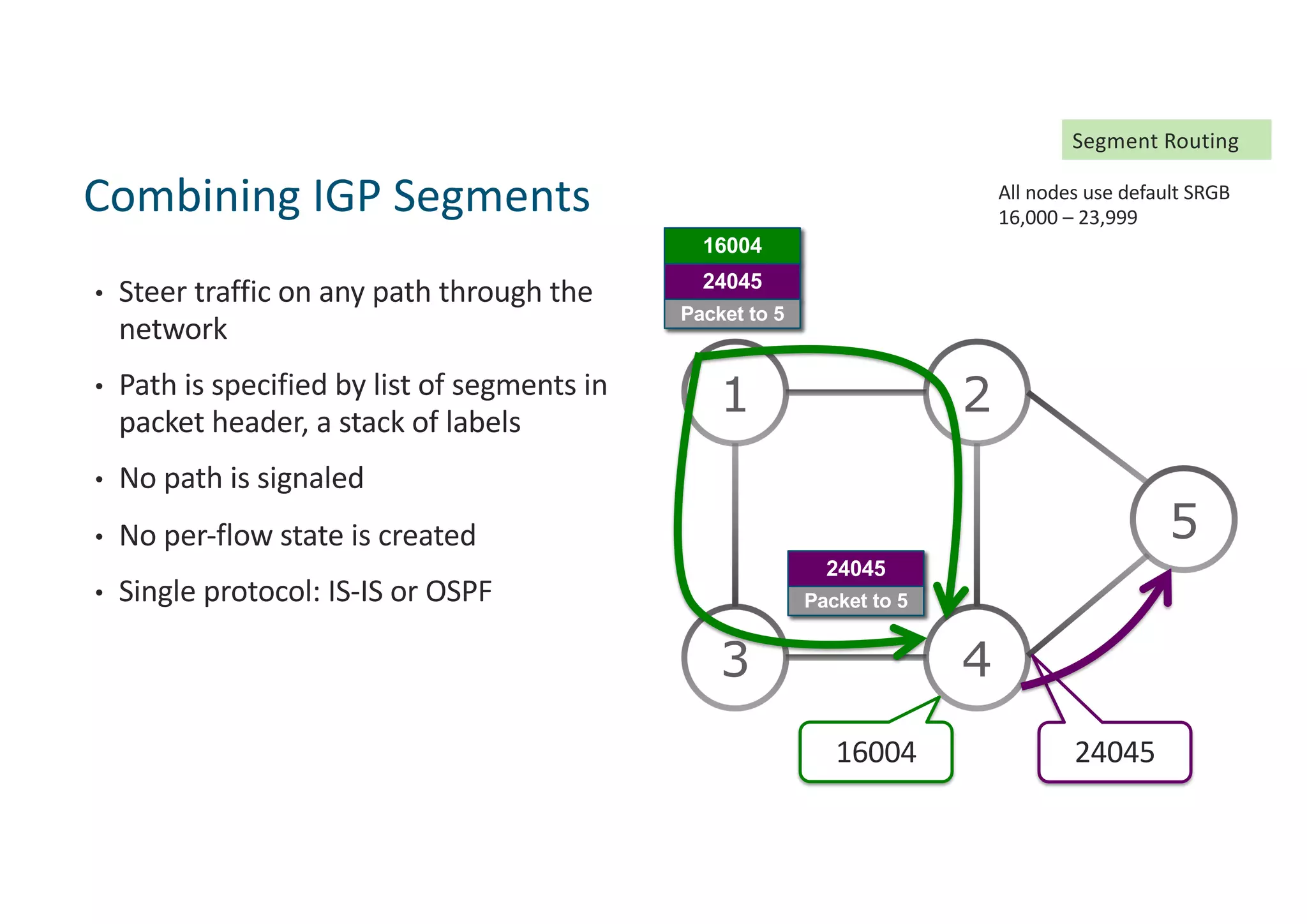
• Steer traffic on any path through the
network
• Path is specified by list of segments in
packet header, a stack of labels
• No path is signaled
• No per-flow state is created
• Single protocol: IS-IS or OSPF
Combining IGP Segments
1 2
3 4
5
16004 24045
16004
24045
Packet to 5
24045
Packet to 5
All nodes use default SRGB
16,000 – 23,999
Segment Routing
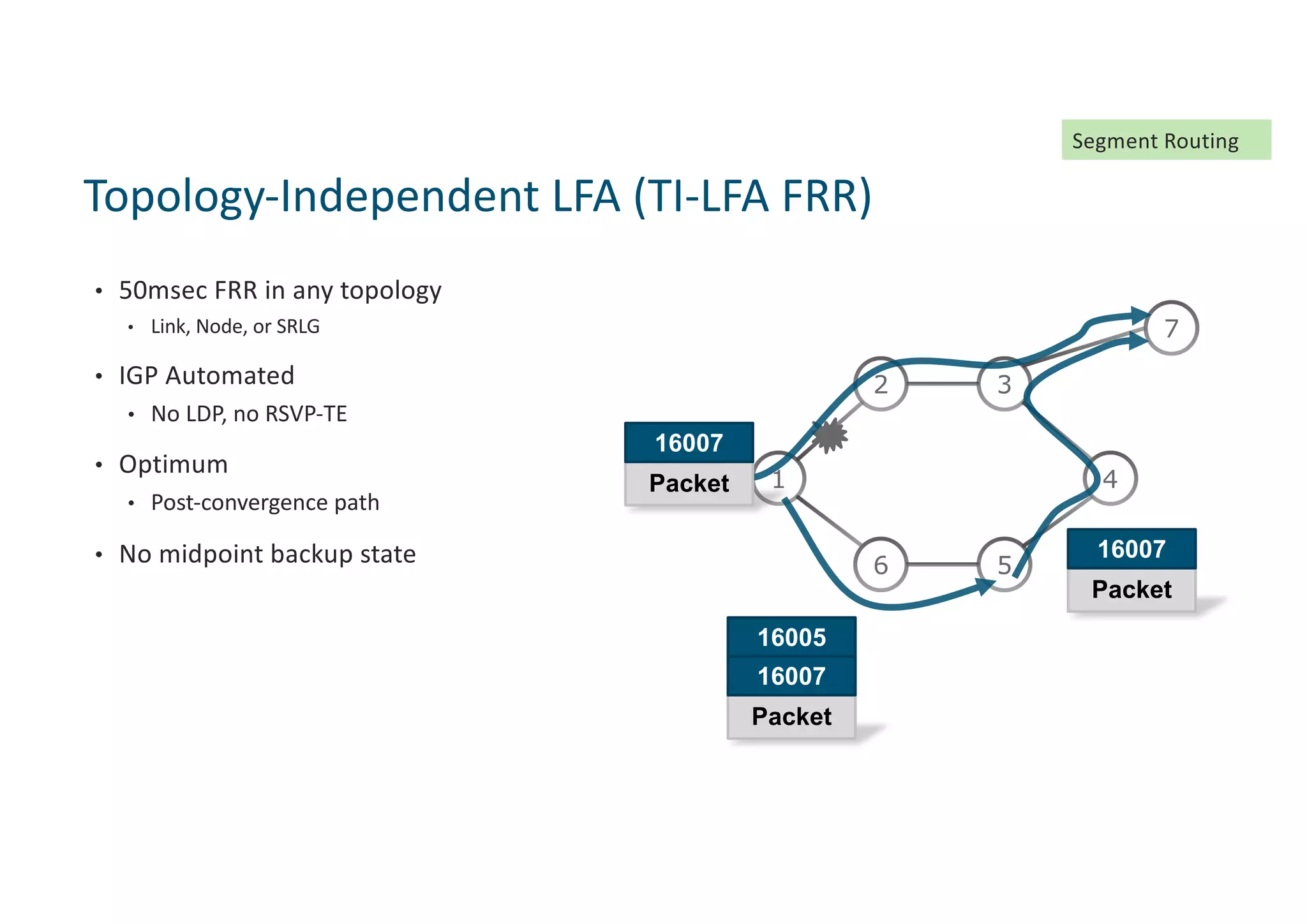
• 50msec FRR in any topology
• Link, Node, or SRLG
• IGP Automated
• No LDP, no RSVP-TE
• Optimum
• Post-convergence path
• No midpoint backup state
Topology-Independent LFA (TI-LFA FRR)
1
2 3
4
6 5
7
Packet
16007
Packet
16007
Packet
16007
16005
Segment Routing
Multi-Domain Topology
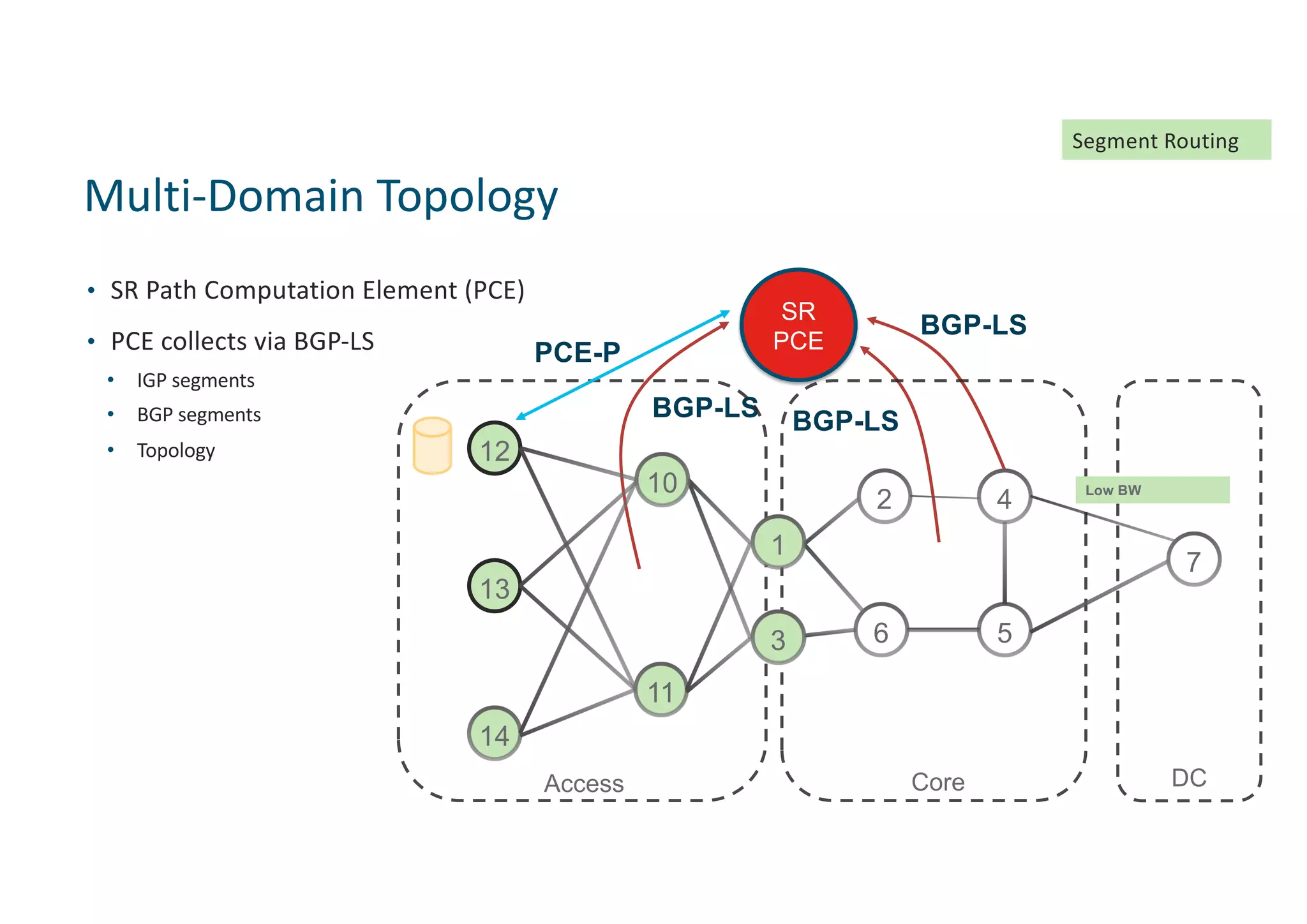
• SR Path Computation Element (PCE)
• PCE collects via BGP-LS
• IGP segments
• BGP segments
• Topology
DC
BGP-LS
10
11
12
13
14
2 4
6 5
7
Core
3
1
Low BW
BGP-LS
BGP-LS
SR
PCE
Segment Routing
Access
PCE-P
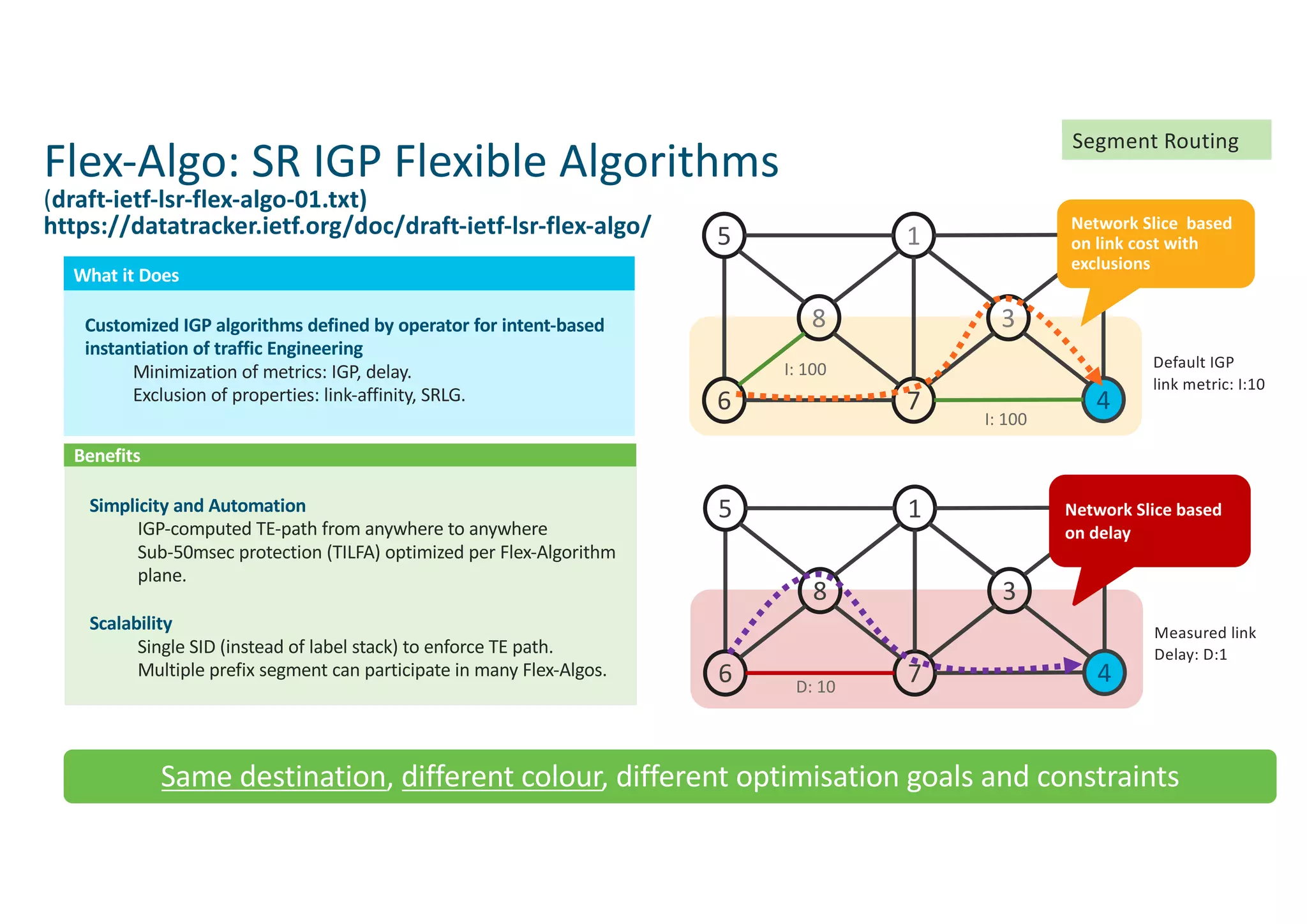
Flex-Algo: SR IGP Flexible Algorithms
(draft-ietf-lsr-flex-algo-01.txt)
https://datatracker.ietf.org/doc/draft-ietf-lsr-flex-algo/
What it Does
Customized IGP algorithms defined by operator for intent-based
instantiation of traffic Engineering
Minimization of metrics: IGP, delay.
Exclusion of properties: link-affinity, SRLG.
Benefits
Simplicity and Automation
IGP-computed TE-path from anywhere to anywhere
Sub-50msec protection (TILFA) optimized per Flex-Algorithm
plane.
Scalability
Single SID (instead of label stack) to enforce TE path.
Multiple prefix segment can participate in many Flex-Algos.
5 1
6 7
8 3
2
4
I: 100 Default IGP
link metric: I:10
5 1
6 7
8 3
2
4D: 10
Measured link
Delay: D:1
Network Slice based
on link cost with
exclusions
Network Slice based
on delay
I: 100
Same destination, different colour, different optimisation goals and constraints
Segment Routing
Flex-Algo: Multi-Plane Topologies
Segment Routing
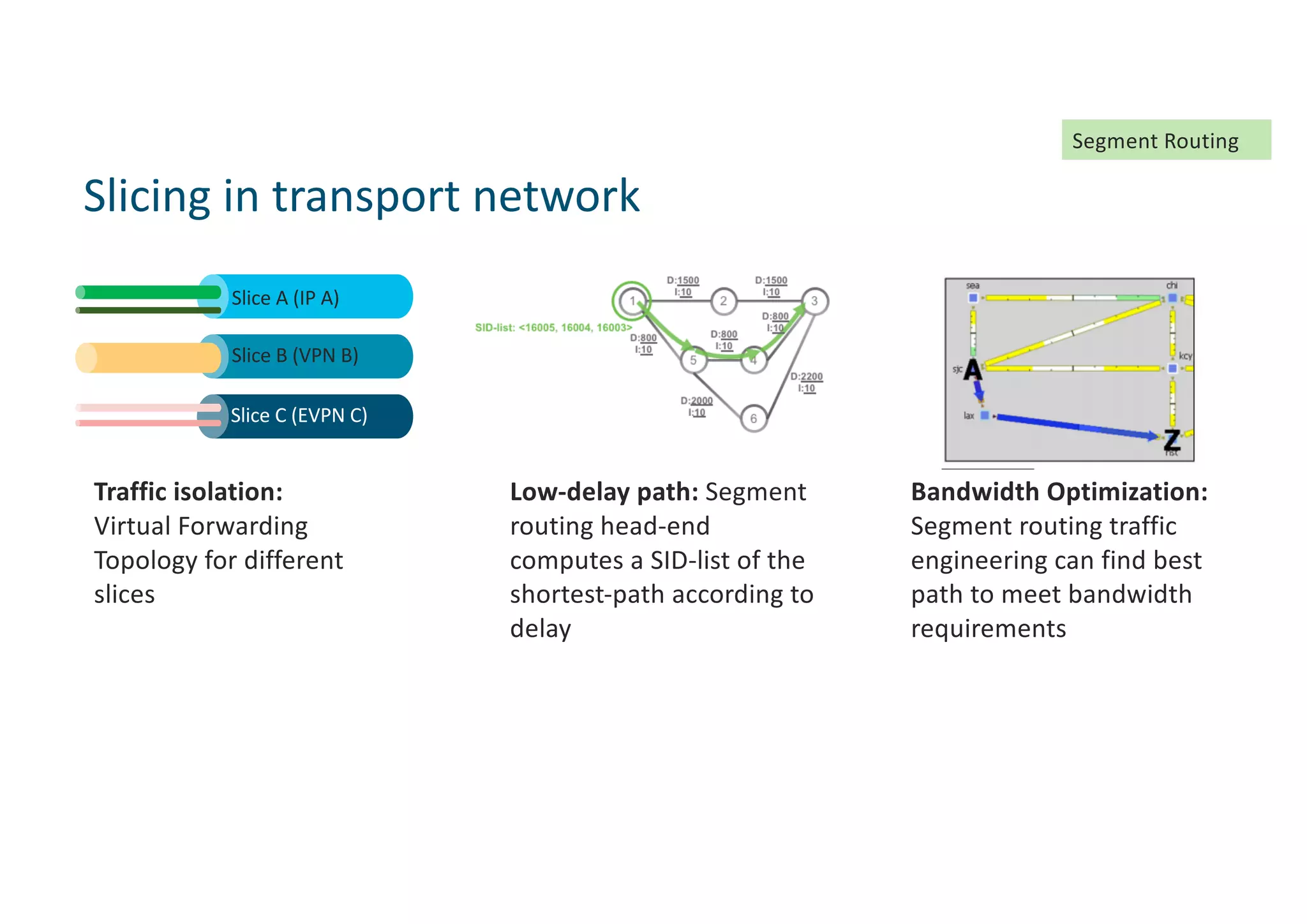
Slicing in transport network
Slice A (IP A)
Slice B (VPN B)
Slice C (EVPN C)
Traffic isolation:
Virtual Forwarding
Topology for different
slices
Low-delay path: Segment
routing head-end
computes a SID-list of the
shortest-path according to
delay
Bandwidth Optimization:
Segment routing traffic
engineering can find best
path to meet bandwidth
requirements
Segment Routing
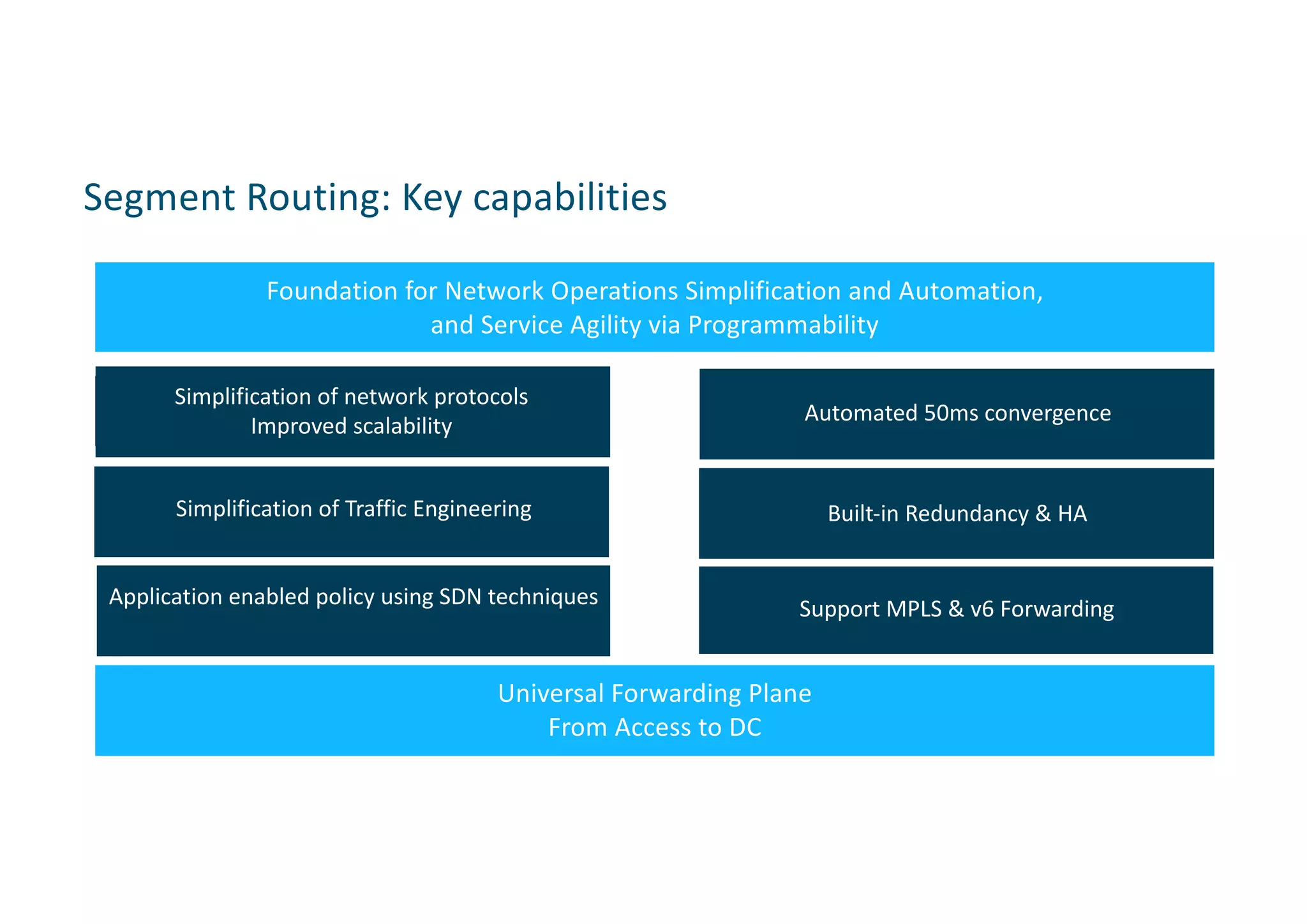
Segment Routing: Key capabilities
Foundation for Network Operations Simplification and Automation,
and Service Agility via Programmability
Simplification of network protocols
Improved scalability
Simplification of Traffic Engineering
Application enabled policy using SDN techniques Support MPLS & v6 Forwarding
Built-in Redundancy & HA
Universal Forwarding Plane
From Access to DC
Automated 50ms convergence
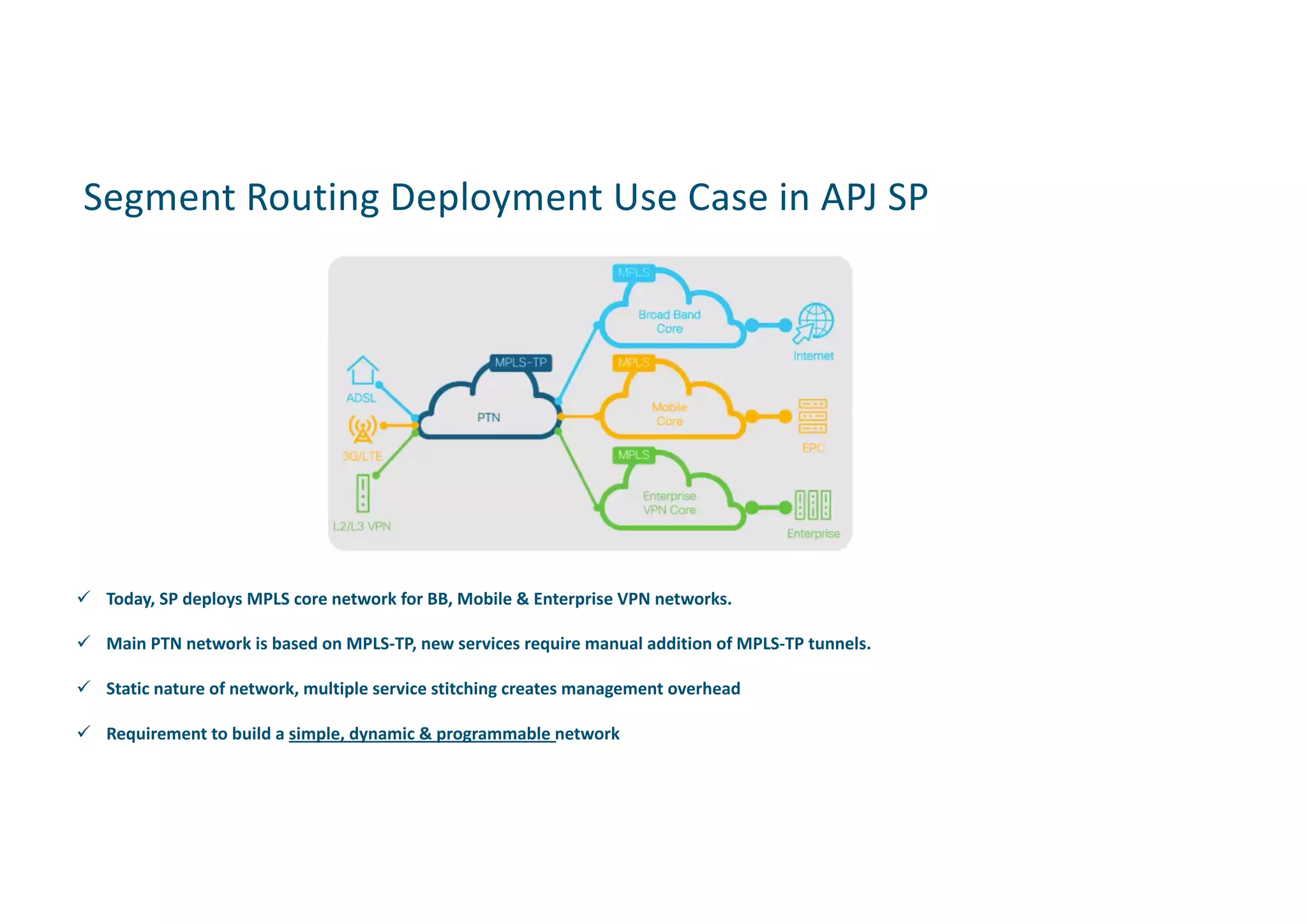
Segment Routing Deployment Use Case in APJ SP
ü Today, SP deploys MPLS core network for BB, Mobile & Enterprise VPN networks.
ü Main PTN network is based on MPLS-TP, new services require manual addition of MPLS-TP tunnels.
ü Static nature of network, multiple service stitching creates management overhead
ü Requirement to build a simple, dynamic & programmable network
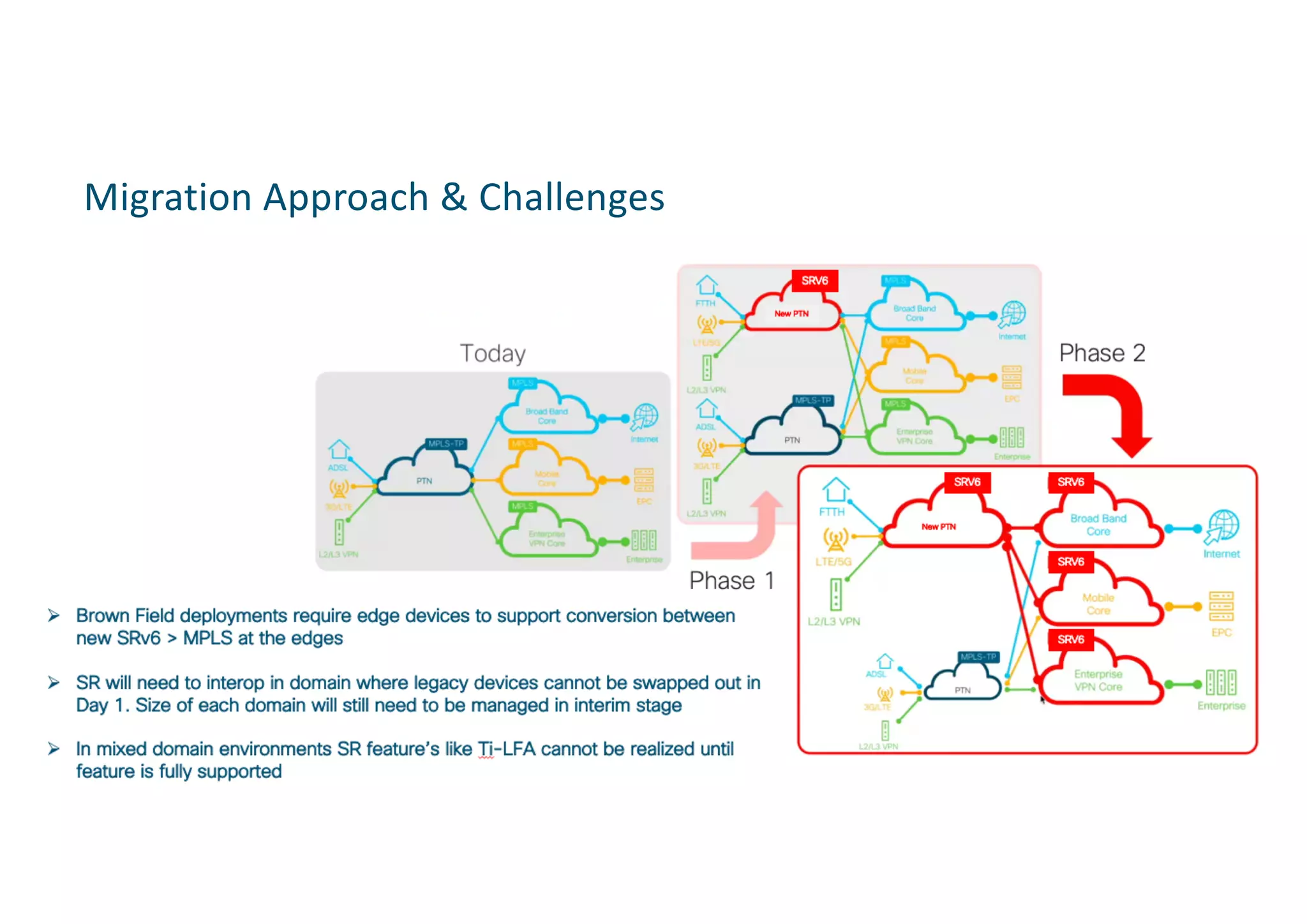
Migration Approach & Challenges
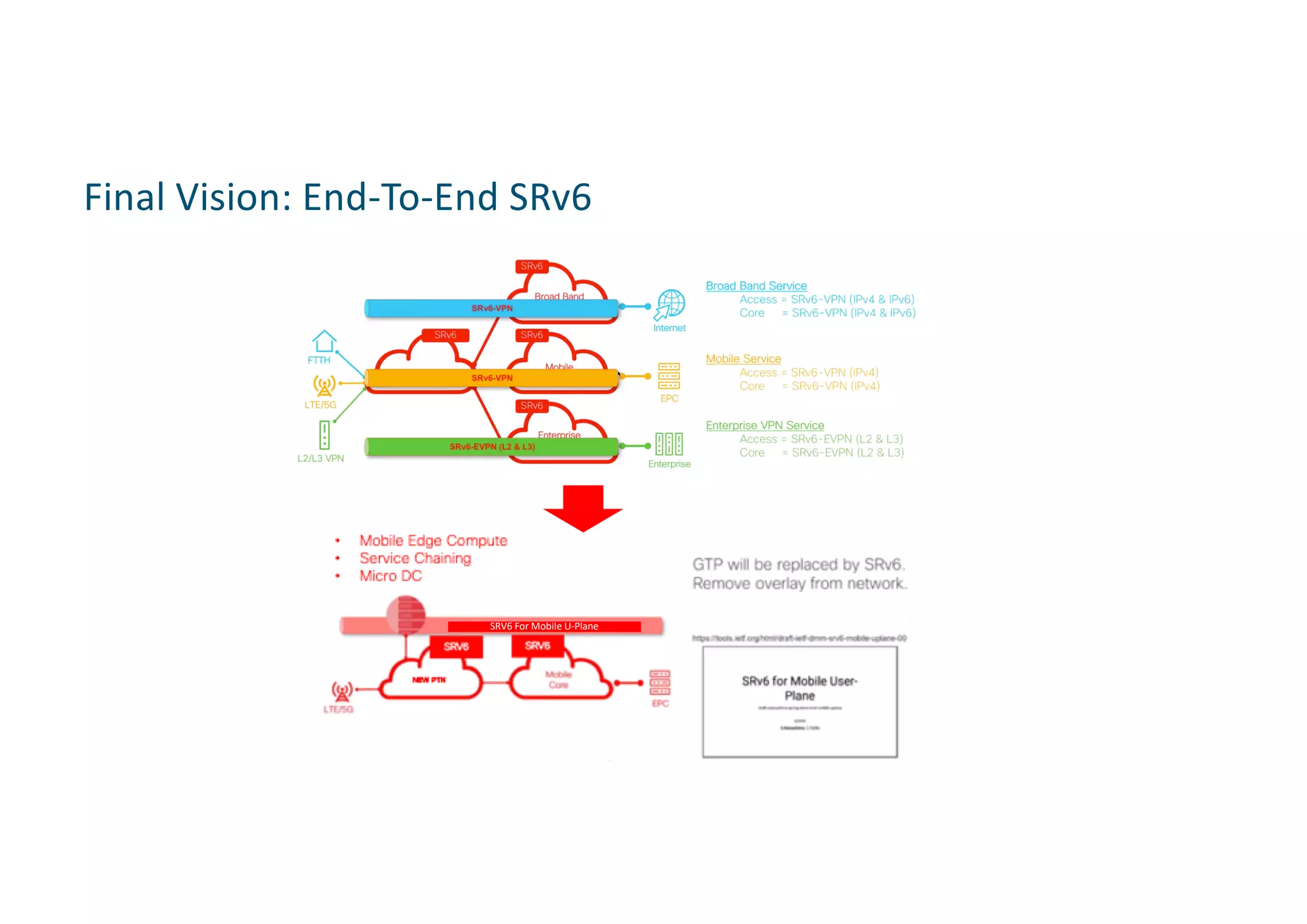
Final Vision: End-To-End SRv6
SRV6 For Mobile U-Plane
• IP Transport requires evolution to support new services
• Network Slice = efficient use in a shared transport
• Segment Routing = Simplicity = Automation = Scale
Thank you. Enjoy MYNOG. :-)
Summary
Engineering The New IP Transport

Engineering The New IP Transport

  • 1.
    Clarence Anslem Systems Architect July2019 Engineering The New IP Transport
  • 2.
    Is your currentnetwork ready to support these? 10 - 100M lines of code and hundreds of subsystems Vehicle updates, telematics, and infotainment Secure Remote Car Software Update Police, fire, hospitals with strict SLAs and Security Network-as-a-Service Public Sector Private Networks Smart-sensor enabled Waste and recycling, parking, smart grid, homes Smart City Enablement Augmented, virtual, and mixed reality for learning, gaming, 4K/8K Video enablement required Augmented / Virtual Reality Delivery Enhanced Broadband Speed 1000x BW, 10-100x Ultra Reliable Low Latency Communication ~1 – 25 msec Latency Super Fast Response 50 msec – 300 msec Massive Machine Type Communications 1000x Density
  • 3.
    Is your currentnetwork ready to support these? q Bandwidth Efficiency q Latency Awareness q Network Slicing q Reliability q Simplicity / Programmability Enhanced Broadband Speed 1000x BW, 10-100x Massive Machine Type Communications 1000x Density Ultra Reliable Low Latency Communication ~1 – 25 msec Latency Super Fast Response 50 msec – 300 msec
  • 4.
    Aggregation Today: Operational Domainsand Layers of Protocols Metro/Access Network Domain Core Network Domain Data Center Domain Limited Cross-domain Automation, Isolated Infrastructure & Service Assurance Automated end-to-end service provisioning can be tricky • Multiple network domains under different management teams • Manual operations • Different types of underlay and overlay networks IPMPLS (LDP, RSVP-TE) L2VPN / L3VPN L2VPN / L3VPN VXLAN Complex E2E Quality of Service (QoS) IP / MPLS
  • 5.
    Aggregation SDN Metro/Access Network Domain SDN CoreNetwork Domain SDN Data Center Domain Segment Routing BGP-VPN L2/L3 EVPN Cross-domain Automation & Assurance SDN Control End-to-end service provisioning is more easily automated • Common underlay and overlay network technologies • Automated underlay and overlay operations • Seamless integration between domains IP Target: Common Infra & Cross Domain Automation
  • 6.
    Segment Routing Basics AnLS IGP protocol extension bringing network simplification/optimization An IP/MPLS architecture designed with SDN in mind • Right balance between distributed intelligence and centralized optimization and programming • SR-TE • Wide applications • (SP, OTT/Web, GET) across (WAN, Metro/Agg, DC) • MPLS and IPv6 dataplanes • SDN controller • No LDP • Lighter protocol suite • Less adjacencies, less states to maintain • No IGP to LDP synchronization • Eliminates delays in activating a path • Topology independent fast reroute using post convergence back up path • 50 ms protection • no microloops • 100% coverage of network topologies Easy troubleshooting Balance Centralized-onlyDistributed-only
  • 7.
    Segment Routing Standardization •IETF standardization in SPRING working group • Protocol extensions progressing in multiple groups • IS-IS • OSPF • PCE • IDR • 6MAN • Broad vendor and customer support 7 Sample IETF Documents Segment Routing Architecture RFC 8402 Source Packet Routing in Networking (SPRING) Problem Statement and Requirements RFC 7855 Use Cases for IPv6 Source Packet Routing in Networking (SPRING) RFC 8354 Label Switched Path (LSP) Ping/Trace for Segment Routing Networks Using MPLS Dataplane RFC 8287 Packet Loss and Delay Measurement for MPLS Networks RFC 6374 IS-IS Traffic Engineering (TE) Metric Extensions RFC 7810 OSPF Traffic Engineering (TE) Metric Extensions RFC 7471 UDP Return Path for Packet Loss and Delay Measurement for MPLS Networks RFC 7876 Close to 30 IETF drafts in progress (http://www.segment-routing.net/ietf/)
  • 8.
    Segment Routing –Source Routing Path expressed in the packet Data Dynamic path Explicit path Path options Dynamic (SPF, Latency, BW) Explicit (expressed in the packet) Control Plane Routing protocols with extensions (IS-IS,OSPF, BGP) SDN controller (BGP , PCEP, NETCONF/YANG) Data Plane MPLS (segment labels) IPv6 (+ SR extension header)
  • 9.
    • Global Segmentsalways distributed as a label range (SRGB) + Index • Index must be unique in Segment Routing Domain • Best practice: same SRGB on all nodes • “Global model”, requested by all operators • Global Segments are global label values, simplifying network operations • Default SRGB: 16,000 – 23,999 • Other vendors also use this label range Global Segments – Global Label Indexes Segment Routing
  • 10.
    • Shortest-path tothe IGP prefix • Equal Cost MultiPath (ECMP)-aware • Global Segment • Label = 16000 + Index • Advertised as index • Distributed by ISIS/OSPF IGP Prefix Segment 1 2 3 4 5 16005 16005 16005 16005 16005 16005 16005 1.1.1.5/32 All nodes use default SRGB 16,000 – 23,999 Segment Routing
  • 11.
    • Forward onthe IGP adjacency • Local Segment • Advertised as label value • Distributed by ISIS/OSPF IGP Adjacency Segment 1 2 3 4 5 24024 24025 Adj to 5 Adj to 4 All nodes use default SRGB 16,000 – 23,999 Segment Routing
  • 12.
    • Steer trafficon any path through the network • Path is specified by list of segments in packet header, a stack of labels • No path is signaled • No per-flow state is created • Single protocol: IS-IS or OSPF Combining IGP Segments 1 2 3 4 5 16004 24045 16004 24045 Packet to 5 24045 Packet to 5 All nodes use default SRGB 16,000 – 23,999 Segment Routing
  • 13.
    • 50msec FRRin any topology • Link, Node, or SRLG • IGP Automated • No LDP, no RSVP-TE • Optimum • Post-convergence path • No midpoint backup state Topology-Independent LFA (TI-LFA FRR) 1 2 3 4 6 5 7 Packet 16007 Packet 16007 Packet 16007 16005 Segment Routing
  • 14.
    Multi-Domain Topology • SRPath Computation Element (PCE) • PCE collects via BGP-LS • IGP segments • BGP segments • Topology DC BGP-LS 10 11 12 13 14 2 4 6 5 7 Core 3 1 Low BW BGP-LS BGP-LS SR PCE Segment Routing Access PCE-P
  • 15.
    Flex-Algo: SR IGPFlexible Algorithms (draft-ietf-lsr-flex-algo-01.txt) https://datatracker.ietf.org/doc/draft-ietf-lsr-flex-algo/ What it Does Customized IGP algorithms defined by operator for intent-based instantiation of traffic Engineering Minimization of metrics: IGP, delay. Exclusion of properties: link-affinity, SRLG. Benefits Simplicity and Automation IGP-computed TE-path from anywhere to anywhere Sub-50msec protection (TILFA) optimized per Flex-Algorithm plane. Scalability Single SID (instead of label stack) to enforce TE path. Multiple prefix segment can participate in many Flex-Algos. 5 1 6 7 8 3 2 4 I: 100 Default IGP link metric: I:10 5 1 6 7 8 3 2 4D: 10 Measured link Delay: D:1 Network Slice based on link cost with exclusions Network Slice based on delay I: 100 Same destination, different colour, different optimisation goals and constraints Segment Routing
  • 16.
  • 17.
    Slicing in transportnetwork Slice A (IP A) Slice B (VPN B) Slice C (EVPN C) Traffic isolation: Virtual Forwarding Topology for different slices Low-delay path: Segment routing head-end computes a SID-list of the shortest-path according to delay Bandwidth Optimization: Segment routing traffic engineering can find best path to meet bandwidth requirements Segment Routing
  • 18.
    Segment Routing: Keycapabilities Foundation for Network Operations Simplification and Automation, and Service Agility via Programmability Simplification of network protocols Improved scalability Simplification of Traffic Engineering Application enabled policy using SDN techniques Support MPLS & v6 Forwarding Built-in Redundancy & HA Universal Forwarding Plane From Access to DC Automated 50ms convergence
  • 19.
    Segment Routing DeploymentUse Case in APJ SP ü Today, SP deploys MPLS core network for BB, Mobile & Enterprise VPN networks. ü Main PTN network is based on MPLS-TP, new services require manual addition of MPLS-TP tunnels. ü Static nature of network, multiple service stitching creates management overhead ü Requirement to build a simple, dynamic & programmable network
  • 20.
  • 21.
    Final Vision: End-To-EndSRv6 SRV6 For Mobile U-Plane
  • 22.
    • IP Transportrequires evolution to support new services • Network Slice = efficient use in a shared transport • Segment Routing = Simplicity = Automation = Scale Thank you. Enjoy MYNOG. :-) Summary