Species sampling models
julyan.arbel@carloalberto.org www.julyanarbel.com
Bocconi University, Milan, Italy & Collegio Carlo Alberto, Turin
Statalks Seminar @ Collegio Carlo Alberto
February 12, 2016
1/12
2/12
Discovery probabilities
Table of Contents
Discovery probabilities
3/12
Discovery probabilities
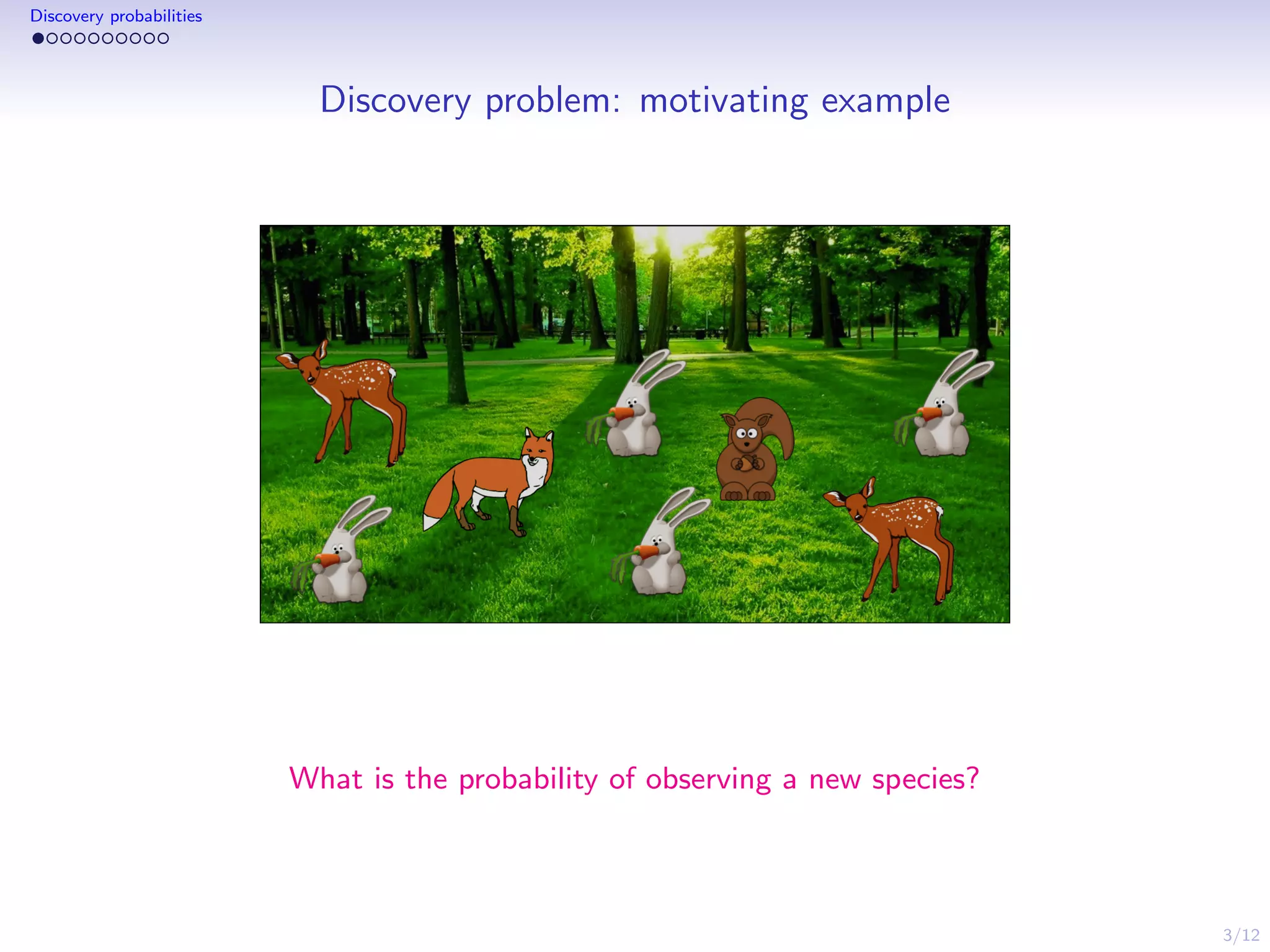
Discovery problem: motivating example
What is the probability of observing a new species?
4/12
Discovery probabilities
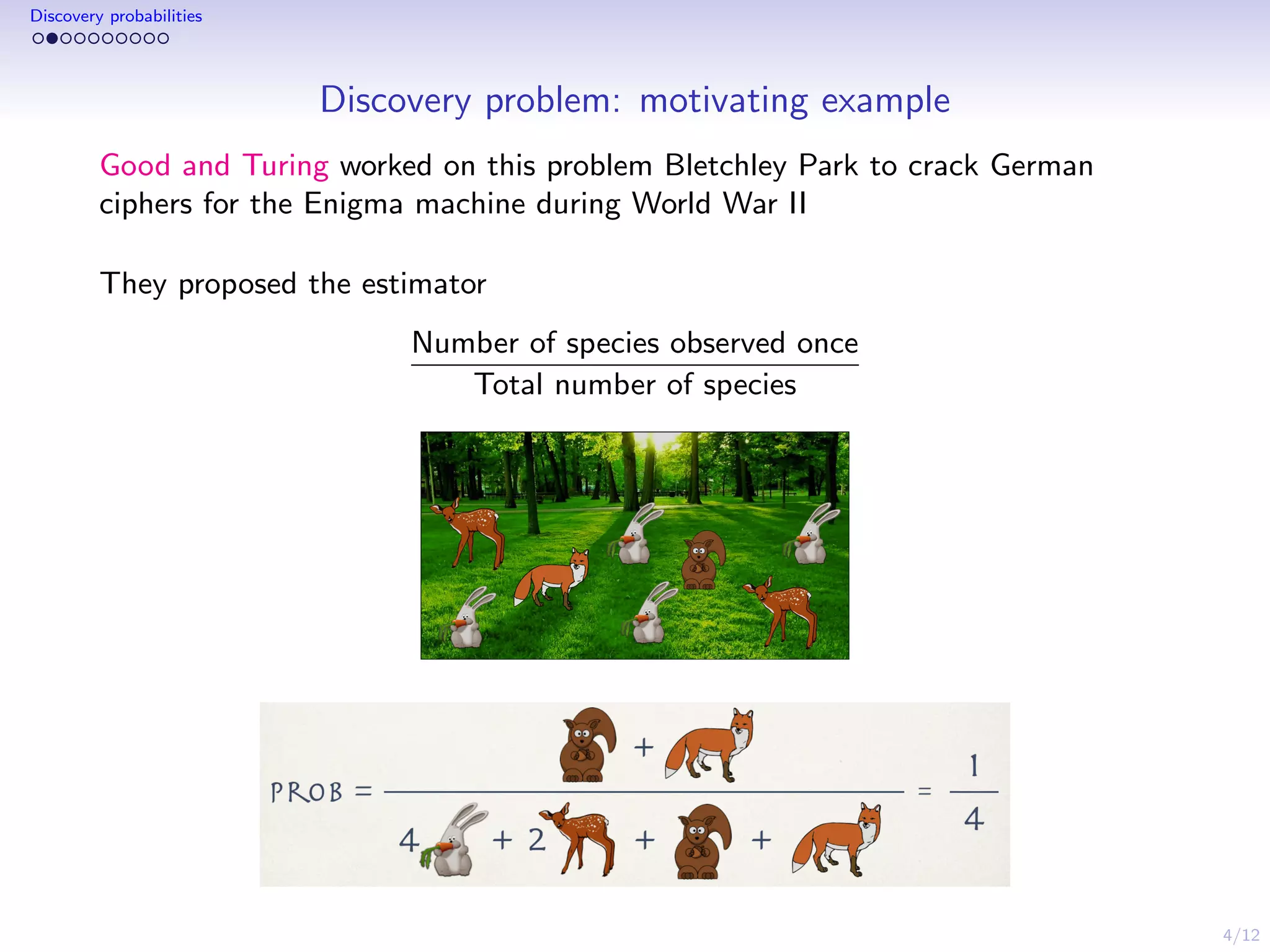
Discovery problem: motivating example
Good and Turing worked on this problem Bletchley Park to crack German
ciphers for the Enigma machine during World War II
They proposed the estimator
Number of species observed once
Total number of species
5/12
Discovery probabilities
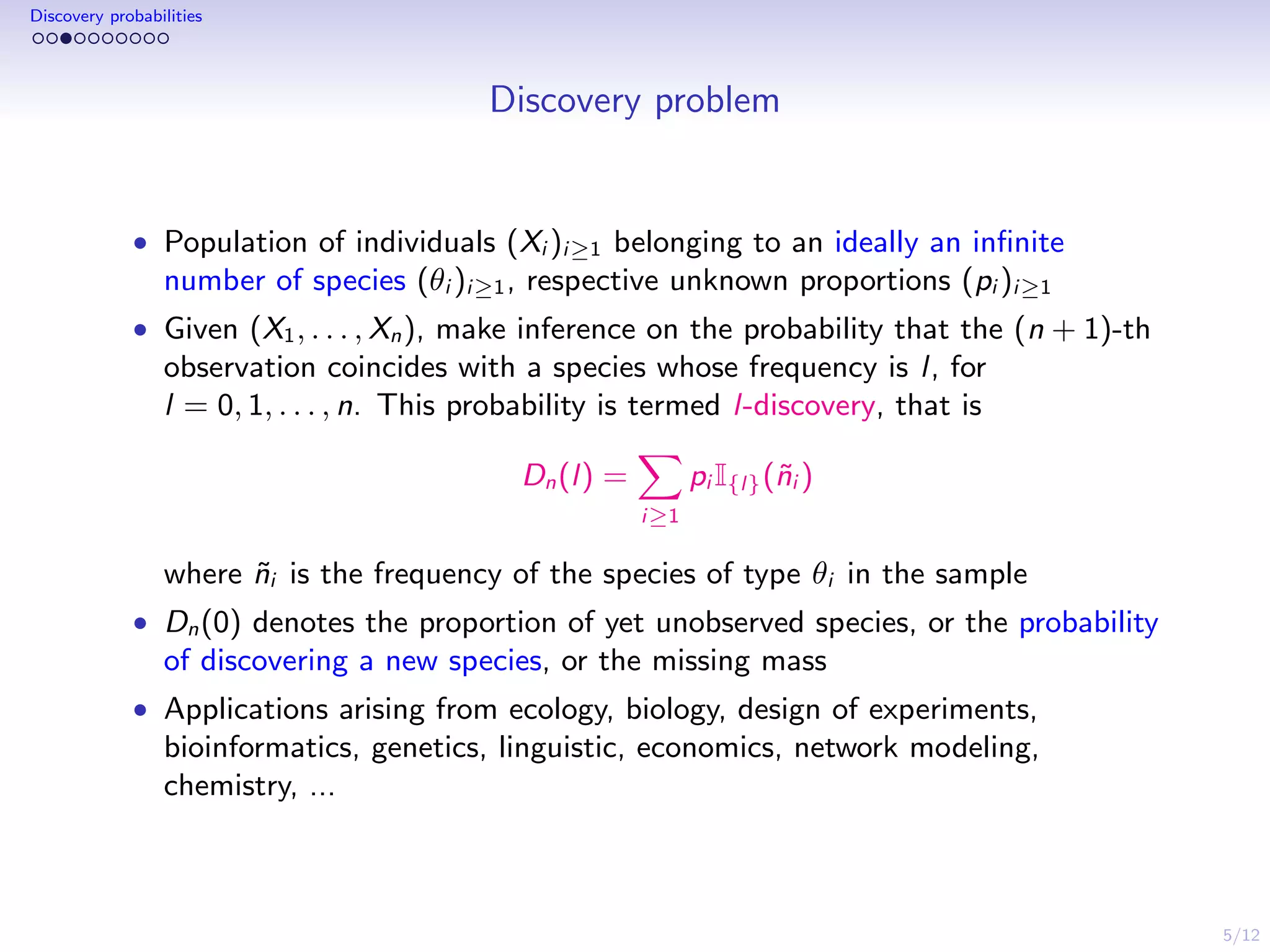
Discovery problem
• Population of individuals (Xi )i≥1 belonging to an ideally an infinite
number of species (θi )i≥1, respective unknown proportions (pi )i≥1
• Given (X1, . . . , Xn), make inference on the probability that the (n + 1)-th
observation coincides with a species whose frequency is l, for
l = 0, 1, . . . , n. This probability is termed l-discovery, that is
Dn(l) =
i≥1
pi I{l}(˜ni )
where ˜ni is the frequency of the species of type θi in the sample
• Dn(0) denotes the proportion of yet unobserved species, or the probability
of discovering a new species, or the missing mass
• Applications arising from ecology, biology, design of experiments,
bioinformatics, genetics, linguistic, economics, network modeling,
chemistry, ...
6/12
Discovery probabilities
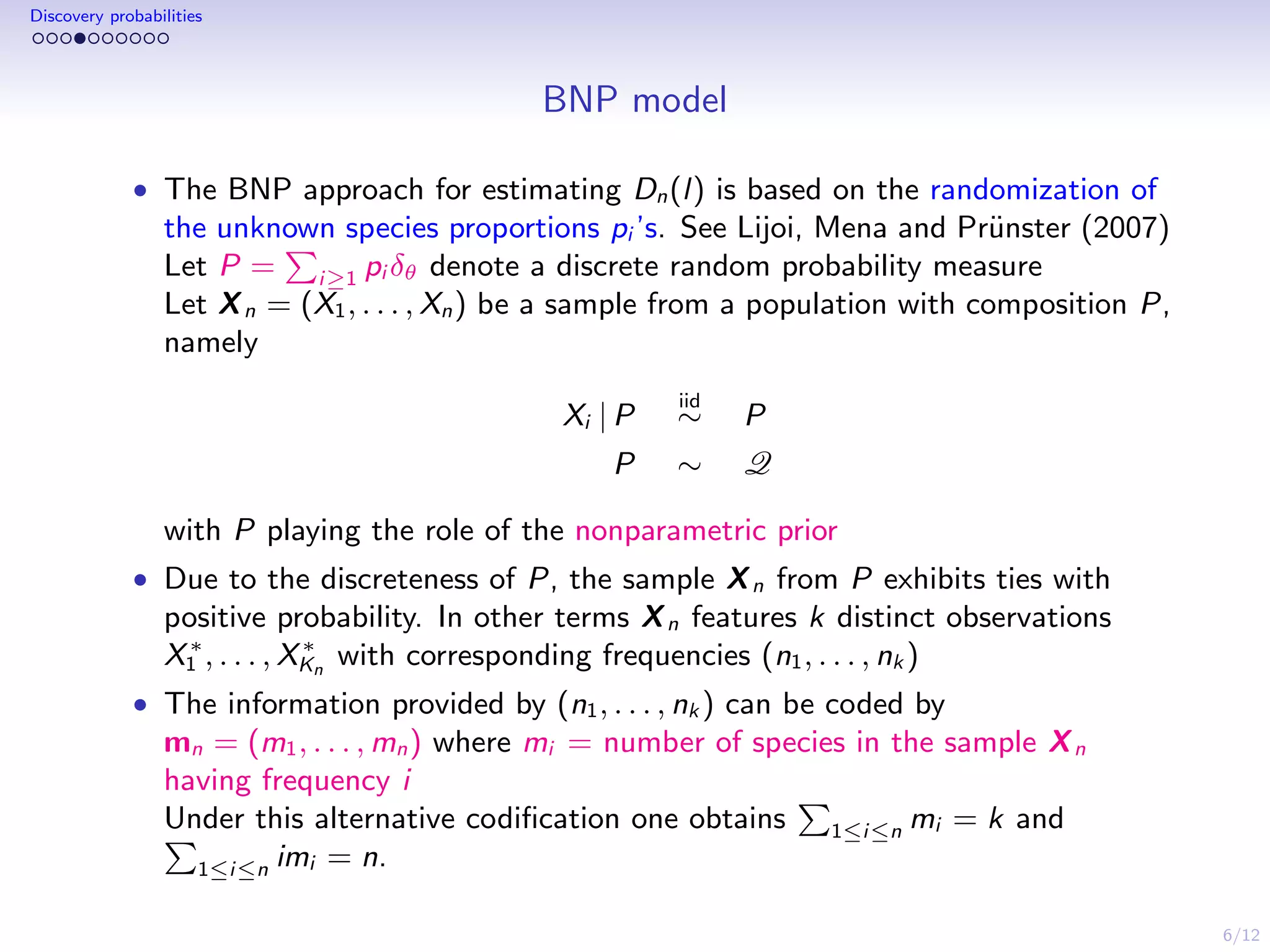
BNP model
• The BNP approach for estimating Dn(l) is based on the randomization of
the unknown species proportions pi ’s. See Lijoi, Mena and Pr¨unster (2007)
Let P = i≥1 pi δθ denote a discrete random probability measure
Let Xn = (X1, . . . , Xn) be a sample from a population with composition P,
namely
Xi | P
iid
∼ P
P ∼ Q
with P playing the role of the nonparametric prior
• Due to the discreteness of P, the sample Xn from P exhibits ties with
positive probability. In other terms Xn features k distinct observations
X∗
1 , . . . , X∗
Kn
with corresponding frequencies (n1, . . . , nk )
• The information provided by (n1, . . . , nk ) can be coded by
mn = (m1, . . . , mn) where mi = number of species in the sample Xn
having frequency i
Under this alternative codification one obtains 1≤i≤n mi = k and
1≤i≤n imi = n.
7/12
Discovery probabilities
Good Turing estimators of discovery
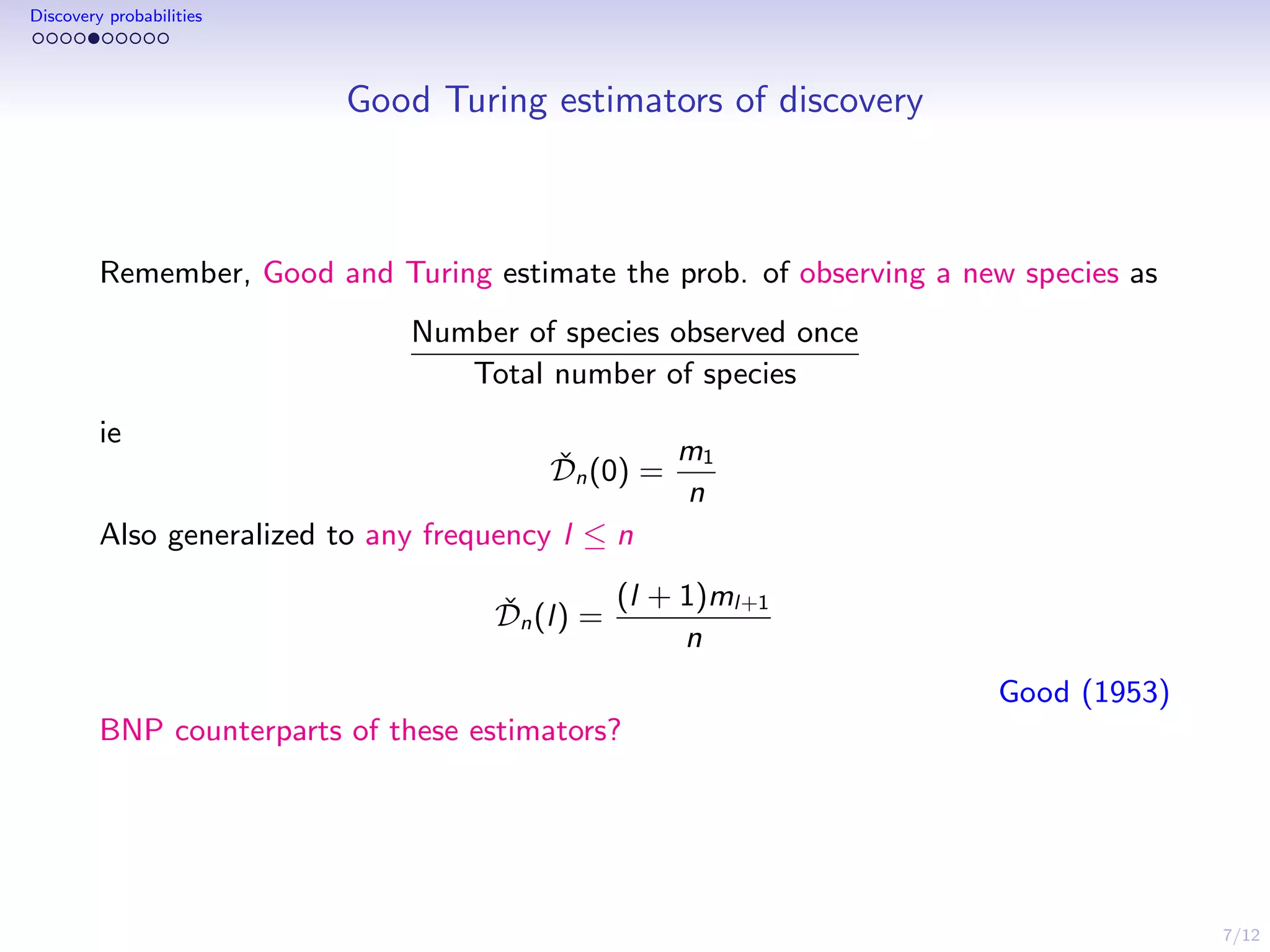
Remember, Good and Turing estimate the prob. of observing a new species as
Number of species observed once
Total number of species
ie
ˇDn(0) =
m1
n
Also generalized to any frequency l ≤ n
ˇDn(l) =
(l + 1)ml+1
n
Good (1953)
BNP counterparts of these estimators?
8/12
Discovery probabilities
BNP estimators of discovery
Gibbs-type random probability measure P with index σ ∈ (0, 1): it is
characterized by (it induces) a predictive distribution of the form
P[Xn+1 ∈ A | Xn] =
Vn+1,kn+1
Vn,kn
G0(A) +
Vn+1,kn
Vn,kn
kn
i=1
(ni − σ) δX∗
i
(A),
BNP estimator ˆDn(l) of Dn(l) derived from the predictive using sets
A0 = X{X∗
1 , . . . , X∗
Kn
} and Al = {X∗
i : Ni,n = l}
BNP Good Turing
ˆDn(0) = E[Ph(A0) | Xn] =
Vn+1,kn+1
Vn,kn
ˇDn(l) = m1
n
ˆDn(l) = E[Ph(Al ) | Xn] = (l − σ)ml
Vn+1,kn
Vn,kn
ˇDn(l) =
(l+1)ml+1
n
9/12
Discovery probabilities
Credible intervals for discovery
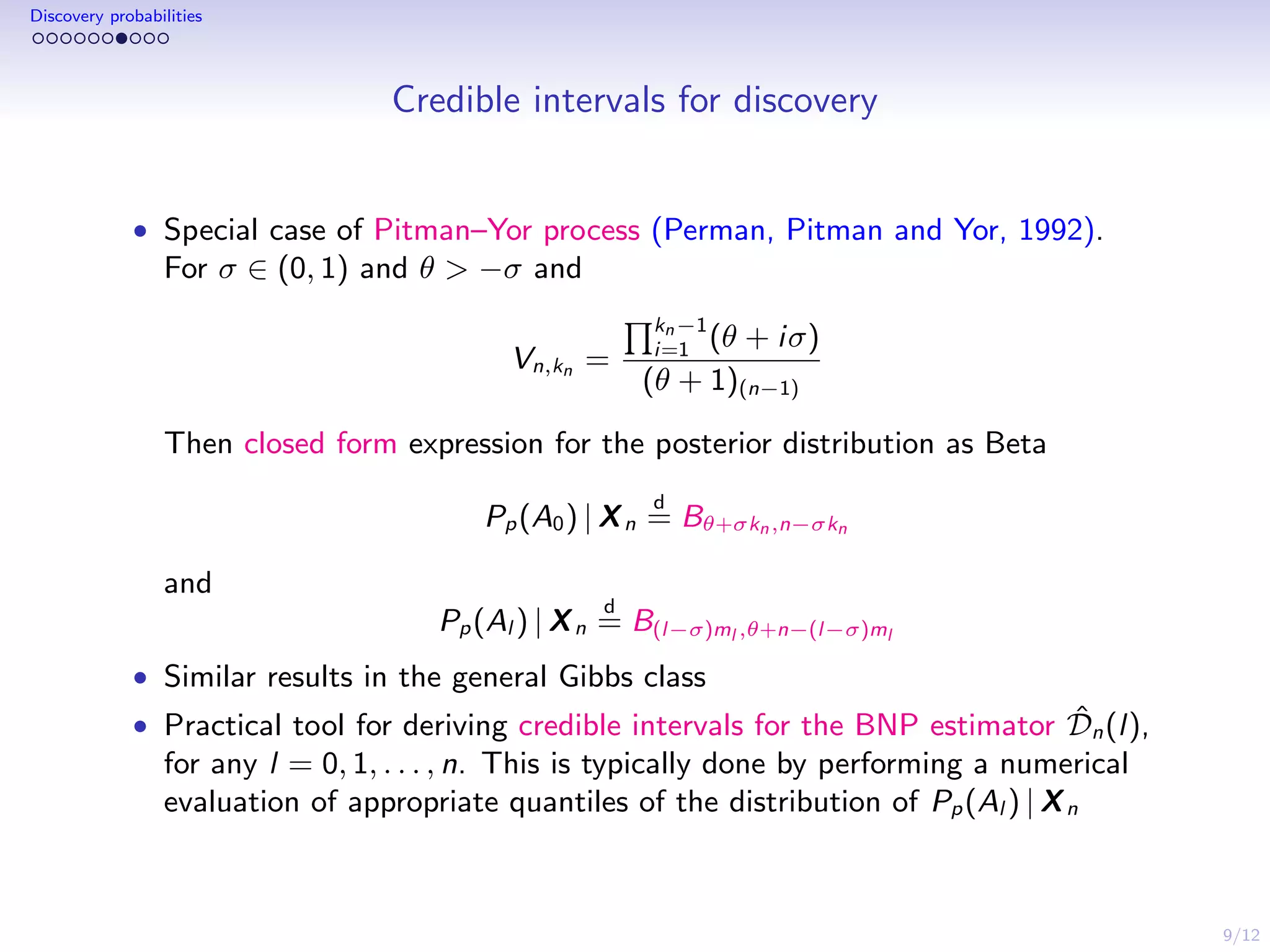
• Special case of Pitman–Yor process (Perman, Pitman and Yor, 1992).
For σ ∈ (0, 1) and θ > −σ and
Vn,kn =
kn−1
i=1 (θ + iσ)
(θ + 1)(n−1)
Then closed form expression for the posterior distribution as Beta
Pp(A0) | Xn
d
= Bθ+σkn,n−σkn
and
Pp(Al ) | Xn
d
= B(l−σ)ml ,θ+n−(l−σ)ml
• Similar results in the general Gibbs class
• Practical tool for deriving credible intervals for the BNP estimator ˆDn(l),
for any l = 0, 1, . . . , n. This is typically done by performing a numerical
evaluation of appropriate quantiles of the distribution of Pp(Al ) | Xn
10/12
Discovery probabilities
Application to EST libraries
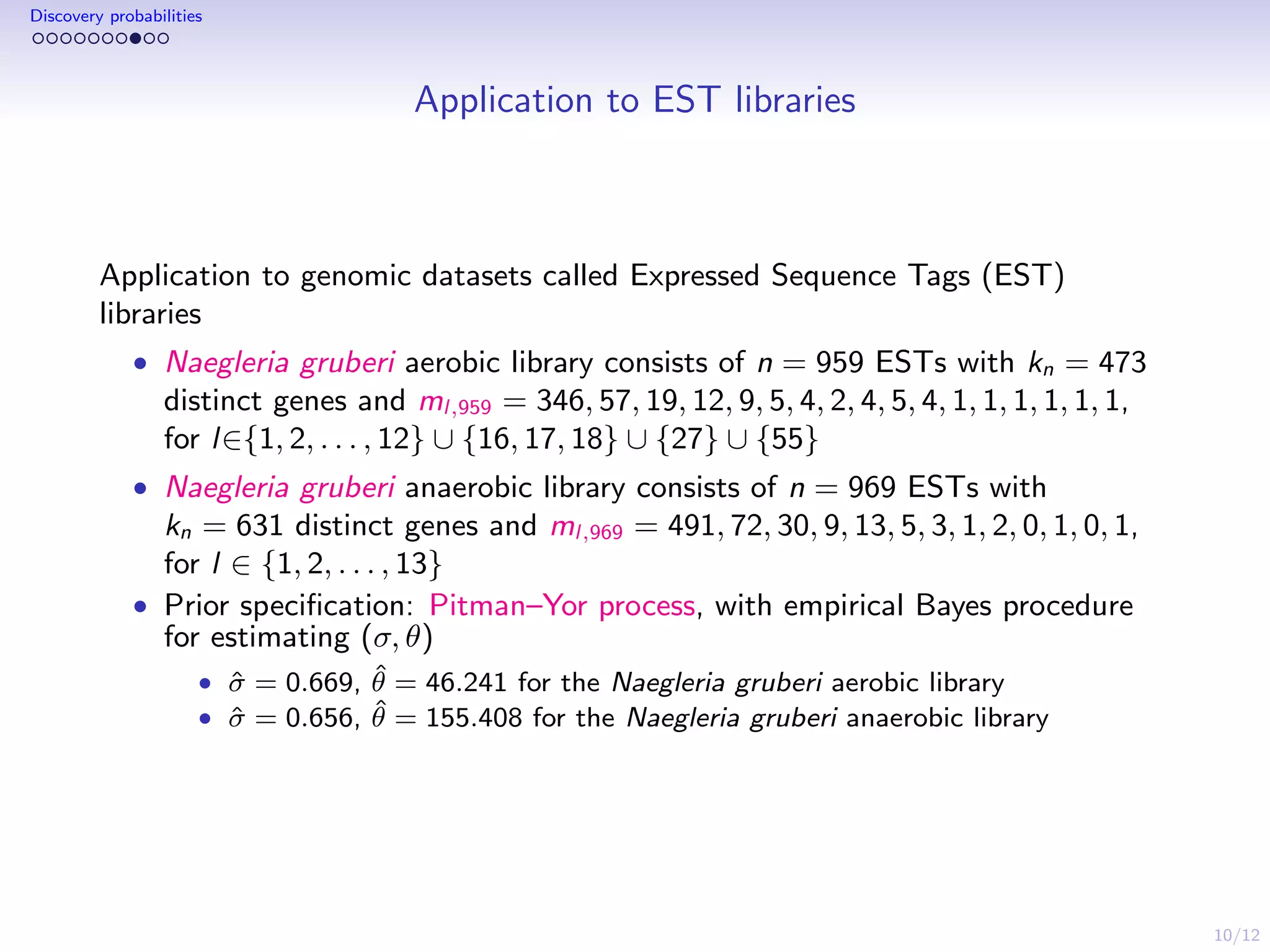
Application to genomic datasets called Expressed Sequence Tags (EST)
libraries
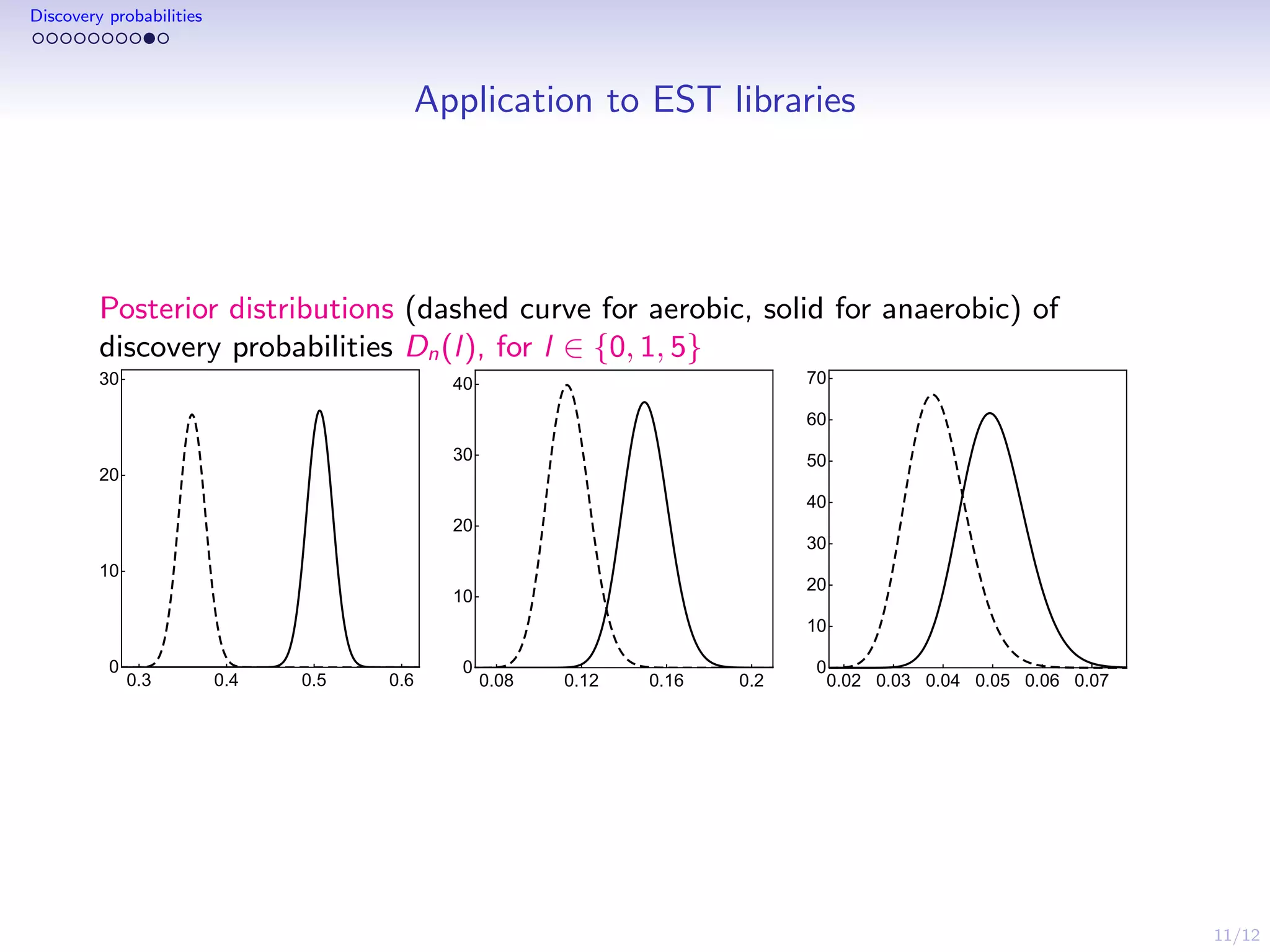
• Naegleria gruberi aerobic library consists of n = 959 ESTs with kn = 473
distinct genes and ml,959 = 346, 57, 19, 12, 9, 5, 4, 2, 4, 5, 4, 1, 1, 1, 1, 1, 1,
for l∈{1, 2, . . . , 12} ∪ {16, 17, 18} ∪ {27} ∪ {55}
• Naegleria gruberi anaerobic library consists of n = 969 ESTs with
kn = 631 distinct genes and ml,969 = 491, 72, 30, 9, 13, 5, 3, 1, 2, 0, 1, 0, 1,
for l ∈ {1, 2, . . . , 13}
• Prior specification: Pitman–Yor process, with empirical Bayes procedure
for estimating (σ, θ)
• ˆσ = 0.669, ˆθ = 46.241 for the Naegleria gruberi aerobic library
• ˆσ = 0.656, ˆθ = 155.408 for the Naegleria gruberi anaerobic library
11/12
Discovery probabilities
Application to EST libraries
Posterior distributions (dashed curve for aerobic, solid for anaerobic) of
discovery probabilities Dn(l), for l ∈ {0, 1, 5}
0.3 0.4 0.5 0.6
0
10
20
30
0.08 0.12 0.16 0.2
0
10
20
30
40
0.02 0.03 0.04 0.05 0.06 0.07
0
10
20
30
40
50
60
70
12/12
Discovery probabilities
Conclusion
Take-home messages
We have seen that Bayesian nonparametric methods allow for
• smoothing estimation of the discovery probabilities Dn(l) via more robust
estimators than frequentist counterparts
• a principled treatment of uncertainty where credible intervals can be
obtained naturally: closed form expression of the posterior distribution

Species sampling models in Bayesian Nonparametrics

  • 1.
    Species sampling models julyan.arbel@carloalberto.orgwww.julyanarbel.com Bocconi University, Milan, Italy & Collegio Carlo Alberto, Turin Statalks Seminar @ Collegio Carlo Alberto February 12, 2016 1/12
  • 2.
    2/12 Discovery probabilities Table ofContents Discovery probabilities
  • 3.
    3/12 Discovery probabilities Discovery problem:motivating example What is the probability of observing a new species?
  • 4.
    4/12 Discovery probabilities Discovery problem:motivating example Good and Turing worked on this problem Bletchley Park to crack German ciphers for the Enigma machine during World War II They proposed the estimator Number of species observed once Total number of species
  • 5.
    5/12 Discovery probabilities Discovery problem •Population of individuals (Xi )i≥1 belonging to an ideally an infinite number of species (θi )i≥1, respective unknown proportions (pi )i≥1 • Given (X1, . . . , Xn), make inference on the probability that the (n + 1)-th observation coincides with a species whose frequency is l, for l = 0, 1, . . . , n. This probability is termed l-discovery, that is Dn(l) = i≥1 pi I{l}(˜ni ) where ˜ni is the frequency of the species of type θi in the sample • Dn(0) denotes the proportion of yet unobserved species, or the probability of discovering a new species, or the missing mass • Applications arising from ecology, biology, design of experiments, bioinformatics, genetics, linguistic, economics, network modeling, chemistry, ...
  • 6.
    6/12 Discovery probabilities BNP model •The BNP approach for estimating Dn(l) is based on the randomization of the unknown species proportions pi ’s. See Lijoi, Mena and Pr¨unster (2007) Let P = i≥1 pi δθ denote a discrete random probability measure Let Xn = (X1, . . . , Xn) be a sample from a population with composition P, namely Xi | P iid ∼ P P ∼ Q with P playing the role of the nonparametric prior • Due to the discreteness of P, the sample Xn from P exhibits ties with positive probability. In other terms Xn features k distinct observations X∗ 1 , . . . , X∗ Kn with corresponding frequencies (n1, . . . , nk ) • The information provided by (n1, . . . , nk ) can be coded by mn = (m1, . . . , mn) where mi = number of species in the sample Xn having frequency i Under this alternative codification one obtains 1≤i≤n mi = k and 1≤i≤n imi = n.
  • 7.
    7/12 Discovery probabilities Good Turingestimators of discovery Remember, Good and Turing estimate the prob. of observing a new species as Number of species observed once Total number of species ie ˇDn(0) = m1 n Also generalized to any frequency l ≤ n ˇDn(l) = (l + 1)ml+1 n Good (1953) BNP counterparts of these estimators?
  • 8.
    8/12 Discovery probabilities BNP estimatorsof discovery Gibbs-type random probability measure P with index σ ∈ (0, 1): it is characterized by (it induces) a predictive distribution of the form P[Xn+1 ∈ A | Xn] = Vn+1,kn+1 Vn,kn G0(A) + Vn+1,kn Vn,kn kn i=1 (ni − σ) δX∗ i (A), BNP estimator ˆDn(l) of Dn(l) derived from the predictive using sets A0 = X{X∗ 1 , . . . , X∗ Kn } and Al = {X∗ i : Ni,n = l} BNP Good Turing ˆDn(0) = E[Ph(A0) | Xn] = Vn+1,kn+1 Vn,kn ˇDn(l) = m1 n ˆDn(l) = E[Ph(Al ) | Xn] = (l − σ)ml Vn+1,kn Vn,kn ˇDn(l) = (l+1)ml+1 n
  • 9.
    9/12 Discovery probabilities Credible intervalsfor discovery • Special case of Pitman–Yor process (Perman, Pitman and Yor, 1992). For σ ∈ (0, 1) and θ > −σ and Vn,kn = kn−1 i=1 (θ + iσ) (θ + 1)(n−1) Then closed form expression for the posterior distribution as Beta Pp(A0) | Xn d = Bθ+σkn,n−σkn and Pp(Al ) | Xn d = B(l−σ)ml ,θ+n−(l−σ)ml • Similar results in the general Gibbs class • Practical tool for deriving credible intervals for the BNP estimator ˆDn(l), for any l = 0, 1, . . . , n. This is typically done by performing a numerical evaluation of appropriate quantiles of the distribution of Pp(Al ) | Xn
  • 10.
    10/12 Discovery probabilities Application toEST libraries Application to genomic datasets called Expressed Sequence Tags (EST) libraries • Naegleria gruberi aerobic library consists of n = 959 ESTs with kn = 473 distinct genes and ml,959 = 346, 57, 19, 12, 9, 5, 4, 2, 4, 5, 4, 1, 1, 1, 1, 1, 1, for l∈{1, 2, . . . , 12} ∪ {16, 17, 18} ∪ {27} ∪ {55} • Naegleria gruberi anaerobic library consists of n = 969 ESTs with kn = 631 distinct genes and ml,969 = 491, 72, 30, 9, 13, 5, 3, 1, 2, 0, 1, 0, 1, for l ∈ {1, 2, . . . , 13} • Prior specification: Pitman–Yor process, with empirical Bayes procedure for estimating (σ, θ) • ˆσ = 0.669, ˆθ = 46.241 for the Naegleria gruberi aerobic library • ˆσ = 0.656, ˆθ = 155.408 for the Naegleria gruberi anaerobic library
  • 11.
    11/12 Discovery probabilities Application toEST libraries Posterior distributions (dashed curve for aerobic, solid for anaerobic) of discovery probabilities Dn(l), for l ∈ {0, 1, 5} 0.3 0.4 0.5 0.6 0 10 20 30 0.08 0.12 0.16 0.2 0 10 20 30 40 0.02 0.03 0.04 0.05 0.06 0.07 0 10 20 30 40 50 60 70
  • 12.
    12/12 Discovery probabilities Conclusion Take-home messages Wehave seen that Bayesian nonparametric methods allow for • smoothing estimation of the discovery probabilities Dn(l) via more robust estimators than frequentist counterparts • a principled treatment of uncertainty where credible intervals can be obtained naturally: closed form expression of the posterior distribution