A Closed-Form Expression for Queuing Delay in
Rayleigh Fading Channels Using Stochastic Network
                    Calculus

                 Giacomo Verticale

                  Politecnico di Milano
                           Italy


                   October 2009
Introduction


        Stochastic Network Calculus is a modern theory for studying
        QoS in wireline
        in this paper, we use it to model of the wireless channel subject
        to Rayleigh fading
        then we obtain an approximate closed-form expression for the
        probability tail of the queuing delay
        finally, we compare our results to simulations


G. Verticale (Politecnico di Milano)   An Expression for Queuing Delay . . .   October 2009   2 / 21
Outline


1    Background
             Markovian Model of the Rayleigh Fading Channel
             Spectral Gap in Markov Chains
             Stochastic Network Calculus


2    Service Envelope of the Fading Channel


3    Comparison with Simulations


4    Conclusion


G. Verticale (Politecnico di Milano)   An Expression for Queuing Delay . . .   October 2009   3 / 21
Markovian Model of the Rayleigh Fading Channel
Assumptions


Assumptions
   1    the channel is frequency flat
   2    the channel coherence time is longer than the frame duration
   3    perfect Channel State Information (CSI) is available
   4    pathloss and shadowing do not change over time

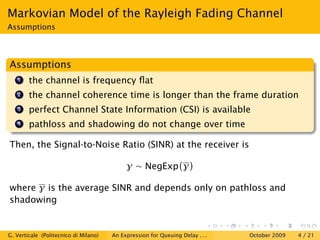
Then, the Signal-to-Noise Ratio (SINR) at the receiver is

                                            γ ∼ NegExp γ

where γ is the average SINR and depends only on pathloss and
shadowing


G. Verticale (Politecnico di Milano)   An Expression for Queuing Delay . . .   October 2009   4 / 21
Markovian Model of the Rayleigh Fading Channel
Multipath Fading


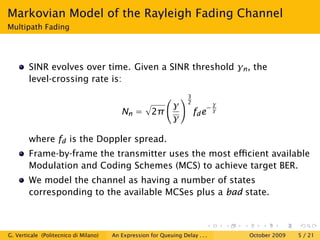
        SINR evolves over time. Given a SINR threshold γn , the
        level-crossing rate is:
                                                                    3
                                                                    2
                                                  γ                             γ
                                                                               −γ
                                          Nn = 2π                       fd e
                                                  γ

        where fd is the Doppler spread.
        Frame-by-frame the transmitter uses the most efficient available
        Modulation and Coding Schemes (MCS) to achieve target BER.
        We model the channel as having a number of states
        corresponding to the available MCSes plus a bad state.


G. Verticale (Politecnico di Milano)   An Expression for Queuing Delay . . .        October 2009   5 / 21
Markovian Model of the Rayleigh Fading Channel
States and Stationary Probabilities

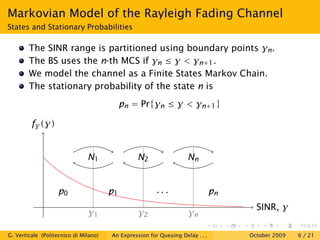
        The SINR range is partitioned using boundary points γn .
        The BS uses the n-th MCS if γn ≤ γ < γn+1 .
        We model the channel as a Finite States Markov Chain.
        The stationary probability of the state n is
                                            pn = Pr{γn ≤ γ < γn+1 }

         fγ (γ)


                               N1               N2                  Nn


                   p0                  p1               ...                    pn
                                                                                      SINR, γ
                               γ1                γ2                 γn

G. Verticale (Politecnico di Milano)   An Expression for Queuing Delay . . .        October 2009   6 / 21
Markovian Model of the Rayleigh Fading Channel
Transition Probabilities


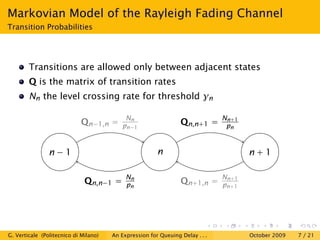
        Transitions are allowed only between adjacent states
        Q is the matrix of transition rates
        Nn the level crossing rate for threshold γn

                                            Nn                                 Nn+1
                             Qn−1,n =      pn−1                  Qn,n+1 =       pn


                n−1                                     n                             n+1

                                            Nn                                 Nn+1
                              Qn,n−1 =      pn                   Qn+1,n =      pn+1


G. Verticale (Politecnico di Milano)   An Expression for Queuing Delay . . .          October 2009   7 / 21
Markovian Model of the Rayleigh Fading Channel

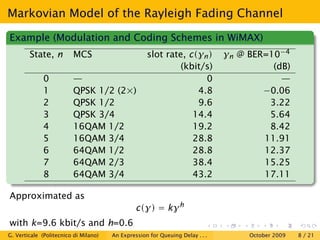
Example (Modulation and Coding Schemes in WiMAX)
        State, n         MCS                        slot rate, c(γn )          γn @ BER=10−4
                                                             (kbit/s)                    (dB)
              0          —                                         0                       —
              1          QPSK 1/2 (2×)                           4.8                   −0.06
              2          QPSK 1/2                                9.6                    3.22
              3          QPSK 3/4                               14.4                    5.64
              4          16QAM 1/2                              19.2                    8.42
              5          16QAM 3/4                              28.8                   11.91
              6          64QAM 1/2                              28.8                   12.37
              7          64QAM 2/3                              38.4                   15.25
              8          64QAM 3/4                              43.2                   17.11

Approximated as
                                                c(γ) = kγ h
with k=9.6 kbit/s and h=0.6
G. Verticale (Politecnico di Milano)   An Expression for Queuing Delay . . .        October 2009   8 / 21
Spectral Gap in Markov Chains

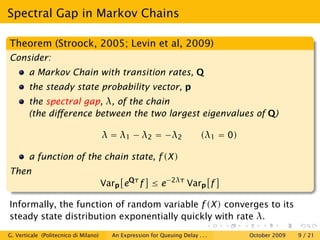
Theorem (Stroock, 2005; Levin et al, 2009)
Consider:
        a Markov Chain with transition rates, Q
        the steady state probability vector, p
        the spectral gap, λ, of the chain
        (the difference between the two largest eigenvalues of Q)

                                       λ = λ1 − λ2 = −λ2                   (λ1 = 0)

        a function of the chain state, f (X )
Then
                                       Varp eQτ f ≤ e−2λτ Varp f

Informally, the function of random variable f (X ) converges to its
steady state distribution exponentially quickly with rate λ.
G. Verticale (Politecnico di Milano)     An Expression for Queuing Delay . . .        October 2009   9 / 21
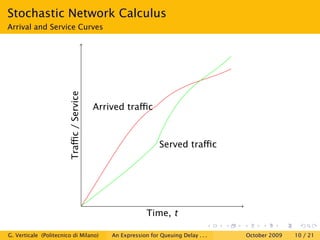
Stochastic Network Calculus
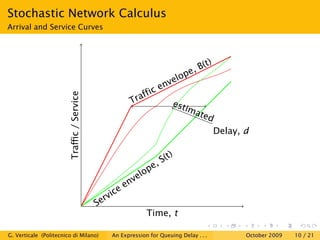
Arrival and Service Curves


                         Traffic / Service


                                           Arrived traffic


                                                                 Served traffic


                                                            Time, t

G. Verticale (Politecnico di Milano)           An Expression for Queuing Delay . . .   October 2009   10 / 21
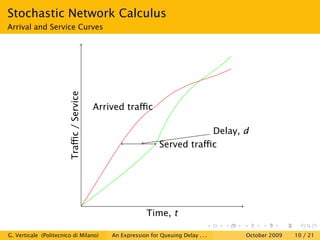
Stochastic Network Calculus
Arrival and Service Curves


                         Traffic / Service


                                           Arrived traffic

                                                                            Delay, d
                                                                 Served traffic


                                                            Time, t

G. Verticale (Politecnico di Milano)           An Expression for Queuing Delay . . .   October 2009   10 / 21
Stochastic Network Calculus
Arrival and Service Curves


                                                                                        )
                                                                                ,   B (t
                                                                             pe
                                                                        velo
                                                                  en
                                                             ffic
                         Traffic / Service

                                                         Tra         est
                                                                         ima
                                                                            ted
                                                                                            Delay, d

                                                                      )
                                                                  S(t
                                                               e,
                                                           l op
                                                         ve
                                                       en
                                                 v ice
                                             r
                                           Se
                                                               Time, t

G. Verticale (Politecnico di Milano)              An Expression for Queuing Delay . . .            October 2009   10 / 21
Stochastic Network Calculus
Queuing Delay


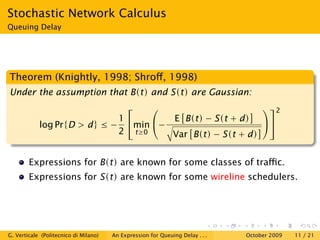
Theorem (Knightly, 1998; Shroff, 1998)
Under the assumption that B(t) and S(t) are Gaussian:
                                                          2
                              1        E B(t) − S(t + d) 
            log Pr{D > d} ≤ −    min −
                              2 t≥0     Var B(t) − S(t + d)


        Expressions for B(t) are known for some classes of traffic.
        Expressions for S(t) are known for some wireline schedulers.


G. Verticale (Politecnico di Milano)   An Expression for Queuing Delay . . .   October 2009   11 / 21
Outline


1    Background
             Markovian Model of the Rayleigh Fading Channel
             Spectral Gap in Markov Chains
             Stochastic Network Calculus


2    Service Envelope of the Fading Channel


3    Comparison with Simulations


4    Conclusion


G. Verticale (Politecnico di Milano)   An Expression for Queuing Delay . . .   October 2009   12 / 21
Service Envelope of the Fading Channel
Mean and Variance of Service Curve in the Markovian Channel


Theorem
If the channel can be modeled as a reversible Markov Chain, then

                                                                λt + e−λt − 1
                               Var S(t) ≤ 2 Var[c]
                                                                     λ2

We also provide a linear approximation:
                                                                         t
                                       Var S(t) ≤ 2 Var[c]
                                                                         λ

The mean is trivial: E S(t) = E[c]t


G. Verticale (Politecnico di Milano)   An Expression for Queuing Delay . . .    October 2009   13 / 21
Service Envelope of the Fading Channel
Mean and Variance of Service Curve in the Markovian Channel


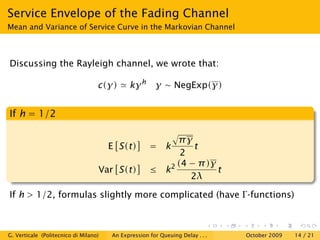
Discussing the Rayleigh channel, we wrote that:

                                   c(γ)      kγ h      γ ∼ NegExp(γ)


If h = 1/2

                                                          πγ
                                       E S(t)        = k      t
                                                           2
                                                          (4 − π )γ
                                   Var S(t)          ≤ k2           t
                                                             2λ

If h > 1/2, formulas slightly more complicated (have Γ -functions)


G. Verticale (Politecnico di Milano)   An Expression for Queuing Delay . . .   October 2009   14 / 21
Service Envelope of the Fading Channel
Queuing Delay with the CBR Source


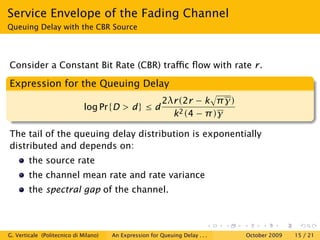
Consider a Constant Bit Rate (CBR) traffic flow with rate r.

Expression for the Queuing Delay
                                                          2λr(2r − k π γ)
                              log Pr{D > d} ≤ d
                                                            k 2 (4 − π )γ

The tail of the queuing delay distribution is exponentially
distributed and depends on:
        the source rate
        the channel mean rate and rate variance
        the spectral gap of the channel.


G. Verticale (Politecnico di Milano)   An Expression for Queuing Delay . . .   October 2009   15 / 21
Outline


1    Background
             Markovian Model of the Rayleigh Fading Channel
             Spectral Gap in Markov Chains
             Stochastic Network Calculus


2    Service Envelope of the Fading Channel


3    Comparison with Simulations


4    Conclusion


G. Verticale (Politecnico di Milano)   An Expression for Queuing Delay . . .   October 2009   16 / 21
Comparison with Simulations
Simulation Scenario


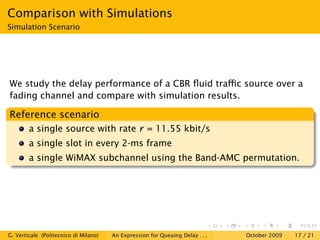
We study the delay performance of a CBR fluid traffic source over a
fading channel and compare with simulation results.

Reference scenario
        a single source with rate r = 11.55 kbit/s
        a single slot in every 2-ms frame
        a single WiMAX subchannel using the Band-AMC permutation.


G. Verticale (Politecnico di Milano)   An Expression for Queuing Delay . . .   October 2009   17 / 21
Comparison with Simulations
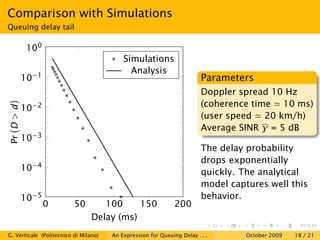
Queuing delay tail

            100
                                           Simulations
                                             Analysis
           10−1                                                          Parameters
                                                                         Doppler spread 10 Hz
           10−2                                                          (coherence time 10 ms)
Pr D > d


                                                                         (user speed 20 km/h)
                                                                         Average SINR γ = 5 dB
           10−3
                                                                         The delay probability
                                                                         drops exponentially
           10−4                                                          quickly. The analytical
                                                                         model captures well this
           10−5                                                          behavior.
                  0       50        100     150                200
                                 Delay (ms)
G. Verticale (Politecnico di Milano)   An Expression for Queuing Delay . . .       October 2009   18 / 21
Comparison with Simulations
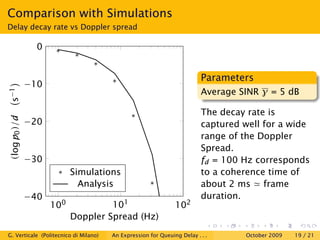
Delay decay rate vs Doppler spread

                 0


                                                                         Parameters
               −10
s−1


                                                                         Average SINR γ = 5 dB

                                                                         The decay rate is
 (log p0 )/d


               −20                                                       captured well for a wide
                                                                         range of the Doppler
                                                                         Spread.
               −30                                                       fd = 100 Hz corresponds
                           Simulations                                   to a coherence time of
                             Analysis                                    about 2 ms frame
               −40                                                       duration.
                     100            101                        102
                           Doppler Spread (Hz)
G. Verticale (Politecnico di Milano)   An Expression for Queuing Delay . . .      October 2009   19 / 21
Comparison with Simulations
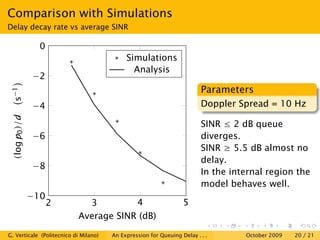
Delay decay rate vs average SINR

                  0
                                            Simulations
                                              Analysis
                −2
                                                                         Parameters
 s−1


                −4                                                       Doppler Spread = 10 Hz
  (log p0 )/d


                                                                         SINR ≤ 2 dB queue
                −6                                                       diverges.
                                                                         SINR ≥ 5.5 dB almost no
                                                                         delay.
                −8
                                                                         In the internal region the
                                                                         model behaves well.
                −10
                      2      3         4                          5
                           Average SINR (dB)

G. Verticale (Politecnico di Milano)   An Expression for Queuing Delay . . .       October 2009   20 / 21
Conclusion


        Stochastic Network Calculus has been successful in the wireline
        we provide a way to use it to study the wireless channel
        we were able to obtain an expression for the probability tail of
        the queuing delay by using results from the spectral graph
        theory
        there is a good match between our analytical results and
        simulations


G. Verticale (Politecnico di Milano)   An Expression for Queuing Delay . . .   October 2009   21 / 21

A Closed-Form Expression for Queuing Delay in Rayleigh Fading Channels Using Stochastic Network Calculus

  • 1.
    A Closed-Form Expressionfor Queuing Delay in Rayleigh Fading Channels Using Stochastic Network Calculus Giacomo Verticale Politecnico di Milano Italy October 2009
  • 2.
    Introduction Stochastic Network Calculus is a modern theory for studying QoS in wireline in this paper, we use it to model of the wireless channel subject to Rayleigh fading then we obtain an approximate closed-form expression for the probability tail of the queuing delay finally, we compare our results to simulations G. Verticale (Politecnico di Milano) An Expression for Queuing Delay . . . October 2009 2 / 21
  • 3.
    Outline 1 Background Markovian Model of the Rayleigh Fading Channel Spectral Gap in Markov Chains Stochastic Network Calculus 2 Service Envelope of the Fading Channel 3 Comparison with Simulations 4 Conclusion G. Verticale (Politecnico di Milano) An Expression for Queuing Delay . . . October 2009 3 / 21
  • 4.
    Markovian Model ofthe Rayleigh Fading Channel Assumptions Assumptions 1 the channel is frequency flat 2 the channel coherence time is longer than the frame duration 3 perfect Channel State Information (CSI) is available 4 pathloss and shadowing do not change over time Then, the Signal-to-Noise Ratio (SINR) at the receiver is γ ∼ NegExp γ where γ is the average SINR and depends only on pathloss and shadowing G. Verticale (Politecnico di Milano) An Expression for Queuing Delay . . . October 2009 4 / 21
  • 5.
    Markovian Model ofthe Rayleigh Fading Channel Multipath Fading SINR evolves over time. Given a SINR threshold γn , the level-crossing rate is: 3 2 γ γ −γ Nn = 2π fd e γ where fd is the Doppler spread. Frame-by-frame the transmitter uses the most efficient available Modulation and Coding Schemes (MCS) to achieve target BER. We model the channel as having a number of states corresponding to the available MCSes plus a bad state. G. Verticale (Politecnico di Milano) An Expression for Queuing Delay . . . October 2009 5 / 21
  • 6.
    Markovian Model ofthe Rayleigh Fading Channel States and Stationary Probabilities The SINR range is partitioned using boundary points γn . The BS uses the n-th MCS if γn ≤ γ < γn+1 . We model the channel as a Finite States Markov Chain. The stationary probability of the state n is pn = Pr{γn ≤ γ < γn+1 } fγ (γ) N1 N2 Nn p0 p1 ... pn SINR, γ γ1 γ2 γn G. Verticale (Politecnico di Milano) An Expression for Queuing Delay . . . October 2009 6 / 21
  • 7.
    Markovian Model ofthe Rayleigh Fading Channel Transition Probabilities Transitions are allowed only between adjacent states Q is the matrix of transition rates Nn the level crossing rate for threshold γn Nn Nn+1 Qn−1,n = pn−1 Qn,n+1 = pn n−1 n n+1 Nn Nn+1 Qn,n−1 = pn Qn+1,n = pn+1 G. Verticale (Politecnico di Milano) An Expression for Queuing Delay . . . October 2009 7 / 21
  • 8.
    Markovian Model ofthe Rayleigh Fading Channel Example (Modulation and Coding Schemes in WiMAX) State, n MCS slot rate, c(γn ) γn @ BER=10−4 (kbit/s) (dB) 0 — 0 — 1 QPSK 1/2 (2×) 4.8 −0.06 2 QPSK 1/2 9.6 3.22 3 QPSK 3/4 14.4 5.64 4 16QAM 1/2 19.2 8.42 5 16QAM 3/4 28.8 11.91 6 64QAM 1/2 28.8 12.37 7 64QAM 2/3 38.4 15.25 8 64QAM 3/4 43.2 17.11 Approximated as c(γ) = kγ h with k=9.6 kbit/s and h=0.6 G. Verticale (Politecnico di Milano) An Expression for Queuing Delay . . . October 2009 8 / 21
  • 9.
    Spectral Gap inMarkov Chains Theorem (Stroock, 2005; Levin et al, 2009) Consider: a Markov Chain with transition rates, Q the steady state probability vector, p the spectral gap, λ, of the chain (the difference between the two largest eigenvalues of Q) λ = λ1 − λ2 = −λ2 (λ1 = 0) a function of the chain state, f (X ) Then Varp eQτ f ≤ e−2λτ Varp f Informally, the function of random variable f (X ) converges to its steady state distribution exponentially quickly with rate λ. G. Verticale (Politecnico di Milano) An Expression for Queuing Delay . . . October 2009 9 / 21
  • 10.
    Stochastic Network Calculus Arrivaland Service Curves Traffic / Service Arrived traffic Served traffic Time, t G. Verticale (Politecnico di Milano) An Expression for Queuing Delay . . . October 2009 10 / 21
  • 11.
    Stochastic Network Calculus Arrivaland Service Curves Traffic / Service Arrived traffic Delay, d Served traffic Time, t G. Verticale (Politecnico di Milano) An Expression for Queuing Delay . . . October 2009 10 / 21
  • 12.
    Stochastic Network Calculus Arrivaland Service Curves ) , B (t pe velo en ffic Traffic / Service Tra est ima ted Delay, d ) S(t e, l op ve en v ice r Se Time, t G. Verticale (Politecnico di Milano) An Expression for Queuing Delay . . . October 2009 10 / 21
  • 13.
    Stochastic Network Calculus QueuingDelay Theorem (Knightly, 1998; Shroff, 1998) Under the assumption that B(t) and S(t) are Gaussian:   2 1 E B(t) − S(t + d)  log Pr{D > d} ≤ − min − 2 t≥0 Var B(t) − S(t + d) Expressions for B(t) are known for some classes of traffic. Expressions for S(t) are known for some wireline schedulers. G. Verticale (Politecnico di Milano) An Expression for Queuing Delay . . . October 2009 11 / 21
  • 14.
    Outline 1 Background Markovian Model of the Rayleigh Fading Channel Spectral Gap in Markov Chains Stochastic Network Calculus 2 Service Envelope of the Fading Channel 3 Comparison with Simulations 4 Conclusion G. Verticale (Politecnico di Milano) An Expression for Queuing Delay . . . October 2009 12 / 21
  • 15.
    Service Envelope ofthe Fading Channel Mean and Variance of Service Curve in the Markovian Channel Theorem If the channel can be modeled as a reversible Markov Chain, then λt + e−λt − 1 Var S(t) ≤ 2 Var[c] λ2 We also provide a linear approximation: t Var S(t) ≤ 2 Var[c] λ The mean is trivial: E S(t) = E[c]t G. Verticale (Politecnico di Milano) An Expression for Queuing Delay . . . October 2009 13 / 21
  • 16.
    Service Envelope ofthe Fading Channel Mean and Variance of Service Curve in the Markovian Channel Discussing the Rayleigh channel, we wrote that: c(γ) kγ h γ ∼ NegExp(γ) If h = 1/2 πγ E S(t) = k t 2 (4 − π )γ Var S(t) ≤ k2 t 2λ If h > 1/2, formulas slightly more complicated (have Γ -functions) G. Verticale (Politecnico di Milano) An Expression for Queuing Delay . . . October 2009 14 / 21
  • 17.
    Service Envelope ofthe Fading Channel Queuing Delay with the CBR Source Consider a Constant Bit Rate (CBR) traffic flow with rate r. Expression for the Queuing Delay 2λr(2r − k π γ) log Pr{D > d} ≤ d k 2 (4 − π )γ The tail of the queuing delay distribution is exponentially distributed and depends on: the source rate the channel mean rate and rate variance the spectral gap of the channel. G. Verticale (Politecnico di Milano) An Expression for Queuing Delay . . . October 2009 15 / 21
  • 18.
    Outline 1 Background Markovian Model of the Rayleigh Fading Channel Spectral Gap in Markov Chains Stochastic Network Calculus 2 Service Envelope of the Fading Channel 3 Comparison with Simulations 4 Conclusion G. Verticale (Politecnico di Milano) An Expression for Queuing Delay . . . October 2009 16 / 21
  • 19.
    Comparison with Simulations SimulationScenario We study the delay performance of a CBR fluid traffic source over a fading channel and compare with simulation results. Reference scenario a single source with rate r = 11.55 kbit/s a single slot in every 2-ms frame a single WiMAX subchannel using the Band-AMC permutation. G. Verticale (Politecnico di Milano) An Expression for Queuing Delay . . . October 2009 17 / 21
  • 20.
    Comparison with Simulations Queuingdelay tail 100 Simulations Analysis 10−1 Parameters Doppler spread 10 Hz 10−2 (coherence time 10 ms) Pr D > d (user speed 20 km/h) Average SINR γ = 5 dB 10−3 The delay probability drops exponentially 10−4 quickly. The analytical model captures well this 10−5 behavior. 0 50 100 150 200 Delay (ms) G. Verticale (Politecnico di Milano) An Expression for Queuing Delay . . . October 2009 18 / 21
  • 21.
    Comparison with Simulations Delaydecay rate vs Doppler spread 0 Parameters −10 s−1 Average SINR γ = 5 dB The decay rate is (log p0 )/d −20 captured well for a wide range of the Doppler Spread. −30 fd = 100 Hz corresponds Simulations to a coherence time of Analysis about 2 ms frame −40 duration. 100 101 102 Doppler Spread (Hz) G. Verticale (Politecnico di Milano) An Expression for Queuing Delay . . . October 2009 19 / 21
  • 22.
    Comparison with Simulations Delaydecay rate vs average SINR 0 Simulations Analysis −2 Parameters s−1 −4 Doppler Spread = 10 Hz (log p0 )/d SINR ≤ 2 dB queue −6 diverges. SINR ≥ 5.5 dB almost no delay. −8 In the internal region the model behaves well. −10 2 3 4 5 Average SINR (dB) G. Verticale (Politecnico di Milano) An Expression for Queuing Delay . . . October 2009 20 / 21
  • 23.
    Conclusion Stochastic Network Calculus has been successful in the wireline we provide a way to use it to study the wireless channel we were able to obtain an expression for the probability tail of the queuing delay by using results from the spectral graph theory there is a good match between our analytical results and simulations G. Verticale (Politecnico di Milano) An Expression for Queuing Delay . . . October 2009 21 / 21