1
COntext-Sensitive and Duration-Aware
Qubit Mapping for Various NISQ Devices
Yu Zhang Hao-wei Deng Quan-xi Li
School of Computer Science & Technology
University of Science & Technology of China
PLanQC 2020, New Orleans, Jan. 19, 2020
2
Quantum
Algorithms
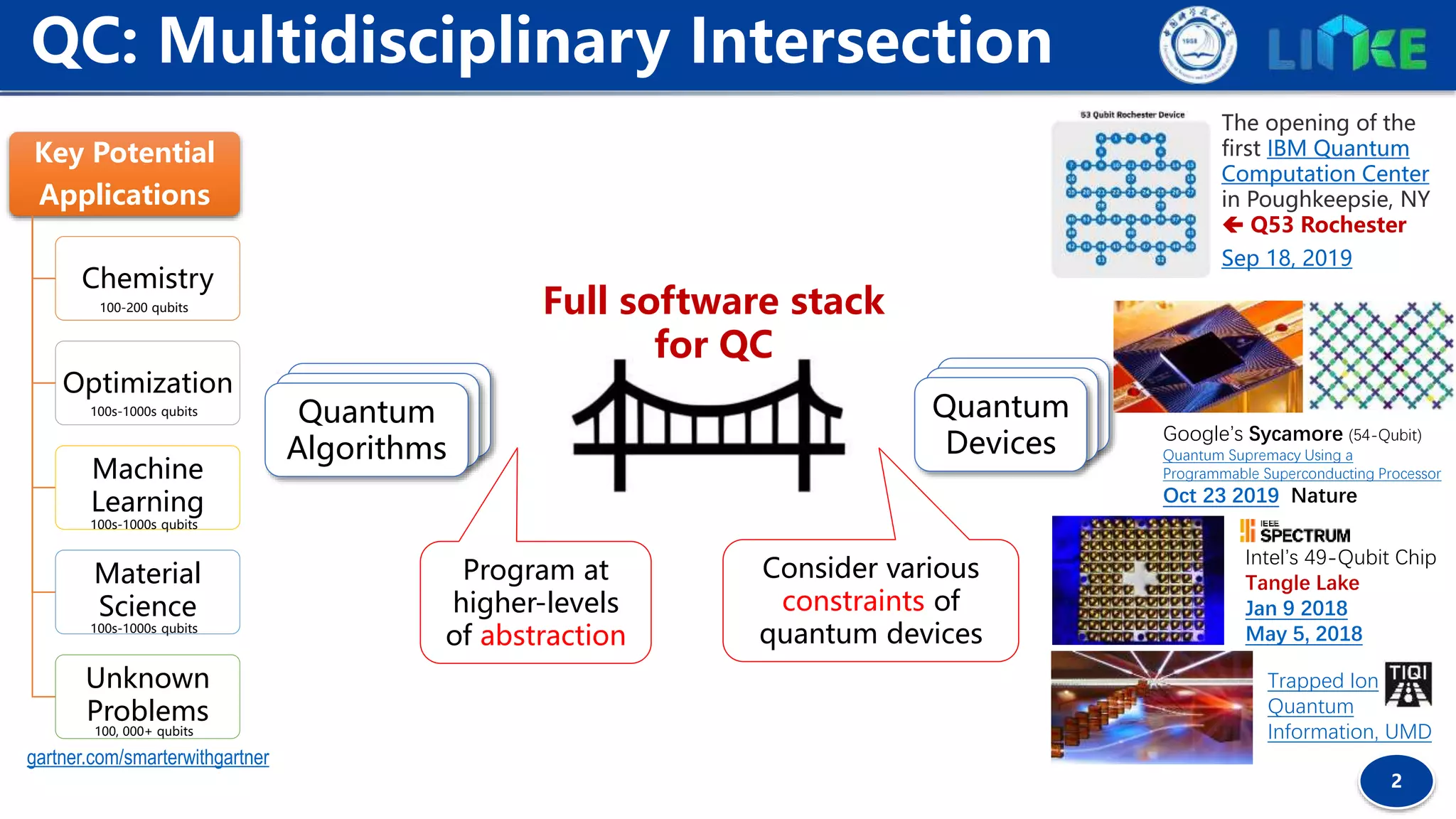
QC: Multidisciplinary Intersection
Quantum
Algorithms
Quantum
Algorithms
Key Potential
Applications
Chemistry
Optimization
Machine
Learning
Material
Science
Unknown
Problems
gartner.com/smarterwithgartner
100-200 qubits
100s-1000s qubits
100s-1000s qubits
100s-1000s qubits
100, 000+ qubits
Algorithm
slgorithms
Quantum
Devices
Trapped Ion
Quantum
Information, UMD
Full software stack
for QC
Program at
higher-levels
of abstraction
Consider various
constraints of
quantum devices
Google’s Sycamore (54-Qubit)
Quantum Supremacy Using a
Programmable Superconducting Processor
Oct 23 2019 Nature
Sep 18, 2019
The opening of the
first IBM Quantum
Computation Center
in Poughkeepsie, NY
 Q53 Rochester
Intel’s 49-Qubit Chip
Tangle Lake
Jan 9 2018
May 5, 2018
3
Most Existing QP Systems
Low-level quantum circuit
qreg q[3];
h q[0];
h q[1];
CX q[1], q[2];
CX q[0], q[2];
H q;
OpenQASM
Host language
+
Embedded DSL
High-level
Quantum
Compilation
ProjectQ
Low-level quantum circuit
Low-level
Quantum
Compilation
Hardware instructions (Pulse)
4
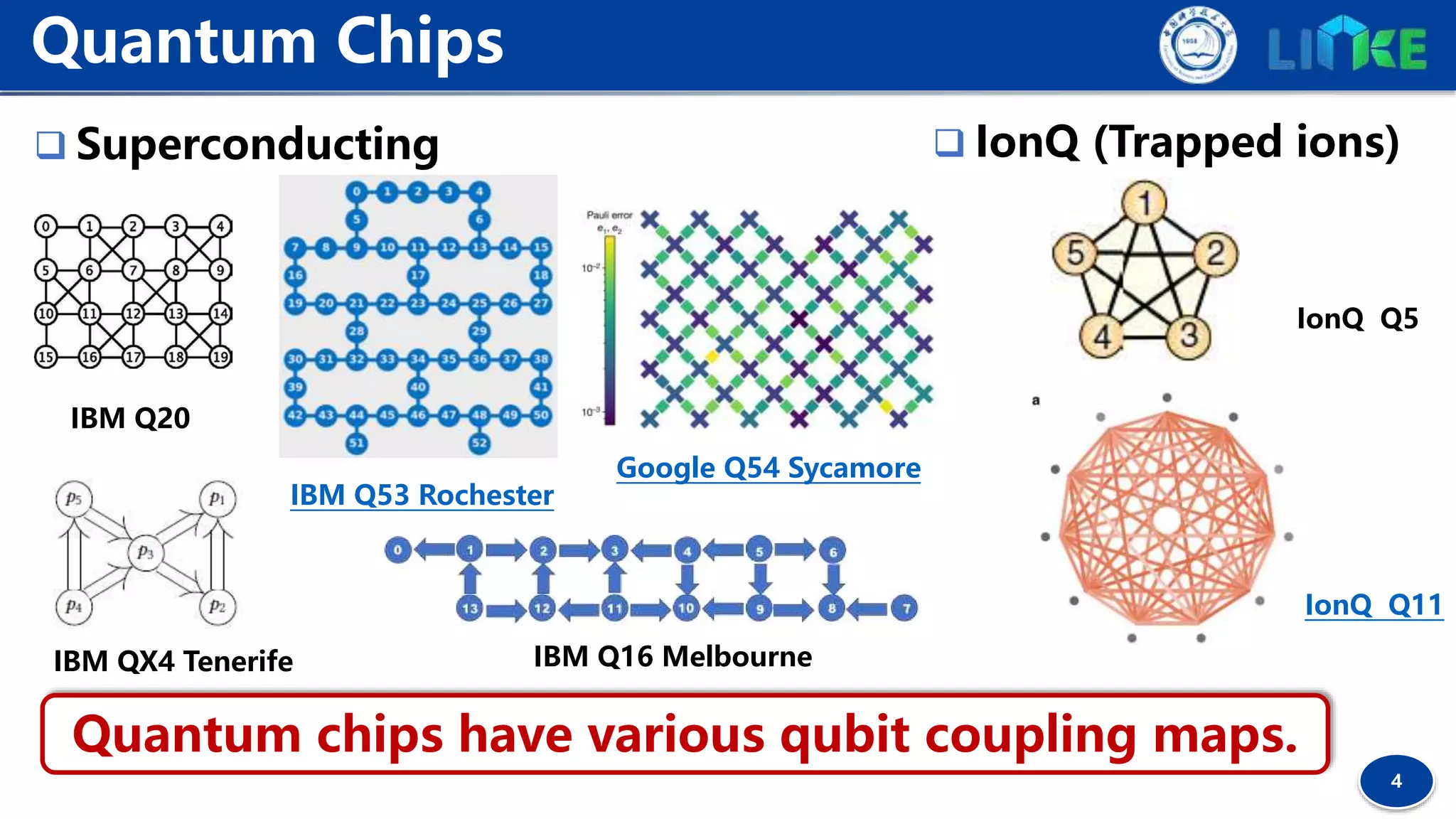
Quantum Chips
 Superconducting  IonQ (Trapped ions)
IBM QX4 Tenerife
IBM Q20
IBM Q16 Melbourne
IonQ Q5
IonQ Q11
IBM Q53 Rochester
Google Q54 Sycamore
Quantum chips have various qubit coupling maps.
5
Qubit Mapping Problem
CNOT
SWAP① CNOT②
Compiler need to insert SWAP into the quantum
circuit to fit the connection limitation in NISQ
hardware.
qreg q[3];
h q[0];
h q[1];
CX q[1], q[2];
CX q[0], q[2];
H q;
OpenQASM
NP-Complete
[CGO2018] Marcos Yukio Siraichi et al. Qubit Allocation.
6
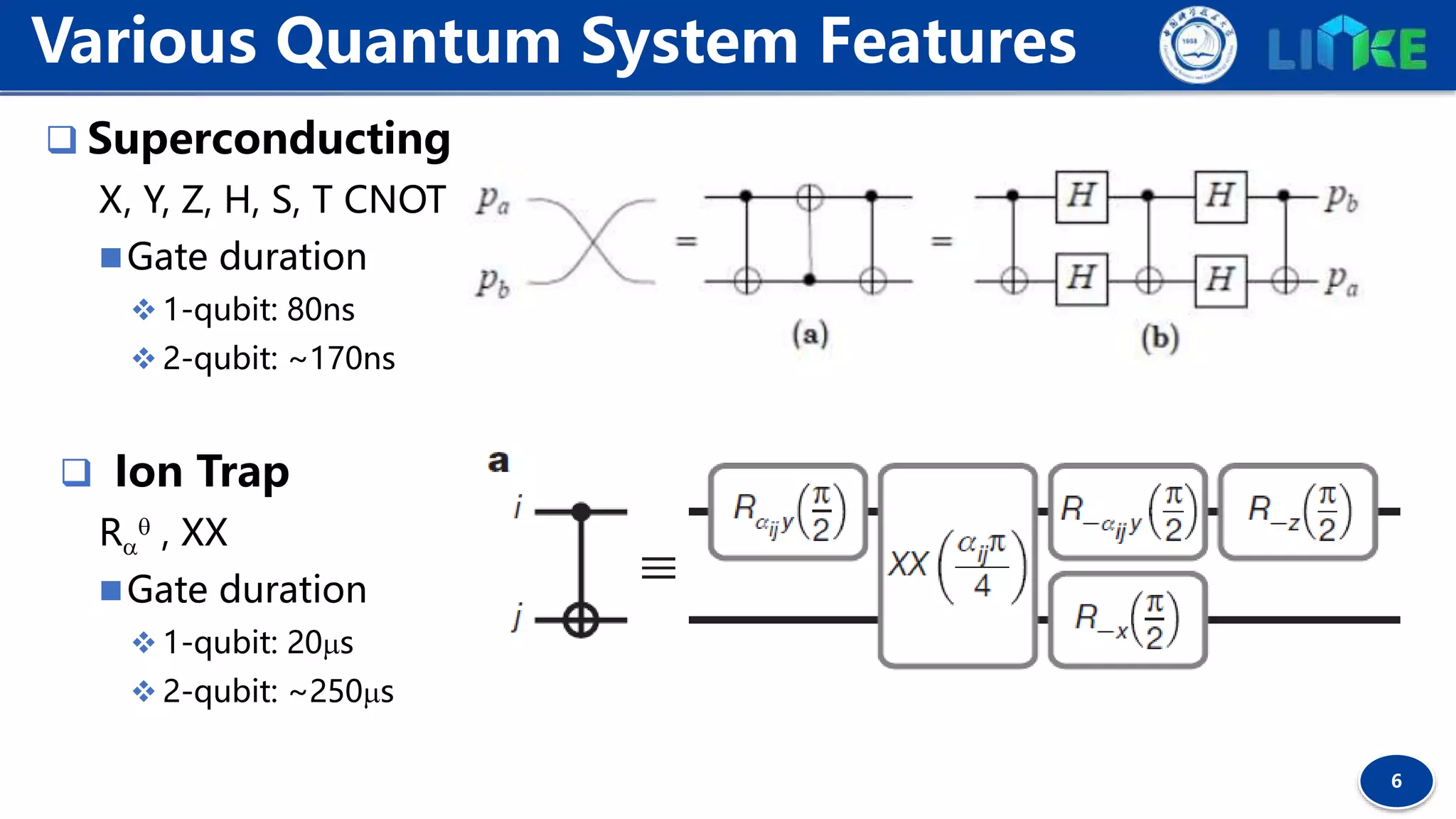
 Superconducting
X, Y, Z, H, S, T CNOT
Gate duration
 1-qubit: 80ns
 2-qubit: ~170ns
 Ion Trap
Ra
q , XX
Gate duration
 1-qubit: 20ms
 2-qubit: ~250ms
Various Quantum System Features
7
How to insert SWAPs
 obtain feasible quantum circuits
for various NISQ devices
8
 Formulate the qubit mapping problem into an equivalent
mathematical problem and apply a (SMT) Solver, e.g.
Unscalable, can only be applied to small-size cases
 Use heuristic search to obtain approximate results
Better in runtime especially when the circuit is in a large scale
Previous Solutions
 Ignore gate/operation duration difference
 Rarely consider the impact of program context on parallelism
9
 Propose a Quantum Abstract Machine to abstract the
characteristics of different NISQ architectures
QAM here is distinct from that in the literature [arxiv1608.03355], which
refers to an abstract machine architecture for classical/quantum
computations
 Propose a heuristic search algorithm CODAR considering
Gate duration difference
Program context
to explore more parallelism of the quantum program
Our Main Idea
[arxiv1608.03355] Robert S. Smith, Michael J. Curtis, William J. Zeng. A Practical Quantum Instruction
Set Architecture. Feb 2017.
CODAR: COntext-sensitive and Duration-Aware Remapping algorithm
10
Which qubit pair is chosen to swap?
The earlier it can start, the better
Motivating Examples
11
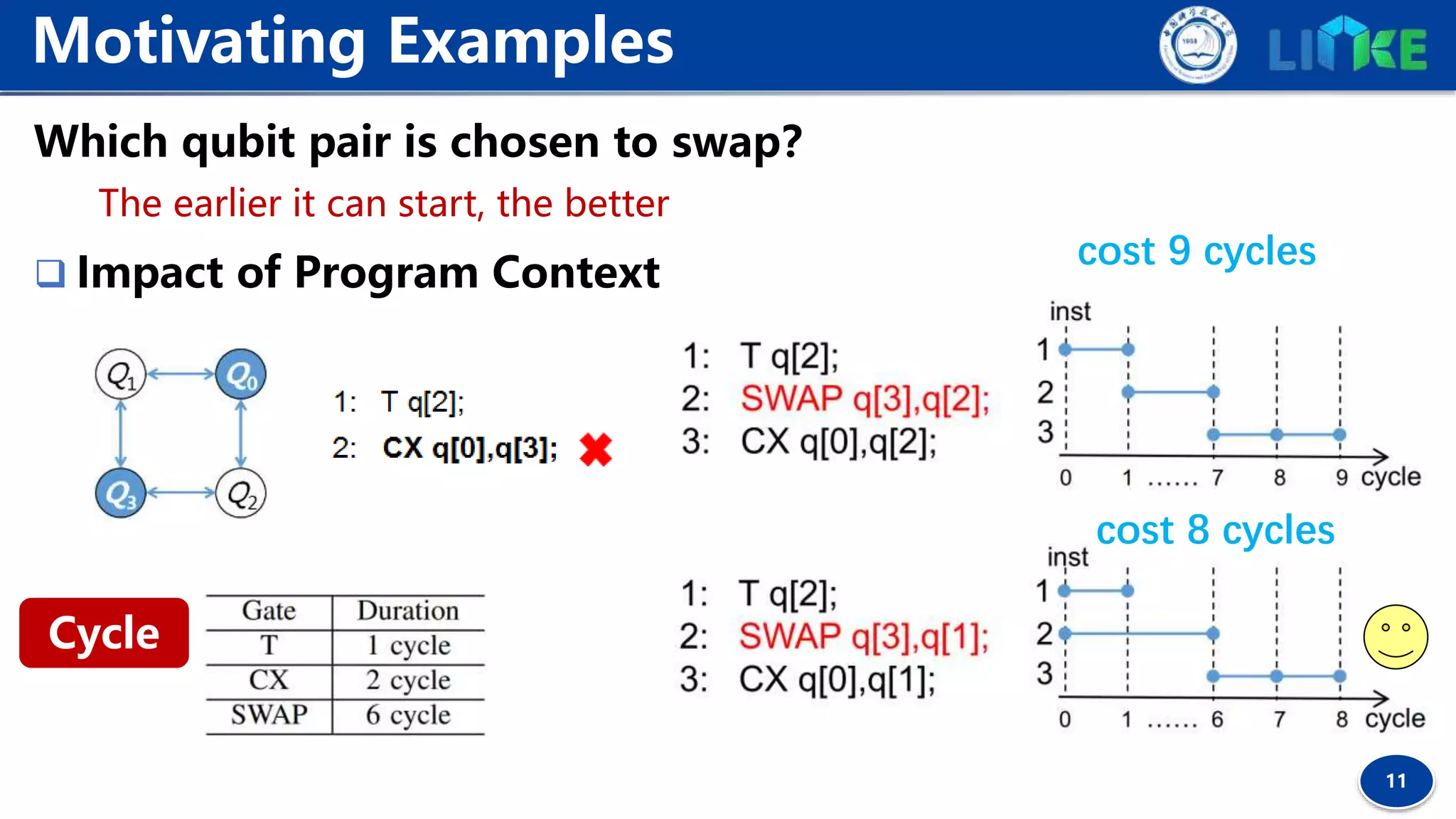
Which qubit pair is chosen to swap?
The earlier it can start, the better
 Impact of Program Context
Motivating Examples
cost 9 cycles
cost 8 cycles
Cycle
12
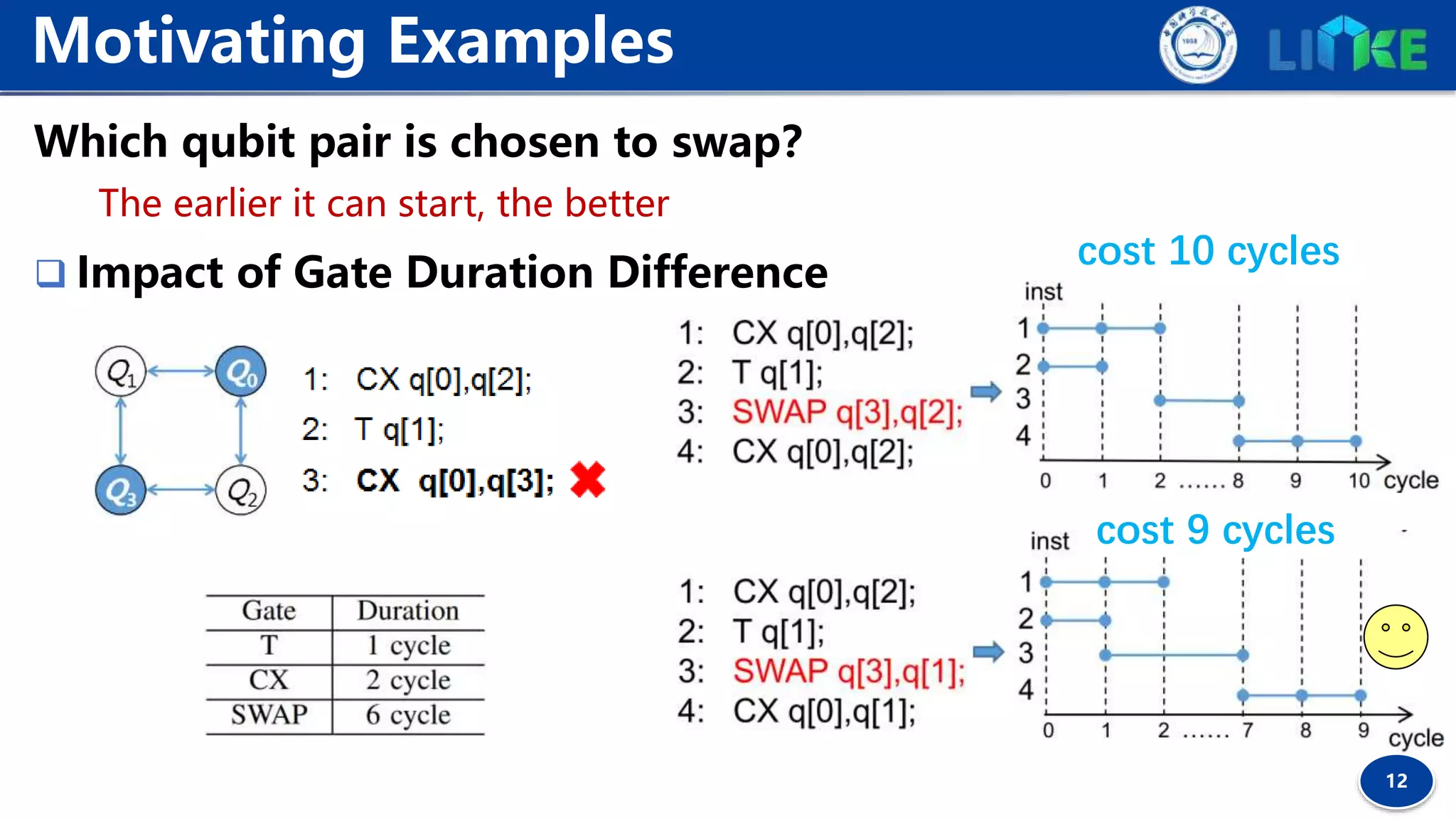
Which qubit pair is chosen to swap?
The earlier it can start, the better
 Impact of Gate Duration Difference
Motivating Examples
cost 10 cycles
cost 9 cycles
13
maQAM: Multi-architecture Adaptive
Quantum Abstract Machine
14
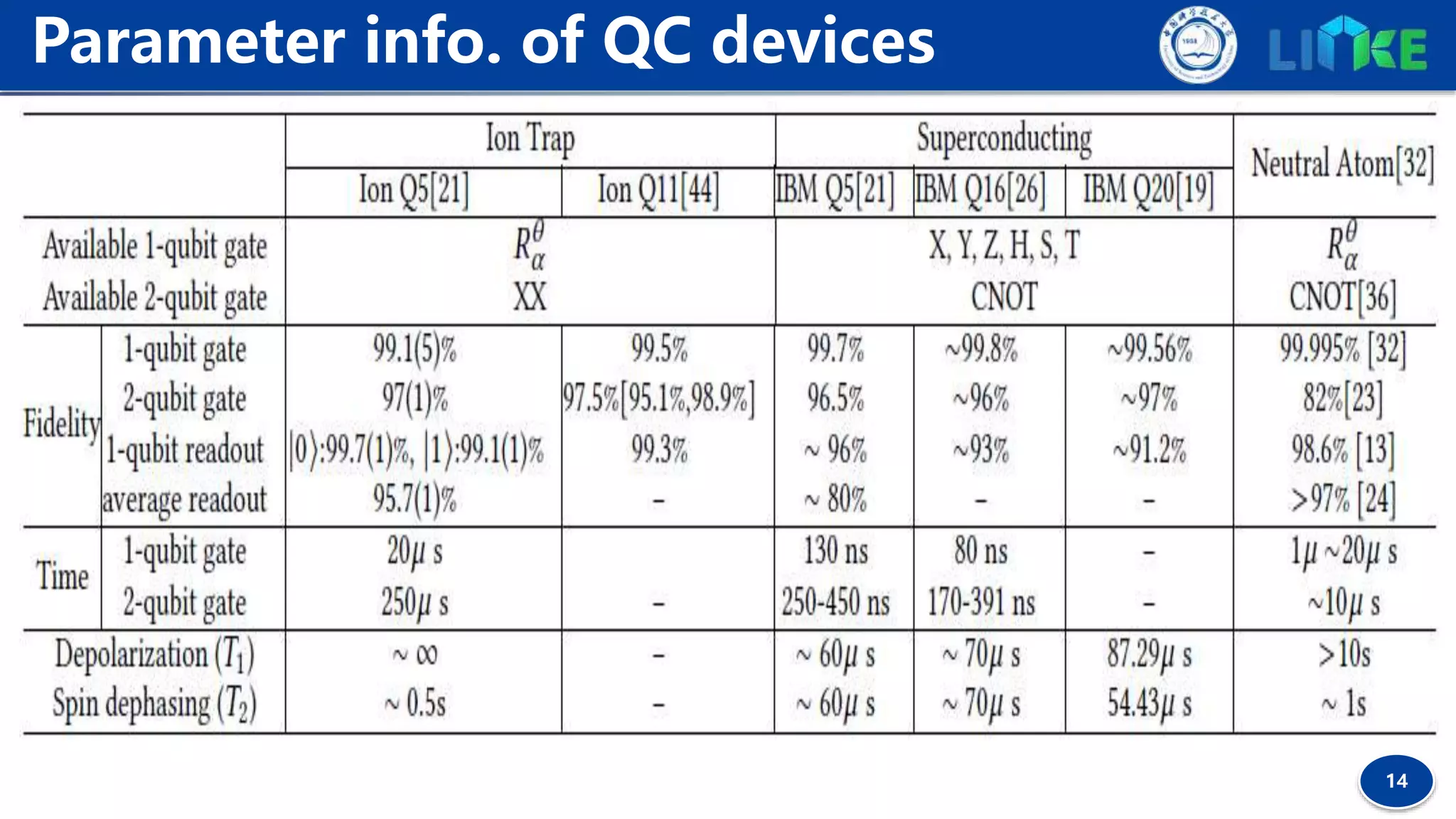
Parameter info. of QC devices
15
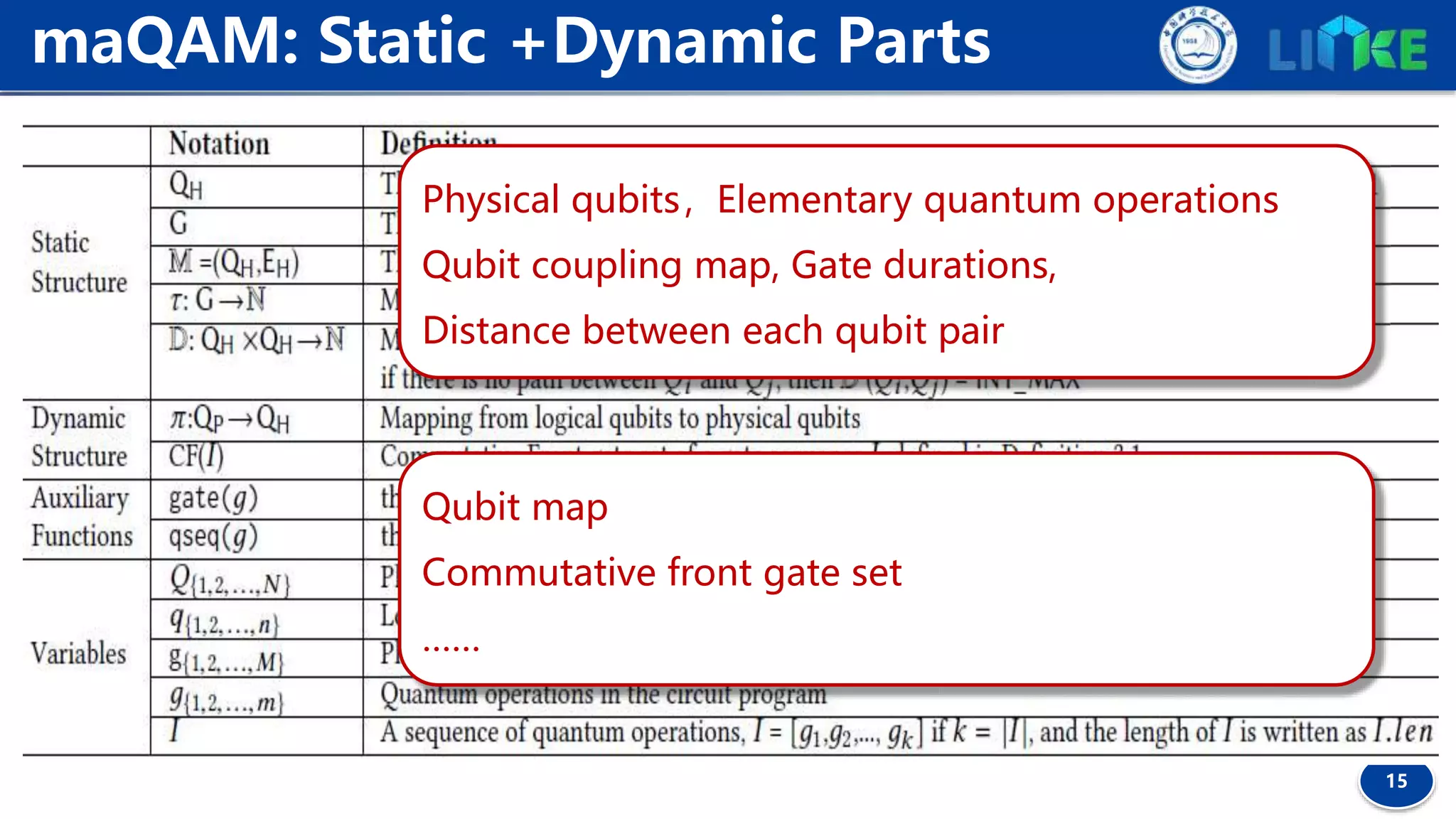
maQAM: Static +Dynamic Parts
Physical qubits,Elementary quantum operations
Qubit coupling map, Gate durations,
Distance between each qubit pair
Qubit map
Commutative front gate set
……
16
Key Design on the CODAR Algorithm
17
 Generate an executable gate sequence for a given input
OpenQASM program by
adjusting the gate sequence
inserting the swap operation
with the program semantics unchanged
Main Idea of CODAR
Fit quantum hardware limitation
Have better parallelism to reduce the weighted depth of the circuit
18
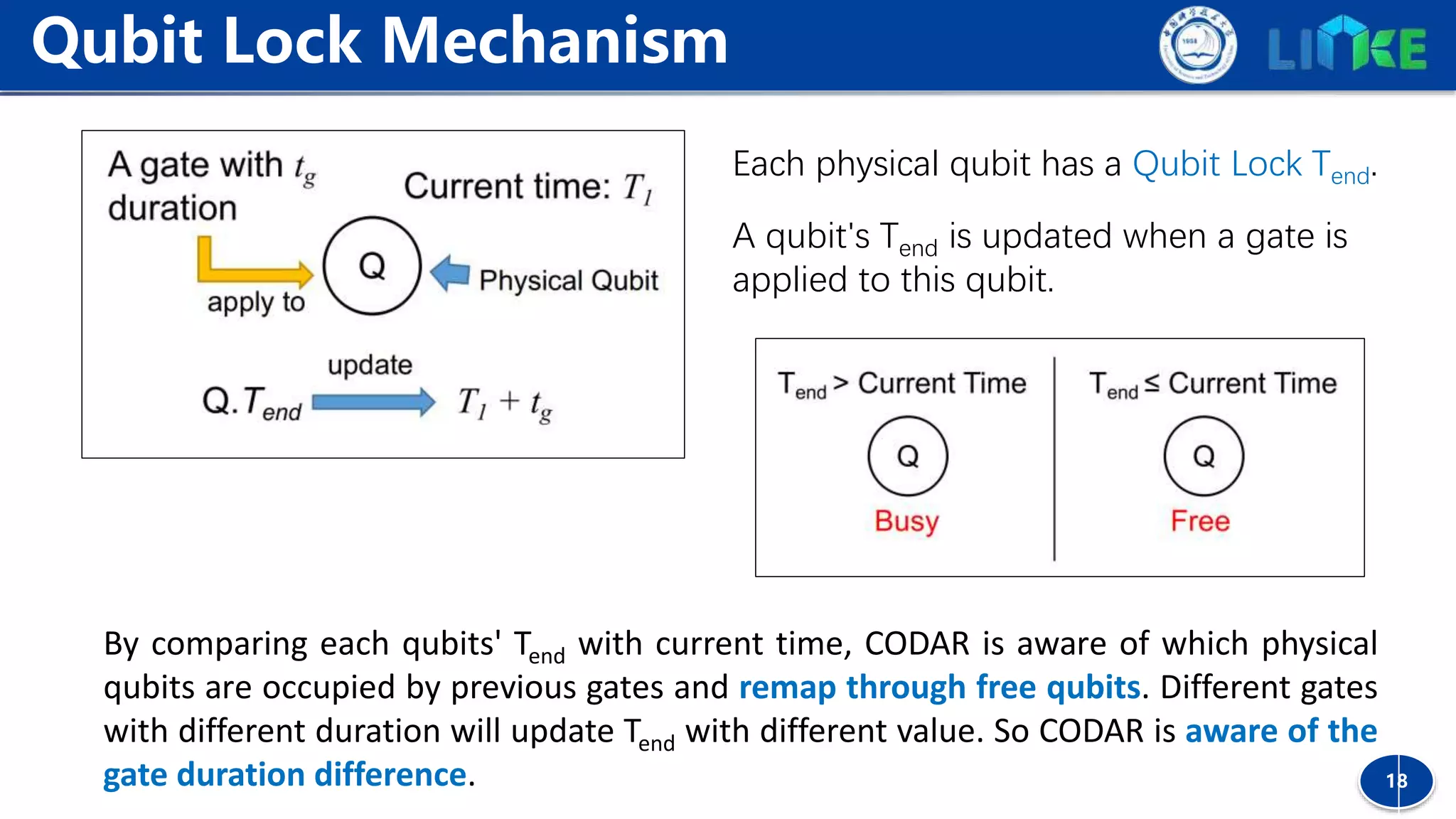
Qubit Lock Mechanism
Each physical qubit has a Qubit Lock Tend.
A qubit's Tend is updated when a gate is
applied to this qubit.
By comparing each qubits' Tend with current time, CODAR is aware of which physical
qubits are occupied by previous gates and remap through free qubits. Different gates
with different duration will update Tend with different value. So CODAR is aware of the
gate duration difference.
19
 Commutativity between gates gA , gB can be resolved by
checking the relevant unitary operators ΑB=BA.
Commutativity Detection
Definition 1 (Commutative Forward Gate, CF gate). Given a gate sequence I=[g1 , g2 , ..., gk , ...],
∀gk ∈ I, gk is a commutative forward gate iff ∀j, 0 < j < k, gj and gk are commutative.
Choosing CF gates as logically-executable gates can expose more future contextual gates
for the heuristic search to determine better remapping solutions.
20
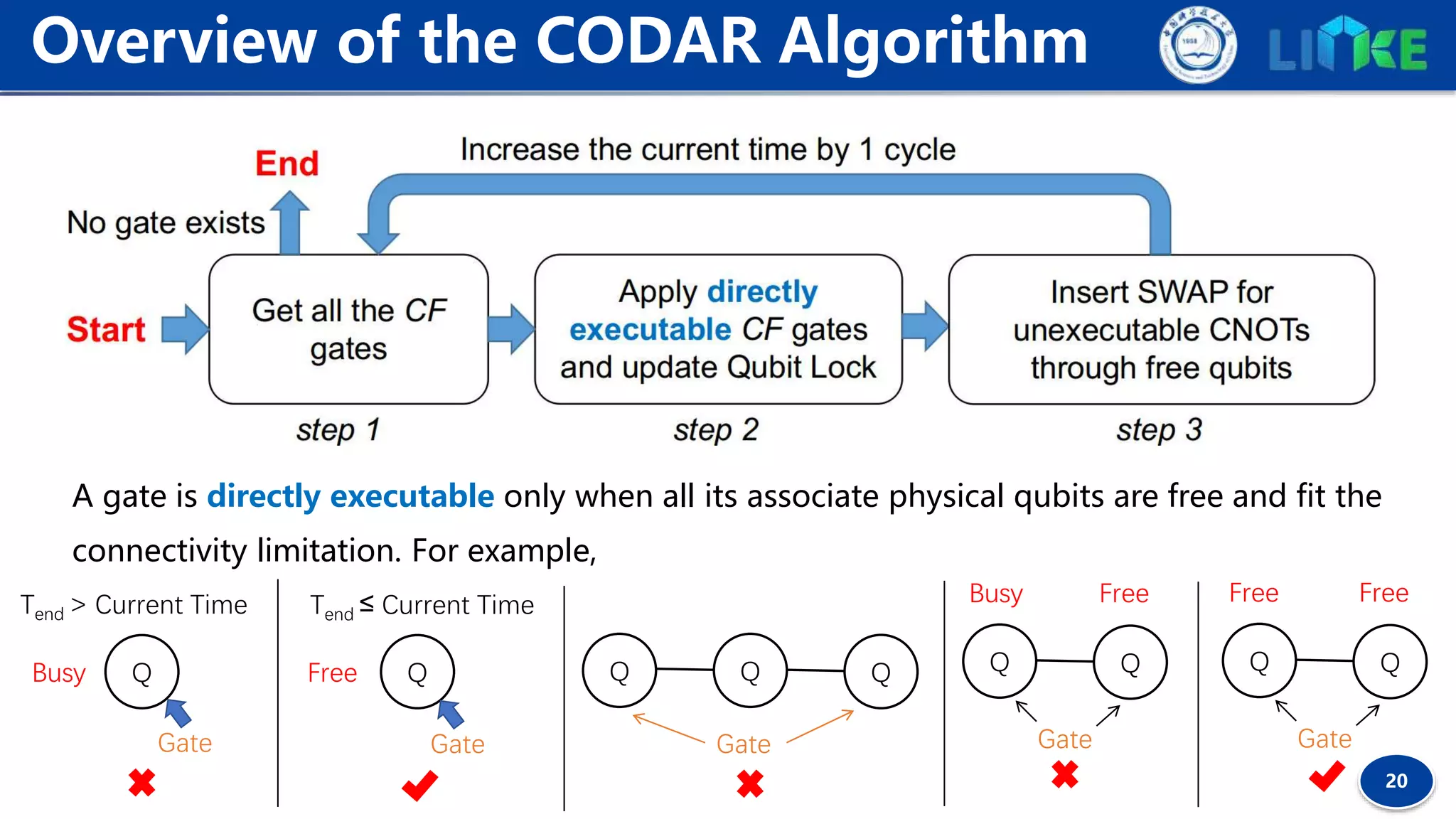
Overview of the CODAR Algorithm
A gate is directly executable only when all its associate physical qubits are free and fit the
connectivity limitation. For example,
Q
Tend > Current Time
Busy QFree
Tend ≤ Current Time
Gate Gate
QQ Q
Gate
QQ
Gate
Busy Free
QQ
Gate
Free Free
21
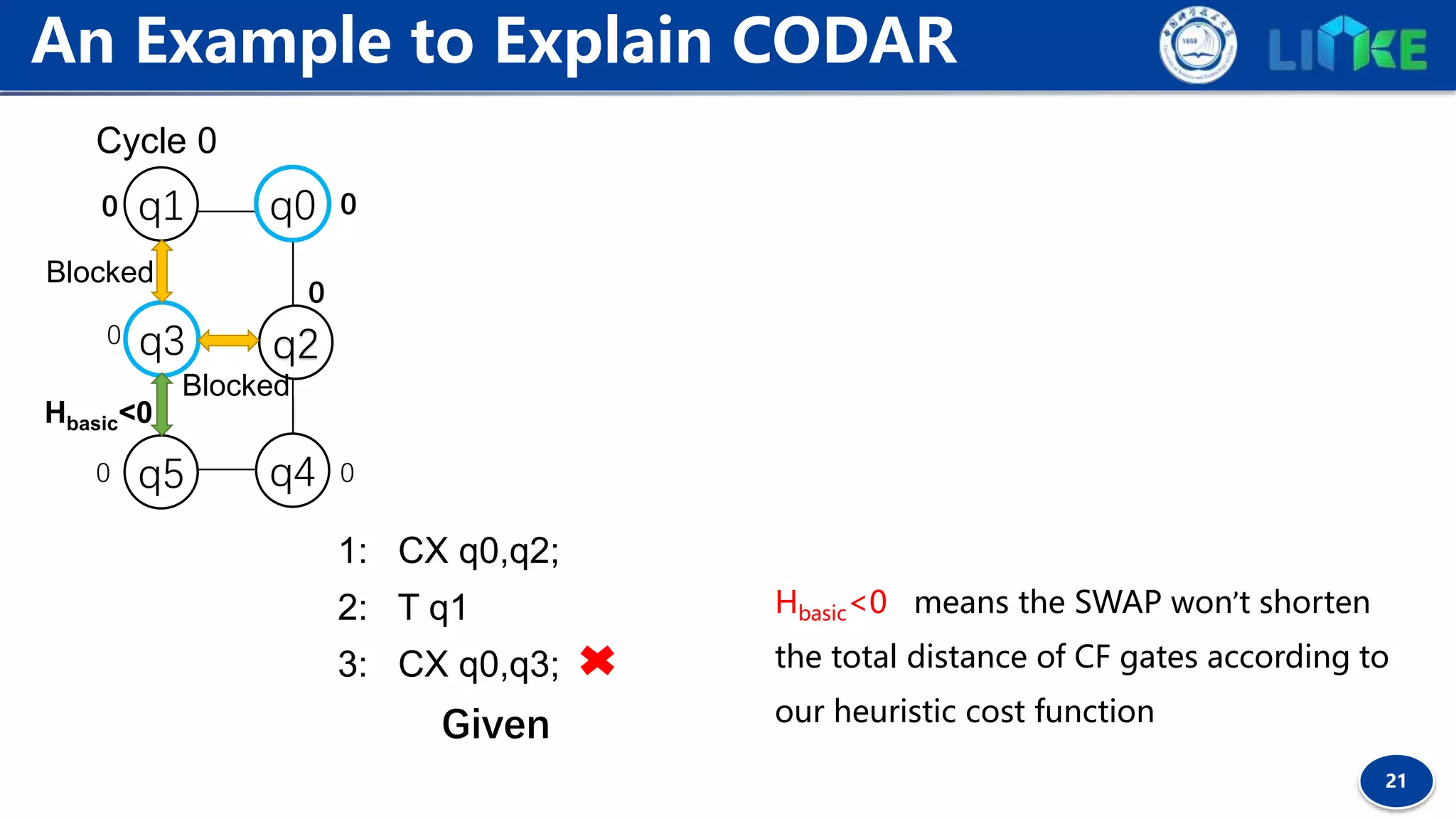
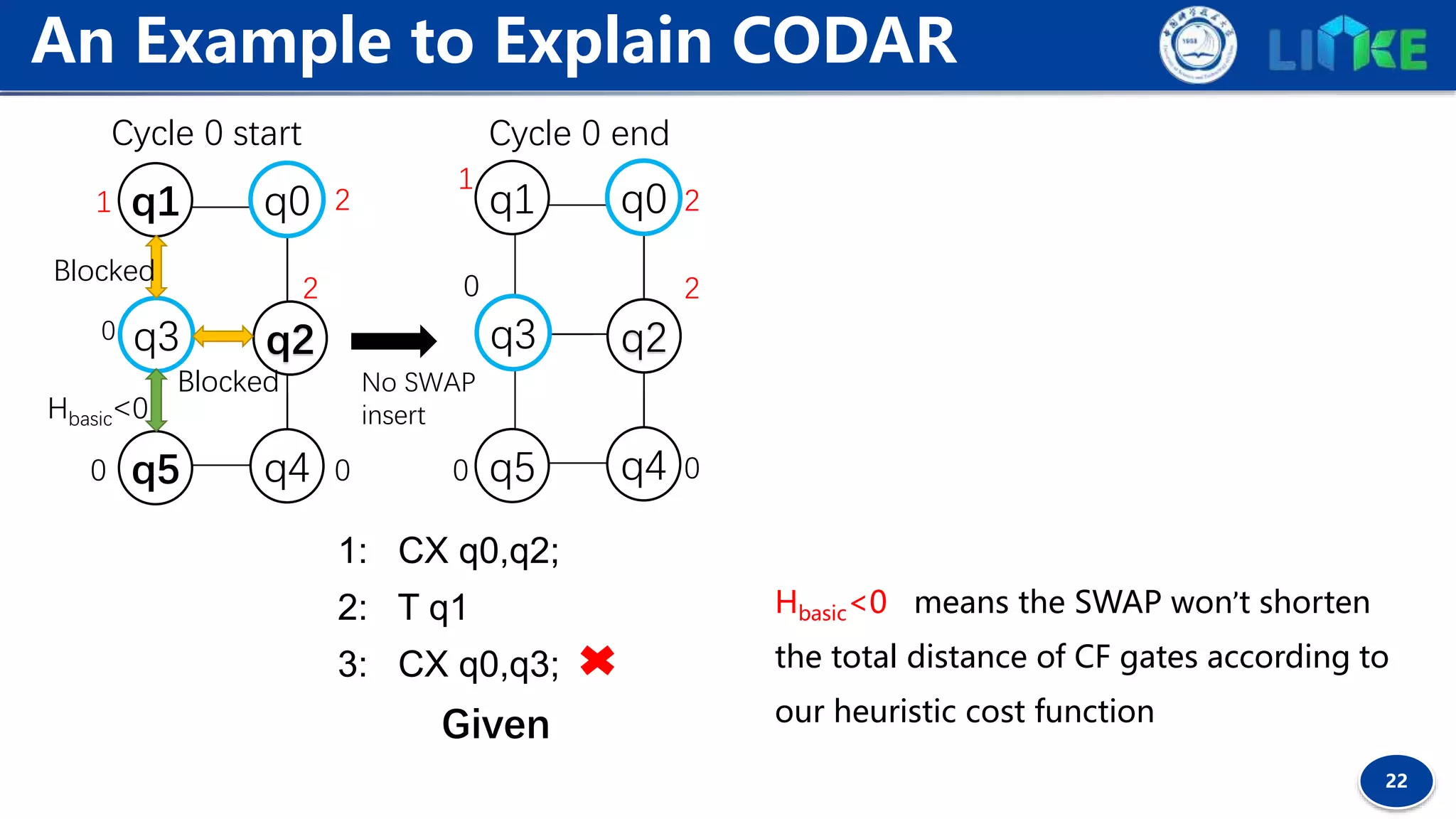
An Example to Explain CODAR
Hbasic<0
q5
q1
q2q3
q0
q4
0
0
0
00
0
Blocked
Blocked
Cycle 0
1: CX q0,q2;
2: T q1
3: CX q0,q3;
Given
Hbasic<0 means the SWAP won’t shorten
the total distance of CF gates according to
our heuristic cost function
22
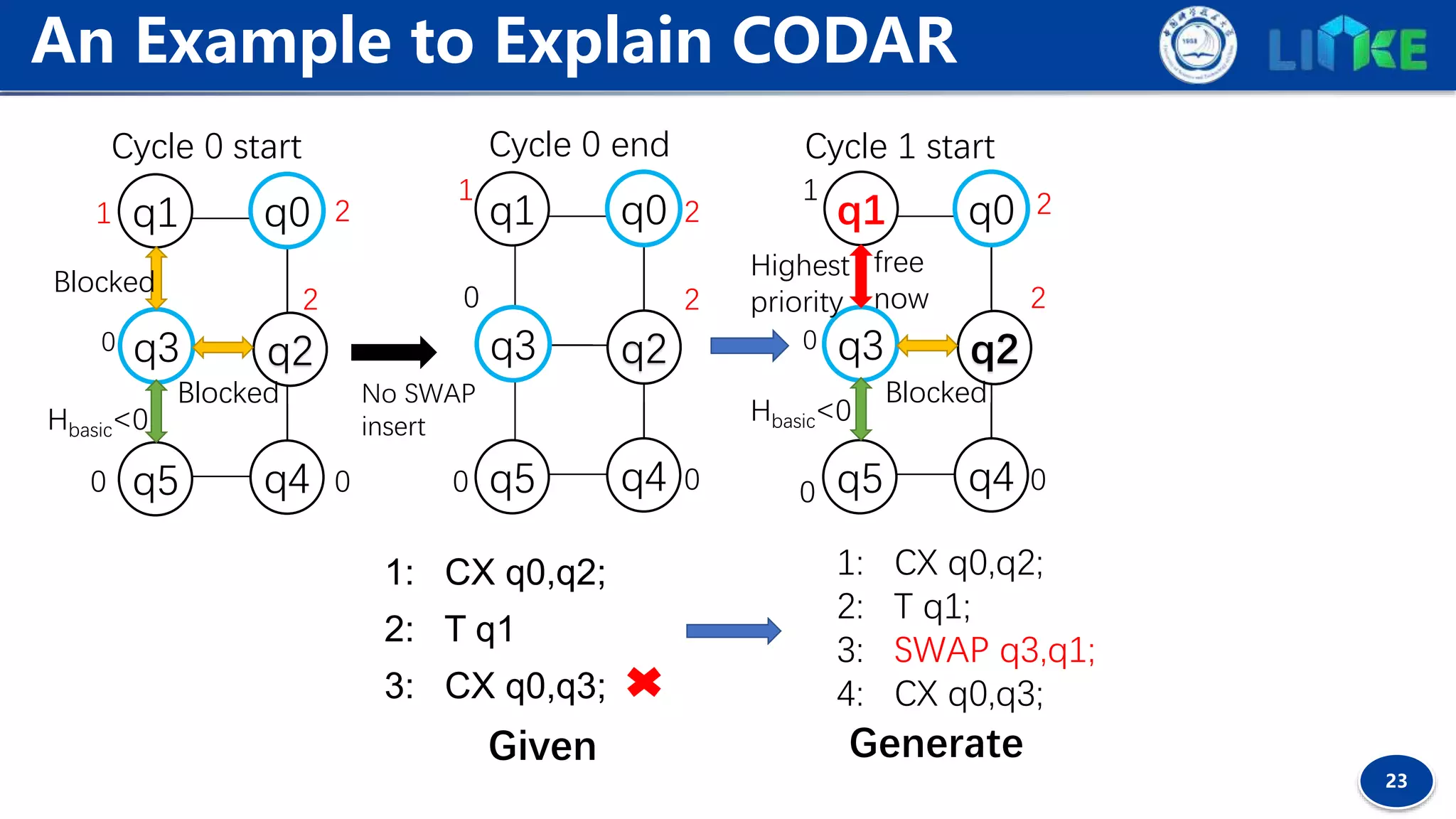
An Example to Explain CODAR
Hbasic<0 means the SWAP won’t shorten
the total distance of CF gates according to
our heuristic cost function
1: CX q0,q2;
2: T q1
3: CX q0,q3;
Given
q5
q1
q2q3
q0
q4
1
0 2
00
2
Hbasic<0
q5
q1
q2q3
q0
q4
1
0
2
00
2
No SWAP
insert
Blocked
Blocked
Cycle 0 endCycle 0 start
23
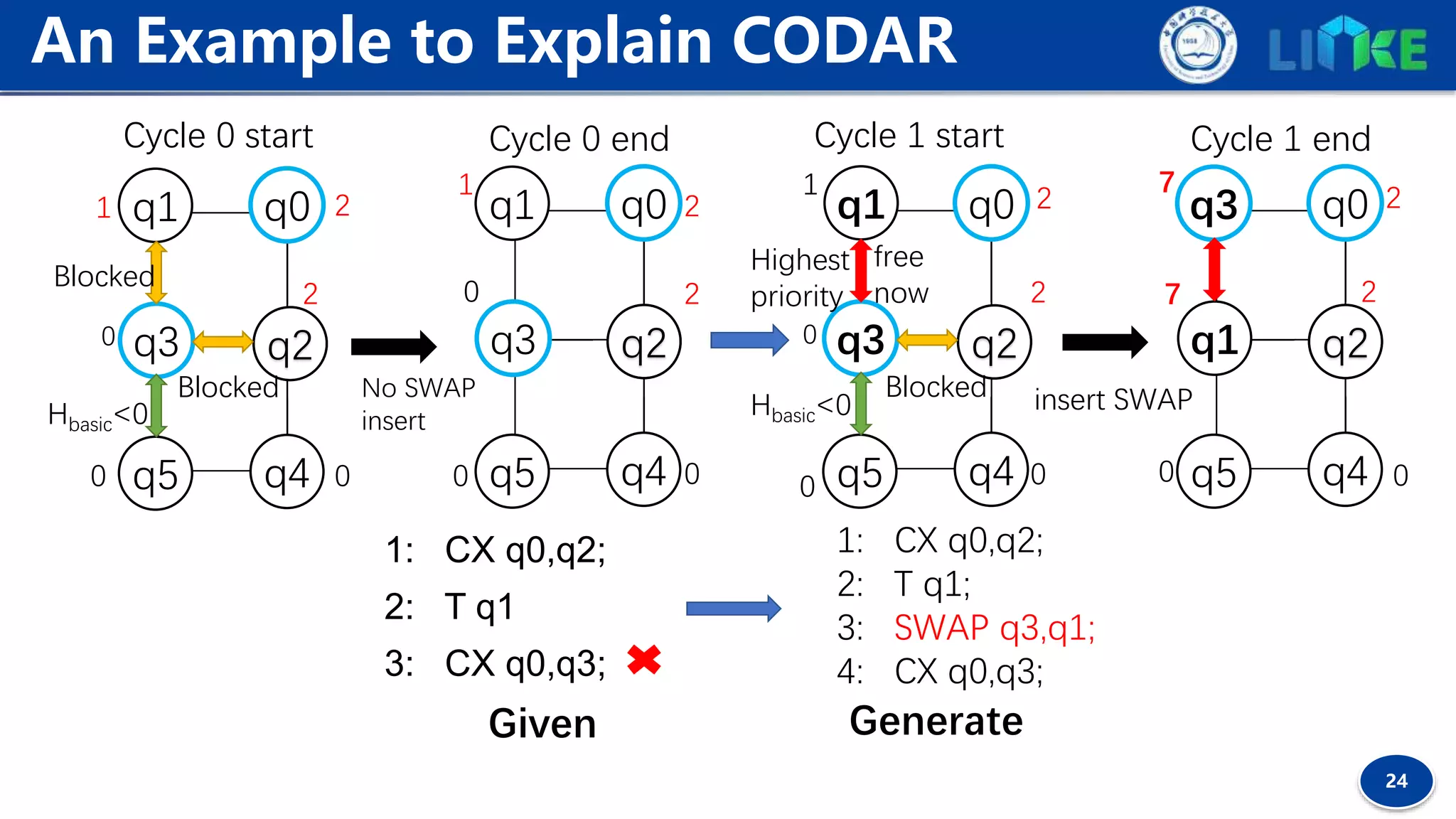
An Example to Explain CODAR
1: CX q0,q2;
2: T q1
3: CX q0,q3;
1: CX q0,q2;
2: T q1;
3: SWAP q3,q1;
4: CX q0,q3;
Given Generate
q5
q1
q2q3
q0
q4
1
0 2
00
2
q5
q1
q3
q0
q4
1
0
2
00
2
Highest
priority
Hbasic<0
q5
q1
q2q3
q0
q4
1
0
2
00
2
No SWAP
insert
Blocked
Blocked
Hbasic<0
q2
Blocked
free
now
Cycle 0 end Cycle 1 startCycle 0 start
24
An Example to Explain CODAR
q5
q1
q2q3
q0
q4
1
0 2
00
2
q5
q1
q3
q0
q4
1
0
2
00
2
Highest
priority
Hbasic<0
q5
q1
q2q3
q0
q4
1
0
2
00
2
No SWAP
insert
Blocked
Blocked
Hbasic<0
q2
Blocked
free
now
q5
q3
q2q1
q0
q4
7
7 2
0
2
insert SWAP
0
Cycle 0 end Cycle 1 startCycle 0 start Cycle 1 end
1: CX q0,q2;
2: T q1
3: CX q0,q3;
1: CX q0,q2;
2: T q1;
3: SWAP q3,q1;
4: CX q0,q3;
Given Generate
25
Evaluation and Conclution
26
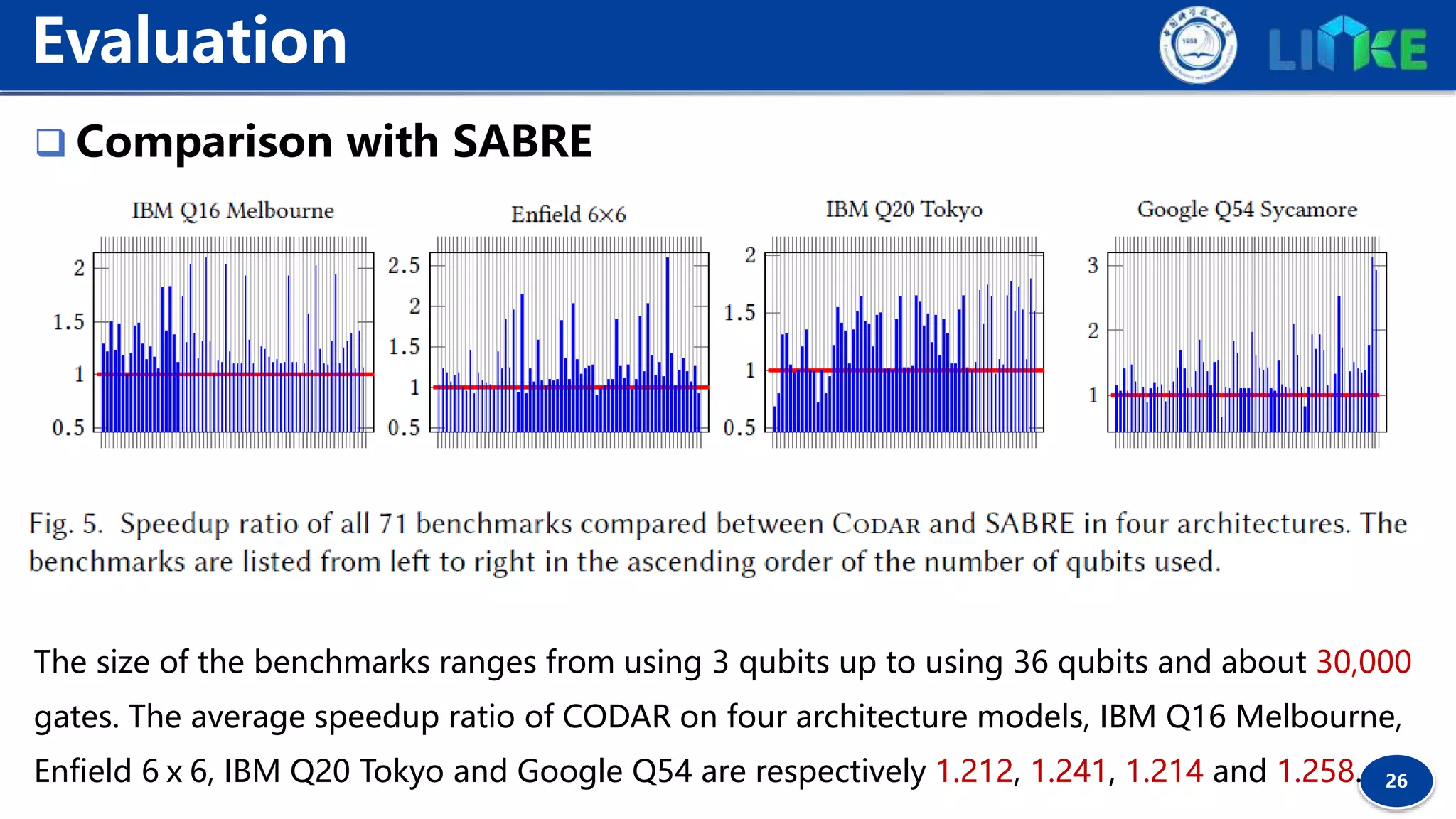
 Comparison with SABRE
Evaluation
The size of the benchmarks ranges from using 3 qubits up to using 36 qubits and about 30,000
gates. The average speedup ratio of CODAR on four architecture models, IBM Q16 Melbourne,
Enfield 6ⅹ6, IBM Q20 Tokyo and Google Q54 are respectively 1.212, 1.241, 1.214 and 1.258.
27
 Conclusion
The design of qubit lock and commutativity detection make CODAR aware
of program context and the gate duration difference, helping CODAR find
the remapping with good parallelism and reduce QC’s weighted depth
 Ongoing and Future Work
The impact of noise: noise of a gate cannot be accumulated sometimes
Are there any noise effect patterns?
The impact of sub-circuit patterns in high-level algorithms
Conclusion and Ongoing Work
28
Yu Zhang (张昱)
yuzhang@ustc.edu.cn
CS@USTC
Thank you and any question?

Planqc2020 codar

  • 1.
    1 COntext-Sensitive and Duration-Aware QubitMapping for Various NISQ Devices Yu Zhang Hao-wei Deng Quan-xi Li School of Computer Science & Technology University of Science & Technology of China PLanQC 2020, New Orleans, Jan. 19, 2020
  • 2.
    2 Quantum Algorithms QC: Multidisciplinary Intersection Quantum Algorithms Quantum Algorithms KeyPotential Applications Chemistry Optimization Machine Learning Material Science Unknown Problems gartner.com/smarterwithgartner 100-200 qubits 100s-1000s qubits 100s-1000s qubits 100s-1000s qubits 100, 000+ qubits Algorithm slgorithms Quantum Devices Trapped Ion Quantum Information, UMD Full software stack for QC Program at higher-levels of abstraction Consider various constraints of quantum devices Google’s Sycamore (54-Qubit) Quantum Supremacy Using a Programmable Superconducting Processor Oct 23 2019 Nature Sep 18, 2019 The opening of the first IBM Quantum Computation Center in Poughkeepsie, NY  Q53 Rochester Intel’s 49-Qubit Chip Tangle Lake Jan 9 2018 May 5, 2018
  • 3.
    3 Most Existing QPSystems Low-level quantum circuit qreg q[3]; h q[0]; h q[1]; CX q[1], q[2]; CX q[0], q[2]; H q; OpenQASM Host language + Embedded DSL High-level Quantum Compilation ProjectQ Low-level quantum circuit Low-level Quantum Compilation Hardware instructions (Pulse)
  • 4.
    4 Quantum Chips  Superconducting IonQ (Trapped ions) IBM QX4 Tenerife IBM Q20 IBM Q16 Melbourne IonQ Q5 IonQ Q11 IBM Q53 Rochester Google Q54 Sycamore Quantum chips have various qubit coupling maps.
  • 5.
    5 Qubit Mapping Problem CNOT SWAP①CNOT② Compiler need to insert SWAP into the quantum circuit to fit the connection limitation in NISQ hardware. qreg q[3]; h q[0]; h q[1]; CX q[1], q[2]; CX q[0], q[2]; H q; OpenQASM NP-Complete [CGO2018] Marcos Yukio Siraichi et al. Qubit Allocation.
  • 6.
    6  Superconducting X, Y,Z, H, S, T CNOT Gate duration  1-qubit: 80ns  2-qubit: ~170ns  Ion Trap Ra q , XX Gate duration  1-qubit: 20ms  2-qubit: ~250ms Various Quantum System Features
  • 7.
    7 How to insertSWAPs  obtain feasible quantum circuits for various NISQ devices
  • 8.
    8  Formulate thequbit mapping problem into an equivalent mathematical problem and apply a (SMT) Solver, e.g. Unscalable, can only be applied to small-size cases  Use heuristic search to obtain approximate results Better in runtime especially when the circuit is in a large scale Previous Solutions  Ignore gate/operation duration difference  Rarely consider the impact of program context on parallelism
  • 9.
    9  Propose aQuantum Abstract Machine to abstract the characteristics of different NISQ architectures QAM here is distinct from that in the literature [arxiv1608.03355], which refers to an abstract machine architecture for classical/quantum computations  Propose a heuristic search algorithm CODAR considering Gate duration difference Program context to explore more parallelism of the quantum program Our Main Idea [arxiv1608.03355] Robert S. Smith, Michael J. Curtis, William J. Zeng. A Practical Quantum Instruction Set Architecture. Feb 2017. CODAR: COntext-sensitive and Duration-Aware Remapping algorithm
  • 10.
    10 Which qubit pairis chosen to swap? The earlier it can start, the better Motivating Examples
  • 11.
    11 Which qubit pairis chosen to swap? The earlier it can start, the better  Impact of Program Context Motivating Examples cost 9 cycles cost 8 cycles Cycle
  • 12.
    12 Which qubit pairis chosen to swap? The earlier it can start, the better  Impact of Gate Duration Difference Motivating Examples cost 10 cycles cost 9 cycles
  • 13.
  • 14.
  • 15.
    15 maQAM: Static +DynamicParts Physical qubits,Elementary quantum operations Qubit coupling map, Gate durations, Distance between each qubit pair Qubit map Commutative front gate set ……
  • 16.
    16 Key Design onthe CODAR Algorithm
  • 17.
    17  Generate anexecutable gate sequence for a given input OpenQASM program by adjusting the gate sequence inserting the swap operation with the program semantics unchanged Main Idea of CODAR Fit quantum hardware limitation Have better parallelism to reduce the weighted depth of the circuit
  • 18.
    18 Qubit Lock Mechanism Eachphysical qubit has a Qubit Lock Tend. A qubit's Tend is updated when a gate is applied to this qubit. By comparing each qubits' Tend with current time, CODAR is aware of which physical qubits are occupied by previous gates and remap through free qubits. Different gates with different duration will update Tend with different value. So CODAR is aware of the gate duration difference.
  • 19.
    19  Commutativity betweengates gA , gB can be resolved by checking the relevant unitary operators ΑB=BA. Commutativity Detection Definition 1 (Commutative Forward Gate, CF gate). Given a gate sequence I=[g1 , g2 , ..., gk , ...], ∀gk ∈ I, gk is a commutative forward gate iff ∀j, 0 < j < k, gj and gk are commutative. Choosing CF gates as logically-executable gates can expose more future contextual gates for the heuristic search to determine better remapping solutions.
  • 20.
    20 Overview of theCODAR Algorithm A gate is directly executable only when all its associate physical qubits are free and fit the connectivity limitation. For example, Q Tend > Current Time Busy QFree Tend ≤ Current Time Gate Gate QQ Q Gate QQ Gate Busy Free QQ Gate Free Free
  • 21.
    21 An Example toExplain CODAR Hbasic<0 q5 q1 q2q3 q0 q4 0 0 0 00 0 Blocked Blocked Cycle 0 1: CX q0,q2; 2: T q1 3: CX q0,q3; Given Hbasic<0 means the SWAP won’t shorten the total distance of CF gates according to our heuristic cost function
  • 22.
    22 An Example toExplain CODAR Hbasic<0 means the SWAP won’t shorten the total distance of CF gates according to our heuristic cost function 1: CX q0,q2; 2: T q1 3: CX q0,q3; Given q5 q1 q2q3 q0 q4 1 0 2 00 2 Hbasic<0 q5 q1 q2q3 q0 q4 1 0 2 00 2 No SWAP insert Blocked Blocked Cycle 0 endCycle 0 start
  • 23.
    23 An Example toExplain CODAR 1: CX q0,q2; 2: T q1 3: CX q0,q3; 1: CX q0,q2; 2: T q1; 3: SWAP q3,q1; 4: CX q0,q3; Given Generate q5 q1 q2q3 q0 q4 1 0 2 00 2 q5 q1 q3 q0 q4 1 0 2 00 2 Highest priority Hbasic<0 q5 q1 q2q3 q0 q4 1 0 2 00 2 No SWAP insert Blocked Blocked Hbasic<0 q2 Blocked free now Cycle 0 end Cycle 1 startCycle 0 start
  • 24.
    24 An Example toExplain CODAR q5 q1 q2q3 q0 q4 1 0 2 00 2 q5 q1 q3 q0 q4 1 0 2 00 2 Highest priority Hbasic<0 q5 q1 q2q3 q0 q4 1 0 2 00 2 No SWAP insert Blocked Blocked Hbasic<0 q2 Blocked free now q5 q3 q2q1 q0 q4 7 7 2 0 2 insert SWAP 0 Cycle 0 end Cycle 1 startCycle 0 start Cycle 1 end 1: CX q0,q2; 2: T q1 3: CX q0,q3; 1: CX q0,q2; 2: T q1; 3: SWAP q3,q1; 4: CX q0,q3; Given Generate
  • 25.
  • 26.
    26  Comparison withSABRE Evaluation The size of the benchmarks ranges from using 3 qubits up to using 36 qubits and about 30,000 gates. The average speedup ratio of CODAR on four architecture models, IBM Q16 Melbourne, Enfield 6ⅹ6, IBM Q20 Tokyo and Google Q54 are respectively 1.212, 1.241, 1.214 and 1.258.
  • 27.
    27  Conclusion The designof qubit lock and commutativity detection make CODAR aware of program context and the gate duration difference, helping CODAR find the remapping with good parallelism and reduce QC’s weighted depth  Ongoing and Future Work The impact of noise: noise of a gate cannot be accumulated sometimes Are there any noise effect patterns? The impact of sub-circuit patterns in high-level algorithms Conclusion and Ongoing Work
  • 28.