Predictive Quantization of
Dechirped Spotlight-Mode SAR Raw Data in
Transform Domain

Takeshi Ikuma, Mort Naraghi-Pour*
Department of Electrical and Computer Engineering
Louisiana State University
Baton Rouge, LA


Thomas Lewis
Air Force Research Laboratory
Dayton, OH
2

Presentation Outline

   Circular spotlight-mode SAR, Motivation

   Previous work

   Autoregressive modeling of IDFT transformed SAR data

   Predictive encoding
       Block predictive quantization: scalar, vector

       Predictive trellis coded quantization

   Numerical results

   Conclusions
3

Circular Spotlight-Mode SAR

   We are interested in circular spotlight-mode SAR
   Radar periodically emits a linear FM chirp pulse and receives,
    dechirps, and samples the reflected pulses
   A large volume of data is generated that must be downlinked
    for processing and archiving
   Downlink channel has limited bandwidth                z
   Need on-board compression
                                         q: azimuth angle
    of SAR RAW* data                                      q

* Not SAR Image Compression

                                                                 y

                                                     x
4

Previous Work

   Block Adaptive Quantization (BAQ)
       Simple scalar quantizer, adapted to the signal power
       Implemented in exiting systems
           NASA Magellan Mission
           NASA Shuttle Imaging Radar Mission C


   More Effective Method?
       Samples of both I and Q channels of SAR raw data are
        largely uncorrelated
       However, SAR image exhibits some correlation
       Transformed data may exhibit some correlation
5

Previous Work, cont’d
Paper           Method      Pre-Proc.         Quantize     Post-Proc.
                                              r
Kwon (1989)     BAQ         Normalization     SQ
Arnold (1988)   CCT                           VQ
Franceschetti   SC-SAR                        1-bit SQ
(1991)
Benz (1995)     FFT-BAQ     Normalization &   SQ w/bit
                            2-D FFT           allocation
Bolle (1997)                R & AZ comp DCT   SQ           Huffman
Owens (1999)    TCVQ        Trellis coding    VQ
Baxter (1999)   Gabor/TCQ   Gabor trans.      VQ           Huffman
                            Trellis coding
Poggi (2000)                Range             VQ
                            compression
Magli (2003)    NPAQ        LPC               SQ           Arithmetic
6

Spotlight CSAR Data
   CSAR data samples are uncorrelated
   Zero-mean Gaussian distributed
   Signal power varies slowly over time

Example: AFRL Gotcha data set (about 42,000 returns from full 360°)
      Magnitude of Raw Data           Formed SAR Image (CBP, 512 returns)
7

Transformed Data
   If there are strong reflectors in the scene, range-wise IDFT of
    CSAR data exhibits correlation along azimuth.
   Isotropic reflectors appear as sinusoidal traces in the
    transformed data. Anisotropic reflectors appear as partial
    sinusoidal traces.
                                     IDFT of SAR data
                  High magnitude sinusoidal trace from metallic cylinder object
8

Transformed Data, cont’d
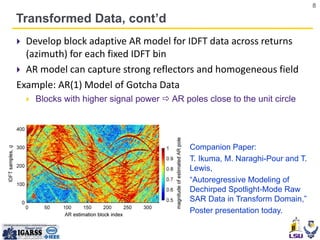
 Develop block adaptive AR model for IDFT data across returns
  (azimuth) for each fixed IDFT bin
 AR model can capture strong reflectors and homogeneous field
Example: AR(1) Model of Gotcha Data
       Blocks with higher signal power  AR poles close to the unit circle


                                               Companion Paper:
                                               T. Ikuma, M. Naraghi-Pour and T.
                                               Lewis,
                                               “Autoregressive Modeling of
                                               Dechirped Spotlight-Mode Raw
                                               SAR Data in Transform Domain,”
                                               Poster presentation today.
9

    Block Predictive Coding

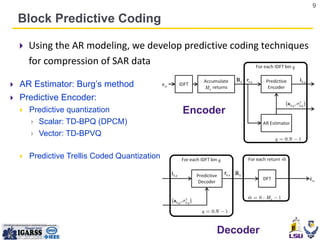
       Using the AR modeling, we develop predictive coding techniques
        for compression of SAR data

   AR Estimator: Burg’s method
   Predictive Encoder:
       Predictive quantization                 Encoder
         Scalar: TD-BPQ (DPCM)
         Vector: TD-BPVQ


       Predictive Trellis Coded Quantization


                                                     Decoder
10

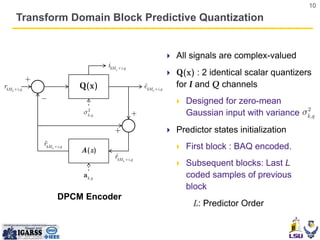
       Transform Domain Block Predictive Quantization


                                                                           All signals are complex-valued
                                     ikMv   i ,q
                                                                           Q(x) : 2 identical scalar quantizers
rkMb   i ,q                 Q(x)                          ˆ
                                                          ekMb   i ,q
                                                                            for I and Q channels
                                                                               Designed for zero-mean
                              2                                                                                2
                              k ,q                                              Gaussian input with variance   k ,q

                                                                           Predictor states initialization
              rkMb   i ,q                                                      First block : BAQ encoded.
                            A(z)
                                       ˆ
                                       rkMb        i ,q
                                                                               Subsequent blocks: Last L
                            a k ,q                                              coded samples of previous
                                                                                block
                     DPCM Encoder
                                                                                 L: Predictor Order
11

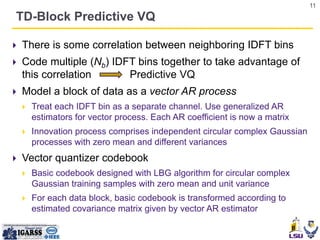
TD-Block Predictive VQ

   There is some correlation between neighboring IDFT bins
   Code multiple (Nb) IDFT bins together to take advantage of
    this correlation      Predictive VQ
   Model a block of data as a vector AR process
       Treat each IDFT bin as a separate channel. Use generalized AR
        estimators for vector process. Each AR coefficient is now a matrix
       Innovation process comprises independent circular complex Gaussian
        processes with zero mean and different variances
   Vector quantizer codebook
       Basic codebook designed with LBG algorithm for circular complex
        Gaussian training samples with zero mean and unit variance
       For each data block, basic codebook is transformed according to
        estimated covariance matrix given by vector AR estimator
12

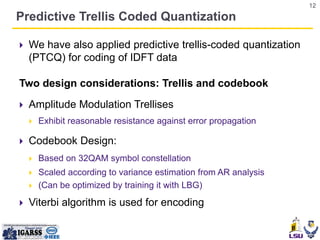
Predictive Trellis Coded Quantization

   We have also applied predictive trellis-coded quantization
    (PTCQ) for coding of IDFT data

Two design considerations: Trellis and codebook
   Amplitude Modulation Trellises
       Exhibit reasonable resistance against error propagation

   Codebook Design:
       Based on 32QAM symbol constellation
       Scaled according to variance estimation from AR analysis
       (Can be optimized by training it with LBG)
   Viterbi algorithm is used for encoding
13

Example: 2-Bit/S PTCQ Configuration

 Codebook Structure                        Trellis Structure

                                      B0    0
                                                         0
32QAM                                                     1
                                                           2 3
                                      B1    1
                                                                3
                                                              0
                                                              1 2

                                      B0    2                3
                                                                  2

                                                             0
              TCQ set partitioning                                1
                                                                  1
                                      B1    3
                                                             2
                                                             3
                                                                  0
                                                               0
                                 B0   B0    4
                                                             1
                                                             2
                                                                3
                                                                  3
   D0    D2        D4       D6        B1    5                1
                                                              0

                                                                  2
                                                                  2
                                                             3
                                      B0    6
                                                             0
                                 B1                             1
                                                             2 1
   D1    D3        D5       D7        B1                     3
                                                               0
                                            7
14

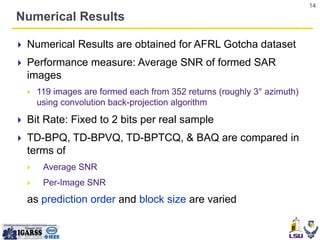
Numerical Results

   Numerical Results are obtained for AFRL Gotcha dataset
   Performance measure: Average SNR of formed SAR
    images
       119 images are formed each from 352 returns (roughly 3° azimuth)
        using convolution back-projection algorithm
   Bit Rate: Fixed to 2 bits per real sample
   TD-BPQ, TD-BPVQ, TD-BPTCQ, & BAQ are compared in
    terms of
        Average SNR
        Per-Image SNR
    as prediction order and block size are varied
15

TD-BPQ: SNR vs. Predictor Order

                                                 M = 256


   SNR improves by 2.5 dB by introducing prediction
   (from L = 0 to L = 1)
16

TD-BPQ: SNR vs. Block Size

                 Prediction order L = 4


        Reasons for SNR loss:
          Mb small – poor AR estimates
          Mb large – data non-stationary
17

Performance Results
L = 4, M = 256, TD-BPVQ: 2 IDFT bins together


       1 dB        1.5 dB
                                                              BAQ
                                                              TD-BPQ

                         5 dB                                 TD-BPVQ
                                                              TD-BPTCQ


SNR for each of the three schemes experiences fluctuations across
images due to the anisotropic nature of the scene
18

Formed SAR Image Comparison

                BAQ           TD-BPVQ
                   9.7 dB          14.4dB

  Original


               TD-BPQ         TD-BPTCQ
                  13.5 dB         14.9 dB
19

Conclusions

   Significant correlation is observed in IDFT of dechirped
    CSAR data
   Three predictive encoding algorithms are applied to
    transformed data:
       TD-BPQ: Scalar DPCM coding in IDFT domain
       TD-BPVQ: Vector predictive coding in IDFT domain
       TD-PTCQ: Predictive Trellis Coded Quantization

   The predictive quantization can provide up to 6 dB
    improvement in average SNR

                          Any Questions?

FR1.L09 - PREDICTIVE QUANTIZATION OF DECHIRPED SPOTLIGHT-MODE SAR RAW DATA IN TRANSFORM DOMAIN

  • 1.
    Predictive Quantization of DechirpedSpotlight-Mode SAR Raw Data in Transform Domain Takeshi Ikuma, Mort Naraghi-Pour* Department of Electrical and Computer Engineering Louisiana State University Baton Rouge, LA Thomas Lewis Air Force Research Laboratory Dayton, OH
  • 2.
    2 Presentation Outline  Circular spotlight-mode SAR, Motivation  Previous work  Autoregressive modeling of IDFT transformed SAR data  Predictive encoding  Block predictive quantization: scalar, vector  Predictive trellis coded quantization  Numerical results  Conclusions
  • 3.
    3 Circular Spotlight-Mode SAR  We are interested in circular spotlight-mode SAR  Radar periodically emits a linear FM chirp pulse and receives, dechirps, and samples the reflected pulses  A large volume of data is generated that must be downlinked for processing and archiving  Downlink channel has limited bandwidth z  Need on-board compression q: azimuth angle of SAR RAW* data q * Not SAR Image Compression y x
  • 4.
    4 Previous Work  Block Adaptive Quantization (BAQ)  Simple scalar quantizer, adapted to the signal power  Implemented in exiting systems  NASA Magellan Mission  NASA Shuttle Imaging Radar Mission C  More Effective Method?  Samples of both I and Q channels of SAR raw data are largely uncorrelated  However, SAR image exhibits some correlation  Transformed data may exhibit some correlation
  • 5.
    5 Previous Work, cont’d Paper Method Pre-Proc. Quantize Post-Proc. r Kwon (1989) BAQ Normalization SQ Arnold (1988) CCT VQ Franceschetti SC-SAR 1-bit SQ (1991) Benz (1995) FFT-BAQ Normalization & SQ w/bit 2-D FFT allocation Bolle (1997) R & AZ comp DCT SQ Huffman Owens (1999) TCVQ Trellis coding VQ Baxter (1999) Gabor/TCQ Gabor trans. VQ Huffman Trellis coding Poggi (2000) Range VQ compression Magli (2003) NPAQ LPC SQ Arithmetic
  • 6.
    6 Spotlight CSAR Data  CSAR data samples are uncorrelated  Zero-mean Gaussian distributed  Signal power varies slowly over time Example: AFRL Gotcha data set (about 42,000 returns from full 360°) Magnitude of Raw Data Formed SAR Image (CBP, 512 returns)
  • 7.
    7 Transformed Data  If there are strong reflectors in the scene, range-wise IDFT of CSAR data exhibits correlation along azimuth.  Isotropic reflectors appear as sinusoidal traces in the transformed data. Anisotropic reflectors appear as partial sinusoidal traces. IDFT of SAR data High magnitude sinusoidal trace from metallic cylinder object
  • 8.
    8 Transformed Data, cont’d Develop block adaptive AR model for IDFT data across returns (azimuth) for each fixed IDFT bin  AR model can capture strong reflectors and homogeneous field Example: AR(1) Model of Gotcha Data  Blocks with higher signal power  AR poles close to the unit circle Companion Paper: T. Ikuma, M. Naraghi-Pour and T. Lewis, “Autoregressive Modeling of Dechirped Spotlight-Mode Raw SAR Data in Transform Domain,” Poster presentation today.
  • 9.
    9 Block Predictive Coding  Using the AR modeling, we develop predictive coding techniques for compression of SAR data  AR Estimator: Burg’s method  Predictive Encoder:  Predictive quantization Encoder  Scalar: TD-BPQ (DPCM)  Vector: TD-BPVQ  Predictive Trellis Coded Quantization Decoder
  • 10.
    10 Transform Domain Block Predictive Quantization  All signals are complex-valued ikMv i ,q  Q(x) : 2 identical scalar quantizers rkMb i ,q Q(x) ˆ ekMb i ,q for I and Q channels  Designed for zero-mean 2 2 k ,q Gaussian input with variance k ,q  Predictor states initialization rkMb i ,q  First block : BAQ encoded. A(z) ˆ rkMb i ,q  Subsequent blocks: Last L a k ,q coded samples of previous block DPCM Encoder L: Predictor Order
  • 11.
    11 TD-Block Predictive VQ  There is some correlation between neighboring IDFT bins  Code multiple (Nb) IDFT bins together to take advantage of this correlation Predictive VQ  Model a block of data as a vector AR process  Treat each IDFT bin as a separate channel. Use generalized AR estimators for vector process. Each AR coefficient is now a matrix  Innovation process comprises independent circular complex Gaussian processes with zero mean and different variances  Vector quantizer codebook  Basic codebook designed with LBG algorithm for circular complex Gaussian training samples with zero mean and unit variance  For each data block, basic codebook is transformed according to estimated covariance matrix given by vector AR estimator
  • 12.
    12 Predictive Trellis CodedQuantization  We have also applied predictive trellis-coded quantization (PTCQ) for coding of IDFT data Two design considerations: Trellis and codebook  Amplitude Modulation Trellises  Exhibit reasonable resistance against error propagation  Codebook Design:  Based on 32QAM symbol constellation  Scaled according to variance estimation from AR analysis  (Can be optimized by training it with LBG)  Viterbi algorithm is used for encoding
  • 13.
    13 Example: 2-Bit/S PTCQConfiguration Codebook Structure Trellis Structure B0 0 0 32QAM 1 2 3 B1 1 3 0 1 2 B0 2 3 2 0 TCQ set partitioning 1 1 B1 3 2 3 0 0 B0 B0 4 1 2 3 3 D0 D2 D4 D6 B1 5 1 0 2 2 3 B0 6 0 B1 1 2 1 D1 D3 D5 D7 B1 3 0 7
  • 14.
    14 Numerical Results  Numerical Results are obtained for AFRL Gotcha dataset  Performance measure: Average SNR of formed SAR images  119 images are formed each from 352 returns (roughly 3° azimuth) using convolution back-projection algorithm  Bit Rate: Fixed to 2 bits per real sample  TD-BPQ, TD-BPVQ, TD-BPTCQ, & BAQ are compared in terms of  Average SNR  Per-Image SNR as prediction order and block size are varied
  • 15.
    15 TD-BPQ: SNR vs.Predictor Order M = 256 SNR improves by 2.5 dB by introducing prediction (from L = 0 to L = 1)
  • 16.
    16 TD-BPQ: SNR vs.Block Size Prediction order L = 4 Reasons for SNR loss: Mb small – poor AR estimates Mb large – data non-stationary
  • 17.
    17 Performance Results L =4, M = 256, TD-BPVQ: 2 IDFT bins together 1 dB 1.5 dB BAQ TD-BPQ 5 dB TD-BPVQ TD-BPTCQ SNR for each of the three schemes experiences fluctuations across images due to the anisotropic nature of the scene
  • 18.
    18 Formed SAR ImageComparison BAQ TD-BPVQ 9.7 dB 14.4dB Original TD-BPQ TD-BPTCQ 13.5 dB 14.9 dB
  • 19.
    19 Conclusions  Significant correlation is observed in IDFT of dechirped CSAR data  Three predictive encoding algorithms are applied to transformed data:  TD-BPQ: Scalar DPCM coding in IDFT domain  TD-BPVQ: Vector predictive coding in IDFT domain  TD-PTCQ: Predictive Trellis Coded Quantization  The predictive quantization can provide up to 6 dB improvement in average SNR Any Questions?