A Capability Maturity Framework
for Sustainable ICT

Brian Donnellan - Innovation Value Institute
Charles Sheridan – Intel Corporation
Edward Curry – Digital Enterprise Research Institute
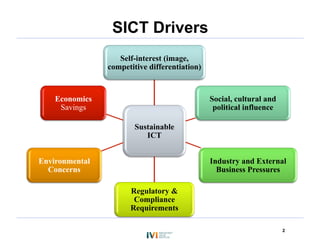
SICT Drivers
                   Self-interest (image,
                competitive differentiation)


    Economics                                  Social, cultural and
     Savings                                    political influence

                        Sustainable
                           ICT


Environmental                                  Industry and External
  Concerns                                       Business Pressures

                      Regulatory &
                       Compliance
                      Requirements

                                                                      2
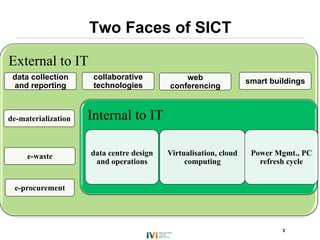
Two Faces of SICT

External to IT
 data collection      collaborative           web                 smart buildings
 and reporting        technologies        conferencing


de-materialization   Internal to IT

     e-waste         data centre design   Virtualisation, cloud    Power Mgmt., PC
                      and operations           computing             refresh cycle


 e-procurement


                                                                           3
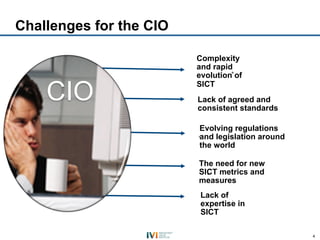
Challenges for the CIO

                         Complexity
                         and rapid
                         evolution of

    CIO
                         SICT
                         Lack of agreed and
                         consistent standards

                         Evolving regulations
                         and legislation around
                         the world

                         The need for new
                         SICT metrics and
                         measures
                          Lack of
                          expertise in
                          SICT

                                                  4
IVI formed to create IT capability maturity framework – creating new
approaches, leveraging existing standards and addressing "value" gap

                 Steering patrons


                                    www.ivi.ie
             IVI membership includes leading enterprises, consulting,
              not-for-profit, government and academic organisations.
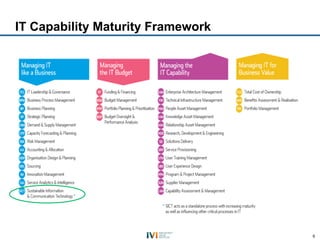
IT Capability Maturity Framework


                                   6
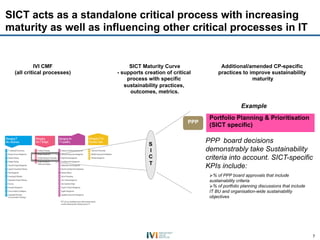
SICT acts as a standalone critical process with increasing
maturity as well as influencing other critical processes in IT


          IVI CMF                SICT Maturity Curve                 Additional/amended CP-specific
 (all critical processes)   - supports creation of critical         practices to improve sustainability
                                process with specific                             maturity
                               sustainability practices,
                                 outcomes, metrics.

                                                                                Example
                                                                Portfolio Planning & Prioritisation
                                                         PPP
                                                                (SICT specific)


                                         S
                                                               PPP board decisions
                                         I                     demonstrably take Sustainability
                                         C                     criteria into account. SICT-specific
                                         T
                                                               KPIs include:
                                                                Ø % of PPP board approvals that include
                                                                sustainability criteria
                                                                Ø % of portfolio planning discussions that include
                                                                IT BU and organisation-wide sustainability
                                                                objectives


                                                                                                                      7
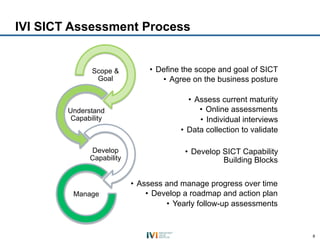
IVI SICT Assessment Process


               Scope &          •  Define the scope and goal of SICT
                Goal                •  Agree on the business posture

                                            •  Assess current maturity
        Understand                              •  Online assessments
         Capability                             •  Individual interviews
                                         •  Data collection to validate

              Develop                     •  Develop SICT Capability
              Capability                             Building Blocks

                           •  Assess and manage progress over time
         Manage                 •  Develop a roadmap and action plan
                                      •  Yearly follow-up assessments


                                                                           8
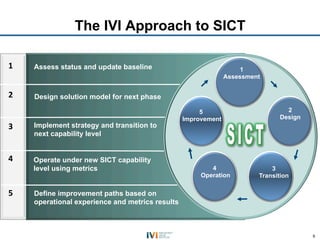
The IVI Approach to SICT

1	
     Assess status and update baseline                              1
                                                                   Assessment


2	
     Design solution model for next phase

                                                          5                          2
                                                     Improvement                   Design
3	
     Implement strategy and transition to
        next capability level


4	
     Operate under new SICT capability
        level using metrics                                  4                  3
                                                          Operation         Transition

5	
     Define improvement paths based on
        operational experience and metrics results


                                                                                            9
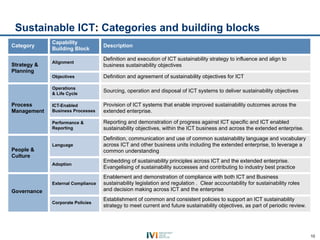
Sustainable ICT: Categories and building blocks
             Capability
Category                           Description
             Building Block
                                   Definition and execution of ICT sustainability strategy to influence and align to
             Alignment
Strategy &                         business sustainability objectives
Planning
             Objectives            Definition and agreement of sustainability objectives for ICT

             Operations
             & Life Cycle
                                   Sourcing, operation and disposal of ICT systems to deliver sustainability objectives

Process      ICT-Enabled           Provision of ICT systems that enable improved sustainability outcomes across the
Management   Business Processes    extended enterprise.

             Performance &         Reporting and demonstration of progress against ICT specific and ICT enabled
             Reporting             sustainability objectives, within the ICT business and across the extended enterprise.
                                   Definition, communication and use of common sustainability language and vocabulary
             Language              across ICT and other business units including the extended enterprise, to leverage a
People &                           common understanding
Culture
                                   Embedding of sustainability principles across ICT and the extended enterprise.
             Adoption
                                   Evangelising of sustainability successes and contributing to industry best practice
                                   Enablement and demonstration of compliance with both ICT and Business
             External Compliance   sustainability legislation and regulation . Clear accountability for sustainability roles
Governance                         and decision making across ICT and the enterprise
                                   Establishment of common and consistent policies to support an ICT sustainability
             Corporate Policies
                                   strategy to meet current and future sustainability objectives, as part of periodic review.


                                                                                                                                10
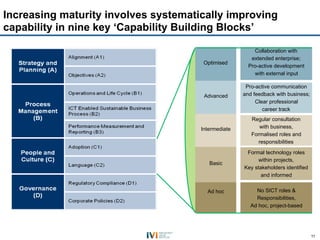
Increasing maturity involves systematically improving
capability in nine key ‘Capability Building Blocks’

                                                         Collaboration with
                                                        extended enterprise;
                                       Optimised
                                                       Pro-active development
                                                         with external input

                                                      Pro-active communication
                                       Advanced      and feedback with business;
                                                          Clear professional
                                                             career track
                                                        Regular consultation
                                      Intermediate         with business,
                                                        Formalised roles and
                                                          responsibilities
                                                      Formal technology roles
                                                           within projects,
                                         Basic
                                                     Key stakeholders identified
                                                            and informed


                                        Ad hoc            No SICT roles &
                                                          Responsibilities,
                                                        Ad hoc, project-based


                                                                                   11
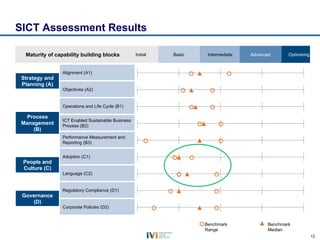
SICT Assessment Results

  Maturity of capability building blocks           Initial   Basic    Intermediate   Advanced      Optimising


                Alignment (A1)
 Strategy and
 Planning (A)
                Objectives (A2)


                Operations and Life Cycle (B1)

  Process
                ICT Enabled Sustainable Business
 Management     Process (B2)
     (B)
                Performance Measurement and
                Reporting (B3)


                Adoption (C1)
 People and
 Culture (C)
                Language (C2)


                Regulatory Compliance (D1)
 Governance
    (D)
                Corporate Policies (D2)


                                                                     Benchmark             Benchmark
                                                                     Range                 Median
                                                                                                                12
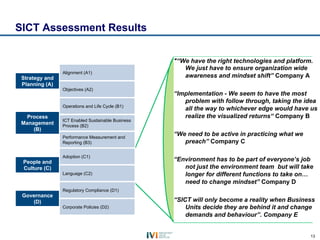
SICT Assessment Results

                                                   "“We have the right technologies and platform.
                                                      We just have to ensure organization wide
                Alignment (A1)
 Strategy and                                         awareness and mindset shift” Company A
 Planning (A)
                Objectives (A2)
                                                   “Implementation - We seem to have the most
                                                      problem with follow through, taking the idea
                Operations and Life Cycle (B1)
                                                      all the way to whichever edge would have us
  Process                                             realize the visualized returns“ Company B
                ICT Enabled Sustainable Business
 Management     Process (B2)
     (B)
                Performance Measurement and
                                                   “We need to be active in practicing what we
                Reporting (B3)                        preach” Company C

                Adoption (C1)
 People and                                        “Environment has to be part of everyone’s job
 Culture (C)                                          not just the environment team but will take
                Language (C2)                         longer for different functions to take on…
                                                      need to change mindset” Company D
                Regulatory Compliance (D1)
 Governance
    (D)                                            “SICT will only become a reality when Business
                Corporate Policies (D2)                Units decide they are behind it and change
                                                       demands and behaviour”. Company E


                                                                                                 13
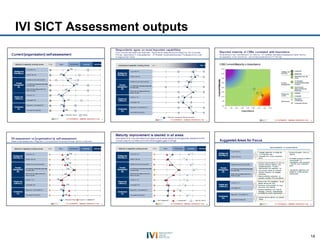
IVI SICT Assessment outputs


                              14
Insight from Assessments
•  Obtain Senior Management’s Vision
 •  Clear business vision for sustainability with goals and milestones
 •  Senior-level drive, visibility, and communication
•  Engage IT and Business Operations
 •  Assessment can be a wake-up call for both parties
 •  Broad actions needed across both IT & the business—not just in IT
•  Accept Cultural Change
 •  Embed SICT into the everyday work routine
 •  Success requires SICT to be viewed as “business as usual”
 •  Incentives can drive cultural change
•  Understand the Potential and Expand Expertise
 •  Misconception remains that sustainability typically represents a cost
 •  SICT skills and experience are still in short supply
 •  Education is critical to changing this skills shortage
                                                                            15
Further Information
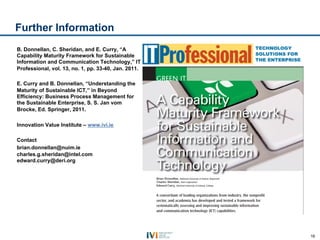
B. Donnellan, C. Sheridan, and E. Curry, “A
Capability Maturity Framework for Sustainable
Information and Communication Technology,” IT
Professional, vol. 13, no. 1, pp. 33-40, Jan. 2011.

E. Curry and B. Donnellan, “Understanding the
Maturity of Sustainable ICT,” in Beyond
Efficiency: Business Process Management for
the Sustainable Enterprise, S. S. Jan vom
Brocke, Ed. Springer, 2011.

Innovation Value Institute – www.ivi.ie

Contact
brian.donnellan@nuim.ie
charles.g.sheridan@intel.com
edward.curry@deri.org


                                                      16
Credits:
   Sheila Upton
   Paul Lidbetter
  Andrew Stewart
 Maurice O’Connor
    John Shaw
  Theodora Ngosi
   Louise Ogden
Emanuelle Saussier
   Benoit Hudzia
 Stephen Dawson


                     17

A Capability Maturity Framework for Sustainable ICT

  • 1.
    A Capability MaturityFramework for Sustainable ICT Brian Donnellan - Innovation Value Institute Charles Sheridan – Intel Corporation Edward Curry – Digital Enterprise Research Institute
  • 2.
    SICT Drivers Self-interest (image, competitive differentiation) Economics Social, cultural and Savings political influence Sustainable ICT Environmental Industry and External Concerns Business Pressures Regulatory & Compliance Requirements 2
  • 3.
    Two Faces ofSICT External to IT data collection collaborative web smart buildings and reporting technologies conferencing de-materialization Internal to IT e-waste data centre design Virtualisation, cloud Power Mgmt., PC and operations computing refresh cycle e-procurement 3
  • 4.
    Challenges for theCIO Complexity and rapid evolution of CIO SICT Lack of agreed and consistent standards Evolving regulations and legislation around the world The need for new SICT metrics and measures Lack of expertise in SICT 4
  • 5.
    IVI formed tocreate IT capability maturity framework – creating new approaches, leveraging existing standards and addressing "value" gap Steering patrons www.ivi.ie IVI membership includes leading enterprises, consulting, not-for-profit, government and academic organisations.
  • 6.
  • 7.
    SICT acts asa standalone critical process with increasing maturity as well as influencing other critical processes in IT IVI CMF SICT Maturity Curve Additional/amended CP-specific (all critical processes) - supports creation of critical practices to improve sustainability process with specific maturity sustainability practices, outcomes, metrics. Example Portfolio Planning & Prioritisation PPP (SICT specific) S PPP board decisions I demonstrably take Sustainability C criteria into account. SICT-specific T KPIs include: Ø % of PPP board approvals that include sustainability criteria Ø % of portfolio planning discussions that include IT BU and organisation-wide sustainability objectives 7
  • 8.
    IVI SICT AssessmentProcess Scope & •  Define the scope and goal of SICT Goal •  Agree on the business posture •  Assess current maturity Understand •  Online assessments Capability •  Individual interviews •  Data collection to validate Develop •  Develop SICT Capability Capability Building Blocks •  Assess and manage progress over time Manage •  Develop a roadmap and action plan •  Yearly follow-up assessments 8
  • 9.
    The IVI Approachto SICT 1   Assess status and update baseline 1 Assessment 2   Design solution model for next phase 5 2 Improvement Design 3   Implement strategy and transition to next capability level 4   Operate under new SICT capability level using metrics 4 3 Operation Transition 5   Define improvement paths based on operational experience and metrics results 9
  • 10.
    Sustainable ICT: Categoriesand building blocks Capability Category Description Building Block Definition and execution of ICT sustainability strategy to influence and align to Alignment Strategy & business sustainability objectives Planning Objectives Definition and agreement of sustainability objectives for ICT Operations & Life Cycle Sourcing, operation and disposal of ICT systems to deliver sustainability objectives Process ICT-Enabled Provision of ICT systems that enable improved sustainability outcomes across the Management Business Processes extended enterprise. Performance & Reporting and demonstration of progress against ICT specific and ICT enabled Reporting sustainability objectives, within the ICT business and across the extended enterprise. Definition, communication and use of common sustainability language and vocabulary Language across ICT and other business units including the extended enterprise, to leverage a People & common understanding Culture Embedding of sustainability principles across ICT and the extended enterprise. Adoption Evangelising of sustainability successes and contributing to industry best practice Enablement and demonstration of compliance with both ICT and Business External Compliance sustainability legislation and regulation . Clear accountability for sustainability roles Governance and decision making across ICT and the enterprise Establishment of common and consistent policies to support an ICT sustainability Corporate Policies strategy to meet current and future sustainability objectives, as part of periodic review. 10
  • 11.
    Increasing maturity involvessystematically improving capability in nine key ‘Capability Building Blocks’ Collaboration with extended enterprise; Optimised Pro-active development with external input Pro-active communication Advanced and feedback with business; Clear professional career track Regular consultation Intermediate with business, Formalised roles and responsibilities Formal technology roles within projects, Basic Key stakeholders identified and informed Ad hoc No SICT roles & Responsibilities, Ad hoc, project-based 11
  • 12.
    SICT Assessment Results Maturity of capability building blocks Initial Basic Intermediate Advanced Optimising Alignment (A1) Strategy and Planning (A) Objectives (A2) Operations and Life Cycle (B1) Process ICT Enabled Sustainable Business Management Process (B2) (B) Performance Measurement and Reporting (B3) Adoption (C1) People and Culture (C) Language (C2) Regulatory Compliance (D1) Governance (D) Corporate Policies (D2) Benchmark Benchmark Range Median 12
  • 13.
    SICT Assessment Results "“We have the right technologies and platform. We just have to ensure organization wide Alignment (A1) Strategy and awareness and mindset shift” Company A Planning (A) Objectives (A2) “Implementation - We seem to have the most problem with follow through, taking the idea Operations and Life Cycle (B1) all the way to whichever edge would have us Process realize the visualized returns“ Company B ICT Enabled Sustainable Business Management Process (B2) (B) Performance Measurement and “We need to be active in practicing what we Reporting (B3) preach” Company C Adoption (C1) People and “Environment has to be part of everyone’s job Culture (C) not just the environment team but will take Language (C2) longer for different functions to take on… need to change mindset” Company D Regulatory Compliance (D1) Governance (D) “SICT will only become a reality when Business Corporate Policies (D2) Units decide they are behind it and change demands and behaviour”. Company E 13
  • 14.
  • 15.
    Insight from Assessments • Obtain Senior Management’s Vision •  Clear business vision for sustainability with goals and milestones •  Senior-level drive, visibility, and communication •  Engage IT and Business Operations •  Assessment can be a wake-up call for both parties •  Broad actions needed across both IT & the business—not just in IT •  Accept Cultural Change •  Embed SICT into the everyday work routine •  Success requires SICT to be viewed as “business as usual” •  Incentives can drive cultural change •  Understand the Potential and Expand Expertise •  Misconception remains that sustainability typically represents a cost •  SICT skills and experience are still in short supply •  Education is critical to changing this skills shortage 15
  • 16.
    Further Information B. Donnellan,C. Sheridan, and E. Curry, “A Capability Maturity Framework for Sustainable Information and Communication Technology,” IT Professional, vol. 13, no. 1, pp. 33-40, Jan. 2011. E. Curry and B. Donnellan, “Understanding the Maturity of Sustainable ICT,” in Beyond Efficiency: Business Process Management for the Sustainable Enterprise, S. S. Jan vom Brocke, Ed. Springer, 2011. Innovation Value Institute – www.ivi.ie Contact brian.donnellan@nuim.ie charles.g.sheridan@intel.com edward.curry@deri.org 16
  • 17.
    Credits: Sheila Upton Paul Lidbetter Andrew Stewart Maurice O’Connor John Shaw Theodora Ngosi Louise Ogden Emanuelle Saussier Benoit Hudzia Stephen Dawson 17