Crowdsourcing Approaches for 
Smart City Open Data Management 
Edward Curry & Adegboyega Ojo 
Insight @ NUI Galway 
ed.curry@insight-centre.org 
www.edwardcurry.org
About Me 
• Researcher in both Computer 
Science and Information 
Systems 
• Green and Sustainable IT 
Research Group Leader in 
DERI/Insight NUI Galway
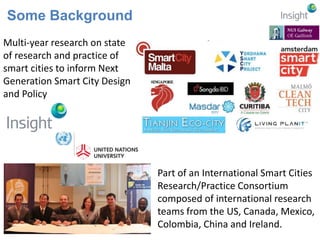
Some Background 
Multi-year research on state 
of research and practice of 
smart cities to inform Next 
Generation Smart City Design 
and Policy 
Part of an International Smart Cities 
Research/Practice Consortium 
composed of international research 
teams from the US, Canada, Mexico, 
Colombia, China and Ireland.
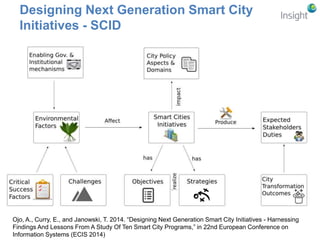
Designing Next Generation Smart City 
Initiatives - SCID 
Ojo, A., Curry, E., and Janowski, T. 2014. “Designing Next Generation Smart City Initiatives - Harnessing 
Findings And Lessons From A Study Of Ten Smart City Programs,” in 22nd European Conference on 
Information Systems (ECIS 2014)
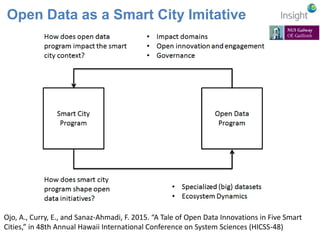
Open Data as a Smart City Imitative 
	 
Ojo, A., Curry, E., and Sanaz-Ahmadi, F. 2015. “A Tale of Open Data Innovations in Five Smart 
Cities,” in 48th Annual Hawaii International Conference on System Sciences (HICSS-48)
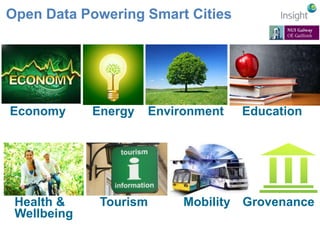
Open Data Powering Smart Cities 
Economy Energy Environment Education 
Health & 
Wellbeing 
Tourism Mobility Grovenance
An Open Innovation Economy 
Initial findings of the study are consistent and 
support the notion of an open data oriented 
smart city as an: 
“Open Innovation Economy” 
We are now investigating Crowdsourcing as a 
means of increasing Citizen engagement and 
participation within a smart city’s open 
innovation ecosystem
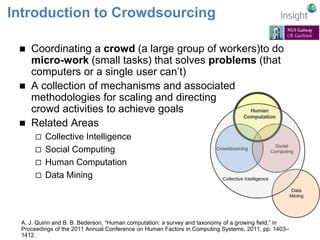
Introduction to Crowdsourcing 
 Coordinating a crowd (a large group of workers)to do 
micro-work (small tasks) that solves problems (that 
computers or a single user can’t) 
 A collection of mechanisms and associated 
methodologies for scaling and directing 
crowd activities to achieve goals 
 Related Areas 
 Collective Intelligence 
 Social Computing 
 Human Computation 
 Data Mining 
A. J. Quinn and B. B. Bederson, “Human computation: a survey and taxonomy of a growing field,” in 
Proceedings of the 2011 Annual Conference on Human Factors in Computing Systems, 2011, pp. 1403– 
1412.
9 
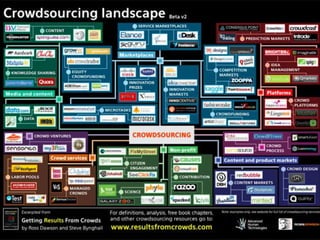
Crowdsourcing Landscape
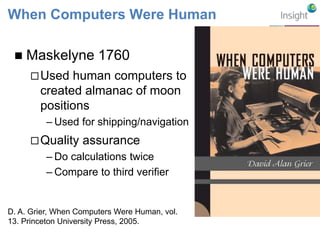
When Computers Were Human 
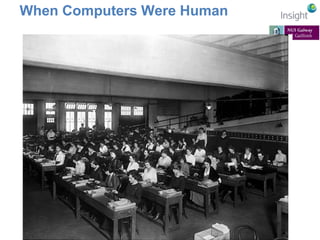
 Maskelyne 1760 
Used human computers to 
created almanac of moon 
positions 
– Used for shipping/navigation 
Quality assurance 
– Do calculations twice 
– Compare to third verifier 
D. A. Grier, When Computers Were Human, vol. 
13. Princeton University Press, 2005.
When Computers Were Human
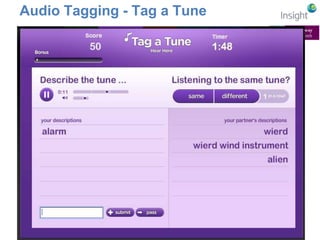
Audio Tagging - Tag a Tune
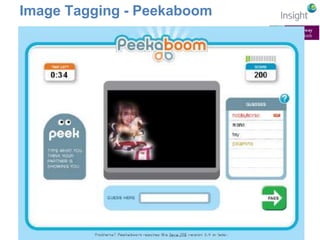
Image Tagging - Peekaboom
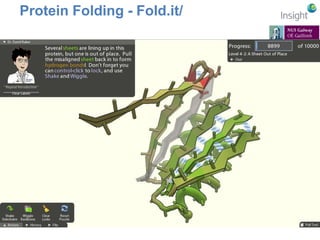
Protein Folding - Fold.it/
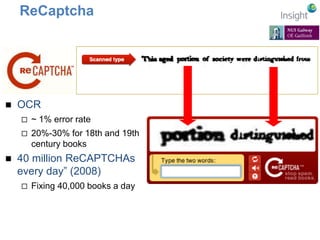
ReCaptcha 
 OCR 
 ~ 1% error rate 
 20%-30% for 18th and 19th 
century books 
 40 million ReCAPTCHAs 
every day” (2008) 
 Fixing 40,000 books a day
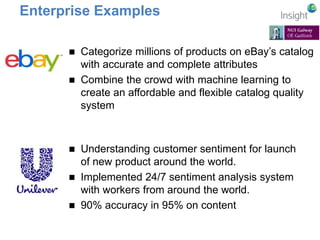
Enterprise Examples 
 Categorize millions of products on eBay’s catalog 
with accurate and complete attributes 
 Combine the crowd with machine learning to 
create an affordable and flexible catalog quality 
system 
 Understanding customer sentiment for launch 
of new product around the world. 
 Implemented 24/7 sentiment analysis system 
with workers from around the world. 
 90% accuracy in 95% on content
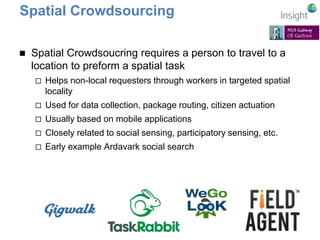
Spatial Crowdsourcing 
 Spatial Crowdsoucring requires a person to travel to a 
location to preform a spatial task 
 Helps non-local requesters through workers in targeted spatial 
locality 
 Used for data collection, package routing, citizen actuation 
 Usually based on mobile applications 
 Closely related to social sensing, participatory sensing, etc. 
 Early example Ardavark social search
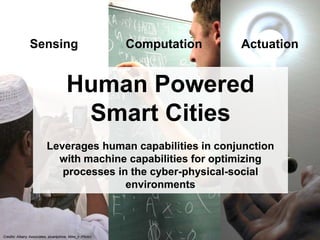
Sensing 
Credits: Albany Associates, stuartpilrow, Mike_n (Flickr) 
Computation Actuation 
Human Powered 
Smart Cities 
Leverages human capabilities in conjunction 
with machine capabilities for optimizing 
processes in the cyber-physical-social 
environments
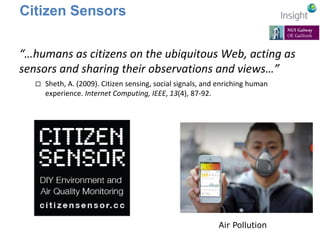
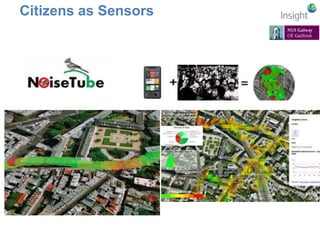
Citizen Sensors 
“…humans as citizens on the ubiquitous Web, acting as 
sensors and sharing their observations and views…” 
 Sheth, A. (2009). Citizen sensing, social signals, and enriching human 
experience. Internet Computing, IEEE, 13(4), 87-92. 
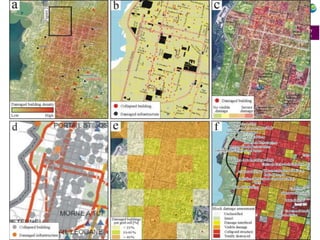
Air Pollution
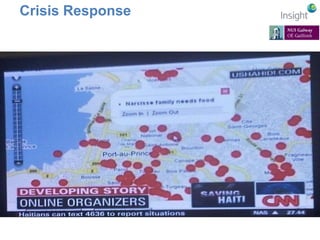
Crisis Response
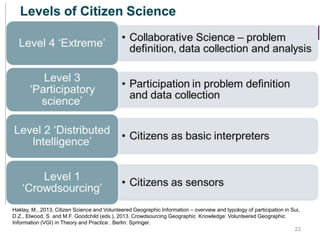
Citizens as Sensors
Haklay, M., 2013, Citizen Science and Volunteered Geographic Information – overview and typology of participation in Sui, 
D.Z., Elwood, S. and M.F. Goodchild (eds.), 2013. Crowdsourcing Geographic Knowledge: Volunteered Geographic 
Information (VGI) in Theory and Practice . Berlin: Springer. 
23
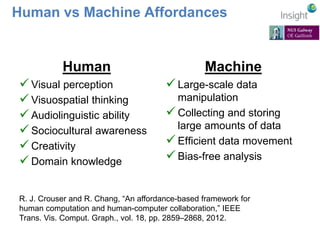
Human vs Machine Affordances 
Human 
 Visual perception 
 Visuospatial thinking 
 Audiolinguistic ability 
 Sociocultural awareness 
 Creativity 
 Domain knowledge 
Machine 
 Large-scale data 
manipulation 
 Collecting and storing 
large amounts of data 
 Efficient data movement 
 Bias-free analysis 
R. J. Crouser and R. Chang, “An affordance-based framework for 
human computation and human-computer collaboration,” IEEE 
Trans. Vis. Comput. Graph., vol. 18, pp. 2859–2868, 2012.
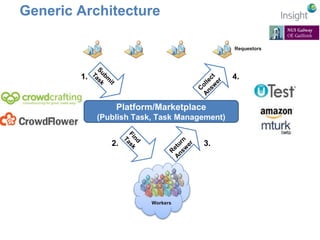
Generic Architecture 
Platform/Marketplace 
(Publish Task, Task Management) 
Workers 
Requestors 
1. 
2. 
4. 
3.
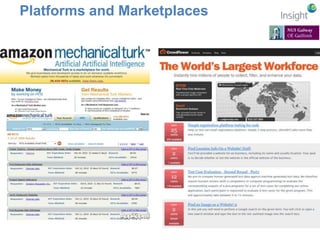
Platforms and Marketplaces
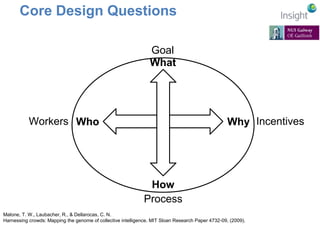
Core Design Questions 
Goal 
What 
Workers Who Why Incentives 
How 
Process 
Malone, T. W., Laubacher, R., & Dellarocas, C. N. 
Harnessing crowds: Mapping the genome of collective intelligence. MIT Sloan Research Paper 4732-09, (2009).
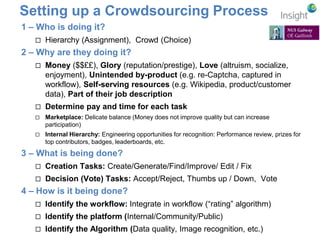
Setting up a Crowdsourcing Process 
1 – Who is doing it? 
 Hierarchy (Assignment), Crowd (Choice) 
2 – Why are they doing it? 
 Money ($$££), Glory (reputation/prestige), Love (altruism, socialize, 
enjoyment), Unintended by-product (e.g. re-Captcha, captured in 
workflow), Self-serving resources (e.g. Wikipedia, product/customer 
data), Part of their job description 
 Determine pay and time for each task 
 Marketplace: Delicate balance (Money does not improve quality but can increase 
participation) 
 Internal Hierarchy: Engineering opportunities for recognition: Performance review, prizes for 
top contributors, badges, leaderboards, etc. 
3 – What is being done? 
 Creation Tasks: Create/Generate/Find/Improve/ Edit / Fix 
 Decision (Vote) Tasks: Accept/Reject, Thumbs up / Down, Vote 
4 – How is it being done? 
 Identify the workflow: Integrate in workflow (“rating” algorithm) 
 Identify the platform (Internal/Community/Public) 
 Identify the Algorithm (Data quality, Image recognition, etc.)
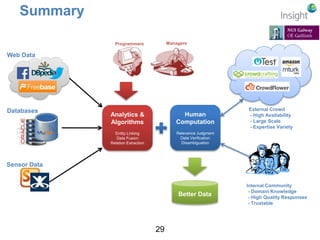
Summary 
29 
Analytics & 
Algorithms 
Entity Linking 
Data Fusion 
Relation Extraction 
Human 
Computation 
Relevance Judgment 
Data Verification 
Disambiguation 
Better Data 
Internal Community 
- Domain Knowledge 
- High Quality Responses 
- Trustable 
Web Data 
Databases 
Sensor Data 
Programmers Managers 
External Crowd 
- High Availability 
- Large Scale 
- Expertise Variety
References & Further Information 
 Ojo, A., Curry, E., and Janowski, T. 2014. “Designing 
Next Generation Smart City Initiatives - Harnessing 
Findings And Lessons From A Study Of Ten Smart City 
Programs,” in 22nd European Conference on Information 
Systems (ECIS 2014) 
 Ojo, A., Curry, E., and Sanaz-Ahmadi, F. 2015. “A Tale 
of Open Data Innovations in Five Smart Cities,” in 48th 
Annual Hawaii International Conference on System 
Sciences (HICSS-48) 
 Curry, E., Freitas, A., and O’Riáin, S. 2010. “The Role of 
Community-Driven Data Curation for Enterprises,” in 
Linking Enterprise Data, D. Wood (ed.), Boston, MA: 
Springer US, pp. 25–47.

Crowdsourcing Approaches for Smart City Open Data Management

  • 1.
    Crowdsourcing Approaches for Smart City Open Data Management Edward Curry & Adegboyega Ojo Insight @ NUI Galway ed.curry@insight-centre.org www.edwardcurry.org
  • 2.
    About Me •Researcher in both Computer Science and Information Systems • Green and Sustainable IT Research Group Leader in DERI/Insight NUI Galway
  • 3.
    Some Background Multi-yearresearch on state of research and practice of smart cities to inform Next Generation Smart City Design and Policy Part of an International Smart Cities Research/Practice Consortium composed of international research teams from the US, Canada, Mexico, Colombia, China and Ireland.
  • 4.
    Designing Next GenerationSmart City Initiatives - SCID Ojo, A., Curry, E., and Janowski, T. 2014. “Designing Next Generation Smart City Initiatives - Harnessing Findings And Lessons From A Study Of Ten Smart City Programs,” in 22nd European Conference on Information Systems (ECIS 2014)
  • 5.
    Open Data asa Smart City Imitative Ojo, A., Curry, E., and Sanaz-Ahmadi, F. 2015. “A Tale of Open Data Innovations in Five Smart Cities,” in 48th Annual Hawaii International Conference on System Sciences (HICSS-48)
  • 6.
    Open Data PoweringSmart Cities Economy Energy Environment Education Health & Wellbeing Tourism Mobility Grovenance
  • 7.
    An Open InnovationEconomy Initial findings of the study are consistent and support the notion of an open data oriented smart city as an: “Open Innovation Economy” We are now investigating Crowdsourcing as a means of increasing Citizen engagement and participation within a smart city’s open innovation ecosystem
  • 8.
    Introduction to Crowdsourcing  Coordinating a crowd (a large group of workers)to do micro-work (small tasks) that solves problems (that computers or a single user can’t)  A collection of mechanisms and associated methodologies for scaling and directing crowd activities to achieve goals  Related Areas  Collective Intelligence  Social Computing  Human Computation  Data Mining A. J. Quinn and B. B. Bederson, “Human computation: a survey and taxonomy of a growing field,” in Proceedings of the 2011 Annual Conference on Human Factors in Computing Systems, 2011, pp. 1403– 1412.
  • 9.
  • 10.
    When Computers WereHuman  Maskelyne 1760 Used human computers to created almanac of moon positions – Used for shipping/navigation Quality assurance – Do calculations twice – Compare to third verifier D. A. Grier, When Computers Were Human, vol. 13. Princeton University Press, 2005.
  • 11.
  • 12.
    Audio Tagging -Tag a Tune
  • 13.
    Image Tagging -Peekaboom
  • 14.
  • 15.
    ReCaptcha  OCR  ~ 1% error rate  20%-30% for 18th and 19th century books  40 million ReCAPTCHAs every day” (2008)  Fixing 40,000 books a day
  • 16.
    Enterprise Examples Categorize millions of products on eBay’s catalog with accurate and complete attributes  Combine the crowd with machine learning to create an affordable and flexible catalog quality system  Understanding customer sentiment for launch of new product around the world.  Implemented 24/7 sentiment analysis system with workers from around the world.  90% accuracy in 95% on content
  • 17.
    Spatial Crowdsourcing Spatial Crowdsoucring requires a person to travel to a location to preform a spatial task  Helps non-local requesters through workers in targeted spatial locality  Used for data collection, package routing, citizen actuation  Usually based on mobile applications  Closely related to social sensing, participatory sensing, etc.  Early example Ardavark social search
  • 18.
    Sensing Credits: AlbanyAssociates, stuartpilrow, Mike_n (Flickr) Computation Actuation Human Powered Smart Cities Leverages human capabilities in conjunction with machine capabilities for optimizing processes in the cyber-physical-social environments
  • 19.
    Citizen Sensors “…humansas citizens on the ubiquitous Web, acting as sensors and sharing their observations and views…”  Sheth, A. (2009). Citizen sensing, social signals, and enriching human experience. Internet Computing, IEEE, 13(4), 87-92. Air Pollution
  • 20.
  • 22.
  • 23.
    Haklay, M., 2013,Citizen Science and Volunteered Geographic Information – overview and typology of participation in Sui, D.Z., Elwood, S. and M.F. Goodchild (eds.), 2013. Crowdsourcing Geographic Knowledge: Volunteered Geographic Information (VGI) in Theory and Practice . Berlin: Springer. 23
  • 24.
    Human vs MachineAffordances Human  Visual perception  Visuospatial thinking  Audiolinguistic ability  Sociocultural awareness  Creativity  Domain knowledge Machine  Large-scale data manipulation  Collecting and storing large amounts of data  Efficient data movement  Bias-free analysis R. J. Crouser and R. Chang, “An affordance-based framework for human computation and human-computer collaboration,” IEEE Trans. Vis. Comput. Graph., vol. 18, pp. 2859–2868, 2012.
  • 25.
    Generic Architecture Platform/Marketplace (Publish Task, Task Management) Workers Requestors 1. 2. 4. 3.
  • 26.
  • 27.
    Core Design Questions Goal What Workers Who Why Incentives How Process Malone, T. W., Laubacher, R., & Dellarocas, C. N. Harnessing crowds: Mapping the genome of collective intelligence. MIT Sloan Research Paper 4732-09, (2009).
  • 28.
    Setting up aCrowdsourcing Process 1 – Who is doing it?  Hierarchy (Assignment), Crowd (Choice) 2 – Why are they doing it?  Money ($$££), Glory (reputation/prestige), Love (altruism, socialize, enjoyment), Unintended by-product (e.g. re-Captcha, captured in workflow), Self-serving resources (e.g. Wikipedia, product/customer data), Part of their job description  Determine pay and time for each task  Marketplace: Delicate balance (Money does not improve quality but can increase participation)  Internal Hierarchy: Engineering opportunities for recognition: Performance review, prizes for top contributors, badges, leaderboards, etc. 3 – What is being done?  Creation Tasks: Create/Generate/Find/Improve/ Edit / Fix  Decision (Vote) Tasks: Accept/Reject, Thumbs up / Down, Vote 4 – How is it being done?  Identify the workflow: Integrate in workflow (“rating” algorithm)  Identify the platform (Internal/Community/Public)  Identify the Algorithm (Data quality, Image recognition, etc.)
  • 29.
    Summary 29 Analytics& Algorithms Entity Linking Data Fusion Relation Extraction Human Computation Relevance Judgment Data Verification Disambiguation Better Data Internal Community - Domain Knowledge - High Quality Responses - Trustable Web Data Databases Sensor Data Programmers Managers External Crowd - High Availability - Large Scale - Expertise Variety
  • 30.
    References & FurtherInformation  Ojo, A., Curry, E., and Janowski, T. 2014. “Designing Next Generation Smart City Initiatives - Harnessing Findings And Lessons From A Study Of Ten Smart City Programs,” in 22nd European Conference on Information Systems (ECIS 2014)  Ojo, A., Curry, E., and Sanaz-Ahmadi, F. 2015. “A Tale of Open Data Innovations in Five Smart Cities,” in 48th Annual Hawaii International Conference on System Sciences (HICSS-48)  Curry, E., Freitas, A., and O’Riáin, S. 2010. “The Role of Community-Driven Data Curation for Enterprises,” in Linking Enterprise Data, D. Wood (ed.), Boston, MA: Springer US, pp. 25–47.

Editor's Notes

  • #10 Crowdsourcing is becoming prevalent There are variety of services and systems on the Web from marketplaces to knowledge bases
  • #11 http://www.youtube.com/watch?v=YwqltwvPnkw Division of Labor Mass production Professional Managers Workflow process Quailty assurance
  • #12 http://www.youtube.com/watch?v=YwqltwvPnkw Division of Labor Mass production Professional Managers Workflow process Quailty assurance