University of North Texas
1
www.attd.unt.edu
University of North TexasUniversity of North Texas
Learning Style PreferencesLearning Style Preferences
of Older Working Adultsof Older Working Adults
2
University of North Texas
Purpose of the StudyPurpose of the Study
•To determine if learning style
preferences differ significantly
between older and younger workers.
•Also to determine if there is a significant
difference in learning style preferences
of older workers when categorized by
age, gender, educational level, job
classification, and years of experience
within job classification.
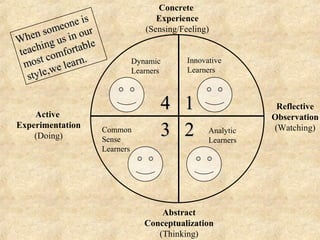
Active
Experimentation
(Doing)
Concrete
Experience
(Sensing/Feeling)
Reflective
Observation
(Watching)
Abstract
Conceptualization
(Thinking)
Dynamic
Learners
44 11
33 22
Innovative
Learners
Analytic
Learners
Common
Sense
Learners
When someone is
When someone is
teaching us in our
teaching us in our
most comfortable
most comfortable
style,we learn.
style,we learn.
University of North Texas
4
www.attd.unt.edu
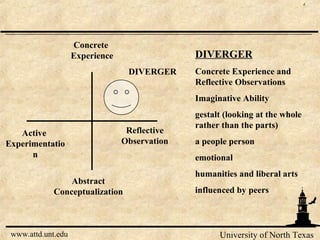
Active
Experimentatio
n
Concrete
Experience
Reflective
Observation
Abstract
Conceptualization
DIVERGER
DIVERGER
Concrete Experience and
Reflective Observations
Imaginative Ability
gestalt (looking at the whole
rather than the parts)
a people person
emotional
humanities and liberal arts
influenced by peers
University of North Texas
5
www.attd.unt.edu
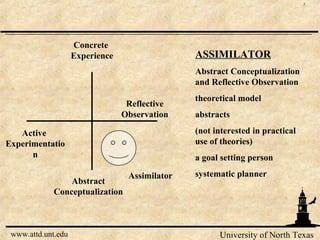
Active
Experimentatio
n
Concrete
Experience
Reflective
Observation
Abstract
Conceptualization
Assimilator
ASSIMILATOR
Abstract Conceptualization
and Reflective Observation
theoretical model
abstracts
(not interested in practical
use of theories)
a goal setting person
systematic planner
University of North Texas
6
www.attd.unt.edu
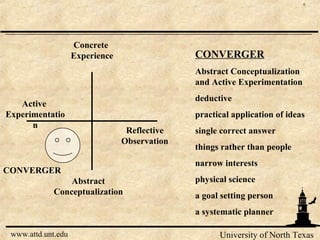
Active
Experimentatio
n
Concrete
Experience
Reflective
Observation
Abstract
Conceptualization
CONVERGER
CONVERGER
Abstract Conceptualization
and Active Experimentation
deductive
practical application of ideas
single correct answer
things rather than people
narrow interests
physical science
a goal setting person
a systematic planner
University of North Texas
7
www.attd.unt.edu
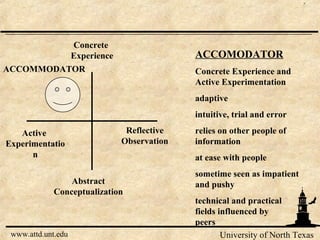
Active
Experimentatio
n
Concrete
Experience
Reflective
Observation
Abstract
Conceptualization
ACCOMMODATOR
ACCOMODATOR
Concrete Experience and
Active Experimentation
adaptive
intuitive, trial and error
relies on other people of
information
at ease with people
sometime seen as impatient
and pushy
technical and practical
fields influenced by
peers
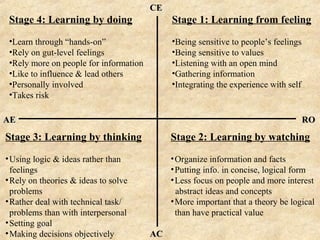
AEAE
CECE
RORO
ACAC
Stage 4: Learning by doing
•Learn through “hands-on”
•Rely on gut-level feelings
•Rely more on people for information
•Like to influence & lead others
•Personally involved
•Takes risk
Stage 1: Learning from feeling
•Being sensitive to people’s feelings
•Being sensitive to values
•Listening with an open mind
•Gathering information
•Integrating the experience with self
Stage 2: Learning by watching
•Organize information and facts
•Putting info. in concise, logical form
•Less focus on people and more interest
abstract ideas and concepts
•More important that a theory be logical
than have practical value
Stage 3: Learning by thinking
•Using logic & ideas rather than
feelings
•Rely on theories & ideas to solve
problems
•Rather deal with technical task/
problems than with interpersonal
•Setting goal
•Making decisions objectively
9
University of North Texas
Data Collection MethodsData Collection Methods
Each individual in the study will be
provided:
• Instructions for completing the
demographic Data Sheet and LSI.
• Most participants completed both
instruments in 10-20 minutes.
10
University of North Texas
Data Collection MethodsData Collection Methods
• The participants score their own
learning style inventories.
• A brief discussion of learning styles
is conducted.
• Instruments are then returned to the
researcher.
11
University of North Texas
Data Collection MethodsData Collection Methods
• The researcher verified the scores
obtained by the participants on all
learning style inventories and make
corrections where mathematical
scoring errors in addition occurred.
• Summary information can be
provided to the contact person.
12
University of North Texas
Data Collection MethodsData Collection Methods
• The researcher verified the scores
obtained by the participants on all
learning style inventories and made
corrections where mathematical
scoring errors in addition occurred.
13
University of North Texas
Related WorkRelated Work
Wircenski, M., Walker, M., & Allen, J., West, L. (1999). Age as a diversity
issue in grades K-12 and in higher education. Educational Gerontology 25(6),
491-500.
Allen, J., Wircenski, M. (1999). AgeShare: Training Older Learners: Issues
for the New Millennium. National Academy for Teaching and Learning about
Aging [on-line]. Available: www.unt.edu/natla/age_share_training_older_learners
Allen, J., & Hart, M. (1998). Training older workers: Implications for
HRD/HPT professionals. Performance Improvement Quarterly, 11(4), 91-102.
Ennis-Cole, D., & Allen, J. (1998). Challenges of training and retraining
older individuals with special needs. The Journal for Vocational Special Need
Education 20(3), 35-42.
The University of North Texas
Program of
Applied Technology, Training
and Development
P.O. Box 311337
Denton, Texas 76203-1337
Phone: (940)565-2093
Faculty Members:
Drs. Allen, Ditzenberger, Walker, J.
Wircenski, & M. Wircenski
Program Web Page:
http://www.attd.unt.edu/
University of North Texaswww.attd.unt.edu

A ashow

  • 1.
    University of NorthTexas 1 www.attd.unt.edu University of North TexasUniversity of North Texas Learning Style PreferencesLearning Style Preferences of Older Working Adultsof Older Working Adults
  • 2.
    2 University of NorthTexas Purpose of the StudyPurpose of the Study •To determine if learning style preferences differ significantly between older and younger workers. •Also to determine if there is a significant difference in learning style preferences of older workers when categorized by age, gender, educational level, job classification, and years of experience within job classification.
  • 3.
  • 4.
    University of NorthTexas 4 www.attd.unt.edu Active Experimentatio n Concrete Experience Reflective Observation Abstract Conceptualization DIVERGER DIVERGER Concrete Experience and Reflective Observations Imaginative Ability gestalt (looking at the whole rather than the parts) a people person emotional humanities and liberal arts influenced by peers
  • 5.
    University of NorthTexas 5 www.attd.unt.edu Active Experimentatio n Concrete Experience Reflective Observation Abstract Conceptualization Assimilator ASSIMILATOR Abstract Conceptualization and Reflective Observation theoretical model abstracts (not interested in practical use of theories) a goal setting person systematic planner
  • 6.
    University of NorthTexas 6 www.attd.unt.edu Active Experimentatio n Concrete Experience Reflective Observation Abstract Conceptualization CONVERGER CONVERGER Abstract Conceptualization and Active Experimentation deductive practical application of ideas single correct answer things rather than people narrow interests physical science a goal setting person a systematic planner
  • 7.
    University of NorthTexas 7 www.attd.unt.edu Active Experimentatio n Concrete Experience Reflective Observation Abstract Conceptualization ACCOMMODATOR ACCOMODATOR Concrete Experience and Active Experimentation adaptive intuitive, trial and error relies on other people of information at ease with people sometime seen as impatient and pushy technical and practical fields influenced by peers
  • 8.
    AEAE CECE RORO ACAC Stage 4: Learningby doing •Learn through “hands-on” •Rely on gut-level feelings •Rely more on people for information •Like to influence & lead others •Personally involved •Takes risk Stage 1: Learning from feeling •Being sensitive to people’s feelings •Being sensitive to values •Listening with an open mind •Gathering information •Integrating the experience with self Stage 2: Learning by watching •Organize information and facts •Putting info. in concise, logical form •Less focus on people and more interest abstract ideas and concepts •More important that a theory be logical than have practical value Stage 3: Learning by thinking •Using logic & ideas rather than feelings •Rely on theories & ideas to solve problems •Rather deal with technical task/ problems than with interpersonal •Setting goal •Making decisions objectively
  • 9.
    9 University of NorthTexas Data Collection MethodsData Collection Methods Each individual in the study will be provided: • Instructions for completing the demographic Data Sheet and LSI. • Most participants completed both instruments in 10-20 minutes.
  • 10.
    10 University of NorthTexas Data Collection MethodsData Collection Methods • The participants score their own learning style inventories. • A brief discussion of learning styles is conducted. • Instruments are then returned to the researcher.
  • 11.
    11 University of NorthTexas Data Collection MethodsData Collection Methods • The researcher verified the scores obtained by the participants on all learning style inventories and make corrections where mathematical scoring errors in addition occurred. • Summary information can be provided to the contact person.
  • 12.
    12 University of NorthTexas Data Collection MethodsData Collection Methods • The researcher verified the scores obtained by the participants on all learning style inventories and made corrections where mathematical scoring errors in addition occurred.
  • 13.
    13 University of NorthTexas Related WorkRelated Work Wircenski, M., Walker, M., & Allen, J., West, L. (1999). Age as a diversity issue in grades K-12 and in higher education. Educational Gerontology 25(6), 491-500. Allen, J., Wircenski, M. (1999). AgeShare: Training Older Learners: Issues for the New Millennium. National Academy for Teaching and Learning about Aging [on-line]. Available: www.unt.edu/natla/age_share_training_older_learners Allen, J., & Hart, M. (1998). Training older workers: Implications for HRD/HPT professionals. Performance Improvement Quarterly, 11(4), 91-102. Ennis-Cole, D., & Allen, J. (1998). Challenges of training and retraining older individuals with special needs. The Journal for Vocational Special Need Education 20(3), 35-42.
  • 14.
    The University ofNorth Texas Program of Applied Technology, Training and Development P.O. Box 311337 Denton, Texas 76203-1337 Phone: (940)565-2093 Faculty Members: Drs. Allen, Ditzenberger, Walker, J. Wircenski, & M. Wircenski Program Web Page: http://www.attd.unt.edu/ University of North Texaswww.attd.unt.edu