SIX SIGMA
How to get started with Six Sigma?
Leaders must be committed on two levels: Must commit company resources to help the Six sigma initiative to succeed Must commit their time and energy to actively promote the initiative
Are you and your company ready? Does your company have a clear strategic course? Are the people in your company ready and willing to accept and react to changes? How effectively does your company focus on meeting customer expectations?
Are you and your company ready? Are you ready to begin measuring the defect levels and yields for each service, product and process? Are you ready reducing defect rates by at least 50 percent over time? Are you ready to begin looking at how much you spend in fixing mistakes- the cost of poor quality?
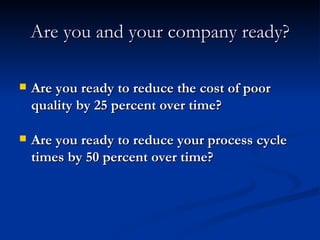
Are you and your company ready? Are you ready to reduce the cost of poor quality by 25 percent over time? Are you ready to reduce your process cycle times by 50 percent over time?
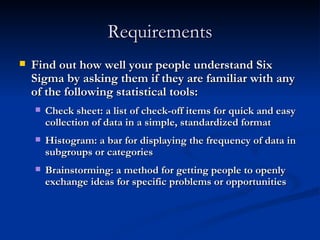
Requirements Find out how well your people understand Six Sigma by asking them if they are familiar with any of the following statistical tools: Check sheet: a list of check-off items for quick and easy collection of data in a simple, standardized format Histogram: a bar for displaying the frequency of data in subgroups or categories Brainstorming: a method for getting people to openly exchange ideas for specific problems or opportunities
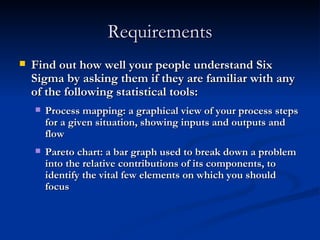
Requirements Find out how well your people understand Six Sigma by asking them if they are familiar with any of the following statistical tools: Process mapping: a graphical view of your process steps for a given situation, showing inputs and outputs and flow Pareto chart: a bar graph used to break down a problem into the relative contributions of its components, to identify the vital few elements on which you should focus
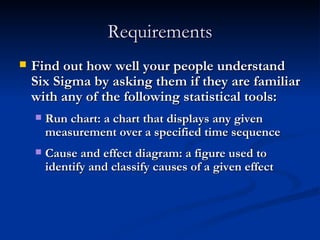
Requirements Find out how well your people understand Six Sigma by asking them if they are familiar with any of the following statistical tools: Run chart: a chart that displays any given  measurement over a specified time sequence Cause and effect diagram: a figure used to identify and classify causes of a given effect
Key Players Roles of the executive leaders Decide to do Six sigma and to publicly endorse it and promote it throughout the organization Need to actively display confidence in the people charged with making it work Must show integrity Should be models of patience
Key Players Roles of the Champions Senior-level manager who promotes the Six Sigma methodology throughout the company and especially in functional groups A champion should be a senior manager who: Understands at least the basics about the tools and techniques used in Six Sigma Understands and supports Six Sigma
Key Players Roles of the Champions: A champion should be a senior manager who: Has direct access to other senior managers Is responsible for the area that is the focus of the Six Sigma project Is able to remove barriers for the team and committed to doing so
Key Players Roles of the Champions: Champions are responsible for monitoring and managing each critical element in a Six Sigma project Champions select black belt candidates; identify project areas, and establish clear and measurable goals for projects Champions are ultimately responsible for the Six Sigma project Champions should do whatever it takes  to support the black belts
Key Players Roles of the Master Black Belts The master black belt: Expert in Six Sigma tools and tactics and a valuable resource in terms of technical and historical expertise Ensures that the necessary infrastructure is in place and that black belts are trained Focuses 100 percent of his efforts on business improvement
Key Players Roles of the Master Black Belts Has the ability to skillfully facilitate problem-solving without actually taking over a project Coordinates and collaborates with the executive managers, and particularly with the champions
Key Players Roles of the Black Belts Lead a team on a selected project on a full-time basis, working strictly on defining, measuring, analyzing, improving, and controlling processes to reach desired outcomes Trained to be technical leaders in using Six Sigma tools and methods to improve quality By applying Six Sigma statistical tools in tandem with critical data, they can mine hidden dollars
Key Players Roles of the Green Belts Assist Black Belts in their functional area Apply Six Sigma tools to examine and solve chronic problems on projects within their regular jobs Help Black Belts in collecting, analyzing data, running experiments, or doing other important tasks in a project
Key Players Roles of the Project Team members Employees who work as members of project teams Come fromvarious functions and work part time on projects Have the least training in Six Sigma Are accountable as individuals and together for specific tasks
Recognition and Rewards The executive team should create rewards that employees can earn in the short term for exceptional efforts and rewards for team members who meet their indivdual and team goals
Roles of the Consultants May help you start with Six Sigma Should be focused on knowledge transter, on showing how to solve problems throughout the most effective methods and fix process defects with the right tools
Role of the Controller Crucial to get advance buy-in from your controller Need to be operating from the same monetary baseline: Need to agree on how you distinguish between hard dollars and soft dollars Hard dollars: savings that are tangible and quantifiable ( reduced hours, reduced inventory levels,..) Soft dollars: savings that are intangible expenses that you avoid ( such as not increasing hours, inventory, or physical workspace)
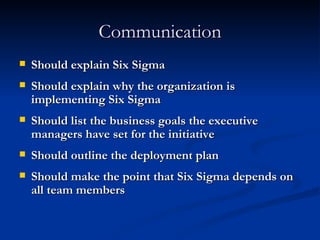
Communication Should explain Six Sigma Should explain why the organization is implementing Six Sigma Should list the business goals the executive managers have set for the initiative Should outline the deployment plan Should make the point that Six Sigma depends on all team members
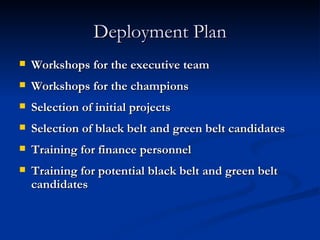
Deployment Plan Workshops for the executive team Workshops for the champions Selection of initial projects Selection of black belt and green belt candidates Training for finance personnel Training for potential black belt and green belt candidates
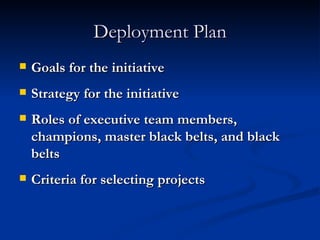
Deployment Plan Goals for the initiative Strategy for the initiative Roles of executive team members, champions, master black belts, and black belts Criteria for selecting projects
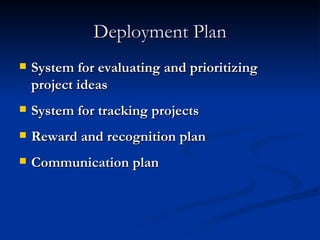
Deployment Plan System for evaluating and prioritizing project ideas System for tracking projects Reward and recognition plan Communication plan
Training For Executives: Executive workshop including: An overview of Six Sigma A review of case studies A definition of the roles of executive team members A discussion of deployment strategies An exploration of scientific tools and methods
Training For Executives: Executive workshop including: A presentation of statistical analysis and measurements A discussion of management controls Development of a draft deployment plan An identification of areas to target for improvement and the champions of these areas
Training For Executives: Workshop of 3 to 5 days for the people identified as champions during the executive workshop
Training For Champions: Training provides the managerial and technical knowledge necessary to plan and implement Six Sigma and mentor black belts Training covers the principles, tools, and applications of Six Sigma, including deployment tactics and strategies for establishing metrics, selecting black belts and projects, and implementing Six Sigma.
Training For Black Belts Training should be thorough but not overwhelming A tool should be taught before the training participants need to use it Goal: Create an independent thinker, technical leaders, advanced practitioners and teachers of Six Sigma
Training For Black Belts Need for the onsite support of an experienced master black belt that can guide and coach the black belt candidates and work with champions to help overcome barriers and obstacles
Training For Green Belts Receive training in the methodology, so they can help and support the black belts Develop their technical knowledge to the point that they become local experts at solving problems

Six Sigma

  • 1.
  • 2.
    How to getstarted with Six Sigma?
  • 3.
    Leaders must becommitted on two levels: Must commit company resources to help the Six sigma initiative to succeed Must commit their time and energy to actively promote the initiative
  • 4.
    Are you andyour company ready? Does your company have a clear strategic course? Are the people in your company ready and willing to accept and react to changes? How effectively does your company focus on meeting customer expectations?
  • 5.
    Are you andyour company ready? Are you ready to begin measuring the defect levels and yields for each service, product and process? Are you ready reducing defect rates by at least 50 percent over time? Are you ready to begin looking at how much you spend in fixing mistakes- the cost of poor quality?
  • 6.
    Are you andyour company ready? Are you ready to reduce the cost of poor quality by 25 percent over time? Are you ready to reduce your process cycle times by 50 percent over time?
  • 7.
    Requirements Find outhow well your people understand Six Sigma by asking them if they are familiar with any of the following statistical tools: Check sheet: a list of check-off items for quick and easy collection of data in a simple, standardized format Histogram: a bar for displaying the frequency of data in subgroups or categories Brainstorming: a method for getting people to openly exchange ideas for specific problems or opportunities
  • 8.
    Requirements Find outhow well your people understand Six Sigma by asking them if they are familiar with any of the following statistical tools: Process mapping: a graphical view of your process steps for a given situation, showing inputs and outputs and flow Pareto chart: a bar graph used to break down a problem into the relative contributions of its components, to identify the vital few elements on which you should focus
  • 9.
    Requirements Find outhow well your people understand Six Sigma by asking them if they are familiar with any of the following statistical tools: Run chart: a chart that displays any given measurement over a specified time sequence Cause and effect diagram: a figure used to identify and classify causes of a given effect
  • 10.
    Key Players Rolesof the executive leaders Decide to do Six sigma and to publicly endorse it and promote it throughout the organization Need to actively display confidence in the people charged with making it work Must show integrity Should be models of patience
  • 11.
    Key Players Rolesof the Champions Senior-level manager who promotes the Six Sigma methodology throughout the company and especially in functional groups A champion should be a senior manager who: Understands at least the basics about the tools and techniques used in Six Sigma Understands and supports Six Sigma
  • 12.
    Key Players Rolesof the Champions: A champion should be a senior manager who: Has direct access to other senior managers Is responsible for the area that is the focus of the Six Sigma project Is able to remove barriers for the team and committed to doing so
  • 13.
    Key Players Rolesof the Champions: Champions are responsible for monitoring and managing each critical element in a Six Sigma project Champions select black belt candidates; identify project areas, and establish clear and measurable goals for projects Champions are ultimately responsible for the Six Sigma project Champions should do whatever it takes to support the black belts
  • 14.
    Key Players Rolesof the Master Black Belts The master black belt: Expert in Six Sigma tools and tactics and a valuable resource in terms of technical and historical expertise Ensures that the necessary infrastructure is in place and that black belts are trained Focuses 100 percent of his efforts on business improvement
  • 15.
    Key Players Rolesof the Master Black Belts Has the ability to skillfully facilitate problem-solving without actually taking over a project Coordinates and collaborates with the executive managers, and particularly with the champions
  • 16.
    Key Players Rolesof the Black Belts Lead a team on a selected project on a full-time basis, working strictly on defining, measuring, analyzing, improving, and controlling processes to reach desired outcomes Trained to be technical leaders in using Six Sigma tools and methods to improve quality By applying Six Sigma statistical tools in tandem with critical data, they can mine hidden dollars
  • 17.
    Key Players Rolesof the Green Belts Assist Black Belts in their functional area Apply Six Sigma tools to examine and solve chronic problems on projects within their regular jobs Help Black Belts in collecting, analyzing data, running experiments, or doing other important tasks in a project
  • 18.
    Key Players Rolesof the Project Team members Employees who work as members of project teams Come fromvarious functions and work part time on projects Have the least training in Six Sigma Are accountable as individuals and together for specific tasks
  • 19.
    Recognition and RewardsThe executive team should create rewards that employees can earn in the short term for exceptional efforts and rewards for team members who meet their indivdual and team goals
  • 20.
    Roles of theConsultants May help you start with Six Sigma Should be focused on knowledge transter, on showing how to solve problems throughout the most effective methods and fix process defects with the right tools
  • 21.
    Role of theController Crucial to get advance buy-in from your controller Need to be operating from the same monetary baseline: Need to agree on how you distinguish between hard dollars and soft dollars Hard dollars: savings that are tangible and quantifiable ( reduced hours, reduced inventory levels,..) Soft dollars: savings that are intangible expenses that you avoid ( such as not increasing hours, inventory, or physical workspace)
  • 22.
    Communication Should explainSix Sigma Should explain why the organization is implementing Six Sigma Should list the business goals the executive managers have set for the initiative Should outline the deployment plan Should make the point that Six Sigma depends on all team members
  • 23.
    Deployment Plan Workshopsfor the executive team Workshops for the champions Selection of initial projects Selection of black belt and green belt candidates Training for finance personnel Training for potential black belt and green belt candidates
  • 24.
    Deployment Plan Goalsfor the initiative Strategy for the initiative Roles of executive team members, champions, master black belts, and black belts Criteria for selecting projects
  • 25.
    Deployment Plan Systemfor evaluating and prioritizing project ideas System for tracking projects Reward and recognition plan Communication plan
  • 26.
    Training For Executives:Executive workshop including: An overview of Six Sigma A review of case studies A definition of the roles of executive team members A discussion of deployment strategies An exploration of scientific tools and methods
  • 27.
    Training For Executives:Executive workshop including: A presentation of statistical analysis and measurements A discussion of management controls Development of a draft deployment plan An identification of areas to target for improvement and the champions of these areas
  • 28.
    Training For Executives:Workshop of 3 to 5 days for the people identified as champions during the executive workshop
  • 29.
    Training For Champions:Training provides the managerial and technical knowledge necessary to plan and implement Six Sigma and mentor black belts Training covers the principles, tools, and applications of Six Sigma, including deployment tactics and strategies for establishing metrics, selecting black belts and projects, and implementing Six Sigma.
  • 30.
    Training For BlackBelts Training should be thorough but not overwhelming A tool should be taught before the training participants need to use it Goal: Create an independent thinker, technical leaders, advanced practitioners and teachers of Six Sigma
  • 31.
    Training For BlackBelts Need for the onsite support of an experienced master black belt that can guide and coach the black belt candidates and work with champions to help overcome barriers and obstacles
  • 32.
    Training For GreenBelts Receive training in the methodology, so they can help and support the black belts Develop their technical knowledge to the point that they become local experts at solving problems