BEYOND SIX SIGMA:  A HOLISTIC APPROACH TO IMPROVING BUSINESS RESULTS Pete Robustelli Executive Vice President Six Sigma Qualtec, Inc.
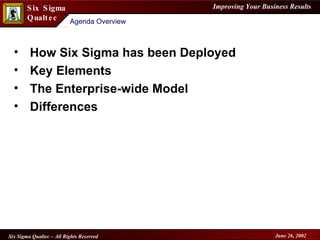
How Six Sigma has been Deployed Key Elements The Enterprise-wide Model Differences Agenda Overview
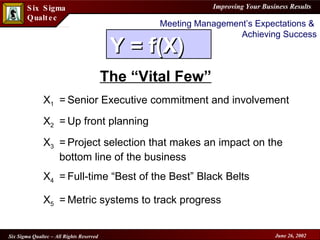
Meeting Management’s Expectations &  Achieving Success The “Vital Few” X 1 = Senior Executive commitment and involvement  X 2 = Up front planning X 3 = Project selection that makes an impact on the bottom line of the business  X 4 = Full-time “Best of the Best” Black Belts  X 5 = Metric systems to track progress   Y = f(X)
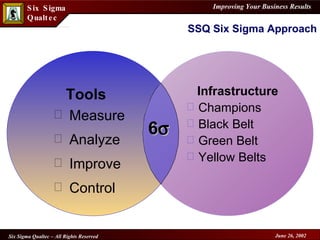
SSQ Six Sigma Approach 6  Infrastructure Champions Black Belt Green Belt Yellow Belts Tools Measure Analyze Improve Control
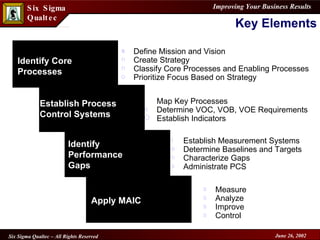
Key Elements Apply MAIC Identify Core Processes Establish Process Control Systems Identify Performance Gaps Define Mission and Vision Create Strategy Classify Core Processes and Enabling Processes Prioritize Focus Based on Strategy Map Key Processes Determine VOC, VOB, VOE Requirements Establish Indicators Establish Measurement Systems Determine Baselines and Targets Characterize Gaps Administrate PCS Measure Analyze  Improve  Control
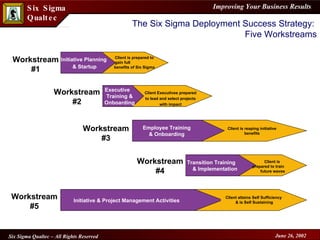
The Six Sigma Deployment Success Strategy:  Five Workstreams Initiative Planning  & Startup Client is prepared to gain full  benefits of Six Sigma Executive  Training & Onboarding Client Executives prepared to lead and select projects with impact Employee Training & Onboarding Client is reaping initiative benefits Transition Training  & Implementation Client is  prepared to train  future waves Initiative & Project Management Activities Client attains Self Sufficiency  & is Self Sustaining Workstream #1 Workstream #2 Workstream #3 Workstream #5 Workstream #4
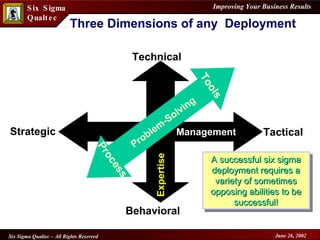
Three Dimensions of any  Deployment A successful six sigma deployment requires a variety of sometimes opposing abilities to be successful! Behavioral Technical Strategic Process Tools Tactical Problem-Solving Management Expertise
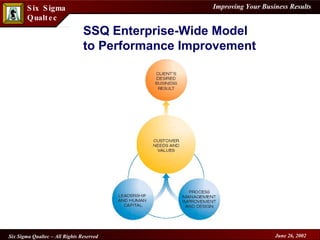
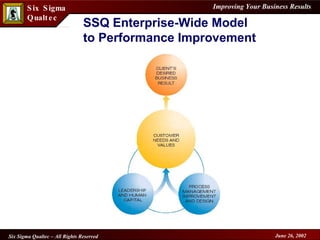
SSQ Enterprise-Wide Model  to Performance Improvement
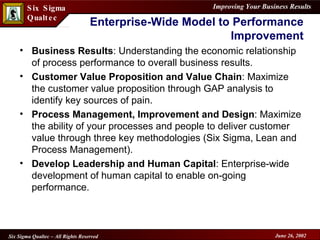
Enterprise-Wide Model to Performance Improvement Business Results : Understanding the economic relationship of process performance to overall business results. Customer Value Proposition and Value Chain : Maximize the customer value proposition through GAP analysis to identify key sources of pain. Process Management, Improvement and Design : Maximize the ability of your processes and people to deliver customer value through three key methodologies (Six Sigma, Lean and Process Management).  Develop Leadership and Human Capital : Enterprise-wide development of human capital to enable on-going performance.
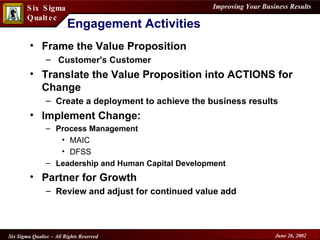
Engagement Activities Frame the Value Proposition Customer's Customer Translate the Value Proposition into ACTIONS for Change Create a deployment to achieve the business results Implement Change: Process Management MAIC DFSS Leadership and Human Capital Development Partner for Growth Review and adjust for continued value add
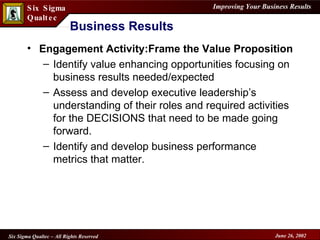
Business Results Engagement Activity:Frame the Value Proposition Identify value enhancing opportunities focusing on business results needed/expected Assess and develop executive leadership’s understanding of their roles and required activities for the DECISIONS that need to be made going forward. Identify and develop business performance metrics that matter.
Business Results Outcomes: Definition and measurement of interventions based on their impact to the business results the client values. Communication details as appropriate for the audience e.g., EVA at the executive level vs. project results at the BB or Team Member level. Value concept created for all levels.
Customer Value Proposition  & Value Chain Engagement Activity:Translate the value proposition into actions for change. Map value streams ands identify critical organization and process relationships. Identify or create organizational performance metrics. Design a DEPLOYMENT to maximize the value proposition and value chain to achieve business results.
Customer Value Proposition  & Value Chain Outcomes: Identification of client's existing metrics linked to their Customer Value Proposition. Map of the client's Customer Value Chain identifying relationships among organizational units, identification of core processes and likely process intervention areas impacting the Customer Value Chain. Linkage of solutions to the client's Business Results through their Customer Value Proposition and associated processes.
Six Sigma Process Management, Improvement & Design  Engagement Activity:Implement Change Develop middle and first line leadership. Align organization goals vertically. Align and develop the infrastructure. Implement process management. Align enabling processes Implement process improvement
Outcomes: Improvement culture, tool, skill and knowledge transfer from SSQ to client personnel  through training and support of Process Management, MAIC, IMAIC, DFSS  and Lean in context with the client's Customer Value Chain. Completed projects showing impact on the Customer Value Chain and economic return on intervention investments. Assessment of the people developmental gaps impacting the sustained implementation of the transferred improvement culture, tools, skills and knowledge. Process and infrastructure to effectively manage and leverage across the client's organization the results and impact of SSQ interventions. Six Sigma Process Management, Improvement & Design
Develop Leadership & Human Capital Engagement Activity: Develop Leadership and Human Capital at all levels. Initialization sessions for Executive and Senior Management to align them on the strategies and tactics for achieving Business Results. Identify knowledge, skill, and ability gaps in front and middle management necessary to implement change. Extend and expand on current education and knowledge management content and tools. Develop and implement an education and training strategy.
Develop Leadership & Human Capital Outcomes: Superior on-job performance of all employees necessary to have appropriate return on intervention investments. Practical mechanism for maintaining human performance levels well beyond the time frame of initial implementation.
Partner for Growth Review and confirm the value of interventions in achieving business results. Partner with mutual strengths to expand the value proposition for both the client and SSQ.
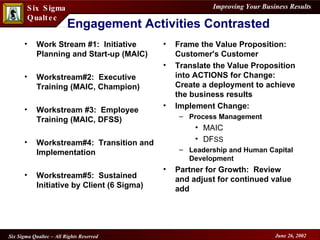
Engagement Activities Contrasted Work Stream #1:  Initiative Planning and Start-up (MAIC) Workstream#2:  Executive Training (MAIC, Champion) Workstream #3:  Employee Training (MAIC, DFSS) Workstream#4:  Transition and Implementation Workstream#5:  Sustained Initiative by Client (6 Sigma) Frame the Value Proposition:  Customer's Customer Translate the Value Proposition into ACTIONS for Change:  Create a deployment to achieve the business results Implement Change: Process Management MAIC DF SS Leadership and Human Capital Development Partner for Growth:  Review and adjust for continued value add
SSQ Enterprise-Wide Model  to Performance Improvement
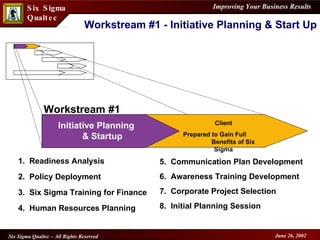
Workstream #1 - Initiative Planning & Start Up 1.  Readiness Analysis 2.  Policy Deployment 3.  Six Sigma Training for Finance 4.  Human Resources Planning 5.  Communication Plan Development 6.  Awareness Training Development 7.  Corporate Project Selection 8.  Initial Planning Session Initiative Planning  & Startup Client Prepared to Gain Full  Benefits of Six Sigma Workstream #1
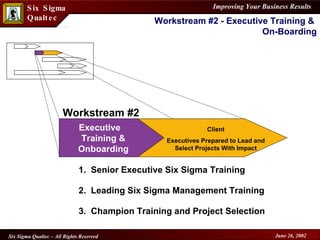
Workstream #2 - Executive Training &  On-Boarding Executive  Training & Onboarding Client Executives Prepared to Lead and Select Projects With Impact Workstream #2 1.  Senior Executive Six Sigma Training 2.  Leading Six Sigma Management Training 3.  Champion Training and Project Selection
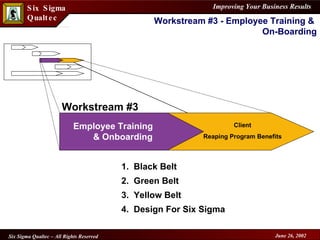
Workstream #3 - Employee Training &  On-Boarding Employee Training  & Onboarding Client Reaping Program Benefits Workstream #3 1.  Black Belt  2.  Green Belt 3.  Yellow Belt 4.  Design For Six Sigma
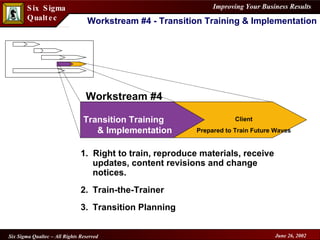
Workstream #4 - Transition Training & Implementation Transition Training  & Implementation Client Prepared to Train Future Waves Workstream #4 1.  Right to train, reproduce materials, receive updates, content revisions and change notices. 2.  Train-the-Trainer 3.  Transition Planning
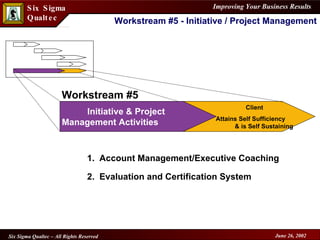
Workstream #5 - Initiative / Project Management 1.  Account Management/Executive Coaching 2.  Evaluation and Certification System Initiative & Project  Management Activities   Client Attains Self Sufficiency   & is Self Sustaining Workstream #5

Holistic Approach

  • 1.
    BEYOND SIX SIGMA: A HOLISTIC APPROACH TO IMPROVING BUSINESS RESULTS Pete Robustelli Executive Vice President Six Sigma Qualtec, Inc.
  • 2.
    How Six Sigmahas been Deployed Key Elements The Enterprise-wide Model Differences Agenda Overview
  • 3.
    Meeting Management’s Expectations& Achieving Success The “Vital Few” X 1 = Senior Executive commitment and involvement X 2 = Up front planning X 3 = Project selection that makes an impact on the bottom line of the business X 4 = Full-time “Best of the Best” Black Belts X 5 = Metric systems to track progress Y = f(X)
  • 4.
    SSQ Six SigmaApproach 6  Infrastructure Champions Black Belt Green Belt Yellow Belts Tools Measure Analyze Improve Control
  • 5.
    Key Elements ApplyMAIC Identify Core Processes Establish Process Control Systems Identify Performance Gaps Define Mission and Vision Create Strategy Classify Core Processes and Enabling Processes Prioritize Focus Based on Strategy Map Key Processes Determine VOC, VOB, VOE Requirements Establish Indicators Establish Measurement Systems Determine Baselines and Targets Characterize Gaps Administrate PCS Measure Analyze Improve Control
  • 6.
    The Six SigmaDeployment Success Strategy: Five Workstreams Initiative Planning & Startup Client is prepared to gain full benefits of Six Sigma Executive Training & Onboarding Client Executives prepared to lead and select projects with impact Employee Training & Onboarding Client is reaping initiative benefits Transition Training & Implementation Client is prepared to train future waves Initiative & Project Management Activities Client attains Self Sufficiency & is Self Sustaining Workstream #1 Workstream #2 Workstream #3 Workstream #5 Workstream #4
  • 7.
    Three Dimensions ofany Deployment A successful six sigma deployment requires a variety of sometimes opposing abilities to be successful! Behavioral Technical Strategic Process Tools Tactical Problem-Solving Management Expertise
  • 8.
    SSQ Enterprise-Wide Model to Performance Improvement
  • 9.
    Enterprise-Wide Model toPerformance Improvement Business Results : Understanding the economic relationship of process performance to overall business results. Customer Value Proposition and Value Chain : Maximize the customer value proposition through GAP analysis to identify key sources of pain. Process Management, Improvement and Design : Maximize the ability of your processes and people to deliver customer value through three key methodologies (Six Sigma, Lean and Process Management). Develop Leadership and Human Capital : Enterprise-wide development of human capital to enable on-going performance.
  • 10.
    Engagement Activities Framethe Value Proposition Customer's Customer Translate the Value Proposition into ACTIONS for Change Create a deployment to achieve the business results Implement Change: Process Management MAIC DFSS Leadership and Human Capital Development Partner for Growth Review and adjust for continued value add
  • 11.
    Business Results EngagementActivity:Frame the Value Proposition Identify value enhancing opportunities focusing on business results needed/expected Assess and develop executive leadership’s understanding of their roles and required activities for the DECISIONS that need to be made going forward. Identify and develop business performance metrics that matter.
  • 12.
    Business Results Outcomes:Definition and measurement of interventions based on their impact to the business results the client values. Communication details as appropriate for the audience e.g., EVA at the executive level vs. project results at the BB or Team Member level. Value concept created for all levels.
  • 13.
    Customer Value Proposition & Value Chain Engagement Activity:Translate the value proposition into actions for change. Map value streams ands identify critical organization and process relationships. Identify or create organizational performance metrics. Design a DEPLOYMENT to maximize the value proposition and value chain to achieve business results.
  • 14.
    Customer Value Proposition & Value Chain Outcomes: Identification of client's existing metrics linked to their Customer Value Proposition. Map of the client's Customer Value Chain identifying relationships among organizational units, identification of core processes and likely process intervention areas impacting the Customer Value Chain. Linkage of solutions to the client's Business Results through their Customer Value Proposition and associated processes.
  • 15.
    Six Sigma ProcessManagement, Improvement & Design Engagement Activity:Implement Change Develop middle and first line leadership. Align organization goals vertically. Align and develop the infrastructure. Implement process management. Align enabling processes Implement process improvement
  • 16.
    Outcomes: Improvement culture,tool, skill and knowledge transfer from SSQ to client personnel through training and support of Process Management, MAIC, IMAIC, DFSS and Lean in context with the client's Customer Value Chain. Completed projects showing impact on the Customer Value Chain and economic return on intervention investments. Assessment of the people developmental gaps impacting the sustained implementation of the transferred improvement culture, tools, skills and knowledge. Process and infrastructure to effectively manage and leverage across the client's organization the results and impact of SSQ interventions. Six Sigma Process Management, Improvement & Design
  • 17.
    Develop Leadership &Human Capital Engagement Activity: Develop Leadership and Human Capital at all levels. Initialization sessions for Executive and Senior Management to align them on the strategies and tactics for achieving Business Results. Identify knowledge, skill, and ability gaps in front and middle management necessary to implement change. Extend and expand on current education and knowledge management content and tools. Develop and implement an education and training strategy.
  • 18.
    Develop Leadership &Human Capital Outcomes: Superior on-job performance of all employees necessary to have appropriate return on intervention investments. Practical mechanism for maintaining human performance levels well beyond the time frame of initial implementation.
  • 19.
    Partner for GrowthReview and confirm the value of interventions in achieving business results. Partner with mutual strengths to expand the value proposition for both the client and SSQ.
  • 20.
    Engagement Activities ContrastedWork Stream #1: Initiative Planning and Start-up (MAIC) Workstream#2: Executive Training (MAIC, Champion) Workstream #3: Employee Training (MAIC, DFSS) Workstream#4: Transition and Implementation Workstream#5: Sustained Initiative by Client (6 Sigma) Frame the Value Proposition: Customer's Customer Translate the Value Proposition into ACTIONS for Change: Create a deployment to achieve the business results Implement Change: Process Management MAIC DF SS Leadership and Human Capital Development Partner for Growth: Review and adjust for continued value add
  • 21.
    SSQ Enterprise-Wide Model to Performance Improvement
  • 22.
    Workstream #1 -Initiative Planning & Start Up 1. Readiness Analysis 2. Policy Deployment 3. Six Sigma Training for Finance 4. Human Resources Planning 5. Communication Plan Development 6. Awareness Training Development 7. Corporate Project Selection 8. Initial Planning Session Initiative Planning & Startup Client Prepared to Gain Full Benefits of Six Sigma Workstream #1
  • 23.
    Workstream #2 -Executive Training & On-Boarding Executive Training & Onboarding Client Executives Prepared to Lead and Select Projects With Impact Workstream #2 1. Senior Executive Six Sigma Training 2. Leading Six Sigma Management Training 3. Champion Training and Project Selection
  • 24.
    Workstream #3 -Employee Training & On-Boarding Employee Training & Onboarding Client Reaping Program Benefits Workstream #3 1. Black Belt 2. Green Belt 3. Yellow Belt 4. Design For Six Sigma
  • 25.
    Workstream #4 -Transition Training & Implementation Transition Training & Implementation Client Prepared to Train Future Waves Workstream #4 1. Right to train, reproduce materials, receive updates, content revisions and change notices. 2. Train-the-Trainer 3. Transition Planning
  • 26.
    Workstream #5 -Initiative / Project Management 1. Account Management/Executive Coaching 2. Evaluation and Certification System Initiative & Project Management Activities Client Attains Self Sufficiency & is Self Sustaining Workstream #5