Achieve Vibrant Health & Well-Being With Therapeutic  Lifestyle Changes Presented by:  Dr. Sarah Corcoran, DC, FLT  cp Rebecca Sauer, FLT  Certified Practioner &  featuring  Chris from Metagenics Back To Health Chiropractic  450 Chauncy St., Mansfield
From:   ACS / ADA / AHA Scientific Statement Preventing Cancer, Cardiovascular Disease, and Diabetes A common Agenda for the American Cancer Society, the American Diabetes Association, and the American Heart Association Circulation 2004;109:3244-3255 Cardiovascular disease, cancer, and diabetes account for nearly 2 of every 3 deaths in the US At a cost of $700 billion “ While healthcare costs skyrocket, the national investment in prevention was estimated at less than 3% of the total annual healthcare expenditures.”
From:   ACS / ADA / AHA Scientific Statement Preventing Cancer, Cardiovascular Disease, and Diabetes A common Agenda for the American Cancer Society, the American  Diabetes Association, and the American Heart Association” Circulation 2004;109:3244-3255 “ In spite of hundreds of medical studies, media reports and advice from health officials, Americans still have not got the message that they can prevent most cases of chronic disease.” –  John Seffrin, American Cancer Society CEO
From: “ Effectiveness of Therapeutic Lifestyle Changes  in Patients With Hypertension, Hyperlipidemia,  and/or Hyperglycemia” American Journal of Cardiology 2004;94:1558-1561 “ National clinical guidelines recommend  therapeutic lifestyle changes  as a standard of care in the management of conventional risk factors (for coronary heart disease).”
From: “ Effectiveness of Therapeutic Lifestyle Changes  in Patients With Hypertension, Hyperlipidemia,  and/or Hyperglycemia” American Journal of Cardiology 2004;94:1558-1561 “… the findings clearly show that many patients who have conventional risk factors for coronary heart disease can achieve goal levels  without medications  within 12 weeks of initiating therapeutic lifestyle changes…”
From: “ Effectiveness of Therapeutic Lifestyle Changes  in Patients With Hypertension, Hyperlipidemia,  and/or Hyperglycemia” American Journal of Cardiology 2004;94:1558-1561 “ Moreover, therapeutic lifestyle changes can generally be implemented less expensively than most medications and, unlike single drug therapy, favorably impacts multiple cardiovascular disease risk factors.”
 
FOOD FUN FACT! EAT A  R A I N B O W  EVERYDAY!!! Colorful fruits & vegetables deliver healthful doses of vitamins, minerals, and disease fighting phytochemicals. The darker the color of the fruit or vegetable, the more nutrients it contains…
National Health Organizations recommended  Therapeutic Lifestyle Changes  (TLC)  as a “first line” treatment National Health Orgs. National Institutes of Health Am. Heart, Blood & Lung Institute Am. Diabetes Association Am. Heart Association Am. Association Clinical Endocrinologists Arthritis Foundation North American Menopause Society Many others Conditions High Cholesterol High Blood Pressure High Blood Sugar and/or  Diabetes Heart Disease Osteoarthritis Osteoporosis Metabolic Syndrome Menopausal symptoms Many others
From:   ACS / ADA / AHA Scientific Statement   Preventing Cancer, Cardiovascular Disease, and Diabetes A common Agenda for the American Cancer Society, the American Diabetes Association, and the American Heart Association Circulation 2004;109:3244-3255 “ At present, preventive health receives only sporadic attention, in the context of office visits for acute and chronic medical problems.  Health care providers  and medical organizations  must transform this model into systems that provide preventive care  and early detection  as an integral part of standard medical practice .”
Presentation Objective Review the system we use to provide  Therapeutic Lifestyle Changes (TLC’s) Our system is: Supported by research  Clinically effective  Realistic and manageable Fulfilling for us & our patients
From:    AHA / NHLBI Scientific Statement “ Diagnosis and Management of the Metabolic Syndrome”  An American Heart Association /  National Heart, Lung, Blood Institute Scientific Statement Metabolic Syndrome confers: A 2-fold increase in relative risk for ASCVD events. A 5-fold increase in risk for developing DM-II in individuals without established diabetes. “ This finding implies that the metabolic syndrome  imparts a relatively high long-term risk for both  ASCVD and diabetes.” Circulation 2005;112:000-000 @www.circulationaha.org
From: “ Prevalence of the Metabolic Syndrome Defined by the International Diabetes Federation Among Adults in the U.S.” Diabetes Care 2005;28:2745-2749 “… almost 40% of U.S. adults were classified as having the metabolic syndrome...”
FOOD FUN FACT! Regular Family Meals  encourage healthy eating habits &  reduce the risk of eating disorders  according to results  of a new study.
From: “ Metabolic Syndrome in Normal-Weight Americans New definition of the metabolically obese, normal weight individual Diabetes Care 2004;27:2222-2228 “ Individuals in the upper normal-weight and slightly overweight BMI range have a relatively high prevalence and are at increased risk of having the metabolic syndrome. Therefore, screening in individuals with normal or slightly elevated BMI is important in the prevention of diabetes and cardiovascular disease.”
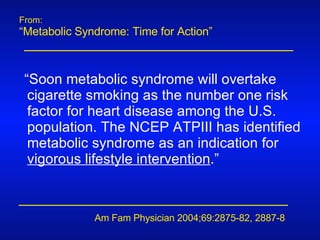
From: “ Metabolic Syndrome: Time for Action” Am Fam Physician 2004;69:2875-82, 2887-8  “ Soon metabolic syndrome will overtake cigarette smoking as the number one risk factor for heart disease among the U.S. population. The NCEP ATPIII has identified metabolic syndrome as an indication for  vigorous lifestyle intervention .”
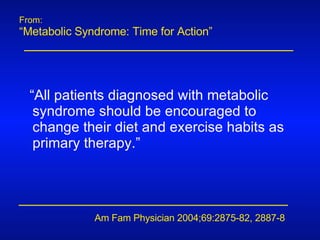
From: “ Metabolic Syndrome: Time for Action” Am Fam Physician 2004;69:2875-82, 2887-8  “ All patients diagnosed with metabolic syndrome should be encouraged to change their diet and exercise habits as primary therapy.”
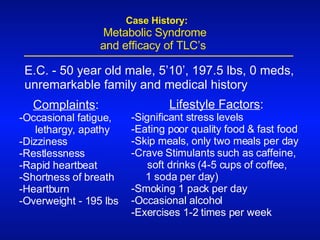
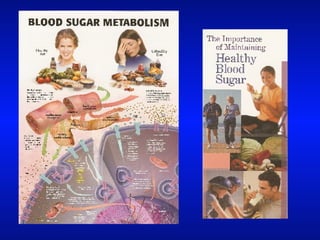
Case History:   Metabolic Syndrome    and efficacy of TLC’s Complaints : -Occasional fatigue, lethargy, apathy -Dizziness -Restlessness -Rapid heartbeat -Shortness of breath -Heartburn -Overweight - 195 lbs Lifestyle Factors : -Significant stress levels -Eating poor quality food & fast food  -Skip meals, only two meals per day -Crave Stimulants such as caffeine, soft drinks (4-5 cups of coffee,  1 soda per day) -Smoking 1 pack per day -Occasional alcohol -Exercises 1-2 times per week E.C. - 50 year old male, 5’10’, 197.5 lbs, 0 meds, unremarkable family and medical history
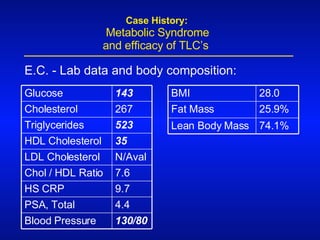
E.C. - Lab data and body composition:   Case History:   Metabolic Syndrome    and efficacy of TLC’s 130/80 Blood Pressure 4.4 PSA, Total 9.7 HS CRP 7.6 Chol / HDL Ratio N/Aval LDL Cholesterol 35 HDL Cholesterol 523 Triglycerides 267 Cholesterol 143 Glucose 74.1% Lean Body Mass 25.9% Fat Mass 28.0 BMI
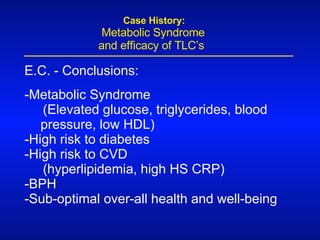
-Metabolic Syndrome (Elevated glucose, triglycerides, blood pressure, low HDL) -High risk to diabetes  -High risk to CVD (hyperlipidemia, high HS CRP) -BPH -Sub-optimal over-all health and well-being E.C. - Conclusions:    Case History:   Metabolic Syndrome    and efficacy of TLC’s
 
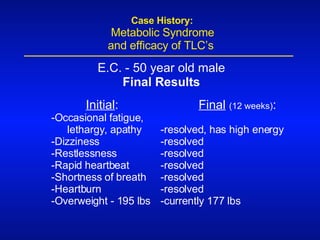
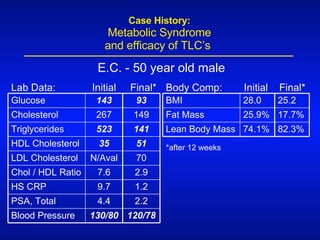
Initial : -Occasional fatigue, lethargy, apathy -Dizziness -Restlessness -Rapid heartbeat -Shortness of breath -Heartburn -Overweight - 195 lbs Final   (12 weeks) : -resolved, has high energy -resolved -resolved -resolved -resolved -resolved -currently 177 lbs E.C. - 50 year old male Final Results   Case History:   Metabolic Syndrome    and efficacy of TLC’s
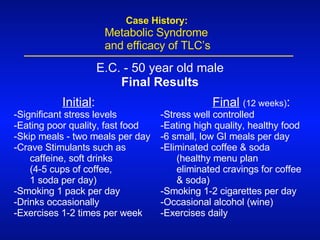
Initial : -Significant stress levels -Eating poor quality, fast food  -Skip meals - two meals per day -Crave Stimulants such as caffeine, soft drinks  (4-5 cups of coffee,  1 soda per day) -Smoking 1 pack per day -Drinks occasionally -Exercises 1-2 times per week E.C. - 50 year old male Final Results Final   (12 weeks) : -Stress well controlled -Eating high quality, healthy food  -6 small, low GI meals per day -Eliminated coffee & soda  (healthy menu plan eliminated cravings for coffee & soda) -Smoking 1-2 cigarettes per day -Occasional alcohol (wine) -Exercises daily   Case History:   Metabolic Syndrome    and efficacy of TLC’s
E.C. - 50 year old male Lab Data:   Initial  Final* Body Comp:   Initial  Final* *after 12 weeks   Case History:   Metabolic Syndrome    and efficacy of TLC’s 130/80 Blood Pressure 4.4 PSA, Total 9.7 HS CRP 7.6 Chol / HDL Ratio N/Aval LDL Cholesterol 35 HDL Cholesterol 523 Triglycerides 267 Cholesterol 143 Glucose 74.1% Lean Body Mass 25.9% Fat Mass 28.0 BMI 120/78 2.2 1.2 2.9 70 51 141 149 93 82.3% 17.7% 25.2
FOOD FUN FACT! Inadequate intake of B-12 is more common than previously thought… A new study showed that most people are 40% deficient in the vitamin Low amounts of B-12 damages the nervous system, resulting in loss of feeling & balance. It can also lead to dementia  
FOOD FUN FACT!  Back to Back Omega-3 Fatty Acids: Help protect the brain against plaque build-up that can lead to cognitive decline and Alzheimer’s disease. *Also, Omega-3 fatty acids also protect CV health by decreasing the risk of a heart attack.


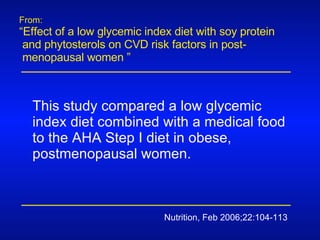
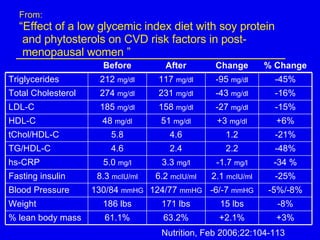
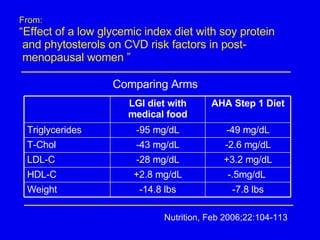
From: “ Effect of a low glycemic index diet with soy protein  and phytosterols on CVD risk factors in post-  menopausal women ” Nutrition, Feb 2006;22:104-113 This study compared a low glycemic index diet combined with a medical food to the AHA Step I diet in obese, postmenopausal women.
From: “ Effect of a low glycemic index diet with soy protein  and phytosterols on CVD risk factors in post-  menopausal women ” Nutrition, Feb 2006;22:104-113 +3% +2.1% 63.2% 61.1% % lean body mass -8% 15 lbs 171 lbs 186 lbs Weight -5%/-8% -6/-7  mmHG 124/77  mmHG 130/84  mmHG Blood Pressure -25% 2.1  mcIU/ml 6.2  mcIU/ml 8.3  mcIU/ml Fasting insulin -34 % -1.7  mg/l 3.3  mg/l 5.0  mg/l hs-CRP -48% 2.2 2.4 4.6 TG/HDL-C -21% 1.2 4.6 5.8 tChol/HDL-C +6% +3  mg/dl 51  mg/dl 48  mg/dl HDL-C -15% -27  mg/dl 158  mg/dl 185  mg/dl LDL-C -16% -43  mg/dl 231  mg/dl 274  mg/dl Total Cholesterol -45% -95  mg/dl 117  mg/dl 212  mg/dl Triglycerides % Change Change After Before
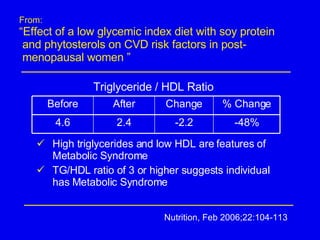
  Triglyceride / HDL Ratio  From: “ Effect of a low glycemic index diet with soy protein  and phytosterols on CVD risk factors in post-  menopausal women ” Nutrition, Feb 2006;22:104-113 High triglycerides and low HDL are features of Metabolic Syndrome TG/HDL ratio of 3 or higher suggests individual has Metabolic Syndrome % Change Change After Before -48% -2.2 2.4 4.6
  Comparing Arms  From: “ Effect of a low glycemic index diet with soy protein  and phytosterols on CVD risk factors in post-  menopausal women ” Nutrition, Feb 2006;22:104-113 -7.8 lbs -14.8 lbs Weight -.5mg/dL  +2.8 mg/dL HDL-C +3.2 mg/dL -28 mg/dL LDL-C -2.6 mg/dL -43 mg/dL T-Chol -49 mg/dL -95 mg/dL Triglycerides AHA Step 1 Diet LGI diet with medical food
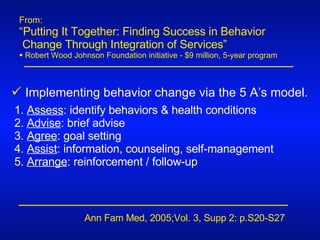
From: “ Putting It Together: Finding Success in Behavior  Change Through Integration of Services” Robert Wood Johnson Foundation initiative - $9 million, 5-year program Ann Fam Med, 2005;Vol. 3, Supp 2: p.S20-S27  Implementing behavior change via the 5 A’s model.   1.  Assess : identify behaviors & health conditions 2.  Advise : brief advise 3.  Agree : goal setting 4.  Assist : information, counseling, self-management 5.  Arrange : reinforcement / follow-up
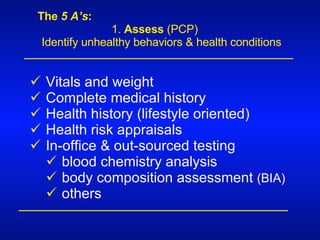
The  5 A’s : 1.  Assess  (PCP) Identify unhealthy behaviors & health conditions Vitals and weight Complete medical history Health history (lifestyle oriented) Health risk appraisals In-office & out-sourced testing blood chemistry analysis body composition assessment  (BIA) others
 
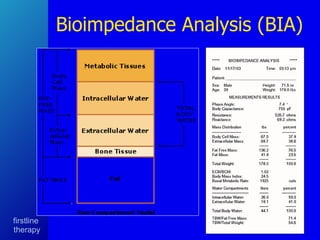
Bioimpedance Analysis (BIA) firstline  therapy
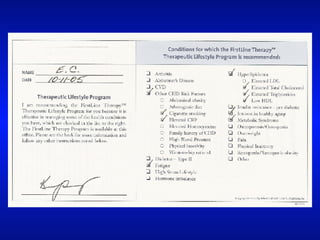
The  5 A’s : 2.  Advise  (PCP) Offer brief advise Brief, general advise Brief motivational interviewing Behavior prescription Prescribe TLC program Schedule patient visit for TLC  counseling with selected staff  member
 
From: “ Putting It Together: Finding Success in Behavior  Change Through Integration of Services” Robert Wood Johnson Foundation initiative - $9 million, 5-year program Ann Fam Med, 2005;Vol. 3, Supp 2: p.S20-S27  “… these first steps can be leveraged into more effective interventions if they (PCP’s) connect patients with professionals (staff) and programs -  within  or outside the office - that can provide more extensive follow-up.”
From: “ Putting It Together: Finding Success in Behavior  Change Through Integration of Services” Robert Wood Johnson Foundation initiative - $9 million, 5-year program Ann Fam Med, 2005;Vol. 3, Supp 2: p.S20-S27  “… these resources should work in concert with primary care professionals in a team approach, reporting to and consulting with clinicians as counseling progresses, and integrating follow-up into ongoing health care.”
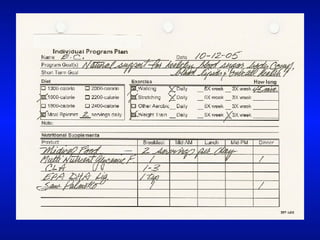
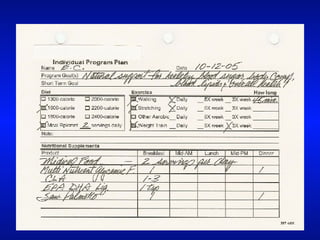
The  5 A’s : 3.  Agree  (Staff) Set collaborative goals and action plans Collaborate with patient to establish an action plan  Create and document weekly written goals Review Dr’s prescription and intake data as basis for collaboration Use individual program plan or  personal contract to create action plan
 
 
The  5 A’s : 4.  Assist  (Staff) Provide more information, counseling, self help tools Menu plan Food diary  Handouts TLC guidebook Activity log In office coaches/counselors


The  5 A’s : 5.  Arrange  (Staff) Arrange follow-up and reinforcement Follow-up visits Email & telephone follow-up Wellness concierge  Group sessions & support, when requested
 
 
Benefits of a System for TLC’s Meets patient demand, is cost effective Many of our patients don’t want to take meds   Applies national guidelines Allows us to do what we already know we should be doing Produces superior clinical outcomes Addresses underlying cause of problem Addresses broad range of health problems unlike single drugs Provides the needed tools & information Saves practitioners time Utilizes integration of PCP and staff
 
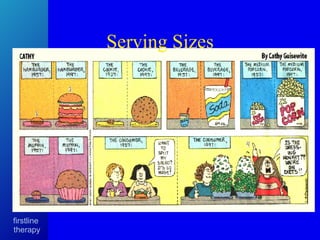
Serving Sizes firstline  therapy
FirstLine Therapy Schedule your “new, healthier you” today… Back to Health 450 Chauncy Street, Suite 2 Mansfield, MA  (508) 339 - 7788

Flt Public Pres

  • 1.
    Achieve Vibrant Health& Well-Being With Therapeutic Lifestyle Changes Presented by: Dr. Sarah Corcoran, DC, FLT cp Rebecca Sauer, FLT Certified Practioner & featuring Chris from Metagenics Back To Health Chiropractic 450 Chauncy St., Mansfield
  • 2.
    From: ACS / ADA / AHA Scientific Statement Preventing Cancer, Cardiovascular Disease, and Diabetes A common Agenda for the American Cancer Society, the American Diabetes Association, and the American Heart Association Circulation 2004;109:3244-3255 Cardiovascular disease, cancer, and diabetes account for nearly 2 of every 3 deaths in the US At a cost of $700 billion “ While healthcare costs skyrocket, the national investment in prevention was estimated at less than 3% of the total annual healthcare expenditures.”
  • 3.
    From: ACS / ADA / AHA Scientific Statement Preventing Cancer, Cardiovascular Disease, and Diabetes A common Agenda for the American Cancer Society, the American Diabetes Association, and the American Heart Association” Circulation 2004;109:3244-3255 “ In spite of hundreds of medical studies, media reports and advice from health officials, Americans still have not got the message that they can prevent most cases of chronic disease.” – John Seffrin, American Cancer Society CEO
  • 4.
    From: “ Effectivenessof Therapeutic Lifestyle Changes in Patients With Hypertension, Hyperlipidemia, and/or Hyperglycemia” American Journal of Cardiology 2004;94:1558-1561 “ National clinical guidelines recommend therapeutic lifestyle changes as a standard of care in the management of conventional risk factors (for coronary heart disease).”
  • 5.
    From: “ Effectivenessof Therapeutic Lifestyle Changes in Patients With Hypertension, Hyperlipidemia, and/or Hyperglycemia” American Journal of Cardiology 2004;94:1558-1561 “… the findings clearly show that many patients who have conventional risk factors for coronary heart disease can achieve goal levels without medications within 12 weeks of initiating therapeutic lifestyle changes…”
  • 6.
    From: “ Effectivenessof Therapeutic Lifestyle Changes in Patients With Hypertension, Hyperlipidemia, and/or Hyperglycemia” American Journal of Cardiology 2004;94:1558-1561 “ Moreover, therapeutic lifestyle changes can generally be implemented less expensively than most medications and, unlike single drug therapy, favorably impacts multiple cardiovascular disease risk factors.”
  • 7.
  • 8.
    FOOD FUN FACT!EAT A R A I N B O W EVERYDAY!!! Colorful fruits & vegetables deliver healthful doses of vitamins, minerals, and disease fighting phytochemicals. The darker the color of the fruit or vegetable, the more nutrients it contains…
  • 9.
    National Health Organizationsrecommended Therapeutic Lifestyle Changes (TLC) as a “first line” treatment National Health Orgs. National Institutes of Health Am. Heart, Blood & Lung Institute Am. Diabetes Association Am. Heart Association Am. Association Clinical Endocrinologists Arthritis Foundation North American Menopause Society Many others Conditions High Cholesterol High Blood Pressure High Blood Sugar and/or Diabetes Heart Disease Osteoarthritis Osteoporosis Metabolic Syndrome Menopausal symptoms Many others
  • 10.
    From: ACS / ADA / AHA Scientific Statement Preventing Cancer, Cardiovascular Disease, and Diabetes A common Agenda for the American Cancer Society, the American Diabetes Association, and the American Heart Association Circulation 2004;109:3244-3255 “ At present, preventive health receives only sporadic attention, in the context of office visits for acute and chronic medical problems. Health care providers and medical organizations must transform this model into systems that provide preventive care and early detection as an integral part of standard medical practice .”
  • 11.
    Presentation Objective Reviewthe system we use to provide Therapeutic Lifestyle Changes (TLC’s) Our system is: Supported by research Clinically effective Realistic and manageable Fulfilling for us & our patients
  • 12.
    From: AHA / NHLBI Scientific Statement “ Diagnosis and Management of the Metabolic Syndrome” An American Heart Association / National Heart, Lung, Blood Institute Scientific Statement Metabolic Syndrome confers: A 2-fold increase in relative risk for ASCVD events. A 5-fold increase in risk for developing DM-II in individuals without established diabetes. “ This finding implies that the metabolic syndrome imparts a relatively high long-term risk for both ASCVD and diabetes.” Circulation 2005;112:000-000 @www.circulationaha.org
  • 13.
    From: “ Prevalenceof the Metabolic Syndrome Defined by the International Diabetes Federation Among Adults in the U.S.” Diabetes Care 2005;28:2745-2749 “… almost 40% of U.S. adults were classified as having the metabolic syndrome...”
  • 14.
    FOOD FUN FACT!Regular Family Meals encourage healthy eating habits & reduce the risk of eating disorders according to results of a new study.
  • 15.
    From: “ MetabolicSyndrome in Normal-Weight Americans New definition of the metabolically obese, normal weight individual Diabetes Care 2004;27:2222-2228 “ Individuals in the upper normal-weight and slightly overweight BMI range have a relatively high prevalence and are at increased risk of having the metabolic syndrome. Therefore, screening in individuals with normal or slightly elevated BMI is important in the prevention of diabetes and cardiovascular disease.”
  • 16.
    From: “ MetabolicSyndrome: Time for Action” Am Fam Physician 2004;69:2875-82, 2887-8 “ Soon metabolic syndrome will overtake cigarette smoking as the number one risk factor for heart disease among the U.S. population. The NCEP ATPIII has identified metabolic syndrome as an indication for vigorous lifestyle intervention .”
  • 17.
    From: “ MetabolicSyndrome: Time for Action” Am Fam Physician 2004;69:2875-82, 2887-8 “ All patients diagnosed with metabolic syndrome should be encouraged to change their diet and exercise habits as primary therapy.”
  • 18.
    Case History: Metabolic Syndrome and efficacy of TLC’s Complaints : -Occasional fatigue, lethargy, apathy -Dizziness -Restlessness -Rapid heartbeat -Shortness of breath -Heartburn -Overweight - 195 lbs Lifestyle Factors : -Significant stress levels -Eating poor quality food & fast food -Skip meals, only two meals per day -Crave Stimulants such as caffeine, soft drinks (4-5 cups of coffee, 1 soda per day) -Smoking 1 pack per day -Occasional alcohol -Exercises 1-2 times per week E.C. - 50 year old male, 5’10’, 197.5 lbs, 0 meds, unremarkable family and medical history
  • 19.
    E.C. - Labdata and body composition: Case History: Metabolic Syndrome and efficacy of TLC’s 130/80 Blood Pressure 4.4 PSA, Total 9.7 HS CRP 7.6 Chol / HDL Ratio N/Aval LDL Cholesterol 35 HDL Cholesterol 523 Triglycerides 267 Cholesterol 143 Glucose 74.1% Lean Body Mass 25.9% Fat Mass 28.0 BMI
  • 20.
    -Metabolic Syndrome (Elevatedglucose, triglycerides, blood pressure, low HDL) -High risk to diabetes -High risk to CVD (hyperlipidemia, high HS CRP) -BPH -Sub-optimal over-all health and well-being E.C. - Conclusions: Case History: Metabolic Syndrome and efficacy of TLC’s
  • 21.
  • 22.
    Initial : -Occasionalfatigue, lethargy, apathy -Dizziness -Restlessness -Rapid heartbeat -Shortness of breath -Heartburn -Overweight - 195 lbs Final (12 weeks) : -resolved, has high energy -resolved -resolved -resolved -resolved -resolved -currently 177 lbs E.C. - 50 year old male Final Results Case History: Metabolic Syndrome and efficacy of TLC’s
  • 23.
    Initial : -Significantstress levels -Eating poor quality, fast food -Skip meals - two meals per day -Crave Stimulants such as caffeine, soft drinks (4-5 cups of coffee, 1 soda per day) -Smoking 1 pack per day -Drinks occasionally -Exercises 1-2 times per week E.C. - 50 year old male Final Results Final (12 weeks) : -Stress well controlled -Eating high quality, healthy food -6 small, low GI meals per day -Eliminated coffee & soda (healthy menu plan eliminated cravings for coffee & soda) -Smoking 1-2 cigarettes per day -Occasional alcohol (wine) -Exercises daily Case History: Metabolic Syndrome and efficacy of TLC’s
  • 24.
    E.C. - 50year old male Lab Data: Initial Final* Body Comp: Initial Final* *after 12 weeks Case History: Metabolic Syndrome and efficacy of TLC’s 130/80 Blood Pressure 4.4 PSA, Total 9.7 HS CRP 7.6 Chol / HDL Ratio N/Aval LDL Cholesterol 35 HDL Cholesterol 523 Triglycerides 267 Cholesterol 143 Glucose 74.1% Lean Body Mass 25.9% Fat Mass 28.0 BMI 120/78 2.2 1.2 2.9 70 51 141 149 93 82.3% 17.7% 25.2
  • 25.
    FOOD FUN FACT!Inadequate intake of B-12 is more common than previously thought… A new study showed that most people are 40% deficient in the vitamin Low amounts of B-12 damages the nervous system, resulting in loss of feeling & balance. It can also lead to dementia 
  • 26.
    FOOD FUN FACT! Back to Back Omega-3 Fatty Acids: Help protect the brain against plaque build-up that can lead to cognitive decline and Alzheimer’s disease. *Also, Omega-3 fatty acids also protect CV health by decreasing the risk of a heart attack.
  • 27.
  • 28.
  • 29.
  • 30.
  • 31.
  • 32.
  • 33.
  • 34.
  • 35.
    From: “ Effectof a low glycemic index diet with soy protein and phytosterols on CVD risk factors in post- menopausal women ” Nutrition, Feb 2006;22:104-113 This study compared a low glycemic index diet combined with a medical food to the AHA Step I diet in obese, postmenopausal women.
  • 36.
    From: “ Effectof a low glycemic index diet with soy protein and phytosterols on CVD risk factors in post- menopausal women ” Nutrition, Feb 2006;22:104-113 +3% +2.1% 63.2% 61.1% % lean body mass -8% 15 lbs 171 lbs 186 lbs Weight -5%/-8% -6/-7 mmHG 124/77 mmHG 130/84 mmHG Blood Pressure -25% 2.1 mcIU/ml 6.2 mcIU/ml 8.3 mcIU/ml Fasting insulin -34 % -1.7 mg/l 3.3 mg/l 5.0 mg/l hs-CRP -48% 2.2 2.4 4.6 TG/HDL-C -21% 1.2 4.6 5.8 tChol/HDL-C +6% +3 mg/dl 51 mg/dl 48 mg/dl HDL-C -15% -27 mg/dl 158 mg/dl 185 mg/dl LDL-C -16% -43 mg/dl 231 mg/dl 274 mg/dl Total Cholesterol -45% -95 mg/dl 117 mg/dl 212 mg/dl Triglycerides % Change Change After Before
  • 37.
    Triglyceride/ HDL Ratio From: “ Effect of a low glycemic index diet with soy protein and phytosterols on CVD risk factors in post- menopausal women ” Nutrition, Feb 2006;22:104-113 High triglycerides and low HDL are features of Metabolic Syndrome TG/HDL ratio of 3 or higher suggests individual has Metabolic Syndrome % Change Change After Before -48% -2.2 2.4 4.6
  • 38.
    ComparingArms From: “ Effect of a low glycemic index diet with soy protein and phytosterols on CVD risk factors in post- menopausal women ” Nutrition, Feb 2006;22:104-113 -7.8 lbs -14.8 lbs Weight -.5mg/dL +2.8 mg/dL HDL-C +3.2 mg/dL -28 mg/dL LDL-C -2.6 mg/dL -43 mg/dL T-Chol -49 mg/dL -95 mg/dL Triglycerides AHA Step 1 Diet LGI diet with medical food
  • 39.
    From: “ PuttingIt Together: Finding Success in Behavior Change Through Integration of Services” Robert Wood Johnson Foundation initiative - $9 million, 5-year program Ann Fam Med, 2005;Vol. 3, Supp 2: p.S20-S27 Implementing behavior change via the 5 A’s model. 1. Assess : identify behaviors & health conditions 2. Advise : brief advise 3. Agree : goal setting 4. Assist : information, counseling, self-management 5. Arrange : reinforcement / follow-up
  • 40.
    The 5A’s : 1. Assess (PCP) Identify unhealthy behaviors & health conditions Vitals and weight Complete medical history Health history (lifestyle oriented) Health risk appraisals In-office & out-sourced testing blood chemistry analysis body composition assessment (BIA) others
  • 41.
  • 42.
    Bioimpedance Analysis (BIA)firstline therapy
  • 43.
    The 5A’s : 2. Advise (PCP) Offer brief advise Brief, general advise Brief motivational interviewing Behavior prescription Prescribe TLC program Schedule patient visit for TLC counseling with selected staff member
  • 44.
  • 45.
    From: “ PuttingIt Together: Finding Success in Behavior Change Through Integration of Services” Robert Wood Johnson Foundation initiative - $9 million, 5-year program Ann Fam Med, 2005;Vol. 3, Supp 2: p.S20-S27 “… these first steps can be leveraged into more effective interventions if they (PCP’s) connect patients with professionals (staff) and programs - within or outside the office - that can provide more extensive follow-up.”
  • 46.
    From: “ PuttingIt Together: Finding Success in Behavior Change Through Integration of Services” Robert Wood Johnson Foundation initiative - $9 million, 5-year program Ann Fam Med, 2005;Vol. 3, Supp 2: p.S20-S27 “… these resources should work in concert with primary care professionals in a team approach, reporting to and consulting with clinicians as counseling progresses, and integrating follow-up into ongoing health care.”
  • 47.
    The 5A’s : 3. Agree (Staff) Set collaborative goals and action plans Collaborate with patient to establish an action plan Create and document weekly written goals Review Dr’s prescription and intake data as basis for collaboration Use individual program plan or personal contract to create action plan
  • 48.
  • 49.
  • 50.
    The 5A’s : 4. Assist (Staff) Provide more information, counseling, self help tools Menu plan Food diary Handouts TLC guidebook Activity log In office coaches/counselors
  • 51.
  • 52.
  • 53.
  • 54.
  • 55.
  • 56.
    The 5A’s : 5. Arrange (Staff) Arrange follow-up and reinforcement Follow-up visits Email & telephone follow-up Wellness concierge Group sessions & support, when requested
  • 57.
  • 58.
  • 59.
    Benefits of aSystem for TLC’s Meets patient demand, is cost effective Many of our patients don’t want to take meds Applies national guidelines Allows us to do what we already know we should be doing Produces superior clinical outcomes Addresses underlying cause of problem Addresses broad range of health problems unlike single drugs Provides the needed tools & information Saves practitioners time Utilizes integration of PCP and staff
  • 60.
  • 61.
  • 62.
    FirstLine Therapy Scheduleyour “new, healthier you” today… Back to Health 450 Chauncy Street, Suite 2 Mansfield, MA (508) 339 - 7788