11
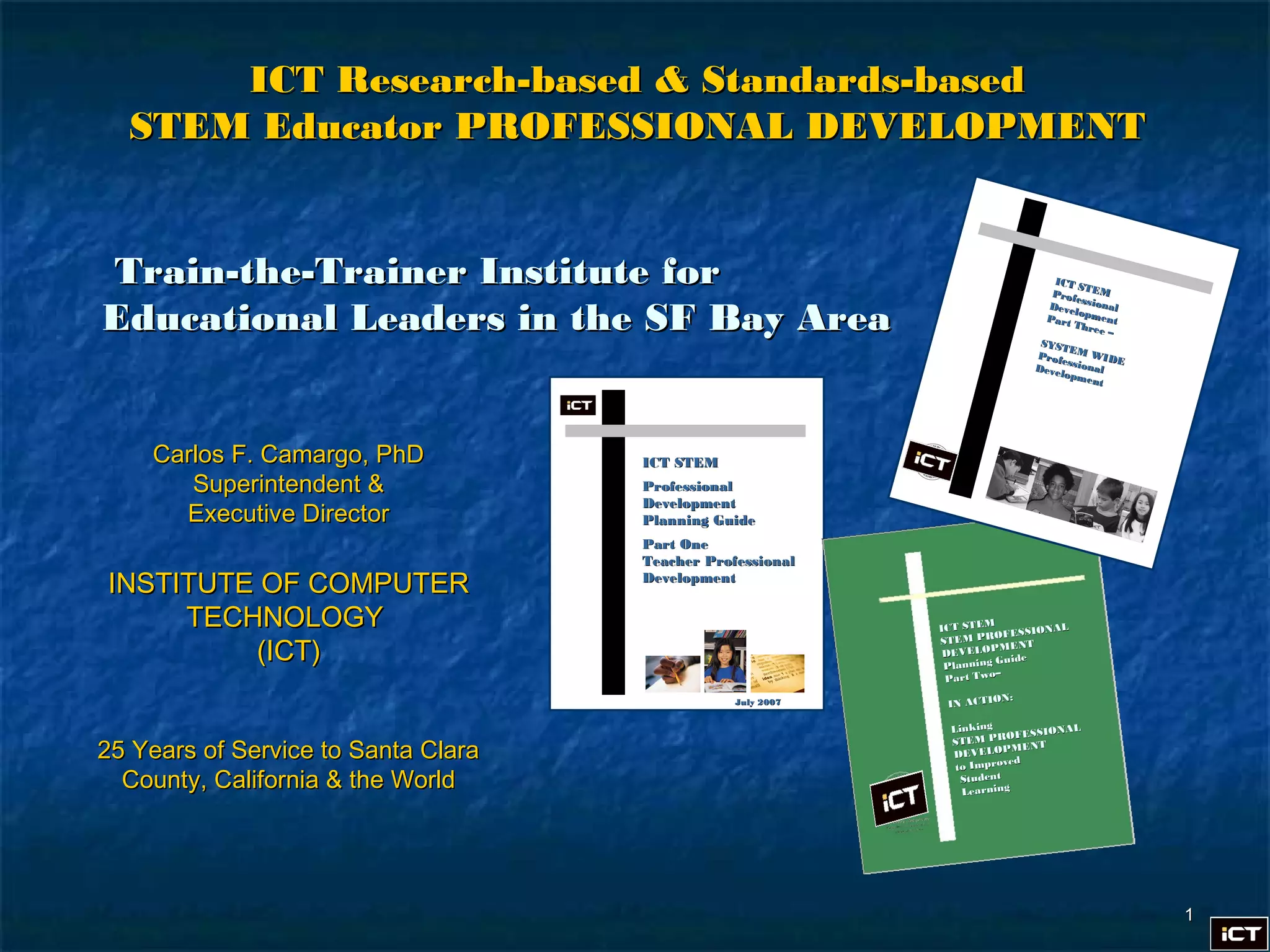
ICT Research-based & Standards-basedICT Research-based & Standards-based
STEM Educator PROFESSIONAL DEVELOPMENTSTEM Educator PROFESSIONAL DEVELOPMENT
Carlos F. Camargo, PhDCarlos F. Camargo, PhD
Superintendent &Superintendent &
Executive DirectorExecutive Director
INSTITUTE OF COMPUTERINSTITUTE OF COMPUTER
TECHNOLOGYTECHNOLOGY
(ICT)(ICT)
25 Years of Service to Santa Clara25 Years of Service to Santa Clara
County, California & the WorldCounty, California & the World
ICT STEMICT STEM
ProfessionalProfessional
DevelopmentDevelopment
Planning GuidePlanning Guide
Part OnePart One
Teacher ProfessionalTeacher Professional
DevelopmentDevelopment
July 2007July 2007
ICT STEMICT STEM
STEM PROFESSIONAL
STEM PROFESSIONAL
DEVELOPMENT
DEVELOPMENT
Planning Guide
Planning Guide
Part Two–Part Two–
IN ACTION:
IN ACTION:
LinkingLinking
STEM PROFESSIONAL
STEM PROFESSIONAL
DEVELOPMENT
DEVELOPMENT
to Improved
to Improved
StudentStudent
LearningLearning
ICT STEM
ICT STEMProfessional
ProfessionalDevelopment
DevelopmentPart Three –
Part Three –
SYSTEM WIDE
SYSTEM WIDEProfessional
ProfessionalDevelopment
Development
Train-the-Trainer Institute forTrain-the-Trainer Institute for
Educational Leaders in the SF Bay AreaEducational Leaders in the SF Bay Area
22
Today’s AgendaToday’s Agenda
 A whirlwind tour throughA whirlwind tour through
ICT STEM educationICT STEM education
research (we promise!)research (we promise!)
 So, now what?So, now what?
 Selecting a structural goalSelecting a structural goal
 Selecting a STEM Content goalSelecting a STEM Content goal
 Selecting a learning process goalSelecting a learning process goal
 Designing STEM PROFESSIONALDesigning STEM PROFESSIONAL
DEVELOPMENTDEVELOPMENT
 ICT STEM resourcesICT STEM resources
33
Why is STEM PROFESSIONALWhy is STEM PROFESSIONAL
DEVELOPMENT so important?DEVELOPMENT so important?
The most critical factor inThe most critical factor in
a child’s education is aa child’s education is a
caring, qualified, andcaring, qualified, and
competent teachercompetent teacher
- Anonymous- Anonymous
44
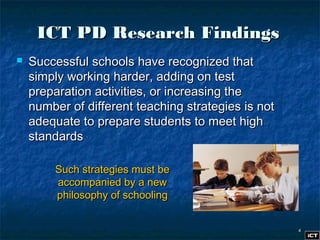
ICT PD Research FindingsICT PD Research Findings
 Successful schools have recognized thatSuccessful schools have recognized that
simply working harder, adding on testsimply working harder, adding on test
preparation activities, or increasing thepreparation activities, or increasing the
number of different teaching strategies is notnumber of different teaching strategies is not
adequate to prepare students to meet highadequate to prepare students to meet high
standardsstandards
Such strategies must beSuch strategies must be
accompanied by a newaccompanied by a new
philosophy of schoolingphilosophy of schooling
55
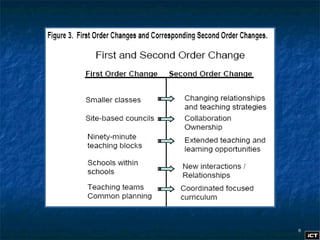
The concept ofThe concept of
first and second order changefirst and second order change
 First order changeFirst order change
 Superficial in nature or arbitrary in adoption such asSuperficial in nature or arbitrary in adoption such as
structural, physical, or administrative changestructural, physical, or administrative change
 Second order changeSecond order change
 A qualitatively different educational experience toA qualitatively different educational experience to
studentsstudents
 changing ideas behind school organization and classroomchanging ideas behind school organization and classroom
practicepractice
 changes to the fundamental beliefs that underlie the schoolchanges to the fundamental beliefs that underlie the school
structure, e.g. – high expectations for every childstructure, e.g. – high expectations for every child
66
77
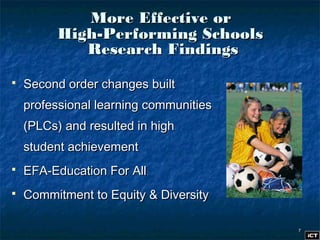
More Effective orMore Effective or
High-Performing SchoolsHigh-Performing Schools
Research FindingsResearch Findings
 Second order changes builtSecond order changes built
professional learning communitiesprofessional learning communities
(PLCs) and resulted in high(PLCs) and resulted in high
student achievementstudent achievement
 EFA-Education For AllEFA-Education For All
 Commitment to Equity & DiversityCommitment to Equity & Diversity
88
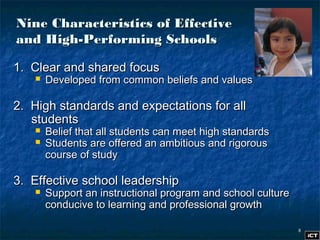
Nine Characteristics of EffectiveNine Characteristics of Effective
and High-Performing Schoolsand High-Performing Schools
1. Clear and shared focus1. Clear and shared focus
 Developed from common beliefs and valuesDeveloped from common beliefs and values
2. High standards and expectations for all2. High standards and expectations for all
studentsstudents
 Belief that all students can meet high standardsBelief that all students can meet high standards
 Students are offered an ambitious and rigorousStudents are offered an ambitious and rigorous
course of studycourse of study
3. Effective school leadership3. Effective school leadership
 Support an instructional program and school cultureSupport an instructional program and school culture
conducive to learning and professional growthconducive to learning and professional growth
99
Nine CharacteristicsNine Characteristics (cont’d)(cont’d)
4. High levels of collaboration and communication4. High levels of collaboration and communication
 Strong teamwork within and between grade levelsStrong teamwork within and between grade levels
 Everybody is involved and connected to each otherEverybody is involved and connected to each other
including partners and members of the communityincluding partners and members of the community
5. Curriculum, instruction, and assessment aligned5. Curriculum, instruction, and assessment aligned
with standardswith standards
 Planned and actual curriculum are aligned to thePlanned and actual curriculum are aligned to the
standardsstandards
 Instruction reflects research baseInstruction reflects research base
1010
Nine CharacteristicsNine Characteristics (cont’d)(cont’d)
6. Frequent monitoring of learning and teaching6. Frequent monitoring of learning and teaching
 Teachers understand what the assessments measureTeachers understand what the assessments measure
 Instruction is adjusted based on the results ofInstruction is adjusted based on the results of
on-going assessmenton-going assessment
 More time is provided to students who need more helpMore time is provided to students who need more help
7. Focused STEM PROFESSIONAL DEVELOPMENT7. Focused STEM PROFESSIONAL DEVELOPMENT
 Strong emphasis is placed on training staffStrong emphasis is placed on training staff
in areas of most needin areas of most need
 Feedback from learning and teaching focuses on extensiveFeedback from learning and teaching focuses on extensive
and on-going STEM PROFESSIONAL DEVELOPMENTand on-going STEM PROFESSIONAL DEVELOPMENT
1111
Nine CharacteristicsNine Characteristics (cont’d)(cont’d)
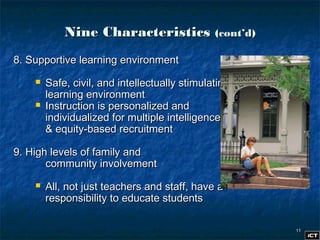
8. Supportive learning environment8. Supportive learning environment
 Safe, civil, and intellectually stimulatingSafe, civil, and intellectually stimulating
learning environmentlearning environment
 Instruction is personalized andInstruction is personalized and
individualized for multiple intelligencesindividualized for multiple intelligences
& equity-based recruitment& equity-based recruitment
9. High levels of family and9. High levels of family and
community involvementcommunity involvement
 All, not just teachers and staff, have aAll, not just teachers and staff, have a
responsibility to educate studentsresponsibility to educate students
1212
Characteristics of ImprovedCharacteristics of Improved
School DistrictsSchool Districts
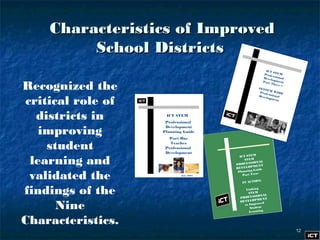
Recognized the
critical role of
districts in
improving
student
learning and
validated the
findings of the
Nine
Characteristics.
ICT STEM
Professional
Development
Planning Guide
Part One
Teacher
Professional
Development
July 2007
ICT STEM
STEM
PROFESSIONAL
DEVELOPMENT
Planning Guide
Part Two–
IN ACTION:
Linking
STEM
PROFESSIONAL
DEVELOPMENT
to Improved
Student
Learning
ICT STEMProfessionalDevelopmentPart Three –
SYSTEM WIDEProfessionalDevelopment
1313
How do you know where to start?How do you know where to start?
Here’s one way…Here’s one way…
 Select three goalsSelect three goals
 StructuralStructural
 STEM ContentSTEM Content
 Learning ProcessLearning Process
1414
Reflect… ShareReflect… Share
Using the “High Standards andUsing the “High Standards and
Expectations for all Students” guidingExpectations for all Students” guiding
questions from the ICT STEM Guide:questions from the ICT STEM Guide:
1.1. Select two questions. Reflect on the answersSelect two questions. Reflect on the answers
based on your school or district;based on your school or district;
2.2. Complete the rubric; andComplete the rubric; and
3.3. Share your answers with a partner.Share your answers with a partner.
1515
So… then what?So… then what?
 First complete the rubrics and select oneFirst complete the rubrics and select one
to work onto work on
 You’ve now defined the priority structuralYou’ve now defined the priority structural
area that research has demonstrated mustarea that research has demonstrated must
be in place in order to achieve andbe in place in order to achieve and
maintain second order changemaintain second order change
1616
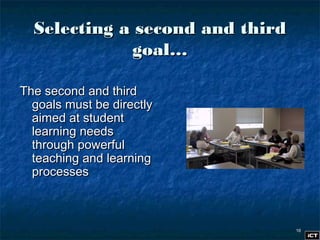
Selecting a second and thirdSelecting a second and third
goal…goal…
The second and thirdThe second and third
goals must be directlygoals must be directly
aimed at studentaimed at student
learning needslearning needs
through powerfulthrough powerful
teaching and learningteaching and learning
processesprocesses
1717
Select a Learning ProcessSelect a Learning Process
Needs GoalNeeds Goal
 Conduct a NeedsConduct a Needs
AssessmentAssessment
 Faculty (and students?)Faculty (and students?)
 Learning Process NeedsLearning Process Needs
AssessmentAssessment
1818
Reflect… ShareReflect… Share
Using the “Learning Process Needs AssessmentUsing the “Learning Process Needs Assessment
Worksheet” (from the STEM PROFESSIONALWorksheet” (from the STEM PROFESSIONAL
DEVELOPMENT Planning Guide – IN ACTION):DEVELOPMENT Planning Guide – IN ACTION):
1.1. Review Component #1 - Students engage inReview Component #1 - Students engage in
challenging curriculumchallenging curriculum
2.2. After watching the video clip of Travis, rate theAfter watching the video clip of Travis, rate the
teacher’s capacity using the Learning Processteacher’s capacity using the Learning Process
Needs Assessment RubricsNeeds Assessment Rubrics
3.3. Share your answers with a partnerShare your answers with a partner
1919
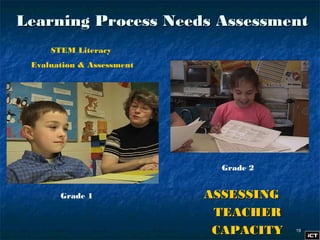
Learning Process Needs AssessmentLearning Process Needs Assessment
ASSESSINGASSESSING
TEACHERTEACHER
CAPACITYCAPACITY
Grade 2
Grade 1
STEM Literacy
Evaluation & Assessment
2020
Do the mathDo the math
Now you haveNow you have oneone
structural goal andstructural goal and
oneone STEM ContentSTEM Content
area goal and onearea goal and one
learning processlearning process
goal….goal….
And that ought to beAnd that ought to be
enough for one year!enough for one year!
2121
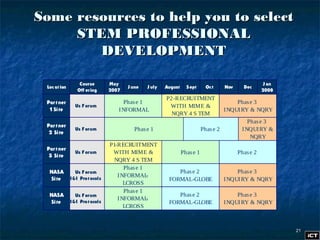
Some resources to help you to selectSome resources to help you to select
STEM PROFESSIONALSTEM PROFESSIONAL
DEVELOPMENTDEVELOPMENT
Loc at ion
Course
Off ering
May
2007
J une J uly August Sept Oct Nov Dec
J an
2008
Partner
1 Site
Us F orum
Phase 1
INFORMAL
P2-RECRUITMENT
WITH MIME &
NQRY 4 S TEM
Phase 3
INQUIRY & NQRY
Partner
2 Site
Us F orum Phase 1 Phase 2
Phase 3
INQUIRY &
NQRY
Partner
3 Site
Us F orum
P1-RECRUITMENT
WITH MIME &
NQRY 4 S TEM
Phase 1 Phase 2
NASA
Site
Us F orum
I&I Protocols
Phase 1
INFORMAL-
LCROSS
Phase 2
FORMAL-GLOBE
Phase 3
INQUIRY & NQRY
NASA
Site
Us F orum
I&I Protocols
Phase 1
INFORMAL-
LCROSS
Phase 2
FORMAL-GLOBE
Phase 3
INQUIRY & NQRY
2222
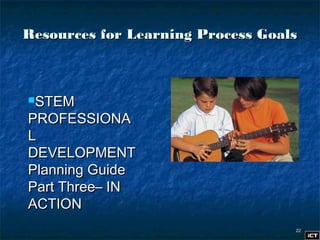
Resources for Learning Process GoalsResources for Learning Process Goals
STEMSTEM
PROFESSIONAPROFESSIONA
LL
DEVELOPMENTDEVELOPMENT
Planning GuidePlanning Guide
Part Three– INPart Three– IN
ACTIONACTION
2323
What do we know aboutWhat do we know about howhow to set upto set up
the STEM PROFESSIONALthe STEM PROFESSIONAL
DEVELOPMENT?DEVELOPMENT?
 STEM STEM PROFESSIONALSTEM STEM PROFESSIONAL
DEVELOPMENT PlanningDEVELOPMENT Planning
Guide Part One – ResearchGuide Part One – Research
Based Practices in STEM STEMBased Practices in STEM STEM
PROFESSIONALPROFESSIONAL
DEVELOPMENT – August 2007DEVELOPMENT – August 2007
2424
Common Experiences in PowerfulCommon Experiences in Powerful
STEM PROFESSIONALSTEM PROFESSIONAL
DEVELOPMENTDEVELOPMENT
 Target PD on student’s needs & dataTarget PD on student’s needs & data
 Customize PD for each educatorCustomize PD for each educator
 Integrate certificationIntegrate certification
 Align with school and district improvement, andAlign with school and district improvement, and
need to close achievement gap & comply withneed to close achievement gap & comply with
Williams equity & access requirementsWilliams equity & access requirements
 Integrate federal requirements-e.g. NCLBIntegrate federal requirements-e.g. NCLB
 Identify effective, research-based PDIdentify effective, research-based PD
 Provide valid & reliable PD evaluationProvide valid & reliable PD evaluation
2525
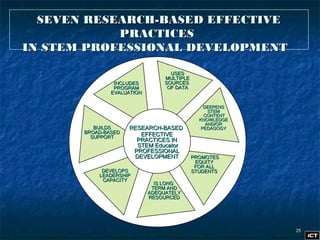
RESEARCH-BASEDRESEARCH-BASED
EFFECTIVEEFFECTIVE
PRACTICES INPRACTICES IN
STEM EducatorSTEM Educator
PROFESSIONALPROFESSIONAL
DEVELOPMENTDEVELOPMENT
DEEPENSDEEPENS
STEMSTEM
CONTENTCONTENT
KNOWLEDGEKNOWLEDGE
AND/ORAND/OR
PEDAGOGYPEDAGOGY
USESUSES
MULTIPLEMULTIPLE
SOURCESSOURCES
OF DATAOF DATA
PROMOTESPROMOTES
EQUITYEQUITY
FOR ALLFOR ALL
STUDENTSSTUDENTS
IS LONGIS LONG
TERM ANDTERM AND
ADEQUATELYADEQUATELY
RESOURCEDRESOURCED
INCLUDESINCLUDES
PROGRAMPROGRAM
EVALUATIONEVALUATION
BUILDSBUILDS
BROAD-BASEDBROAD-BASED
SUPPORTSUPPORT
DEVELOPSDEVELOPS
LEADERSHIPLEADERSHIP
CAPACITYCAPACITY
SEVEN RESEARCH-BASED EFFECTIVESEVEN RESEARCH-BASED EFFECTIVE
PRACTICESPRACTICES
IN STEM PROFESSIONAL DEVELOPMENTIN STEM PROFESSIONAL DEVELOPMENT
2626
1. Uses multiple sources of disaggregated1. Uses multiple sources of disaggregated
student performance data, including statestudent performance data, including state
and local assessments, analysis of studentand local assessments, analysis of student
work, and teacher observation as part of thework, and teacher observation as part of the
process for determining individual andprocess for determining individual and
school learning needsschool learning needs
Seven Effective, Research-based Practices inSeven Effective, Research-based Practices in
STEM PROFESSIONAL DEVELOPMENTSTEM PROFESSIONAL DEVELOPMENT
2727
2. Develops, refines, and deepens educators’2. Develops, refines, and deepens educators’
STEM Content knowledge and pedagogySTEM Content knowledge and pedagogy
3. Builds cultural competence, examines beliefs,3. Builds cultural competence, examines beliefs,
and challenges institutional barriers that act asand challenges institutional barriers that act as
obstacles to equity for all studentsobstacles to equity for all students
Seven Effective, Research-based Practices inSeven Effective, Research-based Practices in
STEM PROFESSIONAL DEVELOPMENTSTEM PROFESSIONAL DEVELOPMENT
2828
4. Uses a coherent, long-term STEM PROFESSIONAL4. Uses a coherent, long-term STEM PROFESSIONAL
DEVELOPMENT process and provides for theDEVELOPMENT process and provides for the
allocation of sufficient time, funds, and materials forallocation of sufficient time, funds, and materials for
full implementationfull implementation
5. Prepares educators to work5. Prepares educators to work
together to build expertisetogether to build expertise
and develop leadership capacityand develop leadership capacity
Seven Effective, Research-based Practices inSeven Effective, Research-based Practices in
STEM PROFESSIONAL DEVELOPMENTSTEM PROFESSIONAL DEVELOPMENT
2929
6. Invites and builds broad-based support of6. Invites and builds broad-based support of
STEM PROFESSIONAL DEVELOPMENT fromSTEM PROFESSIONAL DEVELOPMENT from
all sectors of the organization and communityall sectors of the organization and community
 Incorporates knowledge and skills to appropriatelyIncorporates knowledge and skills to appropriately
involve families and community members as learninginvolve families and community members as learning
partners, and builds widespread commitment topartners, and builds widespread commitment to
continuous learningcontinuous learning
Seven Effective, Research-based Practices inSeven Effective, Research-based Practices in
STEM PROFESSIONAL DEVELOPMENTSTEM PROFESSIONAL DEVELOPMENT
3030
Seven Effective, Research-based Practices inSeven Effective, Research-based Practices in
STEM PROFESSIONAL DEVELOPMENTSTEM PROFESSIONAL DEVELOPMENT
7. Includes strong program evaluation7. Includes strong program evaluation
components based on evidence ofcomponents based on evidence of
improvements in student learning andimprovements in student learning and
teacher practiceteacher practice
 The program evaluation providesThe program evaluation provides
data that informs futuredata that informs future
professional learning plansprofessional learning plans
3131
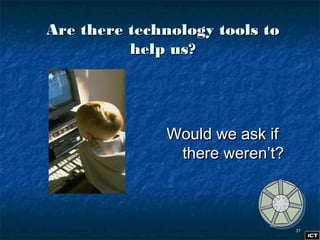
Are there technology tools toAre there technology tools to
help us?help us?
Would we ask ifWould we ask if
there weren’t?there weren’t?
3232
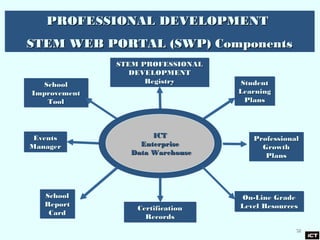
On-Line GradeOn-Line Grade
Level ResourcesLevel Resources
On-Line GradeOn-Line Grade
Level ResourcesLevel Resources
ICTICT
EnterpriseEnterprise
Data WarehouseData Warehouse
ICTICT
EnterpriseEnterprise
Data WarehouseData Warehouse
PROFESSIONAL DEVELOPMENTPROFESSIONAL DEVELOPMENT
STEM WEB PORTAL (SWP) ComponentsSTEM WEB PORTAL (SWP) Components
PROFESSIONAL DEVELOPMENTPROFESSIONAL DEVELOPMENT
STEM WEB PORTAL (SWP) ComponentsSTEM WEB PORTAL (SWP) Components
SchoolSchool
ReportReport
CardCard
SchoolSchool
ReportReport
CardCard
STEM PROFESSIONALSTEM PROFESSIONAL
DEVELOPMENTDEVELOPMENT
RegistryRegistry
STEM PROFESSIONALSTEM PROFESSIONAL
DEVELOPMENTDEVELOPMENT
RegistryRegistry
CertificationCertification
RecordsRecords
CertificationCertification
RecordsRecords
StudentStudent
LearningLearning
PlansPlans
StudentStudent
LearningLearning
PlansPlans
SchoolSchool
ImprovementImprovement
ToolTool
SchoolSchool
ImprovementImprovement
ToolTool
EventsEvents
ManagerManager
EventsEvents
ManagerManager
ProfessionalProfessional
GrowthGrowth
PlansPlans
ProfessionalProfessional
GrowthGrowth
PlansPlans
3333
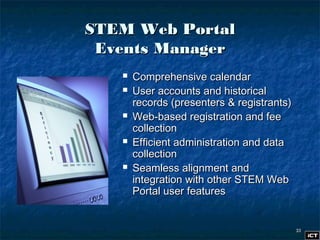
STEM Web PortalSTEM Web Portal
Events ManagerEvents Manager
 Comprehensive calendarComprehensive calendar
 User accounts and historicalUser accounts and historical
records (presenters & registrants)records (presenters & registrants)
 Web-based registration and feeWeb-based registration and fee
collectioncollection
 Efficient administration and dataEfficient administration and data
collectioncollection
 Seamless alignment andSeamless alignment and
integration with other STEM Webintegration with other STEM Web
Portal user featuresPortal user features
3434
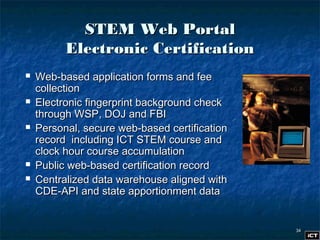
STEM Web PortalSTEM Web Portal
Electronic CertificationElectronic Certification
 Web-based application forms and feeWeb-based application forms and fee
collectioncollection
 Electronic fingerprint background checkElectronic fingerprint background check
through WSP, DOJ and FBIthrough WSP, DOJ and FBI
 Personal, secure web-based certificationPersonal, secure web-based certification
record including ICT STEM course andrecord including ICT STEM course and
clock hour course accumulationclock hour course accumulation
 Public web-based certification recordPublic web-based certification record
 Centralized data warehouse aligned withCentralized data warehouse aligned with
CDE-API and state apportionment dataCDE-API and state apportionment data
3535
STEM Web PortalSTEM Web Portal
Centralized PROFESSIONALCentralized PROFESSIONAL
DEVELOPMENT RegistryDEVELOPMENT Registry
 Database of reporting standards from which toDatabase of reporting standards from which to
create, search, and evaluate PD providers andcreate, search, and evaluate PD providers and
eventsevents
 Web-based two-step evaluation process (end-of-Web-based two-step evaluation process (end-of-
course & job embedded/change)course & job embedded/change)
 Common evaluation tool supporting the sevenCommon evaluation tool supporting the seven
research-based PD practicesresearch-based PD practices
 Detailed evaluation data provided to presenters andDetailed evaluation data provided to presenters and
rating available to publicrating available to public
 Aggregated data used to inform future PDAggregated data used to inform future PD
3636
STEM Web PortalSTEM Web Portal
PD tools connected with and aligned toPD tools connected with and aligned to
State Instructional Plan tools and StudentState Instructional Plan tools and Student
Learning PlansLearning Plans
 PD opportunities searchable based on identifiedPD opportunities searchable based on identified
State Instructional Plan goals and accessibleState Instructional Plan goals and accessible
within web-based State Instructional Plan toolswithin web-based State Instructional Plan tools
 PD opportunities connected to Student LearningPD opportunities connected to Student Learning
Plan needsPlan needs
 Automated school-level and classroom reportsAutomated school-level and classroom reports
aligned with CDE-API dataaligned with CDE-API data
 Aggregated school-level PD needs dataAggregated school-level PD needs data
 Aggregated school and district PD eventAggregated school and district PD event
attendance dataattendance data
3737
STEM Web PortalSTEM Web Portal
PD tools connected with and alignedPD tools connected with and aligned
to on-line Credit, PLU and CEUto on-line Credit, PLU and CEU
 CEU and PLU offerings used to recruit,CEU and PLU offerings used to recruit,
engage, and employ STEM TEAM Trainersengage, and employ STEM TEAM Trainers
& STEM Partners, LEAs & PD providers& STEM Partners, LEAs & PD providers
 Web-based lesson plansWeb-based lesson plans
 Self assessment tools and CSRS dataSelf assessment tools and CSRS data
 Curriculum alignment toolsCurriculum alignment tools
 Diagnostic assessmentsDiagnostic assessments
 Intervention strategiesIntervention strategies
 WASL training materialsWASL training materials
 Video streaming of model lessonsVideo streaming of model lessons
3838
STEM Web PortalSTEM Web Portal
STEM PROFESSIONAL DEVELOPMENTSTEM PROFESSIONAL DEVELOPMENT
Growth PlannerGrowth Planner
 Secure, web-based centralized portfolioSecure, web-based centralized portfolio
for administrators, teachers, ESAs, paraeducators, andfor administrators, teachers, ESAs, paraeducators, and
pre-service teacherspre-service teachers
 Automated self assessment toolsAutomated self assessment tools
 Aligned with pre-service and certification requirementsAligned with pre-service and certification requirements
and PGP criteriaand PGP criteria
 Web-based communication tools, along with Web 2.0Web-based communication tools, along with Web 2.0
social networking tools (e.g. blogs, wikis, codelets, javasocial networking tools (e.g. blogs, wikis, codelets, java
apps including group lists and attachmentsapps including group lists and attachments
3939
Reflect…. ShareReflect…. Share
 So, now what?So, now what?
 What did you learn in today’s session?What did you learn in today’s session?
 How will you use what we’ve discussedHow will you use what we’ve discussed
today within the next two weeks?today within the next two weeks?
4040
ContactContact
Information:Information:
THANKS YOU!THANKS YOU!
Carlos Camargo, PhDCarlos Camargo, PhD
ICT SuperintendentICT Superintendent
Phone: 408-736-4291Phone: 408-736-4291
email: CCamargo@ICT.orgemail: CCamargo@ICT.org
Tim DirksTim Dirks
ICT Curriculum DirectorICT Curriculum Director
STEM Learning & TeachingSTEM Learning & Teaching
email:email: tdirks@ICT.orgtdirks@ICT.org
www.ICT.orgwww.ICT.org
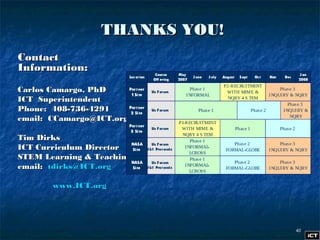
Loc at ion
Course
Off ering
May
2007
J une J uly August Sept Oct Nov Dec
J an
2008
Partner
1 Site
Us Forum
Phase 1
INFORMAL
P2-RECRUITMENT
WITH MIME &
NQRY 4 S TEM
Phase 3
INQUIRY & NQRY
Partner
2 Site
Us Forum Phase 1 Phase 2
Phase 3
INQUIRY &
NQRY
Partner
3 Site
Us Forum
P1-RECRUITMENT
WITH MIME &
NQRY 4 S TEM
Phase 1 Phase 2
NASA
Site
Us Forum
I&I Protocols
Phase 1
INFORMAL-
LCROSS
Phase 2
FORMAL-GLOBE
Phase 3
INQUIRY & NQRY
NASA
Site
Us Forum
I&I Protocols
Phase 1
INFORMAL-
LCROSS
Phase 2
FORMAL-GLOBE
Phase 3
INQUIRY & NQRY

ProfDevTrainingResearch

  • 1.
    11 ICT Research-based &Standards-basedICT Research-based & Standards-based STEM Educator PROFESSIONAL DEVELOPMENTSTEM Educator PROFESSIONAL DEVELOPMENT Carlos F. Camargo, PhDCarlos F. Camargo, PhD Superintendent &Superintendent & Executive DirectorExecutive Director INSTITUTE OF COMPUTERINSTITUTE OF COMPUTER TECHNOLOGYTECHNOLOGY (ICT)(ICT) 25 Years of Service to Santa Clara25 Years of Service to Santa Clara County, California & the WorldCounty, California & the World ICT STEMICT STEM ProfessionalProfessional DevelopmentDevelopment Planning GuidePlanning Guide Part OnePart One Teacher ProfessionalTeacher Professional DevelopmentDevelopment July 2007July 2007 ICT STEMICT STEM STEM PROFESSIONAL STEM PROFESSIONAL DEVELOPMENT DEVELOPMENT Planning Guide Planning Guide Part Two–Part Two– IN ACTION: IN ACTION: LinkingLinking STEM PROFESSIONAL STEM PROFESSIONAL DEVELOPMENT DEVELOPMENT to Improved to Improved StudentStudent LearningLearning ICT STEM ICT STEMProfessional ProfessionalDevelopment DevelopmentPart Three – Part Three – SYSTEM WIDE SYSTEM WIDEProfessional ProfessionalDevelopment Development Train-the-Trainer Institute forTrain-the-Trainer Institute for Educational Leaders in the SF Bay AreaEducational Leaders in the SF Bay Area
  • 2.
    22 Today’s AgendaToday’s Agenda A whirlwind tour throughA whirlwind tour through ICT STEM educationICT STEM education research (we promise!)research (we promise!)  So, now what?So, now what?  Selecting a structural goalSelecting a structural goal  Selecting a STEM Content goalSelecting a STEM Content goal  Selecting a learning process goalSelecting a learning process goal  Designing STEM PROFESSIONALDesigning STEM PROFESSIONAL DEVELOPMENTDEVELOPMENT  ICT STEM resourcesICT STEM resources
  • 3.
    33 Why is STEMPROFESSIONALWhy is STEM PROFESSIONAL DEVELOPMENT so important?DEVELOPMENT so important? The most critical factor inThe most critical factor in a child’s education is aa child’s education is a caring, qualified, andcaring, qualified, and competent teachercompetent teacher - Anonymous- Anonymous
  • 4.
    44 ICT PD ResearchFindingsICT PD Research Findings  Successful schools have recognized thatSuccessful schools have recognized that simply working harder, adding on testsimply working harder, adding on test preparation activities, or increasing thepreparation activities, or increasing the number of different teaching strategies is notnumber of different teaching strategies is not adequate to prepare students to meet highadequate to prepare students to meet high standardsstandards Such strategies must beSuch strategies must be accompanied by a newaccompanied by a new philosophy of schoolingphilosophy of schooling
  • 5.
    55 The concept ofTheconcept of first and second order changefirst and second order change  First order changeFirst order change  Superficial in nature or arbitrary in adoption such asSuperficial in nature or arbitrary in adoption such as structural, physical, or administrative changestructural, physical, or administrative change  Second order changeSecond order change  A qualitatively different educational experience toA qualitatively different educational experience to studentsstudents  changing ideas behind school organization and classroomchanging ideas behind school organization and classroom practicepractice  changes to the fundamental beliefs that underlie the schoolchanges to the fundamental beliefs that underlie the school structure, e.g. – high expectations for every childstructure, e.g. – high expectations for every child
  • 6.
  • 7.
    77 More Effective orMoreEffective or High-Performing SchoolsHigh-Performing Schools Research FindingsResearch Findings  Second order changes builtSecond order changes built professional learning communitiesprofessional learning communities (PLCs) and resulted in high(PLCs) and resulted in high student achievementstudent achievement  EFA-Education For AllEFA-Education For All  Commitment to Equity & DiversityCommitment to Equity & Diversity
  • 8.
    88 Nine Characteristics ofEffectiveNine Characteristics of Effective and High-Performing Schoolsand High-Performing Schools 1. Clear and shared focus1. Clear and shared focus  Developed from common beliefs and valuesDeveloped from common beliefs and values 2. High standards and expectations for all2. High standards and expectations for all studentsstudents  Belief that all students can meet high standardsBelief that all students can meet high standards  Students are offered an ambitious and rigorousStudents are offered an ambitious and rigorous course of studycourse of study 3. Effective school leadership3. Effective school leadership  Support an instructional program and school cultureSupport an instructional program and school culture conducive to learning and professional growthconducive to learning and professional growth
  • 9.
    99 Nine CharacteristicsNine Characteristics(cont’d)(cont’d) 4. High levels of collaboration and communication4. High levels of collaboration and communication  Strong teamwork within and between grade levelsStrong teamwork within and between grade levels  Everybody is involved and connected to each otherEverybody is involved and connected to each other including partners and members of the communityincluding partners and members of the community 5. Curriculum, instruction, and assessment aligned5. Curriculum, instruction, and assessment aligned with standardswith standards  Planned and actual curriculum are aligned to thePlanned and actual curriculum are aligned to the standardsstandards  Instruction reflects research baseInstruction reflects research base
  • 10.
    1010 Nine CharacteristicsNine Characteristics(cont’d)(cont’d) 6. Frequent monitoring of learning and teaching6. Frequent monitoring of learning and teaching  Teachers understand what the assessments measureTeachers understand what the assessments measure  Instruction is adjusted based on the results ofInstruction is adjusted based on the results of on-going assessmenton-going assessment  More time is provided to students who need more helpMore time is provided to students who need more help 7. Focused STEM PROFESSIONAL DEVELOPMENT7. Focused STEM PROFESSIONAL DEVELOPMENT  Strong emphasis is placed on training staffStrong emphasis is placed on training staff in areas of most needin areas of most need  Feedback from learning and teaching focuses on extensiveFeedback from learning and teaching focuses on extensive and on-going STEM PROFESSIONAL DEVELOPMENTand on-going STEM PROFESSIONAL DEVELOPMENT
  • 11.
    1111 Nine CharacteristicsNine Characteristics(cont’d)(cont’d) 8. Supportive learning environment8. Supportive learning environment  Safe, civil, and intellectually stimulatingSafe, civil, and intellectually stimulating learning environmentlearning environment  Instruction is personalized andInstruction is personalized and individualized for multiple intelligencesindividualized for multiple intelligences & equity-based recruitment& equity-based recruitment 9. High levels of family and9. High levels of family and community involvementcommunity involvement  All, not just teachers and staff, have aAll, not just teachers and staff, have a responsibility to educate studentsresponsibility to educate students
  • 12.
    1212 Characteristics of ImprovedCharacteristicsof Improved School DistrictsSchool Districts Recognized the critical role of districts in improving student learning and validated the findings of the Nine Characteristics. ICT STEM Professional Development Planning Guide Part One Teacher Professional Development July 2007 ICT STEM STEM PROFESSIONAL DEVELOPMENT Planning Guide Part Two– IN ACTION: Linking STEM PROFESSIONAL DEVELOPMENT to Improved Student Learning ICT STEMProfessionalDevelopmentPart Three – SYSTEM WIDEProfessionalDevelopment
  • 13.
    1313 How do youknow where to start?How do you know where to start? Here’s one way…Here’s one way…  Select three goalsSelect three goals  StructuralStructural  STEM ContentSTEM Content  Learning ProcessLearning Process
  • 14.
    1414 Reflect… ShareReflect… Share Usingthe “High Standards andUsing the “High Standards and Expectations for all Students” guidingExpectations for all Students” guiding questions from the ICT STEM Guide:questions from the ICT STEM Guide: 1.1. Select two questions. Reflect on the answersSelect two questions. Reflect on the answers based on your school or district;based on your school or district; 2.2. Complete the rubric; andComplete the rubric; and 3.3. Share your answers with a partner.Share your answers with a partner.
  • 15.
    1515 So… then what?So…then what?  First complete the rubrics and select oneFirst complete the rubrics and select one to work onto work on  You’ve now defined the priority structuralYou’ve now defined the priority structural area that research has demonstrated mustarea that research has demonstrated must be in place in order to achieve andbe in place in order to achieve and maintain second order changemaintain second order change
  • 16.
    1616 Selecting a secondand thirdSelecting a second and third goal…goal… The second and thirdThe second and third goals must be directlygoals must be directly aimed at studentaimed at student learning needslearning needs through powerfulthrough powerful teaching and learningteaching and learning processesprocesses
  • 17.
    1717 Select a LearningProcessSelect a Learning Process Needs GoalNeeds Goal  Conduct a NeedsConduct a Needs AssessmentAssessment  Faculty (and students?)Faculty (and students?)  Learning Process NeedsLearning Process Needs AssessmentAssessment
  • 18.
    1818 Reflect… ShareReflect… Share Usingthe “Learning Process Needs AssessmentUsing the “Learning Process Needs Assessment Worksheet” (from the STEM PROFESSIONALWorksheet” (from the STEM PROFESSIONAL DEVELOPMENT Planning Guide – IN ACTION):DEVELOPMENT Planning Guide – IN ACTION): 1.1. Review Component #1 - Students engage inReview Component #1 - Students engage in challenging curriculumchallenging curriculum 2.2. After watching the video clip of Travis, rate theAfter watching the video clip of Travis, rate the teacher’s capacity using the Learning Processteacher’s capacity using the Learning Process Needs Assessment RubricsNeeds Assessment Rubrics 3.3. Share your answers with a partnerShare your answers with a partner
  • 19.
    1919 Learning Process NeedsAssessmentLearning Process Needs Assessment ASSESSINGASSESSING TEACHERTEACHER CAPACITYCAPACITY Grade 2 Grade 1 STEM Literacy Evaluation & Assessment
  • 20.
    2020 Do the mathDothe math Now you haveNow you have oneone structural goal andstructural goal and oneone STEM ContentSTEM Content area goal and onearea goal and one learning processlearning process goal….goal…. And that ought to beAnd that ought to be enough for one year!enough for one year!
  • 21.
    2121 Some resources tohelp you to selectSome resources to help you to select STEM PROFESSIONALSTEM PROFESSIONAL DEVELOPMENTDEVELOPMENT Loc at ion Course Off ering May 2007 J une J uly August Sept Oct Nov Dec J an 2008 Partner 1 Site Us F orum Phase 1 INFORMAL P2-RECRUITMENT WITH MIME & NQRY 4 S TEM Phase 3 INQUIRY & NQRY Partner 2 Site Us F orum Phase 1 Phase 2 Phase 3 INQUIRY & NQRY Partner 3 Site Us F orum P1-RECRUITMENT WITH MIME & NQRY 4 S TEM Phase 1 Phase 2 NASA Site Us F orum I&I Protocols Phase 1 INFORMAL- LCROSS Phase 2 FORMAL-GLOBE Phase 3 INQUIRY & NQRY NASA Site Us F orum I&I Protocols Phase 1 INFORMAL- LCROSS Phase 2 FORMAL-GLOBE Phase 3 INQUIRY & NQRY
  • 22.
    2222 Resources for LearningProcess GoalsResources for Learning Process Goals STEMSTEM PROFESSIONAPROFESSIONA LL DEVELOPMENTDEVELOPMENT Planning GuidePlanning Guide Part Three– INPart Three– IN ACTIONACTION
  • 23.
    2323 What do weknow aboutWhat do we know about howhow to set upto set up the STEM PROFESSIONALthe STEM PROFESSIONAL DEVELOPMENT?DEVELOPMENT?  STEM STEM PROFESSIONALSTEM STEM PROFESSIONAL DEVELOPMENT PlanningDEVELOPMENT Planning Guide Part One – ResearchGuide Part One – Research Based Practices in STEM STEMBased Practices in STEM STEM PROFESSIONALPROFESSIONAL DEVELOPMENT – August 2007DEVELOPMENT – August 2007
  • 24.
    2424 Common Experiences inPowerfulCommon Experiences in Powerful STEM PROFESSIONALSTEM PROFESSIONAL DEVELOPMENTDEVELOPMENT  Target PD on student’s needs & dataTarget PD on student’s needs & data  Customize PD for each educatorCustomize PD for each educator  Integrate certificationIntegrate certification  Align with school and district improvement, andAlign with school and district improvement, and need to close achievement gap & comply withneed to close achievement gap & comply with Williams equity & access requirementsWilliams equity & access requirements  Integrate federal requirements-e.g. NCLBIntegrate federal requirements-e.g. NCLB  Identify effective, research-based PDIdentify effective, research-based PD  Provide valid & reliable PD evaluationProvide valid & reliable PD evaluation
  • 25.
    2525 RESEARCH-BASEDRESEARCH-BASED EFFECTIVEEFFECTIVE PRACTICES INPRACTICES IN STEMEducatorSTEM Educator PROFESSIONALPROFESSIONAL DEVELOPMENTDEVELOPMENT DEEPENSDEEPENS STEMSTEM CONTENTCONTENT KNOWLEDGEKNOWLEDGE AND/ORAND/OR PEDAGOGYPEDAGOGY USESUSES MULTIPLEMULTIPLE SOURCESSOURCES OF DATAOF DATA PROMOTESPROMOTES EQUITYEQUITY FOR ALLFOR ALL STUDENTSSTUDENTS IS LONGIS LONG TERM ANDTERM AND ADEQUATELYADEQUATELY RESOURCEDRESOURCED INCLUDESINCLUDES PROGRAMPROGRAM EVALUATIONEVALUATION BUILDSBUILDS BROAD-BASEDBROAD-BASED SUPPORTSUPPORT DEVELOPSDEVELOPS LEADERSHIPLEADERSHIP CAPACITYCAPACITY SEVEN RESEARCH-BASED EFFECTIVESEVEN RESEARCH-BASED EFFECTIVE PRACTICESPRACTICES IN STEM PROFESSIONAL DEVELOPMENTIN STEM PROFESSIONAL DEVELOPMENT
  • 26.
    2626 1. Uses multiplesources of disaggregated1. Uses multiple sources of disaggregated student performance data, including statestudent performance data, including state and local assessments, analysis of studentand local assessments, analysis of student work, and teacher observation as part of thework, and teacher observation as part of the process for determining individual andprocess for determining individual and school learning needsschool learning needs Seven Effective, Research-based Practices inSeven Effective, Research-based Practices in STEM PROFESSIONAL DEVELOPMENTSTEM PROFESSIONAL DEVELOPMENT
  • 27.
    2727 2. Develops, refines,and deepens educators’2. Develops, refines, and deepens educators’ STEM Content knowledge and pedagogySTEM Content knowledge and pedagogy 3. Builds cultural competence, examines beliefs,3. Builds cultural competence, examines beliefs, and challenges institutional barriers that act asand challenges institutional barriers that act as obstacles to equity for all studentsobstacles to equity for all students Seven Effective, Research-based Practices inSeven Effective, Research-based Practices in STEM PROFESSIONAL DEVELOPMENTSTEM PROFESSIONAL DEVELOPMENT
  • 28.
    2828 4. Uses acoherent, long-term STEM PROFESSIONAL4. Uses a coherent, long-term STEM PROFESSIONAL DEVELOPMENT process and provides for theDEVELOPMENT process and provides for the allocation of sufficient time, funds, and materials forallocation of sufficient time, funds, and materials for full implementationfull implementation 5. Prepares educators to work5. Prepares educators to work together to build expertisetogether to build expertise and develop leadership capacityand develop leadership capacity Seven Effective, Research-based Practices inSeven Effective, Research-based Practices in STEM PROFESSIONAL DEVELOPMENTSTEM PROFESSIONAL DEVELOPMENT
  • 29.
    2929 6. Invites andbuilds broad-based support of6. Invites and builds broad-based support of STEM PROFESSIONAL DEVELOPMENT fromSTEM PROFESSIONAL DEVELOPMENT from all sectors of the organization and communityall sectors of the organization and community  Incorporates knowledge and skills to appropriatelyIncorporates knowledge and skills to appropriately involve families and community members as learninginvolve families and community members as learning partners, and builds widespread commitment topartners, and builds widespread commitment to continuous learningcontinuous learning Seven Effective, Research-based Practices inSeven Effective, Research-based Practices in STEM PROFESSIONAL DEVELOPMENTSTEM PROFESSIONAL DEVELOPMENT
  • 30.
    3030 Seven Effective, Research-basedPractices inSeven Effective, Research-based Practices in STEM PROFESSIONAL DEVELOPMENTSTEM PROFESSIONAL DEVELOPMENT 7. Includes strong program evaluation7. Includes strong program evaluation components based on evidence ofcomponents based on evidence of improvements in student learning andimprovements in student learning and teacher practiceteacher practice  The program evaluation providesThe program evaluation provides data that informs futuredata that informs future professional learning plansprofessional learning plans
  • 31.
    3131 Are there technologytools toAre there technology tools to help us?help us? Would we ask ifWould we ask if there weren’t?there weren’t?
  • 32.
    3232 On-Line GradeOn-Line Grade LevelResourcesLevel Resources On-Line GradeOn-Line Grade Level ResourcesLevel Resources ICTICT EnterpriseEnterprise Data WarehouseData Warehouse ICTICT EnterpriseEnterprise Data WarehouseData Warehouse PROFESSIONAL DEVELOPMENTPROFESSIONAL DEVELOPMENT STEM WEB PORTAL (SWP) ComponentsSTEM WEB PORTAL (SWP) Components PROFESSIONAL DEVELOPMENTPROFESSIONAL DEVELOPMENT STEM WEB PORTAL (SWP) ComponentsSTEM WEB PORTAL (SWP) Components SchoolSchool ReportReport CardCard SchoolSchool ReportReport CardCard STEM PROFESSIONALSTEM PROFESSIONAL DEVELOPMENTDEVELOPMENT RegistryRegistry STEM PROFESSIONALSTEM PROFESSIONAL DEVELOPMENTDEVELOPMENT RegistryRegistry CertificationCertification RecordsRecords CertificationCertification RecordsRecords StudentStudent LearningLearning PlansPlans StudentStudent LearningLearning PlansPlans SchoolSchool ImprovementImprovement ToolTool SchoolSchool ImprovementImprovement ToolTool EventsEvents ManagerManager EventsEvents ManagerManager ProfessionalProfessional GrowthGrowth PlansPlans ProfessionalProfessional GrowthGrowth PlansPlans
  • 33.
    3333 STEM Web PortalSTEMWeb Portal Events ManagerEvents Manager  Comprehensive calendarComprehensive calendar  User accounts and historicalUser accounts and historical records (presenters & registrants)records (presenters & registrants)  Web-based registration and feeWeb-based registration and fee collectioncollection  Efficient administration and dataEfficient administration and data collectioncollection  Seamless alignment andSeamless alignment and integration with other STEM Webintegration with other STEM Web Portal user featuresPortal user features
  • 34.
    3434 STEM Web PortalSTEMWeb Portal Electronic CertificationElectronic Certification  Web-based application forms and feeWeb-based application forms and fee collectioncollection  Electronic fingerprint background checkElectronic fingerprint background check through WSP, DOJ and FBIthrough WSP, DOJ and FBI  Personal, secure web-based certificationPersonal, secure web-based certification record including ICT STEM course andrecord including ICT STEM course and clock hour course accumulationclock hour course accumulation  Public web-based certification recordPublic web-based certification record  Centralized data warehouse aligned withCentralized data warehouse aligned with CDE-API and state apportionment dataCDE-API and state apportionment data
  • 35.
    3535 STEM Web PortalSTEMWeb Portal Centralized PROFESSIONALCentralized PROFESSIONAL DEVELOPMENT RegistryDEVELOPMENT Registry  Database of reporting standards from which toDatabase of reporting standards from which to create, search, and evaluate PD providers andcreate, search, and evaluate PD providers and eventsevents  Web-based two-step evaluation process (end-of-Web-based two-step evaluation process (end-of- course & job embedded/change)course & job embedded/change)  Common evaluation tool supporting the sevenCommon evaluation tool supporting the seven research-based PD practicesresearch-based PD practices  Detailed evaluation data provided to presenters andDetailed evaluation data provided to presenters and rating available to publicrating available to public  Aggregated data used to inform future PDAggregated data used to inform future PD
  • 36.
    3636 STEM Web PortalSTEMWeb Portal PD tools connected with and aligned toPD tools connected with and aligned to State Instructional Plan tools and StudentState Instructional Plan tools and Student Learning PlansLearning Plans  PD opportunities searchable based on identifiedPD opportunities searchable based on identified State Instructional Plan goals and accessibleState Instructional Plan goals and accessible within web-based State Instructional Plan toolswithin web-based State Instructional Plan tools  PD opportunities connected to Student LearningPD opportunities connected to Student Learning Plan needsPlan needs  Automated school-level and classroom reportsAutomated school-level and classroom reports aligned with CDE-API dataaligned with CDE-API data  Aggregated school-level PD needs dataAggregated school-level PD needs data  Aggregated school and district PD eventAggregated school and district PD event attendance dataattendance data
  • 37.
    3737 STEM Web PortalSTEMWeb Portal PD tools connected with and alignedPD tools connected with and aligned to on-line Credit, PLU and CEUto on-line Credit, PLU and CEU  CEU and PLU offerings used to recruit,CEU and PLU offerings used to recruit, engage, and employ STEM TEAM Trainersengage, and employ STEM TEAM Trainers & STEM Partners, LEAs & PD providers& STEM Partners, LEAs & PD providers  Web-based lesson plansWeb-based lesson plans  Self assessment tools and CSRS dataSelf assessment tools and CSRS data  Curriculum alignment toolsCurriculum alignment tools  Diagnostic assessmentsDiagnostic assessments  Intervention strategiesIntervention strategies  WASL training materialsWASL training materials  Video streaming of model lessonsVideo streaming of model lessons
  • 38.
    3838 STEM Web PortalSTEMWeb Portal STEM PROFESSIONAL DEVELOPMENTSTEM PROFESSIONAL DEVELOPMENT Growth PlannerGrowth Planner  Secure, web-based centralized portfolioSecure, web-based centralized portfolio for administrators, teachers, ESAs, paraeducators, andfor administrators, teachers, ESAs, paraeducators, and pre-service teacherspre-service teachers  Automated self assessment toolsAutomated self assessment tools  Aligned with pre-service and certification requirementsAligned with pre-service and certification requirements and PGP criteriaand PGP criteria  Web-based communication tools, along with Web 2.0Web-based communication tools, along with Web 2.0 social networking tools (e.g. blogs, wikis, codelets, javasocial networking tools (e.g. blogs, wikis, codelets, java apps including group lists and attachmentsapps including group lists and attachments
  • 39.
    3939 Reflect…. ShareReflect…. Share So, now what?So, now what?  What did you learn in today’s session?What did you learn in today’s session?  How will you use what we’ve discussedHow will you use what we’ve discussed today within the next two weeks?today within the next two weeks?
  • 40.
    4040 ContactContact Information:Information: THANKS YOU!THANKS YOU! CarlosCamargo, PhDCarlos Camargo, PhD ICT SuperintendentICT Superintendent Phone: 408-736-4291Phone: 408-736-4291 email: CCamargo@ICT.orgemail: CCamargo@ICT.org Tim DirksTim Dirks ICT Curriculum DirectorICT Curriculum Director STEM Learning & TeachingSTEM Learning & Teaching email:email: tdirks@ICT.orgtdirks@ICT.org www.ICT.orgwww.ICT.org Loc at ion Course Off ering May 2007 J une J uly August Sept Oct Nov Dec J an 2008 Partner 1 Site Us Forum Phase 1 INFORMAL P2-RECRUITMENT WITH MIME & NQRY 4 S TEM Phase 3 INQUIRY & NQRY Partner 2 Site Us Forum Phase 1 Phase 2 Phase 3 INQUIRY & NQRY Partner 3 Site Us Forum P1-RECRUITMENT WITH MIME & NQRY 4 S TEM Phase 1 Phase 2 NASA Site Us Forum I&I Protocols Phase 1 INFORMAL- LCROSS Phase 2 FORMAL-GLOBE Phase 3 INQUIRY & NQRY NASA Site Us Forum I&I Protocols Phase 1 INFORMAL- LCROSS Phase 2 FORMAL-GLOBE Phase 3 INQUIRY & NQRY