iChore
Nathan Da Cruz, Alfie Holmes, Eric Kim and
Louis Lee
Who can use our app?
Children, teenagers and young adults.
What is our app about?
Planning when to do your chores and how to do them properly.
When could you use our app?
Anytime that suites you.
Where can you use our app?
Mainly at home, where chores need to be done
Why would you use our app?
So you don’t forget to do your chores and so you know how to do
them.
You often forget when to do your chores or you
don’t know how to do them, so our app will solve
this problem by alerting them when and how to do it.
Problem
How can you remember when and how to do your
chores properly?
Question
You can write it in your diary or just remember but you can
still forget to do them. Our app will give you a notification to
remind you. Also, you could look up how to do a chore on the
internet but using an app would be quicker and easier
Key insights
Mini Elevator Pitch
My team, Ultralight, is developing an app
to help children, teenagers and young adults to remember to do
their chores if they have forgotten, and how to do them properly.
Competitors or alternative solution
There are a few other chore apps in the market but they all
cost money and none of them tell you how to do the chore
properly .
Feasibility
Our app is very feasible because it doesn’t require that many
technical tools. The only ones it will require are calendar,
notifications and timer. There is not much content so it won’t take
up much data either.
We have chosen any smartphone, android, iPod or iPad. We
have chosen these because they are popular and people
always carry them around with them so they will receive
notifications straight away.
Platform
Marketing Strategy
We could make a page on social network sites where people can
find out more about them.
We could also make leaflets and hand them out to people in our
target audience.
Alternatively, we could make a website in which people can find
more information about the app
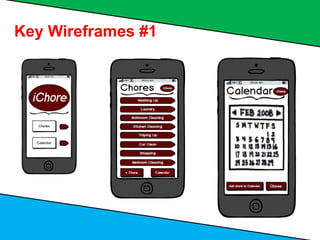
Key Wireframes #1
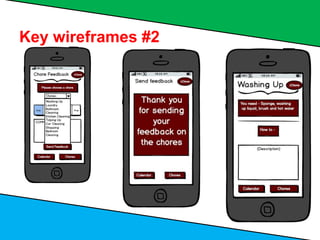
Key wireframes #2
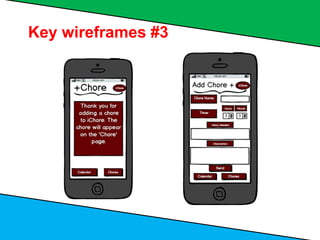
Key wireframes #3
From the team of ULTRALIGHT.
thank you for watching.

9.5 Group 1

  • 1.
    iChore Nathan Da Cruz,Alfie Holmes, Eric Kim and Louis Lee
  • 2.
    Who can useour app? Children, teenagers and young adults. What is our app about? Planning when to do your chores and how to do them properly. When could you use our app? Anytime that suites you. Where can you use our app? Mainly at home, where chores need to be done Why would you use our app? So you don’t forget to do your chores and so you know how to do them.
  • 3.
    You often forgetwhen to do your chores or you don’t know how to do them, so our app will solve this problem by alerting them when and how to do it. Problem
  • 4.
    How can youremember when and how to do your chores properly? Question
  • 5.
    You can writeit in your diary or just remember but you can still forget to do them. Our app will give you a notification to remind you. Also, you could look up how to do a chore on the internet but using an app would be quicker and easier Key insights
  • 6.
    Mini Elevator Pitch Myteam, Ultralight, is developing an app to help children, teenagers and young adults to remember to do their chores if they have forgotten, and how to do them properly.
  • 7.
    Competitors or alternativesolution There are a few other chore apps in the market but they all cost money and none of them tell you how to do the chore properly .
  • 8.
    Feasibility Our app isvery feasible because it doesn’t require that many technical tools. The only ones it will require are calendar, notifications and timer. There is not much content so it won’t take up much data either.
  • 9.
    We have chosenany smartphone, android, iPod or iPad. We have chosen these because they are popular and people always carry them around with them so they will receive notifications straight away. Platform
  • 10.
    Marketing Strategy We couldmake a page on social network sites where people can find out more about them. We could also make leaflets and hand them out to people in our target audience. Alternatively, we could make a website in which people can find more information about the app
  • 11.
  • 12.
  • 13.
  • 14.
    From the teamof ULTRALIGHT. thank you for watching.

Editor's Notes

  • #3 What is the background situation you are addressing? Describe the context users are experiencing.Example: BuzzerBuddiez: Who? Students What? Students are studying for exams When? 7am Where? Student dorm Why? Late night cramming, student likely to oversleep
  • #4 What specific problem do people encounter in that situation? Use the results from your user researchExamples: BuzzerBuddiez: your alarm does not work and you are thus late for: school, work, exams, doctor etc Transit: Many parents don’t speak English and their children have to translate the feedback that a teacher provides. When the feedback is negative students mistranslate. Oyster on the Go: You don’t remember how much money you have left on your pay-as-you-go Oyster card and run out of credit when you urgently need to get on a train Cattle Manager: You need to run backwards and forwards between the office and your cows, taking notes on paper and wasting time or loosing notes
  • #5 What core question are you addressing with the app? Examples: BuzzerBuddiez: how can you avoid oversleeping? Transit: how can negative teacher feedback be translated accurately? Oyster on the Go: how can you be more aware of how much credit you still have on your Oyster card? Cattle Manager: how can you keep track of injections for your cows while you are out and about looking after them?
  • #7 To introduce the judges to your team and the product, include your final min elevator pitch here.Example: - Buzzer Buddiez: Our team, [Buzzer Buddiez], is developing [a mobile app] to help [students] [who have studied late and are likely to oversleep because they hit snooze on their alarm clock] [to wake up on time with the help from friends and family]
  • #8 Summarise what other solutions or alternatives you have found that already exist in the market and explain why they don’t fully solve the problem you are looking at or why your proposed solution is better.
  • #9 Summarise what you have learnt about data, content and technical feasibility. This is crucial, if your product relies heavily on any of these areas. If your product does not rely on them heavily, please explain why. This will show that your team has really understood feasibility well.