Page
1
parser
lexical
analyzer
rest of
front end
symbol
table
UNIT-II
SYNTAX ANALYSIS
SYNTAX ANALYSIS
Syntax analysis is the second phase of the compiler. It gets the input from the tokens and
generates a syntax tree or parse tree.
Advantages of grammar for syntactic specification :
1. A grammar gives a precise and easy-to-understand syntactic specification of a
programming language.
2. An efficient parser can be constructed automatically from a properly designed grammar.
3. A grammar imparts a structure to a source program that is useful for its translation into
object code and for the detection of errors.
4. New constructs can be added to a language more easily when there is a grammatical
description of the language.
THE ROLE OF PARSER
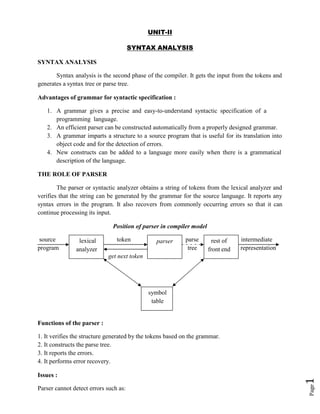
The parser or syntactic analyzer obtains a string of tokens from the lexical analyzer and
verifies that the string can be generated by the grammar for the source language. It reports any
syntax errors in the program. It also recovers from commonly occurring errors so that it can
continue processing its input.
Position of parser in compiler model
source token parse intermediate
program tree representation
get next token
Functions of the parser :
1. It verifies the structure generated by the tokens based on the grammar.
2. It constructs the parse tree.
3. It reports the errors.
4. It performs error recovery.
Issues :
Parser cannot detect errors such as:
Page
2
1. Variable re-declaration
2. Variable initialization before use.
3. Data type mismatch for an operation.
The above issues are handled by Semantic Analysis phase.
Syntax error handling :
Programs can contain errors at many different levels. For example :
1. Lexical, such as misspelling a keyword.
2. Syntactic, such as an arithmetic expression with unbalanced parentheses.
3. Semantic, such as an operator applied to an incompatible operand.
4. Logical, such as an infinitely recursive call.
Functions of error handler :
1. It should report the presence of errors clearly and accurately.
2. It should recover from each error quickly enough to be able to detect subsequent errors.
3. It should not significantly slow down the processing of correct programs.
Error recovery strategies :
The different strategies that a parse uses to recover from a syntactic error are:
1. Panic mode
2. Phrase level
3. Error productions
4. Global correction
Panic mode recovery:
On discovering an error, the parser discards input symbols one at a time until a
synchronizing token is found. The synchronizing tokens are usually delimiters, such as
semicolon or end. It has the advantage of simplicity and does not go into an infinite loop. When
multiple errors in the same statement are rare, this method is quite useful.
Phrase level recovery:
On discovering an error, the parser performs local correction on the remaining input that
allows it to continue. Example: Insert a missing semicolon or delete an extraneous semicolon etc.
Error productions:
The parser is constructed using augmented grammar with error productions. If an error
production is used by the parser, appropriate error diagnostics can be generated to indicate the
erroneous constructs recognized by the input.
Global correction:
Given an incorrect input string x and grammar G, certain algorithms can be used to find a
parse tree for a string y, such that the number of insertions, deletions and changes of tokens is as
small as possible. However, these methods are in general too costly in terms of time and space.
Page
3
CONTEXT-FREE GRAMMARS
A Context-Free Grammar is a quadruple that consists of terminals, non-terminals, start
symbol and productions.
Terminals : These are the basic symbols from which strings are formed.
Non-Terminals : These are the syntactic variables that denote a set of strings. These help to
define the language generated by the grammar.
Start Symbol : One non-terminal in the grammar is denoted as the “Start-symbol” and the set of
strings it denotes is the language defined by the grammar.
Productions : It specifies the manner in which terminals and non-terminals can be combined to
form strings. Each production consists of a non-terminal, followed by an arrow, followed by a
string of non-terminals and terminals.
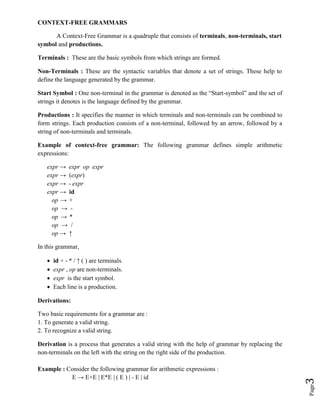
Example of context-free grammar: The following grammar defines simple arithmetic
expressions:
expr → expr op expr
expr → (expr)
expr → - expr
expr → id
op → +
op → -
op → *
op → /
op → ↑
In this grammar,
 id + - * / ↑ ( ) are terminals.
 expr , op are non-terminals.
 expr is the start symbol.
 Each line is a production.
Derivations:
Two basic requirements for a grammar are :
1. To generate a valid string.
2. To recognize a valid string.
Derivation is a process that generates a valid string with the help of grammar by replacing the
non-terminals on the left with the string on the right side of the production.
Example : Consider the following grammar for arithmetic expressions :
E → E+E | E*E | ( E ) | - E | id
Page
4
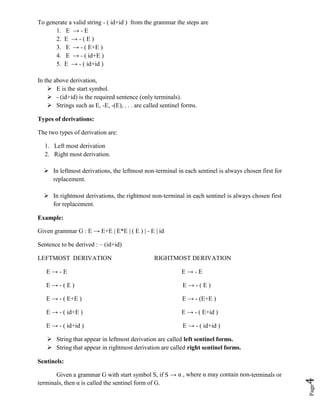
To generate a valid string - ( id+id ) from the grammar the steps are
1. E → - E
2. E → - ( E )
3. E → - ( E+E )
4. E → - ( id+E )
5. E → - ( id+id )
In the above derivation,
 E is the start symbol.
 - (id+id) is the required sentence (only terminals).
 Strings such as E, -E, -(E), . . . are called sentinel forms.
Types of derivations:
The two types of derivation are:
1. Left most derivation
2. Right most derivation.
 In leftmost derivations, the leftmost non-terminal in each sentinel is always chosen first for
replacement.
 In rightmost derivations, the rightmost non-terminal in each sentinel is always chosen first
for replacement.
Example:
Given grammar G : E → E+E | E*E | ( E ) | - E | id
Sentence to be derived : – (id+id)
LEFTMOST DERIVATION RIGHTMOST DERIVATION
E → - E E → - E
E → - ( E ) E → - ( E )
E → - ( E+E ) E → - (E+E )
E → - ( id+E ) E → - ( E+id )
E → - ( id+id ) E → - ( id+id )
 String that appear in leftmost derivation are called left sentinel forms.
 String that appear in rightmost derivation are called right sentinel forms.
Sentinels:
Given a grammar G with start symbol S, if S → α , where α may contain non-terminals or
terminals, then α is called the sentinel form of G.
Page
5
Yield or frontier of tree:
Each interior node of a parse tree is a non-terminal. The children of node can be a
terminal or non-terminal of the sentinel forms that are read from left to right. The sentinel form
in the parse tree is called yield or frontier of the tree.
Ambiguity:
A grammar that produces more than one parse for some sentence is said to be ambiguous
grammar.
Example : Given grammar G : E → E+E | E*E | ( E ) | - E | id
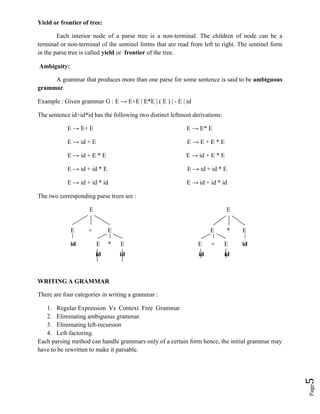
The sentence id+id*id has the following two distinct leftmost derivations:
E → E+ E E → E* E
E → id + E E → E + E * E
E → id + E * E E → id + E * E
E → id + id * E E → id + id * E
E → id + id * id E → id + id * id
The two corresponding parse trees are :
E E
E + E E * E
id E * E E + E id
id id id id
WRITING A GRAMMAR
There are four categories in writing a grammar :
1. Regular Expression Vs Context Free Grammar
2. Eliminating ambiguous grammar.
3. Eliminating left-recursion
4. Left-factoring.
Each parsing method can handle grammars only of a certain form hence, the initial grammar may
have to be rewritten to make it parsable.
Page
6
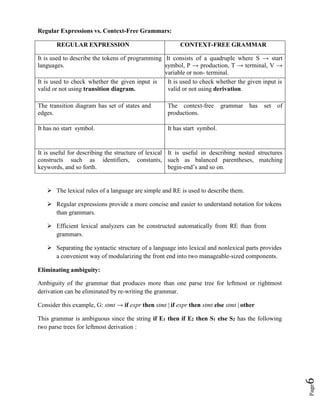
Regular Expressions vs. Context-Free Grammars:
REGULAR EXPRESSION CONTEXT-FREE GRAMMAR
It is used to describe the tokens of programming
languages.
It consists of a quadruple where S → start
symbol, P → production, T → terminal, V →
variable or non- terminal.
It is used to check whether the given input is
valid or not using transition diagram.
It is used to check whether the given input is
valid or not using derivation.
The transition diagram has set of states and
edges.
The context-free
productions.
grammar has set of
It has no start symbol. It has start symbol.
It is useful for describing the structure of lexical
constructs such as identifiers, constants,
keywords, and so forth.
It is useful in describing nested structures
such as balanced parentheses, matching
begin-end’s and so on.
 The lexical rules of a language are simple and RE is used to describe them.
 Regular expressions provide a more concise and easier to understand notation for tokens
than grammars.
 Efficient lexical analyzers can be constructed automatically from RE than from
grammars.
 Separating the syntactic structure of a language into lexical and nonlexical parts provides
a convenient way of modularizing the front end into two manageable-sized components.
Eliminating ambiguity:
Ambiguity of the grammar that produces more than one parse tree for leftmost or rightmost
derivation can be eliminated by re-writing the grammar.
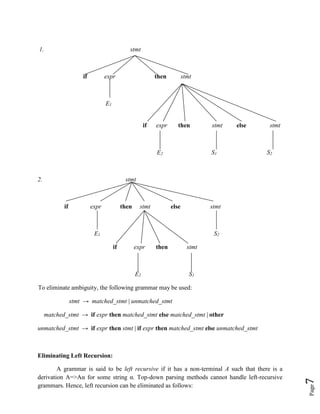
Consider this example, G: stmt → if expr then stmt | if expr then stmt else stmt | other
This grammar is ambiguous since the string if E1 then if E2 then S1 else S2 has the following
two parse trees for leftmost derivation :
Page
7
1. stmt
if expr then stmt
E1
if expr then stmt else stmt
E2 S1 S2
2. stmt
if expr then stmt else stmt
E1 S2
if expr then stmt
E2 S1
To eliminate ambiguity, the following grammar may be used:
stmt → matched_stmt | unmatched_stmt
matched_stmt → if expr then matched_stmt else matched_stmt | other
unmatched_stmt → if expr then stmt | if expr then matched_stmt else unmatched_stmt
Eliminating Left Recursion:
A grammar is said to be left recursive if it has a non-terminal A such that there is a
derivation A=>Aα for some string α. Top-down parsing methods cannot handle left-recursive
grammars. Hence, left recursion can be eliminated as follows:
Page
8
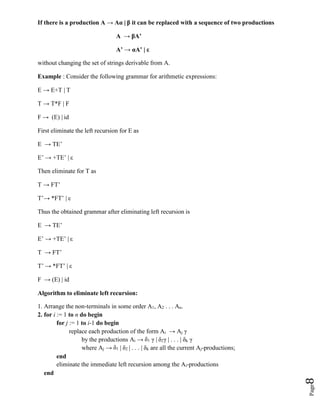
If there is a production A → Aα | β it can be replaced with a sequence of two productions
A → βA’
A’ → αA’ | ε
without changing the set of strings derivable from A.
Example : Consider the following grammar for arithmetic expressions:
E → E+T | T
T → T*F | F
F → (E) | id
First eliminate the left recursion for E as
E → TE’
E’ → +TE’ | ε
Then eliminate for T as
T → FT’
T’→ *FT’ | ε
Thus the obtained grammar after eliminating left recursion is
E → TE’
E’ → +TE’ | ε
T → FT’
T’ → *FT’ | ε
F → (E) | id
Algorithm to eliminate left recursion:
1. Arrange the non-terminals in some order A1, A2 . . . An.
2. for i := 1 to n do begin
for j := 1 to i-1 do begin
replace each production of the form Ai → Aj γ
by the productions Ai → δ1 γ | δ2γ | . . . | δk γ
where Aj → δ1 | δ2 | . . . | δk are all the current Aj-productions;
end
eliminate the immediate left recursion among the Ai-productions
end
Page
9
Left factoring:
Left factoring is a grammar transformation that is useful for producing a grammar
suitable for predictive parsing. When it is not clear which of two alternative productions to use to
expand a non-terminal A, we can rewrite the A-productions to defer the decision until we have
seen enough of the input to make the right choice.
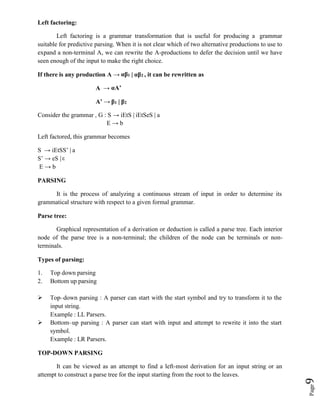
If there is any production A → αβ1 | αβ2 , it can be rewritten as
A → αA’
A’ → β1 | β2
Consider the grammar , G : S → iEtS | iEtSeS | a
E → b
Left factored, this grammar becomes
S → iEtSS’ | a
S’ → eS | ε
E → b
PARSING
It is the process of analyzing a continuous stream of input in order to determine its
grammatical structure with respect to a given formal grammar.
Parse tree:
Graphical representation of a derivation or deduction is called a parse tree. Each interior
node of the parse tree is a non-terminal; the children of the node can be terminals or non-
terminals.
Types of parsing:
1. Top down parsing
2. Bottom up parsing
 Top–down parsing : A parser can start with the start symbol and try to transform it to the
input string.
Example : LL Parsers.
 Bottom–up parsing : A parser can start with input and attempt to rewrite it into the start
symbol.
Example : LR Parsers.
TOP-DOWN PARSING
It can be viewed as an attempt to find a left-most derivation for an input string or an
attempt to construct a parse tree for the input starting from the root to the leaves.
Page
10
Types of top-down parsing :
1. Recursive descent parsing
2. Predictive parsing
1. RECURSIVE DESCENT PARSING
 Recursive descent parsing is one of the top-down parsing techniques that uses a set of
recursive procedures to scan its input.
 This parsing method may involve backtracking, that is, making repeated scans of the
input.
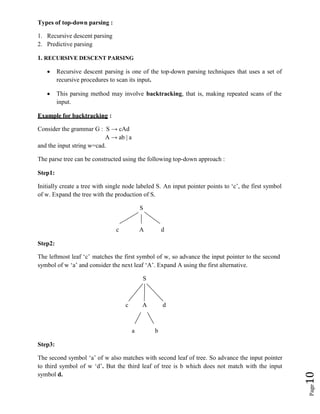
Example for backtracking :
Consider the grammar G : S → cAd
A → ab | a
and the input string w=cad.
The parse tree can be constructed using the following top-down approach :
Step1:
Initially create a tree with single node labeled S. An input pointer points to ‘c’, the first symbol
of w. Expand the tree with the production of S.
S
c A d
Step2:
The leftmost leaf ‘c’ matches the first symbol of w, so advance the input pointer to the second
symbol of w ‘a’ and consider the next leaf ‘A’. Expand A using the first alternative.
S
c A d
a b
Step3:
The second symbol ‘a’ of w also matches with second leaf of tree. So advance the input pointer
to third symbol of w ‘d’. But the third leaf of tree is b which does not match with the input
symbol d.
Page
11
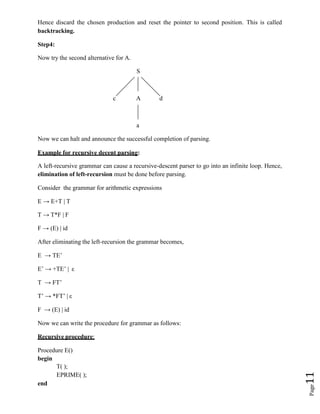
Hence discard the chosen production and reset the pointer to second position. This is called
backtracking.
Step4:
Now try the second alternative for A.
S
c A d
a
Now we can halt and announce the successful completion of parsing.
Example for recursive decent parsing:
A left-recursive grammar can cause a recursive-descent parser to go into an infinite loop. Hence,
elimination of left-recursion must be done before parsing.
Consider the grammar for arithmetic expressions
E → E+T | T
T → T*F | F
F → (E) | id
After eliminating the left-recursion the grammar becomes,
E → TE’
E’ → +TE’ | ε
T → FT’
T’ → *FT’ | ε
F → (E) | id
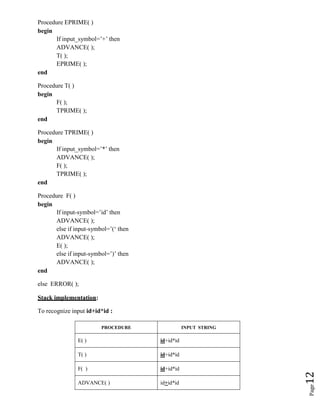
Now we can write the procedure for grammar as follows:
Recursive procedure:
Procedure E()
begin
end
T( );
EPRIME( );
Page
12
Procedure EPRIME( )
begin
end
If input_symbol=’+’ then
ADVANCE( );
T( );
EPRIME( );
Procedure T( )
begin
end
F( );
TPRIME( );
Procedure TPRIME( )
begin
end
If input_symbol=’*’ then
ADVANCE( );
F( );
TPRIME( );
Procedure F( )
begin
end
If input-symbol=’id’ then
ADVANCE( );
else if input-symbol=’(‘ then
ADVANCE( );
E( );
else if input-symbol=’)’ then
ADVANCE( );
else ERROR( );
Stack implementation:
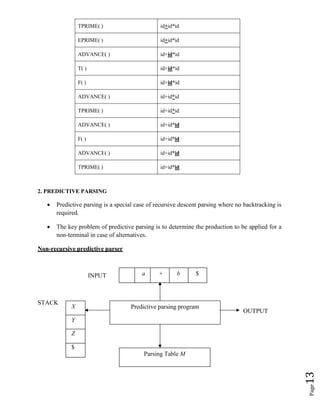
To recognize input id+id*id :
PROCEDURE INPUT STRING
E( ) id+id*id
T( ) id+id*id
F( ) id+id*id
ADVANCE( ) id+id*id
Page
13
Parsing Table M
TPRIME( ) id+id*id
EPRIME( ) id+id*id
ADVANCE( ) id+id*id
T( ) id+id*id
F( ) id+id*id
ADVANCE( ) id+id*id
TPRIME( ) id+id*id
ADVANCE( ) id+id*id
F( ) id+id*id
ADVANCE( ) id+id*id
TPRIME( ) id+id*id
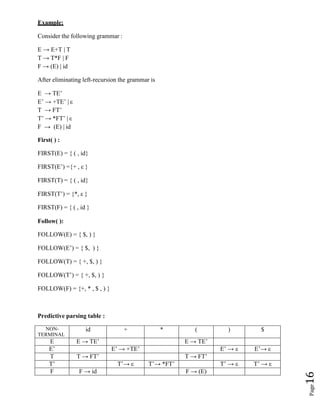
2. PREDICTIVE PARSING
 Predictive parsing is a special case of recursive descent parsing where no backtracking is
required.
 The key problem of predictive parsing is to determine the production to be applied for a
non-terminal in case of alternatives.
Non-recursive predictive parser
INPUT
STACK
OUTPUT
Predictive parsing program
a + b $
X
Y
Z
$
Page
14
The table-driven predictive parser has an input buffer, stack, a parsing table and an output
stream.
Input buffer:
It consists of strings to be parsed, followed by $ to indicate the end of the input string.
Stack:
It contains a sequence of grammar symbols preceded by $ to indicate the bottom of the stack.
Initially, the stack contains the start symbol on top of $.
Parsing table:
It is a two-dimensional array M[A, a], where ‘A’ is a non-terminal and ‘a’ is a terminal.
Predictive parsing program:
The parser is controlled by a program that considers X, the symbol on top of stack, and a, the
current input symbol. These two symbols determine the parser action. There are three
possibilities:
1. If X = a = $, the parser halts and announces successful completion of parsing.
2. If X = a ≠ $, the parser pops X off the stack and advances the input pointer to the next
input symbol.
3. If X is a non-terminal , the program consults entry M[X, a] of the parsing table M. This
entry will either be an X-production of the grammar or an error entry.
If M[X, a] = {X → UVW},the parser replaces X on top of the stack by WVU.
If M[X, a] = error, the parser calls an error recovery routine.
Algorithm for nonrecursive predictive parsing:
Input : A string w and a parsing table M for grammar G.
Output : If w is in L(G), a leftmost derivation of w; otherwise, an error indication.
Method : Initially, the parser has $S on the stack with S, the start symbol of G on top, and w$ in
the input buffer. The program that utilizes the predictive parsing table M to produce a parse for
the input is as follows:
set ip to point to the first symbol of w$;
repeat
let X be the top stack symbol and a the symbol pointed to by ip;
if X is a terminal or $ then
if X = a then
pop X from the stack and advance ip
else error()
else /* X is a non-terminal */
if M[X, a] = X →Y1Y2 … Yk then begin
Page
15
pop X from the stack;
push Yk, Yk-1, … ,Y1 onto the stack, with Y1 on top;
output the production X → Y1 Y2 . . . Yk
end
else error()
until X = $ /* stack is empty */
Predictive parsing table construction:
The construction of a predictive parser is aided by two functions associated with a grammar G :
1. FIRST
2. FOLLOW
Rules for first( ):
1. If X is terminal, then FIRST(X) is {X}.
2. If X → ε is a production, then add ε to FIRST(X).
3. If X is non-terminal and X → aα is a production then add a to FIRST(X).
4. If X is non-terminal and X → Y1 Y2…Yk is a production, then place a in FIRST(X) if for some
i, a is in FIRST(Yi), and ε is in all of FIRST(Y1),…,FIRST(Yi-1); that is, Y1,….Yi-1 => ε. If ε is
in FIRST(Yj) for all j=1,2,..,k, then add ε to FIRST(X).
Rules for follow( ):
1. If S is a start symbol, then FOLLOW(S) contains $.
2. If there is a production A → αBβ, then everything in FIRST(β) except ε is placed in
follow(B).
3. If there is a production A → αB, or a production A → αBβ where FIRST(β) contains ε, then
everything in FOLLOW(A) is in FOLLOW(B).
Algorithm for construction of predictive parsing table:
Input : Grammar G
Output : Parsing table M
Method :
1. For each production A → α of the grammar, do steps 2 and 3.
2. For each terminal a in FIRST(α), add A → α to M[A, a].
3. If ε is in FIRST(α), add A → α to M[A, b] for each terminal b in FOLLOW(A). If ε is in
FIRST(α) and $ is in FOLLOW(A) , add A → α to M[A, $].
4. Make each undefined entry of M be error.
Page
16
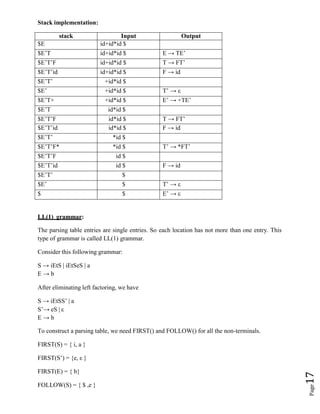
Example:
Consider the following grammar :
E → E+T | T
T → T*F | F
F → (E) | id
After eliminating left-recursion the grammar is
E → TE’
E’ → +TE’ | ε
T → FT’
T’ → *FT’ | ε
F → (E) | id
First( ) :
FIRST(E) = { ( , id}
FIRST(E’) ={+ , ε }
FIRST(T) = { ( , id}
FIRST(T’) = {*, ε }
FIRST(F) = { ( , id }
Follow( ):
FOLLOW(E) = { $, ) }
FOLLOW(E’) = { $, ) }
FOLLOW(T) = { +, $, ) }
FOLLOW(T’) = { +, $, ) }
FOLLOW(F) = {+, * , $ , ) }
Predictive parsing table :
NON-
TERMINAL
id + * ( ) $
E E → TE’ E → TE’
E’ E’ → +TE’ E’ → ε E’→ ε
T T → FT’ T → FT’
T’ T’→ ε T’→ *FT’ T’ → ε T’ → ε
F F → id F → (E)
Page
17
Stack implementation:
stack Input Output
$E id+id*id $
$E’T id+id*id $ E → TE’
$E’T’F id+id*id $ T → FT’
$E’T’id id+id*id $ F → id
$E’T’ +id*id $
$E’ +id*id $ T’ → ε
$E’T+ +id*id $ E’ → +TE’
$E’T id*id $
$E’T’F id*id $ T → FT’
$E’T’id id*id $ F → id
$E’T’ *id $
$E’T’F* *id $ T’ → *FT’
$E’T’F id $
$E’T’id id $ F → id
$E’T’ $
$E’ $ T’ → ε
$ $ E’ → ε
LL(1) grammar:
The parsing table entries are single entries. So each location has not more than one entry. This
type of grammar is called LL(1) grammar.
Consider this following grammar:
S → iEtS | iEtSeS | a
E → b
After eliminating left factoring, we have
S → iEtSS’ | a
S’→ eS | ε
E → b
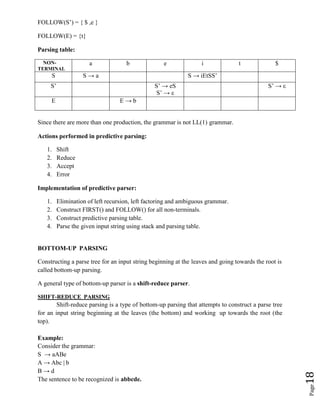
To construct a parsing table, we need FIRST() and FOLLOW() for all the non-terminals.
FIRST(S) = { i, a }
FIRST(S’) = {e, ε }
FIRST(E) = { b}
FOLLOW(S) = { $ ,e }
Page
18
FOLLOW(S’) = { $ ,e }
FOLLOW(E) = {t}
Parsing table:
NON-
TERMINAL
a b e i t $
S S → a S → iEtSS’
S’ S’ → eS
S’ → ε
S’ → ε
E E → b
Since there are more than one production, the grammar is not LL(1) grammar.
Actions performed in predictive parsing:
1. Shift
2. Reduce
3. Accept
4. Error
Implementation of predictive parser:
1. Elimination of left recursion, left factoring and ambiguous grammar.
2. Construct FIRST() and FOLLOW() for all non-terminals.
3. Construct predictive parsing table.
4. Parse the given input string using stack and parsing table.
BOTTOM-UP PARSING
Constructing a parse tree for an input string beginning at the leaves and going towards the root is
called bottom-up parsing.
A general type of bottom-up parser is a shift-reduce parser.
SHIFT-REDUCE PARSING
Shift-reduce parsing is a type of bottom-up parsing that attempts to construct a parse tree
for an input string beginning at the leaves (the bottom) and working up towards the root (the
top).
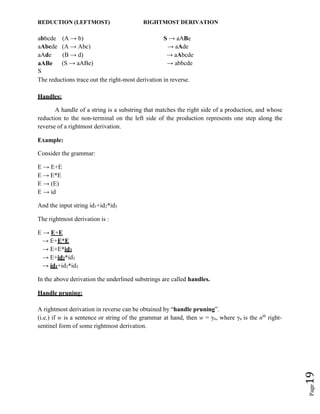
Example:
Consider the grammar:
S → aABe
A → Abc | b
B → d
The sentence to be recognized is abbcde.
Page
19
REDUCTION (LEFTMOST) RIGHTMOST DERIVATION
abbcde (A → b) S → aABe
aAbcde (A → Abc) → aAde
aAde (B → d) → aAbcde
aABe (S → aABe) → abbcde
S
The reductions trace out the right-most derivation in reverse.
Handles:
A handle of a string is a substring that matches the right side of a production, and whose
reduction to the non-terminal on the left side of the production represents one step along the
reverse of a rightmost derivation.
Example:
Consider the grammar:
E → E+E
E → E*E
E → (E)
E → id
And the input string id1+id2*id3
The rightmost derivation is :
E → E+E
→ E+E*E
→ E+E*id3
→ E+id2*id3
→ id1+id2*id3
In the above derivation the underlined substrings are called handles.
Handle pruning:
A rightmost derivation in reverse can be obtained by “handle pruning”.
(i.e.) if w is a sentence or string of the grammar at hand, then w = γn, where γn is the nth
right-
sentinel form of some rightmost derivation.
Page
20
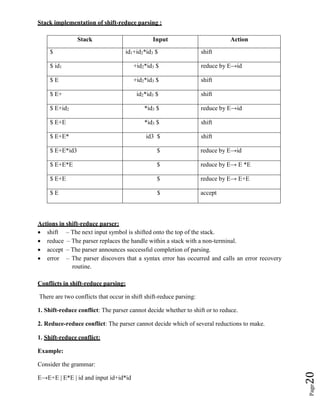
Stack implementation of shift-reduce parsing :
Stack Input Action
$ id1+id2*id3 $ shift
$ id1 +id2*id3 $ reduce by E→id
$ E +id2*id3 $ shift
$ E+ id2*id3 $ shift
$ E+id2 *id3 $ reduce by E→id
$ E+E *id3 $ shift
$ E+E* id3 $ shift
$ E+E*id3 $ reduce by E→id
$ E+E*E $ reduce by E→ E *E
$ E+E $ reduce by E→ E+E
$ E $ accept
Actions in shift-reduce parser:
 shift – The next input symbol is shifted onto the top of the stack.
 reduce – The parser replaces the handle within a stack with a non-terminal.
 accept – The parser announces successful completion of parsing.
 error – The parser discovers that a syntax error has occurred and calls an error recovery
routine.
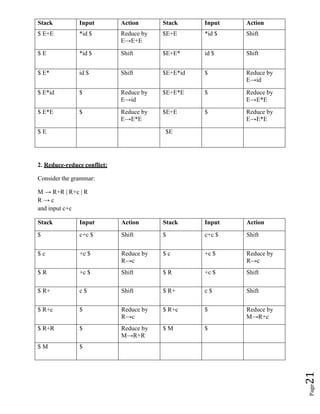
Conflicts in shift-reduce parsing:
There are two conflicts that occur in shift shift-reduce parsing:
1. Shift-reduce conflict: The parser cannot decide whether to shift or to reduce.
2. Reduce-reduce conflict: The parser cannot decide which of several reductions to make.
1. Shift-reduce conflict:
Example:
Consider the grammar:
E→E+E | E*E | id and input id+id*id
Page
21
Stack Input Action Stack Input Action
$ E+E *id $ Reduce by
E→E+E
$E+E *id $ Shift
$ E *id $ Shift $E+E* id $ Shift
$ E* id $ Shift $E+E*id $ Reduce by
E→id
$ E*id $ Reduce by
E→id
$E+E*E $ Reduce by
E→E*E
$ E*E $ Reduce by
E→E*E
$E+E $ Reduce by
E→E*E
$ E $E
2. Reduce-reduce conflict:
Consider the grammar:
M → R+R | R+c | R
R → c
and input c+c
Stack Input Action Stack Input Action
$ c+c $ Shift $ c+c $ Shift
$ c +c $ Reduce by
R→c
$ c +c $ Reduce by
R→c
$ R +c $ Shift $ R +c $ Shift
$ R+ c $ Shift $ R+ c $ Shift
$ R+c $ Reduce by
R→c
$ R+c $ Reduce by
M→R+c
$ R+R $ Reduce by
M→R+R
$ M $
$ M $
Page
22
Viable prefixes:
 α is a viable prefix of the grammar if there is w such that αw is a right sentinel form.
 The set of prefixes of right sentinel forms that can appear on the stack of a shift-reduce parser
are called viable prefixes.
 The set of viable prefixes is a regular language.
OPERATOR-PRECEDENCE PARSING
An efficient way of constructing shift-reduce parser is called operator-precedence parsing.
Operator precedence parser can be constructed from a grammar called Operator-grammar. These
grammars have the property that no production on right side is ɛ or has two adjacent non-
terminals.
Example:
Consider the grammar:
E → EAE | (E) | -E | id
A → + | - | * | / | ↑
Since the right side EAE has three consecutive non-terminals, the grammar can be written as
follows:
E → E+E | E-E | E*E | E/E | E↑E | -E | id
Operator precedence relations:
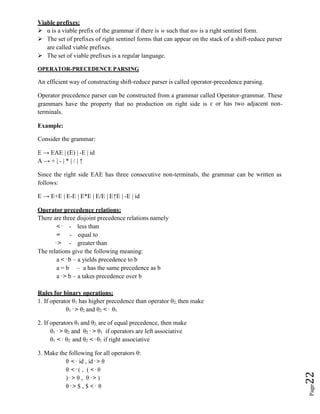
There are three disjoint precedence relations namely
< . - less than
= - equal to
. > - greater than
The relations give the following meaning:
a < . b – a yields precedence to b
a = b – a has the same precedence as b
a . > b – a takes precedence over b
Rules for binary operations:
1. If operator θ1 has higher precedence than operator θ2, then make
θ1
. > θ2 and θ2 < . θ1
2. If operators θ1 and θ2, are of equal precedence, then make
θ1
. > θ2 and θ2
. > θ1 if operators are left associative
θ1 < . θ2 and θ2 < . θ1 if right associative
3. Make the following for all operators θ:
θ < . id , id . > θ
θ < . ( , ( < . θ
) . > θ , θ . > )
θ . > $ , $ < . θ
Page
23
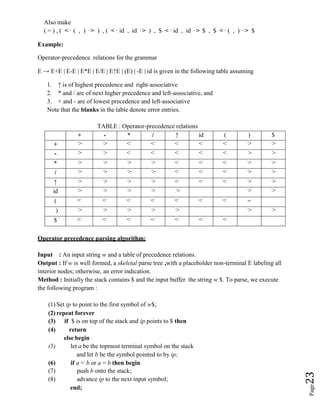
Also make
( = ) , ( < . ( , ) . > ) , ( < . id , id . > ) , $ < . id , id . > $ , $ < . ( , ) . > $
Example:
Operator-precedence relations for the grammar
E → E+E | E-E | E*E | E/E | E↑E | (E) | -E | id is given in the following table assuming
1. ↑ is of highest precedence and right-associative
2. * and / are of next higher precedence and left-associative, and
3. + and - are of lowest precedence and left-associative
Note that the blanks in the table denote error entries.
TABLE : Operator-precedence relations
+ - * / ↑ id ( ) $
+
.
> .
> <.
<.
<.
<.
<. .
> .
>
-
.
> .
> <.
<.
<.
<.
<. .
> .
>
*
.
> .
> .
> .
> <.
<.
<. .
> .
>
/
.
> .
> .
> .
> <.
<.
<. .
> .
>
↑
.
> .
> .
> .
> <.
<.
<. .
> .
>
id
.
> .
> .
> .
> .
>
∙
.
> .
>
( <.
<.
<.
<.
<.
<.
<.
=
)
.
> .
> .
> .
> .
> .
> .
>
$ <.
<.
<.
<.
<.
<.
<.
Operator precedence parsing algorithm:
Input : An input string w and a table of precedence relations.
Output : If w is well formed, a skeletal parse tree ,with a placeholder non-terminal E labeling all
interior nodes; otherwise, an error indication.
Method : Initially the stack contains $ and the input buffer the string w $. To parse, we execute
the following program :
(1) Set ip to point to the first symbol of w$;
(2) repeat forever
(3) if $ is on top of the stack and ip points to $ then
(4) return
else begin
(5) let a be the topmost terminal symbol on the stack
and let b be the symbol pointed to by ip;
(6) if a <.
b or a = b then begin
(7) push b onto the stack;
(8) advance ip to the next input symbol;
end;
Page
24
(9) else if a .
> b then /*reduce*/
(10) repeat
(11) pop the stack
(12) until the top stack terminal is related by <.
to the terminal most recently popped
(13) else error( )
end
Stack implementation of operator precedence parsing:
Operator precedence parsing uses a stack and precedence relation table for its
implementation of above algorithm. It is a shift-reduce parsing containing all four actions shift,
reduce, accept and error.
The initial configuration of an operator precedence parsing is
STACK INPUT
$ w $
where w is the input string to be parsed.
Example:
Consider the grammar E → E+E | E-E | E*E | E/E | E↑E | (E) | id. Input string is id+id*id .The
implementation is as follows:
STACK INPUT COMMENT
$ <∙ id+id*id $ shift id
$ id ∙> +id*id $ pop the top of the stack id
$ <∙ +id*id $ shift +
$ + <∙ id*id $ shift id
$ +id ∙> *id $ pop id
$ + <∙ *id $ shift *
$ + * <∙ id $ shift id
$ + * id ∙> $ pop id
$ + * ∙> $ pop *
$ + ∙> $ pop +
$ $ accept
Advantages of operator precedence parsing:
1. It is easy to implement.
2. Once an operator precedence relation is made between all pairs of terminals of a grammar ,
the grammar can be ignored. The grammar is not referred anymore during implementation.
Disadvantages of operator precedence parsing:
1. It is hard to handle tokens like the minus sign (-) which has two different precedence.
2. Only a small class of grammar can be parsed using operator-precedence parser.
Page
25

8-Practice problems on operator precedence parser-24-05-2023.docx

  • 1.
    Page 1 parser lexical analyzer rest of front end symbol table UNIT-II SYNTAXANALYSIS SYNTAX ANALYSIS Syntax analysis is the second phase of the compiler. It gets the input from the tokens and generates a syntax tree or parse tree. Advantages of grammar for syntactic specification : 1. A grammar gives a precise and easy-to-understand syntactic specification of a programming language. 2. An efficient parser can be constructed automatically from a properly designed grammar. 3. A grammar imparts a structure to a source program that is useful for its translation into object code and for the detection of errors. 4. New constructs can be added to a language more easily when there is a grammatical description of the language. THE ROLE OF PARSER The parser or syntactic analyzer obtains a string of tokens from the lexical analyzer and verifies that the string can be generated by the grammar for the source language. It reports any syntax errors in the program. It also recovers from commonly occurring errors so that it can continue processing its input. Position of parser in compiler model source token parse intermediate program tree representation get next token Functions of the parser : 1. It verifies the structure generated by the tokens based on the grammar. 2. It constructs the parse tree. 3. It reports the errors. 4. It performs error recovery. Issues : Parser cannot detect errors such as:
  • 2.
    Page 2 1. Variable re-declaration 2.Variable initialization before use. 3. Data type mismatch for an operation. The above issues are handled by Semantic Analysis phase. Syntax error handling : Programs can contain errors at many different levels. For example : 1. Lexical, such as misspelling a keyword. 2. Syntactic, such as an arithmetic expression with unbalanced parentheses. 3. Semantic, such as an operator applied to an incompatible operand. 4. Logical, such as an infinitely recursive call. Functions of error handler : 1. It should report the presence of errors clearly and accurately. 2. It should recover from each error quickly enough to be able to detect subsequent errors. 3. It should not significantly slow down the processing of correct programs. Error recovery strategies : The different strategies that a parse uses to recover from a syntactic error are: 1. Panic mode 2. Phrase level 3. Error productions 4. Global correction Panic mode recovery: On discovering an error, the parser discards input symbols one at a time until a synchronizing token is found. The synchronizing tokens are usually delimiters, such as semicolon or end. It has the advantage of simplicity and does not go into an infinite loop. When multiple errors in the same statement are rare, this method is quite useful. Phrase level recovery: On discovering an error, the parser performs local correction on the remaining input that allows it to continue. Example: Insert a missing semicolon or delete an extraneous semicolon etc. Error productions: The parser is constructed using augmented grammar with error productions. If an error production is used by the parser, appropriate error diagnostics can be generated to indicate the erroneous constructs recognized by the input. Global correction: Given an incorrect input string x and grammar G, certain algorithms can be used to find a parse tree for a string y, such that the number of insertions, deletions and changes of tokens is as small as possible. However, these methods are in general too costly in terms of time and space.
  • 3.
    Page 3 CONTEXT-FREE GRAMMARS A Context-FreeGrammar is a quadruple that consists of terminals, non-terminals, start symbol and productions. Terminals : These are the basic symbols from which strings are formed. Non-Terminals : These are the syntactic variables that denote a set of strings. These help to define the language generated by the grammar. Start Symbol : One non-terminal in the grammar is denoted as the “Start-symbol” and the set of strings it denotes is the language defined by the grammar. Productions : It specifies the manner in which terminals and non-terminals can be combined to form strings. Each production consists of a non-terminal, followed by an arrow, followed by a string of non-terminals and terminals. Example of context-free grammar: The following grammar defines simple arithmetic expressions: expr → expr op expr expr → (expr) expr → - expr expr → id op → + op → - op → * op → / op → ↑ In this grammar,  id + - * / ↑ ( ) are terminals.  expr , op are non-terminals.  expr is the start symbol.  Each line is a production. Derivations: Two basic requirements for a grammar are : 1. To generate a valid string. 2. To recognize a valid string. Derivation is a process that generates a valid string with the help of grammar by replacing the non-terminals on the left with the string on the right side of the production. Example : Consider the following grammar for arithmetic expressions : E → E+E | E*E | ( E ) | - E | id
  • 4.
    Page 4 To generate avalid string - ( id+id ) from the grammar the steps are 1. E → - E 2. E → - ( E ) 3. E → - ( E+E ) 4. E → - ( id+E ) 5. E → - ( id+id ) In the above derivation,  E is the start symbol.  - (id+id) is the required sentence (only terminals).  Strings such as E, -E, -(E), . . . are called sentinel forms. Types of derivations: The two types of derivation are: 1. Left most derivation 2. Right most derivation.  In leftmost derivations, the leftmost non-terminal in each sentinel is always chosen first for replacement.  In rightmost derivations, the rightmost non-terminal in each sentinel is always chosen first for replacement. Example: Given grammar G : E → E+E | E*E | ( E ) | - E | id Sentence to be derived : – (id+id) LEFTMOST DERIVATION RIGHTMOST DERIVATION E → - E E → - E E → - ( E ) E → - ( E ) E → - ( E+E ) E → - (E+E ) E → - ( id+E ) E → - ( E+id ) E → - ( id+id ) E → - ( id+id )  String that appear in leftmost derivation are called left sentinel forms.  String that appear in rightmost derivation are called right sentinel forms. Sentinels: Given a grammar G with start symbol S, if S → α , where α may contain non-terminals or terminals, then α is called the sentinel form of G.
  • 5.
    Page 5 Yield or frontierof tree: Each interior node of a parse tree is a non-terminal. The children of node can be a terminal or non-terminal of the sentinel forms that are read from left to right. The sentinel form in the parse tree is called yield or frontier of the tree. Ambiguity: A grammar that produces more than one parse for some sentence is said to be ambiguous grammar. Example : Given grammar G : E → E+E | E*E | ( E ) | - E | id The sentence id+id*id has the following two distinct leftmost derivations: E → E+ E E → E* E E → id + E E → E + E * E E → id + E * E E → id + E * E E → id + id * E E → id + id * E E → id + id * id E → id + id * id The two corresponding parse trees are : E E E + E E * E id E * E E + E id id id id id WRITING A GRAMMAR There are four categories in writing a grammar : 1. Regular Expression Vs Context Free Grammar 2. Eliminating ambiguous grammar. 3. Eliminating left-recursion 4. Left-factoring. Each parsing method can handle grammars only of a certain form hence, the initial grammar may have to be rewritten to make it parsable.
  • 6.
    Page 6 Regular Expressions vs.Context-Free Grammars: REGULAR EXPRESSION CONTEXT-FREE GRAMMAR It is used to describe the tokens of programming languages. It consists of a quadruple where S → start symbol, P → production, T → terminal, V → variable or non- terminal. It is used to check whether the given input is valid or not using transition diagram. It is used to check whether the given input is valid or not using derivation. The transition diagram has set of states and edges. The context-free productions. grammar has set of It has no start symbol. It has start symbol. It is useful for describing the structure of lexical constructs such as identifiers, constants, keywords, and so forth. It is useful in describing nested structures such as balanced parentheses, matching begin-end’s and so on.  The lexical rules of a language are simple and RE is used to describe them.  Regular expressions provide a more concise and easier to understand notation for tokens than grammars.  Efficient lexical analyzers can be constructed automatically from RE than from grammars.  Separating the syntactic structure of a language into lexical and nonlexical parts provides a convenient way of modularizing the front end into two manageable-sized components. Eliminating ambiguity: Ambiguity of the grammar that produces more than one parse tree for leftmost or rightmost derivation can be eliminated by re-writing the grammar. Consider this example, G: stmt → if expr then stmt | if expr then stmt else stmt | other This grammar is ambiguous since the string if E1 then if E2 then S1 else S2 has the following two parse trees for leftmost derivation :
  • 7.
    Page 7 1. stmt if exprthen stmt E1 if expr then stmt else stmt E2 S1 S2 2. stmt if expr then stmt else stmt E1 S2 if expr then stmt E2 S1 To eliminate ambiguity, the following grammar may be used: stmt → matched_stmt | unmatched_stmt matched_stmt → if expr then matched_stmt else matched_stmt | other unmatched_stmt → if expr then stmt | if expr then matched_stmt else unmatched_stmt Eliminating Left Recursion: A grammar is said to be left recursive if it has a non-terminal A such that there is a derivation A=>Aα for some string α. Top-down parsing methods cannot handle left-recursive grammars. Hence, left recursion can be eliminated as follows:
  • 8.
    Page 8 If there isa production A → Aα | β it can be replaced with a sequence of two productions A → βA’ A’ → αA’ | ε without changing the set of strings derivable from A. Example : Consider the following grammar for arithmetic expressions: E → E+T | T T → T*F | F F → (E) | id First eliminate the left recursion for E as E → TE’ E’ → +TE’ | ε Then eliminate for T as T → FT’ T’→ *FT’ | ε Thus the obtained grammar after eliminating left recursion is E → TE’ E’ → +TE’ | ε T → FT’ T’ → *FT’ | ε F → (E) | id Algorithm to eliminate left recursion: 1. Arrange the non-terminals in some order A1, A2 . . . An. 2. for i := 1 to n do begin for j := 1 to i-1 do begin replace each production of the form Ai → Aj γ by the productions Ai → δ1 γ | δ2γ | . . . | δk γ where Aj → δ1 | δ2 | . . . | δk are all the current Aj-productions; end eliminate the immediate left recursion among the Ai-productions end
  • 9.
    Page 9 Left factoring: Left factoringis a grammar transformation that is useful for producing a grammar suitable for predictive parsing. When it is not clear which of two alternative productions to use to expand a non-terminal A, we can rewrite the A-productions to defer the decision until we have seen enough of the input to make the right choice. If there is any production A → αβ1 | αβ2 , it can be rewritten as A → αA’ A’ → β1 | β2 Consider the grammar , G : S → iEtS | iEtSeS | a E → b Left factored, this grammar becomes S → iEtSS’ | a S’ → eS | ε E → b PARSING It is the process of analyzing a continuous stream of input in order to determine its grammatical structure with respect to a given formal grammar. Parse tree: Graphical representation of a derivation or deduction is called a parse tree. Each interior node of the parse tree is a non-terminal; the children of the node can be terminals or non- terminals. Types of parsing: 1. Top down parsing 2. Bottom up parsing  Top–down parsing : A parser can start with the start symbol and try to transform it to the input string. Example : LL Parsers.  Bottom–up parsing : A parser can start with input and attempt to rewrite it into the start symbol. Example : LR Parsers. TOP-DOWN PARSING It can be viewed as an attempt to find a left-most derivation for an input string or an attempt to construct a parse tree for the input starting from the root to the leaves.
  • 10.
    Page 10 Types of top-downparsing : 1. Recursive descent parsing 2. Predictive parsing 1. RECURSIVE DESCENT PARSING  Recursive descent parsing is one of the top-down parsing techniques that uses a set of recursive procedures to scan its input.  This parsing method may involve backtracking, that is, making repeated scans of the input. Example for backtracking : Consider the grammar G : S → cAd A → ab | a and the input string w=cad. The parse tree can be constructed using the following top-down approach : Step1: Initially create a tree with single node labeled S. An input pointer points to ‘c’, the first symbol of w. Expand the tree with the production of S. S c A d Step2: The leftmost leaf ‘c’ matches the first symbol of w, so advance the input pointer to the second symbol of w ‘a’ and consider the next leaf ‘A’. Expand A using the first alternative. S c A d a b Step3: The second symbol ‘a’ of w also matches with second leaf of tree. So advance the input pointer to third symbol of w ‘d’. But the third leaf of tree is b which does not match with the input symbol d.
  • 11.
    Page 11 Hence discard thechosen production and reset the pointer to second position. This is called backtracking. Step4: Now try the second alternative for A. S c A d a Now we can halt and announce the successful completion of parsing. Example for recursive decent parsing: A left-recursive grammar can cause a recursive-descent parser to go into an infinite loop. Hence, elimination of left-recursion must be done before parsing. Consider the grammar for arithmetic expressions E → E+T | T T → T*F | F F → (E) | id After eliminating the left-recursion the grammar becomes, E → TE’ E’ → +TE’ | ε T → FT’ T’ → *FT’ | ε F → (E) | id Now we can write the procedure for grammar as follows: Recursive procedure: Procedure E() begin end T( ); EPRIME( );
  • 12.
    Page 12 Procedure EPRIME( ) begin end Ifinput_symbol=’+’ then ADVANCE( ); T( ); EPRIME( ); Procedure T( ) begin end F( ); TPRIME( ); Procedure TPRIME( ) begin end If input_symbol=’*’ then ADVANCE( ); F( ); TPRIME( ); Procedure F( ) begin end If input-symbol=’id’ then ADVANCE( ); else if input-symbol=’(‘ then ADVANCE( ); E( ); else if input-symbol=’)’ then ADVANCE( ); else ERROR( ); Stack implementation: To recognize input id+id*id : PROCEDURE INPUT STRING E( ) id+id*id T( ) id+id*id F( ) id+id*id ADVANCE( ) id+id*id
  • 13.
    Page 13 Parsing Table M TPRIME() id+id*id EPRIME( ) id+id*id ADVANCE( ) id+id*id T( ) id+id*id F( ) id+id*id ADVANCE( ) id+id*id TPRIME( ) id+id*id ADVANCE( ) id+id*id F( ) id+id*id ADVANCE( ) id+id*id TPRIME( ) id+id*id 2. PREDICTIVE PARSING  Predictive parsing is a special case of recursive descent parsing where no backtracking is required.  The key problem of predictive parsing is to determine the production to be applied for a non-terminal in case of alternatives. Non-recursive predictive parser INPUT STACK OUTPUT Predictive parsing program a + b $ X Y Z $
  • 14.
    Page 14 The table-driven predictiveparser has an input buffer, stack, a parsing table and an output stream. Input buffer: It consists of strings to be parsed, followed by $ to indicate the end of the input string. Stack: It contains a sequence of grammar symbols preceded by $ to indicate the bottom of the stack. Initially, the stack contains the start symbol on top of $. Parsing table: It is a two-dimensional array M[A, a], where ‘A’ is a non-terminal and ‘a’ is a terminal. Predictive parsing program: The parser is controlled by a program that considers X, the symbol on top of stack, and a, the current input symbol. These two symbols determine the parser action. There are three possibilities: 1. If X = a = $, the parser halts and announces successful completion of parsing. 2. If X = a ≠ $, the parser pops X off the stack and advances the input pointer to the next input symbol. 3. If X is a non-terminal , the program consults entry M[X, a] of the parsing table M. This entry will either be an X-production of the grammar or an error entry. If M[X, a] = {X → UVW},the parser replaces X on top of the stack by WVU. If M[X, a] = error, the parser calls an error recovery routine. Algorithm for nonrecursive predictive parsing: Input : A string w and a parsing table M for grammar G. Output : If w is in L(G), a leftmost derivation of w; otherwise, an error indication. Method : Initially, the parser has $S on the stack with S, the start symbol of G on top, and w$ in the input buffer. The program that utilizes the predictive parsing table M to produce a parse for the input is as follows: set ip to point to the first symbol of w$; repeat let X be the top stack symbol and a the symbol pointed to by ip; if X is a terminal or $ then if X = a then pop X from the stack and advance ip else error() else /* X is a non-terminal */ if M[X, a] = X →Y1Y2 … Yk then begin
  • 15.
    Page 15 pop X fromthe stack; push Yk, Yk-1, … ,Y1 onto the stack, with Y1 on top; output the production X → Y1 Y2 . . . Yk end else error() until X = $ /* stack is empty */ Predictive parsing table construction: The construction of a predictive parser is aided by two functions associated with a grammar G : 1. FIRST 2. FOLLOW Rules for first( ): 1. If X is terminal, then FIRST(X) is {X}. 2. If X → ε is a production, then add ε to FIRST(X). 3. If X is non-terminal and X → aα is a production then add a to FIRST(X). 4. If X is non-terminal and X → Y1 Y2…Yk is a production, then place a in FIRST(X) if for some i, a is in FIRST(Yi), and ε is in all of FIRST(Y1),…,FIRST(Yi-1); that is, Y1,….Yi-1 => ε. If ε is in FIRST(Yj) for all j=1,2,..,k, then add ε to FIRST(X). Rules for follow( ): 1. If S is a start symbol, then FOLLOW(S) contains $. 2. If there is a production A → αBβ, then everything in FIRST(β) except ε is placed in follow(B). 3. If there is a production A → αB, or a production A → αBβ where FIRST(β) contains ε, then everything in FOLLOW(A) is in FOLLOW(B). Algorithm for construction of predictive parsing table: Input : Grammar G Output : Parsing table M Method : 1. For each production A → α of the grammar, do steps 2 and 3. 2. For each terminal a in FIRST(α), add A → α to M[A, a]. 3. If ε is in FIRST(α), add A → α to M[A, b] for each terminal b in FOLLOW(A). If ε is in FIRST(α) and $ is in FOLLOW(A) , add A → α to M[A, $]. 4. Make each undefined entry of M be error.
  • 16.
    Page 16 Example: Consider the followinggrammar : E → E+T | T T → T*F | F F → (E) | id After eliminating left-recursion the grammar is E → TE’ E’ → +TE’ | ε T → FT’ T’ → *FT’ | ε F → (E) | id First( ) : FIRST(E) = { ( , id} FIRST(E’) ={+ , ε } FIRST(T) = { ( , id} FIRST(T’) = {*, ε } FIRST(F) = { ( , id } Follow( ): FOLLOW(E) = { $, ) } FOLLOW(E’) = { $, ) } FOLLOW(T) = { +, $, ) } FOLLOW(T’) = { +, $, ) } FOLLOW(F) = {+, * , $ , ) } Predictive parsing table : NON- TERMINAL id + * ( ) $ E E → TE’ E → TE’ E’ E’ → +TE’ E’ → ε E’→ ε T T → FT’ T → FT’ T’ T’→ ε T’→ *FT’ T’ → ε T’ → ε F F → id F → (E)
  • 17.
    Page 17 Stack implementation: stack InputOutput $E id+id*id $ $E’T id+id*id $ E → TE’ $E’T’F id+id*id $ T → FT’ $E’T’id id+id*id $ F → id $E’T’ +id*id $ $E’ +id*id $ T’ → ε $E’T+ +id*id $ E’ → +TE’ $E’T id*id $ $E’T’F id*id $ T → FT’ $E’T’id id*id $ F → id $E’T’ *id $ $E’T’F* *id $ T’ → *FT’ $E’T’F id $ $E’T’id id $ F → id $E’T’ $ $E’ $ T’ → ε $ $ E’ → ε LL(1) grammar: The parsing table entries are single entries. So each location has not more than one entry. This type of grammar is called LL(1) grammar. Consider this following grammar: S → iEtS | iEtSeS | a E → b After eliminating left factoring, we have S → iEtSS’ | a S’→ eS | ε E → b To construct a parsing table, we need FIRST() and FOLLOW() for all the non-terminals. FIRST(S) = { i, a } FIRST(S’) = {e, ε } FIRST(E) = { b} FOLLOW(S) = { $ ,e }
  • 18.
    Page 18 FOLLOW(S’) = {$ ,e } FOLLOW(E) = {t} Parsing table: NON- TERMINAL a b e i t $ S S → a S → iEtSS’ S’ S’ → eS S’ → ε S’ → ε E E → b Since there are more than one production, the grammar is not LL(1) grammar. Actions performed in predictive parsing: 1. Shift 2. Reduce 3. Accept 4. Error Implementation of predictive parser: 1. Elimination of left recursion, left factoring and ambiguous grammar. 2. Construct FIRST() and FOLLOW() for all non-terminals. 3. Construct predictive parsing table. 4. Parse the given input string using stack and parsing table. BOTTOM-UP PARSING Constructing a parse tree for an input string beginning at the leaves and going towards the root is called bottom-up parsing. A general type of bottom-up parser is a shift-reduce parser. SHIFT-REDUCE PARSING Shift-reduce parsing is a type of bottom-up parsing that attempts to construct a parse tree for an input string beginning at the leaves (the bottom) and working up towards the root (the top). Example: Consider the grammar: S → aABe A → Abc | b B → d The sentence to be recognized is abbcde.
  • 19.
    Page 19 REDUCTION (LEFTMOST) RIGHTMOSTDERIVATION abbcde (A → b) S → aABe aAbcde (A → Abc) → aAde aAde (B → d) → aAbcde aABe (S → aABe) → abbcde S The reductions trace out the right-most derivation in reverse. Handles: A handle of a string is a substring that matches the right side of a production, and whose reduction to the non-terminal on the left side of the production represents one step along the reverse of a rightmost derivation. Example: Consider the grammar: E → E+E E → E*E E → (E) E → id And the input string id1+id2*id3 The rightmost derivation is : E → E+E → E+E*E → E+E*id3 → E+id2*id3 → id1+id2*id3 In the above derivation the underlined substrings are called handles. Handle pruning: A rightmost derivation in reverse can be obtained by “handle pruning”. (i.e.) if w is a sentence or string of the grammar at hand, then w = γn, where γn is the nth right- sentinel form of some rightmost derivation.
  • 20.
    Page 20 Stack implementation ofshift-reduce parsing : Stack Input Action $ id1+id2*id3 $ shift $ id1 +id2*id3 $ reduce by E→id $ E +id2*id3 $ shift $ E+ id2*id3 $ shift $ E+id2 *id3 $ reduce by E→id $ E+E *id3 $ shift $ E+E* id3 $ shift $ E+E*id3 $ reduce by E→id $ E+E*E $ reduce by E→ E *E $ E+E $ reduce by E→ E+E $ E $ accept Actions in shift-reduce parser:  shift – The next input symbol is shifted onto the top of the stack.  reduce – The parser replaces the handle within a stack with a non-terminal.  accept – The parser announces successful completion of parsing.  error – The parser discovers that a syntax error has occurred and calls an error recovery routine. Conflicts in shift-reduce parsing: There are two conflicts that occur in shift shift-reduce parsing: 1. Shift-reduce conflict: The parser cannot decide whether to shift or to reduce. 2. Reduce-reduce conflict: The parser cannot decide which of several reductions to make. 1. Shift-reduce conflict: Example: Consider the grammar: E→E+E | E*E | id and input id+id*id
  • 21.
    Page 21 Stack Input ActionStack Input Action $ E+E *id $ Reduce by E→E+E $E+E *id $ Shift $ E *id $ Shift $E+E* id $ Shift $ E* id $ Shift $E+E*id $ Reduce by E→id $ E*id $ Reduce by E→id $E+E*E $ Reduce by E→E*E $ E*E $ Reduce by E→E*E $E+E $ Reduce by E→E*E $ E $E 2. Reduce-reduce conflict: Consider the grammar: M → R+R | R+c | R R → c and input c+c Stack Input Action Stack Input Action $ c+c $ Shift $ c+c $ Shift $ c +c $ Reduce by R→c $ c +c $ Reduce by R→c $ R +c $ Shift $ R +c $ Shift $ R+ c $ Shift $ R+ c $ Shift $ R+c $ Reduce by R→c $ R+c $ Reduce by M→R+c $ R+R $ Reduce by M→R+R $ M $ $ M $
  • 22.
    Page 22 Viable prefixes:  αis a viable prefix of the grammar if there is w such that αw is a right sentinel form.  The set of prefixes of right sentinel forms that can appear on the stack of a shift-reduce parser are called viable prefixes.  The set of viable prefixes is a regular language. OPERATOR-PRECEDENCE PARSING An efficient way of constructing shift-reduce parser is called operator-precedence parsing. Operator precedence parser can be constructed from a grammar called Operator-grammar. These grammars have the property that no production on right side is ɛ or has two adjacent non- terminals. Example: Consider the grammar: E → EAE | (E) | -E | id A → + | - | * | / | ↑ Since the right side EAE has three consecutive non-terminals, the grammar can be written as follows: E → E+E | E-E | E*E | E/E | E↑E | -E | id Operator precedence relations: There are three disjoint precedence relations namely < . - less than = - equal to . > - greater than The relations give the following meaning: a < . b – a yields precedence to b a = b – a has the same precedence as b a . > b – a takes precedence over b Rules for binary operations: 1. If operator θ1 has higher precedence than operator θ2, then make θ1 . > θ2 and θ2 < . θ1 2. If operators θ1 and θ2, are of equal precedence, then make θ1 . > θ2 and θ2 . > θ1 if operators are left associative θ1 < . θ2 and θ2 < . θ1 if right associative 3. Make the following for all operators θ: θ < . id , id . > θ θ < . ( , ( < . θ ) . > θ , θ . > ) θ . > $ , $ < . θ
  • 23.
    Page 23 Also make ( =) , ( < . ( , ) . > ) , ( < . id , id . > ) , $ < . id , id . > $ , $ < . ( , ) . > $ Example: Operator-precedence relations for the grammar E → E+E | E-E | E*E | E/E | E↑E | (E) | -E | id is given in the following table assuming 1. ↑ is of highest precedence and right-associative 2. * and / are of next higher precedence and left-associative, and 3. + and - are of lowest precedence and left-associative Note that the blanks in the table denote error entries. TABLE : Operator-precedence relations + - * / ↑ id ( ) $ + . > . > <. <. <. <. <. . > . > - . > . > <. <. <. <. <. . > . > * . > . > . > . > <. <. <. . > . > / . > . > . > . > <. <. <. . > . > ↑ . > . > . > . > <. <. <. . > . > id . > . > . > . > . > ∙ . > . > ( <. <. <. <. <. <. <. = ) . > . > . > . > . > . > . > $ <. <. <. <. <. <. <. Operator precedence parsing algorithm: Input : An input string w and a table of precedence relations. Output : If w is well formed, a skeletal parse tree ,with a placeholder non-terminal E labeling all interior nodes; otherwise, an error indication. Method : Initially the stack contains $ and the input buffer the string w $. To parse, we execute the following program : (1) Set ip to point to the first symbol of w$; (2) repeat forever (3) if $ is on top of the stack and ip points to $ then (4) return else begin (5) let a be the topmost terminal symbol on the stack and let b be the symbol pointed to by ip; (6) if a <. b or a = b then begin (7) push b onto the stack; (8) advance ip to the next input symbol; end;
  • 24.
    Page 24 (9) else ifa . > b then /*reduce*/ (10) repeat (11) pop the stack (12) until the top stack terminal is related by <. to the terminal most recently popped (13) else error( ) end Stack implementation of operator precedence parsing: Operator precedence parsing uses a stack and precedence relation table for its implementation of above algorithm. It is a shift-reduce parsing containing all four actions shift, reduce, accept and error. The initial configuration of an operator precedence parsing is STACK INPUT $ w $ where w is the input string to be parsed. Example: Consider the grammar E → E+E | E-E | E*E | E/E | E↑E | (E) | id. Input string is id+id*id .The implementation is as follows: STACK INPUT COMMENT $ <∙ id+id*id $ shift id $ id ∙> +id*id $ pop the top of the stack id $ <∙ +id*id $ shift + $ + <∙ id*id $ shift id $ +id ∙> *id $ pop id $ + <∙ *id $ shift * $ + * <∙ id $ shift id $ + * id ∙> $ pop id $ + * ∙> $ pop * $ + ∙> $ pop + $ $ accept Advantages of operator precedence parsing: 1. It is easy to implement. 2. Once an operator precedence relation is made between all pairs of terminals of a grammar , the grammar can be ignored. The grammar is not referred anymore during implementation. Disadvantages of operator precedence parsing: 1. It is hard to handle tokens like the minus sign (-) which has two different precedence. 2. Only a small class of grammar can be parsed using operator-precedence parser.
  • 25.