ARA Research
ARA (Nov’15)- © 2015 -
ARA Research
Philadelphia Semiconductor
Sector (SOX) Index Analysis
A.R. Alvarez
November 2015
Semiconductors
ARA (Nov’15)- © 2015 - 2
ARA Research
SOX Index Outline
 SOX Index History
 SOX Index vs. Benchmarks
 SOX Index Momentum Analysis
 Appendix: SOX Background
Semiconductors
ARA (Nov’15)- © 2015 - 3
ARA Research
SOX Index History
ARA ResearchARA Research
Semiconductors
ARA (Nov’15)- © 2015 - 4
ARA Research
SOX Index Companies
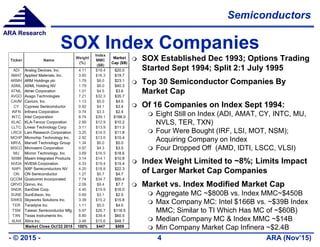
 SOX Established Dec 1993; Options Trading
Started Sept 1994; Split 2:1 July 1995
 Top 30 Semiconductor Companies By
Market Cap
 Of 16 Companies on Index Sept 1994:
 Eight Still on Index (ADI, AMAT, CY, INTC, MU,
NVLS, TER, TXN)
 Four Were Bought (IRF, LSI, MOT, NSM);
Acquiring Company on Index
 Four Dropped Off (AMD, IDTI, LSCC, VLSI)
 Index Weight Limited to ~8%; Limits Impact
of Larger Market Cap Companies
 Market vs. Index Modified Market Cap
 Aggregate MC ~$800B vs. Index MMC~$450B
 Max Company MC: Intel $166B vs. ~$39B Index
MMC; Similar to TI Which Has MC of ~$60B)
 Median Company MC & Index MMC ~$14B
 Min Company Market Cap Infinera ~$2.4B
Ticker Name
Weight
(%)
Index
MMC
($B)
Market
Cap ($B)
ADI Analog Devices, Inc. 4.11 $18.4 $20.0
AMAT Applied Materials, Inc. 3.65 $16.3 $19.7
ARMH ARM Holdings plc 1.79 $8.0 $23.1
ASML ASML Holding NV 1.79 $8.0 $40.3
ATML Atmel Corporation 1.01 $4.5 $3.6
AVGO Avago Technologies 7.21 $32.3 $35.7
CAVM Cavium, Inc. 1.13 $5.0 $4.0
CY Cypress Semiconductor 0.92 $4.1 $3.4
INFN Infinera Corporation 0.74 $3.3 $2.4
INTC Intel Corporation 8.74 $39.1 $166.0
KLAC KLA-Tencor Corporation 2.89 $12.9 $10.2
LLTC Linear Technology Corp 3.11 $13.9 $11.3
LRCX Lam Research Corporation 3.25 $14.5 $11.8
MCHP Microchip Technology Inc. 2.92 $13.0 $10.4
MRVL Marvell Technology Group 1.34 $6.0 $5.0
MSCC Microsemi Corporation 0.97 $4.3 $3.5
MU Micron Technology, Inc. 3.69 $16.5 $18.6
MXIM Maxim Integrated Products 3.14 $14.1 $10.8
NVDA NVIDIA Corporation 4.33 $19.4 $15.4
NXPI NXP Semiconductors NV 4.20 $18.8 $22.3
ON ON Semiconductor 1.27 $5.7 $4.7
QCOM Qualcomm Incorporated 7.74 $34.7 $95.4
QRVO Qorvo, Inc. 2.09 $9.4 $7.7
SNDK SanDisk Corp. 4.45 $19.9 $16.0
SUNE SunEdison, Inc. 0.69 $3.1 $2.5
SWKS Skyworks Solutions Inc. 3.39 $15.2 $15.8
TER Teradyne Inc. 1.11 $5.0 $4.0
TSM Taiwan Semiconductor Mfg 5.97 $26.7 $116.5
TXN Texas Instruments Inc. 8.80 $39.4 $60.5
XLNX Xilinx Inc. 3.48 $15.6 $48.7
Market Close Oct'22 2015 100% $447 $809
Semiconductors
ARA (Nov’15)- © 2015 - 5
ARA Research
SOX Index Employs Algorithm to Limit Contribution of Largest Market
Cap Companies; Balances Bi-Modal Nature of Market Cap
SOX Company Market Caps
Market Cap of Companies in SOX ($B)
Semiconductors
ARA (Nov’15)- © 2015 - 6
ARA Research
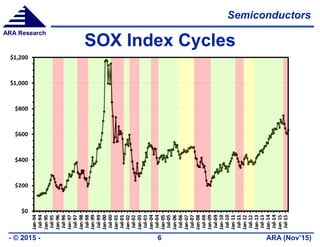
SOX Index Cycles
Semiconductors
ARA (Nov’15)- © 2015 - 7
ARA Research
SOX Index Cycle Min-Max
The Median “Up” Cycle was 123% vs. a Median “Down” Cycle of -
57%, But The Distribution Was Bi-Modal to an Extreme
Median Min Max
Up 123% 50% 496%
Down -57% -69% -22%
Neutral 3% -4% 9%
Semiconductors
ARA (Nov’15)- © 2015 - 8
ARA Research
SOX Index Cycle Lengths
The Median “Up” Cycle Length was 19 Mths vs. a Median “Down”
Cycle Length of 10 Mths
Median Min Max
Up 19 6 30
Down 10 7 17
Neutral 14 11 17
Semiconductors
ARA (Nov’15)- © 2015 - 9
ARA Research
SOX Index vs. Semi Revenue
Semiconductors
ARA (Nov’15)- © 2015 - 10
ARA Research
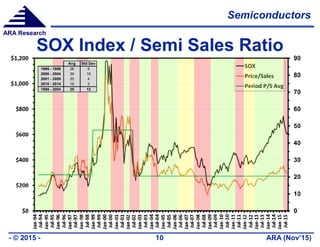
SOX Index / Semi Sales Ratio
Avg Std Dev
1995 - 1999 26 9
2000 - 2004 39 16
2001 - 2009 20 4
2010 - 2014 18 3
1995 - 2004 25 12
Semiconductors
ARA (Nov’15)- © 2015 - 11
ARA Research
SOX Index Summary
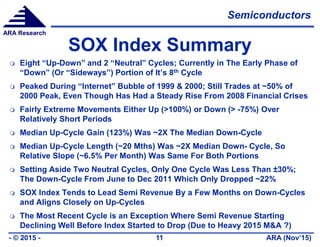
 Eight “Up-Down” and 2 “Neutral” Cycles; Currently in The Early Phase of
“Down” (Or “Sideways”) Portion of It’s 8th Cycle
 Peaked During “Internet” Bubble of 1999 & 2000; Still Trades at ~50% of
2000 Peak, Even Though Has Had a Steady Rise From 2008 Financial Crises
 Fairly Extreme Movements Either Up (>100%) or Down (> -75%) Over
Relatively Short Periods
 Median Up-Cycle Gain (123%) Was ~2X The Median Down-Cycle
 Median Up-Cycle Length (~20 Mths) Was ~2X Median Down- Cycle, So
Relative Slope (~6.5% Per Month) Was Same For Both Portions
 Setting Aside Two Neutral Cycles, Only One Cycle Was Less Than ±30%;
The Down-Cycle From June to Dec 2011 Which Only Dropped ~22%
 SOX Index Tends to Lead Semi Revenue By a Few Months on Down-Cycles
and Aligns Closely on Up-Cycles
 The Most Recent Cycle is an Exception Where Semi Revenue Starting
Declining Well Before Index Started to Drop (Due to Heavy 2015 M&A ?)
Semiconductors
ARA (Nov’15)- © 2015 - 12
ARA Research
SOX Index
Benchmarks
ARA ResearchARA Research
Semiconductors
ARA (Nov’15)- © 2015 - 13
ARA Research
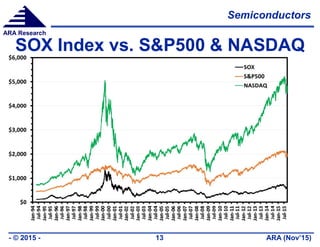
SOX Index vs. S&P500 & NASDAQ
Semiconductors
ARA (Nov’15)- © 2015 - 14
ARA Research
$1,000 Becomes:
Benchmark Performance: B&H
S&P $4,250
Russell $4,571
DJI $4,611
NASDAQ $6,241
SOX $5,066
Semiconductors
ARA (Nov’15)- © 2015 - 15
ARA Research
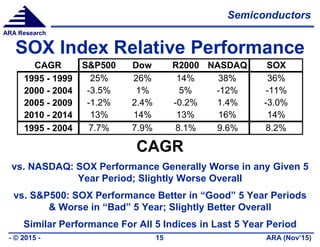
SOX Index Relative Performance
vs. NASDAQ: SOX Performance Generally Worse in any Given 5
Year Period; Slightly Worse Overall
vs. S&P500: SOX Performance Better in “Good” 5 Year Periods
& Worse in “Bad” 5 Year; Slightly Better Overall
Similar Performance For All 5 Indices in Last 5 Year Period
CAGR
CAGR S&P500 Dow R2000 NASDAQ SOX
1995 - 1999 25% 26% 14% 38% 36%
2000 - 2004 -3.5% 1% 5% -12% -11%
2005 - 2009 -1.2% 2.4% -0.2% 1.4% -3.0%
2010 - 2014 13% 14% 13% 16% 14%
1995 - 2004 7.7% 7.9% 8.1% 9.6% 8.2%
Semiconductors
ARA (Nov’15)- © 2015 - 16
ARA Research
SOX Index Relative Performance
vs. NASDAQ: SOX Relative Volatility ~50% Higher, Decreasing
Modestly Over Time
vs. S&P500: SOX Relative Volatility ~2x Higher, Decreasing
Significantly Over Time
SOX Has Much Greater Volatility For Similar/Lower Returns
Volatility
Volatility S&P500 Dow R2000 NASDAQ SOX
1995 - 1999 16% 16% 14% 21% 40%
2000 - 2004 20% 20% 23% 35% 57%
2005 - 2009 24% 22% 30% 25% 32%
2010 - 2014 16% 15% 22% 18% 25%
1995 - 2004 19% 18% 22% 25% 39%
Semiconductors
ARA (Nov’15)- © 2015 - 17
ARA Research
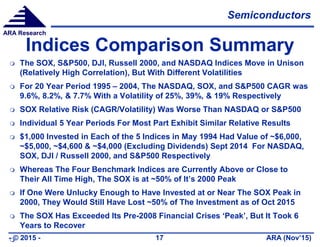
Indices Comparison Summary
 The SOX, S&P500, DJI, Russell 2000, and NASDAQ Indices Move in Unison
(Relatively High Correlation), But With Different Volatilities
 For 20 Year Period 1995 – 2004, The NASDAQ, SOX, and S&P500 CAGR was
9.6%, 8.2%, & 7.7% With a Volatility of 25%, 39%, & 19% Respectively
 SOX Relative Risk (CAGR/Volatility) Was Worse Than NASDAQ or S&P500
 Individual 5 Year Periods For Most Part Exhibit Similar Relative Results
 $1,000 Invested in Each of the 5 Indices in May 1994 Had Value of ~$6,000,
~$5,000, ~$4,600 & ~$4,000 (Excluding Dividends) Sept 2014 For NASDAQ,
SOX, DJI / Russell 2000, and S&P500 Respectively
 Whereas The Four Benchmark Indices are Currently Above or Close to
Their All Time High, The SOX is at ~50% of It’s 2000 Peak
 If One Were Unlucky Enough to Have Invested at or Near The SOX Peak in
2000, They Would Still Have Lost ~50% of The Investment as of Oct 2015
 The SOX Has Exceeded Its Pre-2008 Financial Crises ‘Peak’, But It Took 6
Years to Recover

Semiconductors
ARA (Nov’15)- © 2015 - 18
ARA Research
SOX Index
Momentum Analysis
ARA ResearchARA Research
Semiconductors
ARA (Nov’15)- © 2015 - 19
ARA Research
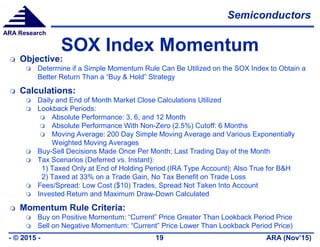
SOX Index Momentum
 Objective:
 Determine if a Simple Momentum Rule Can Be Utilized on the SOX Index to Obtain a
Better Return Than a “Buy & Hold” Strategy
 Calculations:
 Daily and End of Month Market Close Calculations Utilized
 Lookback Periods:
 Absolute Performance: 3, 6, and 12 Month
 Absolute Performance With Non-Zero (2.5%) Cutoff: 6 Months
 Moving Average: 200 Day Simple Moving Average and Various Exponentially
Weighted Moving Averages
 Buy-Sell Decisions Made Once Per Month; Last Trading Day of the Month
 Tax Scenarios (Deferred vs. Instant):
1) Taxed Only at End of Holding Period (IRA Type Account); Also True for B&H
2) Taxed at 33% on a Trade Gain, No Tax Benefit on Trade Loss
 Fees/Spread: Low Cost ($10) Trades, Spread Not Taken Into Account
 Invested Return and Maximum Draw-Down Calculated
 Momentum Rule Criteria:
 Buy on Positive Momentum: “Current” Price Greater Than Lookback Period Price
 Sell on Negative Momentum: “Current” Price Lower Than Lookback Period Price)
Semiconductors
ARA (Nov’15)- © 2015 - 20
ARA Research
B&H vs. 3 Mth Lookback B&S
B&H Taxed No Tax
$1,000 Becomes $3,726 $5,509 $10,928
$ Trades (B&S) n/a 58 58
Avg Trades/Year n/a 2.9 2.9
Max Draw Down 70% 50% 42%
Median Draw Down 49% 32% 23%
3 Mth Lookback
Semiconductors
ARA (Nov’15)- © 2015 - 21
ARA Research
B&H vs. 6 Mth Lookback B&S
B&H Taxed No Tax
$1,000 Becomes $3,726 $2,502 $3,969
$ Trades (B&S) n/a 44 44
Avg Trades/Year n/a 2.2 2.2
Max Draw Down 70% 52% 38%
Median Draw Down 49% 37% 29%
6 Mth Lookback
Semiconductors
ARA (Nov’15)- © 2015 - 22
ARA Research
B&H vs. 12 Mth Lookback
B&H Taxed No Tax
$1,000 Becomes $3,726 $1,833 $2,243
$ Trades (B&S) n/a 26 26
Avg Trades/Year n/a 1.3 1.3
Max Draw Down 70% 61% 55%
Median Draw Down 49% 34% 33%
12 Mth Lookback
Semiconductors
ARA (Nov’15)- © 2015 - 23
ARA Research
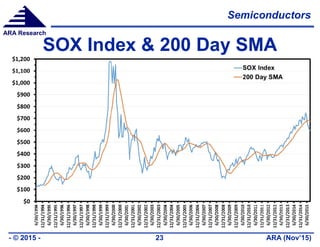
SOX Index & 200 Day SMA
Semiconductors
ARA (Nov’15)- © 2015 - 24
ARA Research
B&H vs. 200 Day SMA B&S
B&H Taxed No Tax
$1,000 Becomes $3,726 $4,364 $7,012
$ Trades (B&S) n/a 38 38
Avg Trades/Year n/a 1.9 1.9
Max Draw Down 70% 43% 28%
Median Draw Down 49% 31% 21%
200 Day SMA
Semiconductors
ARA (Nov’15)- © 2015 - 25
ARA Research
Impact of Non-Zero Threshold
Criteria: 6 Mth Look Price ≥ 2.5% Higher
Than Current Price to “Buy”
B&H Taxed No Tax
$1,000 Becomes $3,726 $3,700 $5,632
$ Trades (B&S) n/a 42 42
Avg Trades/Year n/a 2.1 2.1
Max Draw Down 70% 51% 36%
Median Draw Down 49% 32% 26%
6 Mth LB / 2.5% Criteria
Semiconductors
ARA (Nov’15)- © 2015 - 26
ARA Research
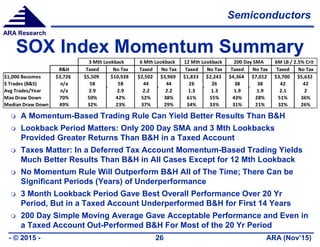
SOX Index Momentum Summary
 A Momentum-Based Trading Rule Can Yield Better Results Than B&H
 Lookback Period Matters: Only 200 Day SMA and 3 Mth Lookbacks
Provided Greater Returns Than B&H in a Taxed Account
 Taxes Matter: In a Deferred Tax Account Momentum-Based Trading Yields
Much Better Results Than B&H in All Cases Except for 12 Mth Lookback
 No Momentum Rule Will Outperform B&H All of The Time; There Can be
Significant Periods (Years) of Underperformance
 3 Month Lookback Period Gave Best Overall Performance Over 20 Yr
Period, But in a Taxed Account Underperformed B&H for First 14 Years
 200 Day Simple Moving Average Gave Acceptable Performance and Even in
a Taxed Account Out-Performed B&H For Most of the 20 Yr Period
B&H Taxed No Tax Taxed No Tax Taxed No Tax Taxed No Tax Taxed No Tax
$1,000 Becomes $3,726 $5,509 $10,928 $2,502 $3,969 $1,833 $2,243 $4,364 $7,012 $3,700 $5,632
$ Trades (B&S) n/a 58 58 44 44 26 26 38 38 42 42
Avg Trades/Year n/a 2.9 2.9 2.2 2.2 1.3 1.3 1.9 1.9 2.1 2
Max Draw Down 70% 50% 42% 52% 38% 61% 55% 43% 28% 51% 36%
Median Draw Down 49% 32% 23% 37% 29% 34% 33% 31% 21% 32% 26%
3 Mth Lookback 6 Mth Lookback 12 Mth Lookback 200 Day SMA 6M LB / 2.5% Crit
Semiconductors
ARA (Nov’15)- © 2015 - 27
ARA Research
Appendix:
SOX Index
Background Information
ARA ResearchARA Research
Semiconductors
ARA (Nov’15)- © 2015 - 28
ARA Research
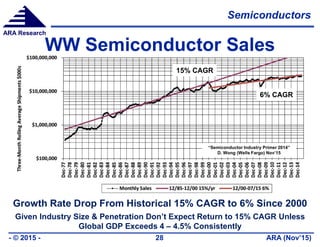
WW Semiconductor Sales
Growth Rate Drop From Historical 15% CAGR to 6% Since 2000
Given Industry Size & Penetration Don’t Expect Return to 15% CAGR Unless
Global GDP Exceeds 4 – 4.5% Consistently
“Semiconductor Industry Primer 2014”
D. Wong (Wells Fargo) Nov’15
15% CAGR
6% CAGR
Semiconductors
ARA (Nov’15)- © 2015 - 29
ARA Research
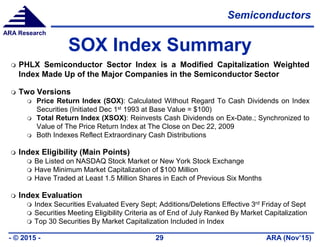
SOX Index Summary
 PHLX Semiconductor Sector Index is a Modified Capitalization Weighted
Index Made Up of the Major Companies in the Semiconductor Sector
 Two Versions
 Price Return Index (SOX): Calculated Without Regard To Cash Dividends on Index
Securities (Initiated Dec 1st 1993 at Base Value = $100)
 Total Return Index (XSOX): Reinvests Cash Dividends on Ex-Date.; Synchronized to
Value of The Price Return Index at The Close on Dec 22, 2009
 Both Indexes Reflect Extraordinary Cash Distributions
 Index Eligibility (Main Points)
 Be Listed on NASDAQ Stock Market or New York Stock Exchange
 Have Minimum Market Capitalization of $100 Million
 Have Traded at Least 1.5 Million Shares in Each of Previous Six Months
 Index Evaluation
 Index Securities Evaluated Every Sept; Additions/Deletions Effective 3rd Friday of Sept
 Securities Meeting Eligibility Criteria as of End of July Ranked By Market Capitalization
 Top 30 Securities By Market Capitalization Included in Index
Semiconductors
ARA (Nov’15)- © 2015 - 30
ARA Research
SOX Index Calculation
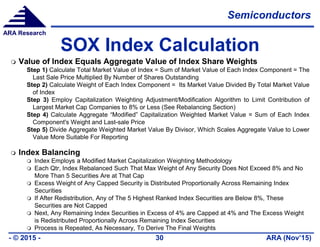
 Value of Index Equals Aggregate Value of Index Share Weights
Step 1) Calculate Total Market Value of Index = Sum of Market Value of Each Index Component = The
Last Sale Price Multiplied By Number of Shares Outstanding
Step 2) Calculate Weight of Each Index Component = Its Market Value Divided By Total Market Value
of Index
Step 3) Employ Capitalization Weighting Adjustment/Modification Algorithm to Limit Contribution of
Largest Market Cap Companies to 8% or Less (See Rebalancing Section)
Step 4) Calculate Aggregate “Modified” Capitalization Weighted Market Value = Sum of Each Index
Component's Weight and Last-sale Price
Step 5) Divide Aggregate Weighted Market Value By Divisor, Which Scales Aggregate Value to Lower
Value More Suitable For Reporting
 Index Balancing
 Index Employs a Modified Market Capitalization Weighting Methodology
 Each Qtr, Index Rebalanced Such That Max Weight of Any Security Does Not Exceed 8% and No
More Than 5 Securities Are at That Cap
 Excess Weight of Any Capped Security is Distributed Proportionally Across Remaining Index
Securities
 If After Redistribution, Any of The 5 Highest Ranked Index Securities are Below 8%, These
Securities are Not Capped
 Next, Any Remaining Index Securities in Excess of 4% are Capped at 4% and The Excess Weight
is Redistributed Proportionally Across Remaining Index Securities
 Process is Repeated, As Necessary, To Derive The Final Weights
Semiconductors
ARA (Nov’15)- © 2015 - 31
ARA Research
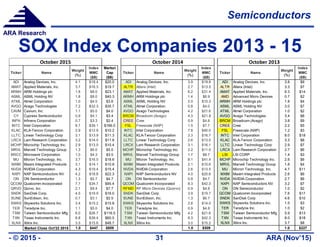
SOX Index Companies 2013 - 15
Ticker Name
Weight
(%)
Index
MMC
($B)
Market
Cap
($B)
Ticker Name
Weight
(%)
Index
MMC
($B)
Ticker Name
Weight
(%)
Index
MMC
($B)
ADI Analog Devices, Inc. 4.1 $18.4 $20.0 ADI Analog Devices, Inc. 3.9 $19.8 ADI Analog Devices, Inc. 3.8 $9
AMAT Applied Materials, Inc. 3.7 $16.3 $19.7 ALTR Altera (Intel) 2.7 $13.5 ALTR Altera (Intel) 3.3 $7
ARMH ARM Holdings plc 1.8 $8.0 $23.1 AMAT Applied Materials, Inc. 6.2 $31.4 AMAT Applied Materials, Inc. 6.3 $14
ASML ASML Holding NV 1.8 $8.0 $40.3 ARMH ARM Holdings plc 1.4 $6.9 AMD Advanced Micro Devices 0.7 $2
ATML Atmel Corporation 1.0 $4.5 $3.6 ASML ASML Holding NV 2.0 $10.3 ARMH ARM Holdings plc 1.8 $4
AVGO Avago Technologies 7.2 $32.3 $35.7 ATML Atmel Corporation 0.8 $4.0 ASML ASML Holding NV 3.0 $7
CAVM Cavium, Inc. 1.1 $5.0 $4.0 AVGO Avago Technologies 4.2 $21.6 ATML Atmel Corporation 1.0 $2
CY Cypress Semiconductor 0.9 $4.1 $3.4 BRCM Broadcom (Avago) 4.3 $21.8 AVGO Avago Technologies 3.4 $8
INFN Infinera Corporation 0.7 $3.3 $2.4 CREE Cree 0.9 $4.8 BRCM Broadcom (Avago) 3.8 $9
INTC Intel Corporation 8.7 $39.1 $166.0 FSL Freescale (NXP) 1.5 $7.7 CREE Cree 2.2 $5
KLAC KLA-Tencor Corporation 2.9 $12.9 $10.2 INTC Intel Corporation 7.8 $40.0 FSL Freescale (NXP) 1.2 $3
LLTC Linear Technology Corp 3.1 $13.9 $11.3 KLAC KLA-Tencor Corporation 3.3 $16.7 INTC Intel Corporation 8.0 $18
LRCX Lam Research Corporation 3.2 $14.5 $11.8 LLTC Linear Technology Corp 2.6 $13.0 KLAC KLA-Tencor Corporation 3.3 $8
MCHP Microchip Technology Inc. 2.9 $13.0 $10.4 LRCX Lam Research Corporation 3.1 $16.1 LLTC Linear Technology Corp 2.9 $7
MRVL Marvell Technology Group 1.3 $6.0 $5.0 MCHP Microchip Technology Inc. 2.2 $11.0 LRCX Lam Research Corporation 2.7 $6
MSCC Microsemi Corporation 1.0 $4.3 $3.5 MRVL Marvell Technology Group 1.7 $8.7 LSI LSI CORP 1.4 $3
MU Micron Technology, Inc. 3.7 $16.5 $18.6 MU Micron Technology, Inc. 8.1 $41.4 MCHP Microchip Technology Inc. 2.6 $6
MXIM Maxim Integrated Products 3.1 $14.1 $10.8 MXIM Maxim Integrated Products 2.1 $10.6 MRVL Marvell Technology Group 1.8 $4
NVDA NVIDIA Corporation 4.3 $19.4 $15.4 NVDA NVIDIA Corporation 2.6 $13.5 MU Micron Technology, Inc. 4.7 $11
NXPI NXP Semiconductors NV 4.2 $18.8 $22.3 NXPI NXP Semiconductors NV 4.0 $20.6 MXIM Maxim Integrated Products 2.6 $6
ON ON Semiconductor 1.3 $5.7 $4.7 ON ON Semiconductor 0.9 $4.7 NVDA NVIDIA Corporation 2.7 $6
QCOM Qualcomm Incorporated 7.7 $34.7 $95.4 QCOM Qualcomm Incorporated 8.3 $42.3 NXPI NXP Semiconductors NV 3.2 $7
QRVO Qorvo, Inc. 2.1 $9.4 $7.7 RFMD RF Micro Devices (Quorvo) 0.9 $4.8 ON ON Semiconductor 1.0 $2
SNDK SanDisk Corp. 4.5 $19.9 $16.0 SNDK SanDisk Corp. 3.9 $19.7 QCOM Qualcomm Incorporated 7.6 $17
SUNE SunEdison, Inc. 0.7 $3.1 $2.5 SUNE SunEdison, Inc. 1.3 $6.7 SNDK SanDisk Corp. 4.6 $10
SWKS Skyworks Solutions Inc. 3.4 $15.2 $15.8 SWKS Skyworks Solutions Inc. 2.8 $14.0 SWKS Skyworks Solutions Inc. 1.5 $3
TER Teradyne Inc. 1.1 $5.0 $4.0 TER Teradyne Inc. 0.9 $4.8 TER Teradyne Inc. 1.0 $2
TSM Taiwan Semiconductor Mfg 6.0 $26.7 $116.5 TSM Taiwan Semiconductor Mfg 4.2 $21.6 TSM Taiwan Semiconductor Mfg 5.9 $13
TXN Texas Instruments Inc. 8.8 $39.4 $60.5 TXN Texas Instruments Inc. 8.3 $42.3 TXN Texas Instruments Inc. 8.0 $18
XLNX Xilinx Inc. 3.5 $15.6 $48.7 XLNX Xilinx Inc. 3.0 $15.2 XLNX Xilinx Inc. 3.7 $8
Market Close Oct'22 2015 1.0 $447 $809 1.0 $509 1.0 $227
October 2015 October 2014 October 2013
Semiconductors
ARA (Nov’15)- © 2015 - 32
ARA Research
SOX Index Sept vs. Oct 2010
 SOX Index Transitioned to
Modified Market Cap Algorithm
and 30 Companies Oct 2010
 Prior to That SOX Index Carrier
16 – 21 Companies, While the
iShares ETF (SOXX) Carried 52
Companies
 Since Oct 2010 Both The SOX
and SOXX Carried the Identical
30 Companies
 Blue = Companies Added
Oct’2010
 Weightings Shown are for SOXX
Ticker Name
Weight
(%)
Index
MMC
($B)
Ticker Name
ALTR Altera (Intel) 4.18 $7.4 ALTR Altera (Intel)
AMAT Applied Materials, Inc. 7.86 $13.9 AMAT Applied Materials, Inc.
AMD Advanced Micro Devices 3.25 $5.8 AMD Advanced Micro Devices
ATHR Atheros (Qcom) 1.45 $2.6 ATHR Atheros (Qcom)
AVGO Avago Technologies 3.88 $6.9 BRCM Broadcom (Avago)
BRCM Broadcom (Avago) 8.98 $15.9 CREE Cree
CREE Cree 3.16 $5.6 HITT Hittite Microwave (ADI)
CRUS Cirrus Logic 0.57 $1.0 INTC Intel Corp
HITT Hittite Microwave (ADI) 1.04 $1.8 KLAC KLA-Tencor Corp
INTC Intel Corp 7.48 $13.2 LLTC Linear Technology Corp
KLAC KLA-Tencor Corp 3.94 $7.0 LRCX Lam Research Corp
LLTC Linear Technology Corp 3.72 $6.6 MU Micron Technology
LRCX Lam Research Corp 3.74 $6.6 NSM National Semi (TI)
MKSI MKS Instruments 0.68 $1.2 NVLS Novellus Systems (Lam)
MRVL Marvell Technology Group 6.85 $12.1 SNDK SanDisk Corp.
MU Micron Technology, Inc. 4.22 $7.5 STM ST Microelectronics
NETL Netlogic Micro (BCOM) 1.26 $2.2 TER Teradyne
NSM National Semi (TI) 2.16 $3.8 TSM Taiwan Semiconductor Mfg
NVDA NVIDIA Corporation 4.26 $7.5 TXN Texas Instruments Inc.
NVLS Novellus Systems (Lam) 1.77 $3.1 WFR MEMC Electronics
POWI Power Integrations 0.63 $1.1 XLNX Xilinx Inc.
RBCN Rubicon Technology 0.35 $0.6
SNDK SanDisk Corp. 3.73 $6.6
STM ST Microelectronics 0.46 $0.8
TER Teradyne Inc. 1.34 $2.4
TSM Taiwan Semiconductor Mfg 3.83 $6.8
TXN Texas Instruments Inc. 8.48 $15.0
VECO Veeco Instruments 1.13 $2.0
WFR MEMC Electronics 1.92 $3.4
XLNX Xilinx Inc. 3.67 $6.5
100% $177
September 2010October 2010
Semiconductors
ARA (Nov’15)- © 2015 - 33
ARA Research
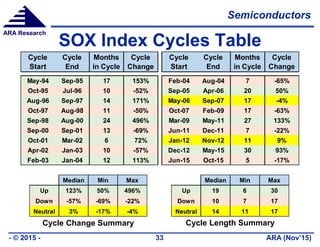
SOX Index Cycles Table
Cycle
Start
Cycle
End
Months
in Cycle
Cycle
Change
Cycle
Start
Cycle
End
Months
in Cycle
Cycle
Change
May-94 Sep-95 17 153% Feb-04 Aug-04 7 -65%
Oct-95 Jul-96 10 -52% Sep-05 Apr-06 20 50%
Aug-96 Sep-97 14 171% May-06 Sep-07 17 -4%
Oct-97 Aug-98 11 -50% Oct-07 Feb-09 17 -63%
Sep-98 Aug-00 24 496% Mar-09 May-11 27 133%
Sep-00 Sep-01 13 -69% Jun-11 Dec-11 7 -22%
Oct-01 Mar-02 6 72% Jan-12 Nov-12 11 9%
Apr-02 Jan-03 10 -57% Dec-12 May-15 30 93%
Feb-03 Jan-04 12 113% Jun-15 Oct-15 5 -17%
Median Min Max
Up 123% 50% 496%
Down -57% -69% -22%
Neutral 3% -17% -4%
Median Min Max
Up 19 6 30
Down 10 7 17
Neutral 14 11 17
Cycle Change Summary Cycle Length Summary
Semiconductors
ARA (Nov’15)- © 2015 - 34
ARA Research
Index Volatility
 Basic Definition:
 Standard Deviation of Historical Returns
 Basically a “Dispersion” Measure; Greater Dispersion (Volatility) Implies Greater Risk
 Upside & Downside Price Movements Are Equally Considered in the Volatility
Calculation; The Sortino Ratio Attempts to Capture Just Downside Volatility
 Calculation
Step 1) Calculate Daily Periodic Stock Return (Ri) = (Pi – Pi-1)/Pi ; Where Pi is Current
Day’s Closing Price and Pi-1 is Closing Price on Previous Day
 More Often Ri = Ln(Pi/Pi-1) is Used as it Better Represents a Continuously
Compounded Return; Approximately The Same For Most Short Intervals
 This was the Method Employed in This Study
Step 2) Decide on Time Period; Volatility for Both the Full 20 Year (1994 – 2014) as Well
as 5 Year Intervals Was Calculated for The 3 Indices Examined in This Study
Step 3) Calculate Daily Sample Variance = [ Sum(Pi-1 – Avg P)2 ] / (m-1); Where ‘m’ =
Number of Sample Data Points Over Which The Sum is Performed
Step 4) Calculate Annualized Sample Volatility = Sqrt (Sample Variance) x Sqrt (250);
250 Being The Number of Trading Days in a Typical Year
 Note: To Calculate Annualized Weekly or Monthly Volatility Multiply The
Corresponding Weekly or Monthly Volatility By Sqrt(52) or Sqrt(12) Respectively;
The Calculated Volatility Will Be Slightly Different in Each Case

Semiconductor Index (SOX) Analysis

  • 1.
    ARA Research ARA (Nov’15)-© 2015 - ARA Research Philadelphia Semiconductor Sector (SOX) Index Analysis A.R. Alvarez November 2015
  • 2.
    Semiconductors ARA (Nov’15)- ©2015 - 2 ARA Research SOX Index Outline  SOX Index History  SOX Index vs. Benchmarks  SOX Index Momentum Analysis  Appendix: SOX Background
  • 3.
    Semiconductors ARA (Nov’15)- ©2015 - 3 ARA Research SOX Index History ARA ResearchARA Research
  • 4.
    Semiconductors ARA (Nov’15)- ©2015 - 4 ARA Research SOX Index Companies  SOX Established Dec 1993; Options Trading Started Sept 1994; Split 2:1 July 1995  Top 30 Semiconductor Companies By Market Cap  Of 16 Companies on Index Sept 1994:  Eight Still on Index (ADI, AMAT, CY, INTC, MU, NVLS, TER, TXN)  Four Were Bought (IRF, LSI, MOT, NSM); Acquiring Company on Index  Four Dropped Off (AMD, IDTI, LSCC, VLSI)  Index Weight Limited to ~8%; Limits Impact of Larger Market Cap Companies  Market vs. Index Modified Market Cap  Aggregate MC ~$800B vs. Index MMC~$450B  Max Company MC: Intel $166B vs. ~$39B Index MMC; Similar to TI Which Has MC of ~$60B)  Median Company MC & Index MMC ~$14B  Min Company Market Cap Infinera ~$2.4B Ticker Name Weight (%) Index MMC ($B) Market Cap ($B) ADI Analog Devices, Inc. 4.11 $18.4 $20.0 AMAT Applied Materials, Inc. 3.65 $16.3 $19.7 ARMH ARM Holdings plc 1.79 $8.0 $23.1 ASML ASML Holding NV 1.79 $8.0 $40.3 ATML Atmel Corporation 1.01 $4.5 $3.6 AVGO Avago Technologies 7.21 $32.3 $35.7 CAVM Cavium, Inc. 1.13 $5.0 $4.0 CY Cypress Semiconductor 0.92 $4.1 $3.4 INFN Infinera Corporation 0.74 $3.3 $2.4 INTC Intel Corporation 8.74 $39.1 $166.0 KLAC KLA-Tencor Corporation 2.89 $12.9 $10.2 LLTC Linear Technology Corp 3.11 $13.9 $11.3 LRCX Lam Research Corporation 3.25 $14.5 $11.8 MCHP Microchip Technology Inc. 2.92 $13.0 $10.4 MRVL Marvell Technology Group 1.34 $6.0 $5.0 MSCC Microsemi Corporation 0.97 $4.3 $3.5 MU Micron Technology, Inc. 3.69 $16.5 $18.6 MXIM Maxim Integrated Products 3.14 $14.1 $10.8 NVDA NVIDIA Corporation 4.33 $19.4 $15.4 NXPI NXP Semiconductors NV 4.20 $18.8 $22.3 ON ON Semiconductor 1.27 $5.7 $4.7 QCOM Qualcomm Incorporated 7.74 $34.7 $95.4 QRVO Qorvo, Inc. 2.09 $9.4 $7.7 SNDK SanDisk Corp. 4.45 $19.9 $16.0 SUNE SunEdison, Inc. 0.69 $3.1 $2.5 SWKS Skyworks Solutions Inc. 3.39 $15.2 $15.8 TER Teradyne Inc. 1.11 $5.0 $4.0 TSM Taiwan Semiconductor Mfg 5.97 $26.7 $116.5 TXN Texas Instruments Inc. 8.80 $39.4 $60.5 XLNX Xilinx Inc. 3.48 $15.6 $48.7 Market Close Oct'22 2015 100% $447 $809
  • 5.
    Semiconductors ARA (Nov’15)- ©2015 - 5 ARA Research SOX Index Employs Algorithm to Limit Contribution of Largest Market Cap Companies; Balances Bi-Modal Nature of Market Cap SOX Company Market Caps Market Cap of Companies in SOX ($B)
  • 6.
    Semiconductors ARA (Nov’15)- ©2015 - 6 ARA Research SOX Index Cycles
  • 7.
    Semiconductors ARA (Nov’15)- ©2015 - 7 ARA Research SOX Index Cycle Min-Max The Median “Up” Cycle was 123% vs. a Median “Down” Cycle of - 57%, But The Distribution Was Bi-Modal to an Extreme Median Min Max Up 123% 50% 496% Down -57% -69% -22% Neutral 3% -4% 9%
  • 8.
    Semiconductors ARA (Nov’15)- ©2015 - 8 ARA Research SOX Index Cycle Lengths The Median “Up” Cycle Length was 19 Mths vs. a Median “Down” Cycle Length of 10 Mths Median Min Max Up 19 6 30 Down 10 7 17 Neutral 14 11 17
  • 9.
    Semiconductors ARA (Nov’15)- ©2015 - 9 ARA Research SOX Index vs. Semi Revenue
  • 10.
    Semiconductors ARA (Nov’15)- ©2015 - 10 ARA Research SOX Index / Semi Sales Ratio Avg Std Dev 1995 - 1999 26 9 2000 - 2004 39 16 2001 - 2009 20 4 2010 - 2014 18 3 1995 - 2004 25 12
  • 11.
    Semiconductors ARA (Nov’15)- ©2015 - 11 ARA Research SOX Index Summary  Eight “Up-Down” and 2 “Neutral” Cycles; Currently in The Early Phase of “Down” (Or “Sideways”) Portion of It’s 8th Cycle  Peaked During “Internet” Bubble of 1999 & 2000; Still Trades at ~50% of 2000 Peak, Even Though Has Had a Steady Rise From 2008 Financial Crises  Fairly Extreme Movements Either Up (>100%) or Down (> -75%) Over Relatively Short Periods  Median Up-Cycle Gain (123%) Was ~2X The Median Down-Cycle  Median Up-Cycle Length (~20 Mths) Was ~2X Median Down- Cycle, So Relative Slope (~6.5% Per Month) Was Same For Both Portions  Setting Aside Two Neutral Cycles, Only One Cycle Was Less Than ±30%; The Down-Cycle From June to Dec 2011 Which Only Dropped ~22%  SOX Index Tends to Lead Semi Revenue By a Few Months on Down-Cycles and Aligns Closely on Up-Cycles  The Most Recent Cycle is an Exception Where Semi Revenue Starting Declining Well Before Index Started to Drop (Due to Heavy 2015 M&A ?)
  • 12.
    Semiconductors ARA (Nov’15)- ©2015 - 12 ARA Research SOX Index Benchmarks ARA ResearchARA Research
  • 13.
    Semiconductors ARA (Nov’15)- ©2015 - 13 ARA Research SOX Index vs. S&P500 & NASDAQ
  • 14.
    Semiconductors ARA (Nov’15)- ©2015 - 14 ARA Research $1,000 Becomes: Benchmark Performance: B&H S&P $4,250 Russell $4,571 DJI $4,611 NASDAQ $6,241 SOX $5,066
  • 15.
    Semiconductors ARA (Nov’15)- ©2015 - 15 ARA Research SOX Index Relative Performance vs. NASDAQ: SOX Performance Generally Worse in any Given 5 Year Period; Slightly Worse Overall vs. S&P500: SOX Performance Better in “Good” 5 Year Periods & Worse in “Bad” 5 Year; Slightly Better Overall Similar Performance For All 5 Indices in Last 5 Year Period CAGR CAGR S&P500 Dow R2000 NASDAQ SOX 1995 - 1999 25% 26% 14% 38% 36% 2000 - 2004 -3.5% 1% 5% -12% -11% 2005 - 2009 -1.2% 2.4% -0.2% 1.4% -3.0% 2010 - 2014 13% 14% 13% 16% 14% 1995 - 2004 7.7% 7.9% 8.1% 9.6% 8.2%
  • 16.
    Semiconductors ARA (Nov’15)- ©2015 - 16 ARA Research SOX Index Relative Performance vs. NASDAQ: SOX Relative Volatility ~50% Higher, Decreasing Modestly Over Time vs. S&P500: SOX Relative Volatility ~2x Higher, Decreasing Significantly Over Time SOX Has Much Greater Volatility For Similar/Lower Returns Volatility Volatility S&P500 Dow R2000 NASDAQ SOX 1995 - 1999 16% 16% 14% 21% 40% 2000 - 2004 20% 20% 23% 35% 57% 2005 - 2009 24% 22% 30% 25% 32% 2010 - 2014 16% 15% 22% 18% 25% 1995 - 2004 19% 18% 22% 25% 39%
  • 17.
    Semiconductors ARA (Nov’15)- ©2015 - 17 ARA Research Indices Comparison Summary  The SOX, S&P500, DJI, Russell 2000, and NASDAQ Indices Move in Unison (Relatively High Correlation), But With Different Volatilities  For 20 Year Period 1995 – 2004, The NASDAQ, SOX, and S&P500 CAGR was 9.6%, 8.2%, & 7.7% With a Volatility of 25%, 39%, & 19% Respectively  SOX Relative Risk (CAGR/Volatility) Was Worse Than NASDAQ or S&P500  Individual 5 Year Periods For Most Part Exhibit Similar Relative Results  $1,000 Invested in Each of the 5 Indices in May 1994 Had Value of ~$6,000, ~$5,000, ~$4,600 & ~$4,000 (Excluding Dividends) Sept 2014 For NASDAQ, SOX, DJI / Russell 2000, and S&P500 Respectively  Whereas The Four Benchmark Indices are Currently Above or Close to Their All Time High, The SOX is at ~50% of It’s 2000 Peak  If One Were Unlucky Enough to Have Invested at or Near The SOX Peak in 2000, They Would Still Have Lost ~50% of The Investment as of Oct 2015  The SOX Has Exceeded Its Pre-2008 Financial Crises ‘Peak’, But It Took 6 Years to Recover 
  • 18.
    Semiconductors ARA (Nov’15)- ©2015 - 18 ARA Research SOX Index Momentum Analysis ARA ResearchARA Research
  • 19.
    Semiconductors ARA (Nov’15)- ©2015 - 19 ARA Research SOX Index Momentum  Objective:  Determine if a Simple Momentum Rule Can Be Utilized on the SOX Index to Obtain a Better Return Than a “Buy & Hold” Strategy  Calculations:  Daily and End of Month Market Close Calculations Utilized  Lookback Periods:  Absolute Performance: 3, 6, and 12 Month  Absolute Performance With Non-Zero (2.5%) Cutoff: 6 Months  Moving Average: 200 Day Simple Moving Average and Various Exponentially Weighted Moving Averages  Buy-Sell Decisions Made Once Per Month; Last Trading Day of the Month  Tax Scenarios (Deferred vs. Instant): 1) Taxed Only at End of Holding Period (IRA Type Account); Also True for B&H 2) Taxed at 33% on a Trade Gain, No Tax Benefit on Trade Loss  Fees/Spread: Low Cost ($10) Trades, Spread Not Taken Into Account  Invested Return and Maximum Draw-Down Calculated  Momentum Rule Criteria:  Buy on Positive Momentum: “Current” Price Greater Than Lookback Period Price  Sell on Negative Momentum: “Current” Price Lower Than Lookback Period Price)
  • 20.
    Semiconductors ARA (Nov’15)- ©2015 - 20 ARA Research B&H vs. 3 Mth Lookback B&S B&H Taxed No Tax $1,000 Becomes $3,726 $5,509 $10,928 $ Trades (B&S) n/a 58 58 Avg Trades/Year n/a 2.9 2.9 Max Draw Down 70% 50% 42% Median Draw Down 49% 32% 23% 3 Mth Lookback
  • 21.
    Semiconductors ARA (Nov’15)- ©2015 - 21 ARA Research B&H vs. 6 Mth Lookback B&S B&H Taxed No Tax $1,000 Becomes $3,726 $2,502 $3,969 $ Trades (B&S) n/a 44 44 Avg Trades/Year n/a 2.2 2.2 Max Draw Down 70% 52% 38% Median Draw Down 49% 37% 29% 6 Mth Lookback
  • 22.
    Semiconductors ARA (Nov’15)- ©2015 - 22 ARA Research B&H vs. 12 Mth Lookback B&H Taxed No Tax $1,000 Becomes $3,726 $1,833 $2,243 $ Trades (B&S) n/a 26 26 Avg Trades/Year n/a 1.3 1.3 Max Draw Down 70% 61% 55% Median Draw Down 49% 34% 33% 12 Mth Lookback
  • 23.
    Semiconductors ARA (Nov’15)- ©2015 - 23 ARA Research SOX Index & 200 Day SMA
  • 24.
    Semiconductors ARA (Nov’15)- ©2015 - 24 ARA Research B&H vs. 200 Day SMA B&S B&H Taxed No Tax $1,000 Becomes $3,726 $4,364 $7,012 $ Trades (B&S) n/a 38 38 Avg Trades/Year n/a 1.9 1.9 Max Draw Down 70% 43% 28% Median Draw Down 49% 31% 21% 200 Day SMA
  • 25.
    Semiconductors ARA (Nov’15)- ©2015 - 25 ARA Research Impact of Non-Zero Threshold Criteria: 6 Mth Look Price ≥ 2.5% Higher Than Current Price to “Buy” B&H Taxed No Tax $1,000 Becomes $3,726 $3,700 $5,632 $ Trades (B&S) n/a 42 42 Avg Trades/Year n/a 2.1 2.1 Max Draw Down 70% 51% 36% Median Draw Down 49% 32% 26% 6 Mth LB / 2.5% Criteria
  • 26.
    Semiconductors ARA (Nov’15)- ©2015 - 26 ARA Research SOX Index Momentum Summary  A Momentum-Based Trading Rule Can Yield Better Results Than B&H  Lookback Period Matters: Only 200 Day SMA and 3 Mth Lookbacks Provided Greater Returns Than B&H in a Taxed Account  Taxes Matter: In a Deferred Tax Account Momentum-Based Trading Yields Much Better Results Than B&H in All Cases Except for 12 Mth Lookback  No Momentum Rule Will Outperform B&H All of The Time; There Can be Significant Periods (Years) of Underperformance  3 Month Lookback Period Gave Best Overall Performance Over 20 Yr Period, But in a Taxed Account Underperformed B&H for First 14 Years  200 Day Simple Moving Average Gave Acceptable Performance and Even in a Taxed Account Out-Performed B&H For Most of the 20 Yr Period B&H Taxed No Tax Taxed No Tax Taxed No Tax Taxed No Tax Taxed No Tax $1,000 Becomes $3,726 $5,509 $10,928 $2,502 $3,969 $1,833 $2,243 $4,364 $7,012 $3,700 $5,632 $ Trades (B&S) n/a 58 58 44 44 26 26 38 38 42 42 Avg Trades/Year n/a 2.9 2.9 2.2 2.2 1.3 1.3 1.9 1.9 2.1 2 Max Draw Down 70% 50% 42% 52% 38% 61% 55% 43% 28% 51% 36% Median Draw Down 49% 32% 23% 37% 29% 34% 33% 31% 21% 32% 26% 3 Mth Lookback 6 Mth Lookback 12 Mth Lookback 200 Day SMA 6M LB / 2.5% Crit
  • 27.
    Semiconductors ARA (Nov’15)- ©2015 - 27 ARA Research Appendix: SOX Index Background Information ARA ResearchARA Research
  • 28.
    Semiconductors ARA (Nov’15)- ©2015 - 28 ARA Research WW Semiconductor Sales Growth Rate Drop From Historical 15% CAGR to 6% Since 2000 Given Industry Size & Penetration Don’t Expect Return to 15% CAGR Unless Global GDP Exceeds 4 – 4.5% Consistently “Semiconductor Industry Primer 2014” D. Wong (Wells Fargo) Nov’15 15% CAGR 6% CAGR
  • 29.
    Semiconductors ARA (Nov’15)- ©2015 - 29 ARA Research SOX Index Summary  PHLX Semiconductor Sector Index is a Modified Capitalization Weighted Index Made Up of the Major Companies in the Semiconductor Sector  Two Versions  Price Return Index (SOX): Calculated Without Regard To Cash Dividends on Index Securities (Initiated Dec 1st 1993 at Base Value = $100)  Total Return Index (XSOX): Reinvests Cash Dividends on Ex-Date.; Synchronized to Value of The Price Return Index at The Close on Dec 22, 2009  Both Indexes Reflect Extraordinary Cash Distributions  Index Eligibility (Main Points)  Be Listed on NASDAQ Stock Market or New York Stock Exchange  Have Minimum Market Capitalization of $100 Million  Have Traded at Least 1.5 Million Shares in Each of Previous Six Months  Index Evaluation  Index Securities Evaluated Every Sept; Additions/Deletions Effective 3rd Friday of Sept  Securities Meeting Eligibility Criteria as of End of July Ranked By Market Capitalization  Top 30 Securities By Market Capitalization Included in Index
  • 30.
    Semiconductors ARA (Nov’15)- ©2015 - 30 ARA Research SOX Index Calculation  Value of Index Equals Aggregate Value of Index Share Weights Step 1) Calculate Total Market Value of Index = Sum of Market Value of Each Index Component = The Last Sale Price Multiplied By Number of Shares Outstanding Step 2) Calculate Weight of Each Index Component = Its Market Value Divided By Total Market Value of Index Step 3) Employ Capitalization Weighting Adjustment/Modification Algorithm to Limit Contribution of Largest Market Cap Companies to 8% or Less (See Rebalancing Section) Step 4) Calculate Aggregate “Modified” Capitalization Weighted Market Value = Sum of Each Index Component's Weight and Last-sale Price Step 5) Divide Aggregate Weighted Market Value By Divisor, Which Scales Aggregate Value to Lower Value More Suitable For Reporting  Index Balancing  Index Employs a Modified Market Capitalization Weighting Methodology  Each Qtr, Index Rebalanced Such That Max Weight of Any Security Does Not Exceed 8% and No More Than 5 Securities Are at That Cap  Excess Weight of Any Capped Security is Distributed Proportionally Across Remaining Index Securities  If After Redistribution, Any of The 5 Highest Ranked Index Securities are Below 8%, These Securities are Not Capped  Next, Any Remaining Index Securities in Excess of 4% are Capped at 4% and The Excess Weight is Redistributed Proportionally Across Remaining Index Securities  Process is Repeated, As Necessary, To Derive The Final Weights
  • 31.
    Semiconductors ARA (Nov’15)- ©2015 - 31 ARA Research SOX Index Companies 2013 - 15 Ticker Name Weight (%) Index MMC ($B) Market Cap ($B) Ticker Name Weight (%) Index MMC ($B) Ticker Name Weight (%) Index MMC ($B) ADI Analog Devices, Inc. 4.1 $18.4 $20.0 ADI Analog Devices, Inc. 3.9 $19.8 ADI Analog Devices, Inc. 3.8 $9 AMAT Applied Materials, Inc. 3.7 $16.3 $19.7 ALTR Altera (Intel) 2.7 $13.5 ALTR Altera (Intel) 3.3 $7 ARMH ARM Holdings plc 1.8 $8.0 $23.1 AMAT Applied Materials, Inc. 6.2 $31.4 AMAT Applied Materials, Inc. 6.3 $14 ASML ASML Holding NV 1.8 $8.0 $40.3 ARMH ARM Holdings plc 1.4 $6.9 AMD Advanced Micro Devices 0.7 $2 ATML Atmel Corporation 1.0 $4.5 $3.6 ASML ASML Holding NV 2.0 $10.3 ARMH ARM Holdings plc 1.8 $4 AVGO Avago Technologies 7.2 $32.3 $35.7 ATML Atmel Corporation 0.8 $4.0 ASML ASML Holding NV 3.0 $7 CAVM Cavium, Inc. 1.1 $5.0 $4.0 AVGO Avago Technologies 4.2 $21.6 ATML Atmel Corporation 1.0 $2 CY Cypress Semiconductor 0.9 $4.1 $3.4 BRCM Broadcom (Avago) 4.3 $21.8 AVGO Avago Technologies 3.4 $8 INFN Infinera Corporation 0.7 $3.3 $2.4 CREE Cree 0.9 $4.8 BRCM Broadcom (Avago) 3.8 $9 INTC Intel Corporation 8.7 $39.1 $166.0 FSL Freescale (NXP) 1.5 $7.7 CREE Cree 2.2 $5 KLAC KLA-Tencor Corporation 2.9 $12.9 $10.2 INTC Intel Corporation 7.8 $40.0 FSL Freescale (NXP) 1.2 $3 LLTC Linear Technology Corp 3.1 $13.9 $11.3 KLAC KLA-Tencor Corporation 3.3 $16.7 INTC Intel Corporation 8.0 $18 LRCX Lam Research Corporation 3.2 $14.5 $11.8 LLTC Linear Technology Corp 2.6 $13.0 KLAC KLA-Tencor Corporation 3.3 $8 MCHP Microchip Technology Inc. 2.9 $13.0 $10.4 LRCX Lam Research Corporation 3.1 $16.1 LLTC Linear Technology Corp 2.9 $7 MRVL Marvell Technology Group 1.3 $6.0 $5.0 MCHP Microchip Technology Inc. 2.2 $11.0 LRCX Lam Research Corporation 2.7 $6 MSCC Microsemi Corporation 1.0 $4.3 $3.5 MRVL Marvell Technology Group 1.7 $8.7 LSI LSI CORP 1.4 $3 MU Micron Technology, Inc. 3.7 $16.5 $18.6 MU Micron Technology, Inc. 8.1 $41.4 MCHP Microchip Technology Inc. 2.6 $6 MXIM Maxim Integrated Products 3.1 $14.1 $10.8 MXIM Maxim Integrated Products 2.1 $10.6 MRVL Marvell Technology Group 1.8 $4 NVDA NVIDIA Corporation 4.3 $19.4 $15.4 NVDA NVIDIA Corporation 2.6 $13.5 MU Micron Technology, Inc. 4.7 $11 NXPI NXP Semiconductors NV 4.2 $18.8 $22.3 NXPI NXP Semiconductors NV 4.0 $20.6 MXIM Maxim Integrated Products 2.6 $6 ON ON Semiconductor 1.3 $5.7 $4.7 ON ON Semiconductor 0.9 $4.7 NVDA NVIDIA Corporation 2.7 $6 QCOM Qualcomm Incorporated 7.7 $34.7 $95.4 QCOM Qualcomm Incorporated 8.3 $42.3 NXPI NXP Semiconductors NV 3.2 $7 QRVO Qorvo, Inc. 2.1 $9.4 $7.7 RFMD RF Micro Devices (Quorvo) 0.9 $4.8 ON ON Semiconductor 1.0 $2 SNDK SanDisk Corp. 4.5 $19.9 $16.0 SNDK SanDisk Corp. 3.9 $19.7 QCOM Qualcomm Incorporated 7.6 $17 SUNE SunEdison, Inc. 0.7 $3.1 $2.5 SUNE SunEdison, Inc. 1.3 $6.7 SNDK SanDisk Corp. 4.6 $10 SWKS Skyworks Solutions Inc. 3.4 $15.2 $15.8 SWKS Skyworks Solutions Inc. 2.8 $14.0 SWKS Skyworks Solutions Inc. 1.5 $3 TER Teradyne Inc. 1.1 $5.0 $4.0 TER Teradyne Inc. 0.9 $4.8 TER Teradyne Inc. 1.0 $2 TSM Taiwan Semiconductor Mfg 6.0 $26.7 $116.5 TSM Taiwan Semiconductor Mfg 4.2 $21.6 TSM Taiwan Semiconductor Mfg 5.9 $13 TXN Texas Instruments Inc. 8.8 $39.4 $60.5 TXN Texas Instruments Inc. 8.3 $42.3 TXN Texas Instruments Inc. 8.0 $18 XLNX Xilinx Inc. 3.5 $15.6 $48.7 XLNX Xilinx Inc. 3.0 $15.2 XLNX Xilinx Inc. 3.7 $8 Market Close Oct'22 2015 1.0 $447 $809 1.0 $509 1.0 $227 October 2015 October 2014 October 2013
  • 32.
    Semiconductors ARA (Nov’15)- ©2015 - 32 ARA Research SOX Index Sept vs. Oct 2010  SOX Index Transitioned to Modified Market Cap Algorithm and 30 Companies Oct 2010  Prior to That SOX Index Carrier 16 – 21 Companies, While the iShares ETF (SOXX) Carried 52 Companies  Since Oct 2010 Both The SOX and SOXX Carried the Identical 30 Companies  Blue = Companies Added Oct’2010  Weightings Shown are for SOXX Ticker Name Weight (%) Index MMC ($B) Ticker Name ALTR Altera (Intel) 4.18 $7.4 ALTR Altera (Intel) AMAT Applied Materials, Inc. 7.86 $13.9 AMAT Applied Materials, Inc. AMD Advanced Micro Devices 3.25 $5.8 AMD Advanced Micro Devices ATHR Atheros (Qcom) 1.45 $2.6 ATHR Atheros (Qcom) AVGO Avago Technologies 3.88 $6.9 BRCM Broadcom (Avago) BRCM Broadcom (Avago) 8.98 $15.9 CREE Cree CREE Cree 3.16 $5.6 HITT Hittite Microwave (ADI) CRUS Cirrus Logic 0.57 $1.0 INTC Intel Corp HITT Hittite Microwave (ADI) 1.04 $1.8 KLAC KLA-Tencor Corp INTC Intel Corp 7.48 $13.2 LLTC Linear Technology Corp KLAC KLA-Tencor Corp 3.94 $7.0 LRCX Lam Research Corp LLTC Linear Technology Corp 3.72 $6.6 MU Micron Technology LRCX Lam Research Corp 3.74 $6.6 NSM National Semi (TI) MKSI MKS Instruments 0.68 $1.2 NVLS Novellus Systems (Lam) MRVL Marvell Technology Group 6.85 $12.1 SNDK SanDisk Corp. MU Micron Technology, Inc. 4.22 $7.5 STM ST Microelectronics NETL Netlogic Micro (BCOM) 1.26 $2.2 TER Teradyne NSM National Semi (TI) 2.16 $3.8 TSM Taiwan Semiconductor Mfg NVDA NVIDIA Corporation 4.26 $7.5 TXN Texas Instruments Inc. NVLS Novellus Systems (Lam) 1.77 $3.1 WFR MEMC Electronics POWI Power Integrations 0.63 $1.1 XLNX Xilinx Inc. RBCN Rubicon Technology 0.35 $0.6 SNDK SanDisk Corp. 3.73 $6.6 STM ST Microelectronics 0.46 $0.8 TER Teradyne Inc. 1.34 $2.4 TSM Taiwan Semiconductor Mfg 3.83 $6.8 TXN Texas Instruments Inc. 8.48 $15.0 VECO Veeco Instruments 1.13 $2.0 WFR MEMC Electronics 1.92 $3.4 XLNX Xilinx Inc. 3.67 $6.5 100% $177 September 2010October 2010
  • 33.
    Semiconductors ARA (Nov’15)- ©2015 - 33 ARA Research SOX Index Cycles Table Cycle Start Cycle End Months in Cycle Cycle Change Cycle Start Cycle End Months in Cycle Cycle Change May-94 Sep-95 17 153% Feb-04 Aug-04 7 -65% Oct-95 Jul-96 10 -52% Sep-05 Apr-06 20 50% Aug-96 Sep-97 14 171% May-06 Sep-07 17 -4% Oct-97 Aug-98 11 -50% Oct-07 Feb-09 17 -63% Sep-98 Aug-00 24 496% Mar-09 May-11 27 133% Sep-00 Sep-01 13 -69% Jun-11 Dec-11 7 -22% Oct-01 Mar-02 6 72% Jan-12 Nov-12 11 9% Apr-02 Jan-03 10 -57% Dec-12 May-15 30 93% Feb-03 Jan-04 12 113% Jun-15 Oct-15 5 -17% Median Min Max Up 123% 50% 496% Down -57% -69% -22% Neutral 3% -17% -4% Median Min Max Up 19 6 30 Down 10 7 17 Neutral 14 11 17 Cycle Change Summary Cycle Length Summary
  • 34.
    Semiconductors ARA (Nov’15)- ©2015 - 34 ARA Research Index Volatility  Basic Definition:  Standard Deviation of Historical Returns  Basically a “Dispersion” Measure; Greater Dispersion (Volatility) Implies Greater Risk  Upside & Downside Price Movements Are Equally Considered in the Volatility Calculation; The Sortino Ratio Attempts to Capture Just Downside Volatility  Calculation Step 1) Calculate Daily Periodic Stock Return (Ri) = (Pi – Pi-1)/Pi ; Where Pi is Current Day’s Closing Price and Pi-1 is Closing Price on Previous Day  More Often Ri = Ln(Pi/Pi-1) is Used as it Better Represents a Continuously Compounded Return; Approximately The Same For Most Short Intervals  This was the Method Employed in This Study Step 2) Decide on Time Period; Volatility for Both the Full 20 Year (1994 – 2014) as Well as 5 Year Intervals Was Calculated for The 3 Indices Examined in This Study Step 3) Calculate Daily Sample Variance = [ Sum(Pi-1 – Avg P)2 ] / (m-1); Where ‘m’ = Number of Sample Data Points Over Which The Sum is Performed Step 4) Calculate Annualized Sample Volatility = Sqrt (Sample Variance) x Sqrt (250); 250 Being The Number of Trading Days in a Typical Year  Note: To Calculate Annualized Weekly or Monthly Volatility Multiply The Corresponding Weekly or Monthly Volatility By Sqrt(52) or Sqrt(12) Respectively; The Calculated Volatility Will Be Slightly Different in Each Case