1
CATTLE &THEIR
FODDER
REQUIREMENT
2
• IMPORTANCE
OF CATTLE
3
• LIVE STOCK
POPULATION
4
CONTD…
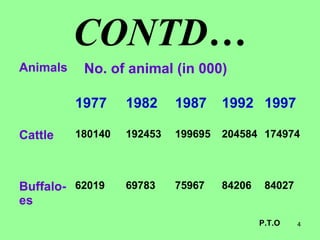
Animals No. of animal (in 000)
1977 1982 1987 1992 1997
Cattle 180140 192453 199695 204584 174974
Buffalo-
es
62019 69783 75967 84206 84027
P.T.O
5
CONTD…
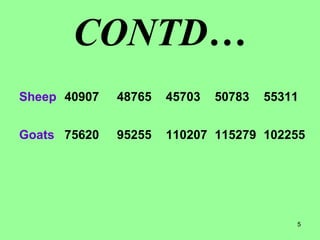
Sheep 40907 48765 45703 50783 55311
Goats 75620 95255 110207 115279 102255
6
•FACTORS AFFECTING
LIVE STOCK
POPULATION
7
FODDER
REQUIREMENT
&
AVAILABILITY
8
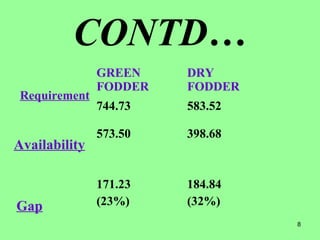
CONTD…
GREEN
FODDER
DRY
FODDER
744.73 583.52
573.50
171.23
(23%)
398.68
184.84
(32%)
Requirement
Availability
Gap
9
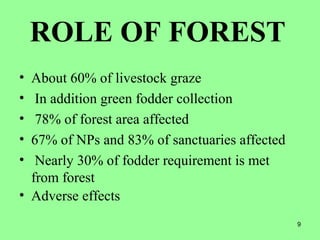
ROLE OF FOREST
• About 60% of livestock graze
• In addition green fodder collection
• 78% of forest area affected
• 67% of NPs and 83% of sanctuaries affected
• Nearly 30% of fodder requirement is met
from forest
• Adverse effects
10
CONTD…
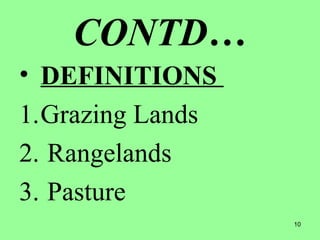
• DEFINITIONS
1.Grazing Lands
2. Rangelands
3. Pasture
11
CONTD…
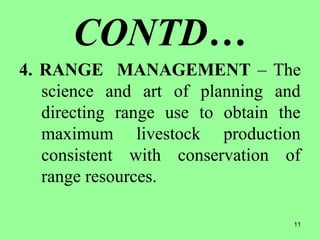
4. RANGE MANAGEMENT – The
science and art of planning and
directing range use to obtain the
maximum livestock production
consistent with conservation of
range resources.
12
CONTD…
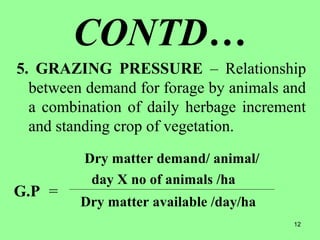
5. GRAZING PRESSURE – Relationship
between demand for forage by animals and
a combination of daily herbage increment
and standing crop of vegetation.
Dry matter demand/ animal/
day X no of animals /ha
Dry matter available /day/ha
G.P =
13
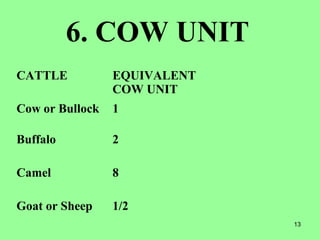
6. COW UNIT
CATTLE EQUIVALENT
COW UNIT
Cow or Bullock 1
Buffalo 2
Camel 8
Goat or Sheep 1/2
14
7. FORAGE ACRE
15
CONTD…
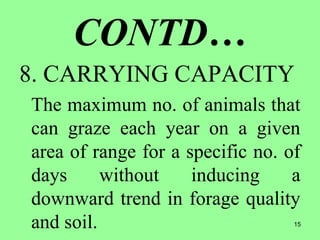
8. CARRYING CAPACITY
The maximum no. of animals that
can graze each year on a given
area of range for a specific no. of
days without inducing a
downward trend in forage quality
and soil.
16
CONTD…
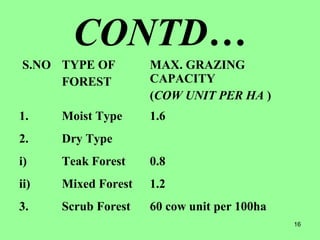
S.NO TYPE OF
FOREST
MAX. GRAZING
CAPACITY
(COW UNIT PER HA )
1. Moist Type 1.6
2. Dry Type
i) Teak Forest 0.8
ii) Mixed Forest 1.2
3. Scrub Forest 60 cow unit per 100ha
17
CONTD…
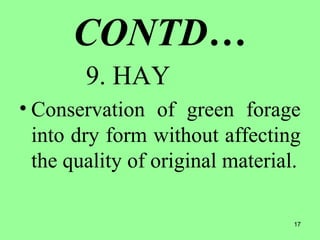
9. HAY
• Conservation of green forage
into dry form without affecting
the quality of original material.
18
CONTD…
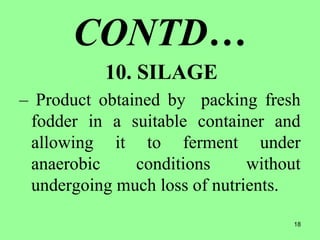
10. SILAGE
– Product obtained by packing fresh
fodder in a suitable container and
allowing it to ferment under
anaerobic conditions without
undergoing much loss of nutrients.
19
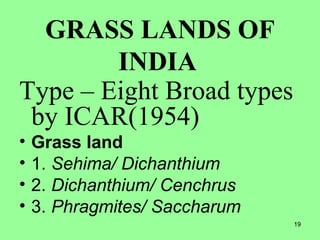
GRASS LANDS OF
INDIA
Type – Eight Broad types
by ICAR(1954)
• Grass land
• 1. Sehima/ Dichanthium
• 2. Dichanthium/ Cenchrus
• 3. Phragmites/ Saccharum
20
CONTD…
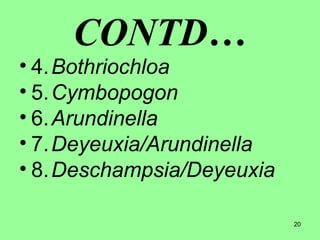
• 4.Bothriochloa
• 5.Cymbopogon
• 6.Arundinella
• 7.Deyeuxia/Arundinella
• 8.Deschampsia/Deyeuxia
21
CONTD…
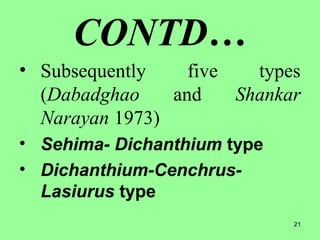
• Subsequently five types
(Dabadghao and Shankar
Narayan 1973)
• Sehima- Dichanthium type
• Dichanthium-Cenchrus-
Lasiurus type
22
CONTD…
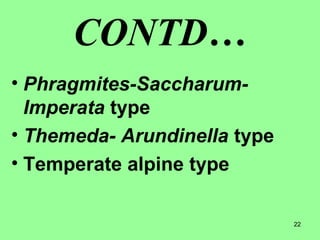
• Phragmites-Saccharum-
Imperata type
• Themeda- Arundinella type
• Temperate alpine type
23
ECOLOGICAL
STATUS
24
CAUSES OF
DETERIORATION
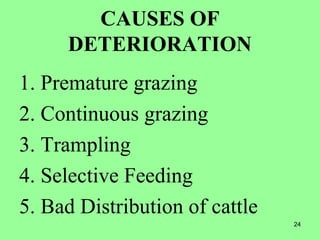
1. Premature grazing
2. Continuous grazing
3. Trampling
4. Selective Feeding
5. Bad Distribution of cattle
25
IMPROVEMENT AND
MANAGEMENT
1.LIVE STOCK Mgt.
P.T.O
26
CONTD…
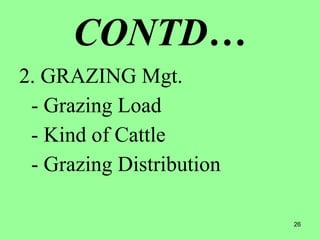
2. GRAZING Mgt.
- Grazing Load
- Kind of Cattle
- Grazing Distribution
27
CONTD…
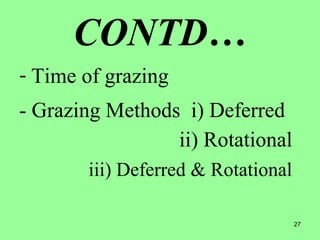
- Time of grazing
- Grazing Methods i) Deferred
ii) Rotational
iii) Deferred & Rotational
28
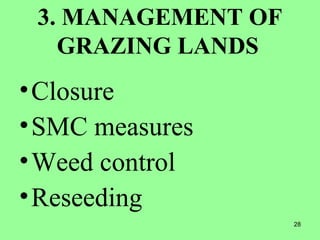
3. MANAGEMENT OF
GRAZING LANDS
•Closure
•SMC measures
•Weed control
•Reseeding
29
CONTD…
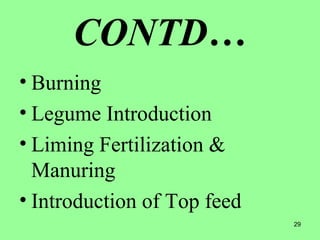
• Burning
• Legume Introduction
• Liming Fertilization &
Manuring
• Introduction of Top feed
30
COMMON FODDER
GRASSES
31
CONTD…
• Anjan – Cenchrus ciliaris syn.
Pennisetum cenchroides)
• DHAMAN- Cenchrus biflorus
32
CONTD…
These are separate spp the former
with a dark rough flower and the
latter with a lighter and more
hairy inflorescence but have the
same fodder value and the
vernacular names are often
interchanged.
P.T.O
33
CONTD…
They do best in a regular and
fairly heavy rainfall but anjan
persists in very arid conditions if
sown on deeply ploughed land.
34
CONTD…
• Palwan or janewah (in U.P)
– Dicanthium annulatum
syn. Bothriochloa pertusa
35
CONTD…
• Is the best fodder grass in the U.P but
falls off in value and quantity with
erratic rainfall, though it is palatable
all the year round and has a
persistent flowering habit.
P.T.O
36
CONTD…
3. Dub, Khabbal- Cynodon dactylon –
Is the obvious choice for grassing
down field drains and escape outlet,
and its use for this purpose should be
greatly extended.
P.T.O
37
To get the best results it requires
cultivation and where a quick cover
is essential to stop further soil loss
from newly made drains a top
dressing of chemical manure is
justified.
38
CONTD…
•Khaus, ganni, gandhi (Iseilema laxum) –A
perennial bunch grass though
sometimes creeping which persists in
heavier clay soils even with a very
low rainfall Found in southern U.P &
other parts.
39
CONTD…
• Sariala (Heteropogon contortus, Spear grass)-
is the commonest hill side cover in Punjab.
Owing to its crop of barbs it can only be
harvested either before flowering or after it is
fully mature when the bunches of barbs can
only be shaken out during or after cutting. It
should not be sown along with other grasses
but kept as a pure crop. Where it is firmly
P.T.O
40
CONTD…
-established as a natural crop it is not
feasible to oust it or replace it with
anything better, owing to its persistency.
Contour trenching of typical sariala
areas will result in the grass producing a
much heavier yield and prolonging its
growth season well into the winter.
41
CONTD…
6. Chimbar – (Eleusine flagellifera)
Found in Punjab, Haryana. It is the
commonest grass of irrigated forest
plantations. Inferior to Anjan in
growth & yield.
42
CONTD…
DAB (Eragrostis cynosuroides or
Desmostachya bipinnata) Is an
inferior grass prevalent on abandoned
cultivation and on heavily grazed
areas and where it is common the only
chance of improvement appears to
P.T.O
43
CONTD…
-lie in complete closure to grazing for
a period during which the land is
contour ridged, the dab eradicated
and better grasses cultivated after
which rotational grazing should
ensure that the better grasses are
not again driven out by it.
44
CONTD…
8. Lamb, lampa (Aristida depressa) is
typical of the poor soils of H.P, Gujrat
etc. It thrives in uplands which have been
eroded down to a clay subsoil and also
often persists as the commonest grass
under scrub under heavy grazing.
45
CONTD…
Owing to its seed being armed with short
spikes its only value is as a green fodder
but it is so thin as to be not worth cutting
so the only way to utilize it is controlled
grazing carefully regulated to what it
will stand.
46
CONTD…
9. Swank (Panicum colunum syn.
Echinochloa colonum)
Is a coarse fleshy grass, a nutritious
fodder but does not make good hay and is
best used green .It favours heavy soils.
47
CONTD…
10.Kahi,Kans (Saccharum spontaneum)
Is a pioneer whose use in sand
reclamation has now been
established as it is almost invariably
the first volunteer in any closure of
torrent ruined land.
P.T.O
48
CONTD…
Once established it requires only
protection against excessive grazing
to bind the surface and provide cut
fodder which can be used right
through the summer and early rains
when other grasses are not fit for
cutting.
49
CONTD…
11. BHABBAR GRASS, SABAI (EULALIOPSIS BINATA
SYN. ISCHOEMUM ANGUSTIFOLIUM)
Is not normally a fodder grass, but finds a
ready market as the raw material for
paper & other products. The natural
distribution of this grass is on the rockier
and drier parts of the foothills from
Nepal westwards almost to the Indus.
50
• IMPORTANT ANIMAL
FODDERS FROM SHRUBS
AND TREES AND THEIR
COMPOSITION
51
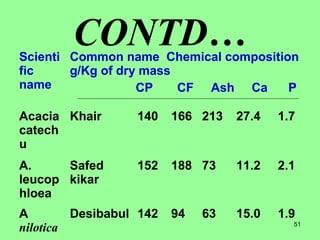
CONTD…Scienti
fic
name
Common name Chemical composition
g/Kg of dry mass
CP CF Ash Ca P
Acacia
catech
u
Khair 140 166 213 27.4 1.7
A.
leucop
hloea
Safed
kikar
152 188 73 11.2 2.1
A
nilotica
Desibabul 142 94 63 15.0 1.9
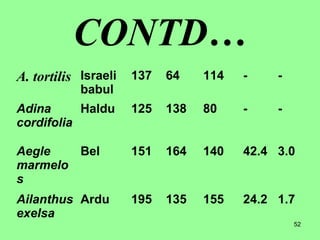
52
CONTD…
A. tortilis Israeli
babul
137 64 114 - -
Adina
cordifolia
Haldu 125 138 80 - -
Aegle
marmelo
s
Bel 151 164 140 42.4 3.0
Ailanthus
exelsa
Ardu 195 135 155 24.2 1.7
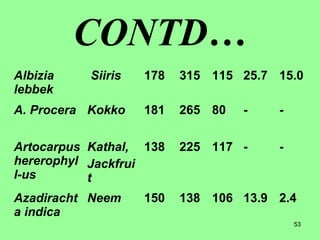
53
CONTD…
Albizia
lebbek
Siiris 178 315 115 25.7 15.0
A. Procera Kokko 181 265 80 - -
Artocarpus
hererophyl
l-us
Kathal,
Jackfrui
t
138 225 117 - -
Azadiracht
a indica
Neem 150 138 106 13.9 2.4
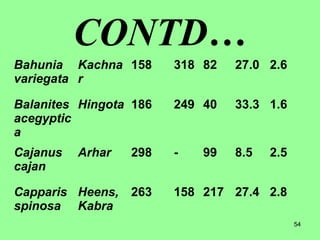
54
CONTD…
Bahunia
variegata
Kachna
r
158 318 82 27.0 2.6
Balanites
acegyptic
a
Hingota 186 249 40 33.3 1.6
Cajanus
cajan
Arhar 298 - 99 8.5 2.5
Capparis
spinosa
Heens,
Kabra
263 158 217 27.4 2.8
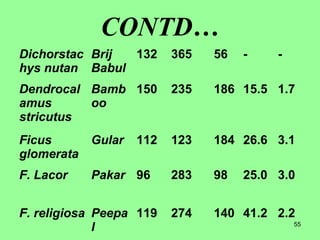
55
CONTD…
Dichorstac
hys nutan
Brij
Babul
132 365 56 - -
Dendrocal
amus
stricutus
Bamb
oo
150 235 186 15.5 1.7
Ficus
glomerata
Gular 112 123 184 26.6 3.1
F. Lacor Pakar 96 283 98 25.0 3.0
F. religiosa Peepa
l
119 274 140 41.2 2.2
56
CONTD…
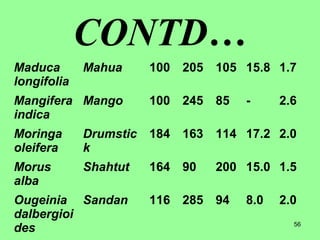
Maduca
longifolia
Mahua 100 205 105 15.8 1.7
Mangifera
indica
Mango 100 245 85 - 2.6
Moringa
oleifera
Drumstic
k
184 163 114 17.2 2.0
Morus
alba
Shahtut 164 90 200 15.0 1.5
Ougeinia
dalbergioi
des
Sandan 116 285 94 8.0 2.0
57
CONTD…
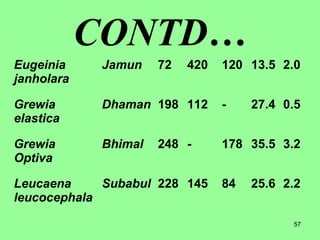
Eugeinia
janholara
Jamun 72 420 120 13.5 2.0
Grewia
elastica
Dhaman 198 112 - 27.4 0.5
Grewia
Optiva
Bhimal 248 - 178 35.5 3.2
Leucaena
leucocephala
Subabul 228 145 84 25.6 2.2
58
CONTD…
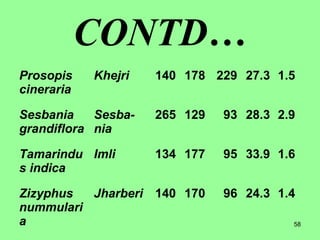
Prosopis
cineraria
Khejri 140 178 229 27.3 1.5
Sesbania
grandiflora
Sesba-
nia
265 129 93 28.3 2.9
Tamarindu
s indica
Imli 134 177 95 33.9 1.6
Zizyphus
nummulari
a
Jharberi 140 170 96 24.3 1.4
Thank you
59

8.cattle & fodder requirement