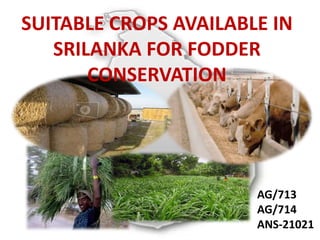
SUITABLE CROPS AVAILABLE IN
SRILANKA FOR FODDER
CONSERVATION
AG/713
AG/714
ANS-21021
INTRODUCTION
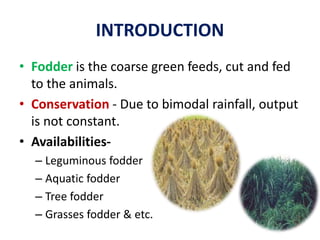
• Fodder is the coarse green feeds, cut and fed
to the animals.
• Conservation - Due to bimodal rainfall, output
is not constant.
• Availabilities-
– Leguminous fodder
– Aquatic fodder
– Tree fodder
– Grasses fodder & etc.
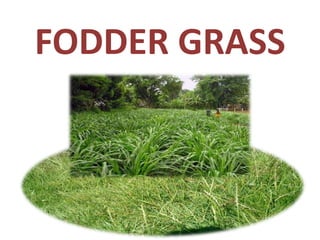
FODDER GRASS
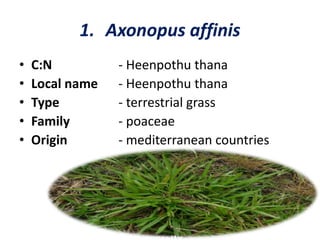
1. Axonopus affinis
• C:N - Heenpothu thana
• Local name - Heenpothu thana
• Type - terrestrial grass
• Family - poaceae
• Origin - mediterranean countries
 NUTRITIONAL STATUS
C:P -6.2%
NDF -22.4% (Lignin)
• Propagated by stem or root cuttings.
• Drought resistant plant.
• For seeds - need well drained and fertile soil.
• Seed sowing - October to November.
• Harvesting - at milking stage for silage
- at soft dough for hay making
• Yield – 60-70 kg/ha.
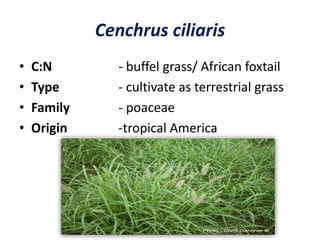
Cenchrus ciliaris
• C:N - buffel grass/ African foxtail
• Type - cultivate as terrestrial grass
• Family - poaceae
• Origin -tropical America
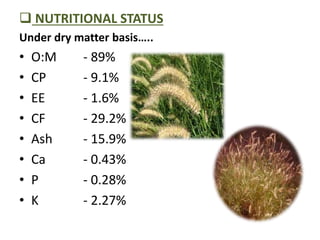
 NUTRITIONAL STATUS
Under dry matter basis…..
• O:M - 89%
• CP - 9.1%
• EE - 1.6%
• CF - 29.2%
• Ash - 15.9%
• Ca - 0.43%
• P - 0.28%
• K - 2.27%
• Erect , tufted, branched perennial shrub.
• 15-16 cm height.
• Adopted to arid and semi arid region.
• Grow well in roadsides, waste place, dike and
open area in low land rice field in sri lanka.
• Can be support 3kg milk yield with out
concentrate feeding.
• Yield - 45-55ton/ha.
• 6-8 cuttings per year.
• Used as cut fodder, hay and silage making.
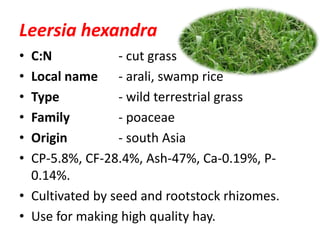
Leersia hexandra
• C:N - cut grass
• Local name - arali, swamp rice
• Type - wild terrestrial grass
• Family - poaceae
• Origin - south Asia
• CP-5.8%, CF-28.4%, Ash-47%, Ca-0.19%, P-
0.14%.
• Cultivated by seed and rootstock rhizomes.
• Use for making high quality hay.
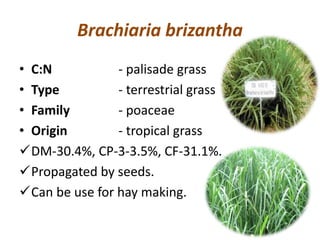
Brachiaria brizantha
• C:N - palisade grass
• Type - terrestrial grass
• Family - poaceae
• Origin - tropical grass
DM-30.4%, CP-3-3.5%, CF-31.1%.
Propagated by seeds.
Can be use for hay making.
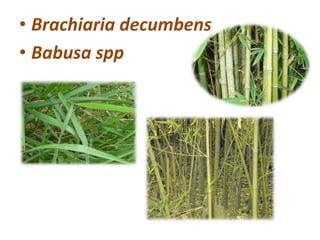
• Brachiaria decumbens
• Babusa spp
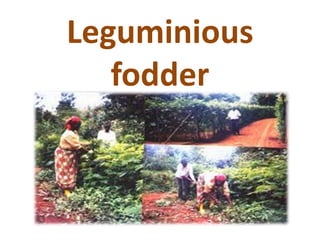
Leguminious
fodder
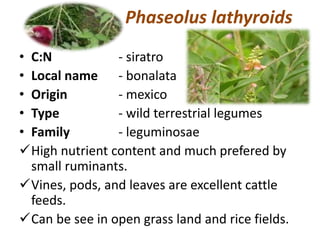
Phaseolus lathyroids
• C:N - siratro
• Local name - bonalata
• Origin - mexico
• Type - wild terrestrial legumes
• Family - leguminosae
High nutrient content and much prefered by
small ruminants.
Vines, pods, and leaves are excellent cattle
feeds.
Can be see in open grass land and rice fields.
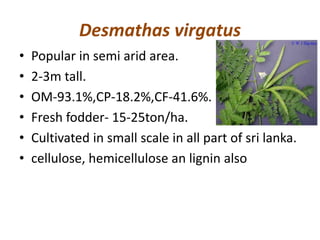
Desmathas virgatus
• Popular in semi arid area.
• 2-3m tall.
• OM-93.1%,CP-18.2%,CF-41.6%.
• Fresh fodder- 15-25ton/ha.
• Cultivated in small scale in all part of sri lanka.
• cellulose, hemicellulose an lignin also
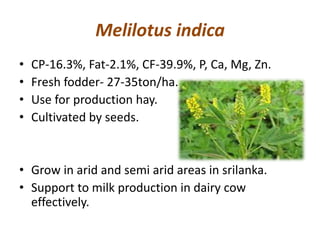
Melilotus indica
• CP-16.3%, Fat-2.1%, CF-39.9%, P, Ca, Mg, Zn.
• Fresh fodder- 27-35ton/ha.
• Use for production hay.
• Cultivated by seeds.
• Grow in arid and semi arid areas in srilanka.
• Support to milk production in dairy cow
effectively.
FODDER TREE
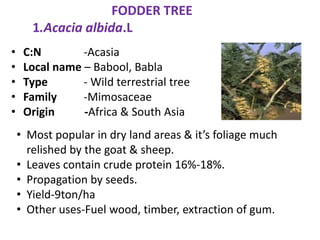
1.Acacia albida.L
• C:N -Acasia
• Local name – Babool, Babla
• Type - Wild terrestrial tree
• Family -Mimosaceae
• Origin -Africa & South Asia
• Most popular in dry land areas & it’s foliage much
relished by the goat & sheep.
• Leaves contain crude protein 16%-18%.
• Propagation by seeds.
• Yield-9ton/ha
• Other uses-Fuel wood, timber, extraction of gum.
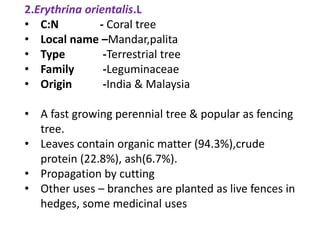
2.Erythrina orientalis.L
• C:N - Coral tree
• Local name –Mandar,palita
• Type -Terrestrial tree
• Family -Leguminaceae
• Origin -India & Malaysia
• A fast growing perennial tree & popular as fencing
tree.
• Leaves contain organic matter (94.3%),crude
protein (22.8%), ash(6.7%).
• Propagation by cutting
• Other uses – branches are planted as live fences in
hedges, some medicinal uses
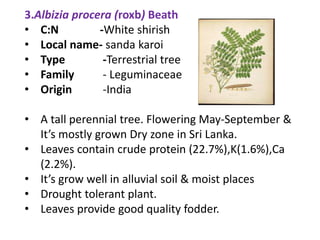
3.Albizia procera (roxb) Beath
• C:N -White shirish
• Local name- sanda karoi
• Type -Terrestrial tree
• Family - Leguminaceae
• Origin -India
• A tall perennial tree. Flowering May-September &
It’s mostly grown Dry zone in Sri Lanka.
• Leaves contain crude protein (22.7%),K(1.6%),Ca
(2.2%).
• It’s grow well in alluvial soil & moist places
• Drought tolerant plant.
• Leaves provide good quality fodder.
Aquatic Fodder
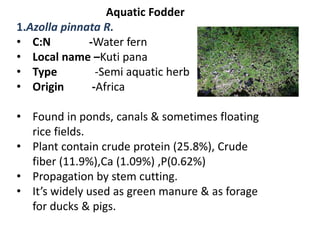
1.Azolla pinnata R.
• C:N -Water fern
• Local name –Kuti pana
• Type -Semi aquatic herb
• Origin -Africa
• Found in ponds, canals & sometimes floating
rice fields.
• Plant contain crude protein (25.8%), Crude
fiber (11.9%),Ca (1.09%) ,P(0.62%)
• Propagation by stem cutting.
• It’s widely used as green manure & as forage
for ducks & pigs.
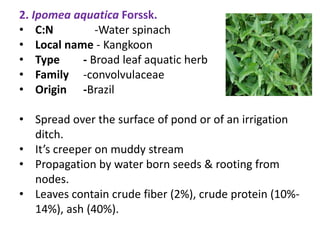
2. Ipomea aquatica Forssk.
• C:N -Water spinach
• Local name - Kangkoon
• Type - Broad leaf aquatic herb
• Family -convolvulaceae
• Origin -Brazil
• Spread over the surface of pond or of an irrigation
ditch.
• It’s creeper on muddy stream
• Propagation by water born seeds & rooting from
nodes.
• Leaves contain crude fiber (2%), crude protein (10%-
14%), ash (40%).
3. Lemma perpusilla T.
• C:N - Duck weed
• Local name - shona pana
• Type - Broad leaf aquatic herb
• Origin - Tropical Asia
• Very popular as duck weed.
• Grown in warm temperature & duck weed is
available in ponds & ditches.
• Contain Organic matter(88-96%), Crude
protein(25-35%) & crude fiber (1.8%).
• Mainly vegetative propagation is used.
• Feeding ducks & fishes.
SUMMARY
• Sri Lanka has lot of suitable crops for fodder
conversation.
• These crops grow in different agro ecological
regions.
• These crops have different propagation
methods such as cutting, seeds….etc.
• Problems- lack of equipment's for cutting, lack
of technology, mid country & hill country soils
are acidic……etc.

Fodder crops for conservation in Sri Lanka

  • 1.
    SUITABLE CROPS AVAILABLEIN SRILANKA FOR FODDER CONSERVATION AG/713 AG/714 ANS-21021
  • 2.
    INTRODUCTION • Fodder isthe coarse green feeds, cut and fed to the animals. • Conservation - Due to bimodal rainfall, output is not constant. • Availabilities- – Leguminous fodder – Aquatic fodder – Tree fodder – Grasses fodder & etc.
  • 3.
  • 4.
    1. Axonopus affinis •C:N - Heenpothu thana • Local name - Heenpothu thana • Type - terrestrial grass • Family - poaceae • Origin - mediterranean countries
  • 5.
     NUTRITIONAL STATUS C:P-6.2% NDF -22.4% (Lignin) • Propagated by stem or root cuttings. • Drought resistant plant. • For seeds - need well drained and fertile soil. • Seed sowing - October to November. • Harvesting - at milking stage for silage - at soft dough for hay making • Yield – 60-70 kg/ha.
  • 6.
    Cenchrus ciliaris • C:N- buffel grass/ African foxtail • Type - cultivate as terrestrial grass • Family - poaceae • Origin -tropical America
  • 7.
     NUTRITIONAL STATUS Underdry matter basis….. • O:M - 89% • CP - 9.1% • EE - 1.6% • CF - 29.2% • Ash - 15.9% • Ca - 0.43% • P - 0.28% • K - 2.27%
  • 8.
    • Erect ,tufted, branched perennial shrub. • 15-16 cm height. • Adopted to arid and semi arid region. • Grow well in roadsides, waste place, dike and open area in low land rice field in sri lanka. • Can be support 3kg milk yield with out concentrate feeding. • Yield - 45-55ton/ha. • 6-8 cuttings per year. • Used as cut fodder, hay and silage making.
  • 9.
    Leersia hexandra • C:N- cut grass • Local name - arali, swamp rice • Type - wild terrestrial grass • Family - poaceae • Origin - south Asia • CP-5.8%, CF-28.4%, Ash-47%, Ca-0.19%, P- 0.14%. • Cultivated by seed and rootstock rhizomes. • Use for making high quality hay.
  • 10.
    Brachiaria brizantha • C:N- palisade grass • Type - terrestrial grass • Family - poaceae • Origin - tropical grass DM-30.4%, CP-3-3.5%, CF-31.1%. Propagated by seeds. Can be use for hay making.
  • 11.
  • 12.
  • 13.
    Phaseolus lathyroids • C:N- siratro • Local name - bonalata • Origin - mexico • Type - wild terrestrial legumes • Family - leguminosae High nutrient content and much prefered by small ruminants. Vines, pods, and leaves are excellent cattle feeds. Can be see in open grass land and rice fields.
  • 14.
    Desmathas virgatus • Popularin semi arid area. • 2-3m tall. • OM-93.1%,CP-18.2%,CF-41.6%. • Fresh fodder- 15-25ton/ha. • Cultivated in small scale in all part of sri lanka. • cellulose, hemicellulose an lignin also
  • 15.
    Melilotus indica • CP-16.3%,Fat-2.1%, CF-39.9%, P, Ca, Mg, Zn. • Fresh fodder- 27-35ton/ha. • Use for production hay. • Cultivated by seeds. • Grow in arid and semi arid areas in srilanka. • Support to milk production in dairy cow effectively.
  • 16.
    FODDER TREE 1.Acacia albida.L •C:N -Acasia • Local name – Babool, Babla • Type - Wild terrestrial tree • Family -Mimosaceae • Origin -Africa & South Asia • Most popular in dry land areas & it’s foliage much relished by the goat & sheep. • Leaves contain crude protein 16%-18%. • Propagation by seeds. • Yield-9ton/ha • Other uses-Fuel wood, timber, extraction of gum.
  • 17.
    2.Erythrina orientalis.L • C:N- Coral tree • Local name –Mandar,palita • Type -Terrestrial tree • Family -Leguminaceae • Origin -India & Malaysia • A fast growing perennial tree & popular as fencing tree. • Leaves contain organic matter (94.3%),crude protein (22.8%), ash(6.7%). • Propagation by cutting • Other uses – branches are planted as live fences in hedges, some medicinal uses
  • 18.
    3.Albizia procera (roxb)Beath • C:N -White shirish • Local name- sanda karoi • Type -Terrestrial tree • Family - Leguminaceae • Origin -India • A tall perennial tree. Flowering May-September & It’s mostly grown Dry zone in Sri Lanka. • Leaves contain crude protein (22.7%),K(1.6%),Ca (2.2%). • It’s grow well in alluvial soil & moist places • Drought tolerant plant. • Leaves provide good quality fodder.
  • 19.
    Aquatic Fodder 1.Azolla pinnataR. • C:N -Water fern • Local name –Kuti pana • Type -Semi aquatic herb • Origin -Africa • Found in ponds, canals & sometimes floating rice fields. • Plant contain crude protein (25.8%), Crude fiber (11.9%),Ca (1.09%) ,P(0.62%) • Propagation by stem cutting. • It’s widely used as green manure & as forage for ducks & pigs.
  • 20.
    2. Ipomea aquaticaForssk. • C:N -Water spinach • Local name - Kangkoon • Type - Broad leaf aquatic herb • Family -convolvulaceae • Origin -Brazil • Spread over the surface of pond or of an irrigation ditch. • It’s creeper on muddy stream • Propagation by water born seeds & rooting from nodes. • Leaves contain crude fiber (2%), crude protein (10%- 14%), ash (40%).
  • 21.
    3. Lemma perpusillaT. • C:N - Duck weed • Local name - shona pana • Type - Broad leaf aquatic herb • Origin - Tropical Asia • Very popular as duck weed. • Grown in warm temperature & duck weed is available in ponds & ditches. • Contain Organic matter(88-96%), Crude protein(25-35%) & crude fiber (1.8%). • Mainly vegetative propagation is used. • Feeding ducks & fishes.
  • 22.
    SUMMARY • Sri Lankahas lot of suitable crops for fodder conversation. • These crops grow in different agro ecological regions. • These crops have different propagation methods such as cutting, seeds….etc. • Problems- lack of equipment's for cutting, lack of technology, mid country & hill country soils are acidic……etc.