Herbarium
H.M.R.P. Perera
14/AG/023
EG 1023
Content
1. Introduction
2. Animal nutrition
• Monogastric Animals
• Ruminants
3. Main types of feed for Livestock.
• Concentrates
• Roughages
4. Classification of Roughages
5. Characteristics of Pasture & Fodder Grasses
Content
1. Common Pasture Grasses.
I. Kangaroo Grass - Themeda australis
II. Bala thana - Eleusine indika
III. Carpet Grass - Axonopus offinis
IV. Putu Thana / Cowfoot grass - Dactylotenium aegyptium
V. Mayura Thana - Chloris barbata
VI. Rila thana - Pennisetum purpureum
VII.Signal grass - Cynodon dactylon
Content…
7. Common Pasture legumes
I. Katarodu - Clitoria ternate
II. Stylo - Stylosanthes hamata
III. Silver Leaf - Desmodium uncinatum
IV. Puero - Pueraria phaseoloides
V. Pea nut/ Ratakaju - Arachis hypogaea
VI. Dambala / Winged bean – Psophocarpus tetragonolobus
VII.Kollu / Horse gram – Macrotyloma uniflorum
VIII.Aswanna - Alysicarpus vaginalis
IX. Siratro – Macroptilium atropurpureum
X. Black gram – Vigna mungo
Content…
8. Common fodder Grasses
I. Clone 13 (High breed) - Pennisetum pupureum
II. Guinea A - Panicum maximum
III. Guinea B - Panicum maximum
IV. Mana / Wild Napier - Pennisetum purpureum
V. Guathamala - Tripsacum laxum
VI. Guinea Mutant - Panicum spp.
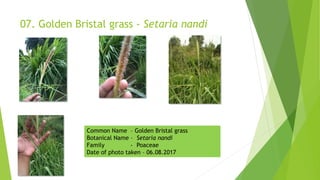
VII.Golden Bristal grass - Setaria nandi
Content…
9. Fodder legumes.
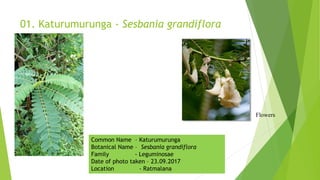
I. Katurumurunga - Sesbania grandiflora
II. Ipil- ipil - Leucaena leucocephala
III. Erabadu - Erythrina indica
IV. Albesia - Albizia ebbece
V. Large leaf Acasia - Acasia manglum
VI. Andanahiriya - Crotalaria retusa
VII.Ladappa/wetamara - Gliricidia sepium
Content…
10. Non – legume Tree Fodder.
I. Apala - Urena lobata.
II. Cassava/ Manyok - Manyok esculent
III. Jack fruit - Artocarpus heterophyllus
IV. Kapok - Ceiba pentandra
V. Awara - Canavalla ensiformis
Content…
11. Toxic plants.
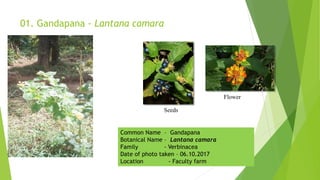
I. Gandapana - Lantana camara
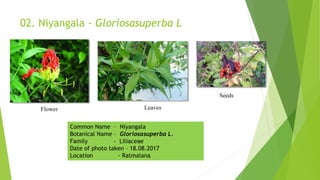
II. Niyangala - Gloriosasuperba L
III. Wal Rubber - Euphorbia heterophylla
IV. Kekilla - Dicranopteris lineari
Introduction.
The main factor to consider before undertaking livestock rearing is feed, where the main components
are pasture grass and fodders. Animals need sufficient quality and balanced diet to ensure maximum
health, reproduction and production of milk and meat.
Due to this, the type or species of pasture and fodder of high quality and of high yield need to be
produced as feed for the animals. Critical planning regarding animal feed to increase efficiency for easy
management of livestock and to unkeep the quality of production to an economical level should be
undertaken.
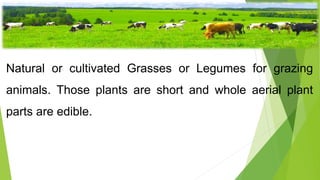
Pastures
Natural or cultivated Grasses or Legumes for grazing
animals. Those plants are short and whole aerial plant
parts are edible.
Fodder
Natural or cultivated Grasses or Legumes are given after
cutting. Those plants are tall and all aerial parts are not
edible.
Animal nutrients.
There are two groups of farm animals.
I. Monogastric Animals.
II. Ruminants.
Monogastric Animals
 They have simple stomach.
 Enzymatic digestion is mainly occurred.
 Microbial digestion is comparatively loss.
 They intake mainly concentrates.
 Ex : Rabbit, Pig, Poultry
Ruminants
 They have complex stomach which has four
chambers.
 They digest their food by fermenting in their
stomach.
 There are bacteria that work to break down the
tough stalks of the plants the ruminant animal has
eaten.
 Ex: Cattle ,Sheep
Main Types of Feed for Livestock
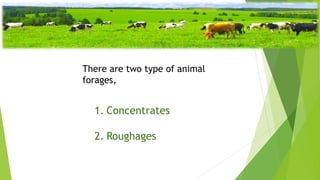
There are two type of animal
forages,
1. Concentrates
2. Roughages
Concentrates
Technically, all feeds supplying nutrients (proteins, carbohydrates and fats) are classed as
concentrates.
Crude fiber content is less than 18%.
Concentrates, for dairy feeding come in a perplexing verity of different individual ingredients,
descriptions and forms, each with their own advantages and limitations.
Concentrates provide the essential extra energy and protein dairy cows need on top of
forages to support modern production level.
They must be carefully selected to balance the specific nutrients provided by the forages
available for the most efficient ruminant digestion ,greatest cow productivity and most cost-
effective herd performance.
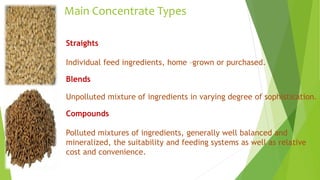
Main Concentrate Types
Straights
Individual feed ingredients, home –grown or purchased.
Blends
Unpolluted mixture of ingredients in varying degree of sophistication.
Compounds
Polluted mixtures of ingredients, generally well balanced and
mineralized, the suitability and feeding systems as well as relative
cost and convenience.
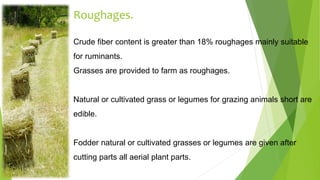
Roughages.
Crude fiber content is greater than 18% roughages mainly suitable
for ruminants.
Grasses are provided to farm as roughages.
Natural or cultivated grass or legumes for grazing animals short are
edible.
Fodder natural or cultivated grasses or legumes are given after
cutting parts all aerial plant parts.
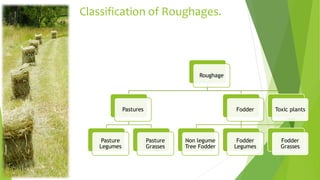
Classification of Roughages.
Roughage
Pastures
Pasture
Legumes
Pasture
Grasses
Fodder
Non legume
Tree Fodder
Fodder
Legumes
Fodder
Grasses
Toxic plants
Characteristics of Pasture
and Fodder
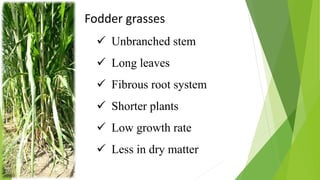
Fodder grasses
 Unbranched stem
 Long leaves
 Fibrous root system
 Shorter plants
 Low growth rate
 Less in dry matter
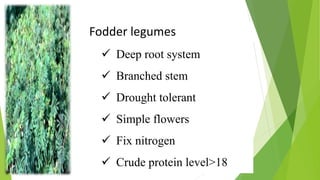
Fodder legumes
 Deep root system
 Branched stem
 Drought tolerant
 Simple flowers
 Fix nitrogen
 Crude protein level>18
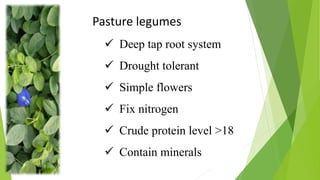
Pasture legumes
 Deep tap root system
 Drought tolerant
 Simple flowers
 Fix nitrogen
 Crude protein level >18
 Contain minerals
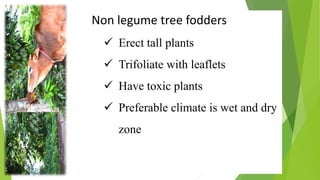
Non legume tree fodders
 Erect tall plants
 Trifoliate with leaflets
 Have toxic plants
 Preferable climate is wet and dry
zone
Pasture Grasses
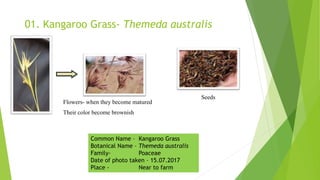
01. Kangaroo Grass- Themeda australis
Flowers- when they become matured
Their color become brownish
Seeds
Common Name – Kangaroo Grass
Botanical Name – Themeda australis
Family- Poaceae
Date of photo taken – 15.07.2017
Place - Near to farm
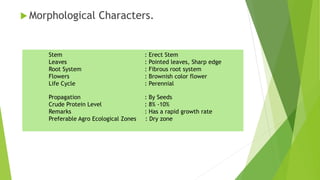
 Morphological Characters.
Stem : Erect Stem
Leaves : Pointed leaves, Sharp edge
Root System : Fibrous root system
Flowers : Brownish color flower
Life Cycle : Perennial
Propagation : By Seeds
Crude Protein Level : 8% -10%
Remarks : Has a rapid growth rate
Preferable Agro Ecological Zones : Dry zone
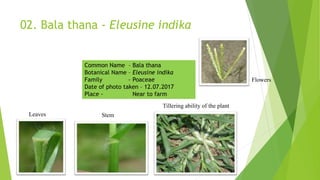
02. Bala thana - Eleusine indika
Flowers
Leaves Stem
Tillering ability of the plant
Common Name – Bala thana
Botanical Name – Eleusine indika
Family - Poaceae
Date of photo taken – 12.07.2017
Place - Near to farm
 Morphological Characters.
Stem : Erect, Round Shape stem
Leaves : Long narrow leaves with parallel Venation.
Small hair on the leaf surface.
Root System : Fibrous root system
Flowers : Finger like elongated inflorescence
Life Cycle : Annual
Propagation : By Seeds
Crude Protein Level : 12%
Remarks : Compete with crops
Preferable Agro Ecological Zones : Wet, dry & intermediate zones
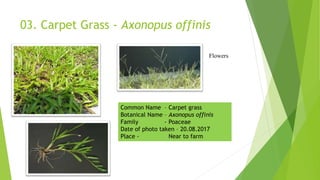
03. Carpet Grass - Axonopus offinis
Flowers
Common Name – Carpet grass
Botanical Name – Axonopus offinis
Family - Poaceae
Date of photo taken – 20.08.2017
Place - Near to farm
 Morphological Characters.
Stem : Creeping type Strongly compressed
Leaves : Linear lanceolate with base
Root System : Fibrous root system
Flowers : Bisexual spike
Life Cycle : Annual
Propagation : By Seeds
Crude Protein Level : 5%-7%
Remarks : Has ornamental value
Preferable Agro Ecological Zones : Dry &low country wet zones
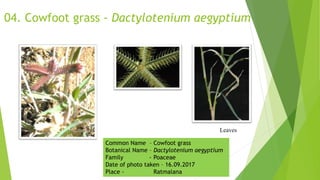
04. Cowfoot grass - Dactylotenium aegyptium
Leaves
Common Name – Cowfoot grass
Botanical Name – Dactylotenium aegyptium
Family - Poaceae
Date of photo taken – 16.09.2017
Place - Ratmalana
 Morphological Characters.
Stem : Creeping & mat forming structure
Leaves : Compressed, glabrous or with a Few bulbous
based hairs on the keel
Root System : Fibrous root system
Flowers : Spikelets borne at the tip of the stem
Life Cycle : Annual
Propagation : By Seeds
Crude Protein Level : 8%-10%
Remarks : Reduces the yield as it competes on
Nutrient uptake
Preferable Agro Ecological Zones : Dry zones
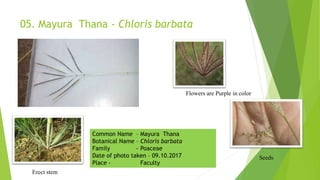
05. Mayura Thana - Chloris barbata
Flowers are Purple in color
Erect stem
Seeds
Common Name – Mayura Thana
Botanical Name – Chloris barbata
Family - Poaceae
Date of photo taken – 09.10.2017
Place - Faculty
 Morphological Characters.
Stem : Erect
Leaves : leaves are strip like & Has a rough margined
Root System : Fibrous root system
Flowers : A terminal panicle of many finger Like spike.
Purple in Color
Life Cycle : Annual
Propagation : By Seeds
Crude Protein Level : 8%-10%
Remarks : Fodder for animal ,Use as decorations
Preferable Agro Ecological Zones : Wet zone, Intermediate zone ,Dry zones
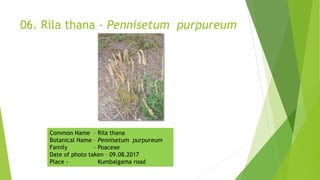
06. Rila thana - Pennisetum purpureum
Common Name – Rila thana
Botanical Name – Pennisetum purpureum
Family - Poaceae
Date of photo taken – 09.08.2017
Place - Kumbalgama road
 Morphological Characters.
Stem : Around 25 cm to 75 cm in tall
Leaves : Liner blade leaves
Root System : Fibrous root system
Flowers : Yellow in color, Terminal inflorescence
Life Cycle : Annual
Propagation : By Seeds
Crude Protein Level : 8%-18%
Remarks : Not cultivated as in organized pasture
Preferable Agro Ecological Zones : Dry & low Country wet zones
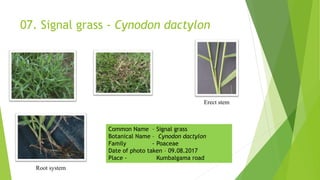
07. Signal grass - Cynodon dactylon
Root system
Erect stem
Common Name – Signal grass
Botanical Name – Cynodon dactylon
Family - Poaceae
Date of photo taken – 09.08.2017
Place - Kumbalgama road
 Morphological Characters.
Stem : Erect stem , grow 1cm – 30cm
Leaves : The blades are Grey green in color
Root System : Fibrous, deep root system
Flowers : Inflorescence a racemes panicle
Life Cycle : Annual
Propagation : By Seeds
Crude Protein Level : 8%-10%
Remarks : Anti- diabetic effects
Preferable Agro Ecological Zones : Dry ,wet & intermediate zones
Pasture Legumes
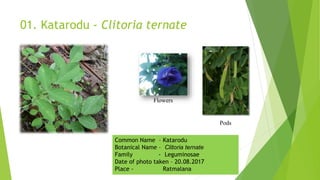
01. Katarodu - Clitoria ternate
Flowers
Pods
Common Name – Katarodu
Botanical Name – Clitoria ternate
Family - Leguminosae
Date of photo taken – 20.08.2017
Place - Ratmalana
 Morphological Characters.
Stem : Climbing & Wine stem
Leaves : Medium trifoliate leaves
Root System : Tap root system
Flowers : Blue or White color flowers
Life Cycle : Perennial
Propagation : By Seeds
Crude Protein Level : 18% - 22%
Remarks : Ability of atmospheric N2 fixation
Preferable Agro Ecological Zones : Dry & low country wet zones
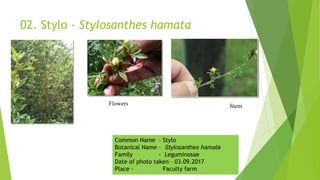
02. Stylo - Stylosanthes hamata
Flowers Stem
Common Name – Stylo
Botanical Name – Stylosanthes hamata
Family - Leguminosae
Date of photo taken – 03.09.2017
Place - Faculty farm
 Morphological Characters.
Stem : Semi erect stem
Leaves : Leaves trifoliate with long , narrow,Shiny
leaflets.
Root System : Tap root system
Flowers : Small yellow flowers on a long Stem (7 to 14)
Life Cycle : Annual
Propagation : By Seeds
Crude Protein Level : 8% - 10%
Remarks : Can grow as a mix crop with grasses
Preferable Agro Ecological Zones : Up country & Mid country wet zones
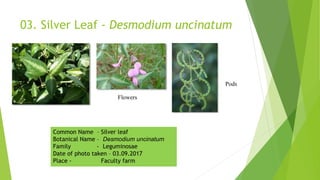
03. Silver Leaf - Desmodium uncinatum
Flowers
Pods
Common Name – Silver leaf
Botanical Name – Desmodium uncinatum
Family - Leguminosae
Date of photo taken – 03.09.2017
Place - Faculty farm
 Morphological Characters.
Stem : Angular stems are cover from hairs
Leaves : Trifoliate leaves have pointed headRoot
System : Tap root system
Flowers : Pink-Bluish color
Life Cycle : Annual
Propagation : By Seeds & stem cutting Crude
Crude Protein Level : 8% - 10%
Remarks : Can grow as a mix crop with grasses
Preferable Agro Ecological Zones : Wet, Dry & Intermediate zones
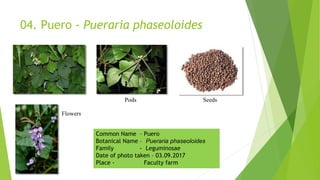
04. Puero - Pueraria phaseoloides
Flowers
Pods Seeds
Common Name – Puero
Botanical Name – Pueraria phaseoloides
Family - Leguminosae
Date of photo taken – 03.09.2017
Place - Faculty farm
 Morphological Characters.
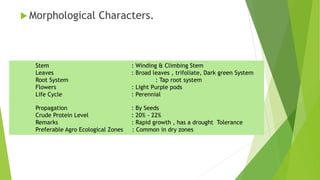
Stem : Winding & Climbing Stem
Leaves : Broad leaves , trifoliate, Dark green System
Root System : Tap root system
Flowers : Light Purple pods
Life Cycle : Perennial
Propagation : By Seeds
Crude Protein Level : 20% - 22%
Remarks : Rapid growth , has a drought Tolerance
Preferable Agro Ecological Zones : Common in dry zones
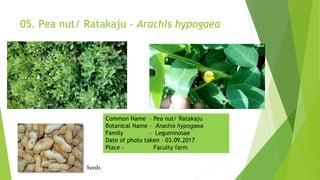
05. Pea nut/ Ratakaju - Arachis hypogaea
Seeds
Common Name – Pea nut/ Ratakaju
Botanical Name – Arachis hypogaea
Family - Leguminosae
Date of photo taken – 03.09.2017
Place - Faculty farm
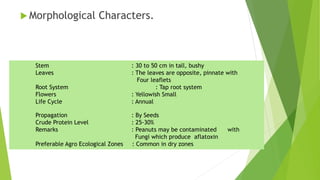
 Morphological Characters.
Stem : 30 to 50 cm in tall, bushy
Leaves : The leaves are opposite, pinnate with
Four leaflets
Root System : Tap root system
Flowers : Yellowish Small
Life Cycle : Annual
Propagation : By Seeds
Crude Protein Level : 25-30%
Remarks : Peanuts may be contaminated with
Fungi which produce aflatoxin
Preferable Agro Ecological Zones : Common in dry zones
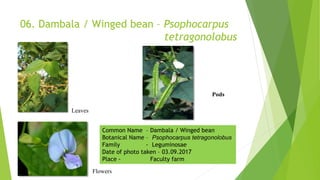
06. Dambala / Winged bean – Psophocarpus
tetragonolobus
Flowers
Pods
Leaves
Common Name – Dambala / Winged bean
Botanical Name – Psophocarpus tetragonolobus
Family - Leguminosae
Date of photo taken – 03.09.2017
Place - Faculty farm
 Morphological Characters.
Stem : High-climbing, twining vine.
Leaves : Have trifoliate leaves, Triangular leaflets
Root System : Tap root system
Flowers : Light blue color flower
Life Cycle : Annual
Propagation : By Seeds
Crude Protein Level : 8-10%
Remarks : Powerful N2 fixing legume
Preferable Agro Ecological Zones : Dry ,wet & intermediate zones
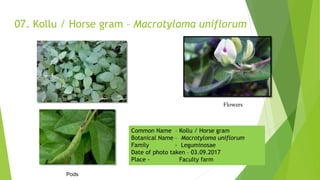
07. Kollu / Horse gram – Macrotyloma uniflorum
Pods
Flowers
Common Name – Kollu / Horse gram
Botanical Name – Macrotyloma uniflorum
Family - Leguminosae
Date of photo taken – 03.09.2017
Place - Faculty farm
 Morphological Characters.
Stem : Slightly hairy stems
Leaves : Three oblong leaflets
Root System : Tap root system
Flowers : Flowers yellow or Greenish yellow
Life Cycle : Annual
Propagation : By Seeds
Crude Protein Level : 22.6% - 23.8%
Remarks : Good for Hay and Silage
Preferable Agro Ecological Zones :Common in Dry zone
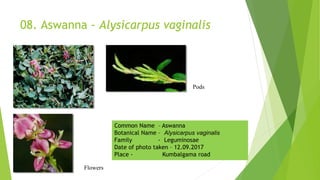
08. Aswanna - Alysicarpus vaginalis
Flowers
Pods
Common Name – Aswanna
Botanical Name – Alysicarpus vaginalis
Family - Leguminosae
Date of photo taken – 12.09.2017
Place - Kumbalgama road
 Morphological Characters.
Stem : Have hard stem
Leaves : Small tiny Green leaves
Root System : Tap root system
Flowers : Red color small flowers
Life Cycle : Perennial
Propagation : By Seeds
Crude Protein Level : 18% - 20%
Remarks : Have a higher ability of fixing atmospheric N2
Preferable Agro Ecological Zones :Dry & low country wet zones
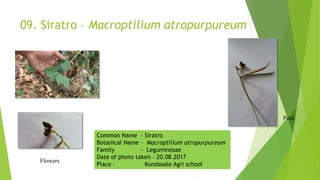
09. Siratro – Macroptilium atropurpureum
Pods
Flowers
Common Name – Siratro
Botanical Name – Macroptilium atropurpureum
Family - Leguminosae
Date of photo taken – 20.08.2017
Place - Kundasale Agri school
 Morphological Characters.
Stem : Climbing and twining stems
Leaves : Trifoliate leaves, Dark green slightly hairy on
the Upper surface
Root System : Tap root system
Flowers : Inflorescence has 6-22 flowers
Life Cycle : Perennial
Propagation : By Seeds
Crude Protein Level : 20%
Remarks : As a cover crop, prevent soil erosion
Preferable Agro Ecological Zones :Common in dry zone
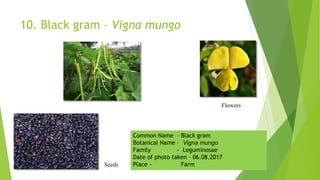
10. Black gram – Vigna mungo
Seeds
Flowers
Common Name – Black gram
Botanical Name – Vigna mungo
Family - Leguminosae
Date of photo taken – 06.08.2017
Place - Farm
 Morphological Characters.
Stem : Slightly ridged & covered with hairs
Leaves : large and trifoliate
Root System : Tap root system
Flowers : Bright yellow & consist with Cluster of
5-6 flowers.
Life Cycle : Perennial
Propagation : By Seeds
Crude Protein Level : 20% - 25%
Remarks : Edible food for human
Preferable Agro Ecological Zones :Common in dry zone
Fodder grasses
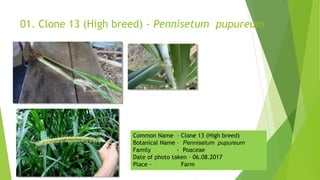
01. Clone 13 (High breed) - Pennisetum pupureum
Common Name – Clone 13 (High breed)
Botanical Name – Pennisetum pupureum
Family - Poaceae
Date of photo taken – 06.08.2017
Place - Farm
 Morphological Characters.
Stem : Erect stem, High tillering ability
Leaves : Without hair, long narrow leaves
Root System : Fibrous root system
Flowers : Uni-axial inflorescence
Life Cycle : Perennial
Propagation : By Seeds & Stem cutting
Crude Protein Level : 6% - 8%
Remarks : Highly palatable and digestibility can’t
Tolerate shade conditions
Preferable Agro Ecological Zones : Dry & Intermediate zones
02. Guinea A - Panicum maximum
Common Name – Guinea A
Botanical Name – Panicum maximum
Family - Poaceae
Date of photo taken – 06.08.2017
Place - Farm
 Morphological Characters.
Stem : Short & thin
Leaves : Rough, Dark green in color
Root System : Fibrous root system
Flowers : Produce large no of tillers
Life Cycle : Annual
Propagation : By Seeds
Crude Protein Level : 11% - 15%
Remarks : It can be used for soil rehabilitation
Preferable Agro Ecological Zones : Dry ,wet & intermediate zones
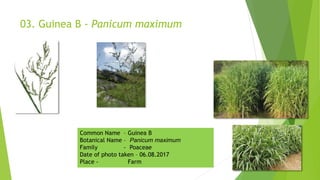
03. Guinea B - Panicum maximum
Common Name – Guinea B
Botanical Name – Panicum maximum
Family - Poaceae
Date of photo taken – 06.08.2017
Place - Farm
 Morphological Characters.
Stem : Short & thin
Leaves : Rough, Dark green in color
Root System : Fibrous root system
Flowers : Produce large no of tillers
Life Cycle : Annual
Propagation : By Seeds
Crude Protein Level : 8% - 10%
Remarks : It can be used for soil rehabilitation
Preferable Agro Ecological Zones : Dry ,wet & intermediate zones
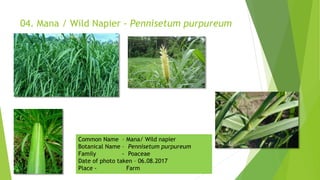
04. Mana / Wild Napier - Pennisetum purpureum
Common Name – Mana/ Wild napier
Botanical Name – Pennisetum purpureum
Family - Poaceae
Date of photo taken – 06.08.2017
Place - Farm
 Morphological Characters.
Stem : Tillers slender stem
Leaves : Narrow and long
Root System : Fibrous root system
Flowers : large inflorescence
Life Cycle : Perennial
Propagation : By Seeds
Crude Protein Level : 12% - 14 %
Remarks : Rapid growth
Preferable Agro Ecological Zones : Common in dry zone
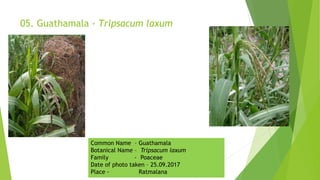
05. Guathamala - Tripsacum laxum
Common Name – Guathamala
Botanical Name – Tripsacum laxum
Family - Poaceae
Date of photo taken – 25.09.2017
Place - Ratmalana
 Morphological Characters.
Stem : Erect type stem
Leaves : Dark green in color Long broad leaves
Root System : Fibrous root system
Flowers : Have Inflorescence
Life Cycle : Perennial
Propagation : By Seeds & cuttings
Crude Protein Level : 12% - 14 %
Remarks : Use for soil rehabilitation
Preferable Agro Ecological Zones : Low & mid Country ,Dry & Wet zone
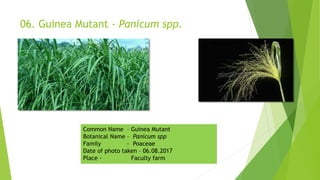
06. Guinea Mutant - Panicum spp.
Common Name – Guinea Mutant
Botanical Name – Panicum spp
Family - Poaceae
Date of photo taken – 06.08.2017
Place - Faculty farm
 Morphological Characters.
Stem : Short & thin stem
Leaves : Dark green in color, Rougher the Guinea A
Root System : Fibrous root system
Flowers : Produce large no of tillers
Life Cycle : Annual
Propagation : By Seeds
Crude Protein Level : 8% - 10%
Remarks : Can be used as soil rehabilitation
Preferable Agro Ecological Zones : Intermediate, Dry & wet zones
07. Golden Bristal grass - Setaria nandi
Common Name – Golden Bristal grass
Botanical Name – Setaria nandi
Family - Poaceae
Date of photo taken – 06.08.2017
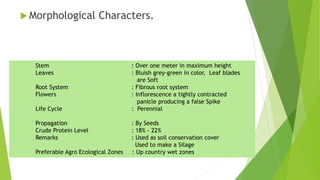
 Morphological Characters.
Stem : Over one meter in maximum height
Leaves : Bluish grey-green in color, Leaf blades
are Soft
Root System : Fibrous root system
Flowers : Inflorescence a tightly contracted
panicle producing a false Spike
Life Cycle : Perennial
Propagation : By Seeds
Crude Protein Level : 18% - 22%
Remarks : Used as soil conservation cover
Used to make a Silage
Preferable Agro Ecological Zones : Up country wet zones
Fodder Legumes
01. Katurumurunga - Sesbania grandiflora
Flowers
Common Name – Katurumurunga
Botanical Name – Sesbania grandiflora
Family - Leguminosae
Date of photo taken – 23.09.2017
Location - Ratmalana
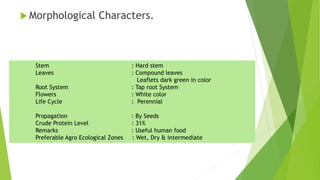
 Morphological Characters.
Stem : Hard stem
Leaves : Compound leaves
Leaflets dark green in color
Root System : Tap root System
Flowers : White color
Life Cycle : Perennial
Propagation : By Seeds
Crude Protein Level : 31%
Remarks : Useful human food
Preferable Agro Ecological Zones : Wet, Dry & intermediate
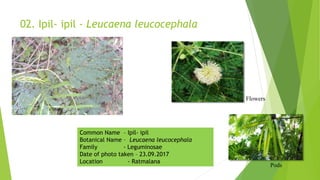
02. Ipil- ipil - Leucaena leucocephala
Pods
Flowers
Common Name – Ipil- ipil
Botanical Name – Leucaena leucocephala
Family - Leguminosae
Date of photo taken – 23.09.2017
Location - Ratmalana
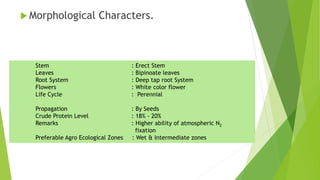
 Morphological Characters.
Stem : Erect Stem
Leaves : Bipinoate leaves
Root System : Deep tap root System
Flowers : White color flower
Life Cycle : Perennial
Propagation : By Seeds
Crude Protein Level : 18% - 20%
Remarks : Higher ability of atmospheric N2
fixation
Preferable Agro Ecological Zones : Wet & Intermediate zones
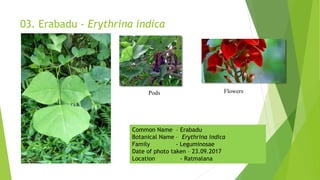
03. Erabadu - Erythrina indica
Pods Flowers
Common Name – Erabadu
Botanical Name – Erythrina indica
Family - Leguminosae
Date of photo taken – 23.09.2017
Location - Ratmalana
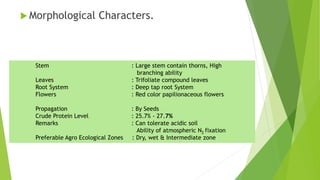
 Morphological Characters.
Stem : Large stem contain thorns, High
branching ability
Leaves : Trifoliate compound leaves
Root System : Deep tap root System
Flowers : Red color papilionaceous flowers
Propagation : By Seeds
Crude Protein Level : 25.7% - 27.7%
Remarks : Can tolerate acidic soil
Ability of atmospheric N2 fixation
Preferable Agro Ecological Zones : Dry, wet & Intermediate zone
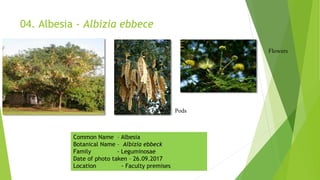
04. Albesia - Albizia ebbece
Flowers
Pods
Common Name – Albesia
Botanical Name – Albizia ebbeck
Family - Leguminosae
Date of photo taken – 26.09.2017
Location - Faculty premises
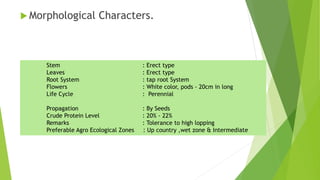
 Morphological Characters.
Stem : Erect type
Leaves : Erect type
Root System : tap root System
Flowers : White color, pods - 20cm in long
Life Cycle : Perennial
Propagation : By Seeds
Crude Protein Level : 20% - 22%
Remarks : Tolerance to high lopping
Preferable Agro Ecological Zones : Up country ,wet zone & Intermediate
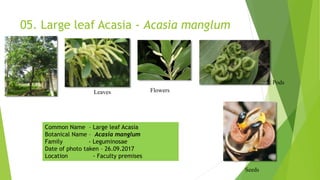
05. Large leaf Acasia - Acasia manglum
Seeds
Pods
Leaves Flowers
Common Name – Large leaf Acasia
Botanical Name – Acasia manglum
Family - Leguminosae
Date of photo taken – 26.09.2017
Location - Faculty premises
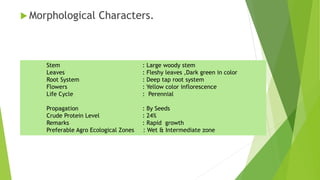
 Morphological Characters.
Stem : Large woody stem
Leaves : Fleshy leaves ,Dark green in color
Root System : Deep tap root system
Flowers : Yellow color inflorescence
Life Cycle : Perennial
Propagation : By Seeds
Crude Protein Level : 24%
Remarks : Rapid growth
Preferable Agro Ecological Zones : Wet & Intermediate zone
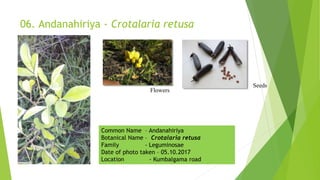
06. Andanahiriya - Crotalaria retusa
Flowers
Seeds
Common Name – Andanahiriya
Botanical Name – Crotalaria retusa
Family - Leguminosae
Date of photo taken – 05.10.2017
Location - Kumbalgama road
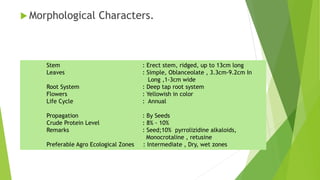
 Morphological Characters.
Stem : Erect stem, ridged, up to 13cm long
Leaves : Simple, Oblanceolate , 3.3cm-9.2cm In
Long ,1-3cm wide
Root System : Deep tap root system
Flowers : Yellowish in color
Life Cycle : Annual
Propagation : By Seeds
Crude Protein Level : 8% - 10%
Remarks : Seed;10% pyrrolizidine alkaloids,
Monocrotaline , retusine
Preferable Agro Ecological Zones : Intermediate , Dry, wet zones
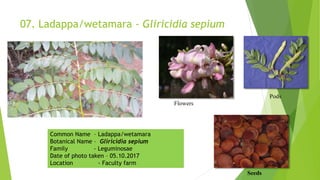
07. Ladappa/wetamara - Gliricidia sepium
Pods
Flowers
Seeds
Common Name – Ladappa/wetamara
Botanical Name – Gliricidia sepium
Family - Leguminosae
Date of photo taken – 05.10.2017
Location - Faculty farm
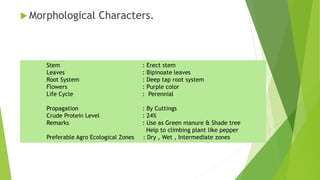
 Morphological Characters.
Stem : Erect stem
Leaves : Bipinoate leaves
Root System : Deep tap root system
Flowers : Purple color
Life Cycle : Perennial
Propagation : By Cuttings
Crude Protein Level : 24%
Remarks : Use as Green manure & Shade tree
Help to climbing plant like pepper
Preferable Agro Ecological Zones : Dry , Wet , Intermediate zones
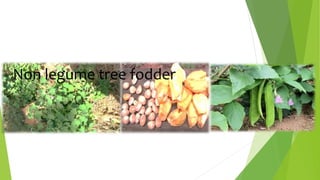
Non legume tree fodder
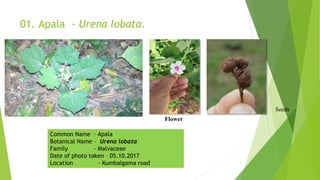
01. Apala - Urena lobata.
Seeds
Flower
Common Name – Apala
Botanical Name – Urena lobata
Family - Malvaceae
Date of photo taken – 05.10.2017
Location - Kumbalgama road
 Morphological Characters.
Stem : Covered with minute star- like hairs &
Often tinged Purple
Leaves : Leaves are divided into 5 main lobe
Root System : Tap root System
Flowers : Flower is Pinky purplish
Life Cycle : Annual
Propagation : By Seeds
Crude Protein Level : 8% - 10%
Remarks : Widely distributed as a weed
Preferable Agro Ecological Zones : Dry , Wet , Intermediate zones
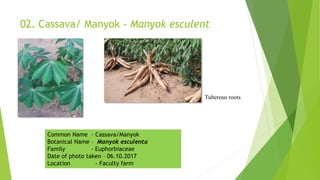
02. Cassava/ Manyok - Manyok esculent
Tuberous roots
Common Name – Cassava/Manyok
Botanical Name – Manyok esculenta
Family - Euphorbiaceae
Date of photo taken – 06.10.2017
Location - Faculty farm
 Morphological Characters.
Stem : Erect tall stem
Leaves : Simple leaves divided into ports
Root System : Tap root System
Flowers : White/Yellow color
Life Cycle : Annual
Propagation : By stems
Crude Protein Level : 19.5%
Remarks : Produce tubers as human food
Produce toxic compounds HCN that toxic
to animals
Preferable Agro Ecological Zones : Dry , Wet , Intermediate zones
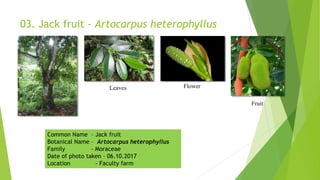
03. Jack fruit - Artocarpus heterophyllus
Fruit
FlowerLeaves
Common Name – Jack fruit
Botanical Name – Artocarpus heterophyllus
Family - Moraceae
Date of photo taken – 06.10.2017
Location - Faculty farm
 Morphological Characters.
Stem : Woody stem ,highly branched ,tall
Leaves : Thick & large leaves
Root System : Tap root System
Flowers : Male & female flowers are in Separate
heads
Life Cycle : Perennial
Propagation : By stems
Crude Protein Level : 2.2g/10g
Remarks : Usual as food & timber
Preferable Agro Ecological Zones : Dry , Wet , Intermediate zones
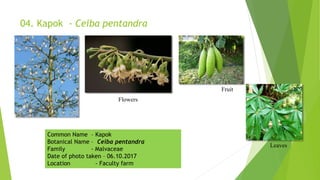
04. Kapok - Ceiba pentandra
Fruit
Leaves
Flowers
Common Name – Kapok
Botanical Name – Ceiba pentandra
Family - Malvaceae
Date of photo taken – 06.10.2017
Location - Faculty farm
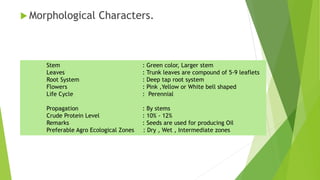
 Morphological Characters.
Stem : Green color, Larger stem
Leaves : Trunk leaves are compound of 5-9 leaflets
Root System : Deep tap root system
Flowers : Pink ,Yellow or White bell shaped
Life Cycle : Perennial
Propagation : By stems
Crude Protein Level : 10% - 12%
Remarks : Seeds are used for producing Oil
Preferable Agro Ecological Zones : Dry , Wet , Intermediate zones
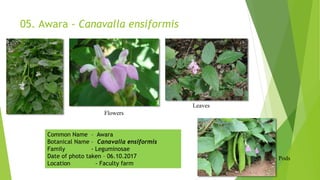
05. Awara - Canavalla ensiformis
Flowers
Leaves
Pods
Common Name – Awara
Botanical Name – Canavalla ensiformis
Family - Leguminosae
Date of photo taken – 06.10.2017
Location - Faculty farm
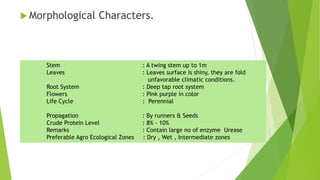
 Morphological Characters.
Stem : A twing stem up to 1m
Leaves : Leaves surface is shiny, they are fold
unfavorable climatic conditions.
Root System : Deep tap root system
Flowers : Pink purple in color
Life Cycle : Perennial
Propagation : By runners & Seeds
Crude Protein Level : 8% - 10%
Remarks : Contain large no of enzyme Urease
Preferable Agro Ecological Zones : Dry , Wet , Intermediate zones
Toxic Plants
01. Gandapana - Lantana camara
Seeds
Flower
Common Name – Gandapana
Botanical Name – Lantana camara
Family - Verbinacea
Date of photo taken – 06.10.2017
Location - Faculty farm
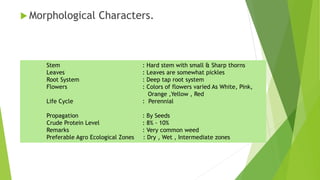
 Morphological Characters.
Stem : Hard stem with small & Sharp thorns
Leaves : Leaves are somewhat pickles
Root System : Deep tap root system
Flowers : Colors of flowers varied As White, Pink,
Orange ,Yellow , Red
Life Cycle : Perennial
Propagation : By Seeds
Crude Protein Level : 8% - 10%
Remarks : Very common weed
Preferable Agro Ecological Zones : Dry , Wet , Intermediate zones
02. Niyangala - Gloriosasuperba L
Seeds
LeavesFlower
Common Name – Niyangala
Botanical Name – Gloriosasuperba L.
Family - Liliaceae
Date of photo taken – 18.08.2017
Location - Ratmalana
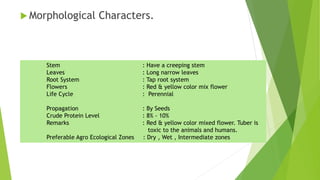
 Morphological Characters.
Stem : Have a creeping stem
Leaves : Long narrow leaves
Root System : Tap root system
Flowers : Red & yellow color mix flower
Life Cycle : Perennial
Propagation : By Seeds
Crude Protein Level : 8% - 10%
Remarks : Red & yellow color mixed flower. Tuber is
toxic to the animals and humans.
Preferable Agro Ecological Zones : Dry , Wet , Intermediate zones
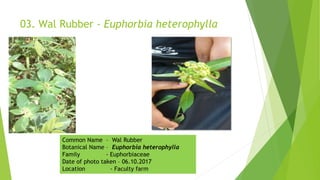
03. Wal Rubber - Euphorbia heterophylla
Common Name – Wal Rubber
Botanical Name – Euphorbia heterophylla
Family - Euphorbiaceae
Date of photo taken – 06.10.2017
Location - Faculty farm
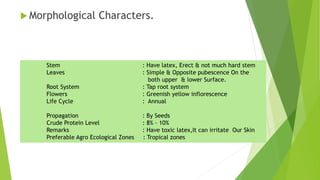
 Morphological Characters.
Stem : Have latex, Erect & not much hard stem
Leaves : Simple & Opposite pubescence On the
both upper & lower Surface.
Root System : Tap root system
Flowers : Greenish yellow inflorescence
Life Cycle : Annual
Propagation : By Seeds
Crude Protein Level : 8% - 10%
Remarks : Have toxic latex,It can irritate Our Skin
Preferable Agro Ecological Zones : Tropical zones
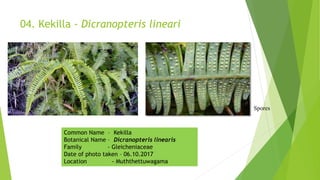
04. Kekilla - Dicranopteris lineari
Spores
Common Name – Kekilla
Botanical Name – Dicranopteris linearis
Family - Gleicheniaceae
Date of photo taken – 06.10.2017
Location - Muththettuwagama
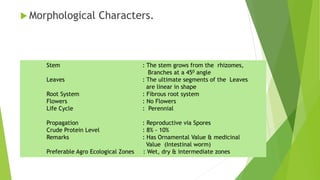
 Morphological Characters.
Stem : The stem grows from the rhizomes,
Branches at a 450 angle
Leaves : The ultimate segments of the Leaves
are linear in shape
Root System : Fibrous root system
Flowers : No Flowers
Life Cycle : Perennial
Propagation : Reproductive via Spores
Crude Protein Level : 8% - 10%
Remarks : Has Ornamental Value & medicinal
Value (Intestinal worm)
Preferable Agro Ecological Zones : Wet, dry & intermediate zones

Herbarium

  • 1.
  • 2.
    Content 1. Introduction 2. Animalnutrition • Monogastric Animals • Ruminants 3. Main types of feed for Livestock. • Concentrates • Roughages 4. Classification of Roughages 5. Characteristics of Pasture & Fodder Grasses
  • 3.
    Content 1. Common PastureGrasses. I. Kangaroo Grass - Themeda australis II. Bala thana - Eleusine indika III. Carpet Grass - Axonopus offinis IV. Putu Thana / Cowfoot grass - Dactylotenium aegyptium V. Mayura Thana - Chloris barbata VI. Rila thana - Pennisetum purpureum VII.Signal grass - Cynodon dactylon

  • 4.
    Content… 7. Common Pasturelegumes I. Katarodu - Clitoria ternate II. Stylo - Stylosanthes hamata III. Silver Leaf - Desmodium uncinatum IV. Puero - Pueraria phaseoloides V. Pea nut/ Ratakaju - Arachis hypogaea VI. Dambala / Winged bean – Psophocarpus tetragonolobus VII.Kollu / Horse gram – Macrotyloma uniflorum VIII.Aswanna - Alysicarpus vaginalis IX. Siratro – Macroptilium atropurpureum X. Black gram – Vigna mungo
  • 5.
    Content… 8. Common fodderGrasses I. Clone 13 (High breed) - Pennisetum pupureum II. Guinea A - Panicum maximum III. Guinea B - Panicum maximum IV. Mana / Wild Napier - Pennisetum purpureum V. Guathamala - Tripsacum laxum VI. Guinea Mutant - Panicum spp. VII.Golden Bristal grass - Setaria nandi
  • 6.
    Content… 9. Fodder legumes. I.Katurumurunga - Sesbania grandiflora II. Ipil- ipil - Leucaena leucocephala III. Erabadu - Erythrina indica IV. Albesia - Albizia ebbece V. Large leaf Acasia - Acasia manglum VI. Andanahiriya - Crotalaria retusa VII.Ladappa/wetamara - Gliricidia sepium
  • 7.
    Content… 10. Non –legume Tree Fodder. I. Apala - Urena lobata. II. Cassava/ Manyok - Manyok esculent III. Jack fruit - Artocarpus heterophyllus IV. Kapok - Ceiba pentandra V. Awara - Canavalla ensiformis
  • 8.
    Content… 11. Toxic plants. I.Gandapana - Lantana camara II. Niyangala - Gloriosasuperba L III. Wal Rubber - Euphorbia heterophylla IV. Kekilla - Dicranopteris lineari
  • 9.
    Introduction. The main factorto consider before undertaking livestock rearing is feed, where the main components are pasture grass and fodders. Animals need sufficient quality and balanced diet to ensure maximum health, reproduction and production of milk and meat. Due to this, the type or species of pasture and fodder of high quality and of high yield need to be produced as feed for the animals. Critical planning regarding animal feed to increase efficiency for easy management of livestock and to unkeep the quality of production to an economical level should be undertaken.
  • 10.
    Pastures Natural or cultivatedGrasses or Legumes for grazing animals. Those plants are short and whole aerial plant parts are edible.
  • 11.
    Fodder Natural or cultivatedGrasses or Legumes are given after cutting. Those plants are tall and all aerial parts are not edible.
  • 12.
    Animal nutrients. There aretwo groups of farm animals. I. Monogastric Animals. II. Ruminants. Monogastric Animals  They have simple stomach.  Enzymatic digestion is mainly occurred.  Microbial digestion is comparatively loss.  They intake mainly concentrates.  They intake mainly concentrates.  Ex : Rabbit, Pig, Poultry Ruminants  They have complex stomach which has four chambers.  They digest their food by fermenting in their stomach.  There are bacteria that work to break down the tough stalks of the plants the ruminant animal has eaten.  Ex: Cattle ,Sheep
  • 13.
    Main Types ofFeed for Livestock There are two type of animal forages, 1. Concentrates 2. Roughages
  • 14.
    Concentrates Technically, all feedssupplying nutrients (proteins, carbohydrates and fats) are classed as concentrates. Crude fiber content is less than 18%. Concentrates, for dairy feeding come in a perplexing verity of different individual ingredients, descriptions and forms, each with their own advantages and limitations. Concentrates provide the essential extra energy and protein dairy cows need on top of forages to support modern production level. They must be carefully selected to balance the specific nutrients provided by the forages available for the most efficient ruminant digestion ,greatest cow productivity and most cost- effective herd performance.
  • 15.
    Main Concentrate Types Straights Individualfeed ingredients, home –grown or purchased. Blends Unpolluted mixture of ingredients in varying degree of sophistication. Compounds Polluted mixtures of ingredients, generally well balanced and mineralized, the suitability and feeding systems as well as relative cost and convenience.
  • 16.
    Roughages. Crude fiber contentis greater than 18% roughages mainly suitable for ruminants. Grasses are provided to farm as roughages. Natural or cultivated grass or legumes for grazing animals short are edible. Fodder natural or cultivated grasses or legumes are given after cutting parts all aerial plant parts.
  • 17.
    Classification of Roughages. Roughage Pastures Pasture Legumes Pasture Grasses Fodder Nonlegume Tree Fodder Fodder Legumes Fodder Grasses Toxic plants
  • 18.
  • 19.
    Fodder grasses  Unbranchedstem  Long leaves  Fibrous root system  Shorter plants  Low growth rate  Less in dry matter
  • 20.
    Fodder legumes  Deeproot system  Branched stem  Drought tolerant  Simple flowers  Fix nitrogen  Crude protein level>18
  • 21.
    Pasture legumes  Deeptap root system  Drought tolerant  Simple flowers  Fix nitrogen  Crude protein level >18  Contain minerals
  • 22.
    Non legume treefodders  Erect tall plants  Trifoliate with leaflets  Have toxic plants  Preferable climate is wet and dry zone
  • 23.
  • 24.
    01. Kangaroo Grass-Themeda australis Flowers- when they become matured Their color become brownish Seeds Common Name – Kangaroo Grass Botanical Name – Themeda australis Family- Poaceae Date of photo taken – 15.07.2017 Place - Near to farm
  • 25.
     Morphological Characters. Stem: Erect Stem Leaves : Pointed leaves, Sharp edge Root System : Fibrous root system Flowers : Brownish color flower Life Cycle : Perennial Propagation : By Seeds Crude Protein Level : 8% -10% Remarks : Has a rapid growth rate Preferable Agro Ecological Zones : Dry zone
  • 26.
    02. Bala thana- Eleusine indika Flowers Leaves Stem Tillering ability of the plant Common Name – Bala thana Botanical Name – Eleusine indika Family - Poaceae Date of photo taken – 12.07.2017 Place - Near to farm
  • 27.
     Morphological Characters. Stem: Erect, Round Shape stem Leaves : Long narrow leaves with parallel Venation. Small hair on the leaf surface. Root System : Fibrous root system Flowers : Finger like elongated inflorescence Life Cycle : Annual Propagation : By Seeds Crude Protein Level : 12% Remarks : Compete with crops Preferable Agro Ecological Zones : Wet, dry & intermediate zones
  • 28.
    03. Carpet Grass- Axonopus offinis Flowers Common Name – Carpet grass Botanical Name – Axonopus offinis Family - Poaceae Date of photo taken – 20.08.2017 Place - Near to farm
  • 29.
     Morphological Characters. Stem: Creeping type Strongly compressed Leaves : Linear lanceolate with base Root System : Fibrous root system Flowers : Bisexual spike Life Cycle : Annual Propagation : By Seeds Crude Protein Level : 5%-7% Remarks : Has ornamental value Preferable Agro Ecological Zones : Dry &low country wet zones
  • 30.
    04. Cowfoot grass- Dactylotenium aegyptium Leaves Common Name – Cowfoot grass Botanical Name – Dactylotenium aegyptium Family - Poaceae Date of photo taken – 16.09.2017 Place - Ratmalana
  • 31.
     Morphological Characters. Stem: Creeping & mat forming structure Leaves : Compressed, glabrous or with a Few bulbous based hairs on the keel Root System : Fibrous root system Flowers : Spikelets borne at the tip of the stem Life Cycle : Annual Propagation : By Seeds Crude Protein Level : 8%-10% Remarks : Reduces the yield as it competes on Nutrient uptake Preferable Agro Ecological Zones : Dry zones
  • 32.
    05. Mayura Thana- Chloris barbata Flowers are Purple in color Erect stem Seeds Common Name – Mayura Thana Botanical Name – Chloris barbata Family - Poaceae Date of photo taken – 09.10.2017 Place - Faculty
  • 33.
     Morphological Characters. Stem: Erect Leaves : leaves are strip like & Has a rough margined Root System : Fibrous root system Flowers : A terminal panicle of many finger Like spike. Purple in Color Life Cycle : Annual Propagation : By Seeds Crude Protein Level : 8%-10% Remarks : Fodder for animal ,Use as decorations Preferable Agro Ecological Zones : Wet zone, Intermediate zone ,Dry zones
  • 34.
    06. Rila thana- Pennisetum purpureum Common Name – Rila thana Botanical Name – Pennisetum purpureum Family - Poaceae Date of photo taken – 09.08.2017 Place - Kumbalgama road
  • 35.
     Morphological Characters. Stem: Around 25 cm to 75 cm in tall Leaves : Liner blade leaves Root System : Fibrous root system Flowers : Yellow in color, Terminal inflorescence Life Cycle : Annual Propagation : By Seeds Crude Protein Level : 8%-18% Remarks : Not cultivated as in organized pasture Preferable Agro Ecological Zones : Dry & low Country wet zones
  • 36.
    07. Signal grass- Cynodon dactylon Root system Erect stem Common Name – Signal grass Botanical Name – Cynodon dactylon Family - Poaceae Date of photo taken – 09.08.2017 Place - Kumbalgama road
  • 37.
     Morphological Characters. Stem: Erect stem , grow 1cm – 30cm Leaves : The blades are Grey green in color Root System : Fibrous, deep root system Flowers : Inflorescence a racemes panicle Life Cycle : Annual Propagation : By Seeds Crude Protein Level : 8%-10% Remarks : Anti- diabetic effects Preferable Agro Ecological Zones : Dry ,wet & intermediate zones
  • 38.
  • 39.
    01. Katarodu -Clitoria ternate Flowers Pods Common Name – Katarodu Botanical Name – Clitoria ternate Family - Leguminosae Date of photo taken – 20.08.2017 Place - Ratmalana
  • 40.
     Morphological Characters. Stem: Climbing & Wine stem Leaves : Medium trifoliate leaves Root System : Tap root system Flowers : Blue or White color flowers Life Cycle : Perennial Propagation : By Seeds Crude Protein Level : 18% - 22% Remarks : Ability of atmospheric N2 fixation Preferable Agro Ecological Zones : Dry & low country wet zones
  • 41.
    02. Stylo -Stylosanthes hamata Flowers Stem Common Name – Stylo Botanical Name – Stylosanthes hamata Family - Leguminosae Date of photo taken – 03.09.2017 Place - Faculty farm
  • 42.
     Morphological Characters. Stem: Semi erect stem Leaves : Leaves trifoliate with long , narrow,Shiny leaflets. Root System : Tap root system Flowers : Small yellow flowers on a long Stem (7 to 14) Life Cycle : Annual Propagation : By Seeds Crude Protein Level : 8% - 10% Remarks : Can grow as a mix crop with grasses Preferable Agro Ecological Zones : Up country & Mid country wet zones
  • 43.
    03. Silver Leaf- Desmodium uncinatum Flowers Pods Common Name – Silver leaf Botanical Name – Desmodium uncinatum Family - Leguminosae Date of photo taken – 03.09.2017 Place - Faculty farm
  • 44.
     Morphological Characters. Stem: Angular stems are cover from hairs Leaves : Trifoliate leaves have pointed headRoot System : Tap root system Flowers : Pink-Bluish color Life Cycle : Annual Propagation : By Seeds & stem cutting Crude Crude Protein Level : 8% - 10% Remarks : Can grow as a mix crop with grasses Preferable Agro Ecological Zones : Wet, Dry & Intermediate zones
  • 45.
    04. Puero -Pueraria phaseoloides Flowers Pods Seeds Common Name – Puero Botanical Name – Pueraria phaseoloides Family - Leguminosae Date of photo taken – 03.09.2017 Place - Faculty farm
  • 46.
     Morphological Characters. Stem: Winding & Climbing Stem Leaves : Broad leaves , trifoliate, Dark green System Root System : Tap root system Flowers : Light Purple pods Life Cycle : Perennial Propagation : By Seeds Crude Protein Level : 20% - 22% Remarks : Rapid growth , has a drought Tolerance Preferable Agro Ecological Zones : Common in dry zones
  • 47.
    05. Pea nut/Ratakaju - Arachis hypogaea Seeds Common Name – Pea nut/ Ratakaju Botanical Name – Arachis hypogaea Family - Leguminosae Date of photo taken – 03.09.2017 Place - Faculty farm
  • 48.
     Morphological Characters. Stem: 30 to 50 cm in tall, bushy Leaves : The leaves are opposite, pinnate with Four leaflets Root System : Tap root system Flowers : Yellowish Small Life Cycle : Annual Propagation : By Seeds Crude Protein Level : 25-30% Remarks : Peanuts may be contaminated with Fungi which produce aflatoxin Preferable Agro Ecological Zones : Common in dry zones
  • 49.
    06. Dambala /Winged bean – Psophocarpus tetragonolobus Flowers Pods Leaves Common Name – Dambala / Winged bean Botanical Name – Psophocarpus tetragonolobus Family - Leguminosae Date of photo taken – 03.09.2017 Place - Faculty farm
  • 50.
     Morphological Characters. Stem: High-climbing, twining vine. Leaves : Have trifoliate leaves, Triangular leaflets Root System : Tap root system Flowers : Light blue color flower Life Cycle : Annual Propagation : By Seeds Crude Protein Level : 8-10% Remarks : Powerful N2 fixing legume Preferable Agro Ecological Zones : Dry ,wet & intermediate zones
  • 51.
    07. Kollu /Horse gram – Macrotyloma uniflorum Pods Flowers Common Name – Kollu / Horse gram Botanical Name – Macrotyloma uniflorum Family - Leguminosae Date of photo taken – 03.09.2017 Place - Faculty farm
  • 52.
     Morphological Characters. Stem: Slightly hairy stems Leaves : Three oblong leaflets Root System : Tap root system Flowers : Flowers yellow or Greenish yellow Life Cycle : Annual Propagation : By Seeds Crude Protein Level : 22.6% - 23.8% Remarks : Good for Hay and Silage Preferable Agro Ecological Zones :Common in Dry zone
  • 53.
    08. Aswanna -Alysicarpus vaginalis Flowers Pods Common Name – Aswanna Botanical Name – Alysicarpus vaginalis Family - Leguminosae Date of photo taken – 12.09.2017 Place - Kumbalgama road
  • 54.
     Morphological Characters. Stem: Have hard stem Leaves : Small tiny Green leaves Root System : Tap root system Flowers : Red color small flowers Life Cycle : Perennial Propagation : By Seeds Crude Protein Level : 18% - 20% Remarks : Have a higher ability of fixing atmospheric N2 Preferable Agro Ecological Zones :Dry & low country wet zones
  • 55.
    09. Siratro –Macroptilium atropurpureum Pods Flowers Common Name – Siratro Botanical Name – Macroptilium atropurpureum Family - Leguminosae Date of photo taken – 20.08.2017 Place - Kundasale Agri school
  • 56.
     Morphological Characters. Stem: Climbing and twining stems Leaves : Trifoliate leaves, Dark green slightly hairy on the Upper surface Root System : Tap root system Flowers : Inflorescence has 6-22 flowers Life Cycle : Perennial Propagation : By Seeds Crude Protein Level : 20% Remarks : As a cover crop, prevent soil erosion Preferable Agro Ecological Zones :Common in dry zone
  • 57.
    10. Black gram– Vigna mungo Seeds Flowers Common Name – Black gram Botanical Name – Vigna mungo Family - Leguminosae Date of photo taken – 06.08.2017 Place - Farm
  • 58.
     Morphological Characters. Stem: Slightly ridged & covered with hairs Leaves : large and trifoliate Root System : Tap root system Flowers : Bright yellow & consist with Cluster of 5-6 flowers. Life Cycle : Perennial Propagation : By Seeds Crude Protein Level : 20% - 25% Remarks : Edible food for human Preferable Agro Ecological Zones :Common in dry zone
  • 59.
  • 60.
    01. Clone 13(High breed) - Pennisetum pupureum Common Name – Clone 13 (High breed) Botanical Name – Pennisetum pupureum Family - Poaceae Date of photo taken – 06.08.2017 Place - Farm
  • 61.
     Morphological Characters. Stem: Erect stem, High tillering ability Leaves : Without hair, long narrow leaves Root System : Fibrous root system Flowers : Uni-axial inflorescence Life Cycle : Perennial Propagation : By Seeds & Stem cutting Crude Protein Level : 6% - 8% Remarks : Highly palatable and digestibility can’t Tolerate shade conditions Preferable Agro Ecological Zones : Dry & Intermediate zones
  • 62.
    02. Guinea A- Panicum maximum Common Name – Guinea A Botanical Name – Panicum maximum Family - Poaceae Date of photo taken – 06.08.2017 Place - Farm
  • 63.
     Morphological Characters. Stem: Short & thin Leaves : Rough, Dark green in color Root System : Fibrous root system Flowers : Produce large no of tillers Life Cycle : Annual Propagation : By Seeds Crude Protein Level : 11% - 15% Remarks : It can be used for soil rehabilitation Preferable Agro Ecological Zones : Dry ,wet & intermediate zones
  • 64.
    03. Guinea B- Panicum maximum Common Name – Guinea B Botanical Name – Panicum maximum Family - Poaceae Date of photo taken – 06.08.2017 Place - Farm
  • 65.
     Morphological Characters. Stem: Short & thin Leaves : Rough, Dark green in color Root System : Fibrous root system Flowers : Produce large no of tillers Life Cycle : Annual Propagation : By Seeds Crude Protein Level : 8% - 10% Remarks : It can be used for soil rehabilitation Preferable Agro Ecological Zones : Dry ,wet & intermediate zones
  • 66.
    04. Mana /Wild Napier - Pennisetum purpureum Common Name – Mana/ Wild napier Botanical Name – Pennisetum purpureum Family - Poaceae Date of photo taken – 06.08.2017 Place - Farm
  • 67.
     Morphological Characters. Stem: Tillers slender stem Leaves : Narrow and long Root System : Fibrous root system Flowers : large inflorescence Life Cycle : Perennial Propagation : By Seeds Crude Protein Level : 12% - 14 % Remarks : Rapid growth Preferable Agro Ecological Zones : Common in dry zone
  • 68.
    05. Guathamala -Tripsacum laxum Common Name – Guathamala Botanical Name – Tripsacum laxum Family - Poaceae Date of photo taken – 25.09.2017 Place - Ratmalana
  • 69.
     Morphological Characters. Stem: Erect type stem Leaves : Dark green in color Long broad leaves Root System : Fibrous root system Flowers : Have Inflorescence Life Cycle : Perennial Propagation : By Seeds & cuttings Crude Protein Level : 12% - 14 % Remarks : Use for soil rehabilitation Preferable Agro Ecological Zones : Low & mid Country ,Dry & Wet zone
  • 70.
    06. Guinea Mutant- Panicum spp. Common Name – Guinea Mutant Botanical Name – Panicum spp Family - Poaceae Date of photo taken – 06.08.2017 Place - Faculty farm
  • 71.
     Morphological Characters. Stem: Short & thin stem Leaves : Dark green in color, Rougher the Guinea A Root System : Fibrous root system Flowers : Produce large no of tillers Life Cycle : Annual Propagation : By Seeds Crude Protein Level : 8% - 10% Remarks : Can be used as soil rehabilitation Preferable Agro Ecological Zones : Intermediate, Dry & wet zones
  • 72.
    07. Golden Bristalgrass - Setaria nandi Common Name – Golden Bristal grass Botanical Name – Setaria nandi Family - Poaceae Date of photo taken – 06.08.2017
  • 73.
     Morphological Characters. Stem: Over one meter in maximum height Leaves : Bluish grey-green in color, Leaf blades are Soft Root System : Fibrous root system Flowers : Inflorescence a tightly contracted panicle producing a false Spike Life Cycle : Perennial Propagation : By Seeds Crude Protein Level : 18% - 22% Remarks : Used as soil conservation cover Used to make a Silage Preferable Agro Ecological Zones : Up country wet zones
  • 74.
  • 75.
    01. Katurumurunga -Sesbania grandiflora Flowers Common Name – Katurumurunga Botanical Name – Sesbania grandiflora Family - Leguminosae Date of photo taken – 23.09.2017 Location - Ratmalana
  • 76.
     Morphological Characters. Stem: Hard stem Leaves : Compound leaves Leaflets dark green in color Root System : Tap root System Flowers : White color Life Cycle : Perennial Propagation : By Seeds Crude Protein Level : 31% Remarks : Useful human food Preferable Agro Ecological Zones : Wet, Dry & intermediate
  • 77.
    02. Ipil- ipil- Leucaena leucocephala Pods Flowers Common Name – Ipil- ipil Botanical Name – Leucaena leucocephala Family - Leguminosae Date of photo taken – 23.09.2017 Location - Ratmalana
  • 78.
     Morphological Characters. Stem: Erect Stem Leaves : Bipinoate leaves Root System : Deep tap root System Flowers : White color flower Life Cycle : Perennial Propagation : By Seeds Crude Protein Level : 18% - 20% Remarks : Higher ability of atmospheric N2 fixation Preferable Agro Ecological Zones : Wet & Intermediate zones
  • 79.
    03. Erabadu -Erythrina indica Pods Flowers Common Name – Erabadu Botanical Name – Erythrina indica Family - Leguminosae Date of photo taken – 23.09.2017 Location - Ratmalana
  • 80.
     Morphological Characters. Stem: Large stem contain thorns, High branching ability Leaves : Trifoliate compound leaves Root System : Deep tap root System Flowers : Red color papilionaceous flowers Propagation : By Seeds Crude Protein Level : 25.7% - 27.7% Remarks : Can tolerate acidic soil Ability of atmospheric N2 fixation Preferable Agro Ecological Zones : Dry, wet & Intermediate zone
  • 81.
    04. Albesia -Albizia ebbece Flowers Pods Common Name – Albesia Botanical Name – Albizia ebbeck Family - Leguminosae Date of photo taken – 26.09.2017 Location - Faculty premises
  • 82.
     Morphological Characters. Stem: Erect type Leaves : Erect type Root System : tap root System Flowers : White color, pods - 20cm in long Life Cycle : Perennial Propagation : By Seeds Crude Protein Level : 20% - 22% Remarks : Tolerance to high lopping Preferable Agro Ecological Zones : Up country ,wet zone & Intermediate
  • 83.
    05. Large leafAcasia - Acasia manglum Seeds Pods Leaves Flowers Common Name – Large leaf Acasia Botanical Name – Acasia manglum Family - Leguminosae Date of photo taken – 26.09.2017 Location - Faculty premises
  • 84.
     Morphological Characters. Stem: Large woody stem Leaves : Fleshy leaves ,Dark green in color Root System : Deep tap root system Flowers : Yellow color inflorescence Life Cycle : Perennial Propagation : By Seeds Crude Protein Level : 24% Remarks : Rapid growth Preferable Agro Ecological Zones : Wet & Intermediate zone
  • 85.
    06. Andanahiriya -Crotalaria retusa Flowers Seeds Common Name – Andanahiriya Botanical Name – Crotalaria retusa Family - Leguminosae Date of photo taken – 05.10.2017 Location - Kumbalgama road
  • 86.
     Morphological Characters. Stem: Erect stem, ridged, up to 13cm long Leaves : Simple, Oblanceolate , 3.3cm-9.2cm In Long ,1-3cm wide Root System : Deep tap root system Flowers : Yellowish in color Life Cycle : Annual Propagation : By Seeds Crude Protein Level : 8% - 10% Remarks : Seed;10% pyrrolizidine alkaloids, Monocrotaline , retusine Preferable Agro Ecological Zones : Intermediate , Dry, wet zones
  • 87.
    07. Ladappa/wetamara -Gliricidia sepium Pods Flowers Seeds Common Name – Ladappa/wetamara Botanical Name – Gliricidia sepium Family - Leguminosae Date of photo taken – 05.10.2017 Location - Faculty farm
  • 88.
     Morphological Characters. Stem: Erect stem Leaves : Bipinoate leaves Root System : Deep tap root system Flowers : Purple color Life Cycle : Perennial Propagation : By Cuttings Crude Protein Level : 24% Remarks : Use as Green manure & Shade tree Help to climbing plant like pepper Preferable Agro Ecological Zones : Dry , Wet , Intermediate zones
  • 89.
  • 90.
    01. Apala -Urena lobata. Seeds Flower Common Name – Apala Botanical Name – Urena lobata Family - Malvaceae Date of photo taken – 05.10.2017 Location - Kumbalgama road
  • 91.
     Morphological Characters. Stem: Covered with minute star- like hairs & Often tinged Purple Leaves : Leaves are divided into 5 main lobe Root System : Tap root System Flowers : Flower is Pinky purplish Life Cycle : Annual Propagation : By Seeds Crude Protein Level : 8% - 10% Remarks : Widely distributed as a weed Preferable Agro Ecological Zones : Dry , Wet , Intermediate zones
  • 92.
    02. Cassava/ Manyok- Manyok esculent Tuberous roots Common Name – Cassava/Manyok Botanical Name – Manyok esculenta Family - Euphorbiaceae Date of photo taken – 06.10.2017 Location - Faculty farm
  • 93.
     Morphological Characters. Stem: Erect tall stem Leaves : Simple leaves divided into ports Root System : Tap root System Flowers : White/Yellow color Life Cycle : Annual Propagation : By stems Crude Protein Level : 19.5% Remarks : Produce tubers as human food Produce toxic compounds HCN that toxic to animals Preferable Agro Ecological Zones : Dry , Wet , Intermediate zones
  • 94.
    03. Jack fruit- Artocarpus heterophyllus Fruit FlowerLeaves Common Name – Jack fruit Botanical Name – Artocarpus heterophyllus Family - Moraceae Date of photo taken – 06.10.2017 Location - Faculty farm
  • 95.
     Morphological Characters. Stem: Woody stem ,highly branched ,tall Leaves : Thick & large leaves Root System : Tap root System Flowers : Male & female flowers are in Separate heads Life Cycle : Perennial Propagation : By stems Crude Protein Level : 2.2g/10g Remarks : Usual as food & timber Preferable Agro Ecological Zones : Dry , Wet , Intermediate zones
  • 96.
    04. Kapok -Ceiba pentandra Fruit Leaves Flowers Common Name – Kapok Botanical Name – Ceiba pentandra Family - Malvaceae Date of photo taken – 06.10.2017 Location - Faculty farm
  • 97.
     Morphological Characters. Stem: Green color, Larger stem Leaves : Trunk leaves are compound of 5-9 leaflets Root System : Deep tap root system Flowers : Pink ,Yellow or White bell shaped Life Cycle : Perennial Propagation : By stems Crude Protein Level : 10% - 12% Remarks : Seeds are used for producing Oil Preferable Agro Ecological Zones : Dry , Wet , Intermediate zones
  • 98.
    05. Awara -Canavalla ensiformis Flowers Leaves Pods Common Name – Awara Botanical Name – Canavalla ensiformis Family - Leguminosae Date of photo taken – 06.10.2017 Location - Faculty farm
  • 99.
     Morphological Characters. Stem: A twing stem up to 1m Leaves : Leaves surface is shiny, they are fold unfavorable climatic conditions. Root System : Deep tap root system Flowers : Pink purple in color Life Cycle : Perennial Propagation : By runners & Seeds Crude Protein Level : 8% - 10% Remarks : Contain large no of enzyme Urease Preferable Agro Ecological Zones : Dry , Wet , Intermediate zones
  • 100.
  • 101.
    01. Gandapana -Lantana camara Seeds Flower Common Name – Gandapana Botanical Name – Lantana camara Family - Verbinacea Date of photo taken – 06.10.2017 Location - Faculty farm
  • 102.
     Morphological Characters. Stem: Hard stem with small & Sharp thorns Leaves : Leaves are somewhat pickles Root System : Deep tap root system Flowers : Colors of flowers varied As White, Pink, Orange ,Yellow , Red Life Cycle : Perennial Propagation : By Seeds Crude Protein Level : 8% - 10% Remarks : Very common weed Preferable Agro Ecological Zones : Dry , Wet , Intermediate zones
  • 103.
    02. Niyangala -Gloriosasuperba L Seeds LeavesFlower Common Name – Niyangala Botanical Name – Gloriosasuperba L. Family - Liliaceae Date of photo taken – 18.08.2017 Location - Ratmalana
  • 104.
     Morphological Characters. Stem: Have a creeping stem Leaves : Long narrow leaves Root System : Tap root system Flowers : Red & yellow color mix flower Life Cycle : Perennial Propagation : By Seeds Crude Protein Level : 8% - 10% Remarks : Red & yellow color mixed flower. Tuber is toxic to the animals and humans. Preferable Agro Ecological Zones : Dry , Wet , Intermediate zones
  • 105.
    03. Wal Rubber- Euphorbia heterophylla Common Name – Wal Rubber Botanical Name – Euphorbia heterophylla Family - Euphorbiaceae Date of photo taken – 06.10.2017 Location - Faculty farm
  • 106.
     Morphological Characters. Stem: Have latex, Erect & not much hard stem Leaves : Simple & Opposite pubescence On the both upper & lower Surface. Root System : Tap root system Flowers : Greenish yellow inflorescence Life Cycle : Annual Propagation : By Seeds Crude Protein Level : 8% - 10% Remarks : Have toxic latex,It can irritate Our Skin Preferable Agro Ecological Zones : Tropical zones
  • 107.
    04. Kekilla -Dicranopteris lineari Spores Common Name – Kekilla Botanical Name – Dicranopteris linearis Family - Gleicheniaceae Date of photo taken – 06.10.2017 Location - Muththettuwagama
  • 108.
     Morphological Characters. Stem: The stem grows from the rhizomes, Branches at a 450 angle Leaves : The ultimate segments of the Leaves are linear in shape Root System : Fibrous root system Flowers : No Flowers Life Cycle : Perennial Propagation : Reproductive via Spores Crude Protein Level : 8% - 10% Remarks : Has Ornamental Value & medicinal Value (Intestinal worm) Preferable Agro Ecological Zones : Wet, dry & intermediate zones