Presented by – Sunil Bhardwaj
First batch - RLBCAU
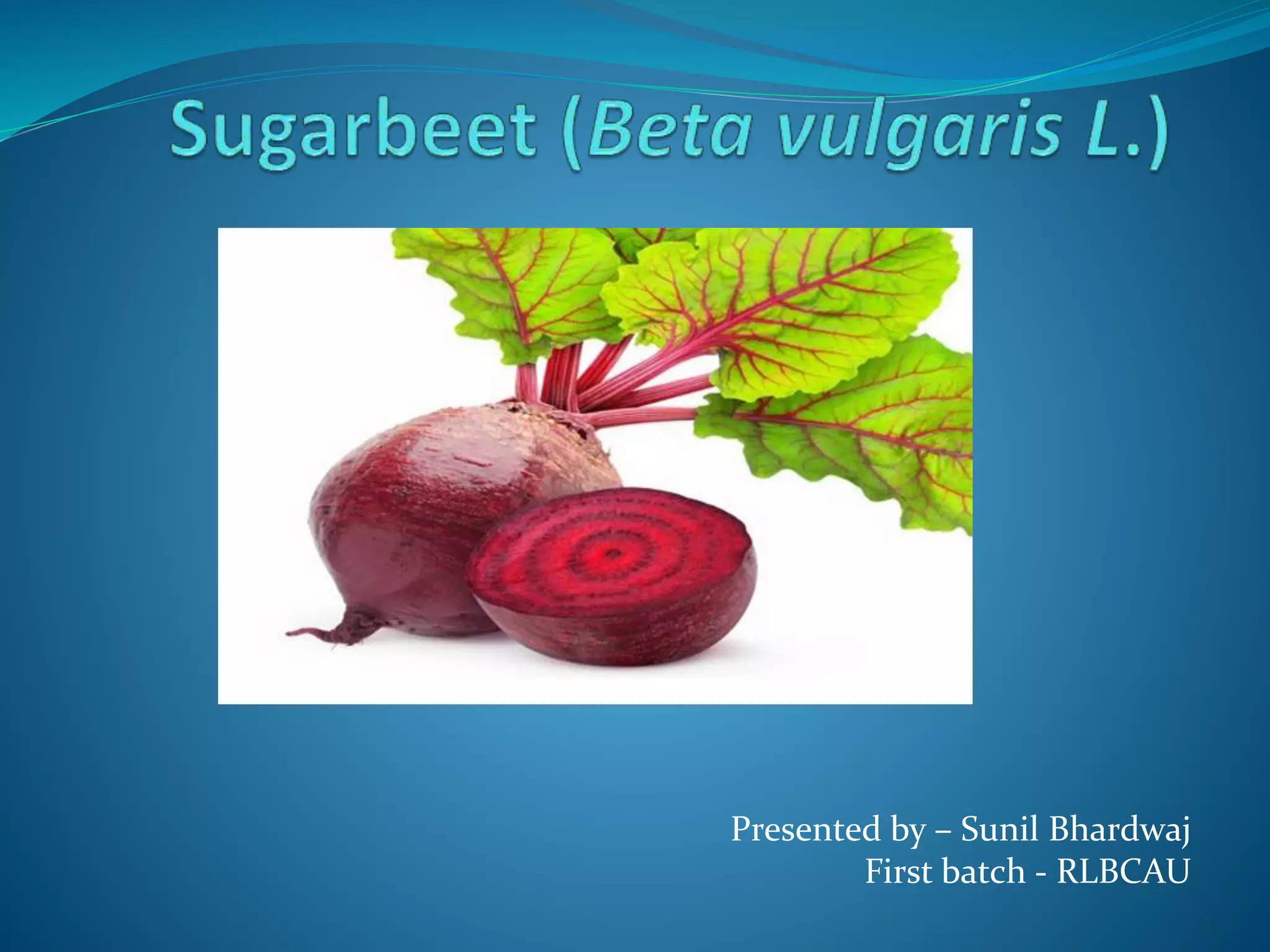
Sugarbeet (Beta vulgaris L.)
Introduction
Sugarbeet (Beta vulgaris) is a temperate crop and is
mainly cultivated in the temperate countries where
sugarcane cultivation is not feasible
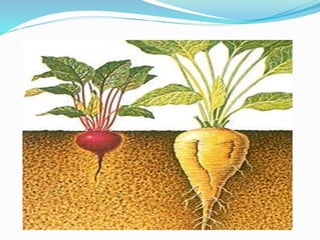
Sugerbeet is a plant whose root contain a high conc. of
sucrose, commercially grown for sugar production.
2nd most imp. sugar crops after sugarcane accounting for
about 22% world sugar prod. and distributed in 45
country.
 Sugarbeet root contains 15-20 % sucrose and in the
process of sugar extraction, 12-14% recovery is possible.
 Unlike sugarcane where sugar extraction is done
through milling, the sugar from the beet, is extracted
by diffusion process.
 The beet roots are washed and cut into thin slices
(cossetts). These slices are put in hot water which
soaks the sugar out and forms syrup. The syrup is then
purified, filtered and boiled again. Finally it is dried to
sugar, which is packaged and marketed.
uses
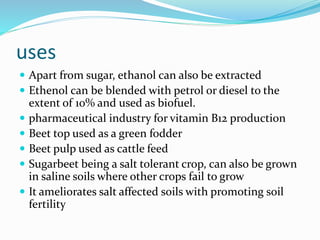
 Apart from sugar, ethanol can also be extracted
 Ethenol can be blended with petrol or diesel to the
extent of 10% and used as biofuel.
 pharmaceutical industry for vitamin B12 production
 Beet top used as a green fodder
 Beet pulp used as cattle feed
 Sugarbeet being a salt tolerant crop, can also be grown
in saline soils where other crops fail to grow
 It ameliorates salt affected soils with promoting soil
fertility
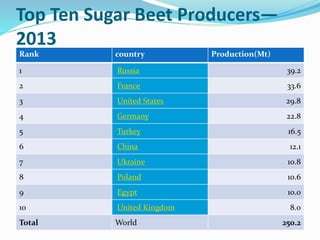
Top Ten Sugar Beet Producers—
2013
Rank country Production(Mt)
1 Russia 39.2
2 France 33.6
3 United States 29.8
4 Germany 22.8
5 Turkey 16.5
6 China 12.1
7 Ukraine 10.8
8 Poland 10.6
9 Egypt 10.0
10 United Kingdom 8.0
Total World 250.2
Origin
 Mediterranean region
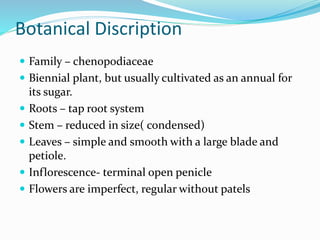
Botanical Discription
 Family – chenopodiaceae
 Biennial plant, but usually cultivated as an annual for
its sugar.
 Roots – tap root system
 Stem – reduced in size( condensed)
 Leaves – simple and smooth with a large blade and
petiole.
 Inflorescence- terminal open penicle
 Flowers are imperfect, regular without patels
Soil and Climate
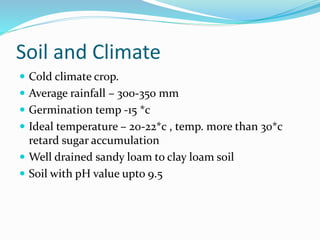
 Cold climate crop.
 Average rainfall – 300-350 mm
 Germination temp -15 *c
 Ideal temperature – 20-22*c , temp. more than 30*c
retard sugar accumulation
 Well drained sandy loam to clay loam soil
 Soil with pH value upto 9.5
Field preparation
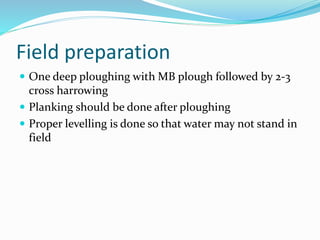
 One deep ploughing with MB plough followed by 2-3
cross harrowing
 Planking should be done after ploughing
 Proper levelling is done so that water may not stand in
field
Seed and sowing
 It can planted on rows on flat bed, or on 15 cm high
ridges , 50 cm apart.
 Seed depth 2.5 cm
 Sowing is done by dibbling manually or by drilling.
 Seed rate require 6 pockets (3.6kg / ha.-
One pocket contains 20000 seeds (600 g)]
 Optimum population is 1,00,000-1,20,000 /ha
 Spacing 50 cm*20 cm .
 Sowing time – oct 15 to Nov 10 are found to be
optimum
Manure and Fertilizers
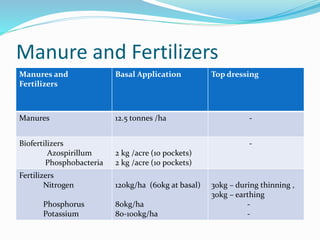
Manures and
Fertilizers
Basal Application Top dressing
Manures 12.5 tonnes /ha -
Biofertilizers
Azospirillum
Phosphobacteria
2 kg /acre (10 pockets)
-
Fertilizers
Nitrogen
Phosphorus
Potassium
120kg/ha (60kg at basal)
80kg/ha
80-100kg/ha
30kg – during thinning ,
30kg – earthing
-
-
Thinning
 The multigerm seeds of sugarbeet give rise to a no. of
seedlings and hence it is necessary to thin them to
maintain optimum plant population.
 Thinning is done after 30 DAS.
 The earthing up operations coincides with top
dressing of N fertilizer.
Water Management
 Crop require 7 -8 irrigation, depending upon seasonal.
 One to two irrigation before thinning
 Subsequent irrigation at an interval of 20-25 days.
 Sugarbeet is sensitive to the inadequacy of water, so
timely irrigation is necessory.
 water does not remain standing in the field for more
than 24hr.
Weed control
 Sugarbeet crop is kept weed free for first 35-45 days,
because severe compitition in early stages.
 3-4 hand weeding
 Pre-emergence herbicide – pyramin @ 3kg a.i/ha (600-
1000 litre of water).
 Post emergence – Betanal @ 2kg a.i/ha (600-1000 litre
of water).
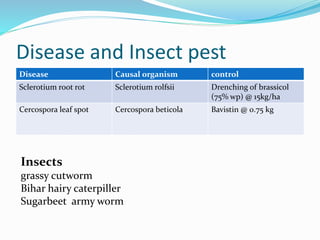
Disease and Insect pest
Disease Causal organism control
Sclerotium root rot Sclerotium rolfsii Drenching of brassicol
(75% wp) @ 15kg/ha
Cercospora leaf spot Cercospora beticola Bavistin @ 0.75 kg
Insects
grassy cutworm
Bihar hairy caterpiller
Sugarbeet army worm
Harvesting and yield
 Done from march end to may and delayed upto mid
june .
 Roots can be loosened in soil by MB plough.
 After collection, the tops and crown are cut off from
the roots.
 Now roots are ready to be sent to factory.
 Yield – 500 to 700 quintals
Sugarbeet (beta vulgaris l

Sugarbeet (beta vulgaris l

  • 1.
    Presented by –Sunil Bhardwaj First batch - RLBCAU
  • 2.
    Sugarbeet (Beta vulgarisL.) Introduction Sugarbeet (Beta vulgaris) is a temperate crop and is mainly cultivated in the temperate countries where sugarcane cultivation is not feasible Sugerbeet is a plant whose root contain a high conc. of sucrose, commercially grown for sugar production. 2nd most imp. sugar crops after sugarcane accounting for about 22% world sugar prod. and distributed in 45 country.
  • 3.
     Sugarbeet rootcontains 15-20 % sucrose and in the process of sugar extraction, 12-14% recovery is possible.  Unlike sugarcane where sugar extraction is done through milling, the sugar from the beet, is extracted by diffusion process.  The beet roots are washed and cut into thin slices (cossetts). These slices are put in hot water which soaks the sugar out and forms syrup. The syrup is then purified, filtered and boiled again. Finally it is dried to sugar, which is packaged and marketed.
  • 4.
    uses  Apart fromsugar, ethanol can also be extracted  Ethenol can be blended with petrol or diesel to the extent of 10% and used as biofuel.  pharmaceutical industry for vitamin B12 production  Beet top used as a green fodder  Beet pulp used as cattle feed  Sugarbeet being a salt tolerant crop, can also be grown in saline soils where other crops fail to grow  It ameliorates salt affected soils with promoting soil fertility
  • 5.
    Top Ten SugarBeet Producers— 2013 Rank country Production(Mt) 1 Russia 39.2 2 France 33.6 3 United States 29.8 4 Germany 22.8 5 Turkey 16.5 6 China 12.1 7 Ukraine 10.8 8 Poland 10.6 9 Egypt 10.0 10 United Kingdom 8.0 Total World 250.2
  • 6.
  • 7.
    Botanical Discription  Family– chenopodiaceae  Biennial plant, but usually cultivated as an annual for its sugar.  Roots – tap root system  Stem – reduced in size( condensed)  Leaves – simple and smooth with a large blade and petiole.  Inflorescence- terminal open penicle  Flowers are imperfect, regular without patels
  • 9.
    Soil and Climate Cold climate crop.  Average rainfall – 300-350 mm  Germination temp -15 *c  Ideal temperature – 20-22*c , temp. more than 30*c retard sugar accumulation  Well drained sandy loam to clay loam soil  Soil with pH value upto 9.5
  • 10.
    Field preparation  Onedeep ploughing with MB plough followed by 2-3 cross harrowing  Planking should be done after ploughing  Proper levelling is done so that water may not stand in field
  • 11.
    Seed and sowing It can planted on rows on flat bed, or on 15 cm high ridges , 50 cm apart.  Seed depth 2.5 cm  Sowing is done by dibbling manually or by drilling.  Seed rate require 6 pockets (3.6kg / ha.- One pocket contains 20000 seeds (600 g)]  Optimum population is 1,00,000-1,20,000 /ha  Spacing 50 cm*20 cm .  Sowing time – oct 15 to Nov 10 are found to be optimum
  • 12.
    Manure and Fertilizers Manuresand Fertilizers Basal Application Top dressing Manures 12.5 tonnes /ha - Biofertilizers Azospirillum Phosphobacteria 2 kg /acre (10 pockets) 2 kg /acre (10 pockets) - Fertilizers Nitrogen Phosphorus Potassium 120kg/ha (60kg at basal) 80kg/ha 80-100kg/ha 30kg – during thinning , 30kg – earthing - -
  • 13.
    Thinning  The multigermseeds of sugarbeet give rise to a no. of seedlings and hence it is necessary to thin them to maintain optimum plant population.  Thinning is done after 30 DAS.  The earthing up operations coincides with top dressing of N fertilizer.
  • 14.
    Water Management  Croprequire 7 -8 irrigation, depending upon seasonal.  One to two irrigation before thinning  Subsequent irrigation at an interval of 20-25 days.  Sugarbeet is sensitive to the inadequacy of water, so timely irrigation is necessory.  water does not remain standing in the field for more than 24hr.
  • 15.
    Weed control  Sugarbeetcrop is kept weed free for first 35-45 days, because severe compitition in early stages.  3-4 hand weeding  Pre-emergence herbicide – pyramin @ 3kg a.i/ha (600- 1000 litre of water).  Post emergence – Betanal @ 2kg a.i/ha (600-1000 litre of water).
  • 16.
    Disease and Insectpest Disease Causal organism control Sclerotium root rot Sclerotium rolfsii Drenching of brassicol (75% wp) @ 15kg/ha Cercospora leaf spot Cercospora beticola Bavistin @ 0.75 kg Insects grassy cutworm Bihar hairy caterpiller Sugarbeet army worm
  • 17.
    Harvesting and yield Done from march end to may and delayed upto mid june .  Roots can be loosened in soil by MB plough.  After collection, the tops and crown are cut off from the roots.  Now roots are ready to be sent to factory.  Yield – 500 to 700 quintals