Blood Group
Dr. Dinesh Veera (MBBS, MS Physiology)
Describe the abo and Rh blood groups and compatibility
testing.
Describe the pattern of inheritance of abo and Rh blood
groups.
Describe the pathogenesis of haemolytic disease of the
newborn (erythroblastosis foetalis.)
Learning Objectives
Multiplicity of Antigens
• At least 30 commonly occurring antigens and hundreds of other rare
antigens on the surfaces of human red blood cells.
• Most of the antigens are weak
• Two particular types of antigens are much more likely than the others
to cause blood transfusion reactions.
• ABO system of antigens and the Rh system.
Importance of knowing about blood group system
1. Safe blood transfusion that may be life saving.
2. To prevent hemolytic disease of new born (Rh compatibility in newborn)
3. To solve the legal disputes related to parenting claimant.
4. To study the Mendelian laws of genetics.
ABO blood group system
▫First ever blood transfusion was made dog to dog by British physician
Richard Lower in 1665.
▫Austrian immunologist Karl Landsteiner discovered the ABO blood group
System in 1901. In 1910 he won Nobel prize for medicine for this discovery.
In 1940- Karl Landsteiner and Alexander S Wiener reported another Rh blood
group.
ABO blood group system
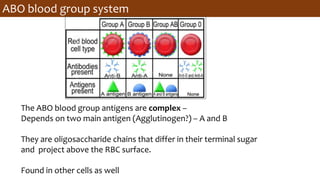
The ABO blood group antigens are complex –
Depends on two main antigen (Agglutinogen?) – A and B
They are oligosaccharide chains that differ in their terminal sugar
and project above the RBC surface.
Found in other cells as well
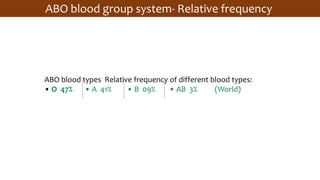
ABO blood types Relative frequency of different blood types:
• O 47% • A 41% • B 09% • AB 3% (World)
ABO blood group system- Relative frequency
Landsteiner’s Law
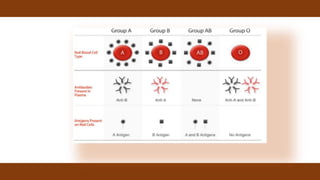
1. If a certain agglutinogen is present on the surface of RBCs, the
corresponding agglutinin must be absent in the plasma.
2. If a certain agglutinogen is absent on the surface of RBCs, then
corresponding agglutinin must be present in the plasma.
• When type A agglutinogen is not present in a person’s red blood cells,
antibodies known as anti-A agglutinins develop in the plasma.
• Also, when type B agglutinogen is not present in the red blood cells,
antibodies known as anti-B agglutinins develop in the plasma.
• Titer of the Agglutinins at Different Ages.
• Most of them are IgM and IgG immunoglobulin molecules
• Immediately after birth, the quantity of agglutinins in the plasma is
almost zero.
• Two to 8 months after birth, an infant begins to produce agglutinins—
anti-A agglutinins when type A agglutinogens are not present in the
cells, and anti-B agglutinins when type B agglutinogens are not in the
cells.
• A maximum titer is usually reached at 8 to 10 years of age, and this
gradually declines throughout the remaining years of life
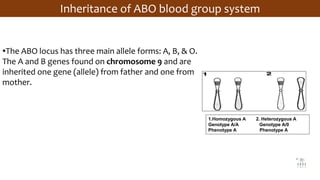
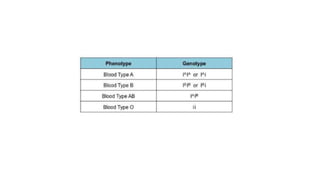
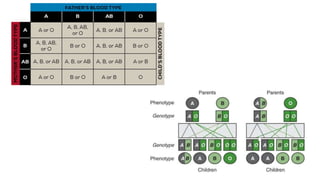
Inheritance of ABO blood group system
▪The ABO locus has three main allele forms: A, B, & O.
The A and B genes found on chromosome 9 and are
inherited one gene (allele) from father and one from
mother.
1.Homozygous A 2. Heterozygous A
Genotype A/A Genotype A/0
Phenotype A Phenotype A
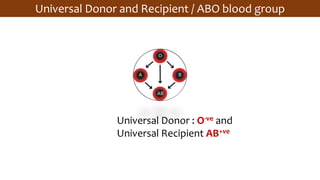
Universal Donor and Recipient / ABO blood group
Universal Donor : O-ve and
Universal Recipient AB+ve
▪The Rh factor, named for the rhesus monkey because it was first studied using the blood of this animal.
▪85% of whites are D-positive & 15% are D-negative; over 99% of Asians are D-positive.
▪Unlike the ABO antigens, the system has not been detected in tissues other than red cells.
There are six common types of Rh antigens, each of which is called an Rh factor- our focus is D –why?
In the O-A-B system, the plasma agglutinins responsible for causing transfusion reactions
develop spontaneously, whereas in the Rh system, spontaneous agglutinins almost never occur!
Rh blood group system
• Formation of Anti-Rh Agglutinins.
• When red blood cells containing Rh factor are injected into a person whose
blood does not contain the Rh factor anti-Rh agglutinins develop gradually
• reaching maximum concentration of agglutinins about 2 to 4 months later.
• This immune response occurs to a much greater extent in some people
than in others.
• With multiple exposures to the Rh factor, an Rh-negative person eventually
becomes strongly “sensitized” to Rh factor.
Transfusion Reaction
• Adverse reactions to transfused blood components occur despite multiple
tests, inspections, and checks.
• Fortunately, the most common reactions are not life threatening, although
serious reactions can present with mild symptoms and signs.
• Transfusion reactions may result from immune and nonimmune
mechanisms.
• Immune-mediated reactions are often due to preformed donor or recipient
antibody; however, cellular elements may also cause adverse effects.
• Nonimmune causes of reactions are due to the chemical and physical
properties of the stored blood component and its additives.
ABO Transfusion Reaction
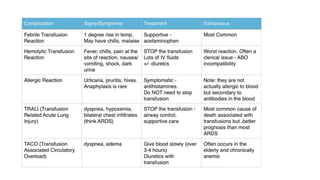
Acute Hemolytic Reactions
• Acute Hemolytic Transfusion Reactions Immune-mediated hemolysis occurs when
the recipient has preformed antibodies that lyse donor erythrocytes.
• The anti-A or anti-B antibodies are responsible for the majority of these
reactions.
• However, alloantibodies directed against other RBC antigens, i.e., Rh, Kell, and
Duffy, are responsible for fatal hemolytic transfusion reactions as well.
• Acute hemolytic reactions may present with hypotension, tachypnea,
tachycardia, fever, chills, hemoglobinemia, hemoglobinuria, chest and/ or flank
pain, and discomfort at the infusion site.
• Monitoring the patient’s vital signs before and during the transfusion is important
to identify reactions promptly. When acute hemolysis is suspected, the
transfusion must be stopped immediately, intravenous access maintained, and
the reaction reported to the blood bank.
Transfusion Reaction ABO
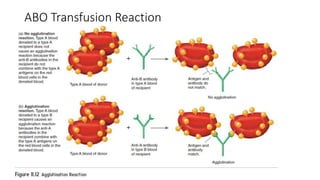
• When bloods are mismatched so that anti-A or anti-B plasma agglutinins are
mixed with red blood cells that contain A or B agglutinogens, respectively, the red
cells agglutinate as a result of the agglutinins’ attaching themselves to the red
blood cells.
• Because the agglutinins have 2 binding sites (IgG type) or 10 binding sites (IgM
type), a single agglutinin can attach to two or more red blood cells at the same
time, thereby causing the cells to be bound together by the agglutinin.
• This causes the cells to clump, which is the process of “agglutination.”
• Then these clumps plug small blood vessels throughout the circulatory system.
During ensuing hours to days, either physical distortion of the cells or attack by
phagocytic white blood cells destroys the membranes of the agglutinated cells,
releasing hemoglobin into the plasma, which is called “hemolysis” of the red
blood cells.
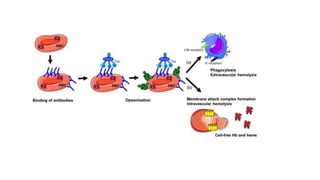
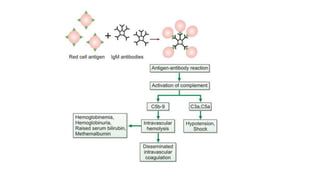
• Acute Hemolysis Occurs in Some Transfusion Reactions. Sometimes,
when recipient and donor bloods are mismatched, immediate
hemolysis of red cells occurs in the circulating blood.
• In this case, the antibodies cause lysis of the red blood cells by
activating the complement system, which releases proteolytic
enzymes (the lytic complex) that rupture the cell membranes
• Usually Immediate intravascular hemolysis is far less common than
agglutination followed by delayed hemolysis
Rh Transfusion Reactions
• If an Rh-negative person has never before been exposed to Rh-positive
blood >> transfusion of Rh-positive blood >> no immediate reaction.
• However, anti-Rh antibodies can develop in sufficient quantities during the
next 2 to 4 weeks to cause agglutination of those transfused cells that are
still circulating in the blood.
• These cells are then hemolyzed by the tissue macrophage system.
• A delayed transfusion reaction occurs, although it is usually mild.
• On subsequent transfusion of Rh-positive blood into the same person >>>
transfusion reaction is greatly enhanced >> as severe as a transfusion
reaction caused by mismatched type A or B blood
Erythroblastosis fetalis / Hemolytic Disease of
Newborn
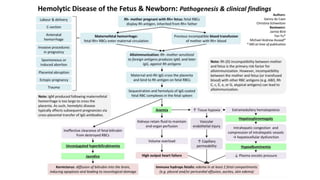
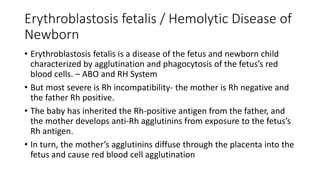
• Erythroblastosis fetalis is a disease of the fetus and newborn child
characterized by agglutination and phagocytosis of the fetus’s red
blood cells. – ABO and RH System
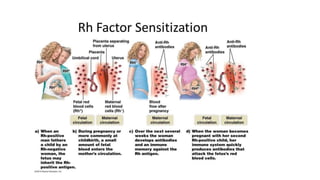
• But most severe is Rh incompatibility- the mother is Rh negative and
the father Rh positive.
• The baby has inherited the Rh-positive antigen from the father, and
the mother develops anti-Rh agglutinins from exposure to the fetus’s
Rh antigen.
• In turn, the mother’s agglutinins diffuse through the placenta into the
fetus and cause red blood cell agglutination
Rh Incompatibility in Pregnancy
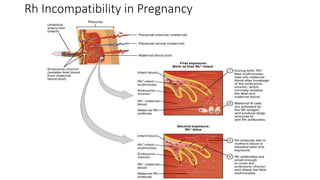
• An Rh-negative mother having her first Rh-positive child usually does
not develop sufficient anti-Rh agglutinins to cause any harm.
• However, about 3 percent of second Rh-positive babies exhibit some
signs of erythroblastosis fetalis
• About 10 percent of third babies exhibit the disease
• The incidence rises progressively with subsequent pregnancies.
• Effect of the Mother’s Antibodies on the Fetus.
• After anti-Rh antibodies have formed in the mother, they diffuse
slowly through the placental membrane into the fetus’s blood.
• There they cause agglutination of the fetus’s blood.
• The agglutinated red blood cells subsequently hemolyze, releasing
hemoglobin into the blood.
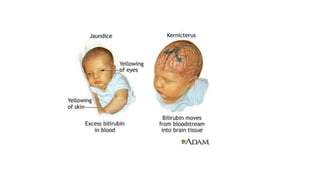
• The fetus’s macrophages then convert the hemoglobin into bilirubin,
which causes the baby’s skin to become yellow (jaundiced).
• The antibodies can also attack and damage other cells of the body
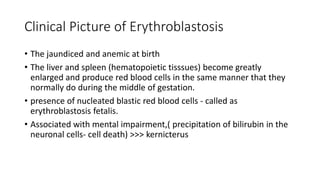
Clinical Picture of Erythroblastosis
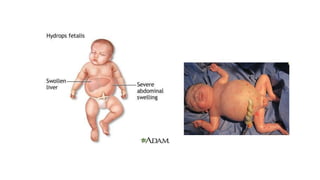
• The jaundiced and anemic at birth
• The liver and spleen (hematopoietic tisssues) become greatly
enlarged and produce red blood cells in the same manner that they
normally do during the middle of gestation.
• presence of nucleated blastic red blood cells - called as
erythroblastosis fetalis.
• Associated with mental impairment,( precipitation of bilirubin in the
neuronal cells- cell death) >>> kernicterus
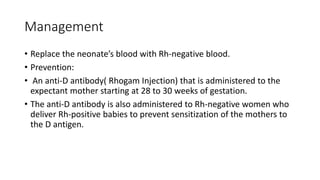
Management
• Replace the neonate’s blood with Rh-negative blood.
• Prevention:
• An anti-D antibody( Rhogam Injection) that is administered to the
expectant mother starting at 28 to 30 weeks of gestation.
• The anti-D antibody is also administered to Rh-negative women who
deliver Rh-positive babies to prevent sensitization of the mothers to
the D antigen.
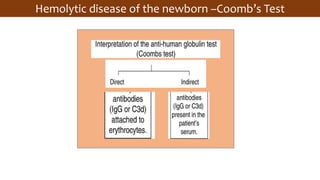
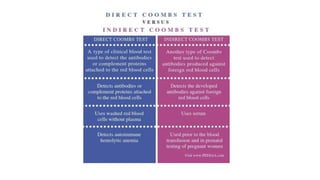
Hemolytic disease of the newborn –Coomb’s Test
Thank you

Lecture 27- Blood Group.pptx

  • 1.
    Blood Group Dr. DineshVeera (MBBS, MS Physiology)
  • 2.
    Describe the aboand Rh blood groups and compatibility testing. Describe the pattern of inheritance of abo and Rh blood groups. Describe the pathogenesis of haemolytic disease of the newborn (erythroblastosis foetalis.) Learning Objectives
  • 3.
    Multiplicity of Antigens •At least 30 commonly occurring antigens and hundreds of other rare antigens on the surfaces of human red blood cells. • Most of the antigens are weak • Two particular types of antigens are much more likely than the others to cause blood transfusion reactions. • ABO system of antigens and the Rh system.
  • 5.
    Importance of knowingabout blood group system 1. Safe blood transfusion that may be life saving. 2. To prevent hemolytic disease of new born (Rh compatibility in newborn) 3. To solve the legal disputes related to parenting claimant. 4. To study the Mendelian laws of genetics.
  • 6.
    ABO blood groupsystem ▫First ever blood transfusion was made dog to dog by British physician Richard Lower in 1665. ▫Austrian immunologist Karl Landsteiner discovered the ABO blood group System in 1901. In 1910 he won Nobel prize for medicine for this discovery. In 1940- Karl Landsteiner and Alexander S Wiener reported another Rh blood group.
  • 7.
    ABO blood groupsystem The ABO blood group antigens are complex – Depends on two main antigen (Agglutinogen?) – A and B They are oligosaccharide chains that differ in their terminal sugar and project above the RBC surface. Found in other cells as well
  • 8.
    ABO blood typesRelative frequency of different blood types: • O 47% • A 41% • B 09% • AB 3% (World) ABO blood group system- Relative frequency
  • 9.
    Landsteiner’s Law 1. Ifa certain agglutinogen is present on the surface of RBCs, the corresponding agglutinin must be absent in the plasma. 2. If a certain agglutinogen is absent on the surface of RBCs, then corresponding agglutinin must be present in the plasma.
  • 10.
    • When typeA agglutinogen is not present in a person’s red blood cells, antibodies known as anti-A agglutinins develop in the plasma. • Also, when type B agglutinogen is not present in the red blood cells, antibodies known as anti-B agglutinins develop in the plasma.
  • 11.
    • Titer ofthe Agglutinins at Different Ages. • Most of them are IgM and IgG immunoglobulin molecules • Immediately after birth, the quantity of agglutinins in the plasma is almost zero. • Two to 8 months after birth, an infant begins to produce agglutinins— anti-A agglutinins when type A agglutinogens are not present in the cells, and anti-B agglutinins when type B agglutinogens are not in the cells. • A maximum titer is usually reached at 8 to 10 years of age, and this gradually declines throughout the remaining years of life
  • 12.
    Inheritance of ABOblood group system ▪The ABO locus has three main allele forms: A, B, & O. The A and B genes found on chromosome 9 and are inherited one gene (allele) from father and one from mother. 1.Homozygous A 2. Heterozygous A Genotype A/A Genotype A/0 Phenotype A Phenotype A
  • 15.
    Universal Donor andRecipient / ABO blood group Universal Donor : O-ve and Universal Recipient AB+ve
  • 16.
    ▪The Rh factor,named for the rhesus monkey because it was first studied using the blood of this animal. ▪85% of whites are D-positive & 15% are D-negative; over 99% of Asians are D-positive. ▪Unlike the ABO antigens, the system has not been detected in tissues other than red cells. There are six common types of Rh antigens, each of which is called an Rh factor- our focus is D –why? In the O-A-B system, the plasma agglutinins responsible for causing transfusion reactions develop spontaneously, whereas in the Rh system, spontaneous agglutinins almost never occur! Rh blood group system
  • 17.
    • Formation ofAnti-Rh Agglutinins. • When red blood cells containing Rh factor are injected into a person whose blood does not contain the Rh factor anti-Rh agglutinins develop gradually • reaching maximum concentration of agglutinins about 2 to 4 months later. • This immune response occurs to a much greater extent in some people than in others. • With multiple exposures to the Rh factor, an Rh-negative person eventually becomes strongly “sensitized” to Rh factor.
  • 18.
    Transfusion Reaction • Adversereactions to transfused blood components occur despite multiple tests, inspections, and checks. • Fortunately, the most common reactions are not life threatening, although serious reactions can present with mild symptoms and signs. • Transfusion reactions may result from immune and nonimmune mechanisms. • Immune-mediated reactions are often due to preformed donor or recipient antibody; however, cellular elements may also cause adverse effects. • Nonimmune causes of reactions are due to the chemical and physical properties of the stored blood component and its additives.
  • 20.
  • 23.
    Acute Hemolytic Reactions •Acute Hemolytic Transfusion Reactions Immune-mediated hemolysis occurs when the recipient has preformed antibodies that lyse donor erythrocytes. • The anti-A or anti-B antibodies are responsible for the majority of these reactions. • However, alloantibodies directed against other RBC antigens, i.e., Rh, Kell, and Duffy, are responsible for fatal hemolytic transfusion reactions as well. • Acute hemolytic reactions may present with hypotension, tachypnea, tachycardia, fever, chills, hemoglobinemia, hemoglobinuria, chest and/ or flank pain, and discomfort at the infusion site. • Monitoring the patient’s vital signs before and during the transfusion is important to identify reactions promptly. When acute hemolysis is suspected, the transfusion must be stopped immediately, intravenous access maintained, and the reaction reported to the blood bank.
  • 24.
    Transfusion Reaction ABO •When bloods are mismatched so that anti-A or anti-B plasma agglutinins are mixed with red blood cells that contain A or B agglutinogens, respectively, the red cells agglutinate as a result of the agglutinins’ attaching themselves to the red blood cells. • Because the agglutinins have 2 binding sites (IgG type) or 10 binding sites (IgM type), a single agglutinin can attach to two or more red blood cells at the same time, thereby causing the cells to be bound together by the agglutinin. • This causes the cells to clump, which is the process of “agglutination.” • Then these clumps plug small blood vessels throughout the circulatory system. During ensuing hours to days, either physical distortion of the cells or attack by phagocytic white blood cells destroys the membranes of the agglutinated cells, releasing hemoglobin into the plasma, which is called “hemolysis” of the red blood cells.
  • 25.
    • Acute HemolysisOccurs in Some Transfusion Reactions. Sometimes, when recipient and donor bloods are mismatched, immediate hemolysis of red cells occurs in the circulating blood. • In this case, the antibodies cause lysis of the red blood cells by activating the complement system, which releases proteolytic enzymes (the lytic complex) that rupture the cell membranes • Usually Immediate intravascular hemolysis is far less common than agglutination followed by delayed hemolysis
  • 26.
    Rh Transfusion Reactions •If an Rh-negative person has never before been exposed to Rh-positive blood >> transfusion of Rh-positive blood >> no immediate reaction. • However, anti-Rh antibodies can develop in sufficient quantities during the next 2 to 4 weeks to cause agglutination of those transfused cells that are still circulating in the blood. • These cells are then hemolyzed by the tissue macrophage system. • A delayed transfusion reaction occurs, although it is usually mild. • On subsequent transfusion of Rh-positive blood into the same person >>> transfusion reaction is greatly enhanced >> as severe as a transfusion reaction caused by mismatched type A or B blood
  • 27.
    Erythroblastosis fetalis /Hemolytic Disease of Newborn • Erythroblastosis fetalis is a disease of the fetus and newborn child characterized by agglutination and phagocytosis of the fetus’s red blood cells. – ABO and RH System • But most severe is Rh incompatibility- the mother is Rh negative and the father Rh positive. • The baby has inherited the Rh-positive antigen from the father, and the mother develops anti-Rh agglutinins from exposure to the fetus’s Rh antigen. • In turn, the mother’s agglutinins diffuse through the placenta into the fetus and cause red blood cell agglutination
  • 28.
  • 31.
    • An Rh-negativemother having her first Rh-positive child usually does not develop sufficient anti-Rh agglutinins to cause any harm. • However, about 3 percent of second Rh-positive babies exhibit some signs of erythroblastosis fetalis • About 10 percent of third babies exhibit the disease • The incidence rises progressively with subsequent pregnancies.
  • 32.
    • Effect ofthe Mother’s Antibodies on the Fetus. • After anti-Rh antibodies have formed in the mother, they diffuse slowly through the placental membrane into the fetus’s blood. • There they cause agglutination of the fetus’s blood. • The agglutinated red blood cells subsequently hemolyze, releasing hemoglobin into the blood. • The fetus’s macrophages then convert the hemoglobin into bilirubin, which causes the baby’s skin to become yellow (jaundiced). • The antibodies can also attack and damage other cells of the body

  • 33.
    Clinical Picture ofErythroblastosis • The jaundiced and anemic at birth • The liver and spleen (hematopoietic tisssues) become greatly enlarged and produce red blood cells in the same manner that they normally do during the middle of gestation. • presence of nucleated blastic red blood cells - called as erythroblastosis fetalis. • Associated with mental impairment,( precipitation of bilirubin in the neuronal cells- cell death) >>> kernicterus
  • 36.
    Management • Replace theneonate’s blood with Rh-negative blood. • Prevention: • An anti-D antibody( Rhogam Injection) that is administered to the expectant mother starting at 28 to 30 weeks of gestation. • The anti-D antibody is also administered to Rh-negative women who deliver Rh-positive babies to prevent sensitization of the mothers to the D antigen.
  • 37.
    Hemolytic disease ofthe newborn –Coomb’s Test
  • 39.