Dr. Maria Idrees; PT
MS (RIU)
DPT(TUF)
 The endocrine system helps to maintain internal
homeostasis through the use of endogenous chemicals
known as hormones.
 A hormone is typically regarded as a chemical
messenger that is released into the bloodstream to
exert an effect on target cells located some distance
from the hormonal release site.
 Drugs can be used as replacement therapy during
hormonal deficiency—for example, insulin
administration in diabetes mellitus.
Primary Endocrine Glands
and Their Hormones
 Hypothalamus and Pituitary Gland
 The pituitary gland is a small, pea-shaped structure.
 The pituitary can be subdivided into an anterior, an
intermediate, and a posterior lobe.
 Anterior Lobe:
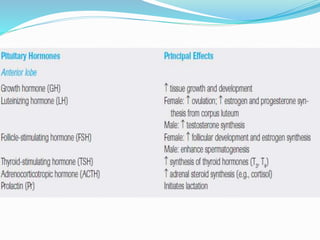
 Secrets six important peptide hormones
1) growth hormone (GH),
2) luteinizing hormone (LH),
3) follicle-stimulating hormone (FSH),
4) thyroid-stimulating hormone (TSH),
5) adrenocorticotropic hormone (ACTH), and
6) Prolactin (Pr).
 Intermediate Lobe.
 In mammals, there is a small intermediate lobe of the
pituitary (pars intermedia) that may secrete
melanocyte-stimulating hormone (MSH).
 Although it can influence skin pigmentation in lower
vertebrates, the intermediate lobe does not produce
MSH in meaningful amounts in humans.
 Humans can, however, produce MSH from a precursor
protein (proopiomelacortin) that is synthesized in
central tissues (anterior pituitary, hypothalamus) and
the periphery (skin, lymphoid tissues)
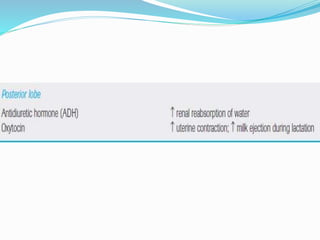
 Posterior Lobe
 Secretes two hormones:
1) Antidiuretic hormone (ADH) (Exerts its effect
primarily on the kidneys, where it increases the
reabsorption of water from the distal renal tubules.
2) Oxytocin (important in parturition and stimulates
the uterus to contract. It also promotes lactation by
stimulating the ejection of milk from the mammary
glands.
Thyroid Gland
 The thyroid gland is located in the anterior neck
region, approximately at the level of the fifth cervical
to first thoracic vertebrae.
 The thyroid synthesizes and secretes two hormones:
 Thyroxine (T4) and
 Triiodothyronine (T3)
 The primary effect of the thyroid hormones is to
increase cellular metabolism in most body tissues
Parathyroid Gland
 Parathyroid glands are small, egg-shaped structures
embedded in the posterior surface of the thyroid
gland.
 There are usually four parathyroid glands
 The parathyroids synthesize and release parathyroid
hormone (PTH).
 PTH is essential in maintaining normal calcium
homeostasis in the body; the primary effect of PTH is
to increase the concentration of calcium in the
bloodstream.
Pancreas
 The pancreas is located behind the stomach in the
lower left area of the abdomen.
 This gland is unique in that it serves both endocrine
and exocrine functions.
 The exocrine aspect of this gland involves digestive
enzymes that are excreted into the duodenum.
 As an endocrine gland, the pancreas primarily secretes
two peptide hormones:
1) Insulin (Alpha cells) and
2) Glucagon (Beta cells)
Adrenal Gland
 Adrenal glands are located at the superior poles of
each kidney.
 Each adrenal gland is composed of an outer cortex and
an inner medulla.
 Hormones of the Adrenal Cortex
 Synthesizes and secretes two primary groups of steroidal
hormones:
1) Glucocorticoids
2) Mineralocorticoids (controlling electrolyte and fluid
levels)
3) Small amounts of sex steroids (estrogens, androgens,
progesterone) are also produced.
 Glucocorticoids are involved in the regulation of glucose
metabolism and are important in enhancing the body’s
ability to handle stress.
 Anti-inflammatory
 Immunosuppressive properties
 Hormones of the Adrenal Medulla
 synthesizes and secretes
 Epinephrine and
 Norepinephrine
 To prepare the body for sudden physical activity.
 By the fight-or-flight reaction
Gonads
 In men, the testes produce testosterone and similar
androgens that are responsible for spermatogenesis
and the secondary sexual characteristics of adult
males.
 In women, sexual maturation and reproductive
function are governed by the production of estrogens
and progestins from the ovaries
Hormone Chemistry
 Steroid hormones share a common chemical
framework that is derived from lipids such as
cholesterol. (e.g sex hormones, glucocorticoids,
mineralocorticoids)
 Peptide hormones consist of amino acids linked
together in a specific sequence (3-180 amino acids, e.g
T3 and T4)
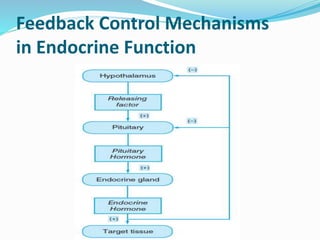
Feedback Control Mechanisms
in Endocrine Function
Hormone Transport
 Hormones are usually carried from their site of origin
to the target cell via the systemic circulation.
 During transport in the bloodstream, certain
hormones such as steroids are bound to specific
plasma proteins.
 These protein carriers appear to help prolong the half-
life of the hormone and prevent premature
degradation.
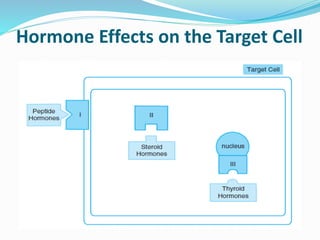
Hormone Effects on the Target Cell
Assignment
 Steroid hormone Mechanism of action??????????
 Due date: 4-11-2022

Introduction to Endocrine.pptx

  • 1.
    Dr. Maria Idrees;PT MS (RIU) DPT(TUF)
  • 2.
     The endocrinesystem helps to maintain internal homeostasis through the use of endogenous chemicals known as hormones.  A hormone is typically regarded as a chemical messenger that is released into the bloodstream to exert an effect on target cells located some distance from the hormonal release site.  Drugs can be used as replacement therapy during hormonal deficiency—for example, insulin administration in diabetes mellitus.
  • 3.
    Primary Endocrine Glands andTheir Hormones  Hypothalamus and Pituitary Gland  The pituitary gland is a small, pea-shaped structure.  The pituitary can be subdivided into an anterior, an intermediate, and a posterior lobe.  Anterior Lobe:  Secrets six important peptide hormones 1) growth hormone (GH), 2) luteinizing hormone (LH), 3) follicle-stimulating hormone (FSH), 4) thyroid-stimulating hormone (TSH), 5) adrenocorticotropic hormone (ACTH), and 6) Prolactin (Pr).
  • 5.
     Intermediate Lobe. In mammals, there is a small intermediate lobe of the pituitary (pars intermedia) that may secrete melanocyte-stimulating hormone (MSH).  Although it can influence skin pigmentation in lower vertebrates, the intermediate lobe does not produce MSH in meaningful amounts in humans.  Humans can, however, produce MSH from a precursor protein (proopiomelacortin) that is synthesized in central tissues (anterior pituitary, hypothalamus) and the periphery (skin, lymphoid tissues)
  • 6.
     Posterior Lobe Secretes two hormones: 1) Antidiuretic hormone (ADH) (Exerts its effect primarily on the kidneys, where it increases the reabsorption of water from the distal renal tubules. 2) Oxytocin (important in parturition and stimulates the uterus to contract. It also promotes lactation by stimulating the ejection of milk from the mammary glands.
  • 8.
    Thyroid Gland  Thethyroid gland is located in the anterior neck region, approximately at the level of the fifth cervical to first thoracic vertebrae.  The thyroid synthesizes and secretes two hormones:  Thyroxine (T4) and  Triiodothyronine (T3)  The primary effect of the thyroid hormones is to increase cellular metabolism in most body tissues
  • 9.
    Parathyroid Gland  Parathyroidglands are small, egg-shaped structures embedded in the posterior surface of the thyroid gland.  There are usually four parathyroid glands  The parathyroids synthesize and release parathyroid hormone (PTH).  PTH is essential in maintaining normal calcium homeostasis in the body; the primary effect of PTH is to increase the concentration of calcium in the bloodstream.
  • 10.
    Pancreas  The pancreasis located behind the stomach in the lower left area of the abdomen.  This gland is unique in that it serves both endocrine and exocrine functions.  The exocrine aspect of this gland involves digestive enzymes that are excreted into the duodenum.  As an endocrine gland, the pancreas primarily secretes two peptide hormones: 1) Insulin (Alpha cells) and 2) Glucagon (Beta cells)
  • 11.
    Adrenal Gland  Adrenalglands are located at the superior poles of each kidney.  Each adrenal gland is composed of an outer cortex and an inner medulla.
  • 12.
     Hormones ofthe Adrenal Cortex  Synthesizes and secretes two primary groups of steroidal hormones: 1) Glucocorticoids 2) Mineralocorticoids (controlling electrolyte and fluid levels) 3) Small amounts of sex steroids (estrogens, androgens, progesterone) are also produced.  Glucocorticoids are involved in the regulation of glucose metabolism and are important in enhancing the body’s ability to handle stress.  Anti-inflammatory  Immunosuppressive properties
  • 13.
     Hormones ofthe Adrenal Medulla  synthesizes and secretes  Epinephrine and  Norepinephrine  To prepare the body for sudden physical activity.  By the fight-or-flight reaction
  • 14.
    Gonads  In men,the testes produce testosterone and similar androgens that are responsible for spermatogenesis and the secondary sexual characteristics of adult males.  In women, sexual maturation and reproductive function are governed by the production of estrogens and progestins from the ovaries
  • 15.
    Hormone Chemistry  Steroidhormones share a common chemical framework that is derived from lipids such as cholesterol. (e.g sex hormones, glucocorticoids, mineralocorticoids)  Peptide hormones consist of amino acids linked together in a specific sequence (3-180 amino acids, e.g T3 and T4)
  • 16.
  • 17.
    Hormone Transport  Hormonesare usually carried from their site of origin to the target cell via the systemic circulation.  During transport in the bloodstream, certain hormones such as steroids are bound to specific plasma proteins.  These protein carriers appear to help prolong the half- life of the hormone and prevent premature degradation.
  • 18.
    Hormone Effects onthe Target Cell
  • 19.
    Assignment  Steroid hormoneMechanism of action??????????  Due date: 4-11-2022

Editor's Notes

  • #10 PTH increases circulating calcium levels primarily by mobilizing calcium from storage sites in bone
  • #11 In the islets of Langerhans, glucagon and insulin are synthesized by alpha and beta cells, respectively.
  • #19 Peptide hormones tend to bind to surface membrane receptors (site I); steroid hormones bind to cytosolic receptors (site II); and thyroid hormones bind to receptors in the cell nucleus (site III)