Sedimentology 2/1
Image log & dipmeter
analysis course
Ichnofabrics – recognition
& interpretation
Sedimentology 2/2
“Those aspects of the sediment's texture and internal
structure that arise from bioturbation and bio-erosion at all
scales" (Ekdale & Bromley 1983).
“A record of the primary sedimentary conditions, original
animal community, and subsequent history of one or more
phases of biogenic activity” (Taylor & Goldring 1993).
Definitions
Sedimentology 2/3
_ 3.41
_ 1.64
_ 2.35
_ 0.21
_ 0.75
_ 2.81
_ 1.81
Log K
Permeability map
Thin section
Core
Microporous nodular limestones
Sedimentology 2/4
•Degree of bioturbation
•Ichnofauna
•Diversity
•Burrow organisation
•Tiering
•Lithology
•Sedimentary structures
Observations
Sedimentology 2/5
Sedimentology 2/6
Trace fossils Environment
Shoreface Shelf
Tidal Foreshore Upper Middle Lower Inner Outer
Arenicolites x x x x x
Asterosoma x x
Bergaueria x x x x x
Chondrites x x
Conichnus x x x x x
Diplocraterion x x x
Escape structures x x x x x x
Gyrolithes x x
Lockeia x x
Macaronichnus x x x x
Monocraterion x x
Muensteria x x x
Ophiomorpha x x x x
Palaeophycus x x x x x
Phycosiphon x x x
Planolites x x x x x x
Rhizocorallium x x
Roots
Rosselia x x x
Scolicia x x x
Siphonites x x x
Skolithos x x x x x x x
Taenidium
Teichichnus x x x
Terebellina x x x
Thalassinoides x x x x x x
Trichichnus x x x
Sedimentology 2/7
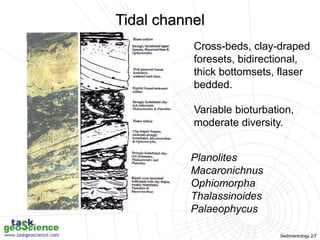
Cross-beds, clay-draped
foresets, bidirectional,
thick bottomsets, flaser
bedded.
Variable bioturbation,
moderate diversity.
Planolites
Macaronichnus
Ophiomorpha
Thalassinoides
Palaeophycus
Tidal channel
Sedimentology 2/8
Cross-bedded to
parallel-laminated
sands.
Variable bioturbation,
moderate diversity.
Ophiomorpha
Scolicia
Planolites
Macaronichnus
Upper shoreface
Sedimentology 2/9
Fair weather deposits;
sandy heterolithics.
Storm deposits, HCS-SCS
sands.
Intensely bioturbated, high
diversity.
Phycosiphon, Rhizocorallium
Teichichnus, Palaeophycus
Sparsely bioturbated, low
diversity.
Ophiomorpha
Lower shoreface
Sedimentology 2/10
Muddy heterolithics.
Intensely bioturbated,
high diversity.
Phycosiphon
Teichichnus
Planolites
Chondrites
Rhizocorallium
Inner shelf
Sedimentology 2/11
Bioturbated mudstone.
Laminated mudstone.
Sparsely bioturbated, low
diversity.
Phycosiphon
Thalassinoides
Intensely bioturbated,
moderate diversity.
Phycosiphon
Chondrites
Planolites
Outer shelf
Sedimentology 2/12
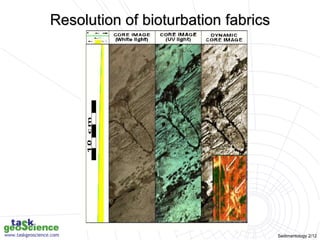
Resolution of bioturbation fabrics
Sedimentology 2/13
Fabric index - determined via flash cards
Mottling and loss of fabric in this example is due to
bioturbation - hence we have a bioturbation index
Fabric index
Sedimentology 2/14
Fabric Analysis adds an extra
dimension to lithofacies description if
it can include a quantitative descriptor.
E.g. Well laminated versus poorly
laminated, and stages in-between.
Fabric index from dipmeter curve activity

8b - Ichnofabrics.ppt

  • 1.
    Sedimentology 2/1 Image log& dipmeter analysis course Ichnofabrics – recognition & interpretation
  • 2.
    Sedimentology 2/2 “Those aspectsof the sediment's texture and internal structure that arise from bioturbation and bio-erosion at all scales" (Ekdale & Bromley 1983). “A record of the primary sedimentary conditions, original animal community, and subsequent history of one or more phases of biogenic activity” (Taylor & Goldring 1993). Definitions
  • 3.
    Sedimentology 2/3 _ 3.41 _1.64 _ 2.35 _ 0.21 _ 0.75 _ 2.81 _ 1.81 Log K Permeability map Thin section Core Microporous nodular limestones
  • 4.
    Sedimentology 2/4 •Degree ofbioturbation •Ichnofauna •Diversity •Burrow organisation •Tiering •Lithology •Sedimentary structures Observations
  • 5.
  • 6.
    Sedimentology 2/6 Trace fossilsEnvironment Shoreface Shelf Tidal Foreshore Upper Middle Lower Inner Outer Arenicolites x x x x x Asterosoma x x Bergaueria x x x x x Chondrites x x Conichnus x x x x x Diplocraterion x x x Escape structures x x x x x x Gyrolithes x x Lockeia x x Macaronichnus x x x x Monocraterion x x Muensteria x x x Ophiomorpha x x x x Palaeophycus x x x x x Phycosiphon x x x Planolites x x x x x x Rhizocorallium x x Roots Rosselia x x x Scolicia x x x Siphonites x x x Skolithos x x x x x x x Taenidium Teichichnus x x x Terebellina x x x Thalassinoides x x x x x x Trichichnus x x x
  • 7.
    Sedimentology 2/7 Cross-beds, clay-draped foresets,bidirectional, thick bottomsets, flaser bedded. Variable bioturbation, moderate diversity. Planolites Macaronichnus Ophiomorpha Thalassinoides Palaeophycus Tidal channel
  • 8.
    Sedimentology 2/8 Cross-bedded to parallel-laminated sands. Variablebioturbation, moderate diversity. Ophiomorpha Scolicia Planolites Macaronichnus Upper shoreface
  • 9.
    Sedimentology 2/9 Fair weatherdeposits; sandy heterolithics. Storm deposits, HCS-SCS sands. Intensely bioturbated, high diversity. Phycosiphon, Rhizocorallium Teichichnus, Palaeophycus Sparsely bioturbated, low diversity. Ophiomorpha Lower shoreface
  • 10.
    Sedimentology 2/10 Muddy heterolithics. Intenselybioturbated, high diversity. Phycosiphon Teichichnus Planolites Chondrites Rhizocorallium Inner shelf
  • 11.
    Sedimentology 2/11 Bioturbated mudstone. Laminatedmudstone. Sparsely bioturbated, low diversity. Phycosiphon Thalassinoides Intensely bioturbated, moderate diversity. Phycosiphon Chondrites Planolites Outer shelf
  • 12.
  • 13.
    Sedimentology 2/13 Fabric index- determined via flash cards Mottling and loss of fabric in this example is due to bioturbation - hence we have a bioturbation index Fabric index
  • 14.
    Sedimentology 2/14 Fabric Analysisadds an extra dimension to lithofacies description if it can include a quantitative descriptor. E.g. Well laminated versus poorly laminated, and stages in-between. Fabric index from dipmeter curve activity