Assembly Language for x86 Processors
7th Edition
7th Edition
Chapter 3: Assembly Language
Fundamentals
Kip Irvine
Irvine, Kip R. Assembly Language for x86 Processors 7/e, 2015.
2
Chapter Overview
Chapter Overview
• Basic Elements of Assembly Language
• Example: Adding and Subtracting Integers
• Assembling, Linking, and Running Programs
• Defining Data
• Symbolic Constants
• 64-Bit Programming
Irvine, Kip R. Assembly Language for x86 Processors 7/e, 2015.
3
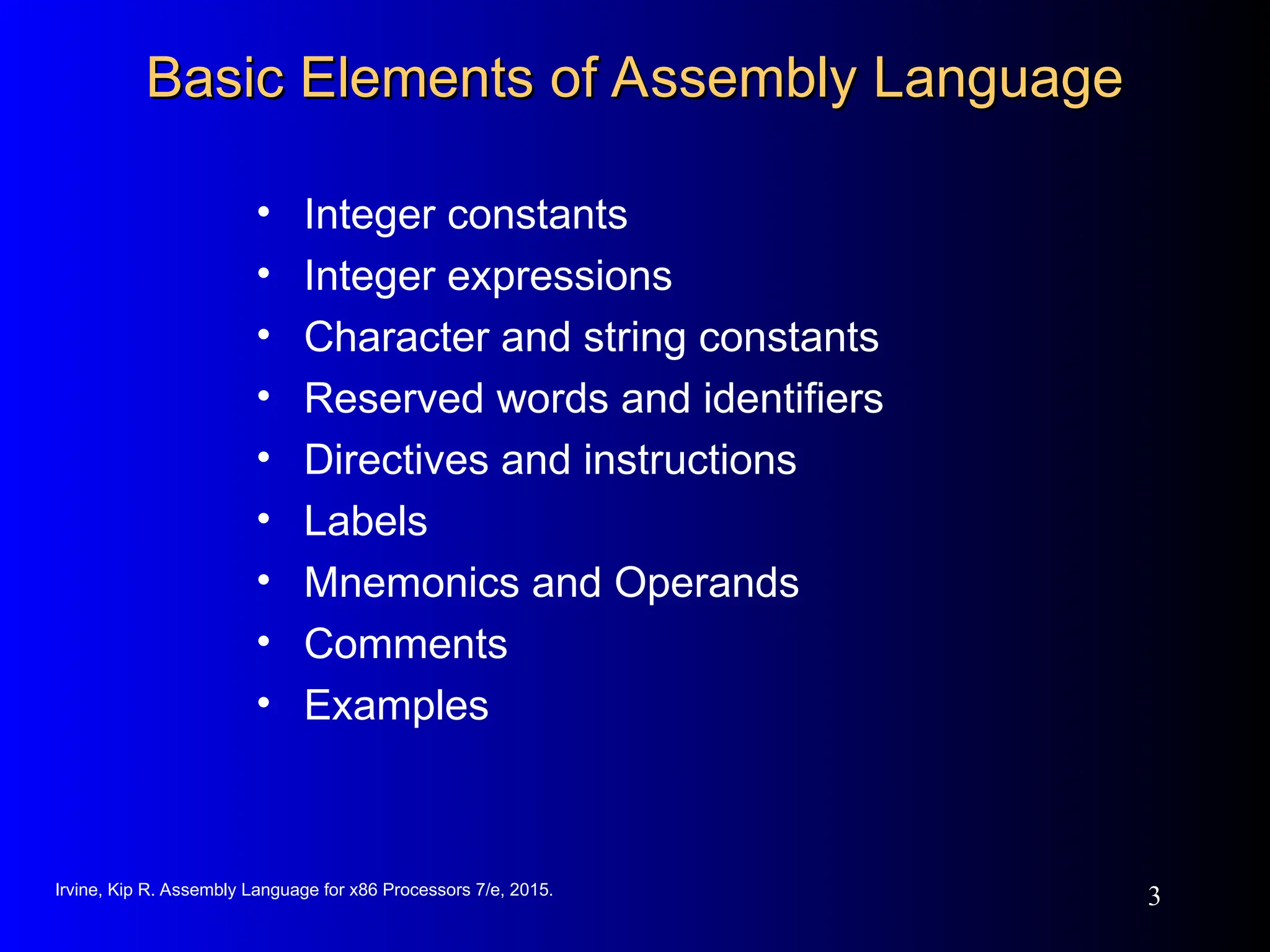
Basic Elements of Assembly Language
• Integer constants
• Integer expressions
• Character and string constants
• Reserved words and identifiers
• Directives and instructions
• Labels
• Mnemonics and Operands
• Comments
• Examples
Irvine, Kip R. Assembly Language for x86 Processors 7/e, 2015.
4
Integer Constants
Integer Constants
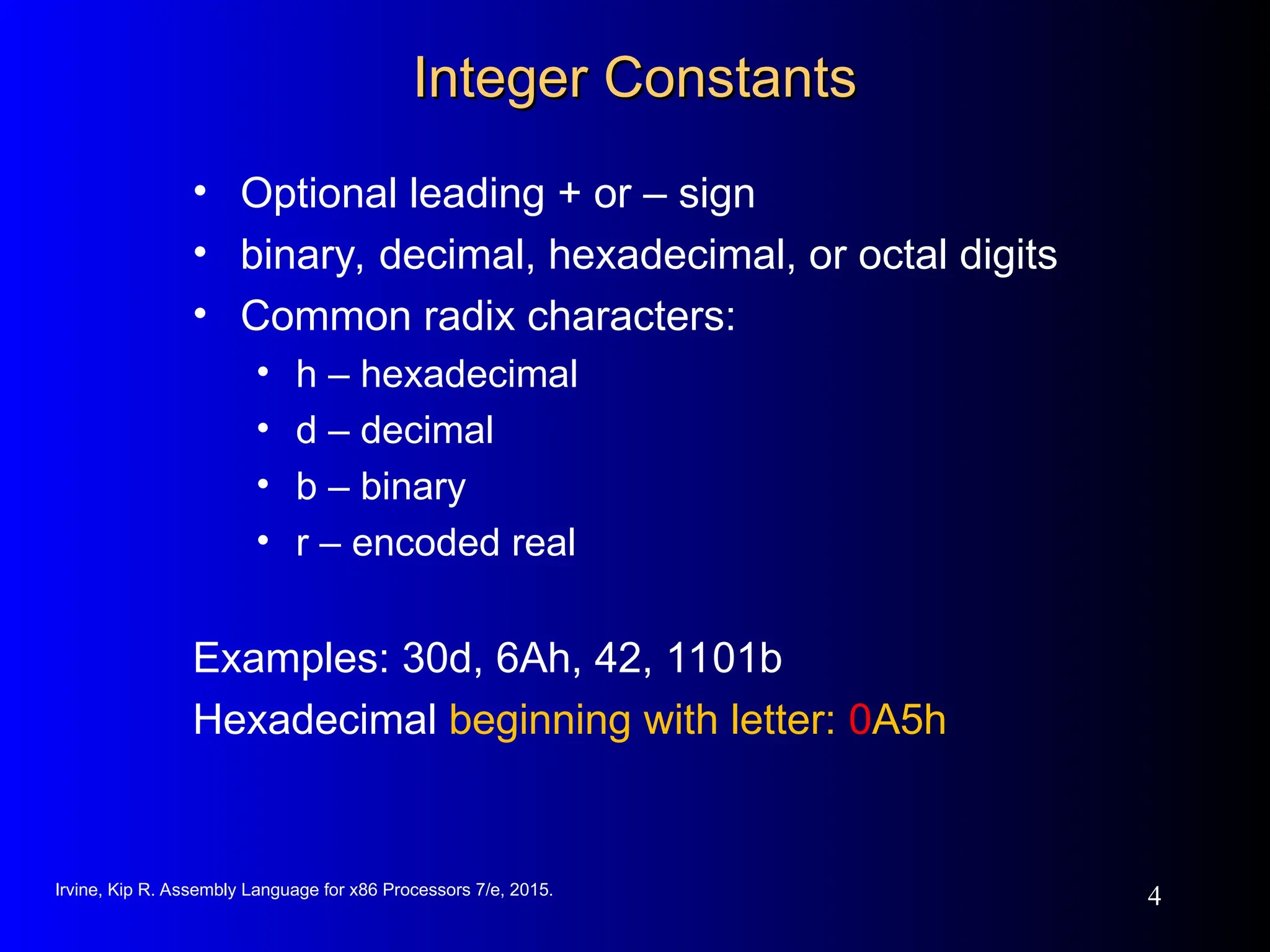
• Optional leading + or – sign
• binary, decimal, hexadecimal, or octal digits
• Common radix characters:
• h – hexadecimal
• d – decimal
• b – binary
• r – encoded real
Examples: 30d, 6Ah, 42, 1101b
Hexadecimal beginning with letter: 0A5h
Irvine, Kip R. Assembly Language for x86 Processors 7/e, 2015.
5
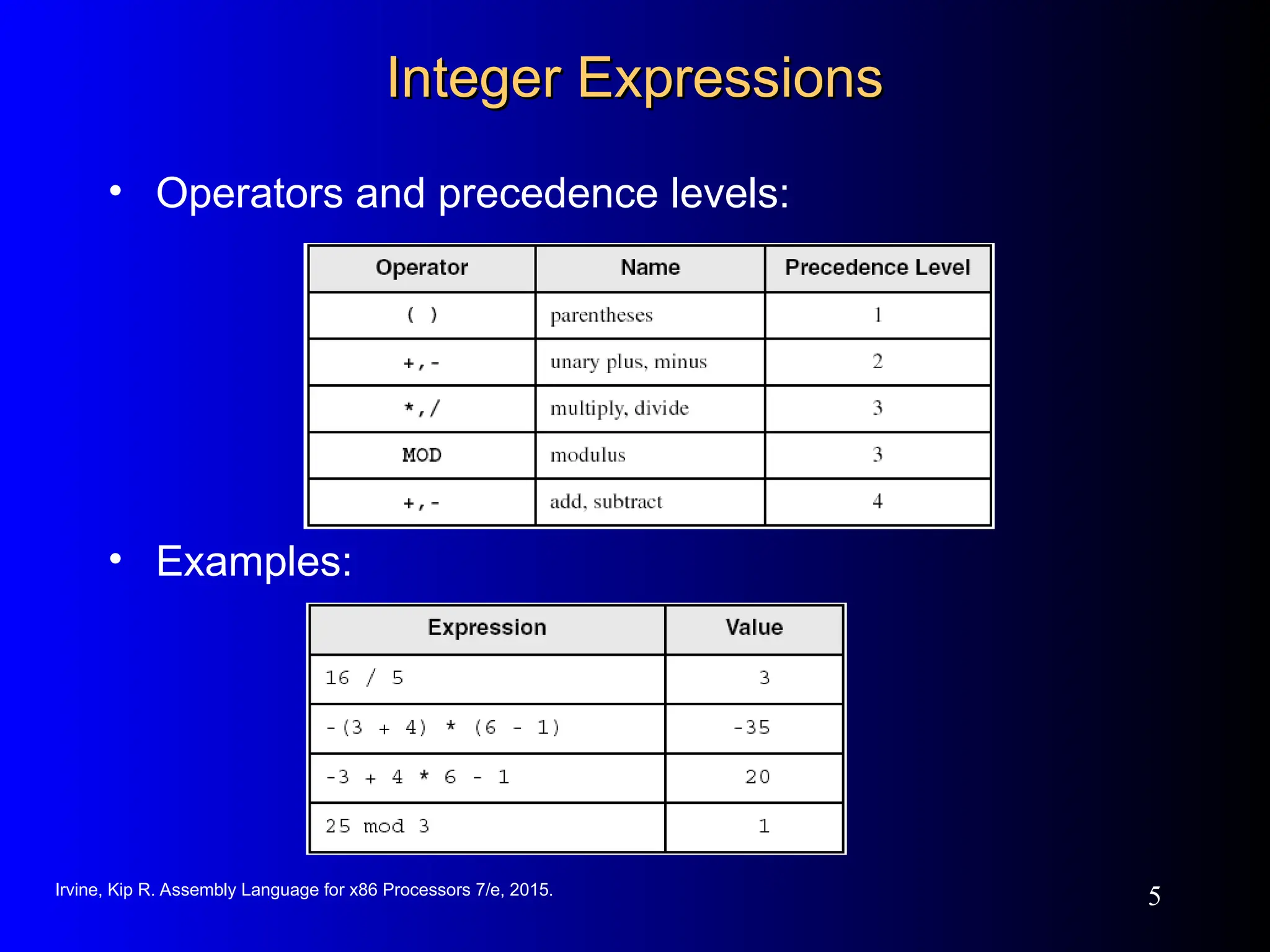
Integer Expressions
Integer Expressions
• Operators and precedence levels:
• Examples:
Irvine, Kip R. Assembly Language for x86 Processors 7/e, 2015.
6
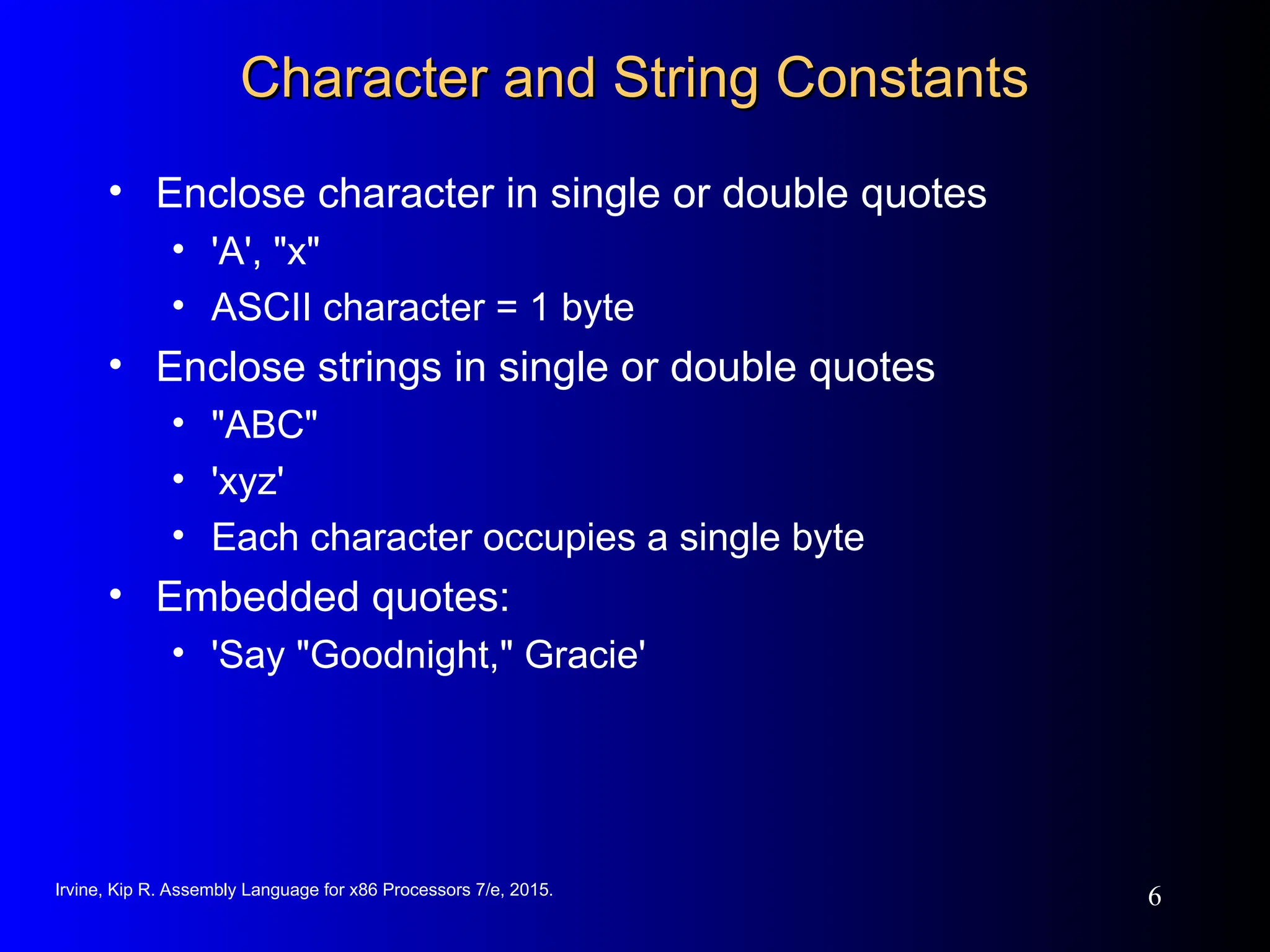
Character and String Constants
• Enclose character in single or double quotes
• 'A', "x"
• ASCII character = 1 byte
• Enclose strings in single or double quotes
• "ABC"
• 'xyz'
• Each character occupies a single byte
• Embedded quotes:
• 'Say "Goodnight," Gracie'
Irvine, Kip R. Assembly Language for x86 Processors 7/e, 2015.
7
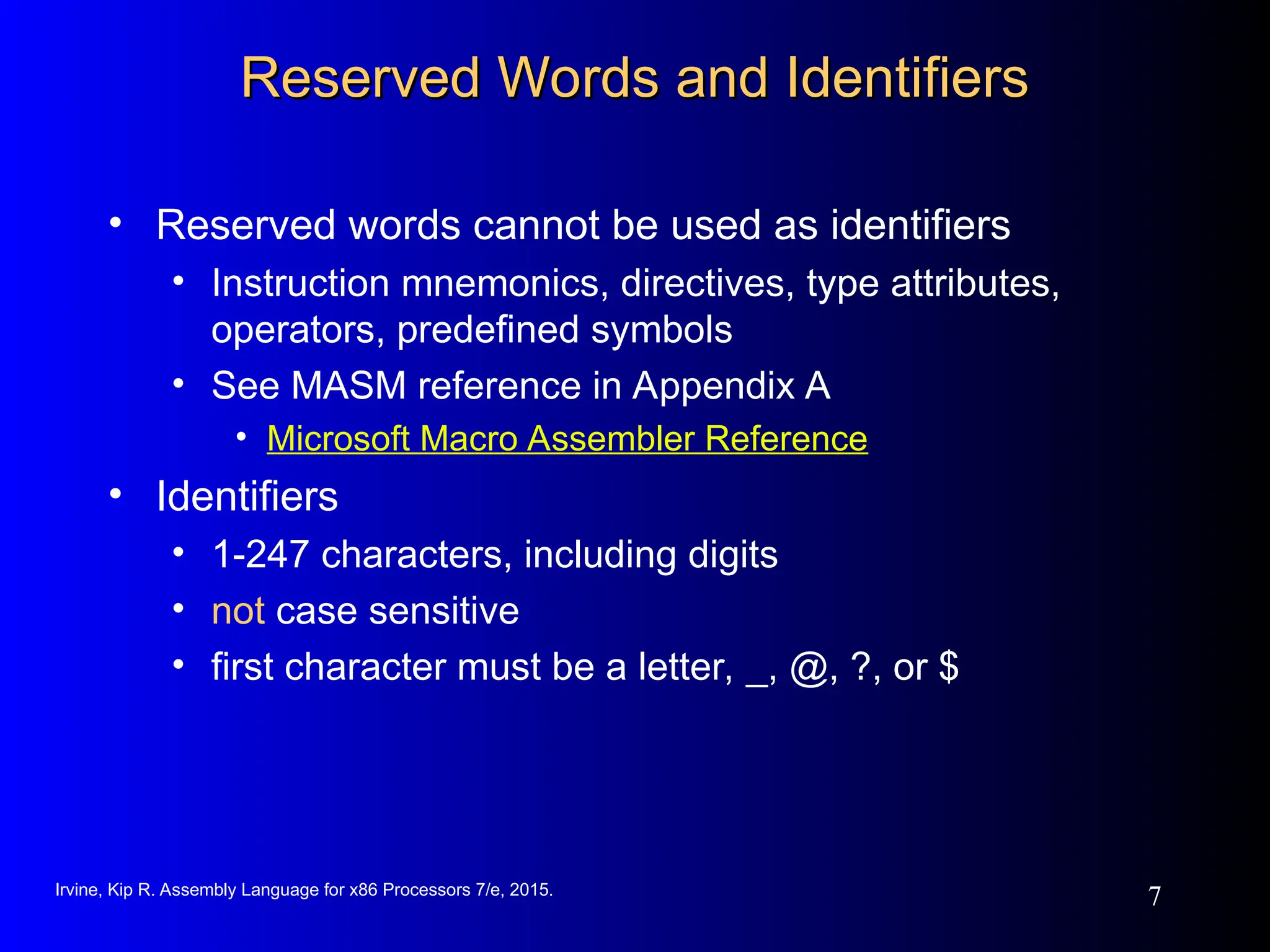
Reserved Words and Identifiers
• Reserved words cannot be used as identifiers
• Instruction mnemonics, directives, type attributes,
operators, predefined symbols
• See MASM reference in Appendix A
• Microsoft Macro Assembler Reference
• Identifiers
• 1-247 characters, including digits
• not case sensitive
• first character must be a letter, _, @, ?, or $
Irvine, Kip R. Assembly Language for x86 Processors 7/e, 2015.
8
Directives
Directives
• Commands that are recognized and acted
upon by the assembler
• Not part of the Intel instruction set
• Used to declare code, data areas, select
memory model, declare procedures, etc.
• not case sensitive
• Different assemblers have different directives
• NASM not the same as MASM, for example
Irvine, Kip R. Assembly Language for x86 Processors 6/e, 2010.
9
Instructions
Instructions
• Assembled into machine code by assembler
• Executed at runtime by the CPU
• We use the Intel IA-32 instruction set
• An instruction contains:
• Label (optional)
• Mnemonic (required)
• Operand (depends on the instruction)
• Comment (optional)
[Label:] Mnemonic Operand(s) [; Comment]
Irvine, Kip R. Assembly Language for x86 Processors 7/e, 2015.
10
Labels
Labels
• Act as place markers
• marks the address (offset) of code and data
• Follow identifer rules
• Data label
• must be unique
• example: myArray (not followed by colon)
• Code label
• target of jump and loop instructions
• example: L1: (followed by colon)
Irvine, Kip R. Assembly Language for x86 Processors 7/e, 2015.
11
Mnemonics and Operands
• Instruction Mnemonics
• memory aid
• examples: MOV, ADD, SUB, MUL, INC, DEC
• Operands
• constant
• constant expression
• register
• memory (data label)
Constants and constant expressions are often called
immediate values
Irvine, Kip R. Assembly Language for x86 Processors 6/e, 2010.
12
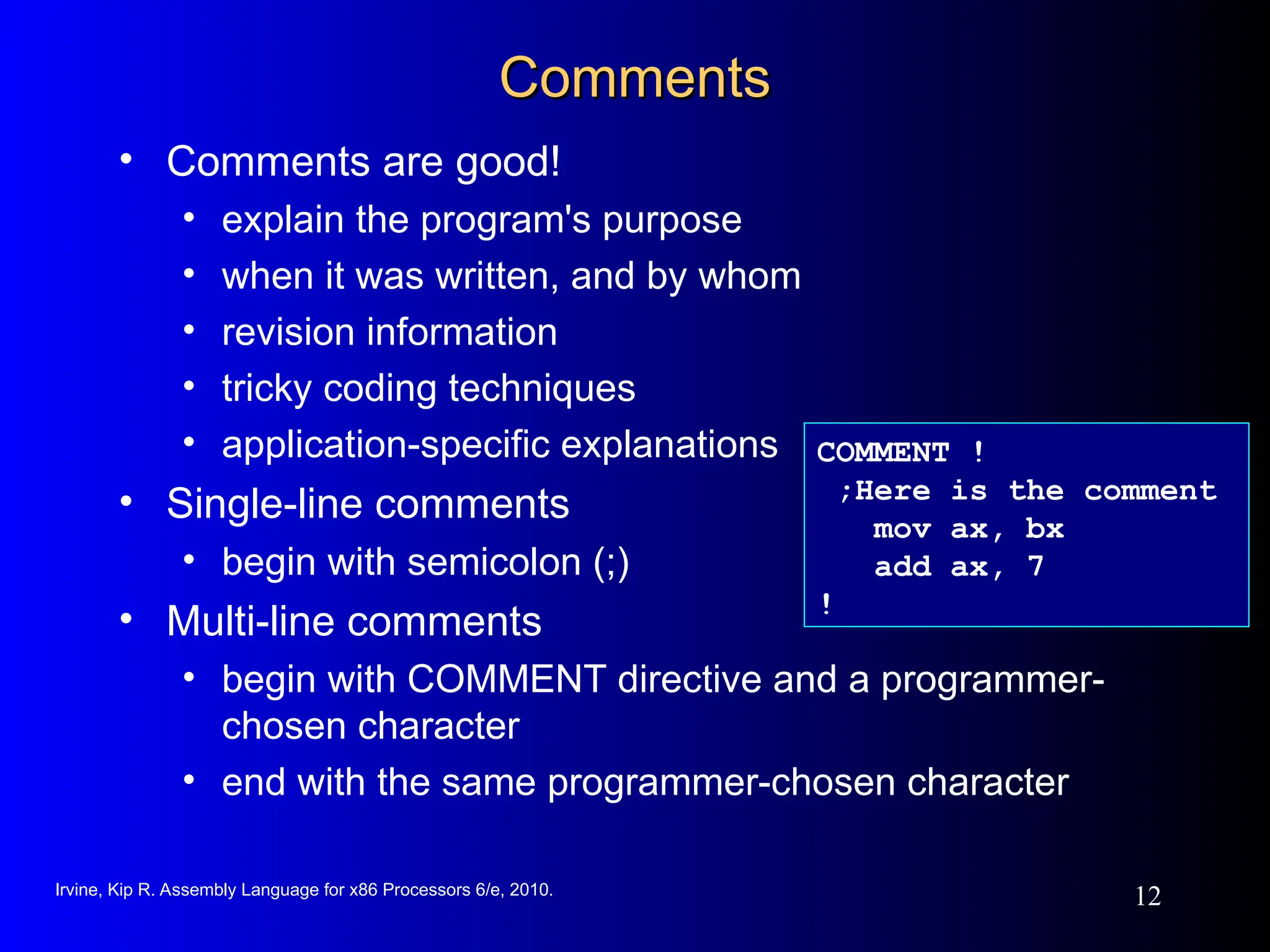
Comments
Comments
• Comments are good!
• explain the program's purpose
• when it was written, and by whom
• revision information
• tricky coding techniques
• application-specific explanations
• Single-line comments
• begin with semicolon (;)
• Multi-line comments
• begin with COMMENT directive and a programmer-
chosen character
• end with the same programmer-chosen character
;Here is the comment
mov ax, bx
add ax, 7
COMMENT !
;Here is the comment
mov ax, bx
add ax, 7
!
Irvine, Kip R. Assembly Language for x86 Processors 7/e, 2015.
13
Instruction Format Examples
• No operands
• stc ; set Carry flag
• One operand
• inc eax ; register
• inc myByte ; memory
• Two operands
• add ebx,ecx ; register, register
• sub myByte,25 ; memory, constant
• add eax,36 * 25 ; register, constant-
expression
Irvine, Kip R. Assembly Language for x86 Processors 7/e, 2015.
14
What's Next
What's Next
• Basic Elements of Assembly Language
• Example: Adding and Subtracting Integers
• Assembling, Linking, and Running Programs
• Defining Data
• Symbolic Constants
• 64-Bit Programming
Irvine, Kip R. Assembly Language for x86 Processors 7/e, 2015.
15
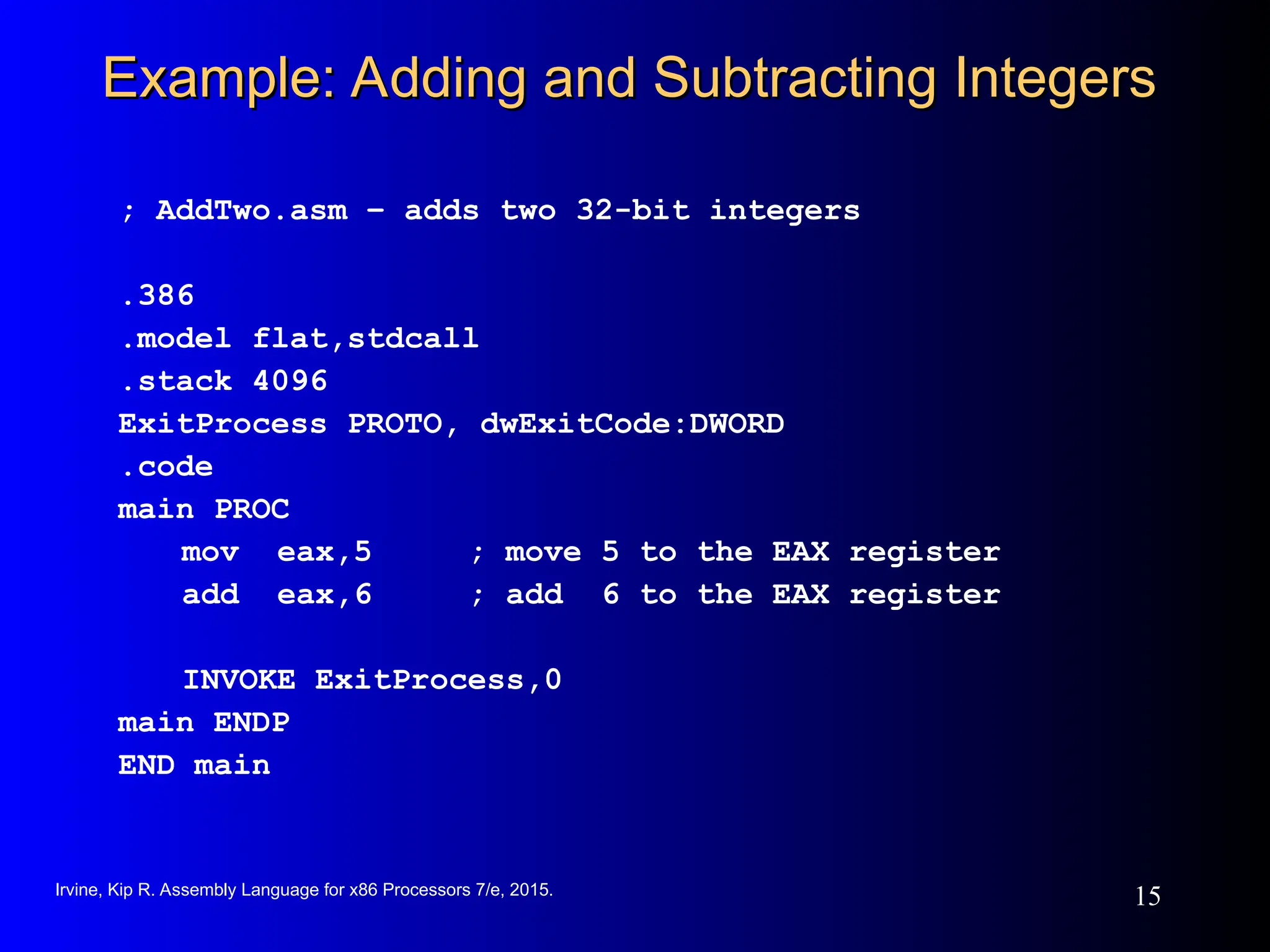
Example: Adding and Subtracting Integers
; AddTwo.asm – adds two 32-bit integers
.386
.model flat,stdcall
.stack 4096
ExitProcess PROTO, dwExitCode:DWORD
.code
main PROC
mov eax,5 ; move 5 to the EAX register
add eax,6 ; add 6 to the EAX register
INVOKE ExitProcess,0
main ENDP
END main
Irvine, Kip R. Assembly Language for x86 Processors 7/e, 2015.
16
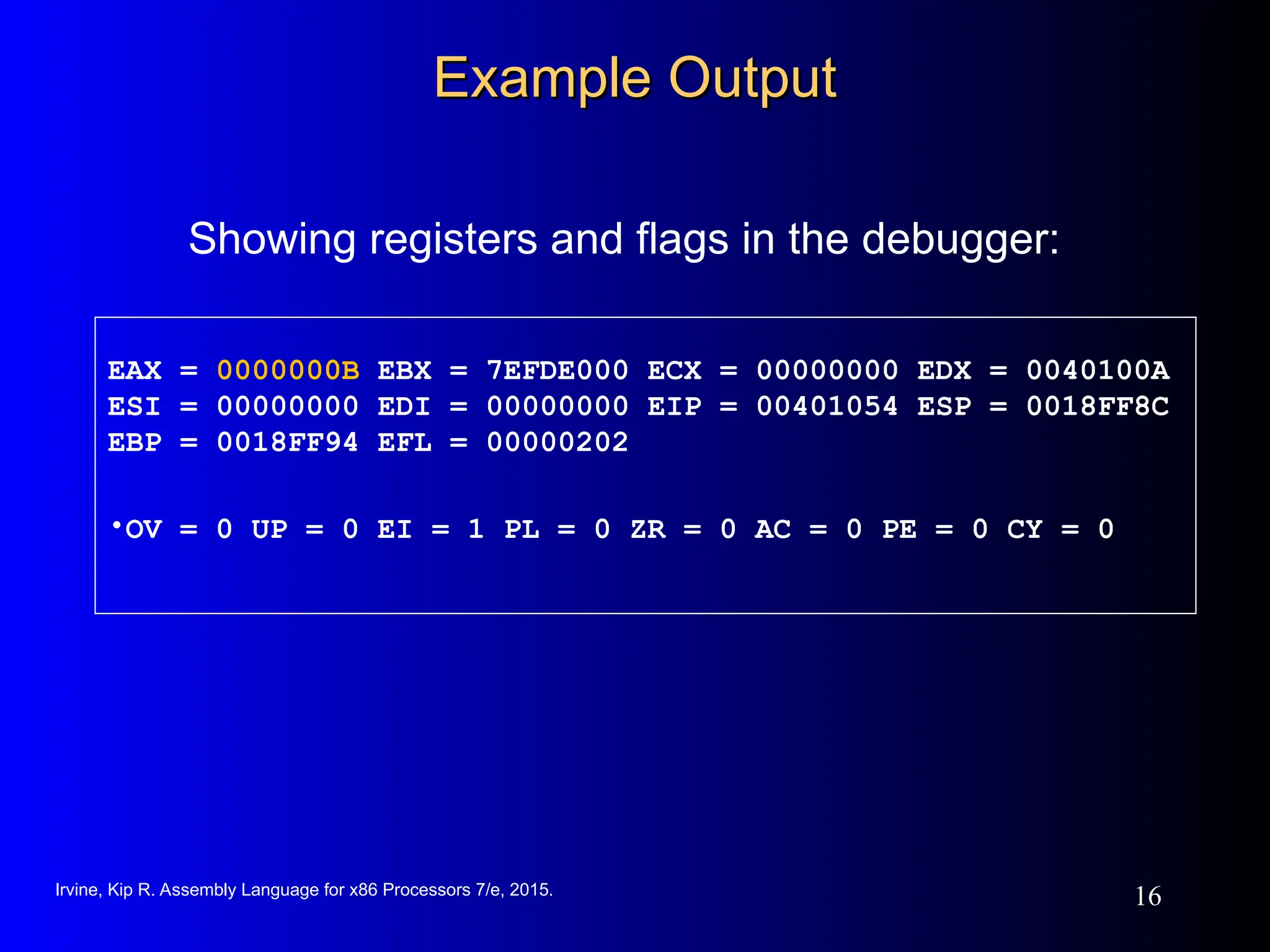
Example Output
Example Output
Showing registers and flags in the debugger:
EAX = 0000000B EBX = 7EFDE000 ECX = 00000000 EDX = 0040100A
ESI = 00000000 EDI = 00000000 EIP = 00401054 ESP = 0018FF8C
EBP = 0018FF94 EFL = 00000202
•OV = 0 UP = 0 EI = 1 PL = 0 ZR = 0 AC = 0 PE = 0 CY = 0
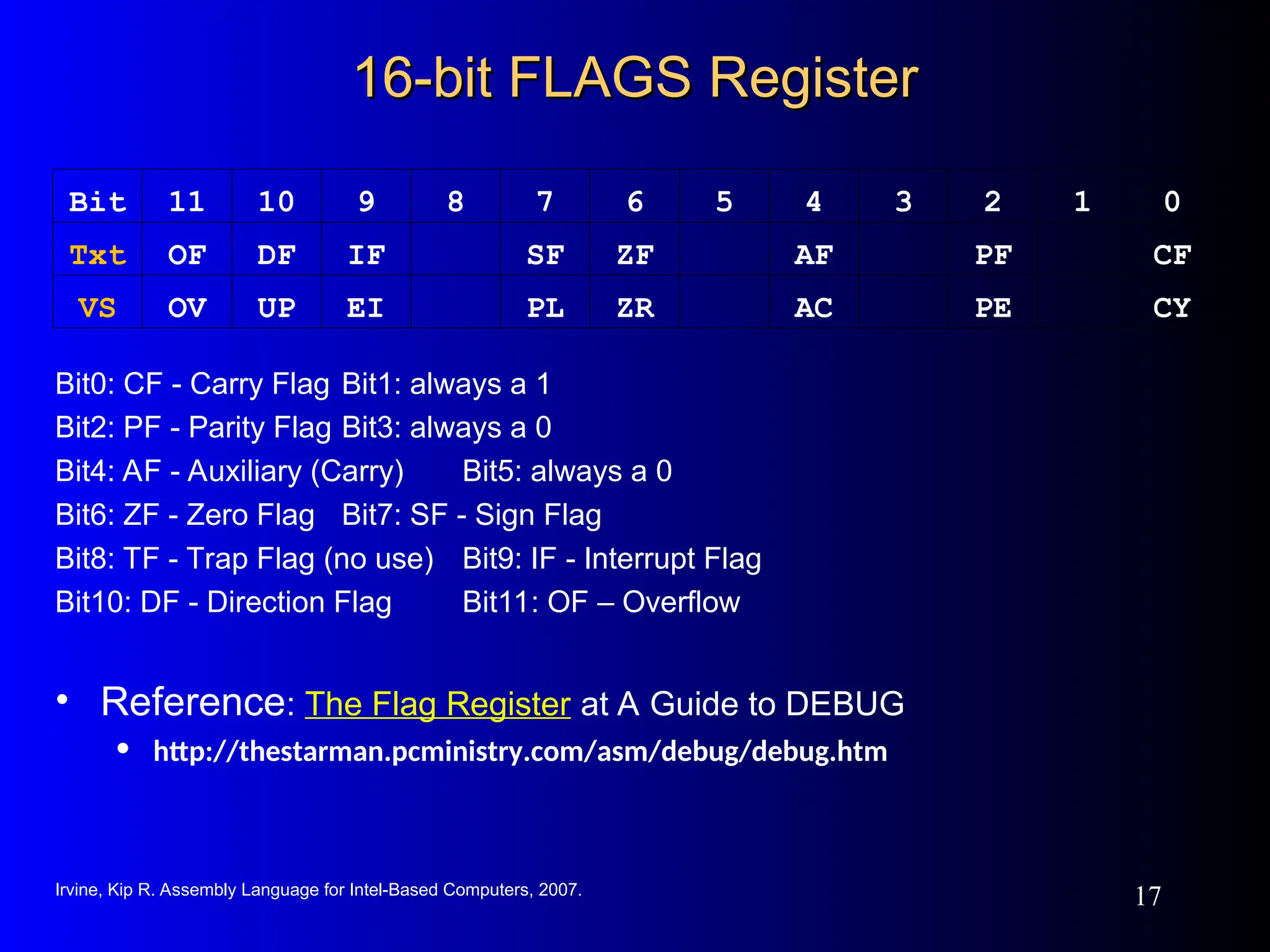
16-bit FLAGS Register
Bit0: CF - Carry Flag Bit1: always a 1
Bit2: PF - Parity Flag Bit3: always a 0
Bit4: AF - Auxiliary (Carry) Bit5: always a 0
Bit6: ZF - Zero Flag Bit7: SF - Sign Flag
Bit8: TF - Trap Flag (no use) Bit9: IF - Interrupt Flag
Bit10: DF - Direction Flag Bit11: OF – Overflow
• Reference: The Flag Register at A Guide to DEBUG
• http://thestarman.pcministry.com/asm/debug/debug.htm
Irvine, Kip R. Assembly Language for Intel-Based Computers, 2007.
17
Bit 11 10 9 8 7 6 5 4 3 2 1 0
Txt OF DF IF SF ZF AF PF CF
VS OV UP EI PL ZR AC PE CY
Irvine, Kip R. Assembly Language for x86 Processors 7/e, 2015.
18
What's Next
What's Next
• Basic Elements of Assembly Language
• Example: Adding and Subtracting Integers
• Assembling, Linking, and Running Programs
• Defining Data
• Symbolic Constants
• 64-Bit Programming
Irvine, Kip R. Assembly Language for x86 Processors 7/e, 2015.
19
Assembling, Linking, and Running Programs
• Assemble-Link-Execute Cycle
• Listing File
• Map File
Irvine, Kip R. Assembly Language for x86 Processors 6/e, 2010.
20
Assemble-Link Execute Cycle
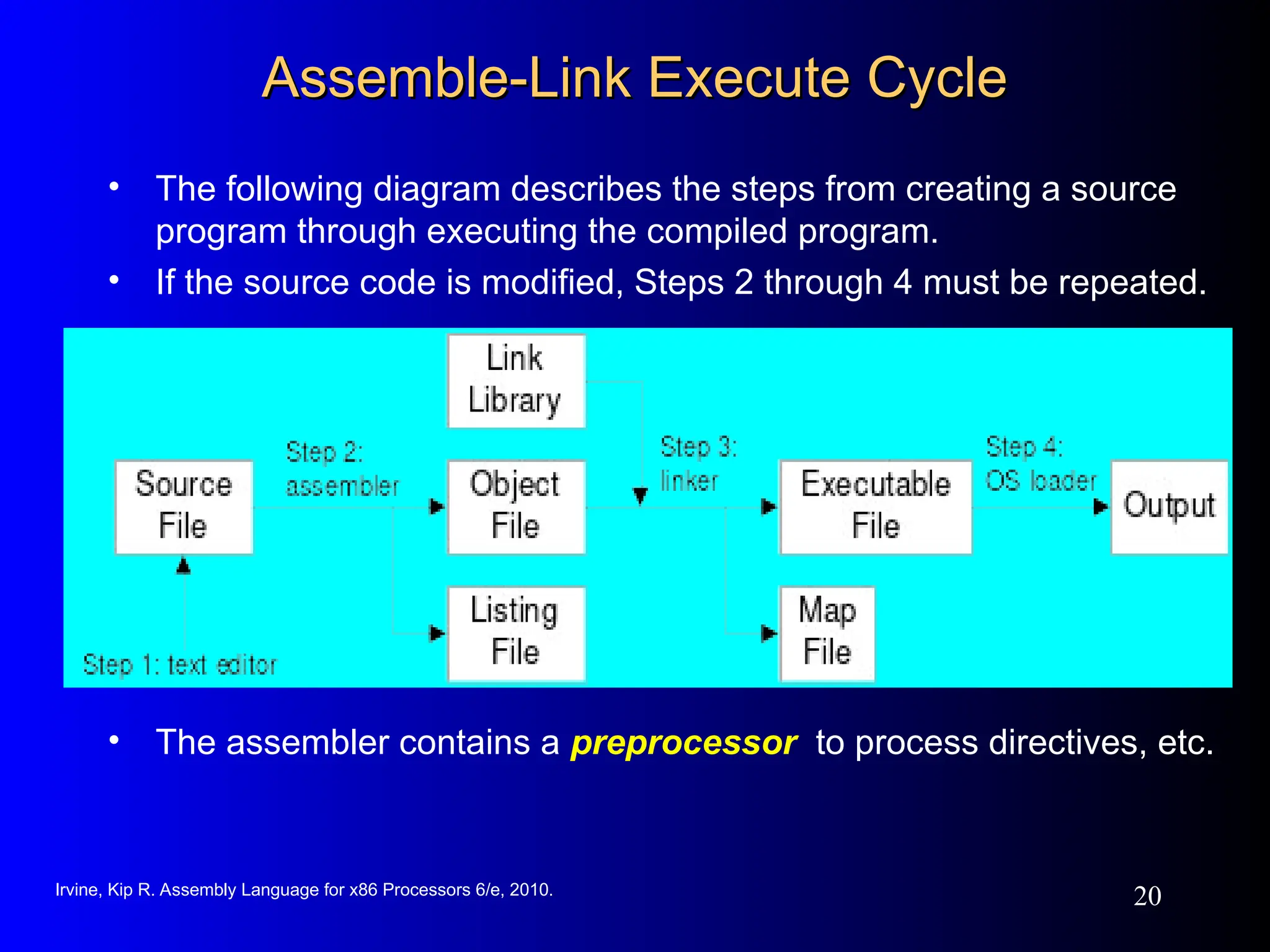
• The following diagram describes the steps from creating a source
program through executing the compiled program.
• If the source code is modified, Steps 2 through 4 must be repeated.
• The assembler contains a preprocessor to process directives, etc.
Irvine, Kip R. Assembly Language for x86 Processors 6/e, 2010.
21
Listing File
Listing File
• Use it to see how your program is compiled
• Contains
• source code
• addresses
• object code (machine language)
• segment names
• symbols (variables, procedures, and constants)
• Example: addSub.lst
Irvine, Kip R. Assembly Language for x86 Processors 6/e, 2010.
22
Map File
Map File
• Information about each program segment:
• starting address
• ending address
• size
• segment type
• Example: addSub.map (16-bit version)
Irvine, Kip R. Assembly Language for x86 Processors 7/e, 2015.
23
What's Next
What's Next
• Basic Elements of Assembly Language
• Example: Adding and Subtracting Integers
• Assembling, Linking, and Running Programs
• Defining Data
• Symbolic Constants
• 64-Bit Programming
Irvine, Kip R. Assembly Language for x86 Processors 7/e, 2015.
24
Defining Data
Defining Data
• Intrinsic Data Types
• Data Definition Statement
• Defining BYTE and SBYTE Data
• Defining WORD and SWORD Data
• Defining DWORD and SDWORD Data
• Defining QWORD Data
• Defining TBYTE Data
• Defining Real Number Data
• Little Endian Order
• Adding Variables to the AddSub Program
• Declaring Uninitialized Data
Irvine, Kip R. Assembly Language for x86 Processors 7/e, 2015.
25
Intrinsic Data Types
Intrinsic Data Types (1 of 2)
(1 of 2)
• BYTE, SBYTE
• 8-bit unsigned integer; 8-bit signed integer
• WORD, SWORD
• 16-bit unsigned & signed integer
• DWORD, SDWORD
• 32-bit unsigned & signed integer
• QWORD
• 64-bit integer
• TBYTE
• 80-bit integer
Irvine, Kip R. Assembly Language for x86 Processors 7/e, 2015.
26
Intrinsic Data Types
Intrinsic Data Types (2 of 2)
(2 of 2)
• REAL4
• 4-byte IEEE short real
• REAL8
• 8-byte IEEE long real
• REAL10
• 10-byte IEEE extended real
Irvine, Kip R. Assembly Language for x86 Processors 7/e, 2015.
27
Data Definition Statement
• A data definition statement sets aside storage in memory for a
variable.
• May optionally assign a name (label) to the data
• Syntax:
[name] directive initializer [,initializer] . . .
value1 BYTE 10
• All initializers become binary data in memory
Irvine, Kip R. Assembly Language for x86 Processors 7/e, 2015.
28
Defining BYTE and SBYTE Data
value1 BYTE 'A' ; character constant
value2 BYTE 0 ; smallest unsigned byte
value3 BYTE 255 ; largest unsigned byte
value4 SBYTE -128 ; smallest signed byte
value5 SBYTE +127 ; largest signed byte
value6 BYTE ? ; uninitialized byte
Each of the following defines a single byte of storage:
• MASM does not prevent you from initializing a BYTE with a
negative value, but it's considered poor style.
• If you declare a SBYTE variable, the Microsoft debugger will
automatically display its value in decimal with a leading sign.
Irvine, Kip R. Assembly Language for x86 Processors 7/e, 2015.
29
Defining Byte Arrays
list1 BYTE 10,20,30,40
list2 BYTE 10,20,30,40
BYTE 50,60,70,80
BYTE 81,82,83,84
list3 BYTE ?,32,41h,00100010b
list4 BYTE 0Ah,20h,‘A’,22h
Examples that use multiple initializers:
Irvine, Kip R. Assembly Language for x86 Processors 7/e, 2015.
30
Defining Strings
Defining Strings (1 of 3)
(1 of 3)
• A string is implemented as an array of characters
• For convenience, it is usually enclosed in quotation marks
• It often will be null-terminated
• Examples:
str1 BYTE "Enter your name",0
str2 BYTE 'Error: halting program',0
str3 BYTE 'A','E','I','O','U'
greeting BYTE "Welcome to the Encryption Demo program "
BYTE "created by Kip Irvine.",0

chap3lec5.pptgfhgfhghghgfhgfhgfhfghgfhfg

  • 1.
    Assembly Language forx86 Processors Assembly Language for x86 Processors 7th Edition 7th Edition Chapter 3: Assembly Language Fundamentals Kip Irvine
  • 2.
    Irvine, Kip R.Assembly Language for x86 Processors 7/e, 2015. 2 Chapter Overview Chapter Overview • Basic Elements of Assembly Language • Example: Adding and Subtracting Integers • Assembling, Linking, and Running Programs • Defining Data • Symbolic Constants • 64-Bit Programming
  • 3.
    Irvine, Kip R.Assembly Language for x86 Processors 7/e, 2015. 3 Basic Elements of Assembly Language Basic Elements of Assembly Language • Integer constants • Integer expressions • Character and string constants • Reserved words and identifiers • Directives and instructions • Labels • Mnemonics and Operands • Comments • Examples
  • 4.
    Irvine, Kip R.Assembly Language for x86 Processors 7/e, 2015. 4 Integer Constants Integer Constants • Optional leading + or – sign • binary, decimal, hexadecimal, or octal digits • Common radix characters: • h – hexadecimal • d – decimal • b – binary • r – encoded real Examples: 30d, 6Ah, 42, 1101b Hexadecimal beginning with letter: 0A5h
  • 5.
    Irvine, Kip R.Assembly Language for x86 Processors 7/e, 2015. 5 Integer Expressions Integer Expressions • Operators and precedence levels: • Examples:
  • 6.
    Irvine, Kip R.Assembly Language for x86 Processors 7/e, 2015. 6 Character and String Constants Character and String Constants • Enclose character in single or double quotes • 'A', "x" • ASCII character = 1 byte • Enclose strings in single or double quotes • "ABC" • 'xyz' • Each character occupies a single byte • Embedded quotes: • 'Say "Goodnight," Gracie'
  • 7.
    Irvine, Kip R.Assembly Language for x86 Processors 7/e, 2015. 7 Reserved Words and Identifiers Reserved Words and Identifiers • Reserved words cannot be used as identifiers • Instruction mnemonics, directives, type attributes, operators, predefined symbols • See MASM reference in Appendix A • Microsoft Macro Assembler Reference • Identifiers • 1-247 characters, including digits • not case sensitive • first character must be a letter, _, @, ?, or $
  • 8.
    Irvine, Kip R.Assembly Language for x86 Processors 7/e, 2015. 8 Directives Directives • Commands that are recognized and acted upon by the assembler • Not part of the Intel instruction set • Used to declare code, data areas, select memory model, declare procedures, etc. • not case sensitive • Different assemblers have different directives • NASM not the same as MASM, for example
  • 9.
    Irvine, Kip R.Assembly Language for x86 Processors 6/e, 2010. 9 Instructions Instructions • Assembled into machine code by assembler • Executed at runtime by the CPU • We use the Intel IA-32 instruction set • An instruction contains: • Label (optional) • Mnemonic (required) • Operand (depends on the instruction) • Comment (optional) [Label:] Mnemonic Operand(s) [; Comment]
  • 10.
    Irvine, Kip R.Assembly Language for x86 Processors 7/e, 2015. 10 Labels Labels • Act as place markers • marks the address (offset) of code and data • Follow identifer rules • Data label • must be unique • example: myArray (not followed by colon) • Code label • target of jump and loop instructions • example: L1: (followed by colon)
  • 11.
    Irvine, Kip R.Assembly Language for x86 Processors 7/e, 2015. 11 Mnemonics and Operands Mnemonics and Operands • Instruction Mnemonics • memory aid • examples: MOV, ADD, SUB, MUL, INC, DEC • Operands • constant • constant expression • register • memory (data label) Constants and constant expressions are often called immediate values
  • 12.
    Irvine, Kip R.Assembly Language for x86 Processors 6/e, 2010. 12 Comments Comments • Comments are good! • explain the program's purpose • when it was written, and by whom • revision information • tricky coding techniques • application-specific explanations • Single-line comments • begin with semicolon (;) • Multi-line comments • begin with COMMENT directive and a programmer- chosen character • end with the same programmer-chosen character ;Here is the comment mov ax, bx add ax, 7 COMMENT ! ;Here is the comment mov ax, bx add ax, 7 !
  • 13.
    Irvine, Kip R.Assembly Language for x86 Processors 7/e, 2015. 13 Instruction Format Examples Instruction Format Examples • No operands • stc ; set Carry flag • One operand • inc eax ; register • inc myByte ; memory • Two operands • add ebx,ecx ; register, register • sub myByte,25 ; memory, constant • add eax,36 * 25 ; register, constant- expression
  • 14.
    Irvine, Kip R.Assembly Language for x86 Processors 7/e, 2015. 14 What's Next What's Next • Basic Elements of Assembly Language • Example: Adding and Subtracting Integers • Assembling, Linking, and Running Programs • Defining Data • Symbolic Constants • 64-Bit Programming
  • 15.
    Irvine, Kip R.Assembly Language for x86 Processors 7/e, 2015. 15 Example: Adding and Subtracting Integers Example: Adding and Subtracting Integers ; AddTwo.asm – adds two 32-bit integers .386 .model flat,stdcall .stack 4096 ExitProcess PROTO, dwExitCode:DWORD .code main PROC mov eax,5 ; move 5 to the EAX register add eax,6 ; add 6 to the EAX register INVOKE ExitProcess,0 main ENDP END main
  • 16.
    Irvine, Kip R.Assembly Language for x86 Processors 7/e, 2015. 16 Example Output Example Output Showing registers and flags in the debugger: EAX = 0000000B EBX = 7EFDE000 ECX = 00000000 EDX = 0040100A ESI = 00000000 EDI = 00000000 EIP = 00401054 ESP = 0018FF8C EBP = 0018FF94 EFL = 00000202 •OV = 0 UP = 0 EI = 1 PL = 0 ZR = 0 AC = 0 PE = 0 CY = 0
  • 17.
    16-bit FLAGS Register 16-bitFLAGS Register Bit0: CF - Carry Flag Bit1: always a 1 Bit2: PF - Parity Flag Bit3: always a 0 Bit4: AF - Auxiliary (Carry) Bit5: always a 0 Bit6: ZF - Zero Flag Bit7: SF - Sign Flag Bit8: TF - Trap Flag (no use) Bit9: IF - Interrupt Flag Bit10: DF - Direction Flag Bit11: OF – Overflow • Reference: The Flag Register at A Guide to DEBUG • http://thestarman.pcministry.com/asm/debug/debug.htm Irvine, Kip R. Assembly Language for Intel-Based Computers, 2007. 17 Bit 11 10 9 8 7 6 5 4 3 2 1 0 Txt OF DF IF SF ZF AF PF CF VS OV UP EI PL ZR AC PE CY
  • 18.
    Irvine, Kip R.Assembly Language for x86 Processors 7/e, 2015. 18 What's Next What's Next • Basic Elements of Assembly Language • Example: Adding and Subtracting Integers • Assembling, Linking, and Running Programs • Defining Data • Symbolic Constants • 64-Bit Programming
  • 19.
    Irvine, Kip R.Assembly Language for x86 Processors 7/e, 2015. 19 Assembling, Linking, and Running Programs Assembling, Linking, and Running Programs • Assemble-Link-Execute Cycle • Listing File • Map File
  • 20.
    Irvine, Kip R.Assembly Language for x86 Processors 6/e, 2010. 20 Assemble-Link Execute Cycle Assemble-Link Execute Cycle • The following diagram describes the steps from creating a source program through executing the compiled program. • If the source code is modified, Steps 2 through 4 must be repeated. • The assembler contains a preprocessor to process directives, etc.
  • 21.
    Irvine, Kip R.Assembly Language for x86 Processors 6/e, 2010. 21 Listing File Listing File • Use it to see how your program is compiled • Contains • source code • addresses • object code (machine language) • segment names • symbols (variables, procedures, and constants) • Example: addSub.lst
  • 22.
    Irvine, Kip R.Assembly Language for x86 Processors 6/e, 2010. 22 Map File Map File • Information about each program segment: • starting address • ending address • size • segment type • Example: addSub.map (16-bit version)
  • 23.
    Irvine, Kip R.Assembly Language for x86 Processors 7/e, 2015. 23 What's Next What's Next • Basic Elements of Assembly Language • Example: Adding and Subtracting Integers • Assembling, Linking, and Running Programs • Defining Data • Symbolic Constants • 64-Bit Programming
  • 24.
    Irvine, Kip R.Assembly Language for x86 Processors 7/e, 2015. 24 Defining Data Defining Data • Intrinsic Data Types • Data Definition Statement • Defining BYTE and SBYTE Data • Defining WORD and SWORD Data • Defining DWORD and SDWORD Data • Defining QWORD Data • Defining TBYTE Data • Defining Real Number Data • Little Endian Order • Adding Variables to the AddSub Program • Declaring Uninitialized Data
  • 25.
    Irvine, Kip R.Assembly Language for x86 Processors 7/e, 2015. 25 Intrinsic Data Types Intrinsic Data Types (1 of 2) (1 of 2) • BYTE, SBYTE • 8-bit unsigned integer; 8-bit signed integer • WORD, SWORD • 16-bit unsigned & signed integer • DWORD, SDWORD • 32-bit unsigned & signed integer • QWORD • 64-bit integer • TBYTE • 80-bit integer
  • 26.
    Irvine, Kip R.Assembly Language for x86 Processors 7/e, 2015. 26 Intrinsic Data Types Intrinsic Data Types (2 of 2) (2 of 2) • REAL4 • 4-byte IEEE short real • REAL8 • 8-byte IEEE long real • REAL10 • 10-byte IEEE extended real
  • 27.
    Irvine, Kip R.Assembly Language for x86 Processors 7/e, 2015. 27 Data Definition Statement Data Definition Statement • A data definition statement sets aside storage in memory for a variable. • May optionally assign a name (label) to the data • Syntax: [name] directive initializer [,initializer] . . . value1 BYTE 10 • All initializers become binary data in memory
  • 28.
    Irvine, Kip R.Assembly Language for x86 Processors 7/e, 2015. 28 Defining BYTE and SBYTE Data Defining BYTE and SBYTE Data value1 BYTE 'A' ; character constant value2 BYTE 0 ; smallest unsigned byte value3 BYTE 255 ; largest unsigned byte value4 SBYTE -128 ; smallest signed byte value5 SBYTE +127 ; largest signed byte value6 BYTE ? ; uninitialized byte Each of the following defines a single byte of storage: • MASM does not prevent you from initializing a BYTE with a negative value, but it's considered poor style. • If you declare a SBYTE variable, the Microsoft debugger will automatically display its value in decimal with a leading sign.
  • 29.
    Irvine, Kip R.Assembly Language for x86 Processors 7/e, 2015. 29 Defining Byte Arrays Defining Byte Arrays list1 BYTE 10,20,30,40 list2 BYTE 10,20,30,40 BYTE 50,60,70,80 BYTE 81,82,83,84 list3 BYTE ?,32,41h,00100010b list4 BYTE 0Ah,20h,‘A’,22h Examples that use multiple initializers:
  • 30.
    Irvine, Kip R.Assembly Language for x86 Processors 7/e, 2015. 30 Defining Strings Defining Strings (1 of 3) (1 of 3) • A string is implemented as an array of characters • For convenience, it is usually enclosed in quotation marks • It often will be null-terminated • Examples: str1 BYTE "Enter your name",0 str2 BYTE 'Error: halting program',0 str3 BYTE 'A','E','I','O','U' greeting BYTE "Welcome to the Encryption Demo program " BYTE "created by Kip Irvine.",0