Sustaining Organizational Change
Promoting effectiveness on all levels
Daryl Rother
Agenda
Cultivate self-efficacy for personal & organizational effectiveness.
Foster effectiveness by fulfilling leadership functions.
Discussion of what we have observed.
Individuals
Sustain organizational performance through continuous learning.
Teams
Organization
Questions
Self Efficacy
• When faced with obstacles, setbacks, or failures, those with
doubt slacken their efforts.
• Increasing job control without raising self-efficacy to manage
increased responsibilities proves to do more harm than good.
• Managers must create enactive mastery
experiences. (Learn through failure.)
• Create a culture of social modeling and
persuasion.
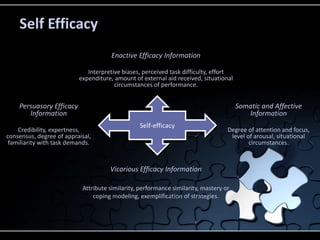
Self Efficacy
Self-efficacy
Enactive Efficacy Information
Interpretive biases, perceived task difficulty, effort
expenditure, amount of external aid received, situational
circumstances of performance.
Persuasory Efficacy
Information
Credibility, expertness,
consensus, degree of appraisal,
familiarity with task demands.
Somatic and Affective
Information
Degree of attention and focus,
level of arousal, situational
circumstances.
Vicarious Efficacy Information
Attribute similarity, performance similarity, mastery or
coping modeling, exemplification of strategies.
TRADITIONAL LEADERSHIP
• Head coach
• Conductor of an orchestra
• Captain of an airline
Leader Attribution Error
In an organization, there is no
learning when a leader is replaced.
• Enabled teams
• Compelling direction
• Challenging yet clear objectives
Everyone Can Exhibit Leadership
EFFECTIVE TEAM LEADERSHIP
Leadership as a Team
Effective team leadership ensures that the
functions most critical for achieving team
purposes are identified and fulfilled.
• Decide whether a team is appropriate for the work.
• Some work is better performed by individuals.
• Never form a team that is a team in name only.
• Decide what type of team to create.
• Is the group responsible, or an
assigned leader?
• Work in real time, or
distributed?
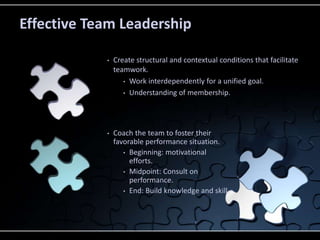
Effective Team Leadership
• Create structural and contextual conditions that facilitate
teamwork.
• Work interdependently for a unified goal.
• Understanding of membership.
• Coach the team to foster their
favorable performance situation.
• Beginning: motivational
efforts.
• Midpoint: Consult on
performance.
• End: Build knowledge and skill.
Effective Team Leadership
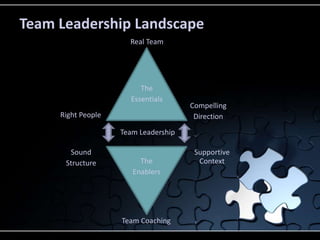
Right People
Team Leadership Landscape
Real Team
Compelling
Direction
Supportive
Context
Team Coaching
Sound
Structure The
Enablers
The
Essentials
Team Leadership
Organizational Behavior
• Organizational behavior is by
nature resistant to change.
• Humans employ emotional and
cognitive processes to defend
against perceived threats.
• Leadership can help by providing
inclusion with
change.
• COORDINATION
between functions
both internal and
customer facing.
• COMMITMENT to org.
and customer needs.
• COMPETENCE in the
activities critical to
success.
• CONVERSATIONS that
are honest no matter
how difficult.
• CREATIVITY and
innovation both
technical and
administrative.
Organizational Change
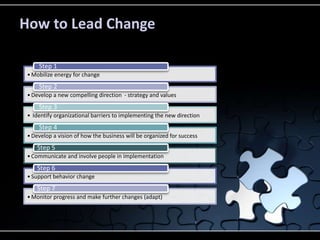
•Mobilize energy for change
Step 1
•Develop a new compelling direction - strategy and values
Step 2
• Identify organizational barriers to implementing the new direction
Step 3
•Develop a vision of how the business will be organized for success
Step 4
•Communicate and involve people in implementation
Step 5
•Support behavior change
Step 6
•Monitor progress and make further changes (adapt)
Step 7
How to Lead Change
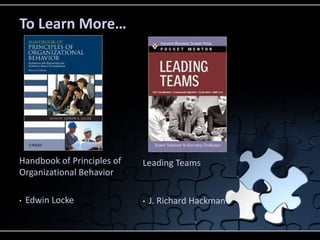
To Learn More…
Handbook of Principles of
Organizational Behavior
• Edwin Locke
Leading Teams
• J. Richard Hackman
Thank You!
Let’s discuss what we have learned.
Daryl Rother

Sustaining Organizational Change

  • 1.
    Sustaining Organizational Change Promotingeffectiveness on all levels Daryl Rother
  • 2.
    Agenda Cultivate self-efficacy forpersonal & organizational effectiveness. Foster effectiveness by fulfilling leadership functions. Discussion of what we have observed. Individuals Sustain organizational performance through continuous learning. Teams Organization Questions
  • 3.
    Self Efficacy • Whenfaced with obstacles, setbacks, or failures, those with doubt slacken their efforts. • Increasing job control without raising self-efficacy to manage increased responsibilities proves to do more harm than good. • Managers must create enactive mastery experiences. (Learn through failure.) • Create a culture of social modeling and persuasion.
  • 4.
    Self Efficacy Self-efficacy Enactive EfficacyInformation Interpretive biases, perceived task difficulty, effort expenditure, amount of external aid received, situational circumstances of performance. Persuasory Efficacy Information Credibility, expertness, consensus, degree of appraisal, familiarity with task demands. Somatic and Affective Information Degree of attention and focus, level of arousal, situational circumstances. Vicarious Efficacy Information Attribute similarity, performance similarity, mastery or coping modeling, exemplification of strategies.
  • 5.
    TRADITIONAL LEADERSHIP • Headcoach • Conductor of an orchestra • Captain of an airline Leader Attribution Error In an organization, there is no learning when a leader is replaced. • Enabled teams • Compelling direction • Challenging yet clear objectives Everyone Can Exhibit Leadership EFFECTIVE TEAM LEADERSHIP Leadership as a Team Effective team leadership ensures that the functions most critical for achieving team purposes are identified and fulfilled.
  • 6.
    • Decide whethera team is appropriate for the work. • Some work is better performed by individuals. • Never form a team that is a team in name only. • Decide what type of team to create. • Is the group responsible, or an assigned leader? • Work in real time, or distributed? Effective Team Leadership
  • 7.
    • Create structuraland contextual conditions that facilitate teamwork. • Work interdependently for a unified goal. • Understanding of membership. • Coach the team to foster their favorable performance situation. • Beginning: motivational efforts. • Midpoint: Consult on performance. • End: Build knowledge and skill. Effective Team Leadership
  • 8.
    Right People Team LeadershipLandscape Real Team Compelling Direction Supportive Context Team Coaching Sound Structure The Enablers The Essentials Team Leadership
  • 9.
    Organizational Behavior • Organizationalbehavior is by nature resistant to change. • Humans employ emotional and cognitive processes to defend against perceived threats. • Leadership can help by providing inclusion with change.
  • 10.
    • COORDINATION between functions bothinternal and customer facing. • COMMITMENT to org. and customer needs. • COMPETENCE in the activities critical to success. • CONVERSATIONS that are honest no matter how difficult. • CREATIVITY and innovation both technical and administrative. Organizational Change
  • 11.
    •Mobilize energy forchange Step 1 •Develop a new compelling direction - strategy and values Step 2 • Identify organizational barriers to implementing the new direction Step 3 •Develop a vision of how the business will be organized for success Step 4 •Communicate and involve people in implementation Step 5 •Support behavior change Step 6 •Monitor progress and make further changes (adapt) Step 7 How to Lead Change
  • 12.
    To Learn More… Handbookof Principles of Organizational Behavior • Edwin Locke Leading Teams • J. Richard Hackman
  • 13.
    Thank You! Let’s discusswhat we have learned. Daryl Rother