Evaluation
India-Rain Harrison
Research
Within my research for my video game I chose a series of 4 games similar to the game we
chose to analyse within our Case Study and researched them to find similarities and differences
within them and my Case Study. This helped with my research for my final game product as the
games I chose were all similar to what I wanted to create myself. Each of the 4 games held
similarities i.e. the way they were all based on some form of storyline and most used an
overhead approach when played. Each game when played is usually assisted with a storyline to
help with game play which is how I wanted to create my game. In order to help with research we
also asked a series of questions to two different audience members to help with what sort of
game our targeted audience would like us to create .The strengths of my work was probably the
games I research and the audience interviews we conducted before production. I found that the
two audience members that answered the questions I wrote preferred games with a storyline
approach as it helped them with game play, hence why I decided to create a storyline based
game.
The weaknesses within my research is mainly that I only chose games with a storyline. I wish I
branched out and chose different games with different styles and themes. Some of the games I
chose to analyse are very similar and I wish I chose a game that was a little different from the
rest.
Research
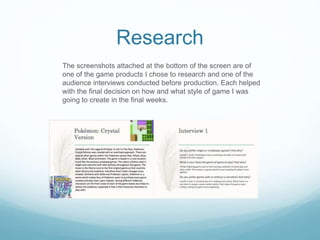
The screenshots attached at the bottom of the screen are of
one of the game products I chose to research and one of the
audience interviews conducted before production. Each helped
with the final decision on how and what style of game I was
going to create in the final weeks.
Planning
The planning for our video games was split into two different PowerPoint presentations. The first
was our Case Study to which we chose a game from our childhood that we played and knew
well. My chosen game was ‘The Legend Of Zelda: Twilight Princess’. I chose this game as it’s a
game I played regularly when I was younger and I would watch my brother complete it on a
regular occasion. After our Case Study was complete, we started on our Initial Plans where we
wrote about 3 different video game ideas we had and chose our favourite or developed our
ideas top create a final; product. As well as that, we also created a Mood Board within our Initial
Plan of games that we have played over the years to get an overall idea on what sort of game
we wanted to create. After writing and discussing the 3 game ideas I had come up with, I
actually took a little bit of each game I thought of and made them into one (the game I have
created). The strengths within my planning I would say are definitely my Mood Board analysis
and games I considered creating.
Weaknesses I feel were the sort of games I verbally created as they didn’t branch out away from
my comfort zone and I wish I created a game that is out of my comfort zone and challenged me
when it came to production. It hasn’t effected my product as such, but I feel that because the
game is mainly based on a storyline with a few puzzles in between, the game itself may be
viewed as basic.
Planning
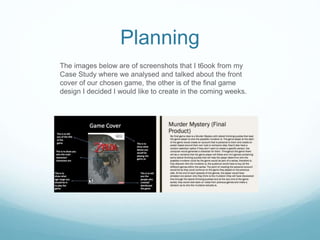
The images below are of screenshots that I t6ook from my
Case Study where we analysed and talked about the front
cover of our chosen game, the other is of the final game
design I decided I would like to create in the coming weeks.
Time Management
I managed my time as well as I could, I was to hand most of my documents in on time, some
were later than I would’ve wanted them to be as they hadn’t been completed as I was adding
extra detail. I was able to start up new presentations and documents when we had to, it only
meant I had to leave my uncompleted work for another time, but once they were all completed I
handed them in. If I had more time to produce my work I would maybe research more thoroughly
and be more mindful of what products I chose to research rather than the first games that come
to mind. In order to get the remainder of my work in before the deadline, I will finish what I can
and use any of me free time to work in the college library or at home to finish the rest of my
work. Most is finished, only missing a few minor details or a PowerPoint slide. If I managed my
time better I would’ve been able to add the audio to my video game before time, however the
Mac I was using wouldn’t let me download the link I needed so I wasn’t able to add audio
straight away.
Technical Qualities
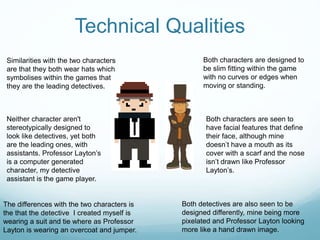
Similarities with the two characters
are that they both wear hats which
symbolises within the games that
they are the leading detectives.
The differences with the two characters is
the that the detective I created myself is
wearing a suit and tie where as Professor
Layton is wearing an overcoat and jumper.
Both detectives are also seen to be
designed differently, mine being more
pixelated and Professor Layton looking
more like a hand drawn image.
Both characters are designed to
be slim fitting within the game
with no curves or edges when
moving or standing.
Both characters are seen to
have facial features that define
their face, although mine
doesn’t have a mouth as its
cover with a scarf and the nose
isn’t drawn like Professor
Layton’s.
Neither character aren't
stereotypically designed to
look like detectives, yet both
are the leading ones, with
assistants. Professor Layton’s
is a computer generated
character, my detective
assistant is the game player.
Technical Qualities
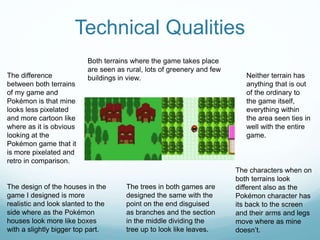
Both terrains where the game takes place
are seen as rural, lots of greenery and few
buildings in view. Neither terrain has
anything that is out
of the ordinary to
the game itself,
everything within
the area seen ties in
well with the entire
game.
The difference
between both terrains
of my game and
Pokémon is that mine
looks less pixelated
and more cartoon like
where as it is obvious
looking at the
Pokémon game that it
is more pixelated and
retro in comparison.
The design of the houses in the
game I designed is more
realistic and look slanted to the
side where as the Pokémon
houses look more like boxes
with a slightly bigger top part.
The trees in both games are
designed the same with the
point on the end disguised
as branches and the section
in the middle dividing the
tree up to look like leaves.
The characters when on
both terrains look
different also as the
Pokémon character has
its back to the screen
and their arms and legs
move where as mine
doesn’t.
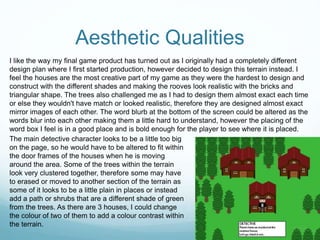
Aesthetic Qualities
I like the way my final game product has turned out as I originally had a completely different
design plan where I first started production, however decided to design this terrain instead. I
feel the houses are the most creative part of my game as they were the hardest to design and
construct with the different shades and making the rooves look realistic with the bricks and
triangular shape. The trees also challenged me as I had to design them almost exact each time
or else they wouldn't have match or looked realistic, therefore they are designed almost exact
mirror images of each other. The word blurb at the bottom of the screen could be altered as the
words blur into each other making them a little hard to understand, however the placing of the
word box I feel is in a good place and is bold enough for the player to see where it is placed.
The main detective character looks to be a little too big
on the page, so he would have to be altered to fit within
the door frames of the houses when he is moving
around the area. Some of the trees within the terrain
look very clustered together, therefore some may have
to erased or moved to another section of the terrain as
some of it looks to be a little plain in places or instead
add a path or shrubs that are a different shade of green
from the trees. As there are 3 houses, I could change
the colour of two of them to add a colour contrast within
the terrain.
Audience Appeal
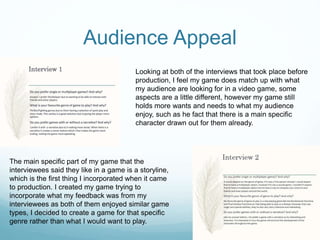
Looking at both of the interviews that took place before
production, I feel my game does match up with what
my audience are looking for in a video game, some
aspects are a little different, however my game still
holds more wants and needs to what my audience
enjoy, such as he fact that there is a main specific
character drawn out for them already.
The main specific part of my game that the
interviewees said they like in a game is a storyline,
which is the first thing I incorporated when it came
to production. I created my game trying to
incorporate what my feedback was from my
interviewees as both of them enjoyed similar game
types, I decided to create a game for that specific
genre rather than what I would want to play.

8. evaluation (completed)

  • 1.
  • 2.
    Research Within my researchfor my video game I chose a series of 4 games similar to the game we chose to analyse within our Case Study and researched them to find similarities and differences within them and my Case Study. This helped with my research for my final game product as the games I chose were all similar to what I wanted to create myself. Each of the 4 games held similarities i.e. the way they were all based on some form of storyline and most used an overhead approach when played. Each game when played is usually assisted with a storyline to help with game play which is how I wanted to create my game. In order to help with research we also asked a series of questions to two different audience members to help with what sort of game our targeted audience would like us to create .The strengths of my work was probably the games I research and the audience interviews we conducted before production. I found that the two audience members that answered the questions I wrote preferred games with a storyline approach as it helped them with game play, hence why I decided to create a storyline based game. The weaknesses within my research is mainly that I only chose games with a storyline. I wish I branched out and chose different games with different styles and themes. Some of the games I chose to analyse are very similar and I wish I chose a game that was a little different from the rest.
  • 3.
    Research The screenshots attachedat the bottom of the screen are of one of the game products I chose to research and one of the audience interviews conducted before production. Each helped with the final decision on how and what style of game I was going to create in the final weeks.
  • 4.
    Planning The planning forour video games was split into two different PowerPoint presentations. The first was our Case Study to which we chose a game from our childhood that we played and knew well. My chosen game was ‘The Legend Of Zelda: Twilight Princess’. I chose this game as it’s a game I played regularly when I was younger and I would watch my brother complete it on a regular occasion. After our Case Study was complete, we started on our Initial Plans where we wrote about 3 different video game ideas we had and chose our favourite or developed our ideas top create a final; product. As well as that, we also created a Mood Board within our Initial Plan of games that we have played over the years to get an overall idea on what sort of game we wanted to create. After writing and discussing the 3 game ideas I had come up with, I actually took a little bit of each game I thought of and made them into one (the game I have created). The strengths within my planning I would say are definitely my Mood Board analysis and games I considered creating. Weaknesses I feel were the sort of games I verbally created as they didn’t branch out away from my comfort zone and I wish I created a game that is out of my comfort zone and challenged me when it came to production. It hasn’t effected my product as such, but I feel that because the game is mainly based on a storyline with a few puzzles in between, the game itself may be viewed as basic.
  • 5.
    Planning The images beloware of screenshots that I t6ook from my Case Study where we analysed and talked about the front cover of our chosen game, the other is of the final game design I decided I would like to create in the coming weeks.
  • 6.
    Time Management I managedmy time as well as I could, I was to hand most of my documents in on time, some were later than I would’ve wanted them to be as they hadn’t been completed as I was adding extra detail. I was able to start up new presentations and documents when we had to, it only meant I had to leave my uncompleted work for another time, but once they were all completed I handed them in. If I had more time to produce my work I would maybe research more thoroughly and be more mindful of what products I chose to research rather than the first games that come to mind. In order to get the remainder of my work in before the deadline, I will finish what I can and use any of me free time to work in the college library or at home to finish the rest of my work. Most is finished, only missing a few minor details or a PowerPoint slide. If I managed my time better I would’ve been able to add the audio to my video game before time, however the Mac I was using wouldn’t let me download the link I needed so I wasn’t able to add audio straight away.
  • 7.
    Technical Qualities Similarities withthe two characters are that they both wear hats which symbolises within the games that they are the leading detectives. The differences with the two characters is the that the detective I created myself is wearing a suit and tie where as Professor Layton is wearing an overcoat and jumper. Both detectives are also seen to be designed differently, mine being more pixelated and Professor Layton looking more like a hand drawn image. Both characters are designed to be slim fitting within the game with no curves or edges when moving or standing. Both characters are seen to have facial features that define their face, although mine doesn’t have a mouth as its cover with a scarf and the nose isn’t drawn like Professor Layton’s. Neither character aren't stereotypically designed to look like detectives, yet both are the leading ones, with assistants. Professor Layton’s is a computer generated character, my detective assistant is the game player.
  • 8.
    Technical Qualities Both terrainswhere the game takes place are seen as rural, lots of greenery and few buildings in view. Neither terrain has anything that is out of the ordinary to the game itself, everything within the area seen ties in well with the entire game. The difference between both terrains of my game and Pokémon is that mine looks less pixelated and more cartoon like where as it is obvious looking at the Pokémon game that it is more pixelated and retro in comparison. The design of the houses in the game I designed is more realistic and look slanted to the side where as the Pokémon houses look more like boxes with a slightly bigger top part. The trees in both games are designed the same with the point on the end disguised as branches and the section in the middle dividing the tree up to look like leaves. The characters when on both terrains look different also as the Pokémon character has its back to the screen and their arms and legs move where as mine doesn’t.
  • 9.
    Aesthetic Qualities I likethe way my final game product has turned out as I originally had a completely different design plan where I first started production, however decided to design this terrain instead. I feel the houses are the most creative part of my game as they were the hardest to design and construct with the different shades and making the rooves look realistic with the bricks and triangular shape. The trees also challenged me as I had to design them almost exact each time or else they wouldn't have match or looked realistic, therefore they are designed almost exact mirror images of each other. The word blurb at the bottom of the screen could be altered as the words blur into each other making them a little hard to understand, however the placing of the word box I feel is in a good place and is bold enough for the player to see where it is placed. The main detective character looks to be a little too big on the page, so he would have to be altered to fit within the door frames of the houses when he is moving around the area. Some of the trees within the terrain look very clustered together, therefore some may have to erased or moved to another section of the terrain as some of it looks to be a little plain in places or instead add a path or shrubs that are a different shade of green from the trees. As there are 3 houses, I could change the colour of two of them to add a colour contrast within the terrain.
  • 10.
    Audience Appeal Looking atboth of the interviews that took place before production, I feel my game does match up with what my audience are looking for in a video game, some aspects are a little different, however my game still holds more wants and needs to what my audience enjoy, such as he fact that there is a main specific character drawn out for them already. The main specific part of my game that the interviewees said they like in a game is a storyline, which is the first thing I incorporated when it came to production. I created my game trying to incorporate what my feedback was from my interviewees as both of them enjoyed similar game types, I decided to create a game for that specific genre rather than what I would want to play.

Editor's Notes

  • #3 What were the strengths of your research? How did your research help your product? What were the weaknesses of your research? What could you have done better/improve? What effect would this have had on your product?
  • #5 What were the strengths of your planning? How did your planning help your product? What were the weaknesses of your planning? What could you have done better/improve? What effect would this have had on your product?
  • #7 Did you manage your time well? Did you complete your project on time or would your products have improved with additional time? What would you have done if you had more time to produce your work?
  • #8 Compare your work to similar existing products and discuss the similarities and differences Put your final piece(s) in the centre of a page alongside an existing product Use text boxes and arrows
  • #10 Does your work look good? Was it creative? What aspects of your game’s visuals do you like? What would you improve? How would you improve it? Discuss the strengths and weaknesses Put your final piece(s) in the centre of a page and analyse them Use text boxes and arrows
  • #11 How have you appealed to your target audience? What specific bits of content would appeal to your target audience. Refer to your findings from your questionnaire. Put your final piece(s) in the centre of a page and analyse them Use text boxes and arrows