DNSSEC and DANE Based 
Security For TLS 
An Introduction 
Wes Hardaker 
Parsons 
<wes.hardaker@parsons.com>
Who is Wes Hardaker? 
● Work for PARSONS 
– Cyber securty parsons.com/cyber 
● Network Security Research Group 
– Technical Director 
– Infrastructure security specialists 
● DNSSEC, RPKI, BGPSEC, SNMP, IPSec, … 
● DNS and DNSSEC monitoring services 
– Open Source Software 
● Net-SNMP 
● DNSSEC-Tools 
● IETF Participant DNS-Sentinel
3 
wes.hardaker@parsons.com 
Overview 
● Current TLS Trust Anchoring Problems 
● What is DANE? How does it help? 
● DANE & The Web 
● DANE & SMTP 
● DANE & XMPP
4 
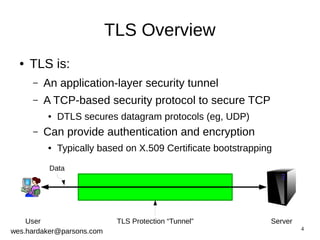
Data 
wes.hardaker@parsons.com 
TLS Overview 
● TLS is: 
– An application-layer security tunnel 
– A TCP-based security protocol to secure TCP 
● DTLS secures datagram protocols (eg, UDP) 
– Can provide authentication and encryption 
● Typically based on X.509 Certificate bootstrapping 
User TLS Protection “Tunnel” Server
5 
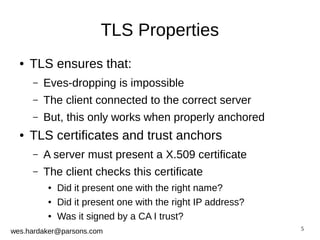
TLS Properties 
● TLS ensures that: 
– Eves-dropping is impossible 
– The client connected to the correct server 
– But, this only works when properly anchored 
● TLS certificates and trust anchors 
– A server must present a X.509 certificate 
– The client checks this certificate 
● Did it present one with the right name? 
● Did it present one with the right IP address? 
● Was it signed by a CA I trust? 
wes.hardaker@parsons.com
6 
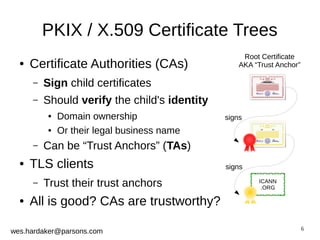
PKIX / X.509 Certificate Trees 
● Certificate Authorities (CAs) 
– Sign child certificates 
– Should verify the child's identity 
● Domain ownership 
● Or their legal business name 
– Can be “Trust Anchors” (TAs) 
● TLS clients 
– Trust their trust anchors 
● All is good? CAs are trustworthy? 
wes.hardaker@parsons.com 
Root Certificate 
AKA “Trust Anchor” 
ICANN 
.ORG 
signs 
signs
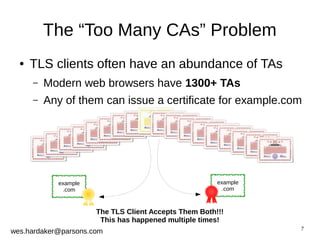
– Modern web browsers have 1300+ TAs 
– Any of them can issue a certificate for example.com 
7 
The “Too Many CAs” Problem 
● TLS clients often have an abundance of TAs 
example 
.com 
wes.hardaker@parsons.com 
example 
.com 
The TLS Client Accepts Them Both!!! 
This has happened multiple times!
8 
DANE To The Rescue! 
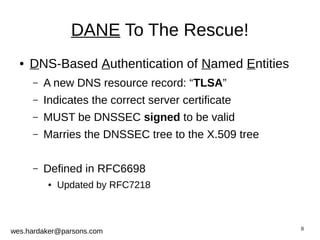
● DNS-Based Authentication of Named Entities 
– A new DNS resource record: “TLSA” 
– Indicates the correct server certificate 
– MUST be DNSSEC signed to be valid 
– Marries the DNSSEC tree to the X.509 tree 
– Defined in RFC6698 
● Updated by RFC7218 
wes.hardaker@parsons.com
9 
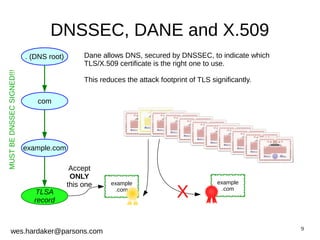
DNSSEC, DANE and X.509 
. (DNS root) 
Dane allows DNS, secured by DNSSEC, to indicate which 
TLS/X.509 certificate is the right one to use. 
This reduces the attack footprint of TLS significantly. 
wes.hardaker@parsons.com 
example 
.com 
example 
.com 
com 
example.com 
TLSA 
record 
Accept 
ONLY 
this one X 
MUST BE DNSSEC SIGNED!!!
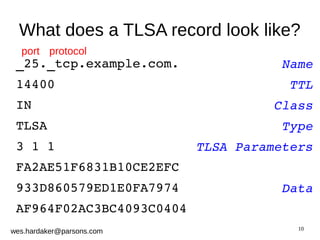
What does a TLSA record look like? 
10 
_25._tcp.example.com. 
14400 
IN 
TLSA 
3 1 1 
FA2AE51F6831B10CE2EFC 
933D860579ED1E0FA7974 
AF964F02AC3BC4093C0404 
wes.hardaker@parsons.com 
Name 
TTL 
Class 
Type 
TLSA Parameters 
Data 
port protocol
11 
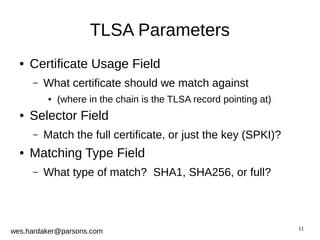
TLSA Parameters 
● Certificate Usage Field 
– What certificate should we match against 
● (where in the chain is the TLSA record pointing at) 
● Selector Field 
– Match the full certificate, or just the key (SPKI)? 
● Matching Type Field 
– What type of match? SHA1, SHA256, or full? 
wes.hardaker@parsons.com
12 
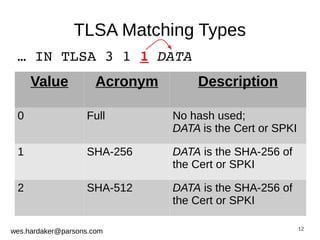
TLSA Matching Types 
… IN TLSA 3 1 1 DATA 
Value Acronym Description 
0 Full No hash used; 
wes.hardaker@parsons.com 
DATA is the Cert or SPKI 
1 SHA-256 DATA is the SHA-256 of 
the Cert or SPKI 
2 SHA-512 DATA is the SHA-256 of 
the Cert or SPKI
13 
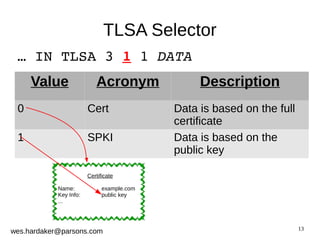
… IN TLSA 3 1 1 DATA 
wes.hardaker@parsons.com 
TLSA Selector 
Value Acronym Description 
0 Cert Data is based on the full 
certificate 
1 SPKI Data is based on the 
public key 
Certificate 
Name: example.com 
Key Info: public key 
...
14 
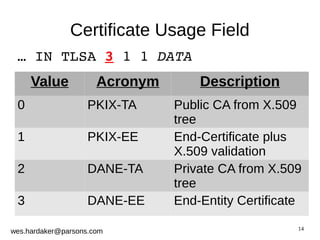
Certificate Usage Field 
… IN TLSA 3 1 1 DATA 
Value Acronym Description 
0 PKIX-TA Public CA from X.509 
wes.hardaker@parsons.com 
tree 
1 PKIX-EE End-Certificate plus 
X.509 validation 
2 DANE-TA Private CA from X.509 
tree 
3 DANE-EE End-Entity Certificate
15 
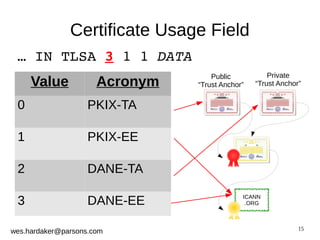
Certificate Usage Field 
… IN TLSA 3 1 1 DATA 
Value Acronym 
0 PKIX-TA 
1 PKIX-EE 
2 DANE-TA 
3 DANE-EE 
wes.hardaker@parsons.com 
ICANN 
.ORG 
Public 
“Trust Anchor” 
Private 
“Trust Anchor”
16 
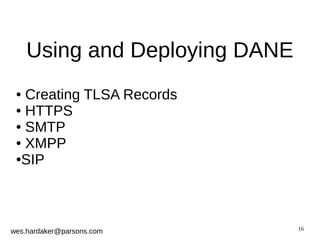
Using and Deploying DANE 
● Creating TLSA Records 
● HTTPS 
● SMTP 
● XMPP 
●SIP 
wes.hardaker@parsons.com
17 
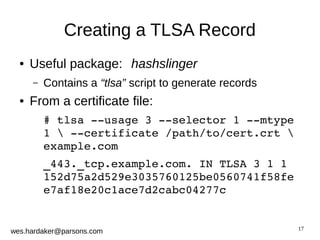
Creating a TLSA Record 
● Useful package: hashslinger 
– Contains a “tlsa” script to generate records 
● From a certificate file: 
# tlsa ­­usage 
3 ­­selector 
1 ­­mtype 
1  ­­certificate 
/path/to/cert.crt  
example.com 
_443._tcp.example.com. IN TLSA 3 1 1 
152d75a2d529e3035760125be0560741f58fe 
e7af18e20c1ace7d2cabc04277c 
wes.hardaker@parsons.com
18 
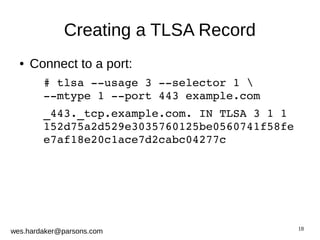
Creating a TLSA Record 
● Connect to a port: 
# tlsa ­­usage 
3 ­­selector 
1  
­­mtype 
1 ­­port 
443 example.com 
_443._tcp.example.com. IN TLSA 3 1 1 
152d75a2d529e3035760125be0560741f58fe 
e7af18e20c1ace7d2cabc04277c 
wes.hardaker@parsons.com
19 
DANE and HTTPS 
HTTPS suffers the most from 
the “too many CAs problem” 
wes.hardaker@parsons.com
20 
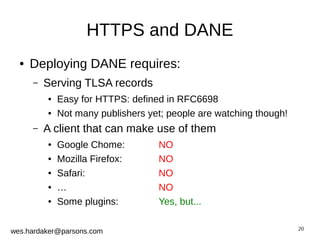
HTTPS and DANE 
● Deploying DANE requires: 
– Serving TLSA records 
● Easy for HTTPS: defined in RFC6698 
● Not many publishers yet; people are watching though! 
– A client that can make use of them 
● Google Chome: NO 
● Mozilla Firefox: NO 
● Safari: NO 
● … NO 
● Some plugins: Yes, but... 
wes.hardaker@parsons.com
21 
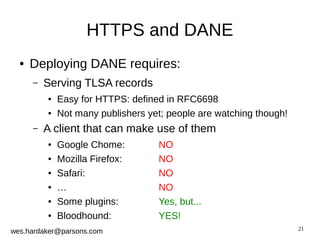
HTTPS and DANE 
● Deploying DANE requires: 
– Serving TLSA records 
● Easy for HTTPS: defined in RFC6698 
● Not many publishers yet; people are watching though! 
– A client that can make use of them 
● Google Chome: NO 
● Mozilla Firefox: NO 
● Safari: NO 
● … NO 
● Some plugins: Yes, but... 
● Bloodhound: YES! 
wes.hardaker@parsons.com
22 
wes.hardaker@parsons.com 
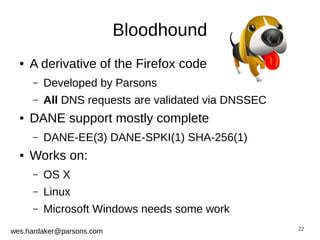
Bloodhound 
● A derivative of the Firefox code 
– Developed by Parsons 
– All DNS requests are validated via DNSSEC 
● DANE support mostly complete 
– DANE-EE(3) DANE-SPKI(1) SHA-256(1) 
● Works on: 
– OS X 
– Linux 
– Microsoft Windows needs some work
23 
DANE and SMTP 
SMTP can't be secured without 
DNSSEC and DANE! 
wes.hardaker@parsons.com
24 
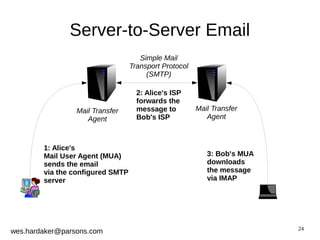
Server-to-Server Email 
1: Alice's 
Mail User Agent (MUA) 
sends the email 
via the configured SMTP 
server 
wes.hardaker@parsons.com 
3: Bob's MUA 
downloads 
the message 
via IMAP 
2: Alice's ISP 
forwards the 
message to 
Bob's ISP 
Mail Transfer 
Agent 
Simple Mail 
Transport Protocol 
(SMTP) 
Mail Transfer 
Agent
25 
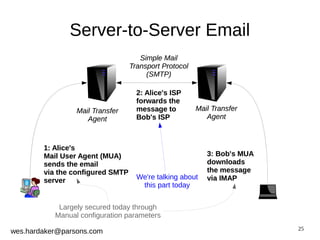
Server-to-Server Email 
1: Alice's 
Mail User Agent (MUA) 
sends the email 
via the configured SMTP 
server 
wes.hardaker@parsons.com 
3: Bob's MUA 
downloads 
the message 
via IMAP 
2: Alice's ISP 
forwards the 
message to 
Bob's ISP 
Mail Transfer 
Agent 
Simple Mail 
Transport Protocol 
(SMTP) 
Mail Transfer 
Agent 
We're talking about 
this part today 
Largely secured today through 
Manual configuration parameters
26 
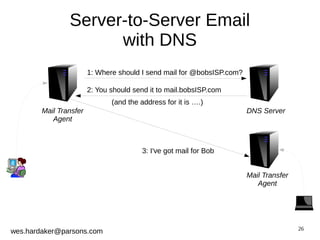
Server-to-Server Email 
wes.hardaker@parsons.com 
with DNS 
DNS Server 
1: Where should I send mail for @bobsISP.com? 
2: You should send it to mail.bobsISP.com 
3: I've got mail for Bob 
Mail Transfer 
Agent 
Mail Transfer 
Agent 
(and the address for it is ….)
27 
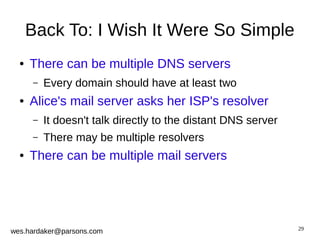
I Wish It Were So Simple 
● There can be multiple DNS servers 
– Every domain should have at least two 
● Alice's mail server asks her ISP's resolver 
– It doesn't talk directly to the distant DNS server 
– There may be multiple resolvers 
● There can be multiple mail servers 
wes.hardaker@parsons.com
28 
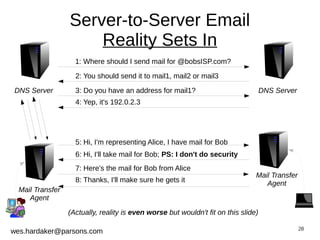
Server-to-Server Email 
Reality Sets In 
DNS Server 
1: Where should I send mail for @bobsISP.com? 
2: You should send it to mail1, mail2 or mail3 
3: Do you have an address for mail1? 
Mail Transfer 
Agent 
wes.hardaker@parsons.com 
DNS Server 
Mail Transfer 
Agent 
4: Yep, it's 192.0.2.3 
5: Hi, I'm representing Alice, I have mail for Bob 
6: Hi, I'll take mail for Bob; PS: I don't do security 
7: Here's the mail for Bob from Alice 
8: Thanks, I'll make sure he gets it 
(Actually, reality is even worse but wouldn't fit on this slide)
29 
Back To: I Wish It Were So Simple 
● There can be multiple DNS servers 
– Every domain should have at least two 
● Alice's mail server asks her ISP's resolver 
– It doesn't talk directly to the distant DNS server 
– There may be multiple resolvers 
● There can be multiple mail servers 
wes.hardaker@parsons.com
30 
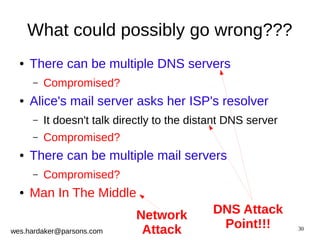
What could possibly go wrong??? 
● There can be multiple DNS servers 
– Compromised? 
● Alice's mail server asks her ISP's resolver 
– It doesn't talk directly to the distant DNS server 
– Compromised? 
● There can be multiple mail servers 
– Compromised? 
● Man In The Middle 
wes.hardaker@parsons.com 
DNS Attack 
Point!!! 
Network 
Attack
31 
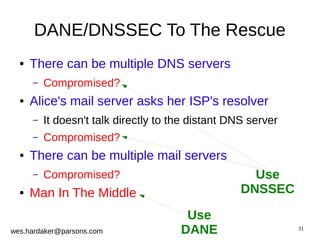
DANE/DNSSEC To The Rescue 
● There can be multiple DNS servers 
– Compromised? 
● Alice's mail server asks her ISP's resolver 
– It doesn't talk directly to the distant DNS server 
– Compromised? 
● There can be multiple mail servers 
– Compromised? 
● Man In The Middle 
wes.hardaker@parsons.com 
Use 
DNSSEC 
Use 
DANE
32 
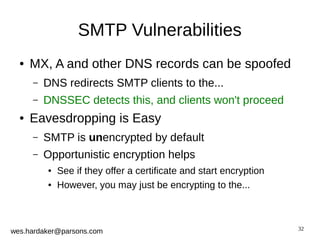
SMTP Vulnerabilities 
● MX, A and other DNS records can be spoofed 
– DNS redirects SMTP clients to the... 
– DNSSEC detects this, and clients won't proceed 
● Eavesdropping is Easy 
– SMTP is unencrypted by default 
– Opportunistic encryption helps 
● See if they offer a certificate and start encryption 
● However, you may just be encrypting to the... 
wes.hardaker@parsons.com
● Server indicates “I do security” 
● But a man-in-the-middle can just say “I don't do security” 
33 
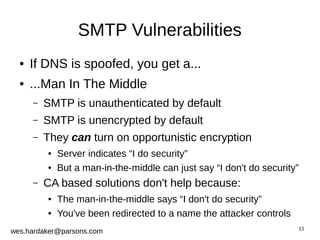
SMTP Vulnerabilities 
● If DNS is spoofed, you get a... 
● ...Man In The Middle 
– SMTP is unauthenticated by default 
– SMTP is unencrypted by default 
– They can turn on opportunistic encryption 
– CA based solutions don't help because: 
● The man-in-the-middle says “I don't do security” 
● You've been redirected to a name the attacker controls 
wes.hardaker@parsons.com
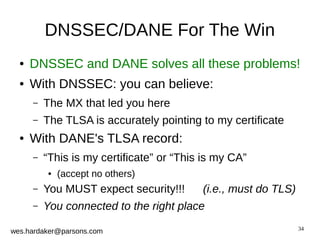
● DNSSEC and DANE solves all these problems! 
34 
DNSSEC/DANE For The Win 
● With DNSSEC: you can believe: 
– The MX that led you here 
– The TLSA is accurately pointing to my certificate 
● With DANE's TLSA record: 
– “This is my certificate” or “This is my CA” 
● (accept no others) 
– You MUST expect security!!! (i.e., must do TLS) 
– You connected to the right place 
wes.hardaker@parsons.com
35 
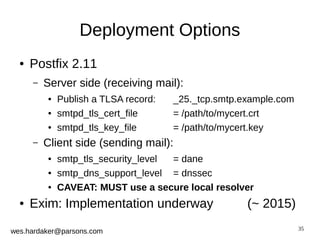
Deployment Options 
● Postfix 2.11 
– Server side (receiving mail): 
● Publish a TLSA record: _25._tcp.smtp.example.com 
● smtpd_tls_cert_file = /path/to/mycert.crt 
● smtpd_tls_key_file = /path/to/mycert.key 
– Client side (sending mail): 
● smtp_tls_security_level = dane 
● smtp_dns_support_level = dnssec 
● CAVEAT: MUST use a secure local resolver 
● Exim: Implementation underway (~ 2015) 
wes.hardaker@parsons.com
36 
DANE and XMPP 
XMPP also uses STARTTLS 
wes.hardaker@parsons.com
37 
DANE and XMPP 
● XMPP 
– The recommended security solution: 
● Check the PKI 
● If that fails, use DANE 
● STARTTLS is required 
– Being defined now in the IETF 
● draft-ietf-xmpp-dna 
● draft-ietf-dane-srv 
● Deployed and running code! 
– Prosody & more ??? 
wes.hardaker@parsons.com
38 
DANE and SIP 
Another level of indirection! 
wes.hardaker@parsons.com
39 
DANE and SIP 
● Just getting started! 
● Not an official WG item yet 
– There is interest in making it one 
– One personal draft discussing it 
wes.hardaker@parsons.com
40 
Questions? 
The Future of TLS Security 
Is Looking Up! 
wes.hardaker@parsons.com 
IIEETTFF 9900 
TToorroonnttoo 
JJuullyy,, 22001144
41 
wes.hardaker@parsons.com 
Resources 
● RFC6698 DANE 
● RFC7218 Acronyms 
● draft-ietf-dane-smtp-with-dane SMTP 
● draft-ietf-dane-ops Guidance 
● draft-ietf-xmpp-dna XMPP 
● draft-ietf-dane-srv SRV 
● http://www.dnssec-tools.org/ 
– (bloodhound!) 
● http://postfix.org/
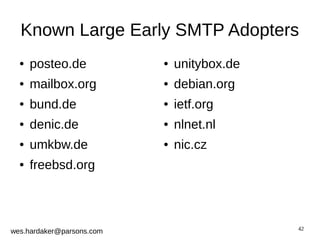
Known Large Early SMTP Adopters 
42 
● posteo.de 
● mailbox.org 
● bund.de 
● denic.de 
● umkbw.de 
● freebsd.org 
wes.hardaker@parsons.com 
● unitybox.de 
● debian.org 
● ietf.org 
● nlnet.nl 
● nic.cz

ION Santiago - DNSSEC and DANE Based Security for TLS

  • 1.
    DNSSEC and DANEBased Security For TLS An Introduction Wes Hardaker Parsons <wes.hardaker@parsons.com>
  • 2.
    Who is WesHardaker? ● Work for PARSONS – Cyber securty parsons.com/cyber ● Network Security Research Group – Technical Director – Infrastructure security specialists ● DNSSEC, RPKI, BGPSEC, SNMP, IPSec, … ● DNS and DNSSEC monitoring services – Open Source Software ● Net-SNMP ● DNSSEC-Tools ● IETF Participant DNS-Sentinel
  • 3.
    3 wes.hardaker@parsons.com Overview ● Current TLS Trust Anchoring Problems ● What is DANE? How does it help? ● DANE & The Web ● DANE & SMTP ● DANE & XMPP
  • 4.
    4 Data wes.hardaker@parsons.com TLS Overview ● TLS is: – An application-layer security tunnel – A TCP-based security protocol to secure TCP ● DTLS secures datagram protocols (eg, UDP) – Can provide authentication and encryption ● Typically based on X.509 Certificate bootstrapping User TLS Protection “Tunnel” Server
  • 5.
    5 TLS Properties ● TLS ensures that: – Eves-dropping is impossible – The client connected to the correct server – But, this only works when properly anchored ● TLS certificates and trust anchors – A server must present a X.509 certificate – The client checks this certificate ● Did it present one with the right name? ● Did it present one with the right IP address? ● Was it signed by a CA I trust? wes.hardaker@parsons.com
  • 6.
    6 PKIX /X.509 Certificate Trees ● Certificate Authorities (CAs) – Sign child certificates – Should verify the child's identity ● Domain ownership ● Or their legal business name – Can be “Trust Anchors” (TAs) ● TLS clients – Trust their trust anchors ● All is good? CAs are trustworthy? wes.hardaker@parsons.com Root Certificate AKA “Trust Anchor” ICANN .ORG signs signs
  • 7.
    – Modern webbrowsers have 1300+ TAs – Any of them can issue a certificate for example.com 7 The “Too Many CAs” Problem ● TLS clients often have an abundance of TAs example .com wes.hardaker@parsons.com example .com The TLS Client Accepts Them Both!!! This has happened multiple times!
  • 8.
    8 DANE ToThe Rescue! ● DNS-Based Authentication of Named Entities – A new DNS resource record: “TLSA” – Indicates the correct server certificate – MUST be DNSSEC signed to be valid – Marries the DNSSEC tree to the X.509 tree – Defined in RFC6698 ● Updated by RFC7218 wes.hardaker@parsons.com
  • 9.
    9 DNSSEC, DANEand X.509 . (DNS root) Dane allows DNS, secured by DNSSEC, to indicate which TLS/X.509 certificate is the right one to use. This reduces the attack footprint of TLS significantly. wes.hardaker@parsons.com example .com example .com com example.com TLSA record Accept ONLY this one X MUST BE DNSSEC SIGNED!!!
  • 10.
    What does aTLSA record look like? 10 _25._tcp.example.com. 14400 IN TLSA 3 1 1 FA2AE51F6831B10CE2EFC 933D860579ED1E0FA7974 AF964F02AC3BC4093C0404 wes.hardaker@parsons.com Name TTL Class Type TLSA Parameters Data port protocol
  • 11.
    11 TLSA Parameters ● Certificate Usage Field – What certificate should we match against ● (where in the chain is the TLSA record pointing at) ● Selector Field – Match the full certificate, or just the key (SPKI)? ● Matching Type Field – What type of match? SHA1, SHA256, or full? wes.hardaker@parsons.com
  • 12.
    12 TLSA MatchingTypes … IN TLSA 3 1 1 DATA Value Acronym Description 0 Full No hash used; wes.hardaker@parsons.com DATA is the Cert or SPKI 1 SHA-256 DATA is the SHA-256 of the Cert or SPKI 2 SHA-512 DATA is the SHA-256 of the Cert or SPKI
  • 13.
    13 … INTLSA 3 1 1 DATA wes.hardaker@parsons.com TLSA Selector Value Acronym Description 0 Cert Data is based on the full certificate 1 SPKI Data is based on the public key Certificate Name: example.com Key Info: public key ...
  • 14.
    14 Certificate UsageField … IN TLSA 3 1 1 DATA Value Acronym Description 0 PKIX-TA Public CA from X.509 wes.hardaker@parsons.com tree 1 PKIX-EE End-Certificate plus X.509 validation 2 DANE-TA Private CA from X.509 tree 3 DANE-EE End-Entity Certificate
  • 15.
    15 Certificate UsageField … IN TLSA 3 1 1 DATA Value Acronym 0 PKIX-TA 1 PKIX-EE 2 DANE-TA 3 DANE-EE wes.hardaker@parsons.com ICANN .ORG Public “Trust Anchor” Private “Trust Anchor”
  • 16.
    16 Using andDeploying DANE ● Creating TLSA Records ● HTTPS ● SMTP ● XMPP ●SIP wes.hardaker@parsons.com
  • 17.
    17 Creating aTLSA Record ● Useful package: hashslinger – Contains a “tlsa” script to generate records ● From a certificate file: # tlsa ­­usage 3 ­­selector 1 ­­mtype 1 ­­certificate /path/to/cert.crt example.com _443._tcp.example.com. IN TLSA 3 1 1 152d75a2d529e3035760125be0560741f58fe e7af18e20c1ace7d2cabc04277c wes.hardaker@parsons.com
  • 18.
    18 Creating aTLSA Record ● Connect to a port: # tlsa ­­usage 3 ­­selector 1 ­­mtype 1 ­­port 443 example.com _443._tcp.example.com. IN TLSA 3 1 1 152d75a2d529e3035760125be0560741f58fe e7af18e20c1ace7d2cabc04277c wes.hardaker@parsons.com
  • 19.
    19 DANE andHTTPS HTTPS suffers the most from the “too many CAs problem” wes.hardaker@parsons.com
  • 20.
    20 HTTPS andDANE ● Deploying DANE requires: – Serving TLSA records ● Easy for HTTPS: defined in RFC6698 ● Not many publishers yet; people are watching though! – A client that can make use of them ● Google Chome: NO ● Mozilla Firefox: NO ● Safari: NO ● … NO ● Some plugins: Yes, but... wes.hardaker@parsons.com
  • 21.
    21 HTTPS andDANE ● Deploying DANE requires: – Serving TLSA records ● Easy for HTTPS: defined in RFC6698 ● Not many publishers yet; people are watching though! – A client that can make use of them ● Google Chome: NO ● Mozilla Firefox: NO ● Safari: NO ● … NO ● Some plugins: Yes, but... ● Bloodhound: YES! wes.hardaker@parsons.com
  • 22.
    22 wes.hardaker@parsons.com Bloodhound ● A derivative of the Firefox code – Developed by Parsons – All DNS requests are validated via DNSSEC ● DANE support mostly complete – DANE-EE(3) DANE-SPKI(1) SHA-256(1) ● Works on: – OS X – Linux – Microsoft Windows needs some work
  • 23.
    23 DANE andSMTP SMTP can't be secured without DNSSEC and DANE! wes.hardaker@parsons.com
  • 24.
    24 Server-to-Server Email 1: Alice's Mail User Agent (MUA) sends the email via the configured SMTP server wes.hardaker@parsons.com 3: Bob's MUA downloads the message via IMAP 2: Alice's ISP forwards the message to Bob's ISP Mail Transfer Agent Simple Mail Transport Protocol (SMTP) Mail Transfer Agent
  • 25.
    25 Server-to-Server Email 1: Alice's Mail User Agent (MUA) sends the email via the configured SMTP server wes.hardaker@parsons.com 3: Bob's MUA downloads the message via IMAP 2: Alice's ISP forwards the message to Bob's ISP Mail Transfer Agent Simple Mail Transport Protocol (SMTP) Mail Transfer Agent We're talking about this part today Largely secured today through Manual configuration parameters
  • 26.
    26 Server-to-Server Email wes.hardaker@parsons.com with DNS DNS Server 1: Where should I send mail for @bobsISP.com? 2: You should send it to mail.bobsISP.com 3: I've got mail for Bob Mail Transfer Agent Mail Transfer Agent (and the address for it is ….)
  • 27.
    27 I WishIt Were So Simple ● There can be multiple DNS servers – Every domain should have at least two ● Alice's mail server asks her ISP's resolver – It doesn't talk directly to the distant DNS server – There may be multiple resolvers ● There can be multiple mail servers wes.hardaker@parsons.com
  • 28.
    28 Server-to-Server Email Reality Sets In DNS Server 1: Where should I send mail for @bobsISP.com? 2: You should send it to mail1, mail2 or mail3 3: Do you have an address for mail1? Mail Transfer Agent wes.hardaker@parsons.com DNS Server Mail Transfer Agent 4: Yep, it's 192.0.2.3 5: Hi, I'm representing Alice, I have mail for Bob 6: Hi, I'll take mail for Bob; PS: I don't do security 7: Here's the mail for Bob from Alice 8: Thanks, I'll make sure he gets it (Actually, reality is even worse but wouldn't fit on this slide)
  • 29.
    29 Back To:I Wish It Were So Simple ● There can be multiple DNS servers – Every domain should have at least two ● Alice's mail server asks her ISP's resolver – It doesn't talk directly to the distant DNS server – There may be multiple resolvers ● There can be multiple mail servers wes.hardaker@parsons.com
  • 30.
    30 What couldpossibly go wrong??? ● There can be multiple DNS servers – Compromised? ● Alice's mail server asks her ISP's resolver – It doesn't talk directly to the distant DNS server – Compromised? ● There can be multiple mail servers – Compromised? ● Man In The Middle wes.hardaker@parsons.com DNS Attack Point!!! Network Attack
  • 31.
    31 DANE/DNSSEC ToThe Rescue ● There can be multiple DNS servers – Compromised? ● Alice's mail server asks her ISP's resolver – It doesn't talk directly to the distant DNS server – Compromised? ● There can be multiple mail servers – Compromised? ● Man In The Middle wes.hardaker@parsons.com Use DNSSEC Use DANE
  • 32.
    32 SMTP Vulnerabilities ● MX, A and other DNS records can be spoofed – DNS redirects SMTP clients to the... – DNSSEC detects this, and clients won't proceed ● Eavesdropping is Easy – SMTP is unencrypted by default – Opportunistic encryption helps ● See if they offer a certificate and start encryption ● However, you may just be encrypting to the... wes.hardaker@parsons.com
  • 33.
    ● Server indicates“I do security” ● But a man-in-the-middle can just say “I don't do security” 33 SMTP Vulnerabilities ● If DNS is spoofed, you get a... ● ...Man In The Middle – SMTP is unauthenticated by default – SMTP is unencrypted by default – They can turn on opportunistic encryption – CA based solutions don't help because: ● The man-in-the-middle says “I don't do security” ● You've been redirected to a name the attacker controls wes.hardaker@parsons.com
  • 34.
    ● DNSSEC andDANE solves all these problems! 34 DNSSEC/DANE For The Win ● With DNSSEC: you can believe: – The MX that led you here – The TLSA is accurately pointing to my certificate ● With DANE's TLSA record: – “This is my certificate” or “This is my CA” ● (accept no others) – You MUST expect security!!! (i.e., must do TLS) – You connected to the right place wes.hardaker@parsons.com
  • 35.
    35 Deployment Options ● Postfix 2.11 – Server side (receiving mail): ● Publish a TLSA record: _25._tcp.smtp.example.com ● smtpd_tls_cert_file = /path/to/mycert.crt ● smtpd_tls_key_file = /path/to/mycert.key – Client side (sending mail): ● smtp_tls_security_level = dane ● smtp_dns_support_level = dnssec ● CAVEAT: MUST use a secure local resolver ● Exim: Implementation underway (~ 2015) wes.hardaker@parsons.com
  • 36.
    36 DANE andXMPP XMPP also uses STARTTLS wes.hardaker@parsons.com
  • 37.
    37 DANE andXMPP ● XMPP – The recommended security solution: ● Check the PKI ● If that fails, use DANE ● STARTTLS is required – Being defined now in the IETF ● draft-ietf-xmpp-dna ● draft-ietf-dane-srv ● Deployed and running code! – Prosody & more ??? wes.hardaker@parsons.com
  • 38.
    38 DANE andSIP Another level of indirection! wes.hardaker@parsons.com
  • 39.
    39 DANE andSIP ● Just getting started! ● Not an official WG item yet – There is interest in making it one – One personal draft discussing it wes.hardaker@parsons.com
  • 40.
    40 Questions? TheFuture of TLS Security Is Looking Up! wes.hardaker@parsons.com IIEETTFF 9900 TToorroonnttoo JJuullyy,, 22001144
  • 41.
    41 wes.hardaker@parsons.com Resources ● RFC6698 DANE ● RFC7218 Acronyms ● draft-ietf-dane-smtp-with-dane SMTP ● draft-ietf-dane-ops Guidance ● draft-ietf-xmpp-dna XMPP ● draft-ietf-dane-srv SRV ● http://www.dnssec-tools.org/ – (bloodhound!) ● http://postfix.org/
  • 42.
    Known Large EarlySMTP Adopters 42 ● posteo.de ● mailbox.org ● bund.de ● denic.de ● umkbw.de ● freebsd.org wes.hardaker@parsons.com ● unitybox.de ● debian.org ● ietf.org ● nlnet.nl ● nic.cz