Jan Žorž, Internet Society - zorz@isoc.org
Acknowledgement
I would like to thank Internet Society to let me
spend some of my ISOC working time in go6lab
and test all this new and exciting protocols and
mechanisms that makes Internet a bit better
and more secure place…
DNSSEC implementation in go6lab
• Powerdns server (used as primary for non-
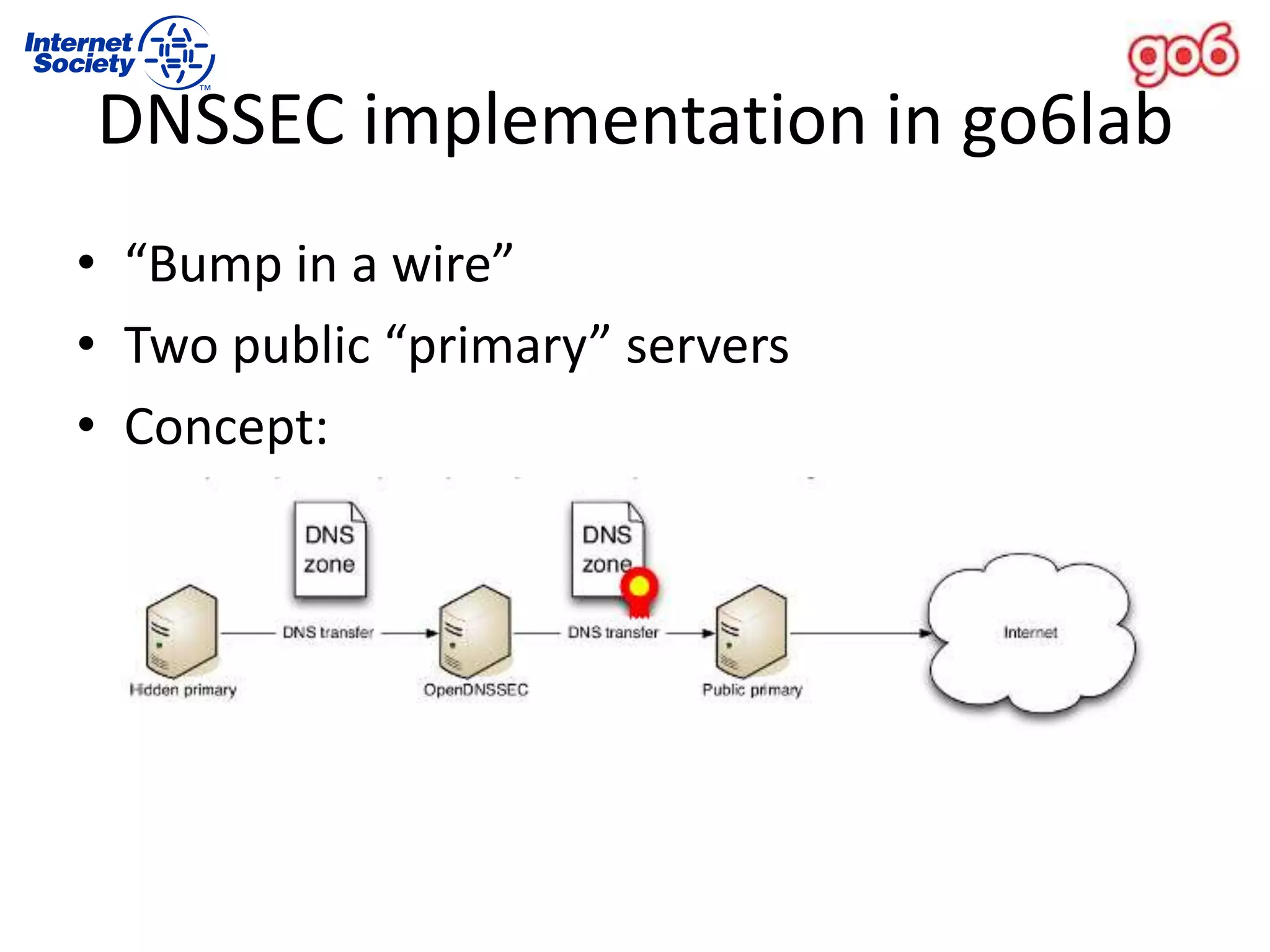
signed domains) as “hidden” primary DNS
server
• OpenDNSSEC platform for signing domains
• BIND9 DNS servers as secondaries to
OpenDNSSEC to serve signed zones
• Virtualization used: PROXMOX 3.4
• OS templates: fedora-20, Centos6/7
DNSSEC implementation in go6lab
• “Bump in a wire”
• Two public “primary” servers
• Concept:
DNSSEC in go6lab
• That was fairly easy and it works very well.
• Implementation document used from Matthijs
Mekking:
https://go6.si/docs/opendnssec-start-guide-draft.pdf
DANE experiment
• When DNSSEC was set up and functioning we
started to experiment with DANE (DNS
Authenticated Name Entities).
• Requirements:
– DNSSEC signed domains
– Postfix server with TLS support > 2.11
• We decided on Postfix 3.0.1
DANE
• TLSA record for mx.go6lab.si
_25._tcp.mx.go6lab.si. IN TLSA 3 0 1
B4B7A46F9F0DFEA0151C2E07A5AD7908F4C8B0050E7CC
25908DA05E2 A84748ED
It’s basically a hash of TLS certificate on mx.go6lab.si
More about DANE:
http://www.internetsociety.org/deploy360/resources/da
ne/
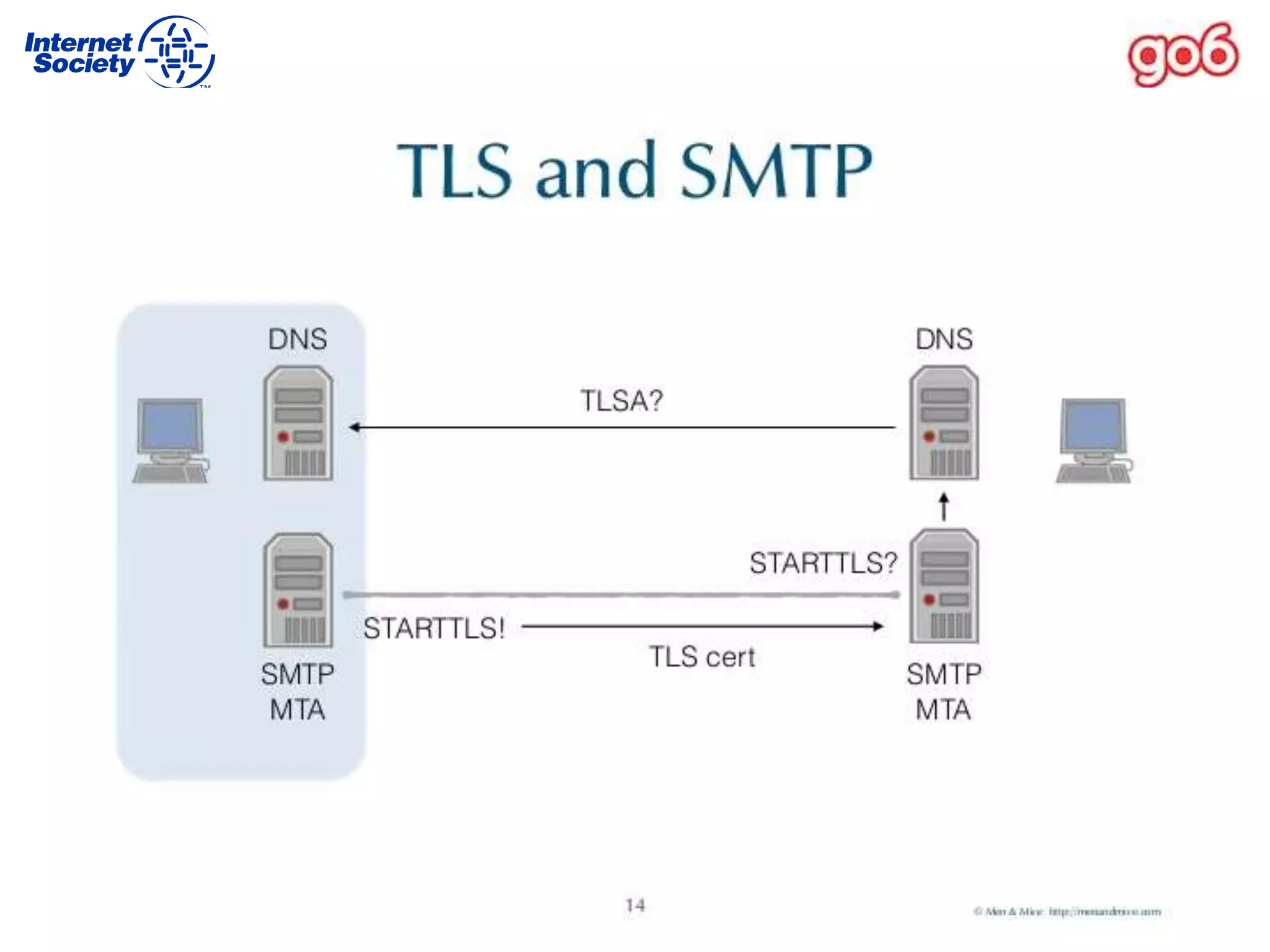
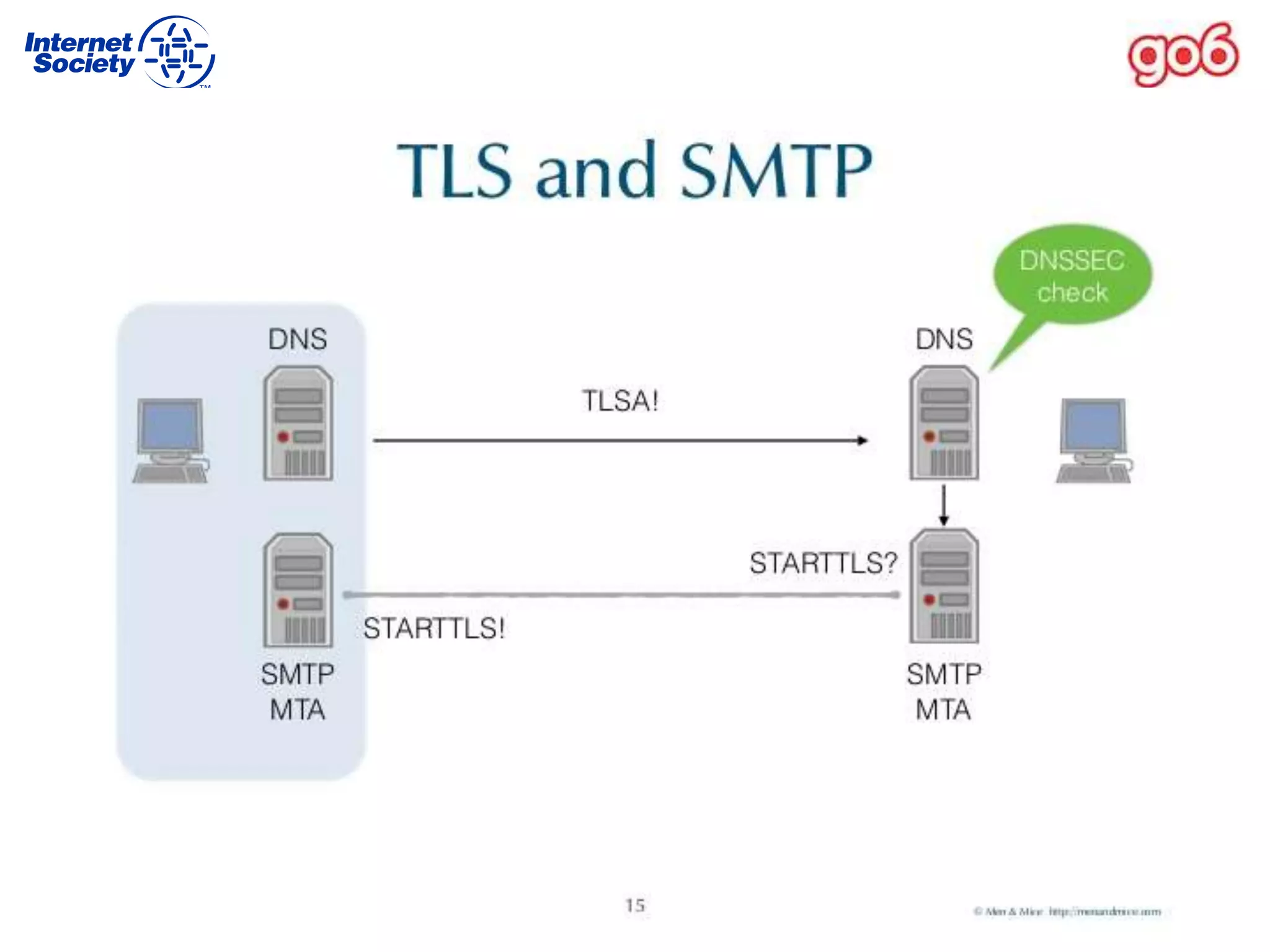
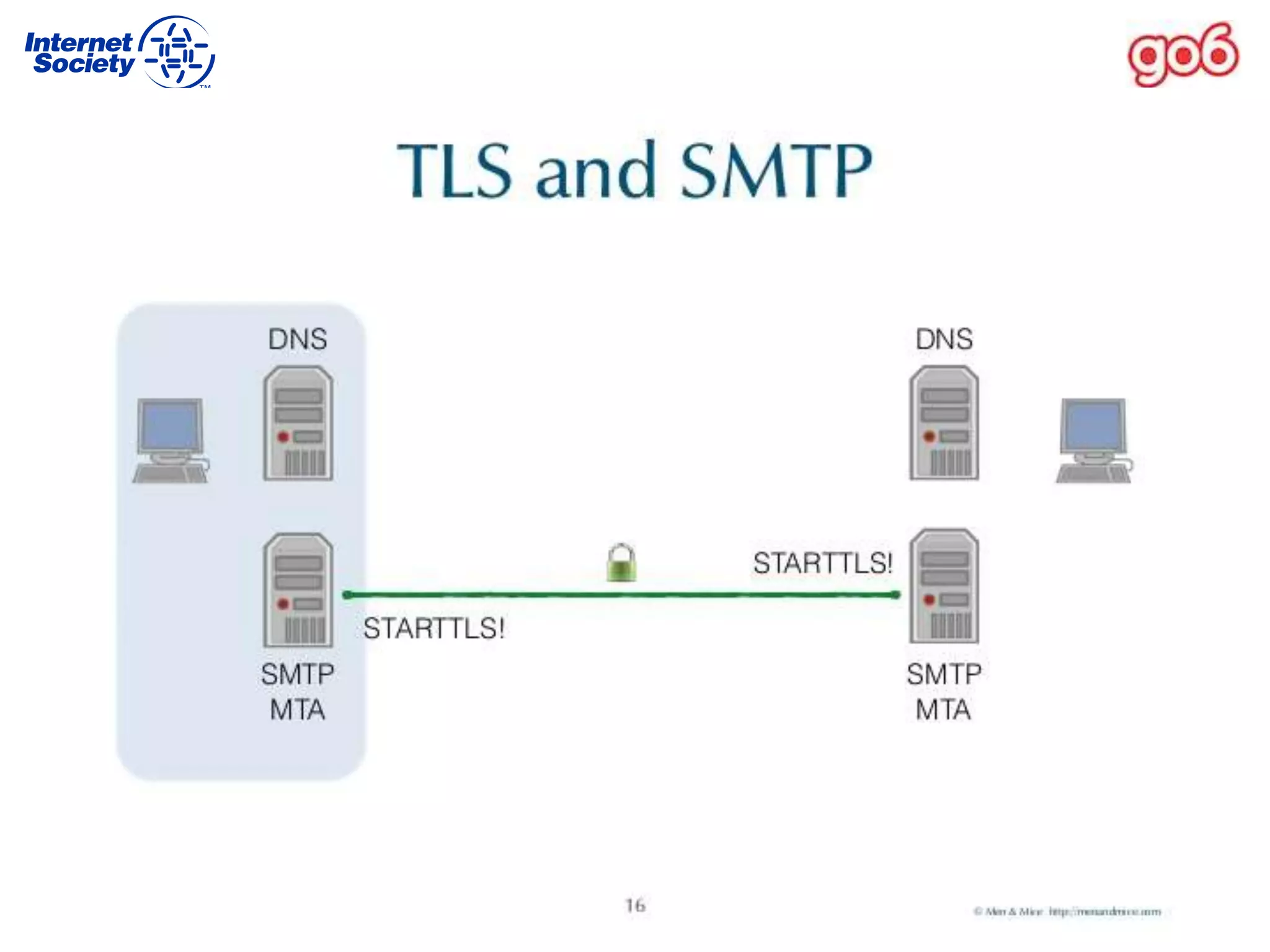
What is DANE and how does it work
DANE verification
• Mx.go6lab.si was able to verify TLS cert to T-2
mail server and nlnet-labs and some others…
mx postfix/smtp[31332]: Verified TLS connection established to
smtp-good-in-2.t-2.si[2a01:260:1:4::24]:25: TLSv1 with cipher
DHE-RSA-AES256-SHA (256/256 bits)
dicht postfix/smtp[29540]: Verified TLS connection established to
mx.go6lab.si[2001:67c:27e4::23]:25: TLSv1.2 with cipher
ECDHE-RSA-AES256-GCM-SHA384 (256/256 bits)
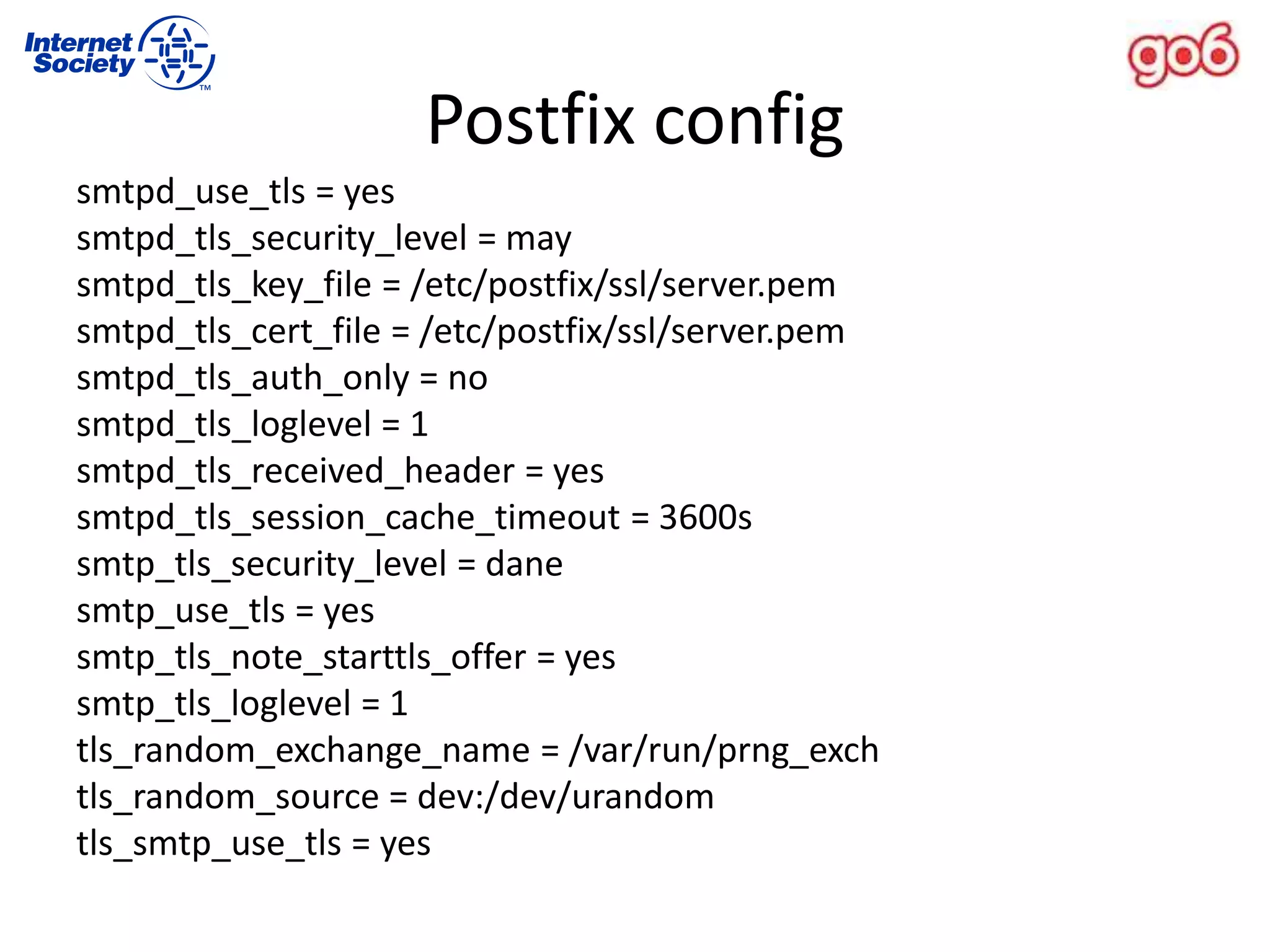
Postfix config
smtpd_use_tls = yes
smtpd_tls_security_level = may
smtpd_tls_key_file = /etc/postfix/ssl/server.pem
smtpd_tls_cert_file = /etc/postfix/ssl/server.pem
smtpd_tls_auth_only = no
smtpd_tls_loglevel = 1
smtpd_tls_received_header = yes
smtpd_tls_session_cache_timeout = 3600s
smtp_tls_security_level = dane
smtp_use_tls = yes
smtp_tls_note_starttls_offer = yes
smtp_tls_loglevel = 1
tls_random_exchange_name = /var/run/prng_exch
tls_random_source = dev:/dev/urandom
tls_smtp_use_tls = yes
1M top Alexa domains and DANE
• We fetched top 1 million Alexa domains and
created a script that sent an email to each of
them ( test-dnssec-dane@[domain] )
• After some tweaking of the script we got
some good results
• Then we built a script that parsed mail log file
and here are the results:
Results
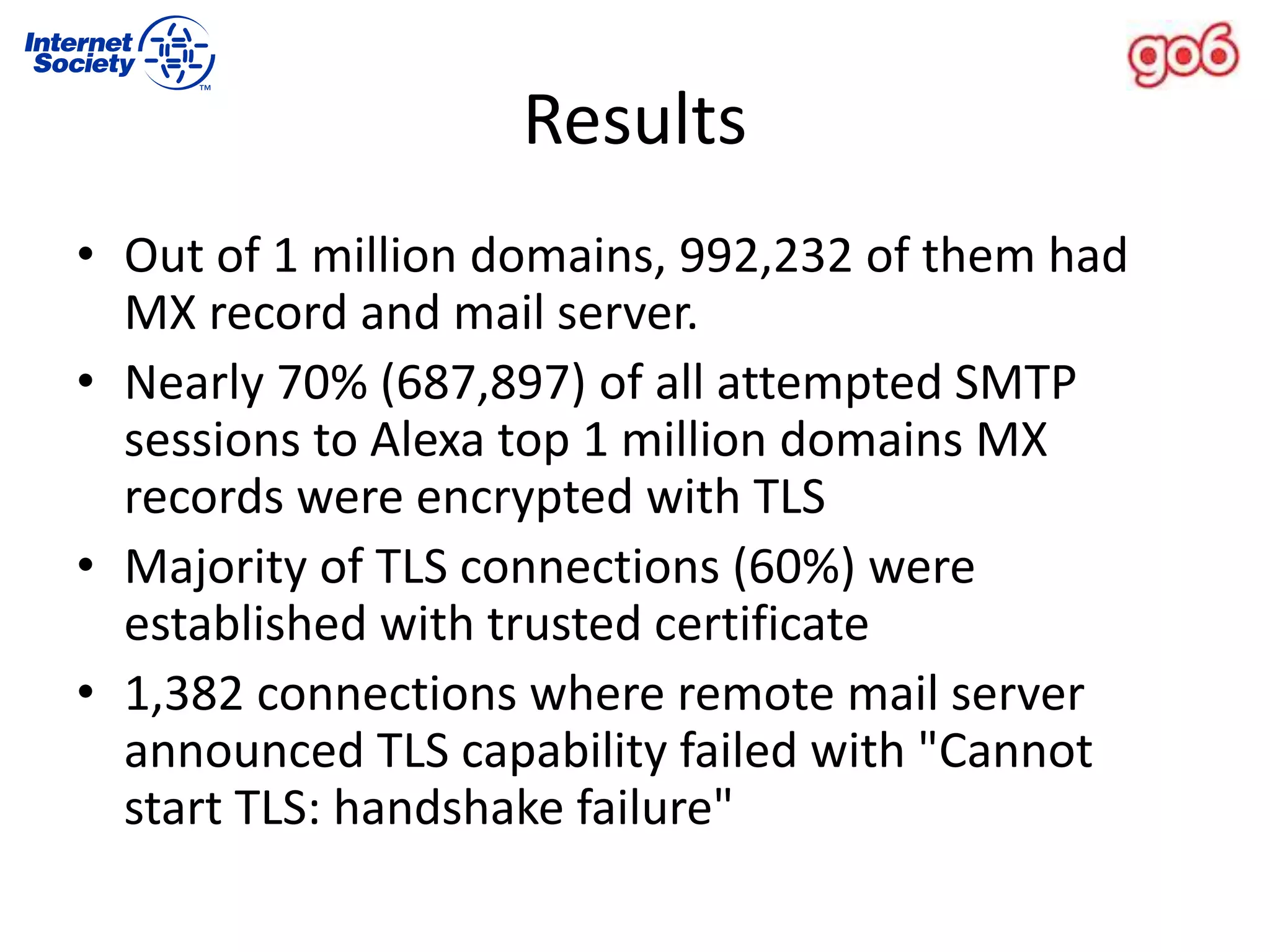
• Out of 1 million domains, 992,232 of them had
MX record and mail server.
• Nearly 70% (687,897) of all attempted SMTP
sessions to Alexa top 1 million domains MX
records were encrypted with TLS
• Majority of TLS connections (60%) were
established with trusted certificate
• 1,382 connections where remote mail server
announced TLS capability failed with "Cannot
start TLS: handshake failure"
More results
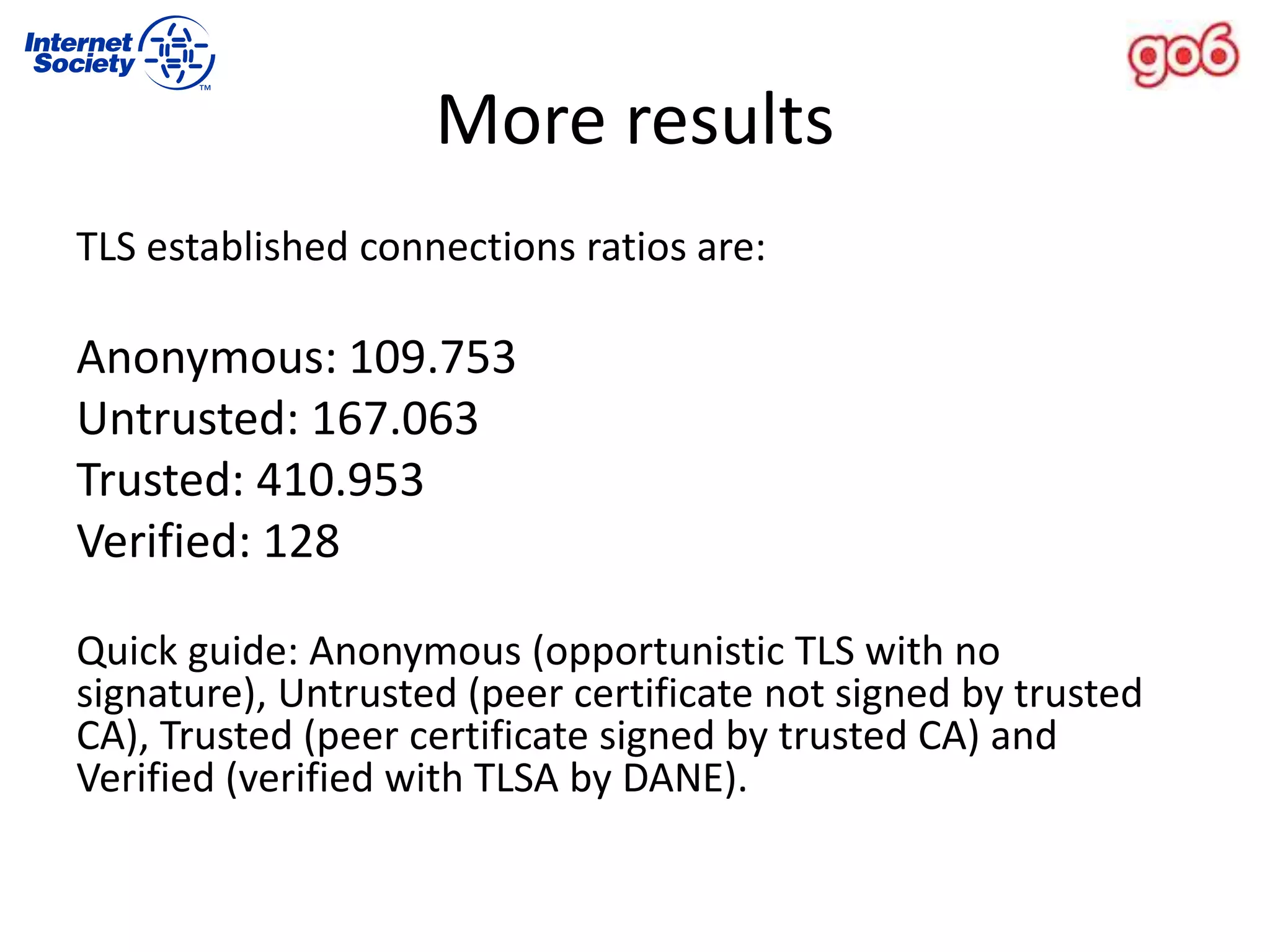
TLS established connections ratios are:
Anonymous: 109.753
Untrusted: 167.063
Trusted: 410.953
Verified: 128
Quick guide: Anonymous (opportunistic TLS with no
signature), Untrusted (peer certificate not signed by trusted
CA), Trusted (peer certificate signed by trusted CA) and
Verified (verified with TLSA by DANE).
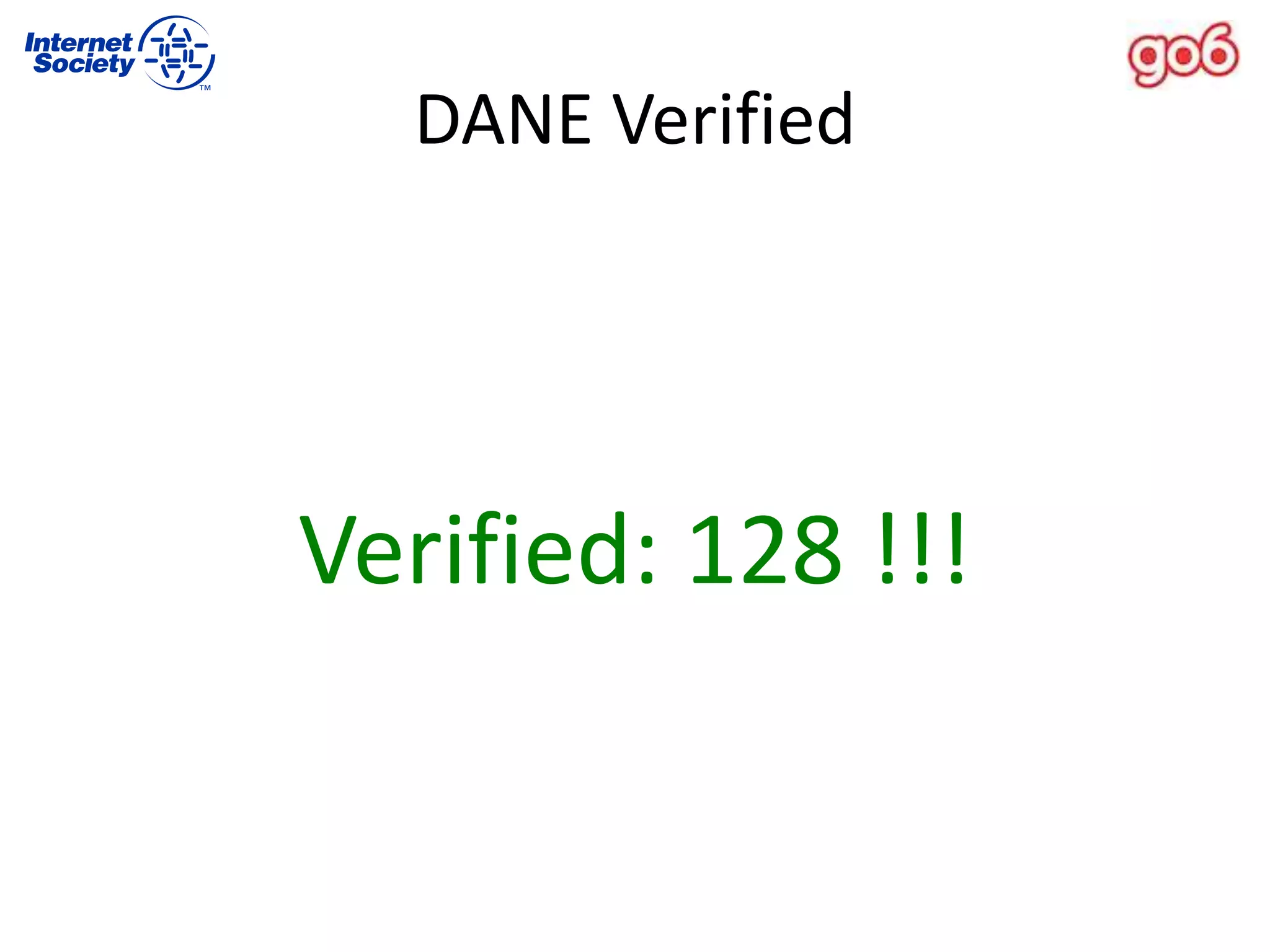
DANE Verified
Verified: 128 !!!
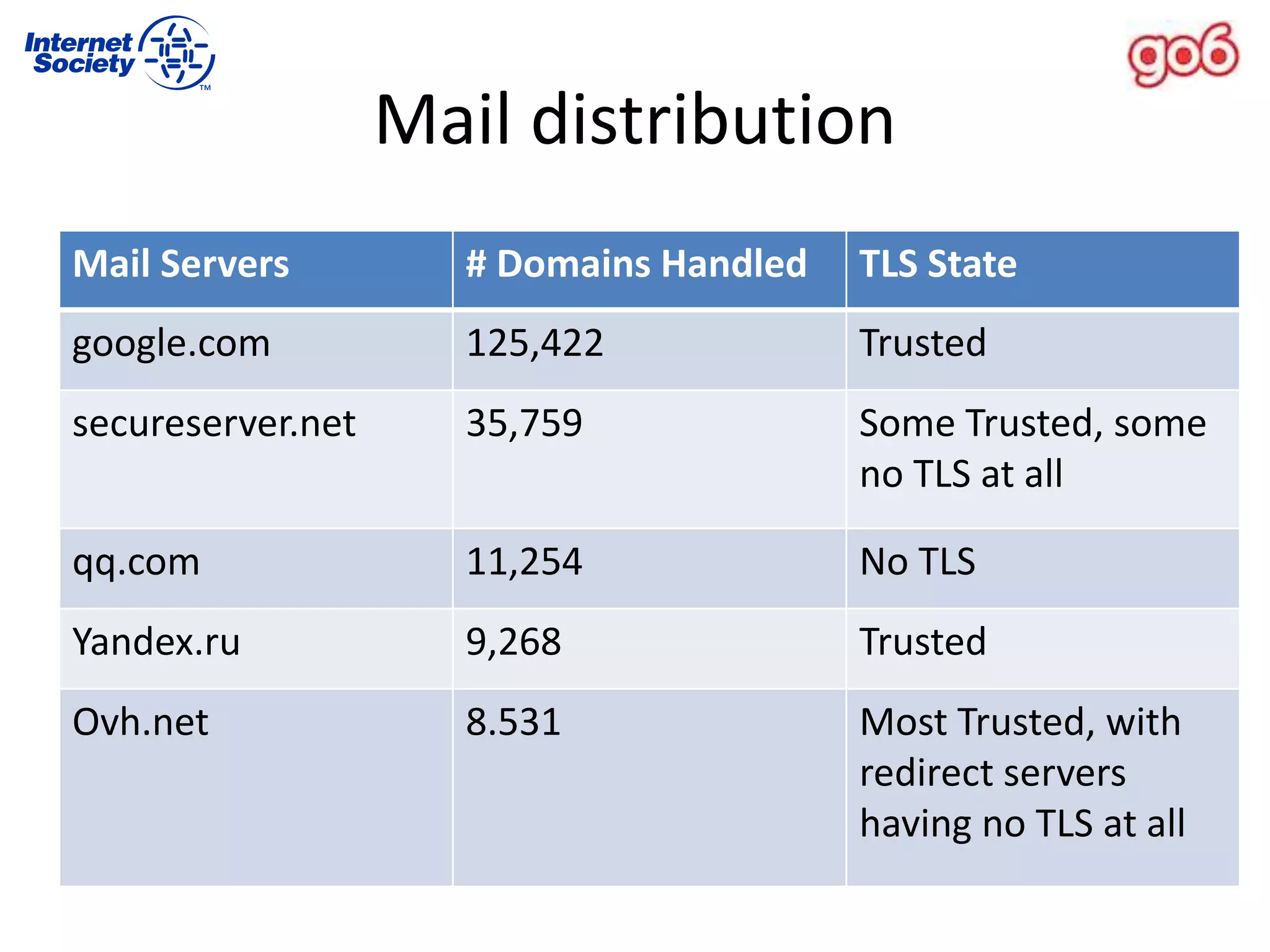
Mail distribution
Mail Servers # Domains Handled TLS State
google.com 125,422 Trusted
secureserver.net 35,759 Some Trusted, some
no TLS at all
qq.com 11,254 No TLS
Yandex.ru 9,268 Trusted
Ovh.net 8.531 Most Trusted, with
redirect servers
having no TLS at all
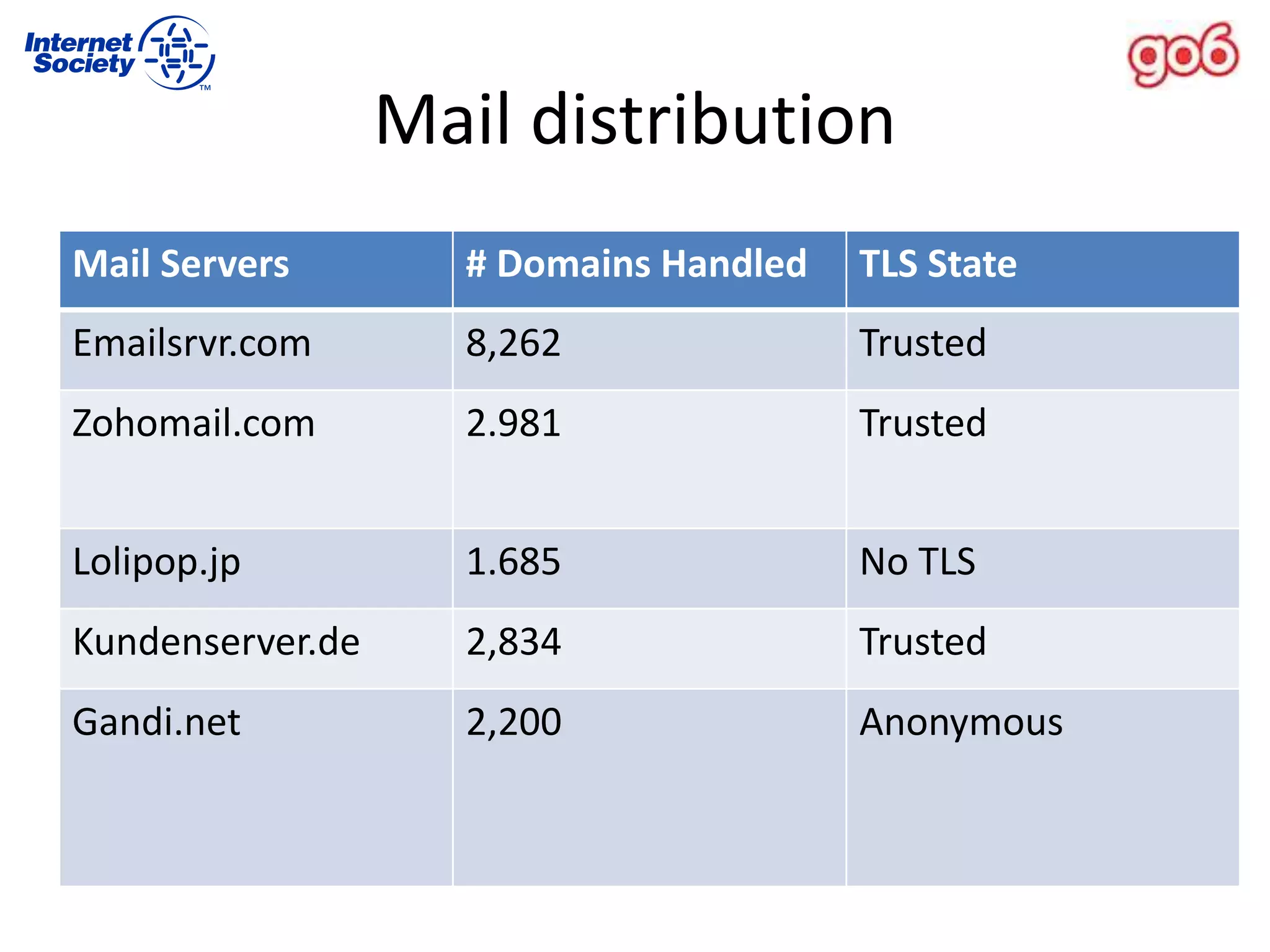
Mail distribution
Mail Servers # Domains Handled TLS State
Emailsrvr.com 8,262 Trusted
Zohomail.com 2.981 Trusted
Lolipop.jp 1.685 No TLS
Kundenserver.de 2,834 Trusted
Gandi.net 2,200 Anonymous
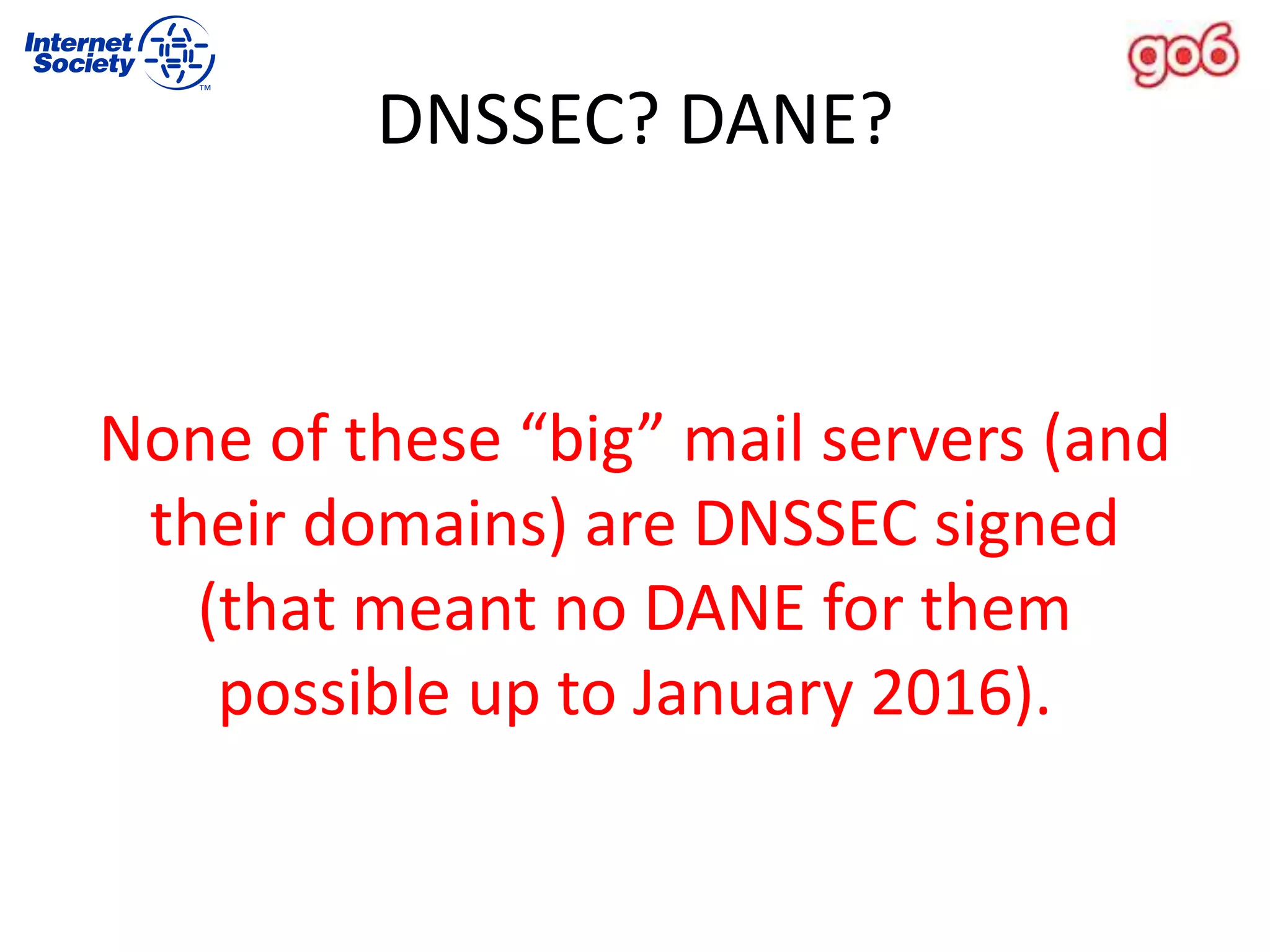
DNSSEC? DANE?
None of these “big” mail servers (and
their domains) are DNSSEC signed
(that meant no DANE for them
possible up to January 2016).
Malformed TLSA record
• We created a TLSA record with a bad hash (one
character changed)
• Postfix failed to verify it and refused to send a message
mx postfix/smtp[1765]: Untrusted TLS connection established to
mail-bad.go6lab.si[2001:67c:27e4::beee]:25: TLSv1.2 with
cipher ECDHE-RSA-AES256-GCM-SHA384 (256/256 bits)
mx postfix/smtp[1765]: 3A4BE8EE5C: Server certificate not
trusted
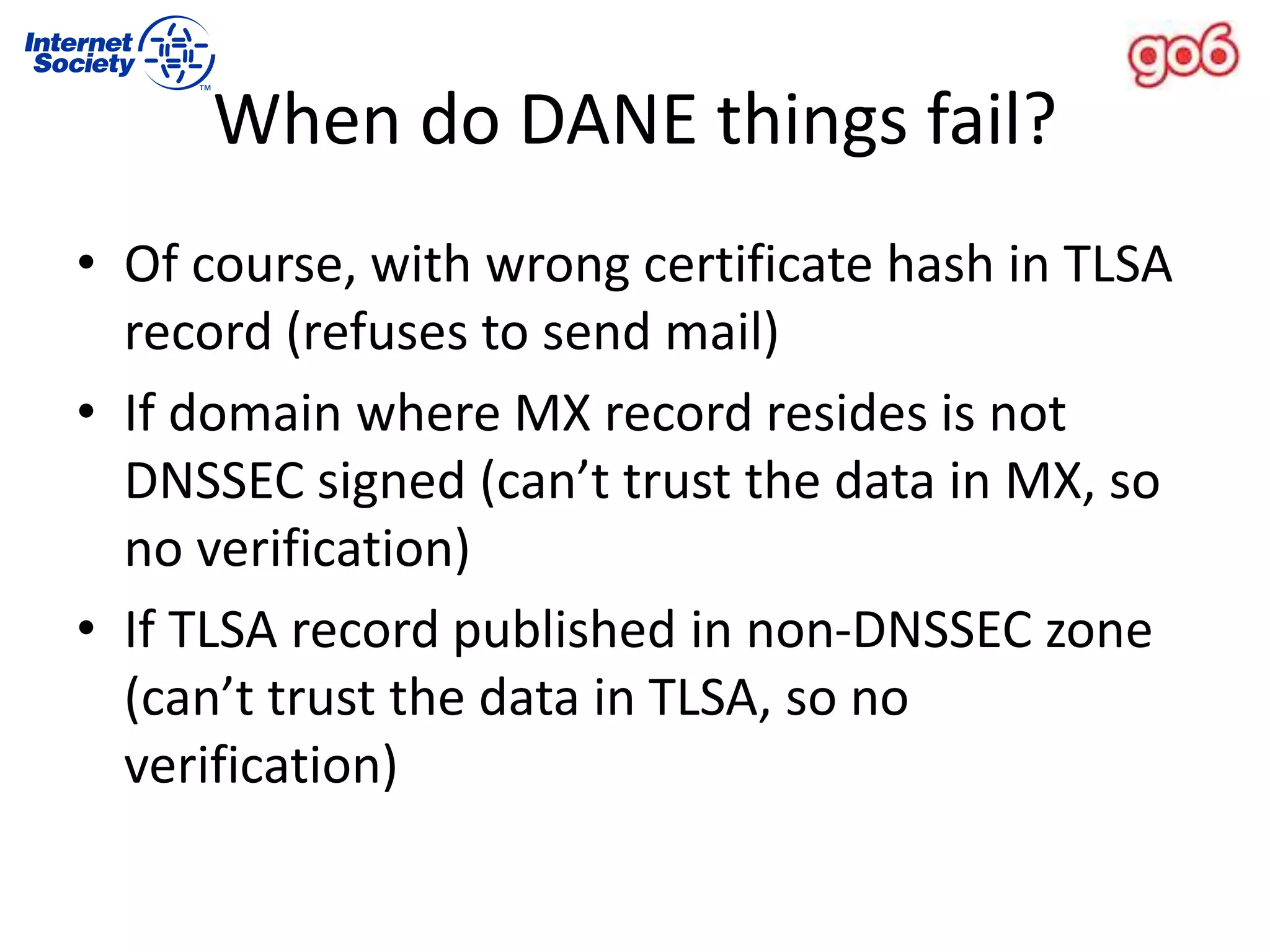
• Of course, with wrong certificate hash in TLSA
record (refuses to send mail)
• If domain where MX record resides is not
DNSSEC signed (can’t trust the data in MX, so
no verification)
• If TLSA record published in non-DNSSEC zone
(can’t trust the data in TLSA, so no
verification)
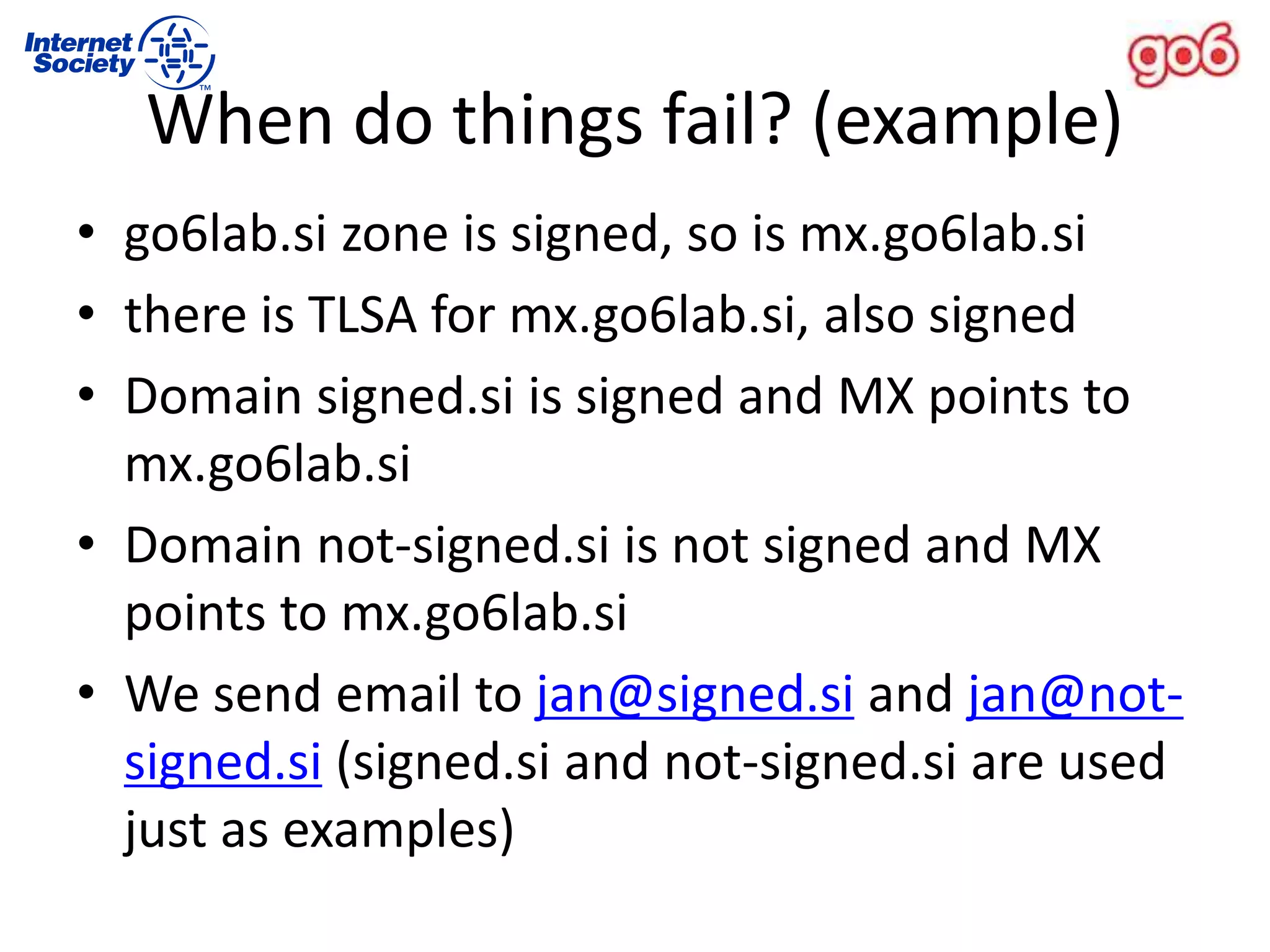
When do DANE things fail?
• go6lab.si zone is signed, so is mx.go6lab.si
• there is TLSA for mx.go6lab.si, also signed
• Domain signed.si is signed and MX points to
mx.go6lab.si
• Domain not-signed.si is not signed and MX
points to mx.go6lab.si
• We send email to jan@signed.si and jan@not-
signed.si (signed.si and not-signed.si are used
just as examples)
When do things fail? (example)
When I send email to jan@signed.si (signed domain):
Verified TLS connection established to
mx.go6lab.si[2001:67c:27e4::23]:25:
When I send email to jan@not-signed.si (not signed
domain):
Anonymous TLS connection established to
mx.go6lab.si[2001:67c:27e4::23]:25:
When do things fail? (example)
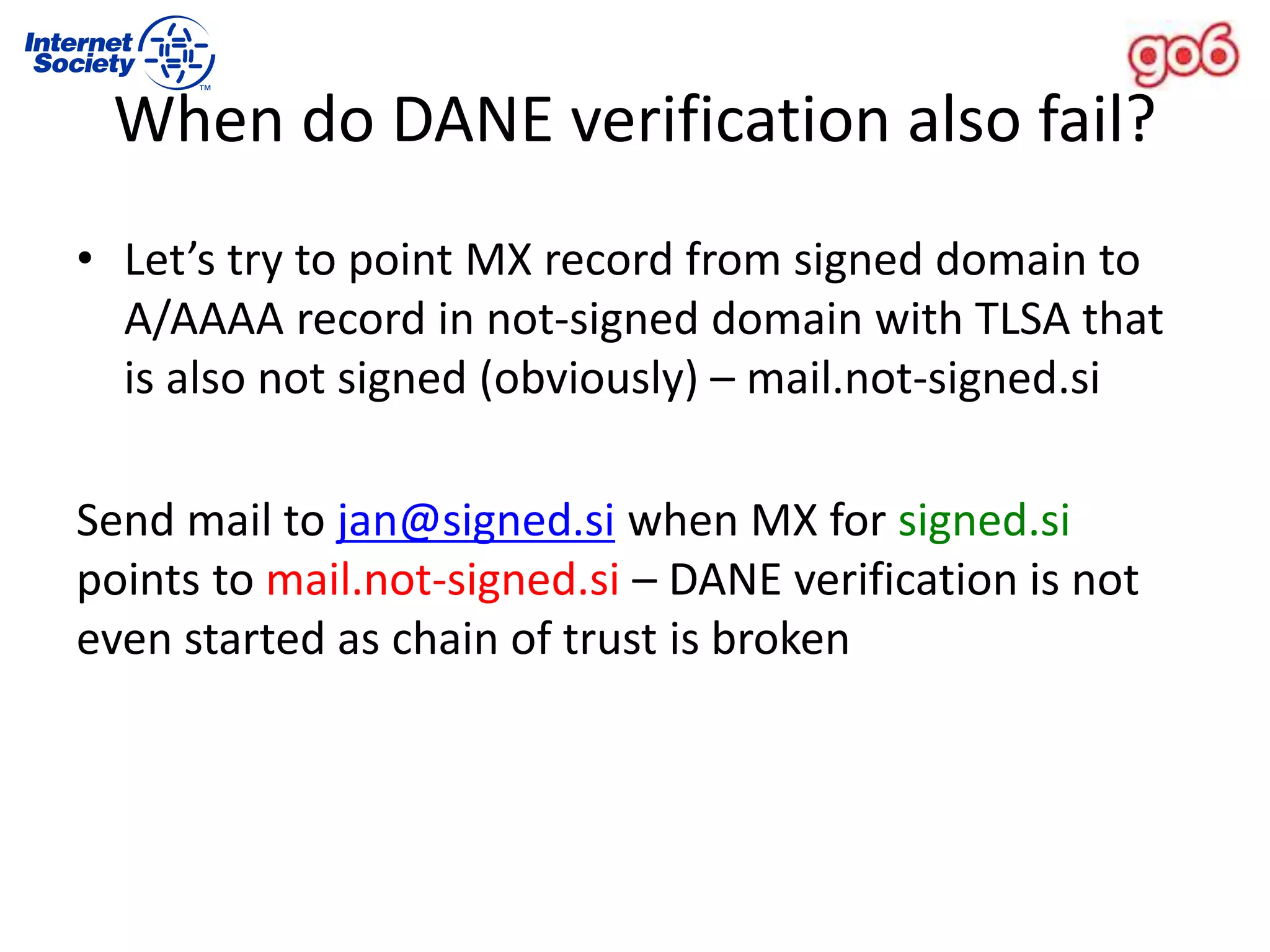
• Let’s try to point MX record from signed domain to
A/AAAA record in not-signed domain with TLSA that
is also not signed (obviously) – mail.not-signed.si
Send mail to jan@signed.si when MX for signed.si
points to mail.not-signed.si – DANE verification is not
even started as chain of trust is broken
When do DANE verification also fail?
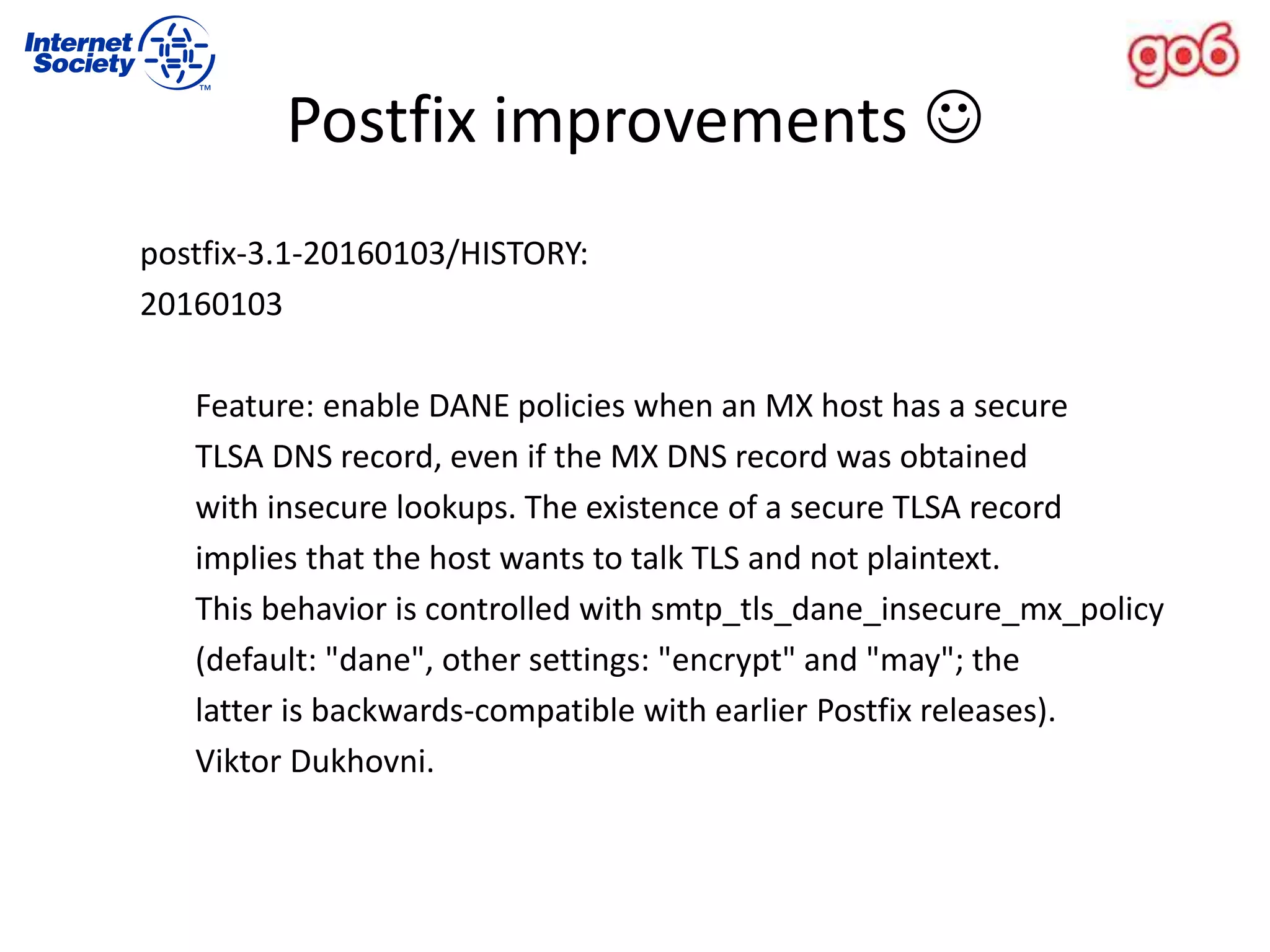
postfix-3.1-20160103/HISTORY:
20160103
Feature: enable DANE policies when an MX host has a secure
TLSA DNS record, even if the MX DNS record was obtained
with insecure lookups. The existence of a secure TLSA record
implies that the host wants to talk TLS and not plaintext.
This behavior is controlled with smtp_tls_dane_insecure_mx_policy
(default: "dane", other settings: "encrypt" and "may"; the
latter is backwards-compatible with earlier Postfix releases).
Viktor Dukhovni.
Postfix improvements 
Let’s Encrypt, DANE and mail
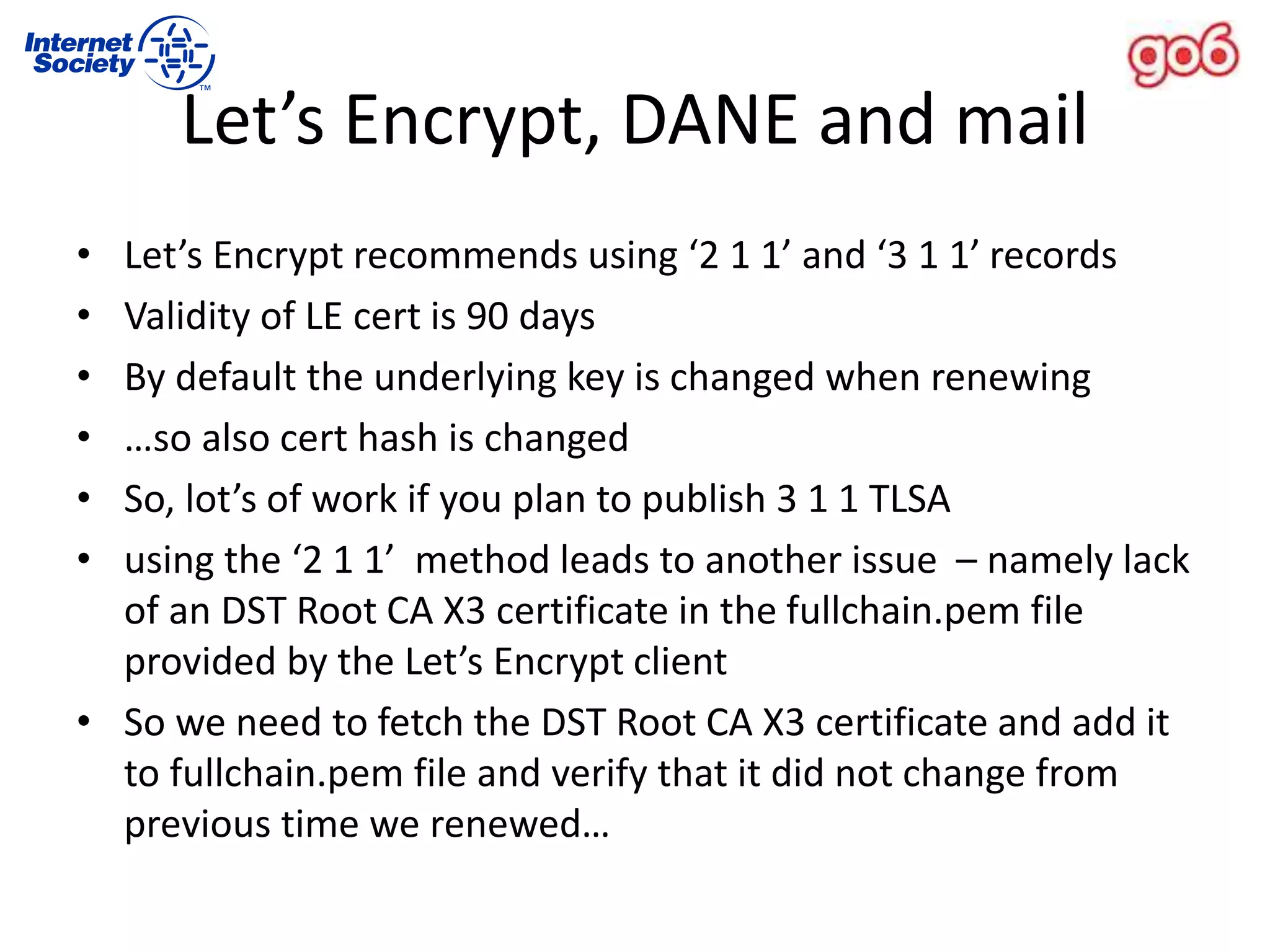
• Let’s Encrypt recommends using ‘2 1 1’ and ‘3 1 1’ records
• Validity of LE cert is 90 days
• By default the underlying key is changed when renewing
• …so also cert hash is changed
• So, lot’s of work if you plan to publish 3 1 1 TLSA
• using the ‘2 1 1’ method leads to another issue – namely lack
of an DST Root CA X3 certificate in the fullchain.pem file
provided by the Let’s Encrypt client
• So we need to fetch the DST Root CA X3 certificate and add it
to fullchain.pem file and verify that it did not change from
previous time we renewed…
Script to add DST Root CA X3
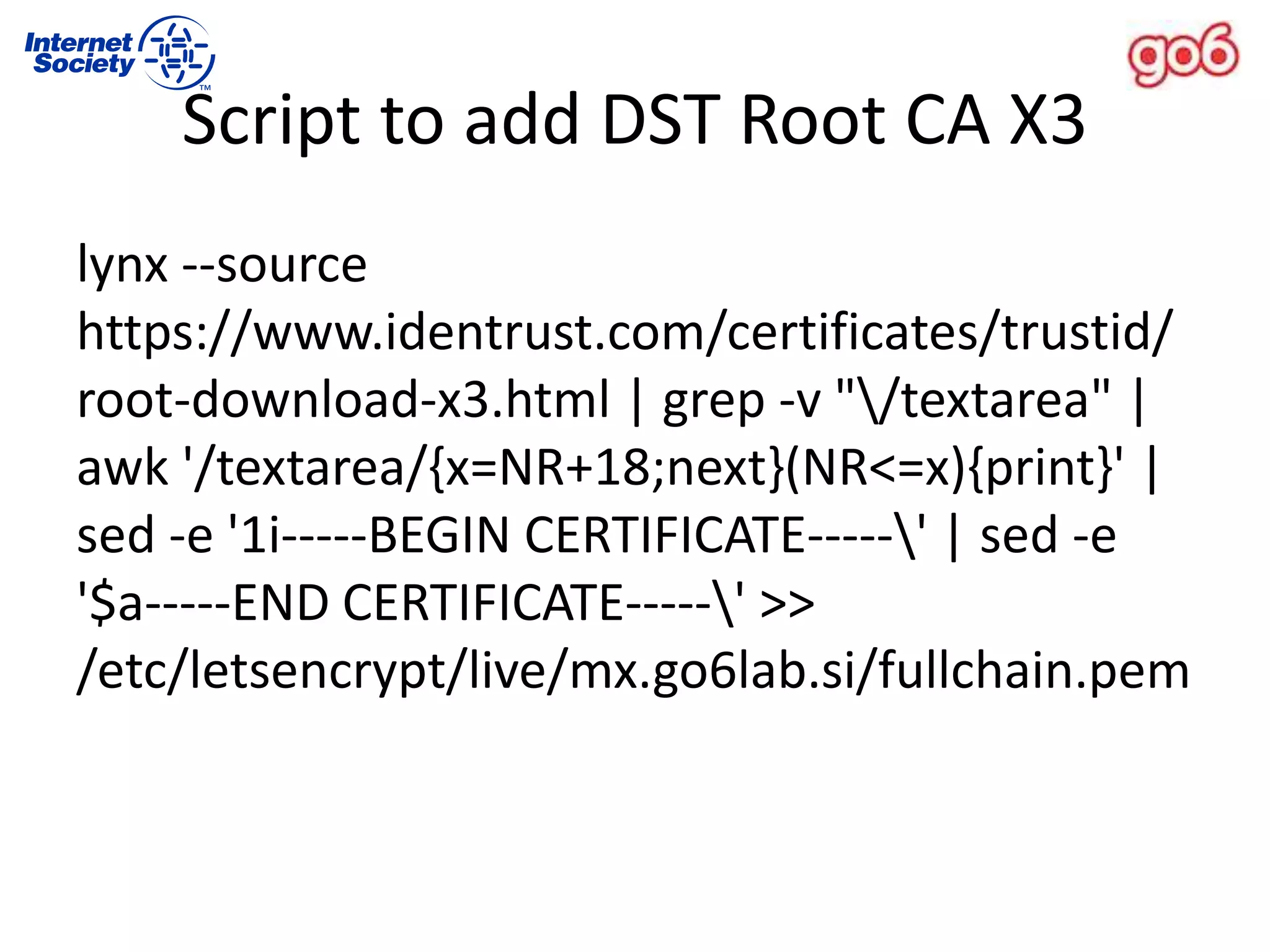
lynx --source
https://www.identrust.com/certificates/trustid/
root-download-x3.html | grep -v "/textarea" |
awk '/textarea/{x=NR+18;next}(NR<=x){print}' |
sed -e '1i-----BEGIN CERTIFICATE-----' | sed -e
'$a-----END CERTIFICATE-----' >>
/etc/letsencrypt/live/mx.go6lab.si/fullchain.pem
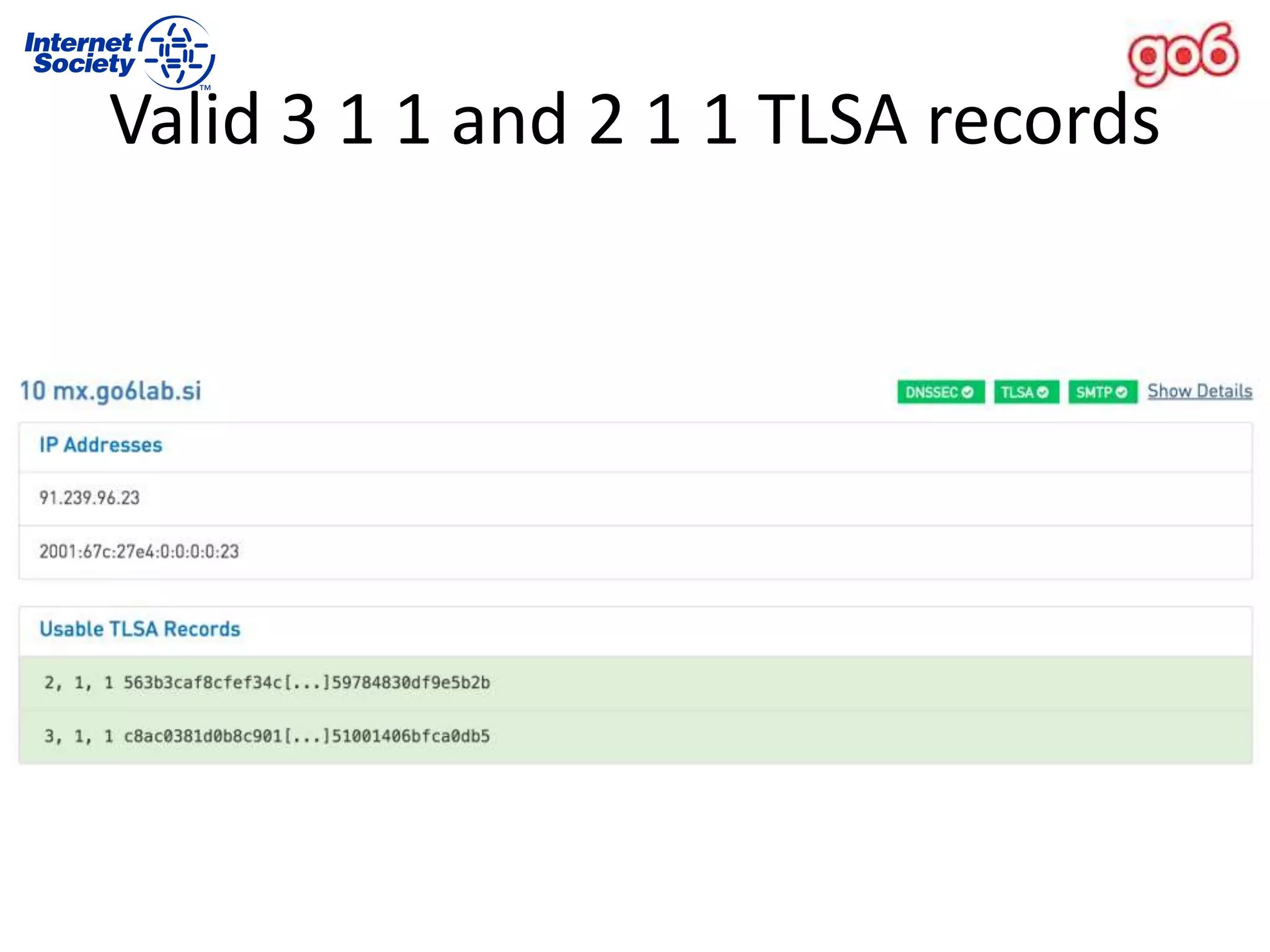
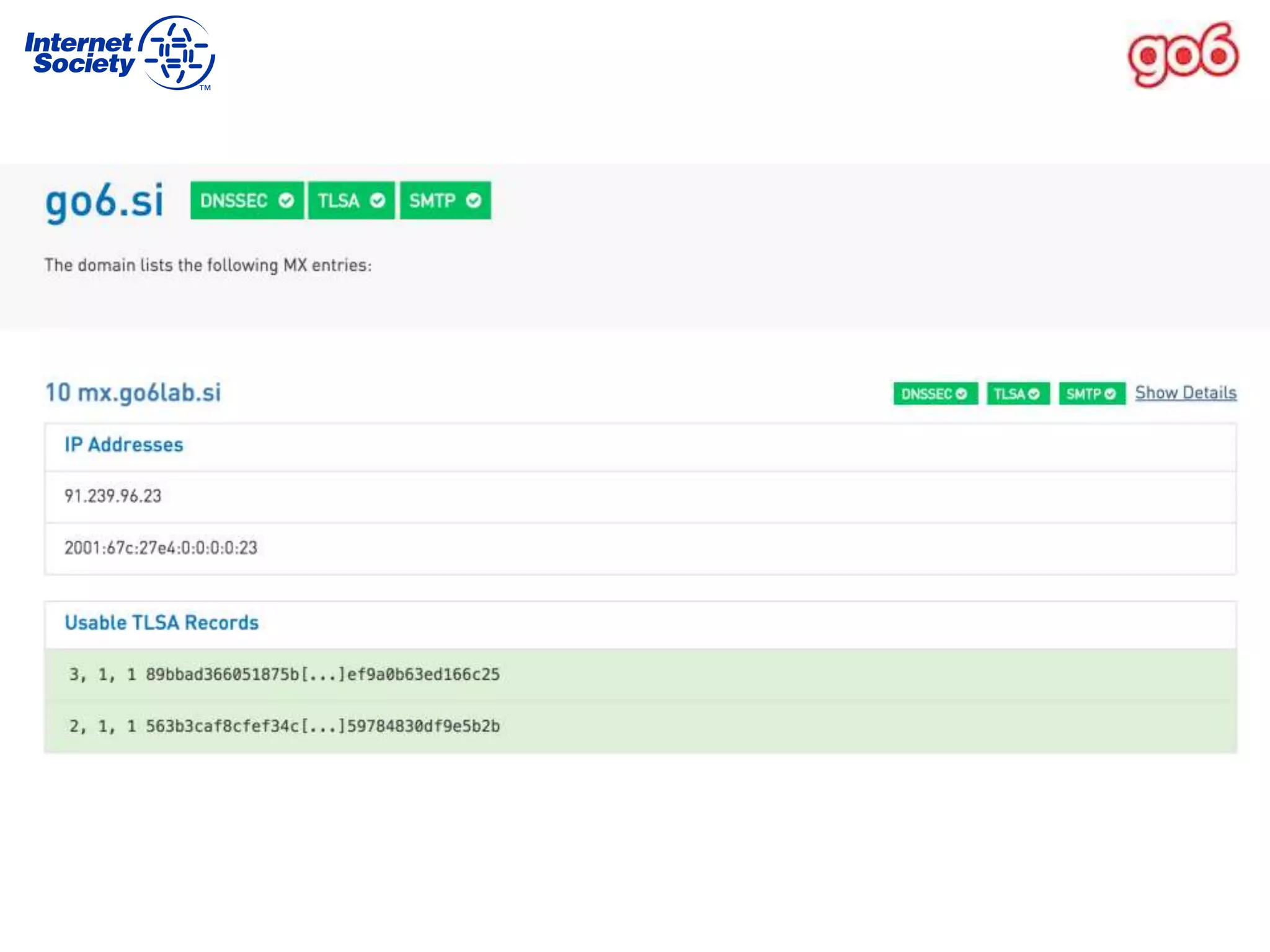
Valid 3 1 1 and 2 1 1 TLSA records
But…
• At next certificate renew, by default
underlying key will change and 3 1 1 TLSA
record will become invalid…
• Labor wise, we need to keep the underlying
key through the renewals
• --csr option in letsencrypt-auto client
• In direcotry “examples” there is “generate-
csr.sh” file (letsencrypt branch)
Stable underlying key…
./generate-csr.sh mx.go6lab.si
Generating a 2048 bit RSA private key
................+++
..+++
writing new private key to 'key.pem'
-----
You can now run: letsencrypt auth --csr csr.der
Renewals and hashes…
• Now we are using the same underlying key for
automatic renewals of certificate, so hash does not
change and 3 1 1 TLSA record works.
• We’ll rotate the underlying key when we decide to
and being driven by human intervention (and also
change the TLSA).
• ./certbot-auto certonly --debug --renew-by-default -a
standalone --csr ./mx.go6lab.si.der –keep
• Of course, we add DST Root CA X3 certificate to
fullchain.pem
More reading:
http://www.internetsociety.org/deploy360/blog
/2016/01/lets-encrypt-certificates-for-mail-
servers-and-dane-part-1-of-2/
http://www.internetsociety.org/deploy360/blog
/2016/03/lets-encrypt-certificates-for-mail-
servers-and-dane-part-2-of-2/
Q&A
Questions? Protests?
Suggestions? Complaints?
zorz@isoc.org

ION Bucharest - DANE-DNSSEC-TLS

  • 1.
    Jan Žorž, InternetSociety - zorz@isoc.org
  • 2.
    Acknowledgement I would liketo thank Internet Society to let me spend some of my ISOC working time in go6lab and test all this new and exciting protocols and mechanisms that makes Internet a bit better and more secure place…
  • 3.
    DNSSEC implementation ingo6lab • Powerdns server (used as primary for non- signed domains) as “hidden” primary DNS server • OpenDNSSEC platform for signing domains • BIND9 DNS servers as secondaries to OpenDNSSEC to serve signed zones • Virtualization used: PROXMOX 3.4 • OS templates: fedora-20, Centos6/7
  • 4.
    DNSSEC implementation ingo6lab • “Bump in a wire” • Two public “primary” servers • Concept:
  • 5.
    DNSSEC in go6lab •That was fairly easy and it works very well. • Implementation document used from Matthijs Mekking: https://go6.si/docs/opendnssec-start-guide-draft.pdf
  • 6.
    DANE experiment • WhenDNSSEC was set up and functioning we started to experiment with DANE (DNS Authenticated Name Entities). • Requirements: – DNSSEC signed domains – Postfix server with TLS support > 2.11 • We decided on Postfix 3.0.1
  • 7.
    DANE • TLSA recordfor mx.go6lab.si _25._tcp.mx.go6lab.si. IN TLSA 3 0 1 B4B7A46F9F0DFEA0151C2E07A5AD7908F4C8B0050E7CC 25908DA05E2 A84748ED It’s basically a hash of TLS certificate on mx.go6lab.si More about DANE: http://www.internetsociety.org/deploy360/resources/da ne/
  • 8.
    What is DANEand how does it work
  • 11.
    DANE verification • Mx.go6lab.siwas able to verify TLS cert to T-2 mail server and nlnet-labs and some others… mx postfix/smtp[31332]: Verified TLS connection established to smtp-good-in-2.t-2.si[2a01:260:1:4::24]:25: TLSv1 with cipher DHE-RSA-AES256-SHA (256/256 bits) dicht postfix/smtp[29540]: Verified TLS connection established to mx.go6lab.si[2001:67c:27e4::23]:25: TLSv1.2 with cipher ECDHE-RSA-AES256-GCM-SHA384 (256/256 bits)
  • 12.
    Postfix config smtpd_use_tls =yes smtpd_tls_security_level = may smtpd_tls_key_file = /etc/postfix/ssl/server.pem smtpd_tls_cert_file = /etc/postfix/ssl/server.pem smtpd_tls_auth_only = no smtpd_tls_loglevel = 1 smtpd_tls_received_header = yes smtpd_tls_session_cache_timeout = 3600s smtp_tls_security_level = dane smtp_use_tls = yes smtp_tls_note_starttls_offer = yes smtp_tls_loglevel = 1 tls_random_exchange_name = /var/run/prng_exch tls_random_source = dev:/dev/urandom tls_smtp_use_tls = yes
  • 13.
    1M top Alexadomains and DANE • We fetched top 1 million Alexa domains and created a script that sent an email to each of them ( test-dnssec-dane@[domain] ) • After some tweaking of the script we got some good results • Then we built a script that parsed mail log file and here are the results:
  • 14.
    Results • Out of1 million domains, 992,232 of them had MX record and mail server. • Nearly 70% (687,897) of all attempted SMTP sessions to Alexa top 1 million domains MX records were encrypted with TLS • Majority of TLS connections (60%) were established with trusted certificate • 1,382 connections where remote mail server announced TLS capability failed with "Cannot start TLS: handshake failure"
  • 15.
    More results TLS establishedconnections ratios are: Anonymous: 109.753 Untrusted: 167.063 Trusted: 410.953 Verified: 128 Quick guide: Anonymous (opportunistic TLS with no signature), Untrusted (peer certificate not signed by trusted CA), Trusted (peer certificate signed by trusted CA) and Verified (verified with TLSA by DANE).
  • 16.
  • 17.
    Mail distribution Mail Servers# Domains Handled TLS State google.com 125,422 Trusted secureserver.net 35,759 Some Trusted, some no TLS at all qq.com 11,254 No TLS Yandex.ru 9,268 Trusted Ovh.net 8.531 Most Trusted, with redirect servers having no TLS at all
  • 18.
    Mail distribution Mail Servers# Domains Handled TLS State Emailsrvr.com 8,262 Trusted Zohomail.com 2.981 Trusted Lolipop.jp 1.685 No TLS Kundenserver.de 2,834 Trusted Gandi.net 2,200 Anonymous
  • 19.
    DNSSEC? DANE? None ofthese “big” mail servers (and their domains) are DNSSEC signed (that meant no DANE for them possible up to January 2016).
  • 20.
    Malformed TLSA record •We created a TLSA record with a bad hash (one character changed) • Postfix failed to verify it and refused to send a message mx postfix/smtp[1765]: Untrusted TLS connection established to mail-bad.go6lab.si[2001:67c:27e4::beee]:25: TLSv1.2 with cipher ECDHE-RSA-AES256-GCM-SHA384 (256/256 bits) mx postfix/smtp[1765]: 3A4BE8EE5C: Server certificate not trusted
  • 21.
    • Of course,with wrong certificate hash in TLSA record (refuses to send mail) • If domain where MX record resides is not DNSSEC signed (can’t trust the data in MX, so no verification) • If TLSA record published in non-DNSSEC zone (can’t trust the data in TLSA, so no verification) When do DANE things fail?
  • 22.
    • go6lab.si zoneis signed, so is mx.go6lab.si • there is TLSA for mx.go6lab.si, also signed • Domain signed.si is signed and MX points to mx.go6lab.si • Domain not-signed.si is not signed and MX points to mx.go6lab.si • We send email to jan@signed.si and jan@not- signed.si (signed.si and not-signed.si are used just as examples) When do things fail? (example)
  • 23.
    When I sendemail to jan@signed.si (signed domain): Verified TLS connection established to mx.go6lab.si[2001:67c:27e4::23]:25: When I send email to jan@not-signed.si (not signed domain): Anonymous TLS connection established to mx.go6lab.si[2001:67c:27e4::23]:25: When do things fail? (example)
  • 24.
    • Let’s tryto point MX record from signed domain to A/AAAA record in not-signed domain with TLSA that is also not signed (obviously) – mail.not-signed.si Send mail to jan@signed.si when MX for signed.si points to mail.not-signed.si – DANE verification is not even started as chain of trust is broken When do DANE verification also fail?
  • 25.
    postfix-3.1-20160103/HISTORY: 20160103 Feature: enable DANEpolicies when an MX host has a secure TLSA DNS record, even if the MX DNS record was obtained with insecure lookups. The existence of a secure TLSA record implies that the host wants to talk TLS and not plaintext. This behavior is controlled with smtp_tls_dane_insecure_mx_policy (default: "dane", other settings: "encrypt" and "may"; the latter is backwards-compatible with earlier Postfix releases). Viktor Dukhovni. Postfix improvements 
  • 26.
    Let’s Encrypt, DANEand mail • Let’s Encrypt recommends using ‘2 1 1’ and ‘3 1 1’ records • Validity of LE cert is 90 days • By default the underlying key is changed when renewing • …so also cert hash is changed • So, lot’s of work if you plan to publish 3 1 1 TLSA • using the ‘2 1 1’ method leads to another issue – namely lack of an DST Root CA X3 certificate in the fullchain.pem file provided by the Let’s Encrypt client • So we need to fetch the DST Root CA X3 certificate and add it to fullchain.pem file and verify that it did not change from previous time we renewed…
  • 27.
    Script to addDST Root CA X3 lynx --source https://www.identrust.com/certificates/trustid/ root-download-x3.html | grep -v "/textarea" | awk '/textarea/{x=NR+18;next}(NR<=x){print}' | sed -e '1i-----BEGIN CERTIFICATE-----' | sed -e '$a-----END CERTIFICATE-----' >> /etc/letsencrypt/live/mx.go6lab.si/fullchain.pem
  • 28.
    Valid 3 11 and 2 1 1 TLSA records
  • 29.
    But… • At nextcertificate renew, by default underlying key will change and 3 1 1 TLSA record will become invalid… • Labor wise, we need to keep the underlying key through the renewals • --csr option in letsencrypt-auto client • In direcotry “examples” there is “generate- csr.sh” file (letsencrypt branch)
  • 30.
    Stable underlying key… ./generate-csr.shmx.go6lab.si Generating a 2048 bit RSA private key ................+++ ..+++ writing new private key to 'key.pem' ----- You can now run: letsencrypt auth --csr csr.der
  • 31.
    Renewals and hashes… •Now we are using the same underlying key for automatic renewals of certificate, so hash does not change and 3 1 1 TLSA record works. • We’ll rotate the underlying key when we decide to and being driven by human intervention (and also change the TLSA). • ./certbot-auto certonly --debug --renew-by-default -a standalone --csr ./mx.go6lab.si.der –keep • Of course, we add DST Root CA X3 certificate to fullchain.pem
  • 33.
  • 34.