2012 © m@tthewa.co.uk
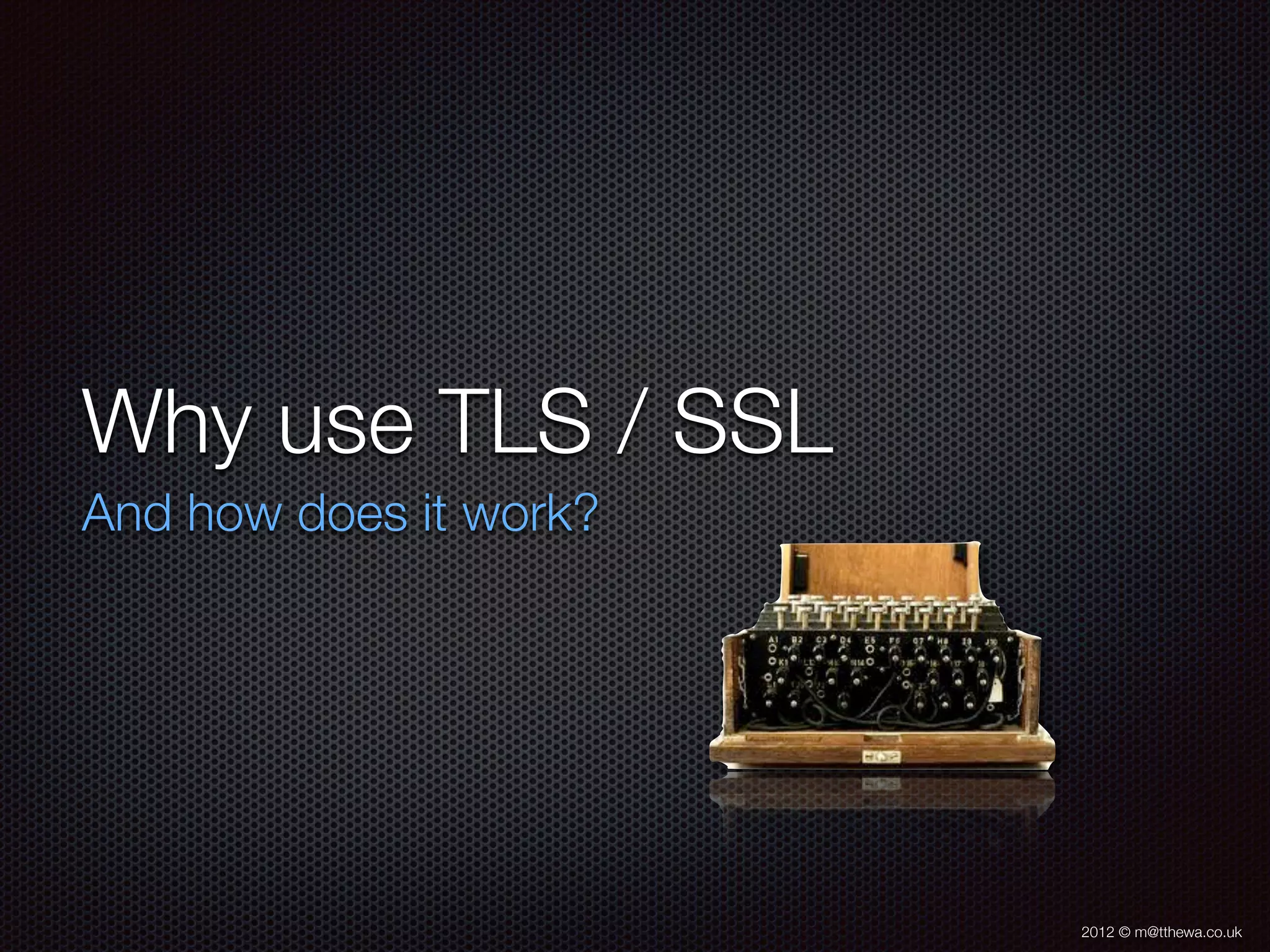
Why use TLS / SSL
And how does it work?
2012 © m@tthewa.co.uk
What we will cover
History of TLS SSL
Purpose of SSL
Understand Asymmetric and Symmetric Cryptography
Drawbacks
Uses of SSL
Public Key Infrastructure (PKI)
Its position in the OSI model
Overview of the Handshake and Record layers & cipher suite’s
Why you’re exposed without it
Questions - Further reading
2012 © m@tthewa.co.uk
History
2012 © m@tthewa.co.uk
History
1994 - Secure Sockets Layer (SSL) was developed by
Netscape as a protocol which permitted persistent and
secure transactions
2012 © m@tthewa.co.uk
History
1994 - Secure Sockets Layer (SSL) was developed by
Netscape as a protocol which permitted persistent and
secure transactions
1997 - an Open Source version of Netscape’s patented
version was created, which is now OpenSSL
2012 © m@tthewa.co.uk
History
1994 - Secure Sockets Layer (SSL) was developed by
Netscape as a protocol which permitted persistent and
secure transactions
1997 - an Open Source version of Netscape’s patented
version was created, which is now OpenSSL
1999 - the existing protocol was extended by a version
now known as Transport Layer Security (TLS). By
convention, the term "SSL" is used even when
technically the TLS protocol is being used.
2012 © m@tthewa.co.uk
Using SSL we can
Confirm identity - certificate
CSR process with trusted
root providers (OS out of
box) e.g. TWATE, Comodo
Encrypt the conversation
2012 © m@tthewa.co.uk
What is SSL?
Uses Asymmetric and
Symmetric cryptography
Uses Public Key
Infrastructure (PKI)
RFC-5246
2012 © m@tthewa.co.uk
What is SSL?
Uses Asymmetric and
Symmetric cryptography
Uses Public Key
Infrastructure (PKI)
RFC-5246
2012 © m@tthewa.co.uk
What is SSL?
Uses Asymmetric and
Symmetric cryptography
Uses Public Key
Infrastructure (PKI)
RFC-5246
RFC-xxxx stands for "Request for Comment"
This refers to a description of a standard for new or modified internet or networking
protocols. When standards are proposed, they are made available for public comment
so that they can be refined and agreed upon. Internet Engineering Task Force (IETF)
2012 © m@tthewa.co.uk
SSL Cryptography
Asymmetric public-key cryptography
Something which is asymmetric displays asymmetry
Asymmetry is the opposite of symmetry i.e. they are not the same
Cryptography (or cryptology; from Greek κρυπτός, "hidden, secret code"
Pair of keys used to encrypt and decrypt - both 

a public and private (secret) key is needed. They work mathematically together
to achieve this
Symmetric private-key (shared secret key) both keys are the same, less CPU
intensive
2012 © m@tthewa.co.uk
Public Key Infrastructure
PKI is a system for the creation, storage, and distribution of digital certificates
which are used to verify that a particular public key belongs to a certain entity.
The PKI creates digital certificates which map public keys to entities, securely
stores these certificates in a central repository, and revokes them if needed
A PKI consists of
A certificate authority (CA) that both issues and verifies the digital
certificates
A registration authority (RA) which verifies the identity of users requesting
information from the CA, binds keys to users which may or may not be
separate from the CA
A central directory - a secure location in which to store and index keys
2012 © m@tthewa.co.uk
Drawbacks of SSL / TLS
Increased processor load - This is the most
significant drawback to implementing SSL / TLS.
Cryptography is CPU intensive. As a result, there is a
performance penalty when using SSL hence more
power consumed- less green
Administrative overhead - An SSL / TLS environment
is more complex and requires maintenance due to
expiry dates; the system administrator needs to
configure understand and manage certificates.
2012 © m@tthewa.co.uk
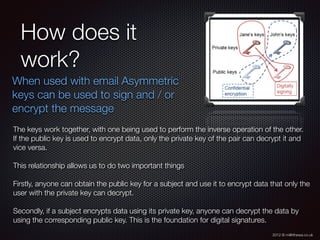
How does it
work?
When used with email Asymmetric
keys can be used to sign and / or
encrypt the message
The keys work together, with one being used to perform the inverse operation of the other.
If the public key is used to encrypt data, only the private key of the pair can decrypt it and
vice versa.
This relationship allows us to do two important things
Firstly, anyone can obtain the public key for a subject and use it to encrypt data that only the
user with the private key can decrypt.
Secondly, if a subject encrypts data using its private key, anyone can decrypt the data by
using the corresponding public key. This is the foundation for digital signatures.
2012 © m@tthewa.co.uk
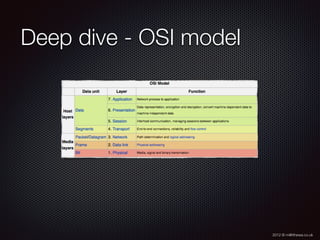
Deep dive - OSI model
2012 © m@tthewa.co.uk
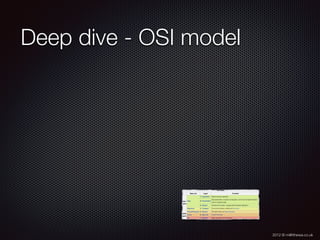
Deep dive - OSI model
2012 © m@tthewa.co.uk
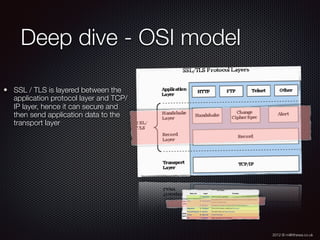
SSL / TLS is layered between the
application protocol layer and TCP/
IP layer, hence it can secure and
then send application data to the
transport layer
Deep dive - OSI model
2012 © m@tthewa.co.uk
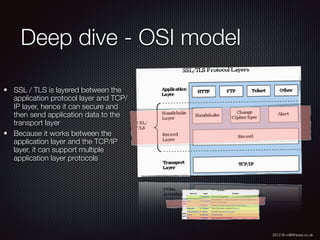
SSL / TLS is layered between the
application protocol layer and TCP/
IP layer, hence it can secure and
then send application data to the
transport layer
Because it works between the
application layer and the TCP/IP
layer, it can support multiple
application layer protocols
Deep dive - OSI model
2012 © m@tthewa.co.uk
SSL / TLS is layered between the
application protocol layer and TCP/
IP layer, hence it can secure and
then send application data to the
transport layer
Because it works between the
application layer and the TCP/IP
layer, it can support multiple
application layer protocols
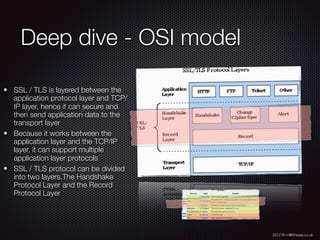
SSL / TLS protocol can be divided
into two layers.The Handshake
Protocol Layer and the Record
Protocol Layer
Deep dive - OSI model
2012 © m@tthewa.co.uk
Handshake Layer
The Handshake layer provides a number of very
important security functions. It performs a set of
exchanges that starts authentication and negotiates
the encryption, hash, and compression algorithms
(cipher suite)
hashing e.g. MD5, SHA-1(use a salt)
encryption uses cipher
symmetric - DES, AES
asymmetric - RSA
2012 © m@tthewa.co.uk
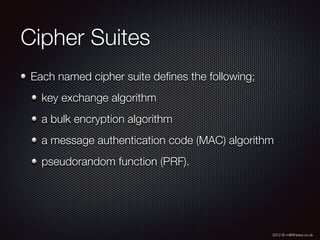
Cipher Suites
Each named cipher suite defines the following;
key exchange algorithm
a bulk encryption algorithm
a message authentication code (MAC) algorithm
pseudorandom function (PRF).
2012 © m@tthewa.co.uk
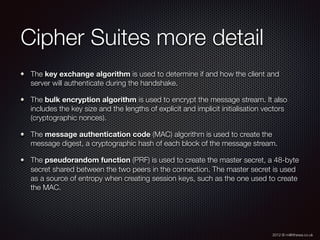
Cipher Suites more detail
The key exchange algorithm is used to determine if and how the client and
server will authenticate during the handshake.
The bulk encryption algorithm is used to encrypt the message stream. It also
includes the key size and the lengths of explicit and implicit initialisation vectors
(cryptographic nonces).
The message authentication code (MAC) algorithm is used to create the
message digest, a cryptographic hash of each block of the message stream.
The pseudorandom function (PRF) is used to create the master secret, a 48-byte
secret shared between the two peers in the connection. The master secret is used
as a source of entropy when creating session keys, such as the one used to create
the MAC.
2012 © m@tthewa.co.uk
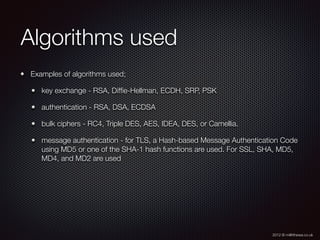
Algorithms used
Examples of algorithms used;
key exchange - RSA, Diffie-Hellman, ECDH, SRP, PSK
authentication - RSA, DSA, ECDSA
bulk ciphers - RC4, Triple DES, AES, IDEA, DES, or Camellia.
message authentication - for TLS, a Hash-based Message Authentication Code
using MD5 or one of the SHA-1 hash functions are used. For SSL, SHA, MD5,
MD4, and MD2 are used
2012 © m@tthewa.co.uk
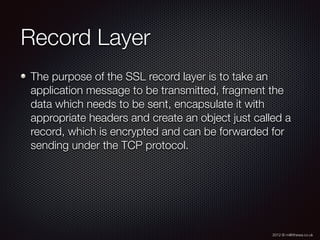
Record Layer
The purpose of the SSL record layer is to take an
application message to be transmitted, fragment the
data which needs to be sent, encapsulate it with
appropriate headers and create an object just called a
record, which is encrypted and can be forwarded for
sending under the TCP protocol.
2012 © m@tthewa.co.uk
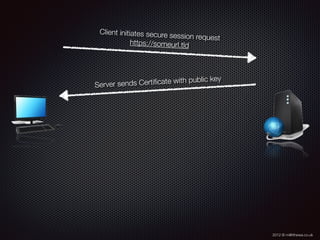
Client initiates secure session request
https://someurl.tld
2012 © m@tthewa.co.uk
Client initiates secure session request
https://someurl.tld
Server sends Certificate with public key
2012 © m@tthewa.co.uk
Client initiates secure session request
https://someurl.tld
Server sends Certificate with public key
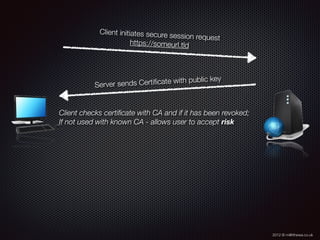
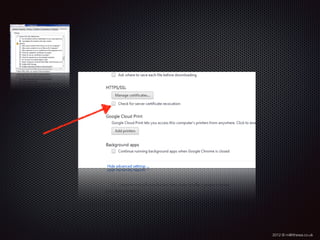
Client checks certificate with CA and if it has been revoked;
If not used with known CA - allows user to accept risk
2012 © m@tthewa.co.uk
Client initiates secure session request
https://someurl.tld
Server sends Certificate with public key
Client checks certificate with CA and if it has been revoked;
If not used with known CA - allows user to accept risk
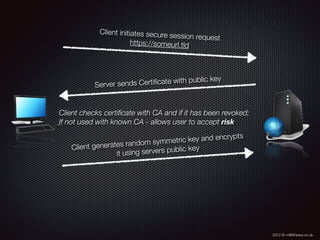
Client generates random symmetric key and encrypts
it using servers public key
2012 © m@tthewa.co.uk
Client initiates secure session request
https://someurl.tld
Server sends Certificate with public key
Client checks certificate with CA and if it has been revoked;
If not used with known CA - allows user to accept risk
Client generates random symmetric key and encrypts
it using servers public key
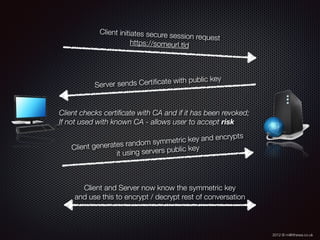
Client and Server now know the symmetric key
and use this to encrypt / decrypt rest of conversation
2012 © m@tthewa.co.uk
CA’s and CRL’s
2012 © m@tthewa.co.uk
CA’s and CRL’s
Certificate Authority (CA) - approved list in OS and
browsers out of the box; i.e. public keys of all major
certificate authorities
2012 © m@tthewa.co.uk
CA’s and CRL’s
Certificate Authority (CA) - approved list in OS and
browsers out of the box; i.e. public keys of all major
certificate authorities
NB. Subordinate CA’s are usually used so that Root
CA can revoke all Subordinates
2012 © m@tthewa.co.uk
CA’s and CRL’s
Certificate Authority (CA) - approved list in OS and
browsers out of the box; i.e. public keys of all major
certificate authorities
NB. Subordinate CA’s are usually used so that Root
CA can revoke all Subordinates
CA also has Certificate Revocation List - browser user
online search
2012 © m@tthewa.co.uk
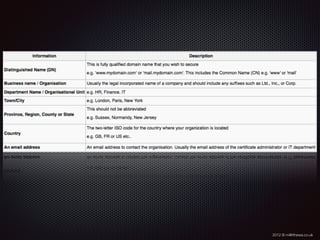
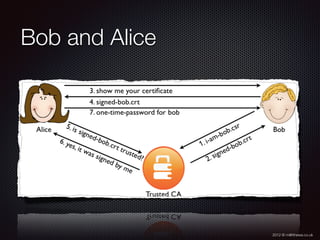
Obtain X.509 certificate from
a CA
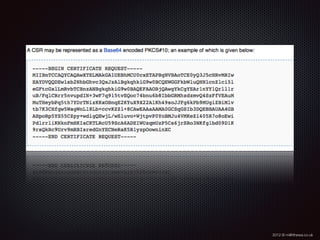
certificate signing request (CSR) - Contains details of
purpose, user, location and your public key
generate a CSR from the entity you want to use it with, part of this process will
first generate a key pair, keeping the private key secret, and will include your
details, and the encodes it using PKCS#10 standard; a binary format for
encoding CSRs for use with X.509.
you may need to provide further evidence of your identity, and the certificate
authority may contact the applicant for further information
if the request is successful, the certificate authority will send back an identity
certificate that has been digitally signed with the private key of the certificate
authority - and hence other people can validate it with the CA public key
2012 © m@tthewa.co.uk
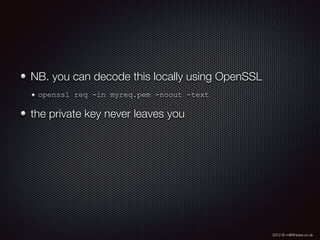
NB. you can decode this locally using OpenSSL
openssl req -in myreq.pem -noout -text
the private key never leaves you
2012 © m@tthewa.co.uk
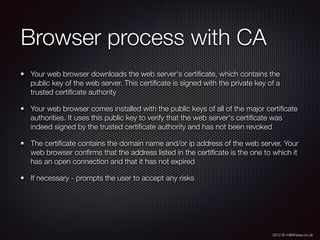
Browser process with CA	
Your web browser downloads the web server's certificate, which contains the
public key of the web server. This certificate is signed with the private key of a
trusted certificate authority
Your web browser comes installed with the public keys of all of the major certificate
authorities. It uses this public key to verify that the web server's certificate was
indeed signed by the trusted certificate authority and has not been revoked
The certificate contains the domain name and/or ip address of the web server. Your
web browser confirms that the address listed in the certificate is the one to which it
has an open connection and that it has not expired
If necessary - prompts the user to accept any risks
2012 © m@tthewa.co.uk
Bob and Alice
2012 © m@tthewa.co.uk
So why do we need it
2012 © m@tthewa.co.uk
Exploiting vulnerable traffic
Don't do this at work!!!
2012 © m@tthewa.co.uk
Exploiting vulnerable traffic
Don't do this at work!!!
2012 © m@tthewa.co.uk
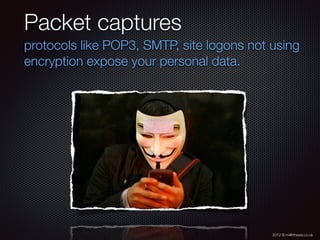
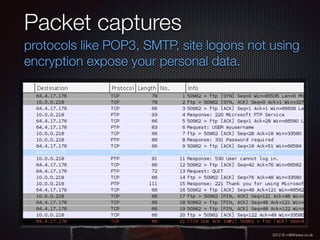
protocols like POP3, SMTP, site logons not using
encryption expose your personal data.
Packet captures
2012 © m@tthewa.co.uk
protocols like POP3, SMTP, site logons not using
encryption expose your personal data.
Packet captures
2012 © m@tthewa.co.uk
protocols like POP3, SMTP, site logons not using
encryption expose your personal data.
Packet captures
2012 © m@tthewa.co.uk
HTTP session hijacking
2012 © m@tthewa.co.uk
HTTP session hijacking
"sidejacking" - allowing you to do anything the user can
do on a particular website. On an open wireless
network, cookies are basically shouted through the air,
making these attacks extremely easy. e.g. Facebook,
only used to secure your logon, everything else was
then plain text - still need to tick a box
2012 © m@tthewa.co.uk
HTTP session hijacking
"sidejacking" - allowing you to do anything the user can
do on a particular website. On an open wireless
network, cookies are basically shouted through the air,
making these attacks extremely easy. e.g. Facebook,
only used to secure your logon, everything else was
then plain text - still need to tick a box
Twitter forced all third party developers to use OAuth
then immediately released (and promoted) a new
version of their insecure website. When it comes to
user privacy, SSL is a must!
2012 © m@tthewa.co.uk
http://codebutler.com/firesheep
2012 © m@tthewa.co.uk
Firesheep
http://codebutler.com/firesheep
2012 © m@tthewa.co.uk
Firesheep
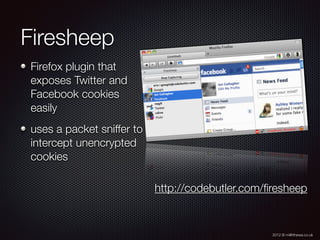
Firefox plugin that
exposes Twitter and
Facebook cookies
easily
uses a packet sniffer to
intercept unencrypted
cookies
http://codebutler.com/firesheep
2012 © m@tthewa.co.uk
Man in the Middle (MITM)
eavesdropping - the attacker sits between the victim
and the service they are using. With HTTP this would
be transparent - HTTPS helps you identify the
conversation is who you think it is
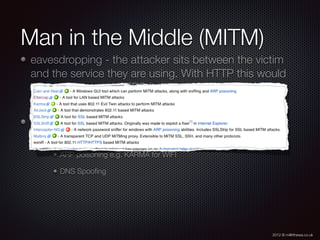
http://en.wikipedia.org/wiki/Man-in-the-middle_attack
shows easy to use free tools to perform such things
ARP poisoning e.g. KARMA for WIFI
DNS Spoofing
2012 © m@tthewa.co.uk
Man in the Middle (MITM)
eavesdropping - the attacker sits between the victim
and the service they are using. With HTTP this would
be transparent - HTTPS helps you identify the
conversation is who you think it is
http://en.wikipedia.org/wiki/Man-in-the-middle_attack
shows easy to use free tools to perform such things
ARP poisoning e.g. KARMA for WIFI
DNS Spoofing
2012 © m@tthewa.co.uk
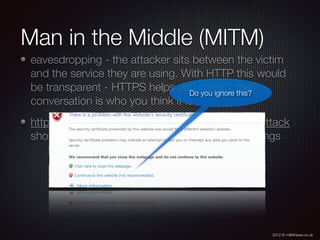
Man in the Middle (MITM)
eavesdropping - the attacker sits between the victim
and the service they are using. With HTTP this would
be transparent - HTTPS helps you identify the
conversation is who you think it is
http://en.wikipedia.org/wiki/Man-in-the-middle_attack
shows easy to use free tools to perform such things
ARP poisoning e.g. KARMA for WIFI
DNS Spoofing
Do you ignore this?
2012 © m@tthewa.co.uk
Final Questions?
2012 © m@tthewa.co.uk
What did we learn
2012 © m@tthewa.co.uk
What did we learn
Why SSL is important - check your Facebook settings
2012 © m@tthewa.co.uk
What did we learn
Why SSL is important - check your Facebook settings
Difference between Hash and Cipher
2012 © m@tthewa.co.uk
What did we learn
Why SSL is important - check your Facebook settings
Difference between Hash and Cipher
MITM
2012 © m@tthewa.co.uk
What did we learn
Why SSL is important - check your Facebook settings
Difference between Hash and Cipher
MITM
Sidejacking
2012 © m@tthewa.co.uk
What did we learn
Why SSL is important - check your Facebook settings
Difference between Hash and Cipher
MITM
Sidejacking
CA’s and how Revocation works
2012 © m@tthewa.co.uk
What did we learn
Why SSL is important - check your Facebook settings
Difference between Hash and Cipher
MITM
Sidejacking
CA’s and how Revocation works
When was SSL first invented
2012 © m@tthewa.co.uk
What did we learn
Why SSL is important - check your Facebook settings
Difference between Hash and Cipher
MITM
Sidejacking
CA’s and how Revocation works
When was SSL first invented
Can a public key decrypt a private key

SSLtalk

  • 1.
    2012 © m@tthewa.co.uk Whyuse TLS / SSL And how does it work?
  • 2.
    2012 © m@tthewa.co.uk Whatwe will cover History of TLS SSL Purpose of SSL Understand Asymmetric and Symmetric Cryptography Drawbacks Uses of SSL Public Key Infrastructure (PKI) Its position in the OSI model Overview of the Handshake and Record layers & cipher suite’s Why you’re exposed without it Questions - Further reading
  • 3.
  • 4.
    2012 © m@tthewa.co.uk History 1994- Secure Sockets Layer (SSL) was developed by Netscape as a protocol which permitted persistent and secure transactions
  • 5.
    2012 © m@tthewa.co.uk History 1994- Secure Sockets Layer (SSL) was developed by Netscape as a protocol which permitted persistent and secure transactions 1997 - an Open Source version of Netscape’s patented version was created, which is now OpenSSL
  • 6.
    2012 © m@tthewa.co.uk History 1994- Secure Sockets Layer (SSL) was developed by Netscape as a protocol which permitted persistent and secure transactions 1997 - an Open Source version of Netscape’s patented version was created, which is now OpenSSL 1999 - the existing protocol was extended by a version now known as Transport Layer Security (TLS). By convention, the term "SSL" is used even when technically the TLS protocol is being used.
  • 7.
    2012 © m@tthewa.co.uk UsingSSL we can Confirm identity - certificate CSR process with trusted root providers (OS out of box) e.g. TWATE, Comodo Encrypt the conversation
  • 8.
    2012 © m@tthewa.co.uk Whatis SSL? Uses Asymmetric and Symmetric cryptography Uses Public Key Infrastructure (PKI) RFC-5246
  • 9.
    2012 © m@tthewa.co.uk Whatis SSL? Uses Asymmetric and Symmetric cryptography Uses Public Key Infrastructure (PKI) RFC-5246
  • 10.
    2012 © m@tthewa.co.uk Whatis SSL? Uses Asymmetric and Symmetric cryptography Uses Public Key Infrastructure (PKI) RFC-5246 RFC-xxxx stands for "Request for Comment" This refers to a description of a standard for new or modified internet or networking protocols. When standards are proposed, they are made available for public comment so that they can be refined and agreed upon. Internet Engineering Task Force (IETF)
  • 11.
    2012 © m@tthewa.co.uk SSLCryptography Asymmetric public-key cryptography Something which is asymmetric displays asymmetry Asymmetry is the opposite of symmetry i.e. they are not the same Cryptography (or cryptology; from Greek κρυπτός, "hidden, secret code" Pair of keys used to encrypt and decrypt - both 
 a public and private (secret) key is needed. They work mathematically together to achieve this Symmetric private-key (shared secret key) both keys are the same, less CPU intensive
  • 12.
    2012 © m@tthewa.co.uk PublicKey Infrastructure PKI is a system for the creation, storage, and distribution of digital certificates which are used to verify that a particular public key belongs to a certain entity. The PKI creates digital certificates which map public keys to entities, securely stores these certificates in a central repository, and revokes them if needed A PKI consists of A certificate authority (CA) that both issues and verifies the digital certificates A registration authority (RA) which verifies the identity of users requesting information from the CA, binds keys to users which may or may not be separate from the CA A central directory - a secure location in which to store and index keys
  • 13.
    2012 © m@tthewa.co.uk Drawbacksof SSL / TLS Increased processor load - This is the most significant drawback to implementing SSL / TLS. Cryptography is CPU intensive. As a result, there is a performance penalty when using SSL hence more power consumed- less green Administrative overhead - An SSL / TLS environment is more complex and requires maintenance due to expiry dates; the system administrator needs to configure understand and manage certificates.
  • 14.
    2012 © m@tthewa.co.uk Howdoes it work? When used with email Asymmetric keys can be used to sign and / or encrypt the message The keys work together, with one being used to perform the inverse operation of the other. If the public key is used to encrypt data, only the private key of the pair can decrypt it and vice versa. This relationship allows us to do two important things Firstly, anyone can obtain the public key for a subject and use it to encrypt data that only the user with the private key can decrypt. Secondly, if a subject encrypts data using its private key, anyone can decrypt the data by using the corresponding public key. This is the foundation for digital signatures.
  • 15.
  • 16.
  • 17.
    2012 © m@tthewa.co.uk SSL/ TLS is layered between the application protocol layer and TCP/ IP layer, hence it can secure and then send application data to the transport layer Deep dive - OSI model
  • 18.
    2012 © m@tthewa.co.uk SSL/ TLS is layered between the application protocol layer and TCP/ IP layer, hence it can secure and then send application data to the transport layer Because it works between the application layer and the TCP/IP layer, it can support multiple application layer protocols Deep dive - OSI model
  • 19.
    2012 © m@tthewa.co.uk SSL/ TLS is layered between the application protocol layer and TCP/ IP layer, hence it can secure and then send application data to the transport layer Because it works between the application layer and the TCP/IP layer, it can support multiple application layer protocols SSL / TLS protocol can be divided into two layers.The Handshake Protocol Layer and the Record Protocol Layer Deep dive - OSI model
  • 20.
    2012 © m@tthewa.co.uk HandshakeLayer The Handshake layer provides a number of very important security functions. It performs a set of exchanges that starts authentication and negotiates the encryption, hash, and compression algorithms (cipher suite) hashing e.g. MD5, SHA-1(use a salt) encryption uses cipher symmetric - DES, AES asymmetric - RSA
  • 21.
    2012 © m@tthewa.co.uk CipherSuites Each named cipher suite defines the following; key exchange algorithm a bulk encryption algorithm a message authentication code (MAC) algorithm pseudorandom function (PRF).
  • 22.
    2012 © m@tthewa.co.uk CipherSuites more detail The key exchange algorithm is used to determine if and how the client and server will authenticate during the handshake. The bulk encryption algorithm is used to encrypt the message stream. It also includes the key size and the lengths of explicit and implicit initialisation vectors (cryptographic nonces). The message authentication code (MAC) algorithm is used to create the message digest, a cryptographic hash of each block of the message stream. The pseudorandom function (PRF) is used to create the master secret, a 48-byte secret shared between the two peers in the connection. The master secret is used as a source of entropy when creating session keys, such as the one used to create the MAC.
  • 23.
    2012 © m@tthewa.co.uk Algorithmsused Examples of algorithms used; key exchange - RSA, Diffie-Hellman, ECDH, SRP, PSK authentication - RSA, DSA, ECDSA bulk ciphers - RC4, Triple DES, AES, IDEA, DES, or Camellia. message authentication - for TLS, a Hash-based Message Authentication Code using MD5 or one of the SHA-1 hash functions are used. For SSL, SHA, MD5, MD4, and MD2 are used
  • 24.
    2012 © m@tthewa.co.uk RecordLayer The purpose of the SSL record layer is to take an application message to be transmitted, fragment the data which needs to be sent, encapsulate it with appropriate headers and create an object just called a record, which is encrypted and can be forwarded for sending under the TCP protocol.
  • 25.
  • 26.
    2012 © m@tthewa.co.uk Clientinitiates secure session request https://someurl.tld
  • 27.
    2012 © m@tthewa.co.uk Clientinitiates secure session request https://someurl.tld Server sends Certificate with public key
  • 28.
    2012 © m@tthewa.co.uk Clientinitiates secure session request https://someurl.tld Server sends Certificate with public key Client checks certificate with CA and if it has been revoked; If not used with known CA - allows user to accept risk
  • 29.
    2012 © m@tthewa.co.uk Clientinitiates secure session request https://someurl.tld Server sends Certificate with public key Client checks certificate with CA and if it has been revoked; If not used with known CA - allows user to accept risk Client generates random symmetric key and encrypts it using servers public key
  • 30.
    2012 © m@tthewa.co.uk Clientinitiates secure session request https://someurl.tld Server sends Certificate with public key Client checks certificate with CA and if it has been revoked; If not used with known CA - allows user to accept risk Client generates random symmetric key and encrypts it using servers public key Client and Server now know the symmetric key and use this to encrypt / decrypt rest of conversation
  • 31.
  • 32.
    2012 © m@tthewa.co.uk CA’sand CRL’s Certificate Authority (CA) - approved list in OS and browsers out of the box; i.e. public keys of all major certificate authorities
  • 33.
    2012 © m@tthewa.co.uk CA’sand CRL’s Certificate Authority (CA) - approved list in OS and browsers out of the box; i.e. public keys of all major certificate authorities NB. Subordinate CA’s are usually used so that Root CA can revoke all Subordinates
  • 34.
    2012 © m@tthewa.co.uk CA’sand CRL’s Certificate Authority (CA) - approved list in OS and browsers out of the box; i.e. public keys of all major certificate authorities NB. Subordinate CA’s are usually used so that Root CA can revoke all Subordinates CA also has Certificate Revocation List - browser user online search
  • 35.
    2012 © m@tthewa.co.uk ObtainX.509 certificate from a CA certificate signing request (CSR) - Contains details of purpose, user, location and your public key generate a CSR from the entity you want to use it with, part of this process will first generate a key pair, keeping the private key secret, and will include your details, and the encodes it using PKCS#10 standard; a binary format for encoding CSRs for use with X.509. you may need to provide further evidence of your identity, and the certificate authority may contact the applicant for further information if the request is successful, the certificate authority will send back an identity certificate that has been digitally signed with the private key of the certificate authority - and hence other people can validate it with the CA public key
  • 36.
  • 37.
  • 38.
    2012 © m@tthewa.co.uk NB.you can decode this locally using OpenSSL openssl req -in myreq.pem -noout -text the private key never leaves you
  • 39.
    2012 © m@tthewa.co.uk Browserprocess with CA Your web browser downloads the web server's certificate, which contains the public key of the web server. This certificate is signed with the private key of a trusted certificate authority Your web browser comes installed with the public keys of all of the major certificate authorities. It uses this public key to verify that the web server's certificate was indeed signed by the trusted certificate authority and has not been revoked The certificate contains the domain name and/or ip address of the web server. Your web browser confirms that the address listed in the certificate is the one to which it has an open connection and that it has not expired If necessary - prompts the user to accept any risks
  • 40.
  • 41.
  • 42.
  • 43.
  • 44.
    2012 © m@tthewa.co.uk Sowhy do we need it
  • 45.
    2012 © m@tthewa.co.uk Exploitingvulnerable traffic Don't do this at work!!!
  • 46.
    2012 © m@tthewa.co.uk Exploitingvulnerable traffic Don't do this at work!!!
  • 47.
    2012 © m@tthewa.co.uk protocolslike POP3, SMTP, site logons not using encryption expose your personal data. Packet captures
  • 48.
    2012 © m@tthewa.co.uk protocolslike POP3, SMTP, site logons not using encryption expose your personal data. Packet captures
  • 49.
    2012 © m@tthewa.co.uk protocolslike POP3, SMTP, site logons not using encryption expose your personal data. Packet captures
  • 50.
    2012 © m@tthewa.co.uk HTTPsession hijacking
  • 51.
    2012 © m@tthewa.co.uk HTTPsession hijacking "sidejacking" - allowing you to do anything the user can do on a particular website. On an open wireless network, cookies are basically shouted through the air, making these attacks extremely easy. e.g. Facebook, only used to secure your logon, everything else was then plain text - still need to tick a box
  • 52.
    2012 © m@tthewa.co.uk HTTPsession hijacking "sidejacking" - allowing you to do anything the user can do on a particular website. On an open wireless network, cookies are basically shouted through the air, making these attacks extremely easy. e.g. Facebook, only used to secure your logon, everything else was then plain text - still need to tick a box Twitter forced all third party developers to use OAuth then immediately released (and promoted) a new version of their insecure website. When it comes to user privacy, SSL is a must!
  • 53.
  • 54.
  • 55.
    2012 © m@tthewa.co.uk Firesheep Firefoxplugin that exposes Twitter and Facebook cookies easily uses a packet sniffer to intercept unencrypted cookies http://codebutler.com/firesheep
  • 56.
    2012 © m@tthewa.co.uk Manin the Middle (MITM) eavesdropping - the attacker sits between the victim and the service they are using. With HTTP this would be transparent - HTTPS helps you identify the conversation is who you think it is http://en.wikipedia.org/wiki/Man-in-the-middle_attack shows easy to use free tools to perform such things ARP poisoning e.g. KARMA for WIFI DNS Spoofing
  • 57.
    2012 © m@tthewa.co.uk Manin the Middle (MITM) eavesdropping - the attacker sits between the victim and the service they are using. With HTTP this would be transparent - HTTPS helps you identify the conversation is who you think it is http://en.wikipedia.org/wiki/Man-in-the-middle_attack shows easy to use free tools to perform such things ARP poisoning e.g. KARMA for WIFI DNS Spoofing
  • 58.
    2012 © m@tthewa.co.uk Manin the Middle (MITM) eavesdropping - the attacker sits between the victim and the service they are using. With HTTP this would be transparent - HTTPS helps you identify the conversation is who you think it is http://en.wikipedia.org/wiki/Man-in-the-middle_attack shows easy to use free tools to perform such things ARP poisoning e.g. KARMA for WIFI DNS Spoofing Do you ignore this?
  • 59.
  • 60.
  • 61.
    2012 © m@tthewa.co.uk Whatdid we learn Why SSL is important - check your Facebook settings
  • 62.
    2012 © m@tthewa.co.uk Whatdid we learn Why SSL is important - check your Facebook settings Difference between Hash and Cipher
  • 63.
    2012 © m@tthewa.co.uk Whatdid we learn Why SSL is important - check your Facebook settings Difference between Hash and Cipher MITM
  • 64.
    2012 © m@tthewa.co.uk Whatdid we learn Why SSL is important - check your Facebook settings Difference between Hash and Cipher MITM Sidejacking
  • 65.
    2012 © m@tthewa.co.uk Whatdid we learn Why SSL is important - check your Facebook settings Difference between Hash and Cipher MITM Sidejacking CA’s and how Revocation works
  • 66.
    2012 © m@tthewa.co.uk Whatdid we learn Why SSL is important - check your Facebook settings Difference between Hash and Cipher MITM Sidejacking CA’s and how Revocation works When was SSL first invented
  • 67.
    2012 © m@tthewa.co.uk Whatdid we learn Why SSL is important - check your Facebook settings Difference between Hash and Cipher MITM Sidejacking CA’s and how Revocation works When was SSL first invented Can a public key decrypt a private key