© Peter R. Egli 2015
1/10
Rev. 1.90
DNS Security Extensions (DNSSEC) indigoo.com
Peter R. Egli
INDIGOO.COM
INTRODUCTION TO DNSSEC FOR
SECURING DNS QUERIES AND INFORMATION
DNSSECDNS SECURITY EXTENSIONS
© Peter R. Egli 2015
2/10
Rev. 1.90
DNS Security Extensions (DNSSEC) indigoo.com
Contents
1. Security Problems of DNS
2. Solutions for securing DNS
3. Security with DNSSEC
4. How to find the signer's public DNS key
5. DNS lookup: Recursive name servers
6. DNSSEC deployment
© Peter R. Egli 2015
3/10
Rev. 1.90
DNS Security Extensions (DNSSEC) indigoo.com
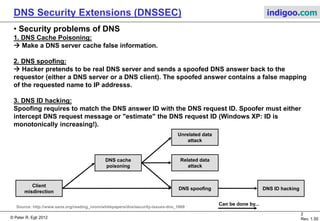
1. Security problems of DNS (1/3)
DNS is vulnerable to a number of attacks.
The attacks are usually targeted at misdirecting a client to a malicious server under the control
of the attacker.
Some attacks are now difficult to conduct since DNS servers like BIND fixed the software.
Still, DNS is too important thus warranting the need for cryptographic protection against
poisoning and spoofing.
Client
misdirection
DNS cache
poisoning
DNS spoofing
Related data
attack
DNS ID hacking
Can be done by...
Unrelated data
attack
© Peter R. Egli 2015
4/10
Rev. 1.90
DNS Security Extensions (DNSSEC) indigoo.com
1. Security problems of DNS (2/3)
DNS Cache Poisoning:
Inject false information into a DNS server's or a client's DNS cache.
DNS spoofing:
In a DNS spoofing attack, an attacker pretends to be a real DNS server and sends a spoofed
DNS answer back to the requestor (either a DNS server or a DNS client). The spoofed answer
contains a false mapping of the requested name to IP address.
DNS ID hacking:
Spoofing requires to match the DNS answer ID with the DNS request ID (DNS transaction ID).
Thus the attacker must either intercept the DNS request message or "estimate" the DNS
transaction ID in the spoofed response (e.g. in Windows XP the DNS ID is monotonically
increasing!).
DNS request, DNS ID = 0x0044
DNS Client Attacker DNS Server
Spoofed response, DNS ID = 0x0044
Legitimate response, DNS ID = 0x0044
© Peter R. Egli 2015
5/10
Rev. 1.90
DNS Security Extensions (DNSSEC) indigoo.com
1. Security problems of DNS (3/3)
Unrelated data attack:
In an unrelated data attack, the attacker sends back an answer to the query question, but adds
additional and unrelated IPname mappings to misdirect the client to a malicious site.
Related data attack:
A related data attack is similar to an unrelated attack with the difference that the attacker
sends extra information related to the query question such as spoofed MX, NS or CNAME
records.
Example question:
www.indigoo.com
Spoofed response with unrelated data:
www.indigoo.com. 1D IN NS www.attacker.com
www.attacker.com. 1D IN A 1.2.3.4
DNS request, question: www.indigoo.com
DNS Client Attacker
Answer 1: www.indigoo.com=85.10.192.4
Answer 2: www.mybank.com=1.2.3.4
(unrelated to request question)
© Peter R. Egli 2015
6/10
Rev. 1.90
DNS Security Extensions (DNSSEC) indigoo.com
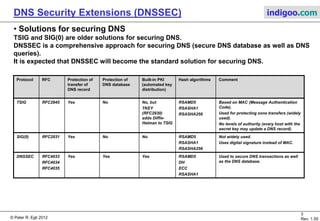
2. Solutions for securing DNS
TSIG and SIG(0) are older solutions for securing DNS.
DNSSEC is a comprehensive approach for securing DNS (secure DNS database as well as DNS
queries).
It is expected that DNSSEC will become the standard solution for securing DNS.
Protocol RFC Protection of
transfer of
DNS record
Protection of
DNS database
Built-in PKI
(automated key
distribution)
Hash algorithms Comment
TSIG RFC2845 Yes No No, but
TKEY
(RFC2930)
adds Diffie-
Helman to TSIG
RSAMD5
RSASHA1
RSASHA256
Based on MAC (Message Authentication
Code).
Used for protecting zone transfers (widely
used).
No levels of authority (every host with the
secret key may update a DNS record).
SIG(0) RFC2931 Yes No No RSAMD5
RSASHA1
RSASHA256
Not widely used.
Uses digital signature instead of MAC.
DNSSEC RFC4033
RFC4034
RFC4035
Yes Yes Yes RSAMD5
DH
ECC
RSASHA1
Used to secure DNS transactions as well
as the DNS database.
© Peter R. Egli 2015
7/10
Rev. 1.90
DNS Security Extensions (DNSSEC) indigoo.com
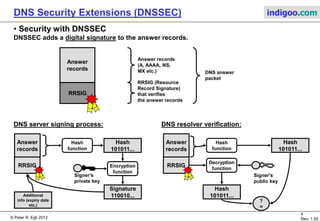
3. Security with DNSSEC
DNSSEC adds a digital signature to the answer records.
DNS server signing process: DNS resolver verification:
Answer
records
RRSIG
DNS answer
packet
Answer records
(A, AAAA, NS,
MX etc.)
RRSIG (Resource
Record Signature)
that verifies
the answer records
Answer
records
Hash
function
Hash
101011...
Encryption
function
RRSIG
Signature
110010...
Signer's
private key
Additional
info (expiry date
etc.)
Answer
records
RRSIG
Decryption
function
Signer's
public key
Hash
101011...
Hash
function
Hash
101011...
?
=
© Peter R. Egli 2015
8/10
Rev. 1.90
DNS Security Extensions (DNSSEC) indigoo.com
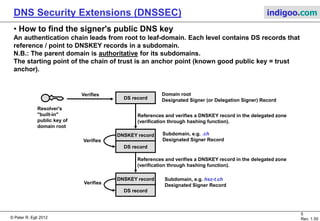
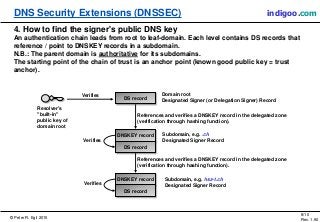
4. How to find the signer's public DNS key
An authentication chain leads from root to leaf-domain. Each level contains DS records that
reference / point to DNSKEY records in a subdomain.
N.B.: The parent domain is authoritative for its subdomains.
The starting point of the chain of trust is an anchor point (known good public key = trust
anchor).
Domain root
Designated Signer (or Delegation Signer) Record
Verifies
Subdomain, e.g. .ch
Designated Signer Record
References and verifies a DNSKEY record in the delegated zone
(verification through hashing function).
Subdomain, e.g. hsz-t.ch
Designated Signer Record
Resolver's
"built-in"
public key of
domain root
DS record
DNSKEY record
DS record
DNSKEY record
DS record
Verifies
Verifies
References and verifies a DNSKEY record in the delegated zone
(verification through hashing function).
© Peter R. Egli 2015
9/10
Rev. 1.90
DNS Security Extensions (DNSSEC) indigoo.com
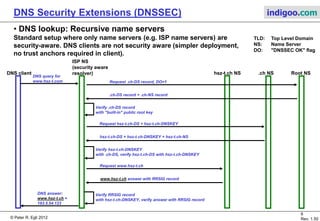
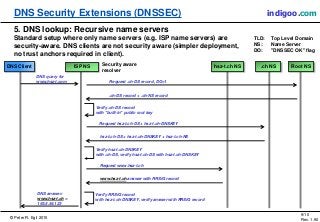
5. DNS lookup: Recursive name servers
Standard setup where only name servers (e.g. ISP name servers) are
security-aware. DNS clients are not security aware (simpler deployment,
no trust anchors required in client).
Security aware
resolver
DNS query for
www.hsz-t.com
DNS answer:
www.hsz-t.ch =
193.5.54.123
Request .ch-DS record, DO=1
.ch-DS record + .ch-NS record
Verify .ch-DS record
with "built-in" public root key
Request hsz-t.ch-DS + hsz-t.ch-DNSKEY
hsz-t.ch-DS + hsz-t.ch-DNSKEY + hsz-t.ch-NS
TLD: Top Level Domain
NS: Name Server
DO: "DNSSEC OK" flag
Verify hsz-t.ch-DNSKEY
with .ch-DS, verify hsz-t.ch-DS with hsz-t.ch-DNSKEY
Request www.hsz-t.ch
www.hsz-t.ch answer with RRSIG record
Verify RRSIG record
with hsz-t.ch-DNSKEY, verify answer with RRSIG record
DNS Client ISP NS hsz-t.ch NS .ch NS Root NS
© Peter R. Egli 2015
10/10
Rev. 1.90
DNS Security Extensions (DNSSEC) indigoo.com
6. DNSSEC deployment
As of 2013 DNSSEC is not (yet) widely deployed, but since the root zone has been signed in
2010, DNSSEC deployment is gradually picking up speed.
Deployment see https://labs.ripe.net/Members/wnagele/dnssec-deployment-today
Problems that prevent fast deployment:
1. "Bootstrap" problem:
DNSSEC requires a certain level of deployment to deliver an increase in security.
But as long this level is not reached, people will not see a benefit and thus not deploy DNSSEC
("chicken and egg problem").
2. Complexity:
DNSSEC is (as many security protocols) rather complex (defined in multiple RFCs).
3. DNS server load:
DNSSEC puts additional load on DNS servers (hashing, encryption / decryption).

DNSSEC - Domain Name System Security Extensions

  • 1.
    © Peter R.Egli 2015 1/10 Rev. 1.90 DNS Security Extensions (DNSSEC) indigoo.com Peter R. Egli INDIGOO.COM INTRODUCTION TO DNSSEC FOR SECURING DNS QUERIES AND INFORMATION DNSSECDNS SECURITY EXTENSIONS
  • 2.
    © Peter R.Egli 2015 2/10 Rev. 1.90 DNS Security Extensions (DNSSEC) indigoo.com Contents 1. Security Problems of DNS 2. Solutions for securing DNS 3. Security with DNSSEC 4. How to find the signer's public DNS key 5. DNS lookup: Recursive name servers 6. DNSSEC deployment
  • 3.
    © Peter R.Egli 2015 3/10 Rev. 1.90 DNS Security Extensions (DNSSEC) indigoo.com 1. Security problems of DNS (1/3) DNS is vulnerable to a number of attacks. The attacks are usually targeted at misdirecting a client to a malicious server under the control of the attacker. Some attacks are now difficult to conduct since DNS servers like BIND fixed the software. Still, DNS is too important thus warranting the need for cryptographic protection against poisoning and spoofing. Client misdirection DNS cache poisoning DNS spoofing Related data attack DNS ID hacking Can be done by... Unrelated data attack
  • 4.
    © Peter R.Egli 2015 4/10 Rev. 1.90 DNS Security Extensions (DNSSEC) indigoo.com 1. Security problems of DNS (2/3) DNS Cache Poisoning: Inject false information into a DNS server's or a client's DNS cache. DNS spoofing: In a DNS spoofing attack, an attacker pretends to be a real DNS server and sends a spoofed DNS answer back to the requestor (either a DNS server or a DNS client). The spoofed answer contains a false mapping of the requested name to IP address. DNS ID hacking: Spoofing requires to match the DNS answer ID with the DNS request ID (DNS transaction ID). Thus the attacker must either intercept the DNS request message or "estimate" the DNS transaction ID in the spoofed response (e.g. in Windows XP the DNS ID is monotonically increasing!). DNS request, DNS ID = 0x0044 DNS Client Attacker DNS Server Spoofed response, DNS ID = 0x0044 Legitimate response, DNS ID = 0x0044
  • 5.
    © Peter R.Egli 2015 5/10 Rev. 1.90 DNS Security Extensions (DNSSEC) indigoo.com 1. Security problems of DNS (3/3) Unrelated data attack: In an unrelated data attack, the attacker sends back an answer to the query question, but adds additional and unrelated IPname mappings to misdirect the client to a malicious site. Related data attack: A related data attack is similar to an unrelated attack with the difference that the attacker sends extra information related to the query question such as spoofed MX, NS or CNAME records. Example question: www.indigoo.com Spoofed response with unrelated data: www.indigoo.com. 1D IN NS www.attacker.com www.attacker.com. 1D IN A 1.2.3.4 DNS request, question: www.indigoo.com DNS Client Attacker Answer 1: www.indigoo.com=85.10.192.4 Answer 2: www.mybank.com=1.2.3.4 (unrelated to request question)
  • 6.
    © Peter R.Egli 2015 6/10 Rev. 1.90 DNS Security Extensions (DNSSEC) indigoo.com 2. Solutions for securing DNS TSIG and SIG(0) are older solutions for securing DNS. DNSSEC is a comprehensive approach for securing DNS (secure DNS database as well as DNS queries). It is expected that DNSSEC will become the standard solution for securing DNS. Protocol RFC Protection of transfer of DNS record Protection of DNS database Built-in PKI (automated key distribution) Hash algorithms Comment TSIG RFC2845 Yes No No, but TKEY (RFC2930) adds Diffie- Helman to TSIG RSAMD5 RSASHA1 RSASHA256 Based on MAC (Message Authentication Code). Used for protecting zone transfers (widely used). No levels of authority (every host with the secret key may update a DNS record). SIG(0) RFC2931 Yes No No RSAMD5 RSASHA1 RSASHA256 Not widely used. Uses digital signature instead of MAC. DNSSEC RFC4033 RFC4034 RFC4035 Yes Yes Yes RSAMD5 DH ECC RSASHA1 Used to secure DNS transactions as well as the DNS database.
  • 7.
    © Peter R.Egli 2015 7/10 Rev. 1.90 DNS Security Extensions (DNSSEC) indigoo.com 3. Security with DNSSEC DNSSEC adds a digital signature to the answer records. DNS server signing process: DNS resolver verification: Answer records RRSIG DNS answer packet Answer records (A, AAAA, NS, MX etc.) RRSIG (Resource Record Signature) that verifies the answer records Answer records Hash function Hash 101011... Encryption function RRSIG Signature 110010... Signer's private key Additional info (expiry date etc.) Answer records RRSIG Decryption function Signer's public key Hash 101011... Hash function Hash 101011... ? =
  • 8.
    © Peter R.Egli 2015 8/10 Rev. 1.90 DNS Security Extensions (DNSSEC) indigoo.com 4. How to find the signer's public DNS key An authentication chain leads from root to leaf-domain. Each level contains DS records that reference / point to DNSKEY records in a subdomain. N.B.: The parent domain is authoritative for its subdomains. The starting point of the chain of trust is an anchor point (known good public key = trust anchor). Domain root Designated Signer (or Delegation Signer) Record Verifies Subdomain, e.g. .ch Designated Signer Record References and verifies a DNSKEY record in the delegated zone (verification through hashing function). Subdomain, e.g. hsz-t.ch Designated Signer Record Resolver's "built-in" public key of domain root DS record DNSKEY record DS record DNSKEY record DS record Verifies Verifies References and verifies a DNSKEY record in the delegated zone (verification through hashing function).
  • 9.
    © Peter R.Egli 2015 9/10 Rev. 1.90 DNS Security Extensions (DNSSEC) indigoo.com 5. DNS lookup: Recursive name servers Standard setup where only name servers (e.g. ISP name servers) are security-aware. DNS clients are not security aware (simpler deployment, no trust anchors required in client). Security aware resolver DNS query for www.hsz-t.com DNS answer: www.hsz-t.ch = 193.5.54.123 Request .ch-DS record, DO=1 .ch-DS record + .ch-NS record Verify .ch-DS record with "built-in" public root key Request hsz-t.ch-DS + hsz-t.ch-DNSKEY hsz-t.ch-DS + hsz-t.ch-DNSKEY + hsz-t.ch-NS TLD: Top Level Domain NS: Name Server DO: "DNSSEC OK" flag Verify hsz-t.ch-DNSKEY with .ch-DS, verify hsz-t.ch-DS with hsz-t.ch-DNSKEY Request www.hsz-t.ch www.hsz-t.ch answer with RRSIG record Verify RRSIG record with hsz-t.ch-DNSKEY, verify answer with RRSIG record DNS Client ISP NS hsz-t.ch NS .ch NS Root NS
  • 10.
    © Peter R.Egli 2015 10/10 Rev. 1.90 DNS Security Extensions (DNSSEC) indigoo.com 6. DNSSEC deployment As of 2013 DNSSEC is not (yet) widely deployed, but since the root zone has been signed in 2010, DNSSEC deployment is gradually picking up speed. Deployment see https://labs.ripe.net/Members/wnagele/dnssec-deployment-today Problems that prevent fast deployment: 1. "Bootstrap" problem: DNSSEC requires a certain level of deployment to deliver an increase in security. But as long this level is not reached, people will not see a benefit and thus not deploy DNSSEC ("chicken and egg problem"). 2. Complexity: DNSSEC is (as many security protocols) rather complex (defined in multiple RFCs). 3. DNS server load: DNSSEC puts additional load on DNS servers (hashing, encryption / decryption).